
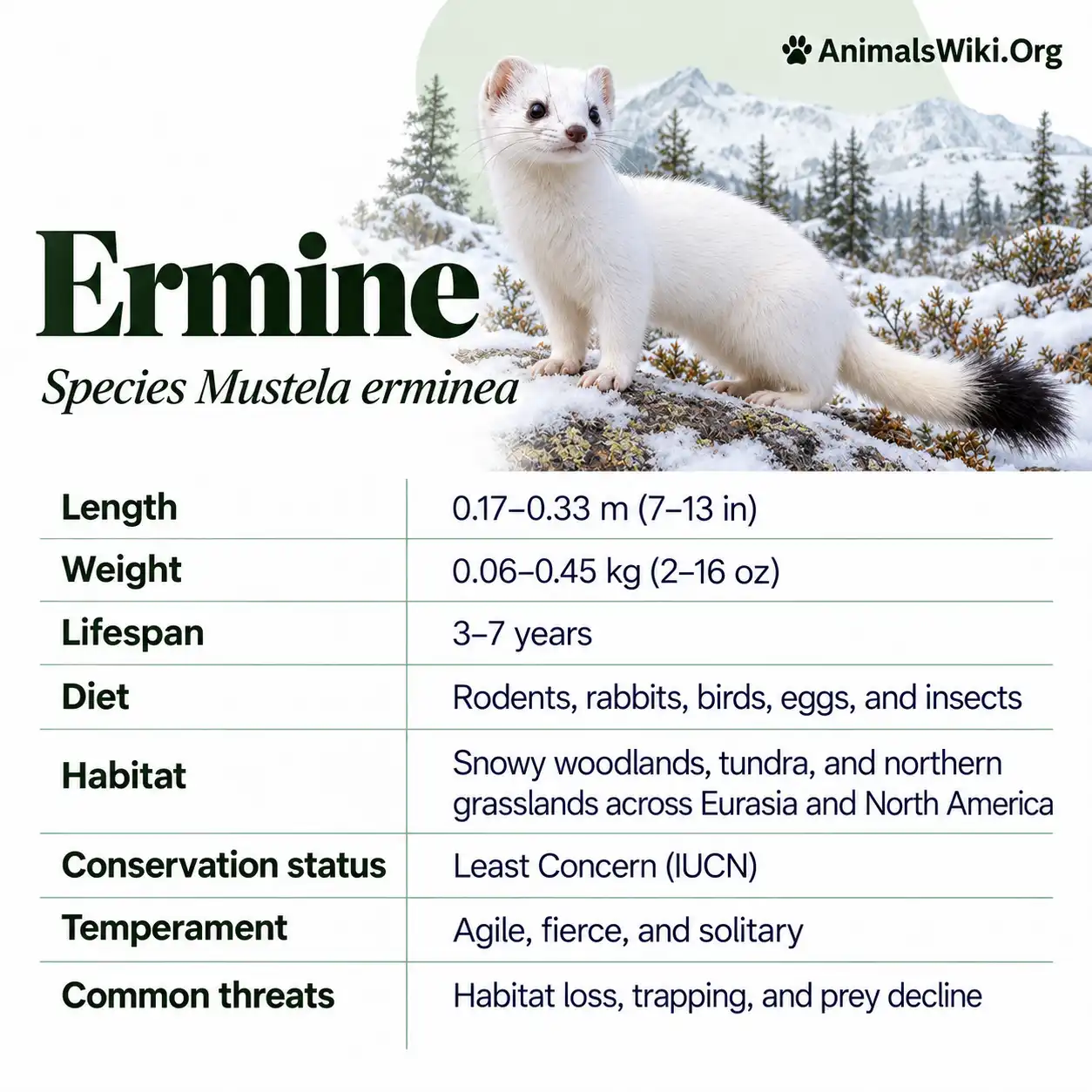
Ermine, The Remarkable Weasel With a Winter Transformation
The ermine is a small predator with an extraordinary combination of agility, determination and seasonal camouflage. Its long, slender body allows it to follow rodents into narrow spaces, while its short legs carry it through grass, beneath snow and around the roots of trees.
Many people recognize the ermine as a white animal with a black-tipped tail. That appearance is only part of its story. During warmer months, these animals typically have brown upperparts and pale undersides. Some populations become white in winter, while others change only partly or remain brown.
The name itself can also be confusing. “Ermine” may refer to the animal, its white winter appearance or the fur historically used in ceremonial clothing. “Stoat” and “short-tailed weasel” are other familiar names, although recent research has changed how scientists classify some North American populations.
Behind those names is a capable hunter whose survival depends closely on food, cover and seasonal conditions. It is an important native predator across much of its natural range, yet introduced stoats can seriously threaten wildlife on islands.
This guide explains ermine identification, classification, habitat, diet, reproduction, winter adaptations and conservation, while separating established facts from popular myths.
Ermine Facts
| Feature | Information |
|---|---|
| Common names | Ermine, stoat, short-tailed weasel |
| Familiar scientific name | Mustela erminea |
| Important classification update | American and Haida ermines are now recognized separately in current mammal taxonomy |
| Animal class | Mammalia |
| Family | Mustelidae |
| General appearance | Slender body, short legs, rounded ears and a black-tipped tail |
| Summer coat | Brown upperparts with pale underparts |
| Winter coat | White in many populations; partial whitening or brown coats occur elsewhere |
| Size difference | Males are generally larger than females |
| Main foods | Small mammals, with other prey depending on location |
| Social behavior | Mostly solitary outside breeding and maternal care |
| Young | Called kits |
| Reproductive adaptation | Delayed implantation |
| Winter activity | Active throughout winter |
| Conservation distinction | Status differs among species, populations and locations |
1. What Is an Ermine?
An ermine is a small carnivorous mammal belonging to the weasel family, Mustelidae.
It has the characteristic weasel shape: an elongated body, short legs, a relatively long neck and a small head. Its tail ends in a distinctive black tip.
The word is used in several overlapping ways. In everyday wildlife language, it often means a stoat or short-tailed weasel. In a seasonal description, an animal may be said to be “in ermine” when wearing its white winter coat.
The National Park Service explains this connection between the animal’s name and its winter appearance.
An ermine remains the same individual through its coat changes. It does not become a separate kind of animal when brown fur replaces white fur.
Understanding that distinction is useful when comparing photographs. A brown summer animal and a white winter animal may look dramatically different while sharing the same proportions, behavior and black-tipped tail.
2. Are Ermines and Stoats the Same Animal?
In much traditional usage, yes.
“Stoat” is particularly familiar in Britain and other parts of Europe. “Ermine” and “short-tailed weasel” are widely used in North America.
However, the answer now requires a classification note. Research has separated several populations previously grouped under one widespread species.
Consequently, an old North American account using Mustela erminea may describe animals now classified as American ermines, Mustela richardsonii.
The Mammal Diversity Database explicitly records this split.
This article uses “ermine” broadly when discussing the familiar animal group and identifies species or locations when the distinction matters.
That approach preserves the usefulness of common names without pretending that every population is biologically identical.
For readers, the practical lesson is to check the location and date of a source. Shared names do not always mean that two accounts refer to exactly the same taxonomic boundaries.
3. Modern Ermine Classification
A major study published in 2021 combined genetic evidence with skull-shape measurements and supported recognition of at least three species within the traditional ermine complex.
The findings linked this diversity with historical isolation and changing connections during glacial periods.
| Recognized species | Common name | Broad association |
|---|---|---|
| Mustela erminea | Stoat or Beringian ermine | Eurasia and parts of northwestern North America |
| Mustela richardsonii | American ermine | Much of continental North America |
| Mustela haidarum | Haida ermine | Particular islands along the North Pacific coast |
These animals were not newly created by the publication. The research improved recognition of differences that already existed.
Taxonomic changes can also affect conservation. An island population previously treated as one small part of an enormous species may represent a much more distinctive lineage.
Names therefore do more than organize a checklist. They help researchers identify which populations carry unique evolutionary histories and require separate attention.
4. What Does an Ermine Look Like?
An ermine has a narrow body, short legs, rounded ears, prominent whiskers and a tail with a black tip.
In summer, its upperparts are generally brown, while the underside is white or cream. In populations that whiten, the winter coat becomes largely white, with the dark tail tip remaining.
Alaska’s wildlife description outlines these characteristic features.
Its body often appears longer during movement than when the animal is curled up or standing upright.
An ermine may briefly rise on its hind legs to inspect its surroundings, exposing the pale throat and belly. When moving quickly, it commonly presents a low, flexible outline close to cover.
Photographs can distort apparent proportions. A curled tail, raised head or deep snow may conceal the animal’s full length.
For identification, combine body shape, tail pattern and scale rather than relying on coat color alone.
5. Ermine Size and Weight
Ermine size varies substantially with species, sex and geographic location.
Males are generally larger than females, but a single global measurement range can hide important differences.
For British stoats, the Mammal Society gives adult male weights of roughly 200–445 grams and female weights of around 140–280 grams. Some North American populations are considerably smaller.
Research on short-tailed weasels in western Oregon recorded much lighter animals, illustrating why location matters when discussing size.
Measurements should also distinguish:
- Head-and-body length.
- Tail length.
- Total length.
- Body mass.
A source giving total length cannot be compared directly with one giving body length alone.
For a casual observer, the most useful impression is of a very small, elongated predator. Even a relatively large stoat remains far smaller than a fisher, otter or domestic cat.
6. Why Is the Body So Long and Slender?
The ermine’s body shape allows it to enter narrow spaces where prey can hide.
A broad-bodied predator may be unable to follow a vole into its tunnel, while a slender weasel can continue the pursuit.
This is a major advantage, but the shape also creates challenges. A small, elongated body has considerable surface area relative to its volume, affecting the balance between heat production and heat loss.
Comparative physiological research has examined thermoregulation in stoats and other carnivores, demonstrating the importance of environmental temperature to their energy use.
The animal’s form is therefore a compromise.
It gains access to food in tight spaces while needing dependable energy intake and sheltered resting places.
This helps explain why hunting, nesting and the use of protected routes are closely connected.
The ermine’s shape is effective because of the complete lifestyle surrounding it, rather than because a long body is advantageous in every situation.
7. Why Do Ermines Turn White in Winter?
In snowy environments, white fur can make an ermine less conspicuous against the background.
The change occurs through molting, when one coat is replaced by another. Existing brown hairs do not simply bleach white when snow arrives.
Seasonal timing and the extent of whitening are influenced by environmental and biological factors.
A study of New Zealand stoats found patterns consistent with day length influencing molt timing and temperature influencing winter whitening.
This is more complicated than saying cold weather instantly changes the animal’s color.
The process takes time, and local populations differ.
During transition, an ermine may have patches of brown and white. Such an animal is not necessarily unhealthy or unusually marked.
It may simply be partway through seasonal replacement.
The transformation is especially striking because the same animal can become difficult to see against snow after being well camouflaged among brown vegetation earlier in the year.
8. Do All Ermines Become Completely White?
No.
Some populations become largely white, some turn partly white, and others retain substantial brown coloration.
The degree of whitening varies geographically and with local conditions.
Research on stoats in the Netherlands found more completely white winter animals in colder regions, supporting a relationship between environmental conditions and the extent of whitening.
The Mammal Society also notes that British stoats may become fully or partly white, particularly in northern areas.
This variation is important when identifying an animal in winter.
A brown stoat is not automatically a different species, and a white weasel is not automatically an ermine.
Other weasels can also whiten seasonally.
The most dependable identification uses several features, especially the tail, body proportions and location.
Seasonal coat color provides useful context but does not replace the rest of the evidence.
9. The Black-Tipped Tail
The black tail tip is one of the ermine’s most useful identification features.
It remains dark even when the rest of the coat becomes white.
This distinguishes an ermine from some other small weasels, although it does not separate it from every related species.
Long-tailed weasels can also have black-tipped tails.
Researchers have proposed that the contrasting tip may influence the targeting behavior of attacking predators. Predator-confusion experiments have explored this explanation.
That hypothesis should be presented as an investigated function rather than a guarantee that the tail prevents capture.
A defensive feature can improve the chance of escape without working in every attack.
For observers, the tip has a more immediate value: it helps identify an animal that may be visible for only seconds.
A photograph showing the whole tail can therefore be more informative than a close image of the face alone.
10. Where Do Ermines Live?
Taken in the traditional broad sense, ermines occupy extensive parts of the Northern Hemisphere.
Modern classification divides that distribution among separate species.
Mustela erminea occurs across much of Eurasia and reaches parts of northwestern North America. The American ermine occupies much of the continental North American range formerly included under the same name.
Distribution is not continuous within every region.
Suitable prey, cover and historical connections influence where populations occur.
Island populations also require separate attention because nearby land masses can support different lineages or lack ermines entirely.
An older map showing one enormous circumpolar species remains useful as a historical overview, but it may not represent current taxonomy.
For local identification, use recent regional information alongside the broader map.
The location of a sighting can help narrow the possibilities before coat pattern and proportions are examined.
11. Ermine Habitat
Ermines use a wide variety of habitats where prey and cover are available.
These can include woodland edges, grasslands, wetlands, riverbanks, scrub, tundra and alpine environments.
Alaska’s species account emphasizes the importance of small-mammal prey and protected spaces beneath snow or vegetation.
This flexibility should not be confused with an ability to thrive anywhere.
An apparently suitable meadow may provide little cover after heavy grazing or mowing. A forest may differ greatly in rodent abundance depending on its structure and ground vegetation.
The scale of habitat also matters.
An ermine can use a narrow strip of cover as a travel route while relying on a larger area for food.
Conservation therefore benefits from examining the whole local mosaic rather than assigning one broad habitat label.
Food, concealment and shelter need to occur close enough together for the animal to use them effectively.
12. Dens, Nests and Resting Places
Ermines use protected spaces among roots, logs, rocks and burrows.
They may occupy tunnels or cavities originally made by prey animals.
Nest material can include fur, which provides insulation around the resting animal or developing young.
Alaska’s wildlife information describes nests in former rodent burrows and other sheltered locations.
A nest and an entire home range serve different purposes.
The nest is a refuge within a wider area used for feeding and movement.
Several shelters may become useful as conditions change, and an animal need not remain beside one entrance throughout its life.
For a female raising kits, protection and insulation are particularly important.
Young cannot immediately accompany their mother on hunting trips.
This makes nearby food access valuable: time spent traveling farther for prey can reduce time available for nursing and attending the nest.
13. Life Beneath the Snow
Snow creates an environment below its surface as well as above it.
Small spaces near the ground can contain rodent tunnels, vegetation and relatively sheltered conditions. This below-snow zone is called the subnivean environment.
An ermine’s shape allows it to enter these spaces and search for prey.
Yellowstone National Park describes short-tailed weasels hunting within rodent burrows, a behavior that fits this narrow-space lifestyle.
Snow can therefore provide both cover and access to a hunting environment.
It is not simply an obstacle.
However, the structure of the snow matters. Depth, crust, compaction and thawing can change the spaces available beneath it.
An ermine crossing the surface may leave visible tracks, then disappear into an opening that leads to a much less visible network.
People watching only the surface see a fraction of its winter activity.
14. What Do Ermines Eat?
Ermines are primarily predators of other animals.
Small mammals are central foods in many populations, especially voles and mice. Depending on location, they also take rabbits, birds, eggs and other available prey.
Diet can differ dramatically between regions.
A British study based on hundreds of stoats found rabbits and hares especially important, while small rodents and birds also contributed.
| Food category | Examples |
|---|---|
| Small mammals | Voles, mice and shrews |
| Larger mammalian prey | Rabbits and some hares |
| Birds | Adults, chicks or nestlings where accessible |
| Eggs | Taken opportunistically |
| Other prey | Some reptiles, amphibians and invertebrates |
| Carrion | Used when available |
The presence of a food item does not establish its importance.
A rare record and a regular dietary foundation should remain separate.
Likewise, a diet measured in Britain should not be copied unchanged into an account of an Alaskan or island population.
15. How Ermines Hunt
Ermines search through dense ground cover, investigate holes and follow prey into narrow passages.
Their movements can look abrupt because they repeatedly stop, turn, inspect and accelerate.
The small head and flexible body help them investigate spaces that larger carnivores cannot enter.
Yellowstone’s description emphasizes their ability to move through rodent burrows.
Hunting success depends on reaching prey, controlling it and delivering an effective bite.
The process differs from the sustained open-country pursuit associated with larger predators.
A vole hidden in a tunnel may still be accessible to an ermine, while the same prey would be protected from an animal too large to follow.
Searching also involves unsuccessful investigations.
A brief sighting of an ermine repeatedly entering holes does not mean it catches something each time.
Its daily food supply emerges from many small decisions about where to investigate and when to move on.
16. Can an Ermine Kill a Rabbit?
Yes. Stoats can take rabbits much larger than themselves.
The importance of rabbits is demonstrated by British diet research, where lagomorphs formed a substantial part of recorded food occurrences.
This ability is remarkable, but it should not become the claim that an ermine can kill any animal regardless of size.
Prey age, condition and the circumstances of an encounter matter.
A successful attack requires control and an effective bite, while failure or injury remains possible.
The same individual may take much smaller prey on other occasions.
Large-prey capability and ordinary prey choice are different questions.
The most useful description is that stoats are capable of exploiting prey substantially larger than their own bodies, especially where those animals are abundant and accessible.
That explains their hunting reputation without turning it into an unrestricted rule.
17. Food Caching and Surplus Killing
Ermines may store food rather than consume every captured item immediately.
This behavior is called caching.
A New Zealand study comparing droppings with den contents found larger prey more frequently represented in dens, consistent with animals carrying substantial food items to sheltered locations.
Caching helps explain why a predator may kill more than it can eat in one sitting.
A temporary abundance of accessible prey can produce an opportunity to store energy for later.
However, not every stored item will necessarily be recovered, and several prey remains at a den do not prove they were all killed during one event.
Scavenging also contributes to some den contents.
This distinction matters when interpreting a dramatic scene in a poultry enclosure or a collection of remains.
The behavior has ecological consequences, but describing it as purposeless cruelty adds a human judgment rather than explaining the animal’s feeding strategy.
18. Why Food Availability Matters So Much
Ermine numbers and reproductive success are closely connected with prey.
When small mammals are abundant, females may have better opportunities to support young. When prey declines, fewer offspring may survive.
Research on fluctuating stoat populations shows that recruitment depends strongly on food conditions during development and early life.
This helps explain why a large potential litter does not guarantee rapid population growth every year.
Several stages separate mating from the appearance of independent young.
Embryos may not all survive, nestlings may die and juveniles face additional risks after leaving shelter.
Predator abundance can also lag behind changes in prey.
A landscape that supported many rodents earlier may later contain numerous predators searching for alternatives.
These changing relationships are central to understanding both native food webs and the particularly damaging effects of introduced stoats in some island ecosystems.
19. Are Ermines Nocturnal?
Ermines can be active during both daylight and darkness.
Their activity occurs in repeated bouts rather than fitting one universal schedule.
A radio-tracking study in Finnish Lapland found seasonal differences in activity and showed that simple assumptions about male and female daily patterns did not capture the complete picture.
This means a daytime sighting is not automatically unusual.
Local food conditions, season and the animal’s immediate needs influence when it moves.
Visibility also differs from activity.
An ermine hunting inside vegetation or beneath snow can remain busy while invisible to an observer.
For wildlife watching, the most productive approach is to identify likely routes and wait quietly rather than assume that a particular hour guarantees success.
Repeated observations can reveal local patterns, while one encounter provides only a snapshot.
20. Climbing, Swimming and Bounding
Ermines are not restricted to moving across open ground.
They can climb, use complex vegetation and swim when necessary.
New Zealand’s Department of Conservation describes stoats as agile climbers and documents their ability to cross substantial water gaps.
These capabilities are particularly important in island conservation.
A water channel that appears to isolate wildlife may not provide a complete barrier to a small, determined predator.
Bounding is another familiar feature of movement. The flexible body bends as the animal advances through a series of quick motions.
The gait can leave paired or grouped prints, depending on speed and surface conditions.
Different movements serve different tasks: quiet investigation, rapid pursuit, escape and travel between feeding areas.
Their agility is best understood as a versatile set of abilities rather than a single impressive speed figure.
21. The “Weasel War Dance”
Ermines and other weasels sometimes leap, twist, roll and change direction in apparently exaggerated ways.
These movements are popularly called a war dance.
The behavior is real, but claims that it reliably hypnotizes rabbits go beyond the evidence.
Scientific discussion has considered several interpretations, including play, arousal and behavior occurring around potential hunting opportunities.
An action can also have more than one context.
A movement seen near prey may resemble one performed during solitary activity.
That makes a single explanation difficult.
A video showing an ermine bouncing in front of another animal does not by itself reveal what either animal perceives or why the sequence occurs.
The safest description is direct: the animal performs rapid, twisting movements whose function depends on the situation and remains incompletely understood.
The behavior is engaging without needing a supernatural explanation.
22. Solitary Life and Home Ranges
Ermines are generally solitary outside breeding interactions and maternal care.
Their use of space is influenced by sex, food and local conditions.
Research in Finnish Lapland found differences between males and females in home-range size and habitat use, with mature females associated with productive prey areas.
Another study in New Zealand found considerable spatial overlap and did not support a simple system of exclusive territories in the conditions studied.
These findings show why “solitary” should not automatically be translated into “every animal defends a perfectly separate patch.”
A home range is the area repeatedly used. A territory includes defense or exclusion.
Different populations can organize space differently.
For conservation, the important resources include productive feeding cover, shelter and routes between them.
Those features determine usable habitat more directly than drawing equal circles around occasional sightings.
23. Ermine Reproduction and Delayed Implantation
Stoats have a reproductive strategy called delayed implantation.
After fertilization, early development pauses before implantation and the later period of active pregnancy.
This separates mating from birth by many months.
The Mammal Society describes summer mating followed by births the next spring, with active gestation lasting around four weeks.
The long interval should not be interpreted as continuous fetal growth throughout that period.
It consists of biologically different stages.
This distinction explains why one source may describe an approximately year-long reproductive cycle while another emphasizes a much shorter active pregnancy.
Timing also differs between hemispheres.
A breeding month from New Zealand should not be copied into an account of a northern European population.
The seasonal relationship is more informative than a single calendar date: mating, delay, implantation and birth fit into the annual cycle.
24. An Unusual Feature of Female Development
Female stoats can become reproductively mature at a remarkably young age, sometimes while still dependent on their mother.
Research on New Zealand populations documents this early mating and the subsequent period of delayed implantation.
This does not mean a tiny dependent kit immediately gives birth.
The developmental pause separates fertilization from the following breeding season.
Reproductive maturity, physical independence and first birth are different milestones.
Combining them into one “age of adulthood” creates confusion.
Males generally become reproductively active later than the earliest-maturing females.
The biological pattern allows young females to enter the reproductive cycle before dispersal, but successful production of young still depends on survival and later food conditions.
This unusual life history is one reason the species can respond strongly when resources become favorable, while also experiencing poor recruitment when those conditions fail.
25. Baby Ermines and Maternal Care
Baby ermines are called kits.
Litters commonly contain several young, with reported size varying among populations and studies.
The female provides care rather than forming a permanent pair that shares the work.
Kits begin life dependent on the nest and their mother’s milk. They gradually develop movement, sensory abilities and the capacity to eat solid food.
Alaska’s account describes young beginning to venture from the nest at around six to eight weeks, with lactation continuing for a variable period.
Those ages are guides rather than exact deadlines.
Leaving the nest does not instantly produce an independent hunter.
Young may continue traveling with the mother and learning to obtain food.
For observers, a small ermine alone is not necessarily abandoned. Its mother may be hunting or temporarily concealed nearby.
Unnecessary handling can interrupt a situation that was functioning normally.
26. Lifespan and Survival
Many ermines have short lives, even though some individuals survive for several years.
The Mammal Society notes that many stoats do not live beyond one or two years, while longer lifespans are possible.
This difference matters when discussing longevity.
A maximum age describes an exceptional survivor. It does not represent the average experience of every animal born.
Survival depends on food, predators, exposure and the risks associated with dispersal.
Population turnover can therefore be rapid.
A site that contains an ermine in one year may contain a different individual the next year, even when the species remains present.
For scientists, identifying survival requires more than repeated sightings of similar-looking animals.
Marking, genetic information or other reliable methods are needed to distinguish continued occupancy from continued survival of one individual.
27. What Animals Prey on Ermines?
Ermines are predators, but their small size also makes them prey.
Potential enemies include birds of prey and larger carnivorous mammals.
Alaska’s wildlife profile lists raptors and larger carnivores among their predators.
Cover is therefore valuable throughout the year.
Dense vegetation, rock spaces and snow tunnels can reduce exposure while the animal searches for food.
The same slender body that helps it enter prey burrows also provides access to escape spaces unavailable to larger attackers.
Nevertheless, no adaptation works perfectly.
A white coat can provide concealment on snow while becoming conspicuous on bare ground.
A successful escape may depend on the route available at that moment rather than simply the animal’s speed.
These interactions help explain why behavior and habitat structure are as important as the physical features shown in a close-up photograph.
28. Ermine Camouflage and Climate Change
Shorter or less predictable snow seasons can create camouflage mismatch.
A white animal on dark ground may be more visible than one whose coat matches the background.
An experiment in northern Sweden used white and brown decoys and found greater predator attention and attack likelihood for mismatched models.
This provides evidence about visibility, although model experiments are not identical to measuring survival in free-living ermines.
A 2026 study of Alpine stoats also projected distribution changes associated with snow conditions and prey relationships.
The authors emphasized the need for further mechanistic work and monitoring.
These results should not be presented as a precise forecast for every population.
They do show why seasonal camouflage depends on the relationship between coat development and environmental conditions.
Protecting cold-adapted wildlife requires attention to that relationship as snow patterns change.
29. Ecological Importance in the Native Range
Within their native ecosystems, ermines participate in food webs as predators and prey.
They consume small mammals and other animals while supplying food to larger hunters.
Their effect on prey varies with abundance, habitat and the wider predator community.
British monitoring information links historical changes in stoats with changes in rabbit availability, illustrating the connection between predator populations and their food supply.
This is more informative than saying ermines simply keep every rodent population under control.
Predator–prey systems contain feedbacks, delays and other influences.
Weather, vegetation and disease can alter prey independently of predation.
The ermine’s ecological role is valuable even when it cannot be reduced to a simple service for people.
Native biodiversity includes hunters as well as the animals they hunt.
Maintaining habitat for both allows the relationships themselves to continue.
30. Ermine Conservation Status
Conservation status must be tied to the correct species and population.
The Mammal Diversity Database lists Mustela erminea as Least Concern. That does not automatically establish the status of every recently separated ermine lineage.
Widespread species can also contain vulnerable island populations.
A global category summarizes risk at one scale. Local assessments may identify particular threats or declines.
Taxonomic revision makes this especially important for ermines.
An older assessment may have covered a broader collection of populations than a modern species account.
Clear conservation writing should therefore state which name and geographic unit it uses.
For practical protection, the relevant questions include whether habitat persists, prey remains available and populations are connected enough to withstand losses.
A common name alone cannot answer those questions.
31. The Haida Ermine Conservation Story
Haida ermines illustrate how island ecology can create distinctive conservation problems.
A Canadian assessment published in 2015 treated the Haida Gwaii population under the older subspecies name and assessed it as Threatened.
The report identified concerns involving introduced deer, changes to understory vegetation, interactions with Pacific martens and accidental trapping.
Current taxonomy recognizes Mustela haidarum more broadly as a species that also includes particular Alaskan island populations.
The older Canadian assessment and modern species boundaries are therefore not identical.
The ecological lesson remains important.
An introduced herbivore can affect a small predator indirectly by changing cover and prey habitat.
Conservation does not always involve removing an obvious direct threat.
Sometimes it requires understanding chains of effects passing through vegetation, prey and competing carnivores.
32. Why Stoats Are a Problem in New Zealand
Stoats are native predators in parts of the Northern Hemisphere, but they were introduced to New Zealand.
They were brought in during the nineteenth century as part of efforts to control rabbits.
New Zealand’s Department of Conservation documents serious impacts on native wildlife, including birds vulnerable at nests.
The same hunting abilities that function within a native food web can become damaging where prey did not evolve with comparable mammalian predators.
Climbing ability exposes cavity nests, while swimming can allow access to islands.
This is why describing a stoat as ecologically important in one location and an invasive threat in another is not contradictory.
The difference is geographic and evolutionary context.
Responsible conservation protects native relationships while addressing introduced predators where they threaten distinctive wildlife.
The animal is following its normal behavior; the problem arises from its introduction into a different system.
33. Mast Years and Predator Increases
In New Zealand forests, heavy seed production can trigger changes that eventually increase pressure on native wildlife.
A large seed crop supports more rodents. Increased rodent food can support more stoats.
When the initial food pulse declines, numerous predators remain and may turn more heavily to other prey.
The Department of Conservation describes this sequence in its explanation of predator-plague cycles.
The sequence shows why a temporary abundance can create later conservation problems.
It also explains the importance of timing.
Waiting until threatened birds are visibly being lost may miss the opportunity to act earlier in the cycle.
However, one mast event does not produce identical results in every forest.
Seed production, weather, rodents and predator responses all vary.
Monitoring the sequence provides better guidance than assuming that every year carries the same risk.
34. Stoats on Orkney
Orkney provides another example of introduced stoats threatening island wildlife.
The Orkney Native Wildlife Project identifies risks to ground-nesting birds and the distinctive Orkney vole.
Its work combines monitoring, public reports and targeted removal.
An October 2026 project update reported the capture of a stoat on Rousay after camera detections, genetic evidence and community assistance.
This is an example of a specific incursion response, not proof that the wider problem has ended.
The case shows how difficult a small, mobile animal can be to detect across a large island.
It also highlights the usefulness of local observations when they are investigated carefully.
A clear report can help direct cameras and surveys, while uncertain identification can waste effort.
Island biosecurity depends on both prevention and the ability to respond promptly when prevention fails.
35. Ermine Fur and Cultural History
Ermine winter fur has a long association with ceremonial clothing.
The contrast between white fur and black tail tips produced a distinctive decorative pattern used in European robes and heraldry.
Royal Collection material documents ermine in coronation garments, including robes combining it with velvet and other textiles.
This cultural history helps explain why the name is familiar to people who have never seen the living animal.
A portrait or robe may introduce someone to “ermine” as a material before they learn it refers to a small predator.
Historical symbolism should be separated from natural behavior.
Stories that the animal would rather die than dirty its coat reflect human ideas about purity, not a demonstrated biological preference.
The living ermine hunts, shelters and moves through soil, vegetation and snow as survival requires.
Its real behavior is more practical than the symbolism attached to its fur.
36. Ermine vs Other Weasels
Several small mustelids can be confused.
| Animal | Helpful distinction |
|---|---|
| Ermine or stoat | Black-tipped tail; intermediate tail proportions |
| Least weasel | Generally smaller, with a short tail lacking a black tip |
| Long-tailed weasel | Longer tail relative to the body; also black-tipped |
| Mink | Usually more robust and strongly associated with waterways |
| Ferret or polecat | Larger, heavier appearance and different facial patterning |
Minnesota’s wildlife guidance emphasizes the black tail tip in short-tailed and long-tailed weasels and its absence in the least weasel.
Winter color alone is insufficient because several species can become white.
Tail length also needs a good view. A curled or partly hidden tail can mislead.
The best identification combines the complete animal, geographic location and clear photographs.
37. Watching Ermines Responsibly
Ermines are easiest to observe when the watcher remains still and allows the animal to continue its route.
Useful places may include edges between cover types, stone walls, banks and areas with small-mammal activity.
Keep enough distance to avoid forcing repeated escape behavior.
A longer lens or binoculars are more useful than trying to approach a fast-moving animal.
Good practice includes:
- Keep pets away.
- Avoid feeding.
- Do not block burrow entrances.
- Leave nests undisturbed.
- Record the location and visible features.
- Report introduced stoats where local projects request sightings.
A brief disappearance is normal.
An ermine may continue moving beneath vegetation while remaining only a short distance away.
Patient observation often produces a better view than walking after it.
The aim is to witness ordinary behavior, not create a prolonged encounter in which the animal must keep responding to a person.
38. Common Ermine Myths
| Popular claim | More accurate explanation |
|---|---|
| An ermine is always white | Summer coats are brown above, and some populations remain brown in winter |
| Ermine and stoat always refer to one unchanged species | Modern taxonomy separates several lineages |
| Snow instantly turns the fur white | Color changes occur through seasonal molting |
| Every white weasel is an ermine | Other weasels can whiten too |
| The black tail tip disappears in winter | It normally remains dark |
| A war dance hypnotizes prey | The function is debated and does not establish hypnosis |
| Killing several prey means the animal is cruel | Food caching and hunting opportunities provide biological explanations |
| It is beneficial or harmful everywhere | Ecological effects depend on whether the population is native or introduced |
| Leaving the nest means full independence | Development occurs through several stages |
The real animal is remarkable enough without these exaggerations: a small hunter whose body, coat and reproductive cycle are closely tied to seasonal life.
39. Frequently Asked Questions About Ermines
What is an ermine?
An ermine is a small member of the weasel family. The name can refer to the animal, its white winter appearance or its fur. Traditional usage overlaps with “stoat” and “short-tailed weasel.”
Is an ermine the same as a stoat?
In much everyday usage, yes. However, modern taxonomy separates American and Haida ermines from Mustela erminea. Location and the age of a source matter when interpreting the names.
What is the scientific name of the ermine?
Mustela erminea is the familiar name for the stoat or Beringian ermine. Current mammal taxonomy also recognizes Mustela richardsonii, the American ermine, and Mustela haidarum, the Haida ermine.
Is an ermine a rodent?
No. It is a carnivoran mammal belonging to Mustelidae. Rodents such as mice and voles are important prey, but sharing a small body size does not make the hunter closely related to them.
Why does an ermine turn white?
A white winter coat provides camouflage in snowy surroundings. The transformation occurs through molting and varies among populations. Seasonal cues and environmental conditions influence the process.
Do all ermines turn white?
No. Some whiten fully, some partly and others remain brown. A brown winter coat does not automatically indicate a different species or a problem with the animal.
Does snow change the color instantly?
No. The animal replaces its coat over time. Transitional individuals can look patchy, with both brown and white areas. Existing hairs do not change immediately when snow touches them.
Why does the tail stay black?
The dark tip is a persistent feature of normal coloration. Predator-confusion hypotheses have been investigated, but the feature should not be described as preventing every attack.
How large is an ermine?
Size varies considerably across species and regions. Males are usually larger than females. A measurement should identify whether it describes body length, total length or weight.
Where do ermines live?
The traditional ermine group occupies extensive Northern Hemisphere regions. Current classification divides much of that range among separate species, including Eurasian, American and island-associated lineages.
What habitat do ermines use?
They use habitats with accessible prey and cover, including grassland, woodland edges, wetlands, tundra and alpine areas. Local habitat structure matters more than a broad label alone.
What do ermines eat?
They mainly eat animals, particularly small mammals. Rabbits, birds, eggs and other prey can also be important. Diet differs substantially among locations.
Can an ermine kill a rabbit?
Yes. Rabbits are important prey in some stoat populations. This does not mean every attack succeeds or that any rabbit, regardless of size and condition, is equally vulnerable.
Do ermines store food?
Yes. Caching allows prey to be used later. Finding several remains does not prove that every animal was killed at once, and some food may have been scavenged.
Are ermines nocturnal?
They can be active during daylight and darkness. Activity varies with season and circumstances. A daytime sighting is not automatically abnormal.
Do ermines hibernate?
No. They remain active during winter and can hunt beneath snow. Sheltered spaces and access to prey help support this year-round activity.
Can ermines climb?
Yes. Their agility allows them to use vegetation and reach elevated places. This ability is particularly significant where introduced stoats threaten birds nesting in tree cavities.
Can ermines swim?
Yes. Stoats can cross water, including gaps relevant to island conservation. A channel should not automatically be assumed to provide a complete barrier.
What is an ermine war dance?
It is a popular name for rapid twisting, leaping and rolling behavior. Several explanations have been proposed. The movements do not demonstrate that the animal hypnotizes prey.
What are baby ermines called?
They are called kits. They begin life dependent on maternal care and develop hunting and movement abilities gradually. Leaving the nest is not the same as complete independence.
What is delayed implantation?
It is a pause in early embryo development before implantation. It separates mating from the later period of active pregnancy and allows births to occur in a subsequent season.
How long do ermines live?
Many survive only one or two years, although longer lives occur. A maximum recorded age should not be confused with the average survival of all animals born.
Are ermines endangered?
The answer depends on the species and population. Mustela erminea is listed as Least Concern, while particular island populations have separate conservation concerns and assessments.
Why are stoats controlled in New Zealand?
They are introduced predators there and threaten native wildlife, including vulnerable birds. Their ecological effects differ from those within the ecosystems where they evolved naturally.
What should I do if I see an ermine?
Watch quietly from a distance and avoid handling or feeding it. Where stoats are introduced, report sightings to the relevant local conservation project if requested.



