
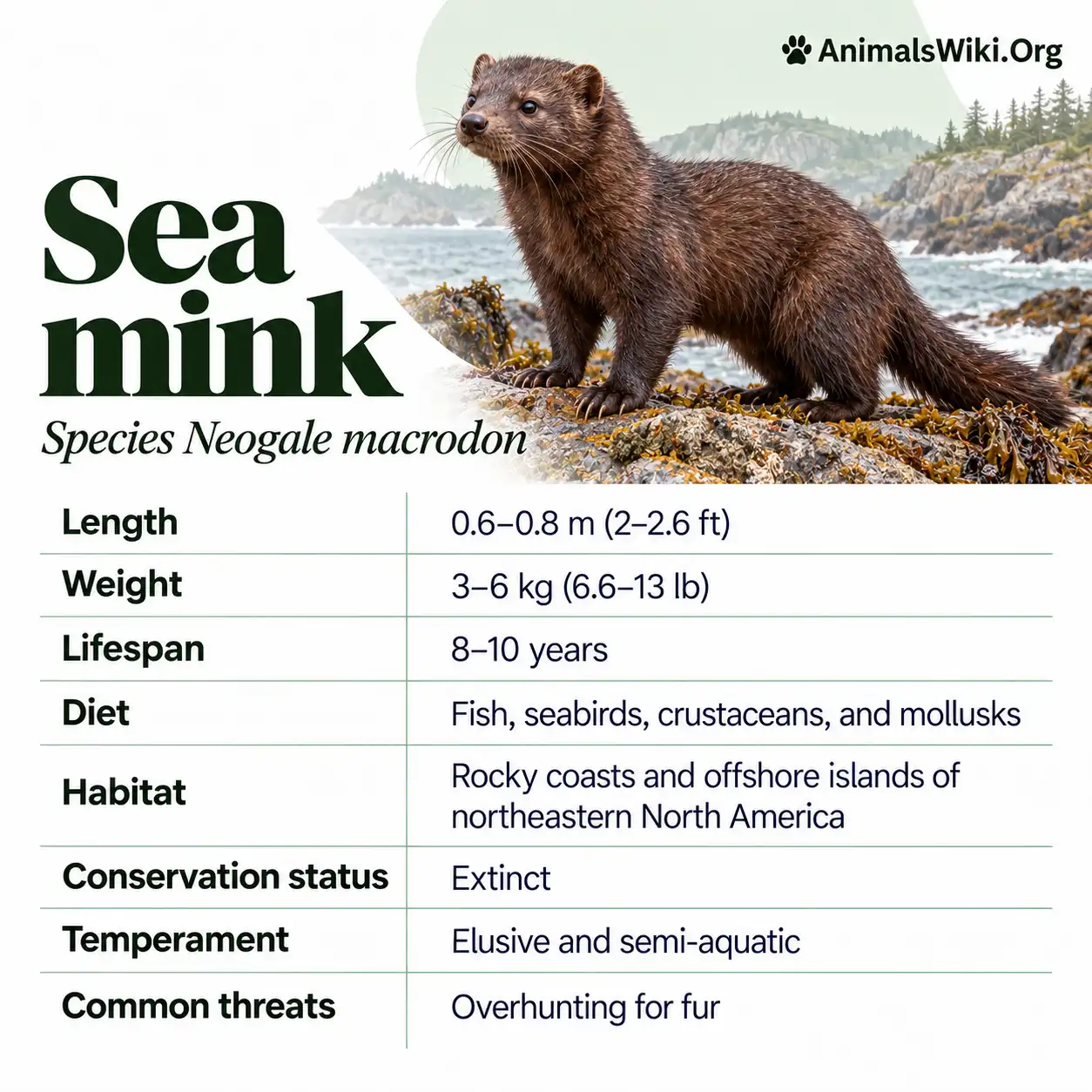
Sea Mink, The Lost Coastal Hunter of North America
The sea mink was a coastal carnivore that disappeared before scientists could study its living populations in detail. It inhabited the northeastern coast of North America, especially the Gulf of Maine region, where archaeological remains preserve evidence of an animal larger and more robust than the familiar American mink.
Its story survives through bones, teeth, historical accounts and the cultural sites of Indigenous coastal communities. These sources reveal a distinctive mammal associated with rocky shores and marine food resources. They also leave important questions unanswered.
Exactly how large was a sea mink? How much time did it spend underwater? When did the final population disappear? Researchers continue to investigate these questions more than a century after the animal received its scientific description.
Modern studies have strengthened the case that the sea mink was a separate species rather than simply an unusually large American mink. Research published in 2025 brought additional anatomical and historical evidence into that discussion.
The sea mink’s disappearance is therefore both an extinction story and an ongoing scientific investigation. Understanding it requires looking at coastal ecology, the fur trade, museum collections and the archaeological evidence that remains.
This guide explains what is established, what researchers infer and what is still unknown about this lost North American mammal.
Information checked: October 19, 2026.
Sea Mink Facts
| Feature | Information |
|---|---|
| Common name | Sea mink |
| Current scientific name | Neogale macrodon |
| Older scientific names | Neovison macrodon, Mustela macrodon, Lutreola macrodon |
| Animal class | Mammalia |
| Order | Carnivora |
| Family | Mustelidae |
| Closely related living animal | American mink |
| Conservation status | Extinct |
| Main geographic association | Northeastern North American coast, especially the Gulf of Maine |
| Habitat association | Rocky coastal environments and islands |
| General appearance | A large, robust mink; detailed external reconstruction remains uncertain |
| Diet | Marine-associated animal food; exact composition remains incompletely known |
| Main evidence | Archaeological bones, teeth and historical accounts |
| Formal scientific description | Published in 1903 |
| Principal explanation for extinction | Heavy exploitation associated with the commercial fur trade |
| Exact extinction date | Uncertain |
1. What Was the Sea Mink?
The sea mink was a North American member of the weasel family that is now extinct.
It was closely related to the American mink but is recognized as a separate species in current taxonomic databases. Its scientific name is Neogale macrodon.
The animal is particularly associated with coastal archaeological sites in Maine. Its remains occur among materials accumulated by Indigenous communities over long periods of coastal occupation.
This makes it different from an extinct mammal known through abundant photographs, zoo records or detailed field observations.
Much of its biology must be reconstructed indirectly.
Bones establish physical characteristics. Historical descriptions offer clues about appearance and distribution. The settings in which remains were found provide information about relationships with people and coastal environments.
These different lines of evidence complement one another, but they are not interchangeable.
A tooth can reveal something about feeding anatomy without revealing the animal’s daily schedule. A trader’s account may describe a pelt accurately while providing little dependable information about breeding.
2. Why Was It Called the Sea Mink?
The name reflects its association with the seacoast.
Historical literature also used names such as seashore mink, saltwater mink, big mink and shell-heap mink. Richard Manville’s 1966 review brought together several of these names.
Each emphasizes a different aspect of how people encountered the animal.
“Sea mink” highlights coastal habitat. “Big mink” distinguishes its size from other mink. “Shell-heap mink” reflects the archaeological deposits in which scientists found its remains.
The name does not mean it was a fish, seal or otter.
It was a mink-like carnivorous mammal whose life appears to have been strongly connected with shore environments.
Common names are useful historical evidence, but they need interpretation. A name applied by a trader or local observer may describe a recognizable animal without defining the same taxonomic boundaries used today.
The scientific name helps connect those varied references to a particular research question.
3. Sea Mink Scientific Classification
The sea mink belonged to Mustelidae, the family containing weasels, mink, otters, badgers, martens and related carnivores.
Its classification places it within the subfamily Mustelinae and the genus Neogale.
| Classification level | Sea mink |
|---|---|
| Kingdom | Animalia |
| Phylum | Chordata |
| Class | Mammalia |
| Order | Carnivora |
| Family | Mustelidae |
| Subfamily | Mustelinae |
| Genus | Neogale |
| Species | Neogale macrodon |
This classification separates it from marine mammals such as seals and whales, even though its ecology involved coastal resources.
It also distinguishes the sea mink from the sea otter.
Both belong to the broader mustelid family, but they occupy different branches within it.
The relationship is comparable to sharing a family connection without sharing the same specialized body plan, behavior or evolutionary history.
Understanding this distinction prevents the sea mink from being described as a small extinct otter.
4. Why Do Scientific Sources Use Different Names?
The sea mink appears in literature under several scientific combinations.
These include Lutreola macrodon, Mustela macrodon, Neovison macrodon and the currently accepted Neogale macrodon.
The Integrated Taxonomic Information System lists the older combinations as synonyms associated with the current name.
These changes do not indicate several separate extinct animals.
They reflect revisions to the classification and naming of mink and related weasels.
A 2021 publication examined the nomenclature of the American weasel group and supported use of Neogale.
For readers, this matters when searching older research. A paper using Mustela macrodon may contain important sea mink evidence even though its genus name differs from a modern database.
It is also important to distinguish two scientific debates.
One concerns which genus name to use. The other concerns whether the sea mink was sufficiently distinct from the American mink to deserve species status.
Changing the genus does not automatically settle the second question.
5. Was the Sea Mink Really a Separate Species?
Scientists have debated this question for more than a century.
One interpretation treated the large coastal animal as a distinct species. Another suggested that its remains represented a large form of American mink or differences between males and females.
Current taxonomic databases recognize the sea mink as a valid species, but that position rests on a history of investigation rather than one obvious feature.
The central issue is whether the differences exceed the normal variation expected within American mink.
Size alone can be difficult to interpret because living mammals vary with sex, age and geography.
Researchers therefore examine proportions, dental structure and multiple skeletal elements.
A convincing comparison must ask whether several characteristics consistently distinguish the groups.
This is especially important when the evidence comes from fragmented archaeological remains.
The absence of living animals prevents direct tests of behavior or breeding relationships, making careful anatomical comparison essential.
6. What Did the Sea Mink Look Like?
The sea mink is generally reconstructed as a large, robust mink with a long body, short legs and a substantial tail.
Historical accounts describe differences in its fur compared with smaller mainland mink. Some emphasize coarser texture or reddish coloration.
An early IUCN historical summary preserved these descriptions while also demonstrating how much information depended on retrospective accounts.
The broad mink-like appearance is more secure than any highly detailed modern illustration.
Exact facial markings, typical coat shade and the appearance of juveniles are not documented to the standard available for living species.
Historical color descriptions can also vary with season, lighting, preservation and the condition of a pelt.
A reddish appearance and a dark appearance are not necessarily mutually exclusive observations.
A responsible reconstruction should therefore present plausible anatomy without pretending that every visible detail is directly known.
The uncertainty belongs to the evidence, not to the artist’s ability to produce a convincing image.
7. How Large Was the Sea Mink?
The sea mink was larger and more robust than the American mink specimens used in several anatomical comparisons.
A study published in 2000 examined skull, jaw and limb-bone measurements and found differences in overall size, robustness and dental proportions.
However, there is no dependable universal figure for its living weight or total length.
Popular estimates sometimes create a false impression that researchers measured many complete animals.
Instead, measurements often come from individual skeletal elements, fragmentary remains or historical descriptions.
A bone can support an estimate of body size, but the relationship involves assumptions.
Pelt measurements add another complication because skins can stretch or be prepared differently.
The best concise description is therefore a notably large and robust mink, rather than a precise weight presented without qualification.
Its scientific interest comes from the pattern of differences across specimens, not simply from a claim that it reached an impressive maximum size.
8. Where Did Sea Mink Live?
The strongest evidence centers on the northeastern North American coast, particularly the Gulf of Maine and coastal Maine.
Archaeological remains have also been reported from southern New Brunswick.
A Canadian study discussed those finds while raising the possibility that some bones reached the area through human transport rather than representing animals killed locally.
That distinction is important.
The location where a bone is found is not always the location where the animal lived.
People can move carcasses, skins and selected body parts.
Historical sources have proposed broader coastal ranges, but those boundaries are less secure than the core archaeological record.
A careful range map should therefore distinguish well-supported occurrences from uncertain extensions.
The sea mink’s known distribution is best understood as an evidence-based reconstruction, with confidence varying from one locality to another.
9. Sea Mink Habitat
The sea mink is associated with rocky coastal environments, including shorelines and islands.
Historical and anatomical research connects it with a more marine-oriented way of life than the usual image of a mink hunting beside an inland stream.
The Society for Marine Mammalogy includes the extinct sea mink in its marine mammal species list.
A rocky coast contains several connected habitats: exposed ledges, crevices, sheltered pools, tidal margins and nearby land.
An animal using that environment would encounter changing conditions as the tide rose and fell.
Its habitat would not have been one uniform strip of water.
Potential food access, shelter and movement routes would change over short distances.
This helps explain why the phrase “coastal specialist” is useful, while still leaving room for uncertainty about exactly how the sea mink divided its time between land and water.
10. Was the Sea Mink Fully Marine?
The sea mink appears to have been strongly associated with marine environments, but that does not establish a seal-like or whale-like existence.
Its body remained that of a land-capable carnivore.
Researchers have described it as an emerging marine fissiped: a carnivoran retaining separate toes and terrestrial capabilities while becoming increasingly associated with marine resources.
The Maine State Museum uses this interpretation in its account of recent research.
“Emerging” does not mean evolution was inevitably leading toward a particular future animal.
It describes an interpretation of adaptations and ecological direction.
Different mammal lineages can make use of marine food without evolving identical bodies.
A coastal mink can remain capable on rocks and land while obtaining much of its food near the sea.
Exact swimming speed, dive duration and daily time underwater remain unknown.
Those figures should not be borrowed from living otters or mink and presented as sea mink measurements.
11. What Did Sea Mink Eat?
The sea mink’s diet was probably strongly connected with coastal and intertidal food resources.
The exact balance among fish, crustaceans, mollusks and other prey remains incompletely resolved.
Dental form provides clues because teeth differ in their ability to cut, crush and process food.
A preliminary research presentation in 2023 reported anatomical and stable-isotope evidence consistent with reliance on intertidal resources in the samples examined.
That finding should be identified as conference research rather than treated as a complete, final dietary reconstruction.
The intertidal zone is the area exposed and submerged by tides.
A predator feeding there could encounter food that differs from prey available along an inland river.
However, a plausible menu is not the same as a measured diet.
A reliable article should avoid assigning exact percentages or claiming a single preferred prey species without direct supporting evidence.
12. What Teeth Reveal About Feeding
Teeth are particularly valuable when other evidence is fragmentary.
Researchers can measure their length, width and proportions, then compare those measurements with related animals.
A 2007 study examined dental variation in archaeological mink and compared it with American mink and other musteloids. The results supported the sea mink’s recognition as a separate species.
The reasoning goes beyond “larger teeth mean a larger animal.”
Differences in relative proportions can indicate that the teeth are organized differently, not simply enlarged uniformly.
That can have implications for both classification and feeding ecology.
Nevertheless, tooth form does not produce an exact list of meals.
Animals with similar teeth can exploit different foods, while related animals can adjust their diets according to availability.
Dental evidence is strongest when considered alongside skeletal measurements, habitat information and other independent clues.
13. What Is Known About Sea Mink Behavior?
Direct behavioral knowledge is limited.
Historical accounts offer suggestions about shore use and shelter, but the sea mink was not followed through systematic field studies comparable with research on living mink.
Animal Diversity Web explicitly identifies major gaps in knowledge of its general behavior and home range.
Descriptions such as solitary, nocturnal or territorial may be plausible comparisons with relatives, but they should not be presented as equally well established.
An animal’s behavior can differ with food, season and disturbance.
Even a reliable sighting at night would establish nighttime activity in that instance, rather than exclusive nocturnality.
The same applies to shelter.
Finding or reporting an animal in a rock crevice does not reveal whether it used that location daily, seasonally or only while escaping a hunter.
The most accurate account keeps those distinctions visible.
14. Reproduction, Babies and Lifespan
The sea mink’s reproductive biology is poorly known.
There are no dependable species-specific figures for typical litter size, weaning age, first reproduction or average lifespan.
As a mammal, it gave birth to young and nursed them, but detailed schedules should not be invented from that basic fact.
Living American mink provide a possible comparative model. Maine wildlife information describes their breeding season, delayed implantation and production of kits.
Those details belong to the living species, not automatically to the sea mink.
This distinction matters because related mammals can differ in reproductive timing and development.
A table claiming that sea mink lived a fixed number of years or produced an exact number of young each spring would exceed the available evidence.
The honest answer is that these aspects remain unknown.
That gap is itself part of the extinction’s significance: opportunities to learn directly from the animal disappeared with its populations.
15. How Do Scientists Know the Sea Mink Existed?
The sea mink is not merely a legend based on one unusual sighting.
Its evidence includes physical remains that can be measured, compared and reexamined.
Archaeological sites contain jaws, teeth and other skeletal elements attributed to the animal.
The 2000 anatomical study compared several parts of the skeleton rather than relying only on one historical description.
Different body parts contribute different information.
Teeth can be useful for identification. Limb bones provide evidence about proportions and robust construction. Repeated finds establish that the phenomenon is not limited to one exceptional individual.
However, every specimen still needs scrutiny.
Some fragments are incomplete, identification can be difficult and old labels may contain errors.
The strength of the case comes from patterns across collections and methods.
Scientific recognition is therefore compatible with continued debate over particular specimens or interpretations.
16. What Are Shell Middens?
Shell middens are cultural accumulations formed through human activities, often including shellfish processing and meals.
They can contain shells, animal bones, stone tools, ceramics and other materials.
Along the Maine coast, many were created by Wabanaki ancestors during repeated occupation over long periods.
The University of Maine explains that shell deposits help buffer acidic soils, improving the preservation of bone and other materials.
This preservation is central to the sea mink story.
Without it, many remains could have decomposed beyond recognition.
A midden is therefore more than a pile containing interesting bones.
Its layers and contents can record relationships among people, animals and changing environments.
The position of a specimen within the deposit matters because it helps connect that specimen with a particular occupation or sequence.
Removing an object without recording its context can destroy part of the information it carries.
17. Indigenous Knowledge and the Sea Mink
The sea mink was known to Indigenous coastal communities before its formal scientific description.
Archaeological remains document long-standing relationships between people and the animal.
Historical recognition and Indigenous knowledge therefore belong within its story, rather than appearing only after the account reaches European naturalists.
Modern discussion of sea mink research emphasizes collaboration with Indigenous partners and the importance of coastal cultural sites.
It is also important to avoid treating all Indigenous communities as interchangeable.
Names, practices and knowledge belong to particular peoples and places.
Likewise, archaeological evidence should not be reduced to a simple assumption about why every animal was taken.
Food, fur, exchange and cultural activities can leave different patterns, and more than one purpose may have been involved.
The strongest interpretation combines careful material study with respectful collaboration and recognizes that these sites are living heritage as well as scientific resources.
18. The Turner Farm Archaeological Site
Turner Farm, on an island in Penobscot Bay, has been especially important to research on coastal animals.
Archaeological work there documented repeated periods of occupation and a substantial animal-bone record.
The site’s account explains how shell accumulation helped preserve remains and how separate layers recorded different occupations.
Sea mink studies have used specimens from this setting to investigate variation through time.
The value lies partly in the ability to compare multiple animals within a documented archaeological sequence.
A large, well-recorded collection can help distinguish an unusual individual from a recurring pattern.
It can also reveal whether different forms appear together.
However, the collection reflects human activities and preservation, not a random sample of every animal living nearby.
That makes archaeological context essential when translating a bone assemblage into an ecological interpretation.
19. Formal Description in 1903
Daniel Webster Prentiss published the sea mink’s formal description in 1903.
The paper described an extinct mink from shell deposits on the Maine coast and established the name Lutreola macrodon.
The Smithsonian preserves the original publication and its bibliographic record.
This was formal scientific recognition, not the first time people had encountered the animal.
That distinction is important.
A species can be familiar to local communities and exploited commercially before receiving a published scientific name.
The description also came too late to begin a conventional field study of a healthy living population.
Researchers inherited a fragmented record rather than an opportunity to observe the animal’s complete life cycle.
The timing helps explain why sea mink information is distributed among archaeology, natural history and historical documents instead of one detailed modern species study.
20. A Century of Scientific Debate
Sea mink research did not end with its naming.
Richard Manville’s 1966 review questioned whether its differences justified separate species status.
Later anatomical work, including the 2000 skeletal study and the 2007 dental analysis, supported distinctness.
The changing interpretations show how science works when evidence is limited.
Researchers can agree that unusual large coastal mink existed while disagreeing about their taxonomic meaning.
A population can differ from another without necessarily being a separate species, so the question requires comparisons rather than labels alone.
New samples and improved methods can change the balance of evidence.
This history should not be simplified into a story in which every earlier scientist was mistaken and every later conclusion is final.
The useful question is what each study examined and how its evidence addressed competing explanations.
21. What the 2025 Study Added
A study published in 2025 revisited the sea mink question using historical evidence and measurements of postcranial bones—the parts of the skeleton behind the skull.
The researchers examined an archaeological record exceeding 1,200 identified mink specimens and supported recognition of a distinct large-bodied form.
“Specimens” here means identified remains or elements, not necessarily 1,200 complete animals.
One individual can contribute several bones.
That distinction is essential when describing archaeological sample sizes.
The study’s broader importance lies in adding another line of anatomical evidence rather than repeating comparisons of skulls alone.
It also connects historical accounts with material remains.
Agreement among independent evidence types strengthens an interpretation, while differences identify questions needing further work.
The paper contributes to a continuing research history rather than eliminating every uncertainty about the animal.
22. When Did the Sea Mink Become Extinct?
The exact date is uncertain.
Accounts commonly place its disappearance in the nineteenth century, but sources differ over the reliability of late records.
The Maine State Museum describes a broader possible interval between approximately 1860 and 1920, while the 2025 study argues for nineteenth-century extinction under market-hunting pressure.
These dates should not be treated as equally precise observations of the final animal.
A last reported capture is different from the actual moment of extinction.
An overlooked population might survive beyond its last documented record, while an uncertain late identification might involve a large American mink.
Older references also mention an 1894 collection, illustrating why simplified timelines can disagree.
The clearest wording is that the sea mink disappeared during the historical era, probably in the nineteenth century, with the exact final date unresolved.
23. Why Did the Sea Mink Become Extinct?
Heavy exploitation associated with the fur trade is the leading explanation.
The larger pelts made the animal commercially desirable, and historical sources connect its decline with sustained hunting.
The Maine State Museum identifies demand for its large, coarse pelts as a likely driver of extinction.
Commercial demand can change the relationship between a predator and its hunters.
An animal that survives ordinary ecological pressures may decline when each remaining individual retains a strong market value.
A coastal distribution can also concentrate hunting effort along accessible routes.
However, the absence of reliable population counts prevents calculation of a precise historical harvest rate or decline curve.
The evidence supports exploitation as the principal explanation without requiring invented numbers.
The important point is that disappearance occurred under human pressure before there was effective species-specific monitoring capable of documenting and preventing the final losses.
24. Why Was a Coastal Mink Vulnerable?
Coastal association may have created both feeding advantages and exposure to people.
Food-rich shores can support predators, but they also concentrate animal movement along recognizable features.
For hunters familiar with local islands and ledges, predictable habitat can make searching more efficient.
This is a general ecological interpretation rather than a measured sea mink population model.
It helps explain how specialization can create vulnerability when the environment changes or exploitation intensifies.
A species need not have an extremely small range to become difficult to replace after losses.
If suitable habitat occurs as a narrow strip or scattered islands, recolonization may depend on connections among those places.
For the sea mink, detailed movement and population data are missing.
Its history nevertheless illustrates why apparently extensive coastline should not automatically be equated with unlimited habitat or unlimited resilience.
25. The Sea Mink’s Possible Ecological Role
The sea mink was probably a predator linking coastal food resources with terrestrial shelter and movement.
Its loss removed a distinctive form of carnivore from the northeastern shoreline.
However, its precise effects on prey populations cannot now be reconstructed with confidence.
Archaeological records can show which animals were present, but they do not directly measure every feeding interaction.
Research on long-term Gulf of Maine resources emphasizes both the value and limitations of archaeological abundance data.
This matters when asking whether the sea mink was a keystone species.
That label requires evidence that its effects were disproportionately large, not simply that it was a predator.
Its ecological importance does not depend on proving such a claim.
The loss of a distinctive coastal lineage is significant even when the exact consequences for fish, invertebrates or other carnivores remain unknown.
26. Sea Mink vs American Mink
The living American mink is the most useful comparison, but it should not be treated as an exact substitute.
| Feature | Sea mink | American mink |
|---|---|---|
| Scientific name | Neogale macrodon | Neogale vison |
| Status | Extinct | Living |
| General size | Larger and more robust in studied comparisons | Smaller in those comparisons |
| Habitat association | Strongly coastal | Wetlands, rivers, ponds and some coasts |
| Biological knowledge | Fragmentary and historical | Directly studied |
| Reproduction | Poorly documented | Known from living populations |
| External appearance | Reconstructed from limited evidence | Available for direct observation |
Maine wildlife information confirms that American mink also occur in ocean bays and hunt along shores.
Therefore, a living mink seen beside salt water is not evidence that the sea mink survives.
Location alone cannot distinguish the extinct species from a living relative that uses similar environments.
27. Why Museum Collections Still Matter
Museum collections preserve opportunities for future questions.
A bone collected decades ago can become useful when researchers develop a new measurement method or compare it with a larger sample.
The sea mink’s research history depends heavily on that continued access.
Collections also preserve labels, field notes and publication histories, which can be as important as the specimen itself.
A recent Harvard specimen record illustrates this process: material formerly identified as sea mink was reexamined, and concerns about identification and origin were recorded.
Such revisions strengthen research.
They make uncertainty visible rather than allowing an old label to remain unquestioned.
A specimen’s scientific value includes the ability to challenge an earlier interpretation.
That is why careful documentation, preservation and access matter long after an animal has disappeared.
Extinction ends observation of living populations, but it does not necessarily end the possibility of learning.
28. The Coastal Record Is Also at Risk
The surviving evidence faces threats of its own.
Shell middens can be damaged by erosion, storm waves, freeze–thaw processes and unauthorized collecting.
University of Maine projects document how coastal change is removing both cultural and environmental information from these sites.
This creates a second kind of loss.
The animal is extinct, and parts of the record needed to understand it can also disappear.
Protecting that record requires more than rescuing an isolated bone after it falls onto a beach.
The relationships among objects, layers and features provide information that cannot always be recovered once the deposit is disturbed.
Community-based monitoring can help identify changes and priorities.
Research led with Wabanaki participation also recognizes that these places are heritage sites belonging within continuing cultural relationships, rather than unclaimed stores of scientific material.
29. Sea Mink Pictures and Reconstructions
Images of the sea mink should be evaluated carefully.
A convincing digital illustration does not establish that every detail is known.
Likewise, a photograph labeled “sea mink” may show an American mink or another living mustelid.
Useful image categories include:
- Archaeological specimens.
- Historical illustrations.
- Clearly labeled scientific reconstructions.
- Modern American mink shown explicitly for comparison.
The Maine State Museum identifies an 1837 illustration associated with the sea mink in its historical material.
That image is a historical representation, not the equivalent of a modern wildlife photograph.
For an educational website, captions should state what the reader is seeing.
A reconstruction can be valuable if its status is clear.
Presenting an invented scene as a genuine photograph would remove precisely the distinction that makes the sea mink’s evidence interesting.
30. What the Sea Mink Teaches About Extinction
The sea mink demonstrates that a species can disappear while basic questions about its biology remain unanswered.
Its story also shows that formal scientific recognition may arrive after long-standing local knowledge and after commercial exploitation has already caused severe damage.
The conservation lesson is to document and protect biodiversity before every uncertainty is resolved.
Waiting for perfect information can leave little time to act.
At the same time, uncertainty should not become permission to invent a complete biography.
The strongest account distinguishes physical evidence, historical observation and reasonable inference.
Those categories can work together without being confused.
The sea mink remains important because it represents a real lost component of coastal life, and because research continues to improve understanding of that loss.
Preserving living species and preserving historical evidence are complementary responsibilities: one protects future possibilities, while the other protects our ability to understand what has already happened.
31. Frequently Asked Questions About the Sea Mink
What was the sea mink?
The sea mink was an extinct North American carnivore associated with northeastern coastal environments. It belonged to the weasel family and was closely related to the American mink, although current taxonomy recognizes it as a separate species.
What is the sea mink’s scientific name?
The currently accepted name is Neogale macrodon. Older sources use Neovison macrodon, Mustela macrodon or Lutreola macrodon. These combinations generally refer to the same extinct animal.
Was the sea mink an otter?
No. It was a mink, although both mink and otters belong to Mustelidae. Its coastal ecology does not make it a sea otter or establish that it behaved like one.
Is the sea mink extinct?
Yes. Current mammal databases recognize it as extinct. There is no accepted evidence of a surviving population. A modern mink beside the ocean is not automatically a sea mink.
When did the sea mink become extinct?
Its exact extinction date remains uncertain. Disappearance is usually associated with the nineteenth century, but historical records and their reliability produce broader possible intervals. One precise final year should not be presented as settled.
Why did the sea mink become extinct?
Heavy exploitation associated with the commercial fur trade is the leading explanation. Its large pelts were desirable. Reliable historical population counts are unavailable, so the decline cannot be reconstructed as an exact numerical curve.
Where did sea mink live?
The strongest evidence centers on the Gulf of Maine and coastal Maine. Remains and historical reports suggest a broader northeastern coastal association, but some proposed range extensions remain uncertain.
Did sea mink live in Canada?
Remains have been reported from southern New Brunswick. Researchers noted that some bones could have been transported by people, so a Canadian archaeological find does not always establish a local living population.
How large was the sea mink?
It was larger and more robust than American mink in several studied comparisons. Exact living weight and total length are uncertain because measurements rely mainly on skeletal evidence and historical descriptions.
Was the sea mink bigger than an otter?
That comparison cannot be made universally because otter species differ greatly in size. The sea mink was a large mink, but calling it larger than all otters would be unsupported.
What color was the sea mink?
Historical accounts describe a coarse coat and sometimes reddish or darker coloration. Exact external appearance is incompletely documented. Reconstructions should not present one precise shade or marking pattern as unquestionable.
What did sea mink eat?
Evidence suggests a strong association with coastal and intertidal food. Fish and hard-bodied marine prey are relevant possibilities, but the precise composition of its diet remains unresolved.
Could the sea mink swim?
Its coastal ecology and anatomical interpretation support an aquatic association. However, exact swimming performance, dive duration and the proportion of each day spent underwater are unknown.
Did sea mink spend their whole lives at sea?
There is no basis for describing them as entirely ocean-dwelling animals. They retained terrestrial capabilities and were associated with shores and islands. Their exact division of time between land and water is uncertain.
Were sea mink nocturnal?
Detailed activity patterns are not securely established. Historical accounts and comparisons may suggest nighttime activity, but they do not justify a precise daily schedule for the species.
Did sea mink live alone?
Its social organization is poorly known. Solitary behavior might be inferred from living relatives, but it should remain an inference rather than a directly documented sea mink fact.
What were baby sea mink called?
“Kits” is a reasonable general term used for young mink. However, there is no dependable sea mink-specific record of typical litter size, weaning age or the complete developmental timetable.
How long did sea mink live?
A reliable species-specific lifespan is not known. Figures from American mink should not be copied into a sea mink fact sheet without clearly labeling them as comparisons.
Who formally described the sea mink?
Daniel Webster Prentiss published its formal scientific description in 1903. That event established a scientific name; it was not the first time coastal communities had known or encountered the animal.
What are shell middens?
Shell middens are cultural deposits formed through human activities. They can preserve shells, animal bones and artifacts. Their chemistry can help protect material that would otherwise disappear in acidic soils.
Why are middens important for sea mink research?
They preserve much of the physical evidence used to identify and study the animal. The location of bones within layers also helps researchers understand chronology and relationships with human activity.
Was the sea mink a separate species?
Current taxonomic databases recognize it as one. Anatomical research, including studies published in 2000, 2007 and 2025, has supported that interpretation, although its classification has a long history of debate.
Did the 2025 study prove every detail?
No. It added anatomical and historical evidence relevant to distinctness and ecology. It did not recover a complete record of behavior, reproduction, lifespan or the exact moment of extinction.
Are there genuine sea mink photographs?
A photograph carrying the label should not be assumed authentic. Educational images commonly involve living relatives, historical representations or reconstructions. Captions should identify the actual type of evidence being shown.
What is the most important lesson from its extinction?
The sea mink shows how exploitation can eliminate an animal before its biology is fully documented. It also demonstrates the continuing value of museum collections, Indigenous knowledge and carefully protected archaeological sites.



