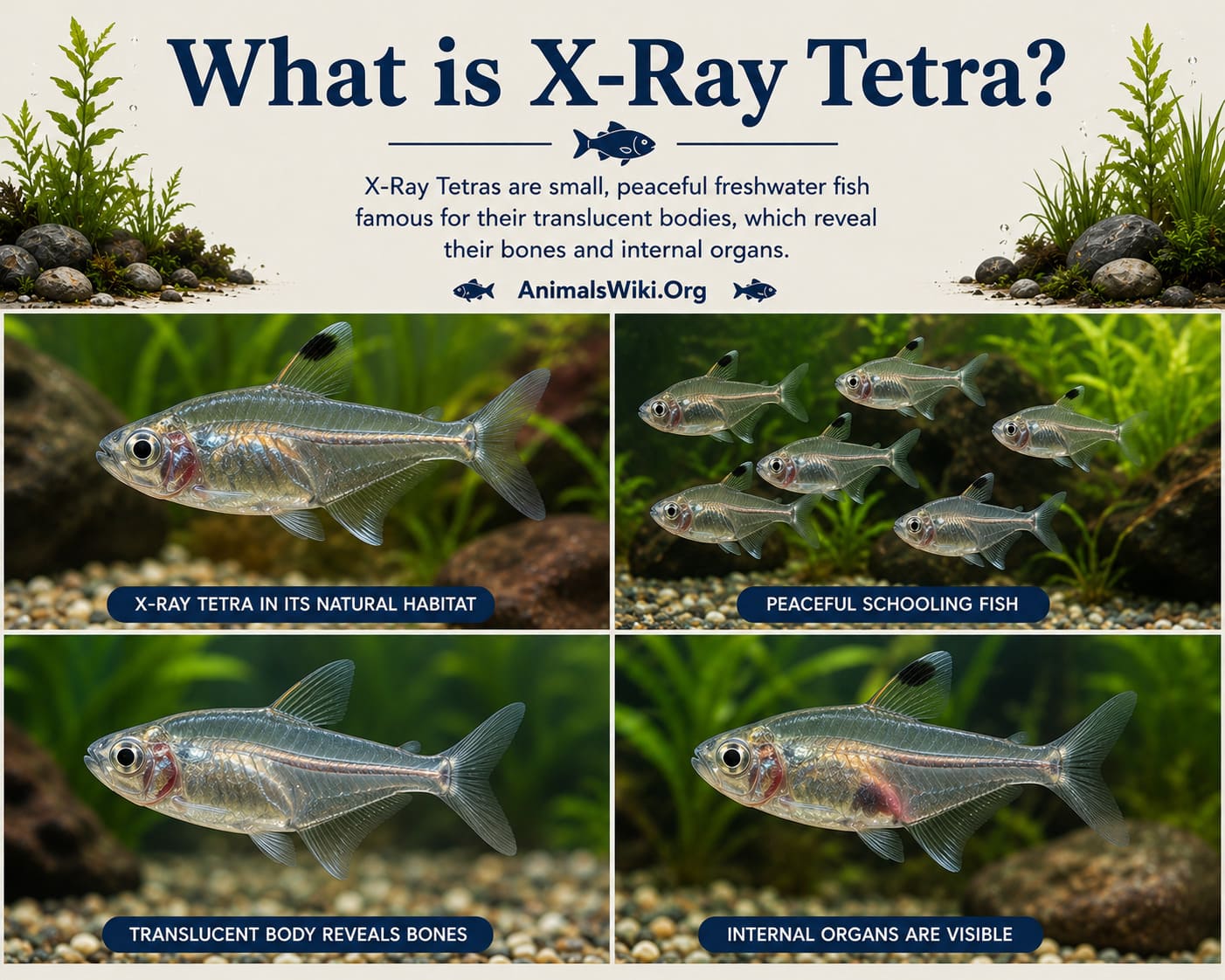
X-Ray Tetra Facts
| Feature | Details |
|---|---|
| Common Name | X-Ray Tetra (also: X-Ray Fish, Golden Pristella Tetra, Water Goldfinch) |
| Scientific Name | Pristella maxillaris |
| Family | Characidae |
| Discovered / Described | 1894 (by Ulrey) |
| Native Habitat | Coastal rivers, floodplains, and estuaries of South America |
| Geographic Range | Venezuela, Guyana, Trinidad, Amazon & Orinoco river basins, Brazil |
| Water Type | Freshwater and slightly brackish water |
| Depth Range | Shallow — surface to ~3 meters |
| Average Size | 3–4.5 cm (1.2–1.8 inches) |
| Weight | Less than 5 grams |
| Lifespan | 4–7 years (wild); up to 8 years (captivity) |
| Diet | Omnivore — small invertebrates, worms, plant matter, algae |
| Conservation Status | Least Concern (IUCN) |
| Defining Feature | Transparent body through which skeleton and organs are visible |
1. Species Overview & Classification
There are thousands of freshwater fish species in the world’s rivers and lakes, but very few stop you in your tracks with a single glance. The X-Ray Tetra (Pristella maxillaris) is one of them.
Imagine looking at a fish and being able to see straight through its body — watching its tiny heart beat, its spine glisten, its organs function in real time. That is exactly what you see when you encounter an X-Ray Tetra. Its body is so extraordinarily transparent that it looks less like a living animal and more like a living anatomical illustration — a swimming ghost wearing a skeleton on the inside and a gossamer skin on the outside.
Despite its otherworldly appearance, the X-Ray Tetra is one of the most widely kept freshwater aquarium fish in the world — beloved by beginners and expert aquarists alike for its hardiness, peaceful temperament, stunning looks, and surprisingly adaptable nature. It is also one of the rare aquarium species with a genuinely interesting wild life story, living in the complex and biodiverse river systems of South America’s coastal and inland waterways.
In the wild, X-Ray Tetras form shimmering schools of dozens or even hundreds of individuals, moving through the water like living glass — one of the most beautiful sights in any South American river ecosystem. Let’s explore everything there is to know about this remarkable little fish.
Species Classification Table
| Classification Level | Details |
|---|---|
| Kingdom | Animalia |
| Phylum | Chordata |
| Class | Actinopterygii (Ray-finned fishes) |
| Order | Characiformes |
| Family | Characidae (Characins / Tetras) |
| Genus | Pristella |
| Species | Pristella maxillaris |
| Synonyms | Pristella riddlei, Holobrycon riddlei |
| Common Variants | Albino X-Ray Tetra (captive-bred) |
The X-Ray Tetra belongs to the family Characidae — one of the largest and most diverse families of freshwater fish in the world, containing over 2,000 species, including famous aquarium favorites such as neon tetras, cardinal tetras, piranhas, and pacus. Within this enormous family, the X-Ray Tetra stands alone in its genus — Pristella — meaning it has no close living relatives and occupies a unique evolutionary position.
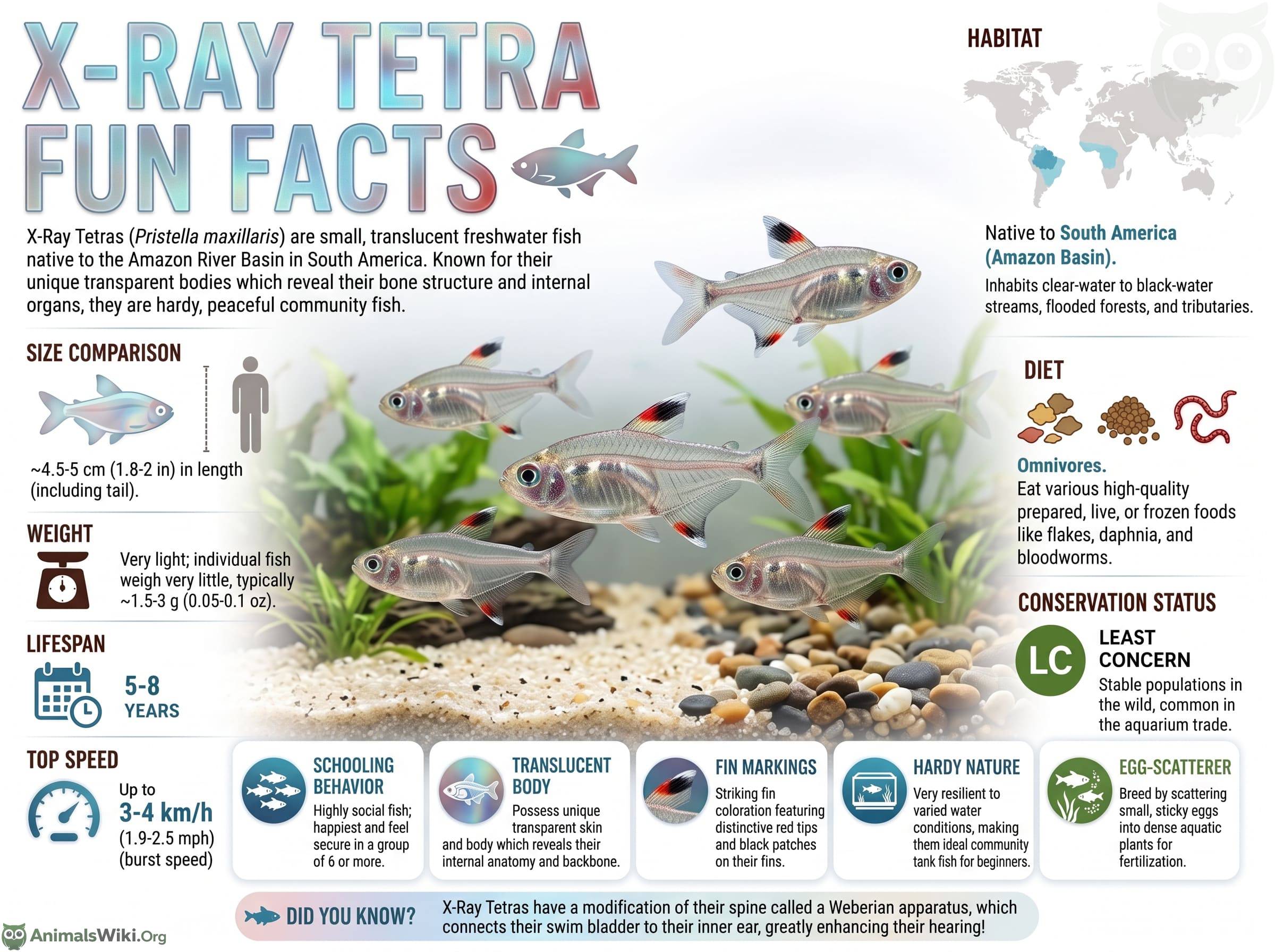
2. Physical Description & Unique Features
The X-Ray Tetra is small, delicate, and jaw-droppingly beautiful. At first glance, it seems almost too extraordinary to be real — an animal that looks like it was designed by an artist rather than shaped by evolution.
Size and Shape
The X-Ray Tetra is a small, slender fish with a streamlined, laterally compressed body typical of the tetra group. Adults reach an average body length of 3 to 4.5 centimeters (1.2 to 1.8 inches), with females typically being slightly larger and rounder than males, particularly when gravid (carrying eggs). Weight is negligible — these are featherlight creatures, generally under 5 grams.
The Transparent Body — Nature’s Living Window
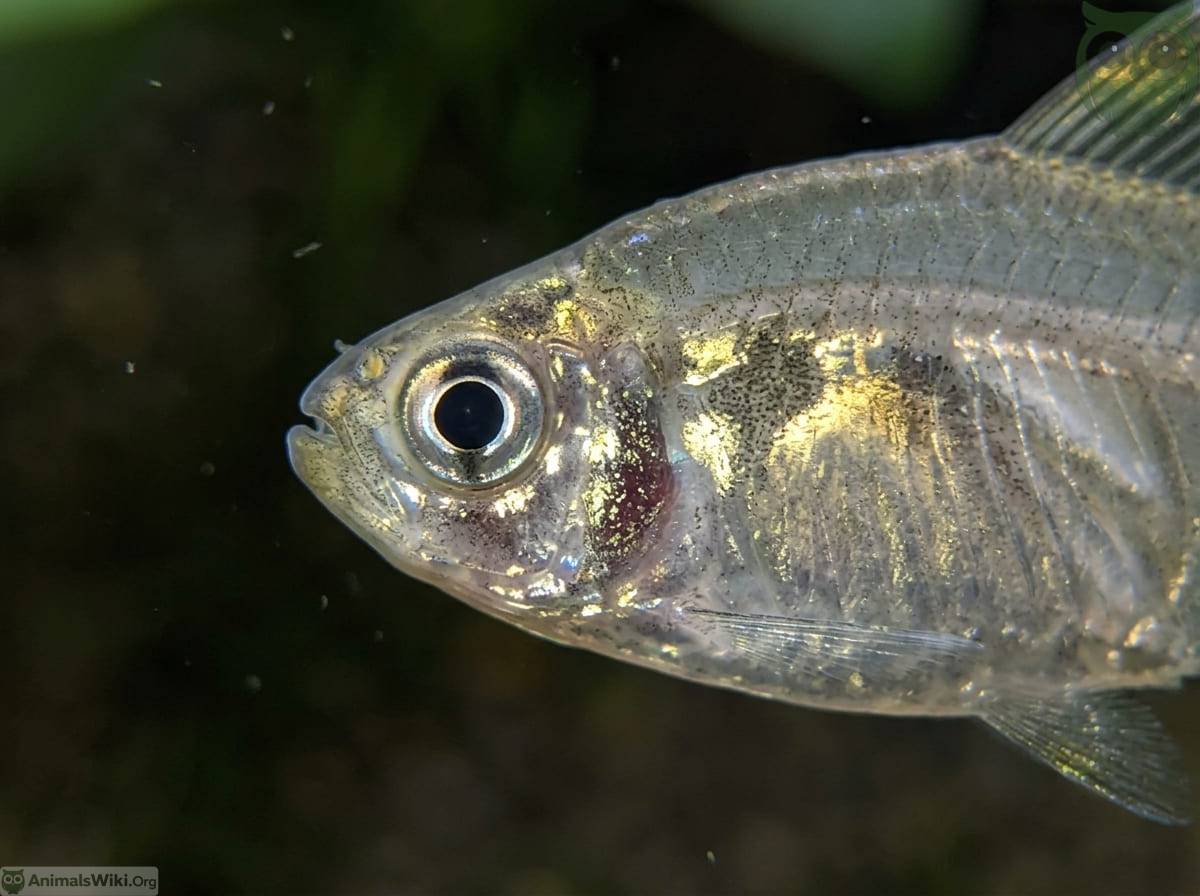
The X-Ray Tetra’s defining feature — the adaptation that gives it its common name — is its extraordinary translucent to semi-transparent body. The skin and musculature of this fish contain very little pigment, allowing light to pass through freely. When viewed in good lighting, you can clearly observe:
- The golden or silvery lateral line running along the body’s midpoint
- The spine and vertebral column glinting through the flesh
- The swim bladder as a distinct pale sac
- The internal organs, including the visible beating of the heart in some light conditions
- The gut contents (yes — you can see what it ate!)
This transparency is not a trick of light — it is a genuine anatomical feature. The fish’s tissues simply lack the melanophores (pigment cells) that make most fish opaque. In science, this quality is called hyaline transparency and is found in only a small number of fish species worldwide.
Coloration and Fins
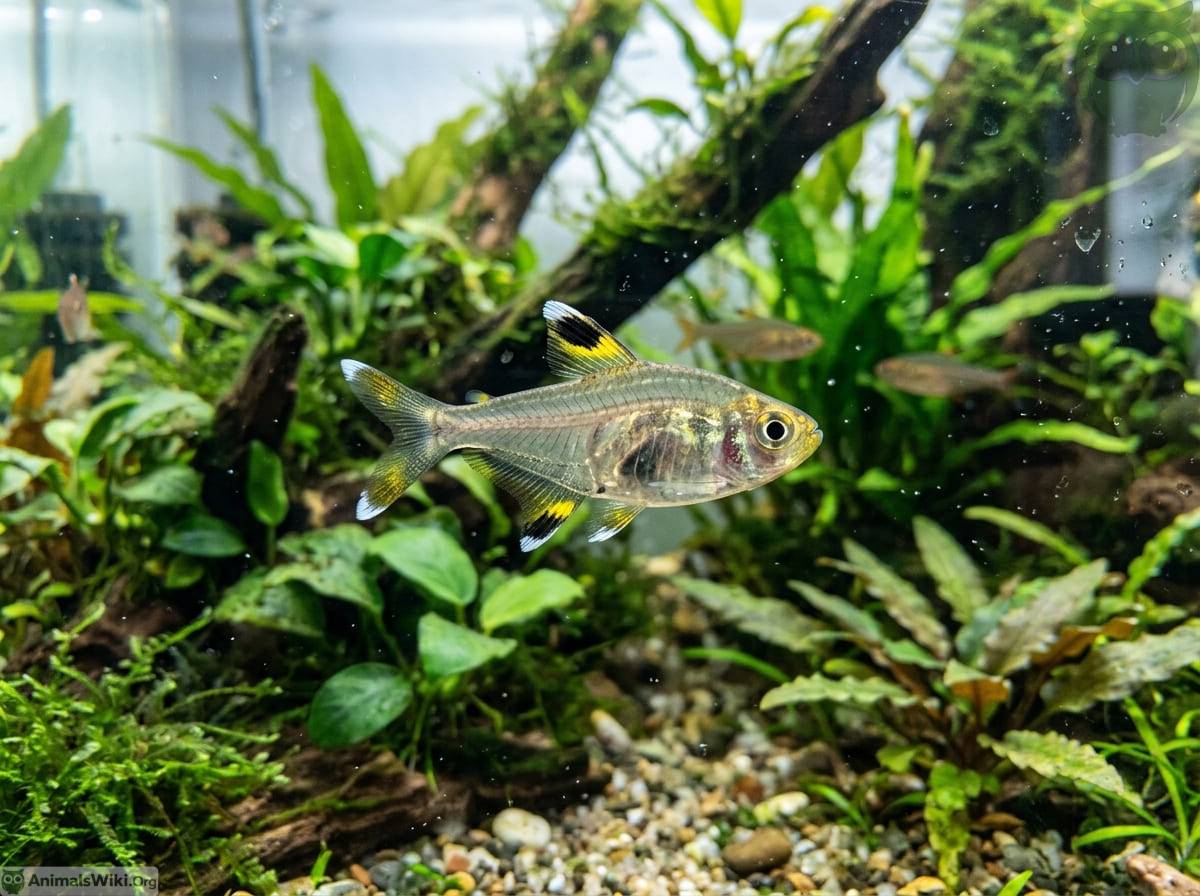
Despite its transparency, the X-Ray Tetra is not without color. Its body carries a subtle golden-yellow to pale silver iridescence, which shimmers beautifully in light — earning it the alternate name “Water Goldfinch” or “Golden Pristella Tetra” in some regions.
The fins are among the most striking features of the fish:
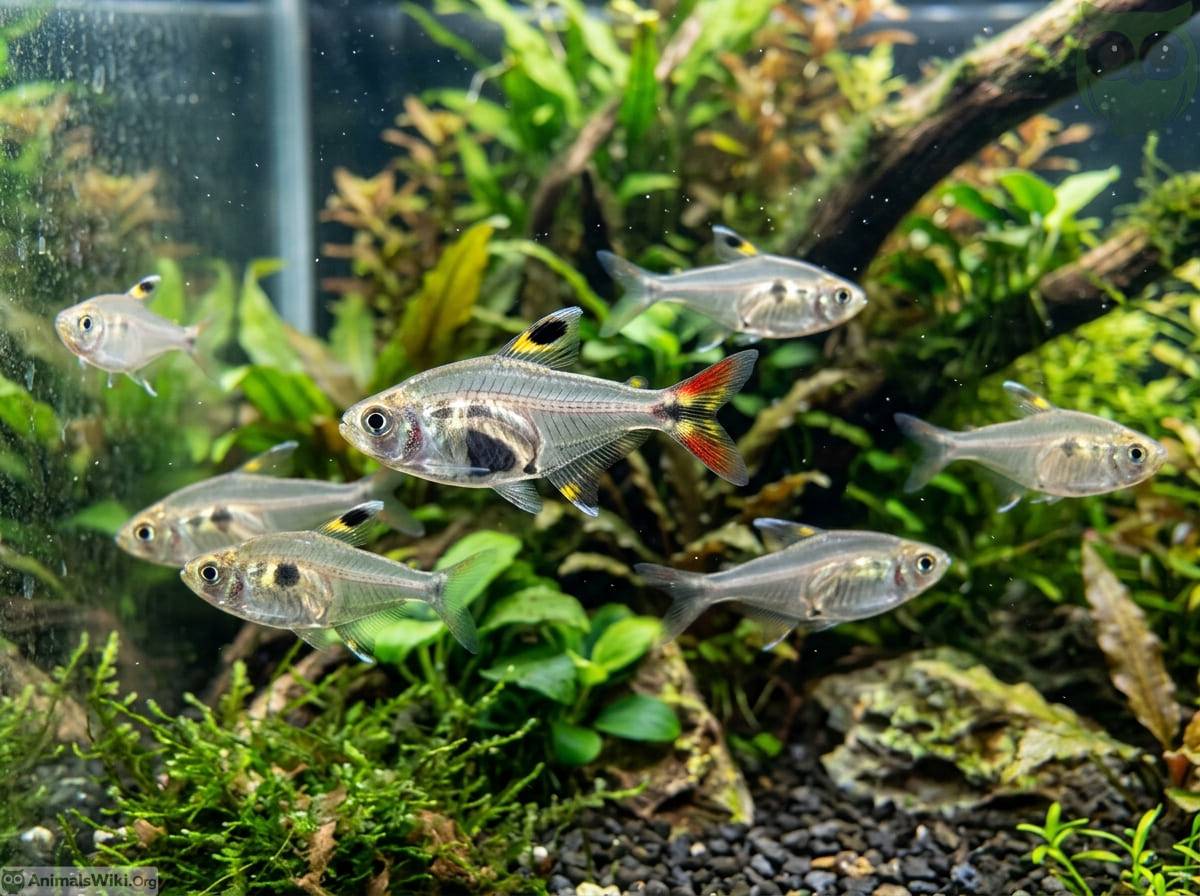
- Dorsal and anal fins are boldly marked with a distinctive pattern of yellow, black, and white bands — reminiscent of warning coloration in other species, though in the X-Ray Tetra’s case it serves a different function
- The tail fin (caudal fin) is forked and often carries a slight reddish or pinkish tint
- The pectoral fins are transparent and nearly invisible in water
The Albino Variant
Through decades of captive breeding, aquarists have developed an albino form of the X-Ray Tetra — a fish with a pinkish-white body, red eyes, and the same bold fin patterning. The albino X-Ray Tetra is widely available in the aquarium trade and, if anything, makes the internal skeleton and organs even more visible against its lighter body.
Did You Know? The X-Ray Tetra is one of very few vertebrate animals in the world whose internal skeleton can be observed without any medical equipment — just hold it gently in good light, and nature provides the X-ray.
3. Natural Habitat & Geographic Range
The X-Ray Tetra is a South American native, and like many members of the Characidae family, it is intimately connected to the rivers, floodplains, and coastal waterways of the continent’s northeastern regions.
Native Range
Pristella maxillaris is found across a broad geographic arc in northern South America, including:
- Venezuela — Orinoco River basin and coastal drainages
- Guyana, Suriname, and French Guiana — coastal rivers and lowland streams
- Trinidad (island nation) — a notable location as it represents a trans-oceanic range extension from the South American mainland
- Northern Brazil — coastal drainages of the Amazon region
Habitat Type
What makes the X-Ray Tetra particularly interesting ecologically is its unusually broad habitat tolerance. Most freshwater fish are highly specific about water chemistry — but the X-Ray Tetra thrives in both pure freshwater and slightly brackish water (water with a small amount of salt content, such as tidal river mouths and coastal estuaries). This remarkable adaptability is rare among tetras.
In the wild, X-Ray Tetras inhabit:
- Slow-moving or still coastal rivers and streams
- Flooded forest margins (especially during the rainy season)
- Estuaries and tidal zones with mild salinity
- Blackwater and clearwater rivers with soft, slightly acidic to neutral water
- Shallow, densely vegetated areas near riverbanks
Habitat Range by Region
| Region | Country / Territory | Habitat Type | Water Type |
|---|---|---|---|
| Orinoco Basin | Venezuela | River floodplains, slow streams | Freshwater |
| Coastal Drainages | Guyana, Suriname | Lowland rivers, estuaries | Fresh to brackish |
| Amazon Coastal Zone | Northern Brazil | Seasonal floodplains, streams | Freshwater |
| Island Range | Trinidad | Coastal rivers, mangrove margins | Fresh to brackish |
| Interior Drainages | Venezuela, Colombia | Clearwater forest streams | Freshwater |
The water in which X-Ray Tetras live is typically warm (22–28°C / 72–82°F), soft to moderately hard, with a pH of 6.0–8.0 — a wider range than most tetra species can tolerate. This flexibility is a key reason the species has thrived in both the wild and in home aquariums worldwide.
Did You Know? The X-Ray Tetra is one of the very few tetra species capable of surviving in brackish water — water with a salinity level between freshwater and seawater. This adaptation allows it to inhabit river mouths and tidal zones that are off-limits to most of its relatives.
4. Diet & Feeding Behavior
The X-Ray Tetra is a textbook opportunistic omnivore — a fish that eats whatever is available and appropriate in its environment, showing no extreme specialization toward either plant or animal food. This dietary flexibility is another reason it has proven so adaptable both in the wild and in captivity.
What X-Ray Tetras Eat in the Wild
In its natural South American habitat, Pristella maxillaris feeds on a wide variety of small food items:
- Small aquatic invertebrates — insect larvae, tiny crustaceans, aquatic worms
- Zooplankton — microscopic animals drifting in the water column
- Insects — small surface insects and those that fall into the water
- Worms — tubifex and similar small annelids
- Plant matter — algae, decaying plant material, seed fragments
- Organic detritus — fine organic particles suspended in the water
Diet Breakdown Table
| Food Type | Estimated % of Wild Diet | Notes |
|---|---|---|
| Aquatic invertebrate larvae | 30–40% | Primary protein source |
| Zooplankton | 20–25% | Readily available in open water |
| Small insects | 15–20% | Surface feeding; fallen insects |
| Worms and annelids | 10–15% | Bottom and mid-water foraging |
| Plant matter / algae | 10–15% | Supplementary; readily consumed |
| Organic detritus | 5–10% | Passive intake while feeding |
Feeding Behavior
X-Ray Tetras are active mid-water and surface feeders. They are not bottom feeders — you will rarely see them grubbing along the substrate. Instead, they patrol the mid-water column and surface zone in schools, picking off food items as they encounter them.
Their feeding behavior is opportunistic and constant — they graze almost continuously throughout their active periods (typically daylight hours), snatching small food items individually. Within a school, individual fish often compete for food with quick darting movements, though outright aggression between school members is uncommon.
“Tetras like Pristella maxillaris are remarkable for their dietary versatility. In the complex and often resource-variable environments of South American river systems, the ability to exploit any available food source is a critical survival advantage.” — Dr. Stanley Weitzman, Curator Emeritus of Fishes, Smithsonian National Museum of Natural History
5. Reproduction & Life Cycle
The X-Ray Tetra’s reproductive biology is both fascinating and highly accessible — it is one of the easiest tetras to breed in captivity, which has made it a favorite among hobbyist aquarists seeking to witness the full life cycle of a tropical fish.
Sexual Dimorphism
Telling males from females is relatively straightforward in this species once you know what to look for:
- Females are typically larger and noticeably rounder in the belly, especially when gravid (full of eggs). Their body outline has a distinctly fuller, rounder profile.
- Males are slimmer and slightly smaller, with a more streamlined body shape.
- In both sexes, the transparency of the body means you can sometimes directly observe eggs in a gravid female — another extraordinary feature of this remarkable fish.
Spawning Behavior
X-Ray Tetras are egg scatterers — they do not build nests, guard territories, or provide parental care. Spawning is triggered by environmental cues, including:
- Rising water temperature (mimicking the onset of the rainy season)
- Softer, slightly more acidic water
- Increased light levels
- Abundant food availability
When ready to spawn, a male will chase a female through the water in an energetic courtship display, nudging her sides and swimming alongside her. When the female is ready, the pair moves into dense vegetation (or fine-leaved plants in an aquarium) and releases eggs and sperm simultaneously. The eggs are adhesive and semi-transparent, attaching to plant leaves and surfaces.
Egg Development and Hatching
- Number of eggs: 300–500 per spawning event
- Egg incubation: 24–36 hours at typical temperatures (26°C / 79°F)
- Fry free-swimming: Within 3–4 days of hatching, the fry absorb their yolk sac and begin swimming and feeding independently
Parental care is entirely absent — the adults show no interest in the eggs and will actually eat them if given the opportunity. This is why breeders routinely remove adults from the spawning tank immediately after egg-laying.
Juvenile Development
Fry are tiny, nearly invisible at birth — their transparency makes them extremely difficult to spot in a tank or river. They grow rapidly when fed appropriately (infusoria, micro-worms, and later baby brine shrimp in captivity). Juveniles reach sexual maturity at approximately 6–9 months of age.
Lifespan Comparison
| Species | Average Lifespan (Wild) | Average Lifespan (Captivity) |
|---|---|---|
| X-Ray Tetra (Pristella maxillaris) | 4–7 years | Up to 8 years |
| Neon Tetra (Paracheirodon innesi) | 5–8 years | Up to 10 years |
| Cardinal Tetra (P. axelrodi) | 3–5 years | Up to 6 years |
| Rummy Nose Tetra (Hemigrammus bleheri) | 5–6 years | Up to 8 years |
| Black Skirt Tetra (Gymnocorymbus ternetzi) | 3–5 years | Up to 7 years |
Did You Know? Because the X-Ray Tetra’s eggs are semi-transparent — just like the adults — newly laid eggs are almost impossible to see with the naked eye in a densely planted aquarium. Aquarists often discover a successful spawning only when the fry appear a few days later, seemingly from nowhere.
6. Social Behavior & Communication
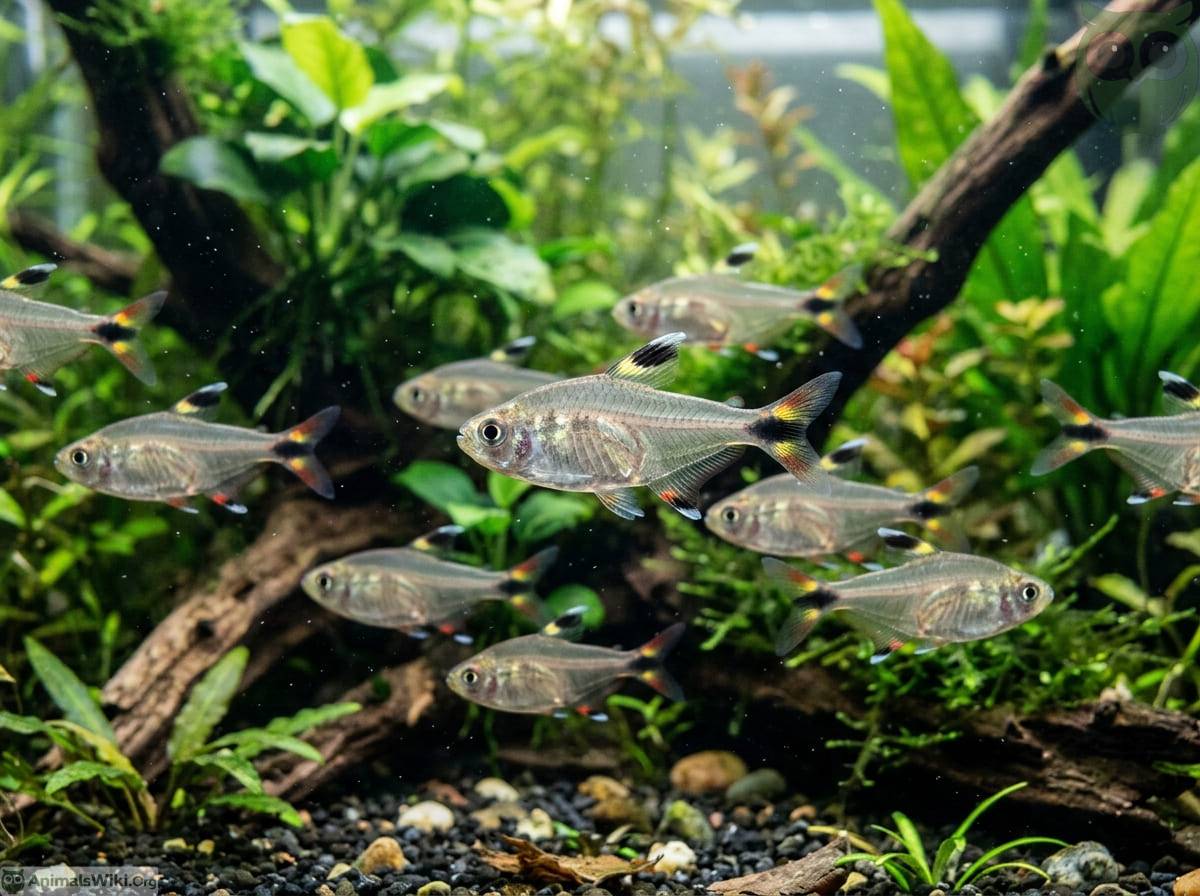
The X-Ray Tetra is a quintessentially social fish — it is at its healthiest, most active, and most visually spectacular when kept or observed in groups. A single X-Ray Tetra is a stressed, shy, and subdued creature. A school of twenty is a living work of art.
Schooling Behavior
In the wild, X-Ray Tetras form schools of dozens to hundreds of individuals, moving through the water with the kind of synchronized precision that makes fish schools one of nature’s most extraordinary spectacles. Each fish constantly monitors the movement of its neighbors, responding to changes in direction, speed, and formation with reaction times measured in milliseconds.
This schooling behavior is not just aesthetically magnificent — it is a critical survival strategy (discussed further in the predators section). Schools form and reform continuously, with individual fish maintaining precise spacing from their neighbors using a combination of vision and lateral line sensing — a pressure-detecting system running along the length of the body that functions like a distant-touch sense.
Temperament
X-Ray Tetras are famously peaceful and non-aggressive. They pose no threat to tankmates of similar size and are themselves non-threatening to the plants and structures in their environment. Within the school, there is occasional mild competition for food and some hierarchical display between males during breeding season, but outright fighting is extremely rare.
They are classified as an ideal community fish — suitable for sharing a habitat with a wide variety of other peaceful species.
Communication
Fish don’t speak, but they communicate with impressive sophistication. X-Ray Tetras use:
- Body positioning and fin display — to signal status, readiness to spawn, or mild aggression
- Lateral line system — to detect water movement from other fish, predators, and environmental changes; essentially a sense of “feeling” what is happening in the surrounding water
- Color flashing — the iridescent body and boldly patterned fins may serve as visual signals within the school, helping individuals identify species members and coordinate movement
- Alarm response — like many schooling fish, X-Ray Tetras exhibit a rapid fright response when one individual is startled — the whole school instantly accelerates and changes direction in a synchronized burst
7. Predators & Defense Mechanisms
Despite their ghostly, beautiful appearance, X-Ray Tetras live in a very real and dangerous world. The rivers of northern South America are rich in predatory fish, birds, and other animals that would happily make a meal of a small, glittering tetra.
Natural Predators
In the wild, X-Ray Tetras face predation from:
- Larger predatory fish — including various South American cichlids, pike characins (Acestrorhynchus spp.), and other predatory characids
- Kingfishers (multiple species) — surface-hunting birds that dive to catch small fish
- Herons and egrets — wading birds that pick off fish in shallow water
- Water snakes — aquatic snakes that hunt small fish in river margins
- Larger tetras and other characins — even some relatives are opportunistic predators on smaller species
Defense: The Power of the School
The X-Ray Tetra’s primary defense is its schooling behavior. Schools provide defense in multiple ways:
Confusion Effect: A single predator facing a swirling mass of identical, synchronized, transparent fish faces enormous difficulty in targeting any one individual. The visual confusion of hundreds of glinting, moving bodies is genuinely disorienting for predators, reducing their strike success rate dramatically.
Dilution Effect: Simply by being part of a large group, any individual fish’s statistical chance of being the one that gets eaten is dramatically reduced. Safety in numbers is mathematically real.
Early Warning: More eyes scanning for danger means threats are detected sooner. When one fish detects a predator and flees, the alarm response ripples through the whole school in a fraction of a second — all fish react before most of them have even directly perceived the threat.
The Transparency Advantage
While the transparency of the X-Ray Tetra’s body is remarkable, its defensive value is debated. In clear, well-lit water, transparency may provide a degree of camouflage by reducing the fish’s visual contrast with the background. In the tannin-stained, murky blackwater rivers where X-Ray Tetras often live, however, the practical camouflage benefit may be limited.
Some researchers suggest that transparency in small fish may serve primarily as a developmental adaptation — keeping juveniles less visible during their most vulnerable early life stages — rather than being a significant adult defense.
“Transparency in freshwater fish is a fascinating evolutionary puzzle. In species like Pristella, it likely reflects a combination of metabolic economy — no need to produce pigment — and some degree of visual camouflage, particularly in early life stages.” — Dr. Ralf Britz, Senior Researcher of Fishes, Natural History Museum London
8. Relationship with Humans
Discovery and Early Science
The X-Ray Tetra was first scientifically described in 1894 by the American ichthyologist Albert Bystrom Ulrey, who published the formal description as Pristella maxillaris. The species had likely been known to indigenous communities of Venezuela and Guyana long before European scientific contact, though no formal historical records of indigenous names or uses survive in the scientific literature.
The Aquarium Trade
The X-Ray Tetra’s relationship with modern humans is overwhelmingly driven by the global ornamental fish trade. By the mid-20th century, it had become established as a popular aquarium species — prized for its transparency, peaceful nature, hardiness, and relative ease of breeding.
Today, Pristella maxillaris is one of the most widely traded freshwater aquarium fish in the world, available in virtually every pet store and fish specialty shop across North America, Europe, Asia, and beyond. The vast majority of X-Ray Tetras in the aquarium trade are captive-bred — produced in commercial fish farms primarily in Southeast Asia, Eastern Europe, and the United States — meaning wild collection pressure on the species is relatively low.
In Home Aquariums
For aquarists, the X-Ray Tetra is considered an ideal beginner species for several reasons:
- It tolerates a wider range of water conditions than most tetras
- It is peaceful and community-friendly
- It is hardy and disease-resistant compared to more delicate species like neon tetras
- It is readily available and inexpensive
- It is easy to breed in home aquarium conditions
- A school of 6–12 individuals creates a stunning visual display that is genuinely comparable to much more expensive fish
Did You Know? The X-Ray Tetra has been kept in home aquariums for over 80 years — making it one of the longest-established ornamental freshwater fish in the hobby. Some of the first dedicated aquarium books published in the early 20th century already featured this species as a recommended beginner’s fish.
9. Conservation Status & Threats
IUCN Status
The X-Ray Tetra (Pristella maxillaris) is currently assessed as Least Concern on the IUCN Red List — the most favorable conservation category. This assessment reflects the species’ wide geographic range, large wild populations, broad habitat tolerance, and significant captive breeding capacity in the aquarium trade.
However, “Least Concern” does not mean “without threats.” The ecosystems the X-Ray Tetra calls home face real and accelerating pressures.
Key Threats
1. Habitat Destruction The coastal rivers, floodplains, and estuaries of Venezuela, Guyana, and northern Brazil — the X-Ray Tetra’s core wild range — are under pressure from:
- Deforestation for agriculture, particularly palm oil and cattle ranching
- Urban and coastal development near estuarine habitats
- Dam construction that alters river flow patterns and floodplain connectivity
- Agricultural runoff that introduces pesticides, fertilizers, and sediment into waterways
2. Water Pollution Industrial and agricultural pollution of South American river systems degrades water quality in ways that affect all aquatic life, including X-Ray Tetras. Pesticide contamination, heavy metal runoff from mining operations, and sewage discharge all reduce habitat quality.
3. Climate Change Changing rainfall patterns, increased drought frequency, and rising water temperatures in South America may reduce the quality and connectivity of the X-Ray Tetra’s floodplain habitats — particularly the seasonal flood cycles that many river fish depend on for reproduction.
4. Wild Collection (Minor) While captive breeding supplies the vast majority of the aquarium trade’s demand, some wild collection still occurs, particularly from Venezuelan and Guyanese rivers. At current levels, this is not considered a significant population threat, but it warrants monitoring.
10. Famous Individuals & Notable Records
Unlike large charismatic animals, individual X-Ray Tetras are not named or tracked. However, the species has achieved notable status in several specific contexts.
World’s First Public Display
The X-Ray Tetra was among the pioneering species displayed in public aquariums in the early-to-mid 20th century. Several major European and American public aquariums — including the London Aquarium and the New York Aquarium — featured Pristella maxillaris in early tropical freshwater displays, introducing millions of visitors to the concept of transparent-bodied fish for the first time.
The Albino Record
The albino form of the X-Ray Tetra, developed through selective captive breeding in the late 20th century, has become one of the most consistently popular aquarium variants in the hobby. Albino X-Ray Tetras have won prizes at international aquarium competitions including events run by the British Aquarist Federation and similar organizations in Germany and Japan.
Scientific Research Subjects
X-Ray Tetras have been used in numerous scientific studies of fish schooling behavior, transparency adaptations, and freshwater fish ecology, contributing meaningfully to our understanding of how social behavior evolves in schooling fish.
11. Role in Ecosystem & Food Chain
Small as it is, the X-Ray Tetra plays a genuinely important role in the functioning of South American freshwater ecosystems.
As a Consumer (Prey on Invertebrates)
By feeding heavily on aquatic invertebrate larvae, zooplankton, and insects, X-Ray Tetras help regulate populations of small invertebrates in river systems. Without predation pressure from fish like tetras, populations of certain insect larvae and zooplankton could grow unchecked, with cascading effects on water quality and plant communities.
As Prey (Food for Larger Animals)
X-Ray Tetras are important prey items for a wide variety of larger predators in their ecosystems. They form part of the energy base that supports:
- Predatory fish (pike characins, cichlids, and others)
- Waterbirds (kingfishers, herons, egrets)
- Aquatic reptiles (water snakes)
In this role, they serve as a critical energy transfer link between the invertebrate layer and the larger carnivore community — converting small invertebrate biomass into fish biomass that larger predators can exploit.
Nutrient Cycling
Through their feeding, waste production, and eventual death and decomposition, X-Ray Tetras (like all fish) contribute to nutrient cycling in river ecosystems — returning organic matter and minerals to the water column and substrate, supporting plant growth and microbial communities.
12. Myths, Culture & Pop Culture Appearances
Cultural Significance
The X-Ray Tetra does not carry the weight of ancient mythology — it is too small and too recently discovered to feature in the traditional stories of most cultures. However, it holds a significant place in modern popular culture, particularly within the global aquarium hobby and science education.
The “X-Ray” Name and Its Cultural Resonance
The name “X-Ray Tetra” is itself a piece of cultural storytelling. It invokes the wonder of medical technology — the X-ray machine — and applies it to a living creature, immediately communicating the fish’s most extraordinary feature in a single evocative phrase. This name has made the X-Ray Tetra one of the most memorable common animal names in any language, instantly communicating the fish’s most extraordinary feature to anyone who hears it for the first time.
Pop Culture Appearances
- “Blue Planet” and “Blue Planet II” (BBC) — While primarily ocean-focused, BBC nature productions have featured South American river systems and their extraordinary biodiversity, with characid fish (including tetra relatives) as key subjects.
- “River Monsters” (Animal Planet) — This popular series explored South American river ecosystems extensively, contextualizing the world that X-Ray Tetras and their larger neighbors inhabit.
- “Amazon with Bruce Parry” (BBC) — Featured the extraordinary biodiversity of Amazonian river systems, including the kinds of ecosystems where X-Ray Tetras thrive.
- Aquarium Keeping Literature — The X-Ray Tetra has appeared in virtually every major aquarium keeping book published in the last 60 years, making it one of the most documented freshwater aquarium species in hobbyist literature.
- “Endless Ocean” (Nintendo Wii game) — Features transparent and exotic fish species in an exploration-based underwater game that references real species including transparent fish.
- Science Education — The X-Ray Tetra is a standard subject in school biology lessons worldwide, particularly in units on animal adaptation, camouflage, and vertebrate anatomy. Its transparent body makes it an ideal living teaching aid.
Did You Know? The X-Ray Tetra is occasionally used in science classrooms as a living demonstration of vertebrate anatomy — allowing students to observe the spine, organs, and skeletal structure of a living fish without any dissection or specialized equipment.
13. Discovery & Evolution Timeline
~250 million years ago — The first ray-finned fish (Actinopterygii) diversify rapidly, laying the evolutionary groundwork for all modern fish groups including the Characiformes.
~100 million years ago — South America separates from Africa as Gondwana breaks apart. South American freshwater fish communities — including the ancestors of the Characidae family — begin evolving in isolation, producing one of the most diverse freshwater fish faunas on Earth.
~60–70 million years ago — The Characidae family begins diversifying into its extraordinary modern array of forms — piranhas, pacus, tetras, and hundreds of other groups.
~10–20 million years ago (estimated) — The Pristella lineage diverges from related characid ancestors, developing its distinctive transparent body plan and brackish-water tolerance.
Pre-1894 — X-Ray Tetras are almost certainly known to indigenous communities of Venezuela and Guyana, living alongside the fish in their rivers for millennia, though no formal scientific record exists of this knowledge.
1894 — American ichthyologist Albert Bystrom Ulrey formally describes Pristella maxillaris based on specimens collected from South American rivers. The species enters the scientific record.
Early 1900s — The species is described under the synonym Pristella riddlei by other researchers — leading to a period of nomenclatural confusion that is eventually resolved in favor of maxillaris as the valid name.
1930s–1950s — The X-Ray Tetra enters the international aquarium hobby, initially in Europe (particularly the UK and Germany) and the United States. It quickly becomes established as a popular beginner fish.
Mid-late 20th century — Commercial captive breeding of X-Ray Tetras begins in earnest, primarily in Southeast Asia. This dramatically reduces reliance on wild-caught specimens and makes the species available globally at low cost.
Late 20th century — The albino variant is developed through selective breeding, adding a popular new form to the aquarium trade.
2000s–2026 — The X-Ray Tetra remains one of the top-selling freshwater aquarium fish worldwide. Scientific research continues to use the species to study schooling behavior, transparency adaptation, and freshwater fish ecology.
14. Comparison with Similar Species
| Feature | X-Ray Tetra (Pristella maxillaris) | Neon Tetra (Paracheirodon innesi) | Rummy Nose Tetra (Hemigrammus bleheri) |
|---|---|---|---|
| Size | 3–4.5 cm | 3–4 cm | 4–6 cm |
| Transparency | High — body clearly transparent | Low — opaque with vivid colors | Low — opaque |
| Key Feature | Transparent body, striped fins | Brilliant neon blue/red stripe | Red nose, black-white tail |
| Water Tolerance | Fresh + brackish; pH 6–8 | Soft acidic water only; pH 5–7 | Soft acidic water; pH 6–7.2 |
| Difficulty (Aquarium) | Easy — beginner-friendly | Moderate — somewhat delicate | Moderate |
| Schooling | Strong — schools of 10+ recommended | Strong — schools of 10+ | Very strong — tightly schooling |
| Lifespan (Captivity) | Up to 8 years | Up to 10 years | Up to 8 years |
| Breeding in Captivity | Easy | Moderately difficult | Difficult |
| Conservation Status | Least Concern | Least Concern | Least Concern |
15. Best Places to See X-Ray Tetras in the Wild
Seeing X-Ray Tetras in their natural habitat requires traveling to northern South America — but for dedicated wildlife and fish enthusiasts, it is an unforgettable experience.
Wild Locations
- 🇻🇪 Orinoco River Basin, Venezuela — The core of the X-Ray Tetra’s wild range. The slow-moving tributaries, coastal rivers, and flooded forest margins of Venezuela’s northern lowlands are ideal X-Ray Tetra habitat. Wildlife-focused river tours operate in this region, offering snorkeling and shallow-water fish observation.
- 🇬🇾 Essequibo River System, Guyana — Guyana’s extraordinary interior rivers support rich fish communities including Pristella maxillaris. Guyana is increasingly popular with ecotourists for its pristine rainforest and river ecosystems.
- 🇸🇷 Coastal Rivers of Suriname — Suriname’s coastal lowland rivers, particularly those with tidal influence and slightly brackish conditions, are excellent X-Ray Tetra habitat.
- 🇹🇹 Trinidad — Northern Range River Systems — Trinidad’s rivers support X-Ray Tetra populations and are accessible for ecotourists visiting the island. Trinidad is a renowned destination for tropical wildlife watching.
- 🇧🇷 Amapá State, Northern Brazil — The coastal drainages of Brazil’s Amapá state support Pristella populations and are part of broader Amazon ecotourism circuits.
In Aquariums and Public Displays
For most people, the best accessible way to see X-Ray Tetras is at:
- London Aquarium (Sea Life London), UK — Features South American river fish displays
- Georgia Aquarium, Atlanta, USA — Extensive freshwater exhibits including South American species
- Monterey Bay Aquarium, California, USA — Regularly features tetra species in tropical freshwater displays
- Shedd Aquarium, Chicago, USA — Amazon and South American river exhibits
- Singapore Zoo and River Safari, Singapore — Excellent Southeast Asian and South American freshwater exhibits
- Quality local aquarium shops — Honestly, your best bet for seeing X-Ray Tetras up close is a well-run fish specialty store, where schools of these fish can often be observed behaving naturally in large display tanks
16. X-Ray Tetra Fun Facts for Kids
- The X-Ray Tetra is so transparent that you can see its beating heart and spine with the naked eye.
- It is one of the very few tetra species tolerant of slightly brackish (salty) water — a rare adaptation in this fish family.
- The alternate name “Water Goldfinch” was given in some regions because of the fish’s delicate golden shimmer in sunlight.
- A school of X-Ray Tetras moves with such coordination that researchers compare it to a single organism — each fish reacting to neighbors in milliseconds.
- Females can produce 300–500 eggs in a single spawning — and the semi-transparent eggs are themselves nearly invisible to the naked eye.
- The species has been in continuous captive cultivation for over 80 years — one of the oldest-established aquarium fish in the hobby.
- The X-Ray Tetra belongs to the same family (Characidae) as the piranha — though the two couldn’t be more different in temperament.
- When stressed or frightened, a school of X-Ray Tetras can reverse direction simultaneously in under 1/100th of a second — faster than any human reflex.
- The species is scientifically placed in a monotypic genus — Pristella — meaning it is the only species in its genus with no close living relatives.
- Newly hatched X-Ray Tetra fry are so tiny and transparent that they are virtually invisible in water — a remarkable natural camouflage for the most vulnerable stage of life.
17. How You Can Help
The X-Ray Tetra is not currently endangered, but the Amazon and northern South American river ecosystems it calls home face serious threats. Here’s how you can make a difference.
Support These Organizations
- WWF (World Wildlife Fund) (wwf.org) — Active programs protecting Amazon Basin ecosystems and freshwater biodiversity.
- Amazon Conservation Association (amazonconservation.org) — Directly focused on protecting Amazonian ecosystems from deforestation and habitat destruction.
- Shoal Conservation (shoal.fish) — A global partnership specifically dedicated to freshwater fish conservation — one of the very few organizations focused exclusively on freshwater fish biodiversity.
- IUCN Freshwater Fish Specialist Group — The scientific authority on freshwater fish conservation globally.
- Rainforest Trust (rainforesttrust.org) — Purchases and protects critical tropical forest habitat including Amazon river catchments.
What You Can Do
- Buy captive-bred fish — When purchasing X-Ray Tetras or other tropical fish, always choose captive-bred specimens from reputable suppliers. Ask your aquarium store where their fish come from.
- Never release aquarium fish into local waterways — This can introduce invasive species that devastate native ecosystems.
- Support sustainable seafood and products — Avoid products linked to Amazon deforestation, including certain beef and palm oil products.
- Donate or volunteer with freshwater conservation organizations.
- Educate others — Share what you’ve learned about freshwater fish and their ecosystems.
- Maintain a responsible aquarium — A well-kept aquarium that showcases these animals beautifully builds appreciation for freshwater biodiversity in everyone who sees it.
Recommended Documentaries & Books
- “Amazon” (BBC One, 2019) — An immersive journey through the Amazon ecosystem from source to sea.
- “Wild Brazil” (BBC, 2014) — Stunning coverage of Brazil’s extraordinary natural ecosystems including its rivers.
- “Jeremy Wade’s Dark Waters” (Animal Planet) — Explores extraordinary freshwater ecosystems and their inhabitants.
- “Freshwater Fishes of the World” by Günther Sterba — The definitive reference book on freshwater fish, including extensive X-Ray Tetra coverage.
- “The Brilliant Abyss” by Helen Scales — While focused on the deep sea, it offers broader context on why freshwater and ocean ecosystems deserve urgent protection.
18. Frequently Asked Questions About X-Ray Tetra
Q1: Why is the X-Ray Tetra transparent?
The X-Ray Tetra’s transparency is caused by an unusually low concentration of pigment cells (melanophores) in its skin and muscle tissue. This allows light to pass through the body, making internal structures — including the spine, organs, and in some cases the beating heart — visible to the naked eye. Scientists call this quality hyaline transparency. It may have evolved as a form of camouflage (reducing visual contrast in water), as a metabolic economy (no energy spent producing pigment), or as a combination of both factors.
Q2: Is the X-Ray Tetra good for beginners?
Yes — it is widely considered one of the best beginner tropical fish available. It tolerates a wider range of water chemistry than most tetras, is peaceful, hardy, easy to feed, and visually stunning. A group of 8–12 individuals in a well-planted community aquarium creates a spectacular display. Its only requirement is being kept in a school — solitary X-Ray Tetras become stressed and reclusive.
Q3: Can X-Ray Tetras live in brackish water?
Yes — this is one of the X-Ray Tetra’s most distinctive natural attributes. Unlike most freshwater tetras, Pristella maxillaris can tolerate slightly brackish water conditions — water with a small amount of dissolved salt. In the wild, they regularly inhabit tidal rivers and estuaries. In captivity, some aquarists even add a small amount of marine salt to their tank, though this is not necessary for the fish’s health.
Q4: How many X-Ray Tetras should be kept together?
A minimum of 6 individuals is recommended for a home aquarium, but 10 or more is strongly preferred. Schooling fish kept in too-small groups become stressed, hide constantly, and lose their most spectacular schooling behaviors. The larger the school, the more natural and visually impressive the group’s behavior becomes.
Q5: What do X-Ray Tetras eat in a home aquarium?
X-Ray Tetras are undemanding feeders in captivity. They accept a wide range of foods including high-quality flake food (the dietary staple), frozen or freeze-dried foods such as daphnia, brine shrimp, and bloodworms, as well as micro-pellets. A varied diet that includes both dry and frozen/live foods promotes the best health, coloration, and breeding condition.
Q6: How can I tell if my X-Ray Tetra is male or female?
The easiest indicator is body shape. Female X-Ray Tetras are noticeably rounder and fuller in the belly than males — a difference that becomes very obvious when a female is gravid (carrying eggs). Males are slimmer and more streamlined. Because the fish are transparent, a gravid female’s eggs may actually be directly visible through her body — one of the most remarkable things you can observe in a home aquarium.
Q7: Are X-Ray Tetras endangered?
No — the X-Ray Tetra is currently listed as Least Concern on the IUCN Red List, reflecting its wide range, large wild populations, and significant captive breeding in the aquarium trade. However, the river ecosystems it inhabits in Venezuela, Guyana, and northern Brazil face growing threats from deforestation, pollution, and climate change — all of which warrant ongoing monitoring and conservation attention.
Q8: What is the scientific name of the X-Ray Tetra?
The correct and currently accepted scientific name is Pristella maxillaris, first described by Ulrey in 1894. The species was also described under the synonym Pristella riddlei in later years, but maxillaris has been confirmed as the valid name under formal ichthyological nomenclature. The genus Pristella is monotypic — meaning P. maxillaris is the only species within this genus.
19. Sources Researched
The information in this article was researched and verified using the following authoritative sources:
- Wikipedia — Pristella maxillaris, Characidae, Characiformes, Amazon River fish
- FishBase (fishbase.se) — The global authority on fish taxonomy, range, and biology data
- IUCN Red List (iucnredlist.org) — Pristella maxillaris conservation status assessment
- Seriously Fish (seriouslyfish.com) — Detailed species profile and care data for Pristella maxillaris
- Smithsonian National Museum of Natural History — Freshwater fish collections and research
- PlanetCatfish / TropicalFishFinder — Aquarium trade and captive care data
- Britannica (britannica.com) — Tetra fish, Characidae, Amazon River
- National Geographic (nationalgeographic.com) — Amazon ecosystem and freshwater biodiversity coverage
- Shoal Conservation (shoal.fish) — Freshwater fish conservation data
- WWF (wwf.org) — Amazon ecosystem protection and biodiversity reports
- Amazon Conservation Association (amazonconservation.org) — Habitat conservation data for northern South America
- Journal of Fish Biology — Peer-reviewed research on tetra behavior, ecology, and taxonomy
- BBC Nature — Documentary references and species behavior data
- Günther Sterba, “Freshwater Fishes of the World” — Classic reference for X-Ray Tetra natural history
X-Ray Tetra Images