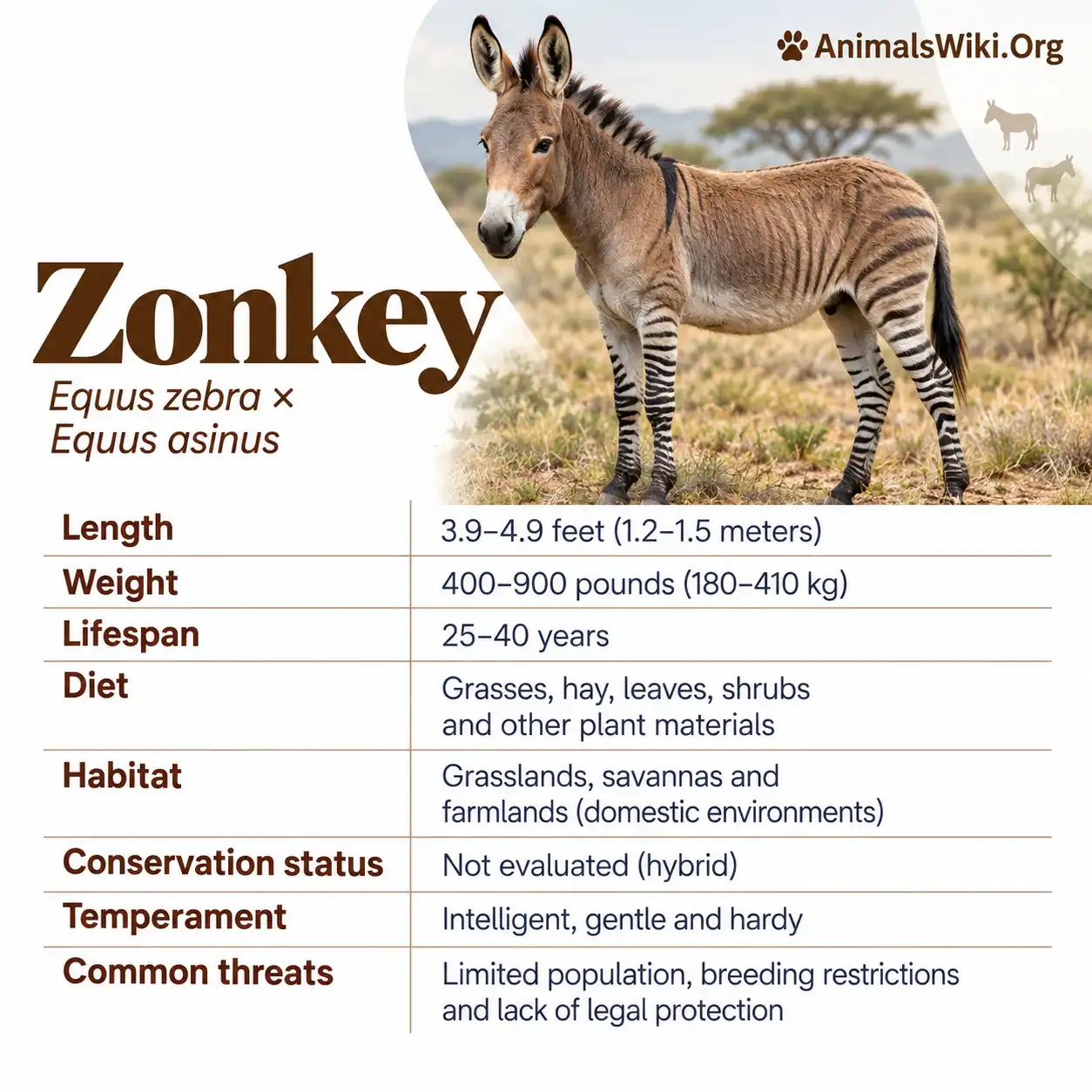
Zonkey Facts
| Feature | Details |
|---|---|
| Common Name | Zonkey (also: Zedonk, Zeedonk, Zebronkey, Donkra) |
| Scientific Classification | Equus zebra × Equus asinus (hybrid) |
| Parent Species | Zebra (sire) × Domestic Donkey (dam) |
| Chromosome Count | ~54–63 (varies by zebra subspecies) |
| Average Lifespan | 15–25 years (captivity) |
| Weight | 250–450 kg (550–990 lbs) |
| Height at Shoulder | 1.0–1.4 m (40–55 inches) |
| Diet | Herbivore — grasses, hay, shrubs, leaves |
| Habitat | Captivity only; rare accidental births on African farms |
| Fertility | Almost always sterile |
| Conservation Status | Not applicable (not a natural species) |
| Known Populations | Zoos and wildlife parks worldwide |
1. Zonkey Species Overview & Classification
Imagine an animal with the sturdy, compact body of a donkey, the bold black-and-white stripes of a zebra, long expressive ears, and a personality that has enchanted zookeepers, wildlife researchers, and curious nature lovers for generations. Meet the Zonkey — one of the most visually stunning and biologically fascinating hybrid animals on Earth.
Neither fully zebra nor fully donkey, the Zonkey occupies a rare and remarkable biological middle ground. These captivating creatures have sparked scientific curiosity, cultural intrigue, and viral social media fame in equal measure. They are living proof of how closely related members of the horse family can be — close enough, under the right circumstances, to produce offspring together.
The Zonkey is what biologists call an interspecies hybrid — born from the crossing of two different but genetically related species. Specifically, it is the offspring of a male zebra (sire) and a female domestic donkey (dam). The reverse cross — a male donkey bred with a female zebra — produces what is sometimes called a Zedonk or Zeedonk, though all of these names are used interchangeably in popular usage. For consistency, we use “Zonkey” throughout this article.
Species Classification Table
| Classification Level | Parent: Zebra | Parent: Donkey | Zonkey (Hybrid) |
|---|---|---|---|
| Kingdom | Animalia | Animalia | Animalia |
| Phylum | Chordata | Chordata | Chordata |
| Class | Mammalia | Mammalia | Mammalia |
| Order | Perissodactyla | Perissodactyla | Perissodactyla |
| Family | Equidae | Equidae | Equidae |
| Genus | Equus | Equus | Equus (hybrid) |
| Species | E. quagga / E. zebra / E. grevyi | E. asinus | Equus zebra × asinus |
Both parent species belong to the family Equidae — the same biological family that includes horses, mules, and hinnies. This shared ancestry is exactly what makes hybridization possible, though it is rare in nature and almost always requires human intervention or accidental proximity on farms near zebra habitats in Africa.
“Hybrid animals like the Zonkey are extraordinary windows into the mechanics of evolution. They show us both how similar and how different closely related species can truly be.” — Dr. Jonathan Kingdon, author of Kingdon Field Guide to African Mammals
2. Zonkey Physical Description & Unique Features
The Zonkey’s appearance is nothing short of breathtaking. It carries the genetic stamp of both its parents in a way that seems almost artistically balanced — as if nature couldn’t decide which species to commit to and chose both.
Body Shape and Size
In terms of build, the Zonkey most closely resembles its donkey mother. It is compact, muscular, and sturdy, with shorter legs than a full zebra and a slightly stockier torso. Its head is notably large relative to its body — a classic donkey trait — and it carries those iconic long, upright ears that make donkeys so recognizable worldwide.
Weight ranges between 250 and 450 kilograms, depending on the size of the parent zebra species. Height at the shoulder typically falls between 1.0 and 1.4 meters.
The Famous Stripes
The most immediately striking feature of any Zonkey is, without question, its stripes. Unlike a full zebra, the Zonkey does not have stripes covering its entire body. Instead, stripes appear most prominently on the legs, which are often boldly striped in classic zebra black-and-white fashion. The torso may show faint striping or a mottled pattern, while the face sometimes bears lighter zebra-like markings. This partial striping gives the Zonkey an almost surreal, patchwork appearance — like a sketch of two animals layered over each other.
The base coat color of the body tends to be a tan, grey, or brown shade inherited from the donkey parent, making the contrast with the bold leg stripes particularly dramatic.
Mane and Tail
Zonkeys inherit a short, upright mane — similar to a zebra’s — rather than the flowing mane of a horse. This mane often carries striped coloring. The tail is thick at the base and ends in a tufted tip, similar to a zebra’s tail but sometimes slightly fuller, echoing the donkey’s influence.
Hooves and Legs
The hooves are narrow and hard — better suited to rocky terrain than a horse’s hooves — which is a trait shared by both parent species and makes the Zonkey exceptionally sure-footed.
Did You Know? The pattern of stripes on every Zonkey is completely unique — just like a human fingerprint. No two Zonkeys have exactly the same stripe arrangement, even if they share the same parents.
3. Zonkey Habitat & Geographic Range
Here’s an important truth about Zonkeys: they do not have a natural habitat in the wild. Unlike their zebra fathers or donkey mothers, Zonkeys do not roam savannahs, grasslands, or mountain ranges freely. They are almost exclusively born and raised in captivity — in zoos, wildlife sanctuaries, and private animal parks around the world.
However, rare cases of accidental Zonkey births have occurred in parts of sub-Saharan Africa, particularly in countries like South Africa, Kenya, Tanzania, and Ethiopia, where wild or semi-wild zebras have occasionally wandered onto farms where domestic donkeys are kept, resulting in unplanned crossbreeding.
Habitat Range by Continent (Captive Population)
| Continent | Countries with Known Zonkeys | Setting |
|---|---|---|
| Africa | South Africa, Kenya, Ethiopia, Tanzania | Farms (accidental), wildlife parks |
| North America | USA, Canada, Mexico | Zoos, wildlife sanctuaries |
| Europe | Germany, UK, Italy, Spain | Zoos, animal parks |
| Asia | China, Japan, South Korea | Zoos |
| Australia | Australia | Zoos |
| South America | Brazil, Argentina | Zoos (rare) |
Their parent species, by contrast, occupy very specific wild habitats. Plains zebras (Equus quagga) roam the open grasslands and savannahs of eastern and southern Africa. Donkeys (Equus asinus), domesticated from the African wild ass, are found on every inhabited continent as working animals.
Did You Know? In 2010, a Zonkey was born on a farm in Harar, Ethiopia when a wild zebra escaped from a nearby reserve and bred with a local donkey. The foal, named Debra, became a local celebrity.
4. Zonkey Diet & Feeding Behavior
As a hybrid of two dedicated herbivores, the Zonkey is — unsurprisingly — a committed plant-eater. Its digestive system is well-adapted to processing tough, fibrous vegetation, much like both its zebra and donkey parents.
What Does a Zonkey Eat?
In captivity, Zonkeys are fed a carefully managed diet that typically includes:
- Grass and hay (the bulk of the diet — up to 70%)
- Leaves, bark, and shrubs (supplemental forage)
- Root vegetables such as carrots and turnips (given as enrichment)
- Fruits such as apples, occasionally as treats
- Mineral supplements added to feed by zookeepers
Diet Breakdown Table
| Food Type | Approximate % of Diet | Notes |
|---|---|---|
| Grasses & Hay | 65–70% | Primary energy source |
| Leafy Shrubs & Browse | 15–20% | Adds variety, micronutrients |
| Root Vegetables | 5–8% | Enrichment, vitamins |
| Fruits | 2–5% | Treats; high sugar, given sparingly |
| Mineral Supplements | <1% | Added by caregivers for health |
Feeding Behavior
Zonkeys, like donkeys, are remarkably efficient feeders. They can thrive on lower-quality forage than horses, extracting more nutrition from fibrous plant matter. They are grazers by preference — meaning they eat little and often, moving across a pasture and nibbling as they go, rather than consuming large meals at set times.
Their molars are wide and ridged, perfectly designed for grinding tough grasses and plant stems. In the wild — if they were to exist there — Zonkeys would likely follow the feeding patterns of zebras, grazing for up to 18 hours a day in search of fresh grass.
“What strikes me most about hybrid equines like the Zonkey is how efficiently their gut adapts. They tend to inherit the donkey’s incredible metabolic efficiency — they really do thrive on relatively little.” — Dr. Sue McDonnell, Equine Behavior Lab, University of Pennsylvania
5. Zonkey Reproduction & Life Cycle
The story of how a Zonkey comes into existence is as unusual as the animal itself. It begins with an unlikely encounter between two species that would almost never meet in the wild — a male zebra and a female donkey.
How Zonkeys Are Born
In captivity, breeders or zoo managers sometimes deliberately pair a zebra stallion with a donkey mare (female donkey) to produce a Zonkey. This process is not common and is often discouraged by serious conservation organizations, as it raises ethical questions about the welfare and purpose of producing hybrid animals.
In nature, these crossings happen accidentally — usually when a zebra wanders into a farming area and mates with a domestic donkey. This is how many of Africa’s most famous Zonkeys have come into the world.
Gestation and Birth
The gestation period for a Zonkey is approximately 11 to 13 months — falling between the zebra’s average of 12 months and the donkey’s average of 11–12 months. Births are almost always single offspring (twins are extremely rare in equids of any kind).
Foals are born relatively developed and are able to stand and walk within hours of birth — a critical survival trait inherited from both parent species.
The Sterility Question
Here is one of the most important biological facts about Zonkeys: they are almost always sterile. This is because zebras and donkeys have different chromosome numbers. Zebra species have between 32 and 46 chromosomes (depending on subspecies), while domestic donkeys have 62 chromosomes. A Zonkey inherits a mismatched set — roughly 54 chromosomes — and the resulting chromosomal imbalance prevents the proper formation of functional eggs or sperm.
This is the same reason that mules (horse × donkey hybrids) are sterile. It is a biological dead end — beautiful, but unable to continue a lineage of its own.
Did You Know? The word “hybrid” comes from the Latin hybrida, which the Romans used to describe the offspring of a domestic pig and a wild boar. The concept of animal hybrids has fascinated humans for thousands of years.
Zonkey Lifespan Comparison
| Animal | Average Lifespan (Wild) | Average Lifespan (Captivity) |
|---|---|---|
| Zonkey | N/A (not found in wild) | 15–25 years |
| Plains Zebra | 20–25 years | Up to 30 years |
| Domestic Donkey | 25–30 years | Up to 40 years |
| Horse | 25–30 years | Up to 35 years |
| Mule | 30–40 years | Up to 50 years |
6. Social Behavior & Communication
The Zonkey’s personality is as fascinating as its appearance — a genuine blend of its two very different parent species.
Temperament
Donkeys are famously stubborn, intelligent, and cautious. Zebras, by contrast, are alert, skittish, and fiercely independent — they have never been successfully domesticated, unlike horses and donkeys. The Zonkey inherits traits from both sides of this spectrum.
In practice, Zonkeys tend to be:
- More approachable than a full zebra but less docile than a domestic donkey
- Highly intelligent and quick to learn routines
- Cautious around unfamiliar humans and situations
- Stubborn when pushed to do things they find uncomfortable
- Social animals that do best in the company of other equids
Communication
Zonkeys communicate in ways that reflect their hybrid nature. They are capable of producing a sound that blends the zebra’s bark-like call with the donkey’s iconic bray — often described as a strange, two-toned vocalization that surprises first-time listeners. They also use body language extensively: ear position, tail movement, and facial expressions all convey mood and intention to other animals and to observant keepers.
7. Predators & Defense Mechanisms
In captivity, Zonkeys face no natural predators — their safety is managed by their keepers. But understanding their defensive instincts is important, because those instincts are very much alive and active.
Inherited Predator Awareness
From their zebra parent, Zonkeys inherit a sharp awareness of potential threats. Zebras in the wild must contend with lions, leopards, hyenas, wild dogs, crocodiles, and cheetahs — and they have evolved a hair-trigger threat response as a result. Zonkeys inherit this alertness and can become highly agitated by loud noises, sudden movements, or unfamiliar animals near their enclosure.
Defense Strategies
When threatened, Zonkeys rely on the classic equid playbook:
- Flight first — the primary instinct is to run
- Kicking — both hind legs can deliver a powerful kick when cornered
- Biting — less common but possible when highly stressed
- Loud vocalizations — to alert other animals of danger
The striped pattern on the legs, though partial in the Zonkey, is thought by some researchers to offer mild camouflage benefits in dappled light conditions — a theory originally developed to explain zebra stripes.
“Stripes in equids are one of nature’s most debated visual adaptations. Even partial striping in hybrids like the Zonkey gives us valuable data about how stripe expression is genetically controlled.” — Prof. Tim Caro, UC Davis Department of Wildlife, Fish & Conservation Biology
8. Relationship with Humans
Historical Context
Humans have been fascinated by hybrid animals since ancient times. Records of zebra hybridization experiments date back to the 19th century, when European explorers and colonists in Africa began experimenting with breeding zebras alongside domestic livestock. The appeal was practical: zebras are immune to many African diseases (including the sleeping sickness transmitted by tsetse flies) that devastate horses. A zebra-donkey hybrid, early experimenters hoped, might combine disease resistance with a donkey’s work ethic.
Lord Walter Rothschild, the famous British naturalist and collector, was among the first to document and exhibit zebra hybrids in the late 1800s, driving a carriage pulled by hybrid zebra-ponies through London — a spectacle that caused a sensation.
Modern Relationship
Today, the Zonkey’s relationship with humans is largely centered on education, conservation awareness, and tourism. Zonkeys housed in zoos and wildlife parks draw enormous crowds and serve as powerful ambassadors for awareness about zebra conservation and the biodiversity of African wildlife.
They are not used as working animals — their unpredictable zebra instincts make them unsuitable for riding or heavy labor. Their value is symbolic and educational.
Did You Know? Lord Walter Rothschild was so obsessed with exotic animals that he kept a private zoo at his estate in Tring, UK — now the Natural History Museum at Tring — which housed zebra hybrids, giant tortoises, and hundreds of other rare species.
9. Zonkey Conservation Status & Threats
The Zonkey Itself
Because the Zonkey is a hybrid and not a naturally occurring species, it has no official conservation status on the IUCN Red List. It cannot reproduce, cannot establish wild populations, and is not considered part of any conservation strategy for either parent species.
Parent Species Conservation Status
However, the parent species of the Zonkey face real and serious conservation challenges:
| Species | IUCN Status | Wild Population (2026 est.) | Key Threats |
|---|---|---|---|
| Plains Zebra (Equus quagga) | Near Threatened | ~500,000 | Habitat loss, hunting, drought |
| Grevy’s Zebra (Equus grevyi) | Endangered | ~2,800 | Habitat fragmentation, disease |
| Mountain Zebra (Equus zebra) | Vulnerable | ~4,500 | Overgrazing, hunting |
| African Wild Ass (Equus africanus) | Critically Endangered | <600 | Hybridization with domestic donkeys |
Ironically, the African Wild Ass — the wild ancestor of the domestic donkey — is critically threatened partly because of hybridization with domestic donkeys, which dilutes the wild gene pool. This makes uncontrolled hybridization near wild populations a genuine conservation concern.
10. Famous Zonkeys Around the World
Despite their rarity, several individual Zonkeys have achieved genuine celebrity status — winning hearts in zoos, going viral on social media, and featuring in news headlines around the world.
Ippo — Florence, Italy
Perhaps the world’s most famous Zonkey, Ippo was born in 2013 at the Il Refugio degli Asini (The Donkey Refuge) animal reserve near Florence, Italy. Her father was a Grant’s zebra named Martin, and her mother was an endangered Amiata donkey named Giada. Ippo was born with stunning black-and-white striped legs, a golden-brown body, and enormous ears. Photos and videos of Ippo went globally viral, making her arguably the most photographed Zonkey in history.
Debra — Harar, Ethiopia
Debra was born in 2010 in the ancient walled city of Harar, Ethiopia, when a wild zebra escaped from a nearby reserve and mated with a local farm donkey. Named by the local community, Debra became a symbol of the proximity between wild and domestic animals in rural Africa.
Khumba — Colchester Zoo, UK
Khumba was born at Colchester Zoo in the UK and became an instant attraction. Her story was used by the zoo to raise awareness about Grevy’s zebra conservation and the importance of protecting wild equid populations.
Zambi — Chestatee Wildlife Preserve, USA
Zambi was born in Georgia, USA, and became a popular attraction at the Chestatee Wildlife Preserve. She is notable for being one of the few Zonkeys in North America with documented public interaction programs.
11. Role in Ecosystem & Food Chain
Since Zonkeys do not exist in the wild, they play no direct role in any natural ecosystem. However, understanding where they would theoretically fit — based on their parent species — gives us insight into the broader ecological picture.
As Herbivores
Both zebras and donkeys are primary consumers — they eat plants and are eaten by carnivores. In a natural setting, a Zonkey would function as a grazing herbivore, consuming grasses and helping to maintain grassland structure. Grazing animals prevent any single plant species from dominating an area, maintaining biodiversity in grasslands and savannahs.
As Prey Animals
Zebras are key prey species for lions, leopards, hyenas, and wild dogs across African ecosystems. A Zonkey in a natural setting would occupy the same trophic level, serving as a potential food source for large carnivores.
In Captivity
In zoo settings, Zonkeys contribute indirectly to ecosystems by serving as ambassadors for wildlife education, inspiring visitors to care about the natural habitats and conservation needs of their parent species — habitats that support hundreds of other plant and animal species.
12. Zonkey Discovery & Evolution Timeline
~4–4.5 million years ago — The genus Equus (the horse family) first evolves in North America, later spreading to Africa and Asia.
~2–3 million years ago — African equids begin diverging into distinct lineages — the ancestors of modern zebras and wild asses begin to separate.
~5,000–6,000 years ago — The African wild ass (Equus africanus) is domesticated by humans in northeast Africa, becoming the domestic donkey. This brings donkeys into proximity with wild zebra populations for the first time under human management.
Late 1700s–early 1800s — European naturalists in Africa begin documenting the biological closeness of zebras and donkeys. Early, unrecorded crossbreedings likely occur on colonial farms.
1815 — One of the earliest recorded descriptions of a possible zebra-donkey hybrid appears in European naturalist literature, though documentation is incomplete.
Late 1800s — Lord Walter Rothschild and other wealthy naturalist-collectors experiment with zebra hybrids, producing animals sometimes called “zebroids” and exhibiting them publicly in Europe.
Early 1900s — Scientific interest in equid hybridization grows. Researchers begin studying chromosome differences between equid species, laying the groundwork for understanding why hybrids are sterile.
1950s–1970s — Modern genetics confirms the chromosomal basis for hybrid sterility in equids. The term “Zonkey” begins appearing in popular usage.
2010 — Debra is born in Harar, Ethiopia — one of the most documented accidental wild-proximity Zonkey births in history.
2013 — Ippo is born in Florence, Italy, becoming the world’s most famous Zonkey and triggering a massive wave of global media coverage.
2020s–2026 — Zonkeys continue to be born sporadically in zoos and on African farms. Public interest remains high, and they are increasingly used in wildlife education programs.
13. Zonkey Comparison with Similar Hybrid Animals
| Feature | Zonkey (Zebra × Donkey) | Zorse (Zebra × Horse) | Mule (Horse × Donkey) |
|---|---|---|---|
| Parents | Zebra ♂ × Donkey ♀ | Zebra ♂ × Horse ♀ | Donkey ♂ × Horse ♀ |
| Size | Medium | Medium-Large | Medium-Large |
| Stripes | Legs & partial body | More extensive body stripes | None |
| Temperament | Cautious, stubborn, alert | More spirited, harder to handle | Calm, hardworking, stubborn |
| Sterility | Almost always sterile | Almost always sterile | Almost always sterile |
| Work Use | Not used for work | Occasionally used for riding | Widely used as work animals |
| Rarity | Very rare | Very rare | Common worldwide |
| Lifespan | 15–25 years | 15–25 years | 30–40 years |
14. Best Places to See a Zonkey
Since Zonkeys are rare and not found in the wild, your best chance to see one is at select zoos and wildlife sanctuaries. Here are some of the top locations globally where Zonkeys have been housed or born:
- 🇮🇹 Il Refugio degli Asini, Tuscany, Italy — Home of the world-famous Ippo. A genuine pilgrimage site for Zonkey fans.
- 🇿🇦 Zebra Country Lodge, Limpopo, South Africa — Has housed accidental Zonkey births in areas where wild zebras roam near domestic animals.
- 🇺🇸 Chestatee Wildlife Preserve, Georgia, USA — Home to Zambi, with public interaction programs.
- 🇬🇧 Colchester Zoo, Essex, UK — Has hosted notable Zonkey births and uses them for conservation education.
- 🇩🇪 Hannover Zoo, Germany — Has previously housed Zonkeys as part of equid education programs.
- 🇨🇳 Beijing Zoo, China — Has displayed zebroid hybrids as part of its diverse equid collection.
- 🇰🇪 Ol Pejeta Conservancy, Kenya — While not a guaranteed Zonkey location, this conservancy borders areas where wild zebras occasionally encounter domestic livestock, making accidental hybrids plausible.
Practical Tip: Before visiting, always call ahead to confirm a Zonkey is currently in residence. Their small numbers and accidental births mean availability changes frequently.
Did You Know? There is currently no global registry of living Zonkeys. Estimates suggest fewer than 100 documented Zonkeys have ever been recorded worldwide — making a sighting genuinely rare and special.
15. Zonkey Fun Facts for Kids
- The Zonkey is sometimes called a “Zedonk,” “Zeedonk,” “Zebronkey,” or “Donkra” — all referring to the same hybrid.
- Zonkeys cannot reproduce with each other due to mismatched chromosome counts.
- The stripes on a Zonkey are genetically dominant — even a small percentage of zebra genetics produces visible striping.
- A Zonkey’s bray is a bizarre mix of a zebra’s bark and a donkey’s classic “hee-haw.”
- Zonkeys inherit the donkey’s legendary stubbornness — zookeepers report they cannot be pushed to do anything they don’t want to do.
- The Zonkey’s hooves are harder than a horse’s and better suited to rocky terrain.
- Zonkeys are not used as riding animals — their zebra instincts make them unpredictable under saddle.
- The famous Zonkey Ippo was born to a father named Martin and a mother named Giada — and the internet collectively fell in love within 48 hours of her first photos being published.
- Zonkeys can live alongside horses, donkeys, and other equids in captivity and often form close social bonds with them.
- Despite being a “dead end” reproductively, Zonkeys are medically robust — they benefit from what geneticists call heterosis (hybrid vigor), often inheriting disease resistance from both parent lines.
16. Frequently Asked Questions About Zonkeys
Q1: What is a Zonkey, exactly?
A Zonkey is a hybrid animal born from a male zebra (sire) and a female domestic donkey (dam). It inherits physical traits from both parents — most notably the donkey’s body shape and the zebra’s distinctive stripes, which typically appear on the legs. Zonkeys are extremely rare and are almost always born in captivity or as the result of accidental crossbreeding on African farms near wild zebra territory.
Q2: Can a Zonkey reproduce?
Almost never. Zonkeys are sterile in virtually all documented cases. This is because zebras and donkeys have different chromosome numbers — zebras have between 32 and 46 chromosomes depending on subspecies, while donkeys have 62. The Zonkey inherits a mismatched set that prevents the formation of functional reproductive cells. This makes them a biological dead end — they cannot produce offspring of their own.
Q3: Where do Zonkeys live?
Zonkeys do not have a natural wild habitat. They exist almost exclusively in zoos, wildlife sanctuaries, and animal parks around the world. Rare exceptions include accidental births on African farms in countries like Ethiopia, Kenya, and South Africa, where wild zebras occasionally come into contact with domestic donkeys.
Q4: How long does a Zonkey live?
In captivity, Zonkeys typically live between 15 and 25 years. This is somewhat shorter than a domestic donkey (which can live 25–40 years) but comparable to their zebra parent. Like many hybrid animals, they may benefit from a degree of hybrid vigor — inherited genetic diversity that can improve overall health and disease resistance.
Q5: What does a Zonkey eat?
Zonkeys are herbivores. In captivity, their diet consists primarily of grasses and hay (about 65–70% of their diet), supplemented by leafy shrubs, root vegetables like carrots, occasional fruit treats, and mineral supplements. They are efficient feeders that can extract nutrition from relatively low-quality forage — a trait inherited from their donkey parent.
Q6: Are Zonkeys dangerous?
Zonkeys are not inherently dangerous, but they require experienced handling. They inherit the zebra’s instinctive wariness of humans and can become unpredictable when stressed or frightened. They are capable of kicking powerfully with their hind legs and should never be approached carelessly. They are not suitable as riding animals or pets for this reason.
Q7: Is the Zonkey endangered or protected?
The Zonkey itself has no conservation status — it is not a natural species and cannot sustain a wild population. However, its parent species — particularly the Grevy’s zebra (Endangered) and the African Wild Ass (Critically Endangered) — are under serious threat. Conservation efforts focused on these parent species are urgently needed.
Q8: What is the difference between a Zonkey, a Zedonk, and a Zorse?
A Zonkey and a Zedonk refer to the same hybrid (zebra × donkey), with minor variations in the pairing direction. A Zorse, by contrast, is the offspring of a zebra and a horse — a different hybrid that tends to be larger, more horse-like in body shape, and covered in more extensive striping. All three are collectively called “zebroids” — equid hybrids involving a zebra parent.
Q9: Has a Zonkey ever been born in the wild?
True wild births are essentially impossible, as wild zebras and wild donkeys occupy different geographic ranges and social structures. However, semi-wild or feral conditions — where wild zebras roam near farms with domestic donkeys — have produced accidental Zonkey births, most notably in Ethiopia (2010) and parts of South Africa. These cases are very rare and always involve human-adjacent environments.