
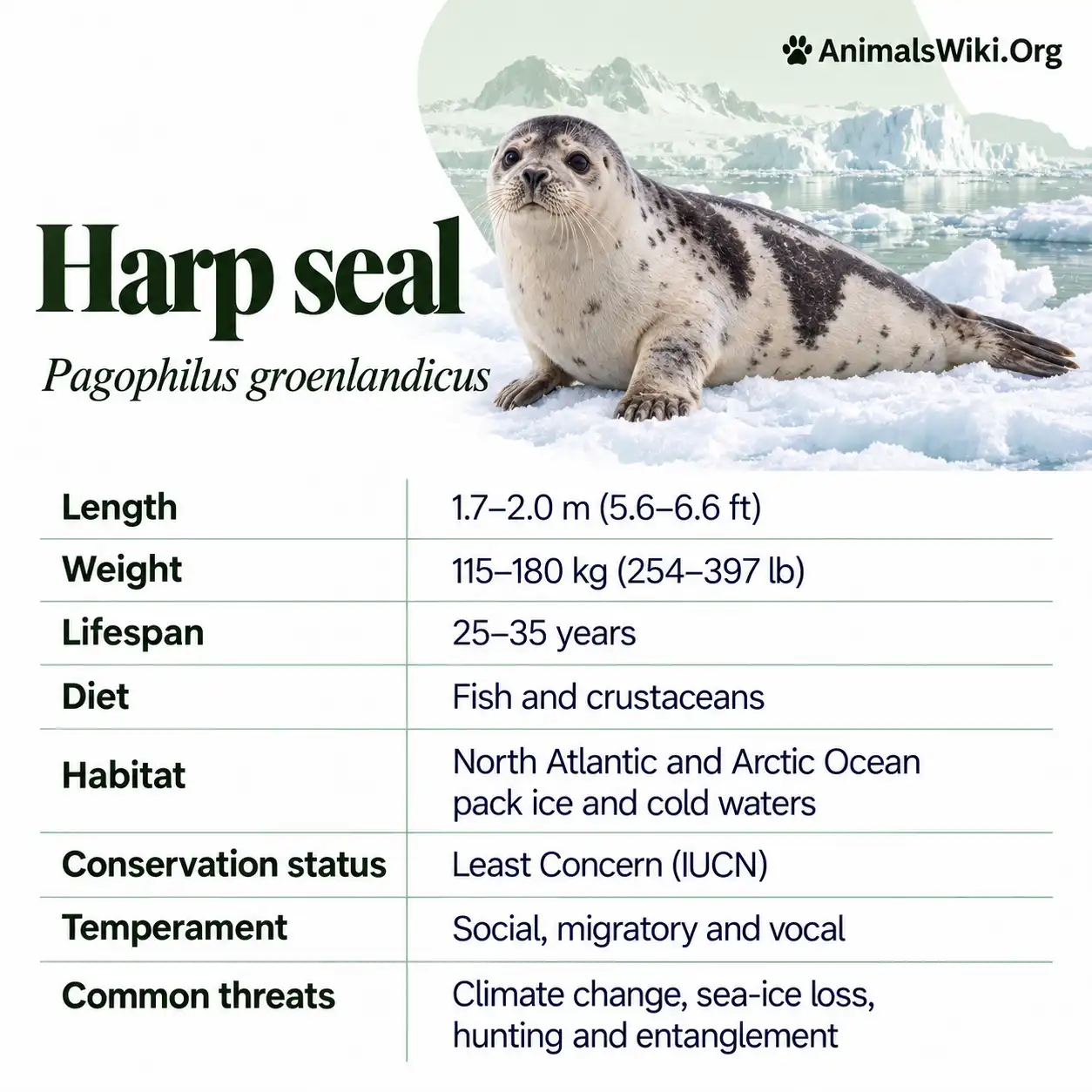
Harp Seal, The Remarkable Life of an Arctic Ice Traveler
The harp seal is a migratory marine mammal known for its pale coat, dark adult markings, and fluffy white pups. Living in the North Atlantic and adjoining Arctic waters, it follows a seasonal rhythm shaped by food, reproduction, and the formation and disappearance of sea ice.
Its name comes from the dark pattern that develops across the back and sides of many adults. This marking resembles a harp or curved saddle, making a mature animal look very different from the white newborn that appears in so many wildlife photographs.
The difference goes far beyond appearance. A newborn depends on a dry coat and a stable ice platform, while an adult is equipped for extended travel and repeated underwater feeding. Between these stages, a young seal must grow rapidly, replace its first coat, survive a period without maternal milk, and begin finding its own food.
Harp seals also tell an important conservation story. In October 2025, the IUCN moved the species from Least Concern to Near Threatened, reflecting growing concern about its future in a changing Arctic. Their continued abundance should therefore be considered alongside their dependence on seasonal habitat.
This guide explores harp seal identification, habitat, migration, feeding, reproduction, early development, and the pressures affecting populations today.
Harp Seal Facts
| Feature | Information |
|---|---|
| Common name | Harp seal |
| Other names | Greenland seal, saddleback seal |
| Scientific name | Pagophilus groenlandicus |
| Animal group | Mammal |
| Family | Phocidae |
| Seal type | True seal |
| Distribution | North Atlantic and adjoining Arctic waters |
| Typical adult length | Approximately 1.6 meters, with individual variation |
| Typical adult weight | Roughly 120–150 kilograms, depending on sex, season, and population |
| Diet | Fish and marine invertebrates |
| Birthplace | Seasonal pack ice |
| Young | Usually one pup |
| Nursing period | Approximately 12 days |
| Newborn appearance | Pale, woolly coat, often initially yellowish |
| Global conservation status | Near Threatened |
1. What Is a Harp Seal?
A harp seal is a true seal belonging to the species Pagophilus groenlandicus. It is an air-breathing mammal whose body is adapted for moving, feeding, and surviving in cold marine environments.
Like other mammals, it maintains its internal temperature, gives birth to live young, and nourishes its offspring with milk. Its aquatic adaptations do not remove its dependence on air or on suitable surfaces for important activities such as giving birth and molting.
Harp seals belong to Phocidae, the family of true seals. This family also contains harbor seals, elephant seals, monk seals, and several other species. Sea lions and fur seals belong to a different family.
Older publications sometimes use the scientific name Phoca groenlandica. Readers researching the species may therefore encounter both names in scientific literature.
Recognizing these naming differences is useful when comparing older biological research with newer assessments. A change in the name used by a publication does not necessarily mean it studied a different animal.
2. Why Is It Called a Harp Seal?
The common name refers to the dark marking that appears on the backs and sides of many mature harp seals. Against a pale background, the curved pattern can resemble a harp.
Another name, saddleback seal, describes a similar visual impression. The name Greenland seal reflects the species’ association with northern Atlantic waters around Greenland and neighboring regions.
The marking is an adult characteristic, not something a newborn carries beneath its white coat. Young animals pass through several appearances before developing a recognizable adult pattern.
Even among mature seals, the markings are not identical. Some have a sharply defined dark pattern, while others remain more spotted.
That variation matters for identification. A photograph of a spotted individual can still show a harp seal even if the familiar harp-shaped marking is incomplete.
The species’ name therefore describes a characteristic appearance, but age and individual variation must also be considered when deciding what animal is being observed.
3. What Does an Adult Harp Seal Look Like?
An adult harp seal usually has a streamlined, robust body, a relatively small head, a tapered muzzle, and short flippers. Mature animals often show a dark face and dark back markings against a silver-gray background.
The overall effect is quite different from the fluffy white appearance associated with newborn pups. Adults have a shorter coat suited to their more aquatic stage of life.
Males and females are broadly similar in size, although males tend to be somewhat larger. The difference is much less dramatic than in species such as elephant seals.
As members of the true seal family, harp seals lack visible external ear flaps. Ear openings are present, but the projecting ears associated with sea lions are absent.
A useful identification combines body shape, coat pattern, age, and location. A dark-faced seal resting on northern pack ice offers a different identification context from an unfamiliar spotted seal on a temperate beach.
4. Harp Seal Size, Weight, and Lifespan
Harp seals are medium-sized seals. Many adults measure around 1.6 meters in length and weigh roughly 120–150 kilograms, although published measurements vary.
Weight is especially sensitive to season and condition. An animal that has accumulated substantial reserves is not directly comparable with one that has recently completed a demanding reproductive period.
This is why a single average should not be treated as a precise description of every adult. Sex, age, population, and the point in the annual cycle all matter.
Harp seals can live for several decades. Authoritative accounts give different upper ranges, with descriptions commonly extending into the thirties and some accounts reporting longer potential lifespans.
A careful general description is that the species is capable of living for around 30 years or more.
Potential longevity is different from expected survival at birth. A pup must first survive the vulnerable transition from nursing to independent feeding before it can contribute to the older age classes within a population.
5. Harp Seal vs. Harbor Seal
Harp seals and harbor seals have similar names, but they are different species with different ecological patterns.
Harbor seals are strongly associated with coastal resting sites such as beaches, rocks, and sandbanks. Harp seals undertake extensive seasonal movements and use pack ice for breeding.
The difference between their pups is particularly striking. Harbor seal pups normally enter the water shortly after birth, while newborn harp seals are more dependent on their ice platform and dry natal coat.
| Feature | Harp seal | Harbor seal |
|---|---|---|
| Scientific name | Pagophilus groenlandicus | Phoca vitulina |
| Broad lifestyle | Highly migratory, associated with seasonal ice | Primarily coastal |
| Adult coat | Often pale with a dark face and harp-shaped marking | Variable spotting or rings |
| Typical birth surface | Pack ice | Shoreline or other suitable haul-out |
| Newborn coat | Thick, pale lanugo | Usually a shorter coat after prenatal lanugo shedding |
These differences show why information about one seal species should not automatically be applied to another. Their shared family does not make their early development identical.
6. Where Do Harp Seals Live?
Harp seals occur in the North Atlantic and neighboring Arctic waters. Their range includes waters associated with eastern Canada, Greenland, and northern European and Russian marine regions.
They are not Antarctic seals. A white pup on ice may suggest a generic polar setting, but harp seals belong to the northern polar and subpolar marine world.
Their distribution changes through the year. Breeding brings animals into relatively concentrated areas, while feeding and migration spread them more widely.
The location of suitable ice is important, but adults also spend considerable time traveling and feeding in open water. Their range cannot be understood simply by drawing a line around permanent ice.
A seasonal map is therefore more informative than a single static image. The same population may occupy different parts of the ocean during breeding, molting, and summer feeding.
This mobility is central to the species’ success, while also exposing it to changing conditions across a large marine region.
7. The Three Main Harp Seal Populations
Scientists generally recognize three major harp seal populations associated with different breeding regions:
- The Northwest Atlantic population
- The Greenland Sea population
- The White Sea–Barents Sea population
These groups are distinguished partly by where they reproduce. They also differ in aspects of movement, population history, and environmental exposure.
Within the Northwest Atlantic, breeding areas include waters off southern Labrador and northern Newfoundland, often called the Front, and areas within the Gulf of St. Lawrence.
A population is not the same thing as a temporary group of animals visible on one piece of ice. It is a broader biological and management unit.
This distinction matters when reading population estimates. A figure for Northwest Atlantic harp seals does not represent every harp seal worldwide.
It also matters when discussing conservation. A favorable year in one breeding region may occur alongside poor conditions elsewhere, and a single headline can hide substantial geographic variation.
8. Why Sea Ice Is Essential to Harp Seals
Sea ice provides the physical platform on which harp seals give birth and nurse their pups. For newborns, it is a crucial part of their early environment.
An adult can leave unstable ice and swim away. A newborn has fewer options because its insulation, energy reserves, and aquatic abilities are still developing.
The importance of ice therefore depends on its timing, stability, and persistence. Ice that forms briefly but breaks apart during nursing may not provide the same conditions as a dependable platform.
This helps explain why total ice area alone does not answer every biological question. Researchers also need to know whether usable ice is present in the right place during the breeding period.
The connection between habitat and survival is direct: the breeding surface must remain usable while pups pass through a vulnerable developmental stage.
For harp seals, conserving habitat involves a moving, seasonal environment rather than protecting only a permanent patch of land.
9. What Is Pack Ice?
Pack ice consists of floating sea ice, often broken into pieces called floes. Wind, currents, freezing, and melting continually change its arrangement.
This makes harp seal breeding habitat unusually dynamic. A surface that appears stable in a photograph is part of a larger moving system.
The floes can drift, separate, collide, or break apart. Open water between them provides access to the sea, while the ice itself offers space for resting and raising young.
Harp seals do not experience this environment as a fixed coastline. Their surroundings can change while they remain in the same general breeding region.
The movement also creates challenges for mothers returning to pups. Reliable recognition becomes important when the landscape lacks permanent landmarks.
Understanding pack ice helps explain many features of harp seal biology: concentrated births, brief nursing, rapid pup growth, and dependence on environmental conditions during a narrow seasonal window.
It is habitat with an expiration date, and the animals’ annual cycle must fit within it.
10. Harp Seal Migration
Harp seals are long-distance seasonal travelers. Their movements connect breeding and molting areas with feeding grounds farther north.
In the Northwest Atlantic, many animals spend summer in Arctic waters and around Greenland before moving south toward eastern Canadian breeding regions.
After breeding and molting, they begin moving toward northern feeding areas again. Other populations follow their own routes within the Greenland Sea and Barents Sea regions.
These journeys can extend for thousands of kilometers over a complete annual cycle.
Migration should not be imagined as every seal traveling in a single tightly organized formation. Individuals differ in timing, age, reproductive condition, and the route they follow.
The broad pattern is seasonal movement between areas that meet different needs. A place suitable for raising a pup may not offer the best feeding opportunities later in the year.
The animal’s range is therefore a network of seasonally useful environments connected by travel.
11. How Young Harp Seals Begin Their First Journey
A young harp seal does not simply follow its mother throughout a long apprenticeship. After the short nursing period, it must begin an independent transition toward feeding and migration.
Satellite-tracking research has examined this early movement in juveniles from the Greenland Sea and Northwest Atlantic populations.
The work revealed similarities in their overall northward movements but differences in how diving behavior developed. Environmental conditions, including sea ice concentration and water depth, were associated with movement patterns.
This is an important stage because several demands arrive together. The young seal must travel, locate suitable feeding opportunities, and improve its ability to remain underwater.
Its first journey therefore combines movement with physiological and behavioral development.
The challenges are also population-specific. Young animals beginning life in different breeding regions do not necessarily encounter the same water depths, ice conditions, or prey fields.
Early experience can help shape how effectively they make the transition to independent life.
12. How Harp Seals Swim
Harp seals have streamlined bodies and flippers that allow efficient movement through water. Their hind flippers help generate propulsion, while the foreflippers contribute to control and maneuvering.
As true seals, they have a very different movement pattern on a solid surface. They cannot move over ice with the same upright, flipper-supported gait associated with sea lions.
Instead, they use body movements to progress across the surface. This can look awkward compared with the smooth control they display underwater.
The contrast reflects the environment in which their bodies perform most effectively. An animal built for aquatic travel does not need to resemble a land-running mammal.
Swimming also supports different activities. Traveling between regions, moving around a breeding aggregation, and pursuing prey require changes in speed and direction.
The harp seal’s body allows these tasks to be combined within a marine lifestyle that alternates between extensive time in water and important periods resting on ice.
13. Harp Seal Diving Abilities
Harp seals can dive hundreds of meters beneath the surface. NOAA describes dives reaching approximately 400 meters, with submergence lasting around 16 minutes.
These figures describe capability, not the depth and duration of every dive. The best feeding depth depends on where suitable prey is located.
Tracking research on Greenland Sea harp seals has documented movements and diving across different marine areas, showing that dive behavior changes with location and season.
This flexibility matters because prey are not distributed evenly through the water column. Food may be concentrated near the surface, at intermediate depths, or closer to the seabed.
A deeper dive also carries costs. The seal must spend time descending and ascending, so greater depth is useful only when the feeding opportunity justifies it.
The most informative question is therefore not simply how deep the species can go, but how it matches its diving effort to the environment it is using.
14. How Diving Capacity Develops
A harp seal pup is not born with the same oxygen-storage capacity as an adult. Development must occur before it can perform the repeated feeding dives required for independence.
Research comparing harp and hooded seals has examined oxygen stores from birth to maturity. Blood and muscle oxygen stores are important components of their ability to support underwater activity.
This development connects physiology with survival. Finding prey is useful only if the animal can reach it and remain submerged long enough to capture it.
Body growth, oxygen storage, swimming experience, and feeding skill all contribute to the transition.
It also explains why an adult’s maximum dive cannot be used to describe what a newborn or newly weaned pup can safely accomplish.
Young seals are developing systems, not miniature adults with identical performance. Their vulnerability reflects the gap between what they need to do and the abilities they are still acquiring.
That gap is especially important when environmental conditions force them into the water early.
15. What Do Harp Seals Eat?
The harp seal diet includes fish and marine invertebrates. Important prey can include capelin, herring, polar cod, other small fishes, krill, amphipods, and shrimp.
The exact mixture varies with region, season, and age. A seal feeding along northern drift ice encounters different opportunities from one in a southern feeding area during winter.
Research in the Barents Sea and White Sea has documented substantial changes in diet between sampling locations and stages of the annual cycle.
This variety helps the species use a broad marine range. However, it does not mean every prey item is equally valuable or equally available.
The animal must obtain enough usable energy to cover movement, maintenance, growth, and reproduction.
A good general description is that harp seals are flexible marine predators whose actual meals reflect the ecosystems through which they move.
A species-wide food list is useful, but it cannot replace evidence about what animals in a particular population are eating.
16. Why Small Crustaceans Matter So Much
Harp seals demonstrate that a large marine mammal does not need to depend entirely on large prey.
Krill and amphipods can be important food resources, particularly in northern feeding areas. These relatively small animals can occur in concentrations that make them valuable to predators.
Their importance also connects harp seals to lower levels of the marine food web. Changes affecting the distribution or abundance of small crustaceans can influence animals much larger than themselves.
A seal eating an amphipod is therefore part of a chain linking ocean productivity to marine mammal survival.
Research in Norwegian high Arctic waters has examined harp seal body condition and prey relationships, identifying prominent roles for amphipods and polar cod in the sampled diet.
The broader lesson is that conservation cannot focus only on the visible mammal. Maintaining its food supply involves understanding smaller organisms, the environments supporting them, and how those relationships change across the year.
17. How Food Availability Changes Feeding Behavior
A flexible diet can help harp seals respond when prey conditions change, but flexibility has limits.
Barents Sea research has examined how reduced capelin availability can alter the composition of seal diets. When one important resource becomes less available, consumption of other prey may increase.
This does not guarantee that every substitute provides the same energetic return. Finding, catching, and digesting different foods can involve different costs.
Researchers studying prey preference also distinguish between what a seal eats and what it actively selects. A frequently consumed prey species may simply be especially abundant where the animal feeds.
That distinction is important when interpreting stomach-content records. Diet composition describes consumption; preference requires comparison with prey availability.
Understanding both helps explain why environmental change can affect seals even when their food list remains long.
The relevant question is whether enough suitable prey is accessible at the time and place the animals need it.
18. Harp Seal Energy Reserves
Harp seals must balance periods of feeding with periods when energy demands are high and feeding opportunities may be reduced.
Blubber serves as an energy reserve as well as insulation. Its importance becomes especially clear during reproduction and early pup development.
The amount of stored energy changes through the annual cycle. Consequently, body condition provides information that body length alone cannot.
Researchers have studied seasonal energy requirements and the relationship between body fat and metabolism in harp seals. Such work helps explain why a population’s condition cannot be assessed only by counting individuals.
A large population experiencing poor feeding conditions may face different challenges from one with abundant resources.
Energy reserves also connect one season to the next. The outcome of feeding can influence an animal’s ability to complete later demands.
This carryover makes harp seal ecology a year-round story. Breeding success is linked to conditions experienced before the animals gather on the ice.
19. Harp Seal Social Behavior
Harp seals can gather in large concentrations, particularly during breeding and molting. They also travel and feed in groups.
This social appearance contrasts with species more often observed as scattered individuals along shorelines.
However, a visible aggregation should not be treated as proof that every animal has a lasting bond with every other member. Animals may gather because the same habitat meets their immediate needs.
Suitable ice, synchronized reproduction, and the seasonal cycle can bring many individuals into the same area.
The group also changes over time. Breeding concentrations give way to later movements and more dispersed feeding.
A solitary harp seal can therefore be entirely normal in the right context. NOAA has described healthy animals resting alone on New England beaches.
The useful approach is to interpret behavior in relation to location, season, and condition rather than assuming the species must always appear in a large herd.
20. Harp Seal Sounds and Communication
Harp seals have an extensive underwater vocal repertoire. Their breeding areas contain acoustic activity that people watching from above the ice may never hear.
Researchers have studied how these calls are arranged in time and frequency, including how animals reduce interference from one another’s sounds.
A study examining 16 call types found patterns consistent with the seals using timing and frequency separation to reduce acoustic masking.
This is especially relevant in a crowded soundscape. A signal is useful only if another animal can distinguish it from surrounding noise.
The findings do not mean every call has a fully understood meaning. They show that communication involves more organization than a random collection of underwater sounds.
For a general observer, this adds a hidden dimension to the species. The ice surface may appear quiet while the water beneath it carries a busy exchange of signals.
Studying that exchange helps researchers understand social behavior that visual observation alone cannot reveal.
21. How Mothers Locate Their Pups
A harp seal mother faces a difficult recognition problem. She must locate and identify her pup in an environment where ice moves and permanent landmarks are scarce.
Research has described the use of visual, auditory, and olfactory information in this process.
These different signals can contribute at different distances. A cue that helps a mother approach a pup’s general location is not necessarily sufficient to confirm its identity at close range.
This is why recognition is better understood as a sequence than as one perfect sensory ability.
The moving habitat adds another complication. A familiar piece of ice may shift in relation to surrounding floes and open water.
Mother–pup reunion therefore demonstrates how behavior fits the environment. Successful care depends on finding the correct young animal within a changing landscape.
It also provides a reason to avoid disturbing breeding groups. Interrupting movement or separating animals can interfere with interactions that are essential during the short nursing period.
22. Harp Seal Breeding Season
Harp seals breed seasonally, with the schedule varying among populations. Their reproductive cycle is closely tied to the availability of suitable ice.
In the Northwest Atlantic, births commonly occur from late February into March. Other breeding regions can have somewhat different timing.
Females generally produce a single pup. A dense breeding aggregation therefore represents many individual mother–pup relationships rather than shared communal nursing.
The concentration of births creates a short, demanding period in the annual cycle. Mothers must transfer substantial energy to their pups while the breeding platform remains usable.
Mating occurs in the water around the end of the nursing period.
The timing explains why short-term environmental events can matter greatly. A period of ice breakup during the breeding window can affect animals at a stage when they are especially dependent on that habitat.
Annual conditions must therefore be considered alongside longer-term trends. Both influence what happens during a particular breeding season.
23. The Newborn Harp Seal
A newborn harp seal typically weighs around 10–11 kilograms and measures approximately 80–85 centimeters.
Its most recognizable feature is the long, pale natal coat, known as lanugo. Immediately after birth, this fur can have a yellowish appearance before becoming whiter.
Unlike the image of a heavily insulated adult seal, a newborn begins with limited protective blubber. It must acquire much of that reserve during nursing.
The pup’s first days therefore involve rapid change. Its weight, body composition, and capacity to cope with the environment develop over a short period.
The ice is essential during this stage because it supports the dry-coat insulation strategy used by the youngest pups.
A photograph captures the appearance but can hide the urgency of development. Beneath the fluffy coat is an animal preparing for a major shift from dependence on maternal milk to life as an independent marine predator.
24. Why Baby Harp Seals Are White
The whitecoat stage is an early developmental phase, not the permanent appearance of the species.
The long natal fur helps provide insulation in air. Its thermal function is especially important before the pup has developed substantial blubber.
Research comparing harp seal pelts at different ages has shown that the insulating function changes as the animal develops.
The key distinction is between a coat functioning in air and the same coat becoming wet. The youngest whitecoat pups are particularly vulnerable to heat loss when submerged.
It is therefore misleading to explain the white fur only as camouflage. Color is visually striking, but the coat’s physical properties are central to the pup’s early survival.
As the animal grows and its insulation strategy changes, the natal coat is replaced.
The whitecoat is best understood as part of a temporary biological package suited to a specific environment and life stage: a young pup resting on seasonal ice.
25. How Harp Seal Pups Stay Warm
A young harp seal’s insulation changes substantially during development.
Early in life, dry lanugo provides much of the thermal protection. As nursing continues, the pup accumulates blubber and becomes less dependent on the natal coat.
Research has documented this shift in thermoregulatory strategy across age classes, showing why the same environmental exposure can have different consequences at different ages.
A small newborn and a well-fed older pup do not have identical capacities to resist heat loss.
Wetness is particularly important. An early pup forced into the water loses the full benefit of a dry, air-filled coat at a time when its blubber reserve is still limited.
This connects physiology directly to ice conditions. A stable platform gives the animal time to develop the insulation needed for a more aquatic life.
The problem with early ice breakup is therefore more than losing a resting place. It can force a developmental transition before the pup is ready.
26. Nursing and Rapid Growth
Harp seal nursing lasts approximately 12 days, making it a short and intense period of maternal investment.
During that time, the pup gains weight rapidly and builds the reserves needed for the next stage of life. Much of the visible change reflects the accumulation of blubber.
Studies of lactation energetics have measured maternal mass loss, pup growth, milk composition, and energy transfer.
These measurements reveal how demanding the process is for the mother. Producing a rapidly growing pup requires a substantial transfer of stored resources.
The nursing period should not be described as a leisurely stage of prolonged dependence. It is a compressed interval during which the young animal must prepare for maternal departure.
That timing also limits opportunities to recover from disruption. Lost nursing time matters when the total period is brief.
For both mother and pup, successful reproduction depends on the coordination of energy reserves, behavior, and a breeding surface that remains available long enough
27. What Happens After Weaning?
When nursing ends, the mother leaves, and the pup enters a new stage without a continuing supply of milk.
Young harp seals can undergo a postweaning fast, drawing on reserves accumulated during lactation. They do not immediately begin feeding with adult efficiency.
Researchers have studied mass loss, metabolism, and energy use during this period. The work helps explain how young seals sustain themselves while their behavior and physiology continue developing.
Fasting is part of the normal life history, but its success depends on the reserves available and the demands placed on the animal.
An animal using more energy than expected may exhaust those reserves sooner.
This period is therefore both an adaptation and a vulnerable transition. The pup has been equipped with stored energy, but that store is finite.
Eventually, survival requires successful feeding. The young seal must move from consuming resources supplied by its mother to locating and capturing prey for itself.
28. Whitecoat, Ragged Jacket, Beater, and Bedlamer
Harp seal coat stages have distinctive names, many originating in historical observations and sealing terminology.
| Stage | General appearance |
|---|---|
| Yellowcoat | Newly born pup with a yellowish tint |
| Whitecoat | Pup retaining the pale natal coat |
| Ragged jacket | Pup shedding natal fur in patches |
| Beater | Young seal with a shorter, spotted coat |
| Bedlamer | Immature seal in a later spotted stage |
| Adult harp | Mature animal with developing or established adult markings |
These labels describe appearances, not perfectly precise ages applicable to every individual.
The ragged-jacket stage can look untidy because long pale fur is being lost unevenly. The spotted coat beneath becomes increasingly visible.
Adult markings develop over subsequent years rather than appearing immediately after the first molt.
This sequence explains why harp seals of different ages can look like different species. Recognizing the stages helps connect the familiar white pup with the darker-faced adult and the spotted juveniles between them.
29. The Annual Molt
Adult harp seals replace their fur during an annual molt. This occurs within the larger seasonal sequence that includes breeding, movement, and feeding.
Molting is a biological process rather than simply fur becoming worn and falling away. New hair growth and related changes occur within the skin.
Researchers have examined hormones and metabolites in relation to the harp seal molt, illustrating that coat replacement is associated with physiological changes.
The process also helps organize where animals gather. Molting concentrations are a recognizable part of the species’ annual behavior.
For a viewer, an uneven-looking coat may therefore represent a normal stage rather than disease.
Context remains important: normal molting does not mean every unusual skin condition is harmless. It means appearance should be interpreted alongside season, behavior, and the animal’s overall condition.
The molt is another reminder that a harp seal’s needs change throughout the year. Feeding, breeding, and maintaining its body are connected tasks within one annual cycle.
30. What Eats Harp Seals?
Harp seals are prey for several large predators, with the relative importance of each changing across their range.
Polar bears can be important predators in Arctic settings. Killer whales and sharks also take harp seals.
The risks are not distributed evenly. A pup resting on ice and an adult traveling through open water face different circumstances.
Predation is part of the wider food web. Harp seals consume fish and invertebrates while transferring energy to larger predators when they themselves are eaten.
This creates ecological connections across several levels of the marine system.
Natural predation should also be distinguished from other causes of mortality. A population assessment needs to consider survival across life stages rather than attributing every decline to one predator.
The presence of predators is normal. The conservation question is how total mortality interacts with reproduction, feeding conditions, habitat change, and human-caused losses over time.
31. Harp Seals and Fisheries
Harp seals eat fish, so their feeding can overlap with species of commercial or conservation interest.
However, the effect of seal predation on a fish population cannot be determined simply by confirming that seals eat that fish.
Researchers must consider the amount consumed, prey size, geographic overlap, and other influences on fish survival.
Fisheries and Oceans Canada has reported that harp seals were not primary drivers of cod abundance off Newfoundland and southern Labrador through the assessments described in its species account.
That is a regional finding, not a claim that harp seals have no ecological effects anywhere.
It demonstrates why evidence matters. A visible predator may receive attention while less visible environmental or ecological processes also influence fish numbers.
Sound management therefore depends on measurements and ecosystem analysis. The question is how predation fits within the full set of processes affecting the fish population being studied.
32. Harp Seal Population: What Do Recent Estimates Show?
Population figures must be matched to a region and assessment year.
A Canadian research assessment published in 2025 estimated the Northwest Atlantic harp seal population at approximately 4.4 million animals in 2024, with a 95% credible interval of roughly 3.65–5.35 million.
Within that assessment’s reconstructed time series, abundance declined from an estimated 5.6 million in 2019.
These figures describe the Northwest Atlantic population, not the global species total.
They also come from an integrated model, rather than a direct count of every seal. Such models combine evidence about pup production, reproduction, age structure, removals, and environmental conditions.
Older general webpages may retain larger estimates from previous assessments. Comparing those numbers without considering updated models can create misleading conclusions.
The useful approach is to identify the assessment, region, year, and uncertainty before deciding what a population figure says about the species’ condition.
33. Are Harp Seals Endangered?
Harp seals are currently classified as Near Threatened globally, following the IUCN’s October 2025 update.
This differs from older descriptions listing the species as Least Concern.
Near Threatened is also different from the formal Red List category Endangered. Accurate wording helps readers understand the level of assessed risk without exaggeration.
The update highlights the importance of climate-related pressures on Arctic seals. A species can remain numerous while facing conditions that raise concern about future decline.
Conservation status is therefore not simply a popularity contest based on how many animals appear in a photograph. It evaluates risk using evidence about populations and threats.
For harp seals, the central concern is the long-term viability of a life cycle that depends on seasonal ice and productive northern marine ecosystems.
34. How Climate Change Affects Harp Seals
Climate change can affect harp seals directly through breeding habitat and indirectly through their food environment.
The direct pathway is easiest to see. If suitable ice is absent, unstable, or lost too early, pups may enter the water before they have completed essential development.
Research has linked ice conditions with first-year mortality and examined longer-term changes across breeding regions.
The indirect pathway involves feeding and reproduction. Changes in prey availability can influence body condition, while reproductive studies have investigated links among environmental conditions, prey, and pregnancy outcomes.
These processes can operate together. Poor feeding conditions before breeding may reduce reserves, while unsuitable ice creates additional problems after birth.
The result is not necessarily identical in every region or every year.
Understanding climate effects therefore requires both immediate observations and long records. A single cold winter does not remove a long-term problem, just as one poor season does not explain the whole population history.
35. Other Pressures: Hunting, Bycatch, and Pollution
Harp seals have a long history of commercial and subsistence use. These activities differ in scale, purpose, and management context and should not be treated as interchangeable.
Population assessments account for human removals alongside reproduction and natural survival. Historical recovery does not guarantee that the same level of removal remains appropriate under changing conditions.
Bycatch is another pressure. Seals can be caught incidentally in fishing gear, creating mortality separate from directed hunting.
Pollution adds a different concern. Studies have detected contaminants such as organochlorines and mercury in harp seal tissues, showing that northern marine environments are not isolated from chemical exposure.
Detecting a substance does not by itself establish the scale of its effect on a population. Researchers must consider concentrations, exposure history, and biological consequences.
Together, these pressures show why conservation needs several kinds of evidence. Habitat, food, health, and mortality all contribute to the outcome, and reducing avoidable losses becomes especially important when environmental conditions deteriorate.
36. How Scientists Study Harp Seals
Harp seal research combines aerial surveys, tracking, biological sampling, and statistical modeling.
Pup-production surveys provide information about births in breeding areas. Tracking devices reveal movements and diving behavior beyond the places researchers can directly observe.
Age information also matters. Scientists can estimate age by examining growth-layer groups in teeth, although research shows that reader experience and older age classes can introduce errors.
Teeth can reveal more than age. Studies have used chemical information preserved in tooth layers to investigate historical environmental change in the Barents Sea.
These methods answer different questions. A tracking study explains where sampled animals travel; an age study helps describe population structure; a breeding survey measures reproductive output.
Combining them produces a stronger understanding than any single method alone.
That combination is essential for a migratory animal whose life unfolds across large, changing marine regions and whose most important activities often happen far from continuous human observation.
37. What to Do If You See a Harp Seal on a Beach
A harp seal resting on a beach is not automatically stranded. Healthy animals sometimes haul out in places outside the breeding habitat most people associate with the species.
NOAA has described harp seals resting alone on New England shores, where their presence can attract considerable attention.
The best first response is to give the animal space. Keep dogs away, avoid surrounding it, and do not attempt to feed it.
Never push a seal back into the water. It may have come ashore because it needs rest.
If the animal appears injured, entangled, or seriously unwell, contact the appropriate local marine mammal response organization. Provide the location and observations from a safe distance.
A quiet resting seal and an animal needing intervention can look similar to an inexperienced observer. Trained responders can assess the context.
Respectful observation protects the animal while allowing specialists to decide whether any action is necessary.
Frequently Asked Questions About Harp Seals
1. What is the scientific name of the harp seal?
The scientific name is Pagophilus groenlandicus. Older research may use Phoca groenlandica, so both names can appear when you explore the scientific literature.
2. Why is the animal called a harp seal?
The name refers to the dark, curved marking across the back and sides of many adults. The pattern resembles a harp or saddle against a pale background.
3. Are all harp seals white?
No. The famous whitecoat belongs to young pups. Older animals develop shorter, spotted coats, and many adults acquire a dark face and recognizable harp-shaped markings.
4. Where do harp seals live?
They inhabit the North Atlantic and adjoining Arctic waters. Their distribution changes seasonally as they move between breeding, molting, and feeding regions.
5. Do harp seals live in Antarctica?
No. Harp seals are northern animals. Antarctic seals such as Weddell seals, leopard seals, and crabeater seals are different species with different geographic ranges.
6. How big is an adult harp seal?
Many adults are approximately 1.6 meters long and weigh roughly 120–150 kilograms. Measurements vary with sex, age, region, season, and the animal’s condition.
7. How long do harp seals live?
Harp seals can live for several decades. A general description is around 30 years or more, although published accounts differ in their reported upper lifespan.
8. What do harp seals eat?
They eat fish and marine invertebrates, including capelin, polar cod, herring, krill, amphipods, and shrimp. The relative importance of these foods changes by region and season.
9. Do harp seals eat krill?
Yes. Krill can be important prey in some northern feeding areas. Harp seals therefore connect small marine organisms with larger predators in Arctic and North Atlantic food webs.
10. How deep can a harp seal dive?
They can dive hundreds of meters, with NOAA describing dives around 400 meters. Routine feeding dives vary according to prey location and local conditions.
11. How long can a harp seal stay underwater?
NOAA reports submergence lasting around 16 minutes. This represents diving capability rather than the duration of every dive or the performance of a newborn pup.
12. What is a baby harp seal called?
A baby harp seal is a pup. “Whitecoat” describes an early coat stage, while later labels include ragged jacket and beater.
13. Why are newborn harp seals sometimes yellow?
The natal coat can be stained yellowish at birth. This fades, producing the white appearance associated with the whitecoat stage.
14. How much does a newborn harp seal weigh?
A newborn commonly weighs around 10–11 kilograms and measures approximately 80–85 centimeters. Rapid nursing growth changes its weight substantially during the following days.
15. How long do harp seals nurse?
The nursing period is approximately 12 days. It is an intensive interval of energy transfer during which the pup builds reserves needed after its mother leaves.
16. Why do harp seal mothers leave their pups?
Maternal departure follows the species’ short nursing period. The pup then uses accumulated reserves while progressing toward independent feeding; this is part of normal development.
17. Can newborn harp seals swim like adults?
No. Newborns have developing insulation, oxygen stores, and swimming abilities. Early submergence can be particularly dangerous for thin whitecoat pups, whose dry fur provides important protection in air.
18. What is a beater harp seal?
A beater is a young harp seal with a shorter, spotted coat after the white natal fur has been shed. It is a developmental stage, not a separate species.
19. Do harp seals migrate?
Yes. They make extensive seasonal movements between breeding and feeding regions. The routes and timing differ among populations and individual animals.
20. What animals prey on harp seals?
Predators include polar bears, killer whales, and sharks. Their importance varies with region, season, and the age and circumstances of the seal.
21. Are harp seals the same as harbor seals?
No. Harp seals are Pagophilus groenlandicus, while harbor seals are Phoca vitulina. They differ in appearance, movement patterns, breeding habitat, and pup development.
22. Are harp seals endangered?
Their current global IUCN classification is Near Threatened. This is different from the formal Endangered category and replaces the older Least Concern classification.
23. How many harp seals are left?
There is no single recent regional estimate that represents the entire species. A 2025 assessment estimated approximately 4.4 million Northwest Atlantic harp seals in 2024, excluding the other major populations.
24. What is the biggest concern for harp seal pups?
Suitable ice is essential during early development. Premature breakup can force pups into the water before they have developed sufficient insulation and other abilities for independent aquatic life.
25. Should you help a harp seal back into the water?
No. A seal may be ashore to rest. Keep people and dogs away, and contact a local marine mammal response organization if you suspect injury, entanglement, or illness.



