
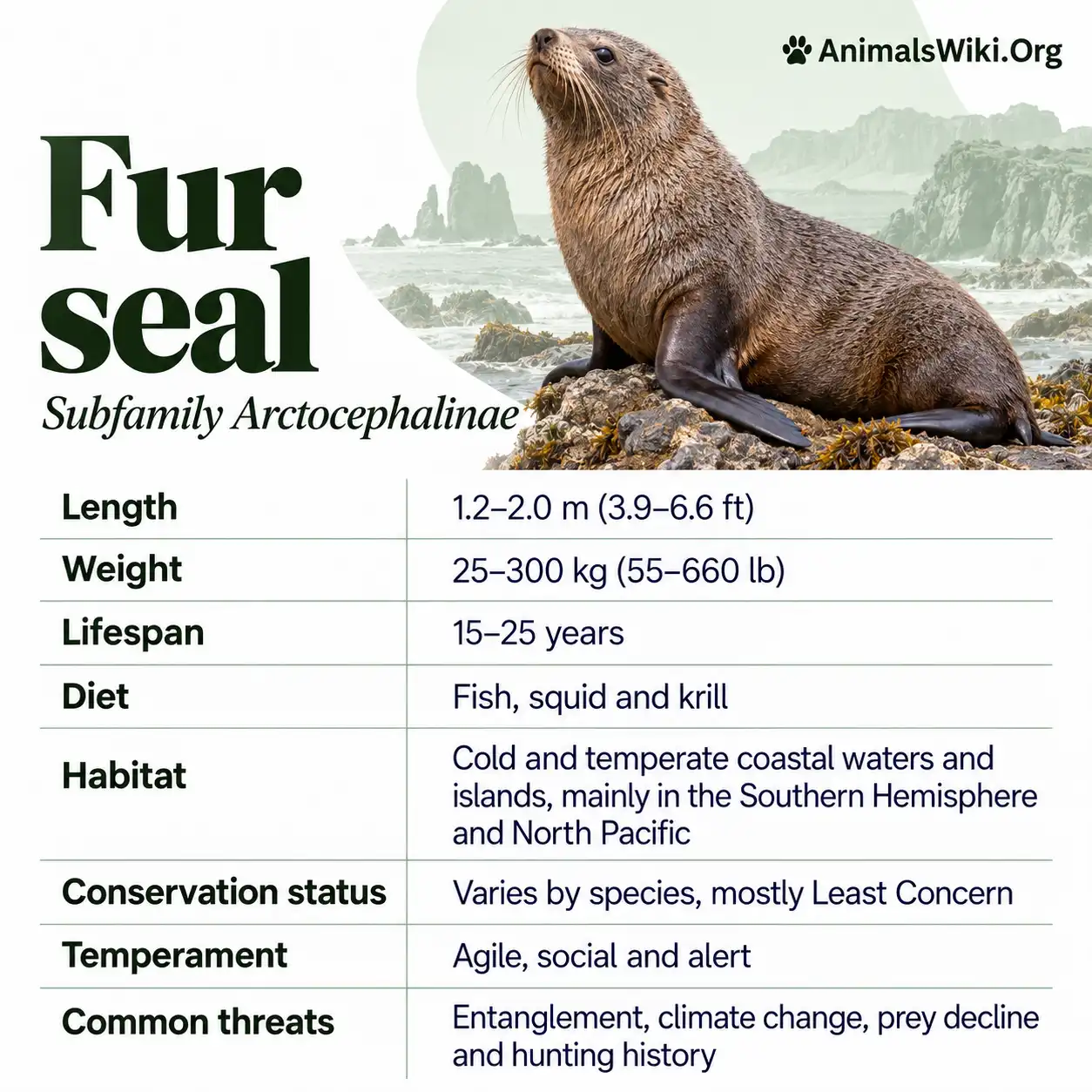
Fur Seal, A Complete Guide to Species, Habitat, Diet and Behavior
A fur seal is a marine mammal recognized for its dense coat, visible ear flaps, long front flippers, and ability to move confidently across rocky shores. Closely related to sea lions, fur seals divide their lives between feeding at sea and resting or breeding on land.
The name describes a group of animals rather than a single species. Northern fur seals travel across the North Pacific, Antarctic fur seals inhabit the Southern Ocean, and Galápagos fur seals live near the equator. Other species occupy coastlines and islands around southern Africa, Australia, New Zealand, and South America.
Their lives involve much more than swimming and sunbathing. A mother returning from a feeding trip must locate her own pup among a noisy crowd. A territorial male may spend weeks defending a breeding area. A young seal eventually leaves the colony and begins finding food independently.
Fur seals also have a complicated conservation history. Commercial hunting devastated many populations, and protection allowed remarkable recoveries. Today, changing ocean conditions, fishing interactions, marine debris, and disease create new challenges.
This guide explains what fur seals are, how the different species live, and why these adaptable marine predators matter.
Fur Seal Facts
| Feature | Information |
|---|---|
| Animal type | Marine mammal |
| Family | Otariidae, the eared seal family |
| Living species | Nine recognized species |
| Genera | Arctocephalus and Callorhinus |
| Closest familiar relatives | Sea lions |
| Main identifying features | Dense underfur, external ear flaps, long foreflippers |
| Diet | Fish, squid, and other marine prey; some populations consume substantial amounts of krill |
| Main habitats | Coastal waters, offshore feeding areas, rocky shores, and oceanic islands |
| Reproduction | Usually one pup per pregnancy |
| Parental care | Mothers nurse pups and make feeding trips to sea |
| Size differences | Adult males are generally much larger than females |
| Conservation | Varies by species and population |
1. What Is a Fur Seal?
A fur seal is an air-breathing mammal belonging to the eared seal family, Otariidae. This family also includes sea lions. Fur seals are part of the broader pinniped group, alongside true seals and walruses.
Their small external ear flaps are among the easiest features to recognize. They also have long front flippers and hind flippers that can turn underneath the body, helping them move on land.
The word “fur” refers to their well-developed coat, especially the dense underfur beneath the longer outer hairs. This insulation is particularly important during life in the water.
Fur seals give birth to live young and nourish them with milk. Although their bodies are adapted for swimming, they retain strong ties to land, especially during reproduction.
A rocky beach occupied by fur seals may therefore serve several purposes: a resting place, a breeding site, a nursery, and a meeting point between long periods spent at sea.
2. How Many Fur Seal Species Are There?
There are nine recognized living fur seal species. One belongs to the genus Callorhinus, while the remaining eight belong to Arctocephalus.
| Common name | Scientific name | Broad geographic association |
|---|---|---|
| Northern fur seal | Callorhinus ursinus | North Pacific |
| Antarctic fur seal | Arctocephalus gazella | Southern Ocean islands |
| Subantarctic fur seal | Arctocephalus tropicalis | Southern Atlantic and Indian Ocean islands |
| Brown fur seal | Arctocephalus pusillus | Southern Africa and southern Australia |
| New Zealand fur seal | Arctocephalus forsteri | New Zealand and southern Australia |
| South American fur seal | Arctocephalus australis | South American coasts |
| Galápagos fur seal | Arctocephalus galapagoensis | Galápagos Islands |
| Guadalupe fur seal | Arctocephalus townsendi | Eastern North Pacific |
| Juan Fernández fur seal | Arctocephalus philippii | Oceanic islands off Chile |
Older books and websites sometimes use different classifications. In particular, Guadalupe fur seals have previously been treated as a subspecies of the Juan Fernández fur seal.
The Cape and Australian fur seals, meanwhile, are subspecies of the brown fur seal rather than two additional species. This distinction prevents an inflated species count.
3. What Does a Fur Seal Look Like?
A typical fur seal has a streamlined body, a noticeable neck, prominent whiskers, external ears, and elongated front flippers. Its head may appear pointed or relatively broad, depending on the species.
Coat colors include dark brown, grayish brown, silver-gray, and lighter cream tones. The throat and chest may be paler than the back. Newborn pups often look darker than adults.
Adult males commonly develop a thick neck and a heavy front half. Females usually have a slimmer outline.
Appearance also changes when an animal enters the water. Wet fur lies flatter and may look much darker than a dry coat. Consequently, color alone can be misleading when identifying a seal from a photograph.
Australian fur seals provide a good example of these features: they have a robust body, a pointed muzzle, large eyes, and long whiskers sweeping backward from the face. Their thick coat covers most of the body, while the flippers have much less hair.
4. How Big Do Fur Seals Get?
Fur seal size varies considerably among species, sexes, and age groups. A small female and a large territorial male can look so different that an unfamiliar observer might assume they belong to different species.
Northern fur seals illustrate this pronounced difference. Adult males can weigh approximately 175–275 kilograms, while females commonly weigh about 30–50 kilograms. Males may reach roughly 2.1 meters in length, compared with around 1.4 meters for females.
These figures describe northern fur seals, not a universal range for every member of the group.
Body condition also matters. A seal may gain weight during successful feeding periods and lose substantial reserves while fasting or reproducing.
For this reason, photographs can be deceptive. A thick coat may conceal poor condition, and an animal that looks large can still be underweight for its sex and age. Wildlife professionals assess more than overall size when evaluating a fur seal’s health.
5. Fur Seal vs Sea Lion: What Is the Difference?
Fur seals and sea lions share many features because both belong to Otariidae. Both have external ear flaps, use their foreflippers extensively while swimming, and can support themselves on all four limbs on land.
The most useful distinction is their coat. Fur seals generally possess much denser underfur than sea lions.
Head shape, ear size, and body proportions can provide additional clues, but these depend on the species. A single rule about nose length or body size will not work everywhere.
In the Galápagos Islands, fur seals typically have shorter, broader heads, more prominent eyes, and more conspicuous ears than local sea lions. They also favor shaded, rocky resting areas.
| Feature | Fur seals | Sea lions |
|---|---|---|
| External ear flaps | Present | Present |
| Dense underfur | Usually strongly developed | Generally less developed |
| Movement on land | Hind flippers rotate underneath body | Hind flippers rotate underneath body |
| Identification | Requires coat and species-specific features | Requires body and species-specific features |
Learning which species occur locally makes identification much easier than relying on a worldwide size comparison.
6. Why Is Fur Seal Fur So Important?
A fur seal’s coat is a functional part of its survival equipment. It contains longer guard hairs and a dense layer of finer underfur.
Together, these hairs help retain an insulating layer of air close to the skin. Water removes heat efficiently, so maintaining insulation is essential for an animal that repeatedly enters cool or cold seas.
The coat’s effectiveness depends on more than hair quantity. Hair shape, arrangement, density, and surface structure influence how well the fur retains air under water pressure.
Research comparing mammalian coats has identified several structural features associated with aquatic insulation, including dense hair and specialized hair surfaces.
This explains why a fur seal’s coat should not be thought of simply as an unusually thick version of a domestic animal’s fur. It is adapted to repeated immersion.
The coat must function while the seal swims, dives, rests at the surface, and moves between water and land.
7. Do Fur Seals Have Blubber?
Yes. Fur seals have blubber as well as fur.
A common oversimplification claims that fur seals use fur while other seals use fat, as though the two systems were mutually exclusive. In reality, fur seals possess both forms of insulation, although they depend heavily on their coat.
Their blubber also serves as an energy reserve. Stored fat helps support periods when feeding is interrupted, including breeding, nursing, and unfavorable feeding conditions.
Comparative research indicates that fur seals rely more strongly on fur for insulation than many other pinnipeds, while their blubber is particularly important for energy storage.
This combination helps explain why coat condition and body condition are separate concerns. A seal needs an effective insulating covering, but it also needs sufficient energy reserves.
An animal can therefore face problems from damaged fur, depleted fat stores, or both. Understanding these different functions gives a more accurate picture of how fur seals survive in the marine environment.
8. Why Do Fur Seals Groom and Roll in the Water?
Fur seals frequently rub, scratch, roll, and twist while floating. These movements can look playful, but grooming also helps maintain their coat.
Diving compresses the fur and reduces the air held within it. At the surface, rolling and rubbing can help restore air to the coat.
Maintaining insulation is an ongoing activity rather than a one-time preparation before entering the sea. Consequently, grooming can occupy a substantial part of a fur seal’s activity budget.
Researchers studying fur seal energy expenditure distinguish grooming from traveling, resting, and other movements because each activity has different energetic costs.
This behavior also explains why an apparently inactive seal at the surface may still be performing essential maintenance.
A rolling fur seal does not automatically need help. Its movements may be normal coat care. The broader situation—its location, breathing, visible injuries, and ability to move—matters more than one unusual-looking posture.
9. How Do Fur Seals Avoid Overheating?
Dense insulation is valuable in cold water, but it creates another challenge on land: releasing excess heat.
Fur seals can alter their posture, seek shade, change their activity, or move toward water. The usefulness of each response depends on conditions at the colony.
Recent research on Australian fur seals has examined how posture and surface temperatures change across different air temperatures. Such work shows that thermoregulation involves behavior as well as anatomy.
The same beach can contain very different thermal environments. An exposed rock may become much hotter than a shaded crevice, while access to the water offers another way to cool down.
This makes resting-site choice important. What looks like a convenient place to lie may also be a location with favorable temperature, airflow, or shade.
Overheating is therefore part of fur seal ecology even for species associated with cool seas. Their bodies must manage changing conditions above and below the water.
10. Where Do Fur Seals Live?
Fur seals occur across widely separated parts of the world. Their distribution includes northern temperate seas, southern continental coastlines, remote oceanic islands, and equatorial waters.
Different species occupy different combinations of marine and coastal habitat. Some feed far offshore, while others remain more closely associated with continental shelves or island waters.
Breeding sites commonly include rocky islands, boulder shores, exposed ledges, and beaches with suitable access to the sea.
Australian fur seals, for example, occur around southern Australia, with important breeding locations in Bass Strait. Outside the breeding season, animals also use other coastal haul-out sites.
A place where seals rest is not necessarily a breeding colony. Some locations are occupied mainly by nonbreeding animals or by seals passing through.
This distinction matters when interpreting sightings. Seeing several fur seals on a shoreline does not prove that pups are born there, and an empty beach during one visit does not mean the site is permanently unused.
11. The Northern Fur Seal
The northern fur seal inhabits the North Pacific and adjoining seas. Important breeding locations include islands in Alaska and the Russian Far East, with additional colonies farther south.
This species is exceptionally ocean-oriented. Adults can spend more than 300 days of the year at sea, returning to land for reproduction and other seasonal activities.
Its marine movements may involve immense distances, and animals use different areas according to sex, age, season, and breeding status.
Northern fur seals feed on a variety of fish and squid. Their prey changes across regions, reflecting the difference between shelf waters, ocean slopes, and offshore environments.
The species demonstrates an important point about marine mammals: a crowded colony can be only a temporary gathering place for animals whose lives otherwise unfold across a vast ocean.
Protecting the breeding beach is valuable, but the animals also depend on suitable feeding conditions far beyond the shoreline.
12. The Antarctic Fur Seal
The Antarctic fur seal is associated mainly with islands in the Southern Ocean, where it breeds on land and feeds in surrounding waters.
Its diet varies geographically. Around South Georgia, krill is especially important. At other locations, fish and squid can contribute more strongly.
Males establish breeding territories, and females give birth during the austral summer. Pups are generally nursed for approximately four months.
The word “Antarctic” can create the impression of an animal that spends its life on sea ice. However, this species uses land-based breeding colonies.
Its dependence on the ocean remains strong because mothers must repeatedly leave the colony to obtain food.
Environmental conditions near a breeding island can therefore influence pup growth and survival. A productive feeding area supports the mother’s ability to return with sufficient energy for milk production.
This close relationship between reproduction and food availability makes Antarctic fur seals valuable animals for studying changes in Southern Ocean ecosystems.
13. The Subantarctic Fur Seal
The subantarctic fur seal breeds on islands in the southern Atlantic and Indian oceans. Important locations include Gough Island, Amsterdam Island, and the Prince Edward Islands.
Despite its common name, many breeding sites lie north of the Antarctic Polar Front.
One useful identifying feature is its pale face and chest, which can contrast strongly with the darker upper body. These markings help distinguish it from other fur seals sharing the same region.
The species has suffered severe historical exploitation, including the loss of some island colonies. Protection subsequently allowed recolonization and recovery in parts of its range.
At certain locations, subantarctic and Antarctic fur seals breed near one another. Hybridization has been documented where these closely related species meet.
That overlap provides scientists with opportunities to investigate species boundaries and breeding behavior.
For wildlife observers, it also means identification may require care. Location alone cannot always establish which fur seal species is present.
14. The Brown Fur Seal: Cape and Australian Forms
The brown fur seal includes two geographically separated subspecies: the Cape fur seal in southern Africa and the Australian fur seal in southern Australia.
Their separation across the Indian Ocean is striking, but they are classified within the same species, Arctocephalus pusillus.
Both are large fur seals with substantial differences between adult males and females.
Cape fur seals form major colonies around Namibia and South Africa. Australian fur seals breed mainly on islands in the Bass Strait region and use additional coastal resting sites.
Although related, the two subspecies experience different oceanographic conditions, prey communities, and human pressures.
It is therefore useful to keep three levels separate: the brown fur seal as a species, its two subspecies, and the individual colonies within each region.
A conservation problem affecting one colony should not automatically be described as affecting every brown fur seal equally. Local evidence remains important even when animals share a scientific species name.
15. The New Zealand Fur Seal
The New Zealand fur seal is also called kekeno in New Zealand and the long-nosed fur seal in Australia.
It occupies rocky coastal habitats and feeds mainly on fish and squid. Feeding behavior often follows the daily movements of prey through the water column.
Some prey remain deeper during daylight and move closer to the surface after dark. Fur seals can take advantage of this movement by conducting much of their feeding at night.
Their diving ability is impressive. New Zealand’s Department of Conservation reports occasional dives by females exceeding 238 meters and lasting up to 11 minutes.
Those measurements represent demonstrated capability, not the depth and duration of every dive.
The species also illustrates how common names can vary geographically. A visitor reading about a “long-nosed fur seal” in Australia may be learning about the same species called a “New Zealand fur seal” elsewhere.
16. The South American Fur Seal
The South American fur seal occupies coastal areas around South America, where different populations encounter distinct marine environments.
Its diet can include fish, squid, and crustaceans. The relative importance of each prey group varies with location and availability.
This flexibility does not make the species immune to food shortages. If ocean conditions reduce the abundance or accessibility of key prey, seals may still struggle to meet their energy needs.
The species should also be distinguished from the South American sea lion, which is a different animal sharing parts of the same coastline.
For readers researching wildlife photographs, the regional overlap can be confusing. A location label such as “Patagonia” or “Uruguay” is useful context, but it does not establish the animal’s identity.
Current conservation assessments also need to be interpreted at the appropriate scale. A broad species assessment can coexist with major differences among local populations, especially where ocean conditions differ between Pacific and Atlantic shores.
17. The Galápagos Fur Seal
The Galápagos fur seal lives in the Galápagos Islands, making it an unusual example of a fur seal adapted to an equatorial setting.
It commonly rests in shaded, rocky places rather than on the open beaches favored by many tourists. As a result, visitors may see fewer fur seals than sea lions even where fur seals are present nearby.
Its large eyes suit feeding in low light. Fish and cephalopods form important parts of its diet, and much feeding occurs at night.
Typical dives are relatively shallow compared with the maximum capabilities of some other fur seal species, although deeper dives occur.
The Galápagos fur seal is classified as Endangered. Its restricted distribution and exposure to changing ocean conditions make successful reproduction particularly important.
Living near the equator does not remove dependence on cool, productive marine waters. The islands’ wildlife is closely connected to currents and the food supply those currents support.
18. The Guadalupe Fur Seal
The Guadalupe fur seal is strongly associated with islands off Mexico, especially Guadalupe Island.
Its history includes intense hunting followed by survival and recovery from very low numbers. The species remains a major conservation focus.
Unlike the broad, exposed colonies people often imagine, Guadalupe fur seals can use rocky recesses and caves for breeding. These sheltered locations influence how easily animals can be observed and counted.
They also travel beyond their main breeding islands, and individuals sometimes appear along the western coast of the United States.
Under the United States Endangered Species Act, the Guadalupe fur seal is listed as threatened. NOAA works with Mexican researchers and conservation managers to study its movements, feeding areas, and recovery.
This international cooperation is essential because the animals do not remain within one country’s waters.
A seal born at a Mexican breeding colony can encounter environmental conditions, fisheries, and rescue organizations elsewhere during its travels.
19. The Juan Fernández Fur Seal
The Juan Fernández fur seal inhabits remote islands off Chile. Its history is one of the most remarkable among fur seals.
Commercial exploitation became so severe that the species was once believed extinct. Its rediscovery in 1965 demonstrated that small surviving groups had escaped detection.
The animal’s remote, rocky habitat helped shape both its survival and the difficulty of finding it.
Juan Fernández fur seals feed mainly on marine prey such as squid and small oceanic fish. Their breeding behavior includes the use of shoreline and aquatic territories.
Heat also influences life at the colony. Adults may move toward the water to cool down during warm periods.
The rediscovery of this species is often presented as a hopeful wildlife story. It is also a reminder that recovery begins with survivors, suitable habitat, and effective protection.
A species can persist unseen for a time, but rediscovery alone does not eliminate the need for monitoring and conservation.
20. What Do Fur Seals Eat?
Fur seals are carnivores, but their diets vary considerably.
Depending on the species and region, prey can include:
- Small schooling fish
- Larger fish
- Squid
- Other cephalopods
- Krill and additional crustaceans
Australian fur seals provide a useful example of dietary variety. A long-term study identified numerous prey types and found that a smaller set of fish species dominated many samples.
Researchers also observed changes through time, showing that a population’s diet is not necessarily fixed.
This matters because a simple list of foods does not explain how easily seals obtain them. A prey species can remain present in the ecosystem while becoming deeper, more dispersed, or less profitable to catch.
For a nursing female, food must be available within a feeding trip she can complete before returning to her pup.
Fur seal feeding ecology therefore involves prey identity, prey distribution, hunting effort, and the animal’s reproductive responsibilities.
21. How Do Fur Seals Catch Their Food?
Fur seals search for prey through repeated dives, adjusting their movements to the kind of food available.
Some hunt in open water. Others frequently search near the seabed.
Australian fur seals are especially well known for bottom-oriented feeding in Bass Strait. Animal-borne cameras have allowed researchers to observe encounters that would otherwise remain hidden beneath the surface.
These observations reveal that catching prey is only part of the process. A seal must also pursue, handle, and consume it.
A large meal may provide substantial energy but require more time and effort than several small prey items. The value of a feeding opportunity therefore depends on both the reward and the cost.
This helps explain why seals do not always pursue the largest available animal. Effective feeding involves making repeated choices under constraints imposed by depth, oxygen, visibility, and the behavior of prey.
Their hunting is a practical exercise in obtaining sufficient energy efficiently.
22. How Deep Can Fur Seals Dive?
There is no single diving depth that accurately describes all fur seals.
Species differ, and individuals within the same species may use different feeding strategies. Sex, age, prey, season, and location all influence diving behavior.
A maximum recorded dive is also different from a typical feeding dive. An animal capable of reaching substantial depth may spend most of its time much closer to the surface.
Researchers measure diving with electronic instruments that record depth and time. Additional sensors can track swimming speed, movement, or heart rate.
Studies of Antarctic fur seals have shown that diving activity and swimming effort interact with physiological responses in complex ways.
For readers, the most useful question is often “How does this population normally feed?” rather than “What is the deepest dive ever recorded?”
Routine behavior reveals the habitat the seals depend on, while exceptional dives show the outer limits of their performance. Both are informative when kept in context.
23. Do Fur Seals Migrate?
Some fur seals undertake extensive seasonal migrations, while others make more localized movements.
Young northern fur seals face a particularly demanding transition when they leave their breeding colony and begin traveling independently.
Tracking studies have investigated where newly weaned pups go, which winter destinations they use, and how environmental conditions shape their movements.
This early period is important because young seals must combine several developing abilities: navigation, prey searching, diving, and energy management.
Migration should not be imagined as every animal following one narrow route. Individuals can spread across broad areas and use different habitats.
Nor does every movement count as migration. A mother’s feeding trip between the colony and a nearby feeding ground differs from a seasonal relocation across an ocean basin.
Recognizing these different kinds of movement helps explain why fur seal conservation requires information about the whole life cycle, including the less visible months spent far from breeding sites.
24. How Do Fur Seals Sleep?
Northern fur seals have an unusual ability to change their sleep patterns between land and water.
Research shows that they can exhibit strongly asymmetric slow-wave sleep, with one brain hemisphere more deeply asleep than the other.
This arrangement supports resting in an environment where breathing and maintaining a suitable position remain essential.
On land, their sleep can involve more symmetrical activity across the two hemispheres. The difference demonstrates how flexible sleep can be in an animal moving between aquatic and terrestrial environments.
Researchers have also found that northern fur seals greatly reduce rapid eye movement, or REM, sleep during extended periods in water.
These findings should not be simplified into the claim that fur seals never sleep properly or that every species uses exactly the same pattern.
The important discovery is flexibility: the northern fur seal can alter how it sleeps according to where it is resting.
25. Why Do Fur Seals Gather in Colonies?
Breeding colonies concentrate adults and pups in places suitable for reproduction.
A successful colony needs more than space. Access to water, appropriate terrain, and feeding opportunities within reach of nursing females all influence its usefulness.
Colonies can be noisy and crowded. Males defend territories, mothers return from sea, and pups move around while waiting to nurse.
This creates a demanding communication environment. The animals must distinguish important signals from the calls and movements of their neighbors.
Research on Cape fur seals has demonstrated mutual vocal recognition between mothers and pups even when their calls are acoustically similar.
The colony therefore functions as an organized collection of individual relationships rather than an anonymous mass of seals.
Its apparent chaos contains repeated reunions, familiar locations, territorial boundaries, and recognition signals.
These social interactions are central to successful pup care, especially when a mother repeatedly disappears into the ocean and later returns to find her offspring.
26. How Do Fur Seals Reproduce?
Fur seal reproduction commonly follows a seasonal cycle. Females usually produce one pup, while breeding males compete for access to suitable territory and mating opportunities.
In northern fur seals and several other pinnipeds, delayed implantation helps coordinate the timing of reproduction.
After fertilization, the developing embryo does not immediately implant in the uterus. Development pauses before pregnancy proceeds more actively.
This timing mechanism allows mating and birth to occur in an annual pattern suited to the breeding season.
The interval from mating to birth therefore includes both the delay and the period of active development.
Descriptions of “gestation” can become confusing when different sources include or exclude the delay. Clear explanations distinguish the full reproductive interval from active pregnancy.
Delayed implantation is a biological timing system, not a guarantee of reproductive success. The mother still needs sufficient resources to carry the pregnancy and later support the pup through milk production.
27. What Happens After a Fur Seal Pup Is Born?
A newborn pup begins life on land, where it depends on maternal milk.
The mother remains close initially, then starts alternating nursing visits with feeding trips. During her absence, the pup stays at the colony.
This pattern differs from a human expectation that a young mammal should always have its mother beside it. Temporary separation is a normal part of fur seal reproduction.
Northern fur seal mothers and pups repeatedly reunite during a dependence period of roughly four months.
The pup must recognize its mother, respond appropriately when she returns, and maintain itself between feeds.
Its early development also involves changes in movement, coordination, and behavior. Over time, the animal becomes better prepared for life at sea.
An unattended pup is therefore not automatically abandoned. Whether it needs intervention depends on the circumstances, including visible injury, entanglement, location, and assessment by trained wildlife personnel.
28. How Does a Mother Find Her Pup?
Finding one pup in a dense colony is a remarkable sensory task.
Fur seal mothers and pups use individual vocal characteristics to recognize each other. Calls contain patterns that help distinguish a familiar animal from its neighbors.
Experiments with subantarctic fur seals have shown that changes in frequency through time are particularly important in a mother’s recognition of her pup’s voice.
Recognition also involves more than simply hearing a sound. At close range, mothers may inspect a pup, bringing other senses into the reunion process.
The sequence can be understood as locating a likely individual and then confirming its identity.
This matters because nursing is an expensive investment. A mother returning from a difficult feeding trip needs to direct that investment toward her own offspring.
The reunion process is one of the clearest examples of how complex behavior supports survival in a crowded breeding colony.
29. Can Fur Seal Pups Recognize Their Mothers?
Yes. Recognition works in both directions.
Studies of Antarctic fur seal pups have shown that they use multiple features of their mother’s voice, including patterns in frequency, amplitude, and sound energy.
These features provide a kind of acoustic identity. The pup can respond differently to its mother’s call than to the calls of unrelated females.
This is especially useful when animals cannot see one another clearly across a crowded or uneven shoreline.
Learning also matters. The pup becomes familiar with a voice that predicts contact and feeding.
Researchers investigate these abilities through playback experiments, presenting calls or modified signals and recording the animal’s response.
Such studies reveal that a noisy colony contains meaningful information for the seals living within it.
To a visitor, many calls may sound alike. To a pup waiting for its mother, the difference can determine whether it approaches, calls back, or continues resting.
30. How Do Young Fur Seals Become Independent?
Independence requires a major shift from receiving milk to capturing prey.
For northern fur seals, weaning is relatively abrupt. Young animals leave the breeding area and begin their first independent feeding journeys.
That transition is challenging because a pup must obtain enough food while still developing experience in the marine environment.
Rehabilitation centers sometimes receive young northern fur seals that are exhausted, underweight, or unable to feed successfully.
These cases show that reaching the ocean is only the beginning. Survival depends on finding suitable prey, coping with weather, avoiding hazards, and maintaining body condition.
The length of maternal dependence differs among fur seal species, so the northern pattern should not be applied to all of them.
What they share is the eventual need to replace maternal support with independent feeding.
The early months after weaning are therefore a critical stage connecting the protected setting of the breeding colony with the demands of life at sea.
31. How Long Do Fur Seals Live?
Fur seals can live for many years, but lifespan varies among species, sexes, and individuals.
A maximum documented age is different from average life expectancy. Many animals die young, while a smaller number survive long enough to reproduce repeatedly.
Long-term studies of known individuals allow researchers to examine survival across age classes.
Research on female subantarctic fur seals has investigated how survival and reproductive performance change with age. These studies provide evidence of aging while also showing meaningful differences among individuals.
An experienced female may return to a familiar breeding site over multiple seasons, but age alone does not explain her success. Condition, environmental circumstances, and individual quality also matter.
For this reason, a single statement such as “fur seals live exactly 20 years” would be misleading.
A more useful description is that they are relatively long-lived marine mammals whose survival depends on passing through vulnerable early stages and maintaining condition through adulthood.
32. What Eats Fur Seals?
Fur seals are predators, but they are also prey.
Depending on the region, natural predators can include killer whales, large sharks, and other marine mammals. The importance of each predator differs among locations.
South American fur seals, for example, can be attacked by sharks, killer whales, and South American sea lions.
Pups and inexperienced young animals may face different risks from large adults. The location of an attack also matters: danger near the colony may differ from danger encountered during offshore feeding.
Predation is a natural ecological process. It should be distinguished from additional mortality caused by fishing gear, pollution, or other human activities.
Fur seals occupy an intermediate position in marine food webs. They consume smaller animals while providing food for larger predators.
This connection helps explain why changes in fur seal abundance can affect more than the seals themselves. Their populations are linked to both the animals they hunt and the predators that hunt them.
33. Why Are Fur Seals Important to Marine Ecosystems?
Fur seals connect several levels of the marine food web.
By consuming fish, squid, and crustaceans, they transfer energy from these prey into the bodies of larger marine predators.
Their feeding behavior also provides information about the ocean. Changes in what seals eat, where they travel, or how long they remain at sea can reveal shifts in prey availability.
Scientists studying Australian fur seals have investigated how environmental conditions influence feeding effort, success, and efficiency.
The distinction is important. An animal may work harder without obtaining more food, or it may change its feeding area to maintain its energy intake.
Consequently, a seal’s behavior can reveal stress in the ecosystem before an obvious population decline appears.
Fur seals are therefore useful indicators, but interpretation requires evidence. A longer feeding trip could reflect several causes, so researchers combine tracking, diet, and condition measurements to understand what is happening.
34. How Did Commercial Hunting Affect Fur Seals?
Dense fur made these animals valuable to commercial hunters.
Across many regions, sealing greatly reduced populations and eliminated some colonies. The effects were especially severe where hunters repeatedly visited accessible breeding sites.
New Zealand fur seals were among the animals heavily exploited. Protection later allowed them to return to parts of their former range.
Recovery can make seals appear to be “new arrivals” in places where people have not seen them for generations. In some cases, they are reoccupying historical habitat.
This history changes how modern sightings should be understood. Increasing encounters do not automatically indicate an unnatural population expansion.
They may reflect the gradual rebuilding of a distribution that existed before intensive hunting.
At the same time, historical recovery does not mean every current problem has disappeared. A population can rebound from exploitation and later encounter new pressures from changing prey, disease, coastal development, or fishing interactions.
35. Are Fur Seals Endangered?
There is no single conservation status for all fur seals.
Assessments depend on the species, and legal protections can differ from global extinction-risk categories.
A particularly important update occurred in April 2026, when the Antarctic fur seal moved from Least Concern to Endangered on the IUCN Red List.
The assessment reported a decline of more than 50%, from an estimated 2,187,000 mature animals in 1999 to 944,000 in 2025.
IUCN identified climate-related changes in food availability as a central cause. Warmer waters and shrinking sea ice affect krill distribution and accessibility.
The Galápagos fur seal is also assessed as Endangered, while Guadalupe fur seals are listed as threatened under United States law.
These examples show why the question needs a species-specific answer.
A large colony in one location cannot establish the security of the entire group. Conservation depends on trends over time, geographic distribution, reproduction, and the threats affecting particular populations.
36. How Does Climate Change Affect Fur Seals?
Climate change can affect fur seals through their food supply, even when the animals breed on land.
Changes in ocean temperature, currents, and sea ice influence where prey live and how easily seals can capture them.
Long-term monitoring around Signy Island has documented substantial changes in seal numbers, including declines in Antarctic fur seals.
Such findings demonstrate that a land-breeding species can still be strongly affected by changes elsewhere in the ecosystem.
A mother may continue returning to the same beach while finding that surrounding feeding conditions have deteriorated.
This creates a difficult reproductive constraint. She must obtain food and return to her pup, so simply traveling indefinitely to find better conditions is not an unlimited option.
Climate effects also interact with local geography and species biology. Different colonies may experience different outcomes.
The most useful assessments therefore combine broad climate information with long-term observations of animals, prey, and breeding success.
37. Why Is Entanglement Dangerous for Fur Seals?
Fur seals can become caught in fishing line, net fragments, plastic packaging bands, and other marine debris.
A loop that fits around a young animal may tighten as it grows. Material can cut into tissue, interfere with feeding, or restrict movement.
Long-term research at Bird Island, South Georgia, has documented Antarctic fur seal entanglements involving several kinds of debris.
The problem can continue far from the place where the material entered the ocean. A discarded item may travel before encountering wildlife.
Entanglement is also difficult to evaluate from a single observation. A seal may still swim or move on land while suffering a serious injury.
Reducing the problem requires preventing debris from entering the sea and responding appropriately when affected animals are found.
Disentanglement should be carried out by trained personnel. A frightened seal can move quickly, and attempting to restrain it without suitable experience can injure both the animal and the person involved.
38. How Do Fisheries Affect Fur Seals?
Fishing interactions include accidental capture, contact with gear, and changes in access to prey.
The importance of each issue varies among fisheries and seal populations.
Australian fisheries management recognizes seals as protected animals and addresses interactions through monitoring and mitigation.
Effective solutions need to consider how the fishing operation works. A measure suitable for one gear type may not address the hazards created by another.
Useful approaches can include modifying equipment, changing procedures, improving reporting, and reducing lost gear.
Understanding the seals’ behavior is also essential. Researchers need to know when animals approach vessels, which species are involved, and whether encounters lead to injury or death.
The goal is to reduce harmful interactions using evidence from the relevant fishery.
This is more informative than assuming all fishing activities affect every fur seal population in the same way. Local information helps identify the problems that practical changes can actually solve.
39. Can Disease Threaten Fur Seal Colonies?
Yes. Disease can cause individual deaths and, in some circumstances, affect larger numbers of animals.
Dense breeding aggregations make health monitoring important, although a colony’s appearance alone cannot identify the cause of illness.
In September 2025, New Zealand’s Department of Conservation reported a divergent strain of canine distemper virus linked to disease and mortality in New Zealand fur seals.
Researchers had detected it during investigations of unusual deaths and were studying its distribution and significance.
This example shows why wildlife disease reports need careful interpretation. Starvation, infection, injury, and environmental conditions can produce overlapping signs.
Laboratory testing and veterinary examinations help distinguish these causes.
It also demonstrates the value of public observations. Reports of unusual clusters of sick or dead animals can alert authorities to an emerging problem.
Observers should keep their distance and provide accurate information rather than handling animals or deciding that every unwell seal has the same disease.
40. How Do Scientists Study Fur Seals?
Scientists combine several methods because no single technique reveals the whole life of a fur seal.
Colony monitoring provides information about births, survival, and reproduction. Electronic devices reveal movements and diving behavior. Diet studies show what the animals eat.
At Bird Island, the British Antarctic Survey uses long-term observations to connect fur seal biology with changes in the surrounding marine environment.
Following known individuals over multiple years is especially valuable. It allows researchers to investigate questions that a one-time count cannot answer.
For example, fewer pups in one season might reflect fewer breeding females, lower reproductive success, or changes in colony attendance.
Researchers also study feeding using DNA recovered from fecal samples. This can identify prey that would be difficult to observe directly.
Together, these methods build a picture of where seals go, what they consume, and how successfully they reproduce under changing conditions.
41. What Should You Do If You Find a Fur Seal?
A fur seal resting on land often needs space rather than intervention.
Healthy animals may remain still, lie alone, make unfamiliar sounds, or rest far from the water. Young animals can also appear in unexpected places.
Avoid feeding, touching, surrounding, or trying to move a seal.
Keep dogs away and leave the animal an unobstructed route toward the sea.
Viewing rules differ by location. In New Zealand, the Department of Conservation advises remaining at least 20 meters away from fur seals.
Contact the relevant wildlife authority if an animal is visibly entangled, injured, or in immediate danger.
A useful report includes the location, time, number of animals, and a clear description. Photographs taken from a safe distance can help responders assess the situation.
The absence of a mother is not sufficient evidence that a pup needs rescue. Fur seal mothers naturally spend time feeding at sea while their pups remain ashore.
42. Can Rescued Fur Seals Return to the Wild?
Some fur seals recover through rehabilitation and return successfully to the ocean.
Treatment depends on the problem. An entangled animal may need material removed and wounds treated, while an underweight seal may require nutritional support and investigation of underlying illness.
Rehabilitation is only part of the story. Monitoring released animals helps establish what happens afterward.
The Marine Mammal Center reported a particularly informative case involving a Guadalupe fur seal named Sallyfur.
Rescued and rehabilitated as a pup, she was later identified as an adult at Guadalupe Island during a 2024 survey.
Such sightings provide evidence that a released animal has survived beyond the immediate period after treatment.
They also show the value of collaboration between rescue organizations and researchers working at breeding colonies.
Individual rescues cannot replace protection of the marine environment, but they can improve animal welfare, support threatened wildlife, and contribute information about health and survival.
Frequently Asked Questions About Fur Seals
1. Is a fur seal a seal or a sea lion?
A fur seal belongs to the eared seal family, Otariidae, alongside sea lions. “Fur seal” is its own common-name grouping within that family. True seals belong to a different family, Phocidae.
2. Are fur seals mammals?
Yes. Fur seals breathe air, give birth to live young, and feed their pups milk. Their adaptation to the ocean does not change their classification as mammals.
3. How many kinds of fur seal exist?
Nine living species are recognized in the taxonomy used here. Older references may give different counts because Guadalupe and Juan Fernández fur seals have not always been classified separately.
4. Do fur seals have ears?
They have visible external ear flaps. These distinguish them from true seals, whose ear openings lack projecting flaps. Ear visibility can still depend on the animal’s position and the photograph’s angle.
5. Why are they called fur seals?
Their name refers to their dense coat, especially the fine underfur beneath the longer guard hairs. This covering plays an important role in reducing heat loss in water.
6. Do fur seals have blubber?
Yes. Fur seals have blubber as well as fur. Their coat is particularly important for insulation, while stored fat also provides energy for periods when food intake is limited.
7. What is the largest fur seal?
Brown fur seals, including the Australian and Cape subspecies, are the largest fur seals. Adult males are substantially bigger than females, so comparisons should specify sex as well as species.
8. Do all fur seals live in cold places?
No. Some inhabit cold southern waters, while others live in temperate regions or near the equator. Galápagos fur seals demonstrate that the group is not restricted to polar environments.
9. What do fur seals mainly eat?
Many eat fish and squid. Some populations also consume substantial quantities of krill or other crustaceans. The main prey depends on species, location, season, and availability.
10. Are fur seals herbivores?
No. Fur seals are carnivores. They obtain their food by consuming marine animals rather than grazing on seaweed or other plants.
11. Do fur seals eat penguins?
Their usual diets center on fish, squid, and, in some populations, krill. Some fur seals have been reported taking penguins, but this should not be presented as the normal diet of every species.
12. Can fur seals breathe underwater?
No. They hold their breath while diving and must return to the surface to breathe. Their diving behavior reflects the need to balance feeding opportunities with access to air.
13. How long can a fur seal stay underwater?
It depends on the species and dive. New Zealand fur seals have occasionally been recorded underwater for about 11 minutes, but many routine feeding dives are shorter.
14. Why do fur seals come onto land?
They use land for resting, breeding, giving birth, and nursing. Different haul-out sites serve different purposes, and some places are used seasonally rather than throughout the year.
15. Can fur seals walk?
They can move on all four limbs by rotating their hind flippers beneath the body. Their movement is different from that of a land mammal, but it is effective on suitable coastal terrain.
16. What is a baby fur seal called?
A baby fur seal is called a pup. It initially depends on milk from its mother and later transitions to capturing food independently.
17. Why is a fur seal pup alone?
Its mother may be feeding at sea. Temporary separation is normal in fur seals. A lone pup should be observed from a distance rather than immediately treated as abandoned.
18. Do male fur seals raise pups?
Mothers provide the milk and most direct care. Breeding males commonly invest their effort in competition and territory defense rather than returning with food or nursing young.
19. How do mothers recognize their pups?
Individual calls help mothers locate and identify their offspring. At close range, other sensory information can contribute. Pups also learn to recognize their mothers’ voices.
20. Why do fur seals roll while floating?
Rolling can be part of grooming and coat maintenance. Surface movements help restore air within the fur after diving, supporting the coat’s insulating function.
21. Do fur seals sleep in the ocean?
Yes. Northern fur seals have been studied sleeping in water and can alter their brain activity and sleep patterns between aquatic and land-based rest.
22. Are fur seals dangerous to people?
They can bite and injure people when approached or threatened. Even a small seal is a wild predator. Give it space and follow the viewing guidance for the area.
23. Should you feed a fur seal?
No. Feeding can change its behavior and create harmful interactions with people. A seal that appears unwell should be reported to the relevant wildlife organization.
24. Are Antarctic fur seals endangered?
Yes. IUCN classified the Antarctic fur seal as Endangered in April 2026 following a substantial population decline associated with climate-related changes in food availability.
25. What is the best way to help fur seals?
Keep wildlife encounters respectful, prevent line and plastic waste from entering the sea, follow local viewing rules, and report entangled or injured animals to trained responders.
Fur Seals and the Future of Ocean Wildlife
Fur seals combine specialized insulation, capable swimming, flexible feeding behavior, and complex communication. Their success depends on much more than a safe place to rest.
A mother needs productive feeding waters within reach of her pup. A newly independent juvenile needs suitable prey during its first journey. A breeding colony needs protection from disturbance, while the animals using it may travel across national boundaries.
Their history demonstrates both resilience and vulnerability. Protection has helped populations recover from intense exploitation, yet recovery from hunting does not guarantee security under changing ocean conditions.
Understanding fur seals means recognizing the differences among species while appreciating their shared dependence on healthy marine ecosystems. Their colonies offer a visible glimpse of lives that unfold largely beyond the shore.



