
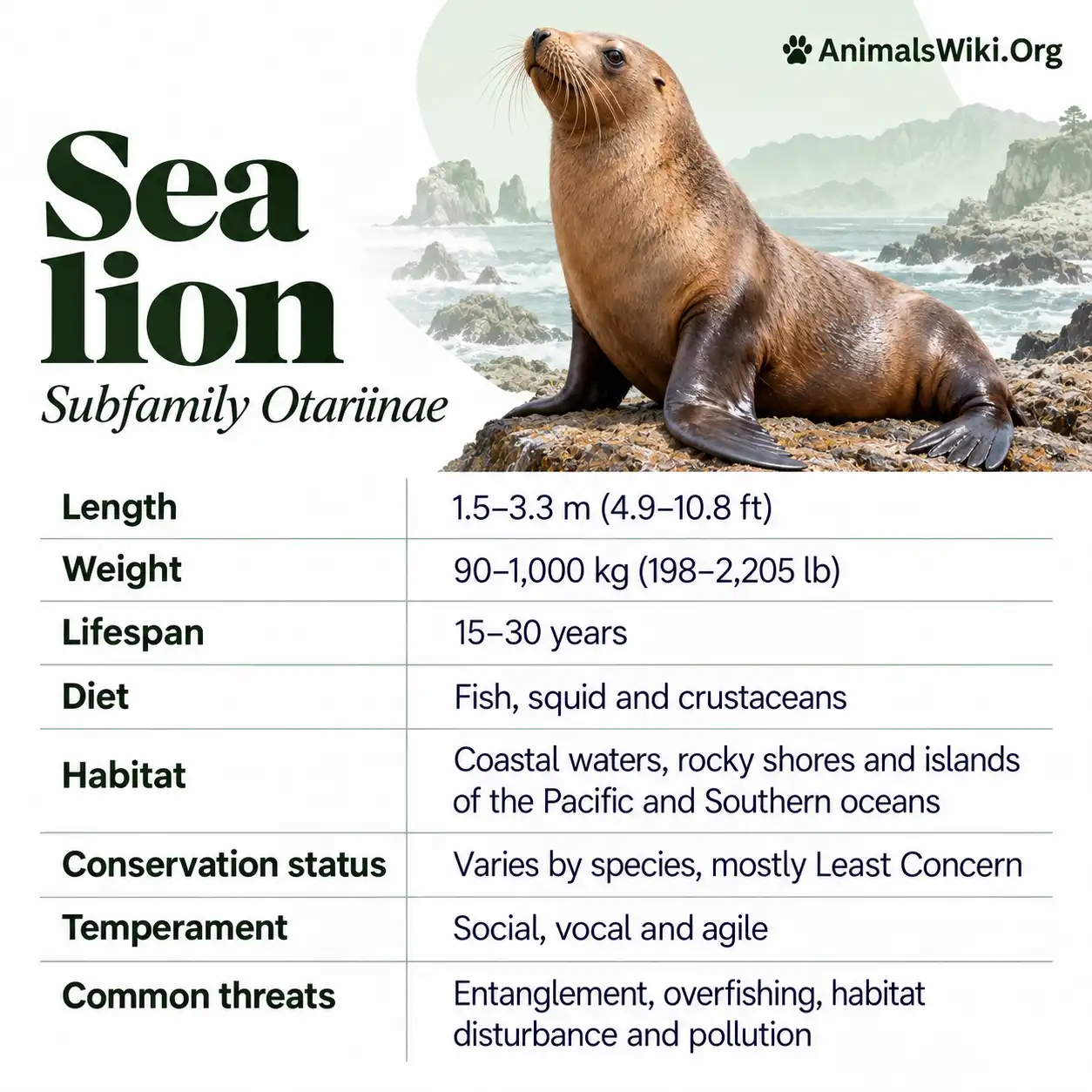
Sea Lion, A Complete Guide to These Remarkable Marine Mammals
A sea lion is a powerful, social marine mammal recognized by its visible ear flaps, long front flippers, and ability to move across land using all four limbs. In water, those same flippers help produce the agile swimming that makes sea lions such effective predators.
However, “sea lion” does not describe just one species. Six living species inhabit different parts of the world, from the North Pacific to the Galápagos Islands, southern Australia, New Zealand, and South America. Their sizes, breeding schedules, feeding habits, and conservation needs vary considerably.
Some are familiar visitors to busy waterfronts. Others breed on remote islands or isolated coastlines. A California sea lion resting on a floating dock and an Australian sea lion returning to a secluded breeding beach share important adaptations, yet they lead different lives.
Their conservation situations also differ. California sea lions are globally classified as Least Concern, while Australian, New Zealand, and Galápagos sea lions are Endangered. The Steller sea lion has another important distinction: its global classification and the legal status of particular populations are not identical.
This guide explains sea lion identification, species, habitat, diet, behavior, reproduction, intelligence, and conservation, with clear distinctions between shared characteristics and species-specific facts.
Sea Lion Facts
| Feature | Information |
|---|---|
| Animal group | Mammals |
| Family | Otariidae |
| Broader group | Pinnipeds |
| Living sea lion species | Six |
| Extinct sea lion species | Japanese sea lion |
| Distinguishing features | External ear flaps, long foreflippers, mobile hind flippers |
| Main swimming propulsion | Foreflipper strokes |
| Diet | Fish, squid, octopus, and other animal prey |
| Young | Usually one pup |
| Birth location | Land |
| Social behavior | Often gathers at colonies and haul-outs |
| Largest species | Steller sea lion |
| Global conservation status | Varies by species |
1. What Is a Sea Lion?
A sea lion is an air-breathing marine mammal in the family Otariidae, commonly called the eared seal family.
Like other mammals, sea lions maintain their internal temperature, give birth to live young, and feed their offspring milk. Their limbs are modified into flippers, allowing them to swim efficiently while retaining useful mobility on land.
The name covers several species rather than one animal with a single worldwide scientific name. For example, the California sea lion is Zalophus californianus, while the much larger Steller sea lion is Eumetopias jubatus.
This distinction matters throughout their biology. A breeding date, maximum size, or population figure for one species should not automatically be applied to another.
Their shared characteristics provide a useful starting point, but the most accurate understanding combines those general features with the particular species and environment being discussed.
2. The Six Living Sea Lion Species
Six living species are generally recognized:
| Species | Scientific name | Main region |
|---|---|---|
| California sea lion | Zalophus californianus | Western North America |
| Steller sea lion | Eumetopias jubatus | North Pacific |
| Galápagos sea lion | Zalophus wollebaeki | Galápagos region |
| Australian sea lion | Neophoca cinerea | Southern and western Australia |
| New Zealand sea lion | Phocarctos hookeri | New Zealand and subantarctic islands |
| South American sea lion | Otaria flavescens | South American coasts |
The South American species also appears as Otaria byronia in many publications.
A seventh species, the Japanese sea lion, is extinct.
These animals differ in more than geography. Their body sizes, coat colors, feeding environments, and reproductive schedules reflect distinct evolutionary histories.
Recognizing that diversity prevents a common problem in general wildlife articles: describing the California sea lion and presenting every detail as a universal sea lion fact.
3. Sea Lion vs. Seal: The Clearest Differences
The easiest visible difference is the presence of external ear flaps on sea lions.
True seals have ear openings but lack those projecting flaps. Sea lions also have longer foreflippers and can rotate their hind flippers beneath the body.
That rotation allows them to support themselves and move on all four limbs. True seals generally move across solid surfaces through body undulation.
| Feature | Sea lion | True seal |
|---|---|---|
| External ear flaps | Present | Absent |
| Foreflippers | Long and prominent | Generally shorter |
| Movement on land | Can move on all four limbs | Body undulation |
| Main swimming propulsion | Foreflippers | Usually hind flippers and rear-body movement |
| Family | Otariidae | Phocidae |
These structural differences are more dependable than broad claims that one group is always social or always noisy.
Behavior changes with species, season, and location, while the ear and flipper differences remain useful identification features.
4. Sea Lion vs. Fur Seal
Sea lions and fur seals belong to the same family, Otariidae.
Both have external ear flaps, long foreflippers, and the ability to bring their hind flippers underneath their bodies.
Fur seals generally have a denser undercoat, while sea lions usually have a less conspicuously furred appearance. However, identification should consider the entire animal and its location rather than coat texture alone.
The names can be confusing because a fur seal is more closely grouped with sea lions than with true seals.
This is why the everyday word “seal” does not always identify a single scientific family.
Knowing the local species is particularly helpful. In New Zealand, for example, sea lions and fur seals occur in the same broader region but differ in size, head shape, and other features.
A clear identification combines anatomy, proportions, and geographic context.
5. How Big Do Sea Lions Grow?
Sea lion size varies dramatically between species and sexes.
Adult males are usually larger than females, but the degree of difference is not identical across the group.
California sea lion males commonly weigh a few hundred kilograms. Large male Steller sea lions can exceed a metric ton, making them the largest living members of Otariidae.
Females are substantially smaller than the largest males.
Age also matters. A young male may be sexually mature before reaching the full size needed to compete successfully with older males.
Therefore, maximum male measurements are poor descriptions of an entire species.
When comparing sizes, ask whether a figure describes a typical adult, a large individual, or an exceptional maximum.
The most useful measurements identify the species, sex, and age class rather than assigning one average weight to every sea lion.
6. Body Shape, Coat, and Appearance
Sea lions have streamlined bodies, flexible necks, and flippers adapted for swimming.
Their coats vary by species, sex, and age. Adult male California sea lions are generally darker than females, while Australian sea lions show a particularly noticeable contrast between dark males and pale females.
Pups often look different from adults and may change color after their first molt.
Large males of some species develop thick necks or mane-like hair, contributing to the name “sea lion.”
These features should not be expected equally in every species.
A female may lack the dramatic head and neck profile of a mature male, and a juvenile can resemble a female before developing adult characteristics.
Appearance therefore provides information about both identity and life stage. Careful observation considers the whole animal rather than one coat color or facial feature.
7. How Sea Lions Swim
Sea lions generate much of their swimming propulsion through strong, wing-like strokes of the foreflippers.
Their rear flippers and flexible bodies help steer and control orientation.
This method differs from the rear-body propulsion typical of true seals.
The long foreflippers allow powerful movement, while the streamlined body reduces resistance as the animal travels through water.
Swimming also varies with purpose. Traveling between resting places, turning toward prey, and exploring a confined area require different movements.
A sea lion can therefore appear relaxed at the surface and highly agile moments later.
Their aquatic performance also explains why their body proportions differ from those of land mammals.
The same limbs must support movement ashore and efficient travel at sea, producing a versatile arrangement rather than a body specialized exclusively for one environment.
8. Sea Lion Diving Abilities
Sea lions make repeated dives to locate and capture prey, but there is no single dive depth that describes every species.
Some feed relatively close to the surface, while others regularly search much deeper or near the seabed.
The useful depth depends on local conditions. A shallow coastal feeding area creates different demands from a deep offshore habitat.
Dive duration also reflects the task. Descending, searching, feeding, and returning to air all use part of the available time.
A maximum recorded dive therefore describes capability rather than ordinary behavior.
Young animals develop their skills over time, so an adult’s performance should not be assigned to a newborn pup.
Understanding diving means connecting physical capacity with prey distribution, water depth, age, and experience. The animal’s objective is successful feeding, not reaching the deepest possible point.
9. How Sea Lions Conserve Oxygen
A diving sea lion must manage a limited oxygen supply until it surfaces again.
Its oxygen stores include blood and muscle, with the muscle protein myoglobin helping hold oxygen for underwater activity.
Heart rate and circulation change during dives, influencing how quickly those reserves are used.
Research on California sea lions has measured these responses during maternal feeding trips, demonstrating that diving involves active physiological regulation.
The response is not identical during every dive. Activity, duration, and the animal’s expectations can influence the pattern.
This makes diving more complex than simply holding a large breath.
The sea lion coordinates movement and physiology to remain submerged long enough to perform useful tasks.
When it returns to the surface, breathing restores the resources needed for subsequent dives, creating a repeated cycle of underwater work and recovery.
10. Sea Lion Eyesight and Hearing
Sea lions use both vision and hearing to understand their surroundings.
Their eyes function underwater, where light changes with depth, turbidity, and surface conditions.
Hearing is important for detecting sounds in the environment and receiving communication from other animals.
However, good underwater hearing should not be confused with dolphin-style echolocation. Sea lions are not known to use that same sound-and-echo hunting system.
Their sensory information comes from several channels working together.
An animal in clear shallow water may rely on different information from one feeding where visibility is poor.
On land, hearing and smell also contribute to social interactions, including mother–pup recognition.
Their sensory abilities therefore serve both feeding and social life. The sea lion must interpret prey, neighbors, approaching animals, and environmental conditions across two very different settings: water and air.
11. What Sea Lion Whiskers Do
Sea lion whiskers, or vibrissae, are sensitive structures that provide information through touch and water movement.
They help the animal investigate objects and conditions near its muzzle.
Experiments involving a California sea lion have demonstrated the ability to follow hydrodynamic trails: disturbances left in water by something that has moved through it.
This adds another source of information when vision is limited.
The ability should not be exaggerated into an exact description of every hunt in the wild. Controlled experiments demonstrate a capacity, while natural feeding involves many changing conditions.
Nevertheless, the findings show that whiskers are functional sensory equipment.
A patch of water that appears empty to a human observer may still contain traces of movement detectable by the animal.
Its underwater environment therefore includes information that people cannot directly perceive.
12. How Sea Lions Stay Warm and Cool
Sea lions use blubber, circulation, and behavior to regulate body temperature.
Blubber beneath the skin reduces heat loss and stores energy.
However, retaining heat is only part of the challenge. A resting animal on a warm beach may also need to release excess heat.
Flippers can help with heat exchange because blood vessels near their surfaces can alter the transfer of heat.
Animals may also move into water, damp sand, or shade.
This explains why a sea lion raising a flipper is not automatically injured or signaling to people.
The behavior may be connected with temperature regulation or comfortable resting.
The balance changes with environment and activity. A cold-water feeding trip and a sunny resting beach create different demands, and successful regulation allows the animal to move between them.
13. Sea Lion Habitat
Sea lions use coastal waters, islands, beaches, rocky shores, and other suitable resting surfaces.
Some also occupy human-made structures, including docks, buoys, and breakwaters.
These places provide opportunities to leave the water, but they are only one part of the habitat.
Feeding areas may lie offshore or along the seabed, and breeding sites can have different requirements from ordinary resting places.
A rookery is a breeding area, while a haul-out is a place used for resting ashore.
The distinction helps explain why a crowded dock is not necessarily a breeding colony.
Protecting habitat means considering the connections among feeding grounds, travel routes, resting sites, and places where pups are raised.
The visible animals on land represent only part of a life that often extends far beyond the shoreline.
14. California Sea Lion
The California sea lion, Zalophus californianus, is native to western North America.
It is the species many people associate with busy waterfronts, loud barking, and animals resting on floating docks.
Adult males are larger and darker than females and develop a prominent forehead crest.
Their diet includes fish and squid, with feeding opportunities changing according to local ocean conditions.
California sea lions are globally classified as Least Concern, but that does not mean every year is favorable.
Poor prey conditions, disease, entanglement, and algal toxins can still cause serious problems.
The species provides an important example of how a relatively abundant marine mammal can face significant health and environmental pressures without being globally threatened.
Its familiarity also makes responsible human behavior important wherever animals and people share coastal space.
15. Steller Sea Lion
The Steller sea lion, Eumetopias jubatus, is the largest living sea lion.
It inhabits the North Pacific and has a robust body, large head, and powerful neck. Its low-frequency calls can sound more like roars than the familiar barking of California sea lions.
Conservation requires a regional distinction.
Globally, the species is classified as Near Threatened. Under the U.S. Endangered Species Act, the western population remains Endangered, while the eastern population recovered sufficiently to be removed from that listing.
These are different assessment systems applied at different scales.
The species therefore illustrates why saying simply “Steller sea lions are endangered” leaves out important information.
Some areas have shown recovery, while others continue to face problems. Conservation depends on tracking those regional differences rather than assuming one trend across the North Pacific.
16. Galápagos Sea Lion
The Galápagos sea lion, Zalophus wollebaeki, is a distinct species associated with the Galápagos region.
It is not merely a California sea lion living on another island chain.
Genetic research helped support the recognition of the two as separate species.
Galápagos sea lions are globally Endangered and face pressures linked to their restricted distribution, changing feeding conditions, and interactions with people.
Some colonies occur close to settlements, making coexistence an important conservation issue.
A management plan for San Cristóbal Island addresses these connections among research, local authorities, communities, and wildlife protection.
The species demonstrates that sea lions are not exclusively cold-water animals.
However, living in a tropical setting does not remove dependence on productive marine conditions. Food availability remains central to adult condition, nursing, and pup survival.
17. Australian Sea Lion
The Australian sea lion, Neophoca cinerea, occurs only in Australia.
Its breeding distribution is concentrated along parts of South Australia and Western Australia, including islands and some mainland sites.
Adult males are generally dark, while females are much paler.
One of its most distinctive traits is a breeding cycle of approximately 17–18 months, with different colonies breeding at different times.
That pattern differs from the annual schedule familiar in many other pinnipeds.
The species is Endangered and has not recovered fully from historical exploitation.
Its slow reproduction makes reducing preventable mortality especially important.
Fishing interactions, debris, disease, and poor pup survival can affect recovery.
The Australian sea lion shows why conservation measures must fit the species: a calendar based on another sea lion’s breeding season may miss vulnerable periods at a particular colony.
18. New Zealand Sea Lion
The New Zealand sea lion, Phocarctos hookeri, is endemic to New Zealand and is known in Māori by names including pakake.
Much breeding occurs on subantarctic islands, although animals are also recolonizing parts of their former mainland range.
Males develop large bodies and prominent manes, while females are lighter and smaller.
The species is classified as Endangered.
Its recovery presents practical challenges because breeding females can use coastal areas that overlap with people, roads, and dogs.
The return of animals to former habitat is encouraging, but successful coexistence requires space and public understanding.
New Zealand sea lions also demonstrate that a species can have a strongly marine feeding ecology while using terrestrial environments more extensively than visitors expect.
A sea lion beyond the immediate waterline is therefore not automatically lost or stranded.
19. South American Sea Lion
The South American sea lion, Otaria flavescens, occurs along western and southeastern South American coastlines.
It is also called the southern sea lion and appears as Otaria byronia in many publications.
Adult males have a heavy head, thick neck, and conspicuous mane-like appearance.
The species uses coastal and island breeding sites and feeds on a variety of marine prey.
Its global assessment has been Least Concern, but recent disease events demonstrate that broad status does not remove vulnerability.
H5N1 avian influenza was associated with extensive mortality across parts of South America during 2023.
These losses must be described with their dates and regions rather than treated as a permanent condition everywhere.
The species’ story combines a broad distribution with substantial differences in the pressures affecting particular coasts and populations.
20. The Extinct Japanese Sea Lion
The Japanese sea lion, Zalophus japonicus, is recognized as extinct.
It formerly inhabited parts of the northwestern Pacific region, including waters around Japan and Korea.
Its loss provides an important reminder that belonging to a familiar animal group does not guarantee survival.
Older publications sometimes treated it within the same species complex as California sea lions, but modern work supports recognition as a separate species.
This matters because extinction is a loss of evolutionary diversity, not merely the disappearance of one local colony.
The Japanese sea lion should therefore be included when discussing the history of the group, even though it is not one of the six living species.
Its story also gives conservation context to the threatened sea lions that remain: recovery is possible for some populations, but permanent loss is also part of the group’s history.
21. What Do Sea Lions Eat?
The sea lion diet includes fish, squid, octopus, and other marine animals.
The importance of particular foods changes by species and location.
California sea lions consume prey such as anchovies, hake, herring, and squid. Australian sea lions frequently use bottom-associated feeding habitats, encountering a different prey community.
These differences mean that one worldwide menu can describe possibilities but not the actual diet of every population.
Feeding also changes with age, season, and available resources.
A successful diet must provide enough energy for swimming, temperature regulation, growth, and reproduction.
Flexibility helps, but it does not mean every substitute food is equally useful.
An animal may find prey yet still face poor energetic conditions if meals are smaller, less nutritious, or require substantially more effort to obtain.
22. How Sea Lions Hunt
Sea lions use active swimming, sensory information, and repeated dives to capture prey.
Their hunting methods vary with the food available.
Chasing a school of fish creates different demands from searching near the seabed for bottom-associated prey.
Individuals can also develop consistent feeding habits based on local opportunities.
This flexibility helps them exploit changing marine conditions, but the animal must balance the energy gained with the cost of pursuit.
The visible moment of capturing a fish is only one part of the feeding process.
Travel to the feeding area, searching, diving, and returning to rest all contribute to the overall cost.
Consequently, a productive habitat is more than a place containing edible animals. It must offer opportunities that a sea lion can use efficiently enough to support the rest of its life cycle.
23. Social Life at Sea Lion Colonies
Sea lions often gather in groups, but a colony is a changing social environment rather than one permanently harmonious community.
Animals rest, compete for space, defend pups, and respond to neighbors.
The breeding season can produce especially intense interactions, with males competing for access to territories or females.
Outside breeding, group composition and spacing can change substantially.
Some animals travel alone, while others form groups at sea or rest together.
The meaning of a behavior therefore depends on context.
An open mouth may be part of a threat display rather than a sign that the animal wants food.
Understanding that distinction is important near wildlife.
A sea lion accustomed to resting beside other sea lions has not necessarily accepted people entering the same personal space. Its social tolerance toward its own species does not make it tame.
24. Why Sea Lions Bark and Call
Sea lion sounds serve several functions, including social communication, territorial interaction, and contact between mothers and pups.
California sea lions are particularly famous for barking.
Other species produce different combinations of calls, and Steller sea lions are associated with deeper, roaring sounds.
A noisy colony contains overlapping information rather than meaningless sound.
Calls can communicate presence, identity, or motivation, depending on the animal and situation.
They also help maintain contact when bodies, rocks, or distance interrupt visual access.
This is especially important when a mother returns from feeding and needs to locate her pup.
The exact sound repertoire should not be generalized from one familiar species to every sea lion.
Their vocal diversity reflects different bodies, social settings, and behavioral demands across the group.
25. Sea Lion Intelligence and Learning
Sea lions have demonstrated substantial learning abilities in controlled research.
Scientists study discrimination, memory, sensory processing, and responses to trained tasks.
One well-known example involves Ronan, a California sea lion trained to synchronize movements with rhythmic sounds.
A 2025 study documented precise performance in beat-keeping tasks.
The result is evidence about a trained individual’s capabilities, not proof that every wild sea lion naturally dances to music.
That distinction strengthens rather than weakens the finding.
Careful experiments reveal what an animal can learn under defined conditions.
Intelligence is also broader than performance in one task. A wild sea lion must remember locations, recognize individuals, find prey, and adjust behavior as conditions change.
Research provides controlled ways to investigate parts of that broader behavioral flexibility.
26. Sea Lion Breeding and Competition
Breeding behavior differs among species, but competition among males is common.
In California sea lions, males establish territories during the breeding season and defend access to favorable areas.
A male’s ability to reproduce successfully depends on more than reaching sexual maturity.
Body size, experience, and the ability to compete with other males influence the outcome.
This explains why a young adult may not yet participate effectively in breeding.
The system also creates energetic demands.
A male defending a territory may reduce or interrupt feeding, relying on stored reserves.
However, the same territorial model should not be assigned identically to every sea lion species.
Australian sea lions, for example, have a distinctive reproductive schedule and different patterns of association.
Species-specific descriptions provide a more accurate picture than one universal account of sea lion breeding.
27. Pregnancy and Breeding Calendars
Many sea lions have seasonal reproduction, but there is no single birth month applying worldwide.
California sea lion births are concentrated around early summer, New Zealand sea lion births occur during the southern summer, and Australian colonies follow their unusual nonannual cycle.
Delayed implantation also occurs in the reproductive biology of sea lions, helping organize pregnancy within a seasonal schedule.
The interval after mating is therefore not always identical to the period of active fetal growth.
This matters when comparing gestation figures from different sources.
A useful general description is that reproduction must fit the mother’s condition and the environment in which the pup develops.
The timing of food availability, weather, and maternal care all contributes to that schedule.
For practical conservation, local breeding information is more useful than a calendar derived from another species or hemisphere.
28. What Are Sea Lion Pups Like?
Sea lions usually give birth to one pup on land.
Newborn appearance and size differ among species, but pups commonly have a darker coat than adult females.
A pup can move and vocalize early, yet it remains dependent on maternal milk and protection.
Its first weeks involve rapid development rather than immediate independence.
Swimming ability, endurance, body reserves, and feeding skill improve over time.
This is why a newborn should not be treated as a miniature adult capable of meeting the same demands.
The species also differs from seals whose pups have a long, pale whitecoat.
California sea lion pups, for example, are born dark and later replace that coat.
Recognizing these differences helps avoid applying harp seal or grey seal pup information to a sea lion simply because all are pinnipeds.
29. Nursing and Maternal Feeding Trips
Sea lion mothers commonly alternate between nursing ashore and feeding at sea.
After an initial period with the newborn, the mother leaves to replenish her energy and later returns.
The pup may remain on land during her absence.
This strategy differs from the short, intensive nursing fast seen in some true seals.
It also means that an unattended pup is not automatically abandoned.
Nursing duration varies considerably. California sea lions commonly nurse for months, while Australian sea lions have particularly prolonged dependence.
The mother must obtain enough food for her own needs while continuing to support growth in her pup.
Poor feeding conditions can therefore affect two animals through the same pathway.
When trips become less successful or more demanding, the consequences may appear in maternal condition, milk delivery, and pup growth.
30. How Mothers Recognize Their Pups
A returning mother faces the challenge of finding one pup among many animals.
Sea lions use individually distinctive calls, with smell and other information contributing to recognition.
Experimental work on Australian sea lions found that mothers could recognize their pup’s voice within approximately 48 hours after birth.
Other research has investigated which features of calls carry identity and how the environment affects recognition.
These studies show that reunion depends on more than simply approaching the nearest small animal.
Recognition is especially valuable in colonies where mothers repeatedly leave and return.
It also explains why a pup’s calls should not automatically be interpreted as evidence that people need to intervene.
Calling is part of communication.
The appropriate response to concern is professional assessment while preserving the space needed for normal mother–pup interaction.
31. Memory, Growth, and Independence
A pup’s development continues long after its first days on the beach.
It must improve swimming, diving, social responses, and the ability to obtain food.
Maternal relationships can also have a lasting sensory component.
Research on Australian sea lions found evidence that young animals recognized their mother’s voice even after independence, demonstrating long-term memory under the study conditions.
This finding adds depth to the idea of a temporary nursing association.
However, recognition does not mean that every mother and offspring remain together permanently.
As young animals develop, their movement and feeding demands change.
The transition to independence is therefore a sequence rather than one moment: reduced dependence on milk, increasing feeding success, and broader use of the environment.
Conditions during that transition can influence survival and eventual recruitment into the breeding population.
32. What Eats Sea Lions?
Large sharks and killer whales are important sea lion predators in parts of the world.
The relative importance of each predator depends on species, location, and life stage.
A small pup entering the water faces different risks from a large adult male.
Predation also affects behavior. Animals must balance access to food with the danger of traveling through particular areas.
This makes sea lions both consumers and prey within marine ecosystems.
Their presence connects fish and squid populations with larger predators.
The relationship should be understood locally rather than described as one universal food chain.
A predator important near one colony may be uncommon around another.
Conservation research therefore examines the full environment, including prey, predators, and human activities, rather than treating sea lion survival as a question of food supply alone.
33. Sea Lions and Fisheries
Sea lions and fisheries can use some of the same fish resources.
Animals may also learn to take fish from lines, nets, or other places where prey becomes concentrated.
These interactions can create risks for both fishing activities and sea lions.
However, observing one animal taking a fish does not establish the population-wide effect of sea lion predation.
Researchers need information about diet, movement, fish abundance, and the behavior of particular individuals.
Bycatch creates another concern: an animal can be accidentally caught while pursuing prey or moving through fishing areas.
Appropriate management therefore requires different responses to different problems.
Reducing accidental capture, evaluating food overlap, and addressing repeated interactions with gear are related but distinct tasks.
A broad label such as “competition with fishing” can hide those practical differences.
34. Changing Oceans and Food Shortages
Sea lions depend on productive marine environments, making changes in prey availability important.
Warmer conditions can alter where prey occurs, how nutritious it is, and how much effort a sea lion must spend feeding.
The effects can be especially serious for nursing females.
They need to support themselves while returning enough energy to a dependent pup.
Galápagos conservation research emphasizes the challenges created by changing ocean conditions, while North Pacific monitoring has linked marine heatwaves with changes in Steller sea lion survival and productivity.
The mechanisms differ among regions, so “warming” should not be treated as one identical event everywhere.
What matters biologically is how environmental change affects feeding opportunities and the rest of the life cycle.
A sea lion can remain an excellent swimmer and hunter while still struggling in an ocean offering less accessible food.
35. Harmful Algal Blooms and Domoic Acid
Some algae produce domoic acid, a toxin that can enter marine food webs.
California sea lions can become exposed through contaminated prey.
Research has documented neurological injury, including damage to the hippocampus, a brain region important for memory.
Studies have also linked exposure with impaired spatial memory and changes in behavior.
This makes the problem more complex than a short episode of illness.
An animal’s ability to navigate and function normally may be affected.
The presence of affected sea lions also provides information about conditions in the surrounding food web.
However, research involving stranded or treated animals should not be used to assign the same health condition to every sea lion population.
The findings identify a serious, well-documented threat with particularly strong research evidence in California sea lions.
36. Disease and Major Mortality Events
Sea lions can be affected by infectious disease, parasites, and other health problems.
California sea lions are susceptible to leptospirosis, an infection that can cause serious illness.
In South America, H5N1 avian influenza was associated with extensive sea lion mortality during 2023.
These events demonstrate that a species’ condition can change quickly even when its broad conservation classification has not yet changed.
Disease research requires careful interpretation.
A confirmed outbreak has a particular location, period, and affected population. It should not be presented as proof that all sea lions everywhere are currently infected.
Monitoring, laboratory testing, and investigation of stranded animals help determine what is happening.
The results support wildlife management and improve understanding of how pathogens move through marine ecosystems.
37. Pollution, Entanglement, and Human Disturbance
Sea lions face pressures that extend beyond food availability and natural predation.
Fishing line, rope, nets, and other debris can entangle animals, causing wounds or interfering with movement and feeding.
Pollutants can also accumulate through marine food webs.
Research on California sea lion cancer has investigated connections involving contaminant exposure and herpesvirus.
Those findings concern particular study populations and should not be converted into an unsupported cancer rate for all wild sea lions.
Disturbance affects a different part of their lives.
Repeated approaches can interrupt resting or interfere with access between mothers and pups.
These pressures require practical responses: reducing dangerous debris, improving fishing practices, limiting pollution, and giving animals space at resting and breeding sites.
Protecting sea lions involves several connected actions rather than one solution.
38. Are Sea Lions Endangered?
There is no single conservation category for all sea lions.
| Species | Global conservation status |
|---|---|
| California sea lion | Least Concern |
| Steller sea lion | Near Threatened |
| Galápagos sea lion | Endangered |
| Australian sea lion | Endangered |
| New Zealand sea lion | Endangered |
| South American sea lion | Least Concern |
| Japanese sea lion | Extinct |
The South American assessment is commonly published under the name Otaria byronia.
Global assessments also differ from national legal listings.
For example, the western Steller sea lion population remains Endangered under U.S. law even though the species’ global category is Near Threatened.
The correct question is therefore which species, population, and assessment system is being discussed.
That precision prevents an abundant population from hiding another’s decline and prevents a regional legal designation from being misrepresented as the status of the entire group.
39. How Scientists Study Sea Lions
Researchers use colony counts, pup surveys, tracking devices, cameras, biological samples, and behavioral experiments.
Each method reveals a different part of the animal’s life.
Pup counts describe reproductive output, while tracking shows where sampled animals travel and feed.
Health research helps identify disease, toxins, and other causes of mortality.
Experiments investigate abilities such as recognition, sensory perception, and learning.
No single approach answers every conservation question.
A colony can appear crowded while the wider population changes, and an animal missing from one resting site may simply have moved.
Combining methods helps separate those possibilities.
Recent Australian work has also used animal-borne cameras to improve knowledge of feeding habitat.
Such research connects the visible animals ashore with the underwater environments that ultimately support them.
40. What to Do Around Wild Sea Lions
Observe sea lions from a distance and allow them to continue resting, moving, and caring for young.
Do not feed, touch, surround, or attempt to move them.
Keep dogs away, and avoid blocking the route between an animal and the water.
A pup alone on shore is not automatically abandoned. Its mother may be feeding at sea.
If an animal appears injured, entangled, or seriously unwell, contact the appropriate local marine mammal response organization.
Provide the location and observations without attempting a rescue yourself.
There is no universal waiting period that applies to every species and situation.
Trained responders consider age, condition, behavior, and local circumstances.
The most useful public action is to preserve space while seeking advice, allowing normal behavior to continue and genuine distress to be assessed professionally.
Frequently Asked Questions About Sea Lions
1. Is a sea lion a mammal?
Yes. Sea lions breathe air, maintain their internal temperature, give birth to live young, and feed their pups milk. They are marine mammals in the family Otariidae.
2. How many sea lion species are alive?
Six living species are generally recognized: California, Steller, Galápagos, Australian, New Zealand, and South American sea lions. The Japanese sea lion is extinct.
3. What is the scientific name of a sea lion?
There is no single scientific name for all sea lions. Each species has its own name, such as Zalophus californianus for the California sea lion.
4. What is the easiest difference between a seal and a sea lion?
Look for external ear flaps and long front flippers. Sea lions have both and can rotate their hind flippers underneath themselves to move on land.
5. Are fur seals related to sea lions?
Yes. Fur seals and sea lions both belong to Otariidae, the eared seal family. True seals belong to a separate family called Phocidae.
6. Which sea lion is the largest?
The Steller sea lion is the largest living sea lion. Large males can exceed a metric ton, while females are substantially smaller.
7. Where do sea lions live?
Different species occupy western North America, the North Pacific, the Galápagos region, South America, southern Australia, and New Zealand and its subantarctic islands.
8. Do all sea lions live in cold water?
No. Some species inhabit temperate or subantarctic regions, while Galápagos sea lions live in a tropical island setting. Productive feeding conditions matter across all these environments.
9. What do sea lions eat?
They eat fish, squid, octopus, and other marine prey. Diet varies by species, location, season, and the food available within their feeding range.
10. Do sea lions use echolocation?
They are not known to use dolphin-style echolocation. They rely on other sensory information, including vision, hearing, and sensitive whiskers.
11. Why do sea lions have whiskers?
Their whiskers provide tactile information and can detect water movement. Experiments have demonstrated hydrodynamic trail-following ability in a California sea lion.
12. Why do sea lions bark?
Barking is especially characteristic of California sea lions and supports social communication. Other sea lion species have different calls, including deeper roaring sounds.
13. Are sea lions intelligent?
Research demonstrates learning, memory, recognition, and sensory abilities. Particular experiments reveal specific capabilities, but one trained task should not define the intelligence of every sea lion.
14. Can sea lions keep a musical beat?
A trained California sea lion named Ronan has demonstrated precise rhythmic synchronization in research. This shows a learned capability rather than universal spontaneous dancing behavior.
15. What is a baby sea lion called?
A baby sea lion is called a pup. Females normally give birth to one pup, with size, appearance, and developmental timing varying between species.
16. Are sea lion pups born in water?
Pups are born on land. They develop aquatic skills after birth while depending on maternal milk and care.
17. How long do sea lion pups nurse?
Nursing commonly continues for many months, but duration differs considerably. Australian sea lions have especially prolonged dependence associated with their unusual reproductive cycle.
18. Why is a sea lion pup alone on the beach?
Its mother may be feeding at sea. Temporary separation is part of normal care in many sea lions, so a lone pup is not automatically abandoned.
19. How do mothers find their pups?
Calls provide important identity information, with smell and other cues also contributing. Australian sea lion mothers have demonstrated recognition of their pup’s voice within about 48 hours.
20. Do sea lions have one breeding season worldwide?
No. Breeding differs by species, hemisphere, and colony. Australian sea lions are particularly distinctive because their approximately 17–18-month cycle is not synchronized among colonies.
21. What predators eat sea lions?
Large sharks and killer whales are important predators in some regions. Risks vary with species, age, location, and the circumstances in which animals enter the water.
22. Are sea lions endangered?
Some are. Australian, New Zealand, and Galápagos sea lions are globally Endangered, while other species have different categories. Particular populations may also have separate legal protection.
23. Is the Japanese sea lion extinct?
Yes. The Japanese sea lion, Zalophus japonicus, is recognized as extinct. It is separate from the six sea lion species still living today.
24. Should people feed sea lions?
No. Feeding changes behavior and can encourage dangerous interactions with people, boats, and fishing gear. Observe without offering food.
25. What should you do if a sea lion appears sick?
Keep people and pets away and contact the local marine mammal response organization. Do not approach, move, or attempt to return the animal to the water.



