
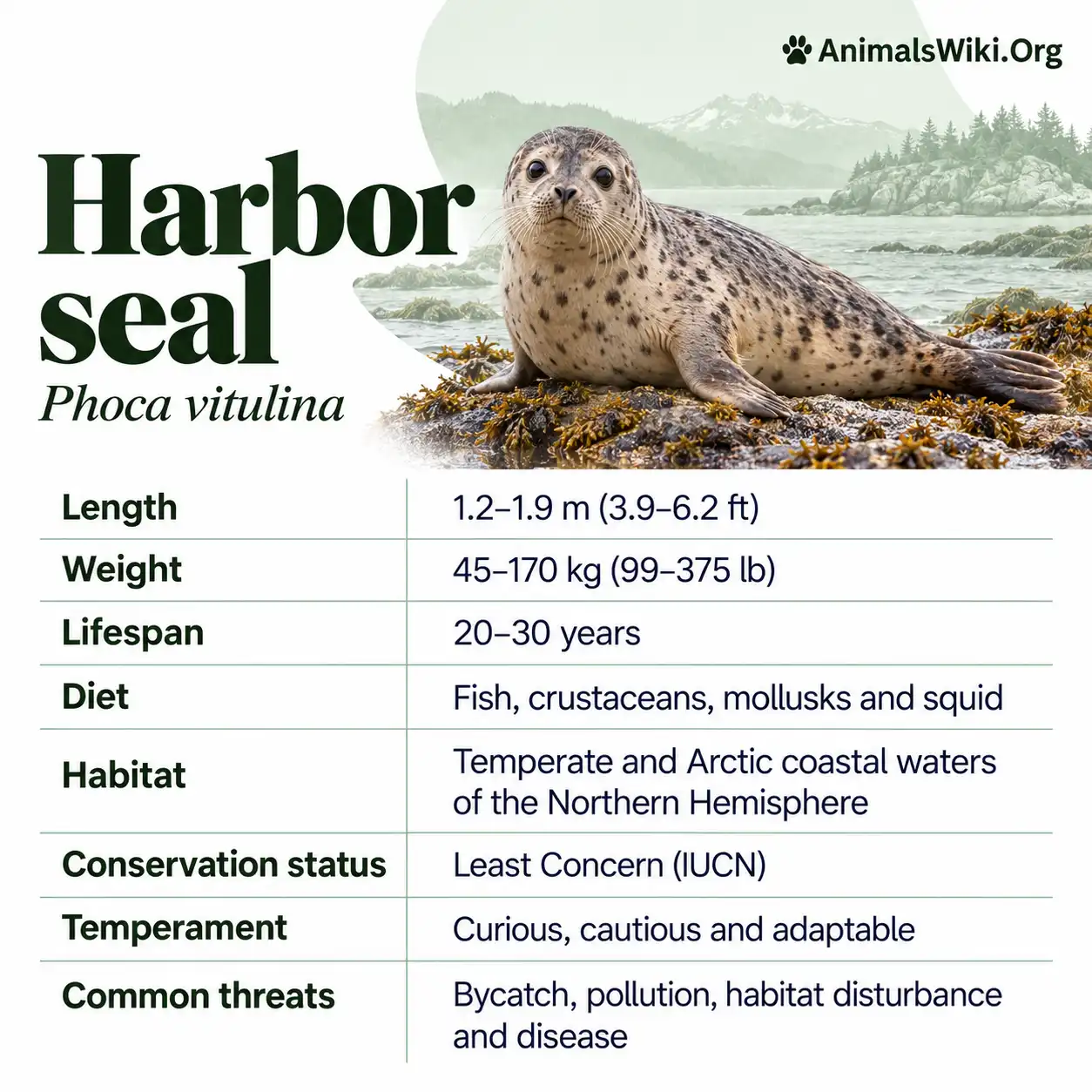
Harbor Seal, A Complete Guide to Its Habitat, Diet, Behavior, and Pups
The harbor seal is a coastal marine mammal recognized by its rounded head, spotted coat, short muzzle, and long whiskers. Also called the harbour seal or common seal, it belongs to the true seal family and lives along parts of the Northern Hemisphere’s Atlantic and Pacific coastlines.
Watching a harbor seal on a beach gives only a small glimpse of its life. Beneath the surface, this animal is an agile predator that searches for fish, follows underwater movements with sensitive whiskers, and adjusts its diving behavior to local feeding conditions. On land, it rests, replaces its coat, and raises its young.
One of the most remarkable harbor seal facts concerns its pups: they can swim shortly after birth. That early ability helps them cope with shorelines where rising tides can quickly cover resting places. However, swimming ability does not make a newborn independent. A pup still depends on its mother for milk and care.
Harbor seals also illustrate why conservation needs a regional perspective. The species is globally classified as Least Concern, yet individual populations can experience substantial declines. Understanding the animal means looking at both its broad distribution and the particular conditions affecting each coastline.
Harbor Seal Facts
| Feature | Information |
|---|---|
| Common names | Harbor seal, harbour seal, common seal |
| Scientific name | Phoca vitulina |
| Animal group | Mammal |
| Family | Phocidae |
| Seal type | True seal |
| Distribution | Northern Atlantic and Northern Pacific coastal regions |
| Typical habitats | Bays, estuaries, beaches, rocky shores, mudflats, and some freshwater systems |
| Diet | Fish, squid, octopus, and crustaceans |
| Adult size | Varies by sex and region; many adults measure approximately 1.5–1.9 meters |
| Lifespan | Can reach approximately 25–30 years |
| Young | Usually one pup |
| Swimming at birth | Yes |
| Global conservation status | Least Concern |
1. What Is a Harbor Seal?
A harbor seal is a marine mammal in the species Phoca vitulina. Like other mammals, it breathes air, maintains its body temperature, gives birth to live young, and feeds its offspring milk. Its streamlined body and flippers allow it to move efficiently through water, while its resting and reproductive activities keep it closely connected to shore.
The species belongs to the family Phocidae, which includes true seals such as elephant seals, monk seals, and gray seals. Harbor seals are therefore more closely grouped with these animals than with sea lions, which belong to a different family.
The word “harbor” describes a familiar part of the animal’s coastal setting, but it does not restrict the species to ports or marinas. Many inhabit remote islands, quiet estuaries, and rugged coastlines.
“Common seal” is another established name. However, that name should not be interpreted as proof that the animal is abundant everywhere. A species can be widespread overall while becoming scarce in particular parts of its range.
2. Harbor Seal or Harbour Seal: Which Spelling Is Correct?
Both harbor seal and harbour seal refer to the same animal. “Harbor” is the usual American English spelling, while “harbour” is widely used in British English and several other English varieties.
The scientific name, Phoca vitulina, stays the same regardless of spelling. It provides a consistent way to identify the species across research papers, wildlife records, and educational material.
For readers, the spelling difference can sometimes create the impression that two animals are being discussed. In reality, an article about harbor seal pups and one about harbour seal pups may describe the same species on different coastlines.
Regional names also appear in descriptions such as Pacific harbor seal or Atlantic harbor seal. These labels indicate geographic context; they do not mean every seal in one ocean has identical behavior or faces identical threats.
When comparing information, the most useful questions are where the animals live, when observations were made, and whether the description concerns the entire species or a particular population.
3. How to Identify a Harbor Seal
A harbor seal usually has a relatively round head, a short muzzle, and prominent whiskers. Its face often appears doglike, especially when compared with the longer head of a gray seal.
Viewed clearly from the front, its nostrils tend to form a V shape. This is a useful identification feature because gray seal nostrils are more nearly parallel. Head shape and nostril arrangement are generally more dependable than coat color alone.
Harbor seals can have light or dark backgrounds with contrasting spots, rings, or patches. A wet coat may look darker than the same coat after the animal has been resting out of water.
Identification is easiest when several features agree. Look at the head profile, muzzle length, nostrils, overall proportions, and location together. A distant head bobbing among waves may not provide enough detail for a confident identification.
The goal is to recognize the animal from a respectful distance. Moving closer to obtain a better view can interrupt the very behavior you are trying to observe.
4. Harbor Seal vs. Gray Seal
Harbor seals and gray seals share parts of the North Atlantic, so distinguishing them is a common challenge. Both are true seals, both lack external ear flaps, and both may rest on beaches or rocky shores.
Their heads provide the clearest contrast. A harbor seal generally has a shorter, rounder face. A gray seal has a longer muzzle and a more elongated profile, especially noticeable in adult males.
| Feature | Harbor seal | Gray seal |
|---|---|---|
| Head shape | Rounded and relatively compact | Longer and more elongated |
| Muzzle | Short and doglike | Longer, often described as horse-like |
| Nostrils | Usually form a V shape | More nearly parallel |
| General size | Usually smaller | Usually larger, especially adult males |
| Scientific name | Phoca vitulina | Halichoerus grypus |
Size helps, but it is not a complete identification method. A young gray seal can overlap in size with an adult harbor seal, and animals at different distances can appear misleadingly similar.
The comparison works best when the face is visible. Coat patterns vary enough that relying on spots alone can cause mistakes.
5. Harbor Seal vs. Sea Lion
Harbor seals and sea lions are both pinnipeds, but they have different body structures and movement patterns.
A harbor seal has small ear openings without visible external flaps. Sea lions have noticeable external ear flaps. The difference can be subtle at a distance, although it becomes clear in a good side view.
Their movement on land also differs. Harbor seals cannot bring their hind flippers underneath their bodies in the same way sea lions can. Instead, they move by flexing and undulating their bodies.
| Feature | Harbor seal | Sea lion |
|---|---|---|
| External ear flaps | Absent | Present |
| Foreflippers | Relatively short | Longer and more prominent |
| Movement on land | Body undulation | Can support movement using rotated hind flippers |
| Appearance while resting | Often low against the ground | Often able to hold an upright posture |
A harbor seal’s awkward-looking land movement is normal. It reflects a body built primarily for aquatic life and should not automatically be mistaken for an injury.
6. Harbor Seal Size, Weight, and Lifespan
Harbor seal size varies with sex, age, geography, and body condition. Males generally grow larger than females, but the difference is modest compared with the extreme size contrast seen in elephant seals.
The University of British Columbia’s Marine Mammal Research Unit gives male lengths of approximately 1.4–1.9 meters and female lengths of approximately 1.2–1.7 meters. Its weight ranges also overlap substantially between the sexes.
A seal’s weight is not fixed throughout adulthood. Feeding conditions and the annual cycle can influence its body reserves, so two animals of similar length may differ noticeably in mass.
Harbor seals can live for several decades. Broad species accounts commonly describe lifespans reaching approximately 25–30 years, with females sometimes surviving longer than males.
These figures describe potential longevity, rather than the age every pup can expect to reach. Survival depends on successful feeding, health, predator exposure, and the conditions in the population where the animal lives.
7. Why Harbor Seals Have Spotted Coats
A harbor seal’s coat may be pale gray, brown, tan, or very dark, with contrasting spots and rings. This variation is one reason photographs of the species can look surprisingly different from one another.
The markings are also useful to researchers. Individual coat patterns can help distinguish one animal from another when images show suitable areas of the body clearly enough.
This makes photography more than a way of producing attractive wildlife pictures. Repeated images can contribute to records of site use and individual survival, provided researchers can reliably match the same animal across observations.
Photo identification requires consistency. Lighting, viewing angle, wetness, and the amount of the body visible can all affect how a pattern appears. A partial image may show only a few marks, while another photograph reveals a much larger identifying area.
For an observer, the variety is part of the species’ appeal. A group on one shoreline may include animals that look almost silver beside others that appear dark brown.
8. Where Do Harbor Seals Live?
Harbor seals inhabit coastal regions of the North Atlantic and North Pacific. Their distribution includes parts of North America, Europe, and Asia.
In the eastern Pacific, their range extends along western North America from northern waters south to Baja California. In the Atlantic, they occur along portions of the eastern North American coast and northern European coastlines.
This is a Northern Hemisphere species. Harbor seals are not native Antarctic seals, and they should not be confused with Weddell seals, crabeater seals, or leopard seals.
Their broad distribution does not mean they occupy every shoreline continuously. Suitable resting places, access to food, disturbance, and local environmental conditions help determine where groups occur.
A map of the species therefore shows a broad geographic envelope rather than an unbroken line of occupied beaches. Within that envelope, individual populations may be separated by considerable distances and may follow different trends.
Understanding location is especially important when reading about breeding seasons, preferred prey, or conservation concerns.
9. Harbor Seal Habitat: More Than Open Ocean
Harbor seals are closely associated with coastal habitats, including sheltered bays, estuaries, rocky islands, sandy beaches, and mudflats. These environments offer combinations of feeding opportunities and places to leave the water.
An estuary can be particularly valuable because it connects river and marine systems. Fish movements, changing salinity, and tidal channels create feeding opportunities that differ from those along an exposed coast.
Resting habitat is just as important as feeding habitat. A productive stretch of water may be less useful if seals cannot reach a secure haul-out site nearby.
The exact arrangement varies. On one coast, seals may rest on offshore rocks. Elsewhere, they may gather on sandbanks exposed by the falling tide. Some populations use floating ice in glacial fjords.
This variety explains why a single habitat photograph cannot represent the whole species. A harbor seal beside a muddy river mouth and one resting near a glacier are using different versions of the same basic strategy: feeding in water and resting on a suitable surface.
10. Can Harbor Seals Live in Freshwater?
Yes. Although harbor seals are usually associated with the sea, some populations regularly inhabit freshwater environments.
A notable example occurs in Iliamna Lake, Alaska. Researchers have studied these seals through surveys, genetic work, and collaboration with local communities. Their presence shows that the species’ ecological flexibility extends beyond tidal coastlines.
Freshwater residence also creates distinct conservation questions. A small lake-associated population may have different movement opportunities, prey conditions, and connections to neighboring seals than a coastal population.
Another remarkable example is the freshwater harbor seal subspecies associated with the Lacs des Loups Marins area of Quebec’s Ungava Peninsula. Canadian conservation documents treat these animals as a distinctive population requiring specific attention.
The important distinction is between an animal occasionally entering a river and a population using freshwater throughout its life cycle. Both situations demonstrate freshwater use, but they are not ecologically identical.
Freshwater harbor seals are therefore an important part of the species’ story, rather than an exception that can be dismissed from a general account.
11. What Does “Hauling Out” Mean?
Hauling out means leaving the water to rest on land, ice, or another suitable surface. It is a normal and necessary part of harbor seal life.
A hauled-out seal may be sleeping, conserving energy, nursing a pup, or participating in its annual molt. The animal is not automatically stranded because it is out of water.
This distinction matters on busy beaches. People sometimes assume a seal needs help reaching the sea and try to approach or move it. That can interrupt rest and may create a much more serious problem.
A resting animal also needs access to an escape route. Crowding it from the beach or surrounding it with boats can reduce its options.
Repeated disturbance may change where and how seals rest. An apparently brief interruption can become significant when many visitors cause the same response throughout the day.
Recognizing hauling out as essential behavior makes coastal observation more rewarding: a quiet animal on a rock is still carrying out an important part of its daily life.
12. How Tides Influence Harbor Seal Activity
Tides can change the availability of harbor seal resting places dramatically. A sandbank that comfortably holds a group at low tide may disappear beneath the water several hours later.
This changing landscape affects how observers interpret seal numbers. A low count at one moment may mean the animals are feeding or that their usual resting surface is submerged.
Research on harbor seal haul-out behavior in Norway has examined counts across high and low tides and through extended daily observation periods. Such work shows why timing matters when comparing one survey with another.
Tides also interact with breeding stage, season, and local geography. A pattern seen at one location should not automatically be applied to every harbor seal population.
For a reader watching seals from shore, the useful lesson is straightforward: the coast is a moving environment. Where the animals rest today depends partly on what the water is doing.
A reliable understanding comes from repeated observations that account for these changing conditions.
13. How Harbor Seals Swim
Harbor seals move through water with flexible, coordinated body movements. Their hind flippers sweep from side to side to help generate forward motion, while their foreflippers assist with steering.
The contrast with their land movement is striking. An animal that appears slow on a beach can turn, dive, and change direction smoothly once submerged.
Their swimming is also adjustable. Traveling between locations, investigating something nearby, and pursuing prey do not require the same movements or effort.
A streamlined body reduces resistance, while controlled flipper movements allow the seal to respond to the surrounding water. These features help explain why the animal’s shape works so well in the sea.
Swimming ability begins early in life, but experience still matters. A newborn’s ability to enter the water is different from an adult’s ability to locate prey efficiently and manage repeated feeding dives.
The harbor seal is therefore both physically adapted to aquatic life and dependent on development and experience to use that environment successfully.
14. How Deep Can a Harbor Seal Dive?
Harbor seals can make dives hundreds of meters deep, but their everyday feeding does not usually require them to approach maximum recorded depths.
The Smithsonian describes recorded dives reaching approximately 446 meters, while noting that many dives are much shallower. It also reports that average dives are brief compared with the animal’s potential maximum submergence time.
This difference between capability and routine behavior is essential. A seal does not gain an advantage by diving deeper than necessary if suitable food is available closer to the surface.
Dive depth reflects the feeding environment. Prey near the seabed creates different demands from fish moving through shallow water, and local bathymetry limits what depths are available.
Age and experience also affect what an animal can accomplish. Young seals develop their abilities as they grow.
When reading a maximum dive figure, treat it as evidence of physiological capacity. It should not be used as a description of every feeding trip or every member of the species.
15. How Harbor Seals Conserve Oxygen Underwater
A diving harbor seal must manage a limited oxygen supply until it returns to the surface. It cannot breathe underwater, so successful diving depends on both oxygen storage and controlled use.
One important adjustment is a reduction in heart rate during submergence. Scientists call this bradycardia. Changes in circulation help the seal manage oxygen delivery while it is holding its breath.
Research on harbor seal diving physiology has measured heart rate, oxygen consumption, and other responses during controlled dives. These studies show that diving involves coordinated physiological adjustments rather than simply “holding a very large breath.”
The response also depends on circumstances. An active dive is not identical to stationary submergence, and laboratory measurements should be interpreted within the conditions under which they were collected.
For the animal, efficient oxygen management supports repeated trips beneath the surface. It allows time for searching and feeding while preserving the need to surface regularly.
The result is a diving system that combines anatomy, physiology, and behavior.
16. How Harbor Seal Whiskers Find Hidden Information
Harbor seal whiskers, or vibrissae, are highly sensitive structures that detect water movement.
A swimming fish leaves a disturbed trail behind it. Even after the fish has moved away, elements of that hydrodynamic trail can remain detectable.
In a landmark experiment, blindfolded harbor seals followed trails produced by a miniature submarine. The results demonstrated that whiskers could provide information about movement through water without the animal seeing the moving object.
This is especially useful in murky or dark conditions, where vision alone may be limited. A seal can gather information from the physical movements of the water around its face.
The process is different from dolphin echolocation. Harbor seals are not using the same system of producing sounds and interpreting returning echoes to locate prey.
Their whiskers help reveal a hidden layer of the underwater environment. To a human observer, a patch of water may look empty; to a seal, it may still contain useful traces of something that recently passed through.
17. Harbor Seal Eyes and Other Senses
Harbor seals also use vision to navigate and investigate their surroundings. Their large eyes are adapted to gathering light in underwater conditions.
Features described in educational accounts include abundant light-sensitive rod cells and a reflective layer behind the retina. Together, these help make available light more useful in dim environments.
Their eyes can look unusually wet when they are out of water. This appearance should not be interpreted as humanlike crying or evidence that a resting seal is emotionally distressed.
Different senses contribute different information. Vision helps the animal detect shapes and movement; whiskers provide information about water disturbances; sound can carry signals from other animals.
No single sense has to provide a complete picture in every setting. A clear, shallow bay and a dark, sediment-filled channel offer very different sensory conditions.
The harbor seal’s success comes partly from combining information. Its surroundings are experienced through overlapping sensory channels, allowing it to respond even when one source of information becomes less useful.
18. What Do Harbor Seals Eat?
The harbor seal diet consists mainly of animal prey, especially fish. Depending on location, seals also eat squid, octopus, and crustaceans.
Commonly reported fish prey include herring, cod, hake, flatfish, and other species available in coastal waters. This is not a fixed menu: the importance of each prey type changes between regions and seasons.
The National Park Service describes harbor seals as consumers of varied fish and invertebrates, with local abundance helping shape feeding choices.
A useful way to understand their diet is to think about opportunity and energetic return. A suitable meal must be available, detectable, and worth the effort required to capture it.
This flexibility helps a broadly distributed species exploit different coastlines. A seal feeding beside a sandy seabed may encounter different prey from one hunting near rocky habitat.
However, flexibility does not mean unlimited adaptability. If important prey becomes less available or harder to catch, feeding conditions can still deteriorate.
19. Why Harbor Seal Diet Changes Between Regions
A harbor seal’s diet reflects the ecosystem around it. Fish communities differ between coastlines, and seasonal changes alter which prey are accessible.
Research from Norway has documented regional and seasonal variation in harbor seal feeding. Work in northeastern Ireland likewise found changes in the balance of flatfish and cod-related fishes across the study period.
These findings explain why a single list of “favorite foods” can oversimplify the species. A food item important in one bay may be uncommon in another.
Longer comparisons are particularly informative. Researchers studying the Skagerrak compared more recent diet samples with historical datasets, examining changes in the prey represented.
Such studies connect seal feeding to broader ecosystem change. Shifts in diet may reflect changing prey availability, although identifying the precise cause requires additional evidence.
For readers, the practical distinction is between the species’ overall dietary range and the actual diet of a particular population. Both are useful, but they answer different questions.
20. Do Individual Harbor Seals Have Different Feeding Habits?
Yes. A species can have a broad diet while individual animals use narrower feeding strategies.
Research in the Salish Sea has found differences associated with location, sex, and individual feeding patterns. That means neighboring seals do not necessarily consume the same prey in the same proportions.
One study using fatty acid analysis found substantial contributions from certain rockfish species in the estimated diets of some individuals. Other research has examined feeding diversity through prey DNA recovered from seal scat.
These differences matter when evaluating ecological effects. Treating every seal as an identical consumer can hide meaningful variation within a population.
Individual feeding strategies also help explain how animals sharing a coastal area may use different resources. Some may concentrate on particular habitats or prey opportunities.
The broader lesson extends beyond seals: “generalist species” does not mean “every individual eats everything.” Population-level descriptions and individual behavior can both be accurate while describing different scales of the same ecological system.
21. How Scientists Discover What Harbor Seals Eat
Much of a harbor seal’s feeding happens underwater, making direct observation difficult. Researchers therefore combine several methods.
Scat analysis can reveal hard prey remains, including fish ear bones called otoliths. These structures can help identify fish species represented in a sample.
DNA metabarcoding provides another approach. Researchers examine genetic material from prey in seal scat to identify what the animals have consumed.
Other techniques examine fatty acid patterns or stable isotopes, offering different perspectives on feeding over time.
Each method has limitations. Some prey leave more recognizable remains than others, and the proportion of DNA detected is not automatically the same as the proportion of prey biomass eaten.
Combining methods helps address those weaknesses. A detailed understanding emerges from comparing evidence rather than expecting one sample type to answer every question.
This research is especially valuable where seal feeding overlaps with concerns about fish conservation or fisheries. Decisions improve when they are based on measured diets rather than assumptions about what seals must be eating.
22. Harbor Seal Social Behavior
Harbor seals often gather at shared resting sites, but a group does not necessarily behave like a tightly coordinated social unit.
Individuals may rest near one another while maintaining personal space. When another seal comes too close, responses can include growling, snorting, head movements, or other displays.
This creates an interesting combination: the animals may use the same site while still resisting direct contact.
The composition and density of a group can change with available space, season, and reproductive activity. A resting site that looks crowded at one time may hold only a few animals later.
Their social behavior should therefore be interpreted in context. A brief dispute over space does not mean the group is permanently hostile, just as resting side by side does not prove strong individual bonds.
For observers, patient watching reveals more than a quick photograph. Small adjustments in posture, spacing, and attention show how animals share a limited coastal surface while managing their own immediate needs.
23. Harbor Seal Sounds and Underwater Communication
A harbor seal may appear quiet to someone standing on shore, yet important communication takes place underwater.
During the breeding season, males produce underwater vocalizations commonly described as roars. Research associates these sounds with reproductive display and interactions among males.
Studies have examined the acoustic behavior of breeding harbor seals and how it relates to their underwater environment. This hidden soundscape adds another dimension to a species often observed only while resting.
Sound can also matter in mother–pup relationships. Researchers have investigated how mothers recognize the calls of their own pups, providing evidence that vocal information contributes to reunion.
These findings show why silence above the surface can be misleading. Human observers hear only part of what is happening.
The underwater world contains signals that travel beyond the animal’s immediate position. For harbor seals, communication therefore involves both visible behavior and acoustic information that a beach visitor may never notice.
24. How Harbor Seals Stay Warm and Replace Their Fur
Harbor seals rely heavily on blubber for insulation and stored energy. Blood flow also helps regulate how much heat reaches the body surface.
Maintaining warmth is not simply a matter of having a thick coat. Water removes heat efficiently, and the seal must balance heat production, insulation, and circulation.
The annual molt creates additional demands. Replacing hair requires active tissue processes, and warmer skin supports that work.
Research has found increased metabolic costs during the harbor seal molt and has examined changes in surface temperature between late pregnancy and coat replacement.
Spending more time hauled out can help the animal manage these demands. Disturbance during this period may therefore interfere with a physiological process, even when the seal appears to be doing little.
This explains why a quiet resting place is valuable beyond comfort. It supports the maintenance of the animal’s body, helping prepare it for continued life in cold coastal water.
25. Harbor Seal Reproduction and Breeding Season
Harbor seals generally give birth to one pup during an annual reproductive cycle. Mating occurs in the water, and breeding behavior can include underwater displays and competition among males.
The reproductive calendar varies geographically. Births do not occur in one universal month across the species’ entire range.
Pregnancy includes delayed implantation, a period when the early embryo does not immediately implant and continue its later development. This helps organize reproduction within the annual cycle.
Because sources may describe different stages of pregnancy, figures for gestation should be read carefully. The interval since mating and the period of active fetal development are not identical measurements.
For a broad understanding, the key points are that reproduction is seasonal, timing differs between populations, and females usually produce a single pup.
Local information is therefore more useful than a worldwide calendar when assessing whether a newborn seal is appearing at an expected time of year.
26. Harbor Seal Pups: Swimming From the Beginning
Harbor seal pups enter life unusually prepared for the water. They can swim shortly after birth, an ability that fits a shoreline environment where tides continually alter available ground.
They normally shed their fine fetal coat, called lanugo, before birth. Premature pups may retain a conspicuous pale, fluffy coat.
Early swimming should not be confused with adult-level endurance or independence. A newborn still needs milk, rest, and continued contact with its mother.
The Marine Mammal Center describes pups sometimes riding on their mothers’ backs when tired. This behavior provides a memorable example of maternal care extending into the water.
A pup’s first weeks combine rapid physical growth with increasing experience of its surroundings. It must cope with water, resting sites, and the need to remain connected with its mother.
That combination makes harbor seal pups both capable and vulnerable: well suited to entering the water early, yet still dependent during a demanding period of development.
27. Nursing, Growth, and Weaning
Harbor seal milk is rich in fat, supporting rapid growth during a relatively short nursing period. Depending on the population and account, nursing commonly lasts around four to six weeks.
The mother’s investment during this time is substantial. Her pup needs enough nutrition to grow and prepare for the transition to independent feeding.
Harbor seal mothers can forage during lactation. This differs from the prolonged nursing fasts associated with some other seal species.
Weaning changes the pup’s daily challenge. Instead of relying on milk, it must obtain food through its own efforts. Swimming ability alone is insufficient; successful feeding also requires finding prey and capturing enough of it.
This transition helps explain why young animals can be vulnerable even after they no longer appear newborn.
Growth, experience, and feeding opportunity all matter. A pup’s development is therefore best understood as a sequence—from dependence on maternal milk to increasing responsibility for meeting its own energetic needs.
28. Is a Harbor Seal Pup Alone on a Beach Abandoned?
A pup resting alone is not automatically abandoned. Its mother may be away feeding.
The Marine Mammal Center emphasizes that this separation can be normal. However, people or dogs approaching the pup can frighten the mother and interfere with her return.
The most useful response is to keep the area quiet and give the animal space. Do not touch it, offer food, or try to push it into the water.
If the pup appears injured, entangled, or otherwise in difficulty, contact the relevant local marine mammal response organization. Provide the location and observations without attempting a rescue yourself.
There is no single waiting period that applies to every seal, beach, and circumstance. Trained responders consider the animal’s condition and local context.
A well-intentioned intervention can disrupt normal care. Allowing specialists to assess the situation protects both possibilities: a healthy pup waiting for its mother and a genuinely distressed animal that needs professional help.
29. What Eats Harbor Seals?
Harbor seal predators vary by region. Killer whales are important predators in parts of the species’ range, and some sharks also take seals.
Pups may face additional threats from predators capable of reaching coastal resting places. Alaska’s Department of Fish and Game includes land predators and bald eagles among animals that can take vulnerable young.
Predation is part of the natural ecosystem. Harbor seals are predators of fish and invertebrates while also serving as prey for larger animals.
The danger changes with location and life stage. A resting adult on an offshore rock faces a different situation from a small pup on an accessible beach.
Killer whale feeding specialization adds further complexity. Some groups primarily consume fish, while mammal-eating groups may hunt seals and other marine mammals.
This is why “killer whales eat harbor seals” is accurate only with appropriate context. The behavior of particular whale populations matters, just as regional differences matter when describing the seals themselves.
30. Harbor Seals, Fisheries, and Coastal Ecosystems
Harbor seals consume fish, so their feeding can overlap with commercial, recreational, and conservation interests.
However, understanding that overlap requires more than observing a seal near fishing activity. Researchers need information about prey species, prey sizes, seasonal patterns, and the feeding differences among individual seals.
Studies in the Salish Sea have used diet data to investigate these relationships, including interactions involving salmon and other fish of concern.
The wider ecosystem also matters. Fish populations respond to habitat conditions, environmental variation, fishing pressure, and multiple predators. Seal consumption is one component within that larger system.
Historically, harbor seals were persecuted in some areas because they were viewed as fishing competitors. Modern research provides more detailed ways to assess ecological relationships.
A productive discussion starts with measured evidence: what seals eat, where they feed, and how those interactions compare with other influences on fish survival.
This approach supports more informed conservation than assuming every seal has the same effect on every fish population.
31. Major Threats: Pollution, Disease, and Disturbance
Harbor seals encounter threats that can interact rather than operate separately.
Pollution is one example. Controlled feeding studies involving harbor seals have linked exposure to contaminated fish with impaired immune responses. Such findings help explain why chemical exposure can matter even when it does not produce immediately visible injury.
Disease can also cause serious mortality. A documented H5N1 avian influenza outbreak affected harbor and gray seals in New England in 2022. NOAA later closed the associated Maine unusual mortality event after investigation.
Disturbance affects the availability and use of resting habitat. In glacial fjords, vessel approaches can cause seals to leave floating ice, potentially interrupting resting and nursing.
These pressures should be assessed in their local context. A disease outbreak at one time and place does not describe the current condition of every harbor seal population.
The larger conservation challenge is to identify which pressures are operating, how strongly they affect survival and reproduction, and where reducing human impacts can help.
32. Harbor Seal Conservation Status and Population Trends
The harbor seal is globally classified as Least Concern, but regional monitoring reveals a more complicated picture.
In June 2026, the University of St Andrews reported an approximately 25% decline in Scotland’s harbor seal population between the latest two census periods, with the estimated population around 28,000.
The same reporting described particularly severe long-term declines in Orkney and substantial recent declines in Shetland. Researchers are investigating several possible drivers, including environmental change, disease, prey conditions, and interactions with gray seals.
These are regional findings. They should not be presented as a 25% decline in harbor seals worldwide.
Conservation also depends on understanding how population figures are produced. NatureScot’s latest survey report recorded 19,978 harbor seals counted during the 2021–2025 survey period. A count of hauled-out animals differs from an estimate that accounts for seals unavailable to observers.
Protecting the species therefore involves both immediate measures—such as reducing disturbance and entanglement—and sustained monitoring that can detect changes before local losses become even more severe.
33. Why Glacial Habitat Matters to Some Harbor Seals
Some harbor seals use floating ice in Alaska’s glacial fjords as resting and pupping habitat. These settings are important enough to support dedicated research on seal movements, nursing, and vessel interactions.
The ice provides surfaces separated from the shoreline, but it also changes continually. Its availability depends on the surrounding glacier and fjord conditions.
NOAA research has included tagging mothers and pups near Hubbard Glacier to investigate their behavior in relation to vessels. Such studies help connect visible disturbance with what animals do afterward.
The distinction between glacial ice and general sea ice is useful. Harbor seals are not uniformly dependent on ice throughout their range, yet particular populations may rely heavily on it.
Habitat change can therefore have a concentrated regional effect even when the species uses many other habitat types elsewhere.
This is another reason broad distribution does not remove conservation concerns. A habitat that is optional for the species globally may still be central to the life of a particular population.
34. How Researchers Count and Track Harbor Seals
Researchers study harbor seals using aerial surveys, photographs, tracking devices, biological samples, and repeated observations.
Aerial surveys can cover extensive coastlines and record seals resting on shore or ice. Photographs allow counts to be checked more carefully afterward.
Tracking devices provide a different kind of information. They reveal movements and behavior when animals leave observation sites, helping researchers understand how seals use feeding areas and connect different locations.
Genetic work adds information about population relationships. Research on Iliamna Lake seals, for example, has used DNA from scat and tissue samples to investigate their distinctiveness.
No single method answers every question. Counts describe abundance under particular survey conditions; tracking describes the movements of sampled animals; genetics addresses relationships and population structure.
Combining these approaches produces a more complete picture. It also helps distinguish a real population change from a temporary change in where seals happen to be resting when observers arrive.
35. How to Observe Harbor Seals Responsibly
Responsible observation begins with letting seals continue their normal behavior.
Watch from a distance that does not cause animals to raise their heads repeatedly, move away, or enter the water. Use binoculars or camera magnification rather than approaching for a close photograph.
Keep dogs away from resting seals and pups. Avoid surrounding an animal, standing between it and the water, or gathering a crowd around it.
Never offer food. Feeding changes the relationship between wildlife and people and can encourage dangerous interactions.
Local guidance matters because shorelines, species concentrations, and management rules differ. Follow posted restrictions and instructions from wildlife authorities.
If an animal appears entangled or injured, record the location and report it to the appropriate response service. Direct intervention should be left to trained personnel.
The best encounter is one in which the animal does not need to change its activity because of your presence. Quiet observation protects the seal and usually reveals more natural behavior.
Frequently Asked Questions About Harbor Seals
1. What is the scientific name of the harbor seal?
The harbor seal’s scientific name is Phoca vitulina. It belongs to the family Phocidae, the true seals. Using the scientific name helps distinguish it from other coastal seals with similar common names.
2. Is a common seal the same as a harbor seal?
Yes. Common seal, harbor seal, and harbour seal are established names for the same species. The spelling difference between harbor and harbour reflects regional English usage.
3. Where are harbor seals found?
They occur along parts of the North Atlantic and North Pacific coastlines. Their range includes coastal regions of North America, Europe, and Asia, with substantial differences between local populations.
4. Do harbor seals live in Antarctica?
No. Harbor seals are Northern Hemisphere animals. Antarctic seals such as Weddell seals, crabeater seals, and leopard seals are different species with their own distributions and adaptations.
5. What do harbor seals eat?
They primarily eat fish, with squid, octopus, and crustaceans also appearing in their diet. The importance of particular prey varies with location, season, and individual feeding behavior.
6. Do harbor seals eat salmon?
Some do, especially where salmon occur within their feeding environment. However, salmon should not be treated as the main food of every harbor seal population; regional diet evidence is essential.
7. How large do harbor seals grow?
Many adults are roughly 1.5–1.9 meters long, although smaller adults occur and published ranges vary. Males generally grow larger than females, and regional differences affect both length and weight.
8. How long do harbor seals live?
They can live for several decades, with broad accounts commonly describing lifespans reaching approximately 25–30 years. These figures describe potential longevity rather than guaranteed survival from birth.
9. Can harbor seal pups swim?
Yes. Harbor seal pups can swim shortly after birth. They still depend on their mothers for milk and care, so early swimming ability should not be confused with independence.
10. Why is a harbor seal pup alone?
Its mother may be feeding at sea. A lone pup is not automatically orphaned. Keeping people and dogs away helps avoid interfering with a normal mother–pup reunion.
11. Should you put a seal pup back in the water?
No. Do not move a resting pup or push it into the sea. Give it space and contact the local marine mammal response organization if you suspect injury or distress.
12. How many pups does a harbor seal have?
A female normally gives birth to one pup in a breeding season. The mother supplies the milk and care needed during the pup’s early development.
13. When are harbor seal pups born?
Timing varies geographically. Births generally occur during a local seasonal window, but there is no single month that accurately describes pupping across the species’ entire range.
14. How long do harbor seals nurse?
Nursing commonly lasts around four to six weeks, with variation among accounts and populations. During this period, rich milk supports rapid growth before the pup becomes independent.
15. Do harbor seals have ears?
Yes. They have ears and can hear, but lack the visible external ear flaps found in sea lions. Small ear openings are present on the sides of the head.
16. Why do harbor seals move awkwardly on land?
Their bodies are specialized for swimming. They cannot rotate their hind flippers underneath themselves as sea lions can, so they move on land by flexing and undulating their bodies.
17. Why do harbor seals have whiskers?
Their whiskers detect water movements, including trails left by moving objects. Experiments have demonstrated hydrodynamic trail-following, helping explain how seals can gather feeding information when visibility is poor.
18. Do harbor seals use echolocation?
They are not known to use dolphin-style echolocation. Their sensitive whiskers provide a different way to detect movement through water, alongside information obtained through vision and hearing.
19. How long can a harbor seal stay underwater?
Some accounts report submergence lasting up to approximately 30 minutes, but routine dives are usually much shorter. Maximum capacity should not be interpreted as the length of every feeding dive.
20. Can harbor seals sleep in water?
Yes. They can rest and sleep in water as well as on land. One recognizable surface posture is “bottling,” with the body submerged and the head visible.
21. Why do harbor seals gather on beaches?
Beaches and other haul-out sites provide space for resting, molting, giving birth, and nursing. A seal resting out of water is carrying out normal behavior and is not necessarily stranded.
22. Are harbor seals dangerous to people?
They are wild animals capable of biting if approached or handled. Give them space, avoid feeding them, and leave rescue or capture attempts to trained responders.
23. Are harbor seals endangered?
The species is globally classified as Least Concern. However, some populations face substantial declines or specific conservation concerns, so global status does not describe every region equally.
24. Can harbor seals live in lakes?
Yes. Freshwater populations include seals in Alaska’s Iliamna Lake and the distinctive freshwater harbor seals associated with Quebec’s Lacs des Loups Marins region. These populations deserve separate ecological consideration.
25. What is the easiest difference between a harbor seal and a gray seal?
Look at the face. Harbor seals generally have short, rounded, doglike heads and V-shaped nostrils. Gray seals have longer muzzles and nostrils that are more nearly parallel.



