
Monk Seal, A Complete Guide to the Rare Seals of Warmer Seas
A monk seal is a true seal associated with warmer marine environments rather than the polar landscapes many people imagine when they think of seals. These mammals rest on beaches and rocky shorelines, search underwater for food, and depend on safe coastal places to raise their young.
Two monk seal species survive today: the Hawaiian monk seal and the Mediterranean monk seal. A third, the Caribbean monk seal, became extinct after centuries of human pressure.
Their shared name hides important differences. Hawaiian monk seals live across the Hawaiian archipelago, while Mediterranean monk seals survive in scattered parts of the Mediterranean and eastern Atlantic. Their nursing periods, use of coastal shelter, and conservation challenges are also different.
Their status requires careful explanation. Both living species are currently classified as Vulnerable on the global IUCN Red List, while the Hawaiian monk seal remains Endangered under the U.S. Endangered Species Act. Those are separate assessment and legal systems.
Monk seals are important examples of both vulnerability and recovery. Historical hunting, disturbance, fishing interactions, and habitat loss reduced their populations. Protection and targeted conservation have produced encouraging results, but small numbers and continuing threats make sustained work essential.
This guide explores monk seal identification, classification, habitat, diet, diving, behavior, reproduction, pups, population estimates, and conservation. It also explains why a seal resting alone is not necessarily stranded and why protecting coastal habitat matters as much as protecting the animal itself.
Monk Seal Facts
| Feature | Details |
|---|---|
| Common name | Monk seal |
| Animal group | Mammal |
| Order | Carnivora |
| Family | Phocidae |
| Seal type | True or earless seal |
| Living species | Two |
| Hawaiian monk seal | Neomonachus schauinslandi |
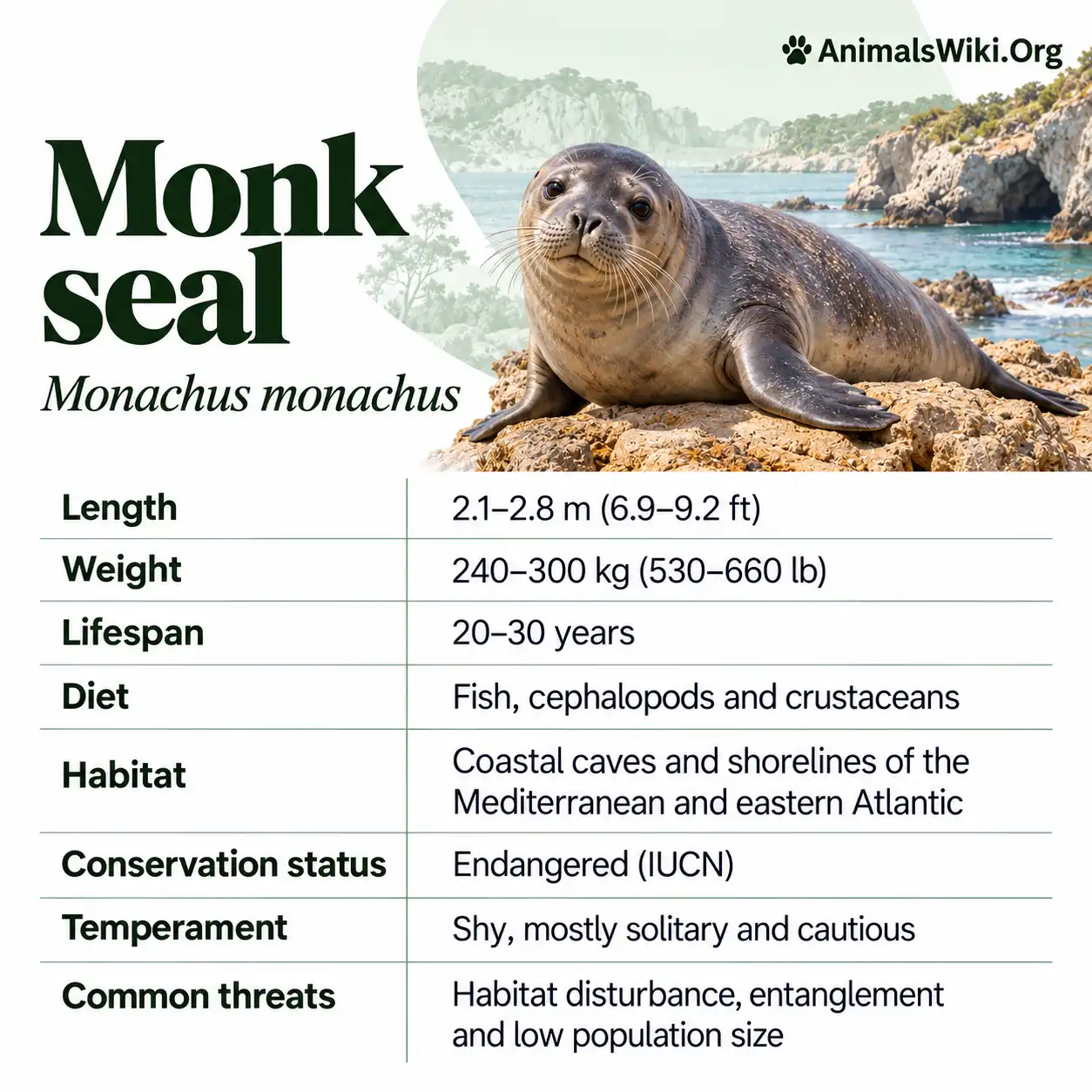
| Mediterranean monk seal | Monachus monachus |
| Extinct Caribbean species | Neomonachus tropicalis |
| Main living ranges | Hawaiian Islands; parts of the Mediterranean and eastern Atlantic |
| Main foods | Fish, cephalopods, and crustaceans |
| Typical social pattern | Often solitary, with important regional and reproductive exceptions |
| Young | Pups |
| Usual litter | One pup |
| Hawaiian nursing period | Approximately 5–7 weeks |
| Mediterranean nursing period | Several months in studied populations |
| Hawaiian global category | Vulnerable |
| Mediterranean global category | Vulnerable |
| Caribbean global category | Extinct |
1. What Is a Monk Seal?
A monk seal is a marine mammal belonging to Phocidae, the true-seal family.
Like other mammals, it breathes air, maintains a warm body, gives birth to live young, and produces milk.
Its daily life connects two environments. The sea provides food and opportunities for movement, while shorelines provide places to rest, molt, and reproduce.
Monk seals are especially associated with tropical, subtropical, and warmer temperate waters.
This makes them useful reminders that seals are not exclusively polar animals.
Their survival depends on more than water temperature. They need accessible prey, appropriate coastal habitat, and sufficient security to complete important activities ashore.
A beach can look suitable to a person while remaining unusable to a seal because of constant disturbance.
Likewise, an apparently secluded cave may contain physical hazards for a young pup.
Understanding monk seals therefore involves both marine ecology and the detailed conditions of the coast.
2. How Many Monk Seal Species Are There?
Three monk seal species are recognized in the recent historical group, but only two remain alive.
| Species | Scientific name | Status |
|---|---|---|
| Hawaiian monk seal | Neomonachus schauinslandi | Living |
| Mediterranean monk seal | Monachus monachus | Living |
| Caribbean monk seal | Neomonachus tropicalis | Extinct |
The Hawaiian and Caribbean species belong to Neomonachus. The Mediterranean species remains in Monachus.
This arrangement reflects evidence from genetics and anatomy.
The two living species should not be treated as populations of one worldwide seal.
Their ranges are separated, their histories differ, and some important aspects of their biology are distinct.
For example, a nursing schedule observed in Hawaiʻi cannot be used automatically to describe a Mediterranean mother.
The same principle applies to conservation.
An improvement in one region does not establish recovery throughout the entire group.
The extinction of the Caribbean species also makes clear why information needs to identify which monk seal is being discussed.
3. Why Did the Scientific Classification Change?
Older references place all three monk seals in the genus Monachus.
Research published in 2014 combined DNA from preserved Caribbean monk seal specimens with anatomical comparisons.
The findings supported a closer relationship between the Hawaiian and Caribbean species than between either of them and the Mediterranean species.
The researchers established Neomonachus for the two New World species.
This explains why a Hawaiian monk seal may appear as Monachus schauinslandi in an older publication and Neomonachus schauinslandi in a newer one.
The animal did not become a different species when its genus changed.
Scientists revised the classification to reflect evolutionary evidence more accurately.
The work also demonstrates the continuing value of museum collections.
Even after a species disappears, preserved material can help answer questions about relationships, history, and biodiversity.
For readers, the practical point is to recognize older names without assuming that every difference in terminology indicates a separate animal.
4. The Hawaiian Monk Seal
The Hawaiian monk seal is native to the Hawaiian archipelago.
Its Hawaiian name is commonly written ʻīlioholoikauaua, often translated as “dog that runs in rough water.”
The species occurs from the remote Northwestern Hawaiian Islands to the populated main Hawaiian Islands.
This creates contrasting conservation settings.
Some animals occupy isolated atolls where access for research and rescue is difficult. Others rest on beaches regularly used by residents and visitors.
The seal is not a recent exotic arrival to Hawaiʻi.
Its modern presence on populated islands belongs within the species’ native range.
Historical pressure and later population changes can make renewed use of an area appear unfamiliar, but unfamiliarity does not establish that the animal is out of place.
Understanding this helps improve coexistence.
A monk seal on a popular beach is using coastal habitat for a normal biological purpose, even when that purpose overlaps with human recreation.
5. The Mediterranean Monk Seal
The Mediterranean monk seal survives in scattered coastal regions rather than occupying the whole Mediterranean continuously.
Important areas include Greece, Türkiye, Cyprus, Madeira, and the Cabo Blanco region of the eastern Atlantic.
The name can therefore be geographically misleading.
Not every Mediterranean monk seal lives inside the Mediterranean Sea.
Its surviving distribution reflects a much larger historical range that contracted through hunting, persecution, habitat pressure, and other factors.
Today, separated groups face different local conditions.
A seal using an Atlantic breeding area encounters different tides, weather, and geography from one occupying an Aegean island cave.
This makes regional knowledge essential.
A conservation action effective at one site may need adjustment elsewhere.
The species’ recovery depends partly on protecting established populations while maintaining opportunities for animals to use suitable habitat beyond their current centers.
Its scattered distribution is both a conservation challenge and a reason to document reliable new records carefully.
6. The Extinct Caribbean Monk Seal
The Caribbean monk seal once occupied parts of the Caribbean and nearby western Atlantic region.
It was the third member of the monk seal group.
The last confirmed sighting was in 1952. After extensive review of available evidence, NOAA declared the species extinct and removed it from the U.S. endangered-species list in 2008.
Those dates refer to different events.
The species did not necessarily disappear in the year its extinction was formally recognized.
The gap reflects the need to evaluate records and determine whether a population could still survive.
Historical hunting and other human pressures played major roles in its disappearance.
Its story is relevant to the living species because extinction is not simply a theoretical category.
A coastal marine mammal can disappear even when it once occupied a broad region.
Preserving the Hawaiian and Mediterranean species therefore protects surviving branches of a group that has already lost one of its recent members.
7. What Do Monk Seals Look Like?
Monk seals have streamlined bodies, rounded heads, noticeable whiskers, and relatively short foreflippers.
They lack the external ear flaps found on sea lions and fur seals.
Coat appearance changes with species, age, sex, wetness, and molt stage.
Hawaiian adults commonly appear gray or brown, with a lighter underside.
Mediterranean adults can also show gray, brown, or darker coloration. Mature males often retain a conspicuous pale belly patch.
Newborns have dark coats that differ from the smoother appearance of older animals.
This means a small black pup and a pale adult may look very different while belonging to the same species.
Identification should therefore consider context.
Location is particularly useful because the two living species do not normally share a range.
Within a population, scars and natural markings can help researchers recognize individuals over time, supporting repeated observation without relying only on body size.
8. How Big Is a Monk Seal?
Monk seals are medium-sized true seals, but the living species differ.
Adult Hawaiian monk seals are commonly about 1.8–2.1 meters long and weigh approximately 180–270 kilograms.
Mediterranean monk seals are generally larger, commonly around 2.3–2.8 meters and approximately 240–300 kilograms.
These are broad references rather than fixed dimensions.
Age, sex, body condition, and reproductive stage influence measurements.
A female supporting a pup can lose substantial reserves during nursing, so body mass is not constant.
| Feature | Hawaiian monk seal | Mediterranean monk seal |
|---|---|---|
| General adult length | About 1.8–2.1 meters | About 2.3–2.8 meters |
| General adult weight | About 180–270 kilograms | About 240–300 kilograms |
| Overall comparison | Usually smaller | Usually larger |
A single photograph can make scale difficult to judge.
The most useful description identifies the species and provides a range instead of presenting one maximum as typical.
9. How Are Monk Seals Different From Sea Lions?
Monk seals are true seals, while sea lions belong to the eared-seal family.
The visible ear flap is one useful distinction.
Movement on land provides another.
Sea lions can bring their hind flippers beneath the body and move more effectively on all four limbs.
Monk seals move through muscular body undulations with assistance from their flippers.
Their apparent awkwardness ashore should not be confused with poor adaptation.
The body is principally equipped for swimming.
| Feature | Monk seal | Sea lion |
|---|---|---|
| Family | Phocidae | Otariidae |
| External ear flaps | Absent | Present |
| Hind flippers rotated beneath body for walking | No | Yes |
| Typical land movement | Body undulation | More effective four-limbed walking |
| Marine feeding | Yes | Yes |
These differences help visitors identify animals without approaching them.
A seal’s resting posture also does not indicate that it is unable to move or defend itself.
Distance remains important even when an animal appears sleepy.
10. Hawaiian Monk Seal Habitat
Hawaiian monk seals use waters around islands, atolls, reefs, and submerged banks.
Their habitat extends beyond the shallow water visible from a beach.
They forage across different underwater settings and return ashore to rest, molt, give birth, and nurse.
Coastal surfaces include sand, coral rubble, and volcanic rock.
Protected sandy areas with nearby shallow water can be particularly valuable for mothers and pups.
However, a shoreline is useful only if the animals can occupy it without repeated disturbance.
The surrounding marine environment must also support adequate feeding.
This connects offshore ecology with beach management.
A rope barrier around a resting seal addresses immediate space needs, while debris removal and protection of feeding habitat address other parts of its life.
The habitat is therefore best understood as a linked land-and-sea system rather than a single resting spot marked on a map.
11. Mediterranean Habitat: More Than Sea Caves
Mediterranean monk seals are strongly associated with coastal caves, but caves are not the entire habitat.
The animals also need surrounding marine areas where they can feed and travel.
Historically, they used open beaches more extensively.
Human disturbance and persecution contributed to the importance of secluded sites.
This history matters because cave use should not be interpreted as proof that the species naturally requires permanent concealment from every open shoreline.
Where conditions permit, animals can use exposed coastal places.
A cave may provide privacy, but its entrance, interior beach, exposure, and escape options influence its usefulness.
Conservation therefore considers the quality of the refuge and the surrounding waters together.
Protecting only the visible cave opening may fail if boat activity, development, or other pressure makes the broader site unsuitable.
The goal is a secure coastal area supporting the full life of the seal.
12. Why Some Caves Are Better Than Others
A sea cave is not automatically a safe nursery.
Water levels, wave energy, interior space, substrate, and the shape of the entrance all influence conditions.
A sheltered interior beach can provide a resting surface, while a poorly protected cave may expose pups to strong surf.
Research at Cabo Blanco linked early pup losses with storms, swells, high tides, separation, and physical injuries.
These findings do not mean cave breeding always fails.
They show that shelter from people can coexist with natural hazards.
The best habitat must balance both kinds of risk.
This is why conservation teams assess cave structure rather than treating all coastal openings as equivalent.
It also explains why entering a pupping cave can be especially disruptive.
A visitor may occupy the same limited space the animals need for resting or escape.
Protecting a nursery involves preserving usable conditions, not simply keeping its location on a list.
13. What Do Monk Seals Eat?
Monk seals eat animal prey.
Fish, cephalopods such as octopuses and squid, and crustaceans are important food categories.
They are not plant-eating seals, even if algae appears on their coats.
Their diets vary with available resources and local habitat.
Hawaiian monk seals often investigate prey near the seabed, including animals hidden in sand, rocks, and reef structures.
Mediterranean monk seals also consume varied coastal prey.
A useful diet description therefore avoids assigning one fish species to every animal.
It also avoids assuming that the seals primarily target the same large gamefish valued by people.
Research on Hawaiian feeding indicates that many prey items are small, concealed animals.
Understanding those details helps replace vague competition narratives with evidence about what seals actually eat.
A generalist diet provides flexibility, but food still needs to be sufficiently available and accessible.
14. How Do They Find Hidden Food?
A prey animal hiding beneath a rock is not necessarily safe from a searching monk seal.
Hawaiian monk seals investigate crevices and can disturb loose material while foraging.
Their snouts, whiskers, movement, and close inspection help them locate concealed prey.
This creates a feeding style different from simply chasing fish through open water.
A seal may spend time examining a small area, then move quickly when food becomes accessible.
The surrounding community also matters.
Other predators can follow and take advantage of animals exposed by the seal’s searching.
Such interactions show that feeding is not always a private event between one predator and one prey item.
The seal’s activity can change opportunities for other animals nearby.
For researchers, underwater video is valuable because these details are difficult to infer from a dive profile alone.
Depth records show where a seal went; imagery can reveal what it was doing there.
15. How Deep Can Monk Seals Dive?
Hawaiian monk seals can dive much deeper than their beachside appearance suggests.
NOAA reports dives beyond 1,800 feet, or roughly 550 meters, and breath holds reaching around 20 minutes.
However, typical feeding dives are often much shorter and shallower.
The distinction between capability and routine behavior is important.
A recorded maximum does not describe every dive.
Depth depends on prey, habitat, individual condition, and the task being performed.
Mediterranean monk seals are commonly associated with coastal feeding, but their behavior should be described using species-specific evidence rather than automatically copying Hawaiian figures.
For either species, the animal’s objective is not to maximize depth.
It needs to obtain food efficiently and return to air.
A short dive reaching useful prey may be more profitable than a longer excursion.
The impressive adaptation is flexible use of the marine environment, not constant record-breaking.
16. Are Monk Seals Territorial or Migratory?
Hawaiian monk seals do not perform one regular seasonal migration comparable to the long journeys of some elephant seals.
However, they can move between islands and travel substantial distances.
Repeated use of a beach does not necessarily mean the animal defends it as a territory.
A home area, a familiar resting place, and a defended territory are different concepts.
Mediterranean seals also move through coastal habitat, with occasional longer-distance dispersal contributing to connections among areas.
Movement matters because isolated populations can become more vulnerable.
An individual reaching a new suitable site may create an opportunity for future range expansion.
However, an isolated sighting does not establish a new breeding population.
The value of the record increases when observers document it accurately and researchers can compare it with other evidence.
For conservation, protecting connections between usable places can matter alongside protecting the places themselves.
17. Why Do Monk Seals Rest on Beaches?
Resting ashore is normal.
A monk seal on a beach is not automatically stranded, sick, or in need of help.
The shoreline provides a place to rest outside the water and supports other essential activities.
The animal may remain for a substantial period.
Its stillness should not be interpreted as an invitation to approach.
Repeated disturbance can force it to move, interrupt rest, or abandon a useful site.
This creates a practical challenge where seals and people use the same beaches.
The solution is not to assume one use must erase the other everywhere.
Clear viewing distances, temporary protected areas, and informed behavior can reduce conflict.
The important biological point is that resting habitat is part of survival.
An animal cannot meet every need by swimming continuously.
Protecting marine wildlife therefore includes allowing appropriate use of land, even when the animal spends most of its life at sea.
18. Molting and the Green-Coat Mystery
Hawaiian monk seals replace their hair and outer skin layer during an annual catastrophic molt.
The word “catastrophic” describes a concentrated process, not a disaster.
The old coat comes away as a new one develops.
Before molting, some seals have a greenish appearance because algae has grown on the fur.
The green color is not evidence that the seal itself has become a different species or that algae is its food.
After replacement, the coat can look much smoother and more silvery.
This makes appearance highly dependent on timing.
A ragged or green-coated seal should not be diagnosed from a photograph alone.
The same normal process can look unfamiliar to someone seeing it for the first time.
Natural markings, scars, and authorized identification tags help researchers follow individuals despite changes in the coat.
The molt therefore connects visible appearance with longer-term monitoring.
19. Are Monk Seals Solitary?
Monk seals are often solitary, especially when compared with densely packed sea lion colonies.
However, social behavior varies by species, region, and circumstance.
Animals can rest near one another, interact in the water, and gather at useful habitat.
Mediterranean populations include more concentrated breeding arrangements in some locations.
Mother–pup pairs also form close associations during early development.
The word “solitary” should therefore not be translated into “never social.”
An animal can spend much of its time alone while recognizing, avoiding, or communicating with others.
Likewise, several seals using the same place do not automatically form a permanent group.
The reason for proximity matters.
They may be responding independently to shelter or food.
Understanding monk seal social life requires attention to particular relationships and behaviors rather than assigning a human personality such as shy, lonely, or unfriendly to the whole group.
20. What Sounds Do Monk Seals Make?
Monk seals produce vocalizations, including underwater sounds.
Recent research has expanded knowledge of both living species.
A study of free-ranging Hawaiian monk seals identified a varied repertoire, including combinations of simpler call elements.
This challenged the idea that a mainly solitary seal would have little need for acoustic communication.
Mediterranean research has also documented calls and explored their potential value for monitoring.
Sound matters because visibility underwater is limited and animals may be separated by distance or coastal structures.
However, discovering a call type does not immediately establish its meaning.
Researchers need to connect sound with identity, location, and behavior.
The practical lesson is that a quiet-looking seal on shore may participate in a much richer underwater soundscape.
Listening provides a different perspective from photography and can reveal activity when the animal is not visible.
21. When Do Hawaiian Monk Seals Have Pups?
Hawaiian monk seals can give birth throughout the year.
The main peak generally falls from spring into summer, with NOAA identifying March through August as the typical peak period.
A female normally gives birth to one pup.
Pregnancy lasts approximately 11 months.
Age at first birth varies.
Differences between the main and Northwestern Hawaiian Islands show that reproductive timing is influenced by conditions rather than one universal age.
A female’s ability to reproduce also depends on survival and condition.
The seasonal peak is useful for planning protected areas and public information, but it should not lead observers to dismiss a pup found outside those months.
The broader point is that reproduction occurs across a long island chain with different local circumstances.
Effective monitoring needs to accommodate that variation rather than relying only on a narrow calendar window.
22. Hawaiian Monk Seal Pups and Nursing
Newborn Hawaiian monk seals have a dark, woolly coat.
They are small compared with the adult and grow rapidly on rich milk.
Mothers typically nurse for approximately five to seven weeks.
During that period, the female relies on stored energy rather than leaving regularly to forage.
Her body condition changes as energy is transferred to the pup.
This makes undisturbed access between mother and young especially important.
A mother’s thinner appearance late in nursing does not automatically indicate a separate problem; some reserve loss is expected.
However, professionals assess the overall condition and circumstances rather than assuming every loss is harmless.
The pup also changes in appearance as its first coat is replaced.
These visible transitions occur during a short but important stage.
The pair should be allowed to complete it without people entering the nursery area or encouraging the youngster to approach.
23. What Happens After a Hawaiian Pup Is Weaned?
Weaning ends the period of maternal milk support.
The youngster then begins functioning independently, often remaining near its birth area while developing feeding experience.
Its behavior can be curious and exploratory.
This creates a risk when people encourage contact.
A pup that treats humans as playmates may later become difficult to manage as it grows stronger.
Likewise, feeding can connect people with an expected food reward.
The appropriate response is to allow the animal space to remain wild.
A weaned pup alone is not necessarily abandoned in a harmful sense.
Maternal separation is part of the normal life cycle.
The youngster still faces challenges, including finding food, avoiding hazards, and developing effective behavior.
That is why researchers monitor survival beyond birth.
A healthy-looking newborn is an encouraging beginning, while recovery depends on enough young animals reaching later life stages.
24. Mediterranean Mothers Use a Different Strategy
Mediterranean monk seal nursing can last several months.
This differs substantially from the shorter Hawaiian nursing period.
Research in the Cabo Blanco population documented lactation averaging around four months among monitored pups.
Mothers began leaving to feed while nursing continued.
The maternal strategy therefore includes obtaining new food during an extended period of dependence.
This is an important example of why related species should not be given identical life histories.
A Mediterranean mother absent from a cave is not automatically abandoning her pup.
She may be following a normal feeding routine.
Researchers interpret attendance over time rather than judging one moment.
The relationship also connects nursery habitat with nearby feeding opportunities.
A secure cave matters, but the mother still needs access to food.
Protecting reproduction therefore requires attention to the surrounding marine environment as well as the shelter in which the pup rests.
25. How Do Young Mediterranean Seals Develop?
Mediterranean monk seal pups begin entering the water early.
Tracking research documented water use during the first week of life in the studied animals.
Their diving abilities improved progressively with age.
This does not mean a young pup immediately performs like an adult.
Movement, endurance, feeding independence, and thermal balance develop over time.
The nursing period allows several of those processes to overlap.
A pup may swim while still relying heavily on maternal milk.
Research inside Greek pupping caves also showed changing attendance as youngsters developed.
The cave remained important for months, rather than only during birth.
These findings make nursery protection a continuing task.
Disturbance after the first few weeks can still affect a dependent animal.
The early ability to enter water should therefore not be used as a reason to approach, flush, or otherwise displace a young seal from its resting place.
26. How Long Do Monk Seals Live?
Monk seals can live for several decades.
Hawaiian individuals have reached ages beyond 30 years, although relatively few survive that long.
Mediterranean references commonly describe longevity around 20–30 years.
These figures should not be interpreted as guaranteed lifespans.
Maximum age and average survival are different measures.
Young animals face risks before reaching maturity, while older seals experience changing reproductive and survival prospects.
For conservation, the survival of breeding females can be particularly influential.
An adult that survives may produce additional pups, while a young female reaching maturity can contribute over many later seasons.
Longevity therefore matters through population structure rather than only through records of exceptional ages.
A population needs enough animals surviving at several stages.
Births alone are insufficient if too few pups become juveniles or too few juveniles become reproductive adults.
27. How Many Monk Seals Remain?
There is no single population number for the entire group.
Recent NOAA information places Hawaiian monk seals at around 1,600.
A report estimating the 2024 population gave approximately 1,580, with uncertainty around that figure.
For Mediterranean monk seals, IUCN reporting in 2026 described approximately 800–1,000 individuals.
| Species | Useful population reference |
|---|---|
| Hawaiian monk seal | Around 1,600; the 2024 estimate was approximately 1,580 |
| Mediterranean monk seal | Approximately 800–1,000 in recent IUCN reporting |
| Caribbean monk seal | Extinct |
These are estimates, not continuously updated live counts.
Different methods and reporting dates influence the figures.
Small differences between estimates should not automatically be treated as significant change.
For example, overlapping uncertainty intervals can mean two apparent totals are statistically consistent.
The broader conservation message remains clear: both living species exist in small populations, making survival and successful reproduction important.
28. Are Monk Seals Endangered?
Both living species remain threatened, but their formal labels require care.
The Mediterranean monk seal moved from Endangered to Vulnerable on the global IUCN Red List in 2023.
The Hawaiian monk seal moved to Vulnerable in the 2025-2 IUCN update.
The IUCN table identifies the Hawaiian change as non-genuine, meaning the category change should not be interpreted by itself as a sudden biological improvement.
Separately, the Hawaiian monk seal remains Endangered under U.S. law.
| Species | Global IUCN category | Additional distinction |
|---|---|---|
| Hawaiian monk seal | Vulnerable | Endangered under the U.S. ESA |
| Mediterranean monk seal | Vulnerable | Still requires sustained protection |
| Caribbean monk seal | Extinct | No surviving population |
Vulnerable is still a threatened category.
It does not mean the animals are common or conservation work is complete.
Accurate writing identifies the assessment system rather than treating every use of “endangered” as interchangeable.
29. Historical Hunting and Persecution
Historical killing reduced monk seal populations across their ranges.
Animals resting ashore were vulnerable to hunters, and some were killed because of perceived competition with fisheries.
The loss was not only numerical.
Repeated pressure removed animals from places they once used and contributed to fragmented distributions.
For Mediterranean monk seals, this history helped make secluded refuges especially important.
For the Caribbean species, the eventual outcome was extinction.
Historical recovery stories should therefore be evaluated species by species.
The survival of a few groups does not erase the former geographic loss.
Likewise, a protected modern population may still carry consequences from an earlier bottleneck.
Understanding that history gives context to present conservation.
A seal returning to an old part of its range is not necessarily expanding into entirely new habitat.
It may represent renewed use of places from which human pressure previously removed the species.
30. Fishing Interactions and Conflict
Monk seals can be injured by hooks, lines, and nets.
Entanglement can restrict movement, interfere with feeding, or prevent an animal from reaching air.
Interactions also occur when seals investigate fishing activity.
The appropriate conservation response combines prevention, reporting, and professional assistance.
It should not assume that every seal eats the same fish sought by people or that all fishery interactions have one cause.
Diet research helps clarify actual overlap.
For Mediterranean seals, coastal fishing and habitat use can bring animals into close contact with gear.
Hawaiian management also addresses hooking and nearshore interactions.
A useful approach considers both wildlife survival and practical fishing behavior.
Reducing attractants, retrieving gear where possible, and following local guidance can address avoidable risks.
A hooked or entangled seal requires trained response rather than an improvised attempt by an observer to restrain a large animal.
31. Marine Debris and Entanglement
Discarded fishing gear can remain dangerous long after active use ends.
Nets, lines, and other plastics accumulate in marine habitats and can entangle monk seals.
Young animals are particularly vulnerable in some documented situations.
Long-term Hawaiian records provide evidence that large-scale debris removal reduces risk.
Research comparing locations before and after sustained cleanup found lower entanglement rates at most studied sites.
This is valuable because conservation actions need evidence of outcomes.
Removing debris is an activity; reducing harmful encounters is the intended result.
The study connected the two.
However, continued accumulation means cleanup cannot be treated as a one-time solution.
Prevention and repeated removal both matter.
The example also shows that protecting a rare species does not always require a complicated new technology.
Sustained practical work on a known hazard can produce measurable benefits when supported by monitoring.
32. Disease and the Land-to-Sea Connection
Disease is an important concern, particularly in small populations.
For Hawaiian monk seals, toxoplasmosis demonstrates how land-based processes can affect marine wildlife.
The parasite Toxoplasma gondii reproduces in felids and reaches the environment through infected cat feces.
Contamination can move into coastal waters, exposing seals through water or prey.
The seal does not need direct physical contact with a cat.
This makes the problem a connection among land use, runoff, animal management, and marine ecology.
NOAA continues to document fatalities and investigate their causes.
The broader lesson is that an animal’s marine range does not isolate it from activities on land.
Conservation may require action far beyond the beach where the seal is observed.
Disease prevention also differs from treating an individual case.
Understanding exposure routes helps address the continuing process that places additional animals at risk.
33. Natural Predators and Harmful Seal Interactions
Sharks can prey on Hawaiian monk seals.
At particular Northwestern Hawaiian sites, predation on pups has been a significant concern.
The risk is not evenly distributed throughout the archipelago.
A local problem should not become a claim that every shark encounter or every island presents the same conditions.
Aggression by other seals can also cause injury.
Some male interactions have harmed females and young animals, although these events can be geographically limited and episodic.
This complicates the idea that all threats come from outside the species.
Management decisions require detailed evidence about which animals are affected and whether intervention improves survival.
A small population can benefit from preventing avoidable losses, but actions need professional evaluation.
The biological point is that recovery depends on several kinds of survival.
Food, habitat, disease, predation, and interactions among seals can all influence whether a youngster reaches adulthood.
34. Habitat Loss, Tourism, and Changing Coasts
Monk seals need usable shorelines.
Development, frequent disturbance, and recreational activity can reduce access even when a beach or cave remains physically present.
Low-lying Hawaiian habitat also faces erosion and storm-related change.
Mediterranean nursery caves can be affected by visitor entry, boat activity, and nearby construction.
A habitat map therefore needs to distinguish existence from suitability.
A cave can remain on the coastline while no longer functioning safely as a nursery.
Similarly, a beach can appear intact while repeated encounters prevent adequate rest.
Protection should address the activity patterns around a site, not only its boundary.
Seasonal restrictions can be especially useful during sensitive reproductive periods.
The objective is to preserve the conditions necessary for use.
This requires attention to both physical change and human behavior, including the quieter forms of pressure that do not leave an obvious scar on the landscape.
35. Why Small, Separated Populations Are Vulnerable
Small populations can face several problems at once.
A local disaster may affect a substantial share of surviving animals.
Separation can also limit genetic exchange.
Research on Mediterranean monk seals found strong population structure and low genetic diversity, reflecting historical and continuing isolation.
These findings matter even where numbers are increasing.
Population growth and genetic condition describe different aspects of recovery.
A group can produce more pups while remaining vulnerable to events affecting one restricted location.
The 1997 Cabo Blanco mortality event illustrates the scale of a sudden loss.
Research estimated a drop from several hundred animals to roughly one hundred in that colony.
The event also changed the population’s age composition.
Conservation therefore benefits from protecting multiple usable sites and maintaining connections where possible.
The goal is not simply more seals in one place, but a population with stronger long-term resilience.
36. Rescue, Rehabilitation, and Carefully Planned Relocation
Professional conservation teams sometimes intervene to improve the survival of individual monk seals.
Actions can include removing hooks or entanglements, treating injuries, rehabilitating animals, reuniting separated pairs, or moving selected seals away from particular risks.
Relocation is not automatically appropriate.
Age, experience, release habitat, and the reason for movement influence the outcome.
Research on Hawaiian translocations found that recently weaned pups often remained near release areas more consistently than older animals.
Other studies compared survival after relocation with suitable control groups.
This allows managers to evaluate whether an action worked rather than assuming success from the release itself.
Intervention is therefore a process involving assessment, preparation, and follow-up.
It is not something visitors should imitate.
The wider aim remains a self-sustaining wild population.
Individual assistance supports that goal when it reduces important losses without replacing the need for functioning habitat and long-term protection.
37. How Scientists Study Monk Seals
Researchers use photographs, tags, movement instruments, cameras, genetic samples, and acoustic recordings.
Each method answers different questions.
Photographs can identify individuals through markings.
Tracking reveals where animals travel and dive.
Cave cameras document maternal attendance without requiring constant human presence.
Acoustic recordings provide information when seals are underwater or difficult to see.
Mediterranean research has recently confirmed underwater vocal activity and developed a foundation for acoustic monitoring.
Population studies also need to account for missed animals.
An observer sees only the individuals available at that time and place.
Combining repeated records helps distinguish a temporary absence from a more meaningful change.
Long-term work is especially important because monk seals are long-lived.
A short increase in births is encouraging, while recovery requires sustained survival and reproduction across years.
The strongest conclusions connect individual histories with changes at the population level.
38. How to Observe Monk Seals Responsibly
The best observation allows the seal to continue its normal behavior.
Use established viewing areas, respect temporary barriers, and follow the guidance provided at the location.
Mother–pup pairs need additional space.
In Hawaiʻi, NOAA advises staying at least 150 feet from these pairs, on land and in the water.
A protective mother can respond strongly to a perceived threat.
Do not feed seals, encourage interaction, enter nursery caves, or block routes between resting places and the sea.
Keep dogs away and report serious injuries or entanglements to the appropriate wildlife authority.
A resting animal is not automatically asking for help.
The larger conservation message is straightforward: monk seals need room to remain wild.
Their survival depends on food, safe coastal habitat, and the chance to complete ordinary activities without repeated interference.
Respectful observation turns public interest into a benefit rather than another source of pressure.
Frequently Asked Questions About Monk Seals
1. What is a monk seal?
A monk seal is a true seal associated with warmer marine environments. Two living species remain: the Hawaiian monk seal and the Mediterranean monk seal.
2. How many monk seal species exist?
Two survive today. A third, the Caribbean monk seal, is extinct. All three belong to the same broader monk seal group but are separate species.
3. What is the scientific name of the Hawaiian monk seal?
Its scientific name is Neomonachus schauinslandi. Older publications may use Monachus schauinslandi, reflecting an earlier classification.
4. What is the scientific name of the Mediterranean monk seal?
The name is Monachus monachus. Its surviving populations occur in the Mediterranean and parts of the eastern Atlantic.
5. Are monk seals polar animals?
They are not primarily polar seals. Their ranges include tropical, subtropical, and warmer temperate environments, demonstrating that seals are not restricted to icy regions.
6. Where do Hawaiian monk seals live?
They occur across the Hawaiian archipelago, including the Northwestern and main Hawaiian Islands. They use both marine feeding habitat and coastal resting or pupping areas.
7. Do all Mediterranean monk seals live in the Mediterranean?
No. Populations also occur in the eastern Atlantic, notably around Madeira and the Cabo Blanco region.
8. What do monk seals eat?
They eat fish, cephalopods, and crustaceans. Diet differs with species and local food availability, so one fixed menu does not describe every animal.
9. Are monk seals related to sea lions?
Both are pinnipeds, but they belong to different families. Monk seals are true seals and lack the external ear flaps of sea lions.
10. How large are Hawaiian monk seals?
Adults commonly measure about 1.8–2.1 meters and weigh approximately 180–270 kilograms. Individual size and condition vary.
11. Are Mediterranean monk seals larger?
They are generally larger, commonly around 2.3–2.8 meters and approximately 240–300 kilograms. These are broad adult references rather than exact limits.
12. Why do some Hawaiian seals look green?
Algae can grow on the fur between molts. The color does not mean the seal eats algae or belongs to a different species.
13. What is a catastrophic molt?
It is the concentrated replacement of fur and the outer skin layer. The temporary patchy appearance can be normal rather than evidence of illness.
14. Why are monk seals lying alone on beaches?
Resting alone is normal behavior. A seal on shore is not automatically stranded or abandoned, and approaching it can interfere with necessary rest.
15. Are monk seals social?
They are often solitary but still communicate and interact. Social patterns differ by species, population, and reproductive situation.
16. Do monk seals make underwater sounds?
Yes. Research has documented underwater vocalizations in both living species. Their calls also provide opportunities for less intrusive monitoring.
17. How many pups do they have?
A single pup is usual. Rare exceptions do not change the general pattern of substantial maternal investment in one youngster.
18. How long do Hawaiian pups nurse?
Approximately five to seven weeks. Mothers normally remain with the pup and rely on stored reserves during that period.
19. How long do Mediterranean pups nurse?
Several months in studied populations, often around four months. Their maternal strategy differs from the shorter Hawaiian nursing period.
20. Is a mother absent from a Mediterranean pup necessarily abandoning it?
No. Mediterranean mothers can leave to forage while nursing continues. A single observation is insufficient to establish abandonment.
21. How many Hawaiian monk seals remain?
Recent NOAA information describes around 1,600. The estimate for 2024 was approximately 1,580, with uncertainty around that number.
22. How many Mediterranean monk seals remain?
Recent IUCN reporting gives approximately 800–1,000 individuals. The figure is an estimate across separated populations, not a live count.
23. Are monk seals endangered?
Both living species are globally listed as Vulnerable by IUCN. The Hawaiian monk seal separately remains Endangered under the U.S. Endangered Species Act.
24. When did the Caribbean monk seal become extinct?
The last confirmed sighting was in 1952. NOAA formally declared it extinct in 2008 after reviewing the available evidence.
25. What is the best way to help monk seals?
Respect resting and nursery areas, avoid feeding or interacting with seals, reduce marine debris, and support evidence-based habitat protection and conservation.



