
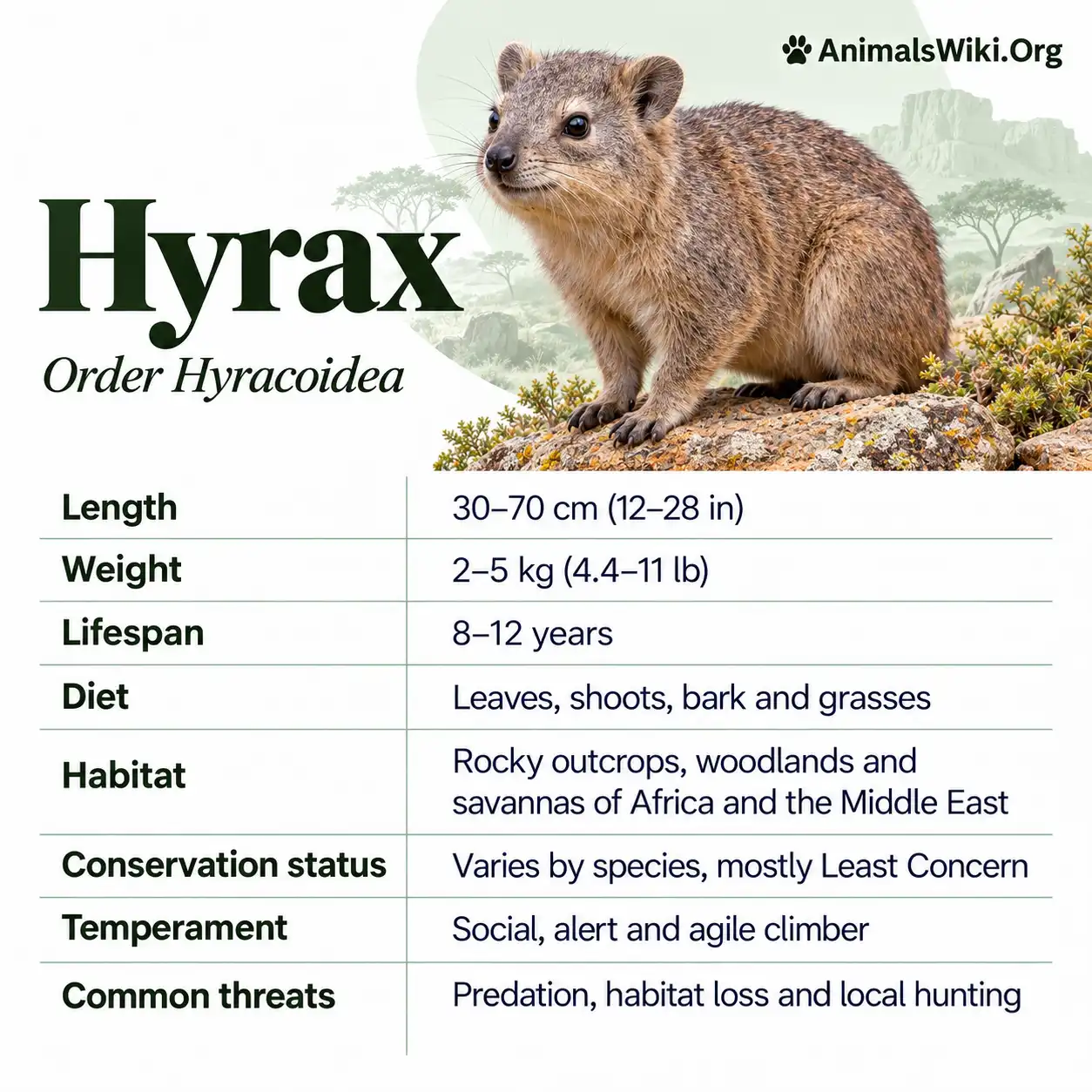
Hyrax, The Small Mammal With a Surprising Elephant Connection
A hyrax is a small, stocky mammal that often looks like a mixture of a guinea pig, a rabbit, and a furry potato. Its rounded ears, short legs, compact body, and almost invisible tail create an appearance that seems familiar, yet its evolutionary identity is anything but ordinary.
Hyraxes belong to their own mammalian order, Hyracoidea. Their living relatives include elephants, manatees, and dugongs, rather than the rodents and rabbits they superficially resemble.
They are also more varied than the familiar image of an animal sunbathing on a boulder suggests. Rock and bush hyraxes use rocky refuges, while tree hyraxes occupy forest habitats and are often heard calling at night.
Modern taxonomy recognizes six living species. Their lives include specialized climbing feet, plant-processing digestive systems, developed newborn young, social relationships, and surprisingly elaborate vocal communication.
Some rock hyraxes produce songs containing repeated elements arranged in patterns. Tree hyrax calls have even helped scientists recognize previously overlooked species.
This guide explores what hyraxes are, where they live, how the different species behave, and why these easily underestimated mammals matter to both ecosystems and scientific research.
Hyrax Facts
| Feature | Information |
|---|---|
| Animal type | Mammal |
| Order | Hyracoidea |
| Living family | Procaviidae |
| Living genera | Procavia, Heterohyrax, and Dendrohyrax |
| Recognized living species | Six in the taxonomy used here |
| Main distribution | Africa, with rock hyraxes also occurring in parts of the Middle East |
| Familiar alternative name | Dassie, especially for rock hyraxes in southern Africa |
| General appearance | Stocky body, short legs, rounded ears, reduced tail |
| Diet | Mainly plants |
| Distinctive adaptation | Flexible feet with moist, gripping pads |
| Evolutionary association | Elephants, manatees, and dugongs |
| Activity pattern | Rock and bush hyraxes mainly active by day; tree hyraxes mainly at night |
| Young | Usually born furred, open-eyed, and relatively mobile |
| Conservation | Varies by species |
1. What Is a Hyrax?
A hyrax is a member of the mammalian order Hyracoidea.
All living hyraxes belong to the family Procaviidae, although the group had a more varied evolutionary history.
Their bodies are compact, with short legs, rounded ears, and no conspicuous external tail.
They are sometimes described as rabbit-like or guinea-pig-like, but those comparisons describe appearance rather than ancestry.
A hyrax’s identity becomes clearer when anatomy, teeth, genetics, and evolutionary history are considered together.
The name covers several species with different habitats and behavior. Some live around rock formations in relatively open landscapes. Others spend much of their time in trees.
This means “hyrax behavior” should not automatically be treated as identical to “rock hyrax behavior.”
The distinction matters throughout this article. Well-studied social colonies on rocky outcrops reveal one part of the group’s biology, while secretive forest-dwelling species contribute another.
2. How Is a Hyrax Related to an Elephant?
Hyraxes and elephants share ancient evolutionary ancestry.
They belong to a broader mammalian grouping called Paenungulata, which also includes sirenians: manatees and dugongs.
This does not mean that modern elephants evolved from modern hyraxes, or that a hyrax is simply a miniature elephant.
The living lineages developed separately over immense periods.
Genetic research supports their shared history, while anatomical evidence also helped scientists investigate the relationship.
The exact branching order among these ancient lineages has been difficult to resolve, so it is better to describe hyraxes as close evolutionary relatives than to present an oversimplified family tree.
Their association is a useful reminder that appearance can be misleading.
A small climbing herbivore, an enormous land mammal, and an aquatic grazer can share ancestry despite occupying very different environments.
Evolutionary relationships reflect inherited history, rather than which animals happen to look most alike today.
3. Is a Hyrax a Rodent or a Rabbit?
No. Hyraxes are neither rodents nor rabbits.
Rodents belong to Rodentia, while rabbits and hares belong to Lagomorpha.
Hyraxes belong to Hyracoidea.
Their resemblance to other small, rounded mammals is superficial.
| Animal | Mammalian order |
|---|---|
| Hyrax | Hyracoidea |
| Guinea pig | Rodentia |
| Squirrel | Rodentia |
| Rabbit | Lagomorpha |
| Elephant | Proboscidea |
| Manatee | Sirenia |
Teeth are especially useful when examining mammalian relationships.
Hyraxes have prominent upper incisors, but their overall dental structure and evolutionary background differ from those of rodents.
Their feet and internal anatomy provide additional distinctions.
For wildlife identification, a rounded body and short ears can suggest a hyrax, but location and habitat are important clues.
An animal sitting beside a rocky crevice in Africa is much more likely to be a hyrax than a wild guinea pig.
The familiar appearance should invite closer observation rather than an immediate rodent label.
4. What Does a Hyrax Look Like?
A typical hyrax has a compact body covered in fur, a blunt face, rounded ears, and short legs.
The tail is reduced and generally not obvious.
Coat color varies among species and populations, including shades of brown, gray, and darker tones.
Some have pale facial markings or a contrasting patch around the dorsal gland on the back.
Long tactile hairs project beyond the ordinary coat and help the animal investigate its surroundings.
Its teeth can become visible when it opens its mouth, revealing prominent upper incisors.
Feet are another important feature, although they may be difficult to examine from a distance.
Unlike many familiar small mammals, most toes carry flattened, hoof-like nails rather than a complete set of narrow climbing claws.
The combination of compact body, unusual feet, and tusk-like incisors makes a hyrax more distinctive than its initial guinea-pig resemblance suggests.
5. How Big Are Hyraxes?
Living hyraxes are small compared with elephants, but they are substantial animals for their body shape.
Adult size varies among species, populations, sexes, and individuals.
For rock hyraxes, San Diego Zoo gives a body-length range of approximately 30–58 centimeters and a weight range of about 1.8–5.4 kilograms.
These measurements should not be applied rigidly to every tree or bush hyrax.
| Feature | General pattern |
|---|---|
| Body length | Commonly several tens of centimeters |
| Body mass | Usually a few kilograms |
| Tail | Reduced and inconspicuous |
| Build | Stocky rather than slender |
| Legs | Short relative to body size |
A thick coat can also change the apparent size of an animal.
Tree hyraxes in cooler or elevated habitats may look especially rounded because of their fur.
As with other mammals, body condition matters. A length measurement does not reveal whether an animal has adequate energy reserves or is growing normally.
6. What Are the Six Living Hyrax Species?
Current taxonomy recognizes six living species in three genera.
| Common name | Scientific name | Broad association |
|---|---|---|
| Rock hyrax | Procavia capensis | Rocky habitats across much of Africa and parts of the Middle East |
| Bush hyrax | Heterohyrax brucei | Rocky habitats in eastern and southern Africa |
| Southern tree hyrax | Dendrohyrax arboreus | Forest habitats in eastern and southern Africa |
| Western tree hyrax | Dendrohyrax dorsalis | Forest regions of western and central Africa |
| Eastern tree hyrax | Dendrohyrax validus | Parts of eastern Africa |
| Benin tree hyrax | Dendrohyrax interfluvialis | Forests between the Volta and Niger rivers |
Older references may give a different number because tree hyrax classification has changed.
Scientific names are especially useful because common names such as “eastern tree hyrax” have not always been used consistently.
Rock hyrax
The rock hyrax is the species many people recognize from photographs of animals basking on boulders.
Its broad distribution includes dry and rocky landscapes across much of Africa and parts of the Middle East.
The Mammal Diversity Database treats numerous historical names within Procavia capensis.
Consequently, an older regional name does not necessarily represent an additional currently recognized species.
Bush hyrax
The bush hyrax is also called the yellow-spotted hyrax.
Despite the word “bush,” it strongly depends on rocky habitat and shelter.
Its distribution includes eastern and southern African regions.
It can occur alongside rock hyraxes, but it remains a separate species with its own feeding preferences and reproductive behavior.
Southern tree hyrax
The southern tree hyrax belongs to the forest-associated genus Dendrohyrax.
Its scientific name is Dendrohyrax arboreus.
Older sources sometimes use a different English common name, making the scientific name important when comparing references.
Its classification should also be distinguished from that of Dendrohyrax validus, which is recognized separately in the taxonomy used here.
Western tree hyrax
The western tree hyrax occurs across a broad African forest region.
Its classification has been the subject of continuing research because apparently similar forest populations can contain overlooked diversity.
The description of the Benin tree hyrax demonstrated that some animals formerly grouped with western tree hyraxes represented a distinct species.
Eastern tree hyrax
The eastern tree hyrax, Dendrohyrax validus, occurs in parts of Kenya and Tanzania.
It has a more restricted distribution than the widespread rock hyrax.
The Mammal Diversity Database lists it as Near Threatened, making species-specific habitat protection particularly relevant.
Benin tree hyrax
The Benin tree hyrax was formally described in 2021.
Its recognition drew on distinctive calls together with anatomical and genetic evidence.
It occurs between the Volta and Niger rivers, including parts of Ghana, Togo, Benin, and Nigeria.
Its name does not mean it is restricted to the country of Benin alone.
7. Where Do Hyraxes Live?
Hyraxes are primarily African mammals.
Rock hyraxes also occur in parts of the Middle East, including areas of the Arabian Peninsula and eastern Mediterranean region.
Different species occupy different combinations of climate, elevation, vegetation, and shelter.
Their habitats range from relatively dry rocky landscapes to forest.
This distribution should not be interpreted as every hyrax species occurring throughout Africa.
The rock hyrax is widespread, while some tree hyraxes have much more restricted ranges.
A broad map also hides local dependence on suitable habitat.
A region may contain extensive vegetation but few usable refuges for a rock-dwelling species.
Likewise, scattered trees may not provide the forest structure needed by a tree hyrax.
Understanding distribution therefore requires identifying the species first, then considering the specific resources it uses.
The word “Africa” provides a starting location, not a complete habitat description.
8. Why Are Rocks So Important to Rock Hyraxes?
Rock formations provide shelter from predators and environmental extremes.
Crevices, cavities, and spaces between boulders allow hyraxes to retreat quickly.
These refuges influence how far animals can safely move while feeding.
Rock hyraxes use a variety of landscapes, including dry areas, savannas, and mountainous terrain, but suitable cover remains important.
They do not simply inhabit any open grassland containing food.
A feeding patch far from shelter may carry greater risk than a smaller patch close to a secure crevice.
This creates a landscape organized around refuge sites.
The rocks themselves are therefore more than convenient resting platforms.
They can determine where a colony establishes, how animals travel, and which parts of the surrounding vegetation they use.
Habitat conservation needs to consider the outcrop together with its nearby feeding area rather than treating one as sufficient without the other.
9. How Do Tree Hyraxes Live Differently?
Tree hyraxes are adapted to forest life.
They use branches, trunks, and sheltered resting places rather than relying primarily on open rocky colonies.
Many are most active at night.
Their voices may reveal their presence more readily than direct sightings.
Forest structure matters because food, climbing routes, and shelter are distributed vertically.
Removing large trees can therefore change more than the amount of shade.
It may eliminate resting cavities, interrupt movement routes, or reduce access to feeding areas.
Research accounts describe tree hyraxes using a range of forest types, including riverine, lowland, montane, and other wooded habitats.
However, details vary by species and location.
Not every observation from one forest population should be generalized across the entire genus.
Tree hyraxes illustrate an important point: the hyrax body plan supports both rock-associated and arboreal lifestyles, each with different ecological requirements.
10. How Do Hyrax Feet Grip Rocks and Trees?
Hyrax feet have specialized bare pads that help them maintain contact with surfaces.
Secretions keep the pads moist, and flexible muscles allow the foot to adjust its shape.
Together, these features improve grip.
Popular descriptions compare them with suction cups, but the practical observation is that their feet help them move confidently across surfaces that would challenge many other mammals.
The bush hyrax provides a well-described example.
Its padded feet support movement over smooth rock and uneven terrain near shelters.
Climbing also involves body control.
A compact animal must place its feet accurately, maintain balance, and shift weight while moving between irregular surfaces.
This ability helps explain why a hyrax that appears slow while resting can move effectively when disturbed.
Its rounded body should not be mistaken for clumsiness.
The feet are a key adaptation linking anatomy with the rocky or wooded habitats used by different species.
11. Do Hyraxes Have Tusks?
Hyraxes have prominent upper incisors that can look like small tusks.
These are especially noticeable when the mouth is open.
They are teeth, not horns.
The incisors form part of a feeding system that also includes strong cheek teeth for processing vegetation.
Although the small tusk-like teeth are often mentioned alongside the elephant relationship, a single similarity does not establish evolutionary ancestry.
Scientists consider many anatomical and genetic characteristics together.
The teeth also differ from the familiar front-tooth arrangement of rodents.
A hyrax is not simply a guinea pig with unusually large incisors.
The combination of tooth structure, foot anatomy, internal biology, and molecular evidence establishes its distinct identity.
For wildlife observers, the visible incisors are useful reminders that this apparently ordinary small mammal has an unusual evolutionary history.
They should be viewed from a respectful distance rather than encouraged through close disturbance.
12. What Do Hyraxes Eat?
Hyraxes are mainly herbivores.
Their foods include grasses, leaves, shoots, flowers, fruit, twigs, and other plant material, depending on species and habitat.
Rock hyraxes may switch between grazing and browsing.
Bush hyraxes are more strongly associated with browsing, while tree hyraxes feed within forest vegetation.
| Hyrax group | Broad feeding pattern |
|---|---|
| Rock hyrax | Flexible use of grasses and browse |
| Bush hyrax | Greater emphasis on browse |
| Tree hyraxes | Forest plant material, including leaves and other available foods |
These differences help explain how two species can share the same rocky area.
They may overlap spatially without using food in exactly the same way.
Season also influences the menu.
Vegetation that is soft and abundant during wetter conditions may become less available later.
A useful diet description therefore includes both the plants eaten and the conditions determining access to them.
13. How Do Hyraxes Digest Tough Plants?
Plant material can be difficult to digest, especially when it contains substantial fiber.
Hyraxes rely on a specialized digestive system involving microbial fermentation.
Studies of the rock hyrax have identified important sites where microorganisms help break down food and produce compounds the animal can use.
The digestive tract retains and processes material in ways that improve extraction from a plant-based diet.
This does not make a hyrax a true ruminant.
It should not be described as having the same digestive process as a cow simply because it sometimes moves its jaws in a way that resembles chewing cud.
Research on the tract’s structure and movement shows a distinctive arrangement.
The broader lesson is that small herbivores can use complex digestive strategies.
A hyrax’s short feeding bouts and long resting periods fit within an energy budget that includes the time required to process vegetation efficiently.
14. How Do Hyraxes Manage in Dry Habitats?
Some hyrax populations live in landscapes where free-standing water is limited.
Moisture obtained from food contributes to their water balance.
Physiological mechanisms also help conserve water, while behavior reduces exposure to difficult conditions.
Sheltering during unfavorable periods can limit the costs of remaining active in heat.
However, dry-habitat adaptation should not be turned into the claim that every hyrax never drinks or has no need for water.
Species and environments differ.
A forest tree hyrax and a rock hyrax in an arid landscape do not experience the same moisture conditions.
Research on metabolism and temperature regulation shows how flexible physiology and behavior can work together.
The animal’s survival depends on the complete setting: food quality, shelter conditions, weather, and activity patterns.
A water-saving adaptation helps within that setting but does not make the animal independent of environmental resources.
15. Why Do Hyraxes Sunbathe?
Basking is a familiar feature of rock and bush hyrax behavior.
Sitting in sunlight allows an animal to gain heat from its surroundings.
This can reduce the need to generate all necessary warmth through metabolism.
The behavior is particularly noticeable after cooler periods.
However, basking does not make a hyrax cold-blooded.
It remains a mammal with physiological mechanisms for temperature regulation.
Research has documented responses such as changes in metabolism and behavior under different thermal conditions.
The animal can also avoid excessive heat by moving into shelter or selecting a different resting surface.
Basking is therefore one part of a flexible temperature-management strategy.
A sunlit boulder, shaded crack, and sheltered sleeping site provide different opportunities.
The colony’s daily routine reflects those changing conditions rather than a simple habit of spending every available moment in direct sunlight.
16. Why Do Hyraxes Huddle Together?
Huddling brings animals into close physical contact.
It can influence heat exchange and the energetic cost of maintaining temperature.
For small mammals, reducing exposed surface area can be useful during cool conditions.
Hyraxes are well known for this behavior, but its effects require careful interpretation.
A study of rock hyraxes found no detectable effect of huddling on core body temperature under the conditions examined.
That does not mean close contact has no energetic or behavioral significance.
Maintaining the same temperature at a lower energy cost would be a different outcome from becoming warmer.
This distinction illustrates why visible behavior and physiological consequences should not be treated as identical.
Huddling also occurs within a social setting.
Who rests beside whom, where the animals gather, and how conditions change through the night can all influence the pattern.
It is both a physical arrangement and part of colony life.
17. Are Hyraxes Active During the Day or Night?
Activity differs among the main groups.
Rock and bush hyraxes are generally active during daylight.
Tree hyraxes are mainly nocturnal.
This difference changes how people encounter them.
A rock hyrax can be photographed while basking or feeding near an outcrop. A tree hyrax may remain concealed while its calls carry through the forest after dark.
Nighttime behavior also matters for species that are visible by day.
Research using proximity loggers has shown that important social interactions occur when observers would otherwise struggle to follow the animals.
A daytime survey therefore cannot reveal the whole social schedule of a colony.
Activity also responds to weather and local conditions.
Heat, cold, disturbance, and feeding opportunities can influence when animals leave shelter.
The most useful description identifies both the species and the circumstances, rather than treating all hyraxes as uniformly active at one time.
18. What Is Life Like in a Rock Hyrax Colony?
Rock hyrax colonies contain repeated relationships rather than a random collection of interchangeable animals.
Individuals rest together, feed near familiar refuges, and respond to social neighbors.
Some males hold resident positions, while other males remain outside the core breeding arrangement.
Females and their offspring contribute to more persistent group structure.
The colony’s organization is affected by space.
Animals using the same refuges and feeding areas are more likely to encounter one another.
Recent experiments have examined whether changes in perceived predator risk and food availability alter social networks.
The results emphasize both the role of space use and the stability that some social arrangements can show under mild environmental changes.
To a visitor, the animals may appear to be doing little.
To a researcher following identified individuals, the same scene contains a history of association, competition, and repeated contact.
19. Can Rock and Bush Hyraxes Live Together?
Yes. Rock and bush hyraxes share some habitats and can form close associations.
They may use the same shelters, rest near one another, and respond to common dangers.
Their young can also interact.
This does not mean the two species are identical or routinely interbreed.
Differences in feeding and reproductive behavior help maintain their distinct identities.
Sharing habitat becomes more feasible when animals do not rely on every resource in exactly the same way.
A rock hyrax using more grass and a browsing bush hyrax can overlap geographically while differing in diet.
These mixed groups are especially interesting because they show cooperation or tolerance across a species boundary.
The relationship should still be understood locally.
Not every rock hyrax population lives beside bush hyraxes, and the details depend on which species and resources occur at a particular outcrop.
20. Can Social Relationships Affect Survival?
Research on wild rock hyraxes has connected social-network patterns with longevity.
A long-term study at Ein Gedi examined nonaggressive interactions and the structure of relationships within groups.
The findings showed that features of the social network were associated with adult lifespan.
This does not justify a simple statement that having more friends always makes a hyrax live longer.
The measured relationships were more specific, and several influences can operate together.
Health, age, group membership, and habitat use may affect both behavior and survival.
Nevertheless, the research demonstrates that social organization can contain biologically meaningful information.
It also explains why long-term studies are valuable.
An isolated photograph cannot reveal whether two resting animals have associated for years.
Repeated observations turn apparently quiet colony behavior into evidence about how relationships may connect with an individual’s life history.
21. What Sounds Do Hyraxes Make?
Hyraxes produce a variety of sounds, including calls described as whistles, grunts, barks, shrieks, and more elaborate vocal sequences.
The repertoire differs among species.
Some tree hyrax calls are especially loud and striking in the nighttime forest.
Their sounds can reveal presence even when the animals themselves are difficult to find.
Researchers studying tree hyrax diversity have used vocal differences alongside anatomy and genetics.
This was important in recognizing the Benin tree hyrax.
A call is therefore more than an unusual background noise.
It can carry information about identity, species, social context, or location.
However, a sound alone needs careful interpretation.
Scientists compare recordings systematically rather than assuming that every unfamiliar call represents a new species.
The strongest conclusions come from combining acoustic evidence with other biological data.
22. Do Rock Hyraxes Really Sing?
Male rock hyraxes produce extended vocal displays commonly called songs.
These contain different sound elements arranged in sequences.
Researchers have examined how those elements are ordered, describing syntactic structure and geographic differences.
The word “syntax” here refers to the arrangement of vocal components.
It should not be confused with evidence that hyraxes use human-style grammar or language.
The finding is nevertheless remarkable.
A song is not simply a repeated identical note. Its structure can vary among individuals and regions.
Such differences may reflect social and developmental processes that researchers continue investigating.
Listening to the whole sequence reveals patterns that would be missed by studying one isolated sound.
The rock hyrax therefore provides an unusual example of a terrestrial mammal whose vocal displays can be analyzed for organization, variation, and possible social significance.
23. Does Rhythm Matter in Hyrax Songs?
Research has found an association between rhythmic features of male rock hyrax songs and reproductive success.
Males producing more regular timing patterns achieved greater reproductive success in the studied population.
That result does not mean a particular rhythm guarantees mating success.
It shows that timing can contain information relevant to understanding vocal display.
Other work has examined how songs progress toward a more elaborate ending.
Changes in complexity, frequency, or intensity can shape the overall display rather than leaving every section identical.
Together, these studies demonstrate that both individual elements and the structure of the complete song matter.
The animal’s performance is therefore more complex than a loud announcement of presence.
It may communicate aspects of the singer’s condition or status, although the precise information received by listeners requires continued investigation.
24. How Do Hyraxes Reproduce?
Hyraxes have unusually long pregnancies for mammals of their size.
Gestation is commonly around seven to eight months.
Litter size varies among species and circumstances.
Rock hyrax females often produce one to four young.
Births within a group can occur during a relatively concentrated period, linking reproductive timing with seasonal conditions.
The long pregnancy contributes to the advanced condition of newborn young.
A hyrax pup is not born in the helpless state associated with many small rodents.
Reproduction also occurs within a social system.
Resident males, dispersing animals, and related females can have different roles in the population.
These details should not be transferred identically across rock, bush, and tree species.
The broad pattern is slow prenatal development followed by relatively capable young, with the mother still providing milk and care after birth.
25. What Are Baby Hyraxes Like?
Baby hyraxes are often called pups.
They are born with fur, open eyes, and a relatively high level of mobility.
Biologists describe this condition as precocial.
That does not mean they are immediately independent.
They still need milk, protection, and time to develop.
Young rock and bush hyraxes can investigate their surroundings soon after birth and begin trying vegetation while nursing continues.
Their ability to move is useful in habitats where families occupy uneven rock surfaces and crevices.
However, early mobility also brings hazards.
A pup must learn to use refuge space, follow adults, and respond to danger.
Observations of births and early behavior show that hyrax development is quite different from that of many similarly sized mammals.
The newborn’s capable appearance reflects the substantial investment made during the long pregnancy.
26. How Long Do Hyraxes Live?
Hyrax lifespan varies among species, sexes, populations, and living conditions.
General wildlife accounts describe some individuals living around a decade or longer.
That should not be confused with average survival from birth.
Many young animals die before reaching adulthood, while successful adults may survive through several breeding seasons.
Maximum age, median life expectancy, and average lifespan are different measurements.
This explains why sources can give different figures without necessarily contradicting one another.
Predation, habitat, disease, and social conditions all contribute to survival.
Long-term identification studies are especially valuable because they follow actual individuals rather than relying only on estimated ages.
For conservation, the important point is that population persistence depends on both producing young and retaining enough adults to reproduce again.
A colony with visible pups is not automatically secure if adult losses remain high.
27. What Eats Hyraxes?
Hyraxes are prey for several predators.
These include large eagles, leopards, caracals, snakes, and other carnivores, depending on the region.
Verreaux’s eagles are especially associated with hyrax hunting in parts of Africa.
The importance of each predator varies locally.
A hyrax colony near an eagle nesting area may experience different pressures from a forest tree hyrax population.
Body size and age also matter. Small young may face risks different from those confronting adults.
Predation helps explain the importance of refuges and vigilance.
A short distance between a feeding patch and a crevice can affect the opportunity to escape.
Hyraxes are therefore not simply resting beside rocks because the surface is convenient.
The surrounding structure is part of a survival system linking food access, predator detection, and rapid retreat.
Their role as prey also connects them with larger animals throughout the ecosystem.
28. Why Are Hyraxes Ecologically Important?
Hyraxes connect vegetation with higher levels of the food web.
They consume plants and become food for larger predators.
Their use of rocky outcrops also concentrates feeding, waste, and biological activity around particular refuges.
Forest species participate in different ecological settings, linking vegetation with predators that use wooded habitat.
The significance of a colony depends on context.
A small isolated group does not necessarily have the same effect as a dense population occupying a large outcrop.
Nevertheless, the general connections are clear: plants support hyraxes, and hyraxes help support predators.
Their conservation therefore reaches beyond the animals themselves.
Removing a population can change a local food resource, while degrading an outcrop or forest patch can affect the wider community using it.
Understanding their role helps explain why apparently modest mammals deserve attention alongside more conspicuous species.
29. What Is the Gland on a Hyrax’s Back?
Hyraxes have a dorsal gland, meaning a gland on the back.
It is surrounded by a patch of specialized hairs that may contrast with the rest of the coat.
Those hairs can become more conspicuous when raised.
The gland is involved in chemical communication.
Its appearance can also help observers distinguish some animals, although color varies among species and individuals.
A raised patch should not automatically be interpreted as an injury or missing fur.
It can be part of normal anatomy and behavior.
Chemical communication matters because animals receive information through scent as well as sight and sound.
For humans, the calls and movements of a colony are easier to notice.
For a hyrax, scent adds another layer of information about the social environment.
The dorsal gland is therefore one component of a communication system operating through several senses.
30. Why Do Hyraxes Use the Same Toilet Sites?
Rock hyrax colonies often repeatedly use particular places for urination and defecation.
Over time, these latrines can leave visible deposits.
White streaks beneath a rocky refuge may be one clue that hyraxes use the site.
The deposits can persist because waste accumulates in sheltered places rather than being dispersed evenly across the landscape.
Researchers call these accumulations middens.
Their existence also reflects repeated occupation and behavior over long periods.
However, a deposit does not reveal exactly how many animals currently live there.
Old material can remain after local conditions change.
For wildlife observation, latrines are useful signs of habitat use.
For scientists, they can preserve information far beyond a recent visit.
The same behavior that produces an obvious stain on rock can create a layered environmental record when material accumulates under favorable conditions.
31. How Can Hyrax Middens Reveal Ancient Climate?
Hyrax middens can preserve material that helps scientists reconstruct past environments.
Layered accumulations of urine and fecal pellets may contain pollen, chemical signals, and other evidence.
Researchers use dating methods and laboratory analysis to connect those layers with changes through time.
An international research project investigated middens preserving records extending back tens of thousands of years.
This is especially useful in dry regions where other environmental archives may be limited.
The midden is not a simple recording device.
Scientists must understand preservation, deposition, and the relationship between the animal’s behavior and the surrounding landscape.
Nevertheless, the archive can reveal changes in vegetation and climate.
A small mammal repeatedly using a sheltered latrine has therefore contributed evidence to questions about environmental history.
The scientific value depends on leaving such deposits intact rather than disturbing them out of curiosity.
32. Were Ancient Hyraxes Larger?
The living hyrax species represent only part of a much broader evolutionary history.
Fossil evidence shows that ancient hyracoids were more diverse in size and form.
Some were considerably larger than modern hyraxes.
This does not mean that today’s rock hyrax is a smaller version of one particular giant ancestor.
Evolution involves branching lineages, with many forms disappearing and others persisting.
The modern association with rocks and trees should therefore not be projected unchanged into the distant past.
Fossils help reveal when body forms, diets, and geographic distributions differed.
They also show why studying only living species can create an incomplete impression of a mammalian group.
The small animals seen today are survivors of an older radiation, not evidence that every member of their evolutionary history always occupied the same ecological niche.
33. Are Hyraxes Endangered?
There is no single conservation category for all hyraxes.
Current status differs among species.
| Species | IUCN category reported in the Mammal Diversity Database |
|---|---|
| Rock hyrax | Least Concern |
| Bush hyrax | Least Concern |
| Southern tree hyrax | Least Concern |
| Western tree hyrax | Least Concern |
| Eastern tree hyrax | Near Threatened |
| Benin tree hyrax | Not Evaluated |
“Not Evaluated” does not mean safe.
It means the species has not been assigned an assessment category in the referenced information.
Likewise, Least Concern does not guarantee that every local population is stable.
A widespread species can decline in a particular area, while forest-dependent species may be sensitive to habitat changes within a restricted range.
Accurate conservation writing should identify the species rather than describe all hyraxes as equally common or equally threatened.
34. What Threats Do Hyraxes Face?
Habitat loss and fragmentation can affect access to food, shelter, and other animals.
For rock-associated species, damaging an outcrop or removing surrounding vegetation can reduce habitat quality.
For tree hyraxes, forest clearance can eliminate both feeding areas and resting structures.
Hunting also affects some populations.
The importance of each threat differs geographically.
A conservation approach designed for a widespread rock hyrax cannot simply be copied to a forest species with a restricted distribution.
Fragmentation matters because a remaining patch may be difficult to reach safely.
An animal moving across exposed land can face risks absent within its normal refuge.
Protecting isolated pieces of habitat is therefore not always sufficient.
Maintaining useful connections and understanding local pressures helps turn a protected area from a mapped boundary into habitat that animals can actually use.
35. Why Are Scientists Still Discovering Hyrax Diversity?
Tree hyraxes can be difficult to observe, and outward similarity can conceal important differences.
The recognition of Dendrohyrax interfluvialis showed how recordings, anatomy, and genetics can reveal overlooked species.
The animals were not newly created or necessarily unknown to local people.
What changed was their formal scientific recognition.
This distinction matters when reading the phrase “new species.”
Discovery often means that researchers establish a previously unrecognized evolutionary identity.
The finding also affects conservation.
A population once considered part of a widespread species may turn out to represent a more restricted lineage with different needs.
Taxonomy is therefore not merely a naming exercise.
It helps define the biological units that conservation is trying to preserve and identifies where additional surveys or assessments may be necessary.
36. How Should People Observe Hyraxes?
Watch quietly and allow the animals to keep using their normal routes and shelters.
Binoculars or a zoom lens provide a closer view without requiring a closer approach.
Do not block crevice entrances or surround animals on a small outcrop.
Avoid feeding.
An animal accustomed to approaching people can face risks different from those associated with natural feeding.
For tree hyraxes, listening can be more informative than trying to force a sighting.
Do not use bright lights or repeated disturbance to make a concealed animal move or call.
Photographs and sound recordings are most valuable when accompanied by an accurate location and time.
If identification is uncertain, retain that uncertainty rather than assigning a species from one unclear image.
Responsible observation preserves the behavior that makes hyraxes interesting in the first place.
Frequently Asked Questions About Hyraxes
1. What is a hyrax?
A hyrax is a small mammal in the order Hyracoidea. Living species belong to the family Procaviidae and include rock, bush, and tree hyraxes.
2. Is a hyrax a rodent?
No. Rodents belong to Rodentia. Hyraxes have a separate evolutionary identity despite their superficial resemblance to guinea pigs and other rounded mammals.
3. Is it related to a rabbit?
It is not closely related to rabbits. Rabbits belong to Lagomorpha, while hyraxes belong to Hyracoidea.
4. How is it related to an elephant?
Hyraxes and elephants share ancient ancestry within a broader group that also includes manatees and dugongs. Modern elephants did not evolve from modern hyraxes.
5. How many living hyrax species are recognized?
The taxonomy used here recognizes six: one rock hyrax, one bush hyrax, and four tree hyrax species.
6. What is a dassie?
Dassie is a common southern African name particularly associated with the rock hyrax. It is not a separate species.
7. Where do hyraxes live?
They are primarily African mammals. Rock hyraxes also occur in parts of the Middle East, while individual species occupy different regional habitats.
8. Do all hyraxes live on rocks?
No. Rock and bush hyraxes strongly use rocky refuges, while tree hyraxes are associated mainly with forest habitats.
9. Are tree hyraxes active at night?
They are mainly nocturnal. Their calls often reveal their presence more readily than direct sightings.
10. What do hyraxes eat?
They mainly eat plants, including grasses, leaves, shoots, fruit, and other vegetation. The relative importance of foods differs among species.
11. Do they chew cud?
Hyraxes are not true ruminants. Their specialized digestive systems support microbial processing of vegetation, but that is different from cow-like rumination.
12. Why do they sunbathe?
Basking helps them gain heat from the environment. It works alongside physiological temperature regulation and the use of shelter.
13. Are hyraxes cold-blooded?
No. They are mammals. Their use of sunlight and huddling does not make them reptiles or remove their physiological ability to regulate temperature.
14. How do they climb smooth rocks?
Their flexible feet have specialized pads kept moist by secretions. These features improve grip and help them move across difficult surfaces.
15. Do hyraxes have tusks?
Their upper incisors can resemble small tusks. They are teeth rather than horns.
16. Why is there a patch on the back?
The patch surrounds a dorsal gland involved in chemical communication. Its appearance varies among species and individuals.
17. Do hyraxes sing?
Male rock hyraxes produce complex vocal displays called songs. Researchers have studied the arrangement and timing of the sound elements.
18. Do they have a language?
Their calls can have structured sequences, but that does not establish human-like language. Scientific use of “syntax” refers to the ordering of vocal elements.
19. What is a baby hyrax called?
A young hyrax is often called a pup. It is born furred, open-eyed, and relatively mobile, but still depends on maternal care.
20. How long is pregnancy?
Pregnancy is commonly around seven to eight months, which is unusually long for a mammal of this size.
21. Can rock and bush hyraxes live together?
Yes. Some populations share shelters and other space. Differences in diet and reproduction help maintain their separate identities.
22. What animals eat hyraxes?
Predators include large eagles, leopards, caracals, snakes, and other carnivores, depending on location and species.
23. Are all hyraxes threatened?
No. Conservation status varies. The eastern tree hyrax is listed as Near Threatened in the reference used here, while several other species are Least Concern.
24. What are hyrax middens?
They are accumulations of waste at repeatedly used sites. Under suitable conditions, their layers can preserve evidence of past vegetation and climate.
25. Can you keep a wild hyrax as a pet?
Hyraxes are wild animals with specialized habitat, social, and dietary needs. Observe them in natural habitat or appropriately managed settings, and follow local wildlife laws.
Hyraxes and the Value of Looking More Closely
Hyraxes reward careful observation.
What first appears to be a small animal resting on a rock turns out to have specialized feet, an unusual digestive system, complex social relationships, and an evolutionary connection to elephants and sea cows.
The group also extends far beyond the familiar rock hyrax.
Forest species contribute loud nighttime calls, overlooked diversity, and conservation needs tied to trees and connected habitat.
From vocal research to ancient climate archives, hyraxes have helped scientists investigate questions much larger than their modest bodies suggest.
Protecting them begins with recognizing those differences and preserving the refuges, vegetation, and forest structures that make their lives possible.



