
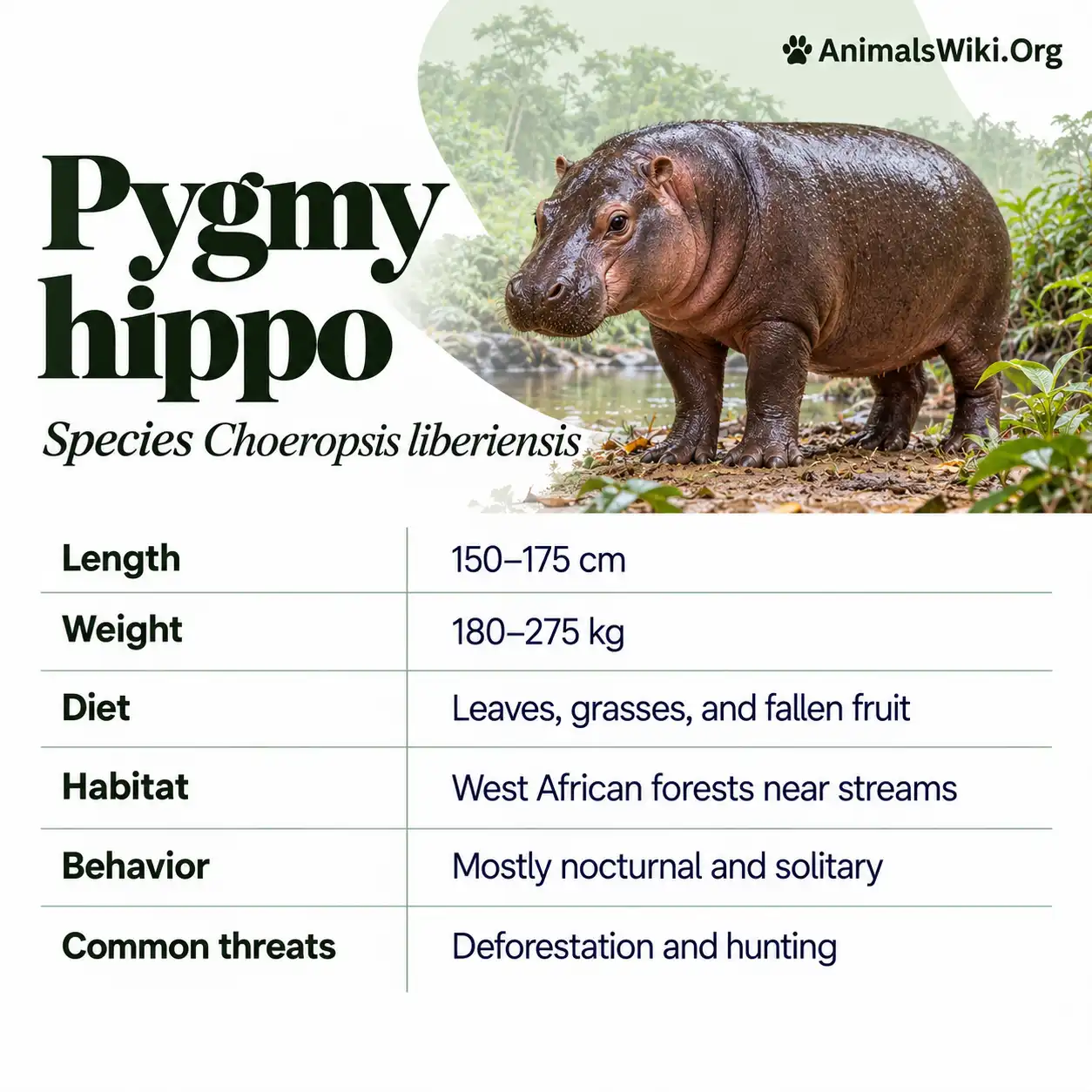
Pygmy Hippo, A Complete Guide to West Africa’s Rare Forest Hippopotamus
The pygmy hippo is one of West Africa’s most unusual mammals. With a rounded body, glossy skin, short legs and a broad mouth, it looks unmistakably like a hippopotamus. Yet its life differs considerably from that of the much larger hippos seen gathering in open rivers.
A pygmy hippo spends much of its life in dense forest, moving between shaded resting places, streams and feeding areas. It is generally solitary, secretive and most active during the evening and night. Even where the species survives, people may encounter its footprints or droppings more often than the animal itself.
Its small size is relative. An adult pygmy hippo can weigh around 160–275 kilograms, making it substantially smaller than a common hippopotamus but still a powerful animal. It is a separate species, with its own evolutionary history and adaptations for forest life.
Unfortunately, the forests that support pygmy hippos are under pressure. Habitat loss, fragmentation and hunting threaten a species already difficult to count and study.
This guide explores pygmy hippo facts, appearance, habitat, diet, behavior, reproduction and conservation, while distinguishing well-documented observations from aspects of its wild life that remain uncertain.
Pygmy Hippo Facts
| Feature | Information |
|---|---|
| Common name | Pygmy hippo or pygmy hippopotamus |
| Scientific name | Choeropsis liberiensis |
| Family | Hippopotamidae |
| Order | Artiodactyla |
| Native region | Upper Guinean forests of West Africa |
| Current established range | Liberia, Sierra Leone, Guinea and Côte d’Ivoire |
| Typical adult weight | Approximately 160–275 kg |
| Approximate body length | Around 1.5–1.75 m |
| Diet | Herbivorous |
| Main foods | Leaves, herbs, shoots, ferns and fallen fruit |
| Lifestyle | Mostly solitary and largely nocturnal |
| Relationship with water | Semiaquatic, but more terrestrial than the common hippo |
| Pregnancy | Roughly six to seven months |
| Typical litter | One calf |
| Conservation status | Endangered |
1. What Is a Pygmy Hippo?
A pygmy hippo is a forest-dwelling hippopotamus native to West Africa. Its scientific name is Choeropsis liberiensis.
The species belongs to Hippopotamidae, the same family as the common hippopotamus, Hippopotamus amphibius. These are the two living hippo species recognized by the IUCN Hippo Specialist Group.
“Pygmy” describes its smaller size compared with its much larger relative. It does not mean that the animal is a juvenile or a miniature breed produced by people.
An adult pygmy hippo retains its own characteristic proportions. Its head, legs, eyes and feet differ from those of a common hippo in ways associated with spending more time moving through forest.
The distinction is important because a pygmy hippo’s needs cannot be understood simply by scaling down everything known about common hippos.
2. Pygmy Hippo Scientific Classification
The pygmy hippo is a mammal and an even-toed ungulate.
| Classification level | Placement |
|---|---|
| Kingdom | Animalia |
| Phylum | Chordata |
| Class | Mammalia |
| Order | Artiodactyla |
| Family | Hippopotamidae |
| Genus | Choeropsis |
| Species | Choeropsis liberiensis |
Older scientific literature often uses the name Hexaprotodon liberiensis. Readers may encounter both names while researching the species.
The current Mammal Diversity Database places the living pygmy hippo in Choeropsis. It also includes the historically described Nigerian form, heslopi, as a subspecies rather than recognizing it as a separate living species.
Changes in scientific names can make older studies harder to find, but those studies can still contain useful observations.
Searching both the current and historical names helps connect research published under different classifications.
3. Are Pygmy Hippos Related to Whales?
Hippos are the closest living relatives of cetaceans, the group containing whales, dolphins and porpoises.
This relationship is supported by evolutionary research combining different kinds of evidence, including molecular information.
The connection does not mean that whales evolved from modern pygmy hippos. Instead, the lineages share an ancient common ancestor.
Their descendants followed very different evolutionary paths. Cetaceans became fully aquatic, while hippos retained legs and the ability to move on land.
Pygmy hippos are particularly interesting within this comparison because they spend more time on land than common hippos.
The relationship is a reminder that appearance alone can conceal ancestry. A dolphin and a forest-dwelling pygmy hippo look dramatically different today, but their family histories connect them more closely than either appearance suggests.
4. Pygmy Hippo vs. Common Hippo
Pygmy hippos and common hippos differ in size, habitat and social behavior.
| Feature | Pygmy hippo | Common hippo |
|---|---|---|
| Scientific name | Choeropsis liberiensis | Hippopotamus amphibius |
| General size | Much smaller | Much larger |
| Main setting | Forests and associated waterways | Rivers, lakes and surrounding feeding areas |
| Social pattern | Generally solitary | Often gathers in groups in water |
| Time on land | Relatively greater | Strongly associated with aquatic resting areas |
| Head shape | Rounder and narrower | Broader and more elongated |
| Eye position | Less elevated | Positioned high on the head |
| Feet | Less webbing; toes more independent | More adapted to an aquatic lifestyle |
These differences are connected. An animal moving through dense forest benefits from a different body arrangement than one spending much of the day submerged in open water.
The pygmy hippo is therefore best understood as a distinctive forest specialist within the hippo family.
5. How Big Is a Pygmy Hippo?
Adult pygmy hippos are commonly described as weighing approximately 160–275 kilograms.
Their body length is roughly 1.5–1.75 meters, although measurements depend on the individual and how length is recorded.
The word “small” can be misleading without context. A pygmy hippo is small beside an adult common hippopotamus, but it is still a substantial mammal.
Its compact appearance also makes its weight difficult to judge from photographs. A rounded body and short legs can give an impression of a smaller animal than the measurements suggest.
Published size ranges should not be treated as a target for every individual. Age, sex, body condition and management history can affect weight.
The most useful comparison is relative: pygmy hippos occupy a much smaller size range than common hippos while remaining powerful, heavy-bodied animals.
6. What Does a Pygmy Hippo Look Like?
A pygmy hippo has a barrel-shaped body, a rounded head, short legs and a broad mouth.
Its skin is generally dark grayish, brownish or nearly black, often with lighter areas underneath. Moisture and lighting can make the surface appear especially glossy.
The body has relatively little visible hair, although sparse hairs occur in particular areas.
Compared with a common hippo, the pygmy species has a less elongated face and a more rounded overall appearance.
Its expression in photographs can appear gentle or almost cartoon-like, but that impression comes from human interpretation of its features. The animal’s broad jaw and substantial body remain practical parts of its anatomy.
Color can also look different depending on whether the animal has just left water, is standing in shade or has a thin coating of mud.
7. Adaptations for Moving Through Forest
Pygmy hippo anatomy reflects a life spent moving between land and water within dense vegetation.
Its legs are proportionally longer than those of a common hippo, and its feet have less webbing. The toes are also more independent.
Its eyes are positioned less prominently on the top of the head.
Common hippos can remain largely submerged while keeping elevated sensory openings near the surface. A pygmy hippo spends more time investigating surroundings at ground level.
These features do not make it a completely terrestrial animal. Water remains important.
Instead, its body represents a different balance between aquatic and land-based demands.
The result is an animal suited to shaded forest pathways, uneven banks and small waterways rather than simply a reduced version of a large river-dwelling hippo.
8. Where Do Pygmy Hippos Live?
The established surviving range includes four West African countries:
- Liberia.
- Sierra Leone.
- Guinea.
- Côte d’Ivoire, also called Ivory Coast.
The species is associated with the Upper Guinean forest region.
This does not mean it occupies every forest within those countries. Its distribution is fragmented, and suitable areas are separated by landscapes that have been altered or cleared.
Liberia is particularly important to conservation efforts, while forests in neighboring countries support other remaining populations.
A country-level map provides only an introduction. Effective protection requires understanding where animals occur within each landscape and how those places connect.
A small patch beside a stream may be important locally even when it is almost invisible on a regional map.
9. What Is the Upper Guinean Forest?
The Upper Guinean forest region is a major West African forest system that supports many distinctive plants and animals.
For pygmy hippos, it provides the combination of vegetation, moisture and waterways associated with their natural habitat.
The region has also experienced extensive forest loss and fragmentation.
This matters because the pygmy hippo’s distribution is already limited. It cannot compensate for habitat loss by moving freely into forests across the entire African continent.
Its history and ecological requirements tie it to a particular region.
Protecting this forest system benefits more than one species. Research and monitoring in places such as Liberia’s protected forests document other threatened mammals alongside pygmy hippos.
The animal can therefore serve as a recognizable representative of a much larger community of forest life.
10. Pygmy Hippo Habitat
Pygmy hippos use forests associated with streams, rivers, swamps and other wet places.
Suitable habitat offers more than water alone. It also needs feeding opportunities, shade, cover and routes between the places the animal uses.
A stream passing through a heavily disturbed area may provide water while lacking the surrounding conditions needed for long-term survival.
Similarly, forest without accessible wet refuges may not provide the same value as forest containing a network of sheltered waterways.
Habitat quality is therefore a combination of features rather than a single ingredient.
This becomes especially important when land is divided into small fragments. An animal may need resources on both sides of a boundary drawn on a conservation map.
Understanding the whole landscape is more useful than protecting isolated features without considering how the animal moves among them.
11. Why Water Matters to Pygmy Hippos
Pygmy hippos are semiaquatic mammals.
They use water for resting, cooling and helping maintain the condition of their skin. Streams and wet refuges are also important features of the sheltered landscapes they occupy.
Their dependence on water does not mean that they spend every active moment submerged.
They leave aquatic resting places to feed and move through forest.
The relationship is better understood as a daily connection between two environments. Land provides much of the food, while water and shaded wet areas provide other essential conditions.
This helps explain why conserving only the forest canopy or only the watercourse would be incomplete.
The animal’s needs connect vegetation, banks, water and the routes between them.
12. How Do Pygmy Hippos Move Underwater?
Pygmy hippos can move through water, but their movement is not identical to the sustained swimming of an otter or seal.
Zoo descriptions commonly characterize their underwater movement as walking or moving along the bottom.
This distinction helps avoid imagining that a barrel-shaped hippo moves like a streamlined aquatic carnivore.
The animals can close their nostrils and ears when submerged, protecting those openings from water.
However, comfort in water develops within the context of age, experience and conditions. Adult abilities should not be assumed to apply immediately to newborn calves.
The useful general description is that pygmy hippos are capable semiaquatic mammals whose bodies remain fully functional on land.
Their relationship with water involves resting and moving within it rather than living as permanently aquatic animals.
13. Why Is Pygmy Hippo Skin Shiny?
A pygmy hippo’s skin can appear polished or wet even when the animal is standing outside water.
Moisture and skin secretions contribute to this appearance.
Zoo accounts describe a pinkish secretion that helps protect the skin. It is often called “blood sweat,” although that phrase should not be interpreted literally.
The animal is not normally bleeding through healthy skin, and the substance is different from ordinary human perspiration.
The glossy appearance is therefore a biological feature rather than evidence that the hippo has just been sprayed with water.
Skin care is particularly important for an animal regularly moving between wet surroundings and air.
Shade, water access and the skin’s own properties work together as parts of that lifestyle.
14. Do Pygmy Hippos Sweat Blood?
No. The familiar phrase “blood sweat” describes the appearance of a skin secretion.
It does not mean the fluid is blood.
Chemical studies of the common hippopotamus have identified red and orange pigments in its secretion. However, research on one hippo species should not automatically be presented as an equally detailed chemical analysis of the other.
For pygmy hippos, the clearest educational explanation is that a colored skin secretion contributes to skin protection and can create a reddish or pinkish appearance.
This distinction matters because memorable animal facts often become exaggerated through repetition.
“Hippos sweat blood” is a striking sentence, but it gives readers the wrong biological picture.
The actual explanation is more interesting: specialized skin secretions can perform protective functions while producing an unusual visible effect.
15. What Do Pygmy Hippos Eat?
Pygmy hippos are herbivores.
Their food includes a variety of forest plants and plant parts, such as:
- Leaves.
- Herbs and other low-growing plants.
- Shoots.
- Ferns.
- Sedges.
- Fallen fruit.
Their diet differs from the popular image of a common hippo grazing across an open lawn-like area.
A pygmy hippo searches within a forest environment, where food is distributed among different plants and patches.
The availability of particular foods can change with location and season.
This makes plant diversity relevant to habitat quality. A forest that appears green may still differ from another forest in the foods available near accessible feeding routes.
Diet research helps identify those differences rather than assuming that any vegetation provides an equivalent meal.
16. How Scientists Study the Wild Pygmy Hippo Diet
Watching a wild pygmy hippo feed for long periods is difficult.
Researchers have therefore used indirect methods, including analysis of plant fragments in droppings.
A study in Taï National Park, Côte d’Ivoire, compared leaf epidermis fragments from fecal samples with a reference collection of plants.
This allowed researchers to identify foods without continuously following the animals through dense forest.
The work found a diet containing several plant groups rather than a single dominant food category.
The method also illustrates why apparently unremarkable field material can be valuable. A dropping can contain information about feeding decisions that would otherwise remain unseen.
Such evidence supports conservation by helping researchers understand what suitable feeding habitat actually contains.
17. How Does a Pygmy Hippo Digest Plants?
Pygmy hippos rely on microbial fermentation to help process plant material.
They are described as non-ruminant foregut fermenters.
Foregut fermentation means that microorganisms help break down food in chambers before it passes through later parts of the digestive system.
Non-ruminant means that the animal does not follow the familiar cow-like process of bringing food back to the mouth and chewing the cud.
This distinction is useful because having a complex stomach does not make every herbivore a ruminant.
A pygmy hippo’s digestion is adapted to extracting nutrients from vegetation within its own anatomical arrangement.
Its digestive system also helps explain why an appealing list of fruits and vegetables is not, by itself, a complete description of an appropriate diet under managed care.
18. What Do Pygmy Hippos Eat in Zoos?
Zoo diets are formulated to meet nutritional needs while accounting for the conditions of managed care.
They can include forage, hay, leafy vegetables and other foods selected by animal-care teams.
San Diego Zoo, for example, describes providing hay and several varieties of lettuce.
A zoo menu should not be interpreted as a direct inventory of the plants an animal eats in West African forest.
It is a managed substitute designed around nutrition, availability and health.
Likewise, an animal visibly enjoying a particular treat does not establish that the treat should dominate its diet.
Photographs often capture the most engaging feeding moments, while the less visually interesting components can provide much of the dietary foundation.
Understanding that distinction helps readers interpret zoo observations more accurately.
19. Are Pygmy Hippos Nocturnal?
Pygmy hippos are largely nocturnal, with substantial feeding activity during the evening and night.
They commonly rest in sheltered wet places during the hotter part of the day.
This pattern reduces exposure to heat and fits the protected conditions offered by their forest environment.
However, “nocturnal” does not mean an animal is physically unable to move during daylight.
Activity can vary with conditions, disturbance and the circumstances of an individual.
Zoo schedules can also differ from wild behavior because food delivery, enclosure design and other routines influence what visitors observe.
The most useful general picture is of a secretive mammal whose natural activities are concentrated in cooler, darker periods, rather than one that follows an identical timetable every day.
20. Are Pygmy Hippos Solitary?
Pygmy hippos generally live more solitary lives than common hippos.
Adults are commonly found alone, while a mother and calf form an important exception.
This does not imply that they have no social behavior. Animals still need to encounter mates, recognize other individuals and respond to signs of their presence.
Solitary living describes how daily space and activity are organized.
It also helps explain why keeping several animals together requires careful management rather than an assumption that they naturally form a herd.
Wild social relationships remain difficult to observe continuously.
The safest description is that pygmy hippos are usually solitary, with temporary associations and mother-offspring relationships forming part of a more complex life than the word “alone” might suggest.
21. Pygmy Hippo Trails and Scent Marking
Pygmy hippos use established pathways through vegetation.
Both sexes can leave droppings along routes, and tail movements can help scatter dung during defecation.
These signs provide information within a landscape even when the animal is elsewhere.
For a mostly solitary species, indirect communication can reduce the need for repeated close encounters.
A pathway can also connect feeding areas with water and resting sites.
At a human scale, a narrow passage through vegetation may look insignificant. For an animal repeatedly traveling the same route, it is part of the structure of its home.
These trails are also useful to researchers, although signs alone require careful interpretation before conclusions are drawn about abundance or the number of individuals present.
22. How Much Space Does a Pygmy Hippo Need?
There is no single home-range figure that applies to every wild pygmy hippo.
Published information is limited, and movement can vary with sex, habitat and access to food and water.
A home range is the area an animal uses during its normal activities. It is not necessarily defended uniformly as a territory.
These terms are often mixed together in popular accounts.
For conservation, the practical question is whether the landscape contains enough connected resources for the animal to complete its daily and reproductive activities.
A small protected patch may contain a resting place while excluding important feeding routes.
This is one reason field surveys outside formal reserves matter. Animals use ecological resources rather than the boundaries printed on administrative maps.
23. Is a Pygmy Hippo Dangerous?
A pygmy hippo is a powerful wild mammal with a broad jaw and substantial body mass.
Its smaller size compared with the common hippo does not make close contact harmless.
At the same time, it is unhelpful to transfer every dramatic story about common hippos directly to pygmy hippos.
The species differs in ecology and behavior, and reliable information about wild encounters is limited.
A more accurate approach is to understand the animal within its own context.
In zoos and research settings, trained teams manage space, barriers and interactions accordingly.
A calm appearance in a photograph reveals little about how an animal might respond to sudden disturbance, restriction or an unfamiliar close approach.
Respectful distance allows observation without requiring assumptions about temperament.
24. Pygmy Hippo Reproduction
Much of the detailed knowledge of pygmy hippo reproduction comes from managed populations.
Researchers have used observations and non-invasive hormone monitoring to understand reproductive cycles and pregnancy.
This work supports breeding management while also identifying questions that remain unresolved in wild populations.
Zoo animals have produced calves in different months of the year, but that does not establish an identical year-round pattern in every forest population.
Environmental conditions and food availability can influence reproduction in the wild.
Another important distinction concerns age at first breeding. A zoo animal’s first successful pregnancy can depend on when it is paired, available space and management decisions.
It should not automatically be treated as the exact age at which all wild animals become reproductively mature.
25. How Long Is a Pygmy Hippo Pregnant?
Pregnancy lasts roughly six to seven months.
Published summaries commonly place gestation around 188–210 days, with approximately 200 days as a useful general figure.
A single calf is normally born. Twins are unusual and should not be described as the standard litter.
The relatively small number of offspring matters for conservation.
A species that usually produces one calf after a substantial pregnancy cannot replace losses through the rapid reproductive output associated with some smaller mammals.
However, population recovery depends on more than births alone. Calves must survive, adults need secure habitat and enough individuals must successfully reproduce.
The pregnancy figure is therefore one part of a larger demographic picture rather than a complete explanation of population trends.
26. Are Pygmy Hippo Calves Born on Land?
Pygmy hippos normally give birth on land.
This is an important difference from the familiar image of common hippos giving birth in water.
Published husbandry and biological accounts emphasize the need for appropriate conditions around birth and early calf development.
A newborn’s ability to cope with water should not be assumed from the skills of an adult.
The calf is small relative to its mother, and its first days involve developing strength, coordination and an effective nursing relationship.
These early requirements explain why zoo teams often adjust access, privacy and observation around an expected birth.
The biological lesson is straightforward: belonging to a semiaquatic species does not mean that every stage of life has the same aquatic abilities.
27. How Big Is a Baby Pygmy Hippo?
Newborn pygmy hippos typically weigh only a few kilograms.
Published accounts commonly give a range of approximately 3–8 kilograms.
That is a small beginning for an animal that can eventually weigh well over 150 kilograms.
Growth requires substantial nutrition, beginning with milk and gradually incorporating more plant food.
Photographs of very young calves often emphasize rounded faces and soft-looking folds, but appearance changes as the animal grows and its proportions develop.
Individual growth rates vary, so one calf’s milestone should not become a fixed schedule for the entire species.
Reliable growth records are useful because they allow animal-care teams to assess development through repeated measurements rather than impressions from appearance alone.
28. How Mothers Care for Their Calves
A mother provides milk and access to protected conditions during early development.
Descriptions of pygmy hippo care indicate that young calves may remain concealed while the mother leaves to feed.
This differs from the image of a newborn immediately accompanying its mother through every part of the landscape.
As the calf develops, its mobility and participation in the mother’s activities change.
Exact timelines vary among records, and observations from managed care do not reveal every detail of wild maternal behavior.
The important pattern is a period of strong dependence followed by gradual development.
A calf’s ability to walk or enter water is therefore only one milestone. Feeding independence, coordination and experience develop over a longer period.
29. How Long Do Pygmy Hippos Live?
Pygmy hippos can live for several decades under managed care.
However, maximum recorded longevity and average life expectancy are different measurements.
An unusually old individual shows what is possible, while a median describes the middle of a population’s survival experience.
The San Diego Zoo Wildlife Alliance reference sheet gives a managed-care median life expectancy of 27.6 years for female pygmy hippos, citing AZA information.
Wild longevity is much less securely established.
Following secretive forest mammals from birth to death is difficult, particularly where researchers cannot repeatedly identify the same individuals.
For this reason, a single lifespan figure should always specify whether it describes zoo records, an exceptional individual or a well-studied wild population.
30. What Eats Pygmy Hippos?
Natural predation on pygmy hippos is poorly documented.
Large carnivores such as leopards are considered capable of attacking them, while younger animals may be vulnerable to a wider range of predators.
However, a plausible predator is not the same as a well-documented frequent cause of death.
Lists of predators in popular animal summaries sometimes hide this distinction.
The strongest account acknowledges both the animal’s potential vulnerability and the limits of observation.
For conservation planning, human pressures such as habitat loss and hunting are much better established than precise estimates of natural predation.
Understanding that difference helps keep attention on threats for which evidence and practical interventions are clearer.
31. Why Is the Pygmy Hippo Endangered?
The pygmy hippo is classified as Endangered.
The main pressures include habitat loss, fragmentation and hunting.
Forests are affected by logging, agricultural expansion, mining and other forms of land conversion.
As suitable areas shrink, populations can become isolated and animals may encounter people more frequently.
The problem is therefore not limited to the direct removal of individual hippos.
Changing the landscape can reduce feeding opportunities, disturb waterways and separate the places needed for daily life.
An animal may survive temporarily in a degraded patch without that patch supporting a secure population over time.
The Endangered classification reflects concern about the species’ survival in the wild, even though individuals remain visible and successfully bred in zoos.
32. How Many Pygmy Hippos Remain?
The exact number of wild pygmy hippos is uncertain.
Figures around a few thousand animals are widely repeated, but they should not be presented as a precise current census.
Some estimates are based on older assessments, incomplete surveys or different definitions, including whether the count refers to all individuals or mature animals.
Dense vegetation and the species’ secretive behavior make counting difficult.
A camera image confirms presence but does not, by itself, reveal how many animals occupy the surrounding forest.
Likewise, several tracks can come from one individual moving repeatedly.
The most useful statement is that the species has a small, fragmented wild population requiring improved monitoring.
Pretending to know an exact total would give readers more confidence than the evidence supports.
33. Why Forest Connectivity Matters
A protected forest patch is more valuable when animals can move safely among the resources they need.
Connectivity can help maintain contact between populations and preserve access to a wider landscape.
For pygmy hippos, this requires attention to forest, waterways and suitable conditions along potential movement routes.
Fauna & Flora describes work identifying conservation corridors in southeastern Liberia, with connectivity included as a goal of pygmy hippo conservation planning.
A corridor is more than a strip colored green on a map.
Its effectiveness depends on what the animal encounters on the ground: cover, disturbance, water and the safety of crossing the area.
Protecting connections can therefore complement the protection of core forest habitat.
34. Pygmy Hippos Outside Protected Areas
Formal reserves are essential, but they do not contain every place used by pygmy hippos.
Research in West Africa has emphasized the importance of understanding unprotected landscapes.
Animals may occur near farms, community land and forest fragments outside park boundaries.
This creates both opportunities and challenges.
Conservation can benefit from local knowledge about sightings, tracks and seasonal use. It must also consider the effects of wildlife on people’s activities.
A plan that protects a national park while ignoring the surrounding landscape may miss important populations or movement routes.
The research supports a combination of protected forests and community-based conservation rather than assuming that one approach can address every part of the species’ range.
35. The Role of Local Communities
People living near pygmy hippo habitat are central to conservation.
They may recognize signs, understand local land use and experience the practical consequences of sharing space with wildlife.
Research around the Moa River Island Complex in Sierra Leone examined local awareness and attitudes toward pygmy hippos.
The findings highlighted the importance of local support and the different factors shaping perceptions of conservation.
This matters because awareness alone does not necessarily resolve conflicting needs.
Effective projects must understand what people value, what difficulties they face and which conservation activities produce meaningful benefits.
Local residents are therefore participants in shaping workable solutions, with knowledge that can improve both research and management.
36. How Camera Traps Help Researchers
Camera traps record animals without requiring a person to remain beside the trail.
They are particularly useful for secretive mammals active in dense vegetation or at night.
Research in Liberia’s Sapo National Park used camera traps to obtain early photographic records of pygmy hippos in the country.
Such images can establish presence, document behavior and support repeated monitoring.
However, photographs need careful interpretation.
The number of images is not automatically the number of animals, and an absence of photographs does not always prove an absence of hippos.
Camera placement, survey duration and animal movement affect detection.
The strongest monitoring programs use consistent methods so that records collected at different times can be compared meaningfully.
37. Other Ways to Find a Hidden Hippo
Researchers also look for footprints, dung, feeding signs and other evidence.
Some projects use trained detection dogs to locate signs that are difficult for people to find.
Rotterdam Zoo describes supporting work in which dogs help identify pygmy hippo evidence, followed by camera placement in relevant areas.
Fauna & Flora also reports using environmental DNA surveys to investigate presence in river systems.
These methods answer related but different questions.
Tracks can indicate recent movement, a camera can show an animal and genetic evidence can detect biological traces.
Combining methods can improve confidence while reducing dependence on a single kind of observation.
For a species that is difficult to watch directly, this combination is especially valuable.
38. What Zoos Contribute to Pygmy Hippo Conservation
Managed populations contribute to breeding coordination, veterinary knowledge and research.
Breeding programs use pedigree information to guide pairings and maintain genetic diversity.
Transfers among institutions can therefore form part of long-term population management rather than simply moving animals for display.
Zoo Basel’s reporting describes such coordinated transfers within the EAZA program.
Research in managed care has also improved understanding of reproduction and development.
These contributions complement field conservation, but they do not replace it.
A healthy zoo population cannot provide the forest, streams and ecological relationships needed by wild pygmy hippos.
The strongest conservation approach links knowledge gained under managed care with practical protection of the species in its native range.
39. Why Pygmy Hippo Research Still Matters
Many basic questions remain open.
Researchers need better information about wild population size, movement, reproductive timing and survival.
Those gaps affect practical decisions. Protecting the right places requires knowing where animals occur, while evaluating progress requires a reliable baseline.
The species has also contributed to broader scientific questions.
Research comparing hippo and cetacean skin combined anatomy and genomic evidence to investigate how aquatic adaptations evolved.
This demonstrates that a rare forest mammal can inform both immediate conservation and larger evolutionary understanding.
Improving knowledge is therefore valuable at several levels: it can help manage an individual animal, protect a population and clarify the history of an entire mammal lineage.
40. Why the Pygmy Hippo Matters
The pygmy hippo represents one of only two living hippo species and a distinctive part of West Africa’s forest wildlife.
Its value extends beyond its appealing appearance.
Protecting its habitat can support other forest animals, conserve waterways and contribute to the survival of a larger ecosystem.
It also provides a clear example of how conservation depends on connected knowledge.
Anatomy helps explain habitat use. Diet research identifies feeding requirements. Monitoring reveals where animals remain. Community participation helps make protection practical.
No single photograph, birth announcement or population estimate captures the whole story.
The animal’s future depends on maintaining the conditions that allow successive generations to live, feed and reproduce within functioning forests.
Frequently Asked Questions About Pygmy Hippos
1. Is a pygmy hippo a baby hippo?
No. A pygmy hippo is a separate species, Choeropsis liberiensis. It remains much smaller than a common hippopotamus as an adult. A baby common hippo eventually grows into a large common hippo, while a pygmy hippo retains its own characteristic proportions.
2. What is the scientific name of the pygmy hippo?
The current name used here is Choeropsis liberiensis. Older publications may use Hexaprotodon liberiensis. Both names can appear in research about the same living animal, reflecting changes in its generic classification.
3. Where do pygmy hippos live in the wild?
They live in the Upper Guinean forest region of West Africa. Established surviving populations occur in Liberia, Sierra Leone, Guinea and Côte d’Ivoire. Their distribution is fragmented rather than continuous across those countries.
4. How much does a pygmy hippo weigh?
Adults commonly weigh approximately 160–275 kilograms. Measurements vary with the individual and source. Although small compared with common hippos, pygmy hippos are still heavy, powerful mammals rather than tiny household-sized animals.
5. What do pygmy hippos eat?
They eat plant material, including leaves, herbs, shoots, ferns and fallen fruit. Their forest diet differs from the familiar image of common hippos grazing in open grassland. The foods available vary among locations and seasons.
6. Do pygmy hippos need water?
Yes. Water and wet refuges are important for resting, cooling and maintaining skin condition. They also spend substantial time on land. Their habitat combines forest feeding areas with suitable aquatic or damp resting places.
7. Can pygmy hippos swim?
They move effectively in water, often using movements described as walking or traveling along the bottom. They are semiaquatic rather than fully aquatic mammals. Newborn calves should not be assumed to have the same abilities as adults.
8. Why is a pygmy hippo’s skin shiny?
Moisture and skin secretions contribute to the glossy appearance. The secretion can be pinkish or reddish and is sometimes called “blood sweat.” That name describes its appearance rather than indicating that the animal is bleeding.
9. Do pygmy hippos sweat blood?
No. Their colored skin secretion is not blood. The expression “blood sweat” is memorable but biologically misleading. The substance is associated with skin protection and should not be confused with ordinary human perspiration.
10. Are pygmy hippos nocturnal?
They are largely active during evening and nighttime periods. They commonly rest in sheltered wet places during the hotter part of the day. Activity can vary, particularly under managed-care conditions with different routines and environmental settings.
11. Do pygmy hippos live in groups?
They are generally solitary. Mothers and calves are an important exception, and adults interact for reproduction. Their social organization differs from the conspicuous groups of common hippos often seen resting together in water.
12. Are pygmy hippos dangerous?
They are powerful wild animals capable of causing injury. Their smaller size does not make close contact harmless. However, claims about their behavior should be based on the species itself rather than automatically borrowed from stories about common hippos.
13. How long is a pygmy hippo pregnant?
Pregnancy lasts roughly six to seven months, commonly described as around 188–210 days. Most detailed records come from managed populations. The normal outcome is a single calf rather than a large litter.
14. How many babies does a pygmy hippo have?
Usually one calf is born. Twins are rare. A single birth is therefore a meaningful event within a coordinated breeding program, although successful conservation also requires calf survival and secure habitat for wild populations.
15. Are baby pygmy hippos born underwater?
Pygmy hippos normally give birth on land. This differs from the common image of hippo birth in water. Early calf management must account for the fact that a newborn’s coordination and aquatic abilities are still developing.
16. How long do pygmy hippos live?
They can live for several decades under managed care. Wild longevity is less clearly established. Maximum ages, median life expectancy and average survival describe different things, so a lifespan figure should always identify the population and measure involved.
17. Why are pygmy hippos endangered?
Habitat loss, forest fragmentation and hunting are major threats. Logging, agricultural expansion, mining and other disturbances can reduce or separate suitable areas. Their restricted range makes the condition of West African forests especially important.
18. How many pygmy hippos remain in the wild?
The exact total is uncertain. Estimates of a few thousand are widely repeated, but they should not be presented as an exact current census. Better surveys are needed to understand abundance, distribution and population trends.
19. Are pygmy hippos related to pigs?
Hippos and pigs are both even-toed ungulates, but hippos are more closely related to whales and dolphins than to pigs. Their pig-like appearance does not provide a complete picture of their evolutionary relationships.
20. Can zoo breeding save the species?
Zoo breeding can maintain managed populations and support research, but it cannot replace protection of wild habitat. Long-term survival requires functioning forests, waterways and conditions that allow pygmy hippos to reproduce successfully in their native range.
A Forest Hippo With an Uncertain Future
The pygmy hippo combines familiar hippo features with a distinct forest-based life. Its smaller body, more terrestrial proportions and solitary habits reflect a different ecological balance from that of its larger relative.
Its story also shows why careful wildlife information matters. A zoo observation can reveal something valuable without answering every question about the wild. A camera image can confirm survival without proving that a population is secure.
Protecting pygmy hippos requires both curiosity and continuity: learning where they remain, understanding what they need and maintaining the forests and waterways that support them.
Behind every recognizable pygmy hippo is a less visible landscape of feeding routes, shaded refuges and connected habitat. Preserving that landscape is essential to keeping this remarkable mammal in the wild.



