
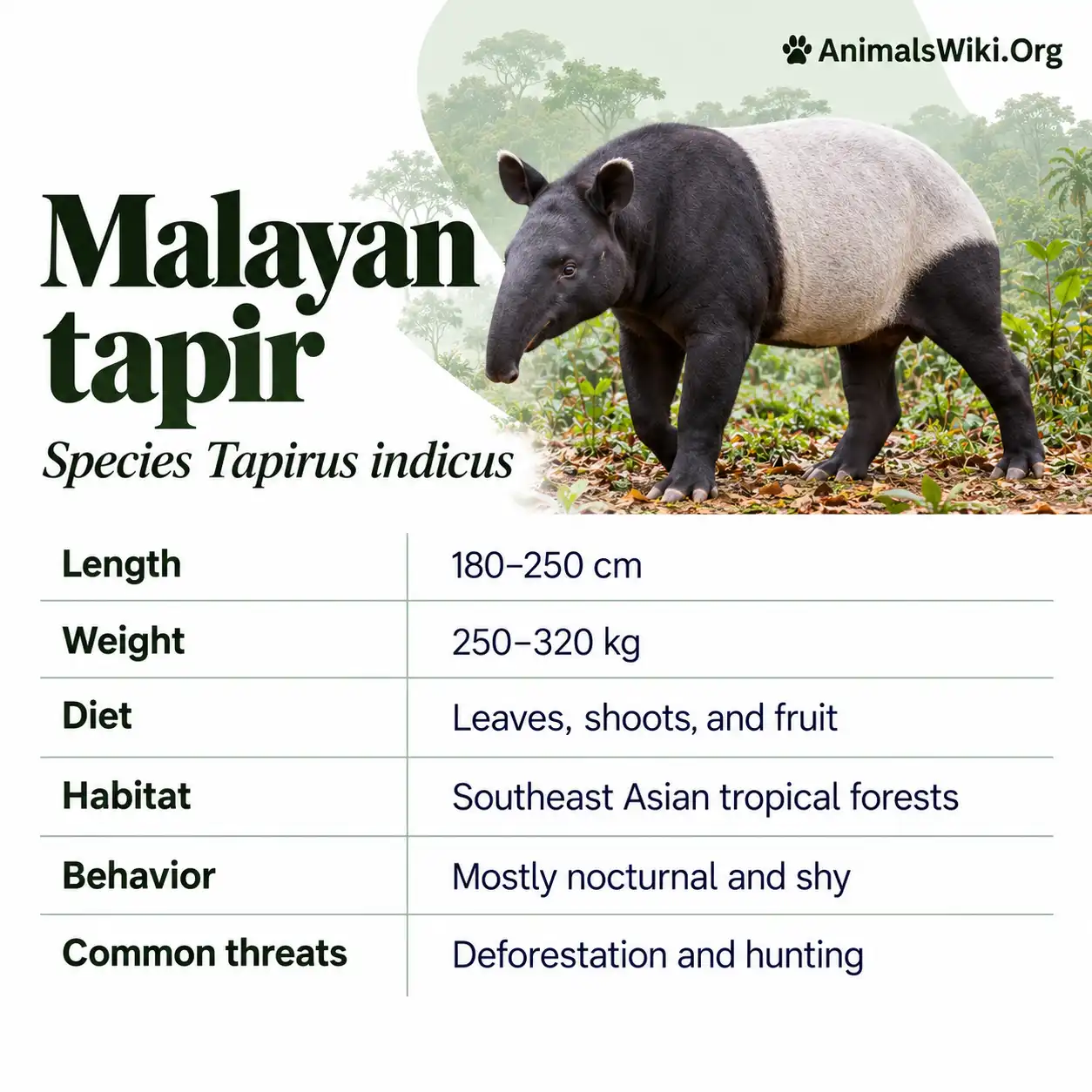
Malayan Tapir, A Complete Guide to Asia’s Black-and-White Forest Mammal
The Malayan tapir is one of Southeast Asia’s most distinctive mammals. Its black head and legs contrast with a broad pale saddle across the body, creating an appearance unlike that of any other living tapir. A short, flexible trunk adds to its unusual profile.
At first glance, it may resemble a large pig with an elephant-like nose. Its closest living relatives, however, are horses and rhinoceroses. The similarities to pigs and elephants are features of appearance rather than evidence of especially close ancestry.
The Malayan tapir is also the only living tapir native to Asia. The other recognized living species occur in the Americas, making its Southeast Asian distribution particularly interesting. Its established range includes parts of Malaysia, Thailand, Myanmar and the Indonesian island of Sumatra.
Despite its substantial size, a tapir can be difficult to observe in dense forest. Much of its activity occurs after dark, and its movements connect feeding areas, water sources and sheltered resting places.
This guide explores Malayan tapir facts, appearance, habitat, diet, behavior, reproduction and conservation. It also explains why this remarkable mammal needs connected forests, how its striped calves develop, and what research reveals about its role in moving seeds through tropical landscapes.
Malayan Tapir Facts
| Feature | Information |
|---|---|
| Common name | Malayan tapir |
| Other names | Asian tapir, Malay tapir, black-and-white tapir |
| Scientific name | Tapirus indicus |
| Family | Tapiridae |
| Order | Perissodactyla |
| Native region | Southeast Asia |
| Established range | Malaysia, Thailand, Myanmar and Sumatra, Indonesia |
| Typical adult weight | Approximately 250–320 kg, with individual variation |
| Body length | Approximately 1.8–2.4 m |
| Shoulder height | Roughly 0.9–1.1 m |
| Diet | Herbivorous; primarily a browser |
| Main foods | Leaves, shoots, twigs and fruit |
| Activity | Mainly nocturnal, with variation among sites |
| Social pattern | Generally solitary |
| Pregnancy | Approximately 13 months |
| Typical litter | One calf |
| Conservation status | Endangered |
1. What Is a Malayan Tapir?
A Malayan tapir is a large, plant-eating mammal native to Southeast Asia.
Its scientific name is Tapirus indicus, and it belongs to Tapiridae, the tapir family. It is widely recognized as the largest living tapir species.
The animal’s body is compact and heavy, with a short tail, rounded ears and a mobile snout. Adults have a distinctive black-and-white coat, while young calves begin life with a very different pattern.
The word “Malayan” connects the animal with the Malay region, but its natural distribution extends beyond modern Malaysia.
A tapir is a forest mammal rather than a domestic livestock animal. Its feeding, movement and reproductive behavior developed within landscapes containing diverse vegetation, water and cover.
Understanding that setting helps explain why a substantial animal can remain so elusive.
2. Malayan Tapir Scientific Classification
The Malayan tapir belongs to the order Perissodactyla.
| Classification level | Placement |
|---|---|
| Kingdom | Animalia |
| Phylum | Chordata |
| Class | Mammalia |
| Order | Perissodactyla |
| Family | Tapiridae |
| Genus | Tapirus |
| Species | Tapirus indicus |
Some publications use the alternative name Acrocodia indica. The Mammal Diversity Database retains the species within Tapirus, which is the treatment followed here.
Scientific names help connect observations across languages and regions. They are especially useful when common names differ or older studies use a different generic arrangement.
A change in classification does not make earlier observations disappear. It means researchers have reconsidered how the animal’s evolutionary relationships should be represented.
For practical reading, both names may lead to relevant scientific literature about the same species.
3. Are Malayan Tapirs Related to Pigs?
Malayan tapirs are not close relatives of pigs.
Their rounded bodies and broad snouts can create a pig-like impression, but tapirs belong to a different mammalian order.
Horses, zebras and rhinoceroses share the order Perissodactyla with tapirs. Pigs belong to Artiodactyla, a separate lineage.
These relationships are based on evolutionary evidence rather than a simple comparison of overall shape.
A tapir’s flexible nose is also independently distinct from an elephant’s trunk. Both are useful feeding structures, but elephants belong to another mammal order.
The Malayan tapir therefore provides a good example of why appearance can be misleading. Similar-looking features can arise in unrelated animals, while genuine relatives may develop very different bodies and lifestyles.
4. The World’s Living Tapirs
Four living tapir species are recognized in the classification used by the IUCN Tapir Specialist Group.
| Species | Scientific name | General native region |
|---|---|---|
| Malayan tapir | Tapirus indicus | Southeast Asia |
| Baird’s tapir | Tapirus bairdii | Mesoamerica and northwestern South America |
| Lowland tapir | Tapirus terrestris | South America |
| Mountain tapir | Tapirus pinchaque | Northern Andes |
The Malayan tapir is geographically separated from its American relatives.
That distribution reflects a much longer evolutionary history than today’s range maps suggest. Modern animals occupy only part of the geographic and ecological space once associated with their broader lineage.
The four species also differ in habitat and appearance. A mountain tapir living at high elevation faces conditions very different from those experienced by a Malayan tapir in tropical forest.
Facts about one species should therefore be transferred to another only when the evidence supports doing so.
5. What Does a Malayan Tapir Look Like?
An adult Malayan tapir has a black head, neck and forequarters, with a broad white or pale gray area extending across much of the middle and rear body.
The legs and the rear end below the pale saddle remain dark.
Its ears are rounded and have pale edges, and its tail is short.
The coat is made of hair rather than bare skin, although photographs can make the surface look smooth. Wetness, lighting and viewing distance influence its appearance.
Its body narrows toward the head, while the rear is rounded and substantial.
The most expressive feature is the short trunk, which moves as the animal sniffs or investigates food.
Together, these features create a silhouette that is easy to recognize once seen clearly, even though the animal can be difficult to detect within vegetation.
6. Why Is the Malayan Tapir Black and White?
The adult’s contrasting colors help disrupt its outline.
In a brightly lit open enclosure, the pale saddle can look conspicuous. In a forest, however, uneven light, shade and vegetation create a much more complicated background.
The separate dark and pale areas make it harder to interpret the animal as one continuous shape.
This is an example of disruptive coloration: a pattern can interfere with recognition rather than matching one uniform background color.
The effect depends on context. A pattern that stands out against a simple wall may perform differently among shadowed trunks, leaves and patches of light.
The Malayan tapir’s appearance therefore illustrates an important camouflage principle. An animal does not need to be one shade of green or brown to become difficult to recognize in a forest.
7. How Big Is a Malayan Tapir?
Typical adults are often described as weighing approximately 250–320 kilograms, although some individuals fall outside that range.
Their body length is around 1.8–2.4 meters, and shoulder height is roughly 90–110 centimeters.
These dimensions make the Malayan tapir a substantial forest herbivore.
Photographs can underestimate its size because the animal has short legs relative to its heavy body. A person seeing only its head or face may not appreciate the mass carried behind it.
Weight also varies with sex, age and body condition.
The most useful approach is to treat published ranges as reference points rather than a requirement that every healthy adult have the same measurements.
Comparisons should also distinguish body length from shoulder height and include the units being used.
8. How Does the Tapir’s Trunk Work?
The Malayan tapir’s trunk is a flexible extension formed from the nose and upper lip.
It is often called a prehensile snout. Prehensile means capable of grasping or holding.
The animal uses it to investigate objects, gather smells and pull suitable plant material toward its mouth.
The snout is shorter and has a different working range from an elephant’s trunk. It is especially suited to close investigation and food handling.
Watching a tapir feed reveals how frequently the structure changes position. It can stretch toward leaves, curl around vegetation and move while the animal selects a bite.
The trunk is therefore more than a distinctive facial feature. It is an active part of the feeding process, connecting sensory exploration with the handling of food.
9. Malayan Tapir Senses
Smell and hearing are particularly important to Malayan tapirs.
Their mobile nose allows them to investigate scents around vegetation, trails and other animals. Their rounded ears help them attend to nearby sounds.
Their eyesight is commonly described as relatively limited compared with their other senses.
That does not mean a tapir is blind. It means vision is one part of a sensory system in which smell and hearing are especially useful.
In dense forest, clear sightlines are often short. Information carried by scent or sound can remain available when another animal is hidden behind vegetation.
The tapir’s behavior makes this visible: pauses, sniffing and ear movements are part of gathering information before it continues moving or feeding.
10. How Many Toes Does a Malayan Tapir Have?
A Malayan tapir has four toes on each front foot and three on each hindfoot.
This can seem confusing because Perissodactyla is commonly called the odd-toed ungulate order.
The term concerns the arrangement and principal weight-bearing axis of the foot, not a rule that every foot must display an odd total of visible toes.
Tapir feet differ from the single dominant hoof of a horse and from the feet of rhinoceroses.
These differences developed within a shared evolutionary lineage.
The toes also remind us that a tapir is built to move through varied surfaces rather than remaining on a flat, firm floor. Forest pathways can contain mud, banks, roots and uneven ground.
Its feet are part of that broader locomotor system.
11. Where Do Malayan Tapirs Live?
The Malayan tapir’s established native range includes:
- Peninsular Malaysia.
- Parts of Thailand.
- Parts of Myanmar.
- Sumatra in Indonesia.
The species is not naturally distributed throughout all of Malaysia or all of Indonesia.
In particular, a country-level map can conceal the distinction between Peninsular Malaysia and Malaysian Borneo, or between Sumatra and other Indonesian islands.
Its populations are fragmented within the broader range.
This means conservation must work across several countries while also addressing local differences in habitat, roads and human activity.
A tapir surviving in a large forest complex may face different immediate pressures from one moving through a narrow remnant beside developed land.
Both belong to the same species, but their practical conservation needs can differ.
12. Malayan Tapir Habitat
Malayan tapirs occupy tropical forests, including lowland, hill and some montane environments.
Water is an important part of the habitat, and suitable landscapes provide cover, food and routes between resources.
The species occurs in both relatively intact and modified forest settings, although presence in an altered area does not establish that the area supports a secure population.
A forest edge can contain attractive food while also exposing an animal to roads or people.
Habitat quality therefore involves more than whether trees are present.
The arrangement of vegetation, access to water, available browse and the ability to move safely all contribute.
For a large herbivore, a small isolated green patch may offer one resource without supplying everything needed over its lifetime.
13. Why Connected Forests Matter
A tapir’s needs are distributed across space.
Food plants, resting places, water and mineral resources do not necessarily occur beside one another.
The animal must move among them.
When a forest is divided into smaller pieces, familiar routes may cross roads, farmland or settlements. The tapir can remain physically capable of traveling while the journey becomes more dangerous.
Research on Malayan tapir genetics has identified population structure and examined the effects of separation among populations.
This adds a longer-term concern to the immediate problem of habitat loss.
Connectivity can influence whether animals encounter potential mates and whether populations remain genetically linked.
Protecting movement routes therefore supports more than daily feeding. It can contribute to the future condition of the population.
14. What Habitat Research Can Reveal
A 2025 study examined habitat suitability in the Greater Taman Negara Forest Complex.
Researchers combined tapir presence records with environmental variables such as land use, elevation, slope and distance from water.
The resulting model identified patterns associated with suitable habitat within the study area.
This is useful because conservation decisions often involve large landscapes that cannot be surveyed equally at every point.
However, a habitat model is a structured prediction rather than a direct count of animals.
Its value lies in guiding attention: identifying places for surveys, planning and closer assessment.
The study also demonstrates why habitat should be described through several interacting features. “Forest” is a useful starting category, but it does not capture every condition influencing where tapirs occur.
15. What Do Malayan Tapirs Eat?
Malayan tapirs are herbivores and primarily browsers.
Browse includes leaves, shoots, twigs and other plant material gathered from shrubs, saplings and similar vegetation.
They also consume fruit when available.
Their flexible snout helps them select and collect food.
Browsing differs from feeding mainly on extensive grass cover. A browser encounters many individual plants, each with different leaves, textures and chemical properties.
This creates a varied feeding environment.
A forest can contain abundant vegetation while offering different proportions of suitable food from one location to another.
The Malayan tapir’s diet therefore connects it closely with the composition of the forest understory, not simply the total amount of green material visible in the landscape.
16. Are Malayan Tapirs Selective Feeders?
Malayan tapirs can be selective in their feeding.
Observations summarized by Malaysia’s biodiversity information system describe animals taking moderate quantities from a variety of plants rather than consuming only one plant in bulk.
Their food plants include saplings, shrubs, vines and other vegetation.
This pattern matters because it challenges the idea of a large herbivore simply eating whatever stands in front of it.
Selection can occur at several levels: the plant species, the part of the plant and the condition of a particular shoot or leaf.
To understand feeding habitat, researchers therefore need more detail than a general list of plants growing in the area.
The animal’s choices reveal which parts of that vegetation actually contribute to its diet.
17. How Does a Malayan Tapir Digest Food?
Malayan tapirs are hindgut fermenters.
Microorganisms help break down plant material in the enlarged hindgut, including the cecum and colon.
This differs from the digestive arrangement of ruminants such as cattle, which rely on fermentation chambers before the small intestine and regurgitate food for further chewing.
A tapir has a relatively simple stomach and does not chew cud.
Recent research comparing zoo-kept lowland and Malayan tapirs has examined how efficiently they digest different dietary components.
Such work helps connect anatomy with nutrition.
The digestive system explains why fiber-rich food is important and why a diet cannot be judged solely by whether an animal eagerly eats a particular item.
18. What Digestion Studies Tell Us
Research involving Malayan and lowland tapirs has measured how long fluid and particles remain in the digestive tract.
These studies show that food processing takes place over many hours, with retention affected by intake.
The practical lesson is that digestion is a continuing process rather than an immediate conversion of a meal into energy.
It also helps explain why nutrition studies require careful measurement of food consumption and fecal output.
Watching one feeding session provides only a small part of the picture.
For conservation biology, digestive knowledge can support better managed-care diets and improve understanding of how food and seeds pass through the animal.
The same digestive system influences both the tapir’s nutrition and its effects on plants.
19. Do Malayan Tapirs Disperse Seeds?
Yes, Malayan tapirs can disperse seeds, but the effect varies among plants.
A seed must survive consumption and digestion before it can potentially germinate after being deposited elsewhere.
Research combining feeding trials, germination tests and tapir movement data found effective dispersal for some small-seeded plants.
For larger seeds included in that study, tapirs often acted as seed predators instead.
This means the familiar description “forest gardener” needs explanation.
The animal can help move some plants while damaging the seeds of others.
Its ecological role is valuable precisely because it is specific. Understanding which seeds survive provides a more accurate picture than assuming every fruit eaten produces a new tree somewhere along the trail.
20. Can Tapirs Replace Elephants as Seed Dispersers?
Malayan tapirs cannot be assumed to replace elephants in seed dispersal.
Their size, feeding choices and treatment of seeds differ.
The study comparing their dispersal potential concluded that tapirs did not provide an equivalent service for the larger-seeded plants investigated.
This matters when forests lose large animals.
An ecosystem may retain several herbivore species while still losing a particular ecological function.
Counting the remaining animals without considering what each does can therefore conceal important changes.
The tapir contributes to forest processes in its own way. Protecting it is valuable, but that does not make other large herbivores interchangeable.
A diverse forest community contains overlapping roles alongside differences that become especially important when one member disappears.
21. Why Do Tapirs Visit Salt Licks?
Malayan tapirs visit mineral-rich sites commonly called salt licks.
Research in Malaysian forests has recorded them using both natural and artificial licks.
These locations can provide minerals that are less readily available through ordinary feeding.
They can also become useful research sites because animals return to a relatively concentrated resource.
However, a mineral lick is only one part of the habitat. It does not replace the need for browse, cover, water and safe travel routes.
The behavior illustrates how a large herbivore’s requirements extend beyond calories.
An animal needs nutrients in appropriate proportions, and some resources occur in particular places rather than being distributed evenly across the forest.
Protecting those places can therefore have value beyond their small physical area.
22. Are Malayan Tapirs Nocturnal?
Malayan tapirs are mainly active at night.
Camera-trap research in Royal Belum State Park and Temengor Forest Reserve found predominantly nocturnal activity.
Other surveys have recorded differences among sites, including some activity during daylight.
The useful generalization is therefore “mainly nocturnal,” rather than “never active by day.”
Activity schedules can reflect environmental conditions and the particular setting in which animals live.
For researchers, photographs collected across a full day help reveal patterns that brief daytime observations would miss.
For readers, this explains why tapirs can occupy a forest without frequently being seen by people walking through it.
The absence of a daytime encounter is not strong evidence that the animal is absent.
23. Are Malayan Tapirs Solitary?
Malayan tapirs generally live solitary lives.
Mother-calf pairs are an important exception, and adults also interact during reproduction or around shared resources.
Solitary does not mean the animal has no social relationships.
Individuals may encounter one another, investigate scents and respond to previous signs left in the landscape.
Nor does solitary living require every home range to be entirely separate.
Animals can use some of the same spaces at different times.
This distinction helps explain why a camera may record several tapirs at one location without establishing that they live as a permanent herd.
Social organization concerns the pattern of relationships through time, not simply the number of animals appearing in one photograph.
24. How Do Malayan Tapirs Communicate?
Malayan tapirs use sound, scent and close physical investigation.
Reported vocalizations include whistles, clicks and hiccup-like sounds.
These calls can occur in different contexts, including contact with other tapirs or responses to disturbance.
Smell is also important. Individuals investigate one another and scent cues within their surroundings.
Communication should not be treated as a simple dictionary in which every noise has one fixed meaning.
The setting, the animal’s posture and the response of another individual help explain what a signal is doing.
The tapir’s quiet forest life therefore includes information exchange even when it does not involve a conspicuous group.
Sounds and scents can connect individuals that spend much of their time apart.
25. Can Malayan Tapirs Swim?
Malayan tapirs are strong swimmers.
Water is an important feature of their environment, and they can enter it readily.
Their flexible snout can be held above the surface while much of the head remains lower, a behavior often compared with using a snorkel.
However, a tapir is a terrestrial mammal that uses water rather than an animal adapted to living permanently underwater.
Its daily needs still depend heavily on land-based food and shelter.
Swimming ability also broadens the kinds of terrain it can navigate.
A watercourse may be a resource and a route rather than only a boundary.
Understanding these abilities helps explain why conservation landscapes should include both forest structure and the waterways passing through it.
26. How Do Tapirs Move Through Dense Vegetation?
A Malayan tapir’s compact body and narrowing front end help it move through vegetation.
Despite its mass, it can move quickly when necessary and negotiate uneven terrain, including steep riverbanks.
Its appearance can therefore be deceptive. A heavy body does not imply an inability to maneuver.
Forest movement also depends on familiarity with routes and access to suitable passages.
A landscape containing roots, slopes, water and dense growth demands a different combination of abilities from an open plain.
The tapir’s body, feet and flexible head all contribute to that movement.
This helps explain why a clear view in an enclosure reveals only part of the animal’s physical capabilities.
Its form is best understood against the complexity of the habitat in which it evolved.
27. Malayan Tapir Reproduction
Malayan tapirs give birth to live young and nurse their calves with milk.
Research on tapir reproduction has examined hormonal cycles, pregnancy detection and breeding management.
The Malayan species is notable for reproductive cycles that can fall into shorter and longer patterns, approximately one month and two months.
This makes careful monitoring useful when coordinating breeding under managed care.
External appearance does not always provide an early, reliable indication of pregnancy.
Hormone testing, behavioral records and appropriate veterinary examinations can provide additional information.
The research is important because maintaining a population depends on more than bringing a male and female together.
Successful reproduction requires compatible animals, suitable conditions and effective care across pregnancy, birth and calf development.
28. How Long Is a Malayan Tapir Pregnant?
Pregnancy lasts approximately 13 months, sometimes described as 13–14 months.
Usually one calf is born.
This is a substantial investment of time and resources for the mother.
The combination of a long pregnancy and a single offspring limits how quickly a population can replace animals lost to roads, hunting or other causes.
Recovery therefore depends on protecting adults as well as supporting successful births.
A new calf is valuable, but it does not erase the effects of repeated mortality in a small population.
The reproductive timetable also explains why conservation breeding programs plan over years rather than expecting immediate changes from one pairing.
Population management is a continuing commitment across generations.
29. What Does a Baby Malayan Tapir Look Like?
A baby Malayan tapir looks dramatically different from an adult.
Its coat is brownish or dark, covered with pale stripes and spots.
This pattern is often compared with the markings on a watermelon.
The stripes and spots help break up the calf’s shape among patches of light and shadow close to the forest floor.
As the animal grows, this temporary pattern fades and the adult black-and-white arrangement develops.
The transformation makes photographs of young and adult tapirs especially striking.
It also illustrates how camouflage can change with life stage.
A calf and an adult differ in size, vulnerability and behavior, so the same coat pattern need not provide the best solution throughout the animal’s life.
30. How Big Is a Newborn Malayan Tapir?
A newborn Malayan tapir commonly weighs around 8–10 kilograms, although individual birth weights vary.
A recent example comes from Taipei Zoo, where a female calf born on August 17, 2026, weighed 8.6 kilograms.
The zoo documented her early nursing and monitored the mother and calf following delivery.
Such records are valuable because they provide measured information rather than estimates based only on appearance.
A newborn is small compared with its mother but is already capable of active behavior.
Its first successful nursing is particularly important as the calf begins receiving milk and colostrum.
Individual birth announcements should be read as examples, while broader ranges require information from many animals.
31. How Do Malayan Tapir Mothers Care for Calves?
The mother supplies milk and provides the calf’s primary early social relationship.
Managed-care observations describe calves nursing for several months and remaining with their mothers beyond the end of nursing.
The timing varies among animals and circumstances.
A calf begins exploring and sampling its environment before becoming fully independent.
This distinction matters because eating a little solid food does not mean milk is no longer important.
Development involves overlapping changes in diet, movement, confidence and experience.
Research on captive Malayan tapirs has also examined how maternal experience and environmental conditions relate to social and reproductive behavior.
These studies help care teams assess conditions around a vulnerable stage of life.
32. When Do Calves Develop Adult Colors?
The striped and spotted coat begins fading during the calf’s early months.
Adult coloration emerges gradually rather than appearing overnight.
Woodland Park Zoo descriptions place the transition toward adult coloring around five to eight months, while broader tapir summaries give somewhat different developmental timelines.
The variation is understandable because “begins changing” and “fully resembles an adult” are different milestones.
Photographs taken weeks apart can therefore show a mixture of remaining stripes and an increasingly visible pale saddle.
The change in coat should also be kept separate from physical maturity.
A young tapir can look more adult in color while still growing and relying on its mother.
Appearance is only one part of development.
33. How Long Do Malayan Tapirs Live?
Malayan tapirs can live for several decades under managed care, with some individuals reaching their thirties.
However, an exceptional maximum age is different from the typical lifespan of a population.
The San Diego Zoo Wildlife Alliance reference sheet reports a managed-care median life expectancy of 18.2 years for Malayan tapirs, citing AZA data from 2024.
Zoo Berlin lists an achievable age of up to 36 years in human care.
These figures describe different things and are not contradictory.
Wild longevity is harder to establish because following identified animals throughout their lives is difficult.
A useful lifespan statement should always distinguish between median life expectancy, a maximum record and an estimate for wild animals.
34. What Eats Malayan Tapirs?
Tigers are among the natural predators capable of attacking Malayan tapirs.
However, information about the frequency and circumstances of predation is limited.
A healthy adult tapir is large and powerful, so it presents a different challenge from a small calf.
Camouflage, rapid movement and access to cover can help reduce risk.
Its substantial jaws also mean that a tapir is not defenseless.
For readers, the important distinction is between a predator being capable of killing a species and that predator accounting for a large share of its mortality.
In present-day conservation, habitat loss, road collisions and other human-related pressures are especially prominent concerns.
Natural predator lists alone do not explain the species’ endangered status.
35. Why Is the Malayan Tapir Endangered?
The Malayan tapir is classified as Endangered.
Habitat loss and fragmentation are major threats, alongside road collisions, hunting and accidental capture in snares.
These pressures can interact.
Clearing forest may force animals to move through unfamiliar or exposed areas. A road can then become both a barrier and a source of mortality.
An animal does not need to be deliberately targeted to suffer from activities intended for other purposes.
Snares, for example, can harm species beyond the hunter’s intended quarry.
The Endangered category concerns the survival of wild populations. The presence of tapirs in zoos or occasional sightings near developed areas does not demonstrate that the species is secure across its range.
36. How Many Malayan Tapirs Remain?
The exact number of wild Malayan tapirs is uncertain.
An estimate of fewer than about 2,500 mature individuals is widely cited from an earlier IUCN assessment.
It should be presented as an assessment estimate rather than an exact current census.
The distinction between mature individuals and all animals is also important.
Calves and juveniles can be included in one population figure and excluded from another.
Dense vegetation, nighttime activity and fragmented distributions make complete counting difficult.
Conservation therefore depends on repeated surveys, improved detection and careful interpretation of available records.
A precise-looking number can be less informative than an honest explanation of what was counted, when the information was collected and how much uncertainty remains.
37. Roads and Malayan Tapir Conservation
Road collisions are a documented threat to Malayan tapirs in Peninsular Malaysia.
Government wildlife research has examined records across multiple years, including studies covering 2006–2019 and 2018–2022.
These records show that road mortality is an established conservation issue rather than a purely hypothetical risk.
The underlying problem includes the relationship between roads and the remaining habitat.
A tapir traveling between useful forest patches may encounter traffic along a route that formerly contained continuous cover.
Understanding collision locations can help identify where closer investigation and mitigation are needed.
The goal is to reduce mortality while preserving movement, rather than assuming that separating animals from all routes automatically solves the broader problem of fragmentation.
38. What Genetics Reveals About Tapir Populations
Genetic research can reveal differences among populations that are not obvious from external appearance.
Studies of Malayan tapirs have investigated diversity, population structure and historical separation.
A 2025 genomic study examined demographic history across Southeast Asian lineages and highlighted questions relevant to conservation management.
This does not mean every genetic difference requires recognizing a new species.
Instead, the evidence can help researchers understand ancestry, relatedness and the consequences of isolation.
For breeding programs, that information can support decisions about maintaining diversity.
For wild populations, it can contribute to understanding which groups remain connected and which have become more separated.
Genetics complements field ecology by examining relationships that cannot be reconstructed from camera images alone.
39. How Scientists Monitor Malayan Tapirs
Researchers use camera traps, field signs, genetic samples and movement information to investigate Malayan tapirs.
Each method answers particular questions.
A camera can document presence and activity. A genetic sample can help identify sex or relatedness. Repeated movement records can show how an animal uses the landscape.
A study in Peninsular Malaysia developed molecular methods for determining sex and investigating population sex ratios.
This is useful because demographic information affects how populations are assessed.
However, a photograph, track or sample is one piece of evidence rather than a complete population census.
The strongest monitoring programs combine methods and repeat them consistently enough to detect meaningful changes through time.
40. What Zoos Contribute to Conservation
Zoos contribute through coordinated breeding, veterinary research, education and support for field projects.
Species Survival Plans and other managed breeding programs use recommendations intended to maintain healthy, genetically diverse populations.
Transfers between institutions can therefore serve a long-term conservation purpose.
Woodland Park Zoo’s reporting on a male Malayan tapir transfer describes this coordinated approach.
Research under managed care also provides opportunities to study reproduction, nutrition and development in detail.
These contributions are valuable, but wild habitat remains essential.
A successful birth cannot replace a functioning forest or remove the danger of a road crossing.
Effective conservation connects managed populations with the continuing work of protecting tapirs within Southeast Asian landscapes.
Frequently Asked Questions About Malayan Tapirs
1. What is another name for the Malayan tapir?
The Malayan tapir is also called the Asian tapir or Malay tapir. “Black-and-white tapir” describes its distinctive adult coat. Its scientific name is Tapirus indicus, although some publications use the alternative name Acrocodia indica.
2. Is a Malayan tapir a pig?
No. Tapirs belong to Perissodactyla, the order that also contains horses and rhinoceroses. Pigs belong to a separate order. A tapir’s pig-like body shape is an outward resemblance rather than evidence that it is a kind of pig.
3. Is the Malayan tapir related to elephants?
Tapirs and elephants are both mammals, but they are not close relatives. The tapir’s short trunk evolved within a different lineage. Its closer living relatives are rhinoceroses and members of the horse family.
4. Where do Malayan tapirs live?
Their established range includes parts of Peninsular Malaysia, Thailand, Myanmar and Sumatra. They are not found naturally throughout all of those countries. Remaining populations occupy fragmented areas of suitable habitat.
5. Is the Malayan tapir the only Asian tapir?
Yes. It is the only living tapir species native to Asia. The other recognized living species occur in the Americas. This geographic separation is one of the most distinctive features of the modern tapir family.
6. Why are Malayan tapirs black and white?
The contrasting pattern helps disrupt the animal’s outline in forest light and shadow. Camouflage can work by making a body difficult to recognize as one shape, rather than simply matching the color of the background.
7. What do Malayan tapirs eat?
They mainly browse on leaves, shoots, twigs and other vegetation, with fruit also included. They select among different foods rather than relying on one plant. Their diet connects them closely with the forest understory.
8. Do Malayan tapirs eat meat?
Their normal diet is herbivorous. They are adapted to gathering and digesting plant material. Their large body and strong jaws should not be interpreted as signs that they are predators.
9. What is the tapir’s trunk used for?
The trunk combines the nose and upper lip into a flexible structure. It helps the animal investigate smells and grasp plant material. It is shorter and more limited in reach than an elephant’s trunk.
10. How many toes does a Malayan tapir have?
It has four toes on each front foot and three on each hindfoot. Its placement among odd-toed ungulates concerns the structure and principal axis of the foot, rather than requiring an odd visible total on every foot.
11. Are Malayan tapirs active at night?
They are mainly nocturnal, although daylight activity occurs. Camera surveys have recorded differences among locations. “Mainly nocturnal” describes the overall tendency more accurately than saying that a tapir never moves during the day.
12. Can Malayan tapirs swim?
Yes. They are strong swimmers and use water within their forest environment. Their flexible snout can be held above the surface. However, they remain terrestrial mammals that obtain much of their food and shelter on land.
13. Do Malayan tapirs live in herds?
They generally live solitary lives. Mothers remain with calves, and adults interact during breeding or at shared resources. Several animals visiting one location does not necessarily mean that they form a permanent herd.
14. How long is a Malayan tapir pregnant?
Pregnancy lasts approximately 13 months, sometimes described as 13–14 months. A single calf is normally born. The long reproductive cycle limits how quickly populations can replace animals lost to continuing threats.
15. Why do baby tapirs have stripes and spots?
The calf’s pale markings help break up its shape among dappled light and vegetation. They are temporary juvenile markings. As the calf grows, the coat gradually changes into the adult black-and-white pattern.
16. How much does a newborn Malayan tapir weigh?
Newborns commonly weigh around 8–10 kilograms, with variation among individuals. Measured birth records are valuable because photographs alone provide an unreliable impression of size and early growth.
17. Are Malayan tapirs dangerous?
They are large wild animals with powerful jaws and the ability to move quickly. Their quiet appearance does not make close contact harmless. Professional care relies on appropriate facilities, trained staff and respect for individual behavior.
18. How long do Malayan tapirs live?
They can live for several decades under managed care, with some reaching their thirties. Maximum longevity is different from median life expectancy. Wild lifespan is less securely documented and should not be assumed identical to zoo records.
19. Are Malayan tapirs endangered?
Yes. They are classified as Endangered. Habitat loss, fragmentation, road collisions and other human-related pressures threaten wild populations. Their survival depends on protecting both core habitat and the connections between useful areas.
20. Why are Malayan tapirs important to forests?
They interact with vegetation through browsing and can disperse some seeds. Their effects vary among plants, and they can destroy larger seeds while dispersing smaller ones. Their ecological role is distinctive rather than interchangeable with that of elephants or rhinoceroses.
A Distinctive Mammal That Needs Connected Forests
The Malayan tapir combines an unmistakable appearance with a much less visible forest life. Its flexible snout helps select food, its contrasting coat disrupts its outline, and its movements link feeding areas with water and other resources.
Its story also shows why accurate ecological details matter. A tapir can disperse some seeds without replacing an elephant. A forest patch can contain food without providing safe long-term habitat. A successful zoo birth can support conservation while wild populations continue to face serious pressures.
Protecting the species requires attention to those connections: between forest fragments, between scientific evidence and management, and between individual animals and the landscapes that support them.
The future of Asia’s only living tapir depends on keeping those landscapes large enough, connected enough and safe enough for successive generations to survive.



