
Brazilian Tapir, A Complete Guide to South America’s Remarkable Forest Gardener
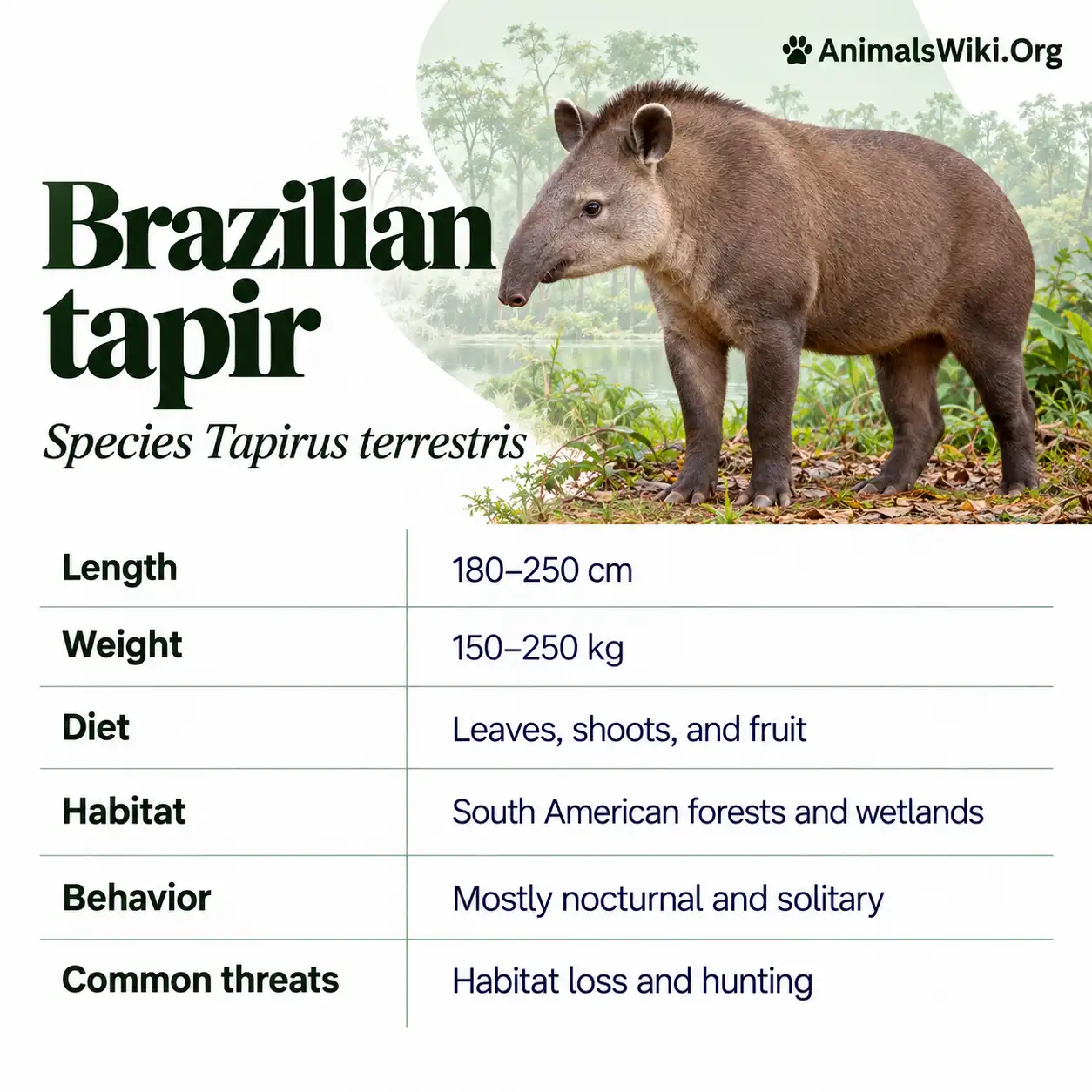
The Brazilian tapir is a large South American mammal with a flexible snout, rounded body, short tail and distinctive mane. It may resemble a pig with a small trunk, but its closest living relatives are horses and rhinoceroses.
Also called the lowland tapir or South American tapir, this animal occurs far beyond Brazil. Its range extends across substantial parts of South America, where it inhabits forests, wetlands, savannas and other landscapes containing suitable food, water and cover.
Its role in nature is especially important. Brazilian tapirs eat fruit, carry seeds through their digestive systems and deposit them as they move. Research shows that this activity can contribute to seed dispersal in both established forests and disturbed areas undergoing regeneration.
Despite its size, a tapir can be difficult to observe. Much of its activity occurs at night or around dawn and dusk, and it often moves through dense vegetation. Researchers therefore rely on camera traps, tracking collars, droppings and other evidence to investigate its life.
This guide explores Brazilian tapir facts, appearance, habitat, diet, behavior, reproduction and conservation. It also explains how its ecological role differs across habitats and why a widespread animal can still face serious threats.
Brazilian Tapir Facts
| Feature | Information |
|---|---|
| Common name | Brazilian tapir |
| Other names | Lowland tapir, South American tapir |
| Scientific name | Tapirus terrestris |
| Family | Tapiridae |
| Order | Perissodactyla |
| Native region | South America |
| Representative adult weight | Approximately 150–300 kg, depending on the individual and source |
| Body length | Roughly 1.8–2.5 m |
| Distinctive features | Flexible snout, dark coat and bristly mane |
| Diet | Herbivorous |
| Main foods | Leaves, shoots, stems, fruit and other vegetation |
| Activity | Commonly nocturnal and crepuscular |
| Social pattern | Generally solitary |
| Pregnancy | Approximately 13 months |
| Typical litter | One calf |
| Conservation status | Vulnerable |
1. What Is a Brazilian Tapir?
A Brazilian tapir is a large herbivorous mammal belonging to the species Tapirus terrestris.
It is one of the living members of Tapiridae, a family recognized for its flexible snouts, compact bodies and strong association with vegetation-rich habitats.
The animal is often described as South America’s largest native terrestrial mammal. Its substantial size makes it an important component of many ecosystems, even where people seldom see it directly.
A tapir’s life involves repeated movement among feeding sites, water, resting places and other resources. Those journeys connect its own survival with processes such as seed transport.
The species is therefore interesting at two scales: as an individual with unusual anatomy and behavior, and as a large herbivore whose daily activities influence the surrounding landscape.
2. Are Brazilian Tapirs and Lowland Tapirs the Same Animal?
Yes. Brazilian tapir, lowland tapir and South American tapir are common names for Tapirus terrestris.
Different institutions and regions favor different names.
“Brazilian tapir” emphasizes a country containing an important part of its distribution. “Lowland tapir” helps distinguish it from the mountain tapir, while “South American tapir” points to its broader geographic identity.
None of these names means that every individual lives in the same kind of lowland rainforest.
The species uses a variety of environments across a wide range.
In Portuguese, it is commonly known as anta.
For accurate identification, the scientific name is useful because it remains a consistent reference when common names vary among languages, websites and field guides.
3. Brazilian Tapir Scientific Classification
The Brazilian tapir belongs to Perissodactyla, the mammal order containing tapirs, rhinoceroses and the horse family.
| Classification level | Placement |
|---|---|
| Kingdom | Animalia |
| Phylum | Chordata |
| Class | Mammalia |
| Order | Perissodactyla |
| Family | Tapiridae |
| Genus | Tapirus |
| Species | Tapirus terrestris |
The Mammal Diversity Database currently treats the name Tapirus kabomani as a synonym within Tapirus terrestris.
This is relevant because some older or alternative sources list a fifth living tapir species under that name.
Classification changes as researchers evaluate anatomy, genetics and geographic variation. The treatment used here follows the current database rather than combining incompatible species lists.
Readers comparing references should therefore check which classification each source uses.
4. What Animals Are Related to Brazilian Tapirs?
Brazilian tapirs are related to other tapirs, and more broadly to horses and rhinoceroses.
Their pig-like appearance does not place them in the pig family.
The flexible snout can also resemble a small elephant trunk, but that resemblance does not make elephants especially close relatives.
Anatomical relationships are clearer when researchers compare detailed structures rather than overall shape. Feet, teeth and skull features provide important evidence.
Within the tapir family, the lowland tapir belongs to the American group, alongside Baird’s and mountain tapirs. The Malayan tapir lives in Southeast Asia.
This distribution reflects a long evolutionary history. Present-day ranges show where lineages survive now, rather than every place their ancestors once occupied.
5. Brazilian Tapir vs. Malayan Tapir
The Brazilian tapir and Malayan tapir share a family but differ in several recognizable ways.
| Feature | Brazilian tapir | Malayan tapir |
|---|---|---|
| Scientific name | Tapirus terrestris | Tapirus indicus |
| Native region | South America | Southeast Asia |
| Adult coat | Mostly brown or grayish brown | Contrasting black and white |
| Mane | Prominent bristly mane | Lacks the same conspicuous mane |
| General size | Usually smaller | Largest living tapir species |
| Global conservation category | Vulnerable | Endangered |
Their ecological roles also require species-specific research.
For example, evidence about which seeds survive digestion in Brazilian tapirs cannot automatically be transferred to Malayan tapirs.
The same caution applies to habitat use and population threats. Family resemblance provides a starting point, but each species has its own biology and conservation context.
6. What Does a Brazilian Tapir Look Like?
An adult Brazilian tapir usually has a brown, grayish-brown or dark coat, with lighter areas around parts of the face and underside.
Its body is rounded and substantial, while the head narrows toward the mobile snout.
The ears are rounded, often with pale margins, and the tail is short.
A bristly mane runs along the top of the head and neck, helping distinguish the species from other tapirs.
Coat color can appear different in photographs because of lighting, wetness, mud and individual variation.
A tapir standing in bright sunlight may look much lighter than one photographed after dark.
Its simple-looking body conceals considerable specialization, particularly in the skull, nose, teeth and feet.
7. How Big Is a Brazilian Tapir?
Adult Brazilian tapirs commonly weigh somewhere within approximately 150–300 kilograms.
Different references give narrower or broader ranges, reflecting variation in animals and measurement records.
Body length is roughly 1.8–2.5 meters, and shoulder height is commonly around a meter.
These measurements make the tapir much larger than its compact appearance sometimes suggests.
The animal’s legs are relatively short beside its deep body, so photographs can obscure its scale.
Size comparisons should also distinguish healthy variation from body condition. A particularly heavy zoo individual does not necessarily represent the typical wild adult.
For most readers, the useful impression is of a powerful mammal roughly comparable in mass to a small pony, with a very different body arrangement and lifestyle.
8. Why Does the Brazilian Tapir Have a Mane?
The mane follows a distinctive raised profile along the upper head and neck.
Beneath that profile, the skull has a prominent sagittal crest, a ridge associated with the attachment of chewing muscles.
The crest and the external mane are related aspects of appearance, but they are different anatomical structures.
The mane is hair; the sagittal crest is bone.
This distinction helps explain why the tapir’s head can look almost helmet-like from the side.
Researchers studying skull development have investigated how the unusually pronounced crest forms.
The feature is useful for recognizing the lowland tapir and demonstrates that its appearance reflects both feeding anatomy and external covering.
9. How Does the Tapir’s Nose Work?
The Brazilian tapir’s short trunk, or proboscis, combines the nose and upper lip into a flexible structure.
It is prehensile, meaning it can grasp or manipulate objects.
During feeding, the snout helps pull vegetation toward the mouth and investigate food at close range.
It also remains a functioning nose, allowing the animal to gather scent information.
The structure is supported mainly by soft tissues rather than a rigid bony extension reaching to its tip.
This arrangement gives it considerable mobility.
A tapir does not use the snout exactly like an elephant uses its much longer trunk. Its working range is shorter, but it is well suited to selecting leaves, shoots and fruit around the animal’s head.
10. Teeth and Plant Processing
Brazilian tapirs have cheek teeth with raised transverse ridges.
These ridges provide surfaces suited to processing leaves, twigs and fruit.
Chewing is the first major mechanical step in digestion. It breaks food into smaller pieces and prepares material for later chemical and microbial processing.
The shape of a herbivore’s teeth therefore helps explain what happens after food is collected by the lips or snout.
A tapir’s large mouth is part of a feeding system rather than simply a defense structure.
Its dietary flexibility also means that the teeth encounter materials with different textures, from soft fruit to tougher vegetation.
The combination of food selection, chewing and digestion allows the animal to use a wide variety of plants.
11. How Many Toes Does a Brazilian Tapir Have?
A Brazilian tapir has four toes on each front foot and three on each hindfoot.
Its feet are splayed and suited to moving across soft or uneven surfaces.
The order Perissodactyla is commonly called the odd-toed ungulate order, which can make the front-foot count seem surprising.
The name concerns the structure and main weight-bearing axis of the foot rather than requiring every foot to have an odd visible total.
Forest and wetland terrain can include mud, roots, banks and shallow water.
The tapir’s feet form part of the system that lets a heavy animal move through these conditions.
They differ from a horse’s single dominant hoof while retaining a shared evolutionary foundation.
12. Where Do Brazilian Tapirs Live?
Brazilian tapirs occur across a broad part of South America east of the Andes.
Their range includes areas from northern South America to northern Argentina.
Countries containing populations include Brazil, Bolivia, Peru, Ecuador, Colombia, Venezuela, Paraguay, Argentina and the Guianas.
However, a broad range map does not show continuous occupation.
Local populations can be separated by unsuitable land, roads, hunting pressure or historical losses.
The word “Brazilian” should therefore be understood as a common name rather than a complete distribution statement.
Protecting the species requires cooperation across borders and attention to local conditions.
A tapir population in an Amazonian forest and one in a fragmented southern landscape may face very different immediate challenges.
13. Brazilian Tapir Habitat
The species uses forests, wetlands, wooded savannas, shrublands and mixed landscapes.
Its habitats include both tropical and subtropical environments.
Food, water and shelter are important, but their arrangement also matters. A feeding area separated from water by a busy road presents a different situation from the same resources inside connected habitat.
Lowland tapirs can use altered environments, yet their presence there does not establish that conditions are safe over the long term.
An agricultural edge may contain attractive food while exposing animals to traffic or chemicals.
Habitat quality must therefore be assessed through survival, reproduction and movement, rather than only through sightings.
The landscape needs to support the animal’s entire life cycle.
14. Tapirs Across Different Brazilian Landscapes
Lowland tapir research in Brazil has focused on several major environments.
The Amazon contains extensive tropical forests. The Atlantic Forest includes heavily fragmented forest landscapes. The Cerrado is a diverse savanna region, while the Pantanal is a large seasonal wetland.
These settings differ in vegetation, water availability and human land use.
Long-term conservation work has expanded across these regions to understand how the same species functions under contrasting conditions.
The comparison is valuable because a finding from one area may not explain every population.
A tapir can share basic anatomy with relatives elsewhere while encountering different foods, seasonal patterns and threats.
Regional studies connect the general species account with the practical realities of conservation.
15. Why Water Matters
Water is an important feature of many lowland tapir habitats.
Tapirs are strong swimmers and can enter rivers, ponds and other water bodies.
They may feed on aquatic vegetation, move through water or use it while escaping danger.
Their relationship with water is therefore more varied than simply drinking.
Waterways can also connect different parts of a landscape.
However, tapirs remain land mammals that obtain much of their food and shelter outside water.
A suitable habitat needs the surrounding vegetation and safe access routes as well as the water itself.
This helps explain why protecting a river while allowing all neighboring cover to disappear would provide incomplete protection for the animals using it.
16. What Do Brazilian Tapirs Eat?
Brazilian tapirs are herbivores.
Their diet can include:
- Leaves.
- Young shoots.
- Stems and twigs.
- Fallen fruit.
- Aquatic plants.
- Grasses and sedges.
The balance differs among locations and seasons.
A tapir in a fruit-rich forest may consume a different mixture from one using a savanna-forest transition.
Researchers studying feeding in southeastern Brazil found relatively few fruit seeds in samples during the study, illustrating that fruit does not dominate every population’s diet.
This matters because “fruit eater” is only part of the description.
The species combines browsing with the use of other plant resources, and its feeding behavior reflects what the local environment supplies.
17. How Varied Is the Brazilian Tapir Diet?
Diet studies reveal substantial plant diversity.
A 2026 study in Brazil’s Carlos Botelho State Park used DNA metabarcoding of fecal material collected from tapir latrines.
The method detected a broad range of plants in the animals’ diet.
Metabarcoding compares genetic fragments with reference information, allowing researchers to identify foods that may be difficult to recognize visually after digestion.
The results support a picture of flexible, varied feeding within that forest.
However, detecting a plant does not automatically show exactly how much of it was eaten.
The technique is especially useful when combined with observations and knowledge of local vegetation.
Together, these approaches reveal feeding choices that would be difficult to document by watching a secretive animal directly.
18. How Does a Brazilian Tapir Digest Plants?
Brazilian tapirs are hindgut fermenters.
Microorganisms help break down plant material in the enlarged hindgut, including the cecum and colon.
This differs from the digestive arrangement of ruminants such as cattle.
Tapirs do not repeatedly regurgitate food and chew cud.
Their digestive anatomy allows them to process fibrous vegetation while also using fruit and other plant foods.
Research on zoo-kept lowland and Malayan tapirs has investigated digestive efficiency by measuring intake and fecal output.
Such studies are useful because enthusiasm for a food item does not establish its overall nutritional value.
A suitable diet must account for fiber, nutrients and the way the digestive system processes them over time.
19. Why Are Tapirs Called Forest Gardeners?
Brazilian tapirs are often called forest gardeners because they move seeds.
After eating fruit, they can carry surviving seeds through the digestive tract and deposit them in droppings.
Their movements transport those seeds away from the original plant.
This can influence where plants have opportunities to germinate.
The nickname is useful, but the mechanism deserves explanation. A tapir is not deliberately planting trees, and seed deposition does not guarantee establishment.
A seed must remain viable and reach conditions suitable for germination and survival.
The tapir contributes one important step within a longer process involving soil, moisture, light, competition and other animals.
Its influence is substantial precisely because those journeys are repeated throughout its life.
20. Evidence From the Peruvian Amazon
Research in the Peruvian Amazon examined seeds from 135 lowland tapir dung samples collected over several years.
Researchers identified seeds from 122 plant species.
The diversity changed with seasonal fruit availability, showing a connection between what the forest produced and what tapirs transported.
This is strong evidence that seed dispersal can involve many plant species rather than a handful of familiar fruits.
The study also shows why repeated sampling matters.
Many plants appeared infrequently, so a small number of dung samples would have missed much of the variety.
Understanding ecological roles often requires looking beyond the most common interactions to include occasional events that accumulate over time.
21. Can Seeds Germinate After Passing Through a Tapir?
Yes. Research has documented viable seeds in lowland tapir droppings.
A study in the northern Brazilian Amazon examined germination from fecal samples and found evidence supporting the animal’s role as a disperser.
The presence of both small and larger viable seeds was particularly relevant.
However, seed size alone does not determine success.
Plant identity, seed structure, chewing, digestion and the conditions after deposition all influence the outcome.
A tapir’s diet therefore creates a range of plant interactions.
Some seeds survive and may be moved considerable distances, while others can be damaged.
The ecological question is which plants benefit, under what circumstances and with what consequences for the surrounding vegetation.
22. Tapirs and Forest Regeneration
Lowland tapirs can help move seeds into disturbed forest.
Research in southeastern Amazonia combined field observations, camera traps and vegetation information to investigate this role.
In the study area, tapirs traveled and deposited dung more frequently in degraded forest, delivering seeds to those places.
This suggests a potential contribution to natural regeneration.
The finding is especially interesting because disturbed areas can lack some of the animal-mediated seed movement needed for recovery.
It does not mean tapirs make all forms of degradation harmless.
Rather, surviving wildlife can retain functions that support recovery when conditions permit.
Protecting large herbivores can therefore contribute to both the conservation of existing ecosystems and the restoration of damaged ones.
23. Brazilian Tapir Activity Patterns
Lowland tapirs are commonly active at night and around dawn or dusk.
Camera-trap research in the Greater Madidi-Tambopata landscape documented predominantly nocturnal and crepuscular activity.
Crepuscular means active around twilight.
However, activity is not identical everywhere.
Research in southern Brazil recorded seasonal differences, including a more evenly distributed pattern across day and night during winter.
The schedule reflects a combination of local conditions rather than a rigid rule.
This helps explain why observations from one zoo or one forest should not become the universal timetable for the species.
For field researchers, continuous monitoring is valuable because short visits can miss most activity.
24. Are Brazilian Tapirs Solitary?
Brazilian tapirs are generally solitary.
Adults often move and feed independently, while mothers and calves form an important exception.
Animals also interact during reproduction or when using shared resources.
Solitary living does not mean every individual avoids all contact or occupies an entirely separate piece of land.
Genetic and behavioral research in a central Amazon landscape has investigated relationships among individuals and their spatial use.
These studies help move beyond broad labels.
A complete social description requires knowing who encounters whom, whether individuals are related and how repeated interactions are organized.
The tapir’s secretive behavior makes those questions difficult, but modern methods provide information that fleeting sightings cannot.
25. How Do Brazilian Tapirs Communicate?
Brazilian tapirs communicate using scent and sound.
Reported sounds include clicking, snorting, puffing and higher-pitched calls.
Different contexts include contact with other tapirs, agitation and distress.
Scent information can remain after an animal has moved away, allowing communication without simultaneous face-to-face contact.
This is particularly useful for animals that spend much of their time apart.
The meaning of a signal depends on context, so a simple one-word translation for each sound is usually inadequate.
Posture, the presence of another animal and what happens next all help explain the interaction.
The tapir’s relatively quiet daily life therefore still contains a substantial flow of information.
26. How Far Do Tapirs Move?
There is no single daily travel distance or home-range size that describes every Brazilian tapir.
Long-term telemetry research provides a better picture than isolated sightings.
A major study used more than 232,000 recorded locations from 74 animals tracked across the Atlantic Forest, Cerrado and Pantanal.
The dataset covered 22 years.
Researchers found considerable consistency in movement and space use across these contrasting landscapes.
That finding has an important implication: an animal may continue moving in familiar ways even when the surrounding landscape becomes more dangerous.
The ability to cross disturbed ground does not demonstrate that the disturbance has no cost.
Movement records must therefore be interpreted alongside mortality, health and reproduction.
27. Responses to Human Disturbance
Research in the Pantanal has examined how habitat, season and human activity relate to lowland tapir behavior.
Camera-trap studies found predominantly nocturnal activity, while some responses to settlements and cattle differed between areas.
These results show that adaptation is not one uniform response.
An animal can alter the timing or location of some activities while retaining other patterns.
Understanding that variation matters for conservation planning.
A measure effective in one landscape may need adjustment elsewhere.
It also cautions against interpreting every sighting near people as evidence that tapirs thrive under human disturbance.
Presence establishes that an animal uses a place; longer-term evidence is needed to evaluate the consequences.
28. Brazilian Tapir Reproduction
Brazilian tapirs give birth to live young and nurse them with milk.
Pregnancy lasts approximately 13 months, and a single calf is the usual outcome.
The AnAge life-history database gives a gestation figure close to 398 days, illustrating the length of this reproductive investment.
Small litter size and long pregnancy limit how rapidly a population can replace losses.
An adult female must survive pregnancy, produce a calf and support its development.
Successful recovery therefore depends on reducing continuing mortality as well as producing young.
A population losing animals repeatedly to roads or hunting can remain under pressure even when births continue.
Reproductive biology helps explain why conserving adults is so important.
29. What Does a Baby Brazilian Tapir Look Like?
A baby Brazilian tapir has a dark reddish-brown coat marked with pale stripes and spots.
These markings help break up its shape among vegetation and uneven light.
The pattern is temporary.
As the calf grows, the stripes and spots fade and the more uniform adult coat develops.
The change takes place over several months rather than overnight.
This striking difference between young and adults is common across living tapirs.
It also illustrates how the needs of a vulnerable calf can differ from those of a much larger adult.
Camouflage is connected with body size, behavior and background, so one appearance need not serve every stage equally well.
30. Maternal Care and Calf Development
The mother provides milk and the calf’s main early social relationship.
Newborns can stand relatively soon after birth, but mobility is only one part of development.
A calf still needs nutrition, protection and time to become familiar with its surroundings.
During early life, young tapirs may remain concealed while their mothers feed. They increasingly accompany their mothers as development progresses.
Sampling plant food begins before complete nutritional independence.
This overlap is important: nibbling vegetation does not mean that nursing has ended.
Published weaning timelines vary, so a single age should not be treated as universal.
The broader pattern is a gradual transition from strong dependence toward independent feeding and movement.
31. How Long Do Brazilian Tapirs Live?
Brazilian tapirs can live for several decades under managed care.
Zoo references commonly describe potential lifespans around 25–35 years.
Those figures should be understood as longevity summaries rather than a guarantee for every individual.
Maximum recorded age and average survival are different measures.
Wild lifespan is harder to establish because researchers must recognize and follow animals for many years.
An individual disappearing from a study area may have died, moved beyond detection or lost its tracking device.
For accurate interpretation, a lifespan figure should specify whether it concerns zoo records, a particular known-age animal or a monitored wild population.
The distinction is more informative than one apparently precise universal number.
32. What Eats Brazilian Tapirs?
Jaguars are important natural predators of Brazilian tapirs.
Other large carnivores, including pumas, may also prey on them in some settings.
Young animals differ from adults in vulnerability.
An adult tapir is large and powerful, while a calf is smaller and less experienced.
Escape routes, access to cover and proximity to water can affect encounters.
Predation is part of the species’ ecology, but it should not obscure the importance of human pressures.
A list of possible predators does not tell us which causes of death most strongly affect a particular population.
Conservation research therefore considers hunting, traffic, habitat change and health alongside natural interactions.
33. Are Brazilian Tapirs Dangerous?
A Brazilian tapir is a powerful wild mammal.
Its relatively quiet behavior and rounded appearance do not make close contact harmless.
It has strong jaws and can move quickly.
An animal responding to disturbance, confinement or an unfamiliar approach may behave differently from one resting calmly.
At the same time, sensational descriptions do little to explain its normal ecology.
The useful approach is to recognize its physical capabilities and respect its space.
Professional care and field research rely on trained teams, appropriate equipment and carefully managed interactions.
Observing a tapir from a suitable distance allows people to appreciate its behavior without requiring assumptions about how it will respond at close range.
34. Brazilian Tapir Conservation Status
The Brazilian tapir is globally classified as Vulnerable.
This means it faces a high risk of extinction in the wild under the assessment framework.
The category differs from Endangered, the global status assigned to several other tapir species.
However, Vulnerable does not mean secure.
A widespread species can suffer local disappearances and severe regional declines while surviving elsewhere.
Its global category also does not necessarily match every national or regional assessment.
Conservation therefore needs two perspectives: the condition of the species across its whole range and the circumstances of individual populations.
For a fragmented landscape, the survival of one local population can require urgent attention even when the species remains relatively widespread geographically.
35. Habitat Loss and Fragmentation
Forest clearing and other land-use changes reduce and divide tapir habitat.
Agriculture, livestock production and infrastructure can replace areas that once offered connected food, water and shelter.
Fragmentation affects more than the total number of trees.
It changes the journeys between resources and can isolate populations.
Genetic research in an Atlantic Forest corridor has shown that large protected landscapes still require attention to population structure and long-term persistence.
A corridor appearing continuous on a map may contain ecological or demographic limitations.
Effective conservation therefore combines protection of remaining habitat with evidence about how tapirs use it.
Maintaining an area is the beginning; understanding whether it supports a viable population is the continuing task.
36. Road Mortality
Vehicle collisions are a documented threat to Brazilian tapirs.
Research in the Cerrado has examined animals killed on roads, including pathological findings from systematic monitoring.
These records show how road networks intersect with wildlife movement.
A tapir traveling between familiar feeding and resting areas can encounter traffic along a route that formerly contained continuous habitat.
For a slow-reproducing animal, repeated losses can matter considerably.
Monitoring helps identify where and when collisions occur, providing evidence for mitigation.
The broader conservation problem is maintaining safe movement through the landscape.
Simply knowing that tapirs cross a road is insufficient; researchers need to understand the survival consequences and whether interventions reduce them.
37. Pesticides and Environmental Contamination
Tapirs moving through agricultural landscapes can encounter environmental chemicals.
A study in the Brazilian Cerrado detected pesticides and metals in samples collected from road-killed tapirs.
Some findings raised concern about potential health effects and the need for further investigation.
The evidence should be interpreted carefully.
Detection establishes exposure; determining exactly how that exposure affects survival or reproduction requires additional analysis.
This is why conservation health research combines tissue samples, examinations and environmental information.
The work broadens the meaning of habitat quality.
An area may contain vegetation and water while also exposing animals to conditions invisible in a photograph.
Protecting wildlife therefore includes attention to the chemical environment as well as the physical landscape.
38. Fire and Tapir Habitat
Severe or repeated fires can affect the vegetation and refuges used by tapirs.
The consequences depend on the ecosystem, the intensity of the fire and the remaining unburned habitat.
Recent Pantanal research found an association between forest cover and the occurrence of several mammals, including lowland tapirs.
This highlights the value of forest refuges within a landscape affected by major fires.
Tapirs may also contribute to recovery by moving seeds, but that ecological role does not make them immune to habitat damage.
Conservation needs to protect both surviving animals and the places that allow populations to persist after disturbance.
Repeated monitoring is particularly important because immediate observations may not reveal longer-term effects.
39. Can Brazilian Tapirs Be Reintroduced?
Yes. Carefully planned reintroductions are underway in parts of the Atlantic Forest where tapirs had disappeared.
Work associated with REGUA and Refauna has restored tapirs to landscapes in Rio de Janeiro state.
Reintroduction involves more than releasing an animal.
Planning considers habitat, health, behavior, local support and continued monitoring.
Research published in 2026 investigated how released animals’ activity patterns changed as they adjusted to life outside managed care.
This provides an example of conservation using evidence to evaluate progress after release.
The aim is a population capable of surviving and contributing to ecological processes, rather than a short-lived increase in the number of animals present.
40. Long-Term Research and Conservation
Brazil’s Lowland Tapir Conservation Initiative has combined movement research, health assessments, genetics, road monitoring and education.
This integrated approach reflects the complexity of the threats.
A tracking collar can show where an animal goes, while health samples reveal information about conditions it encounters.
Road surveys document mortality, and work with local communities can improve reporting and practical responses.
No single method answers every question.
The value comes from connecting evidence across years and landscapes.
For a long-lived mammal with a slow reproductive cycle, that continuity is especially important.
Conservation success depends on conditions that allow animals to survive and reproduce repeatedly, maintaining populations and ecological relationships across generations.
Frequently Asked Questions About Brazilian Tapirs
1. Is the Brazilian tapir the same as the lowland tapir?
Yes. Brazilian tapir, lowland tapir and South American tapir are common names for Tapirus terrestris. The names emphasize different aspects of the same species and are used by different institutions and regions.
2. Do Brazilian tapirs live only in Brazil?
No. They occur across a broad part of South America east of the Andes. Brazil contains an important part of the range, but populations also occur in several neighboring countries and farther north.
3. Is a Brazilian tapir a pig?
No. It belongs to Perissodactyla, the order containing tapirs, horses and rhinoceroses. Its pig-like appearance is a superficial resemblance. Pigs belong to a different evolutionary branch.
4. Is a Brazilian tapir related to an elephant?
Only distantly as a fellow mammal. The short tapir proboscis and elephant trunk developed within separate lineages. Horses and rhinoceroses are closer living relatives of tapirs.
5. How much does a Brazilian tapir weigh?
Adults commonly weigh approximately 150–300 kilograms, although ranges differ among references. Age, sex, population and body condition influence measurements. The species is a substantial animal despite its compact appearance.
6. What does a Brazilian tapir eat?
It eats leaves, shoots, stems, twigs, fruit and other vegetation. Aquatic plants and grasses can also form part of the diet. The balance varies with habitat and seasonal food availability.
7. Why does a tapir have a short trunk?
The flexible snout helps it investigate smells and grasp food. It combines the nose and upper lip into a mobile structure. Its abilities suit close-range feeding rather than the much longer reach of an elephant’s trunk.
8. Can Brazilian tapirs swim?
Yes. They are strong swimmers and use water within their habitat. Water can provide food, movement opportunities and an escape route. Their lives still depend heavily on suitable vegetation and shelter on land.
9. How many toes does a Brazilian tapir have?
It has four toes on each front foot and three on each hindfoot. The feet help support movement across soft and uneven ground. Its placement among odd-toed ungulates concerns foot structure rather than a simple count on every limb.
10. Are Brazilian tapirs nocturnal?
They are commonly active at night and around dawn or dusk. Activity can vary by season and location. Some studies have recorded more activity across both day and night under particular conditions.
11. Do Brazilian tapirs live in groups?
They are generally solitary, although mothers remain with calves and adults interact. Individuals can also use the same resources at different times. Several animals appearing at one site does not establish permanent herd living.
12. Why are tapirs called forest gardeners?
They consume fruit and move surviving seeds through their digestive systems. Seeds deposited in droppings can germinate under suitable conditions. This contributes to plant movement and can support regeneration in some disturbed forests.
13. Do all seeds survive being eaten by a tapir?
No. Survival depends on the plant, the seed and what happens during feeding and digestion. Researchers use germination tests and other methods to determine which seeds remain viable after passing through the animal.
14. How long is a Brazilian tapir pregnant?
Pregnancy lasts approximately 13 months. A single calf is the normal outcome. This long reproductive investment limits how quickly populations can replace animals lost to continuing threats.
15. Why do baby tapirs have stripes and spots?
The markings help conceal the calf among vegetation and uneven light. They gradually fade as the animal grows. The adult develops a more uniform coat rather than retaining the juvenile pattern.
16. How long do Brazilian tapirs live?
They can live for several decades under managed care. Published maximum or potential ages differ from average survival. Wild longevity is more difficult to establish because identified animals must be followed over long periods.
17. What predators eat Brazilian tapirs?
Jaguars are important natural predators, while other large predators may take tapirs in some circumstances. Calves are more vulnerable than adults. Human-caused mortality is also a major conservation concern.
18. Are Brazilian tapirs endangered?
Their global conservation category is Vulnerable. They remain threatened by habitat loss, hunting, road mortality and other pressures. Some local populations face more severe conditions than the global category alone suggests.
19. How many Brazilian tapirs remain?
There is no reliable exact worldwide total. Their broad, fragmented distribution and secretive behavior make complete counting difficult. Local surveys and long-term monitoring provide more useful evidence than an unsupported precise global number.
20. Can tapirs return to areas where they disappeared?
Yes, where suitable conditions and carefully managed projects permit. Atlantic Forest reintroductions demonstrate this possibility. Success requires habitat, health screening, appropriate preparation, local participation and monitoring after release.
A Large Mammal With a Lasting Ecological Role
The Brazilian tapir combines distinctive anatomy with ecological influence. Its flexible snout helps collect a varied plant diet, its movements connect habitat patches, and its digestive system can transport viable seeds across the landscape.
Its wide range should not conceal its vulnerability. Populations face different combinations of forest loss, roads, hunting, fire and environmental contamination. Surviving in an altered landscape does not necessarily mean that the landscape supports long-term recovery.
Research and reintroduction projects show that practical progress is possible. Protecting habitat, maintaining safe connections and reducing preventable mortality can support both tapirs and the ecological processes they help sustain.
The future of this forest gardener depends on preserving places where it can continue moving, feeding and raising young across generations.



