
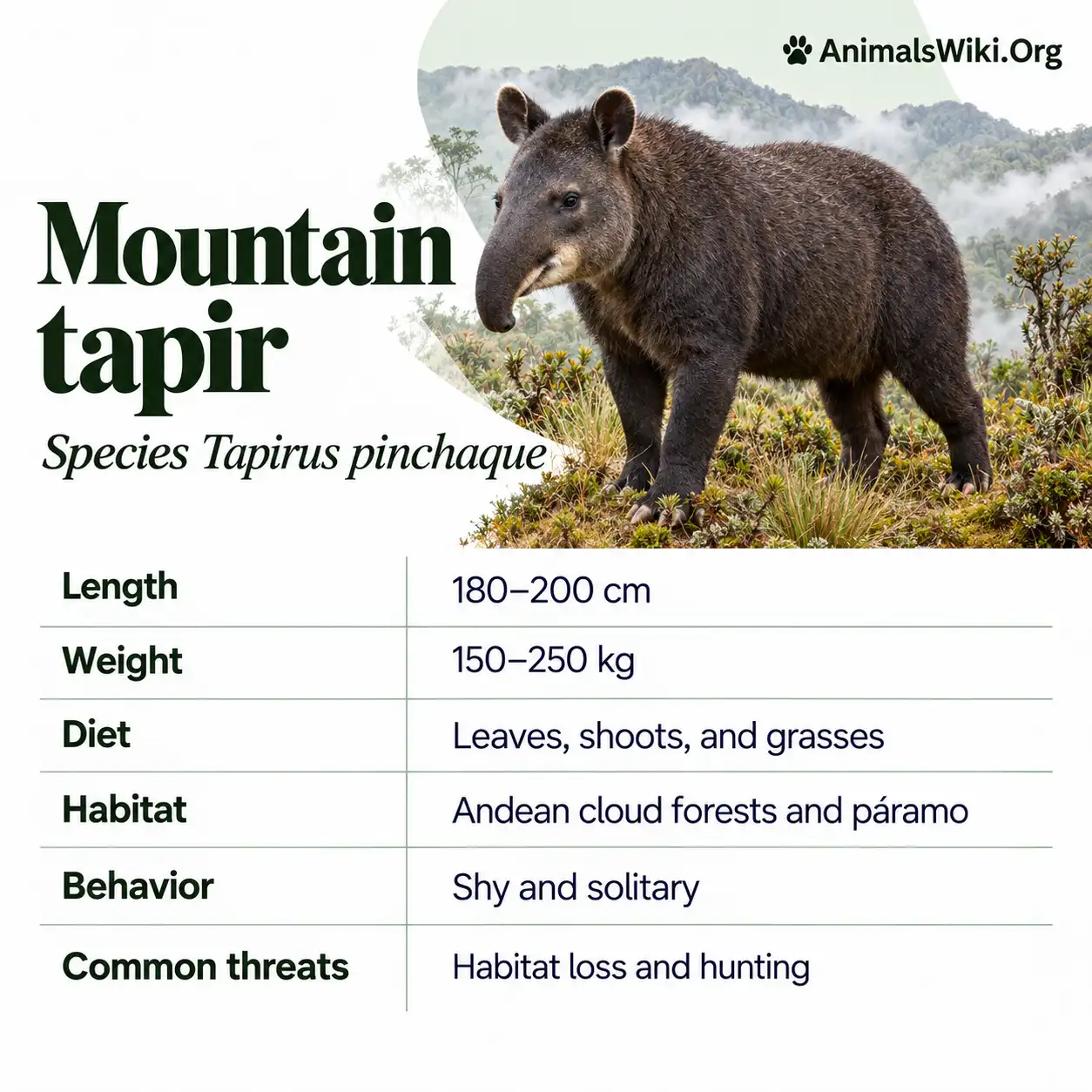
Mountain Tapir, A Complete Guide to the Woolly Gardener of the Andes
The mountain tapir lives in a landscape of mist-covered forests, steep slopes, cold streams and high-elevation grasslands. Its thick coat, flexible snout and sturdy body make it one of the most distinctive large mammals of the northern Andes.
Also called the Andean tapir or woolly tapir, this species differs noticeably from its relatives in warmer lowland environments. Instead of the relatively short coat associated with many other tapirs, it has dense hair that helps it cope with chilly mountain conditions.
Its established range includes parts of Colombia, Ecuador and northern Peru. Within those countries, however, it occupies a fragmented collection of suitable habitats rather than an uninterrupted stretch of mountain wilderness. The species is globally classified as Endangered.
Mountain tapirs are important plant eaters and seed dispersers. Their movements connect feeding areas, sheltered forest and mineral resources, while their droppings can transport viable seeds. Protecting them therefore helps preserve ecological relationships within some of South America’s most remarkable mountain landscapes.
This guide explores mountain tapir facts, appearance, habitat, diet, behavior, reproduction and conservation. It also explains what research reveals about their daily activity, why connected habitat matters and how recent health studies are broadening conservation priorities.
Mountain Tapir Facts
| Feature | Information |
|---|---|
| Common name | Mountain tapir |
| Other names | Andean tapir, woolly tapir |
| Scientific name | Tapirus pinchaque |
| Family | Tapiridae |
| Order | Perissodactyla |
| Native region | Northern Andes of South America |
| Established range | Colombia, Ecuador and northern Peru |
| Representative adult weight | Approximately 150–250 kg |
| Approximate body length | Around 1.8 m |
| Approximate shoulder height | Around 0.9 m |
| Distinctive features | Woolly coat, pale lips and flexible snout |
| Main habitats | Andean cloud forest, montane vegetation and páramo |
| Diet | Herbivorous, with a strong browsing component |
| Social pattern | Generally solitary |
| Pregnancy | Approximately 13 months |
| Typical litter | One calf |
| Global conservation status | Endangered |
1. What Is a Mountain Tapir?
A mountain tapir is a large, plant-eating mammal belonging to the species Tapirus pinchaque.
It is one of the four living tapir species recognized in the classification followed here. Among them, it is generally considered the smallest and the most conspicuously woolly.
“Smallest” is relative. An adult remains a substantial animal capable of weighing well over 100 kilograms.
Its body combines the familiar tapir features of a flexible snout, rounded rear, short tail and sturdy legs with adaptations associated with colder conditions.
The species belongs to the native large-mammal community of the northern Andes. It moves through forests and adjacent highland vegetation while searching for food and other resources.
Understanding that setting is essential. A mountain tapir is more than a lowland tapir living on a hillside; it is a distinct species with its own history and ecological relationships.
2. Why Is It Called a Woolly Tapir?
The name “woolly tapir” refers to the animal’s dense coat.
Mountain tapirs have longer, thicker hair than the other living tapirs, including an insulating undercoat.
This covering helps them retain warmth in environments where nights can be cold and damp.
The coat can look especially shaggy when wet or when photographed at close range. At a distance, the animal may simply appear dark.
Its hair is not a decorative difference. It forms part of the relationship between the animal and its surroundings.
An Andean forest can be geographically tropical while remaining cool because of elevation. Latitude alone does not determine the temperatures an animal experiences.
The mountain tapir’s coat makes that distinction visible: it lives near the equator in some parts of its range while still needing protection against cold conditions.
3. Mountain Tapir Scientific Classification
Mountain tapirs belong to Perissodactyla, the mammalian order that includes horses, zebras and rhinoceroses.
| Classification level | Placement |
|---|---|
| Kingdom | Animalia |
| Phylum | Chordata |
| Class | Mammalia |
| Order | Perissodactyla |
| Family | Tapiridae |
| Genus | Tapirus |
| Species | Tapirus pinchaque |
The scientific name identifies the species consistently across languages and common names.
“Andean tapir,” “woolly tapir” and “mountain tapir” all refer to the same animal.
Its classification also explains a common source of confusion. Although a tapir can look pig-like, it does not belong to the pig family.
The resemblance comes from broad body proportions rather than especially close ancestry.
Scientific classification considers detailed anatomical and genetic evidence, including features that may be difficult to recognize in a photograph.
4. What Are the Mountain Tapir’s Closest Relatives?
The mountain tapir is closely related to other tapirs, particularly the lowland tapir of South America.
More broadly, tapirs share ancestry with rhinoceroses and members of the horse family.
The short trunk can suggest an elephant, but elephants belong to a separate mammalian lineage.
These comparisons show why outward appearance provides an incomplete guide to evolution.
A tapir’s feet, skull and teeth reveal relationships that its rounded body may conceal. Genetic studies add another source of evidence.
Research on mountain tapir mitochondrial genomes has investigated relationships among South American tapirs and variation across populations.
Such studies help clarify both evolutionary history and conservation questions, including how populations are related across a fragmented range.
5. Mountain Tapir vs. Lowland Tapir
Mountain tapirs and lowland tapirs are separate species.
| Feature | Mountain tapir | Lowland tapir |
|---|---|---|
| Scientific name | Tapirus pinchaque | Tapirus terrestris |
| Main region | Northern Andes | Broad areas of South America |
| Typical environments | Montane forest and highland vegetation | Forests, wetlands and savanna mosaics |
| Coat | Dense and woolly | Generally shorter-haired |
| Adult appearance | Dark coat with pale lips | Brownish coat with a prominent mane |
| Global status | Endangered | Vulnerable |
These differences influence their conservation needs.
A lowland landscape containing abundant food does not automatically provide suitable conditions for mountain tapirs. Likewise, information from lowland tapir studies must be checked before being applied to the Andean species.
Their shared ancestry creates similarities, while their different environments create meaningful distinctions.
6. What Does a Mountain Tapir Look Like?
An adult mountain tapir is usually dark brown to nearly black.
Pale lips are a particularly recognizable feature, and the ear margins may also appear light.
Its body narrows toward the head and becomes rounded toward the rear. A short tail projects from the back, while the flexible snout extends beyond the mouth.
The thick coat softens its outline, making the animal look less sleek than its lowland relatives.
Lighting can change its apparent color considerably. A wet animal in deep shade may look almost black, while a photograph in brighter conditions can reveal brown or reddish tones.
The pale mouth contrasts with this dark covering and often remains visible even when much of the face is shadowed.
7. How Big Is a Mountain Tapir?
Mountain tapirs are commonly described as weighing approximately 150–250 kilograms.
Adults are around 1.8 meters long and roughly 90 centimeters high at the shoulder, although measurements vary.
These dimensions place them among the substantial herbivores of the high Andes.
A photograph taken without an object for scale can make the animal appear much smaller. The rounded head and woolly covering often create an almost juvenile appearance.
However, an adult is a powerful mammal with considerable body mass.
Published ranges should be understood as general guides rather than strict limits for every individual.
Age, sex, health, body condition and the origin of the measurement can all influence the figures reported in different references.
8. How the Flexible Snout Helps Feeding
The mountain tapir’s snout is a mobile extension of the nose and upper lip.
It is prehensile, meaning it can grasp or manipulate objects.
The animal uses it to investigate vegetation and draw food toward its mouth.
This allows close selection among leaves, shoots and other plant parts without constantly repositioning the entire body.
The snout also remains a sensory structure. It gathers information about food and the immediate surroundings while handling vegetation.
Its movement is therefore worth watching carefully. A tapir may sniff, curl the tip around a stem and then bring the selected material within reach of its teeth.
The structure is shorter and functions over a smaller working area than an elephant’s trunk, but it is highly useful for browsing.
9. Feet, Slopes and Uneven Ground
Mountain tapirs have four toes on each front foot and three on each hindfoot.
Their splayed feet provide support on soft ground and uneven surfaces.
This matters in a habitat containing muddy trails, steep slopes, roots and streambanks.
A large animal cannot use a mountain landscape effectively through strength alone. Balance, footing and access to suitable routes are also important.
Tapirs follow well-used paths through vegetation, connecting places they repeatedly visit.
The landscape is therefore experienced as a network of usable passages rather than an uninterrupted surface.
A route that appears narrow or awkward to a person may be familiar to a tapir that travels it regularly.
Its body and feet help it negotiate that terrain.
10. Where Do Mountain Tapirs Live?
The established range covers parts of Colombia, Ecuador and northern Peru.
These are countries within the northern Andean region of South America.
The species does not occupy all mountain habitat in those countries.
Its distribution consists of suitable areas separated by valleys, altered land and other barriers or unsuitable conditions.
Research in Peru has used sightings, camera records and other occurrence information to improve understanding of the southern part of the range.
This is important because distribution maps are only as reliable as the evidence behind them.
A blank area can indicate unsuitable habitat, local disappearance or a lack of adequate surveys.
Conservation planning needs to distinguish among those possibilities.
11. At What Elevation Do Mountain Tapirs Occur?
Mountain tapirs are strongly associated with high-elevation Andean environments.
Many accounts place much of their occurrence above approximately 2,000 meters, while broader compilations include records outside a narrower band.
The exact limits vary among regions and sources.
Elevation is useful, but it is not a complete habitat description.
Temperature, moisture, vegetation and access to food can differ between sites at the same height.
A cool, humid forest and a heavily modified slope may have identical elevation readings while offering very different conditions.
For this reason, the animal’s habitat should be understood through several environmental features together.
The word “mountain” identifies a broad setting; local ecology determines where the animal can actually live.
12. What Is a Cloud Forest?
A cloud forest is a mountain forest frequently influenced by low cloud, mist and high moisture.
Its appearance can include dense vegetation, moss-covered branches and a shaded, damp forest floor.
For a mountain tapir, this setting provides food, shelter and routes through protected vegetation.
Cloud forests also vary with elevation and location. They should not be imagined as one identical habitat repeated across the Andes.
A tapir may use several vegetation types during its movements, but forest cover can remain particularly important.
Field research in Ecuador found that closed-cover habitats supplied substantial quantities of favored foods.
This helps explain why protecting open highlands alone would leave an incomplete picture of the species’ requirements.
13. What Is Páramo?
Páramo is a high-elevation tropical mountain ecosystem found above the continuous forest line in parts of the northern Andes.
It contains vegetation adapted to cool, exposed conditions.
Grasslands, shrubs and distinctive highland plants can form a complex landscape rather than a simple empty expanse.
Mountain tapirs use páramo as part of their habitat mosaic.
However, calling them páramo animals should not obscure their relationship with nearby forest.
The boundary between forest and open highland vegetation can offer different resources over relatively short distances.
An animal may obtain cover in one place and food in another.
Protecting the combination is therefore more useful than selecting only the most visually dramatic part of the mountain landscape.
14. Why Habitat Mosaics Matter
Mountain tapir habitat often consists of connected forest, dense scrub, highland vegetation and waterways.
Each component can contribute something different.
Food plants may be concentrated in particular patches. Resting cover may occur elsewhere. Mineral-rich sites can attract repeated visits.
The animal needs to move among these resources.
Research examining mountain tapir diet and habitat in Sangay National Park emphasized the importance of Andean forest for both food and cover.
This creates a practical conservation lesson: an area should be evaluated as a working landscape.
A protected patch containing one useful feature may still depend on the condition of neighboring land.
The tapir’s daily needs connect places that human land-use boundaries may divide.
15. What Do Mountain Tapirs Eat?
Mountain tapirs are herbivores with a strong emphasis on browsing.
Their diet includes leaves, shoots, twigs, herbs, shrubs, grasses and some fruit.
The relative contribution of these foods depends on what is available in the habitat.
A four-year study in Ecuador documented a wide variety of woody and non-woody food plants.
This diversity matters because a mountain tapir cannot be adequately described as eating just one characteristic highland plant.
Its meals reflect selection among many possible resources.
Different plant parts can also have different nutritional value.
A young shoot, mature leaf and woody stem from the same plant are not equivalent foods.
Understanding diet therefore requires attention to both plant identity and the material actually eaten.
16. How Scientists Identify Food Plants
Direct observation is useful, but it is difficult to follow a secretive animal continuously through rugged terrain.
Researchers therefore combine observations with evidence such as feeding signs and fecal material.
Plant fragments in droppings can provide information about foods that were consumed out of sight.
Studies comparing localities can also reveal how diet changes across habitats.
Research in Ecuador’s Llanganates–Sangay corridor has examined mountain tapir diet at multiple locations.
Such work helps connect feeding behavior with conservation planning.
A plant list alone is not enough: researchers also need to know where important foods grow and whether animals can reach them safely.
Diet studies therefore contribute to understanding habitat quality, not merely to compiling menus.
17. How Does a Mountain Tapir Digest Vegetation?
Like other tapirs, the mountain tapir is a hindgut fermenter.
Microorganisms help break down plant material in the enlarged hindgut, including the cecum and colon.
This arrangement differs from the foregut fermentation and cud-chewing associated with cattle.
The tapir’s teeth begin the process by reducing food mechanically. Later, digestive processes extract nutrients from the material passing through the gut.
The system allows an animal to use fibrous vegetation, but different foods still vary in nutritional quality.
A varied natural diet also does not mean every available plant is eaten indiscriminately.
Food selection and digestion work together.
The animal’s feeding choices determine what enters the system, while its anatomy determines how that material can be processed.
18. Mountain Tapirs as Seed Dispersers
Mountain tapirs can move viable seeds through the landscape.
They consume plant material, including fruit, and deposit surviving seeds in their droppings.
Field observations and germination work in Ecuador have documented successful dispersal of Andean plants.
This provides a biological basis for describing the species as a mountain forest gardener.
The role should still be understood as a process rather than a guarantee.
A deposited seed must remain viable and reach conditions suitable for germination and subsequent growth.
The tapir contributes transport, but establishment also depends on moisture, soil, light and other ecological interactions.
Its importance emerges through repeated journeys and feeding events across many years.
19. Why Seed Dispersal Is More Complex Than Eating Fruit
A fruit-eating animal does not automatically benefit every plant whose seeds it encounters.
Research across tapir species shows that tapirs can act as both seed dispersers and seed predators.
The result depends on the seed and what happens during feeding and digestion.
A useful ecological study therefore asks several questions: Which seeds are swallowed? Which survive? Where are they deposited? Can seedlings establish there?
This is especially important when comparing tapir species.
Evidence about lowland forests or Asian plants should not be used as a substitute for mountain tapir research.
The broader family provides context, while species-specific studies reveal the actual relationships in Andean environments.
20. Why Do Mountain Tapirs Visit Mineral Licks?
Mountain tapirs visit mineral-rich locations commonly called salt licks.
These sites can provide resources not evenly distributed among ordinary food plants.
They also create opportunities for research because animals may return repeatedly.
A study in Colombia monitored activity both along trails and at mineral licks, finding that the timing of visits could differ between settings.
This means an animal’s daily schedule is partly shaped by what it is doing.
A camera at a lick and a camera on a travel route may produce different activity patterns without either being wrong.
The behavior also demonstrates why relatively small habitat features can have importance beyond their area.
A resource used occasionally can still be part of the animal’s wider requirements.
21. Are Mountain Tapirs Nocturnal?
Mountain tapirs can be active during both daylight and darkness.
Their activity should not be reduced to a strict rule that applies everywhere.
Research in the Central Andes of Colombia found two prominent activity periods: early morning and early evening.
Patterns at a mineral lick differed from those recorded more generally along trails.
The study also documented variation associated with setting and environmental conditions.
For readers, the useful conclusion is that mountain tapirs organize activity flexibly within their habitat.
For researchers, the finding highlights the need for observations across the full day.
A brief visit at one hour can miss a large part of the animal’s behavior.
22. Are Mountain Tapirs Solitary?
Mountain tapirs are generally described as solitary.
Adults commonly move independently, while mothers and calves form an important exception.
However, camera images have recorded more than one individual using mineral licks at the same time.
Such observations do not automatically establish permanent group living.
Animals can gather temporarily around a valuable resource while maintaining largely independent lives.
Understanding social organization requires repeated information about who interacts, how often encounters occur and whether associations persist.
The mountain tapir remains difficult to observe closely, so some details are still uncertain.
Its solitary reputation is a useful general description, with room for more complex interactions than a single word can capture.
23. How Do Mountain Tapirs Communicate?
Mountain tapirs use high-pitched whistles and scent-related behavior.
Urine marking is reported, although the detailed organization and function of communication remain incompletely studied.
For an animal that often moves alone, a scent can provide information after the individual that left it has departed.
Sounds can support more immediate contact.
However, the meaning of a signal depends on context.
A call during an unfamiliar encounter may have a different role from one exchanged between a mother and calf.
Careful behavioral research therefore looks at the surrounding situation and the receiver’s response.
The interesting question is not simply whether the animal makes a noise, but how that noise contributes to its relationships and decisions.
24. How Much Space Does a Mountain Tapir Use?
There is no single home-range figure suitable for every mountain tapir.
The area used can depend on resource distribution, terrain, sex, season and the method used to estimate it.
Tracking studies in Colombia and Ecuador have investigated movements using GPS and related technologies.
These methods provide repeated locations rather than relying on occasional sightings.
A home range is also different from a territory. The first describes an area used; the second implies some form of defense.
For conservation, the main issue is whether animals can move among the resources needed for feeding, shelter and reproduction.
A habitat patch must be understood in relation to the surrounding landscape, not only through its size.
25. How Mountain Tapirs Use Water
Streams and wet places form an important part of mountain tapir environments.
Tapirs can enter water to move, forage or bathe.
The mountain setting adds a distinctive context: waterways may have steep banks and flow through cool, dense vegetation.
Water is therefore connected with both the animal’s behavior and the wider structure of its habitat.
Protecting a stream while removing surrounding cover would preserve only part of that system.
Similarly, maintaining forest while allowing important waterways to become degraded could reduce habitat quality.
The animal’s requirements connect land and water.
This makes the species a useful representative of conservation efforts that consider entire mountain landscapes and their watersheds.
26. Mountain Tapir Reproduction
Mountain tapirs give birth to live young and nurse them with milk.
As in other tapirs, reproduction involves a long pregnancy and a small litter.
Much detailed reproductive knowledge comes from managed animals, while observations of wild breeding are harder to obtain.
This distinction matters when interpreting precise timelines.
A birth recorded in a zoo provides reliable information about that animal, but it does not establish every aspect of reproduction throughout the wild range.
Breeding success depends on the condition of adults, access to mates and suitable conditions for raising calves.
For a rare species, repeated successful reproduction is as important as individual births.
Population recovery requires those calves to survive and eventually reproduce themselves.
27. How Long Is a Mountain Tapir Pregnant?
Pregnancy lasts approximately 13 months.
A single calf is the usual outcome, while multiple births are unusual.
This is a substantial investment of time and resources by the female.
The reproductive pace has important conservation consequences.
A small population losing adults repeatedly cannot quickly replace them through large litters or short pregnancies.
Protecting reproductive adults therefore has value beyond saving one animal at a time.
It also preserves the opportunity for future calves.
The same principle explains why recovery plans must look beyond short-term changes in animal numbers.
A population needs conditions that allow successive generations to survive through the full life cycle.
28. What Does a Baby Mountain Tapir Look Like?
A baby mountain tapir begins life with a dark brown coat marked by pale stripes and spots.
The pattern resembles that of other young tapirs despite the distinctive adult coat of the mountain species.
These markings help break up the calf’s outline among vegetation and uneven light.
As the animal develops, the juvenile pattern gradually disappears.
The transition is not an immediate switch from one appearance to another.
A growing calf can show a mixture of remaining markings and increasingly uniform coloration.
Color change is also separate from independence.
An animal may begin to resemble an adult while still relying on its mother and continuing to develop physically and behaviorally.
29. Maternal Care and Early Development
The mother provides milk and the calf’s main early relationship.
Young tapirs develop mobility relatively early, but the ability to stand or walk does not make a newborn independent.
It still needs nutrition, shelter and experience.
As development progresses, the calf becomes more capable of accompanying its mother and investigating food.
Sampling vegetation can overlap with nursing for a considerable period.
These stages should be understood as gradual changes rather than a rigid sequence completed on identical dates for every animal.
Wild observations are especially valuable because they can reveal how maternal care fits within the demands of rugged terrain, weather and food availability.
A calf’s survival depends on the condition of the surrounding habitat as well as the care of its mother.
30. How Long Do Mountain Tapirs Live?
Mountain tapirs can live for several decades under managed care, with published zoo summaries giving potential longevity around 30 years.
That figure is a possible lifespan rather than a guaranteed average.
Wild longevity is more difficult to establish.
Researchers need to identify animals reliably and follow them across many years, while accounting for movement beyond the study area.
An individual disappearing from observations may have died, moved or simply become difficult to detect.
Zoo records and wild survival estimates therefore answer different questions.
The clearest lifespan account identifies the source and type of measurement rather than presenting one number as equally applicable everywhere.
31. Natural Predators and Defensive Behavior
Pumas are among the predators associated with mountain tapirs.
Andean bears are also listed as potential predators in species accounts, particularly in relation to vulnerable young animals.
However, detailed information on predation frequency is limited.
A healthy adult is a substantial animal, while a calf presents a different level of vulnerability.
Tapirs can defend themselves with bites and kicks when threatened.
Their quiet or elusive behavior should not be mistaken for physical harmlessness.
The ecological question is how predator encounters affect survival within a particular population.
For conservation, natural predation must also be considered alongside better-established human pressures such as habitat loss, hunting and attacks by free-ranging dogs.
32. Why Is the Mountain Tapir Endangered?
The mountain tapir is globally classified as Endangered.
Habitat loss, degradation and fragmentation are central concerns.
Agricultural expansion, livestock production and other land-use changes can reduce the forests and highland habitats used by the species.
Hunting adds pressure in some areas.
These threats interact. A surviving habitat patch may become isolated, limiting movements and reducing contact among populations.
The animal’s slow reproductive pace makes continuing losses especially important.
The global category also should not be confused with every national assessment. Countries can evaluate the species differently within their own borders.
A useful conservation account therefore distinguishes the worldwide assessment from regional circumstances and the condition of individual populations.
33. How Many Mountain Tapirs Remain?
Estimates of fewer than approximately 2,500 mature individuals are widely cited.
However, this should not be presented as an exact live count.
The species is difficult to survey, and information varies across its fragmented range.
Some records confirm presence without providing a reliable estimate of abundance.
Population density can also differ among sites, so multiplying one local estimate across all apparently suitable habitat can create misleading confidence.
The most accurate general statement is that the mountain tapir has a small, fragmented population requiring better monitoring.
Knowing the limits of an estimate is useful.
It helps researchers identify where additional surveys are needed and prevents an old assessment figure from being repeated as though it were a complete census conducted today.
34. Why Connected Protected Areas Matter
A national park boundary does not necessarily contain everything a mountain tapir population needs.
Animals may depend on habitat outside the protected area or on connections with neighboring populations.
Research in Colombia has examined functional connectivity for the country’s tapir species.
This approach asks how animals can actually move through the landscape, rather than treating all space between parks as equivalent.
Restoring connections can involve forest recovery and changes in land management.
The work also helps identify priorities.
Protecting every possible strip of land equally may be impractical, while evidence can reveal routes with particular importance.
For a species distributed among mountain habitat fragments, connectivity is part of long-term population conservation.
35. Climate Change and High-Elevation Habitat
Climate change presents a particular challenge for animals associated with cool mountain environments.
Suitable climatic conditions may shift in elevation or become more restricted.
A modeling study in Ecuador examined possible future changes in mountain tapir distribution and highlighted the importance of protected areas.
The results were projections under specified scenarios, not a direct prediction that every population would respond identically.
This distinction matters.
Animals encounter vegetation, land use and movement barriers alongside temperature.
A theoretically suitable area may remain unreachable or lack essential resources.
Conservation planning therefore needs to consider future conditions together with current habitat protection and connectivity.
Maintaining options for movement can be valuable in an environment that is changing.
36. Free-Ranging Dogs as a Conservation Concern
Domestic dogs can affect mountain wildlife when they enter natural habitats without appropriate control.
Research has documented attacks on mountain tapirs in Colombian cloud forests.
Other work in the Ecuadorian Andes has recorded negative dog interactions involving several native species, including mountain tapirs.
These records establish that the problem is more than a theoretical possibility.
The consequences can include injury, harassment and death.
Addressing the issue requires working with people living near habitat, because dogs form part of human communities.
The practical goal is coexistence that reduces preventable harm to wildlife while recognizing local circumstances.
It is one example of why mountain tapir conservation extends beyond the management of vegetation alone.
37. New Findings About Mountain Tapir Health
A 2025 scientific report documented New World screwworm infestation in wild mountain tapirs in Colombia’s Central Andes.
The condition involves fly larvae developing in wounds and can have severe consequences.
The researchers emphasized that the factors behind these cases were not fully established.
This is important because an observation of disease does not automatically prove one simple cause.
Wildlife health research examines interactions among animals, parasites, wounds, environmental conditions and human activities.
For a small population with slow reproduction, additional mortality can matter even when the number of documented cases is limited.
Health monitoring therefore complements habitat protection rather than replacing it.
Both address different parts of the species’ survival.
38. What Antibody Studies Can Tell Us
Research published in 2026 examined blood samples collected from free-ranging mountain tapirs in Ecuador’s Cayambe-Coca National Park.
The study found evidence of prior exposure to selected pathogens in some animals.
The interpretation requires care.
Antibodies do not by themselves establish current disease, identify the source of exposure or prove transmission from livestock.
The researchers also emphasized the limitations of the small, opportunistic sample.
The value lies in establishing baseline information for a poorly studied species.
Repeated studies can build a clearer picture of health over time.
This illustrates a broader principle: conservation depends on understanding uncertainty as well as recording findings that appear immediately significant.
39. How Scientists Study Mountain Tapirs
Researchers combine several methods:
- Camera traps.
- GPS or radio tracking.
- Footprint and dung surveys.
- Vegetation and feeding studies.
- Genetic sampling.
- Veterinary health assessments.
Each method provides a different view.
A camera records an animal at one place and time. A collar reveals a sequence of movements. A dung sample can contain dietary or genetic information.
Combining evidence helps answer questions that no single method can resolve.
Smithsonian-associated movement research emphasizes the value of each tracked animal because habitat use remains incompletely understood.
For a rare species in difficult terrain, even a modest dataset can add useful information when it is collected and interpreted carefully.
40. Local Communities and Mountain Tapir Protection
People living beside mountain tapir habitat are essential conservation partners.
They may recognize trails, report sightings and understand land-use changes that are difficult to detect through occasional field visits.
Conservation projects can combine this knowledge with scientific monitoring.
The Mountain Tapir Project describes a community-based approach linking research, local participation and sustainable livelihoods.
Work in Ecuador’s Llanganates–Sangay corridor has also examined connectivity through a participatory approach involving stakeholders.
These efforts recognize that protected habitat exists within lived landscapes.
Long-term success depends on practical arrangements that support people while maintaining the resources wildlife needs.
Local participation can turn an abstract conservation objective into continuing work on the ground.
Frequently Asked Questions About Mountain Tapirs
1. What is another name for the mountain tapir?
The mountain tapir is also called the Andean tapir or woolly tapir. All three names refer to Tapirus pinchaque. “Andean” identifies its mountain region, while “woolly” describes the dense coat that distinguishes it from other tapirs.
2. Is a mountain tapir a pig?
No. Mountain tapirs belong to Perissodactyla, the order containing tapirs, rhinoceroses and the horse family. Their pig-like proportions are an outward resemblance rather than evidence that they belong to the pig family.
3. Where do mountain tapirs live?
Their established range includes parts of Colombia, Ecuador and northern Peru. They occupy fragmented areas of suitable Andean habitat rather than every mountain or forest within those countries.
4. What kind of habitat does a mountain tapir need?
It uses montane forests, cloud forests, dense scrub and páramo. Food, cover, water and safe movement routes all matter. Protecting a connected habitat mosaic is more useful than focusing on one vegetation type alone.
5. Why do mountain tapirs have thick fur?
Their dense coat helps retain warmth in cool, damp mountain conditions. Although much of the range lies at tropical latitudes, elevation creates colder environments than those occupied by many lowland relatives.
6. Is the mountain tapir the smallest tapir?
It is generally recognized as the smallest of the four living tapir species in the classification used here. However, adults are still large mammals, commonly weighing well over 100 kilograms.
7. What do mountain tapirs eat?
They eat leaves, shoots, herbs, twigs, shrubs, grasses and some fruit. Their diet contains a wide variety of plants. The proportion of different foods varies with location and local availability.
8. What does a mountain tapir use its trunk for?
The flexible snout helps it investigate smells and grasp vegetation. It combines the nose and upper lip into a mobile feeding structure. Its reach is much shorter than that of an elephant’s trunk.
9. How many toes does a mountain tapir have?
It has four toes on each front foot and three on each hindfoot. The feet help support movement across soft, muddy and uneven terrain. Foot structure also forms part of the evidence connecting tapirs with other perissodactyls.
10. Are mountain tapirs active at night?
They can be active during both day and night. Research has documented early-morning and early-evening peaks, with different patterns at some mineral licks. A strict “only nocturnal” description would conceal this variation.
11. Do mountain tapirs live in groups?
They are generally solitary, with mother-calf pairs as an important exception. Multiple animals can visit the same mineral resource. Such gatherings do not necessarily indicate permanent group living.
12. Can mountain tapirs swim?
Yes. Water forms an important part of their environment, and they can enter streams and other water bodies. They remain land mammals whose feeding and shelter requirements depend heavily on surrounding vegetation.
13. Why do mountain tapirs visit salt licks?
Mineral-rich sites can provide nutrients that are unevenly available in ordinary food. Repeated visits also make these places useful for researchers studying activity and encounters among animals.
14. How long is a mountain tapir pregnant?
Pregnancy lasts approximately 13 months. A single calf is normally born. This long reproductive investment helps explain why repeated adult deaths can have serious consequences for a small population.
15. What does a baby mountain tapir look like?
A calf has a brownish coat with pale stripes and spots. The markings help conceal it among vegetation and uneven light. They gradually fade as the animal develops a more uniform adult appearance.
16. How long do mountain tapirs live?
They can live for several decades under managed care, with published summaries giving potential longevity around 30 years. Wild lifespan is harder to establish and should not be assumed identical to a zoo record.
17. Are mountain tapirs endangered?
Yes. Their global category is Endangered. Habitat loss, fragmentation, hunting and other pressures affect their survival. National or regional assessments may describe different levels of risk within particular countries.
18. How many mountain tapirs remain?
Estimates of fewer than approximately 2,500 mature individuals are widely cited. This is an assessment estimate, not an exact current census. Improved surveys are needed across the fragmented range.
19. Why are mountain tapirs important to plants?
They browse vegetation and can disperse viable seeds. Their movements transport some seeds away from parent plants. Germination and establishment depend on additional conditions, so seed transport is one important step in a larger ecological process.
20. What would help mountain tapirs most?
Priorities include protecting habitat, maintaining connections among populations, reducing hunting and dog-related impacts, supporting local conservation work and improving monitoring. Wildlife health research adds another useful layer to these efforts.
A Woolly Mammal With a Future Tied to the Andes
The mountain tapir brings together distinctive anatomy and an equally distinctive environment. Its dense coat suits cool conditions, its flexible snout helps select vegetation, and its movements connect forest, highland feeding areas and mineral resources.
Its conservation also reveals how many parts of a landscape must work together. Protected forests need connections. Healthy animals need suitable habitat. Research needs continuity, and practical protection needs local participation.
The species’ rarity should encourage careful attention rather than the repetition of uncertain figures as facts. Every reliable observation improves understanding of where mountain tapirs survive and what they need.
Keeping this woolly gardener in the wild means maintaining the Andean environments that allow it to feed, move and raise young across generations.



