
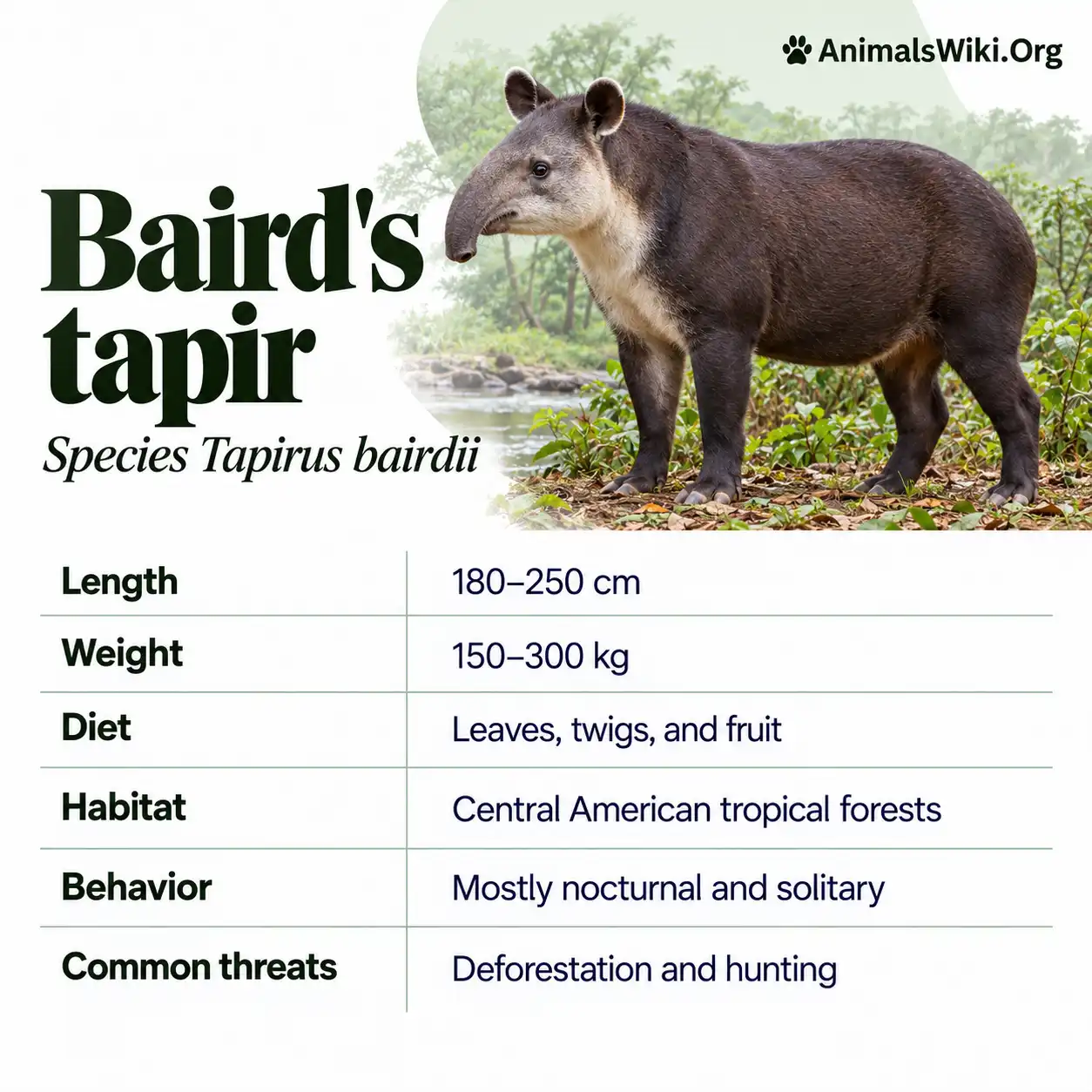
Baird’s Tapir, A Complete Guide to Central America’s Remarkable Forest Mammal
Baird’s tapir is a large, plant-eating mammal with a rounded body, sturdy legs and a flexible snout that works like a small trunk. Found from southern Mexico through Central America into northwestern Colombia, it is one of the most distinctive animals in the region’s forests.
Although its shape can remind people of a pig, Baird’s tapir belongs to the same mammalian order as horses and rhinoceroses. Its unusual appearance reflects a practical combination of adaptations: a snout for collecting food, a strong body for moving through vegetation and feet suited to soft, uneven ground.
This animal also performs an important ecological job. As it feeds on vegetation and fruit, it carries seeds through the landscape and deposits some of them in its dung. These movements connect the everyday feeding habits of an individual tapir with the regeneration of its forest home.
Unfortunately, Baird’s tapir is classified as Endangered. Habitat loss, hunting and other pressures have reduced and separated its populations. Understanding how it lives helps explain why protecting connected forests, reliable water sources and safe movement routes matters for its future.
1. Baird’s Tapir Facts
| Feature | Details |
|---|---|
| Common name | Baird’s tapir |
| Other common name | Central American tapir |
| Scientific name | Tapirus bairdii |
| Animal group | Mammal |
| Order | Perissodactyla |
| Family | Tapiridae |
| Diet | Herbivorous |
| Main foods | Leaves, shoots, twigs and fruit |
| Typical adult weight | Approximately 150–300 kilograms, with individual variation |
| Distribution | Southern Mexico, Central America and northwestern Colombia |
| Habitats | Tropical forests, wetlands, river margins and some mountain forests |
| Social behavior | Usually solitary, apart from mothers with young and temporary associations |
| Pregnancy | Approximately 13 months |
| Usual number of offspring | One calf |
| Conservation status | Endangered |
| Distinctive features | Flexible snout, pale throat and white-edged ears |
2. Scientific Classification and Closest Relatives
Baird’s tapir belongs to the order Perissodactyla, the group commonly called odd-toed ungulates. Living members include tapirs, horses and rhinoceroses.
Its classification is:
| Classification level | Name |
|---|---|
| Kingdom | Animalia |
| Phylum | Chordata |
| Class | Mammalia |
| Order | Perissodactyla |
| Family | Tapiridae |
| Genus | Tapirus |
| Species | Tapirus bairdii |
The Mammal Diversity Database recognizes the species under Tapirus bairdii. Some taxonomic discussions have proposed alternative generic arrangements, but Tapirus remains the name used here.
Its trunk-like snout does not make it an elephant relative, and its rounded body does not place it among pigs. These similarities are useful visual comparisons, but scientific relationships depend on evolutionary history rather than superficial resemblance.
3. What Does Baird’s Tapir Look Like?
An adult Baird’s tapir usually has a dark brown, reddish-brown or nearly black coat. Its throat and chest are lighter, and the rounded ears have conspicuous pale edges.
The head is relatively long, ending in the flexible snout. Small eyes sit above the cheeks, while the ears can be easier to notice against the dark coat. The tail is short and contributes little to the animal’s overall outline.
Its body is deep and heavy, supported by short, strong legs. Short hair covers thick skin, producing a much smoother appearance than that of the woolly mountain tapir.
The pale throat and ear margins are particularly helpful when identifying an adult. Lighting, wet fur and camera exposure can change apparent coat color, so identification works best when several features are considered together.
4. How Big Is Baird’s Tapir?
Baird’s tapir is the largest native terrestrial mammal in Central America. Adults commonly weigh roughly 150–300 kilograms, although age, sex, health and individual development influence body size.
That makes a mature tapir a substantial animal, even when it appears small beside rainforest trees or partly hidden in vegetation.
Length and shoulder-height figures vary among zoo and reference profiles. An adult is broadly around two meters long and approximately a meter tall at the shoulder, with considerable variation around those general dimensions.
Large size has advantages: an adult can process substantial quantities of vegetation and move through sturdy undergrowth. It also creates demands. A big herbivore needs enough food, water and usable space throughout the year, including during difficult dry periods.
5. How Its Flexible Snout Works
A tapir’s snout is formed from its nose and upper lip. This structure is prehensile, meaning it can grasp and manipulate objects.
While feeding, the animal can reach toward a branch, gather leaves or guide fruit into its mouth. The snout adds precision to feeding without requiring the whole head and body to move each time.
This is especially useful when edible material sits among tangled stems. A mobile snout helps the tapir select accessible plant parts instead of simply biting everything in front of it.
The structure also remains a nose, playing an important role in smelling its surroundings. Its resemblance to a miniature elephant trunk is easy to understand, but it is a separate evolutionary adaptation with its own proportions and capabilities.
6. Feet, Toes and Movement Through Mud
Tapirs have four toes on each front foot and three on each hind foot. Their spread-out feet help them gain traction on soft ground, including muddy shorelines and forest slopes.
The term “odd-toed ungulate” can seem confusing when the front feet carry four toes. The classification concerns the underlying structure of the limb and how the main weight-bearing axis passes through the central digit; it is not simply a count of every visible toe.
For a tapir, dependable footing matters during ordinary activities such as approaching water, climbing a slippery bank or following a trail after rain.
Its body and feet work together. The broad, sturdy animal can move through conditions that would be awkward for an animal with narrower feet or a less compact build.
7. Where Does Baird’s Tapir Live?
The species occurs from southern Mexico through parts of Central America into northwestern Colombia.
Its recognized range includes:
- Mexico
- Belize
- Guatemala
- Honduras
- Nicaragua
- Costa Rica
- Panama
- Colombia
This list describes the species’ geographic distribution, not continuous occupation of every forest within those countries. Suitable habitat may be separated by farms, roads, settlements or areas where tapirs have disappeared.
Historically occupied places can therefore remain part of the species’ broader story while no longer supporting a local population. The Belize Zoo identifies El Salvador among the places where the species has become locally extinct.
A useful way to understand its range is as a network of surviving populations with different levels of protection, connectivity and exposure to human activity.
8. Baird’s Tapir Habitat
Baird’s tapir occupies several kinds of habitat, including humid tropical forest, river-associated woodland, seasonal forest, wetlands and some upland forests.
This variety shows that it is not restricted to one simple picture of dense, permanently wet jungle. Different populations encounter different rainfall patterns, plant communities and terrain.
However, habitat variety does not mean every landscape is equally useful. An animal needs access to food, cover, water and routes between important resources.
A patch of trees may provide shelter while failing to supply enough food throughout the year. A feeding area may be productive but difficult to reach safely. A suitable habitat therefore functions as a combination of resources rather than a single vegetation label.
Riparian vegetation can be especially valuable because it brings cover and water together within the same part of the landscape.
9. Can Baird’s Tapir Live in Mountains?
Yes. Although often associated with tropical lowlands, Baird’s tapir also occurs in mountain environments.
Its distribution includes cloud forests and high-elevation landscapes. A Costa Rican research initiative describes the species occurring across a broad environmental span, from coastal Corcovado to páramo environments in the Talamanca region.
This range introduces very different living conditions. A lowland forest may be hot and humid, while an upland site can be cooler, steeper and exposed to frequent cloud or mist.
The important distinction is that Baird’s tapir living in mountains is still Baird’s tapir. The mountain tapir, Tapirus pinchaque, is a separate species.
Habitat elevation alone cannot identify a tapir. Geographic location, body characteristics and species-level evidence must also be considered.
10. Why Water Matters So Much
Water is a central feature of tapir life. Rivers, streams, ponds and other wet places provide opportunities to drink, cool down and spend time partly submerged.
A pool can serve several purposes during one visit. The tapir may approach to drink, remain in the water while resting and later leave along a familiar trail.
Water availability also affects the wider landscape that an animal can use. A forest with abundant vegetation may become harder to occupy if dependable drinking places disappear during the dry season.
This helps explain why protecting forest cover alone can leave an important gap in conservation planning. The locations, persistence and accessibility of water sources matter too.
For a tapir moving between feeding and resting areas, a safe route to water can be as important as the water itself.
11. Swimming and Life Around Rivers
Despite its heavy appearance, Baird’s tapir is comfortable in water. Swimming allows it to move through waterways that might divide the travel routes of less capable animals.
Its elongated snout can remain above the surface while much of the body is submerged. This allows breathing in shallow water without lifting the entire head high above the surface.
Water use should be understood as part of a largely terrestrial lifestyle. A tapir still spends much of its time on land, feeding and traveling through forest vegetation.
The meeting point between land and water is particularly important. Banks, muddy edges and sheltered approaches influence how easily an animal can enter or leave a pool.
Protecting a water source therefore includes protecting its surroundings, rather than treating the water surface as an isolated feature.
12. What Does Baird’s Tapir Eat?
Baird’s tapir is an herbivore. Its food includes leaves, shoots, twigs and fruit, with other plant material contributing according to local availability.
It is often described as a browser because it feeds on vegetation from shrubs, young plants and branches. Fruit can also be an important component of its diet.
The exact menu varies between locations. A tapir in a seasonally dry Mexican forest does not encounter the same plant community as one in a wet Costa Rican forest or a mountain environment.
A 2026 review of Baird’s tapir diet brings together evidence from different sites and methods, highlighting the importance of looking beyond a single list of favorite foods.
The most accurate general description is a flexible plant-based diet shaped by the resources available in each habitat.
13. How Feeding Changes With the Seasons
Seasonal changes affect which plant foods are available and where tapirs can find them.
A fruiting tree may create a concentrated feeding opportunity for a limited period. Elsewhere, fresh leaf growth may become more accessible after rain. During drier conditions, both food and water can become unevenly distributed.
These changes help explain why a tapir needs access to more than one feeding spot. A place that offers abundant food in one month may become less useful later.
Seasonality also complicates research. A diet survey conducted during a fruiting peak can produce a different picture from a survey during a lean period.
For conservation, the practical implication is that habitat quality should be assessed over time. A landscape must support the animal through changing conditions, including the least favorable part of the year.
14. How a Tapir Digests Its Food
Tapirs are hindgut fermenters. Microorganisms help break down plant material in the enlarged digestive tract behind the stomach, particularly in the cecum and colon.
This differs from the digestive arrangement of cattle and other ruminants, which rely on fermentation chambers before the main stomach.
For a plant-eating animal, digestion is about obtaining usable nutrients from food that can contain a great deal of structural fiber. Leaves and stems require a different digestive approach from the easily absorbed foods available to many carnivores.
The feeding process therefore continues long after a tapir has swallowed. Food selection, chewing, digestion and the activity of microorganisms all contribute to how the animal uses vegetation.
Calling a tapir a “mountain cow” may be culturally familiar in Belize, but the nickname does not describe its digestive anatomy or evolutionary relationship.
15. Why Baird’s Tapir Is Called a Forest Gardener
When a tapir eats fruit, it may swallow seeds along with the edible flesh. Some seeds survive digestion and are deposited later in another location.
This process is known as seed dispersal.
The animal does not plant intentionally. Its contribution comes from combining feeding with movement. A fruit eaten in one part of a forest may lead to a seed being deposited somewhere else.
The ecological outcome depends on several stages: the seed must survive handling and digestion, land in a suitable place and eventually germinate and establish.
Baird’s tapir is therefore part of a relationship between plants, animals and the physical environment. Its nickname “forest gardener” captures the broad idea, while field research examines which plants benefit and under what conditions.
16. What Research Reveals About Seed Dispersal
Seed dispersal is more complicated than finding seeds in dung.
Researchers need to determine whether those seeds remain viable and whether their new location improves or reduces their chances of producing an established plant.
A field experiment in Mexico’s Greater Calakmul region examined the dispersal of large seeds by Baird’s tapir. Other work on Barro Colorado Island in Panama investigated small seeds recovered from tapir feces.
These studies address different parts of the same ecological process. Seed size, plant species, digestive survival and the conditions at a deposition site can all matter.
It would therefore be misleading to assume that every swallowed seed survives or that every surviving seed becomes a tree. The tapir contributes an important transport mechanism within a much longer sequence of ecological events.
17. How Tapirs Influence Forest Regeneration
The importance of a large fruit-eating animal extends beyond the food it consumes.
If it moves seeds between forest patches, feeding areas and resting places, it can influence where future plants have the opportunity to grow. Over time, these small events may contribute to patterns in forest regeneration.
However, no single species controls the entire process. Birds, bats, rodents, insects, weather and soil conditions also shape plant recruitment.
A helpful way to view Baird’s tapir is as one contributor whose body size, diet and movements give it a particular role.
Research on tapir ecology in Mexico connects its conservation with plant interactions and forest processes. Protecting the animal consequently helps preserve a relationship within the ecosystem, rather than simply retaining a large mammal on a species checklist.
18. Is Baird’s Tapir Nocturnal?
Baird’s tapir is often active at night or around dawn and dusk, but its activity is flexible.
Local conditions influence when it moves. Temperature, disturbance, access to food and exposure to hunting can all affect the usefulness or safety of different times of day.
A daytime sighting is therefore possible and should not automatically be interpreted as unusual behavior or evidence that something is wrong.
Zoo New England notes that the species can be particularly nocturnal in areas where it is hunted.
This flexibility is important when studying tapirs. A survey based only on daytime observations may overlook animals that are using the same area after dark. Camera traps provide a useful way to investigate activity across the full day without requiring an observer to remain beside a trail.
19. Social Behavior and Communication
Baird’s tapirs are generally solitary. Mothers and calves form the most obvious lasting association, while adults may come together temporarily.
Living alone does not mean living without communication. Tapirs use vocal sounds and scent-related behavior to exchange information.
Descriptions include whistles, squeaks and other high-pitched calls. Some sounds occur during contact between animals, while others are associated with excitement or agitation.
Their calls can surprise people because the sound seems delicate compared with the animal’s heavy body.
Scent also provides a way for individuals to leave information after moving away from a location. In a dense forest, where direct visibility is often limited, signals that persist in the environment can be useful.
The species’ social life is best described through these observed interactions rather than assuming that solitary adults never encounter one another.
20. Home Ranges, Trails and Habitat Use
A home range is the area an animal uses during its normal activities. It includes places for feeding, resting, drinking and moving between resources.
Baird’s tapir home ranges vary with local conditions, so a single size should not be applied to every population.
Research in Costa Rica’s Corcovado National Park followed five adults using radio telemetry. The animals used secondary forest more than expected from its availability within the study landscape.
That result is informative, but its meaning requires context. Regrowing forest can provide accessible food, while nearby mature forest may still supply other resources and cover.
The broader lesson is that tapirs respond to the arrangement and quality of habitat. Conservation planning benefits from studying how animals actually use a landscape, rather than judging every forest patch by age alone.
21. Mating, Pregnancy and Slow Reproduction
Baird’s tapir has a long reproductive cycle compared with many smaller mammals.
Pregnancy lasts approximately 13 months, and a female usually gives birth to one calf. This combination limits how quickly a population can replace animals that die.
Reproductive biology is also a focus of veterinary research. Studies of tapirs have examined methods for monitoring reproductive hormones, ovarian activity and pregnancy.
Such information can support breeding management under human care, while also improving understanding of the species’ biology.
For wild populations, the most important implication is straightforward: recovery takes time. Even when threats decline, the number of breeding females, calf survival and the time needed for young animals to mature all influence population growth.
Protecting adults and allowing successful reproduction to continue are therefore closely connected conservation goals.
22. Baby Baird’s Tapirs and Their Striped Coats
A newborn Baird’s tapir looks strikingly different from an adult.
Its reddish-brown coat carries pale stripes and spots, producing a pattern often compared with a small watermelon. The markings help break up the calf’s outline among vegetation and patches of light and shade.
As the calf grows, the pattern gradually fades and the darker adult coat develops. The transition takes place over several months rather than at one exact age.
A calf’s appearance is therefore also a record of development. An animal with fading stripes is at a different stage from a newly born calf, although precise age cannot be read from markings alone.
The contrast between young and adults is one reason baby tapirs attract so much attention. Beneath the appealing pattern, however, is a period of substantial dependence and vulnerability.
23. Maternal Care and Growing Independence
A mother provides more than milk. Her presence connects a young tapir with the practical demands of living in its environment.
Early in life, a calf may remain concealed while its mother feeds nearby or leaves temporarily to forage. As it develops, it becomes more capable of accompanying her.
Sampling vegetation, reducing dependence on milk and traveling independently are different stages. A calf can begin eating plants while still relying heavily on its mother.
The transition also involves learning where resources are found and how to move through the landscape.
Zoo birth reports show why early care receives close attention: keepers monitor nursing, growth and the mother’s response to her calf. These observations offer detailed information about development, although conditions under managed care differ from those faced by a calf in the wild.
24. Are Tapir Twins Possible?
Yes, but twins are unusual.
A documented example occurred at Franklin Park Zoo in September 2020, when a Baird’s tapir gave birth to a male and a female calf.
The birth attracted attention because twin pregnancies create additional challenges for monitoring, delivery and newborn care. Reports from the zoo and veterinary team describe the planning and clinical attention involved.
This example should not change the general description of the species’ reproduction. A single calf remains the normal outcome.
Rare events are valuable because they reveal the range of what is biologically possible, but they should be kept separate from typical patterns. For an overview of Baird’s tapir, the key reproductive facts remain the long pregnancy, usual single calf and extended investment in young.
25. Lifespan and Natural Predators
Baird’s tapirs can live for decades. Zoo profiles report lifespans reaching around 30 years, although typical survival and maximum longevity are different measures.
Wild lifespan is harder to establish because researchers rarely follow every individual from birth to death. Health, food availability, injuries and human pressures all affect survival.
Large predators, including jaguars and pumas, may prey on tapirs. Predation risk differs with the age and size of the tapir, the surrounding habitat and the predators present.
An adult’s size provides some protection, while a young calf faces a different set of risks.
Natural predation belongs to the ecological setting in which the species evolved. Conservation concerns arise when additional human-caused mortality and habitat changes exceed what a slowly reproducing population can withstand.
26. Why Is Baird’s Tapir Endangered?
Baird’s tapir is classified as Endangered, reflecting serious concern about its future in the wild.
Its main pressures include habitat destruction and fragmentation, hunting, roads and conflict where its needs overlap with farming or settlements.
These threats can reinforce one another. A road may divide habitat while also making a previously remote area more accessible. Forest clearance can reduce food and cover while forcing animals to cross open ground.
A population that appears to have enough forest may still be vulnerable if adult animals are being killed or if breeding groups have become isolated.
Conservation therefore requires attention to both the condition of the habitat and the survival of the animals using it. Improving one while neglecting the other can leave a population exposed to continued decline.
27. Habitat Loss and Fragmentation
Habitat loss removes usable space. Fragmentation divides the remaining space into pieces.
For a tapir, these changes can affect ordinary journeys. A route that once connected a feeding area with water may begin to cross pasture, a settlement edge or a busy road.
The consequences are not limited to the amount of vegetation left standing. The arrangement of that vegetation determines whether an animal can reach the resources it needs.
Small isolated populations also have fewer opportunities for movement between groups. Over time, this can increase their vulnerability to local losses.
A range-wide conservation study identified connectivity among the important priorities for Baird’s tapir. Its recommendations emphasize the need to protect functioning landscapes and improve links between populations, alongside strengthening protection where the species already survives.
28. Hunting and the Importance of Adult Survival
Hunting can be particularly damaging to an animal with a long pregnancy and usually one calf at a time.
When an adult is removed, the immediate loss is one animal. If that adult is a breeding female, the population also loses her potential future contribution to reproduction.
The seriousness of hunting varies between places. Local practices, access to alternative foods, enforcement, cultural relationships and the condition of surrounding habitat all influence outcomes.
Research in northeastern Honduras has examined the coexistence of Baird’s tapirs and Indigenous hunters, including the role of landscape context and refuge areas.
This reinforces an important principle: conservation works best when it investigates actual conditions and involves the people connected with a landscape. Broad assumptions about an entire community cannot replace evidence about a particular place.
29. Roads and Vehicle Collisions
Roads create a direct risk when tapirs cross them, particularly where traffic overlaps with nighttime movement.
The Belize Zoo identifies lethal vehicle collisions as one of the major threats facing tapirs in Belize.
A collision site can reveal more than an unfortunate encounter. It may indicate a route between forest patches, a nearby water source or a repeated crossing point.
Road conservation measures are most useful when they respond to those patterns. Monitoring can help identify where driver awareness, speed management or appropriately designed crossing infrastructure may be needed.
The surrounding land also matters. A crossing cannot maintain connectivity if the habitat leading to it disappears.
For tapirs, safer roads and connected habitat belong to the same problem: allowing animals to complete necessary movements without an avoidable risk of death.
30. Drought and Changing Water Availability
Drought can make a forest increasingly difficult to use even when much of its vegetation remains standing.
In Mexico’s Greater Calakmul region, researchers have documented concerns about tapirs approaching villages while searching for water. Seasonal water shortages can bring animals into closer contact with people and domestic animals.
This creates a chain of pressures. A drying pond may require a longer journey, a different route or the use of a more disturbed location.
Research on drought and human–wildlife conflict shows why water availability deserves specific attention in tapir conservation.
Artificial water sources have also been explored in the region. Such interventions require planning and monitoring because the usefulness of a water point depends on its location, maintenance and effects on wildlife movement.
31. Crop Damage and Living Alongside Tapirs
A large herbivore may encounter crops where farms and forests meet. For a household, damage to food plants can be a serious concern, even when the animal involved is endangered.
Effective responses begin by identifying what happened, which animals were responsible and when the damage occurred.
A recent study in eastern Honduras used noninvasive monitoring to investigate mammal interactions with crops. Its findings illustrate why tapir presence near a field should not be treated as proof that tapirs caused all observed damage.
Local evidence can support more appropriate responses and help reduce unnecessary retaliation.
Other projects explore ways for communities to benefit from living alongside tapirs. In Costa Rica, farmer-led tourism initiatives have been developed in areas affected by conflict, with evaluation needed to understand how well they work.
32. How Scientists Study Baird’s Tapir
Studying a large mammal in dense vegetation requires several complementary methods.
Camera traps can record presence and activity without a person remaining beside the trail. Tracks and dung provide evidence of recent use. Telemetry can reveal movements that individual sightings cannot reconstruct.
Diet studies may examine feeding observations, plant remains or material recovered from dung. Genetic methods can help investigate relationships and population connectivity.
Each approach answers a different question. A photograph shows that an animal visited a location; it does not automatically reveal the size of the population living nearby.
Likewise, a few weeks of monitoring may miss seasonal changes.
Range-wide conservation planning has emphasized the need for additional surveys and movement-related research. Combining local observations with systematic methods helps turn scattered records into a clearer picture of the species’ needs.
33. What Zoos Contribute to Tapir Conservation
Zoos can contribute through coordinated breeding, veterinary work, public education and support for conservation in the species’ native range.
Managed breeding programs aim to maintain healthy populations with attention to genetic diversity and demographic stability. Birth records also provide detailed information about pregnancy, development and maternal behavior.
These contributions are most useful when they connect with field conservation. Maintaining animals under human care does not by itself resolve habitat loss or hunting in the wild.
Reid Park Zoo, for example, describes participation in a Baird’s tapir Species Survival Plan and support connected with tapir research.
Public education has a role too. A close view of a tapir can help visitors understand an animal that many people have never encountered or even heard of before visiting a zoo.
34. Local Communities and Regional Cooperation
Baird’s tapir crosses political boundaries in its overall distribution, while individual conservation challenges are often highly local.
A water shortage, dangerous road or conflict with a farm requires knowledge of that particular place. Regional cooperation allows people working in different areas to share approaches without assuming that one solution fits everywhere.
The Baird’s Tapir Survival Alliance brings together partners working on threats, research, coexistence and conservation capacity.
Community participation is central to this work because residents are often the first to notice changing animal movements, drying water sources or new pressures on forest habitat.
Long-term protection depends on maintaining practical relationships. Research findings need to be useful to local decisions, and conservation measures need to take people’s livelihoods and rights seriously while improving conditions for tapirs.
35. Baird’s Tapir Compared With Other Tapirs
Baird’s tapir shares the basic tapir body plan with its relatives, but several features help distinguish it.
| Species | General distribution | Useful identifying feature |
|---|---|---|
| Baird’s tapir | Mexico, Central America and northwestern Colombia | Dark adult coat with pale throat and white-edged ears |
| Lowland or Brazilian tapir | Much of tropical South America | More conspicuous upright mane |
| Mountain tapir | Northern Andes | Dense, woolly coat |
| Malayan tapir | Southeast Asia | Broad pale saddle across a darker body |
The comparison is especially useful when photographs appear without reliable location information.
A tapir’s surroundings provide clues, but appearance and geographic range should be considered together. Baird’s tapir can occupy mountain habitat, and the Belizean name “mountain cow” does not identify it as the mountain tapir.
All four share important traits, including plant-based diets and flexible snouts, while differing in appearance and distribution.
36. Baird’s Tapir as Belize’s National Animal
Baird’s tapir is the national animal of Belize, where it is widely known as the mountain cow.
The name reflects local familiarity rather than a scientific relationship with cattle. It provides an accessible way to talk about an animal that belongs to the region’s natural heritage.
National recognition can give conservation a strong public foundation. People may encounter the species through school activities, zoo programs, signs or community events before seeing one in the wild.
The challenge is connecting recognition with practical protection. Appreciation becomes particularly valuable when it encourages safer driving near wildlife habitat, support for forest conservation or participation in local monitoring.
Baird’s tapir is therefore both a biological species and a cultural symbol. Protecting it preserves a recognizable part of Belize’s wildlife identity as well as its ecological role.
37. Responsible Tapir Watching
Seeing a wild tapir can be memorable, especially when the animal continues its normal behavior without reacting strongly to observers.
A responsible encounter gives it space to feed, rest and move away. This is particularly important beside water, along narrow trails or near a mother and calf.
Feeding wildlife can change the conditions of an encounter and encourage animals to approach people. A better observation keeps attention on what the tapir is doing naturally.
Local guides can help visitors understand tracks, habitat and behavior while following the rules of a particular reserve.
For tourism projects connected with conservation, the useful question is whether visits support lasting benefits for communities and wildlife. The strongest experience leaves the animal able to continue using its habitat and gives visitors a clearer understanding of why that habitat matters.
38. Why Protecting Baird’s Tapir Matters
Baird’s tapir connects several parts of a forest ecosystem. It consumes vegetation, moves seeds, travels between resources and participates in relationships with plants, predators and people.
Its conservation also draws attention to landscape features that benefit many other organisms: connected vegetation, functioning wetlands, reliable water and safer movement routes.
Protecting the species requires patience because its biology does not allow rapid replacement of lost adults. Progress is likely to depend on sustained protection and repeated successful breeding over many years.
The most useful conservation picture combines several goals: keep existing populations safe, maintain links between them, understand local threats and support the people sharing their habitat.
A surviving tapir population represents more than the presence of a distinctive mammal. It indicates that a landscape still supports at least part of the movement, feeding and reproduction needed to sustain a large forest herbivore.
Frequently Asked Questions About Baird’s Tapir
1. What is Baird’s tapir?
Baird’s tapir is a large herbivorous mammal native to southern Mexico, Central America and northwestern Colombia. It has a heavy body, short legs and a flexible snout. The species is also called the Central American tapir and is classified as Endangered.
2. What is the scientific name of Baird’s tapir?
Its scientific name is Tapirus bairdii. It belongs to the family Tapiridae and the order Perissodactyla, which also includes horses and rhinoceroses. In scientific writing, the genus begins with a capital letter and the species name remains lowercase.
3. Is Baird’s tapir a pig?
No. Although its rounded body can look pig-like, Baird’s tapir is an odd-toed ungulate. Its evolutionary relationships place it with other tapirs, horses and rhinoceroses rather than with pigs. Similar body shapes do not necessarily indicate a close relationship.
4. Is Baird’s tapir related to elephants?
It is not a close elephant relative. Its mobile snout resembles a small trunk, but tapirs belong to a different mammalian order. The snout is formed from the nose and upper lip and helps the animal gather and manipulate food.
5. Where can Baird’s tapir be found?
It occurs in suitable parts of southern Mexico, Belize, Guatemala, Honduras, Nicaragua, Costa Rica, Panama and northwestern Colombia. Its distribution is fragmented, so this country list should not be interpreted as a continuous population occupying every forest in the region.
6. What does Baird’s tapir eat?
It eats plant material, including leaves, shoots, twigs and fruit. The proportion of different foods varies with location and season. A population living in a seasonal forest may have a different diet from one living in a wetter or higher-elevation habitat.
7. Does Baird’s tapir eat meat?
Baird’s tapir is classified as an herbivore. Its normal feeding ecology centers on plants rather than hunting or routinely consuming animal prey. Leaves and fruit are important parts of its diet, with local availability influencing exactly what an individual eats.
8. How heavy is an adult Baird’s tapir?
Adults commonly weigh approximately 150–300 kilograms. These figures are a general guide, and individual animals vary. A calf, a growing juvenile and a fully mature adult have very different body sizes, so age is important when comparing weights.
9. Is it the largest tapir species?
Baird’s tapir is a large tapir, but the Malayan tapir is generally recognized as the largest living species. Baird’s tapir’s particular distinction is being the largest native terrestrial mammal in Central America, which is a geographic comparison rather than a worldwide ranking.
10. Can Baird’s tapir swim?
Yes. It is a capable swimmer and regularly uses rivers, ponds and other water sources. Water forms an important part of its habitat, providing opportunities for drinking and cooling. Its largely terrestrial lifestyle includes frequent use of aquatic environments.
11. Why does Baird’s tapir have a long nose?
Its elongated, flexible snout helps it reach and grasp vegetation and guide food into its mouth. Because it combines the nose and upper lip, it also remains important for smelling. This makes it both a feeding tool and a sensory structure.
12. How many toes does it have?
A tapir has four toes on each front foot and three on each hind foot. Its feet help provide traction on soft, slippery ground. The classification “odd-toed ungulate” refers to the structure and main weight-bearing axis of the foot rather than a simple total of visible toes.
13. Is Baird’s tapir active only at night?
No. It is often nocturnal or active around dawn and dusk, but daytime activity also occurs. Local disturbance and other environmental conditions can influence its schedule. Observing a tapir during daylight does not, by itself, indicate that the animal is behaving abnormally.
14. Do Baird’s tapirs live in groups?
They are usually solitary. Mothers and calves remain associated, and adults may interact or come together temporarily. Their generally solitary lifestyle still includes communication through sounds, scent-related behavior and direct encounters with other animals.
15. What is a baby Baird’s tapir called?
A baby is called a calf. Unlike the mostly dark adult, a young calf has pale spots and stripes over a reddish-brown coat. Its distinctive pattern gradually fades as it develops toward adult coloration over the following months.
16. How long is a Baird’s tapir pregnant?
Pregnancy lasts approximately 13 months. The usual result is one calf, making reproduction relatively slow. Because each birth follows a long investment, the survival of breeding females and their young is especially important to maintaining wild populations.
17. Can Baird’s tapirs have twins?
Yes, although twins are rare. A documented twin birth occurred at Franklin Park Zoo in September 2020. Such births are exceptional and should not be treated as the normal reproductive pattern, which is a single calf following a long pregnancy.
18. Why are Baird’s tapir babies striped?
The pale stripes and spots help break up the calf’s outline against vegetation and variable forest light. The markings are temporary developmental features. As the young animal grows, they gradually give way to the darker and more uniform appearance of an adult.
19. Why is it called the mountain cow?
“Mountain cow” is a familiar Belizean name for the species. It does not mean the animal is a cow or belongs to the cattle family. It also should not be confused with “mountain tapir,” the common name of a different tapir species.
20. Is Baird’s tapir endangered?
Yes. It is classified as Endangered. Habitat loss, fragmentation, hunting and other local pressures threaten its survival. Conservation needs differ among populations, making field research and locally informed action important alongside broader protection of habitat.
21. How many Baird’s tapirs remain?
Conservation organizations commonly describe only a few thousand mature individuals remaining in the wild. These are estimates rather than a complete, real-time count. Survey coverage, methods and the distinction between mature animals and all age groups affect how figures should be interpreted.
22. Why are tapirs important for forests?
Tapirs can carry seeds away from the plants where they fed and deposit them in dung. Some of those seeds may survive and establish elsewhere. Their ecological contribution depends on the plant species, seed survival and conditions where deposition occurs.
23. Is Baird’s tapir the same as the mountain tapir?
No. Baird’s tapir is Tapirus bairdii, while the mountain tapir is Tapirus pinchaque. Baird’s tapir can live in mountain habitat, but it is a separate species. The mountain tapir is particularly recognizable for its dense, woolly coat.
24. Can Baird’s tapir be dangerous?
It is a powerful wild animal, so close encounters require space and care. An animal that feels cornered or threatened may defend itself. Respectful observation allows it an escape route and avoids crowding, feeding or approaching a mother with a calf.
25. What helps protect Baird’s tapir?
Important measures include protecting habitat, maintaining connections between forest areas, reducing hunting and vehicle deaths, and addressing local conflict. Research, community participation and cooperation among conservation organizations help identify which actions are most useful in each part of its range.
A Forest Future With Baird’s Tapir
Baird’s tapir is memorable for its flexible snout and striking calves, but its deeper significance lies in how it lives within the forest.
A feeding journey can move seeds. A familiar trail can connect a resting place with water. A successful pregnancy can add a calf to a population that grows slowly. These ordinary events are the processes that conservation must allow to continue.
The species’ future depends on landscapes where those needs remain connected. Forest patches, water sources and breeding populations cannot be managed as unrelated pieces.
Protecting Baird’s tapir means sustaining the conditions that allow a large native herbivore to keep moving, feeding and reproducing. With informed local action and continued regional cooperation, this remarkable mammal can remain part of Central America’s living forests.



