
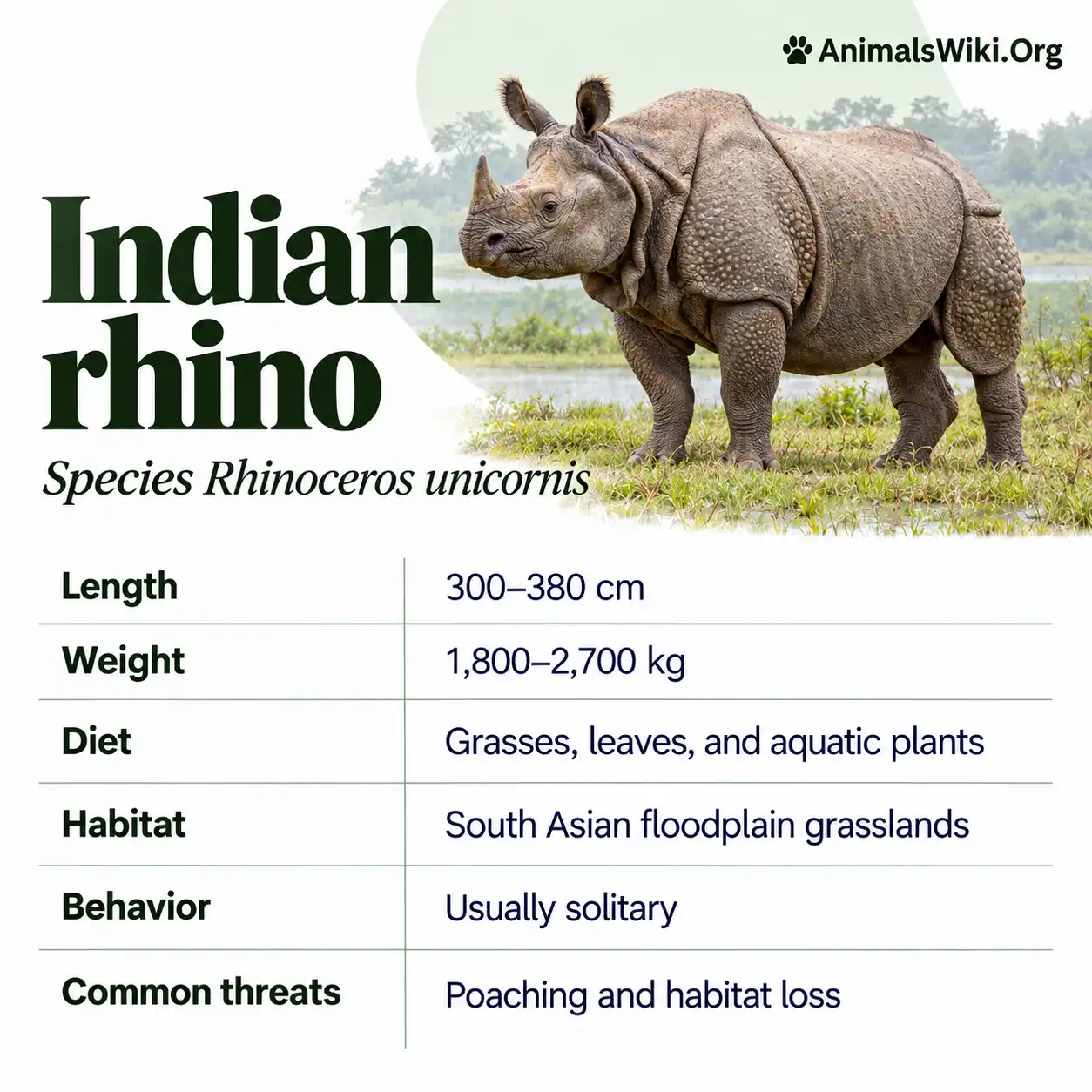
Indian Rhino, The Armored Giant of Asia’s Grasslands
The Indian rhino is one of Asia’s most impressive wild animals. With a single horn, enormous body and deeply folded skin, it looks almost as though it is wearing a suit of armor. Yet behind that powerful appearance is a plant-eating mammal whose daily life revolves around finding grass, cooling in water and navigating a changing floodplain landscape.
Also called the greater one-horned rhinoceros, the Indian rhino survives in the wild in India and Nepal. Its strongholds include grasslands, wetlands and river-associated habitats that provide food, water and shelter.
Its conservation story offers both encouragement and a continuing challenge. Protection helped the species recover from extremely low numbers, demonstrating what sustained wildlife management can achieve. However, recovery has left many rhinos concentrated in a limited number of places, where habitat degradation, poaching and extreme events remain concerns.
The latest consolidated estimate used in current conservation reporting is 4,075 wild greater one-horned rhinos, referring to the population reported for March 2025. The species is classified as Vulnerable on the IUCN Red List. These figures describe substantial progress, alongside a continuing need for protection.
Indian Rhino Facts
| Feature | Details |
|---|---|
| Common name | Indian rhino |
| Other common name | Greater one-horned rhinoceros |
| Scientific name | Rhinoceros unicornis |
| Animal group | Mammal |
| Order | Perissodactyla |
| Family | Rhinocerotidae |
| Native wild range today | India and Nepal |
| Main habitats | Floodplain grasslands, wetlands and adjacent woodland |
| Diet | Herbivorous, with grasses usually dominant |
| Typical adult weight | Approximately 1,800–2,700 kilograms, with substantial individual variation |
| Head-and-body length | Approximately 3–3.8 meters |
| Shoulder height | Approximately 1.75–2 meters |
| Number of horns | One |
| Typical horn length | Approximately 20–61 centimeters |
| Pregnancy | Approximately 15–16 months |
| Usual offspring | One calf |
| General social pattern | Mostly solitary, with important exceptions |
| Conservation status | Vulnerable |
1. What Is an Indian Rhino?
The Indian rhino is a large hoofed mammal native to the Indian subcontinent. Its best-known features are its single nasal horn and thick skin, which forms prominent folds around the shoulders, neck and hindquarters.
The name “Indian rhino” remains widely used, but “greater one-horned rhinoceros” more clearly accommodates its surviving populations in both India and Nepal.
It belongs to a small group of living rhinoceros species, each with its own appearance, distribution and conservation needs. The Indian rhino is particularly associated with productive grasslands and wetlands shaped by large rivers.
Understanding this habitat connection is essential. A rhino’s survival depends on more than the presence of open land. It needs suitable food plants, dependable water, resting places and access between these resources throughout the year.
Its impressive body is therefore part of a much larger ecological relationship with a dynamic landscape.
2. Scientific Classification and Evolutionary Relationships
The scientific name of the Indian rhinoceros is Rhinoceros unicornis.
Its classification is:
| Classification level | Name |
|---|---|
| Kingdom | Animalia |
| Phylum | Chordata |
| Class | Mammalia |
| Order | Perissodactyla |
| Family | Rhinocerotidae |
| Genus | Rhinoceros |
| Species | Rhinoceros unicornis |
The order Perissodactyla includes rhinoceroses, horses and tapirs. Members share an evolutionary history reflected in their anatomy, including the structure of their limbs.
Although a rhino’s heavy body may invite comparisons with a hippopotamus or elephant, those animals belong to different evolutionary lineages.
The species name unicornis refers to having one horn. In this context, the meaning describes a real anatomical feature rather than the mythical unicorn.
Scientific names are useful because common names vary across languages and regions. Whether a source says Indian rhinoceros or greater one-horned rhinoceros, Rhinoceros unicornis identifies the same species.
3. How Large Is the Indian Rhino?
The Indian rhino is the largest living Asian rhinoceros and ranks among the heaviest land mammals.
Adult males are generally larger than females. Representative adult weights fall around 1,800–2,700 kilograms, while particularly large individuals can exceed the upper end of a general profile.
A mature rhino’s size becomes especially apparent when it stands beside tall grass, a vehicle or another large herbivore. Its deep body, broad shoulders and massive head contribute to an appearance of exceptional strength.
However, measurements need context. A maximum recorded weight is different from an average, and a figure based mainly on large males does not describe every adult female.
For readers comparing species, the white rhinoceros generally ranks above the Indian rhino in overall size. The Indian species’ distinction is being Asia’s largest living rhino, rather than the largest of all rhinoceroses.
4. The Single Horn: Material, Shape and Growth
Both male and female Indian rhinos normally develop one horn on the nose.
The horn is made primarily of keratin, the structural protein also found in human nails and hair. It does not contain the bony core characteristic of a cow’s horn.
Its appearance varies between individuals. Length, wear and shape reflect growth and the ways the animal uses or rubs the horn during daily life.
A newborn does not arrive with a fully formed adult horn. Development occurs as the calf grows, gradually contributing to the familiar adult profile.
The horn is the feature that gives the species its common name, but it should not overshadow the rest of its anatomy. The lips, teeth, feet and digestive system are equally important to how the rhino lives.
A living rhino is far more biologically significant than the horn that has made it a target for illegal exploitation.
5. Why Its Skin Looks Like Armor
The Indian rhino’s armor-like appearance comes from deep skin folds rather than separate plates.
These folds are especially noticeable near the shoulders, neck and upper legs. Rounded bumps, called tubercles, add a textured surface that can resemble rivets.
The skin is generally gray or brownish gray, although mud, water and lighting can change its apparent color. Softer areas within the folds may look pinkish.
This combination produces one of the most recognizable outlines in the animal kingdom. Even without a clear view of the horn, the arrangement of folds can help identify the species.
However, thick skin is still living tissue. It requires care and protection from environmental stresses, and it can suffer injuries or disease.
The image of an armored animal is therefore a useful description of appearance, but the rhino remains a sensitive, living mammal beneath that striking exterior.
6. Hearing, Smell and Awareness of Its Surroundings
Indian rhinos gather information through several senses, with smell and hearing playing especially important roles.
Their ears can turn toward sounds, helping them investigate activity that may be hidden by tall vegetation. Smell provides information about food, other rhinos and unfamiliar disturbances.
Their eyesight is comparatively limited, but describing a rhino as blind would be inaccurate. Vision remains one part of a broader sensory system.
This matters when interpreting behavior. An animal that lifts its head, turns its ears or pauses on a trail may be assessing something an observer has barely noticed.
Dense grassland creates many situations in which seeing is difficult for both wildlife and people. Sound and scent can therefore provide information before direct visual contact occurs.
A rhino’s response should be understood within that setting, rather than assuming that a heavy animal is unaware of what is happening nearby.
7. Where Does the Indian Rhino Live?
Wild Indian rhinos survive in India and Nepal.
Within India, populations occur in protected landscapes in states including Assam, West Bengal and Uttar Pradesh. Nepal’s populations occupy parts of the lowland Terai.
This distribution is much smaller and more fragmented than the species’ historical range. Surviving populations are concentrated in suitable protected areas rather than spread continuously across the northern subcontinent.
A country-level range map can therefore conceal an important reality. Large spaces between rhino populations may contain farms, towns, roads or habitat that no longer supports the species.
For conservation, location matters at several scales. Countries coordinate policy, protected areas support local populations, and individual corridors or river margins influence daily movement.
Knowing that the species lives in India and Nepal is the starting point. Understanding where secure habitat exists within those countries provides a more meaningful picture.
8. The Floodplain Habitat of the Greater One-Horned Rhino
Indian rhinos are strongly associated with floodplain grasslands, wetlands and neighboring woodland.
A floodplain is shaped by the movement of water. Rivers rise, sediments shift, channels change and vegetation responds. These processes create a mixture of habitats rather than a uniform field of grass.
For a rhino, that mixture can provide feeding areas, wallows, shelter and travel routes within a relatively compact landscape.
Tall grass can offer concealment, while shorter growth may provide accessible grazing. Nearby wooded areas contribute shade and alternative feeding opportunities.
The important feature is the relationship between these habitat types. A grassland separated from water and shelter may function differently from one embedded in a healthy river system.
Protecting rhino habitat therefore requires attention to the processes that maintain it, including water movement and vegetation change, as well as the boundaries drawn around a reserve.
9. What Does the Indian Rhino Eat?
The Indian rhino is an herbivore, and grasses usually form the largest part of its diet.
It also eats other vegetation, including leaves, shoots, twigs, aquatic plants and some fruit. The balance changes with location and seasonal availability.
Research in Orang National Park in Assam found grasses dominating the annual diet while documenting additional woodland and aquatic foods.
This variety should not obscure the importance of grassland quality. A rhino may be capable of eating several kinds of plants while still depending heavily on productive grazing areas.
Plant identity matters too. A landscape covered in vegetation does not necessarily offer the same nutritional value as one containing appropriate food species.
Diet studies help conservationists distinguish between the mere presence of plant cover and habitat that can genuinely support feeding animals over the course of a year.
10. A Flexible Upper Lip and a Specialized Digestive System
The Indian rhino has a mobile, prehensile upper lip that helps it gather vegetation.
The lip can grasp stems and assist with feeding on taller plants. It can also be positioned to allow grazing on shorter grass.
After swallowing, the rhino relies on a digestive system suited to processing fibrous food. Like horses, rhinoceroses use hindgut fermentation, with microorganisms contributing to the breakdown of plant material.
Research on captive Indian rhinos has examined food intake, digestibility and the passage of material through the digestive tract. Such work helps improve diets under managed care.
The feeding process therefore combines several adaptations: lips collect the food, teeth process it mechanically, and the digestive tract extracts usable nutrients.
These structures explain how an animal with such a large body can obtain its energy from vegetation rather than from hunting other animals.
11. Seasonal Feeding and Changes in Movement
An Indian rhino’s food supply changes throughout the year.
Rainfall, flooding, plant growth and the drying of wetlands alter which foods are available and where they can be reached.
Long-term field research in Nepal documented seasonal variation in diet and movements between vegetation types. This shows why a single observation cannot fully represent the species’ feeding ecology.
An animal photographed grazing in one patch may use a different part of the landscape later in the season.
For habitat management, this means that protecting only the most visibly productive feeding area can leave gaps. Less frequently used places may become important when conditions change.
The same principle applies to surveys. A location with few rhinos during one visit may still provide a valuable seasonal resource.
A healthy landscape supports flexibility, allowing animals to respond to changing conditions without being forced into increasingly dangerous or unsuitable areas.
12. Why Indian Rhinos Spend Time in Water
Water plays a major role in the daily life of the Indian rhinoceros.
Rhinos enter pools and wallows to cool down and obtain relief from heat and biting insects. They may remain partly submerged for extended periods.
For a large animal, water offers more than a place to drink. It creates a different thermal environment and can make resting more comfortable during hot conditions.
The quality and location of wallows influence how useful they are. A suitable pool needs accessible approaches and enough space for an animal to enter, settle and leave.
Several rhinos may use the same wet area, sometimes creating temporary gatherings.
These places are therefore part of the species’ social and spatial environment as well as its physical comfort. Losing a wallow can affect how animals distribute their time and movement across the surrounding habitat.
13. Can Indian Rhinos Swim?
Yes. Indian rhinos are capable swimmers and are especially comfortable around aquatic habitats.
Their ability to move through water fits a lifestyle centered on rivers, wetlands and floodplains. They can also feed on some aquatic vegetation.
However, swimming ability does not remove every danger associated with water. A familiar pool, a flowing channel and a severe flood present very different conditions.
Water depth, current strength, access to banks and the availability of dry refuge all matter.
This distinction helps explain why a species well adapted to wet landscapes can still suffer during extreme floods. Adaptation supports ordinary life within an environment; it does not guarantee safety under every possible condition.
For conservationists, maintaining access between wetlands and higher ground is part of keeping a functioning landscape available to the animals that depend on it.
14. Daily Activity and Resting Behavior
Indian rhinos divide their time among feeding, resting, moving and using water.
They often feed during cooler periods, including early morning, evening and nighttime, while spending hotter hours resting or wallowing.
This pattern remains flexible. Weather, disturbance, food availability and local conditions influence the schedule of an individual animal.
A rhino resting in midday heat may become more active later, so a brief observation reveals only one part of its daily routine.
Activity also has practical implications for wildlife viewing and monitoring. Surveys that operate at different times may detect different levels of movement without any change in population size.
Understanding daily behavior helps observers read the landscape more carefully. A well-used trail, fresh feeding signs and a recently occupied wallow can indicate activity even when the rhino itself is hidden.
The animal’s routine is best understood over repeated observations rather than from a single sighting.
15. Are Indian Rhinos Solitary Animals?
Indian rhinos are generally solitary, but their social lives include several important exceptions.
Mothers remain with dependent calves. Adults meet during mating, and multiple animals may gather around productive feeding areas or wallows.
A temporary gathering is different from a stable herd. Animals using the same resource may later separate and continue their activities independently.
Their tolerance of one another also varies with circumstances. Food availability, reproductive condition and the identities of the animals involved can influence an encounter.
This makes “solitary” a useful summary rather than a complete description of every interaction.
For an observer, the key is to distinguish association from coincidence. Two rhinos close together may be a mother and calf, a mating pair or unrelated animals attracted to the same resource.
Careful interpretation avoids forcing the species into an overly simple social category.
16. How Indian Rhinos Communicate
Indian rhinos communicate through sounds, scent and physical displays.
Their vocal repertoire includes snorts, honks and other calls. The meaning of a sound depends on the surrounding behavior and the interaction taking place.
Scent provides another channel of information. Dung, urine and scent associated with trails can leave signals that persist after an animal has moved away.
This is especially useful for animals that do not spend all their time together. Information can remain available without requiring a direct encounter.
Body posture and movement also matter. An approach, retreat, head position or display of the lower teeth can influence how another rhino responds.
Communication helps animals negotiate a shared landscape. It may contribute to spacing, reproductive interactions and the assessment of potential competitors.
The apparent quietness of a grazing rhino therefore hides a much richer system of exchanges with its surroundings and other members of its species.
17. Home Ranges, Competition and Fighting
An Indian rhino’s home range includes the places it uses for feeding, resting, drinking and other routine activities.
Its size and shape vary according to the arrangement of resources. A diverse, productive area may allow an animal to meet its needs within a smaller space than a less favorable landscape.
Males can compete with one another, particularly in reproductive contexts. These encounters may involve displays, chases or physical fighting.
The lower incisors are especially important. Indian rhinos possess sharp, tusk-like lower teeth that can inflict serious injuries.
This is an important correction to the assumption that every rhino fight centers on the horn.
Competition also connects behavior with habitat management. When usable feeding space becomes limited, the distribution of animals and their opportunities to avoid one another can change.
Providing sufficient habitat supports more than nutrition; it also influences the social conditions in which rhinos live.
18. Reproduction and the Long Pregnancy
Indian rhinos reproduce slowly.
Pregnancy lasts approximately 15–16 months, and a female normally gives birth to one calf. Births are separated by years rather than by a few months.
The timing of reproduction varies among individuals and populations. A female’s condition, previous calf, food supply and other circumstances influence her reproductive history.
Males and females do not form a permanent pair to raise offspring together. Maternal care is the central relationship after birth.
The long reproductive cycle has major conservation consequences. A population cannot quickly replace several lost breeding adults, even when suitable habitat remains.
Recovery therefore depends on maintaining adult survival and allowing repeated successful births over many years.
Every calf represents a substantial investment of time and energy. Its survival contributes to population growth, but that contribution takes place within the slower rhythm characteristic of a very large mammal.
19. What Does a Baby Indian Rhino Look Like?
A baby Indian rhino is called a calf.
It is already substantial at birth, weighing tens of kilograms, but it remains small beside its mother. Its proportions are softer and less imposing than those of a mature adult.
The calf lacks an adult-sized horn, and its body changes considerably as it grows. Young skin within the folds can look especially pink compared with the darker outer surface.
Zoo birth reports provide close observations of these early features, including calves following their mothers and beginning to explore shared spaces.
A calf must soon coordinate walking, nursing and keeping close to its mother. These early abilities matter because remaining mobile allows the pair to move between feeding, resting and wet areas.
The appealing appearance of a young rhino is therefore connected with a demanding period of rapid physical and behavioral development.
20. Maternal Care and Growing Independence
The mother–calf relationship is the most enduring social bond in Indian rhino life.
A calf relies on milk early in development and gradually incorporates vegetation into its diet. Beginning to sample grass does not mean it has become independent.
The young animal also gains experience moving through the landscape. Following its mother brings it into contact with feeding areas, water, trails and resting places.
Association can continue for several years, although nursing, dependence and eventual separation are different stages.
Reports of young rhinos entering larger zoo habitats show how closely calves attend to their mothers during unfamiliar experiences. Field conditions add further challenges, including predators, floods and encounters with other rhinos.
Successful maternal care therefore combines nutrition, protection and access to a usable environment.
For population recovery, producing a calf is only the first step. The young animal must survive, grow and eventually reach reproductive age.
21. Lifespan and Natural Threats
Indian rhinos can live for several decades. Lifespans around 30–40 years are commonly reported, with some individuals living longer under human care.
Longevity figures require interpretation. A maximum lifespan is different from the age reached by most animals, and managed-care records provide a different picture from observations in the wild.
Healthy adults face relatively limited natural predation because of their size and strength. Calves are more vulnerable, and tigers can prey on young rhinos.
Other natural sources of mortality include injury and conflict between rhinos. Severe environmental events can also affect survival.
The presence of natural mortality does not mean a population is unhealthy. Death is part of any ecosystem.
Conservation becomes particularly challenging when additional losses from poaching, habitat degradation or human conflict occur faster than the species’ slow reproductive cycle can compensate for them.
22. The Indian Rhino’s Ecological Role
As a very large herbivore, the Indian rhino influences the places where it feeds and moves.
Repeated grazing removes plant material, while dung returns nutrients to the environment. Its movements connect feeding sites, wetlands and other parts of the landscape.
The species can also transport seeds after eating fruit. A classic study in lowland Nepal examined the dispersal of Trewia nudiflora by rhinoceroses and demonstrated a relationship between fruit consumption, dung deposition and plant recruitment.
This illustrates why a predominantly grazing animal can still play a role in the life cycle of trees.
Its ecological importance comes from the combined effects of many ordinary activities rather than from one dramatic behavior.
A landscape with rhinos contains interactions among plants, soil, water and other organisms that may change if the animals disappear or become too few to maintain those relationships.
23. Why Floods Are Both Necessary and Dangerous
Flooding is a natural force in many Indian rhino habitats.
Annual floods help sustain floodplain ecosystems by moving nutrients, altering vegetation and maintaining the conditions on which their productivity depends.
At the same time, high water can create immediate danger. Animals may need to leave submerged areas, reach higher ground or cross unfamiliar routes.
The International Rhino Foundation emphasizes this dual role in Kaziranga: flooding helps maintain the ecosystem, while safe movement during high floods can reduce wildlife losses.
This means effective conservation cannot simply aim to eliminate every flood.
The more useful goal is a functioning landscape where natural processes continue and animals retain access to refuge.
Higher ground, connecting routes and land outside the most frequently flooded areas can become crucial during an emergency. Protecting these connections is part of conserving the floodplain itself.
24. How Many Indian Rhinos Are Left?
The latest consolidated estimate cited in current international conservation reporting is 4,075 wild Indian rhinos.
IUCN’s August 2025 reporting identifies this as the number reached by the end of March 2025. The International Rhino Foundation’s 2026 State of the Rhino page continues to use that estimate.
The date matters. A report published in 2026 can use population information collected or consolidated earlier.
It would therefore be misleading to describe the figure as a complete count conducted on the day this article was checked.
Population estimates also combine information from multiple sites, whose surveys may differ in timing.
The clearest interpretation is that 4,075 represents the latest consolidated figure verified for this article. It demonstrates a major long-term recovery while remaining a dated estimate that should be revised when newer authoritative information becomes available.
25. Is the Indian Rhino Endangered?
In everyday speech, “endangered” sometimes means any animal facing serious conservation concern. The IUCN Red List uses the word more precisely.
The Indian rhino is currently classified as Vulnerable, rather than in the separate Endangered category.
Vulnerable still falls within the Red List’s threatened categories. It does not mean the species is secure or can survive without continued conservation.
The distinction matters because accurate status reporting helps readers understand both progress and remaining risk.
The Indian rhino’s recovery is real, but its concentration in a limited number of populations creates exposure to habitat problems, security failures and extreme events.
A species can increase numerically while still needing intensive protection.
The most accurate description is therefore a recovering threatened species whose current category is Vulnerable and whose future depends on maintaining the conditions that enabled its improvement.
26. Historical Decline and the Recovery Story
Indian rhinos once occupied a much wider area across the northern Indian subcontinent.
Hunting and the conversion of habitat greatly reduced both their numbers and their distribution. By the beginning of the twentieth century, the species had reached an exceptionally low point.
Stronger protection in India and Nepal helped reverse that decline.
The recovery required more than simply declaring that rhinos should be protected. It depended on people maintaining security, preserving habitat, monitoring populations and responding to changing threats over many years.
Different conservation sources provide slightly different historical minimum estimates, reflecting the difficulty of reconstructing past abundance.
The overall story is clear: the species rose from a small remnant population to several thousand animals.
That success is valuable evidence that conservation can work, while also showing how much sustained effort may be needed after a species has been pushed close to extinction.
27. Poaching and Illegal Horn Trade
Poaching remains a conservation concern because Indian rhino horn is targeted for illegal trade.
For the animal, the consequences are immediate and often fatal. For a population, the loss can extend beyond the individual, especially when a breeding female dies or a dependent calf is left without maternal care.
Protection requires several connected activities: field patrols, information gathering, investigation and efforts to disrupt trafficking.
Preventing a killing is different from responding after one has occurred, so both deterrence and law enforcement matter.
Rhino recovery can also create a dangerous misconception that the problem has been solved. A larger population still needs effective security, particularly when many animals occupy a few well-known sites.
Long-term protection therefore depends on maintaining capacity during periods of success as well as during crises.
Progress is strongest when lower losses become a lasting condition rather than a temporary achievement.
28. Habitat Loss and the Need for More Space
Floodplain land can be highly productive for both wildlife and agriculture.
That creates pressure where settlements, cultivation, infrastructure and rhino habitat meet.
Habitat loss removes feeding and resting areas, while fragmentation limits movement between the pieces that remain.
As a rhino population grows, space can become a more visible conservation issue. Successful protection may increase animal numbers without automatically increasing the amount of usable habitat.
Conservation organizations therefore identify habitat expansion and the establishment of additional secure populations as important priorities.
This does not mean every open area is suitable for rhinos. A potential site needs appropriate food, water, security and a realistic plan for long-term management.
Providing more space is a practical process of making an entire habitat function, rather than simply increasing the area shown on a map.
The quality of that space matters as much as its extent.
29. Invasive Plants and Grassland Degradation
A protected area can retain its boundary while losing some of its value for rhinos.
Invasive plants may spread through grasslands, replacing or suppressing vegetation that animals use for food.
In Manas National Park, conservation projects have addressed plants including Siam weed, Chromolaena odorata, and bitter vine, Mikania micrantha.
Their spread illustrates why wildlife conservation includes active habitat management. Security alone cannot maintain a population if its feeding environment steadily deteriorates.
Restoration requires identifying the plants involved, choosing appropriate control methods and checking what grows afterward.
Removing an invasive plant once may not be enough. Follow-up helps determine whether native vegetation is recovering or whether the same pressure is returning.
The aim is a lasting improvement in usable habitat, with food availability and ecological function guiding the work rather than appearance alone.
30. Rhinos and People Living Near Their Habitat
Communities near rhino habitat can experience both opportunities and costs.
Tourism and conservation work may provide income, while crop damage, restricted access or dangerous encounters can create serious difficulties.
These experiences vary among places and households, so broad statements about universal benefits or universal conflict are rarely adequate.
Effective coexistence begins with understanding local conditions. Where do rhinos leave protected areas? What attracts them? Which routes do they use, and who bears the consequences?
Community involvement also contributes to conservation itself. Residents can help identify changes in animal movements, participate in restoration and support protection efforts.
WWF Nepal describes community-based anti-poaching work as part of the country’s broader conservation approach.
The relationship is strongest when local participation has practical meaning and conservation decisions take people’s livelihoods seriously alongside the needs of wildlife.
31. Important Indian Rhino Strongholds
Several protected landscapes play major roles in the species’ survival.
| Location | Country | Conservation significance |
|---|---|---|
| Kaziranga National Park | India | Holds the largest population of the species |
| Chitwan National Park | Nepal | A major stronghold in the Terai |
| Orang National Park | India | Supports an important Assam population |
| Pobitora Wildlife Sanctuary | India | An established rhino site in Assam |
| Manas National Park | India | Important for restoration and population rebuilding |
| Jaldapara National Park | India | A significant stronghold in West Bengal |
| Dudhwa National Park | India | Important within the species’ restored distribution |
Kaziranga and Chitwan also have World Heritage recognition.
Their importance extends beyond the animals inside them. Habitat around protected areas influences movement, water systems and the pressures experienced at their edges.
A successful park therefore forms part of a wider landscape rather than functioning as a completely independent island.
32. Translocation and Restoring Populations
Translocation involves moving animals under carefully planned conservation management.
For Indian rhinos, it can help rebuild populations in suitable former habitat and reduce reliance on a small number of strongholds.
The process requires veterinary expertise, transport planning, release preparation and monitoring afterward.
A release site must already have adequate habitat and protection. Moving an animal into an insecure or poorly managed place does not solve the original conservation problem.
Manas provides an important example of coordinated rhino translocation in Assam. Conservation partners have described moving animals from other protected areas as part of efforts to restore its population.
Success should be assessed over time. Survival after release is essential, but breeding, calf survival and the stability of the population provide a fuller measure.
A translocated rhino’s arrival begins a new stage of conservation work rather than completing it.
33. Research, Monitoring and Veterinary Science
Indian rhino conservation depends on knowing what is happening to populations and why.
Population surveys estimate abundance, while repeated observations help identify births, deaths and changes in distribution.
Diet studies examine whether habitat provides the foods animals need. Research on dung can reveal feeding information and relationships with other organisms.
Veterinary science contributes through health assessment, reproductive research and care during translocation or rescue.
Managed-care studies also provide opportunities to investigate questions that are difficult to examine closely in wild animals. Research involving assisted reproduction, for example, has expanded knowledge of Indian rhino breeding.
No single method provides the whole picture.
The most useful monitoring links evidence with decisions: whether habitat needs restoration, whether a site can support more animals or whether unusual mortality requires investigation.
Research becomes most valuable when its findings improve the conditions under which rhinos survive and reproduce.
34. Indian Rhino Compared With Other Rhino Species
Five rhinoceros species survive today.
| Species | General native region | Horns | Useful identifying feature |
|---|---|---|---|
| Indian or greater one-horned rhino | South Asia | One | Large body and deep skin folds |
| Javan rhino | Southeast Asia | Usually one; females may lack a conspicuous horn | Smaller body with folded skin |
| Sumatran rhino | Southeast Asia | Two | Smaller size and noticeable hair |
| White rhino | Africa | Two | Broad mouth adapted to grazing |
| Black rhino | Africa | Two | Pointed, prehensile upper lip |
Horn number alone does not distinguish the Indian rhino from the Javan rhino.
Body size, skin characteristics and geographic location provide additional clues.
The species also differ in conservation circumstances. An encouraging trend in one rhino species should not be applied to all the others.
Recognizing those differences helps readers understand why conservation strategies need to address the biology and situation of each species individually.
35. Common Misconceptions About the Indian Rhino
Several popular ideas can obscure the animal’s actual biology.
Its skin looks armored, but it consists of living tissue rather than separate protective plates.
Its horn is made of keratin and should not be confused with ivory or a bony antler.
Its large body does not make it slow in every situation, and a resting animal can respond quickly when disturbed.
Its mostly solitary lifestyle still includes communication, maternal bonds and temporary gatherings.
Finally, its population recovery does not mean conservation is finished. More animals can create new management needs, including maintaining sufficient habitat and spreading risk among secure populations.
The most useful understanding combines the impressive features with the practical ones: what the animal eats, how it raises young and what it needs from the landscape.
These everyday requirements explain its survival more clearly than the image of an almost invulnerable armored giant.
36. The Future of Indian Rhino Conservation
The next stage of Indian rhino conservation builds on a genuine recovery.
The IUCN SSC Asian Rhino Specialist Group identifies priorities including strengthening existing strongholds, extending the species into additional secure sites and considering the effects of changing flood regimes.
These goals respond to a central challenge: increasing numbers must be supported by healthy, secure and sufficiently connected habitat.
Future success will require several efforts to continue together. Protection keeps animals alive, habitat management sustains their food supply, and carefully planned population expansion reduces dependence on a few locations.
Community participation and reliable monitoring help make those actions workable over the long term.
The Indian rhino demonstrates what sustained commitment can achieve. Its future depends on keeping that commitment active as the species moves from surviving a historical crisis toward a more resilient distribution.
Recovery is an ongoing biological process, supported by decisions made year after year.
Frequently Asked Questions About the Indian Rhino
1. What is an Indian rhino?
The Indian rhino is a large herbivorous mammal also called the greater one-horned rhinoceros. Its scientific name is Rhinoceros unicornis. It is recognizable by its single horn, massive body and deeply folded skin, and it survives in the wild in India and Nepal.
2. Why is it called the greater one-horned rhinoceros?
The name refers to its single nasal horn and helps distinguish it from other rhinoceros species. “Indian rhino” and “greater one-horned rhinoceros” describe the same species. The latter name also avoids suggesting that its surviving wild range is limited to India.
3. Is the Indian rhino found in Nepal?
Yes. Nepal supports important wild populations, particularly in lowland Terai landscapes. Chitwan National Park is one of the species’ major strongholds. Nepal’s protection and management efforts have contributed substantially to the wider recovery of the greater one-horned rhinoceros.
4. What does the Indian rhino eat?
Its diet is dominated by grasses, but it also consumes other vegetation, including leaves, shoots, aquatic plants and some fruit. The exact mixture depends on the habitat and season. Different populations therefore do not necessarily eat the same plants in the same proportions.
5. Is the Indian rhino a carnivore?
No. It is an herbivore whose normal diet consists of plant material. Its feeding structures and digestive system support the collection and processing of vegetation. Aggressive behavior toward another animal does not make it a predator or change its dietary classification.
6. How much does an Indian rhino weigh?
Representative adult weights are approximately 1,800–2,700 kilograms, with substantial variation. Males are generally larger than females. Age, condition and the distinction between average and exceptionally large animals should be considered when comparing weight figures from different sources.
7. Is it the world’s largest rhinoceros?
The Indian rhino is the largest living Asian rhinoceros. The white rhinoceros generally ranks above it among all living rhino species. Statements that call the Indian species the largest rhino without specifying Asia can therefore give readers a misleading impression.
8. Do female Indian rhinos have horns?
Yes. Both males and females normally develop a single horn. The horn varies in size and appearance between individuals. A newborn does not have the prominent horn seen on a mature animal; it develops as the calf grows.
9. What is Indian rhino horn made of?
The horn is made primarily of keratin, the structural protein found in human nails and hair. It is different from ivory and does not have the bony core seen in cattle horns. Its material is a biological feature, not evidence of extraordinary properties.
10. Can Indian rhinos swim?
Yes. They are capable swimmers and regularly use water. However, swimming ability does not protect them from every flood hazard. Strong currents, extensive inundation and the loss of access to higher ground can still create dangerous conditions.
11. Why do Indian rhinos wallow in mud?
Wallowing helps them cope with heat and provides relief from biting insects. Wet areas are important resting places within their habitat. A wallow can also attract more than one animal, creating temporary gatherings among rhinos that are otherwise largely solitary.
12. Do Indian rhinos live in herds?
They do not generally form permanent herds. Mothers remain with calves, adults meet for mating, and several animals may use the same feeding area or wallow. These temporary associations are different from the stable group structure seen in many herd-forming mammals.
13. How long is an Indian rhino pregnant?
Pregnancy lasts approximately 15–16 months. A female normally gives birth to one calf. The long pregnancy and years between successive births help explain why populations recover slowly and why the survival of breeding adults is especially important.
14. What is a baby Indian rhino called?
A baby is called a calf. It weighs tens of kilograms at birth but remains highly dependent on its mother. As it grows, it develops the body proportions, skin characteristics and horn that make mature Indian rhinos so recognizable.
15. How long does a calf stay with its mother?
The mother–calf association can last several years. Nursing, eating vegetation and eventual independence occur at different stages. A calf may begin sampling plants while still relying on milk, protection and the practical benefits of remaining near its mother.
16. Do Indian rhinos have predators?
Healthy adults face limited natural predation because of their great size. Calves are more vulnerable, and tigers can prey on young rhinos. Predation should be considered alongside other natural risks, such as injury, and the additional pressures caused by human activities.
17. How many Indian rhinos remain in the wild?
The latest consolidated estimate verified for this article is 4,075, referring to reporting for March 2025 and still cited in 2026 conservation summaries. It is a dated population estimate rather than a complete real-time count of every animal alive today.
18. Is the Indian rhino endangered or Vulnerable?
Its current IUCN Red List classification is Vulnerable. This is a threatened category, although it is distinct from the category formally named Endangered. The species has recovered considerably but continues to require protection, habitat management and monitoring.
19. Where is the largest Indian rhino population?
Kaziranga National Park in Assam, India, supports the largest population of greater one-horned rhinos. Its conservation history is internationally recognized. The park’s importance also makes the protection of its habitat and surrounding landscape particularly significant for the species.
20. Is the Indian rhino the same as the Javan rhino?
No. The Indian rhino is Rhinoceros unicornis, while the Javan rhino is Rhinoceros sondaicus. Both belong to the same genus, but they are separate species with different sizes, distributions and conservation circumstances. Having one horn does not make them identical.
21. Are Indian rhinos dangerous to people?
A rhino is a powerful wild animal and can injure someone at close range, particularly if disturbed or crowded. Wildlife viewing should follow local rules and maintain space. A calm appearance is not a reason to approach, block a route or separate a mother from her calf.
22. What are the biggest threats to Indian rhinos?
Major concerns include poaching, habitat loss, invasive plants and the concentration of populations in a limited number of sites. Extreme floods and conflict near habitat boundaries can add local pressures. The importance of each threat differs between protected areas and surrounding landscapes.
23. Why are rhinos moved between protected areas?
Carefully planned translocations can restore populations in suitable former habitat and reduce dependence on a few strongholds. They require security, veterinary care and long-term monitoring. Moving animals is useful only when the destination can support them safely after release.
24. How can Indian rhino conservation improve?
Continued protection should be combined with healthy grasslands, reliable water, safe movement routes and additional secure populations. Local participation and scientific monitoring help identify practical priorities. Conservation is strongest when it supports both individual survival and the habitat needed for successful reproduction.
A Remarkable Recovery Worth Protecting
The Indian rhino is an extraordinary mammal whose most impressive story extends beyond its horn and armored appearance.
Its recovery demonstrates that protection can reverse a severe decline. At the same time, its biology explains why that progress needs continued care: long pregnancies, dependent calves and specialized habitat requirements leave little room for complacency.
A healthy future requires more than a rising total. It requires secure populations in functioning landscapes, with sufficient food, dependable water and access to refuge when conditions change.
Protecting the Indian rhino also helps sustain the grasslands, wetlands and river systems with which its life is closely connected. The enduring achievement will be a species that continues to feed, reproduce and move safely through those landscapes for generations.



