
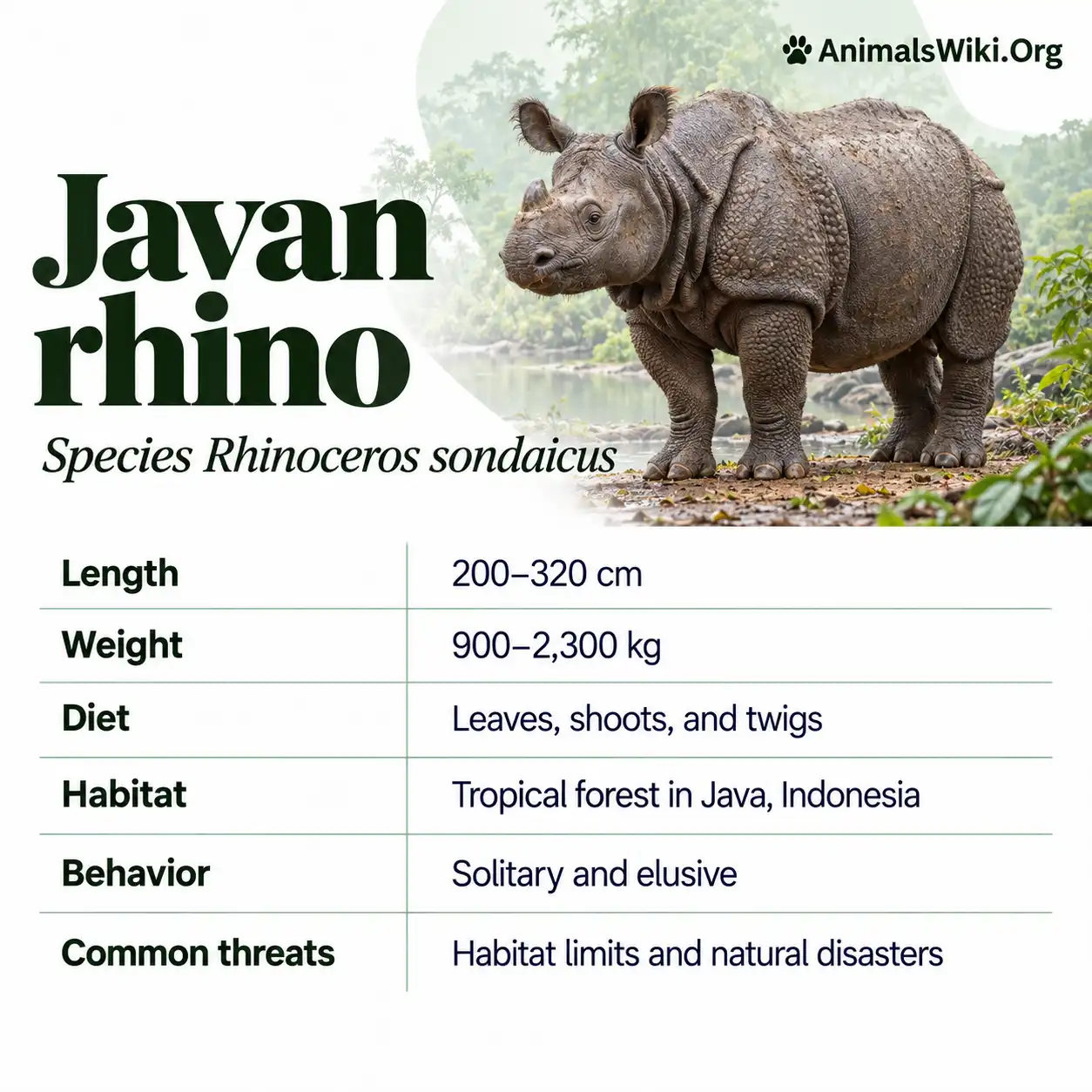
Javan Rhino, The Rare Forest Giant Fighting for Survival
The Javan rhino is a large, secretive mammal that lives in the tropical forests of western Java, Indonesia. Its folded skin, powerful body and small horn give it a striking appearance, yet few people ever see one in the wild. Much of what scientists know about this animal comes from camera traps, footprints, dung and signs left on vegetation.
Also called the lesser one-horned rhinoceros, the Javan rhino is among the rarest large mammals on Earth. Its entire surviving population occupies Ujung Kulon National Park. There is no separate wild population elsewhere and no established zoo breeding population to provide a reserve.
That concentration makes its future unusually fragile. Poaching, disease or a major natural disaster could affect a substantial part of the species within a short period.
Current conservation sources place its population at around 50 or fewer animals. The IUCN SSC Asian Rhino Specialist Group lists an estimate of fewer than 50, dated February 2026, while the International Rhino Foundation describes approximately 50 survivors. These are estimates, rather than an exact real-time count.
Understanding the Javan rhino means looking beyond its rarity. Its feeding habits, wallows, reproductive biology and relationship with forest vegetation explain what the species needs to survive—and why protecting its last habitat requires sustained, practical work.
Javan Rhino Facts
| Feature | Details |
|---|---|
| Common name | Javan rhino |
| Other common name | Lesser one-horned rhinoceros |
| Scientific name | Rhinoceros sondaicus |
| Animal group | Mammal |
| Order | Perissodactyla |
| Family | Rhinocerotidae |
| Current wild range | Ujung Kulon National Park, Java, Indonesia |
| Main habitat | Lowland tropical forest with water, wallows and accessible vegetation |
| Diet | Herbivorous; mainly leaves, shoots, twigs and other browse |
| Reported adult weight range | Approximately 900–2,300 kilograms |
| Shoulder height | Approximately 1.4–1.7 meters |
| Horn | Usually short in males; often absent or reduced to a small knob in females |
| Social behavior | Generally solitary, except mothers with calves and temporary associations |
| Pregnancy | Thought to last approximately 15–16 months; direct evidence is limited |
| Usual offspring | One calf |
| Conservation status | Critically Endangered |
| Population | Around 50 or fewer, depending on the dated estimate used |
1. What Is a Javan Rhino?
The Javan rhino is a hoofed, plant-eating mammal native to Asia. It belongs to the rhinoceros family and shares the heavy body, strong limbs and distinctive head shape associated with other rhinos.
Its common name can create a misleading impression that it has always been restricted to Java. Historically, the species occupied a much wider area across parts of South and Southeast Asia.
Today, however, Java holds the entire surviving population.
The animal’s rarity also shapes how people understand it. Photographs and camera-trap videos provide brief windows into a life largely concealed by forest vegetation. A short clip may show feeding, walking or wallowing, while leaving many hours of activity unseen.
This makes the Javan rhino both recognizable and poorly understood. Scientists can identify its main ecological needs, but several details of its life history remain less certain than those of more frequently observed mammals.
2. Scientific Classification and Closest Relatives
The scientific name of the Javan rhinoceros is Rhinoceros sondaicus.
Its classification is:
| Classification level | Name |
|---|---|
| Kingdom | Animalia |
| Phylum | Chordata |
| Class | Mammalia |
| Order | Perissodactyla |
| Family | Rhinocerotidae |
| Genus | Rhinoceros |
| Species | Rhinoceros sondaicus |
The Mammal Diversity Database recognizes it as a distinct species within the genus Rhinoceros. The Indian rhino, Rhinoceros unicornis, belongs to the same genus.
Rhinoceroses are members of Perissodactyla, the mammalian order that also includes horses and tapirs. Their evolutionary relationships are reflected in anatomy and genetic evidence, even though their bodies look very different.
Scientific names are especially useful when reading historical accounts. Common names such as Javan rhino, lesser one-horned rhino and Indian rhino can be confused, particularly in older literature.
Using Rhinoceros sondaicus identifies the species clearly and separates it from the other living rhinoceroses.
3. What Does the Javan Rhino Look Like?
The Javan rhino has gray or gray-brown skin, a large body, short sturdy legs and a relatively small head compared with its Indian relative.
Folds cross parts of the body, creating an appearance often described as armor-like. The skin also has a patterned surface, with fine creases dividing it into smaller sections.
Its appearance changes with conditions. A wet rhino may look darker than a dry one, while a coating of mud can obscure the underlying skin color.
The upper lip is elongated and mobile, making it one of the most useful features to notice when the animal feeds.
Compared with the greater one-horned rhinoceros, its skin folds are generally less massive and its head is smaller. These differences matter because both species can otherwise appear similar in a quick photograph.
A reliable identification combines several features with geographic information. A wild rhino recorded in Ujung Kulon belongs to a very different conservation setting from one photographed in India or Nepal.
4. Size, Weight and the Limits of Measurement
Javan rhinos are smaller than Indian rhinos, but they remain enormous animals.
Reference profiles commonly give an adult weight range of approximately 900–2,300 kilograms and a shoulder height around 1.4–1.7 meters. Such broad figures reflect variation as well as limited measurement opportunities.
It is difficult to obtain a precise average when most animals live freely in dense forest and routine weighing is impossible.
Historical measurements can introduce further uncertainty. Records may come from different regions, ages or methods, and some older descriptions involved confusion between Asian rhino species.
The practical point is that a Javan rhino requires substantial resources. A body weighing well over a tonne needs a dependable supply of vegetation and access to water.
Large size can protect an adult from many natural threats, but it does not solve problems caused by habitat deterioration or illegal hunting.
Its survival depends on the quality of the landscape supporting that body.
5. The Javan Rhino’s Horn
Male Javan rhinos normally have one short horn on the nose. Many females have no obvious horn, while others possess a small knob or reduced projection.
This difference is one of the species’ most distinctive features.
The horn is made of keratin, the structural material also found in nails and hair. It differs from ivory and from the bony antlers of deer.
Its shape varies with growth and wear. A short horn can still be useful during activities involving vegetation or mud, even though it lacks the dramatic length seen in some other rhinoceroses.
The horn should also be understood as one part of a much more complex animal. Lips collect vegetation, teeth process food and strong limbs carry the body through forest terrain.
Unfortunately, demand for horn has placed disproportionate pressure on the species. A feature that occupies a small part of its anatomy has become central to the human threat against it.
6. Skin, Teeth and Sensory Adaptations
The Javan rhino’s skin is living tissue shaped into folds, rather than a set of separate plates. Its striking surface does not make the animal invulnerable to injuries, parasites or environmental stress.
Its mouth contains another important adaptation: sharp lower incisors that can play a role in confrontations. Chewing teeth process the woody material included in its diet.
Smell and hearing help it gather information in vegetation where visibility is restricted. Its eyesight is comparatively limited, but the animal should not be described as blind.
These features work together. A rhino can investigate a sound, follow scent information and use its mobile lip to examine or collect food.
The forest is therefore more than a visual environment. Chemical signals, sounds, textures and familiar routes all contribute to how an animal moves through it.
Understanding those abilities helps replace the image of a clumsy giant with that of a mammal adapted to navigating dense habitat.
7. Where Does the Javan Rhino Live Today?
All surviving Javan rhinos live in Ujung Kulon National Park, at the western end of Java in Indonesia.
This is the species’ only known remaining wild population.
The park protects an exceptionally important area of lowland rainforest. UNESCO identifies it as containing the most extensive remaining stand of this habitat on Java, where lowland forests have largely disappeared elsewhere.
However, the protected area and the rhino population should not be imagined as interchangeable. Not every part of a park necessarily provides equally suitable feeding habitat or receives equal use by animals.
Water, vegetation, terrain and disturbance affect where rhinos spend their time.
For conservation, the park is both a refuge and a concentration of risk. Protecting it is indispensable because it holds every surviving individual. At the same time, the absence of a separate population means the species has little protection against a threat affecting the entire site.
8. Historical Range: Beyond the Island of Java
The Javan rhino once occupied parts of mainland and island Asia.
Historical accounts and specimens document a distribution extending through portions of South and Southeast Asia, including areas now within India, Bangladesh, Myanmar and several countries farther east and south.
Its former island distribution included Java and Sumatra.
This wider history matters because the habitat of the last survivors may represent only a portion of the environments the species could use.
A population pushed into a final refuge does not necessarily reveal its full ecological range.
Research published in 2026 used historical occurrence records to investigate suitable landscapes for Javan and Sumatran rhinos. This approach can help conservationists look beyond the conditions found in present-day remnants.
Historical information cannot identify a release site by itself. Modern security, land use and local conditions still require investigation. Nevertheless, it can broaden the questions asked when planning the species’ future.
9. The Loss of the Javan Rhino in Vietnam
Vietnam once supported the last Javan rhinos surviving on the Asian mainland.
That population disappeared after its final known animal was killed in 2010. The extinction was confirmed publicly in 2011 following investigation and analysis.
WWF and the International Rhino Foundation reported that genetic testing of dung samples collected during surveys identified a single individual—the same rhino later found dead.
The dates describe different stages of the event: the animal died in 2010, while confirmation of the population’s extinction followed in 2011.
This loss demonstrates why finding signs of a rare animal does not necessarily mean a secure breeding population remains.
Several dung samples or repeated observations can come from one individual.
Vietnam’s experience also shows the importance of effective protection before a population becomes extremely small. Once only one animal remained, habitat protection alone could no longer restore a self-sustaining population without intervention involving other individuals.
10. What Kind of Habitat Does It Need?
Javan rhinos use tropical forest environments containing accessible food, water and suitable places to wallow.
Their habitat can include dense vegetation, shrub-rich areas, wet ground and forest openings.
A closed canopy is not the only feature that matters. Young leaves and shoots must be available at a height and density the animal can use.
Research in Ujung Kulon has examined how rhino distribution relates to terrain, rivers, wallows and vegetation structure. One study identified substantial use of swampy shrub and relatively open habitat, among other characteristics.
Such findings show that habitat suitability is a combination of features.
A place can look lush while providing limited browse. Another may contain good food plants but lack dependable water or suitable mud.
For management, the useful question is whether an area allows rhinos to complete their normal activities throughout the year, rather than whether it simply appears green on a satellite image.
11. What Does the Javan Rhino Eat?
The Javan rhino is an herbivore and primarily a browser.
Browsing involves feeding on leaves, shoots, twigs, saplings and other vegetation above ground level. Fallen fruit and additional plant foods may contribute to its diet.
This differs from describing it as a specialist grass eater. Although grasses can appear in dietary accounts, leafy and woody browse is central to its feeding ecology.
Its menu includes many plant species, and the exact mixture depends on what is available.
A rhino’s food choices also reflect accessibility. A nutritious plant may contribute little if it is difficult to reach or uncommon within the animal’s usual movements.
Researchers studying food quality in Ujung Kulon have examined both what rhinos consume and the nutritional value of those plants.
That distinction matters: a list of food species explains what can be eaten, while nutritional analysis helps assess whether the habitat meets the animal’s requirements.
12. How It Collects and Digests Vegetation
The Javan rhino’s elongated upper lip is prehensile, meaning it can grasp and manipulate vegetation.
This allows the animal to pull leaves and stems toward its mouth. Its head and body provide strength, while the lip adds precision.
After food is chewed and swallowed, microorganisms help break down fibrous plant material within the hindgut.
Like other rhinoceroses, the species is a hindgut fermenter, relying particularly on the enlarged cecum and colon for microbial processing.
Eating leaves and twigs therefore involves more than simply taking large mouthfuls. The animal must collect suitable material, process it mechanically and extract usable nutrients from it.
These feeding adaptations also explain why a forest full of plants is not automatically sufficient. The plants must be appropriate in quality, accessible in form and available in enough quantity.
The digestive system can use fibrous foods, but it cannot compensate for every nutritional deficiency in the habitat.
13. Food Quality, Seasons and Carrying Capacity
The amount of habitat available to a rhino is different from the amount of habitat capable of supporting it well.
Food plants vary in nutritional composition, and their growth changes over time. A plant that is abundant may not supply the same nutrients as another that is less common.
A study of three male Javan rhinos found variation in food quality, intake and digestibility between animals and over time. The researchers suggested that nutritional limitations deserved attention in habitat management.
The small sample means the findings should not be turned into a diagnosis of every individual. They nevertheless illustrate why detailed feeding research is useful.
Carrying capacity describes how many animals an environment can support under particular conditions.
For Javan rhinos, that capacity depends on more than total forest area. Food quality, water, wallows, disturbance and the arrangement of resources all influence how much of the landscape functions as usable habitat.
14. Why Water and Mud Wallows Matter
Wallowing is a central part of Javan rhino behavior.
Mud and water help with temperature regulation and skin protection. They can also provide relief from biting insects and external parasites.
A wallow is more than a random puddle. Its location, shade, soil and water availability affect how useful it becomes.
Research examining 35 wallows and hundreds of camera-trap videos found that these sites also supported interactions and communication.
That discovery expands their conservation importance. A wallow can meet physical needs while serving as a place where animals encounter information about others.
Protecting one therefore involves maintaining the surrounding conditions that allow it to function.
If a potential conservation site contains food plants but lacks suitable ground for wallowing, it may be missing a crucial requirement.
The animal’s daily comfort, skin condition and social environment can all depend partly on a resource that might otherwise be dismissed as a muddy depression.
15. Daily Activity and Movement Through the Forest
A Javan rhino divides its time among feeding, walking, resting, drinking and wallowing.
These activities do not fit one rigid schedule for every individual.
Camera-based studies have recorded wallowing during both daytime and nighttime. Weather, local conditions and the availability of resources can influence when an animal moves.
This flexibility is important when interpreting a short video. A rhino filmed in daylight is not necessarily behaving unusually, and a camera that records mostly night visits may be positioned along a route used at particular times.
Different locations reveal different parts of an animal’s routine.
A wallow camera is especially likely to record wallowing-related behavior. A trail camera provides another view, while feeding signs reveal activity that may happen outside the frame.
Combining these sources produces a more complete picture than assuming that one visible behavior dominates the animal’s entire day.
16. Solitary Behavior and Communication
Javan rhinos are generally solitary.
The clearest lasting association is between a mother and her dependent calf. Adults also meet during reproductive interactions or when using shared resources.
Solitary animals still communicate. They can exchange information through scent, sounds and direct behavior without living in permanent groups.
For an elusive species, these interactions are difficult to study continuously. Researchers often need to reconstruct them from separate recordings.
A sequence of visits to the same wallow, for example, can reveal that several animals use a location even when they do not appear together.
The relationship between solitude and communication is therefore important. Living independently does not mean living without awareness of other rhinos.
Conservation researchers are interested in social structure because the survival of a tiny population depends partly on whether breeding animals encounter one another and whether those encounters lead to successful reproduction.
Population size alone cannot answer those questions.
17. Why Javan Rhinos Are Difficult to Count
The Javan rhino is large, but its habitat makes it difficult to observe directly.
Dense vegetation blocks sightlines, while the animal’s movements occur across a substantial forest area.
A camera trap records only what passes within its detection zone. Some individuals may be recorded repeatedly, while others are rarely photographed.
Counting images would therefore greatly exaggerate population size. Researchers must identify individuals, compare records and account for animals that may have gone undetected.
A landmark monitoring study combined extensive camera sampling with spatial capture–recapture methods to estimate population size and distribution.
The broader principle remains important: the minimum number of animals individually identified can differ from a statistical estimate of the total population.
Likewise, failure to record an animal during one survey does not by itself establish that it has died.
Reliable monitoring requires repeated effort, careful identification and clear explanations of how each figure was produced.
18. Reproduction: What Is Known and What Is Estimated
Javan rhinos reproduce slowly, normally producing one calf at a time.
Pregnancy is commonly thought to last approximately 15–16 months, but direct observations remain limited. Some reference sources give broader estimated ranges.
That uncertainty should be preserved rather than replaced with an exact number presented as settled fact.
Birth intervals are also imperfectly documented. The important general pattern is a long pregnancy followed by substantial maternal investment, with years separating successive calves.
This reproductive pace limits how quickly the species can replace lost adults.
It also makes demographic information especially valuable. Knowing the number of animals is useful, but conservationists need to understand how many are breeding females, whether calves survive and whether younger animals are entering the reproductive population.
A stable-looking total can conceal an aging population, while a few successful births can indicate opportunities for future growth.
The species’ future depends on that underlying structure.
19. Baby Javan Rhinos and Maternal Care
A baby Javan rhino is called a calf.
It depends on its mother for milk and protection while developing the strength and experience needed for independent life.
Camera traps often provide the first evidence of a new calf. Such discoveries can reveal previously undocumented reproduction without anyone witnessing the birth itself.
An official Indonesian park announcement in 2024 described a newly identified calf estimated to be three to five months old.
The calf’s estimated age and the date of its first recording are different pieces of information. This distinction matters when news reports say that a baby has “just been born” even though it was already several months old when detected.
Each confirmed calf is encouraging, but successful reproduction includes more than birth.
The young animal must continue growing, survive environmental hazards and eventually reach breeding age.
Monitoring mother–calf pairs helps conservationists follow that longer process rather than treating a first photograph as the final measure of success.
20. Lifespan and Natural Threats
Javan rhinos are generally estimated to live for several decades, often around 30–40 years.
These figures are less firmly established than lifespan records for species maintained and documented extensively under human care.
Following a wild animal from birth to death is difficult, especially when individuals are recorded only intermittently.
A large adult faces limited natural predation. The main modern concerns involve people, habitat conditions, disease and the vulnerability created by having only one population.
Calves are smaller and less physically secure, making maternal association especially important.
Natural mortality also remains part of the species’ biology. Animals age, become ill and suffer injuries even within protected habitat.
For conservation, the challenge is keeping preventable losses sufficiently low that births and survival can support recovery.
When the population is extremely small, ordinary biological losses become more consequential because fewer breeding individuals remain to replace them.
21. The Javan Rhino’s Ecological Role
A Javan rhino affects its environment through feeding, movement, dung deposition and wallowing.
Browsing removes leaves and shoots, while repeated passage through vegetation creates paths. Dung returns nutrients to the environment and may transport seeds after fruit is consumed.
These activities connect the animal with plants, soil organisms and other wildlife.
However, ecological descriptions should remain proportional to the evidence. The survival of every forest plant cannot be attributed to rhinos, and not every swallowed seed necessarily survives digestion.
The most useful picture is a collection of interactions.
A wallow changes a small patch of ground. A feeding visit alters vegetation. Dung introduces organic material and potentially seeds into another location.
Repeated across an animal’s lifetime, such ordinary activities contribute to the structure and functioning of its habitat.
Losing the species would therefore remove both a distinctive mammal and the relationships associated with its way of living.
22. How Many Javan Rhinos Remain?
Current conservation estimates describe around 50 or fewer Javan rhinos.
The IUCN SSC Asian Rhino Specialist Group gives fewer than 50, dated February 2026. The International Rhino Foundation uses an approximate figure of 50.
Readers may encounter older totals in the seventies. Those figures reflect earlier reporting and should not be presented as interchangeable with current assessments.
Differences can arise from survey dates, identification methods, incomplete detection and the time needed to incorporate confirmed deaths.
The clearest editorial approach is to identify the organization, estimate and date, then update the article when stronger information becomes available.
For this article, “around 50 or fewer” communicates the current conservation assessment without pretending to provide a precise count of every living animal.
Regardless of small differences between estimates, the central concern is unchanged: the species survives as a tiny population with very little margin for additional loss.
23. Why Is the Javan Rhino Critically Endangered?
Critically Endangered is an IUCN Red List category indicating an extremely high risk of extinction in the wild.
The Javan rhino’s risk reflects the combination of very small population size, restricted distribution and serious continuing threats.
Its circumstances are especially severe because every survivor occupies the same general refuge.
If a species has several secure populations, a disaster at one site may leave others unaffected. The Javan rhino lacks that separation.
The current problem also goes beyond the number of animals. Reproductive condition, age structure, health and genetic diversity affect whether a population can sustain itself.
A park containing living rhinos is therefore not automatically a park containing a secure future population.
Conservation must maintain survival while supporting enough successful reproduction to replace losses and gradually increase resilience.
The category describes a biological warning, but it does not mean extinction is inevitable. It identifies the urgency of effective action.
24. Poaching and the Recent Population Losses
Poaching has played a devastating role in the Javan rhino’s decline.
IUCN reporting in 2025 described the loss of 26 animals to poaching between 2019 and 2023—roughly one-third of the previously known population.
The scale of those losses shows why a long-established protected area still needs effective, adaptable security.
For a small population, the consequences extend beyond the immediate number killed. The age, sex and reproductive role of each animal influence the demographic damage.
Losses of breeding animals reduce the opportunities for future calves. The removal of particular genetic lineages may also narrow the population’s remaining variation.
Protecting rhinos therefore requires more than finding carcasses or announcing arrests. Prevention, investigation, intelligence and the disruption of trafficking networks all contribute.
Recent losses also make accurate monitoring essential. Conservation decisions need to reflect the animals likely to remain, rather than relying indefinitely on earlier totals.
25. Genetic Diversity and Small-Population Risks
A small population can lose genetic variation over time.
This matters because variation contributes to the biological options available to future generations. Close relatedness can also increase the likelihood of harmful inherited combinations.
Genetic research on Javan rhinos has compared modern information with mitochondrial DNA recovered from historical museum specimens.
The work documents how the species’ contraction has involved the loss of maternal lineages, not simply a reduction in geographic area.
Mitochondrial DNA represents one part of inheritance, so it should not be treated as a complete description of every animal’s genome.
Nevertheless, historical genetic material provides evidence that cannot be obtained from living animals alone.
The conservation implication is to preserve remaining diversity while supporting reproduction.
Managing genetics also requires demographic knowledge. Researchers need to understand which individuals breed and how their offspring contribute to the population, rather than assuming that all surviving animals have equal reproductive representation.
26. Disease and the Connection With Domestic Livestock
Disease deserves particular attention when an entire species survives in one small population.
Conservation researchers have investigated health risks associated with water buffalo living near Ujung Kulon.
A study examined hemorrhagic septicemia surveillance in buffalo around the park, collecting samples and assessing husbandry-related factors.
The researchers emphasized that understanding disease dynamics could benefit both local livelihoods and rhino conservation.
This does not mean every unexplained rhino death can be assigned to a particular infection. Establishing a cause requires appropriate evidence, and several possible explanations may need investigation.
The broader lesson is that wildlife health is connected with the surrounding landscape.
Livestock management, veterinary services and patterns of grazing can influence opportunities for contact.
Protecting rhinos therefore includes work outside the immediate location of an individual animal. A healthy relationship between domestic animals, people and protected habitat can reduce risks that patrols alone cannot address.
27. Tsunamis, Volcanoes and the Danger of One Refuge
Ujung Kulon lies in a geologically active region near the Sunda Strait.
Researchers have examined the potential consequences of tsunami inundation for the remaining rhino population.
The concern is not that a disaster must occur on a predictable date. It is that one severe event could affect a large proportion of a species concentrated in a single area.
Historical accounts also require care. A study of the 1883 Krakatoa eruption found no evidence supporting the claim that all Ujung Kulon rhinos were exterminated and later replaced by a new founder population.
The animal’s history should therefore be separated from dramatic but unsupported stories.
For present conservation, the practical issue is risk distribution.
Protecting the existing population remains essential, while establishing another secure population could reduce exposure to a disaster affecting the current refuge.
That goal requires careful planning because moving rare animals introduces its own risks.
28. Habitat Restoration and the Arenga Palm
A forest can remain standing while becoming less suitable for a browsing animal.
In Ujung Kulon, dense growth of the palm Arenga obtusifolia, often called langkap, can suppress plants used as rhino food.
Its spread is therefore a habitat-management concern.
The palm naturally occurs in the park, so describing the problem only as an introduced alien species can be misleading. The relevant issue is its dominance and the effect of dense stands on other vegetation.
Conservation projects have removed palms in selected areas to allow rhino food plants to recover.
The International Rhino Foundation reports that browse can regenerate in treated areas and attract rhinos.
Restoration still requires follow-up. Managers need to know whether food plants return, whether rhinos use the area and whether palms regain dominance.
A successful intervention improves usable habitat over time. Clearing vegetation without monitoring the ecological response would provide a much weaker measure of progress.
29. Protection, Local Participation and Scientific Monitoring
Javan rhino conservation requires several forms of work to operate together.
Land patrols help detect illegal activity and record animal signs. Coastal protection matters because Ujung Kulon’s shoreline creates possible access routes from the sea.
UNESCO’s account of coastal patrol development explains how marine approaches became part of the protection strategy.
Local participation also supports habitat work. A restoration project reported involving community members alongside park personnel in selected palm-removal activities.
Scientific monitoring provides another layer. Camera records, tracks, dung and vegetation surveys help assess the condition of animals and habitat.
These activities complement one another. A camera can document an individual, but it cannot replace a functioning investigation when a poaching threat appears.
Likewise, patrols can protect an area while habitat research identifies a nutritional problem.
The strongest conservation system links evidence with a response and maintains the people, equipment and coordination needed to keep doing so.
30. Can a Second Population Help Save the Species?
Establishing another secure population could reduce the risk of losing all Javan rhinos to a threat affecting Ujung Kulon.
However, finding a second site involves much more than locating a large forest.
A suitable area needs food plants, water, wallows, security and a realistic management plan. The health and reproductive roles of potential founder animals also require assessment.
Moving individuals can affect both the animals transferred and the population left behind.
This creates a difficult balance: remaining in one location carries risk, while an intervention can also cause harm if poorly planned or implemented.
Conservation research and specialist planning therefore need to compare alternatives using the best available evidence.
A release would begin a long process of monitoring survival, movement and reproduction.
The ultimate goal is not simply a rhino standing in a new place. It is a second population capable of persisting and contributing to the species’ future.
31. What Recent Calf Discoveries Tell Us
New calf records provide evidence that reproduction continues within the surviving population.
In 2024, Indonesian authorities announced several calf detections. One female calf, named Iris, was identified with her mother, Putri.
Such records can improve understanding of breeding females, the timing of reproduction and the survival of young animals.
They should also be interpreted carefully.
A new calf observation does not automatically mean the total population has increased by one since the previous estimate. Other births or deaths may have occurred, and the calf may already have been alive during an earlier reporting period.
The value of the record lies in its contribution to a continuing demographic history.
Following the same mother and calf over time can reveal more than a single announcement.
For a species this rare, every confirmed reproductive event matters. Its long-term significance depends on whether the young animal survives and eventually contributes to another generation.
32. Javan Rhino Compared With Other Rhinos
Five rhinoceros species survive today.
| Species | General native region | Horns | Useful identifying feature |
|---|---|---|---|
| Javan rhino | Indonesia | Short horn in males; often absent or reduced in females | Folded skin and pointed upper lip |
| Indian rhino | India and Nepal | One | Larger body and especially prominent skin folds |
| Sumatran rhino | Indonesia | Two | Smaller body with noticeable hair |
| Black rhino | Africa | Two | Pointed upper lip adapted for browsing |
| White rhino | Africa | Two | Broad mouth adapted for grazing |
The Javan and Indian rhinos share the genus Rhinoceros, but they are separate species.
The Javan rhino also differs from the Sumatran rhino despite both surviving only in Indonesia.
Conservation programs should not be transferred between them without considering those differences. Their population structures, distribution and management circumstances are not identical.
A success involving one species can provide useful experience, but the practical decisions must still fit the biology and condition of the animals involved.
33. Why There Are No Zoo Populations to Provide a Reserve
There is no established zoo population of Javan rhinos.
This sharply distinguishes the species from rhinoceroses maintained in coordinated breeding programs under human care.
Historical Javan rhinos were kept in captivity, but those records did not develop into a surviving managed population.
As a result, conservation cannot rely on an existing group elsewhere to replace losses in the wild.
This does not make zoos irrelevant. Institutions can support field conservation through funding, research, education and technical expertise without keeping the species themselves.
It does mean that the survival of every remaining individual is connected directly with the future of the species.
Public education should also avoid confusing Javan rhinos with other Asian rhinos displayed in zoos.
An Indian rhino exhibit may teach visitors about rhinoceros conservation broadly, but it is not evidence that Javan rhinos have a secure captive breeding program.
34. What a More Secure Future Would Look Like
A stronger future for the Javan rhino would involve more than a higher headline number.
It would include effective protection, a growing number of surviving calves, healthy breeding adults and habitat capable of supporting them.
Reliable monitoring would make it easier to distinguish real change from differences in detection or reporting.
Health surveillance would reduce uncertainty about disease risks, while habitat restoration would improve the availability of food.
A secure second population could provide additional protection against disasters concentrated in one location.
These goals require continuity. A short project may produce useful improvements, but the species’ slow reproduction means recovery must be assessed across many years.
The remaining rhinos still browse, wallow, raise calves and move through their forest. Conservation succeeds by allowing those ordinary biological processes to continue safely.
Every improvement that raises survival or supports successful reproduction helps preserve the possibility of a larger, more resilient population.
Frequently Asked Questions About the Javan Rhino
1. What is a Javan rhino?
The Javan rhino is a large Asian herbivore with folded skin and a mobile upper lip. Males usually have one short horn, while females often appear hornless. Its scientific name is Rhinoceros sondaicus, and its entire surviving population lives in Indonesia.
2. What is another name for the Javan rhino?
It is also called the lesser one-horned rhinoceros. The word “lesser” distinguishes it from the larger greater one-horned, or Indian, rhinoceros. Both names refer to the same species, although scientific writing uses Rhinoceros sondaicus for precision.
3. Where do Javan rhinos live?
All surviving Javan rhinos live in Ujung Kulon National Park at the western end of Java, Indonesia. Historically, the species occupied a much wider area across parts of South and Southeast Asia. That broader distribution has disappeared through local extinctions.
4. How many Javan rhinos are left?
Current conservation estimates indicate around 50 or fewer. The IUCN SSC Asian Rhino Specialist Group lists fewer than 50, dated February 2026, while the International Rhino Foundation uses approximately 50. These figures should be presented as dated estimates rather than exact live counts.
5. Why do some websites give a population above 70?
Some pages retain figures from earlier reporting, before recent losses were fully reflected in conservation assessments. Different dates and methods also contribute to discrepancies. A population number is most useful when accompanied by its source, reporting date and explanation of how it was estimated.
6. Is the Javan rhino extinct?
No. The species still survives in Indonesia, but it is Critically Endangered. Its former population in Vietnam is extinct. Distinguishing the loss of a local population from the extinction of the entire species helps explain the current situation accurately.
7. Is the Javan rhino the rarest rhino?
It is among the rarest rhinoceroses and large mammals. Precise rankings can change with updated estimates, particularly because Sumatran rhinos are also exceptionally scarce. The essential conservation fact is that Javan rhinos survive as one extremely small population.
8. What does the Javan rhino eat?
It primarily eats leaves, shoots, twigs, saplings and other browse. Fallen fruit and additional plant foods may supplement its diet. Its food choices depend on availability and access, while plant quality influences how well the habitat meets its nutritional needs.
9. Does the Javan rhino eat meat?
Its normal diet is herbivorous. The species obtains nutrition from vegetation rather than hunting prey. Its lips, chewing teeth and digestive system support plant feeding, particularly the collection and processing of leafy and woody material.
10. How much does a Javan rhino weigh?
References commonly give a broad adult range of approximately 900–2,300 kilograms. Direct measurements are limited, and individual animals vary. These figures are best treated as a general guide rather than a precise average based on measurements of the entire population.
11. Do female Javan rhinos have horns?
Many females have no conspicuous horn, while some have a small knob or reduced projection. Males generally possess a short horn. This variation means a hornless-looking rhino can still be an adult Javan rhinoceros.
12. How long is a male Javan rhino’s horn?
The horn is usually short, commonly under about 25 centimeters. Its length and shape vary with age, growth and wear. A measurement from one individual should not be treated as the exact size expected for every adult male.
13. Is its skin really armor?
The armor-like appearance comes from folds and surface patterning in living skin. It does not consist of separate plates. The skin can still experience injury, parasites and environmental stress, which helps explain the importance of suitable water and wallows.
14. Why do Javan rhinos wallow in mud?
Wallowing helps regulate body temperature and protect the skin. It can also provide relief from biting insects and external parasites. Research shows that wallows have additional importance as locations for communication and interactions between animals.
15. Are Javan rhinos nocturnal?
Their activity is flexible, and research has recorded behavior during both day and night. The time of a camera recording depends partly on its location and the activity being observed. It is more accurate to describe a varied daily routine than a strictly nocturnal lifestyle.
16. Do Javan rhinos live in groups?
They are generally solitary, with mothers and calves forming the most important lasting association. Adults may meet temporarily, including during reproductive interactions or visits to shared resources. Solitary behavior still allows communication and awareness of other individuals.
17. How long is a Javan rhino pregnant?
Pregnancy is generally thought to last around 15–16 months, but direct evidence remains limited. Some sources provide broader estimated ranges. A careful article should identify this as an estimate instead of presenting a highly precise duration as established fact.
18. How many babies does a Javan rhino have?
A female normally gives birth to one calf at a time. The long pregnancy and subsequent maternal investment mean reproduction is slow. Population recovery therefore depends heavily on keeping adults alive and helping calves survive into later life.
19. What is a baby Javan rhino called?
A baby is called a calf. It relies on its mother for milk and protection while developing. Camera-trap records often provide the first evidence that a calf exists, sometimes when it is already several months old.
20. How long do Javan rhinos live?
Their lifespan is generally estimated at around 30–40 years. Exact longevity is difficult to establish because continuous individual records are limited. These estimates should be distinguished from the more detailed lifespan data available for species maintained extensively under human care.
21. When did the Javan rhino disappear from Vietnam?
The last known animal in Vietnam was killed in 2010. The population’s extinction was confirmed publicly in 2011 after investigation and genetic analysis. These two dates refer to the death and subsequent confirmation, respectively.
22. Are Javan rhinos kept in zoos?
There is no established living zoo population of Javan rhinos. All surviving animals belong to the population associated with Ujung Kulon. Conservation organizations and zoos can still help through funding, education, research and technical support for work in Indonesia.
23. What are the biggest threats to the species?
Major threats include poaching, the risks associated with one small population, habitat-quality problems, disease and natural disasters. Genetic and demographic challenges add further concern. Different threats can interact, making coordinated conservation more effective than treating each issue separately.
24. What is the Arenga palm problem?
Dense stands of Arenga obtusifolia can suppress vegetation used as rhino food. The palm naturally occurs in Ujung Kulon, but its dominance can reduce habitat quality. Selected removal and follow-up monitoring aim to encourage the recovery of useful browse.
25. Can Javan rhinos still recover?
Recovery remains possible, but it requires sustained protection and successful reproduction. Maintaining habitat, reducing preventable deaths and managing health risks are central tasks. Establishing another secure population could also improve resilience, provided the planning protects both the founders and the remaining animals.
Protecting a Species With No Replacement Population
The Javan rhino survives through the continued lives of a small number of animals in one forest refuge.
Its future depends on practical conditions: accessible food, functioning wallows, secure habitat, healthy breeding adults and calves that survive long enough to reproduce.
Those needs explain why protection, research and habitat management must continue together. A new calf is encouraging, a restored feeding area is useful, and an effective patrol can prevent a devastating loss. Their lasting value comes from how they contribute to a functioning population over time.
The species’ rarity should inspire attention, but its biology should guide the response.
Giving Javan rhinos the opportunity to keep feeding, moving and raising young is the foundation of recovery—and the reason its last forest home matters far beyond its boundaries.



