
Sumatran Rhino, The Smallest Rhinoceros and Its Fight for Survival
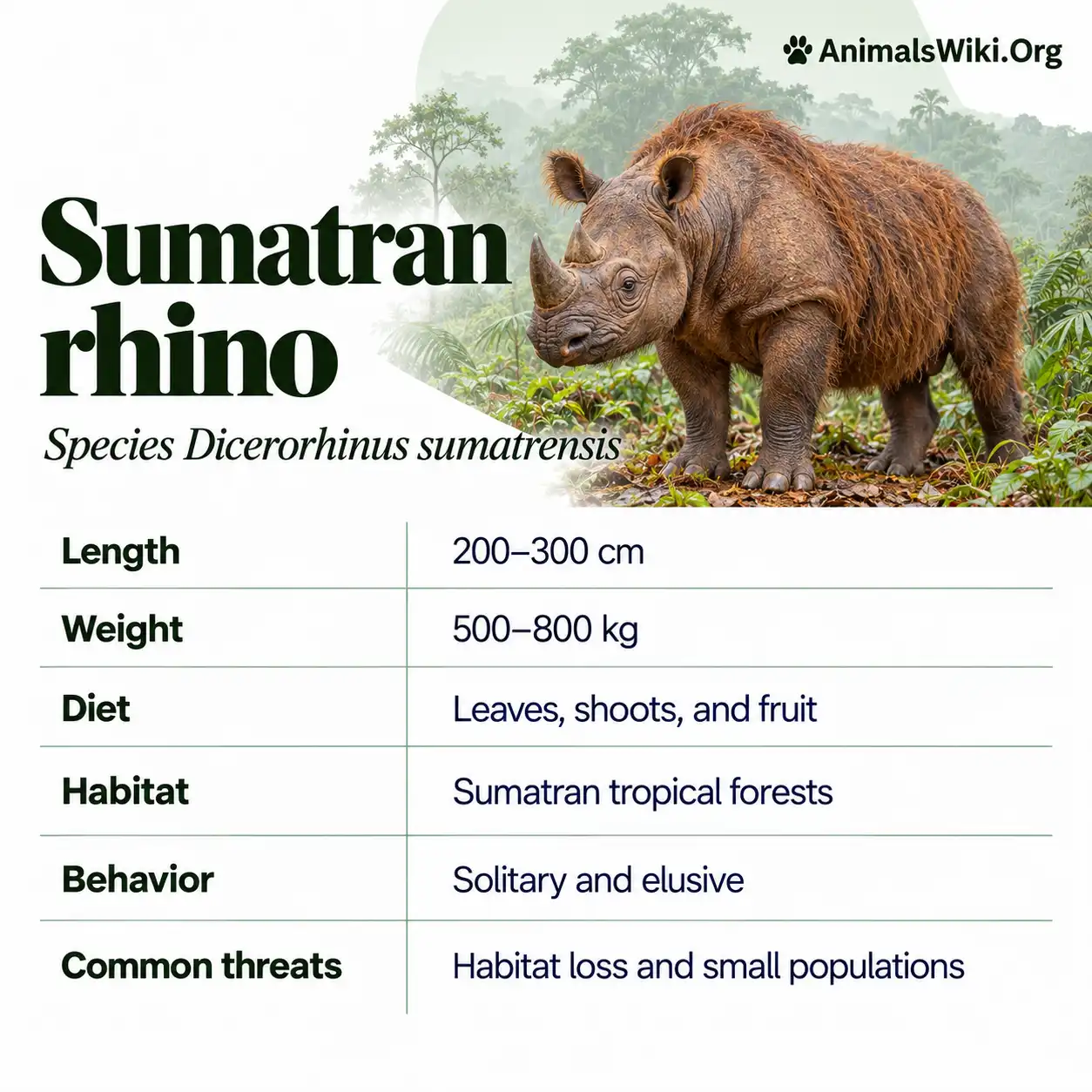
The Sumatran rhino is a forest-dwelling mammal with reddish-brown hair, two horns and a surprisingly expressive voice. It is the smallest living rhinoceros, yet it can weigh hundreds of kilograms and move through dense vegetation, muddy ground and steep terrain.
Its appearance sets it apart from the larger, mostly hairless rhinos familiar from African grasslands. Young Sumatran rhinos can look almost shaggy, while adults often retain a thinner coat of bristly hair. Their mobile upper lips help them gather leaves and shoots from forest plants.
Unfortunately, this remarkable animal is also among the world’s most threatened mammals. The current specialist estimate is 34–47 wild Sumatran rhinos, with surviving animals restricted to Indonesia. The species is classified as Critically Endangered.
Its conservation challenge involves more than protecting trees. When animals become scattered across small, isolated groups, they may struggle to find mates. A forest can still contain rhinos while producing too few calves to sustain its population.
There is also reason for cautious hope. A breeding program in Indonesia has produced several calves, and an October 2026 government announcement confirmed pregnancies in two females, Ratu and Delilah. These developments make understanding the animal’s biology especially important.
Sumatran Rhino Facts
| Feature | Details |
|---|---|
| Common name | Sumatran rhino |
| Scientific name | Dicerorhinus sumatrensis |
| Animal group | Mammal |
| Order | Perissodactyla |
| Family | Rhinocerotidae |
| Distinction | Smallest living rhinoceros |
| Coat | Reddish-brown hair, usually denser in calves |
| Horns | Two |
| Typical adult weight | Approximately 500–1,000 kilograms |
| Shoulder height | Approximately 1.2–1.5 meters |
| Diet | Herbivorous; primarily leaves, shoots, twigs and other browse |
| Habitat | Lowland and upland tropical forest |
| Current surviving country | Indonesia |
| Social behavior | Generally solitary, except mothers with calves and temporary breeding associations |
| Pregnancy | Approximately 15–16 months |
| Usual offspring | One calf |
| Conservation status | Critically Endangered |
| Current wild population estimate | 34–47, as cited in current specialist reporting |
1. What Is a Sumatran Rhino?
The Sumatran rhino is a large, plant-eating mammal native to Asia. It belongs to the rhinoceros family but differs noticeably from its living relatives.
Its combination of small body size, visible hair and two horns makes it especially distinctive. “Small,” however, is relative: even a modest-sized adult is a powerful animal weighing several hundred kilograms.
The species is associated with tropical forest rather than open savanna. Much of its life takes place among shrubs, saplings, streams, trails and muddy wallows.
Its common name can also create a narrow impression of its history. Although Sumatra is central to its survival today, the species once occupied a much wider region.
Understanding the Sumatran rhino therefore requires two perspectives. It is a living forest animal with ordinary daily needs, and it is the remaining representative of a once much more widespread evolutionary lineage.
2. Scientific Name and Classification
The scientific name of the Sumatran rhinoceros is Dicerorhinus sumatrensis.
Its classification is:
| Classification level | Name |
|---|---|
| Kingdom | Animalia |
| Phylum | Chordata |
| Class | Mammalia |
| Order | Perissodactyla |
| Family | Rhinocerotidae |
| Genus | Dicerorhinus |
| Species | Dicerorhinus sumatrensis |
It is the only living species in the genus Dicerorhinus.
The order Perissodactyla also includes horses and tapirs. These animals share an evolutionary history, although their modern bodies and ways of living differ considerably.
Scientific names help avoid confusion between the three Asian rhino species. The Sumatran rhino is distinct from the Javan rhino, Rhinoceros sondaicus, and the Indian rhino, Rhinoceros unicornis.
They should not be treated as interchangeable forms of the same animal. Their physical characteristics, population structures and conservation circumstances require separate attention.
3. Its Relationship With the Woolly Rhinoceros
The Sumatran rhino is the closest living relative of the extinct woolly rhinoceros.
That relationship helps explain why it attracts interest beyond its immediate conservation importance. It preserves part of a rhinoceros lineage whose relatives once occupied very different environments.
However, the Sumatran rhino is a modern species adapted to tropical forests. Its relationship with the woolly rhino does not mean it is an unchanged Ice Age animal.
Evolution continues in every surviving lineage.
Genomic research using both ancient and modern rhinoceros DNA has improved understanding of relationships within the family. These studies also show how genetic diversity has changed through time.
Calling the Sumatran rhino a “living fossil” can be memorable, but it is less informative than explaining the actual relationship.
The animal deserves protection as a living species with its own ecological role, as well as a representative of an unusually distinctive branch of rhinoceros evolution.
4. What Does the Sumatran Rhino Look Like?
The Sumatran rhino has a rounded body, short strong legs, a relatively compact head and two horns positioned one behind the other.
Its skin is generally reddish brown, although mud, moisture and age can change its apparent color.
Folds are visible around the body and limbs, but its appearance is less heavily plated than that of the Indian rhino. Hair softens the outline and makes some individuals look almost woolly.
The ears have conspicuous hair around their margins, and the tail ends in a tuft.
A wet or muddy animal may appear much darker than a clean, dry one. Photographs therefore do not always show the reddish tones clearly.
Identification works best by considering several features together: the relatively small body, visible coat, two horns and forest setting.
No single feature fully represents the species, but the combination makes it unlike any other living rhinoceros.
5. Why Is the Sumatran Rhino Hairy?
The Sumatran rhino has the most conspicuous coat of any living rhinoceros.
Calves usually have denser hair than older animals. As an individual matures, its coat can become thinner and more bristly.
Hair coverage also varies with conditions. Contact with vegetation and repeated rubbing can influence how much hair remains visible.
This explains why photographs show a wide range of appearances. One animal may look shaggy, while another appears nearly bare across parts of its body.
Its coat should not be interpreted as evidence that it belongs in a cold climate. The species lives in tropical forests, including both lowland and upland environments.
The important distinction is between evolutionary relationship and present-day adaptation.
A Sumatran rhino can share ancestry with the woolly rhinoceros while having biological requirements suited to a warm, humid forest landscape.
6. How Big Is a Sumatran Rhino?
Sumatran rhinos are the smallest of the five living rhinoceros species.
Adults generally weigh approximately 500–1,000 kilograms and stand around 1.2–1.5 meters at the shoulder.
These are broad reference ranges rather than exact measurements for every animal. Sex, age, condition and individual development affect size.
Even at the lower end of that range, a Sumatran rhino is a substantial mammal. Its body requires a reliable food supply and suitable ground for moving, resting and wallowing.
Its smaller size compared with other rhinos may help it use dense forest environments, but the animal still needs considerable space and resources.
A useful comparison is with the Indian rhino, which can weigh several times as much.
The Sumatran species’ smaller stature should therefore be understood within the rhinoceros family. It remains a powerful wild animal with the strength to bend vegetation and move through demanding terrain.
7. Two Horns and a Flexible Upper Lip
The Sumatran rhino is the only living Asian rhinoceros with two horns.
The front horn is usually larger, commonly around 15–25 centimeters long. The rear horn is often much smaller and can look like a low projection.
Both horns are made of keratin, the structural material found in hair and nails.
Its upper lip is another important feature. The lip is prehensile, meaning it can grasp and manipulate vegetation.
While feeding, the animal uses this flexible structure to collect leaves and shoots. It can bring food toward the mouth with greater precision than a simple bite would allow.
The horns may attract more public attention, but the lip directly supports the animal’s daily nutrition.
For a forest browser, the ability to select and handle plants is fundamental. It allows a large mammal to obtain food from a complicated arrangement of stems, branches and leaves.
8. Where Do Sumatran Rhinos Live Today?
The Sumatran rhino survives only in Indonesia.
Sumatra holds the species’ principal remaining wild stronghold. The species also has a history of survival in Indonesian Borneo, where its current situation is especially precarious.
Modern distribution accounts require care because historical populations, recent detections, unconfirmed remnants and animals under managed care are different categories.
Current specialist reporting emphasizes the Leuser landscape in northern Sumatra as the critical confirmed wild stronghold.
Older sources may describe larger populations in additional national parks without reflecting subsequent uncertainty or decline.
For an endangered animal that is difficult to detect, a distribution map can lag behind conditions on the ground.
The clearest approach is to distinguish places where the species formerly occurred from sites with recent evidence.
That distinction matters for conservation planning because remaining animals, suitable habitat and historical habitat do not necessarily overlap completely.
9. Historical Range Across Asia
The Sumatran rhino once occupied a much wider area than its name suggests.
Historical records place it across parts of mainland Southeast Asia, the Malay Peninsula, Sumatra and Borneo. Its former distribution extended toward the eastern Himalayan region.
This broad range included different forest types, elevations and environmental conditions.
As populations disappeared, the species became restricted to smaller and more separated areas. The present distribution is therefore the outcome of extensive contraction.
Historical range information can help researchers investigate future conservation options. It can reveal environments the species used before modern pressures forced it into remnant populations.
However, a historical record does not prove that a place is suitable today.
Land use, human settlement, security and forest condition may have changed dramatically.
The value of historical information is to broaden the evidence base. It helps conservationists ask where recovery might be possible while recognizing that current conditions must still be assessed carefully.
10. The Loss of Sumatran Rhinos in Malaysia
Malaysia’s last known Sumatran rhino, a female named Iman, died in November 2019.
The country’s last male, Tam, had died earlier that year.
Their deaths marked the loss of the species from Malaysia and left Indonesia as its final surviving country.
The story demonstrates how a species can disappear locally even while a few individuals remain alive under care.
A small number of animals does not necessarily constitute a viable breeding population. Age, health, fertility and access to compatible mates determine whether another generation is possible.
Iman’s death was therefore more than the loss of one animal. It closed the remaining living chapter of the species in a country that once formed part of its range.
For conservation elsewhere, the lesson is the importance of acting before a population loses its reproductive options.
Protecting the last individuals is essential, but recovery becomes much harder when intervention begins only after breeding opportunities have nearly vanished.
11. Lowland and Mountain Forest Habitat
Sumatran rhinos use dense tropical forest in both lowland and upland environments.
Their habitat contains more than trees. Useful landscapes include feeding vegetation, water, wallows, trails and places to rest.
Terrain also matters. An animal must be able to move between resources, including when rainfall changes conditions underfoot.
A study in East Kalimantan examined habitat use in relation to several environmental variables. Slope and distance from wallows were particularly influential within that study.
Such findings show why habitat quality cannot be judged from forest cover alone.
A large green area may contain unsuitable vegetation or lack dependable wallows. Another area may provide good food while being difficult to reach safely.
For conservation, habitat assessment needs to connect resources with actual animal movements.
The question is whether the landscape supports the complete routine of a rhino throughout changing conditions, rather than whether it appears intact from a distance.
12. Moving Through Dense Vegetation
Despite its heavy body, the Sumatran rhino is capable of moving through steep and densely vegetated terrain.
Its short limbs provide support, while its head and body help it push through undergrowth.
Movement is not simply a matter of strength. Familiar trails, ground conditions and the arrangement of vegetation influence the routes an animal uses.
A route between a feeding area and a wallow may become part of its ordinary routine.
These movements also leave evidence. Bent stems, tracks, feeding signs and disturbed ground can reveal the presence of an animal that remains unseen.
Researchers use such signs to understand habitat use and direct further monitoring.
However, a track should not automatically be treated as evidence of a separate individual. Several signs can come from the same animal repeatedly using a route.
Careful field interpretation turns scattered evidence into a more reliable understanding of how the forest is occupied.
13. What Does the Sumatran Rhino Eat?
The Sumatran rhino is an herbivore and primarily a browser.
Its food includes leaves, twigs, shoots, saplings and other forest vegetation. Fruit can also contribute to its diet.
Browsing differs from specializing in grass. The animal obtains much of its food from woody plants and leafy growth within the forest.
Its menu is diverse, but diversity does not mean every plant is equally useful.
Food availability, accessibility, palatability and nutritional composition influence what the rhino consumes.
Its flexible lip helps collect material, while its body allows it to bring some vegetation within reach.
Understanding this diet matters for both field conservation and managed care. A habitat must supply suitable browse over time, and a sanctuary must provide food that supports health as well as appetite.
A rhino eating readily is encouraging, but good nutrition requires more detailed assessment than simply observing that it accepts the plants offered.
14. Feeding Research and Nutrition Under Human Care
Nutrition has played an important role in learning how to maintain Sumatran rhinos successfully under human care.
Research at Cincinnati Zoo examined food intake and the composition of diets offered and consumed.
Browse, including Ficus species, formed a substantial part of the diets studied.
The researchers compared nutrient levels with available recommendations, illustrating the need to evaluate the whole diet rather than focus on one preferred food.
This work also shows why feeding a forest browser can be demanding. Suitable plants must be sourced, supplied in sufficient quantities and assessed for their contribution to the animal’s health.
Food preference is useful information, but it does not provide a complete nutritional plan.
Sanctuary teams must consider body condition, clinical health, reproductive status and individual needs.
For an endangered species, feeding research contributes directly to conservation by improving the conditions under which animals survive, reproduce and raise healthy calves.
15. Digestion and the Importance of Fiber
Like other rhinoceroses, the Sumatran rhino is a hindgut fermenter.
Microorganisms in the digestive tract help break down fibrous plant material, particularly within the enlarged cecum and colon.
This system allows the animal to obtain nutrients from leaves and stems that require extensive processing.
Digestion begins before microbial fermentation. The rhino first selects food, chews it and mixes it with saliva.
The physical and chemical properties of the food then influence how it moves through the digestive system.
This explains why a plant-based diet can still be highly specialized. A forest browser’s needs are not necessarily met by offering the same foods used for a grazing herbivore.
Diet quality also connects with conservation habitat. A forest full of vegetation may differ considerably from one containing suitable, accessible browse.
The animal’s digestive adaptations make plant feeding possible, but they do not remove the need for appropriate nutrition.
16. Mud Wallows and Temperature Regulation
Wallowing is a regular and important part of Sumatran rhino life.
Mud and water help the animal manage heat and protect its skin. Wallowing can also provide relief from biting insects and external parasites.
A useful wallow needs appropriate ground, water and access.
Its value therefore depends on more than the presence of a shallow depression. Soil conditions and seasonal water availability influence whether the site continues to function.
When conditions change, the animal may need to use another location or modify an existing muddy area.
For habitat management, wallows deserve attention alongside food plants.
A potential conservation site with abundant browse may still fail to meet an important requirement if suitable wallowing places are absent.
Protecting these resources supports daily comfort and health. It also preserves the movement patterns connecting feeding, resting and wet areas within the animal’s home range.
17. Mineral Licks and Other Important Resources
Mineral licks are sites where animals obtain minerals from soil or water.
They are an important feature in accounts of Sumatran rhino ecology.
A resource like a mineral lick can influence movement even when it occupies only a small part of the landscape.
This is one reason conservation cannot rely exclusively on the size of a forest block. Small sites may perform functions that a much larger area does not replace.
Access matters too. A useful lick separated from feeding habitat by disturbance or unsuitable land may become difficult to use.
Researchers therefore investigate the arrangement of resources rather than treating habitat as a uniform surface.
For a largely solitary animal, shared resource sites can also provide opportunities to encounter scent information left by others.
The ecological value of a place may include both what it supplies physically and how it contributes to movement through the forest.
18. Solitary Behavior and Home Ranges
Adult Sumatran rhinos are generally solitary.
Mothers remain with dependent calves, while adults associate temporarily during breeding.
Solitary living does not mean that each animal occupies a completely separate piece of forest. Home ranges can overlap, and individuals can use some of the same trails or resources.
A home range is the area an animal uses during ordinary activities. Its size depends partly on how food, water and other resources are distributed.
Published estimates differ between males and females, but a single number should not be applied to every individual or landscape.
The important conservation issue is whether animals can meet their needs and encounter suitable mates.
A large forest may contain enough food for several individuals while still leaving them too widely separated for regular reproduction.
Understanding spacing is therefore essential to understanding why a population can decline without every remaining animal facing an immediate food shortage.
19. The Rhino That Whistles and Makes Whale-Like Calls
The Sumatran rhino is unusually vocal.
Researchers have described calls with names such as “eeps,” “whale calls” and “whistle-blows.”
These labels describe the sounds heard and analyzed; they do not mean that a rhino communicates exactly like a whale.
Acoustic work with animals at Cincinnati Zoo documented several distinct vocal patterns, including sounds produced during ordinary activities.
The comparison with whale calls is memorable because people rarely expect such sounds from a rhinoceros.
For a forest animal, vocal communication can be useful when vegetation blocks visual contact.
However, the precise meaning of each call remains incompletely understood. A sound may occur in more than one context, and observations under managed care do not answer every question about communication in the wild.
The calls provide evidence of a richer behavioral life than the silent, heavy-bodied image often associated with rhinos.
20. Scent Communication in the Forest
Sound is only one part of Sumatran rhino communication.
Urine, dung and other scent-related signs allow information to remain after an animal has moved away.
This can be particularly useful for solitary mammals. Individuals do not need to stand together continuously to learn something about one another’s presence.
Repeated use of trails can create locations where scent information accumulates.
Physical signs, such as disturbed vegetation or scraped ground, may contribute additional information.
For researchers, these traces also help establish where animals have traveled.
Interpreting them requires caution. A scent-marked area is not necessarily defended in the same way as a rigid territory in another species.
The relationship between marking, movement and social behavior needs to be investigated through repeated evidence.
For conservation, the key point is that a forest contains a network of information as well as physical resources. Fragmenting that landscape can disrupt both.
21. Pregnancy, Birth and Slow Reproduction
A Sumatran rhino pregnancy lasts approximately 15–16 months.
The usual outcome is one calf, followed by substantial maternal care.
This slow reproductive pace means that population recovery takes time. Even a healthy breeding female cannot produce enough offspring quickly to offset repeated losses of adults.
Reproductive research has also revealed an important feature: Sumatran rhinos are induced ovulators.
In this context, ovulation is stimulated by mating-related activity rather than occurring in the same spontaneous pattern familiar from many other mammals.
Ultrasound and hormone studies helped establish this aspect of their reproductive biology.
The finding had practical consequences for breeding management because it improved understanding of when and how females could become pregnant.
It also illustrates why conservation sometimes depends on detailed biological research. Protecting an animal is essential, but successful reproduction may require knowledge that cannot be obtained from occasional sightings alone.
22. Baby Sumatran Rhinos and Maternal Care
A baby Sumatran rhino is called a calf.
Its dense hair and small body give it a markedly different appearance from a mature adult.
The calf depends on its mother for milk and protection while developing its ability to move, explore and feed.
Sampling vegetation does not immediately end that dependence. Nursing, growth and eventual separation are different stages.
Managed-care records provide unusually detailed opportunities to follow these changes.
Yayasan Badak Indonesia’s updates about Anggi, born in September 2023, describe her development toward the more independent life typical of older Sumatran rhinos.
Such observations help explain the species’ social pattern: the mother–calf association is temporary but highly important.
For conservation, a birth is the beginning of an investment. The calf must survive, develop and eventually become capable of reproducing.
Monitoring that longer process provides a stronger measure of progress than a birth announcement alone.
23. Why Isolation Can Lead to Reproductive Failure
A Sumatran rhino can be alive in protected forest yet have little chance of producing a calf.
If potential mates are too far apart, encounters become rare.
Researchers have also documented serious reproductive problems in females from small, declining populations.
A study examining reproductive disease described high rates of pathology or conception problems among assessed females, including several recently captured animals.
These findings support the concern that prolonged reproductive inactivity and isolation can contribute to a worsening cycle.
Fewer breeding opportunities produce fewer calves. As numbers decline further, finding mates becomes even harder.
This is one reason simply preventing poaching may not be sufficient for recovery.
Conservation must also investigate whether surviving animals are reproductively healthy and able to breed.
The challenge is demographic as well as geographic: a population needs the right combination of surviving individuals, successful mating and calf recruitment to continue.
24. Lifespan, Health and Natural Risks
Sumatran rhinos can live for several decades, with general references often giving estimates around 35–40 years.
As with many rare animals, lifespan figures should be distinguished from the age reached by most individuals.
Health, nutrition, injuries and disease influence survival.
Experience under human care has also revealed clinical challenges, including iron storage disease in some individuals. Cincinnati’s historical records document the deaths of Emi and Suci from this condition.
These cases contributed to the need for careful nutritional and medical management.
Wild animals face a different combination of conditions, and findings from one managed individual should not be applied indiscriminately to the species.
The useful lesson is that protecting a rhino involves more than preventing an immediate external threat.
Long-term care and conservation also depend on understanding how diet, physiology, age and health interact across the animal’s lifetime.
25. Seed Dispersal and Forest Ecology
The Sumatran rhino influences its habitat through feeding, movement, dung deposition and wallowing.
Fruit consumption creates opportunities for seed dispersal when seeds survive digestion and are deposited elsewhere.
A study titled Lost Mutualisms brought together field observations, local ecological knowledge and other records to investigate this role.
The broader ecological concern is that a species can become so rare that its former contribution is greatly reduced, even before the last individual disappears.
A handful of rhinos cannot necessarily maintain seed movement across the extensive landscapes once occupied by the species.
Its ecological value therefore includes relationships that may already be diminished in many forests.
Recovery would preserve more than the animal’s appearance or genetic identity.
It could also help restore interactions between large herbivores and plants, although the scale and timing of those effects would depend on where populations recover and how many animals survive.
26. How Many Sumatran Rhinos Remain?
The current specialist estimate commonly cited is 34–47 wild animals.
The IUCN SSC Asian Rhino Specialist Group presents this range with an estimate date of February 2026.
A range is appropriate because these animals are exceptionally difficult to detect and count.
Dense forest, low numbers and fragmented distribution create uncertainty. Some individuals may be recorded repeatedly, while others remain undetected.
It is also important to separate wild estimates from the number of animals under managed care.
Adding figures from different sources without checking their definitions and dates can produce an inaccurate total.
Likewise, a sanctuary birth should not automatically be added to a wild population estimate.
For publication, the clearest wording identifies the estimate as referring to wild animals and retains the reporting date.
The conservation message does not depend on pretending to know an exact number: the surviving wild population is extremely small.
27. Why the Species Is Critically Endangered
The Sumatran rhino is classified as Critically Endangered.
Its risk reflects a combination of severe decline, very small surviving populations and limited reproductive opportunities.
Habitat loss and historical hunting contributed to the contraction of its range.
The resulting isolation now creates additional problems. Animals can struggle to encounter mates, and reproductive health may deteriorate before conservationists can intervene.
This makes the species’ situation different from a simple shortage of protected forest.
Habitat remains essential, but the animals within it must also form a functioning population.
A secure future requires enough breeding individuals, successful pregnancies, surviving calves and continued protection across generations.
The category signals an extremely high extinction risk, but it does not mean extinction is predetermined.
It indicates that the remaining opportunities are limited and that conservation needs to act on the full set of problems rather than rely on one measure alone.
28. Habitat Loss, Fragmentation and Poaching
Habitat loss removes usable forest. Fragmentation separates what remains.
For a solitary animal, separation can become particularly damaging when few individuals survive in each fragment.
Historical poaching also played a major role in reducing the species, while illegal hunting and snares remain concerns in occupied forests.
However, it would be incomplete to attribute every recent disappearance to confirmed poaching. Detecting carcasses and establishing causes of death are difficult in remote habitat.
Conservation needs both security and evidence.
Patrols can reduce immediate threats, while monitoring helps determine whether animals are present and breeding.
A protected forest without successful reproduction may still hold a declining population.
Conversely, breeding success cannot secure the species if habitat and protection disappear.
The problem therefore requires coordinated action: keep animals alive, maintain suitable forest and address the reproductive consequences of their isolation.
29. Genetics and the Management of a Tiny Population
Small populations face increasing risks associated with close relatedness and the loss of genetic variation.
Genomic research on Sumatran rhinos has examined historical and modern animals from different parts of their range.
The findings show that conservation genetics is more complicated than assuming every surviving group has identical levels of diversity or inbreeding.
The study also identified the potential value of carefully managed gene flow among surviving lineages.
In practice, genetic information must be combined with health, behavior and reproductive considerations.
A pairing that looks desirable on a family tree still requires compatible, healthy animals and suitable management.
The goal is to preserve as much remaining variation as possible while producing a growing population.
That requires thinking beyond the next calf.
A successful conservation program should consider how today’s breeding decisions influence the options available to the next several generations.
30. The Sumatran Rhino Sanctuary
The Sumatran Rhino Sanctuary in Way Kambas National Park, Indonesia, is central to managed breeding efforts.
The facility provides large forested enclosures alongside veterinary care, nutrition and reproductive monitoring.
It is designed to combine a natural environment with the close management needed for such a rare species.
Yayasan Badak Indonesia and Indonesian authorities jointly manage the program with support from conservation partners.
The sanctuary’s role extends beyond keeping animals alive. It supports research into reproduction, development, feeding and health.
Its residents also form part of an effort to build a managed population that can contribute to the species’ long-term survival.
However, a sanctuary does not replace the need for wild habitat.
A complete conservation strategy must connect the management of individual animals with the protection and restoration of the forests where future populations could persist.
The value of managed care lies in supporting that wider goal.
31. Cincinnati’s Breeding Breakthrough
Cincinnati Zoo played a major role in understanding Sumatran rhino reproduction.
In September 2001, Emi gave birth to Andalas, the first Sumatran rhino bred and born in captivity in 112 years.
The birth followed years of research and unsuccessful pregnancies.
Scientists used ultrasound and hormone monitoring to understand Emi’s reproductive cycle and improve management.
The achievement was not a simple matter of placing a male and female together. It depended on detailed biological investigation and repeated adjustment.
Andalas later moved to Indonesia and contributed to the breeding program there.
This connection illustrates how knowledge and animals can move between institutions in support of a common conservation goal.
The most important outcome was not only a single calf. It was the development of experience that helped make subsequent births possible.
For a species with so few survivors, such transferable knowledge can have consequences across generations.
32. Five Calves Born at Way Kambas
The Way Kambas sanctuary had recorded five births by the October 2026 government update.
| Calf | Birth year | Significance |
|---|---|---|
| Andatu | 2012 | First calf born at the sanctuary |
| Delilah | 2016 | Later became a breeding female |
| Sedah Mirah | 2022 | Added another individual to the managed population |
| Anggi | 2023 | Female calf born to Ratu and Andalas |
| Indra | 2023 | First calf of Delilah and Harapan |
Each birth contributed something different to the program.
Delilah’s later reproduction was particularly important because it demonstrated another generation within the managed population.
The records also provide opportunities to study growth and maternal care.
These achievements should be interpreted alongside the species’ wider situation. Five births over several years are valuable, but they do not erase losses or fragmentation in the wild.
They demonstrate that successful reproduction is possible and provide a foundation for further work.
33. October 2026 Update: Ratu and Delilah Pregnant
Indonesia’s Forestry Ministry announced in October 2026 that Ratu and Delilah were pregnant at the Way Kambas sanctuary.
Ratu was carrying a potential fourth calf, fathered by Andalas. Delilah was carrying a potential second calf, fathered by Harapan.
The ministry described continued monitoring by medical staff, keepers and sanctuary management.
These pregnancies are encouraging developments, but they remain pregnancies rather than completed births.
Keeping that distinction clear matters when reporting conservation news.
A successful outcome includes the health of the mother, delivery, nursing and the calf’s subsequent development.
The announcement also shows the long time scale of the program. Delilah, born in 2016, has become part of the next breeding generation.
For readers checking this article later, the pregnancy information should be updated when official birth outcomes are available.
As of the information check on October 22, 2026, the verified development is the announcement of two ongoing pregnancies.
34. Habitat Restoration and Local Communities
Conservation work also takes place beyond breeding facilities.
Restoring degraded habitat can increase the availability of food plants and improve conditions for other forest wildlife.
Projects around Way Kambas have involved local communities and farmer groups in planting and restoration.
Such work can connect conservation with employment, practical skills and a shared interest in maintaining the landscape.
The quality of restoration matters. Planting trees is a beginning, while survival, growth and ecological usefulness determine the longer-term result.
A restored area should be assessed for the resources it provides and the role it can play within the surrounding forest.
Local participation is valuable because people understand land use and experience the consequences of conservation decisions.
The strongest programs combine that knowledge with ecological research and sustained follow-up.
Protecting a rare animal becomes more durable when the surrounding relationships are maintained as carefully as the habitat itself.
35. Sumatran Rhino Compared With Other Rhinos
Five rhinoceros species survive today.
| Species | General native region | Horns | Distinctive feature |
|---|---|---|---|
| Sumatran rhino | Indonesia | Two | Smallest living rhino, with conspicuous hair |
| Javan rhino | Indonesia | Usually one in males; often reduced or absent in females | Folded skin and pointed upper lip |
| Indian rhino | India and Nepal | One | Large body with prominent skin folds |
| Black rhino | Africa | Two | Pointed lip adapted for browsing |
| White rhino | Africa | Two | Broad mouth adapted for grazing |
The comparison helps explain why “rhino conservation” includes several different biological challenges.
A method developed for one species may provide useful experience, but it still needs assessment before being applied to another.
Sumatran rhinos require particular attention to forest browse, reproductive biology and the consequences of isolation.
Their small size and hair make them visually distinctive. Their conservation needs are equally specific.
36. What a More Secure Future Would Require
A stronger future for the Sumatran rhino would involve more than occasional births.
It would include surviving breeding adults, healthy calves, managed genetic diversity and enough suitable habitat to support growing populations.
Wild protection and managed breeding need to reinforce one another.
Monitoring should identify where animals remain, while reproductive assessment helps establish whether they can contribute to recovery.
Research must also translate into practical decisions about care, pairings, habitat and movement.
The species’ slow life cycle means progress will need to be sustained over many years.
Success would be a population capable of replacing losses and continuing across generations, with fewer individuals isolated beyond breeding reach.
The remaining animals still have the biological capacity to produce calves. Conservation’s task is to preserve and expand those opportunities while protecting the forests that make a long-term future possible.
Frequently Asked Questions About the Sumatran Rhino
1. What is a Sumatran rhino?
The Sumatran rhino is the smallest living rhinoceros. It has two horns, a visible coat of reddish-brown hair and a flexible upper lip. It is a forest-dwelling herbivore whose surviving population is restricted to Indonesia.
2. What is its scientific name?
Its scientific name is Dicerorhinus sumatrensis. It belongs to the rhinoceros family, Rhinocerotidae, and is the only living species in the genus Dicerorhinus. Scientific naming distinguishes it from the separate Javan and Indian rhino species.
3. Why is it called a hairy rhinoceros?
It has the most conspicuous coat of any living rhino. Calves are usually more densely covered than adults, while older animals often have thinner, bristly hair. The amount visible can vary with age, rubbing and other conditions.
4. Is the Sumatran rhino related to the woolly rhino?
Yes. It is the closest living relative of the extinct woolly rhinoceros. However, it is a modern tropical forest species with its own adaptations. The relationship does not mean it is an unchanged Ice Age animal.
5. How much does a Sumatran rhino weigh?
Adults generally weigh approximately 500–1,000 kilograms. Individual animals vary, and different references provide somewhat different ranges. It is small compared with other rhinos but remains a large, powerful mammal requiring substantial food and space.
6. How many horns does it have?
It has two horns, making it the only living Asian rhino with that number. The front horn is usually larger, while the rear horn can be much smaller. Both are made of keratin, the material found in hair and nails.
7. Where do Sumatran rhinos live?
The species survives only in Indonesia. Sumatra contains its principal remaining wild stronghold, especially the Leuser landscape. Distribution accounts involving other areas require attention to recent evidence, historical records and the distinction between wild and managed animals.
8. Does the Sumatran rhino still live in Malaysia?
Malaysia’s last known individual, Iman, died in November 2019. The last male, Tam, died earlier that year. Indonesia subsequently remained the only country with surviving Sumatran rhinos.
9. What does it eat?
It primarily eats leaves, twigs, shoots, saplings and other browse. Fruit can also contribute to its diet. Suitable food depends on nutritional quality and accessibility, so the presence of abundant vegetation alone does not establish that a habitat can support it.
10. Is the Sumatran rhino a grass eater?
It is primarily a browser rather than a specialized grazer. Its diet centers on leafy and woody forest vegetation. This distinction matters when comparing it with the white rhino, whose broad mouth is strongly associated with grazing.
11. Why does it have a pointed upper lip?
The upper lip can grasp and manipulate plants. This helps the animal collect leaves and shoots from stems and branches. Such a feeding structure is useful for a forest browser selecting food from complicated vegetation.
12. Why do Sumatran rhinos wallow?
Wallowing helps regulate body temperature and protect the skin. Mud and water can also provide relief from insects and external parasites. Suitable wallows are therefore an important habitat resource rather than an incidental feature.
13. Do Sumatran rhinos live in herds?
Adults are generally solitary. Mothers remain with calves, and adults meet temporarily for breeding. Home ranges may overlap, so solitary living does not mean each individual occupies completely separate habitat or never encounters another rhino.
14. What sounds do they make?
Researchers have described “eeps,” whale-like calls and whistle-blows. These labels capture the character of the sounds. Their precise functions remain incompletely understood, but they demonstrate that Sumatran rhinos have a varied vocal repertoire.
15. How long is a Sumatran rhino pregnant?
Pregnancy lasts approximately 15–16 months. A female normally gives birth to one calf. This long reproductive investment limits how quickly a population can replace losses and makes adult survival particularly important.
16. What is a baby Sumatran rhino called?
A baby is called a calf. Young calves have dense hair and depend on their mothers for milk and protection. As they develop, they gradually become more independent, but eating some vegetation does not immediately end maternal dependence.
17. Why can isolated rhinos struggle to reproduce?
Widely separated animals may rarely encounter suitable mates. Researchers have also documented reproductive problems in females from small, declining populations. Protecting individuals therefore needs to be combined with understanding their fertility and opportunities to breed.
18. How many Sumatran rhinos remain?
The current specialist estimate is 34–47 wild animals. It is a range rather than an exact live count. Wild estimates should be distinguished from the number of rhinos living in sanctuary care, and reporting dates should remain attached to the figures.
19. Is the species extinct?
No. Sumatran rhinos still survive, but they are Critically Endangered. The species has disappeared from much of its former range, including Malaysia. Its continued existence depends on a very small number of wild and managed animals.
20. What is the Sumatran Rhino Sanctuary?
It is a managed breeding and research facility in Way Kambas National Park, Indonesia. Rhinos live in forested enclosures with veterinary and nutritional support. The program aims to support reproduction while improving knowledge of the species.
21. How many calves have been born at Way Kambas?
Five births were documented by the October 2026 government update: Andatu, Delilah, Sedah Mirah, Anggi and Indra. These births are important achievements, but they should not be confused with the total number of rhinos alive in the wild.
22. What is the latest breeding news?
Indonesia’s Forestry Ministry announced in October 2026 that Ratu and Delilah were pregnant. The announcement described ongoing monitoring. As of October 22, 2026, these were verified pregnancies, and subsequent birth outcomes required later confirmation.
23. How is the Sumatran rhino different from the Javan rhino?
The Sumatran rhino is smaller, hairier and has two horns. The Javan rhino has more conspicuous folded skin, with a short horn in males and often no obvious horn in females. They also have different reproductive and population-management circumstances.
24. Can the Sumatran rhino still recover?
Recovery remains possible, but it requires sustained protection, successful reproduction and careful management. Habitat, health, genetics and breeding opportunities all matter. The sanctuary births demonstrate that calves can be produced, while the wild population’s small size makes continued action urgent.
A Future for the Forest’s Hairy Rhinoceros
The Sumatran rhino’s future rests on a small number of animals, but its story is more than a count of survivors.
It is the story of a forest browser that whistles, wallows, follows familiar routes and raises one calf after a long pregnancy. Those ordinary activities explain what conservation must preserve.
The breeding achievements at Way Kambas and the October 2026 pregnancy announcements provide evidence of continuing reproductive potential. Protecting that potential requires healthy animals, informed management and secure habitat.
A lasting recovery will take patience. It will depend on calves surviving, breeding opportunities continuing and forest protection remaining effective across generations.
Preserving the Sumatran rhino would retain both a distinctive evolutionary lineage and a living participant in Southeast Asia’s forest ecosystems.



