
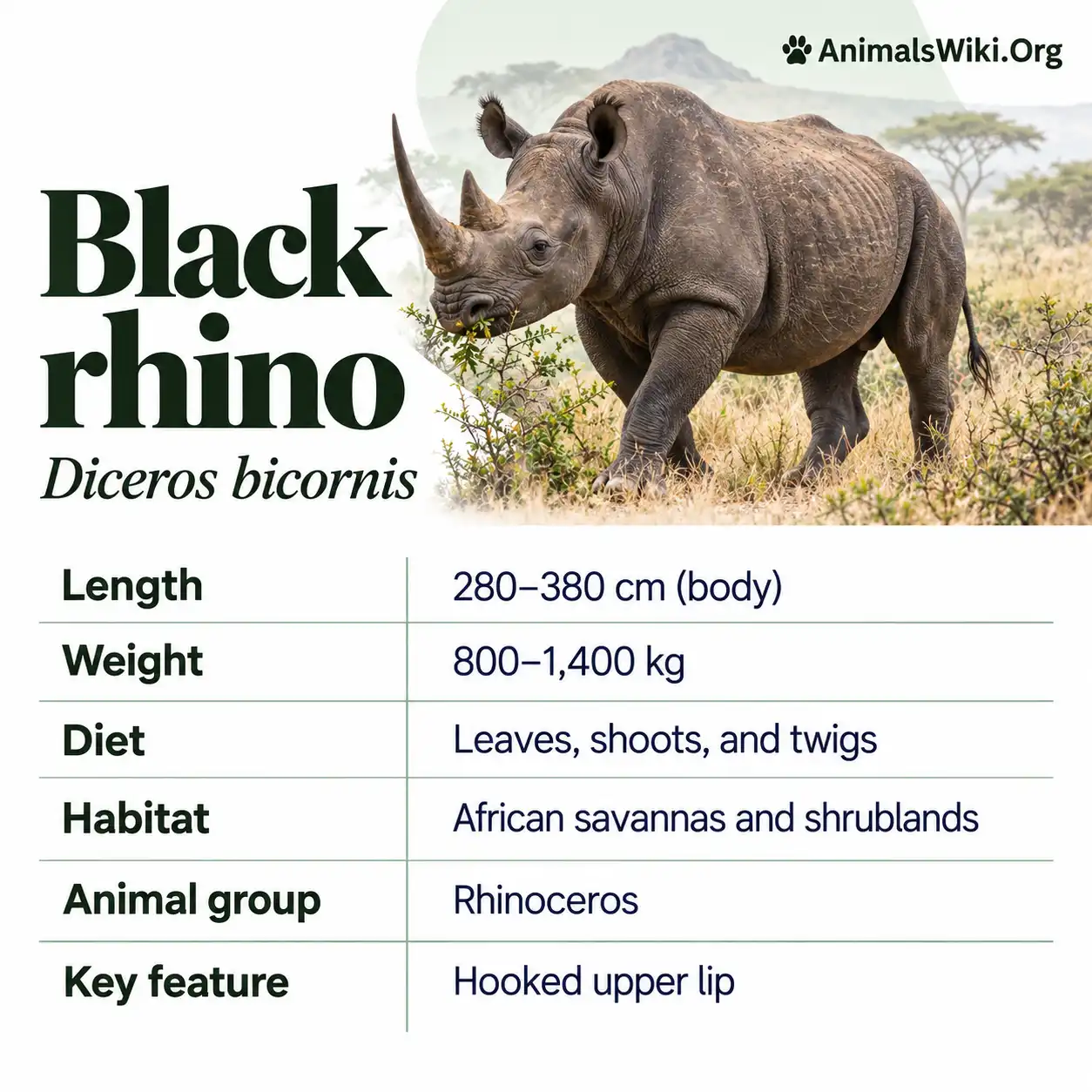
Black Rhino, Africa’s Hooked-Lip Browser and Its Remarkable Recovery
The black rhino is one of Africa’s most recognizable large mammals. Its two horns, powerful body and pointed upper lip give it a distinctive appearance, while its feeding habits make it an important part of woodland, shrubland and savanna ecosystems.
Despite its name, the black rhino usually has gray skin. Mud and dust can change its apparent color, but its most useful identifying feature is its mobile, hooked upper lip. This specialized structure helps it collect leaves and twigs from shrubs and trees.
The species has experienced both a devastating decline and a significant conservation recovery. The latest consolidated estimate used in current international reporting is 6,788 wild black rhinos, referring to the population at the end of 2024. The species remains Critically Endangered.
Those two facts belong together. More animals now survive than during the population’s lowest point, but poaching, limited secure habitat and the challenges of managing small populations continue to threaten progress.
Understanding the black rhino means looking beyond its horns. Its diet, senses, communication, reproductive biology and relationships with other wildlife explain how it lives—and what it needs to recover.
Black Rhino Facts
| Feature | Details |
|---|---|
| Common name | Black rhino |
| Other common name | Hook-lipped rhinoceros |
| Scientific name | Diceros bicornis |
| Animal group | Mammal |
| Order | Perissodactyla |
| Family | Rhinocerotidae |
| Native continent | Africa |
| Main surviving region | Eastern and southern Africa |
| Typical adult weight | Approximately 800–1,400 kilograms, with individual variation |
| Shoulder height | Approximately 1.4–1.7 meters |
| Diet | Herbivorous; primarily a browser |
| Main foods | Leaves, shoots, twigs and other plant material |
| Number of horns | Usually two |
| Pregnancy | Approximately 15–17 months |
| Usual offspring | One calf |
| General social pattern | Often solitary, with maternal bonds and other associations |
| Conservation status | Critically Endangered |
| Latest consolidated wild estimate | 6,788, referring to the end of 2024 |
1. What Is a Black Rhino?
The black rhino is a large, hoofed, plant-eating mammal native to Africa. It is one of two living African rhinoceros species, the other being the white rhino.
Its alternative name, hook-lipped rhinoceros, describes its most distinctive feeding adaptation.
The black rhino is primarily a browser. It obtains much of its food from shrubs, small trees and other vegetation above ground level, using its flexible upper lip to gather suitable plant parts.
This feeding style connects it closely with the structure of its habitat. A landscape containing abundant grass may look productive while offering relatively little of the browse it needs.
Its behavior also reflects a combination of strength and sensitivity. A rhino can push through thorny vegetation, yet it pays close attention to sounds and smells.
It is therefore best understood as a specialized herbivore with complex environmental needs, rather than simply as a heavy animal carrying two horns.
2. Scientific Name and Classification
The scientific name of the black rhinoceros is Diceros bicornis.
Its classification is:
| Classification level | Name |
|---|---|
| Kingdom | Animalia |
| Phylum | Chordata |
| Class | Mammalia |
| Order | Perissodactyla |
| Family | Rhinocerotidae |
| Genus | Diceros |
| Species | Diceros bicornis |
The black rhino is the only living species in the genus Diceros.
It belongs to the order Perissodactyla, which also includes horses and tapirs. These animals share an evolutionary history even though their modern bodies and habitats differ considerably.
Scientific names help distinguish the species from other rhinos and provide consistency across languages.
They also separate species-level identity from subspecies classifications. A southwestern black rhino and an eastern black rhino belong to the same species, although conservation programs recognize important differences between their populations.
That distinction becomes especially relevant when planning breeding, translocations and the preservation of genetic diversity.
3. Why Is It Called a Black Rhino?
Black rhinos are generally gray rather than black.
Their apparent color often reflects the mud or dust coating their skin. An animal wallowing in reddish soil can look different from one using pale or dark mud.
The name probably developed as a distinction from the white rhinoceros. The exact history of common names is less straightforward than the modern labels suggest.
For identification, skin color is therefore unreliable.
A black rhino is better recognized by its pointed upper lip, relatively compact head and browsing behavior.
This naming issue is a useful reminder that animal names do not always describe literal appearance. The white rhino is not truly white either.
A photograph showing a dark rhino cannot identify the species by color alone. Body shape, mouth structure and location provide a much stronger combination of evidence.
4. Appearance and Body Shape
A black rhino has a deep body, strong shoulders, short sturdy legs and a large head ending in a pointed mouth.
Its skin appears thick and wrinkled, with limited body hair. The ears are mobile, and the small eyes sit on either side of the head.
Two horns usually project from the nose, with the front horn generally more prominent.
Compared with the white rhino, the black rhino has a smaller head and a different mouth shape. Its feeding posture also often places the head higher while selecting vegetation from shrubs.
These features work together to create a recognizable profile.
However, posture and lighting can make identification difficult in a single image. A feeding animal may hold its head differently from one resting or investigating a disturbance.
Accurate recognition depends on several characteristics rather than one isolated feature.
5. Size and Weight
Adult black rhinos commonly weigh approximately 800–1,400 kilograms, although published ranges differ and larger individuals occur.
They generally stand around 1.4–1.7 meters at the shoulder.
This makes them smaller than white rhinos, but still among Africa’s largest land mammals.
Age, sex, nutrition and individual development influence body size. A growing subadult should not be compared directly with a fully mature animal.
Maximum measurements can also give a misleading impression if presented as typical.
For readers, the useful picture is of a mammal weighing around a tonne or more, supported by strong limbs and requiring a substantial supply of vegetation.
That body size offers advantages against many natural threats.
It also creates demands. Food, water, shade and usable space must remain available through seasonal changes, droughts and shifts in vegetation.
6. The Hooked Upper Lip
The black rhino’s upper lip is pointed and prehensile, meaning it can grasp and manipulate objects.
While feeding, the lip gathers leaves and twigs and guides them into the mouth.
This allows more selective feeding than simply taking broad mouthfuls of vegetation. A rhino can work around stems and collect particular parts of a plant.
The adaptation is especially useful among shrubs and thorny branches.
Its importance becomes clear when comparing black and white rhinos. The white rhino’s broad mouth suits grazing, while the black rhino’s narrower, flexible lip supports browsing.
Neither design is inherently better. Each fits a different feeding strategy.
The hooked lip is therefore more than an identification feature. It helps explain where the animal feeds, what it selects and why habitat suitable for one African rhino may not meet the needs of the other.
7. What Are Black Rhino Horns Made Of?
Black rhino horns are made primarily of keratin, the structural protein found in human hair and nails.
They differ from ivory, which forms elephant tusks, and from the bony antlers of deer.
The horn grows from specialized tissue on the nose. Its shape reflects growth, wear and the ways the animal uses or rubs it.
Both males and females normally possess horns.
Horn length varies considerably, so it should not be treated as a simple measure of an animal’s age or importance.
The horns contribute to normal behavior, including defense and interactions with other rhinos.
Unfortunately, they have also made the species a target for illegal trade.
A horn is only one part of the animal, but human demand for it has had consequences for entire populations, breeding relationships and the conservation landscapes in which rhinos survive.
8. Hearing, Smell and Vision
Black rhinos have a strong sense of smell and sensitive hearing.
These abilities help them investigate food, other animals and unfamiliar disturbances, particularly where vegetation blocks visibility.
Their ears can turn toward sounds, providing clues about what has attracted their attention.
Vision is comparatively limited, but calling a rhino blind would be inaccurate.
Its awareness comes from the combined use of several senses. A rhino may smell a person or hear movement before obtaining a clear view.
This helps explain why an animal can appear calm and then respond suddenly. It may be reacting to information that an observer has not noticed.
Understanding that sensory world also improves interpretation of behavior.
A lifted head, turning ears or prolonged sniffing can indicate investigation rather than immediate aggression.
The animal is continuously assessing its surroundings, even when it seems to be doing little more than standing among shrubs.
9. Where Do Black Rhinos Live?
Black rhinos survive mainly in eastern and southern Africa.
Important populations occur in countries including Namibia, South Africa, Kenya and Zimbabwe. Other populations occupy protected landscapes elsewhere within the species’ remaining distribution.
The species formerly occurred across a much wider area of sub-Saharan Africa.
Today’s distribution reflects extensive losses, surviving strongholds and conservation reintroductions.
A country-level map can conceal how fragmented that distribution has become. Animals may occupy individual parks, conservancies or reserves separated by land that is unsuitable or unsafe.
For conservation, these protected populations form parts of a wider network.
Their condition differs according to habitat, management, security and breeding history.
Knowing where black rhinos occur is therefore only the beginning. Understanding whether each population is reproducing, genetically connected and adequately protected provides a more useful picture of the species’ future.
10. Black Rhino Habitat
Black rhinos occupy a variety of environments, including shrubland, savanna, woodland and some relatively dry landscapes.
Their habitat needs are shaped by browsing rather than a dependence on extensive short grass.
Suitable areas provide accessible food plants, water or moisture-bearing vegetation, resting places and routes between resources.
The arrangement of these features matters.
A patch containing good browse may become less useful if it is separated from dependable water. A resting site may be attractive during hot conditions but unsuitable during disturbance.
Black rhino habitat should therefore be evaluated as a functioning landscape.
The presence of vegetation alone does not establish its quality.
Plant species, growth stages, seasonal availability and the ability of animals to move safely all influence how well an area supports them.
This helps explain why careful habitat assessment is necessary before establishing a new population.
11. Desert-Adapted Black Rhinos
Some black rhinos live in the arid landscapes of northwestern Namibia.
These animals survive in an environment that can appear remarkably sparse compared with better-known African wildlife habitats.
Their presence does not mean they have no need for water or nutrition. It demonstrates the importance of local adaptations, movement patterns and knowledge of scattered resources.
The phrase “desert-adapted” describes their ecological circumstances rather than identifying a separate species.
Protecting them requires approaches suited to large, open landscapes and the communities sharing those areas.
Save the Rhino Trust works with monitoring teams and partners in Namibia’s communal conservancies and tourism concessions.
These conservation arrangements show that rhino protection can extend beyond conventional fenced reserves.
The landscape, local knowledge and continued tracking all contribute to understanding where animals move and whether they remain safe.
Their survival depends on maintaining that practical relationship between wildlife and the people who live nearby.
12. What Does the Black Rhino Eat?
Black rhinos are herbivores and primarily browsers.
Their diet includes leaves, shoots, twigs, branches and other plant material.
They use many plant species, with the exact selection varying between habitats and seasons.
Although grass consumption is usually limited compared with that of white rhinos, some populations incorporate more grass than a simple “never eats grass” description would suggest.
The best general description is a flexible browsing diet.
Food selection involves more than abundance. Nutrients, fiber, plant defenses and accessibility can all affect what an animal chooses.
A shrub may be common without being heavily eaten, while a less abundant plant may receive disproportionate attention.
Diet research therefore investigates both what is available and what is consumed.
This information helps managers distinguish a landscape that looks vegetated from one that supplies suitable food throughout the year.
13. How Scientists Study Rhino Diets
Observing every mouthful eaten by a wild black rhino is difficult.
Researchers therefore combine several methods, including direct observations, feeding signs and the examination of plant remains in dung.
Backtracking follows an animal’s route to identify where and what it ate.
Dung analysis provides another form of evidence, although different plant materials may be represented unevenly after digestion.
A study in South Africa’s Great Fish River Reserve compared these methods and found differences in the diets they reconstructed.
That result matters because research methods influence conclusions.
A plant missed by one technique may still contribute to the animal’s food intake.
The strongest interpretation often comes from combining approaches rather than assuming one method captures the entire diet perfectly.
For conservation, improving dietary knowledge helps assess habitat quality, investigate poor condition and plan populations according to the resources an area can actually provide.
14. Digestion and Seasonal Nutrition
Black rhinos are hindgut fermenters.
Microorganisms help break down plant material in the enlarged digestive tract behind the stomach, particularly within the cecum and colon.
This arrangement supports the use of fibrous vegetation.
However, a specialized digestive system does not eliminate the effects of changing food quality.
Seasonal rainfall influences leaf growth, the availability of shoots and the condition of woody plants.
Research in Mkomazi National Park examined seasonal changes in food availability, selection and browsing intensity, showing how feeding pressure can increase as preferred resources become less available.
These patterns help explain why habitat capacity changes over time.
A reserve may support animals comfortably during favorable conditions while becoming nutritionally restrictive during a prolonged dry period.
Conservation planning therefore needs to consider difficult seasons as well as the most productive part of the year.
15. Drinking Water and Coping With Dry Conditions
Black rhinos can obtain some moisture from their food.
Their need to visit drinking water depends partly on the moisture content of vegetation and local conditions.
This flexibility helps explain their ability to occupy relatively dry habitats.
Nevertheless, it should not be interpreted as independence from water.
An animal eating dry forage faces different demands from one feeding on fresh, moisture-rich growth.
Water availability also influences movement. A dependable source can become an important destination during unfavorable conditions.
Drought affects more than drinking opportunities. It can reduce the quantity and quality of food, placing additional pressure on pregnant females, mothers and growing calves.
For habitat management, the useful question is whether the landscape can meet animals’ combined needs across changing conditions.
A single permanent water point does not necessarily compensate for widespread deterioration in browse.
16. Wallowing, Shade and Skin Care
Black rhinos use mud wallows and shaded resting places to cope with heat.
Mud can provide relief from biting insects and contribute to skin protection.
A wallow’s usefulness depends on its location, water supply, soil and access.
During the hottest part of the day, an animal may spend considerable time resting rather than feeding.
This is part of its normal energy and temperature management.
Rubbing against suitable surfaces can also help remove dried mud and provide physical comfort.
Such behavior shows why habitat requirements include more than food plants.
A landscape needs places where animals can rest safely and manage environmental stress.
Protecting a wallow may involve maintaining its approaches and surrounding cover, not merely preserving the depression itself.
These small features form part of the network that supports the daily routine of a large herbivore.
17. Daily Activity and Movement
Black rhinos often feed during cooler periods, including early morning, evening and nighttime.
They may rest during hotter hours, although activity varies with weather, disturbance and local resources.
A daytime sighting does not indicate abnormal behavior.
Movement also reflects the arrangement of food, water and shelter.
An individual may return to familiar routes and resting places, producing repeated signs in the same parts of its range.
For researchers, this can make some animals easier to encounter than others.
A camera on a frequently used trail may record many visits without indicating that the wider area holds a large population.
Understanding activity therefore requires both time and space.
Repeated observations help distinguish ordinary use, seasonal shifts and changes that might signal disturbance or declining habitat quality.
The animal’s routine is more informative than any single photograph.
18. Are Black Rhinos Really Solitary?
Black rhinos are often described as solitary, but their social behavior is more varied than that label suggests.
Mothers and calves form lasting associations. Females and younger animals may also associate, while adults meet during breeding or at shared resources.
Males are generally more solitary and may defend access to space or receptive females.
Home ranges can overlap.
This means an animal living independently can still be familiar with others using the same landscape.
A temporary gathering should not automatically be interpreted as a stable herd, but neither should every association be dismissed as accidental.
The International Rhino Foundation specifically notes that female black rhinos can be more social than popular descriptions suggest.
Understanding those relationships matters during population management.
Moving animals changes more than their geographic location. It can alter the social setting in which they feed, breed and establish familiar routines.
19. Scent Communication and Dung Middens
Black rhinos communicate extensively through scent.
Dung piles, often called middens, and urine-marked locations can hold information after an individual has left.
For animals that do not remain together continuously, this provides a way to learn about others without direct contact.
Researchers have investigated how black rhinos respond to chemical signals associated with age, sex and identity.
The information left in dung and urine can contribute to reproductive interactions and relationships between animals.
Middens therefore function as more than waste-disposal sites.
They are part of the species’ social landscape.
A rhino approaching one may sniff, investigate or add its own material.
For observers, such behavior reveals how much communication can occur without dramatic displays.
The apparent quietness of a browsing animal conceals a system of information exchange that depends heavily on smell and repeated use of familiar places.
20. Sounds, Displays and Confrontations
Black rhinos also communicate through vocalizations and body movements.
Snorts, squeaks, growls and other sounds occur in different contexts.
Posture helps shape the meaning of an encounter. Ear position, head movement and the way an animal approaches or retreats can influence another rhino’s response.
Some interactions involve displays rather than immediate physical contact.
These behaviors help animals assess one another and negotiate access to space or mates.
However, confrontations can become serious, especially between competing adults.
The familiar image of a rhino charging captures only one possible response.
A charge may follow alarm or a perceived threat, while many other encounters involve investigation, avoidance or less forceful displays.
Interpreting behavior requires the surrounding context.
A single movement or sound should not be assigned one universal meaning without considering what happened before and how the other animal responded.
21. Reproduction and the Long Pregnancy
Black rhinos can reproduce throughout the year, although local environmental conditions influence patterns of birth and breeding.
Pregnancy generally lasts approximately 15–17 months.
A female usually gives birth to one calf, followed by a long period of maternal investment.
Birth intervals commonly span several years.
This reproductive pace limits how quickly a population can replace lost animals.
A breeding female contributes through repeated successful pregnancies over her lifetime, making her survival especially important.
Reproductive performance also depends on habitat and population conditions.
Adequate nutrition supports pregnancy and nursing, while access to suitable mates influences whether conception occurs.
For managers, counting adult females is therefore only a starting point.
Monitoring which females breed, how often they calve and whether their offspring survive provides a much clearer picture of population growth than total abundance alone.
22. Baby Black Rhinos
A baby black rhino is called a calf.
Newborns commonly weigh a few tens of kilograms, with reference ranges around 27–45 kilograms.
They remain tiny beside their mothers but develop mobility early.
A calf’s first priorities include nursing, keeping close to its mother and learning to move safely through its surroundings.
It may begin sampling plant material while still depending heavily on milk.
The appearance of a young calf can differ from that of an adult. Its horn is small, its body proportions are less imposing and its movements may look tentative or playful.
Each successful birth is important, but a calf must survive beyond the first days to contribute to recovery.
Monitoring growth, condition and the mother–calf relationship helps reveal whether a population is producing the next generation successfully.
23. Maternal Care and Independence
The mother–calf bond is central to black rhino life.
A mother supplies milk and protection while her calf develops the ability to feed and travel independently.
Weaning and separation are different milestones. A young animal can eat vegetation and still benefit substantially from remaining near its mother.
Association often continues for several years.
The arrival of another calf can change that relationship, with the older youngster becoming more independent.
Some young animals may associate with other individuals afterward.
This transition shows why social behavior cannot be reduced to a simple choice between solitary living and permanent herds.
The species includes changing relationships across different life stages.
For conservation, maternal survival protects more than one animal’s future. It also supports the dependent calf whose nutrition and security are closely connected with hers.
24. Lifespan, Predators and Natural Mortality
Black rhinos can live for several decades.
Wild longevity is often described as reaching around 35–40 years, although lifespan varies and maximum age differs from typical survival.
Healthy adults face limited natural predation because of their size and strength.
Calves, sick animals and weakened individuals are more vulnerable. Lions and hyenas can occasionally threaten young rhinos.
Natural mortality also results from injury, disease, drought and conflict between rhinos.
These losses occur even in protected populations.
Conservation becomes especially difficult when additional deaths from poaching exceed what reproduction can replace.
A population’s future therefore depends on the balance between births, survival and movement.
An encouraging total may conceal poor calf recruitment, while a stable population may reflect successful management under difficult conditions.
Long-term records reveal more than a single count.
25. Oxpeckers and the Rhino’s Early-Warning System
Black rhinos sometimes carry oxpeckers, birds that feed in association with large mammals.
The relationship can provide an additional benefit beyond access to food for the bird.
A study in South Africa investigated whether oxpecker alarm calls helped black rhinos detect approaching people.
The rhinos detected human approaches more reliably and at greater distances when oxpeckers were present.
This provides evidence that a bird’s behavior can influence the awareness of a much larger animal.
The finding should remain tied to its study context rather than becoming a claim that oxpeckers always prevent danger.
Nevertheless, it reveals an important ecological connection.
Rhino conservation involves the animal’s relationships with other species as well as its food and habitat.
A landscape that retains these interactions can support functions that might otherwise go unnoticed by people watching only the largest mammal.
26. How Black Rhinos Influence Vegetation
Browsing changes the plants a rhino feeds on.
Removing shoots and twigs can influence plant form and the distribution of feeding pressure.
The animal also transports nutrients through dung and urine, linking feeding locations with deposition sites.
These effects vary according to rhino density, plant communities and local conditions.
It would be misleading to claim that every browsing event benefits every plant. Herbivory can reduce growth or reproduction for some individual plants while contributing to broader patterns in vegetation.
The ecological role emerges from repeated interactions over time.
A black rhino is therefore part of the processes shaping shrubland and woodland.
Its conservation preserves more than a species on a checklist.
It helps retain the feeding, movement and nutrient relationships associated with a large native browser, although their scale depends on how many animals remain and how they use the landscape.
27. Seed Dispersal and Plant Relationships
Black rhinos can consume fruit and transport seeds through their digestive systems.
Whether this benefits a plant depends on seed survival, the location of deposition and subsequent conditions for germination.
A 2025 experimental study examined interactions between black rhinos and Vachellia erioloba, an ecologically important tree in arid savannas.
The results provided evidence that passage through the rhino could enhance germination under the tested conditions.
This is a specific finding, rather than proof that every seed eaten by a rhino benefits.
Further field research can investigate how frequently seeds are consumed, how far they travel and where they are deposited.
The study nevertheless demonstrates how the conservation of a large browser can connect with the regeneration of particular plants.
The animal’s ecological contribution includes relationships that are easy to miss when attention focuses only on horns and population numbers.
28. Black Rhino Population: The Current Picture
The latest consolidated estimate used in current international reporting is 6,788 wild black rhinos.
IUCN identifies this figure as referring to the end of 2024.
The International Rhino Foundation’s 2026 reporting continues to cite it.
The reporting year and population reference date should remain separate. A figure appearing in a 2026 report does not necessarily represent a complete count carried out during 2026.
National updates may also be newer than the consolidated continental estimate.
For example, South Africa reported at least 2,565 black rhinos at the end of 2025.
That national figure should not simply be substituted into an older global total without reconciling the other countries’ data.
The clearest editorial approach preserves the date and scope of each estimate.
This allows readers to understand both the recovery trend and the limits of the available information.
29. Historical Decline and Recovery
The black rhino suffered one of the most severe declines recorded among large African mammals.
Large-scale hunting and poaching reduced a once widespread population to a small fraction of its former size.
Save the Rhino International describes a fall from around 70,000 animals in 1970 to approximately 2,410 in 1995.
Since that low point, protection, population management and translocations have helped numbers increase.
The recovery demonstrates that conservation can reverse a severe decline.
It also illustrates the difference between improvement and security.
Several thousand animals represent substantial progress compared with the 1990s, but remain far below historical abundance.
Recovery requires continued attention because the threats that drove the decline have not disappeared.
The most useful interpretation recognizes the achievement while asking what conditions must continue for another generation of growth.
A past success becomes durable only when the protection supporting it remains effective.
30. Black Rhino Subspecies
A widely used conservation classification recognizes three surviving black rhino subspecies.
| Subspecies | Scientific name | General association |
|---|---|---|
| Southwestern black rhino | Diceros bicornis bicornis | Southwestern African populations |
| South-central black rhino | Diceros bicornis minor | Parts of southern and southeastern Africa |
| Eastern black rhino | Diceros bicornis michaeli | East African populations |
| Western black rhino | Diceros bicornis longipes | Extinct |
Taxonomic discussions have proposed additional arrangements, so older names and classifications appear in the literature.
For a general article, identifying the conservation framework being used is more helpful than presenting every historical name as equally current.
Subspecies matter because populations differ in evolutionary history and management needs.
Translocation decisions should therefore consider ancestry and genetic relationships alongside habitat, security and reproductive potential.
Preserving the species includes maintaining appropriate representation of its remaining diversity.
31. The Extinction of the Western Black Rhino
The western black rhino was declared extinct in 2011.
Its loss should not be confused with the extinction of the entire black rhino species.
Other subspecies survive, but the western form no longer has a living population.
This distinction explains why readers may encounter both “black rhinos are recovering” and “a black rhino subspecies became extinct.”
Both statements can be true.
The loss demonstrates the limits of recovery elsewhere. Increasing numbers in one population cannot restore a lineage after its final individuals have disappeared.
It also reinforces the importance of acting before a population becomes too small or uncertain to manage effectively.
Conservation must pay attention to distribution and diversity as well as the species-wide total.
A growing overall number can conceal the disappearance of particular populations with their own histories and ecological relationships.
32. Why Black Rhinos Remain Critically Endangered
The black rhino remains classified as Critically Endangered at the species level.
That status reflects severe historical decline and continuing vulnerability.
Population growth is encouraging, but the number of animals is only one part of extinction risk.
Poaching, isolation, habitat limitations and the condition of individual populations also matter.
A recovering species can still face a high risk if the improvements depend on intensive protection that could be disrupted.
Assessment categories can also differ between the whole species, particular subspecies and regional populations.
Those scales should not be mixed.
A regional assessment describing a better situation does not automatically change the global species category.
For a general wildlife article, the clearest statement is that black rhinos are recovering overall while remaining Critically Endangered and dependent on sustained conservation.
That accurately communicates progress without implying that protection is no longer necessary.
33. Poaching and Illegal Horn Trade
Poaching remains a major threat to black rhinos.
Illegal demand for horn can turn a surviving population into a target even inside a protected area.
The impact extends beyond the animal killed.
A breeding female’s death removes her future reproductive contribution and may leave a dependent calf without care.
Protection therefore requires prevention, detection, investigation and efforts to disrupt trafficking.
Patrols are one part of the response, supported by information gathering, trained personnel and cooperation between institutions.
Success needs to be maintained rather than treated as a permanent result.
A period with few recorded incidents can reflect effective protection, but it does not establish that demand has vanished.
Conservation programs must continue assessing threats and adapting.
The slow reproduction of rhinos makes avoiding adult losses especially valuable: preventing one death can protect years of future breeding potential.
34. Dehorning: Evidence and Limitations
Some conservation programs remove much of a rhino’s horn under veterinary supervision to reduce the reward available to poachers.
This is a specialized management intervention.
A 2025 study of rhinos in the Greater Kruger region found a large reduction in poaching associated with dehorning.
The research involved African rhinos and should not be presented as a universal black-rhino-only result.
Dehorning also does not remove every risk. Poachers may target remaining horn or regrowth, and ongoing protection remains necessary.
Researchers have separately investigated behavioral changes in dehorned black rhinos, including changes in home-range size and social interactions.
These findings show why management must evaluate both protection benefits and biological consequences.
The useful question is how an intervention performs within a particular conservation setting.
No single technique replaces the need for secure habitat, monitoring, veterinary expertise and an effective response to illegal trade.
35. Translocation and Expanding the Species’ Range
Translocation moves animals under planned conservation management.
For black rhinos, it can establish new populations, restore the species to former habitat and relieve pressure where suitable space is becoming limited.
Kenya’s wildlife authorities documented the translocation of 21 eastern black rhinos to Loisaba Conservancy in 2024.
Such an operation requires preparation before animals arrive.
The destination needs food, water, protection, monitoring and staff capable of responding to problems.
The composition of the founder group matters too. Age, sex, health and genetic relationships influence future breeding.
Success is measured over time through survival, adaptation and reproduction.
A rhino released safely has completed the transport stage, but the conservation objective remains a functioning population.
Range expansion is therefore a long-term biological commitment rather than a single dramatic event.
36. Communities, Monitoring and Conservation Partnerships
Many black rhinos survive in landscapes involving national agencies, private landholders and local communities.
These different forms of management can contribute to recovery when they maintain suitable habitat and effective protection.
In Namibia, community rhino ranger initiatives connect monitoring with people living alongside the animals.
Conservation can provide employment and tourism-related opportunities, although benefits need to be practical and sustained.
Local knowledge also improves understanding of animal movements and changing conditions.
Scientific monitoring adds systematic records of births, deaths, distribution and breeding.
The strongest programs link these sources of information with action.
A missed sighting may prompt further investigation. Declining condition may lead to habitat assessment. A growing population may create opportunities for carefully planned range expansion.
Conservation becomes more resilient when the people responsible for these tasks have the training, resources and partnerships needed to continue across many years.
37. Black Rhino Compared With White Rhino
| Feature | Black rhino | White rhino |
|---|---|---|
| Scientific name | Diceros bicornis | Ceratotherium simum |
| General body size | Smaller | Larger |
| Upper lip | Pointed and prehensile | Broad and square |
| Main feeding strategy | Browsing | Grazing |
| Typical foods | Leaves, shoots and twigs | Mostly grasses |
| Usual feeding posture | Often head raised toward vegetation | Often head lowered |
| Skin color | Generally gray | Generally gray |
| Horns | Usually two | Usually two |
The mouth is one of the clearest differences.
Color is much less useful because both species can appear darker, lighter or reddish after contact with different soils.
Their feeding strategies also explain why conservation planning must consider species-specific habitat.
A grassy landscape that supports white rhinos may provide insufficient browse for black rhinos.
Both need protection, but the resources supporting them are not identical.
38. What a Secure Future Would Look Like
A stronger future for black rhinos would include growing populations distributed across enough secure, suitable habitat.
That requires more than increasing the continental total.
Individual populations need healthy breeding adults, surviving calves and appropriate genetic management.
Protection must remain effective while habitat can continue supporting animals through drought and other environmental changes.
Range expansion can reduce pressure on existing sites and spread risk among additional populations.
Zoos also contribute through coordinated breeding, research and support for field conservation. San Diego Zoo Wildlife Alliance, for example, describes both managed breeding and work directed toward wild population sustainability.
These contributions are most useful when they support a common long-term goal.
The black rhino’s recovery demonstrates that decline can be reversed.
The next challenge is ensuring that progress continues across generations and remains resilient when security, climate or land use changes.
Frequently Asked Questions About the Black Rhino
1. What is a black rhino?
The black rhino is a large African herbivore also called the hook-lipped rhinoceros. Its scientific name is Diceros bicornis. It has two horns and a pointed, flexible upper lip adapted for collecting leaves and twigs.
2. Is the black rhino actually black?
Its skin is generally gray. Mud and dust can change its apparent color, so individuals may look darker, lighter or reddish. The pointed upper lip provides a more useful identification feature than the color of the skin.
3. Where do black rhinos live?
They survive mainly in eastern and southern Africa. Important populations occur in Namibia, South Africa, Kenya and Zimbabwe, with others in protected landscapes elsewhere. Their current distribution is fragmented compared with their much wider historical range.
4. What does a black rhino eat?
It primarily eats leaves, shoots, twigs and other browse from shrubs and trees. Diet varies with habitat and season. Some populations consume grass as well, so describing the species as never eating grass would be too absolute.
5. What is a prehensile lip?
A prehensile lip can grasp and manipulate objects. The black rhino uses its pointed upper lip to collect vegetation and guide it into the mouth. This structure supports selective browsing among stems, branches and leaves.
6. How much does a black rhino weigh?
Adults commonly weigh approximately 800–1,400 kilograms, with variation between individuals and references. Some animals exceed that range. Age, sex and condition should be considered when comparing measurements.
7. How many horns does it have?
Black rhinos normally have two horns. The front horn is generally larger, although shape and proportions vary. Both males and females possess horns, and horn size alone does not reliably establish an animal’s age.
8. What are the horns made of?
They are made primarily of keratin, the structural protein found in hair and nails. Rhino horn differs from ivory and from deer antlers. Its biological composition is one reason accurate descriptions matter when discussing illegal trade.
9. Are black rhinos blind?
No. Their eyesight is comparatively limited, but they can see. Smell and hearing play especially important roles in detecting food, other animals and disturbances. Their awareness comes from the combined use of several senses.
10. Are black rhinos aggressive?
They can defend themselves forcefully when threatened, startled or involved in competition. Their behavior includes investigation, avoidance, displays and social interaction as well as charges. A single description such as “always aggressive” misses that range.
11. Do black rhinos live in herds?
They do not usually form large, permanent herds. Mothers remain with calves, and females or younger animals may associate. Adults also meet during breeding or at shared resources, making their social behavior more varied than complete isolation.
12. How do black rhinos communicate?
They use scent, sounds and body movements. Dung middens and urine-marked places can convey information after an animal leaves. Snorts, squeaks and displays provide additional signals during direct encounters.
13. Why do they roll in mud?
Wallowing helps them cope with heat and provides relief from biting insects. Mud also contributes to skin protection. Suitable wallows and shaded resting places form part of the habitat resources supporting their daily routine.
14. How long is a black rhino pregnant?
Pregnancy generally lasts approximately 15–17 months. The usual result is one calf. This long pregnancy, followed by maternal care, contributes to the species’ relatively slow reproductive rate.
15. What is a baby black rhino called?
A baby is called a calf. Newborns weigh a few tens of kilograms and remain dependent on their mothers. They gradually develop the feeding, movement and social abilities needed for greater independence.
16. How long does a calf stay with its mother?
The association commonly lasts several years. Nursing, eating vegetation and separation occur at different stages. A calf can feed on plants while still benefiting substantially from its mother’s protection and presence.
17. How long do black rhinos live?
They can live for several decades, with wild longevity often described as reaching around 35–40 years. Individual survival varies. Maximum lifespan should be distinguished from the age reached by most animals.
18. What animals prey on black rhinos?
Healthy adults face limited natural predation. Calves and weakened individuals are more vulnerable, with lions and hyenas among the potential predators. Predation is generally less important to conservation than human-caused losses.
19. How many black rhinos remain?
The latest consolidated estimate cited in current international reporting is 6,788 wild animals, referring to the end of 2024. It should not be described as a complete real-time count made during 2026.
20. Are black rhinos extinct?
No. The species survives and has increased since its lowest recorded population levels. However, the western black rhino subspecies is extinct, and the species overall remains Critically Endangered.
21. Why are they endangered if numbers are increasing?
Recovery does not remove all extinction risks. The species has suffered a severe historical decline and continues to face poaching, limited secure habitat and small-population challenges. Continued growth depends on maintaining effective conservation.
22. What happened to the western black rhino?
It was declared extinct in 2011. Other black rhino subspecies survive, so its disappearance did not mean the loss of the entire species. The event nevertheless removed a distinct part of black rhino diversity.
23. Does dehorning protect black rhinos?
It can reduce poaching risk in some settings, but it does not eliminate every threat. Regrowth and remaining horn can still attract poachers. Veterinary care, continued security and monitoring remain essential.
24. Why are black rhinos moved between reserves?
Planned translocations can establish populations in suitable habitat, restore former range and improve population management. They require preparation and long-term monitoring. A successful release begins the next stage of conservation rather than completing it.
25. Can black rhinos continue to recover?
Yes. Their increase since the 1990s demonstrates the potential for recovery. Continued progress requires protection, suitable habitat, successful breeding and cooperation among the people and institutions responsible for their survival.
A Recovery That Depends on Continued Protection
The black rhino’s story contains both a warning and evidence of possibility.
Its historical decline shows how quickly a widespread animal can become scarce. Its recovery shows that sustained protection and careful management can help reverse that process.
A secure future requires the conditions that allow ordinary rhino life to continue: enough browse, dependable resources, safe movement and successful reproduction.
Population growth matters most when it produces healthy calves, viable breeding groups and a wider network of secure habitats.
Protecting the black rhino therefore preserves more than an iconic African mammal. It maintains the relationships between a large browser, its vegetation, other wildlife and the people sharing its landscape.



