
White Rhino, Africa’s Giant Grazer and Its Two Different Conservation Stories
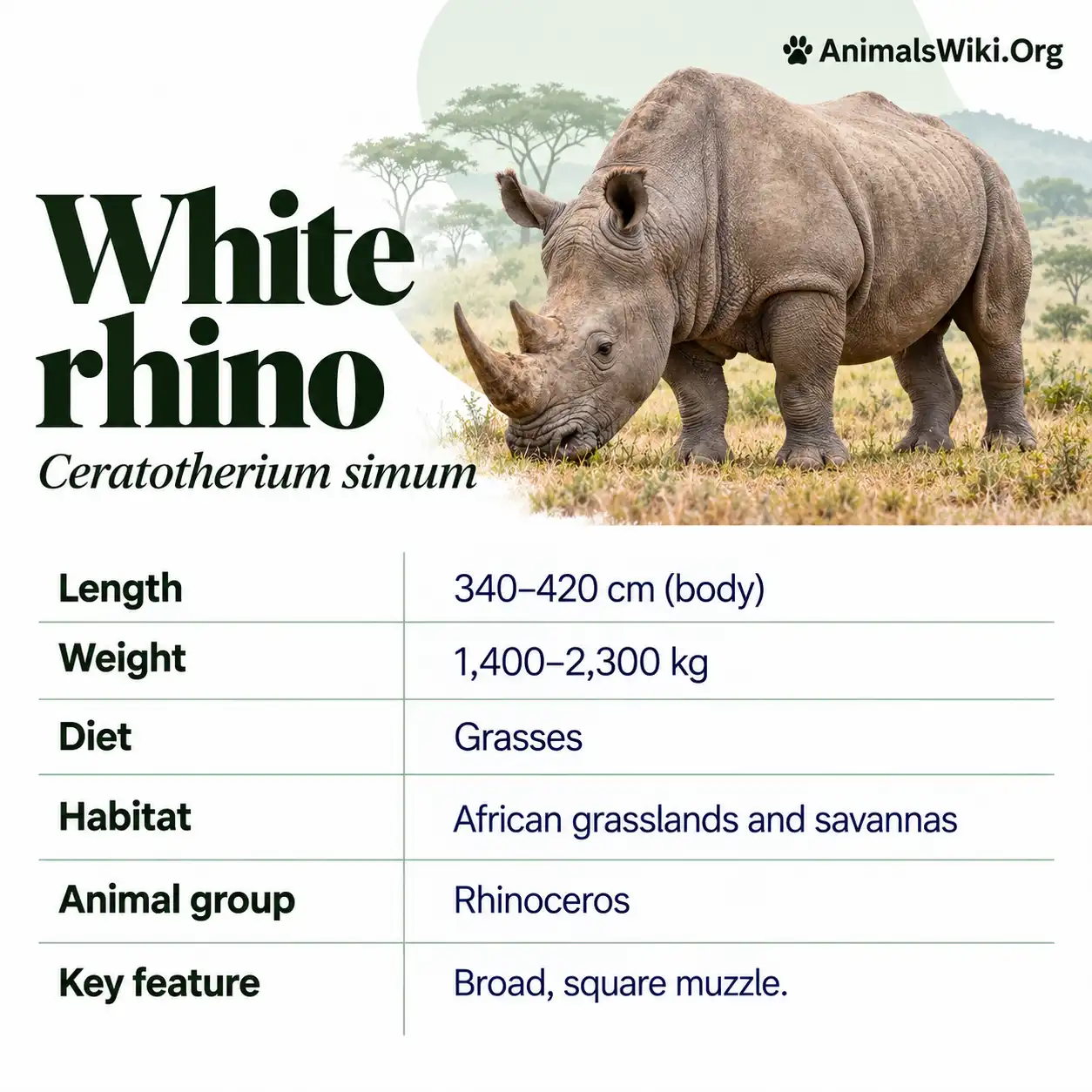
The white rhino is the largest living rhinoceros and one of the heaviest land mammals on Earth. Its broad mouth, massive head and muscular shoulders make it unmistakable as it moves slowly across African grasslands.
Despite its name, the white rhino is generally gray. Its alternative name, square-lipped rhinoceros, describes it more accurately. The wide mouth helps it crop grass close to the ground, supporting a grazing lifestyle that differs from the browsing habits of the black rhino.
Its conservation story contains a striking contrast. Southern white rhinos recovered from an exceptionally small surviving population, becoming the most numerous rhinoceroses. Northern white rhinos, however, declined until only two females remained.
The latest consolidated estimate used in current international reporting is 15,752 white rhinos in Africa, referring to the end of 2024. Almost all belong to the southern population. The two surviving northern white rhinos, Najin and Fatu, live under protection in Kenya.
Understanding the white rhino therefore requires more than one headline number. Its biology explains how it shapes grasslands, while the very different circumstances of northern and southern animals show both the possibilities and limits of conservation.
White Rhino Facts
| Feature | Details |
|---|---|
| Common name | White rhino |
| Other common name | Square-lipped rhinoceros |
| Scientific name | Ceratotherium simum |
| Animal group | Mammal |
| Order | Perissodactyla |
| Family | Rhinocerotidae |
| Native continent | Africa |
| Main feeding strategy | Grazing |
| Main food | Grasses |
| Typical adult weight | Approximately 1,800–2,700 kilograms, with individual variation |
| Shoulder height | Approximately 1.5–2 meters |
| Horns | Usually two |
| Skin color | Gray, often altered in appearance by mud and dust |
| Pregnancy | Around 16 months, with variation between references and individuals |
| Usual offspring | One calf |
| General social pattern | Females and young often associate; adult males are more territorial |
| Species-level conservation status | Near Threatened |
| Northern white rhinos | Two surviving females; natural population recovery is no longer possible |
1. What Is a White Rhino?
The white rhino is a large, hoofed herbivore native to Africa. It belongs to the rhinoceros family and is distinguished by its broad mouth, heavy head and grazing habits.
It is one of two living African rhinoceros species, the other being the black rhino.
Although both have two horns and generally gray skin, their feeding adaptations differ substantially.
A white rhino spends much of its feeding time with its head lowered toward grass. Its mouth collects vegetation across a relatively wide surface, helping it use short grass efficiently.
Its size also influences how it interacts with the landscape. A large animal removes substantial plant material, moves nutrients through dung and creates repeated patterns of use around feeding areas, water and resting places.
The white rhino is therefore both an individual animal with daily needs and an ecological participant whose activities can influence other organisms.
2. Scientific Name and Classification
The scientific name of the white rhinoceros is Ceratotherium simum.
Its classification is:
| Classification level | Name |
|---|---|
| Kingdom | Animalia |
| Phylum | Chordata |
| Class | Mammalia |
| Order | Perissodactyla |
| Family | Rhinocerotidae |
| Genus | Ceratotherium |
| Species | Ceratotherium simum |
The Mammal Diversity Database recognizes the white rhino under this species name.
White rhinos belong to Perissodactyla, the same mammalian order as other rhinoceroses, horses and tapirs.
Their body shape can make elephants or hippopotamuses seem like obvious relatives, but those animals belong to different evolutionary groups.
Two white rhino subspecies are commonly recognized: the southern and northern forms. Some researchers have proposed treating them as separate species, but the subspecies framework remains widely used in conservation reporting.
This article follows that framework while explaining their different conservation circumstances separately.
3. Why Is It Called a White Rhino?
A white rhino is usually gray rather than white.
Mud, dust, wet skin and lighting can all change its apparent color. An animal coated in pale soil may look much lighter than one emerging from dark mud.
A familiar explanation connects the name with a word meaning “wide,” referring to the mouth. However, the naming history is not completely settled, so that explanation is best presented as one account rather than an unquestionable fact.
The alternative name square-lipped rhinoceros avoids the confusion.
It also directs attention to a feature that matters biologically. The broad mouth supports grazing, while the black rhino’s pointed upper lip helps it gather browse.
For identification, mouth shape is much more reliable than color.
A gray animal covered in reddish dust has not changed species; it has simply acquired the color of its surroundings.
4. Northern and Southern White Rhinos
The two commonly recognized subspecies are:
| Subspecies | Scientific name | Present situation |
|---|---|---|
| Southern white rhino | Ceratotherium simum simum | Survives in substantial numbers, although threatened by poaching and other pressures |
| Northern white rhino | Ceratotherium simum cottoni | Only two females survive; recovery depends on advanced reproductive intervention |
Their situations are so different that an article should never use one population’s circumstances to describe the other.
Southern white rhinos account for almost all living white rhinos.
The northern form has no surviving male and cannot recover through ordinary natural breeding.
Calling the entire white rhino species extinct is therefore incorrect. Equally, saying white rhinos are numerous can conceal the northern population’s crisis.
Both statements need biological and geographic context.
The distinction also explains why conservation includes very different activities, from protecting breeding populations across large reserves to developing embryo-transfer techniques for an almost-lost subspecies.
5. What Does a White Rhino Look Like?
The white rhino has a long, heavy head, broad muzzle, deep body and pronounced shoulder hump.
The head usually hangs low during feeding. Its ears project upward and can turn toward sounds even while the animal continues grazing.
The skin is thick and sparsely haired, with visible folds and wrinkles. Hair is most noticeable around the ears, eyelashes and tail tip.
Its back slopes from the raised shoulder region toward the hindquarters.
Two horns normally sit on the nose, with the front horn generally longer.
Compared with the black rhino, the white rhino has a larger head and a much wider mouth.
These characteristics become especially clear in a side view.
However, an animal’s posture changes while resting, looking around or interacting with another rhino. Identification works best when several features are considered together rather than relying entirely on head position.
6. Size, Weight and the Shoulder Hump
The white rhino is the largest living rhinoceros.
Adults commonly weigh roughly two tonnes or more, with males generally heavier than females. Reference ranges differ, partly because exceptionally large animals and typical adults are not the same measurement.
Shoulder height is generally around 1.5–2 meters.
Its pronounced hump supports the powerful musculature associated with its neck and heavy head.
That anatomy fits its feeding position. Holding and moving a large head near ground level requires substantial support.
The body’s size also affects resource requirements. A white rhino needs enough grazing to maintain condition, support pregnancy and raise a calf.
Its strength offers protection against many natural predators, but it cannot compensate for an inadequate food supply.
Large size is therefore both an advantage and a demand placed on the habitat supporting the animal.
7. The Square Mouth and Grazing Adaptation
The white rhino’s mouth is broad and relatively flat across the front.
This shape allows it to gather grass close to the ground.
Unlike the black rhino’s flexible, pointed upper lip, the white rhino’s mouth is suited to collecting vegetation across a wider feeding surface.
The difference helps the two species use different food resources when they share a landscape.
A white rhino can move slowly while cropping grass, repeatedly taking bites as it advances.
Its head and neck position support that continuous feeding routine.
The mouth therefore explains more than how the animal looks. It helps explain where it spends time, which habitats support it and how it influences grassland vegetation.
A reserve dominated by dense shrubs may offer good browse for black rhinos while providing less suitable grazing for white rhinos.
Conservation planning needs to recognize those feeding differences.
8. Horns: Structure and Biological Importance
Both male and female white rhinos usually have two horns.
The front horn is generally larger, while the rear horn is shorter.
Horns are made primarily of keratin, the structural protein found in hair and nails. They differ from ivory and from the bony antlers of deer.
Their shape reflects growth, wear and use.
A long horn is not a simple measurement of an animal’s age because individual development and abrasion vary.
Horns contribute to defense and interactions between rhinos. Their importance should be understood within the animal’s normal behavior.
Unfortunately, demand for horn has made white rhinos targets for illegal killing.
The resulting damage extends beyond the animal killed. Losing a breeding female can also remove future calves from a population’s recovery.
Protecting rhinos therefore preserves entire life histories and reproductive possibilities, not merely a collection of living individuals.
9. Hearing, Smell and Vision
White rhinos have sensitive hearing and a strong sense of smell.
Their mobile ears can turn toward sounds, providing visible clues about what has attracted attention.
Smell helps them investigate other rhinos, food and unfamiliar activity.
Their eyesight is comparatively limited, but describing them as blind would be inaccurate.
An animal can be aware of something through sound or scent before a person watching it notices any obvious response.
This matters when interpreting behavior. A rhino that pauses, raises its head or turns its ears may be assessing a disturbance.
Its sensory world includes information that is not immediately visible.
A grazing animal is therefore not necessarily inattentive.
The combination of hearing, smell and vision allows it to feed while remaining responsive to its surroundings.
Giving wildlife space also allows those assessments to occur without forcing the animal into a defensive encounter.
10. Where Do White Rhinos Live?
Most surviving white rhinos belong to southern populations in Africa.
South Africa holds the largest share, with other important populations in countries including Namibia, Zimbabwe and Kenya.
Conservation translocations have also established or reinforced populations elsewhere.
Current distribution therefore reflects both historical range and deliberate management.
Northern white rhinos formerly occupied parts of central and northeastern Africa. Their last two surviving representatives now live under protection at Ol Pejeta Conservancy in Kenya.
These are different distribution stories.
A southern white rhino living in a newly established population does not represent the recovery of the northern subspecies.
Likewise, a map showing white rhinos in several countries can hide major differences in ancestry, population size and conservation purpose.
For an accurate overview, distribution should identify which form is being discussed and whether animals are native survivors, reintroduced populations or managed individuals.
11. Grasslands, Savannas and Suitable Habitat
White rhinos occupy grassland and savanna environments, including landscapes containing scattered trees and wooded areas.
Good habitat combines suitable grazing, water, shade and resting places.
Open ground alone does not establish suitability.
Grass height, species composition, seasonal growth and the amount of usable forage all affect how well an area supports animals.
A landscape can look green while offering relatively poor feeding conditions.
Conversely, a short-grass patch may appear sparse to a casual observer while providing valuable grazing.
The arrangement of resources also matters. Animals need routes between feeding areas, water and refuge from heat.
Protected-area managers therefore assess habitat as a working system rather than a simple acreage.
This is especially important before introducing rhinos into a new location, where food availability and seasonal conditions may differ from those at the source population.
12. What Does the White Rhino Eat?
The white rhino is an herbivore and a specialized grazer.
Its diet consists overwhelmingly of grasses.
It commonly selects short grass, using its broad mouth to crop vegetation close to the soil surface.
The amount and quality of food available change with rainfall, grazing pressure and plant growth.
This creates choices during feeding. An animal may encounter short, nutritious growth in one area and taller, more fibrous material elsewhere.
Research on dry-season feeding has examined how white rhinos respond as short-grass patches become depleted.
The results show why diet cannot be reduced to the statement that rhinos simply eat whatever grass is present.
Feeding involves balancing accessibility, bite size and nutritional return.
For conservation, maintaining usable grazing is essential. A population can remain protected from poachers while still suffering if food becomes too scarce or poor in quality.
13. Digestion and Processing Fibrous Food
White rhinos are hindgut fermenters.
Microorganisms help break down plant material within the enlarged digestive tract behind the stomach, particularly in the cecum and colon.
This differs from the digestive arrangement of ruminants such as cattle, which ferment food in chambers before the main stomach.
For a large grazer, digestion involves processing substantial quantities of fibrous material.
Food selection and chewing begin that process before microbial activity contributes further.
The digestive system supports the use of grasses, but it does not remove the effects of inadequate nutrition.
An animal still needs sufficient intake and a diet suitable for its physiological condition.
Pregnant females, nursing mothers and growing calves place particular demands on available resources.
Understanding digestion therefore connects anatomy with habitat management. The capacity to eat grass does not mean every grassland can support the same number of rhinos indefinitely.
14. Drinking Water and Wallowing
Water contributes to drinking, cooling and physical comfort.
White rhinos visit water sources and use mud or shallow water to obtain relief from heat.
Wallowing also helps protect the skin from sun exposure and biting insects.
A wallow functions as more than an isolated muddy patch. Its approaches, shade and seasonal persistence affect how useful it is.
Several animals may use the same site, creating temporary gatherings.
During hot conditions, resting near or within a wallow can become an important part of the daily routine.
These behaviors show why habitat assessment must include resources beyond food.
A large area of grazing can still lack suitable places for animals to manage heat and rest.
Maintaining water and wallows, together with safe access to them, supports the ordinary activities that keep a population healthy.
15. Daily Activity and Movement
White rhinos divide their time among grazing, resting, drinking, wallowing and social interaction.
They often feed during cooler periods, but activity remains flexible.
Weather, disturbance and the distribution of food can alter an individual’s schedule.
A rhino resting at midday may become more active later, while an animal grazing in daylight may simply be responding to favorable conditions.
Movement connects the resources within its home range.
Repeated use of particular routes can create recognizable trails between feeding and resting areas.
For researchers, a sighting records one moment rather than a complete daily pattern.
Understanding movement requires repeated observations or monitoring over time.
This is also important during translocation. An animal entering unfamiliar habitat must establish new routines and locate resources.
Safe transport is therefore only one stage in helping it settle successfully into a new landscape.
16. Why White Rhinos Form Groups
White rhinos are generally more social than the other living rhinoceros species.
Females and young often associate, while adult males are more commonly solitary and territorial.
Groups can include a mother and calf, several females or younger animals that remain together after becoming independent.
The familiar collective term “crash” describes a group of rhinos, but it does not explain the relationships within it.
A temporary gathering at water is different from a stable association.
Likewise, a large group does not mean every animal belongs to one permanent social unit.
Understanding these distinctions helps explain behavior more accurately.
Social relationships can influence movement, resting and the experience of young animals.
They also matter in managed populations, where introductions and transfers change the individuals an animal encounters.
A rhino’s surroundings therefore include a social environment as well as vegetation and terrain.
17. Male Territories and Breeding Access
Mature male white rhinos can occupy territories used in reproductive competition.
Females move through broader home ranges that may overlap the areas used by several males.
Territorial males monitor the presence and reproductive condition of females while responding to potential competitors.
Their behavior includes scent marking and direct interactions.
Not every adult male holds a territory, and reproductive success can differ considerably between individuals.
This matters when assessing population potential.
A population containing several males does not necessarily receive an equal breeding contribution from each.
Management needs to consider age, social status, relatedness and reproductive history.
Providing suitable habitat can influence these relationships by affecting how animals distribute themselves.
Population growth therefore depends on more than the number of rhinos present. It requires a social and environmental setting in which successful breeding occurs.
18. Dung Middens as Information Centers
White rhinos use communal dung piles called middens.
These sites contain chemical information that other rhinos can investigate.
Research has found differences in dung odors associated with sex, age, male territorial status and female reproductive condition.
Experiments using reconstructed odor profiles also demonstrated behavioral responses.
This makes a midden much more than a place where animals leave waste.
It can function as an information center within the landscape.
A rhino may learn about others without encountering them directly.
That is particularly useful where animals move through overlapping areas at different times.
The findings reveal how communication can depend on chemistry rather than visible displays.
They also show why dung is valuable to researchers. It provides information about behavior, reproduction, health and feeding through methods that can often be used without capturing the animal.
19. How Scent Changes Over Time
A chemical signal does not remain unchanged after being deposited.
Temperature, moisture and time influence the odors released from dung.
Research on white rhinos has investigated how signals vary over hours and between seasons.
This helps explain why scent communication is a dynamic process rather than a permanent notice left on the ground.
A recently used midden may contain different information from one that has not received a fresh deposit for some time.
The surrounding conditions can also influence how long particular signals remain available.
For researchers, this means sample timing matters.
For the animal, it means repeated investigation and marking can maintain information within familiar areas.
The study of these processes adds detail to an apparently simple behavior and demonstrates how closely communication is connected with the physical environment.
20. Sounds and Body Language
White rhinos communicate through vocalizations and physical behavior as well as scent.
Their repertoire includes snorts, growls and softer contact sounds. Calves can produce conspicuous calls when seeking attention or responding to separation.
Posture contributes additional information.
Head movements, ear position, approaches and retreats help shape an encounter.
A display may allow animals to assess one another without immediately escalating to physical contact.
However, confrontations can become dangerous, especially when mature males compete.
The meaning of a signal depends on context.
A sound heard during a tense encounter should not automatically be assigned the same interpretation when produced in a different situation.
Observing the sequence of behavior provides a stronger explanation than identifying one isolated movement.
White rhino social life is therefore a combination of visible actions, audible signals and chemical information.
21. Mating and Pregnancy
White rhinos can breed throughout the year, although local conditions may influence reproductive patterns.
Pregnancy lasts roughly 16 months, with references reporting some variation.
The female normally gives birth to one calf.
A successful pregnancy requires sustained maternal investment, and the time between calves usually spans years.
That slow pace is important to conservation.
A population cannot rapidly replace repeated adult losses, even when several females are capable of breeding.
Researchers therefore monitor reproductive performance alongside abundance.
Useful information includes which females conceive, whether pregnancies reach term and how many calves survive.
These measures reveal whether a population is recruiting the next generation.
They can also help distinguish a stable-looking group with poor breeding from a genuinely growing population.
Protecting adults and supporting successful reproduction are closely connected parts of recovery.
22. Baby White Rhinos
A baby white rhino is called a calf.
Newborns usually weigh several tens of kilograms, with commonly reported figures around 40–60 kilograms.
They remain small beside their mothers but develop mobility early.
The calf begins nursing and gradually explores its surroundings.
Its horn is far less developed than that of an adult, and its body proportions give it a noticeably different appearance.
Play, short runs and investigation can become visible parts of development.
Managed-care observations provide detailed records of these changes because keepers can follow individuals closely.
A birth is an important event, but it begins a longer process.
The calf must establish nursing, grow, maintain health and eventually become independent.
For conservation, survival through those stages is what turns an encouraging birth announcement into a lasting contribution to the population.
23. Maternal Care and Growing Independence
The mother–calf relationship is central to a young white rhino’s life.
The mother provides milk and protection while the calf develops the ability to graze and move independently.
Eating grass does not immediately end dependence.
Nursing, nutritional independence and eventual separation occur at different stages.
Association often continues for several years, commonly changing when the mother produces another calf.
Young animals may then associate with others.
This transition fits the species’ broader social pattern, in which females and immature animals can form relationships beyond a single breeding pair.
A managed-care report describing a calf’s introduction to other rhinos illustrates how social development can continue after the first weeks with its mother.
For a growing calf, learning to live among other animals is part of becoming an independent member of the population.
24. Calf Survival and Environmental Conditions
Not every calf survives to adulthood.
Health, maternal condition, rainfall and habitat quality can influence the outcome.
A long-term study of white rhinos examined how rainfall and the mother’s home-range choices related to calf survival.
The findings emphasize that reproduction is connected with the environment used by the mother.
A birth alone does not establish that habitat conditions are adequate throughout the calf’s development.
Changes in food availability can affect maternal nutrition, while local habitat differences influence access to resources.
This is why conservation programs track survival as well as births.
If calves repeatedly die at particular ages or under certain conditions, those patterns can guide investigation.
Detailed records turn individual events into evidence that helps managers improve the conditions for future young.
25. Lifespan and Natural Predators
White rhinos can live for several decades, often reaching around 40 years and sometimes longer.
Maximum lifespan differs from the age reached by most animals.
Health, injuries, environmental conditions and human pressures influence survival.
Healthy adults face limited natural predation because of their size and strength.
Calves are more vulnerable, although maternal protection reduces many risks.
Natural mortality also includes disease, drought and injuries associated with interactions between animals.
These losses are part of population biology, even in secure reserves.
Conservation becomes particularly challenging when additional human-caused deaths exceed the species’ capacity to replace them.
Long-term survival records therefore matter.
They help distinguish normal variation from unusual mortality and show whether adults, calves or particular groups are experiencing a problem that requires attention.
26. Grazing Lawns and Ecosystem Engineering
Repeated white rhino grazing can help maintain patches of short grass known as grazing lawns.
These patches differ from surrounding taller vegetation and can influence how other animals use a landscape.
Experimental research has examined what happens when rhinos are removed from areas.
In some settings, grass became taller without their grazing, demonstrating that the animals were helping maintain a particular vegetation structure.
This is one reason white rhinos are described as ecosystem engineers.
Their influence comes from ordinary feeding repeated over time.
However, the effect depends on rainfall, other herbivores and local conditions.
A rhino does not produce the same outcome everywhere.
The important finding is that the loss or restoration of a large grazer can change habitat structure, creating consequences beyond the survival of the rhino itself.
27. Grassland Diversity and Fire
White rhino grazing can affect the amount and arrangement of grassy vegetation.
Because grass also provides fuel, these changes can influence the way fire moves through some savanna landscapes.
Research has connected short-grass patches maintained by rhinos with changes in habitat for other grazers and potential effects on fire.
The relationship is complex.
Rainfall, ignition, weather and the activities of other herbivores also influence fire behavior.
It would therefore be misleading to say that rhinos prevent all fires or control an entire ecosystem by themselves.
Their contribution is one part of a wider set of processes.
Research in Kruger National Park has also explored landscape effects associated with the return of white rhinos.
These studies show why conservation can involve restoring ecological functions as well as increasing the number of animals.
28. Drought and the Limits of Adaptation
White rhinos depend heavily on grass, making prolonged shortages especially important.
Drought can reduce forage quantity and quality while increasing the difficulty of maintaining body condition.
A study of the 2015–2016 drought in Kruger National Park found increased natural mortality and reduced births among white rhinos.
The same study did not detect equivalent changes in black rhinos, illustrating how feeding strategies can influence vulnerability.
The finding should remain tied to that research setting rather than becoming a claim that every drought affects the species identically.
Nevertheless, it provides a clear conservation lesson.
Protecting animals from poaching is essential, but populations also need habitat capable of supporting them through difficult environmental conditions.
Monitoring vegetation, body condition and reproduction can help reveal pressures before they appear fully in population totals.
29. How Many White Rhinos Remain?
The latest consolidated estimate used in current international reporting is 15,752 white rhinos in Africa, referring to the end of 2024.
The International Rhino Foundation’s 2026 reporting continues to cite that figure.
The reference date matters.
A population estimate appearing on a current webpage is not necessarily a complete count made during the current year.
Figures for wild or free-ranging animals also need to be distinguished from animals held in zoos or other managed settings.
Most importantly, the total should not be interpreted as representing a secure northern white rhino population.
Almost all surviving white rhinos belong to the southern form.
For publication, the clearest wording keeps the population figure, its date and its scope together.
That allows readers to understand both the species’ relative abundance and the limits of the available estimate.
30. Are White Rhinos Endangered?
At the species level, the white rhino is classified as Near Threatened on the IUCN Red List.
This differs from the formal categories Vulnerable, Endangered and Critically Endangered.
Near Threatened does not mean free from serious concern.
The species still faces substantial poaching pressure and has experienced recent population declines.
The northern white rhino is in a much more severe situation and is commonly described as functionally extinct because ordinary natural breeding is no longer possible.
These different scales explain why general statements can become confusing.
A species-level category summarizes the wider assessment, while a subspecies can face a very different future.
The most accurate description is that southern white rhinos remain numerous enough to support recovery efforts, while northern white rhinos survive as two females and require extraordinary reproductive intervention.
31. Southern White Rhino Recovery
Southern white rhinos came close to extinction during the nineteenth and early twentieth centuries.
A small surviving population in what is now South Africa became the foundation for recovery.
Protection, breeding and the movement of animals into additional areas helped numbers increase substantially.
Operation Rhino, developed in the early 1960s, became an important part of that expansion.
The recovery demonstrates the value of acting while enough breeding animals remain.
It also shows why saving one stronghold can have consequences across a much wider region.
However, the achievement should not be interpreted as permanent protection against decline.
The population’s later exposure to intense poaching illustrates how progress can be reversed.
Conservation history provides evidence of possibility, while current monitoring determines whether the conditions supporting that recovery remain effective.
32. Poaching and Protection
Illegal demand for rhino horn remains a major threat.
White rhinos can be targeted even in managed and protected landscapes.
The impact of a killing includes the immediate loss and the animal’s future reproductive contribution.
A nursing calf may also be affected if its mother dies.
Protection involves several connected activities: monitoring, patrols, intelligence, investigation and action against trafficking.
Veterinary interventions such as dehorning are also used in some settings, alongside continued security.
No single measure removes every risk.
Successful protection requires the ability to detect changing threats and respond effectively.
It also depends on the people carrying out daily work, including rangers, animal monitors, veterinarians and managers.
The slow reproductive cycle of rhinos makes prevention particularly valuable. Avoiding an adult death can preserve many years of potential contribution to the population.
33. Rhino Rewild and Population Expansion
African Parks launched Rhino Rewild after taking responsibility for a large southern white rhino breeding operation in 2023.
The initiative aims to move approximately 2,000 animals into secure, well-managed protected areas over a decade.
Its September 2026 update reported that 745 rhinos had been moved to 19 recipient areas across four countries.
The same update documented births and deaths, emphasizing that translocation carries both opportunities and risks.
Those details matter.
Moving animals is not the same as establishing a successful population.
Recipients need suitable grazing, security, veterinary capacity and continued monitoring.
The animals must adapt, survive and reproduce.
The program illustrates the scale of planning involved in population expansion and the importance of reporting outcomes beyond the number transported.
A release begins the next stage of responsibility rather than completing the conservation objective.
34. The Last Northern White Rhinos
Najin and Fatu are the two surviving northern white rhinos.
They are mother and daughter and live under intensive protection at Ol Pejeta Conservancy in Kenya.
The last male, Sudan, died in 2018.
Neither surviving female can carry a pregnancy, so natural reproduction cannot restore the population.
This is the basis for describing the northern white rhino as functionally extinct.
The term does not mean that no living individuals remain. It means the surviving animals cannot maintain the population through ordinary breeding.
Their care remains essential, both for their welfare and their contribution to conservation research.
At the same time, preserving a living population now depends on stored genetic material and advanced reproductive methods.
The situation demonstrates how difficult recovery becomes after the remaining animals lose the ability to produce another generation naturally.
35. IVF, Embryos and Surrogate Mothers
The BioRescue program is developing assisted reproductive methods for northern white rhinos.
The approach involves collecting eggs, fertilizing them using preserved northern white rhino sperm and transferring resulting embryos into southern white rhino surrogates.
These are several different stages.
Creating an embryo does not establish a pregnancy, and a pregnancy does not guarantee a live calf.
Research with southern white rhinos has helped demonstrate parts of the process, including an embryo-transfer pregnancy reported from work conducted in 2023.
The northern program still faces major challenges, including limited genetic material and the technical demands of transfer.
Its long-term aim extends beyond one birth.
A viable recovery would require multiple healthy animals, successful breeding and the preservation of enough genetic diversity to support future generations.
Advanced reproduction therefore complements habitat and population conservation; it does not make either unnecessary.
36. The Verified Northern White Rhino Update
An April 22, 2026 BioRescue update reported that three northern white rhino embryo transfers conducted during the second half of 2025 had not produced a long-term pregnancy.
The program had also introduced additional potential surrogate females.
A partner announcement described the creation of another northern white rhino embryo from eggs collected from Fatu at the beginning of 2026.
These developments represent continuing research and practical progress, but they should be reported accurately.
They are not confirmation of a northern white rhino calf.
As of the information verified for this article, the appropriate wording is that embryo production and transfer efforts continue.
Future updates should distinguish laboratory milestones, confirmed pregnancies, deliveries and calf survival.
Clear reporting helps readers appreciate the work without turning hope into a result that has not yet been demonstrated.
37. What Zoos and Reproductive Research Contribute
Zoos contribute through breeding, veterinary knowledge, public education and support for field conservation.
Southern white rhinos also provide opportunities to develop reproductive techniques.
In 2019, San Diego Zoo Safari Park reported the birth of Edward following artificial insemination.
That method differs from IVF and embryo transfer: sperm is introduced into the female, and fertilization occurs within her reproductive tract.
Explaining the distinction avoids treating every assisted birth as the same scientific achievement.
The work can improve understanding of fertility, pregnancy and calf development.
However, a managed birth is one contribution within a much larger conservation effort.
Long-term survival still requires secure habitat, effective protection and populations capable of reproducing.
The strongest connection between managed care and field conservation is the exchange of useful knowledge, resources and carefully planned support.
38. White Rhino Compared With Black Rhino
| Feature | White rhino | Black rhino |
|---|---|---|
| Scientific name | Ceratotherium simum | Diceros bicornis |
| General size | Larger | Smaller |
| Mouth | Broad and square | Pointed and prehensile |
| Main diet | Grass | Leaves, shoots and twigs |
| Feeding strategy | Grazing | Browsing |
| Typical feeding posture | Head lowered | Often head raised toward vegetation |
| Social pattern | Females and young commonly associate | Often more solitary, with important exceptions |
| Skin color | Generally gray | Generally gray |
| Horns | Usually two | Usually two |
The mouth provides one of the clearest distinctions.
Skin color is much less useful because mud and dust can make either species appear pale, dark or reddish.
The feeding difference also explains why suitable habitat is species-specific.
Conserving both African rhinos requires attention to the resources and relationships supporting each one.
Frequently Asked Questions About the White Rhino
1. What is a white rhino?
The white rhino is Africa’s largest rhinoceros and a specialized grass eater. It has a broad mouth, heavy head, shoulder hump and two horns. Its scientific name is Ceratotherium simum, and it is also called the square-lipped rhinoceros.
2. Is a white rhino actually white?
Its skin is generally gray. Mud, dust and moisture can alter its appearance. The common name does not provide a reliable identification feature, so mouth shape and body proportions are more useful when distinguishing it from a black rhino.
3. Why is it called the square-lipped rhino?
Its mouth is broad and relatively flat across the front. This shape helps it crop grass near ground level. The alternative name describes a feeding adaptation more accurately than the color-based common name.
4. How much does a white rhino weigh?
Adults commonly weigh approximately 1,800–2,700 kilograms, with males generally heavier than females. Larger individuals occur, and references vary. Typical weights should be distinguished from maximum records or measurements of exceptionally large animals.
5. Is it the largest rhinoceros?
Yes. The white rhino is the largest living rhinoceros species. Its enormous body, heavy head and powerful shoulders place it among the world’s largest land mammals, although measurements vary substantially between individuals.
6. What does a white rhino eat?
It primarily eats grasses, often selecting short growth. Its feeding choices change as rainfall, grazing pressure and seasonal conditions alter availability. Having abundant vegetation does not necessarily mean an area provides suitable grazing throughout the year.
7. Is it a browser or a grazer?
The white rhino is a grazer. This distinguishes it from the black rhino, which primarily browses shrubs and trees. Their different mouth shapes reflect these feeding strategies and help explain their contrasting habitat requirements.
8. How many horns does it have?
White rhinos normally have two horns. The front horn is generally longer than the rear one. Both males and females possess horns, with substantial individual differences in shape and length.
9. What are its horns made of?
The horns are made primarily of keratin, the structural protein found in hair and nails. They differ from ivory and bony antlers. Growth and wear influence their final shape, so horn length alone is not a precise age indicator.
10. Where do white rhinos live?
Most surviving animals are southern white rhinos living in Africa, especially South Africa and other managed populations. The two surviving northern white rhinos live at Ol Pejeta Conservancy in Kenya under intensive protection.
11. Do white rhinos live in groups?
Females and younger animals often associate. Adult males are generally more territorial and commonly live alone. A gathering at water may be temporary, while some associations between females or immature animals persist longer.
12. What is a group of rhinos called?
A group is commonly called a crash. The term does not establish how the animals are related or whether they form a stable social unit. Understanding the group requires observing the individuals and their relationships.
13. Are white rhinos dangerous?
They are powerful wild animals capable of causing serious injury when threatened, crowded or disturbed. Their generally calm appearance while grazing should not encourage close approaches. Responsible viewing follows local guidance and allows animals space to move away.
14. How long is a white rhino pregnant?
Pregnancy lasts around 16 months, with variation between individuals and published references. The usual result is one calf. This long reproductive investment limits how quickly a population can replace repeated losses.
15. What is a baby white rhino called?
A baby is called a calf. Newborns commonly weigh around 40–60 kilograms and depend on their mothers for milk and protection. They gradually begin grazing while remaining associated with their mothers.
16. How long does a calf stay with its mother?
Association often continues for several years, commonly changing when another calf is born. Nursing, grazing and independence are separate developmental stages. Eating grass does not immediately remove the benefits of maternal protection.
17. How long do white rhinos live?
They can live for several decades, often reaching around 40 years and sometimes longer. Lifespan varies with health, environmental conditions and other pressures. Maximum longevity is different from the age reached by most individuals.
18. How many white rhinos remain?
The latest consolidated estimate cited in current reporting is 15,752 in Africa, referring to the end of 2024. Almost all belong to the southern population. The date and scope should remain attached to the figure.
19. Are white rhinos endangered?
The species-level IUCN classification is Near Threatened. Northern white rhinos face a much more severe situation, with only two females surviving. Species-level and subspecies-level circumstances should therefore be explained separately.
20. Are northern white rhinos extinct?
Two individuals remain alive, so they are not completely extinct. They are described as functionally extinct because natural breeding can no longer restore the population. Assisted reproduction is being pursued to preserve their lineage.
21. Who are Najin and Fatu?
Najin and Fatu are the two surviving northern white rhinos. They are mother and daughter and live at Ol Pejeta Conservancy in Kenya. Their welfare and protection remain central to the northern white rhino conservation program.
22. Why can they not breed naturally?
There is no surviving male northern white rhino, and neither female can carry a pregnancy. Researchers therefore use preserved sperm, collected eggs and embryo-transfer methods involving southern white rhino surrogates.
23. Has a northern white rhino calf been produced through IVF?
The verified updates used for this article describe embryo production and transfer attempts rather than a confirmed northern white rhino calf. An April 2026 update reported that earlier northern embryo transfers had not resulted in a long-term pregnancy.
24. What is the difference between northern and southern white rhinos?
They are commonly recognized as separate subspecies with different historical distributions and conservation circumstances. Southern white rhinos survive in substantial numbers. Northern white rhinos survive as two females and require advanced reproductive intervention for any prospect of recovery.
25. Can white rhinos continue to recover?
Southern white rhinos have demonstrated a strong capacity to recover when protected and provided with suitable habitat. Continued progress requires security, healthy grazing, successful breeding and careful population management. Northern recovery presents a separate and much more difficult challenge.
A Giant Grazer With an Unfinished Conservation Story
The white rhino connects two very different lessons.
Southern white rhinos show that a population reduced to a small remnant can recover through sustained protection and management. Northern white rhinos show how difficult recovery becomes once natural breeding is no longer possible.
Both stories point toward the same practical priorities: protect animals while enough reproductive options remain, maintain suitable habitat and use research to improve decisions.
A grazing rhino also shapes the world around it, influencing grass height, nutrient movement and the habitats used by other wildlife.
Its future therefore matters beyond the survival of one impressive mammal. Continued recovery would preserve a large grazer and the ecological relationships associated with its everyday life.



