
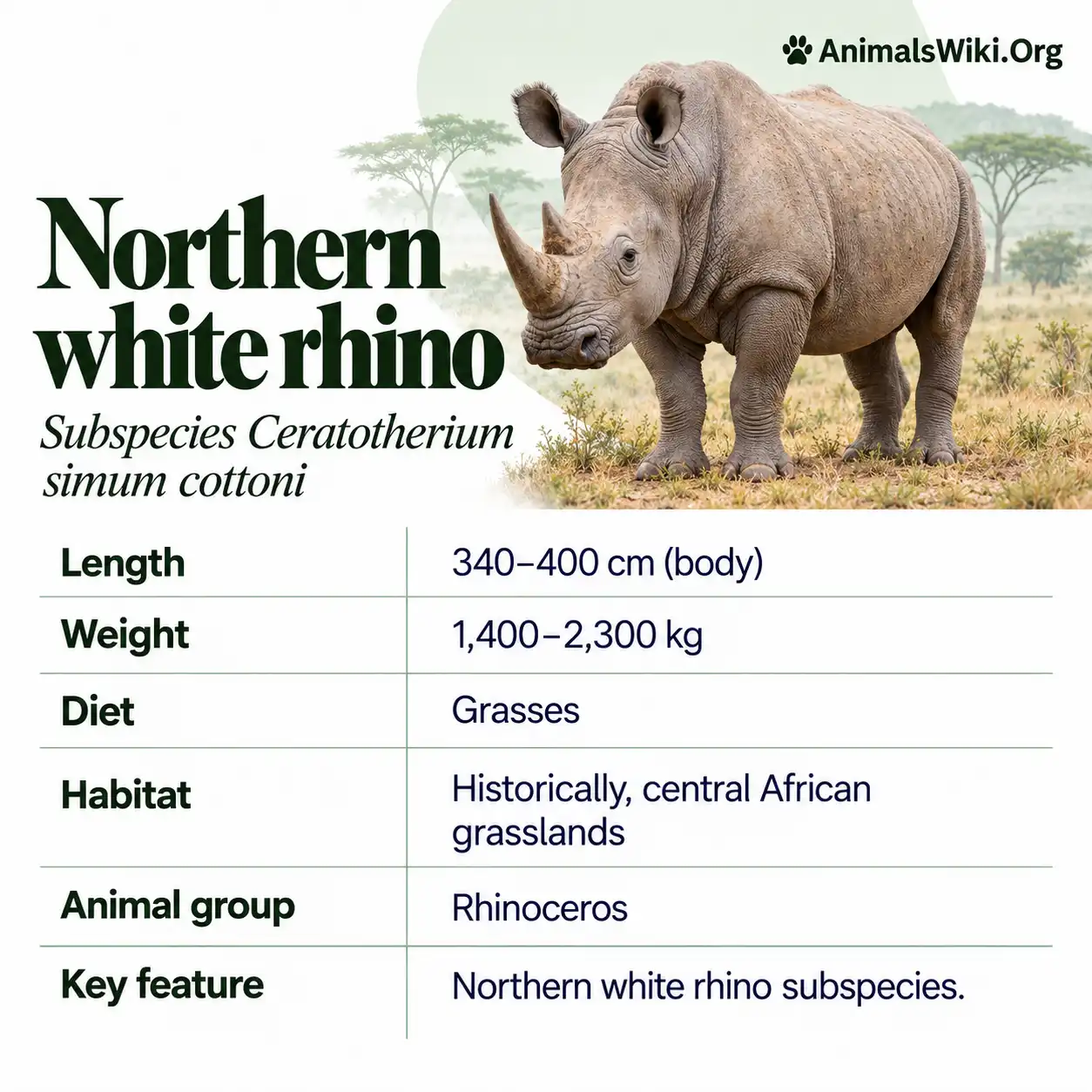
Northern White Rhino: The Last Two Survivors and the Science of Saving Their Future
The northern white rhino is one of the clearest examples of how a once widespread animal can disappear almost completely within a few generations. Formerly found across parts of central and eastern Africa, it now survives as just two known individuals: Najin and Fatu.
Both are female. They live under intensive protection at Ol Pejeta Conservancy in Kenya, where their care has become part of an international conservation effort.
Their situation is often described as functional extinction. Living northern white rhinos remain, but natural breeding can no longer produce another generation. There is no surviving male, and neither female can carry a pregnancy.
That distinction matters. The northern white rhino has not vanished entirely, but its future depends on intervention far beyond ordinary breeding management.
Scientists are working with preserved sperm, collected eggs, embryos and frozen cells to preserve the possibility of recovery. Their progress is real, although an embryo in a laboratory, an embryo transfer and a healthy calf represent very different achievements.
Behind the scientific headlines is a remarkable animal: a large grassland grazer with a broad mouth, sensitive hearing, social relationships and an ecological role that once extended across extensive African landscapes.
Northern White Rhino Facts
| Feature | Details |
|---|---|
| Common name | Northern white rhino |
| Scientific name | Ceratotherium simum cottoni |
| Usual classification | A subspecies of the white rhinoceros |
| Animal group | Mammal |
| Order | Perissodactyla |
| Family | Rhinocerotidae |
| Historical region | Parts of central and eastern Africa |
| Current known survivors | Two females |
| Names | Najin and Fatu |
| Current location | Ol Pejeta Conservancy, Kenya |
| Diet | Herbivorous; primarily grasses |
| Mouth | Broad and square, adapted for grazing |
| Horns | Normally two |
| Historical habitat | Grasslands, savannas and open woodland mosaics |
| Natural breeding | No longer possible with the surviving animals |
| Formal conservation assessment | Critically Endangered, with the qualification “Possibly Extinct in the Wild” |
| Main recovery approach | Assisted reproduction, supported by genetic and stem-cell research |
1. What Is a Northern White Rhino?
The northern white rhino is a large African herbivore commonly recognized as one of two white rhinoceros subspecies.
The other is the southern white rhino.
Both belong to the white rhino species, Ceratotherium simum, under the classification used by IUCN and many conservation organizations.
The northern form historically occupied areas far from the southern populations familiar from South Africa and neighboring countries.
Its disappearance therefore represents the loss of an animal from a distinct geographic and ecological setting.
Today, its identity is often reduced to a single number: two.
That number communicates urgency, but it does not explain what has been lost. Northern white rhinos once grazed, moved between resources, raised calves and interacted with other animals across a much larger landscape.
Conservation aims to preserve the possibility that these ordinary biological activities can eventually continue beyond the lives of the final two females.
2. Scientific Classification and the Species Debate
The commonly used scientific name is Ceratotherium simum cottoni.
Its classification is:
| Classification level | Name |
|---|---|
| Kingdom | Animalia |
| Phylum | Chordata |
| Class | Mammalia |
| Order | Perissodactyla |
| Family | Rhinocerotidae |
| Genus | Ceratotherium |
| Species | Ceratotherium simum |
| Subspecies | Ceratotherium simum cottoni |
Some researchers have proposed recognizing northern white rhinos as a separate species, Ceratotherium cottoni, based on differences from southern white rhinos.
Other research supports retaining the subspecies arrangement.
For a general article, the most useful approach is to identify the framework being followed. This article uses the widely applied subspecies classification.
The conservation concern does not disappear whichever taxonomic interpretation is chosen.
Northern white rhinos represent a distinctive lineage with a separate history, distribution and remaining genetic inheritance. Their preservation matters beyond the precise rank assigned to them.
3. Northern White Rhino Versus Southern White Rhino
The northern and southern forms share the broad white rhino body plan, including a square mouth, large head and two horns.
Their present circumstances are dramatically different.
| Feature | Northern white rhino | Southern white rhino |
|---|---|---|
| Scientific name | C. s. cottoni | C. s. simum |
| Historical center of distribution | Central and northeastern African landscapes | Southern Africa |
| Living population | Two known females | Many thousands |
| Natural breeding | No longer possible with the survivors | Continues in multiple populations |
| Immediate conservation focus | Preserve the lineage through advanced reproduction and genetic resources | Protect and manage breeding populations |
| Role in northern recovery | Provides eggs and preserved northern genetic material | Provides potential surrogate mothers |
A southern white rhino calf is therefore not automatically a northern white rhino conservation success.
The ancestry of the embryo matters.
Likewise, introducing southern white rhinos into former northern habitat can restore grazing functions without recreating the northern lineage.
These distinctions keep ecological restoration and lineage recovery clearly understood.
4. Appearance and Physical Characteristics
Northern white rhinos have the characteristic white rhino appearance: a massive body, long head, broad muzzle and strong shoulder region.
Their skin is gray rather than white.
Mud, dust and moisture can make an animal appear lighter, darker or reddish, depending on local conditions.
They normally have two horns, with the front horn generally more prominent.
Hair is sparse compared with that of the Sumatran rhino, although some body characteristics differ between northern and southern forms.
Fine physical comparisons are more complicated than popular illustrations suggest. Limited samples, individual variation and age can affect measurements.
The surviving females should not be treated as perfect representatives of every northern white rhino that once lived.
For identification, ancestry and documented history now matter more than trying to separate the subspecies from an isolated photograph.
Their shared appearance also explains why images must be labeled carefully. Most available white rhino photographs show southern animals.
5. Size and the Demands of a Large Body
Northern white rhinos are very large mammals, belonging to the largest living rhinoceros species.
Exact measurements specific to the northern form are less readily available than general white rhino size figures.
A useful description is a tonne-scale grazer with a heavy head, deep body and substantial daily nutritional needs.
Quoting a maximum southern white rhino weight as the standard northern measurement can give a misleading impression.
The biological significance of size is clearer than a falsely precise number.
A large body requires enough food to maintain condition, support activity and, historically, sustain pregnancy and nursing.
It also influences movement, heat management and the amount of vegetation consumed.
Size provides adults with protection from many natural predators, but it cannot compensate for insufficient food, reproductive failure or organized killing by people.
The animal’s strength and its conservation vulnerability therefore belong in the same account.
6. The Broad Mouth and Grazing Lifestyle
The white rhino’s broad, square mouth is adapted for collecting grass.
This differs from the pointed, prehensile upper lip of the black rhino, which helps gather leaves and twigs.
A northern white rhino’s feeding ecology centered on grazing rather than specialized browsing.
The head is carried low while the animal crops vegetation.
That posture, together with the broad muzzle, allows repeated feeding across patches of grass.
The adaptation helps explain its historical habitat. Suitable landscapes needed enough accessible grazing, not simply dense vegetation.
A forested area could contain abundant plants while supplying relatively little appropriate food.
The grazing lifestyle also connects the rhino with wider ecological processes. Repeated feeding influences grass height, while dung returns nutrients to the environment.
Understanding the mouth therefore helps explain both the animal’s daily routine and the landscapes capable of supporting it.
7. Horns, Skin and Sensory Awareness
Northern white rhinos normally have two horns made primarily of keratin.
Their horns differ from ivory and from the bony antlers of deer.
The skin is thick but remains living tissue that can suffer injury, infection and environmental stress.
White rhinos also possess sensitive hearing and a strong sense of smell.
Their eyesight is comparatively limited, but describing them as blind would be inaccurate.
These senses support feeding, investigation and communication.
An animal may respond to a smell or sound before a human observer recognizes what has changed nearby.
This matters even for animals accustomed to particular caregivers. Familiarity with people does not remove their biological needs or their capacity to react.
Good care depends on understanding behavior and condition rather than assuming that a calm appearance indicates complete comfort.
The surviving females remain individual wild animals under management, not simply passive participants in a scientific project.
8. Historical Range Across Africa
Northern white rhinos formerly occurred in parts of what are now Uganda, Chad, South Sudan, the Central African Republic and the Democratic Republic of the Congo.
Their distribution was separate from the main southern white rhino range.
Historical boundaries should be interpreted with care because political names and borders changed over time.
For example, older references to Sudan can include areas now within South Sudan.
The important geographic picture is a lineage associated with central and northeastern African grassland and savanna landscapes.
As populations disappeared, the remaining distribution contracted toward a few refuges.
Eventually, Garamba National Park in the Democratic Republic of the Congo became the last confirmed wild stronghold.
Today, the presence of Najin and Fatu in Kenya reflects a conservation transfer. It should not be interpreted as evidence that their current enclosure represents the full historical range of northern white rhinos.
9. Natural Habitat and Ecological Setting
Northern white rhinos historically used grasslands, savannas and open woodland landscapes.
Their requirements included grazing, water, resting places and opportunities to manage heat.
Garamba illustrates the broader environmental setting. The landscape contains extensive grassland savanna within a region also influenced by equatorial forest.
That mixture supports a variety of large mammals and plant communities.
Habitat suitability depended on the resources available within this mosaic, rather than the presence of one vegetation label.
A functioning landscape also needed safe movement between feeding and resting areas.
The rhino’s decline cannot therefore be understood only as a disappearance from a particular national park.
It involved the breakdown of the conditions allowing large animals to persist across a wider region.
Conservation planning for any future population must consider both ecological suitability and the practical security required to keep animals alive.
10. Diet and Digestion
Northern white rhinos are herbivores whose natural diet centers on grasses.
Their digestive system follows the white rhino pattern of hindgut fermentation.
Microorganisms help break down fibrous plant material behind the stomach, particularly in the enlarged cecum and colon.
This allows a large animal to obtain nutrients from vegetation requiring extensive processing.
However, the ability to digest grass does not mean every grassland offers equal nutrition.
Plant species, growth stage, moisture and seasonal conditions affect the value of available food.
Under managed care, nutrition must also take account of each individual’s health, age and body condition.
Supplements can form part of a care plan, but they do not change the animal’s underlying identity as a grazer.
For Najin and Fatu, appropriate feeding supports their everyday welfare as well as the broader conservation effort associated with them.
11. Water, Wallowing and Daily Comfort
Water supports drinking, cooling and skin care.
White rhinos use mud and shallow water to obtain relief from heat and biting insects.
A suitable wallow depends on more than the presence of a puddle. Its depth, footing, access and surrounding conditions affect how useful it becomes.
Shade and resting places provide additional opportunities to manage temperature.
These resources matter because a very large body can experience significant heat load.
Daily comfort also influences behavior. An animal may choose different resting places according to weather and ground conditions.
For the surviving northern white rhinos, maintaining suitable surroundings is part of routine care.
Their conservation significance does not reduce these ordinary requirements.
A project can pursue sophisticated laboratory research while remaining dependent on simple practical tasks: providing food, checking water, observing skin condition and ensuring that the animals can rest comfortably.
12. Social Behavior and Communication
Much detailed information about white rhino social behavior comes from southern populations, so it should not be assumed that every observation transfers perfectly to the northern form.
The broader pattern includes associations among females and young, while mature males are more territorial.
Communication involves scent, sounds and body movements.
Dung and urine can carry information about individuals, allowing animals to investigate others without meeting directly.
Calls, ear position and changes in posture contribute during encounters.
Najin and Fatu also share a real social relationship. They are mother and daughter with a long history of living together.
Their importance is therefore more than genetic.
Conservationists have discussed the potential value of surviving adults in passing on social experience to future young, should recovery succeed.
That possibility remains a future role, not a substitute for the immediate need to maintain their welfare.
13. Reproduction and the Loss of a Natural Breeding Population
White rhino reproduction involves a long pregnancy, usually around 16 months, followed by one calf.
Young animals depend on maternal care while developing.
The time between successive calves is measured in years, making population recovery naturally slow.
The northern white rhino crisis has progressed beyond ordinary slow reproduction.
There is no surviving male, and neither female can carry a pregnancy.
That removes the possibility of restoring the population simply by placing living northern animals together.
The distinction is important because a small population and a nonbreeding population are different problems.
A small group with several fertile adults may grow under protection.
A group containing only two females unable to carry pregnancies requires a fundamentally different approach.
The present rescue effort is designed to preserve reproductive possibilities that no longer exist within the living population alone.
14. Najin: Mother of the Last Generation
Najin was born on July 11, 1989, at Dvůr Králové Zoo in what is now Czechia.
She is Fatu’s mother and Sudan’s daughter.
In 2009, she moved to Ol Pejeta Conservancy with Fatu and the males Sudan and Suni.
As of October 2026, Najin is 37 years old.
Her role in conservation has changed over time. She was initially part of attempts to restore natural breeding, then participated in egg-collection procedures.
In 2021, the BioRescue team retired her as an egg donor following an assessment of welfare, risks and expected benefits.
Retirement from that procedure did not remove her importance.
She remains one of only two living northern white rhinos and continues to receive care and protection.
Her life also illustrates why conservation decisions must consider the condition and interests of individual animals, even when each represents a substantial share of a disappearing population.
15. Fatu: The Remaining Source of Naturally Collected Eggs
Fatu was born on June 29, 2000, at Dvůr Králové.
She is Najin’s daughter and, as of October 2026, is 26 years old.
Although she cannot carry a pregnancy, she can provide egg cells used in assisted reproduction.
That distinction is central to the recovery program.
Producing eggs and being able to sustain pregnancy are separate biological functions.
Fatu’s collected eggs have been used with preserved northern white rhino sperm to create embryos.
Her role is therefore unusually important, but the program must still consider her health and the consequences of repeated procedures.
Every collection involves planning, veterinary expertise and evaluation.
The broader scientific effort also aims to reduce dependence on one individual by investigating stored cells and additional reproductive methods.
Fatu provides a living connection with the lineage’s remaining natural reproductive material, while the research attempts to expand future options.
16. Sudan: The Last Male Northern White Rhino
Sudan was the last known male northern white rhino.
He died at Ol Pejeta on March 19, 2018, after age-related health problems.
His death attracted worldwide attention because it made the population’s reproductive crisis immediately understandable.
However, the problem had developed before that final event.
Advanced age, declining fertility and the condition of the remaining females had already limited natural breeding prospects.
Sudan’s life therefore became a symbol of a much longer population collapse.
His daughter Najin and granddaughter Fatu survived him.
The availability of preserved reproductive material from deceased males means that the death of the last male did not eliminate every scientific possibility.
It did, however, end the existence of a living northern male population.
That loss helps explain why conservation now depends on stored biological resources as well as the care of the two surviving females.
17. The 2009 Move to Kenya
On December 20, 2009, four northern white rhinos arrived at Ol Pejeta Conservancy from Dvůr Králové.
They were Najin, Fatu, Sudan and Suni.
The move aimed to improve breeding opportunities by providing an African environment with suitable conditions and space.
Mating was observed, but no calf resulted.
Suni died in 2014, while Sudan survived until 2018.
The transfer demonstrates an important conservation principle: providing favorable surroundings can help, but it cannot guarantee successful reproduction.
Age, fertility and individual health remain decisive.
The move also established the Kenyan setting in which the current recovery project operates.
Ol Pejeta’s caregivers, veterinarians and management became part of an international collaboration extending far beyond one conservancy.
The animals’ relocation was therefore a significant step, but it was not the final solution to their reproductive problems.
18. Garamba and the Collapse of the Wild Population
Garamba National Park held the last confirmed wild northern white rhino population.
The animals declined sharply under intense poaching pressure, with regional conflict making protection especially difficult.
IUCN’s assessment describes approximately 30 animals in April 2003 and only four confirmed during surveys in 2006.
Subsequent searches failed to establish a surviving breeding population.
It is difficult to identify an exact date when the final wild animal died because absence is harder to document than presence.
That uncertainty explains the formal wording “Possibly Extinct in the Wild.”
The collapse also illustrates how quickly a small remnant can lose viability.
A population of a few dozen may appear to offer time, yet concentrated losses can remove that opportunity rapidly.
Protecting a site requires sustained capacity on the ground, especially when instability threatens both wildlife and the people responsible for its care.
19. Why Northern White Rhinos Declined
The decline involved several interacting pressures.
Hunting and habitat loss reduced the wider range, while later poaching for horn drove remaining populations downward.
Armed conflict and insecurity disrupted protection in parts of the historical range.
As numbers fell, populations became increasingly vulnerable to ordinary demographic problems.
The loss of one adult could remove a substantial fraction of the remaining breeding potential.
Fewer animals also meant fewer opportunities to find suitable mates and maintain genetic diversity.
This sequence matters because extinction rarely begins with the death of the last individual.
It develops through the loss of habitat, numbers, reproductive opportunities and resilience.
The northern white rhino’s final crisis is the outcome of that longer process.
Understanding the sequence helps explain why conservation is more effective when it acts before populations become exceptionally small.
20. What “Functionally Extinct” Means
The phrase functionally extinct describes a population that can no longer maintain itself through ordinary natural reproduction or ecological functioning.
For northern white rhinos, the reproductive meaning is especially clear.
Only two known females survive, and neither can carry a pregnancy.
The phrase does not mean there are no living animals.
It also does not automatically mean every scientific recovery option has disappeared.
Stored sperm, eggs, embryos and living cells provide possibilities that would not exist if all biological material had been lost.
However, preserving material is different from restoring a population.
A successful recovery would require healthy births, future breeding and suitable protected habitat.
Functional extinction therefore describes the severity of the present situation while leaving open the question of what carefully developed intervention may eventually achieve.
21. Formal Conservation Status
The IUCN assessment lists the northern white rhino as Critically Endangered, with the qualification Possibly Extinct in the Wild.
This wording should be kept separate from the species-level status of white rhinos overall.
The larger white rhino species remains represented by many southern animals.
That broader total does not reduce the northern form’s immediate crisis.
The distinction between wild status and survival under management also matters.
Najin and Fatu are living animals, but they do not constitute a self-sustaining wild population.
Accurate reporting therefore needs several pieces of information together: the number of survivors, their reproductive condition, their managed setting and the formal assessment.
A single label such as “extinct” or “endangered” cannot communicate the whole situation.
Clear terminology helps readers understand both the urgency and the remaining options.
22. What Is the BioRescue Program?
BioRescue is an international conservation research effort developing methods to preserve the northern white rhino lineage.
Its work combines assisted reproduction, stem-cell research, genetics and animal care.
The collaboration includes specialists and institutions in Kenya, Germany, Czechia, Italy, Japan and other participating locations.
Different partners contribute different expertise.
Veterinarians work with the animals, laboratories develop embryos and cell methods, and conservation organizations provide the setting and protection required for continued care.
The objective extends beyond producing a laboratory result.
The long-term ambition is a living population capable of reproduction.
A 2026 review describes the project as a combination of reproductive biotechnology, cell-based approaches and efforts to use remaining genetic diversity.
These activities remain connected with a practical conservation goal: preserve enough biological potential to create future animals and eventually support a viable population.
23. How Eggs Are Collected
The program collects immature egg cells, called oocytes, from Fatu.
The procedure requires specialized veterinary equipment and anesthesia.
After collection, the cells are transported to a laboratory where researchers attempt to mature and fertilize them.
Not every collected egg becomes an embryo.
Some may be unsuitable, fail to mature or fail during later development.
This explains why the number of procedures, eggs and embryos should never be treated as interchangeable.
The work also depends on timing, careful handling and coordination between teams in different countries.
Fatu’s contribution is therefore supported by an extensive chain of expertise.
The process is a conservation application of reproductive biology, but it remains experimental in several respects.
Its progress is measured through repeatable steps, with each stage requiring assessment before the next can succeed.
24. IVF and Embryo Development
In vitro fertilization, or IVF, involves fertilization outside the animal’s body.
In the northern white rhino program, collected eggs are matured and combined with preserved sperm using specialized laboratory methods.
If development proceeds successfully, an embryo may become suitable for storage or transfer.
An embryo is an early developmental stage, not a miniature calf ready for release.
Its creation is an important achievement because it preserves a potential route toward birth.
However, several further steps remain.
The embryo must tolerate storage and handling, be transferred successfully, establish a pregnancy and continue developing.
A healthy delivery and calf survival would follow after that.
Understanding these stages makes conservation reporting more meaningful.
It allows readers to recognize laboratory progress while appreciating why the creation of multiple embryos has not yet translated automatically into a restored population.
25. Why Southern White Rhinos Are Used as Surrogates
Najin and Fatu cannot carry pregnancies.
The program therefore uses selected southern white rhino females as potential surrogate mothers.
A surrogate would carry an embryo whose genetic parents are northern white rhinos.
The surrogate’s identity does not, by itself, make the calf a hybrid.
The embryo’s ancestry depends on the egg and sperm used to create it.
Successful transfer also requires attention to the recipient’s reproductive condition, health and suitability.
The close relationship between northern and southern white rhinos supports the biological rationale for the approach, but it does not guarantee success.
Pregnancy involves complex communication between embryo and maternal tissues.
The program must therefore establish that development can continue safely within the surrogate.
This is one reason experience from southern white rhino reproductive research remains valuable to the northern recovery effort.
26. The 2023 Embryo-Transfer Pregnancy
A major milestone came from work with a southern white rhino embryo and a southern surrogate named Curra.
Researchers transferred embryos in September 2023.
After Curra later died, examination confirmed a pregnancy with a developing male fetus approximately 70 days old.
The pregnancy demonstrated that an IVF-produced rhino embryo could establish development after transfer.
However, it did not produce a live calf.
It also was not a northern white rhino pregnancy.
Those distinctions do not diminish the scientific importance of the result. They explain precisely what was demonstrated.
The event provided evidence supporting the next stage of the program while also revealing the difficulty of turning technical progress into a successful birth.
Conservation science often advances through such partial achievements, where one barrier is crossed but others remain.
27. What the Verified 2026 Update Says
An April 22, 2026 BioRescue update reported three northern white rhino embryo transfers during the second half of 2025.
None had developed into a long-term pregnancy.
The program also introduced additional potential surrogate females and continued embryo production.
These are the verified outcomes, rather than confirmation of a northern white rhino calf.
A review published in June 2026 describes wider progress in reproductive and stem-cell methods, but publication of a scientific review should not be confused with a live-birth announcement.
For readers following the project, the most useful milestones are clearly separated:
- Eggs collected
- Embryos created
- Embryos transferred
- Pregnancies confirmed
- Calves born
- Calves surviving and developing
Each represents progress at a different stage. A future update should state exactly which one has been achieved.
28. Frozen Cells and the Genetic Resources That Remain
The northern white rhino’s future is not limited entirely to the genetic material available from its two living females.
Researchers preserved cells from additional individuals before they died.
San Diego Zoo Wildlife Alliance’s Frozen Zoo contains living cell lines and other biological materials maintained at extremely low temperatures.
The value of these collections lies in preserving options.
A skin cell cannot simply be placed into a surrogate and become a calf. It requires complex research before it could contribute to reproduction.
Nevertheless, frozen cells can retain genetic information from individuals no longer alive.
That makes early banking important.
Material collected decades before a technology exists may later become useful in ways its original collectors could not demonstrate.
Biobanking therefore complements immediate conservation by preserving biological resources that might otherwise be lost permanently.
29. Stem Cells: A Different Route Toward Reproduction
Researchers can reprogram certain body cells into induced pluripotent stem cells.
These cells can develop into multiple cell types under appropriate conditions.
For northern white rhinos, the long-term aim includes producing reproductive cells from stored material.
That could expand the genetic contribution beyond the small number of animals represented by naturally collected eggs and available sperm.
However, a stem cell is not yet a functional egg or sperm cell.
Several developmental steps separate those stages.
Research has established northern white rhino stem-cell lines and explored states suitable for further differentiation.
These achievements preserve possibilities while leaving substantial work unfinished.
The distinction matters because popular headlines can compress a complex sequence into “scientists can bring back rhinos from skin.”
The actual work involves demonstrating each stage, checking biological quality and establishing whether resulting cells can support healthy reproduction.
30. Primordial Germ Cell Research
An important stem-cell milestone involved producing primordial germ cell-like cells from northern white rhino cells.
Primordial germ cells are early precursors in the developmental pathway leading toward eggs and sperm.
Researchers reported this work in 2022.
The result showed progress in directing cells toward a reproductive lineage.
It did not demonstrate the creation of fully functional northern white rhino eggs and sperm ready to produce calves.
That distinction is essential.
A developmental precursor is valuable evidence, but later stages must still be achieved and assessed.
The work also shows how conservation research can draw on knowledge developed across different fields.
Cell biology, reproductive medicine, veterinary science and genetics contribute to the same objective.
For the northern white rhino, success would require these laboratory advances to connect eventually with viable embryos, healthy pregnancies and animals capable of living and breeding.
31. Genetic Diversity and a Future Population
Producing one calf would be a major event, but one animal cannot establish a viable population alone.
A recovery program needs sufficient genetic diversity and an appropriate balance of breeding individuals.
Studies have examined the genetic variation preserved in northern white rhino cell lines.
Research on genetic load and future viability suggests that preserved material retains meaningful conservation value.
This should not become a guarantee that rebuilding a population will be straightforward.
The biological quality of cells, successful reproduction and the representation of different founders all matter.
Genetics also needs to be considered across generations.
A few closely related calves could increase numbers while leaving future breeding options restricted.
The broader goal is therefore to preserve as much remaining diversity as feasible and use it within a carefully managed reproductive strategy.
32. Why Genome Research Matters
A genome is the full set of genetic information in an organism.
A high-quality reference genome helps researchers locate genes, compare individuals and assess changes in cultured cells.
A 2025 study produced a chromosome-level northern white rhino genome assembly and used it to investigate the integrity of stem-cell material.
This matters because cells maintained in laboratories can acquire changes.
Before such cells contribute to reproduction, researchers need ways to evaluate whether they remain suitable.
Genome research therefore supports quality assessment rather than merely producing a descriptive map.
It also improves understanding of relationships between northern and southern white rhinos.
For a conservation program working with irreplaceable material, better genetic information can help guide decisions and identify problems.
Its value lies in connecting molecular detail with the health and viability of future animals.
33. Animal Welfare and Najin’s Retirement
In 2021, BioRescue stopped collecting eggs from Najin following an ethical risk assessment.
The team considered her health, the risks of further procedures and the limited reproductive results obtained.
This decision illustrates a difficult conservation balance.
An individual animal’s welfare remains important even when its participation could affect the future of an entire lineage.
Being one of the last survivors does not make every possible intervention automatically justified.
The assessment also shows that conservation plans can change when evidence changes.
Najin’s role continued through care, social presence and the possibility of contributions involving less invasive material.
For readers, the lesson is that a rescue program should be evaluated by more than the number of procedures performed.
Responsible progress includes deciding when an intervention offers insufficient benefit relative to its risks.
34. Is the Program Cloning Northern White Rhinos?
The principal embryo program uses eggs and sperm, so it is an assisted reproductive approach rather than conventional cloning.
Stem-cell research adds another potential route to producing reproductive cells.
These methods differ from creating a genetic copy through the familiar cloning model involving transfer of a body-cell nucleus.
The distinction matters because different technologies address different problems.
The northern white rhino project needs healthy births and, eventually, enough diversity to support future breeding.
Producing repeated genetic copies would not by itself solve that diversity challenge.
The scientific program therefore explores complementary tools rather than relying on one dramatic technique.
For general readers, the clearest explanation follows the biological material involved: collected eggs, preserved sperm, embryos, stored body cells and experimental reproductive-cell development.
That sequence explains the work more accurately than treating every advanced method as cloning.
35. Habitat Restoration Still Matters
Advanced reproduction cannot provide a lasting future without a place for animals to live.
Any future northern white rhino population would require secure habitat, suitable grazing, water, veterinary planning and long-term management.
The historical range also contains communities whose lives and livelihoods need to be considered.
Reintroduction would therefore be a major conservation undertaking, not simply a transport decision.
Meanwhile, southern white rhinos have been introduced into Garamba to help restore large-grazer functions.
That is ecological restoration using a different subspecies.
It should not be reported as the return of living northern white rhinos.
The distinction keeps two valid conservation goals clear: restore grazing processes in a landscape and preserve the northern lineage through reproductive science.
Both require sustained protection, but they achieve different outcomes.
36. What Successful Recovery Would Look Like
Recovery would involve a sequence of achievements rather than one breakthrough.
A live northern white rhino calf would need to survive, develop normally and eventually contribute to reproduction.
Additional animals would be required to create suitable breeding opportunities.
Genetic management would need to preserve diversity across generations.
The population would also require secure habitat and a management system capable of responding to health and security problems.
This is why the project cannot be measured only by embryo totals.
Each milestone matters because it supports another stage.
The long-term objective is a population that can continue beyond intensive intervention in every reproductive event.
That future remains uncertain, but the research has preserved possibilities that would otherwise have disappeared.
The immediate responsibility continues alongside the ambition: care for Najin and Fatu while using remaining biological resources carefully.
Frequently Asked Questions About the Northern White Rhino
1. What is a northern white rhino?
The northern white rhino is a large African grazer commonly classified as a subspecies of white rhinoceros. Its scientific name is Ceratotherium simum cottoni. Only two known individuals survive, both females living at Ol Pejeta Conservancy in Kenya.
2. How many northern white rhinos are left?
Two known individuals remain: Najin and Fatu. Both are female. This figure counts living animals, not frozen embryos or stored cells, which represent different forms of biological material within the conservation program.
3. Are northern white rhinos extinct?
They are not completely extinct because Najin and Fatu remain alive. They are functionally extinct from a natural breeding standpoint. The formal IUCN assessment lists them as Critically Endangered, with the qualification “Possibly Extinct in the Wild.”
4. What does functionally extinct mean here?
It means the surviving animals cannot maintain the population through natural reproduction. There is no living male northern white rhino, and neither female can carry a pregnancy. Scientific recovery therefore depends on assisted reproduction and preserved biological material.
5. Where do the last two live?
Najin and Fatu live at Ol Pejeta Conservancy in Kenya. They receive intensive care and protection. Their presence there results from a 2009 conservation transfer from Dvůr Králové, rather than representing a surviving wild Kenyan population.
6. Are Najin and Fatu related?
Yes. Najin is Fatu’s mother. Sudan, the last known male, was Najin’s father and Fatu’s grandfather. Their relationship also explains why preserving genetic material from additional individuals is important to future recovery efforts.
7. How old are Najin and Fatu?
As of October 22, 2026, Najin is 37 and Fatu is 26. Najin was born on July 11, 1989, while Fatu was born on June 29, 2000. Both were born at Dvůr Králové.
8. Who was Sudan?
Sudan was the last known male northern white rhino. He lived at Ol Pejeta during his final years and died on March 19, 2018. His death left Najin and Fatu as the only known living northern white rhinos.
9. Why can Najin and Fatu not breed naturally?
Neither female can carry a pregnancy, and no living male remains. Producing egg cells and sustaining pregnancy are separate functions. Fatu can provide eggs for laboratory work even though she cannot carry a calf herself.
10. Why was Najin retired from egg collection?
The team stopped procedures in 2021 after assessing welfare, health, risks and expected benefits. Her retirement applies to egg collection, not to her care or conservation importance. She remains a living representative of the northern lineage.
11. What do northern white rhinos eat?
They are primarily grazers, feeding on grasses. Their broad mouths are adapted for collecting vegetation near ground level. Under managed care, nutrition is adjusted to the individual animal’s condition and health requirements.
12. Are northern white rhinos actually white?
Their skin is generally gray. Mud and dust can change the apparent color. The alternative name “square-lipped rhinoceros” describes the mouth more accurately than the color-based name.
13. Where did they originally live?
Their historical range included parts of Uganda, Chad, South Sudan, the Central African Republic and the Democratic Republic of the Congo. Garamba National Park became the last confirmed wild stronghold before that population disappeared.
14. What caused their decline?
Hunting, poaching, habitat pressures and regional conflict contributed to the collapse. As numbers fell, the remaining population also lost reproductive resilience. The final two animals are the outcome of a long decline rather than a single recent event.
15. What is BioRescue?
BioRescue is an international conservation research program working on assisted reproduction, stem cells and genetic resources. Its goal is to preserve the possibility of a future northern white rhino population while maintaining the welfare of participating animals.
16. How can a male contribute after death?
Sperm collected and frozen while a male was alive can remain available for laboratory fertilization. Stored cells may also preserve genetic information. Their usefulness depends on material quality and the reproductive methods that can be developed successfully.
17. Why use southern white rhino surrogates?
The surviving northern females cannot carry pregnancies. Selected southern white rhinos provide a possible gestational environment for northern embryos. The genetic ancestry of a calf would depend on the egg and sperm used, not simply on the surrogate.
18. Would the calf automatically be a hybrid?
No. A calf produced from a northern white rhino egg and northern white rhino sperm would have northern genetic parents. Carrying that embryo in a southern surrogate does not automatically make it a northern–southern hybrid.
19. Has a northern white rhino IVF calf been born?
The verified sources used for this article do not confirm a northern white rhino calf produced through IVF. They document embryo production and transfer attempts. A live birth should be reported only after confirmation from the responsible conservation and research teams.
20. What happened in the 2023 pregnancy?
A southern white rhino embryo established pregnancy in a southern surrogate, Curra. A developing fetus was confirmed after the surrogate died. The result demonstrated part of the embryo-transfer process but did not produce a living calf.
21. Can frozen skin cells become rhinos?
Not directly. Researchers can reprogram some cells into stem cells and investigate pathways toward reproductive cells. Several complex developmental stages remain between a stored skin cell and a healthy calf. The research preserves possibilities rather than providing an immediate conversion.
22. Is the project cloning rhinos?
The main embryo program uses eggs and sperm. Stem-cell work aims to expand reproductive options. These approaches should be distinguished from conventional cloning, and none by itself removes the need for genetic management and healthy pregnancies.
23. Why not use southern white rhinos instead?
Southern white rhinos already contribute to conservation and ecological restoration. However, they do not contain all the genetic inheritance of the northern lineage. Restoring grazing functions and preserving northern ancestry are related but different conservation goals.
24. Could northern white rhinos return to the wild?
That is a long-term aspiration. It would first require successful births, survival, reproduction and a viable population. Suitable protected habitat and sustained management would also be essential. A single calf would be an important beginning, not complete recovery.
25. Can the northern white rhino still be saved?
Scientific recovery remains possible enough to justify continued research, but success is uncertain. Preserved sperm, embryos and cells retain important options. Those options still need to produce healthy animals and, eventually, a population capable of continuing across generations.
Preserving the Possibility of Another Generation
The northern white rhino’s story is both a warning about delayed conservation and a test of what science can preserve after natural breeding has ended.
Najin and Fatu remain living animals with daily needs, social relationships and individual histories. Their welfare matters alongside the ambition to recover their lineage.
The research has created meaningful possibilities through embryos, stored cells and new reproductive methods. Those achievements should be recognized accurately, without confusing an early developmental milestone with a restored population.
A future northern white rhino calf would be extraordinary. A lasting recovery would require much more: multiple healthy animals, genetic diversity, successful breeding and secure habitat.
The purpose of the work is to keep that longer future possible.



