
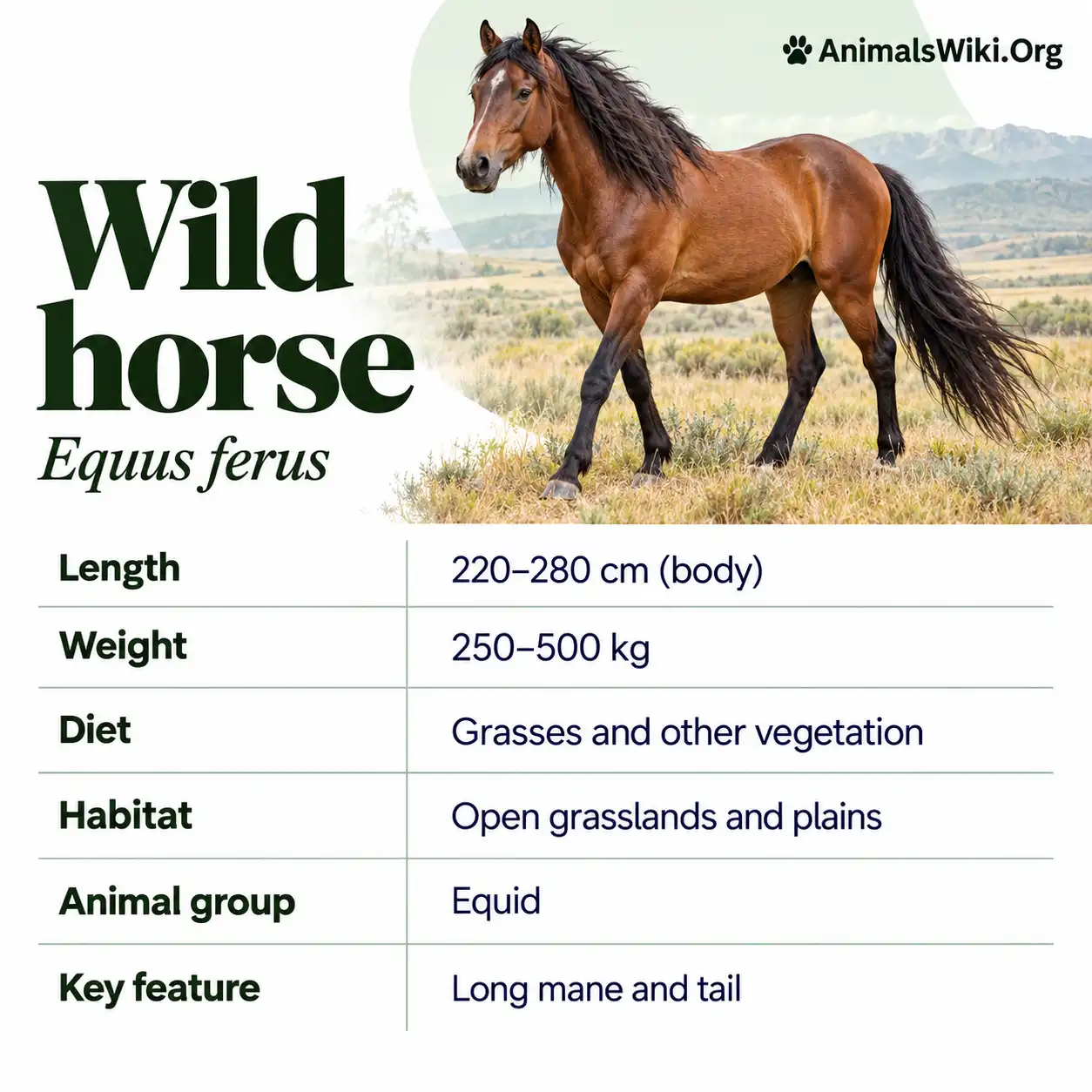
Wild Horse, Habitat, Diet, Behavior and Conservation
A wild horse running across open grassland is one of nature’s most recognizable sights. With its flowing tail, powerful legs, and close connection to its herd, this animal has become a symbol of freedom in many cultures. Yet the story behind wild horses is more complicated—and more interesting—than that familiar image suggests.
The term wild horse can describe different kinds of free-roaming horses. American mustangs and Australian brumbies descend from domestic horses that established independent populations. Biologists generally call these animals feral horses. Przewalski’s horses represent a distinct surviving horse lineage with a different evolutionary and conservation history.
These differences matter. Some horse populations need protection and restoration, while others require management to reduce damage to sensitive habitats. Their appearance, daily routines, and relationships with people also vary considerably.
This guide explores what wild horses eat, where they live, how their herds work, and how foals survive. It also explains the distinction between wild and feral horses, the recovery of Przewalski’s horses, and the challenges of protecting both horses and the ecosystems around them.
Wild Horse Facts
| Feature | Details |
|---|---|
| Common name | Wild horse |
| Animal group | Mammal |
| Family | Equidae |
| Genus | Equus |
| Closest living relatives | Other horses, asses, and zebras |
| Diet | Herbivorous; mainly grasses and other vegetation |
| Social structure | Family bands, bachelor groups, and larger temporary gatherings |
| Male | Stallion |
| Female | Mare |
| Young | Foal |
| Pregnancy | Approximately 11 months |
| Typical birth | One foal |
| Main habitats | Grasslands, steppes, shrublands, and some coastal or mountain landscapes |
| Familiar examples | Przewalski’s horses, mustangs, brumbies, and Assateague horses |
| Conservation status | Depends on the population; Przewalski’s horse is Endangered |
1. What Is a Wild Horse?
In everyday language, a wild horse is a horse living freely outside the routine control of people. It finds much or all of its own food, moves through a landscape, and interacts with other horses without being ridden or handled regularly.
However, this description tells us about its lifestyle rather than its ancestry.
A horse can live independently while descending from animals that people domesticated. This is the case for many well-known free-roaming populations. Other horses belong to conservation populations maintained to preserve a distinct evolutionary lineage.
Ownership adds another complication. Some horses roam across large areas but still have owners who monitor their condition or manage breeding.
When identifying a wild horse, three questions help: Where did its ancestors come from? How independently does it live? What kind of management does it receive? The answers provide a clearer picture than appearance alone.
2. Wild Horses vs. Feral Horses
Wild and feral have different biological meanings.
A feral animal descends from domesticated ancestors but lives outside ordinary domestic management. Mustangs in North America and brumbies in Australia fit this description. Their ancestors included horses that escaped, were released, or otherwise became established away from human control.
Calling them feral does not mean they are tame. A feral horse may have lived its entire life without close human contact and can react strongly when approached.
Przewalski’s horses are usually discussed separately because they preserve a distinct horse lineage. Their relationship with ancient human communities is an active research topic.
“Wild horse” also appears in official management terminology, particularly in the United States. Consequently, a population can be called wild in a management context while being described as feral in a biological discussion.
3. Scientific Classification of Wild Horses
Horses belong to Equidae, the family that also includes zebras and asses. They are members of Perissodactyla, the mammalian order containing horses, rhinoceroses, and tapirs.
Scientific names vary according to the classification system used.
Domestic horses are commonly called Equus caballus. Some classifications place them within the wild horse species as Equus ferus caballus. Przewalski’s horse is frequently listed as Equus ferus przewalskii, although other authorities recognize it as Equus przewalskii.
For a general reader, the essential distinction is straightforward: a mustang is not a separate species simply because it lives freely. It belongs to the domestic horse lineage.
Likewise, “brumby” describes Australian feral horses rather than one uniform scientific category. These regional names reflect history and geography, while scientific classification addresses evolutionary relationships.
4. What Does a Wild Horse Look Like?
Wild horse appearance depends heavily on ancestry.
Feral horses can have long or short manes, different head shapes, and a wide variety of coat colors. Black, bay, chestnut, gray, and patterned individuals may occur within free-roaming populations. Their size and proportions can reflect several generations of domestic breeding before their ancestors became feral.
Przewalski’s horses have a more consistent appearance. They are stocky, with relatively large heads, upright dark manes, pale undersides, and darker lower legs. A dark stripe runs along the back.
Their mane usually lacks the long, falling forelock familiar in many domestic horses.
Body condition also affects appearance. Seasonal changes in food availability, pregnancy, age, and winter coat thickness can make the same individual look noticeably different at different times of year.
5. How Big Is a Wild Horse?
There is no single size that accurately represents every wild horse.
A free-roaming population descended from small riding horses may look very different from one with ancestry from larger working animals. Food availability during growth and the condition of the surrounding habitat also influence adult development.
Przewalski’s horses are relatively compact. A San Diego Zoo Wildlife Alliance reference gives a body weight of approximately 200–300 kilograms, although individual measurements vary.
Horse height is normally measured at the withers, the raised area where the neck meets the back. This provides a more consistent measurement than the top of the head, which changes position.
Size should not be confused with strength or temperament. A small free-roaming horse can still deliver a serious bite or kick and should receive the same respectful distance as a larger animal.
6. What Is Przewalski’s Horse?
Przewalski’s horse is a distinctive horse associated with the grasslands and dry landscapes of Central Asia. It is also known as the Mongolian wild horse or Asiatic wild horse, and in Mongolia it is commonly called the takhi.
Its importance extends beyond its unusual appearance. It preserves genetic diversity distinct from that of modern domestic horses.
The population disappeared from the wild during the twentieth century, but animals maintained in human care survived. International breeding programs eventually produced horses suitable for reintroduction.
Przewalski’s horse is currently classified as Endangered. Its recovery shows what coordinated conservation can achieve, while its continuing vulnerability demonstrates that reintroduction requires long-term work.
Protecting this horse involves suitable habitat, genetic management, veterinary knowledge, and cooperation with the people living near release areas.
7. Were Przewalski’s Horses Ever Domesticated?
This question has a more complicated answer than many short wildlife descriptions suggest.
Ancient DNA research linked Przewalski’s horses closely to horses associated with the Botai culture of ancient Kazakhstan. Some researchers interpret the archaeological and genetic evidence as indicating an early form of horse husbandry or domestication.
Other research has questioned parts of the traditional Botai domestication argument, including how particular archaeological findings should be interpreted.
What remains clear is that Botai-associated horses belonged to a lineage different from the one that produced most modern domestic horses.
Therefore, describing Przewalski’s horses as animals that were “definitely never domesticated” oversimplifies the evidence. A more accurate description is that they represent a distinct surviving horse lineage whose ancient relationship with humans remains under scientific investigation.
8. Where Did Horses Originate?
The deeper evolutionary history of horses is strongly connected to North America.
Over millions of years, horse relatives changed in body size, teeth, limbs, and habitat use. This was a branching evolutionary history involving many different forms rather than a simple straight line from one small ancestor to the modern horse.
Members of the horse lineage spread into other parts of the world. Horses later disappeared from North America near the end of the Pleistocene, before domestic horses were introduced again through European colonization.
Modern North American free-roaming horses descend from those later domestic populations.
This history explains why discussions about horses can involve both ancient native ancestry and recent introduction. Understanding their current ecological effects still requires evidence from the particular habitats where they live today.
9. Where Do Wild Horses Live Today?
Free-roaming horses occupy a surprisingly wide range of landscapes.
In the western United States, many live in dry grasslands, shrublands, and rugged terrain. Australian brumbies occur in several environments, including tropical regions and sensitive mountain landscapes. Coastal horse populations inhabit some barrier islands along the eastern United States.
Przewalski’s horse conservation populations occur in Central Asia and in managed breeding facilities elsewhere.
Some European landscapes support semi-feral horses that range freely but remain connected to owners or organized grazing systems.
This distribution does not mean horses thrive equally well everywhere. A landscape must provide accessible food, dependable water, and enough space for daily and seasonal movement.
Even within a large region, suitable habitat may occur only in scattered patches connected by routes that horses can travel.
10. American Mustangs
The mustang is one of the best-known examples of a free-roaming horse.
Mustangs descend from domestic horses that became established outside routine human control. Their ancestry can include several historical sources, so they should not all be assumed to share one appearance or identical genetic background.
Many occupy public lands in the western United States, where their management involves questions about forage, water, habitat condition, population growth, and animal welfare.
A mustang herd may contain individuals of different colors and body types. Some horses show characteristics associated with particular historical bloodlines, but visual appearance alone cannot reliably establish detailed ancestry.
Mustangs also hold considerable cultural importance. They appear in literature, art, tourism, and public debate.
Their conservation and management discussions are most useful when cultural value is considered alongside evidence about local ecosystems and the condition of the horses themselves.
11. Australian Brumbies
Brumby is the common name for a feral horse in Australia.
These horses descend from domestic animals introduced by people. Over time, free-roaming populations became established in different parts of the country.
Brumbies have an important place in Australian storytelling and cultural identity. At the same time, their presence creates serious conservation challenges in some habitats.
Australian environmental authorities document impacts including erosion, competition for vegetation, weed spread, and damage around waterways. Alpine and subalpine environments can be particularly vulnerable to trampling and grazing.
The debate is therefore about more than whether people admire horses. It also concerns the survival of native plants and animals and the condition of fragile landscapes.
Responsible management must address these ecological effects while applying clear animal welfare standards to any intervention.
12. Horses on Assateague Island
Assateague Island, off the Atlantic coast of the United States, supports famous free-roaming horse populations.
These horses descend from domestic ancestors. Their island surroundings expose them to salt marshes, sandy ground, biting insects, coastal weather, and vegetation that differs from the food available in many inland habitats.
The horses are often associated with romantic stories about shipwrecks. However, their presence should be understood through documented regional history rather than assuming every popular legend is established fact.
Management also differs between parts of the island. The Maryland and Virginia populations do not operate under identical arrangements.
Visitors may see horses near beaches, roads, or campsites, but this apparent familiarity can be misleading. They remain powerful animals whose reactions can change quickly when food, foals, personal space, or other horses are involved.
13. Semi-Feral Horses and Free-Roaming Ponies
A horse can roam freely without being ownerless.
The New Forest in England provides a useful example. Its free-roaming ponies belong to members of the commoning community, whose grazing rights allow animals onto the open Forest.
These ponies are part of an established cultural and land-management system. Their freedom to move across the landscape does not remove human responsibility for them.
The term semi-feral is often useful for horses that live with substantial independence while remaining under some organized ownership or management.
This category helps explain why photographs can be misleading. A horse standing far from a stable may still be checked, gathered, treated, or selectively bred by people.
Before describing any population as completely wild, it is worth understanding its ownership, breeding arrangements, and relationship with local communities.
14. Wild Horse Habitat Requirements
Suitable wild horse habitat provides more than a large open space.
Horses need vegetation they can eat, water they can reach, and routes connecting important resources. They also need places where they can rest and respond to changing weather conditions.
A landscape with abundant grass may become unsuitable if its only dependable water source is inaccessible. Conversely, a water-rich area may support few horses if forage is limited.
Seasonal variation matters. Spring growth, summer drying, winter snow, and drought can change which parts of a range are usable.
Fences, roads, development, and other barriers may interrupt movement between otherwise suitable areas.
For conservation planning, the important question is whether a habitat can support horses throughout the year, including during difficult periods, rather than only during its most productive season.
15. What Do Wild Horses Eat?
Wild horses are herbivores, and grasses usually form a major part of their diet.
Depending on the location and season, they may also eat other herbaceous plants, leaves, and portions of shrubs. The exact menu varies with the vegetation available.
A horse living in dry shrubland cannot select the same foods as one inhabiting a coastal marsh or temperate grassland. Even within the same population, diets may change as plants grow, mature, or disappear seasonally.
Horses use their lips to select vegetation and their front teeth to crop it. Their cheek teeth grind food before swallowing.
Although horses can survive on fibrous plants, this does not mean every rough-looking landscape provides adequate nutrition. Poor forage quality and insufficient quantity can affect body condition, reproduction, and the survival of young animals.
16. How Do Wild Horses Digest Grass?
Horses are hindgut fermenters.
Unlike cattle, they do not have the same specialized stomach arrangement for processing plant material. Much of their fiber digestion depends on microorganisms in the cecum and large colon, farther along the digestive tract.
These microbes help break down fibrous material and produce compounds the horse can use for energy.
This system supports a lifestyle involving frequent feeding and substantial intake of vegetation. It also helps explain why a grazing horse may spend considerable time moving slowly with its head down.
However, digestion depends on both the food and the health of the digestive system. Sudden dietary changes or unsuitable foods can cause problems.
For free-roaming populations, changes in the available plant community can therefore affect much more than where horses choose to graze.
17. How Do Wild Horses Find Water?
Water strongly influences where horses travel and how they use their habitat.
Depending on the landscape, they may drink from rivers, streams, springs, ponds, wetlands, or water sources maintained by people. Familiar routes can connect drinking sites with grazing areas.
Their water requirements change with temperature, activity, diet, body size, and reproductive condition. A nursing mare may face different demands from a nonbreeding adult.
Eating moist vegetation contributes some water, but it does not make horses independent of reliable drinking opportunities.
During drought, water sources can become crowded. Repeated trampling may damage banks and surrounding vegetation, while competition can increase between horses and other animals.
Habitat planning must consider both the availability of water and the ecological effects of concentrating animals around a small number of drinking sites.
18. Movement, Hooves, and Daily Travel
The dramatic gallop is only one part of wild horse movement.
Much of a horse’s day involves walking between feeding areas, water, resting places, and other herd members. The distance traveled depends on how resources are distributed.
Each foot bears weight on a single main hoof, a structure that protects internal tissues and helps support movement across the ground.
Hoof condition reflects several interacting factors, including growth, wear, moisture, nutrition, and terrain. Living freely does not guarantee that every hoof remains perfectly shaped or healthy.
Similarly, a horse that travels far is not necessarily healthier than one with a smaller daily range. Long journeys may indicate widely scattered resources.
Understanding movement requires looking at why horses travel, what they encounter along the way, and whether the landscape allows them to meet their needs.
19. Wild Horse Herd Structure
Many free-roaming horses live in relatively stable social groups known as bands.
A family band commonly contains mares, their young, and one or more stallions. Its exact composition can change through births, deaths, dispersal, and movement between groups.
Young males may join bachelor groups before gaining regular access to breeding opportunities. These groups allow social interaction and the development of skills relevant to adult life.
Several bands may gather in the same general area without becoming one permanent social unit.
This distinction matters when interpreting photographs of large groups. A gathering near water may contain multiple smaller bands with their own relationships.
Horse society is built from repeated interactions between recognizable individuals. Group membership, familiarity, and social bonds can therefore matter as much as the total number of horses present.
20. Does One Horse Lead the Herd?
The familiar image of a single stallion controlling every herd decision is too simple.
Stallions may defend access to mares, respond to rival males, and influence group movement. Mares can also initiate travel and affect where the group goes.
The horse at the front is not necessarily exercising permanent authority. It may be more motivated to reach water, more familiar with a route, or simply moving first on that occasion.
Social rank and leadership are also different concepts. A horse that displaces another from food does not automatically make every decision for the group.
For an observer, leadership is better understood as a pattern of interactions over time.
Watching which horses begin moving, who follows, and how the group responds offers a more useful picture than assigning one animal the role of an unquestioned ruler.
21. How Wild Horses Communicate
Wild horses communicate through posture, movement, touch, scent, and sound.
They may neigh to maintain contact, use quieter calls at close range, or squeal during particular social encounters. Head position, body orientation, and changes in distance also convey information.
Ears are especially noticeable, but their meaning depends on context. An ear turned backward may be tracking a sound, while tightly flattened ears combined with other signals may accompany a threat.
Mutual grooming is another important behavior. Two horses may stand alongside one another and nibble areas that are difficult to reach alone.
Communication helps horses maintain relationships and avoid unnecessary physical conflict. Many disagreements end with a warning or one animal moving away.
A reliable interpretation considers the whole interaction rather than treating one gesture as a universal translation.
22. Wild Horse Senses
A horse’s senses help it locate resources, recognize companions, and detect possible danger.
Eyes positioned toward the sides of the head provide a wide field of view. However, horses do not have uninterrupted vision in every direction. Head movements help them inspect areas they cannot see clearly.
Their ears can turn toward sounds, allowing them to gather information without moving the entire body. Smell and touch also contribute to their understanding of the surroundings.
A sudden movement may trigger a rapid reaction, especially when its source is unfamiliar or difficult to assess.
This sensitivity explains why a quiet-looking horse may startle unexpectedly.
Visitors should avoid assuming that an animal has noticed them simply because they are nearby. A respectful distance gives the horse more opportunity to respond without feeling crowded.
23. Do Wild Horses Sleep Standing Up?
Horses can rest and experience some sleep while standing.
Specialized arrangements of tendons and ligaments help support their body with relatively little muscular effort. This ability is useful for a large prey animal that may need to move quickly.
However, standing rest does not replace all forms of sleep.
Normal sustained rapid eye movement, or REM, sleep requires the horse to lie down because of the associated loss of muscle tone. A horse therefore needs opportunities to rest while recumbent.
Safety, social surroundings, ground conditions, and disturbance can affect when lying down occurs.
A resting group may contain horses in different positions and levels of alertness. This does not mean they follow a fixed schedule in which one appointed guard always stands watch.
Rest is flexible and changes with local conditions.
24. Wild Horse Reproduction
A female horse is a mare, and an adult male is a stallion.
Pregnancy lasts approximately eleven months, and mares usually give birth to one foal. Reproductive timing can be influenced by seasonal conditions, body condition, and the population’s environment.
In many temperate settings, births occur during periods when improving weather and plant growth support the mother and her young.
A successful birth is only the beginning. The mare must obtain enough energy and nutrients to maintain herself while producing milk.
Breeding opportunities also depend on social relationships. Stallions may compete for access to mares, but horse mating systems vary between populations.
Reproduction should therefore be understood as part of a larger ecological picture involving food, health, social structure, and the ability of the habitat to support additional animals.
25. How Wild Horse Foals Grow
A newborn foal is relatively well developed compared with the young of many smaller mammals.
It must begin standing, nursing, and moving soon after birth. These abilities allow it to remain close to its mother and gradually keep pace with the group.
Milk provides essential early nourishment. As the foal grows, it also begins investigating and eating vegetation, although sampling grass does not mean it is ready to live without milk.
Play contributes to physical and social development. Young horses run, turn, interact, and explore movements they will use later in life.
Their mother remains an important source of protection and contact.
Foal survival depends on more than the ability to stand quickly. Weather, disease, nutrition, predators, and the mare’s condition all influence whether a youngster reaches independence.
26. How Long Do Wild Horses Live?
Wild horse lifespan varies with the population and the circumstances of individual animals.
Some horses survive into their twenties, and individuals can live longer. However, a maximum recorded age should not be confused with the average life expectancy of horses in a particular free-roaming population.
A young animal may die from disease, predation, injury, or severe weather. An older horse may gradually struggle as its teeth become less effective at processing coarse vegetation.
Food availability and access to water also influence survival. A landscape that supports a horse comfortably in one season may become much harder to use during drought or winter.
For this reason, a single lifespan figure can hide important differences.
Age, reproductive history, habitat quality, and health all help explain why some individuals survive much longer than others.
27. What Predators Hunt Wild Horses?
Predation depends on which carnivores share the landscape.
Wolves and mountain lions can prey on horses in regions where they overlap. Foals, sick individuals, and animals weakened by age or injury may be particularly vulnerable, although circumstances differ between populations.
Predators are absent or uncommon in some free-roaming horse habitats. This can change the pressures influencing population size.
Horses respond to danger through alertness, movement, escape, and sometimes defensive behavior. Their size and powerful kicks can make an attack risky.
Living in a group can improve the chances that a threat is detected, but it does not guarantee protection.
Predation should also be viewed alongside other causes of death. Drought, poor nutrition, disease, accidents, and severe weather may be equally or more important in particular places.
28. How Wild Horses Influence Ecosystems
Horses change their surroundings through feeding, movement, and the return of nutrients in dung and urine.
Grazing can alter vegetation height and the balance between plant species. Repeated travel creates paths, while dung supports organisms that use animal waste.
In suitable restoration settings, horses can contribute to the ecological activity of large grazing mammals. Przewalski’s horse reintroductions in Central Asia are connected to broader efforts to restore steppe ecosystems.
These effects should not be described as automatically beneficial everywhere.
The outcome depends on the habitat, horse density, other grazers, climate, and management goals. Grazing that contributes to a varied grassland in one setting may damage a sensitive plant community in another.
Evaluating ecological roles requires looking at measurable changes in the landscape rather than relying only on the appeal of the animal.
29. Can Wild Horses Damage Habitats?
Yes. Horse populations can cause substantial environmental damage in particular circumstances.
Heavy grazing may reduce plant cover, while repeated trampling can disturb soil and damage wet ground. Concentrated activity around streams and springs may affect banks, vegetation, and water quality.
These impacts can reduce habitat quality for other animals.
In Australia’s alpine environments, conservation authorities identify horse damage as a threat to sensitive ecosystems and species dependent on them. The effects include disturbance to waterways and the loss or degradation of important vegetation.
Recognizing these problems does not require dismissing horse welfare.
A sound response considers the condition of the horses, the vulnerability of native wildlife, and the likely consequences of management choices.
Protecting a familiar large animal cannot be the only measure of success if less visible species are declining around it.
30. How Many Wild Horses Are Left?
There is no single worldwide figure that answers this question accurately.
“Wild horses” may mean Przewalski’s horses, all feral horses, animals within a particular country, or a population managed by one agency. These categories should not be combined without explanation.
Some published figures include both horses and burros. Others count only animals on certain public lands and exclude privately managed or differently governed populations.
Przewalski’s horse totals may also distinguish between free-ranging animals, semi-reserve populations, and those maintained in breeding facilities.
A useful population estimate therefore needs a date, location, definition, and explanation of what was counted.
For conservation, the number alone is insufficient. Reproduction, survival, genetic diversity, habitat condition, and the distribution of animals among separate populations also affect future prospects.
31. Why Did Przewalski’s Horses Disappear From the Wild?
Przewalski’s horses declined under a combination of pressures.
Hunting, capture, competition with livestock, and the loss or deterioration of suitable habitat contributed to the disappearance of wild populations. Access to productive grazing and dependable water became increasingly difficult.
By the late 1960s, the remaining wild population had disappeared.
The survival of horses in zoos and other managed collections prevented complete extinction. However, this surviving population descended from a very small number of founders.
Rebuilding numbers was therefore only part of the challenge. Conservationists also needed to manage relatedness and preserve as much remaining genetic diversity as possible.
This history illustrates how a large, mobile animal can become vulnerable when several pressures occur together, especially after its population has already been reduced and fragmented.
32. Reintroducing Przewalski’s Horses
Reintroduction involves much more than transporting horses to an open landscape.
Animals must be selected carefully, prepared for travel, and assessed for health and genetic suitability. Release areas need adequate habitat and arrangements for continued monitoring.
Horses may spend time in acclimatization enclosures before entering the surrounding landscape. This allows them to adjust to local vegetation, climate, and other conditions.
Reintroduction to Mongolia began in 1992, following international conservation breeding efforts.
Kazakhstan has also become an important part of the recovery story. In 2026, conservation partners reported two foals born at the Alibi reintroduction center in the central Kazakh steppe.
These births are encouraging, but lasting recovery depends on repeated successful breeding, survival through difficult seasons, and the establishment of populations that can persist over generations.
33. Genetics and Horse Conservation
A growing population can still face genetic problems.
When all surviving animals descend from a small founder group, some genetic variants may become rare or disappear. Breeding between close relatives can also increase risks associated with inbreeding.
Conservation programs use pedigree records, genetic research, and coordinated breeding decisions to address these challenges.
Przewalski’s horses have also become part of genetic rescue research involving preserved cells.
Two cloned males, Kurt and Ollie, were produced using cells from a stallion whose genetic contribution was underrepresented in the living population. Kurt was born in 2020, and Ollie in 2023.
The purpose is to help recover existing genetic diversity. Cloning does not replace habitat protection, ordinary reproduction, or careful population management, and producing a cloned animal is only one stage in a much longer conservation process.
34. How Are Free-Roaming Horses Managed?
Management depends on the population, the landscape, and the goals of the responsible organization.
Approaches may include habitat monitoring, individual identification, fertility control, movement restrictions, gathers, adoption, or other population reduction measures.
Each option has limitations.
Fertility control requires effective delivery and follow-up. Adoption depends on suitable placements and continued care. Capture and transportation introduce welfare concerns that must be assessed and managed.
Doing nothing also has consequences if population growth contributes to poor body condition, habitat degradation, or competition around limited water.
The most useful management programs define what success should look like and measure progress over time.
Relevant indicators include horse health, vegetation recovery, water conditions, population trends, and effects on other wildlife. Public communication is stronger when those indicators and the reasons for intervention are clearly explained.
35. Climate, Disease, and Future Challenges
Free-roaming horses face changing conditions rather than a permanently stable environment.
Drought can reduce forage and drinking opportunities. Severe winters may make vegetation difficult to reach. Heat, storms, and other weather events can affect young or weakened animals particularly strongly.
Disease creates additional risks. Horses may encounter pathogens carried by insects or transmitted through contact with other animals.
For small conservation populations, a localized event can have a disproportionate effect. Losing several breeding individuals may affect both numbers and genetic representation.
Planning therefore benefits from maintaining suitable habitat across more than one location, monitoring health, and understanding how horses use resources during difficult periods.
Climate resilience does not mean eliminating every natural hardship. It means reducing avoidable pressures so populations have a better chance of coping with environmental change.
36. How to Watch Wild Horses Responsibly
Watching horses is most rewarding when their behavior continues naturally.
Use binoculars or a longer camera lens, remain outside the required viewing distance, and avoid walking between animals. Give mares and foals ample space, and never block a horse’s path to water or the rest of its group.
Do not offer food or attempt to touch, ride, or attract a free-roaming horse.
At Assateague, visitors must remain at least 40 feet, approximately 12 meters, from horses. Other locations may have different requirements, so local guidance should always be checked.
Secure food and drive cautiously where horses occur near roads.
A horse approaching people is not an invitation to interact. Create space calmly and allow it to move away. Good wildlife watching leaves the animal free to choose what it does next.
Frequently Asked Questions About Wild Horses
1. What is a wild horse?
A wild horse is commonly understood as a horse living freely rather than under routine domestic control. However, the term includes different populations. Many familiar examples are feral descendants of domestic horses, while Przewalski’s horses represent a distinct surviving horse lineage.
2. Are mustangs truly wild horses?
Mustangs are widely called wild horses, including in American management terminology. Biologically, they are generally described as feral because they descend from domestic horses. That ancestry does not make an individual tame or safe to approach, particularly if it has never been handled.
3. What is the difference between a wild horse and a feral horse?
“Feral” specifically describes an animal descended from domesticated ancestors that lives outside ordinary domestic management. “Wild horse” is used more broadly in everyday language. Understanding ancestry, ownership, and management provides a clearer distinction than judging whether the animal lives behind a fence.
4. What do wild horses eat?
Wild horses mainly eat grasses, supplemented by other vegetation according to location and season. Their diets may include herbaceous plants, leaves, and some shrub material. Food selection changes as plants become available, mature, dry out, or disappear during less productive periods of the year.
5. Do wild horses eat meat?
Horses are classified as herbivores, and their normal diet consists of plant material. Their teeth and digestive system are adapted to processing vegetation. Unusual observations involving animal material should not be used to describe meat as a normal or necessary component of a wild horse’s diet.
6. Where can wild horses be found?
Free-roaming horses occur in places including the western United States, parts of Australia, and certain Atlantic barrier islands. Przewalski’s horses occur in conservation populations in Central Asia and elsewhere. Some European landscapes also contain semi-feral horses associated with traditional grazing or management systems.
7. Are all wild horses endangered?
No. Conservation status depends on the population or taxon. Przewalski’s horse is Endangered, while some feral populations are sufficiently numerous to create management challenges. A shortage of horses in one conservation program does not describe the condition of free-roaming horses everywhere else.
8. What is the rarest kind of wild horse?
Przewalski’s horse is especially important because it preserves a distinct lineage that disappeared from the wild before reintroduction. However, describing any horse as “the rarest” requires defining whether the comparison concerns species, subspecies, breeds, genetic lineages, or individual free-roaming populations.
9. How long is a wild horse pregnant?
A horse’s pregnancy lasts approximately eleven months. Mares usually produce one foal. The mother’s nutritional condition, health, and environment influence reproductive success, while seasonal patterns affect the timing of births in many populations living in temperate climates.
10. Can a foal walk immediately after birth?
A healthy foal normally begins attempting to stand and move soon after birth. Rapid development helps it stay close to its mother. However, it still depends on nursing, protection, and favorable conditions; early mobility should not be confused with independence or an absence of vulnerability.
11. Do wild horses live in families?
Many live in family bands containing mares, their young, and one or more stallions. Other animals form bachelor groups. These arrangements vary, and several bands can temporarily gather near resources without becoming one permanent social group with identical relationships.
12. Is the stallion always the herd leader?
No single rule explains every movement decision. Stallions influence social interactions and breeding access, but mares can also initiate travel. The horse walking at the front may change, and social dominance does not automatically mean an individual controls every activity of the group.
13. Why do horses groom each other?
Mutual grooming helps horses maintain social contact and scratch places that are difficult to reach alone. It often involves two animals standing beside one another and nibbling along the neck, back, or nearby areas. The interaction can be an important part of an established relationship.
14. Do wild horses sleep lying down?
Yes. Horses can rest and experience some sleep while standing, but lying down is necessary for normal sustained REM sleep. Whether they lie down at a particular moment depends on factors including safety, comfort, disturbance, and the social conditions around them.
15. How fast can a wild horse run?
Horses can move rapidly at a gallop, but there is no single dependable speed for every free-roaming population. Size, fitness, terrain, distance, and weather all matter. Much of their ordinary activity involves walking and grazing rather than running at maximum speed.
16. Can wild horses survive without people?
Many feral populations find their own food and water and reproduce without routine care. Others depend partly on managed resources, monitoring, or population intervention. Even apparently independent populations can be affected strongly by human decisions about land use, fences, roads, and water access.
17. Do wild horses need horseshoes?
Free-roaming horses generally live without horseshoes. Their hoof condition depends on growth, wear, terrain, moisture, nutrition, and health. This does not mean every wild horse has healthy feet or that domestic horses should automatically receive the same hoof management regardless of their circumstances.
18. Can a wild horse be tamed?
Some feral horses can become accustomed to handling through skilled, patient training and appropriate care. However, the process varies between individuals. Taming one horse is also different from domestication, which involves changes in a population over generations through its relationship with people.
19. Are wild horses dangerous?
They can be. Horses are large, powerful animals capable of biting, kicking, charging, or reacting suddenly when startled. A calm posture does not guarantee safety. Keeping a respectful distance is especially important near foals, food, water, or interactions between competing horses.
20. Is it safe to feed a wild horse?
Feeding free-roaming horses can create problems for both animals and people. It may encourage horses to approach visitors, vehicles, or campsites and can introduce unsuitable foods. Follow local guidance, keep food secured, and allow horses to obtain their normal diet without interference.
21. Why are some wild horses removed from their habitat?
Authorities may intervene when horse numbers, habitat damage, limited water, or poor animal condition create management concerns. The reason should be assessed for the particular location. Management decisions need clear objectives, evidence about conditions, and consideration of animal welfare and other affected wildlife.
22. Are Australian brumbies native animals?
Brumbies descend from domestic horses introduced to Australia by people. They are therefore feral rather than native Australian mammals. Their cultural importance is considerable, but conservation assessments must also consider their documented effects on native vegetation, waterways, and habitat used by threatened species.
23. Can Przewalski’s horses breed with domestic horses?
Yes. Despite their differences, Przewalski’s horses and domestic horses can produce fertile offspring. This creates a conservation concern where the populations mix, because breeding with domestic horses can affect the distinct genetic identity that Przewalski’s horse conservation programs aim to preserve.
24. Have scientists cloned a wild horse?
Scientists have cloned Przewalski’s horses using preserved cells. Kurt and Ollie were produced as part of efforts to recover underrepresented genetic diversity. Their births demonstrate a conservation tool, but the long-term value depends on their contribution to a carefully managed breeding population.
25. How can people help wild horses?
Helpful actions depend on the population. People can support credible conservation programs, observe horses responsibly, avoid feeding them, and learn about local habitat challenges. Supporting transparent monitoring and welfare standards also helps ensure that management decisions consider horses alongside the ecosystems they inhabit.
Conclusion
The wild horse is both a familiar animal and a subject full of important distinctions. Mustangs, brumbies, semi-feral ponies, and Przewalski’s horses share many biological characteristics, but their ancestry, ecological roles, and conservation needs differ.
Understanding those differences makes their story more meaningful. Their lives depend on grass, water, movement, social relationships, and the ability to cope with changing conditions.
Protecting horses responsibly requires attention to the animals themselves and to the wider landscapes around them. With careful research, respectful observation, and thoughtful management, people can better understand these remarkable mammals and make better decisions about their future.



