
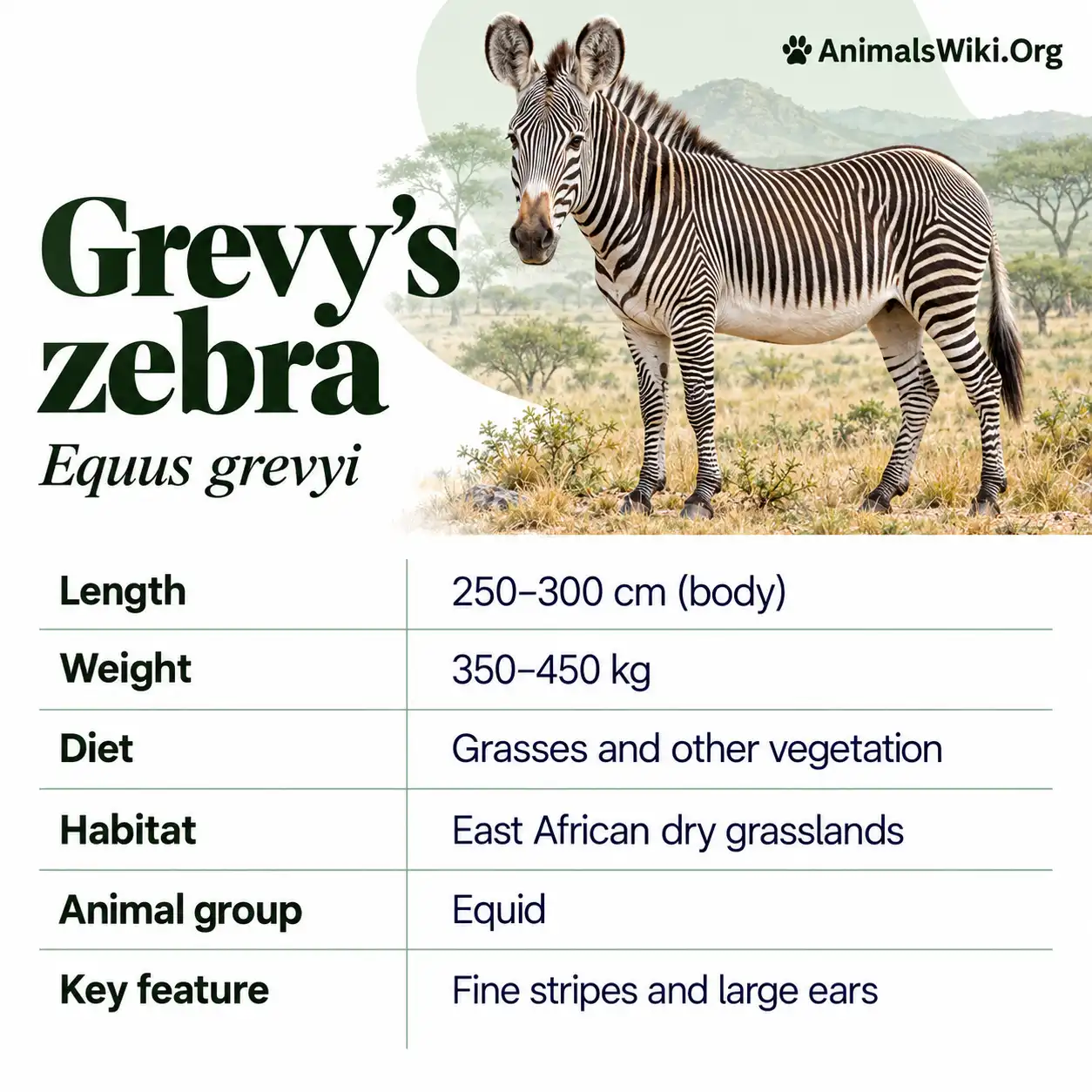
Grevy’s Zebra, Habitat, Diet, Behavior and Conservation
Grevy’s zebra is the largest living zebra species, distinguished by its narrow stripes, enormous rounded ears, and striking white belly. At first glance, it may resemble a taller version of the familiar plains zebra. A closer look reveals an animal with a different social system, specialized relationships with dry landscapes, and an urgent conservation story.
Native to East Africa, Grevy’s zebra survives mainly in Kenya and Ethiopia. It inhabits places where rainfall can be unpredictable and good grazing may lie far from dependable water. Its movements, breeding behavior, and social relationships reflect those challenges.
Unlike plains zebras, which usually live in stable family groups, Grevy’s zebras form more fluid associations. Females move according to their needs, while breeding males defend territories that may contain valuable resources.
Today, Grevy’s zebra is classified as Endangered. Habitat degradation, restricted access to water, drought, and other pressures threaten its future. Protecting it requires cooperation among conservation organizations, researchers, and the pastoral communities sharing its range.
This guide explores Grevy’s zebra facts, appearance, habitat, diet, reproduction, behavior, and the conservation work helping this remarkable African mammal survive.
Grevy’s Zebra Facts
| Feature | Details |
|---|---|
| Common name | Grevy’s zebra |
| Alternative spelling | Grévy’s zebra |
| Scientific name | Equus grevyi |
| Animal group | Mammal |
| Family | Equidae |
| Native region | East Africa |
| Main remaining range | Kenya and Ethiopia |
| Distinguishing features | Narrow stripes, large rounded ears, white belly |
| Size | Largest living zebra species |
| Typical adult weight | Approximately 350–450 kilograms; individuals vary |
| Shoulder height | Roughly 1.2–1.6 meters |
| Diet | Mainly grasses, with other vegetation |
| Social organization | Fluid groups; some adult males defend territories |
| Pregnancy | Approximately 13 months |
| Typical offspring | One foal |
| Conservation status | Endangered |
| Major concerns | Habitat degradation, water access, drought, fragmentation, and low recruitment |
1. What Is Grevy’s Zebra?
Grevy’s zebra is one of the three living zebra species. The other two are the plains zebra and mountain zebra.
It belongs to the horse family, Equidae, which also includes domestic horses and wild asses. Its scientific name is Equus grevyi.
Although all zebras share a striped appearance, Grevy’s zebra is a distinct species with recognizable differences in anatomy, distribution, and behavior. It is particularly associated with the dry grasslands and shrublands of East Africa.
Its conservation importance also sets it apart. The species has experienced a severe historical decline and now occupies a much smaller range.
Understanding Grevy’s zebra means looking beyond its coat. Its need to connect grazing with water, the demands of nursing foals, and its territorial mating system help explain how it survives—and why changes to its habitat can be so damaging.
2. Why Is It Called Grevy’s Zebra?
The species is named after Jules Grévy, a nineteenth-century president of France.
In 1882, a zebra sent from Ethiopia to France attracted scientific attention. The French zoologist Émile Oustalet recognized and described it as a distinct species, giving it the name associated with Grévy.
The spelling sometimes retains the French accent, producing Grévy’s zebra. Both forms are widely understood.
Its appearance in European scientific records should not be confused with the animal first becoming known to people. Communities within its African range had encountered these zebras long before the scientific name was established.
The name is usually pronounced approximately “GRAY-veez zebra.”
Learning the naming history adds context, but the animal’s identity is rooted in East Africa: its landscapes, ecological relationships, and continuing connections with the people who live alongside it.
3. Scientific Classification
Grevy’s zebra is a mammal and an odd-toed ungulate, belonging to the order Perissodactyla.
Its classification is:
| Rank | Classification |
|---|---|
| Kingdom | Animalia |
| Phylum | Chordata |
| Class | Mammalia |
| Order | Perissodactyla |
| Family | Equidae |
| Genus | Equus |
| Species | Equus grevyi |
Each foot bears weight on a single main hoof, representing the enlarged central toe characteristic of living equids.
Despite their different appearances, horses, zebras, and asses share important features of their limbs, teeth, and digestive systems.
Grevy’s zebra is not a striped domestic horse or a variety of plains zebra. It is a separate species.
This distinction matters when discussing conservation. An abundant population of another zebra species cannot replace the genetic identity, ecological relationships, or evolutionary history represented by Grevy’s zebra.
4. How Big Is Grevy’s Zebra?
Grevy’s zebra is the largest living zebra species and is commonly described as the largest living wild equid.
Adults generally weigh several hundred kilograms. Published profiles commonly place them around 350–450 kilograms, although sex, age, condition, and the population measured influence the figures.
Shoulder height is approximately 1.2–1.6 meters across commonly reported ranges.
Males are generally larger than females, but size overlaps. A photograph without a reliable scale can make comparison difficult, particularly when animals stand at different distances.
Its tall frame and long legs support travel across extensive landscapes. However, body size also creates substantial feeding demands.
A large grazer must obtain enough vegetation to maintain itself. During drought, even an animal adapted to coarse food may struggle when the amount of available forage drops sharply.
5. What Does Grevy’s Zebra Look Like?
Grevy’s zebra has a long, relatively narrow head, a sturdy neck, and a prominent upright mane.
Its most noticeable features include:
- Fine, closely spaced black and white stripes.
- Very large, rounded ears.
- A mostly unstriped white belly.
- A pale area around the muzzle.
- A dark stripe running along the back.
- A tail ending in a tuft of long hair.
The body stripes change direction across different regions. They form intricate patterns around the neck, torso, and hindquarters.
Its ears are especially useful for identification when comparing photographs of zebra species.
Foals look different from adults. Their darker markings are initially brownish rather than the deep black usually associated with mature animals.
Together, body proportions and stripe arrangement provide a stronger identification than judging one isolated feature, particularly in distant or partly obscured views.
6. Every Zebra Has an Individual Stripe Pattern
A Grevy’s zebra’s stripe arrangement can be used to recognize it as an individual.
Researchers compare photographs of markings along the flanks and other visible areas, much as they might identify a leopard from its spots.
This is particularly valuable because it allows repeated observations without physically capturing every animal.
An identified zebra can contribute information about survival, movement, reproduction, and association with other individuals. Over time, photographs become part of a life history rather than simply a record that “a zebra was present.”
Photographic identification still requires care. Image quality, body angle, partial obstruction, and which side is visible can affect matching.
Recognizable stripes are therefore a powerful research tool, but dependable population estimates also require consistent field methods and suitable analysis. A collection of photographs is the beginning of the process, not the finished census.
7. Why Does Grevy’s Zebra Have Stripes?
Scientists have proposed several explanations for zebra stripes, including camouflage, predator confusion, social recognition, and temperature regulation.
One of the strongest bodies of experimental evidence supports a role in reducing successful landings by biting flies.
Studies comparing striped and unstriped surfaces, including experiments involving horses wearing different patterned coverings, found that stripes can interfere with fly landing behavior.
This does not mean flies never approach zebras. The important difference can occur during the final stages of landing.
It is also important to distinguish a demonstrated effect from a complete explanation of evolution. Evidence that stripes reduce fly landings does not automatically explain every difference in stripe width or arrangement between species.
For Grevy’s zebra, its fine stripes remain both a recognizable physical feature and part of a broader scientific investigation into animal coloration.
8. Grevy’s Zebra vs. Plains Zebra vs. Mountain Zebra
The three living zebra species differ in more than size.
| Feature | Grevy’s zebra | Plains zebra | Mountain zebra |
|---|---|---|---|
| Scientific name | Equus grevyi | Equus quagga | Equus zebra |
| General size | Largest zebra species | Usually smaller | Usually smaller |
| Stripes | Especially narrow and closely spaced | Generally broader; geographically variable | Distinctive body and hindquarter patterns |
| Ears | Very large and rounded | Smaller proportionally | Relatively large |
| Belly | Mostly white | Usually has striping extending underneath | White |
| Throat dewlap | Absent | Absent | Present |
| Typical social pattern | Fluid associations and territorial males | Stable family groups | Stable family groups |
| Main region | Kenya and Ethiopia | Broad areas of eastern and southern Africa | Parts of southern Africa |
These are practical identification guides rather than a guarantee that every distant photograph will be easy to interpret.
Age, posture, lighting, and regional variation can obscure features.
The social difference is especially important: behavior associated with a plains zebra family should not automatically be applied to Grevy’s zebra.
9. Where Does Grevy’s Zebra Live?
The species’ remaining wild distribution is centered on Kenya and Ethiopia.
Kenya supports most of the surviving population, particularly across northern and north-central landscapes. Ethiopia holds much smaller, fragmented populations.
The present range represents a major contraction from its historical distribution in the Horn of Africa.
A country-level map can make the remaining habitat look more continuous than it really is. Within those countries, zebras depend on particular grazing areas, water sources, and routes between them.
Some populations also occur under different conservation arrangements, including community lands, conservancies, reserves, and managed settings.
This patchwork distribution makes local conditions important.
A population may be close to another on a map but separated by fences, settlement, unsuitable habitat, or difficult access to water. Protecting the connections can matter as much as protecting the places where zebras are most frequently photographed.
10. Grevy’s Zebra Habitat
Grevy’s zebra inhabits arid and semiarid grassland and shrubland.
Its habitat can include open plains, scattered trees, bush-covered ground, and stony areas. The defining requirement is not one particular view of African savanna, but a workable combination of food, water, and access.
Rainfall changes that combination.
After rain, new grass can make previously dry areas valuable. Later, animals may need to leave those places as vegetation dries or is heavily grazed.
A habitat must therefore be considered across seasons.
Protecting only a wet-season feeding area may leave zebras without a dry-season refuge. Similarly, a water point offers limited benefit if nearby grazing is exhausted.
The species’ survival depends on landscapes that allow movement between resources as their availability changes, rather than a small permanently suitable patch.
11. What Does Grevy’s Zebra Eat?
Grevy’s zebra is a herbivore, with grasses forming the main part of its diet.
It also eats other herbaceous plants and may browse on leaves or other vegetation when conditions require it.
Its food changes with the environment. Fresh growth after rainfall differs greatly from the mature, dry material available later in the season.
The ability to process coarse vegetation helps Grevy’s zebra use food that may be less attractive to some other grazers.
However, “able to eat coarse grass” does not mean “able to survive without enough food.”
Forage quantity, accessibility, and quality all influence body condition. Nursing females face particularly demanding circumstances because they must support themselves while producing milk.
Feeding ecology therefore connects directly to conservation: a landscape may contain vegetation yet fail to provide sufficient usable food at the times when zebras need it most.
12. Teeth and Digestion
Grevy’s zebra uses its front teeth to crop plants and its cheek teeth to grind them.
The grinding surfaces are adapted to repeated use on tough, abrasive vegetation.
Like other equids, it is a hindgut fermenter. Microorganisms in the large intestine help break down fibrous food and release energy the animal can use.
This digestive arrangement supports the consumption of substantial quantities of plant material.
It differs from the digestive system of a ruminant such as a cow, which processes food through specialized stomach compartments.
Neither system makes an animal independent of nutrition. They represent different ways of obtaining energy from vegetation.
For Grevy’s zebra, the capacity to handle coarse grass can become especially valuable during dry periods, provided sufficient material remains available. Losing access to those grass reserves can therefore remove an important seasonal survival option.
13. How Much Water Does Grevy’s Zebra Need?
Grevy’s zebra tolerates dry conditions better than some other large grazers, but it still depends on reliable drinking opportunities.
Conservation sources report that some individuals can go several days between drinks under suitable conditions.
Nursing females have much more demanding requirements. Milk production makes frequent water access particularly important.
This difference helps explain why different animals use the same landscape differently. A non-nursing adult may range farther from water, while a mother with a young foal needs a more favorable relationship between drinking sites and forage.
Long journeys can reduce feeding time and expose both mother and foal to additional risks.
Water conservation is consequently about access as well as supply. A source can contain water while remaining difficult to use because of disturbance, congestion, timing, or the conditions along the route.
14. Daily Activity and Coping With Heat
Grevy’s zebras can be active during both day and night.
Their daily routine includes grazing, walking, drinking, resting, and social interaction. The timing changes with temperature, disturbance, predators, and resource availability.
During hot periods, shade can become valuable. Resting at the hottest time may reduce the cost of activity, while feeding can continue at cooler hours.
However, no single timetable describes every population.
A zebra forced to delay drinking may follow a different schedule from one with undisturbed access. A mother may also organize her movements differently from a territorial male.
These patterns show why observing behavior is useful. When feeding time falls or travel increases, the change may reveal a problem in the relationship between the animal and its habitat.
Ordinary activities can therefore provide early information about environmental pressure.
15. Movement and Seasonal Range
Grevy’s zebras can move across extensive areas in search of resources.
Their movements are influenced by rainfall, grass growth, water distribution, and reproductive condition.
Some animals use broad home ranges rather than remaining within a small defended area. These movements should not be confused with the territories of breeding males, which serve a different social function.
A route that appears unimportant during one season may become essential during another.
For example, animals may need to reach a reserve of standing grass when heavily used wet-season areas stop producing new growth.
This makes connectivity a practical survival requirement.
Fences and development can affect animals even without occupying their favorite feeding site. Interrupting the journey between resources may be enough to make the wider landscape less usable. Conservation must account for those journeys as well as destinations.
16. A Different Kind of Zebra Society
Grevy’s zebra does not normally organize its life around the same stable family structure familiar in plains zebras.
Instead, groups can form, split, and reorganize as individuals respond to resources and reproductive needs.
This is often described as a fission–fusion social system: associations change rather than remaining permanently fixed.
The mother–foal relationship is especially important and persistent.
Adults may associate without belonging to one permanent family group led by a stallion. A gathering around water can therefore contain animals whose relationships will change once they disperse.
Fluid social organization is useful in a landscape where food and water are unevenly distributed.
Large groups may be possible when resources are abundant, while smaller associations reduce competition when feeding opportunities become limited. The social system reflects the environment rather than simply a preference for company or solitude.
17. Territorial Males
Some adult male Grevy’s zebras establish and defend territories.
The value of a territory depends partly on resources that attract females, including water and forage.
A male does not simply gather a permanent group of mares and lead them everywhere. Females can move through different territories as they meet their own needs.
Territorial behavior includes vocal communication, scent marking, and responses to other males.
Dung piles can serve as repeated marking locations, advertising the presence of a resident male.
Competition may involve displays, chasing, biting, or kicking, but encounters do not always develop into prolonged fights.
Defending an area also requires continuing effort. A territory can change in value as conditions shift, and a male’s success depends on more than physical size alone. Resource distribution and female movement are central to the mating system.
18. Females and Changing Resource Needs
Female Grevy’s zebras do not all face the same ecological demands.
A nursing mare needs enough food and water to produce milk while maintaining her own condition. A female without a dependent foal may have more freedom to use areas farther from frequent drinking opportunities.
Pregnancy, nursing, and the age of a foal can therefore influence where a female goes and which animals she associates with.
This creates patterns that may be missed if every sighting is treated as equivalent.
A landscape supporting many adult zebras might still be difficult for mothers and young.
Conservation needs to examine the most demanding stages of the life cycle. Protecting habitat that supports successful nursing and foal growth can have a greater long-term effect than merely maintaining places where adults are occasionally seen.
19. How Grevy’s Zebras Communicate
Communication involves sound, posture, movement, smell, and contact.
Grevy’s zebra is known for loud calls with a braying quality. Vocalizations can advertise presence and contribute to interactions between animals.
Ear position, body orientation, head movements, and the distance between individuals also provide information.
Scent marking is particularly noticeable around territories.
These signals help animals assess one another and respond without every encounter becoming a physical contest.
A single gesture is rarely enough for a complete interpretation. Ears turned backward can occur in different circumstances, and the meaning depends on the animal’s posture and the surrounding interaction.
For observers, the most useful approach is to watch sequences: which animal approached, what changed, and whether the other individual moved away, stayed, or responded.
Communication is an exchange, rather than a collection of isolated poses.
20. Breeding and Pregnancy
Grevy’s zebras can reproduce throughout the year, although environmental conditions influence the timing and success of births.
Pregnancy lasts approximately thirteen months, longer than the typical pregnancy of a domestic horse.
A mare normally produces one foal.
This substantial investment means population recovery cannot happen instantly. A female must complete pregnancy, raise her youngster, and remain healthy enough for future reproduction.
Good feeding conditions are particularly important around these demanding stages.
Breeding success also reflects the social system. Females move across the landscape, and males with useful territories may gain opportunities when receptive females enter.
A conservation assessment therefore needs more than evidence that mating occurs.
The important sequence includes conception, successful birth, adequate milk production, foal survival, and the youngster eventually reaching reproductive age. Each stage can be affected by habitat conditions.
21. What Is a Newborn Foal Like?
A Grevy’s zebra foal is born with long legs, large ears, and a relatively well-developed body.
Its darker stripes initially have a brown or reddish-brown appearance and darken as it matures.
The youngster begins trying to stand soon after birth. Early mobility helps it remain near its mother rather than staying hidden in one place for an extended period.
Standing quickly, however, does not make it independent.
The foal needs milk, contact, and protection. It must also learn to move confidently, recognize companions, and respond to its surroundings.
Play becomes part of development as strength and coordination improve.
For conservationists, a newborn is encouraging evidence of reproduction, but the following months are crucial. Growth and survival through challenging conditions determine whether that birth contributes to lasting population recovery.
22. Mother–Foal Recognition and Nursery Groups
The mother–foal relationship forms the foundation of Grevy’s zebra social life.
During the first period after birth, close contact helps the pair establish recognition. The mother’s appearance, scent, sounds, and behavior all form part of the youngster’s experience.
As it grows, the foal begins interacting more widely.
In some settings, females and young form nursery groups. Conservation observations describe foals remaining with other animals while mothers travel to water.
These arrangements should not be treated as an identical rule followed everywhere. Their occurrence depends on local conditions and social circumstances.
The main conservation lesson is that water access affects more than thirst.
When mothers must spend longer traveling, their foals may face additional exposure or separation. Keeping suitable grazing and safe water within practical reach can improve the conditions under which young are raised.
23. How Long Does Grevy’s Zebra Live?
Grevy’s zebras can live for two decades or more, and some individuals in human care reach older ages.
However, a potential lifespan is different from the average age animals actually reach.
Young zebras may die before maturity, while adults face risks from injury, disease, predation, and nutritional stress.
Survival also varies among locations and years. A prolonged drought can produce a very different outcome from a period of dependable rainfall.
For an aging grazer, dental condition becomes important because worn or damaged teeth can make processing vegetation harder.
Population health therefore cannot be summarized by one maximum age.
Conservationists need to understand which age groups survive, whether enough foals reach adulthood, and whether breeding females remain in good condition. Those patterns reveal much more about the future than the age of the oldest recorded individual.
24. Predators and Defensive Behavior
Lions are important predators of Grevy’s zebra in parts of its range.
Foals and vulnerable individuals may also face danger from other large carnivores, depending on the location.
A zebra’s defenses include alertness, movement, escape, and powerful kicks. Its size makes attacking an adult potentially dangerous.
Associating with other animals can increase opportunities to detect a threat, although grouping does not remove risk.
Predation becomes a particular conservation concern when a small, isolated population loses animals faster than it can replace them.
The response requires local evidence. It is not useful to assume that every predator affects every zebra population in the same way.
At the same time, predators are part of the ecosystem. Management must consider the condition of the zebra population, habitat constraints, and wider conservation goals rather than treating the relationship as a simple conflict.
25. Why Grevy’s Zebra Matters Ecologically
Grevy’s zebra contributes to the functioning of East African rangelands.
Its grazing changes vegetation structure, while dung returns nutrients and supports organisms that use animal waste.
It also forms part of predator–prey relationships and shares landscapes with other herbivores.
Its ability to process coarse vegetation helps explain its place within the broader grazing community.
The species also provides a way to understand landscape health. Monitoring its condition and movements can reveal changes in food availability, water access, and connectivity.
However, ecological importance should not be reduced to the claim that one animal controls an entire ecosystem.
Grevy’s zebra operates within a network of relationships involving plants, soils, insects, predators, livestock, and people. Conserving those relationships helps protect a functioning landscape rather than preserving a striped animal in isolation.
26. Is Grevy’s Zebra Endangered?
Yes. Grevy’s zebra is listed as Endangered on the IUCN Red List.
Its historical decline has been severe. The Grevy’s Zebra Trust cites an estimated global population of around 15,000 in the late 1970s, compared with an estimate of 3,042 in 2018.
The 2018 figure is a dated estimate, not a verified total for October 2026.
Published summaries differ because they use different survey years, methods, geographic coverage, and population categories.
The consistent message is that the species survives in only small numbers compared with its historical population and across a greatly reduced range.
Conservation status also depends on more than abundance. Distribution, trends, fragmentation, and the survival of breeding animals and young all influence how vulnerable the species remains.
27. Why Has Grevy’s Zebra Declined?
The decline reflects several interacting pressures.
Historical hunting reduced numbers, while habitat changes restricted access to food and water. Expanding settlement and other land uses altered movement routes.
Periods of drought added pressure to animals already using a fragmented landscape.
The consequences can reinforce one another. Poor grazing may reduce body condition, longer journeys may increase energy costs, and restricted water access can affect milk production.
When few foals survive, a population may fail to replace adults even if many mature animals remain visible.
This explains why conservation cannot focus on only one cause.
Preventing direct killing is important, but it does not automatically restore grass, improve water access, or reconnect seasonal ranges. Recovery depends on understanding which pressures are most important in each part of the remaining distribution.
28. Competition With Livestock: A More Detailed Picture
Competition with livestock can become serious when food and water are limited.
Heavy use may reduce the quantity of vegetation available to zebras or make drinking sites difficult to access.
However, livestock and wildlife relationships vary with season and management.
A 2025 study in the Samburu–Laikipia landscape found that Grevy’s zebras used pastoral lands during wet periods when grazing and rainfall supported fresh growth. During dry periods, they shifted toward areas with larger reserves of standing vegetation.
This does not mean overgrazing is harmless. It shows that the timing and distribution of grazing matter.
The practical goal is a landscape containing both productive wet-season feeding areas and dry-season grass reserves, with routes connecting them.
Pastoral communities can consequently be central partners in a solution rather than being treated only as a source of pressure.
29. Drought and Climate Stress
Grevy’s zebra lives in dry country, but adaptation to aridity does not make it immune to drought.
Several failed rainy seasons can reduce both vegetation growth and water availability.
Animals may travel farther, spend more time searching, and enter the next difficult period with reduced body reserves.
Mothers and young can be particularly affected because milk production and growth require dependable resources.
Drought can also intensify competition among people, livestock, and wildlife sharing the same landscape.
Emergency support may sometimes be needed, but a lasting response includes healthy soils, vegetation recovery, flexible grazing arrangements, and access to seasonal refuges.
The ability to move is especially valuable. A zebra prevented from reaching remaining resources may suffer even when suitable habitat still exists elsewhere.
Climate resilience therefore depends partly on maintaining choices within the landscape.
30. Habitat Fragmentation and Barriers
Fragmentation occurs when usable habitat is divided into smaller or less connected pieces.
For Grevy’s zebra, barriers may include fencing, settlement, infrastructure, or land uses that make movement difficult.
The damage is not always obvious from the amount of land directly occupied.
A narrow obstruction across an important route can separate grazing from water or interrupt travel between seasonal ranges.
Small, isolated populations may also have fewer opportunities for individuals to disperse and breed with animals elsewhere.
Protecting corridors requires understanding actual movement rather than drawing lines between habitat patches on a map.
Local knowledge and repeated observations can help identify routes that become important during drought or seasonal change.
Conservation planning is strongest when it considers the whole journey an animal must make to meet its needs, including places where it is only briefly present.
31. Disease and Population Health
Disease is another concern for a species surviving in small populations.
Wildlife, livestock, insects, and environmental conditions can interact in ways that influence exposure to pathogens.
Poor nutrition may add to the difficulty of coping with illness.
Conservation health work therefore includes monitoring body condition, investigating deaths, and coordinating responses among wildlife specialists and local veterinary services.
Kenya’s Grevy’s zebra recovery planning explicitly includes disease surveillance and response.
A decline in sightings alone does not establish that disease is responsible. Animals may have moved, and a proper investigation requires evidence.
Similarly, an isolated healthy-looking animal does not prove that the whole population is thriving.
Reliable health assessment combines individual observations with information about births, deaths, food, water, and conditions across the surrounding landscape.
32. Community-Led Conservation
Much Grevy’s zebra conservation takes place outside the boundaries of traditional national parks.
This makes cooperation with local communities essential.
The Grevy’s Zebra Trust works with community Scouts, Ambassadors, and Warriors who monitor animals and resources across the landscape.
Their observations include body condition, movements, births, deaths, and emerging threats.
These roles connect scientific monitoring with people who know local terrain, water sources, and seasonal patterns.
Employment and participation also help make conservation a shared activity rather than an instruction arriving from outside.
Women have an important role within these programs, contributing field information and conservation leadership.
The value is practical as well as social. A local observer can notice a drying water source or a struggling animal quickly, helping teams decide where attention is needed before a problem becomes more severe.
33. Restoring Grassland and Supporting Water Access
Habitat restoration aims to improve the resources on which zebras and neighboring communities depend.
Work can include reseeding vegetation, reducing erosion, improving soil-water retention, and coordinating livestock grazing.
Restoration should be assessed through results rather than the number of activities completed.
The important questions include whether plants establish, bare ground decreases, forage persists, and animals can use the area during difficult periods.
Water interventions also require planning. A new source can change where animals gather and increase grazing pressure nearby.
For this reason, food, water, and movement need to be considered together.
Recent Grevy’s Zebra Trust reporting describes continuing community work on rangelands and water access. These efforts seek to maintain the landscape’s capacity to support life, rather than rely indefinitely on emergency assistance after conditions deteriorate.
34. How Researchers Count Grevy’s Zebras
Counting zebras is more difficult than looking across a plain.
Animals move, hide in vegetation, gather temporarily, and may be encountered more than once.
The Great Grevy’s Rally uses photographs to help identify individuals from their stripes. Repeated sightings can then contribute to statistical estimates.
This approach depends on adequate coverage and usable images.
The Grevy’s Zebra Trust’s 2026 reporting discusses how differences in survey effort and photo quality affected interpretation of the 2024 exercise.
That is an important distinction: fewer photographed animals do not automatically prove an equivalent population decline.
Year-round monitoring complements larger surveys by recording health, distribution, and age structure.
Together, these methods provide a better understanding than a single count. The strongest conclusions emerge when field observations, individual identification, and consistent analysis support one another.
35. Zoos, Studbooks, and Managed Populations
Managed populations can contribute to Grevy’s zebra conservation through coordinated breeding, research, education, and support for field programs.
A studbook records ancestry and other information needed to manage a population over generations.
Breeding decisions aim to preserve genetic diversity and avoid relying too heavily on a small number of individuals.
These populations complement conservation in East Africa, but they do not replace functioning wild habitat.
Some field situations also require intensive management. In 2026, Ol Pejeta described work to establish a more secure breeding setting after a combination of predation, drought, disease, and other difficulties.
Such interventions address local circumstances and should not be assumed to be the appropriate model everywhere.
Their value depends on whether they improve survival and reproduction while contributing to broader, clearly defined recovery goals.
36. Watching Grevy’s Zebras Responsibly
Responsible observation gives zebras space to feed, drink, rest, and move.
Follow local rules and guide instructions, remain on permitted routes, and use binoculars or a longer camera lens instead of driving closer.
Avoid surrounding a group or positioning a vehicle between animals and water.
Mothers and foals deserve particular care because disturbance can interrupt feeding or separate them.
Do not feed, touch, chase, or attempt to attract zebras.
The species is a wild equid, capable of sudden movement, biting, and powerful kicks. Its relationship to domestic horses does not make close interaction safe.
Good wildlife viewing should leave behavior largely undisturbed. A photograph is more valuable when it records an animal continuing its life naturally, rather than reacting to pressure from the person taking the picture.
37. What Would a Successful Recovery Look Like?
A successful recovery would involve more than a higher total on a census sheet.
Grevy’s zebras need populations in which adults survive, foals grow into breeding animals, and genetic diversity remains represented.
They also need access to adequate seasonal grazing and dependable water without increasing conflict with neighboring communities.
Progress should be visible in habitat condition, successful reproduction, and the continued use of connected landscapes.
No single intervention can deliver all of these outcomes.
Protection, restoration, research, community cooperation, and appropriate local management work together.
People can contribute by supporting credible conservation organizations, choosing responsible wildlife experiences, and sharing accurate information.
The future of Grevy’s zebra depends on maintaining the ecological and social relationships that make its range usable—not simply protecting isolated animals while the surrounding landscape becomes harder to live in.
Frequently Asked Questions About Grevy’s Zebra
1. What is Grevy’s zebra?
Grevy’s zebra is a distinct African zebra species with the scientific name Equus grevyi. It is recognizable by its large size, fine stripes, rounded ears, and white belly. Its remaining wild distribution is centered on Kenya and Ethiopia.
2. Is Grevy’s zebra the largest zebra?
Yes. It is the largest living zebra species. Adults commonly weigh around 350–450 kilograms, although individuals vary. Size is useful for identification, but ear shape, stripe arrangement, and body proportions provide additional clues.
3. Why is it called Grevy’s zebra?
The name honors Jules Grévy, a former French president. The species was scientifically described in 1882 following the arrival of an Ethiopian zebra in France. People living within its African range knew the animal long before that scientific description.
4. How do you pronounce Grevy’s zebra?
A common English pronunciation is “GRAY-veez zebra.” The name also appears with a French accent as “Grévy’s zebra.” Both spellings refer to the same species and are used in wildlife and conservation writing.
5. Where does Grevy’s zebra live?
Its remaining wild populations occur mainly in Kenya and Ethiopia. Within those countries, it uses particular grasslands, shrublands, water sources, and connecting routes. Its presence is much more fragmented than a broad country-level range map may suggest.
6. What does Grevy’s zebra eat?
It mainly eats grasses, supplemented by other vegetation such as herbaceous plants and browse. Its diet changes with local availability and season. The ability to process coarse food helps it use dry-season vegetation, but it still needs enough accessible forage.
7. Can Grevy’s zebra survive without water?
It can tolerate longer intervals between drinks than some grazers, and some individuals can go several days under suitable conditions. It is still water dependent. Nursing females require much more frequent access because producing milk places additional demands on them.
8. Why are its ears so large?
Large rounded ears are a characteristic feature of the species and are useful for hearing sounds in the surrounding environment. They also help people distinguish Grevy’s zebra from other zebras. Their size should not be assigned one exclusive function without supporting evidence.
9. Why does Grevy’s zebra have narrow stripes?
Narrow stripes distinguish the species, but the complete explanation for differences among zebra patterns remains under investigation. Research strongly supports a role for contrasting patterns in reducing successful biting-fly landings, without necessarily explaining every detail of stripe width or placement.
10. Are zebra stripes unique?
Yes. Individual stripe arrangements allow researchers to recognize particular zebras in photographs. This supports monitoring of movement, survival, and reproduction. Reliable matching still requires good images, appropriate angles, and careful analysis.
11. Is Grevy’s zebra black or white?
Its coat contains both dark and light hairs arranged in stripes, while the underlying skin is dark. Describing the visible animal accurately is more useful than treating it as a simple choice between “black with white stripes” and the reverse.
12. Does Grevy’s zebra live in permanent herds?
Its associations are generally more fluid than the stable family groups of plains zebras. Animals can gather and separate according to resources and reproductive needs. The mother–foal bond is particularly important, while some adult males defend territories.
13. What is a male Grevy’s zebra called?
An adult male is called a stallion. Some stallions defend territories, while others remain nonterritorial. A female is a mare, and a young zebra is a foal.
14. How long is its pregnancy?
Pregnancy lasts approximately thirteen months. A mare normally produces one foal. Successful reproduction also depends on the mother’s condition and the resources available during pregnancy, nursing, and the youngster’s early growth.
15. What color are newborn Grevy’s zebra stripes?
Foals initially have brown or reddish-brown darker markings. These darken as the animal matures. Their large ears and long legs can make them appear especially different from adults during the first stages of life.
16. How quickly can a foal stand?
A healthy foal begins attempting to stand soon after birth and becomes mobile early. This helps it follow its mother. Early mobility does not remove its dependence on milk, protection, and suitable conditions for growth.
17. How long do Grevy’s zebras live?
They can live for two decades or more, with some individuals surviving longer in human care. Actual survival varies with health, nutrition, predation, and environmental conditions. Maximum age and the average lifespan of a particular population are different measures.
18. What eats Grevy’s zebra?
Lions are important predators in parts of its range. Other large carnivores may threaten foals or vulnerable individuals. The significance of predation varies locally and must be considered alongside disease, drought, nutrition, and other causes of mortality.
19. Is Grevy’s zebra endangered?
Yes. It is classified as Endangered. Its population and range have declined severely, and continuing pressures include habitat degradation, water access, drought, fragmentation, and difficulties raising enough young to replace lost adults.
20. How many Grevy’s zebras remain?
Only a few thousand remain in the wild, but exact figures must be tied to a survey year and method. The Grevy’s Zebra Trust cites a 2018 estimate of 3,042 animals. That figure should not be presented as a verified October 2026 census.
21. Can Grevy’s zebra breed with plains zebra?
Natural hybridization between Grevy’s zebra and plains zebra has been documented. Its frequency and conservation significance require local assessment. The existence of hybrids does not mean the two are the same species or that hybridization explains their main population trends.
22. Can Grevy’s zebra be domesticated?
Individual wild equids may sometimes become accustomed to handling, but training an individual is different from domesticating a population over generations. Grevy’s zebra remains a wild species with specialized welfare and conservation needs, rather than an ordinary riding or companion animal.
23. Are Grevy’s zebras dangerous?
They can injure people through biting, kicking, or sudden movement. A relaxed appearance does not guarantee safety. Keep a respectful distance and follow local guidance, particularly around foals, territorial interactions, and access to food or water.
24. Do livestock always harm Grevy’s zebras?
No single rule describes every situation. Competition can be severe during shortages, but seasonal grazing patterns can also create vegetation that zebras use. Conservation focuses on managing timing, intensity, grass reserves, water access, and movement across the shared landscape.
25. How can people help Grevy’s zebra?
Support credible conservation programs, choose responsible wildlife tourism, and avoid disturbing animals near water or young. Accurate information also matters: use dated population estimates and recognize the essential role of local communities in protecting habitat and monitoring the species.
Grevy’s Zebra Endangerd
Grevy’s zebra combines impressive size with a highly distinctive appearance and an adaptable social life. Its fine stripes attract attention, but its survival depends on less visible connections: between grass and water, mothers and foals, seasonal ranges, and neighboring communities.
Its Endangered status reflects a serious historical decline. Yet community monitoring, habitat restoration, research, and coordinated conservation provide practical ways forward.
Protecting Grevy’s zebra means keeping East African landscapes usable through changing seasons. When those landscapes support healthy adults, surviving foals, and sustainable livelihoods, the species has a stronger chance of recovery.



