
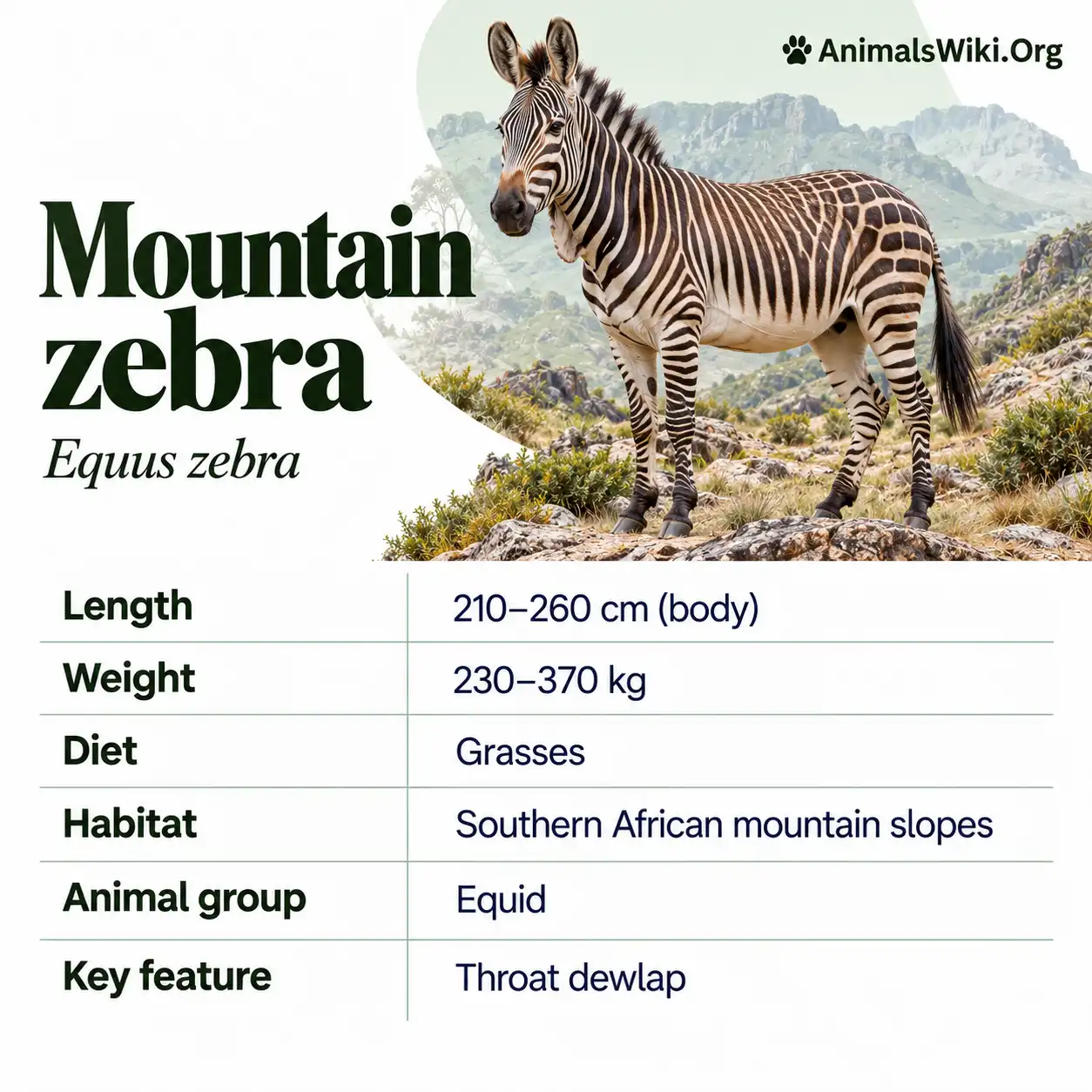
Mountain Zebra, Habitat, Diet, Behavior and Conservation
The mountain zebra is a distinctive African mammal built for life among rocky slopes, open plateaus, and dry grasslands. Its striped coat makes it instantly recognizable as a zebra, but several features distinguish it from its better-known relatives. Look closely, and you will notice a hanging fold of skin beneath the throat, strong contrasting stripes, and a characteristic pattern above the tail.
Mountain zebras include two traditionally recognized subspecies: the Cape mountain zebra and Hartmann’s mountain zebra. Their ranges, sizes, population histories, and conservation challenges differ.
The Cape mountain zebra provides an important example of recovery from near extinction. Hartmann’s mountain zebra, found mainly in Namibia, illustrates the importance of movement across dry landscapes where rain and water availability change considerably.
Neither story can be understood through population numbers alone. Habitat quality, access to water, genetic diversity, and the ability to move between suitable areas all influence survival.
This guide explores mountain zebra facts, appearance, habitat, diet, reproduction, social behavior, and conservation. It also explains the differences between the two subspecies and why protecting mountain zebras requires attention to the wider landscapes they inhabit.
Mountain Zebra Facts
| Feature | Details |
|---|---|
| Common name | Mountain zebra |
| Scientific name | Equus zebra |
| Animal group | Mammal |
| Family | Equidae |
| Traditionally recognized subspecies | Cape mountain zebra and Hartmann’s mountain zebra |
| Native region | Southwestern and southern Africa |
| Main range countries | Namibia, South Africa, and parts of Angola |
| Main habitats | Rocky hills, mountain slopes, plateaus, and adjoining grasslands |
| Diet | Primarily grasses, with other vegetation |
| Distinctive feature | Throat dewlap |
| Other identifying features | Striped legs, pale belly, and gridiron rump pattern |
| Social organization | Stable breeding groups and bachelor groups |
| Pregnancy | Approximately one year |
| Typical offspring | One foal |
| Global species status | Vulnerable |
| Major concerns | Habitat fragmentation, drought, hunting, and genetic management |
1. What Is a Mountain Zebra?
A mountain zebra is a wild member of the horse family native to southern and southwestern Africa.
Its scientific name is Equus zebra. It is one of the three living zebra species commonly recognized, alongside the plains zebra and Grevy’s zebra.
The name reflects its association with hilly and mountainous terrain. However, mountain zebras do not spend every moment on steep slopes. They also use plateaus, valleys, and nearby feeding areas when these provide suitable resources.
Their survival depends on the relationship between terrain, vegetation, water, and movement.
The species is particularly recognizable by its dewlap, a loose fold of skin beneath the throat.
Understanding mountain zebras also requires distinguishing their two main forms. Cape and Hartmann’s mountain zebras share many characteristics, but their geography and conservation histories are sufficiently different that they should not be treated as interchangeable populations.
2. Cape Mountain Zebra and Hartmann’s Mountain Zebra
The two traditionally recognized subspecies are:
- Cape mountain zebra — Equus zebra zebra
- Hartmann’s mountain zebra — Equus zebra hartmannae
Cape mountain zebras occur naturally in South Africa. Hartmann’s mountain zebras are associated mainly with Namibia, with populations or parts of their distribution extending into Angola and South Africa.
Cape mountain zebras are generally smaller. Differences in stripe proportions can also help specialists distinguish them, although appearance alone is not always sufficient for conservation decisions.
Their population histories differ considerably.
Cape mountain zebras survived an extreme decline and were rebuilt from a few remnant populations. Hartmann’s mountain zebras occupy a broader dry-country landscape where drought, fences, and access to resources are especially important.
These differences mean a successful management approach for one population may not be appropriate for another. Conservation needs to account for each group’s ancestry, habitat, and local circumstances.
3. Scientific Classification
Mountain zebras belong to Equidae, the family containing horses, zebras, and asses.
They are members of Perissodactyla, the mammalian order commonly called odd-toed ungulates. Rhinoceroses and tapirs also belong to this order.
| Rank | Classification |
|---|---|
| Kingdom | Animalia |
| Phylum | Chordata |
| Class | Mammalia |
| Order | Perissodactyla |
| Family | Equidae |
| Genus | Equus |
| Species | Equus zebra |
Some researchers have proposed treating Cape and Hartmann’s mountain zebras as separate species. Many conservation authorities continue to recognize them as subspecies within Equus zebra.
Consequently, different publications may use different naming arrangements.
The practical conservation issue remains the same: their distinct populations and genetic characteristics need appropriate management.
A difference in taxonomic rank does not remove the need to preserve their diversity or justify mixing animals without considering their origin and conservation purpose.
4. What Does a Mountain Zebra Look Like?
Mountain zebras have an upright mane, relatively long ears, a dark muzzle, and strong black or dark-brown stripes against a pale background.
The stripe pattern changes across the body.
Stripes on the neck and torso are generally narrower than the broad bars across the hindquarters. The legs remain striped down toward the hooves.
The underside is mostly pale, unlike the fully wrapped appearance often associated with plains zebra striping.
Above the tail, a distinctive arrangement of short transverse markings creates the gridiron pattern.
The dewlap beneath the throat provides another useful identifying feature.
An individual may sometimes look reddish or dusty because soil clings to its coat after rolling. This should not automatically be interpreted as its natural coat color.
For identification, the combination of body shape, throat fold, and stripe arrangement is more reliable than one feature viewed from a distance.
5. How Big Is a Mountain Zebra?
Mountain zebra size varies between subspecies, sexes, and individuals.
Cape mountain zebras are generally smaller than Hartmann’s mountain zebras. Published profiles commonly place mountain zebras within a broad weight range of approximately 230–380 kilograms, although some individuals fall outside simplified reference ranges.
Shoulder height is roughly 1.15–1.5 meters in commonly used descriptions.
A measurement at the shoulder is more useful than the height of the head because head position changes constantly.
Body condition also affects appearance. An animal with a full digestive tract or a mare late in pregnancy may look heavier without having a larger skeletal frame.
Mountain zebras are smaller than Grevy’s zebras, but they remain powerful animals.
Their relatively compact build should not encourage close approaches. Size differences among zebra species do not make any of them suitable for casual handling.
6. What Is the Mountain Zebra’s Dewlap?
The dewlap is a loose fold of skin hanging beneath the throat.
It is one of the easiest ways to distinguish a mountain zebra from a plains zebra or Grevy’s zebra.
Its prominence can vary between individuals, and it may be easier to see from the side than from the front.
Photographs can hide the feature if the animal’s head is lowered or the throat is obscured.
Although dewlaps occur in several other mammals, their presence should not lead to assuming an identical function in every species. Short wildlife descriptions sometimes give confident explanations without distinguishing observation from hypothesis.
For identification, the important established point is straightforward: the mountain zebra’s throat fold is a characteristic anatomical feature.
Combined with the gridiron rump pattern and striped lower legs, it provides a practical guide for recognizing the species in the field.
7. Stripes and Individual Recognition
Mountain zebra stripes are not identical from one animal to another.
Differences in pattern allow researchers to recognize individuals in photographs, providing a useful alternative or complement to physical marking.
Repeated identification can reveal which animals survive, where they travel, and which group they belong to.
It can also help document births and changes in group membership.
Scientists studying Hartmann’s mountain zebras in Namibia have used stripe photographs to investigate population changes and their relationship with rainfall.
As with any research method, image quality matters. A distant, blurred, or partly hidden animal may be difficult to match reliably.
The stripe pattern is therefore more than a visual attraction. It can become a record of an individual’s life, helping conservationists understand changes that a simple total count would miss.
8. Mountain Zebra vs. Other Zebra Species
Mountain zebras differ from their relatives in appearance, habitat, and social organization.
| Feature | Mountain zebra | Plains zebra | Grevy’s zebra |
|---|---|---|---|
| Scientific name | Equus zebra | Equus quagga | Equus grevyi |
| General size | Relatively compact; Cape form especially small | Usually intermediate | Largest zebra species |
| Throat dewlap | Present | Absent | Absent |
| Stripe pattern | Narrower body stripes, broad hindquarter bars, gridiron rump | Broad and geographically variable | Especially fine, closely spaced stripes |
| Belly | Mostly pale | Usually striped | Mostly white |
| Typical social pattern | Stable breeding groups | Stable breeding groups | More fluid associations |
| Main region | Southern and southwestern Africa | Eastern and southern Africa | Kenya and Ethiopia |
These comparisons describe broad patterns.
A distant animal may still be difficult to identify, particularly when only part of its body is visible.
Behavior also deserves attention. Mountain zebras should not be described using Grevy’s zebra’s territorial social system simply because both are striped African equids.
9. Where Do Mountain Zebras Live?
Mountain zebras are native to southern and southwestern Africa.
Cape mountain zebras occur in South Africa, especially within parts of the Cape region and associated conservation areas.
Hartmann’s mountain zebras are found mainly in Namibia, with a distribution also involving southwestern Angola and populations in South Africa.
The range is not continuous.
Suitable terrain may be separated by farms, fences, settlements, dry plains, or other areas that animals cannot readily use.
Some populations have also been established or reinforced through conservation transfers.
A country name therefore provides only a starting point. Within a country, water distribution, grazing conditions, and the ability to move between areas determine where zebras can persist.
Conservation assessments distinguish naturally occurring populations, reintroduced populations, and animals placed beyond historical range because those categories can have different implications for management.
10. Mountain Zebra Habitat
Typical mountain zebra habitat includes rocky slopes, hills, plateaus, valleys, and adjoining grassland.
However, rugged scenery alone does not make an area suitable.
Zebras still require enough edible vegetation and access to water. A steep reserve covered mainly in unpalatable plants may support fewer animals than its size suggests.
Research in Mountain Zebra National Park found strong use of vegetation communities offering useful grass resources.
This helps explain why zebras may move between terrain types instead of remaining permanently on the highest ground.
Food quality, food quantity, and season all influence habitat use.
A good conservation area must therefore be assessed as a feeding landscape, not only as a protected mountain.
Managers need to understand which parts support animals during productive periods and which remain useful when vegetation dries, temperatures change, or water becomes scarce.
11. Adaptations for Rocky Terrain
Mountain zebras are capable climbers and move confidently across uneven ground.
Their hooves, limb structure, balance, and experience help them negotiate slopes and rocky surfaces.
Each foot bears weight on a single main hoof, as in other living equids.
Their ability should not be compared with that of an animal specialized for narrow cliff ledges, such as an ibex. Mountain zebras are large grazers using rugged landscapes, rather than animals confined to sheer rock faces.
Suitable footing also does not remove all risk of injury.
The conservation significance is that terrain influences where they can travel and feed. A population may use hills for refuge or movement while depending on flatter ground for productive grazing.
Protecting only the roughest areas can therefore overlook important lowland resources needed to sustain the same animals throughout the year.
12. What Do Mountain Zebras Eat?
Mountain zebras are primarily grazers.
Grasses form the core of their diet, but they can also eat other vegetation, including leaves and browse.
The exact mixture depends on habitat and availability.
A mountain zebra in productive grassland does not necessarily eat the same diet as one restricted to a dry, shrub-dominated reserve.
Studies of Cape mountain zebra have found meaningful differences in resource use between sites. Some populations incorporate more non-grass vegetation where suitable grass is limited.
This flexibility helps animals cope, but it should not automatically be interpreted as evidence that every diet is equally good.
A zebra may eat an available plant because preferred food is scarce.
Conservationists consequently consider feeding choices alongside body condition, reproduction, and habitat quality to determine whether a population is thriving or merely managing to persist.
13. How Mountain Zebras Digest Their Food
Mountain zebras are hindgut fermenters, like horses and other zebras.
Microorganisms in the large intestine help process fibrous plant material and produce compounds the animal can use for energy.
This digestive strategy allows substantial quantities of vegetation to move through the system.
It differs from the arrangement found in ruminants such as cattle, sheep, and many antelopes.
Being able to process coarse food is useful in seasonal environments, but it does not make food quality irrelevant.
A zebra needs enough digestible energy and nutrients to maintain its body, move, grow, and reproduce.
A nursing mare faces additional demands because she must produce milk.
When suitable grass becomes limited, changes in diet may therefore affect more than feeding time. They can influence the condition of adults and the ability of females to raise healthy young.
14. Water Requirements
Mountain zebras are water-dependent animals.
Regular access to drinking water is important, even when they occupy dry landscapes.
Their requirements change with weather, activity, diet, and reproductive condition. Nursing females face different demands from adults that are not producing milk.
Springs, streams, pools, and other reliable sources influence how animals use their range.
Mountain zebras may also paw at the ground where subsurface moisture can be reached, but this does not allow them to obtain water from every dry location.
The important conservation question is whether usable water remains accessible when conditions deteriorate.
A source separated from grazing by an impassable fence offers little practical benefit.
Water management therefore needs to consider routes, surrounding vegetation, and the wider distribution of resources rather than treating each drinking point as an isolated feature.
15. Daily and Seasonal Movement
Mountain zebras move between feeding areas, water, resting places, and other parts of their range.
The amount of movement depends on how resources are arranged.
Some populations undertake important seasonal journeys, while others live within smaller fenced areas where movement choices are restricted.
Changes in grass quality and availability can help explain why a group leaves one area and uses another.
These journeys are not necessarily dramatic mass migrations. A relatively modest movement can still be essential if it connects animals with the only remaining useful resource.
This distinction matters for conservation planning.
A population might survive comfortably within a reserve during a good season yet struggle when conditions change and a former route is blocked.
Protecting movement opportunities gives animals more options, helping them respond to variation instead of depending entirely on human intervention.
16. Activity, Resting, and Dust Bathing
Mountain zebras divide their time among grazing, traveling, drinking, resting, and social interaction.
Many are especially active during cooler parts of the day, although activity can change with local conditions.
Dust bathing is a conspicuous behavior.
An animal lowers itself and rolls, coating its body with loose soil. Repeated use can create a shallow depression in the ground.
The behavior contributes to coat and skin maintenance and may help reduce irritation.
These rolling places can also have effects beyond the zebra itself.
Research on Hartmann’s mountain zebras has shown that their rolling pits alter local conditions for plants and other organisms.
This makes dust bathing a useful example of how an ordinary animal behavior can influence a landscape. Something that looks like a brief personal grooming activity can leave a physical feature that persists after the zebra moves away.
17. Mountain Zebra Herd Structure
Mountain zebras commonly form stable breeding groups.
A group usually contains one adult stallion, several mares, and their young.
These associations can persist for years, making familiarity and repeated interaction important parts of social life.
Males that do not hold breeding groups may associate in bachelor groups.
Several breeding groups can gather temporarily without losing their separate identities.
This is different from assuming that every large collection of zebras forms one permanent herd under one male.
Long-term studies of Cape mountain zebras have documented the importance of these smaller social units.
For conservation, group structure matters when animals are moved, populations are monitored, or breeding performance is assessed.
A reserve containing a certain number of zebras may still have a different reproductive outlook depending on how many breeding groups exist and how those groups are composed.
18. Communication and Social Relationships
Mountain zebras communicate through posture, movement, touch, scent, and sound.
Ear position, head movements, body orientation, and changes in distance help animals assess one another.
Vocalizations can accompany alarm, contact, or challenging encounters.
Close interactions also maintain familiar relationships within a group.
Not every signal has one fixed meaning. Ears facing backward may be tracking a sound, while flattened ears combined with a tense posture can accompany a threat.
The sequence of an interaction matters more than one photograph.
Researchers and keepers therefore examine who approached, what each animal did, and how the encounter ended.
Understanding these relationships can help identify social stress in managed populations.
Providing food and water is essential, but a social animal’s welfare also depends on compatible companions and opportunities to interact in ways appropriate to its species.
19. Breeding and Pregnancy
Mountain zebras can breed throughout the year, although births may be more frequent during favorable seasons.
Pregnancy lasts approximately one year, and a mare usually produces one foal.
The interval between births varies with condition and circumstances. A female should not be assumed to produce a surviving youngster every year.
Pregnancy and nursing are substantial investments.
The mare needs enough nutrition to support herself while also sustaining fetal growth and later milk production.
Reproductive success therefore provides useful information about habitat quality.
A population containing many adults but few surviving young may be facing a problem that total numbers alone do not reveal.
Conservation monitoring follows the full process: births, growth, survival, and the eventual entry of young animals into the breeding population.
That sequence determines whether the population can replace losses and continue growing.
20. Mountain Zebra Foals
A newborn mountain zebra is relatively well developed.
It has long legs, a soft-looking coat, and darker markings that may initially appear brown rather than deep black.
The foal begins trying to stand and move soon after birth.
Early mobility helps it stay near its mother and gradually keep pace with the group.
It still depends heavily on milk, contact, and protection.
As the youngster grows, it investigates vegetation and begins grazing while continuing to nurse.
Play contributes to coordination and social experience. Running, turning, and interacting with companions help develop abilities that become important later.
Foal survival reflects several conditions at once: maternal health, food availability, weather, disease, and predation.
A birth is therefore an encouraging milestone, but the following months determine whether that youngster contributes to the population’s long-term recovery.
21. Lifespan and Aging
Mountain zebras can survive for two decades or more, and some individuals in human care live into their late twenties.
A potential lifespan is different from the average age reached in a wild population.
Young animals may die before maturity, while adults face risks from injury, disease, predation, and nutritional stress.
Older grazers can become increasingly vulnerable as dental condition changes. Food that was manageable earlier in life may become harder to process effectively.
Body condition can then decline, especially during difficult seasons.
For conservation, age structure is more informative than the age of the oldest animal.
A population needs enough surviving young to replace adults, enough breeding females to sustain reproduction, and adequate conditions across life stages.
Long-lived individuals are valuable, but they do not by themselves establish that a population is healthy or secure.
22. Predators and Defensive Behavior
Predation varies according to which carnivores occur within a mountain zebra’s range.
Lions and hyenas can be important predators in some settings. Young or weakened animals may be particularly vulnerable.
Adult zebras are strong and can defend themselves with powerful kicks and bites.
Their responses also include alertness, moving away, and coordinated reactions within a group.
Predation is one influence among many.
Drought, poor nutrition, injury, and disease may be equally important or more important in particular populations.
Conservation decisions therefore require local evidence rather than assumptions based only on the presence of carnivores.
Mountain Zebra National Park, for example, manages a wider community of large mammals and predators, with interventions guided by ecological objectives.
Protecting zebras within such a system involves understanding population performance and predator–prey relationships rather than expecting a landscape without natural risks.
23. Ecological Importance
Mountain zebras influence their habitats through feeding, movement, dung deposition, and disturbance of the soil.
Their grazing affects vegetation structure, while waste returns nutrients and supports organisms that use animal dung.
They also form part of food webs involving predators and scavengers.
Hartmann’s mountain zebras provide a particularly interesting example through their rolling pits.
A study in the Pre-Namib found that these disturbed patches contributed to plant diversity and landscape variation. Loose soil and altered water conditions created different growing opportunities from those in the surrounding ground.
This is why the animals can be described as ecosystem engineers in that context.
The term does not mean they control the entire environment.
It means their behavior physically changes conditions in ways that affect other organisms, connecting the life of a large grazer with smaller-scale ecological processes.
24. Is the Mountain Zebra Endangered?
The mountain zebra species, Equus zebra, is globally classified as Vulnerable.
However, conservation categories must be matched to the correct taxon and assessment.
Cape mountain zebra has been assessed separately as Least Concern following substantial recovery, while Hartmann’s mountain zebra is globally assessed as Vulnerable.
Regional assessments can differ from global ones. For example, a regional category describing Hartmann’s mountain zebra within South Africa should not be presented as the status of the entire population across its range.
These distinctions prevent misleading summaries.
“Least Concern” also does not mean that management is unnecessary. A recovered population may still depend on habitat protection, genetic management, and careful movement between isolated groups.
Status describes an assessment of extinction risk; it is not a guarantee that future decline cannot occur.
25. How Cape Mountain Zebras Nearly Disappeared
Cape mountain zebras suffered an extreme historical decline.
Hunting, agricultural expansion, and competition over land and grazing reduced their distribution and numbers.
By the twentieth century, only a few remnant populations remained.
Their survival became associated with three especially important stocks: Mountain Zebra National Park, Gamkaberg, and Kammanassie.
The remaining animals did not represent equal quantities of genetic diversity, and later expansion drew heavily from some stocks more than others.
This history explains why recovery is more complicated than breeding many animals.
A population can regain numbers while still carrying the effects of a severe bottleneck.
Conserving Cape mountain zebras therefore includes protecting the descendants of different surviving lineages and ensuring that future breeding does not allow less common genetic variation to disappear.
26. Mountain Zebra National Park
South Africa’s Mountain Zebra National Park was established in 1937 to protect Cape mountain zebras.
Located in the Eastern Cape, it became central to the subspecies’ recovery.
The park’s significance extends beyond maintaining one population.
Animals from its stock have helped establish or strengthen populations in other protected areas and private conservation properties.
This spreading of animals reduced dependence on a single site and contributed to numerical growth.
However, extensive use of one source population also helped produce an uneven representation of surviving lineages.
The park therefore illustrates both the achievements and the continuing complexities of conservation.
Protecting and breeding animals can prevent disappearance, while later stages require attention to ancestry, distribution, and habitat quality.
Recovery is a sequence of changing tasks rather than one intervention that permanently solves every problem.
27. Hartmann’s Mountain Zebra Conservation
Hartmann’s mountain zebra occupies extensive dry landscapes, particularly along Namibia’s escarpment.
Its challenges differ from those of the most restricted Cape populations.
Rainfall strongly influences feeding conditions, and zebras may need to move over large areas to reach suitable resources.
Fences can become particularly damaging when they block those movements.
Historical drought accounts document the consequences of animals being unable to reach better conditions.
Hunting, conflict over grazing, and changes in land use can add pressure.
At the same time, local populations can increase when conditions are favorable.
This variation means that short periods of growth should not be mistaken for permanent security.
Conservation must preserve the ability to respond to changing rainfall and maintain access across the wider landscape, including land outside conventional protected areas.
28. How Many Mountain Zebras Are Left?
There is no useful single figure unless the count specifies which animals it includes.
A mountain zebra total may combine Cape and Hartmann’s mountain zebras, count only mature animals, or cover one country or management area.
Survey year also matters.
Cape mountain zebra numbers have recovered into the thousands. A South African government account published in 2024 cited an estimate of approximately 5,185 animals.
That is a dated estimate, not a verified October 2026 census.
Hartmann’s mountain zebra populations are larger overall, but estimates also depend on survey methods, coverage, and environmental conditions.
For conservation, abundance must be considered alongside distribution and reproductive performance.
Thousands of animals separated into poorly connected populations can face different risks from the same number occupying a functioning, connected landscape with adequate resources.
29. Habitat Fragmentation and Fences
Fragmentation divides usable habitat into smaller, less connected areas.
For mountain zebras, fences can restrict access to grazing, water, or seasonal refuges.
A fenced reserve may protect animals from some threats while also preventing natural dispersal.
This becomes especially important when local conditions deteriorate.
The amount of land enclosed does not automatically reveal how well it supports zebras. A large area with little suitable grass may provide fewer resources than a smaller, better-quality site.
Fragmentation also affects breeding.
When animals cannot move between populations, genetic exchange may depend on planned transfers.
Conservation must therefore evaluate both physical resources and population connections.
The practical objective is to maintain enough suitable habitat and enough movement of animals or genes to prevent isolated groups from gradually becoming less resilient.
30. Why Genetic Diversity Matters
Cape mountain zebra recovery has drawn attention to the difference between more animals and more genetic security.
A population descended from few founders can remain genetically restricted even after its numbers grow.
Genetic drift can further reduce variation in small isolated groups, while inbreeding can increase risks associated with close relatedness.
A study published in 2019 documented losses of genetic diversity in several Cape mountain zebra populations.
These results reinforced the need for coordinated management rather than treating each reserve as an independent breeding unit.
Genetic management seeks to retain valuable variation across the wider population.
This includes considering which animals move, their ancestry, and how their descendants contribute.
The aim is a population with better long-term options for reproduction and adaptation, rather than simply achieving the largest possible head count in each enclosure.
31. Translocations and Genetic Management
A translocation is the deliberate movement of animals for a defined purpose.
For mountain zebras, transfers can establish populations, reduce pressure at one site, or improve genetic representation elsewhere.
The process requires more than selecting healthy-looking animals.
Managers consider ancestry, social compatibility, habitat suitability, disease concerns, and the objectives of both the source and destination populations.
Appearance cannot reliably answer every genetic question.
Hybridization between different equids or mountain zebra forms is therefore relevant when evaluating potential breeding animals.
Monitoring continues after release.
A transferred zebra must settle, find resources, integrate socially, and—where intended—contribute to reproduction.
A successful journey is only the first stage. The long-term conservation outcome depends on what happens to the animal and its descendants within the receiving population.
32. Recent Work at Zebraskop
Recent conservation work in the Western Cape connects habitat expansion with genetic rescue.
CapeNature reported a 2024 translocation program involving Cape mountain zebras from remnant lineages at Gamkaberg and Kammanassie.
The work used Zebraskop as a setting for carefully managed genetic mixing.
In December 2025, CapeNature announced the establishment of the 3,952-hectare Zebraskop Nature Reserve, intended to support the Cape mountain zebra genetic program.
The announcement also described work toward a connection with Gamkaberg and continued monitoring of transferred animals.
The importance is not simply the addition of land.
Suitable lowland habitat and better population connections can improve opportunities for breeding and growth.
This example shows how recovery can address several linked problems at once: limited grazing, isolated populations, and uneven representation of surviving genetic diversity.
33. Drought and Climate Challenges
Mountain zebras live in environments where rainfall can vary substantially.
Drought reduces vegetation growth and can limit water access.
Animals may travel farther, spend more time searching, and enter the next season with reduced body reserves.
These effects can influence both adult survival and reproduction.
Research on Hartmann’s mountain zebras in Namibia has linked rainfall with birth and death patterns.
The ability to move becomes particularly important when conditions differ across a large area.
A population blocked from reaching remaining resources may be more vulnerable than one able to use alternative ranges.
Climate resilience therefore involves more than supplying water during an emergency.
Healthy vegetation, adequate habitat, movement opportunities, and sensible population management help animals cope with difficult periods before intensive intervention becomes necessary.
34. People, Landowners, and Conservation
Mountain zebra conservation involves national parks, provincial reserves, private landowners, researchers, and nearby communities.
Different participants contribute different resources and knowledge.
Protected areas maintain important populations, while private conservation properties can provide additional habitat and breeding opportunities.
Local understanding helps identify grazing changes, fence problems, water shortages, and unusual animal behavior.
Cooperation is especially important when decisions affect land use or require transfers between properties.
Conservation becomes stronger when objectives are clear: which lineage is being maintained, what habitat can support, and how the population contributes to wider recovery.
A zebra population should not be judged only as an attraction for visitors.
Its value also lies in functioning as part of a healthy ecosystem and contributing to the long-term persistence of the species.
35. Zoos and Research
Managed populations can support mountain zebra conservation through coordinated breeding, research, education, and assistance to field projects.
Studbooks and ancestry records help institutions make breeding decisions.
Research also improves understanding of nutrition, health, reproduction, and social needs.
For example, recent zoo transfers have been made under coordinated breeding recommendations for Hartmann’s mountain zebras.
However, maintaining animals in human care cannot replace suitable habitat in their native range.
The strongest contribution comes when managed populations connect with broader conservation goals.
Field research remains essential because conditions in an enclosure differ from those in an extensive mountain landscape.
Combining knowledge from both settings helps answer practical questions while keeping attention on the ultimate objective: healthy populations capable of persisting over generations.
36. Watching Mountain Zebras Responsibly
Responsible observation allows zebras to continue feeding, resting, and moving normally.
Follow local rules, use designated roads and trails, and keep a respectful distance.
Binoculars and a longer camera lens provide better views without requiring close approaches.
Do not feed, touch, attract, or attempt to ride a zebra.
Avoid placing yourself or a vehicle between group members, particularly between a mare and her foal.
Water sources deserve special care because repeated disturbance can affect whether animals use them.
When visiting a reserve, choose experiences that respect wildlife and support credible conservation work.
A successful encounter is one in which the zebra remains free to choose its activity.
The goal is to observe a wild animal’s life, rather than make it react for the sake of a photograph.
Frequently Asked Questions About Mountain Zebras
1. What is a mountain zebra?
A mountain zebra is a wild African equid with the scientific name Equus zebra. It is recognizable by its throat dewlap, striped legs, pale belly, and gridiron rump pattern. It is traditionally divided into Cape and Hartmann’s mountain zebra subspecies.
2. Where do mountain zebras live?
They occur in southern and southwestern Africa. Cape mountain zebras are native to South Africa. Hartmann’s mountain zebras are found mainly in Namibia, with distribution also involving southwestern Angola and populations in South Africa.
3. Why are they called mountain zebras?
The name reflects their association with hilly and mountainous terrain. They are capable climbers, but they also use valleys, plateaus, and adjoining grasslands. Productive feeding areas and water can be as important as the rocky slopes themselves.
4. What are the two mountain zebra subspecies?
The traditionally recognized subspecies are the Cape mountain zebra, Equus zebra zebra, and Hartmann’s mountain zebra, Equus zebra hartmannae. Some researchers have proposed separate species status, but many conservation authorities continue to use the subspecies arrangement.
5. Which mountain zebra is smaller?
Cape mountain zebras are generally smaller than Hartmann’s mountain zebras. Individual measurements overlap, so size alone is not always enough for identification. Body proportions, stripe characteristics, geographic origin, and genetic information can also be relevant.
6. What is a dewlap?
A dewlap is a loose fold of skin beneath the throat. It is a characteristic feature of mountain zebras and a useful way to distinguish them from plains and Grevy’s zebras when the throat is clearly visible.
7. What do mountain zebras eat?
They primarily eat grasses but can also consume other vegetation, including browse. Diet varies with habitat and season. A population using more non-grass food may be responding to limited grazing rather than demonstrating that every available diet is equally suitable.
8. Do mountain zebras need water every day?
They depend on regular water access, and Cape mountain zebra conservation guidance emphasizes daily drinking. Requirements vary with conditions and reproductive state. Dry-country adaptations do not remove the need for dependable water and practical routes between drinking and feeding areas.
9. Can mountain zebras dig for water?
They may paw at the ground to reach accessible subsurface water. This behavior helps in particular situations but does not allow them to obtain water anywhere. Suitable water distribution remains a major factor in habitat use and conservation planning.
10. How large are mountain zebras?
Commonly reported adult weights fall broadly around 230–380 kilograms, with shoulder heights roughly 1.15–1.5 meters. Cape mountain zebras are generally smaller than Hartmann’s. Sex, age, body condition, and the population measured influence these ranges.
11. Are mountain zebras good climbers?
Yes. They negotiate rocky hills and slopes with considerable agility. However, they are large grazing mammals rather than cliff specialists. Many populations also need flatter feeding areas, making protection of surrounding valleys and lowlands important.
12. Do mountain zebras live in herds?
They commonly form stable breeding groups containing one stallion, several mares, and their young. Other males may join bachelor groups. Several breeding groups can gather temporarily while retaining their separate social relationships.
13. How long is a mountain zebra pregnant?
Pregnancy lasts approximately one year. A mare normally gives birth to one foal. Birth intervals vary with condition and circumstances, so females should not be assumed to raise a youngster every year.
14. Can a newborn mountain zebra walk?
A healthy foal begins attempting to stand and move soon after birth. Early mobility helps it stay close to its mother. It still depends on milk, protection, and suitable conditions while its coordination and independence develop.
15. What color are mountain zebra foals?
Foals have pale areas and darker stripes that can initially appear brownish. The darker markings become more pronounced as the animal matures. Age, lighting, and dust on the coat can also influence how the colors appear.
16. How long do mountain zebras live?
They can live for two decades or more, and some individuals in human care reach their late twenties. Actual survival depends on health, nutrition, predation, injury, and environmental conditions. Maximum age is different from average lifespan.
17. What animals hunt mountain zebras?
Lions and hyenas can prey on them where their ranges overlap. Young and weakened animals may be especially vulnerable. The importance of predation differs among populations and should be considered alongside drought, disease, and nutritional stress.
18. Are mountain zebras endangered?
The mountain zebra species is globally classified as Vulnerable. Cape and Hartmann’s mountain zebras have separate assessments, and regional categories may differ from global categories. It is important to specify which population or taxon a conservation label describes.
19. Is the Cape mountain zebra still at risk?
Yes, despite substantial recovery and a Least Concern subspecies assessment. Genetic diversity, fragmented populations, limited suitable habitat, and hybridization concerns still require attention. Improved status reflects conservation progress rather than the disappearance of every threat.
20. Why was Mountain Zebra National Park established?
The park was established in 1937 to protect Cape mountain zebras during their severe decline. Its population later became an important source for establishing or strengthening other populations, helping the subspecies recover across additional conservation areas.
21. Why do mountain zebras roll in dust?
Dust bathing contributes to coat and skin maintenance and may reduce irritation. Repeated rolling creates shallow pits. Research on Hartmann’s mountain zebras shows that these pits can also influence local vegetation and small-scale habitat conditions.
22. Can different zebras interbreed?
Hybridization can occur between certain equids, including mountain zebra forms. This creates conservation concerns when maintaining distinct ancestry is important. Appearance does not always reveal hybrid origin, which is why genetic assessment can be relevant before transfers.
23. Are mountain zebras safe to approach?
No wild zebra should be treated as safe for close interaction. Mountain zebras can bite, kick, or move suddenly. Observe from a respectful distance and follow local guidance, especially near foals, water, or interactions between animals.
24. Can mountain zebras be kept as pets?
They are wild social animals with substantial space, welfare, and management needs. Becoming accustomed to a keeper is not the same as domestication. Their care belongs within appropriate specialist settings rather than ordinary companion-animal arrangements.
25. How can people help mountain zebras?
Support credible conservation programs, respect wildlife during visits, and share accurate information. Habitat protection, genetic management, and cooperation among landholders all matter. Responsible tourism can also contribute when it supports conservation without disturbing animals or damaging their habitat.
Mountain Zebra Endangerd
The mountain zebra is a capable climber, a social grazer, and an important part of southern Africa’s landscapes. Its dewlap and distinctive stripes make it recognizable, while the histories of Cape and Hartmann’s mountain zebras reveal different conservation needs.
Cape mountain zebra recovery demonstrates what sustained protection can achieve. Continuing genetic work shows why increasing numbers is only one part of success.
For both subspecies, the future depends on suitable grazing, dependable water, healthy populations, and opportunities to respond to changing conditions. Protecting those connections gives mountain zebras a stronger foundation for long-term survival.



