
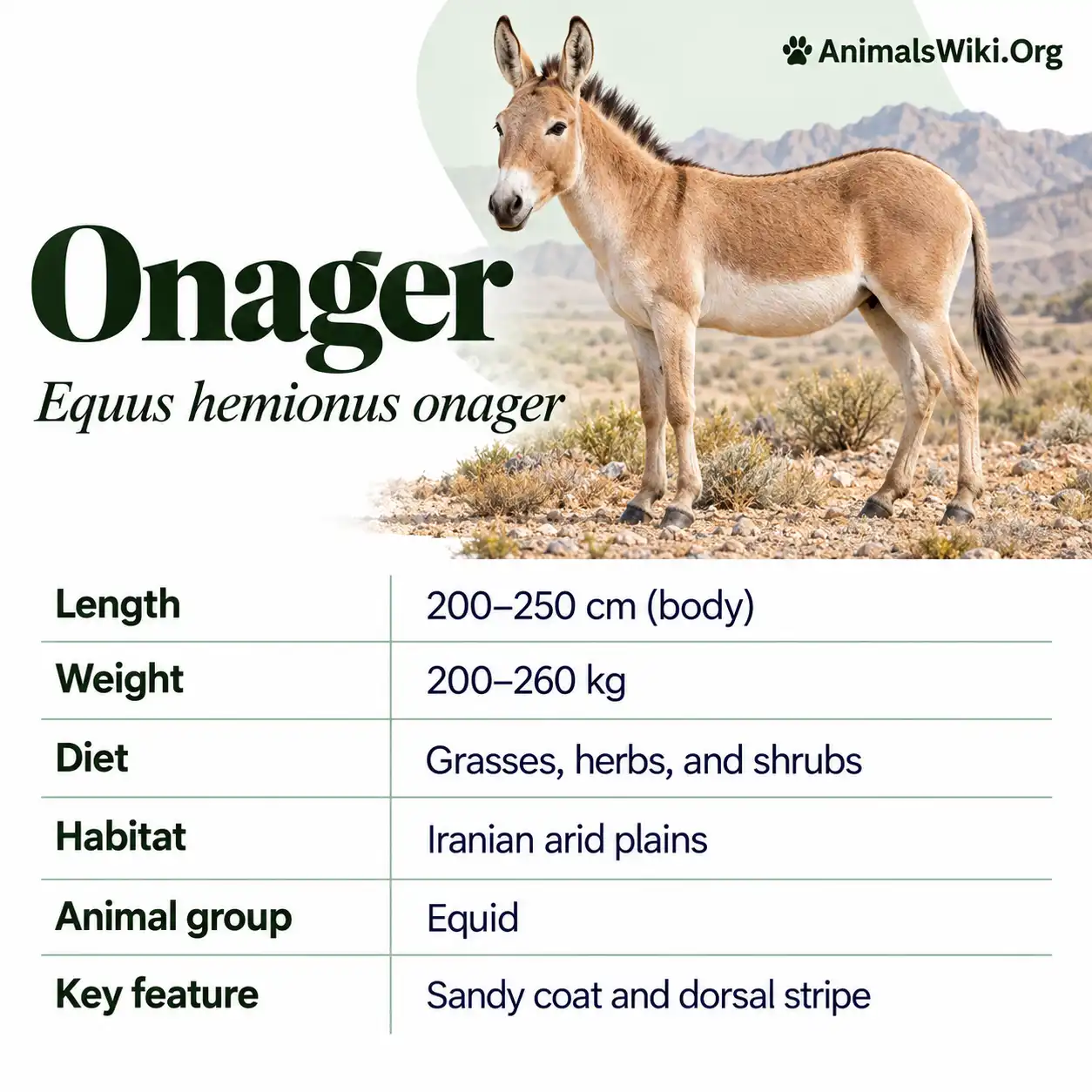
Onager, Habitat, Diet, Behavior and Conservation
The onager is a swift, alert member of the horse family that survives in some of Asia’s most demanding landscapes. With its sandy coat, upright mane, pale underside, and dark stripe along the back, it resembles a donkey at first glance. However, its ancestry, behavior, and conservation needs tell a different story.
The name onager has two common uses. It can describe the Asiatic wild ass species, Equus hemionus, or refer more specifically to the Persian onager, Equus hemionus onager, associated with Iran. Understanding this distinction is essential because the wider species and the Persian subspecies have different conservation assessments.
Across their range, Asiatic wild asses depend on movement. Rainfall, vegetation, and water availability change over time, so survival often requires access to extensive landscapes rather than one permanently productive location.
Their future is closely connected to those landscapes. Roads, fences, hunting, drought, and competition around limited resources can make suitable habitat increasingly difficult to use.
This guide explains onager facts, appearance, habitat, diet, social behavior, reproduction, and conservation, while distinguishing information about the wider species from findings specific to Persian onagers.
Onager Facts
| Feature | Details |
|---|---|
| Common name | Onager |
| Broader name | Asiatic wild ass |
| Species | Equus hemionus |
| Persian subspecies | Equus hemionus onager |
| Animal group | Mammal |
| Family | Equidae |
| Native region | Parts of Asia |
| Main habitats | Desert, semidesert, dry grassland, and steppe |
| Diet | Grasses, herbs, and other vegetation |
| Distinctive features | Sandy coat, pale underside, upright mane, dark dorsal stripe |
| Social organization | Flexible groups; territorial behavior occurs in some populations |
| Male | Stallion |
| Female | Mare |
| Young | Foal |
| Pregnancy | Approximately one year |
| Typical offspring | One foal |
| Wider species status | Near Threatened |
| Persian onager status | Critically Endangered in the assessment published in 2025 |
1. What Is an Onager?
An onager is a wild equid: a member of the family containing horses, zebras, and asses.
In its broadest modern usage, the name refers to the Asiatic wild ass, Equus hemionus. These animals occur across several separated Asian regions and include geographically distinct populations commonly called khulan, kulan, khur, and Persian onager.
In narrower usage, “onager” means the Persian subspecies found in Iran.
This article covers the wider species while identifying information specific to Persian onagers.
The distinction prevents several common mistakes. A population estimate for all Asiatic wild asses cannot be presented as the number of Persian onagers. Similarly, a behavior studied in Mongolia should not automatically be described as identical in Iran.
The animals share important biology, but their environments and conservation circumstances differ substantially.
2. Onager, Khulan, Kulan, and Khur
Different regional names describe populations within the Asiatic wild ass group.
Khulan is commonly used for Mongolian wild asses. Kulan is associated with Central Asian populations, particularly those traditionally called Turkmen kulans. Khur refers to the Indian wild ass.
Persian onager identifies the Iranian subspecies.
These names reflect geography, language, and taxonomic history. They should not be treated as evidence that every named population is an entirely separate species.
Conversely, sharing a species name does not make all populations interchangeable for conservation.
Animals may differ in ancestry, habitat use, environmental pressures, and management history.
For clear wildlife writing, the useful approach is to state both the common name and scientific identity when discussing a particular population. This makes it easier to understand which facts apply broadly and which belong to one location.
3. Scientific Classification and Subspecies
The onager belongs to Equidae, within the order Perissodactyla, the odd-toed ungulates.
Its classification is:
| Rank | Classification |
|---|---|
| Kingdom | Animalia |
| Phylum | Chordata |
| Class | Mammalia |
| Order | Perissodactyla |
| Family | Equidae |
| Genus | Equus |
| Species | Equus hemionus |
Traditionally recognized forms include:
| Common name | Scientific name | General association |
|---|---|---|
| Mongolian wild ass or khulan | E. h. hemionus | Mongolia and adjoining regions |
| Turkmen kulan | E. h. kulan | Central Asia |
| Persian onager | E. h. onager | Iran |
| Indian wild ass or khur | E. h. khur | Northwestern India |
| Syrian wild ass or hemippe | E. h. hemippus | Extinct |
Classification continues to be informed by genetics. Natural contact and mixed ancestry between neighboring populations also make some boundaries less simple than a map of subspecies might suggest.
4. Onager vs. Donkey, Horse, and Kiang
An onager is not a domestic donkey living without an owner.
Domestic donkeys derive from the African wild ass lineage, whereas onagers belong to the Asiatic wild ass species.
They are related, but their histories differ.
| Animal | Identity | Important distinction |
|---|---|---|
| Onager | Asiatic wild ass | Wild Asian equid |
| Domestic donkey | Domesticated ass | Descends from African wild ass ancestry |
| Horse | Another equid lineage | Includes domestic breeds and distinct wild-horse conservation lineages |
| Kiang | Tibetan wild ass, usually Equus kiang | Generally treated as a separate species |
| Mule | Horse–donkey hybrid | A hybrid rather than a wild ass species |
The onager’s resemblance to a donkey is therefore a family resemblance, rather than proof of domestication.
Recognizing this helps avoid describing an animal with its own evolutionary and conservation history as merely an unusually fast donkey.
5. What Does an Onager Look Like?
Onagers have a horse-like body combined with several features associated with wild asses.
Their coat is commonly sandy, reddish brown, or grayish brown, with paler areas underneath. The exact appearance varies among populations and seasons.
A dark dorsal stripe runs along the back.
The mane is relatively short and stands upright. The tail has a tuft of longer hair toward its end rather than the full length of flowing hair familiar in many horses.
Persian onagers are particularly associated with a sandy-red appearance and contrasting pale areas.
Their winter coat becomes longer and can look grayer.
Age, lighting, dust, and body condition also affect photographs. An animal viewed after rolling may look darker or redder than its underlying coat.
Identification should therefore consider several characteristics together, including origin, rather than relying on coat color alone.
6. How Big Is an Onager?
Size varies across the Asiatic wild ass species.
Persian onager profiles commonly report adult weights of approximately 200–260 kilograms, although age, sex, condition, and reference population influence the figures.
Published height ranges also vary. They should not be treated as one exact measurement applying to every regional form.
Males are generally somewhat larger than females, but the outward difference is modest compared with the striking sexual differences seen in some other mammals.
Horse-family height is usually measured at the withers, where the neck meets the back.
The onager’s build combines strength with relatively slender limbs and an athletic outline.
Its body supports fast movement, but it must also be maintained through daily feeding. During drought, insufficient usable vegetation can affect a large herbivore even when it appears well adapted to dry surroundings.
7. Speed and Running Ability
Onagers are known for rapid running.
Their long limbs, powerful muscles, and hoofed feet support quick movement across open country. Speed can help them escape danger and move between separated resources.
However, dramatic speed claims should be interpreted cautiously.
A short burst, a sustained run, and ordinary daily travel are different activities. Terrain, temperature, age, fitness, and the method of measurement all affect a reported figure.
An onager does not spend its day galloping at maximum speed.
Much of its movement involves walking, feeding, pausing, and traveling steadily between useful areas.
Its conservation needs are therefore better understood through the ability to move freely than through one top-speed number. Even a fast animal cannot solve the problem of an impassable fence or a route that ends at a dangerous road.
8. Where Do Onagers Live?
The wider Asiatic wild ass species has a scattered distribution across Asia.
Important populations occur in Mongolia, China, India, Iran, and Central Asia. Conservation introductions and reintroductions have also established animals in additional locations.
These populations occupy very different settings.
Mongolian khulan range through extensive Gobi landscapes. Indian khur use the Little Rann of Kutch and surrounding areas. Persian onagers are associated with Iran’s arid and semiarid environments.
A broad range map can make these areas appear more connected than they are.
Many populations are separated by substantial distances or unsuitable landscapes. Political borders, infrastructure, settlement, and land use can further restrict movement.
Conservation planning must consequently work at both levels: maintaining local populations and preserving the wider ecological connections that allow animals to respond to changing conditions.
9. Onager Habitat
Onager habitat includes desert plains, semidesert, dry grassland, steppe, and adjoining foothills.
The word “desert” can be misleading if it suggests endless bare sand.
Usable habitat contains vegetation, water opportunities, and travel routes. Some areas are productive only after rainfall, while others provide more dependable resources during dry periods.
Research on Persian onagers has examined how vegetation and water influence habitat use.
The important question is not simply whether a protected area is large.
Managers need to understand how much of it provides suitable food, which parts animals actually use, and whether essential resources remain accessible.
A landscape may contain extensive salt flats or other terrain that contributes little usable forage. The amount of land inside a boundary therefore differs from the amount of functioning habitat available to the animals.
10. What Do Onagers Eat?
Onagers are herbivores.
They eat grasses, herbs, and other vegetation, with the mixture changing according to season and location.
When grasses are available, grazing can dominate. At other times, animals may consume more shrubs or other plant material.
Research on khulan in northern Xinjiang documented seasonal diet patterns using fecal analysis.
This illustrates why one food list cannot represent every onager population throughout the year.
A plant’s presence also does not guarantee that it provides adequate nutrition. Maturity, moisture, digestibility, and the amount available all matter.
Onagers can use challenging environments, but they still need sufficient energy and nutrients.
Food becomes particularly important during growth, pregnancy, and nursing, when an animal must support additional demands beyond routine maintenance.
11. How Onagers Digest Vegetation
Like horses and zebras, onagers are hindgut fermenters.
Microorganisms in the large intestine help break down fibrous plant material and release energy the animal can use.
This arrangement differs from the digestive system of ruminants such as cattle and sheep, which have specialized stomach compartments.
Hindgut fermentation supports a lifestyle involving repeated feeding and the processing of substantial quantities of vegetation.
It does not make every rough plant equally useful.
A large volume of poor food may still fail to meet an animal’s needs if intake, digestibility, or nutrient content is too low.
For conservation, feeding biology explains why both quality and quantity matter.
An onager population needs more than scattered plants that can technically be eaten. It needs a landscape that consistently supplies enough usable vegetation across the changing seasons.
12. How Onagers Obtain Water
Onagers obtain some moisture from vegetation, but drinking opportunities remain important.
The relative contribution of food moisture changes with plant condition, season, and location.
Fresh vegetation following rain differs greatly from dry stems during prolonged drought.
Research tracking Mongolian khulan has shown how journeys to water shape movement. Animals may travel directly toward a source, spend only a short period nearby, and then return toward feeding areas.
This pattern explains why a water visit can be easy to miss during occasional observations.
Water availability also includes accessibility.
A source can contain water but remain difficult to use because of people, livestock, barriers, or disturbance.
Protecting onagers therefore requires attention to the routes connecting food and water, rather than assuming that the existence of a water point makes the surrounding habitat secure.
13. Surviving Heat and Cold
Onagers are associated with hot, dry environments, but many also experience cold winters.
Their coat changes seasonally, becoming thicker when conditions require greater insulation.
Behavior provides another layer of adjustment.
Animals may alter feeding times, resting locations, and movement according to heat, wind, or resource availability.
Persian onagers maintained in conservation facilities demonstrate substantial seasonal coat changes, reflecting the environmental variation of their native setting.
These adaptations have limits.
A winter coat does not compensate indefinitely for inadequate food, and tolerance of heat does not remove the need for water.
The animal’s success depends on the interaction between its body, behavior, and available resources.
This is why conservation must preserve choices within a landscape. Different feeding and resting areas allow animals to respond when conditions become uncomfortable or dangerous.
14. Nomadic Movement and Changing Resources
Some Asiatic wild ass populations make exceptionally extensive movements.
In the Mongolian Gobi, khulan travel across large areas as water and forage conditions change.
Their movement is often nomadic, meaning it does not necessarily follow the same fixed seasonal route every year.
This flexibility is valuable in an unpredictable environment.
A patch receiving rain this year may not be productive at the same time next year.
The animals need room to respond rather than being confined to one historical path.
Research and conservation guidance emphasize the connection between nomadism and flexible social grouping.
For an onager, survival can depend on finding a temporary opportunity somewhere else in the landscape.
A protected area that seems sufficient during favorable conditions may consequently fail to meet its needs during an exceptional drought.
15. Onager Social Organization
Onager social organization varies among populations and circumstances.
Animals may gather in groups that form and separate as conditions change. Adult males can occur alone or with other males, while females associate with their young and other females.
Some populations show territorial mating systems.
Others have been described using group arrangements that differ from that pattern.
This variation is important. Onagers should not automatically be assigned the stable family structure commonly associated with plains zebras or Przewalski’s horses.
Nor should every gathering be treated as one permanent herd.
A group near water may reflect a temporary concentration around a resource.
Studies of Gobi khulan have examined how ecology relates to social structure, demonstrating the value of observing relationships over time rather than drawing conclusions from one encounter.
16. Territorial Stallions and Breeding Opportunities
In territorial systems, a stallion defends an area that can attract females.
The value of that area may depend on food, water, or its position within the surrounding landscape.
Females can move between territories according to their needs rather than remaining permanently attached to one male.
Territory ownership therefore differs from simply leading a fixed family group.
Males may advertise their presence through posture, scent marking, calls, and responses to rivals.
Physical competition can occur, but not every encounter results in a prolonged fight.
Environmental conditions influence the whole arrangement.
When resources shift, female distribution can shift as well, changing breeding opportunities for males.
This relationship between resources and reproduction helps explain why social behavior cannot be separated neatly from habitat conservation. Protecting usable landscapes supports both survival and the conditions under which breeding occurs.
17. Communication and Senses
Onagers communicate through sound, smell, movement, posture, and physical contact.
Ear position, head movements, body orientation, and changes in distance help individuals assess one another.
Scent provides information about other animals and can contribute to reproductive interactions.
Vocalizations help maintain contact or accompany particular encounters.
Their senses also support vigilance in open landscapes.
An animal may notice people or other disturbances before those observers realize it is aware of them.
Interpreting behavior requires context. Ears turned backward may be tracking a sound, while a tense posture and flattened ears can accompany a warning.
A single photograph rarely captures the whole exchange.
For people observing onagers, the practical lesson is to allow space. If animals repeatedly stop feeding, move away, or remain focused on the observer, the encounter may already be affecting their behavior.
18. Breeding and Pregnancy
Onager pregnancy lasts approximately one year.
A mare usually gives birth to one foal, making successful reproduction a substantial investment.
The timing of breeding and births can vary among populations and environmental settings.
Females need sufficient nutrition to support pregnancy and later milk production.
In conservation facilities, researchers can monitor reproductive hormones to understand cycles and improve the timing of breeding.
Smithsonian work with Persian onagers has used noninvasive urine sampling as part of that research.
Breeding success should not be measured only by mating or pregnancy.
A useful assessment follows the sequence through birth, foal growth, survival, and eventual maturity.
That longer view matters because a population may produce young yet fail to grow if too few youngsters survive the difficult stages that follow.
19. Onager Foals and Maternal Care
A newborn onager foal is relatively well developed.
It begins attempting to stand and move soon after birth, allowing it to remain close to its mother.
Early mobility is essential for an animal whose safety and access to resources may depend on movement.
However, it does not mean the youngster is independent.
Milk, contact, and maternal protection remain important while the foal grows.
As its coordination improves, it explores, interacts, and begins sampling vegetation.
The mother must balance her own feeding and drinking needs with those of the youngster.
This creates a direct connection between habitat quality and foal survival.
Longer journeys, poor forage, or disturbance near water can affect both animals. Protecting breeding populations therefore requires conditions that support mothers raising young, rather than merely places where adults can remain alive.
20. Lifespan, Survival, and Natural Risks
Onagers can live for more than twenty years in human care, but a single dependable average lifespan for wild populations is difficult to establish.
Published maximum-age claims should not be confused with the age most animals reach.
Survival depends on nutrition, health, injury, weather, and local threats.
Predation risk varies across the species’ extensive range and should not be reduced to the claim that every onager population has no natural predators.
Adults rely partly on vigilance, rapid escape, and the defensive strength typical of large equids.
Young or weakened individuals face different risks from healthy adults.
For conservationists, survival by age class is especially informative.
A population with long-lived adults can still decline if too few foals reach maturity. Understanding those patterns is more useful than quoting an exceptional maximum age.
21. Ecological Importance
Onagers influence their surroundings through grazing, browsing, movement, and the return of nutrients in dung.
Their feeding affects vegetation structure, while dung supports organisms that use animal waste.
They may also disperse seeds after consuming plant material. Research in Iran has examined potential seed dispersal by Persian wild asses.
These activities connect a large herbivore with processes occurring at much smaller scales.
Its ecological role is therefore broader than being a visible animal on an otherwise empty plain.
Restoration programs involving kulans also aim to recover interactions between large grazers and steppe ecosystems.
Such goals still need monitoring.
The effects depend on animal density, vegetation, rainfall, and other herbivores.
Successful restoration involves understanding how the whole system responds, rather than assuming the presence of an onager automatically proves that ecological recovery is complete.
22. Onagers and Ancient Human History
Asiatic wild asses have a long relationship with human societies.
They appear in the broader history of hunting, animal management, and the development of transport in western Asia.
One especially interesting discovery concerns the kunga, an animal valued in ancient Syro-Mesopotamia.
Genomic research published in 2022 identified studied kungas as first-generation hybrids between female domestic donkeys and male Syrian wild asses, also called hemippes.
This finding distinguishes hybrid breeding from domestication of the wild ass itself.
It also shows why precise identification matters.
The extinct Syrian wild ass should not be casually replaced with the modern Persian onager in descriptions of the research.
Ancient people interacted with different equids in different ways, and genetic evidence can reveal relationships that outward appearance or historical terminology alone cannot resolve.
23. Is the Onager Endangered?
The answer depends on which meaning of “onager” is intended.
The wider Asiatic wild ass species, Equus hemionus, is Near Threatened in the assessment published in 2025.
The Persian onager subspecies, Equus hemionus onager, is Critically Endangered in its separately published 2025 assessment.
These categories are not contradictory.
A species can contain a relatively numerous population in one region and a highly vulnerable subspecies elsewhere.
The Persian assessment reflects serious future risk, including dependence on continued protection and access to resources.
Older pages may display an earlier category, so an apparently recent webpage should not automatically override a newer formal assessment.
For accurate writing, conservation status must always be attached to the correct species or subspecies and the relevant assessment.
24. How Many Onagers Are Left?
Population figures require the same distinction between the whole species and the Persian subspecies.
The Asiatic wild ass assessment published in 2025 estimated approximately 108,300 animals globally, with most in Mongolia.
The assessors explained that the higher total compared with the earlier assessment largely reflected improved information and surveys rather than proof of an equally dramatic population increase.
For Persian onagers, the 2025 subspecies assessment cited approximately 1,200 animals in the Bahram-e-Goor population in 2023, including an estimated 720 mature individuals.
Those figures are dated assessment estimates, not live October 2026 counts.
They also explain why older claims that only 600 Persian onagers remain should not be repeated without checking their source and date.
Counting methods, ancestry definitions, and geographic coverage all affect what a population total means.
25. Persian Onagers and Iranian Population History
Iran is central to Persian onager conservation.
The 2025 subspecies assessment identifies the native Persian onager population with the Bahram-e-Goor Protected Area and its Qatrouiyeh National Park core.
It treats wild asses in the Touran region and some populations originating from there as naturally mixed onager–kulan ancestry.
This is a significant distinction from older summaries that described two equivalent Persian onager populations.
Natural mixed ancestry does not make those other animals unimportant.
The assessment explicitly recognizes their conservation value and their history within a formerly more continuous distribution.
The distinction helps define what is being counted and protected.
Conservation can preserve the Persian subspecies while also valuing natural contact-zone populations. Those objectives require accurate ancestry information rather than assuming every Iranian wild ass belongs to an identical genetic category.
26. Why Onager Populations Declined
Historical declines resulted from several pressures acting together.
Hunting reduced animals directly, while cultivation, settlement, and livestock use changed the availability of food and water.
As infrastructure expanded, some populations lost access to routes connecting essential resources.
The consequences can reinforce one another.
An animal unable to reach a better feeding area may lose condition. A population confined to a small region may then suffer disproportionately during drought.
Isolation also limits opportunities for natural recolonization after local losses.
This is why conservation cannot rely on one intervention.
Preventing hunting is important, but it does not automatically reopen a blocked route or restore degraded vegetation.
Recovery requires understanding which pressures matter most in each landscape and how they interact with the biology of a mobile, wide-ranging herbivore.
27. Livestock, Water, and Local Livelihoods
Onagers share parts of their range with pastoralists, livestock, and farming communities.
Competition can become particularly serious when water and forage are limited.
However, it is too simple to describe every interaction as inevitable conflict.
The outcome depends on the timing, intensity, and distribution of resource use.
A drinking site may become difficult for wildlife to access even while water remains available. Conversely, cooperation over access and grazing can help maintain usable habitat.
Conservation must recognize that people also depend on these landscapes.
Understanding local needs improves the prospects for practical agreements rather than decisions that look effective on paper but fail in daily use.
The objective is to reduce damaging competition while sustaining the conditions needed by both wildlife and neighboring communities.
28. Roads, Railways, and Fences
Linear infrastructure can have effects far beyond the area it physically occupies.
A road or railway may cross a movement route. Associated fencing can turn it into a barrier between feeding areas and water.
For a nomadic animal, that restriction can remove an important response to changing conditions.
Research in the Mongolian Gobi has examined how mining-related development and other infrastructure affect khulan movements.
The issue is particularly important because useful resources shift over time.
A route that appears unnecessary during a wet year may become essential during drought.
Conservation planning therefore needs movement information before construction decisions are finalized.
Crossing opportunities, fence design, and wider land-use planning can determine whether animals retain access to a functioning landscape or become confined to increasingly limited choices.
29. Drought and Climate Variability
Onagers are adapted to dry environments, but drought remains a serious threat.
A sequence of poor rainfall years can reduce both vegetation growth and drinking opportunities.
Animals may travel farther, concentrate around remaining resources, or enter cultivated areas where food is more accessible.
These responses can increase conflict and expose animals to additional danger.
Recent research on Iranian onagers examines the relationship between rainfall, movement, and agricultural encounters.
The conservation lesson is that fixed protected boundaries do not necessarily contain everything a mobile animal needs under every condition.
Long-term planning must consider refuge areas, connecting routes, and resources outside the places used most frequently in ordinary years.
Emergency feeding or watering may help during a crisis, but it does not replace attention to the ecological conditions that created the vulnerability.
30. Genetics and Conservation Units
Genetic research helps conservationists understand relatedness, historical connections, and the effects of isolation.
This matters when deciding which animals should be moved or included in breeding programs.
Ancestry cannot always be determined reliably from appearance.
The history of contact among Asiatic wild ass populations also means conservation categories do not always fit into sharply separated boxes.
Natural genetic exchange is different from an accidental mixture created without a management objective.
Both situations need evidence and careful interpretation.
The goal is to preserve meaningful diversity while supporting viable populations.
For onagers, genetics therefore informs practical decisions rather than merely supplying a scientific label. It helps managers understand which populations represent distinct histories, where exchange has occurred naturally, and how future actions can avoid losing valuable variation.
31. What Reintroduction Research in Iran Shows
Reintroduction is more complicated than transporting animals into an apparently suitable reserve.
A 2026 study examined wild asses described as Persian onagers in Kavir National Park, using field observations and demographic records.
The researchers found that habitat features, proximity to ranger stations, and the circumstances of release influenced outcomes.
They also reported substantial early losses associated with translocation stress and social aggression in the acclimatization setting.
These findings demonstrate why release totals are an incomplete measure of success.
A project must evaluate survival, reproduction, social compatibility, and the ability of offspring to persist.
The study also highlights the value of reporting difficulties openly.
Understanding why a release struggles helps improve future management and prevents an encouraging transport event from being mistaken for the establishment of a self-sustaining population.
32. Kulan Restoration in Kazakhstan
Kazakhstan provides another important chapter in Asiatic wild ass conservation.
Restoration work in Altyn Dala aims to return kulans to a landscape from which they disappeared.
The work forms part of a broader steppe restoration effort involving several organizations and national partners.
Animals have been transferred from established populations, acclimatized, and monitored before or after release.
A 2026 Frankfurt Zoological Society report described further transfers undertaken in autumn 2025.
The project illustrates both opportunity and difficulty.
Moving large wild equids requires specialist handling, veterinary oversight, and suitable receiving habitat. Success must then be assessed over subsequent years.
The objective is not simply to place animals in a new location. It is to rebuild a population that reproduces and participates in the ecological processes of the surrounding steppe.
33. Restoration Beyond Iran and Central Asia
Asiatic wild asses have also been involved in restoration programs elsewhere in western Asia.
These projects need careful descriptions because the ancestry of introduced animals may differ from that of populations historically lost from the region.
For example, Saudi Arabia’s Prince Mohammed bin Salman Royal Reserve announced a Persian onager restoration initiative in 2024.
Such work should not be described as bringing the extinct Syrian wild ass back to life.
It uses living animals within a modern restoration program.
The distinction matters scientifically and for public understanding.
A release can contribute to conservation and ecological restoration without recreating an extinct subspecies.
Assessing its value requires examining habitat suitability, ancestry, welfare, reproduction, and long-term management rather than relying solely on the phrase “return of the wild ass.”
34. Zoos and Assisted Reproduction
Conservation facilities maintain Persian onagers through coordinated breeding and specialist care.
These populations can preserve genetic representation and support research into reproduction, health, and behavior.
The Wilds and the Smithsonian Conservation Biology Institute have collaborated on artificial insemination research involving Persian onagers.
Such techniques can help managers use genetic contributions without always moving an adult animal between institutions.
They still require careful planning and do not replace ordinary population management.
Social conditions are also important. Persian onagers need sufficient room and appropriate arrangements to avoid damaging interactions.
A managed population is therefore more than a collection of breeding animals.
Its conservation value depends on ancestry records, welfare, reproductive success, and clear coordination with wider objectives for the subspecies and its future.
35. How Scientists Study Onagers
Scientists use several complementary methods to study onagers.
GPS tracking reveals movement and helps identify important resource connections. Camera traps document visits to water and activity in places where direct observation is difficult.
Field surveys contribute information about numbers, group composition, and distribution.
Genetic sampling helps investigate ancestry and relatedness.
Each method has limitations.
A brief survey may miss animals that moved elsewhere, while a camera at one water source does not represent the entire landscape.
Combining approaches produces a stronger picture.
Research using animal-borne cameras in the Gobi has also provided insights into the surroundings encountered by khulan.
These tools help conservationists understand the landscape from the animal’s perspective, showing how resources, infrastructure, people, and other wildlife interact along its actual journeys.
36. Watching Onagers and Supporting Their Future
Responsible observation leaves animals able to feed, drink, rest, and move normally.
Use binoculars or a longer camera lens, follow local rules, and avoid approaching groups on foot without appropriate guidance.
Do not chase animals for a photograph or position a vehicle across their path.
Water sources and mothers with foals deserve particular care.
Onagers are powerful wild animals, and their resemblance to domestic donkeys does not make them safe to touch or feed.
People can also help by supporting credible conservation programs and sharing accurate information.
The most useful conservation goal is lasting viability: animals surviving, young reaching maturity, and populations retaining access to suitable landscapes.
That requires attention to habitats and human relationships as well as the animals themselves.
Frequently Asked Questions About Onagers
1. What is an onager?
“Onager” can mean the Asiatic wild ass species, Equus hemionus, or more specifically the Persian subspecies, Equus hemionus onager. The intended meaning should be stated because population figures, range descriptions, and conservation assessments differ between the species and subspecies.
2. Is an onager a donkey?
It is a wild ass related to donkeys, but it is not a domestic donkey. Domestic donkeys descend from African wild ass ancestry. Onagers belong to the Asiatic wild ass species and have a different evolutionary and conservation history.
3. What is the scientific name of the onager?
The wider Asiatic wild ass species is Equus hemionus. The Persian onager is Equus hemionus onager. Using the complete name helps clarify whether a discussion concerns the whole species or the Iranian subspecies.
4. Where do onagers live?
Asiatic wild asses occur in separated parts of Asia, including Mongolia, China, India, Iran, and Central Asia. Additional populations have been established through conservation projects. Persian onagers are specifically associated with Iran.
5. What do onagers eat?
They eat grasses, herbs, and other vegetation. The mixture changes with habitat and season, and some animals consume more browse when grass is limited. Food quantity and quality influence condition, reproduction, and the survival of young.
6. How large is a Persian onager?
Common profiles give an adult weight of approximately 200–260 kilograms. Height and length vary among individuals and references. Sex, age, nutritional condition, and population background should be considered before applying a measurement to every animal.
7. Why does an onager have a stripe along its back?
The dorsal stripe is a characteristic coat marking found in onagers and several other equids. Its presence helps describe the animal’s appearance but should not be used alone to establish identity or ancestry because similar markings occur in related animals.
8. Do onagers have zebra stripes?
They do not have the extensive black-and-white body striping characteristic of zebras. Their most noticeable linear marking is the dark stripe along the back. Pale areas, seasonal color changes, and other markings vary across the Asiatic wild ass group.
9. How fast can an onager run?
Onagers are capable of fast galloping, but a single maximum-speed figure should be treated cautiously. A short burst differs from sustained travel, and measurements depend on conditions. Their ability to move across extensive habitat is more important to conservation than a speed record.
10. Can onagers survive without drinking water?
They obtain moisture from food but still depend on drinking opportunities. Requirements vary with plant moisture, weather, activity, and reproductive condition. Their adaptation to dry environments should not be interpreted as independence from reliable water access.
11. Are onagers desert animals?
Many occupy deserts and semideserts, but the wider species also uses dry grassland, steppe, and foothills. Suitable habitat must provide vegetation, water, and movement opportunities. Bare desert scenery alone does not establish that an area can support them.
12. Do onagers live in herds?
They can form groups, but social arrangements vary among populations and conditions. Associations may form and separate as resources change. Some males defend territories, while females and young use the landscape according to their needs.
13. What is a male onager called?
A male is called a stallion, a female is a mare, and a young onager is a foal. These terms are shared with other members of the horse family.
14. How long is an onager pregnant?
Pregnancy lasts approximately one year. A mare usually produces one foal. Successful reproduction also depends on the mother’s health and the availability of food and water during pregnancy, nursing, and the youngster’s early development.
15. Can a newborn onager walk?
A healthy foal begins attempting to stand and move soon after birth. Early mobility helps it stay near its mother, but it remains dependent on milk and protection while its strength, coordination, and experience develop.
16. How long do onagers live?
Individuals can survive for more than twenty years in human care. A reliable average for all wild populations is harder to establish. Maximum-age claims should not be confused with typical survival under natural conditions.
17. Is the onager endangered?
The wider Asiatic wild ass species is Near Threatened in the assessment published in 2025. The Persian onager subspecies is Critically Endangered in its separate 2025 assessment. Both the scientific identity and assessment date matter when reporting status.
18. Why is the Persian onager Critically Endangered?
Its assessment identifies serious future risks linked to resource access, climate pressures, and dependence on continued protection and management. Recent numerical growth does not remove vulnerability when a subspecies is concentrated in a limited setting and relies on supportive conditions.
19. How many Persian onagers remain?
The 2025 assessment cited approximately 1,200 animals in the Bahram-e-Goor population in 2023, including an estimated 720 mature individuals. These are dated assessment figures, not a live census, and should be distinguished from totals for all Asiatic wild asses.
20. Is a kulan the same as an onager?
Kulan is a regional name commonly associated with a Central Asian form of Asiatic wild ass. It belongs within the wider Equus hemionus group. It is related to the Persian onager but should not automatically be treated as the same subspecies.
21. Is the kiang an onager?
The kiang, or Tibetan wild ass, is generally recognized as a separate species, Equus kiang. Older classifications and informal names can create confusion. A modern article should distinguish it from the Asiatic wild ass unless explaining a particular taxonomic treatment.
22. Were onagers domesticated?
Onagers should not be described as the ancestors of ordinary domestic donkeys. Ancient people interacted with wild asses in several ways, including hybrid breeding, but managing or crossing wild animals is different from establishing a domesticated population.
23. What was a kunga?
Genomic research identified studied ancient kungas as first-generation hybrids between female domestic donkeys and male Syrian wild asses. This finding concerns the extinct Syrian form and should not be casually rewritten as evidence that modern Persian onagers were domesticated.
24. Are onagers dangerous?
They are powerful wild animals capable of sudden movement, biting, or kicking. Familiarity with keepers does not make them appropriate for casual handling. Observe from a respectful distance and follow guidance, especially near foals, water, or breeding interactions.
25. How can people help conserve onagers?
Support credible habitat, research, and conservation programs; observe animals responsibly; and share accurate information. Preserving movement routes, reducing damaging competition, and maintaining suitable food and water access are essential alongside protection of individual animals.
Onager Asiatic Wild Ass
The onager is more than a donkey-like animal of the desert. It is a mobile wild equid whose life depends on finding resources across changing landscapes.
The distinction between the wider Asiatic wild ass and the Persian onager is particularly important. Their conservation assessments differ, and recent research has refined understanding of population ancestry and numbers.
Protecting their future requires suitable habitat, dependable resource connections, informed management, and cooperation with neighboring communities. When those conditions support surviving adults and successfully raised foals, onagers have a stronger foundation for lasting recovery.



