
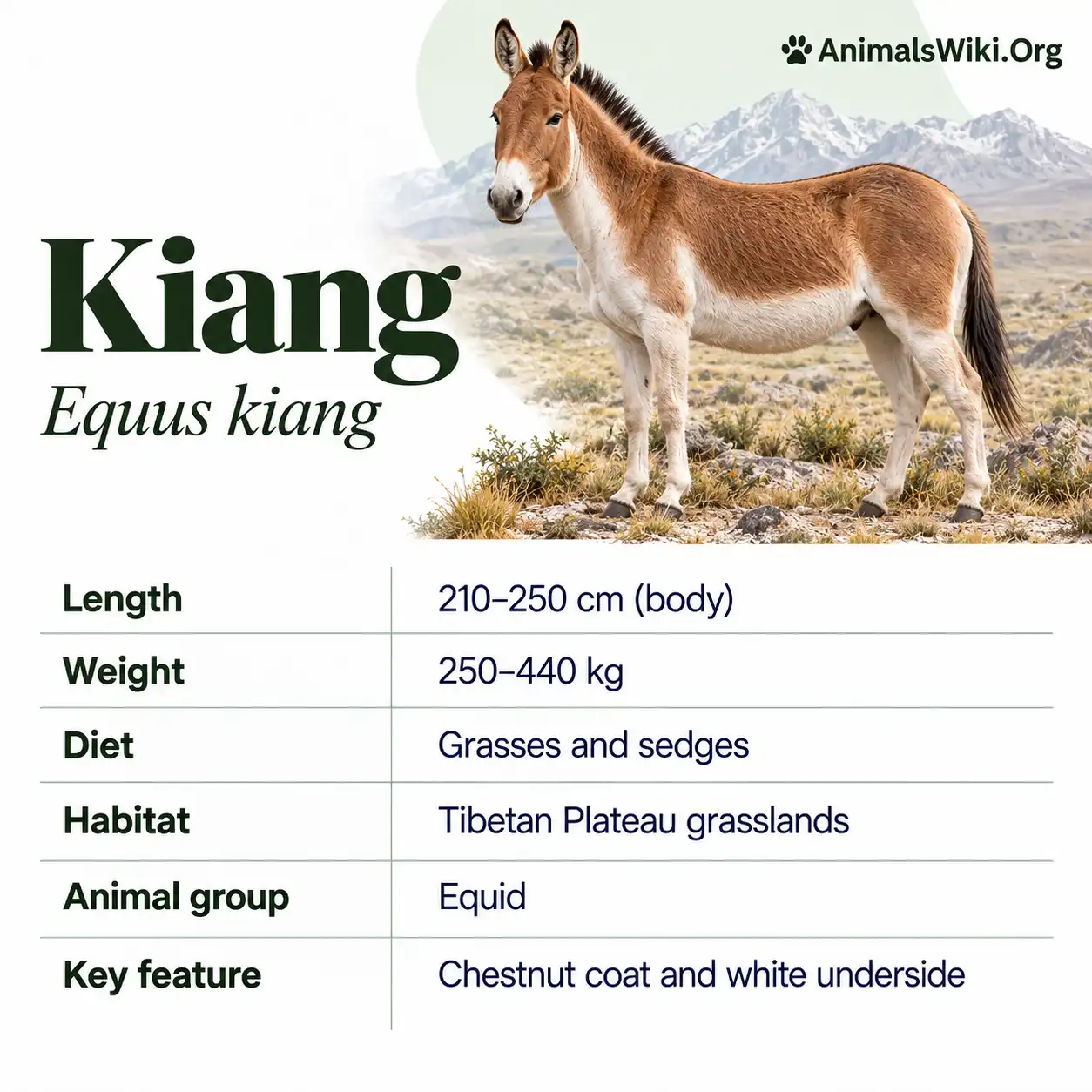
Kiang, Habitat, Diet, Behavior, Adaptations and Conservation
The kiang is the largest living wild ass and one of the most distinctive mammals of the Tibetan Plateau. With its rich brown coat, bright pale underside, upright mane, and powerful body, it often looks more horse-like than people expect from an animal called a wild ass.
Its home is equally remarkable. Kiangs inhabit high, open landscapes where cold winds, low oxygen availability, and a short growing season shape daily life. Broad valleys, alpine meadows, rolling plains, and dry steppe provide the vegetation these large herbivores need.
Also known as the Tibetan wild ass, the kiang is a wild species with its own evolutionary history. It is not a domestic donkey that escaped, and it is generally recognized as a separate species from the onager or Asiatic wild ass.
Globally, the kiang is classified as Least Concern. That status reflects its overall distribution and abundance, but conditions differ across its range. Local populations can face pressure from habitat fragmentation, disturbance, changing grazing patterns, and competition over productive pasture.
This guide explores kiang facts, appearance, habitat, diet, reproduction, behavior, and the adaptations that support life in one of the world’s highest inhabited landscapes.
Kiang Facts
| Feature | Details |
|---|---|
| Common name | Kiang |
| Other name | Tibetan wild ass |
| Scientific name | Equus kiang |
| Animal group | Mammal |
| Family | Equidae |
| Distinction | Largest living wild ass species |
| Native region | Tibetan Plateau and adjoining highlands |
| Main habitats | Alpine grassland, steppe, broad valleys, and rolling plains |
| Typical adult weight | Approximately 250–440 kilograms; individuals vary |
| Typical shoulder height | Around 1.4 meters, with variation |
| Diet | Mainly grasses and sedges |
| Social organization | Flexible associations; territorial behavior occurs among males |
| Male | Stallion |
| Female | Mare |
| Young | Foal |
| Pregnancy | Approximately one year |
| Typical offspring | One foal |
| Global conservation status | Least Concern |
| Important local concerns | Pasture access, habitat fragmentation, disturbance, and coexistence with livestock |
1. What Is a Kiang?
A kiang is a wild member of the horse family native to the Tibetan Plateau and neighboring high-altitude regions.
Its scientific name is Equus kiang.
Although called a wild ass, it has a substantial body, sturdy limbs, and a relatively horse-like appearance. It shares important anatomical features with other equids, including a single main hoof on each foot, grazing teeth, and a digestive system adapted to fibrous vegetation.
The kiang is especially associated with open country. Its habitat includes wide valleys and rolling grasslands rather than only the steep mountain slopes sometimes suggested by the word “Himalayan.”
Its identity also matters when discussing conservation. Kiangs should not be confused with domestic donkeys or automatically included in population figures for Asiatic wild asses.
They represent a distinct living species with their own ecological relationships and regional conservation needs.
2. Kiang vs. Onager, Donkey, and Horse
The kiang belongs to the same family as horses, donkeys, zebras, and onagers, but these animals are not interchangeable.
| Animal | Scientific identity | Main distinction |
|---|---|---|
| Kiang | Equus kiang | High-altitude wild ass of the Tibetan Plateau |
| Onager or Asiatic wild ass | Equus hemionus | Related species occupying several Asian dryland regions |
| Persian onager | Equus hemionus onager | Iranian subspecies of Asiatic wild ass |
| Domestic donkey | Commonly Equus asinus | Domesticated animal descended from African wild ass ancestry |
| Przewalski’s horse | Equus ferus przewalskii or Equus przewalskii | Distinct horse lineage with a separate conservation history |
Older publications sometimes placed the kiang within the Asiatic wild ass group.
Modern authorities commonly recognize it as a separate species.
The distinction helps prevent mistakes such as applying Persian onager conservation status to kiangs or describing high-altitude domestic donkeys as kiangs simply because they share the same landscape.
3. Scientific Classification and Regional Forms
Kiangs are mammals belonging to Perissodactyla, the order of odd-toed ungulates.
Their family, Equidae, includes all living horses, zebras, and asses.
| Rank | Classification |
|---|---|
| Kingdom | Animalia |
| Phylum | Chordata |
| Class | Mammalia |
| Order | Perissodactyla |
| Family | Equidae |
| Genus | Equus |
| Species | Equus kiang |
Three regional forms have traditionally been described as western, eastern, and southern kiangs.
However, the boundaries and taxonomic significance of those forms have been debated. Naming a regional population does not automatically establish that it is a sharply separated evolutionary unit.
For a general species profile, Equus kiang is the clearest starting point.
For conservation research, regional differences remain important because animals in separate parts of the range may face different pressures and retain different genetic variation.
Classification is therefore useful when it supports a better understanding of actual populations rather than replacing that understanding.
4. What Does a Kiang Look Like?
The kiang has a large body, a broad-looking head, an upright dark mane, and a tail ending in a tuft of longer hair.
Its upper coat is usually reddish brown or chestnut in summer, contrasting strongly with pale areas underneath.
The belly, lower portions of the body, and parts of the face and legs appear lighter.
A dark stripe extends along the back.
The boundary between the darker upper coat and pale underside can be particularly striking when a kiang stands against a muted plateau landscape.
Its appearance changes seasonally. Winter fur becomes longer and thicker, and the upper body can look darker.
Dust, lighting, wet fur, and body condition also affect photographs.
For identification, the combination of body proportions, coat pattern, mane, and geographic setting is more reliable than judging one color feature alone.
5. How Big Is a Kiang?
The kiang is generally recognized as the largest living wild ass.
Common reference measurements give adult weights of approximately 250–440 kilograms, although age, sex, body condition, and population influence size.
A shoulder height around 1.4 meters is frequently reported.
These figures describe a substantial mammal rather than a small donkey-like animal.
Males are generally larger than females, but the difference is not always obvious in a distant photograph.
Height is measured at the withers, where the neck meets the back, rather than at the top of the head.
Large size has advantages, including strength and the capacity to travel through open country, but it also creates feeding demands.
A kiang must obtain enough vegetation to maintain its body through a short growing season and the less productive periods that follow.
6. The Kiang’s Seasonal Coat
A kiang’s coat changes with the seasons.
The summer coat is relatively short and sleek, while winter growth provides greater insulation against cold.
This difference can make the same animal appear noticeably larger or darker at another time of year.
A thick coat helps reduce heat loss, but it is only one part of surviving on the plateau.
Maintaining body temperature requires energy. If food becomes difficult to reach, an animal can still lose condition despite good insulation.
Wind, moisture, snow conditions, and opportunities to rest also influence the challenge.
The seasonal coat therefore works together with feeding and behavior.
It should not be treated as proof that kiangs are unaffected by harsh weather. Their adaptations allow them to live in demanding environments, while severe conditions can still exceed what particular individuals or populations can withstand.
7. How Kiangs Cope With High Altitude
High altitude creates challenges beyond cold.
As elevation increases, lower atmospheric pressure reduces the amount of oxygen available with each breath. Animals must continue supplying tissues with oxygen while also supporting movement, digestion, and heat production.
Kiangs have evolved within this environment rather than merely visiting it temporarily.
Genomic research has identified signatures of selection associated with high-altitude adaptation, including variation involving EPAS1, a gene involved in responses to low oxygen.
A 2021 study compared kiangs with domestic donkeys, including Tibetan donkeys, and found evidence supporting independent adaptation rather than simply assuming one acquired its adaptations from the other.
These findings make the kiang important to research on life under low-oxygen conditions.
However, one gene does not explain the entire animal. High-altitude performance involves interacting physiological systems, development, behavior, and environmental conditions.
8. Where Do Kiangs Live?
Kiangs are native to the Tibetan Plateau and adjoining highlands.
Most occur in China, including plateau landscapes associated with Tibet, Qinghai, and neighboring regions. Smaller populations occur in India and Nepal, while range accounts also include limited occurrence in Pakistan.
Within India, Ladakh is particularly important.
Their distribution should not be imagined as continuous across every highland area between these places.
Suitable grassland, water, disturbance, and barriers influence where animals occur.
Some populations occupy extensive landscapes, while others are more restricted or peripheral.
This matters for conservation because a broad global range can conceal local isolation.
Protecting the species requires knowing which areas remain connected, where animals reproduce successfully, and where changing land use is reducing their ability to reach resources. Country-level maps provide context, but local ecological information determines how usable the range actually is.
9. Kiang Habitat and Elevation
Kiangs occupy open high-altitude terrain, including alpine meadows, dry steppe, broad valleys, plains, and low hills.
They are often reported from elevations around 2,700–5,400 meters, although the elevations used differ among regions.
Their habitat is not simply a collection of steep mountains.
Relatively level areas can provide important grazing, while river valleys and wet meadows may support productive vegetation within a much drier surrounding landscape.
The amount of useful habitat also changes seasonally.
Snow, plant growth, surface moisture, and human activity can alter which areas animals use.
For conservation, the important question is whether a landscape supplies enough accessible resources through the year.
A large protected area with limited edible vegetation may support fewer kiangs than its size suggests, particularly during difficult seasons.
10. What Do Kiangs Eat?
Kiangs are herbivores, feeding mainly on grasses and sedges.
Sedges are grass-like plants, but they belong to a different botanical family from true grasses.
Both groups can provide important food in plateau meadows and steppe.
The precise diet varies with location and availability. A kiang feeding in a relatively moist meadow encounters different plants from one using a dry, sparsely vegetated plain.
Researchers studying resource selection in Ladakh examined choices at several levels: broad habitat, feeding site, and vegetation type.
That approach helps explain why saying “kiangs eat grass” is accurate but incomplete.
Animals also select where to feed and which parts of the available vegetation to consume.
Food quality, plant abundance, and the effort needed to obtain a mouthful all contribute to those decisions.
11. Digestion and the Gut Microbiome
Like other equids, kiangs are hindgut fermenters.
Microorganisms in the large intestine help process fibrous vegetation and produce compounds the animal can use for energy.
This system differs from that of ruminants such as yaks, sheep, and antelopes, which use specialized stomach compartments.
The microbial community is therefore part of the kiang’s feeding biology.
Research comparing kiangs under different conditions has found variation in gut microbial composition associated with season and management setting.
These findings suggest useful relationships between diet, environment, and digestion, but they do not mean that one microbial group alone explains survival on the plateau.
Nutrition depends on the whole system: available plants, food intake, microbial activity, and the animal’s health.
Protecting feeding habitat consequently supports processes occurring inside the animal as well as the visible act of grazing.
12. Water, Wet Meadows, and Moisture
Kiangs need water, although some of their moisture comes from the vegetation they eat.
The balance changes with food condition, weather, activity, and reproductive state.
Fresh meadow plants provide more moisture than dry winter forage.
Lakes, streams, river margins, and wet meadows can therefore influence where animals gather and feed.
A kiang standing near a wetland is not necessarily using the lake itself as its main drinking source. The surrounding vegetation and smaller freshwater features may be equally important.
This distinction matters when evaluating habitat.
A salt lake may dominate the landscape visually while nearby freshwater inflows support the most useful feeding areas.
Conservation needs to consider the entire water–vegetation relationship, including how seasonal changes alter access.
Protecting a visible waterbody alone may not preserve the resources on which the animals actually depend.
13. Do Kiangs Migrate?
Kiangs make movements between habitat areas, and some of those movements are seasonal.
However, they should not automatically be described as following one fixed migration route every year.
The Convention on Migratory Species describes seasonal movement between habitat types without a regular migration pattern being established across the species.
Animals respond to changes in food, snow, water, and disturbance.
Some journeys may be modest in distance but still essential.
Moving from a snow-covered feeding area to a more accessible slope can matter more to immediate survival than the total distance traveled.
The practical conservation requirement is flexibility.
A population needs access to alternative areas when conditions change. Roads, fences, or concentrated human use can remove those choices even when suitable vegetation remains elsewhere nearby.
14. Daily Activity and Foraging Decisions
A kiang’s day includes feeding, walking, resting, vigilance, and social interaction.
The proportion devoted to each activity changes with season, habitat, and social circumstances.
Field research has shown that foraging behavior varies across different time scales.
A study of kiangs found differences in feeding time between relatively moist and dry habitats and between parts of the growing season.
This means daily routines are responses to conditions, rather than a rigid timetable.
When food is harder to obtain, an animal may need to adjust feeding effort or travel.
Disturbance can also interrupt grazing, creating a cost even when it does not cause immediate injury.
Watching ordinary behavior therefore provides useful ecological information. Repeated changes in where animals feed or how often they remain alert can reveal pressures that a simple population count would overlook.
15. Kiang Social Organization
Kiang social life is more flexible than the familiar image of a permanent horse family.
Animals can form temporary associations that change as resources and reproductive conditions change.
The mother–foal relationship is particularly important and persistent.
Females and young may gather, while adult males can occur alone or with other males depending on age, season, and social status.
Large gatherings do not necessarily represent one permanent herd.
Several animals may temporarily share productive pasture before dispersing.
This flexibility is useful in an environment where good feeding areas vary in size and location.
The social system should also be described with care because observations from one setting may not capture the species’ full range of behavior.
Long-term observation helps distinguish a repeated social relationship from a brief concentration around food or water.
16. Territorial, Bachelor, and Transient Males
Researchers have documented different social roles among male kiangs.
These include territorial males, bachelor males, and animals described as transient males.
Territorial males defend areas, particularly in relation to breeding opportunities. Bachelors may associate with other males without controlling such an area.
Transient behavior has attracted interest because some males have been observed courting females within another male’s territory.
Researchers have investigated whether this reflects an alternative reproductive tactic or a stage in social development.
The findings illustrate why all males should not be treated as behaviorally identical.
A study comparing male social classes found differences in habitat use and activity.
For conservation research, identifying those classes can improve interpretation. A change in the behavior of one group may reflect its reproductive role rather than a response shared equally by the whole population.
17. How Kiangs Communicate
Kiangs communicate through posture, movement, smell, sound, and physical interaction.
An animal’s ear position, head orientation, body tension, and distance from others can all contribute to an exchange.
Scent investigation is also important. Males may examine scents associated with other animals and use marking behavior within their social interactions.
Vocalizations provide another means of contact or signaling.
Interpreting communication requires context.
A single ear movement cannot reliably be translated without knowing what the animal was doing before and how nearby individuals responded.
This is especially relevant for visitors. An animal focused on an observer may be interrupting its normal activity to assess a possible threat.
Allowing space reduces that pressure.
Good observation follows the sequence of behavior rather than treating one photograph as a complete explanation of the animal’s mood or intentions.
18. Breeding and Pregnancy
Kiang breeding is associated with the warmer part of the year.
In many accounts, births occur mainly in summer, when new vegetation can better support the mother and her young.
Pregnancy lasts approximately one year, and mares normally produce a single foal.
A precise duration can vary among references and observations, so “approximately one year” is more useful than implying that every pregnancy lasts an identical number of days.
Reproduction requires substantial energy.
A female must support pregnancy, maintain her own condition, and later produce milk.
This connects breeding success with the short plateau growing season.
Conservation monitoring therefore needs to follow more than the number of births. Foal growth, survival through the next difficult season, and eventual maturity show whether reproduction is translating into a population capable of sustaining itself.
19. Kiang Foals and Early Development
A newborn kiang foal has long legs and is relatively well developed.
It begins attempting to stand and move soon after birth, allowing it to remain near its mother.
Early mobility is valuable in open country, where a youngster cannot rely indefinitely on remaining hidden in one place.
However, a foal that can walk still depends on milk, contact, and maternal protection.
As it grows stronger, it explores and begins interacting more widely.
Play helps develop coordination and experience with movements used later in life.
The mother must balance feeding and drinking with the needs of the youngster.
A productive birth season is therefore important, but it is not the whole story. The young animal must also survive changing weather and declining food quality as summer gives way to autumn and winter.
20. How Long Do Kiangs Live?
Kiangs can live for several decades under favorable conditions in human care.
The AnAge longevity database reports a maximum captive longevity of approximately 30 years.
That figure is a maximum record, not a typical lifespan for every animal.
Wild survival depends on food, weather, injury, disease, predation, and local disturbance.
Young animals may die before maturity, while older individuals can become more vulnerable as teeth wear and body condition becomes harder to maintain.
For conservation, the most useful information concerns survival across age groups.
A population containing long-lived adults can still decline if too few youngsters reach breeding age.
Conversely, a productive population may recover from some losses when enough young survive.
Understanding those patterns requires repeated monitoring rather than relying on the oldest known individual.
21. What Predators Hunt Kiangs?
Wolves are important potential predators in parts of the kiang’s range.
Young, weakened, or isolated animals can face different risks from healthy adults.
Kiangs respond through vigilance, movement, escape, and the defensive strength expected of a large equid.
Their size and powerful kicks can make an attack dangerous.
Predation is also part of the wider plateau food web.
Recent research in western Nepal has compared the activity of Himalayan wolves with kiangs and Himalayan marmots, examining how predator and prey activity relate across seasons.
Such studies help move discussion beyond dramatic encounters.
For conservation, the question is how predation interacts with nutrition, weather, population size, and habitat conditions.
A population under several other pressures may respond differently from one occupying extensive, productive habitat with good reproductive success.
22. The Kiang’s Ecological Role
Kiangs contribute to plateau ecosystems through feeding, movement, and the return of nutrients.
Grazing changes vegetation height and influences which plant material remains available.
Dung supports organisms that use animal waste and returns nutrients to the environment.
Kiangs also form part of predator–prey relationships.
Their role should not be reduced to the claim that one species controls an entire landscape.
Ecological outcomes depend on density, rainfall, other herbivores, soils, and human land use.
A concentration of animals in one productive patch can have different effects from the same number spread across a large area.
Studying kiangs therefore helps explain how large grazers interact with plateau vegetation.
Protecting those relationships means considering the wider system rather than managing the animal as an isolated symbol of high-altitude wilderness.
23. Why Plateau Wetlands Matter
Wetlands can be particularly valuable within otherwise dry plateau environments.
Streams, lake margins, and wet meadows may support productive feeding areas during the short growing season.
The Tso Kar basin in Ladakh provides an example of a landscape used by kiangs alongside other wildlife.
Official wetland information identifies the Tibetan wild ass among mammals using the site and its resources.
Protecting such a place involves more than preserving open water.
The surrounding grassland, freshwater inputs, seasonal grazing, and movement routes also matter.
A wetland can support birds, large mammals, and neighboring communities through different but connected resources.
This is why conservation planning benefits from looking across the whole basin. Changes outside the immediate shoreline may affect the vegetation and access that make the area useful to kiangs.
24. Is the Kiang Endangered?
The kiang is globally classified as Least Concern on the IUCN Red List.
This means it does not currently meet the criteria for a globally threatened category.
It does not mean every local population is secure.
A widespread species can decline in one region while remaining sufficiently numerous elsewhere to retain its global category.
Local isolation, pasture loss, disturbance, or reduced reproduction may consequently deserve attention even without a change in worldwide status.
The distinction is especially important for a species whose population is unevenly distributed.
Conservation should respond to evidence about particular places rather than waiting for a global crisis.
Maintaining a species while it remains relatively widespread is generally a stronger position than attempting recovery after severe losses have already occurred.
25. How Many Kiangs Are Left?
A widely cited global estimate places kiang numbers at approximately 60,000–70,000 animals, with the great majority in China.
However, this figure should not be presented as a newly completed October 2026 census.
The kiang occupies remote terrain, and survey coverage differs across regions.
Counts can also measure different things: animals directly observed, estimated abundance within a study area, or broader totals assembled from multiple sources.
Age categories and survey dates need attention as well.
A large gathering near a productive meadow does not establish that animals are equally common across the surrounding plateau.
For conservation, population distribution, trends, and reproductive performance matter alongside the total.
A species can appear abundant in a few familiar viewing locations while smaller peripheral populations remain poorly understood or increasingly isolated.
26. Kiangs in Ladakh
Ladakh is an important part of the kiang’s range outside China.
Its Changthang landscapes contain high plains, lakes, wetlands, and pastures used by wildlife and livestock.
Kiangs are conspicuous large herbivores in these open settings, making them an important part of the region’s wildlife identity.
They also occupy a landscape where people depend on grazing animals for their livelihoods.
This creates practical conservation questions about access to productive meadows and seasonal pasture.
Research in Ladakh has examined habitat use, foraging, male behavior, and perceptions of competition.
These studies show why local knowledge matters.
A global description of the Tibetan Plateau cannot substitute for understanding how particular valleys and meadows are used.
Conserving kiangs here requires attention to ecological conditions and the people whose daily lives are connected to the same resources.
27. Kiangs and Livestock: Competition or Coexistence?
Competition is possible when kiangs and livestock use the same limited forage.
However, the scale of analysis matters.
A study of perceived conflict in Ladakh found that regional calculations alone could miss concentrated pressure on particularly valuable meadow patches.
At the same time, the presence of visible kiang groups did not justify assuming they explained every shortage across the wider landscape.
This distinction supports a more useful approach.
Researchers need to examine which plants animals eat, where overlap occurs, when resources are limiting, and how grazing has changed over time.
Pastoral communities also bring detailed knowledge of seasonal conditions.
The goal is to identify workable arrangements rather than choose between the claims that competition never happens or that wildlife is always the main cause of pasture problems.
28. Roads, Fences, and Habitat Fragmentation
Habitat fragmentation divides usable land into smaller or less connected areas.
For kiangs, roads and fences can affect access to feeding areas, water, and alternative seasonal habitat.
The direct footprint of a development may underestimate its ecological effect.
A narrow barrier can interrupt a much larger movement system.
Research on a peripheral population in eastern Tibet identified fragmentation associated with major roads and human land use.
The results illustrate why conservation cannot rely only on the total amount of apparently open land.
Animals must be able to use it.
Planning benefits from identifying crossing areas, seasonal routes, and locations where disturbance is concentrated.
Maintaining connectivity gives kiangs options when local conditions change, reducing the likelihood that a population becomes trapped within habitat that is adequate only during favorable periods.
29. Climate and Seasonal Extremes
Kiangs are adapted to plateau conditions, but environmental change can still affect them.
Snow, rainfall, temperature, and the timing of plant growth influence the amount and accessibility of food.
A warmer period does not automatically improve conditions if it is accompanied by changes in moisture or vegetation.
Likewise, a severe winter can be damaging when snow or ice restricts access to forage.
The consequences depend partly on an animal’s condition before the event and whether it can move elsewhere.
Conservation planning should therefore preserve a variety of usable habitats rather than assume one site will remain productive indefinitely.
Monitoring vegetation, weather, movement, and survival together helps reveal the processes behind a decline.
This is more informative than attributing every change to climate without examining the local evidence.
30. How Scientists Monitor Kiangs
Scientists use field surveys, behavioral observations, photographs, habitat mapping, genetic sampling, and camera traps to study kiangs.
Different methods answer different questions.
A survey estimates numbers and distribution. Behavioral observation reveals how animals spend time. Habitat models identify environmental features associated with occurrence.
Camera traps can document activity without a person being present throughout the observation period.
Recent research has also examined how kiang activity changes in landscapes used by livestock.
A study on the eastern plateau reported shifts toward evening and nighttime activity in grazed areas.
Such findings show that animals can respond to disturbance without disappearing entirely.
Monitoring should therefore look beyond presence or absence. An area may still contain kiangs while changes in feeding opportunities or daily routines reveal growing pressure.
31. What Genomic Research Can Reveal
Genomic research provides information about ancestry, adaptation, and population history.
For kiangs, it has helped investigate the biological basis of life at high altitude.
A chromosome-level genome study published in 2024 identified findings consistent with adaptation involving responses to low oxygen and other biological processes.
Such resources can also support future conservation research.
However, a high-quality genome from one or a few animals does not automatically describe genetic diversity across the entire species.
Researchers still need samples from different populations to understand connectivity, isolation, and regional variation.
Genomics is most useful when connected to field ecology.
Knowing where animals live, how they move, and which populations are declining gives biological meaning to genetic differences.
Together, those approaches can inform conservation decisions more effectively than either can alone.
32. Kiangs in Zoos and Conservation Care
Kiangs are maintained in some zoos and safari parks, where specialist care provides opportunities for education and research.
Appropriate management includes suitable space, diet, social arrangements, and veterinary attention.
Breeding behavior can create challenges, particularly when males become more competitive.
A managed setting must provide opportunities for animals to avoid unwanted interaction rather than simply placing compatible-looking individuals together.
These populations can help people understand a species that is otherwise difficult to observe.
They also allow detailed monitoring of reproduction and individual development.
However, animals in human care do not replace wild populations or the ecological relationships of the plateau.
Their strongest contribution comes when education and research remain connected to accurate information and support for conservation within the species’ native range.
33. Watching Kiangs Responsibly
Kiangs are best observed with patience and distance.
Use binoculars or a longer camera lens and follow local guidance about roads, trails, and access.
Do not drive across sensitive vegetation or chase animals to obtain a running photograph.
Avoid positioning yourself between a mare and foal or blocking a group’s direction of travel.
Feeding, touching, or attempting to attract a kiang changes the encounter and can create problems.
These are powerful wild animals, despite their relationship to familiar horses and donkeys.
Responsible observation also respects the people sharing the landscape.
Stay clear of livestock operations and follow rules around settlements and grazing areas.
A successful sighting records an animal continuing its normal life, rather than one repeatedly interrupting its activity to respond to the observer.
34. What Does the Kiang Need for the Future?
The kiang’s global status offers an opportunity to conserve the species before widespread emergency intervention becomes necessary.
Its future depends on usable plateau landscapes.
That includes productive feeding areas, accessible water, seasonal alternatives, and connections between them.
Local populations also need monitoring so that declines are recognized rather than hidden within a reassuring global total.
Cooperation with pastoral communities is essential wherever livestock and kiangs share resources.
Useful conservation focuses on practical conditions: healthy vegetation, manageable disturbance, and decisions informed by evidence.
People can contribute by supporting credible research, choosing responsible wildlife experiences, and sharing accurate information.
The goal is not merely to preserve a recognizable animal in a few protected locations. It is to maintain populations that reproduce, move, and continue participating in the ecosystems where they evolved.
Frequently Asked Questions About Kiangs
1. What is a kiang?
A kiang is a wild equid native to the Tibetan Plateau and neighboring highlands. Its scientific name is Equus kiang, and it is also called the Tibetan wild ass. It is generally recognized as a separate species from the Asiatic wild ass or onager.
2. Is the kiang the largest wild ass?
Yes. The kiang is generally recognized as the largest living wild ass species. Its substantial body and horse-like proportions distinguish it from the smaller animal many people imagine when they hear the term “wild ass.”
3. Is a kiang a donkey?
It is related to domestic donkeys but is not a domestic donkey. Kiangs are a separate wild species. Domestic donkeys descend from African wild ass ancestry, while kiangs belong to a distinct Asian lineage adapted to plateau environments.
4. What is another name for the kiang?
The most widely used alternative name is Tibetan wild ass. Regional forms may also be described as eastern, western, or southern kiangs, although the taxonomic boundaries and significance of those forms have been debated.
5. Where do kiangs live?
Most occur in China’s Tibetan Plateau region, with smaller populations in adjoining highlands, including parts of India and Nepal. Range accounts also include limited occurrence in Pakistan. Their distribution depends on suitable vegetation, water, and access across the landscape.
6. Do kiangs live on steep mountains?
They use high-altitude landscapes but are strongly associated with open plains, broad valleys, rolling hills, and alpine grasslands. High elevation does not necessarily mean steep terrain. Productive valley bottoms can be particularly valuable feeding areas.
7. How high do kiangs live?
They are commonly reported from elevations around 2,700–5,400 meters, depending on the region. Their habitat is among the highest regularly occupied by wild equids. Claims involving exceptional elevations should be distinguished from the range normally used by populations.
8. What do kiangs eat?
Their diet consists mainly of grasses and sedges. The exact plants vary with location and season. Kiangs also select feeding sites according to the vegetation available, so diet is connected to habitat quality as well as the identity of individual plants.
9. What are sedges?
Sedges are grass-like plants belonging to a different botanical family from true grasses. They can be important components of plateau meadows and kiang diets. Their presence helps explain the value of particular wet or relatively moist feeding areas.
10. How much does a kiang weigh?
Common reference ranges place adult kiangs at approximately 250–440 kilograms. Individual weight varies with sex, age, body condition, and population. A broad species range is more useful than treating one measurement as typical of every animal.
11. Why do kiangs have a brown-and-white coat?
The contrasting darker upper body and pale underside are characteristic features of the species. Their appearance also changes seasonally. It is useful to describe those features accurately without assigning every color boundary a specific function unsupported by research.
12. How do kiangs survive cold weather?
They grow a thicker winter coat and adjust behavior to local conditions. Survival also depends on sufficient food and access to usable habitat. Insulation helps conserve heat, but it cannot compensate indefinitely for prolonged nutritional stress.
13. How do they cope with low oxygen?
Kiangs have evolved adaptations to high-altitude conditions. Genomic research has identified selection involving biological pathways associated with low-oxygen responses. These findings contribute to understanding their physiology, but no single gene explains every aspect of high-altitude survival.
14. Are kiangs migratory?
They move between habitat areas, sometimes seasonally, but a single regular migration pattern does not describe the whole species. Their movements respond to changing resources and conditions. Maintaining access to alternative areas is therefore important.
15. Do kiangs live in permanent herds?
Their social organization is flexible, with temporary associations and a particularly important mother–foal bond. Group size and composition can change. A large gathering on productive pasture should not automatically be interpreted as one permanent family group.
16. What is a male kiang called?
A male is a stallion, a female is a mare, and a young kiang is a foal. Researchers also distinguish male social roles such as territorial, bachelor, and transient males in studied populations.
17. How long is a kiang pregnant?
Pregnancy lasts approximately one year. Mares normally produce one foal, with births commonly associated with the warmer growing season. Reproductive success depends on maternal condition and the resources available during pregnancy and nursing.
18. Can a newborn kiang walk?
A healthy foal begins attempting to stand and move soon after birth. Early mobility helps it stay near its mother. It remains dependent on milk and protection while its coordination, strength, and experience develop.
19. How long do kiangs live?
A maximum captive longevity of approximately thirty years has been reported. This should not be confused with average wild lifespan. Actual survival depends on health, nutrition, weather, injury, predation, and local environmental conditions.
20. What animals hunt kiangs?
Wolves are important potential predators in parts of their range. Risk varies with age, condition, habitat, and local predator communities. Predation should be assessed alongside other pressures rather than assumed to explain every population change.
21. Is the kiang endangered?
The species is globally classified as Least Concern. That does not mean every local population is secure. Regional isolation, disturbance, pasture pressures, or poor recruitment can require conservation attention without immediately changing the global category.
22. How many kiangs remain?
A widely cited estimate is approximately 60,000–70,000 animals, mostly in China. It should not be presented as a new October 2026 census. Survey dates, geographic coverage, and methods matter when interpreting totals.
23. Do kiangs compete with livestock?
Competition can occur, especially around productive pasture during limiting periods. However, its importance varies by place and season. Research supports examining local resource use rather than assuming either that competition never happens or that kiangs cause every grazing shortage.
24. Can a kiang be kept as a pet?
Kiangs are powerful wild animals with substantial space, social, nutritional, and management needs. Becoming accustomed to keepers is different from domestication. Their care belongs in appropriate specialist settings rather than ordinary companion-animal arrangements.
25. How can people help conserve kiangs?
Support credible habitat and research programs, observe animals without disturbing them, and share accurate information. Conservation also benefits from maintaining movement routes and working with pastoral communities to address specific pasture and access problems.
Kiang Animal, Tibetan Wild Ass
The kiang is a distinctive high-altitude grazer whose life connects physiology, seasonal food, movement, and social behavior.
Its global Least Concern status is encouraging, but it should not hide local pressures or gaps in knowledge. The ability to move across usable habitat remains essential, particularly where productive pastures are scattered or conditions change sharply.
Protecting kiangs means conserving functioning plateau landscapes and maintaining cooperation with the people who depend on them. That approach supports the animals, their ecological relationships, and their prospects for remaining widespread in the future.



