
African Wild Ass, Habitat, Diet, Behavior and Conservation
The African wild ass is a rare desert mammal with a surprisingly familiar connection to human history: its ancestral populations gave rise to domestic donkeys. Yet while donkeys became widespread working animals, their wild relatives declined to a precarious position.
Today, the African wild ass is classified as Critically Endangered. Its best-established surviving populations occur in the harsh landscapes of Eritrea and Ethiopia, where food and water are scattered and temperatures can be extreme.
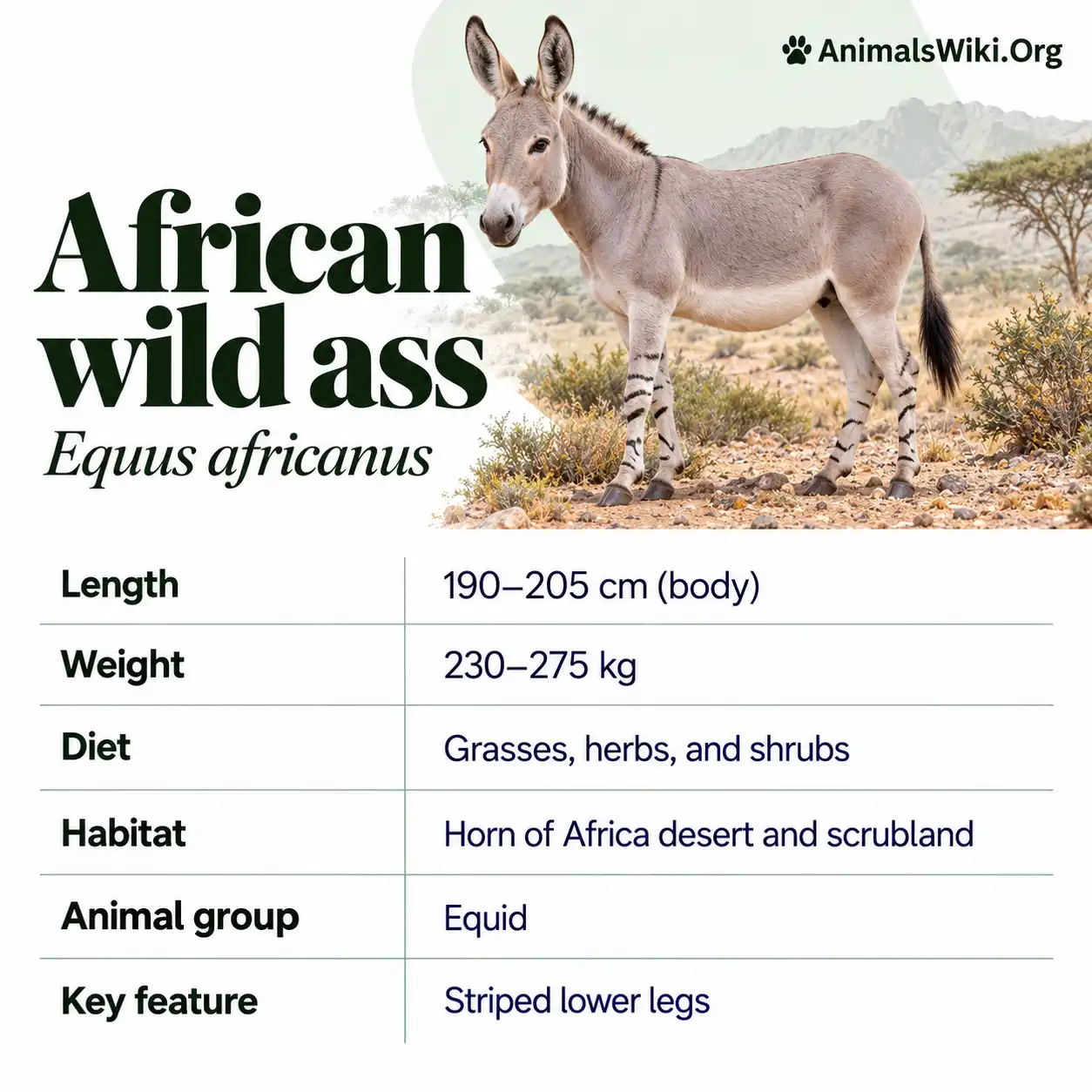
The animal’s appearance is both recognizable and distinctive. Large ears, a short upright mane, a pale coat, and a tufted tail identify it as a member of the ass lineage. Somali wild asses also have striking dark stripes on their legs, giving them a zebra-like feature without making them zebras.
Their lives are shaped by movement, resource availability, and reproduction. A female raising a foal faces different demands from an adult male, and access to one dependable water source can influence an entire local population.
This guide explores African wild ass facts, appearance, habitat, diet, social behavior, reproduction, ancestry, and conservation. It also explains why abundant domestic donkeys cannot replace this threatened wild species.
African Wild Ass Facts
| Feature | Details |
|---|---|
| Common name | African wild ass |
| Scientific name | Equus africanus |
| Animal group | Mammal |
| Family | Equidae |
| Historically recognized forms | Somali wild ass and Nubian wild ass |
| Best-established surviving wild range | Eritrea and Ethiopia |
| Main habitats | Rocky desert, semidesert, dry plains, and adjoining hills |
| Diet | Grasses, herbs, browse, and other vegetation |
| Typical adult weight | Approximately 250–275 kilograms; individuals vary |
| Shoulder height | Approximately 1.25–1.45 meters |
| Distinctive features | Large ears, upright mane, pale coat, narrow hooves |
| Somali form | Dark barring on the legs |
| Young | Foal |
| Pregnancy | Approximately one year |
| Typical birth | One foal |
| Conservation status | Critically Endangered |
| Major concerns | Hunting, resource competition, restricted water access, drought, and small populations |
1. What Is an African Wild Ass?
The African wild ass is a wild member of the horse family native to northeastern Africa.
Its scientific name is Equus africanus.
It belongs to the same broader family as horses, zebras, kiangs, and Asiatic wild asses, but it has its own evolutionary history and ecological relationships.
The species is especially associated with hot, dry landscapes where edible vegetation and dependable water may be widely separated.
Its resemblance to a domestic donkey is meaningful: domestic donkeys descend from African wild ass ancestry. However, a living wild population is not simply a group of ownerless domestic animals.
African wild asses retain a distinct conservation identity.
Their survival preserves wild genetic diversity, natural behavior, and relationships with desert ecosystems. These cannot be measured by the worldwide number of domestic donkeys or replaced merely by releasing domestic animals into suitable-looking terrain.
2. Scientific Classification
African wild asses belong to Equidae, the horse family.
They are members of Perissodactyla, the order commonly called odd-toed ungulates. Living equids bear weight on a single main hoof on each foot.
| Rank | Classification |
|---|---|
| Kingdom | Animalia |
| Phylum | Chordata |
| Class | Mammalia |
| Order | Perissodactyla |
| Family | Equidae |
| Genus | Equus |
| Species | Equus africanus |
Domestic donkeys are commonly listed as Equus asinus, although some classification systems place them within the African wild ass species.
This variation in naming does not erase the difference between domestic populations and threatened wild populations.
For wildlife conservation, the important task is to identify the naturally occurring animals accurately and understand their ancestry.
A scientific name provides a framework, but effective management also requires information about population history, distribution, health, and relationships with neighboring domestic animals.
3. Somali and Nubian Wild Asses
Two forms are traditionally recognized:
- Somali wild ass, commonly written as Equus africanus somaliensis.
- Nubian wild ass, Equus africanus africanus.
The spelling somalicus also appears in specialist sources for the Somali form.
Somali wild asses are particularly recognizable by dark bars across their lower legs. Nubian wild asses have historically been associated with a shoulder stripe and less pronounced leg barring.
Their names reflect historical geography rather than guaranteeing present-day occurrence within the country named.
The status and identity of animals reported from parts of the former Nubian range require careful investigation.
Modern conservation has focused heavily on well-documented populations in Eritrea and Ethiopia.
It is therefore more accurate to discuss confirmed populations and uncertain reports separately than to assume that every historical form has an equally well-established surviving wild population.
4. What Does an African Wild Ass Look Like?
African wild asses have a relatively slender body, long ears, an upright mane, and a tail ending in a tuft.
Their coat is usually gray, grayish brown, or pale sandy gray, with lighter areas underneath.
A dark stripe may run along the back.
The head and overall outline resemble those of a donkey, although wild animals should not be identified from that resemblance alone.
Somali wild asses have particularly noticeable dark markings on their legs.
The coat can change in appearance with lighting, dust, age, and condition. An animal standing in bright desert sunlight may look much paler than the same individual photographed in shade.
For identification, several features should be considered together.
Location, body proportions, coat markings, and population history all matter, especially where domestic or feral donkeys occur nearby and can show superficially similar characteristics.
5. Why Does the Somali Wild Ass Have Striped Legs?
The Somali wild ass has narrow dark bands across its legs.
These markings are among its most recognizable features and help distinguish it from many other asses.
However, striped legs do not mean that the animal is a zebra or a recent zebra hybrid.
Related species can retain or develop similar-looking markings without belonging to the same species.
The exact evolutionary significance of every marking should not be assumed from appearance alone.
For wildlife identification, the practical point is that Somali wild asses combine a mostly unstriped gray body with dark leg barring.
Individual patterns also vary.
Their markings can assist observers, but detailed conservation decisions should not rely entirely on visual inspection. Ancestry questions may require genetic evidence, particularly when distinguishing wild animals from domestic descendants or assessing reports from poorly studied locations.
6. How Big Is an African Wild Ass?
African wild asses are substantial mammals despite being smaller than many horses and zebras.
Common reference measurements place adults around 250–275 kilograms, with a shoulder height of approximately 1.25–1.45 meters.
Individuals vary with age, sex, and body condition.
The difference between males and females is not as visually dramatic as in animals with conspicuous horns or strongly contrasting coats.
Height is measured at the withers, where the neck meets the back.
A photograph can make size difficult to judge if the animal stands alone without a reliable scale.
Its relatively compact body supports travel through rugged habitat, but it still needs enough food to maintain itself.
During difficult seasons, weight and condition can change considerably. A thin animal is not necessarily a naturally smaller form; it may be experiencing nutritional or health problems.
7. Hooves and Movement on Rocky Ground
African wild asses are sure-footed animals with relatively small, narrow hooves.
Their feet help them negotiate stony surfaces and uneven terrain.
Each hoof protects the structures within the foot while supporting the animal’s weight and movement.
This does not mean wild animals are immune to foot injuries or lameness. Habitat, nutrition, moisture, and individual health still influence hoof condition.
Their ability to travel matters because resources are not evenly distributed.
A feeding area may lie several kilometers from dependable water, while temporary rainfall can make another location useful for only a short period.
The animal’s adaptations therefore support a mobile way of life.
Protecting its feet and movement indirectly means preserving routes through the landscape, rather than assuming a small protected patch can always supply everything required.
8. Adaptations to Heat
African wild asses live in environments where high temperatures create considerable challenges.
Their pale coat, desert physiology, and behavioral adjustments help them cope.
Large ears support sensitive hearing and provide exposed surfaces through which heat can be exchanged, although no single feature explains the animal’s overall tolerance.
Behavior is equally important.
Animals may rest during the hottest periods and feed when conditions are cooler.
They also adjust movement in response to available water and vegetation.
Heat tolerance should not be confused with freedom from environmental stress.
An animal still needs sufficient food and opportunities to drink. A nursing female may face additional demands that an adult male does not share.
Conservation therefore needs to consider different animals within the population, rather than treating “desert adapted” as a guarantee that every individual can withstand the same shortage.
9. Where Do African Wild Asses Live?
The best-established surviving wild populations occur in Eritrea and Ethiopia.
Historical distribution extended more widely across northeastern Africa.
Presence elsewhere has often been uncertain because recent surveys are limited and domestic or feral donkeys can complicate identification.
A Convention on Migratory Species report identified Eritrea and Ethiopia as confirmed range states while encouraging investigation in former range countries.
This is more precise than presenting every historical country as a confirmed current stronghold.
Country boundaries also reveal little about how the animals use habitat.
Within Eritrea and Ethiopia, populations occupy particular landscapes and depend on specific resources and routes.
Their survival is consequently influenced by local conditions around springs, feeding areas, settlement, and livestock use.
Protecting a species with such restricted confirmed distribution requires detailed knowledge of the places where reproduction and survival continue.
10. African Wild Ass Habitat
Typical habitat includes rocky desert, dry plains, semidesert, volcanic landscapes, and adjoining hills.
The Danakil region is particularly important in accounts of the surviving species.
These environments may appear nearly empty, but small differences in vegetation and water availability have major consequences.
A spring, temporary pool, or patch of productive grass can support activity across a much larger surrounding area.
Suitable habitat must therefore be understood functionally.
The amount of land matters, but so does the arrangement of resources.
Research in Eritrea has used field observations and habitat modeling to identify areas likely to support African wild asses.
Such work helps conservationists distinguish merely open land from land that animals can actually use.
It also guides monitoring beyond familiar observation sites, where additional animals or important seasonal habitat may otherwise remain overlooked.
11. What Do African Wild Asses Eat?
African wild asses are herbivores.
They eat grasses and other vegetation, including herbs, browse, and tough plant material available in their dry surroundings.
The balance changes with season and location.
Rain can produce fresh growth, while prolonged dry periods leave animals with a different and often less nutritious selection.
Their front teeth crop vegetation, and the cheek teeth grind it before swallowing.
Being able to eat coarse material helps, but it does not make every desert plant equally useful.
Food quantity, digestibility, and nutrient content all influence whether the diet meets an animal’s needs.
A mare producing milk must obtain more than enough food for basic maintenance.
This connection between feeding and reproduction makes access to suitable vegetation essential for population recovery, rather than simply a matter of keeping adults visibly alive.
12. How They Digest Tough Vegetation
African wild asses use hindgut fermentation, like other equids.
Microorganisms in the large intestine help break down fibrous vegetation and produce compounds that provide usable energy.
This differs from the digestive arrangement of ruminants such as cattle, sheep, and goats.
The system supports repeated feeding and the processing of substantial quantities of plant material.
However, digestive capability has limits.
An animal cannot obtain sufficient nutrition from food that is unavailable, inaccessible, or too poor in quality to meet its needs.
Research comparing African wild asses and livestock has used fecal indicators to investigate diet and nutritional condition.
Such studies connect visible feeding behavior with what animals are obtaining from their environment.
For conservation, the important outcome is adequate condition, survival, and reproduction—not merely evidence that an animal has found something to chew.
13. Water Needs and Drinking Behavior
African wild asses can tolerate dry conditions, but water access remains critical.
Their drinking patterns differ with reproductive condition and environmental circumstances.
A study on Eritrea’s Messir Plateau found that females with young foals visited permanent water daily during dry months, while nonreproductive adults visited less frequently.
The study also documented nighttime drinking and substantial travel between feeding areas and water.
These are findings from a particular population and period, rather than a universal schedule followed everywhere.
Their significance is clear: a mother producing milk has demanding needs.
When access to water becomes difficult, the consequences can extend to her foal.
Conservation therefore must consider both supply and access. Water may physically exist while disturbance, livestock concentration, or unsuitable surrounding habitat makes it difficult for wild asses to use effectively.
14. Daily Activity and Rest
Daily life includes feeding, walking, resting, drinking, vigilance, and social interaction.
In hot conditions, African wild asses often make greater use of cooler parts of the day.
Shade can become valuable during midday heat, although its availability varies across open desert landscapes.
Nighttime activity is also important in some circumstances.
An animal may change its schedule when drinking sites are less disturbed after dark or when temperatures are lower.
These adjustments demonstrate flexibility, but they can carry costs.
Delaying a water visit may reduce time available for feeding or require travel under different conditions.
Observing activity therefore provides more information than simply noting whether an animal is present.
Repeated interruptions, longer journeys, or changes in feeding time can help researchers identify pressures before they become obvious through poor condition or declining numbers.
15. Movement and Resource Connections
African wild asses move through landscapes where resources are scattered and change over time.
Rainfall can briefly improve a feeding area or create temporary water. Later, the same place may become much less useful.
Animals need the ability to respond.
A route connecting grazing with a dependable spring can be important even if wild asses spend little time along it.
This is why habitat conservation must include connections, not only the places where animals remain longest.
Barriers or concentrated disturbance can make an otherwise useful resource effectively unavailable.
The problem is especially serious for small populations with few alternative areas.
A conservation plan should therefore ask how animals move during both favorable and difficult conditions.
Protecting a feeding patch without preserving access to water may protect only one part of the system required for survival.
16. Social Organization
African wild ass social groups are generally more flexible than the stable families associated with plains zebras.
The mother and her recent foal form a particularly important social unit.
Other associations can change as animals respond to food, water, and reproductive opportunities.
Males may occur alone, with other males, or near females depending on circumstances.
A large gathering should not automatically be interpreted as one permanent herd.
Several animals may temporarily concentrate around a resource and later separate.
This flexibility fits a habitat where supporting a large group in one place can be difficult.
However, flexible grouping does not mean animals lack individual relationships.
Understanding social life requires repeated observations of recognizable animals, rather than assuming that every association is temporary or that all individuals interact in the same way.
17. Do African Wild Asses Form Friendships?
Research in human care suggests Somali wild asses can show consistent preferences for particular companions.
At Saint Louis Zoo, observers recorded proximity and interactions over an extended period.
Preliminary social-network findings indicated that females did not divide their time equally among all available partners.
This is useful evidence of selective association.
It should not be transferred uncritically to every wild population because abundant food, predictable water, and enclosure conditions can change social opportunities.
Nevertheless, the research challenges the simplistic idea that flexible wild grouping means individuals have no meaningful preferences.
Social information also has practical value.
When animals are transferred or breeding groups reorganized, compatibility matters.
Maintaining suitable relationships can support welfare and management, alongside the more familiar considerations of ancestry, health, and reproductive potential.
18. Communication and Senses
African wild asses communicate through vocalizations, posture, movement, scent, and contact.
Their characteristic bray is one of the most recognizable sounds associated with asses.
Ear movements, head position, body orientation, and changes in distance contribute to communication at closer range.
Scent marking and investigation also provide information during social and reproductive interactions.
Their hearing and vision help them monitor open surroundings.
A distant observer may already have been noticed before realizing the animal is alert.
As with other equids, a single gesture should not be assigned one meaning without context.
Flattened ears combined with a tense posture can signal a warning, while an ear turned backward may simply be following a sound.
Good observation considers the entire exchange and avoids forcing an animal to remain focused on the observer.
19. Breeding and Pregnancy
African wild ass reproduction is linked to the distribution of resources and the condition of breeding animals.
Some males defend areas associated with access to females rather than permanently leading a fixed family group.
Pregnancy lasts approximately one year, and females usually produce one foal.
This relatively slow reproductive pace limits how quickly a severely reduced population can recover.
A successful birth also requires substantial maternal investment.
The female must support pregnancy and then produce milk while maintaining her own condition.
Conservation breeding facilities have studied reproductive physiology, including hormone patterns, to improve management.
In the wild, adequate food and water remain fundamental.
The useful measure of reproductive success is not only whether a foal is born, but whether it grows, survives difficult periods, and eventually contributes to the next generation.
20. Foals and Early Development
A newborn African wild ass foal is relatively well developed.
It begins attempting to stand and move soon after birth, allowing it to stay close to its mother.
Early mobility is valuable in an environment where remaining in one hiding place may not be an effective survival strategy.
The youngster still depends on milk, protection, and close contact.
As it grows, it begins investigating vegetation and interacting more widely with its surroundings.
Playing, running, and turning help develop coordination.
The mother’s condition strongly influences these early stages.
A female struggling to reach water or obtain suitable food may have difficulty meeting the needs of her foal.
This is why protecting breeding habitat requires attention to mothers and young, rather than assuming that land adequate for nonbreeding adults is automatically sufficient for successful recruitment.
21. Lifespan and Survival
African wild asses can survive for many years, with longevity influenced by conditions and individual health.
However, figures from domestic donkeys, feral burros, and zoo animals should not automatically be presented as average lifespan in the wild.
These animals experience different food supplies, veterinary care, risks, and environmental pressures.
For a small wild population, age-specific survival is especially important.
Adult females must survive long enough to raise young, and sufficient foals must reach maturity to replace losses.
A population can decline even when some individuals live for a long time.
Drought, poor nutrition, injury, disease, and human-caused mortality may all influence outcomes.
Consequently, conservationists examine births, deaths, age structure, and condition together.
That provides a clearer assessment of population health than relying on the maximum age of an exceptional individual.
22. Defense and Natural Risks
African wild asses are alert, mobile animals capable of rapid escape.
If threatened at close range, they can defend themselves with powerful kicks or bites.
Their narrow hooves and sure-footed movement help them use rugged terrain, but physical ability cannot eliminate every danger.
Young, sick, or weakened individuals face different risks from healthy adults.
The importance of natural predation varies with the local carnivore community.
For conservation, it is particularly important not to import a list of predators from feral donkey populations in another continent and apply it automatically to the Horn of Africa.
Human pressures are central to the species’ documented decline.
Understanding risk therefore requires evidence about particular places, including the condition of the animals and the combined effects of hunting, resource access, disturbance, and environmental stress.
23. Ecological Importance
African wild asses contribute to desert ecosystems through feeding, movement, and nutrient return.
Their grazing and browsing affect vegetation structure.
Dung becomes a resource for organisms that use animal waste and returns nutrients to the ground.
The animals also interact with other herbivores and form part of wider food webs.
Their ecological role should not be exaggerated into the claim that one rare species controls an entire desert.
Instead, they represent one component of a functioning system.
Preserving that component matters because extinction removes relationships as well as individuals.
The African wild ass also provides a way to understand dryland conditions.
Its movements, body condition, and reproductive performance reveal how resources are distributed and whether a landscape remains usable for a large native herbivore.
24. The Ancestor of Domestic Donkeys
The African wild ass lineage is the source of domestic donkeys.
This relationship connects the species to thousands of years of human transport, agriculture, trade, and daily labor.
A major genomic study published in 2022 supported an African origin for donkey domestication around 7,000 years ago.
The detailed contribution of historical wild populations is more complicated than claiming that all modern donkeys descend from one surviving zoo group or one visually identified subspecies.
Ancient DNA and modern genomes help reconstruct that history.
The important broad distinction is well established: domestic donkeys have African wild ass ancestry rather than deriving from the Asian onager or kiang.
Their shared history makes the surviving wild species especially significant, but it also emphasizes how differently the domestic and wild populations have fared.
25. Why Domestic Donkeys Cannot Replace Wild Asses
The widespread domestic donkey does not remove the African wild ass’s conservation crisis.
Domestic populations have been shaped by human selection, breeding, movement, and management over many generations.
Wild populations preserve their own ancestry and ecological history.
Releasing domestic donkeys would therefore not recreate the lost wild population.
It could also introduce new pressures involving vegetation, disease, or uncontrolled breeding.
Conservation aims to maintain more than a familiar body shape.
It protects genetic diversity, natural behavior, and the continuing relationship between an animal and its native habitat.
The same principle applies to other domestic and wild relatives.
Abundant domestic cattle do not replace threatened wild bovines, and domestic horses do not remove the importance of distinct wild-horse conservation populations.
The African wild ass needs protection in its own right.
26. Conservation Status and Population Estimates
The African wild ass is classified as Critically Endangered on the IUCN Red List.
The formal assessment published in 2015 estimated, at best, approximately 200 mature individuals, while emphasizing considerable uncertainty.
That figure should not be presented as a newly completed October 2026 census.
Other summaries refer to a few hundred total animals, which is not the same category as mature individuals.
Survey coverage is difficult because animals are scarce, scattered, and occupy demanding terrain.
The clearest conclusion is that the established wild population is extremely small and vulnerable.
Exact numbers require a source, date, geographic scope, and explanation of what was counted.
Breeding success, survival, distribution, and genetic diversity also matter. A total alone cannot show whether the population has the conditions needed for long-term recovery.
27. What Do Recent Reports From Sudan Mean?
A study published in 2026 reported asses from Sudan’s Red Sea State, including animals identified by the researchers as Nubian wild asses.
The report is important because historical-range surveys can reveal information from poorly studied areas.
However, its findings should not automatically be added to older global estimates.
The authors themselves called for molecular genetic work to clarify the identity and prevalence of the reported forms.
This matters because wild, domestic, feral, and mixed-ancestry asses can be difficult to distinguish reliably through appearance alone.
The appropriate conclusion is that the report creates a reason for further investigation.
It does not by itself establish a revised worldwide population or demonstrate that all uncertainties about Nubian wild ass survival have been resolved.
Clear reporting preserves the significance of new evidence without turning a preliminary result into a confirmed recovery.
28. Hunting and Direct Human Pressure
Hunting has contributed to African wild ass declines.
Animals have been killed for meat and body parts used in traditional practices.
In a very small population, the loss of even a few breeding individuals can have substantial consequences.
The effect extends beyond the animal killed.
A dependent foal may also be affected, and the population loses future reproductive opportunities.
Protection therefore needs to be effective where animals actually occur, including outside highly visible conservation sites.
Local knowledge, monitoring, and cooperation are essential.
Conservation messages are strongest when they address real circumstances rather than treating every neighboring community as identical.
Reducing direct mortality must also be combined with habitat work. An animal protected from hunting still needs usable grazing, water, and the ability to move between them.
29. Competition With Livestock
African wild asses share landscapes with cattle, domestic donkeys, goats, sheep, and camels.
Competition can arise when animals depend on the same limited resources.
A study on Eritrea’s Messir Plateau found substantial dietary overlap with cattle and domestic donkeys.
The researchers also documented changes in space use associated with livestock presence and differences in fecal nutrient indicators.
These findings provide a more detailed explanation than simply saying that livestock and wildlife occur together.
The consequences depend on which resources overlap, when demand is greatest, and whether wild asses can move elsewhere.
Conservation should therefore consider seasonal grazing arrangements and the distribution of livestock.
The objective is to maintain practical access for the threatened species while recognizing that people also depend on these dryland resources for their livelihoods.
30. Drought, Habitat Change, and Water Access
Drought can reduce both forage and drinking opportunities.
For African wild asses, this may mean longer journeys, poorer nutrition, and greater concentration around remaining resources.
Habitat change can make those effects worse.
A water source may be surrounded by disturbance, inaccessible infrastructure, or vegetation too limited to support animals nearby.
Similarly, a productive feeding area may become unusable if the route to water is blocked.
These are connected problems.
Providing water alone does not guarantee recovery if food remains inadequate.
Long-term conservation therefore needs to maintain a functioning network of resources.
Healthy vegetation, dependable access, alternative feeding areas, and informed local management give animals more options when conditions deteriorate.
This reduces the likelihood that a short period of environmental stress becomes a lasting population loss.
31. Genetics and Population Identity
Genetic research helps determine relatedness, population connections, and ancestry.
For a species with very few surviving animals, this information is valuable when considering future management.
A Convention on Migratory Species report described genetic sampling from Eritrea and Ethiopia collected during fieldwork between 2016 and 2020.
The results indicated that the populations were closely related while still sufficiently distinguishable to assign sampled animals to their population of origin.
This demonstrates how molecular information can complement field observations.
It also helps address questions that coat markings cannot resolve alone.
Potential mixing with domestic donkeys deserves investigation, but it should not be described as a proven explanation for every decline.
The practical goal is evidence-based management that preserves wild diversity while avoiding unsupported assumptions about ancestry.
32. How Researchers Study African Wild Asses
Research combines direct observation, camera traps, photographic records, fecal sampling, and habitat analysis.
Each method provides a different part of the picture.
Water-point cameras document visits that observers might miss, especially at night.
Field surveys identify where animals occur, while fecal samples can support nutritional or genetic research.
Habitat models help predict additional areas worth investigating.
The conditions make this work difficult. Heat, rocky terrain, long distances, and sparse animals limit how much a team can observe.
Repeated monitoring is consequently more useful than assuming one unsuccessful visit proves absence.
Research must also connect to decisions.
Information about mothers’ water use, for example, becomes valuable when it guides the protection of access routes or helps reduce disturbance during important drinking periods.
33. Local Communities and Field Conservation
African wild ass conservation depends on people living within and around its remaining habitat.
Local residents understand seasonal water, grazing patterns, travel routes, and changes that visiting teams may not notice immediately.
Cooperation can improve monitoring and make management decisions more workable.
Conservation projects in Eritrea have emphasized the importance of field research and protection within the species’ actual landscape.
The wider international conservation roadmap also recognizes the need for coordinated action.
A durable approach considers both wildlife needs and local livelihoods.
This does not mean every conflict disappears.
It means solutions are built around the circumstances that create pressure, including access to resources and the distribution of costs.
Protecting a rare animal becomes more achievable when neighboring people have meaningful roles and the practical support needed to participate.
34. Zoos and Conservation Breeding
Managed Somali wild ass populations provide an important safeguard against further losses.
Coordinated breeding programs use ancestry records and specialist management to retain genetic representation.
The European program identifies an insurance-population role, alongside research, education, and support for conservation in the Horn of Africa.
Institutions also study reproduction, health, and social compatibility.
These efforts matter because adding animals without preserving diversity or maintaining welfare is not a complete conservation strategy.
Human-care populations do not replace wild habitat.
Their strongest contribution comes when they support a wider recovery effort rather than becoming an isolated achievement.
The aim is to preserve options for the species while protection, research, and resource access improve within its native landscape.
35. Watching Responsibly and Supporting Recovery
African wild asses should be observed with distance and respect.
Follow local guidance, avoid disturbing water access, and never chase animals to obtain a photograph.
Mothers and foals deserve particular care.
Do not feed, touch, or attempt to attract a wild ass. Its relationship to a familiar domestic animal does not make close interaction safe or appropriate.
Support for credible conservation organizations can contribute to field monitoring, research, and coordinated breeding.
Accurate information is also useful.
Population estimates should be dated, and uncertain reports should remain clearly distinguished from confirmed findings.
The most meaningful goal is a wild population with surviving adults, successfully raised foals, and access to the resources needed through difficult seasons.
That requires sustained work on habitats, relationships, and management—not only occasional attention when a foal is born.
Frequently Asked Questions About African Wild Asses
1. What is an African wild ass?
The African wild ass is a wild equid native to northeastern Africa. Its scientific name is Equus africanus. It belongs to the horse family and is the ancestral source of domestic donkeys, while retaining its own threatened wild populations and conservation identity.
2. Is it the same as a donkey?
It is closely related to domestic donkeys, which descend from African wild ass ancestry. However, a surviving wild population is different from domestic or feral donkeys. Conservation focuses on preserving its wild ancestry, behavior, and ecological relationships.
3. What is the difference between an African and Asiatic wild ass?
The African wild ass is Equus africanus. The Asiatic wild ass or onager is Equus hemionus. They belong to the same family but have different evolutionary histories, distributions, and conservation circumstances.
4. What is a Somali wild ass?
The Somali wild ass is a traditionally recognized form of African wild ass, commonly named Equus africanus somaliensis. It is especially recognizable by dark bars on its legs. Its name does not mean that all confirmed surviving animals occur in Somalia.
5. What is a Nubian wild ass?
The Nubian wild ass is the historically recognized form Equus africanus africanus, associated with northeastern Africa. Its current survival and the identity of reported animals require careful investigation. Recent reports should not be treated as fully resolved ancestry evidence without appropriate verification.
6. Why does the Somali wild ass have striped legs?
Dark leg barring is a characteristic feature of the Somali form. It does not make the animal a zebra or demonstrate recent zebra ancestry. Similar-looking markings can occur among related equids without making them the same species.
7. Where do African wild asses live?
The best-established surviving wild populations occur in Eritrea and Ethiopia. Their historical distribution was wider. Reports from other former range areas require evaluation, particularly where domestic or feral donkeys make identification difficult.
8. What habitat do they prefer?
They occupy arid landscapes such as rocky desert, dry plains, semidesert, and adjoining hills. Suitable habitat must include usable vegetation, water access, and routes between resources. A large area of apparently empty desert is not automatically adequate habitat.
9. What do African wild asses eat?
They eat grasses and other vegetation, including herbs and browse. Diet varies with season and location. The ability to process tough food helps them survive, but sufficient quantity and nutritional quality remain essential.
10. Do they need drinking water?
Yes. Desert adaptations do not remove their dependence on drinking opportunities. Requirements differ among animals and conditions, with nursing females facing particularly high demands. Safe, practical access can be as important as the physical presence of water.
11. How large are African wild asses?
Common references place adults around 250–275 kilograms, with shoulder heights roughly 1.25–1.45 meters. Individual size varies with age, sex, and condition. They remain strong animals despite being smaller than many other equids.
12. Why do they have large ears?
Large ears support sensitive hearing and provide exposed surfaces relevant to heat exchange. Their survival nevertheless depends on several interacting adaptations. Ear size alone does not explain their ability to use hot, dry environments.
13. Are African wild asses good climbers?
They are sure-footed on rocky and uneven ground. Their relatively narrow hooves help them negotiate stony habitat. This does not make them cliff specialists or immune to injury, and they also need accessible feeding areas and water.
14. Do they live in permanent herds?
Their associations are generally flexible, with the mother–foal relationship particularly important. Group composition can change with resources and reproduction. A gathering near water should not automatically be interpreted as one permanent family herd.
15. Can Somali wild asses form social preferences?
Research in human care has found consistent preferences for particular companions among females. This suggests meaningful selective association. Conditions in managed settings differ from the wild, so the findings should be applied with appropriate attention to context.
16. What is a baby African wild ass called?
A baby is a foal. Adult males may be called stallions or jacks, while females may be called mares or jennies. Terminology varies between wildlife and domestic-donkey contexts.
17. How long is its pregnancy?
Pregnancy lasts approximately one year. Females usually produce a single foal. Raising that youngster requires substantial maternal resources, so reproductive success depends on conditions during pregnancy, nursing, and early development.
18. Can a newborn foal walk?
A healthy foal begins attempting to stand and move soon after birth. This helps it remain close to its mother. Early mobility does not mean independence: milk, protection, and suitable environmental conditions remain necessary.
19. How long does an African wild ass live?
Longevity varies with conditions and individual health. Figures for domestic donkeys, feral burros, and managed animals should not automatically be used as average wild lifespan. Conservation monitoring focuses on survival across age groups and successful replacement of lost adults.
20. Is the African wild ass endangered?
Yes. It is classified as Critically Endangered on the IUCN Red List. Its established wild populations are extremely small and face continuing pressure from hunting, resource competition, restricted access, and environmental stress.
21. How many remain in the wild?
The assessment published in 2015 estimated, at best, approximately 200 mature individuals, with considerable uncertainty. This is a dated assessment rather than a live census. Reports using total animals or different survey areas should not be combined without explanation.
22. Was the African wild ass domesticated?
Ancestral African wild ass populations gave rise to domestic donkeys. Genomic research supports domestication in Africa around 7,000 years ago. This historical relationship does not make the surviving wild animals equivalent to modern domestic donkeys.
23. Can domestic donkeys save the wild species?
Their abundance does not replace threatened wild populations. Domestic animals have a different management and breeding history. Conservation aims to preserve wild ancestry, natural populations, and ecological relationships rather than simply maintain a similar-looking animal.
24. Are African wild asses dangerous?
They can bite, kick, or react suddenly when threatened. Familiarity with domestic donkeys should not encourage close approaches. Observe from a respectful distance and avoid interfering with foals, social interactions, or access to water.
25. How can people help?
Support credible field conservation and coordinated breeding programs, observe animals responsibly, and share accurate information. Maintaining food, water access, and cooperation with local communities is essential alongside protecting individual animals from direct harm.
African Wild Ass Animal conservation
The African wild ass combines remarkable desert adaptations with an exceptionally vulnerable conservation position.
Its connection to domestic donkeys makes its story familiar, but the survival of the wild species depends on conditions that domestic abundance cannot replace.
Protecting it means maintaining safe access to food and water, reducing direct mortality, understanding population identity, and supporting successful reproduction.
Field research, community cooperation, and coordinated conservation breeding preserve important options. The goal is a future in which African wild asses continue to live and reproduce within functioning native landscapes.



