
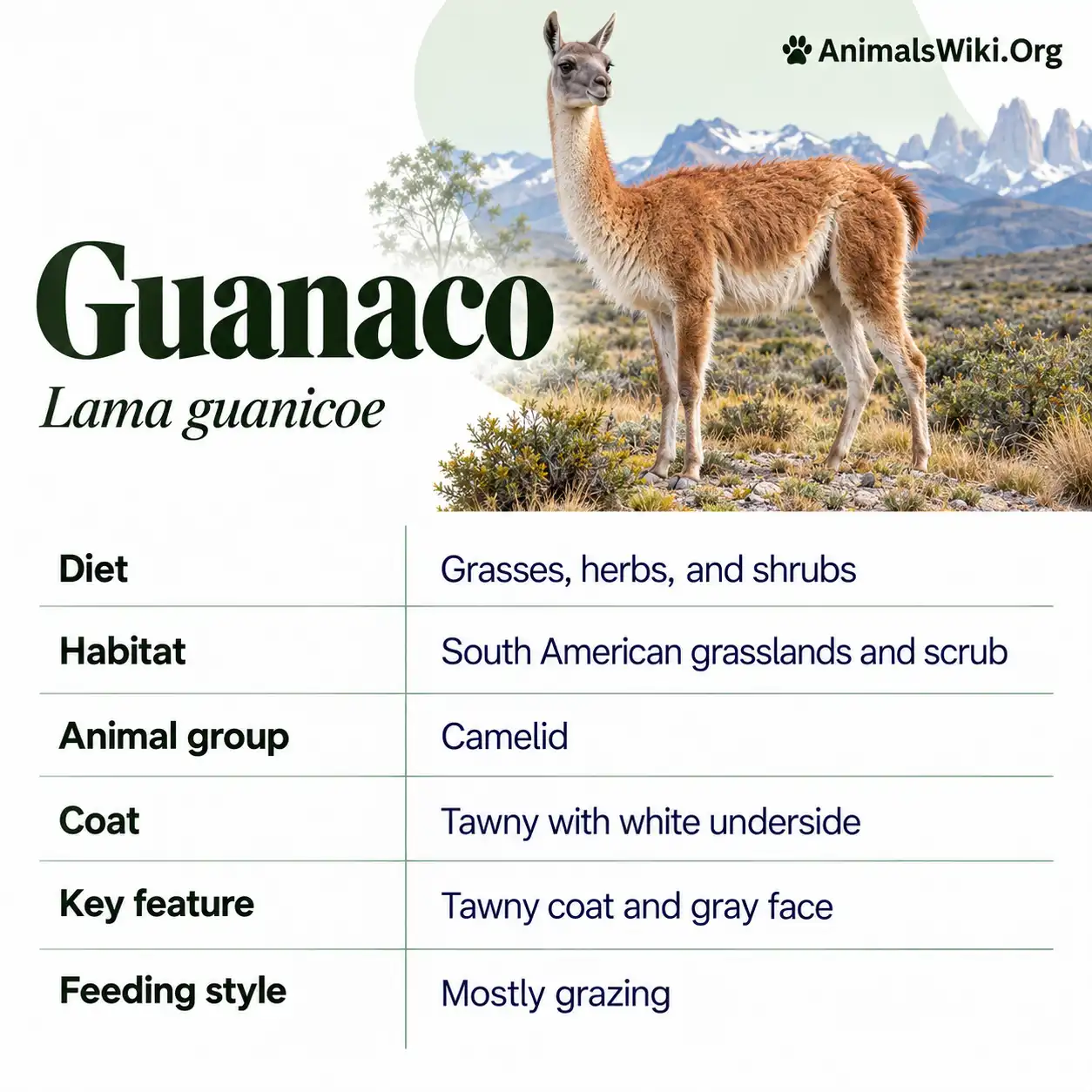
Tawny Guanaco, The Wild Camelid of South America’s Open Landscapes
The tawny guanaco is the familiar guanaco, Lama guanicoe, described by its warm, reddish-brown coat. “Tawny” refers to its coloring; it is not a separate recognized species or subspecies.
With its long neck, dark face, pale underside, and alert stance, the guanaco is one of South America’s most recognizable grazing mammals. It is particularly associated with Patagonia, where groups move across grasslands beneath mountains, beside lakes, and through windswept valleys.
However, guanacos are not limited to one landscape. Their range includes coastal areas, dry shrublands, mountain environments, and some southern forest habitats. This flexibility distinguishes them from the smaller vicuña, which is more closely associated with high Andean environments.
Guanacos are wild relatives of domestic llamas. They help shape vegetation, support predators and scavengers, and maintain ecological connections through their movements.
Although globally classified as Least Concern, they face serious local pressures. Fences, habitat fragmentation, hunting, and competition for resources can affect populations and migration routes.
This guide explores the guanaco’s appearance, biology, social life, ecological importance, and conservation.
Tawny Guanaco Facts
| Feature | Details |
|---|---|
| Standard common name | Guanaco |
| Meaning of “tawny” | A description of its yellowish-brown or reddish-brown coloring |
| Scientific name | Lama guanicoe |
| Family | Camelidae |
| Animal type | Wild South American camelid |
| Humps | None |
| Typical adult weight | Often approximately 80–120 kilograms, with regional variation |
| Typical shoulder height | Approximately 1.1 meters |
| Diet | Herbivorous; grazes and browses |
| Main environments | Grasslands, shrublands, deserts, mountain areas, and some forests |
| Social organization | Family groups, male groups, solitary males, and other temporary associations |
| Pregnancy | Approximately 11–11.5 months |
| Typical offspring | One |
| Young animal’s name | Chulengo |
| Main predator | Puma |
| General lifespan | Commonly described as approximately 15–20 years |
| Global IUCN category | Least Concern |
| International trade listing | CITES Appendix II |
What Is a Tawny Guanaco?
A guanaco is a wild member of the camel family native to South America.
The phrase “tawny guanaco” describes the animal’s coat rather than identifying a different biological type. Its upper body commonly has shades of cinnamon, yellowish brown, or reddish brown.
The standard species name remains Lama guanicoe.
This clarification matters because descriptive words can sometimes look like formal animal names when used in titles or keyword lists. In this case, information about guanacos applies to the animal being described.
A guanaco is not a wild dromedary or a small Bactrian camel. It belongs to the South American branch of the camel family and has no hump.
It is also different from a feral llama. Guanacos are a wild species with their own evolutionary history, social behavior, and ecological relationships.
Their connection with people is longstanding, but that connection has not made every free-ranging guanaco a domestic animal.
Scientific Classification and Camel Relatives
Guanacos belong to Camelidae, the family containing camels, llamas, alpacas, and vicuñas.
Their genus, Lama, also includes the domestic llama.
| Classification level | Guanaco |
|---|---|
| Kingdom | Animalia |
| Phylum | Chordata |
| Class | Mammalia |
| Family | Camelidae |
| Genus | Lama |
| Species | Lama guanicoe |
The scientific name is useful when comparing research, conservation documents, and wildlife-trade information.
Common names can vary between languages, while phrases describing color may appear in informal writing. The species name makes the identity clearer.
Family membership also explains certain shared features, including padded feet and specialized digestion.
However, related animals are not interchangeable. A camel adapted to a Central Asian winter, an alpaca bred for fiber, and a free-ranging guanaco experience different environmental and management demands.
Classification reveals relationships without removing those differences.
What Does a Guanaco Look Like?
A guanaco has a long neck, upright ears, a relatively small head, and a substantial body supported by slender legs.
The upper coat is usually brownish, while the belly, rump, and inner portions of the legs are much paler. The head often appears gray or dark compared with the neck and body.
This contrast helps distinguish it from some other camelids.
The face has large eyes and a divided upper lip. Guanacos have neither horns nor antlers.
Their backs are relatively straight, without the humps found in Old World camels.
Color varies across the range, so not every animal has exactly the same tawny shade. Light, season, age, and condition also affect how the coat appears.
For identification, consider the full combination of proportions, face, coat pattern, and location.
One feature alone, such as brown hair or a long neck, is insufficient to distinguish every guanaco from every related animal.
How Big Is a Guanaco?
Guanacos are the largest living wild South American camelids.
Many adults weigh approximately 80–120 kilograms, although size varies between populations and individuals. Some southern animals can be heavier.
Shoulder height is commonly around 1.1 meters.
The height of the head is greater because the neck extends above the shoulders. Comparing head height with another animal’s shoulder height can therefore produce misleading impressions.
Regional variation is important. A single average should not be presented as an absolute limit for the entire species.
Age, sex, nutrition, and body condition also influence measurements.
Guanacos are larger and more substantial than vicuñas, but a young guanaco can overlap in size with adults of smaller species.
Photographs can make comparisons harder when distance and perspective differ.
Reliable identification combines size with anatomy and context, rather than assuming that the tallest animal in a picture must belong to a particular species.
Guanaco vs Llama
The guanaco is the wild relative from which the domestic llama was developed.
Genomic research supports this ancestry, while also revealing the importance of historical interbreeding among South American camelids.
Domestication has produced considerable variation in llama size, coat, appearance, and behavior.
| Feature | Guanaco | Llama |
|---|---|---|
| General identity | Wild species | Domestic animal |
| Scientific name | Lama guanicoe | Lama glama |
| Typical coat pattern | Brown upper body, pale underside, darker face | Highly variable |
| Relationship with people | Wildlife, sometimes managed for conservation or fiber | Bred and managed for human uses |
| Typical role | Native herbivore | Pack animal, fiber producer, companion, and other domestic uses |
A guanaco should not be expected to accept handling like a well-trained llama.
Likewise, a llama roaming freely does not automatically become a guanaco.
Ancestry connects the animals, but present-day identity involves more than whether a person happens to be standing beside them.
Guanaco vs Vicuña and Alpaca
Guanacos and vicuñas are wild South American camelids. Llamas and alpacas are domesticated forms.
A guanaco generally has a larger, heavier body than a vicuña. Its face is often darker, while the vicuña has a particularly fine coat and more delicate proportions.
Alpacas vary considerably because people have selected them for fiber production.
These distinctions are easier to understand when appearance is considered alongside ecology.
Vicuñas are strongly associated with high Andean grasslands. Guanacos occupy a much wider range of elevations and environments.
However, habitat is not a perfect identification rule. Guanacos can live at altitude, and different camelids can occur within the same wider region.
Their evolutionary relationships are also more complicated than four completely isolated family lines.
For everyday identification, focus on body proportions, coat pattern, head shape, and whether the animal belongs to a managed domestic group or a wild population.
Where Do Guanacos Live?
Guanacos occur in western and southern South America.
Their range includes Argentina, Chile, Peru, and Bolivia, with small populations or regional records also associated with Paraguay.
The largest remaining populations occur in Argentina, especially in Patagonia.
However, country-level distribution can hide major differences. A species may be widespread in one country and restricted to a few small populations in another.
It is therefore inaccurate to assume that every part of the range contains large, continuous herds.
Historical distribution was also broader than the areas occupied today.
Land use, hunting, fences, and other pressures have altered where populations persist and how they connect.
Current maps should distinguish established populations from historical occurrence and introduced animals.
The central geographic fact is the guanaco’s breadth: it is not restricted to one highland belt, one national park, or the southernmost part of the continent.
Guanaco Habitat: From Coast to Mountains
Guanacos use an unusually broad range of environments for a South American wild camelid.
They occur from near sea level to elevations above 4,000 meters.
Suitable landscapes can include grasslands, dry shrublands, semi-deserts, mountain slopes, and parts of southern forest environments.
This variety does not mean every habitat is equally productive or that the animals can live anywhere.
Food, water, seasonal weather, disturbance, and access to neighboring areas determine local suitability.
An open plain may support feeding during one season, while another area becomes important when snow or vegetation conditions change.
The broad habitat range also explains why one detailed observation should not automatically be applied everywhere.
A coastal guanaco population may face different feeding and movement constraints from a high Andean population.
Conservation needs to preserve those local relationships rather than relying on one simplified picture of guanaco habitat.
Why Are Guanacos Associated with Patagonia?
Patagonia contains extensive landscapes in which guanacos remain prominent native herbivores.
Open steppes, valleys, shrublands, and mountain margins provide settings where groups can be visible from considerable distances.
This visibility has made the guanaco an emblem of the region.
Its importance is ecological as well as visual. It consumes vegetation, supports predators, and contributes to the food available to scavengers.
Patagonia also contains working landscapes, including ranches, roads, fences, and settlements. Guanacos therefore live within a mixture of protected and privately managed land.
That arrangement creates both opportunities and conflicts.
A population seen frequently in one national park may appear secure, while nearby movement routes or smaller populations remain under pressure.
The regional symbol should not conceal that unevenness.
Protecting the guanaco’s place in Patagonia means maintaining functioning landscapes, not merely ensuring that visitors can photograph a few familiar groups.
Coat and Temperature Regulation
A guanaco’s coat includes coarser outer hairs and a finer undercoat.
Together, these layers help manage heat exchange with the environment.
Insulation is particularly valuable in cold, windy conditions, but the coat’s properties vary across the body and between seasons.
Research comparing summer, winter, and shorn pelts has documented differences in thermal conductance.
In simple terms, the amount of heat passing through the coat changes with its condition and characteristics.
This matters when interpreting the animal’s ability to live in challenging environments.
The coat is not merely decorative or a textile resource. It has an important biological function.
Removing fiber can therefore affect the animal, depending on the amount removed, season, weather, and condition.
Understanding the insulation system helps explain both natural adaptation and the welfare considerations involved in live shearing.
Padded Feet and Movement
Guanacos walk on padded feet with two toes.
Their feet differ from the compact hooves of horses and many other grazing mammals.
The pads and flexible contact with the ground support movement across varied terrain, including rocky slopes and loose surfaces.
However, sure-footedness should not be interpreted as immunity to falls or injury.
Sharp objects, wire, unsuitable fencing, slippery surfaces, and unfamiliar obstacles can still create hazards.
The animal’s ability to cross a landscape also depends on whether routes remain available.
A guanaco may be physically capable of moving across a valley but prevented from doing so by a continuous barrier.
That distinction is important in conservation.
Anatomy determines what an animal can do under suitable conditions. Infrastructure and land management influence whether it has the opportunity to do it.
Protecting movement requires attention to both.
What Does a Guanaco Eat?
Guanacos are herbivores that both graze and browse.
Grazing involves taking grasses and other low-growing vegetation. Browsing includes leaves, shoots, and parts of woody plants.
Their diet changes with location and season.
A guanaco living in a dry shrubland may use different foods from one feeding near southern forests or high mountain meadows.
This flexibility is one reason the species occupies a broad environmental range.
However, flexibility does not mean that all available plants provide equal nutritional value.
Animals can select particular species or plant parts while avoiding others.
Research in Tierra del Fuego has examined guanaco feeding in environments containing Nothofagus forests, showing why it is inaccurate to describe them only as open-grassland feeders.
A useful diet description therefore includes both their general herbivory and the local variation that allows different populations to survive.
Digestion and Water Needs
Guanacos use microbial fermentation to obtain nutrients from fibrous plants.
Their stomach is generally described as having three compartments. They also regurgitate partly processed food, chew it again, and swallow it.
This makes them functional cud-chewing animals, although their anatomy differs from the four-compartment stomach of cattle.
Digestive efficiency helps them use challenging vegetation, but it does not remove the need for adequate food.
Water relationships also depend on conditions.
Moisture in plants can contribute substantially to hydration, especially in some dry environments. That should not be exaggerated into a claim that guanacos never need drinking water.
Weather, food moisture, activity, and individual condition influence requirements.
For managed animals, dependable access to suitable water remains important.
The most accurate explanation connects diet, digestion, and hydration rather than presenting any one adaptation as a complete solution to scarcity.
Social Groups and Family Life
Guanaco societies include family groups, nonbreeding male groups, solitary males, and other associations that change with season and local conditions.
A family group commonly includes an adult male, females, and young.
However, this arrangement should not be imagined as a rigid household whose membership never changes.
Females can move between areas and social groups, and the importance of territorial behavior varies.
Young or nonterritorial males may associate in male groups.
Group size can influence feeding, vigilance, and the way animals respond to threats.
Researchers have examined how resource distribution and other ecological factors help explain this variation.
The practical lesson is that “guanacos live in herds” is correct but incomplete.
Understanding their social life requires observing who is together, what resources they use, and how relationships change through time.
One photograph captures a moment rather than the full social system.
Communication, Territoriality, and Spitting
Guanacos communicate through sounds, posture, movement, and interactions with other animals.
An alert stance or warning call can influence how nearby animals respond.
During territorial encounters, males may chase, push, bite, or spit. The intensity depends on the individuals and situation.
Spitting involves saliva and potentially regurgitated material rather than simply spraying clean water.
It should not become a reason to portray every guanaco as aggressive.
A wild animal defending space or reacting to close approach is responding within its own behavioral context.
For observers, the useful response is to provide distance and avoid interfering.
Territoriality also connects social behavior with resources. A male defending a useful feeding area is not merely guarding an arbitrary piece of ground.
Food quality, safety, and access influence the value of the territory and the animals associated with it.
Do Guanacos Migrate?
Some guanaco populations migrate, while others remain relatively resident.
Migration can involve seasonal movement between areas that differ in elevation, snow cover, or feeding conditions.
The behavior is flexible rather than identical across the species.
In some studied populations, an individual’s movement strategy can change between years.
This is why protecting only the place where animals are counted during one season may be insufficient.
They may depend on a different area later, along with the route connecting the two.
Conservation organizations have documented large seasonal movements in parts of Argentina, including La Payunia.
These movements are significant ecological processes, not simply animals wandering without purpose.
A connected landscape allows guanacos to respond to seasonal conditions. Barriers can remove that flexibility even when apparently suitable habitat remains on both sides.
Preserving migration therefore requires attention to routes as well as destinations.
Breeding and Pregnancy
Guanaco reproduction is influenced by season, environment, social relationships, and the condition of females.
Territorial males may gain mating opportunities by defending areas attractive to females.
Pregnancy lasts approximately 11–11.5 months, and a female usually produces one offspring.
Birth timing varies geographically. In southern populations, births commonly cluster during the warmer part of the year.
This can align early development with more favorable feeding and weather conditions.
However, one calendar should not be applied to every population across the species’ large range.
Reproductive success also involves more than the number of pregnancies.
The mother needs sufficient resources during pregnancy and lactation, while the young must survive weather, predators, disease, and other hazards.
A population can contain many adults without recruiting enough surviving young.
For that reason, breeding observations are valuable alongside population counts.
Chulengos: Baby Guanacos
A young guanaco is commonly called a chulengo.
Newborns are relatively well developed and can stand and begin following their mothers soon after birth.
Early mobility is useful in open landscapes, where remaining exposed in one location can be dangerous.
Nevertheless, a mobile calf is not independent.
It relies on milk, maternal recognition, protection, and access to suitable surroundings.
As it grows, it begins taking plant food and gradually develops greater feeding independence.
The mother–young relationship can be disrupted by repeated disturbance, close pursuit, or separation during handling.
Visitors should therefore avoid moving between a female and her calf.
A small animal standing still may appear approachable, but that does not make contact appropriate.
Watching from a distance gives the pair space to nurse, rest, and coordinate movement.
Early life is a period of rapid development supported by continued maternal investment.
How Long Do Guanacos Live?
Guanacos are commonly described as having lifespans around 15–20 years, with some individuals living longer under managed conditions.
Potential lifespan is different from the age reached by an average wild animal.
Young animals face substantial risks, and adult survival varies with environment, predation, weather, disease, and human activity.
Age structure therefore provides information that a total count cannot.
A population containing many adults but few surviving young may face a different future from an equally sized population with successful recruitment.
Similarly, a sudden severe winter can affect survival in ways that differ from ordinary year-to-year variation.
Long-term monitoring is valuable because it follows those processes rather than relying on one snapshot.
The lifespan figure is useful background, but conservation depends on understanding what allows animals to survive and reproduce within their particular landscape.
Guanacos and Pumas
The puma is an important natural predator of guanacos.
Predation affects the species through direct mortality and through changes in vigilance, movement, and habitat use.
Risk varies with terrain, vegetation, prey age, and predator behavior.
Young guanacos can be particularly vulnerable, but adults are also prey.
Severe weather can change the relationship by affecting body condition and the ease with which animals move or obtain food.
Research in Torres del Paine has examined guanaco mortality during a historically severe winter, illustrating how predation and environmental conditions can interact.
This does not make the puma an unnatural threat that should automatically be removed.
Predator–prey relationships form part of the ecosystem.
Conservation should examine the full setting, including human-caused pressures that may leave a small prey population less able to withstand additional losses.
Why Guanacos Matter to Condors and Other Scavengers
A guanaco can support other animals even after death.
Carcasses provide food for scavengers, including Andean condors where their ranges overlap.
Puma kills can make large food resources available that scavengers could not produce themselves.
Research in the high Andes has investigated how predation on native camelids contributes to condor feeding.
The relationship connects herbivores, predators, and scavengers across the landscape.
It also explains why ecological importance cannot be measured only by what an animal consumes.
Guanacos convert vegetation into body tissue, which can later support other members of the food web.
Natural mortality and predation are therefore part of nutrient and energy transfer.
Protecting a functioning ecosystem requires recognizing these relationships rather than treating every death as a failure of conservation.
The objective is healthy populations and ecological processes, not the elimination of all natural mortality.
Grazing, Nutrients, and the Wider Ecosystem
As native herbivores, guanacos influence vegetation through feeding, movement, and the return of nutrients in dung and urine.
The effects depend on density, plant communities, season, and other herbivores using the same area.
A native grazer should not automatically be described as beneficial at every possible density or in every altered environment.
Equally, feeding on vegetation does not automatically make it a pest.
Understanding impact requires examining what changes, where it changes, and which processes are involved.
Guanacos also use repeated dung sites, creating concentrated areas of organic material.
Their movements can connect feeding areas with resting or social locations.
At a broader scale, maintaining a native herbivore contributes to the restoration of relationships that developed within South American ecosystems.
This is one reason conservation organizations work to recover connected populations rather than preserve only isolated display herds.
Guanacos and Human History
People have interacted with guanacos for thousands of years.
The animals provided food, hides, fiber, and other materials, while their behavior and seasonal movements formed part of local ecological knowledge.
These relationships differed between regions and cultures.
They should not be reduced to a single universal tradition shared by every Indigenous community.
Guanacos also played an important role in the development of domestic camelids, particularly the llama.
Archaeological research examines bones, artifacts, and ancient DNA to distinguish wild use from the presence of domestic animals.
That distinction can be difficult because related camelids share anatomical features and historical interbreeding complicates ancestry.
For example, ancient DNA research in southern Mendoza identified sampled animals as guanacos rather than providing evidence of domestic llamas at those sites.
Such studies show how scientific methods can refine assumptions about the past.
Guanaco Fiber and Its Characteristics
The guanaco’s coat includes a fine underlayer beneath coarser guard hairs.
That undercoat can be processed into textiles, but the final material depends on collection, sorting, cleaning, and removal of coarser fibers.
Published descriptions often place guanaco undercoat diameter around the mid-teens in micrometers.
However, one measurement should not be assigned to every animal or every sample.
Age, body region, population, and processing influence results.
Fiber quality also involves length, consistency, cleanliness, and the proportion of coarse hair.
Comparisons with vicuña fiber should therefore be qualified rather than reduced to a contest with one permanent ranking.
Most importantly, the coat serves the animal before it becomes a product.
Its insulating function creates welfare considerations whenever material is removed.
Commercial interest must be assessed alongside the effects on the living population.
Live Shearing and Animal Welfare
Some management programs capture guanacos, collect fiber, and release the animals.
This can create a continuing economic use for living wildlife, but live shearing is not automatically harmless.
Pursuit, crowding, restraint, separation, injury, and loss of insulation can affect welfare.
Wild ungulates can also experience serious physiological consequences from intense capture stress.
The relevant question is therefore not simply whether the animal survives the event.
Assessment should consider handling methods, duration, weather, animal selection, health, behavior after release, and longer-term survival and reproduction.
Research has examined demographic effects of repeated roundups and shearing in Patagonia.
These studies illustrate the need to evaluate management over time rather than relying only on immediate observations.
A responsible program should have clear objectives, trained personnel, oversight, and a willingness to change practices when monitoring reveals problems.
Is the Guanaco Endangered?
The guanaco is globally classified as Least Concern on the IUCN Red List.
That category reflects its overall assessment and should not be interpreted as proof that every population is secure.
The species is unevenly distributed, with large populations in some areas and small, fragmented groups elsewhere.
Its global classification also does not mean that hunting, trade, capture, or disturbance is unrestricted.
Different conservation and legal systems address different questions.
A global extinction-risk assessment is not the same thing as a local management decision.
This distinction is especially important for an animal that remains conspicuous in certain tourist destinations.
Seeing many guanacos in one protected valley does not reveal the condition of populations hundreds of kilometers away.
Conservation needs both the broad species-level picture and detailed understanding of local trends, threats, and ecological connections.
Fences and Fragmented Migration Routes
Fences can affect guanacos in two main ways: by restricting movement and by causing injury or death during crossing attempts.
An animal may become entangled in wire, particularly when its body or legs fail to clear the barrier.
Young animals can face substantial risks.
Even a fence that causes no immediate visible injury may prevent access to seasonal feeding or resting areas.
This makes fragmentation different from simple habitat loss.
Suitable land may still exist, but the animals can no longer move between the places they need.
Research in Patagonia has examined mortality associated with fence design and animal age.
The conservation response can involve removing unnecessary barriers, modifying infrastructure, and planning routes that preserve movement.
Solutions need to consider landholders as well as wildlife.
The aim is a landscape where practical land management does not unnecessarily sever essential ecological connections.
Guanacos, Livestock, and Shared Landscapes
Guanacos and domestic livestock can use overlapping foods and spaces.
The extent of competition depends on resource availability, stocking levels, season, and how the land is managed.
Dietary overlap alone does not prove that one guanaco produces a fixed amount of economic loss.
Such claims require local evidence.
Nevertheless, conflict can be real for landholders facing limited forage or water.
Conservation responses are more durable when they acknowledge those concerns and investigate practical ways to reduce pressure.
This may involve changes to grazing management, protection of key wildlife areas, and cooperation over infrastructure.
Research in livestock-dominated landscapes has examined how human activity influences guanaco distribution.
The central challenge is coexistence at an appropriate scale.
Neither dismissing every concern nor treating every wild herbivore as a problem provides a sufficient basis for management.
Hunting, Trade, and Protection
Guanacos have historically been hunted for meat, hides, and fiber.
The effects depend on intensity, population size, enforcement, and whether use is part of an effective management system.
Small populations can be particularly vulnerable when losses exceed their ability to replace animals.
International trade is regulated through CITES Appendix II.
This does not mean every transaction is prohibited. It means international trade is subject to controls intended to prevent use that threatens survival.
National and regional requirements may impose additional conditions.
Trade categories should not be confused with the IUCN Red List or the Convention on Migratory Species.
Each system has a different purpose.
For general readers, the useful principle is that a widespread animal can still require protection and traceability.
Actual trade or wildlife use must follow current requirements from the relevant authorities rather than assumptions based on a common conservation label.
Research, Tracking, and Conservation Progress
Modern guanaco research combines field observation, tracking, population surveys, genetics, and habitat analysis.
Each method answers different questions.
A count estimates abundance within a defined survey. Tracking reveals movement. Behavioral observation helps explain what animals are doing, while genetics can reveal population relationships and ancestry.
Combining methods provides a stronger picture than relying on one number.
Conservation work in Argentina has documented major seasonal movements and investigated barriers affecting connectivity.
The guanaco’s inclusion in CMS Appendix II in 2024 also recognized the importance of cooperation over migratory populations.
This listing should not be confused with CITES Appendix II, which concerns international trade.
The shared numbering can be misleading, but the purposes differ.
One addresses coordinated conservation of migratory species; the other regulates trade.
Clear terminology helps readers understand what a conservation development actually changes.
Restoration and Responsible Wildlife Viewing
Restoration can involve protecting habitat, removing unnecessary fencing, reconnecting populations, and reducing avoidable disturbance.
Some projects have also reintroduced guanacos where they had disappeared.
Reintroduction requires careful planning. Releasing animals alone does not ensure success if the original causes of decline remain.
Food, barriers, predators, disease, acclimatization, and post-release monitoring all matter.
For visitors, responsible observation supports conservation without needing to handle the animals.
Keep a respectful distance, avoid feeding, and allow groups to cross paths or roads without being crowded.
Do not separate mothers and young or pursue animals for photographs.
Drone use also deserves particular caution. Research has shown that guanacos can change their behavior in response to drones, with responses influenced by social circumstances.
An undisturbed group feeding or moving naturally provides a more informative encounter than one forced to flee.
Common Tawny Guanaco Myths
| Myth | More accurate explanation |
|---|---|
| Tawny guanaco is a separate species | “Tawny” describes the guanaco’s coat color |
| A guanaco is a feral llama | It is a wild species and the llama’s ancestral relative |
| Guanacos have humps | South American camelids have no humps |
| They live only in Patagonia | Their range includes several western and southern South American regions |
| They live only at high altitude | Populations occur from coastal areas to high mountains |
| Every guanaco migrates | Some populations migrate; others are relatively resident |
| Least Concern means no conservation problems | Local populations and migration routes can face serious pressures |
| All fences are harmless because guanacos can jump | Fences can block movement and cause entanglement |
| Live shearing guarantees good welfare | Capture and fiber removal require monitoring and safeguards |
| Every brown camelid is a guanaco | Identification requires several anatomical and contextual features |
Frequently Asked Questions About Tawny Guanacos
Is a tawny guanaco a different species?
No. The phrase describes the familiar guanaco’s yellowish-brown or reddish-brown coat. The recognized species is Lama guanicoe.
What does “tawny” mean?
Tawny describes a warm brown color, often with yellow, orange, or reddish tones. Guanaco coats vary, so the word is descriptive rather than a precise biological category.
Is a guanaco a camel?
It belongs to the camel family, Camelidae. However, it is a South American camelid rather than a hump-bearing member of the genus Camelus.
Does a guanaco have a hump?
No. Guanacos, vicuñas, llamas, and alpacas lack humps. Their body form differs from dromedary and Bactrian camels.
What is the guanaco’s scientific name?
Its scientific name is Lama guanicoe. Using that name helps distinguish the wild species from domestic llamas and other camelids.
Is the guanaco the ancestor of the llama?
Yes. Genetic research supports the development of domestic llamas from guanaco ancestry. Historical interbreeding makes some details complicated, but the broad relationship is well established.
How is a guanaco different from a llama?
A guanaco is wild and usually has a relatively consistent brown-and-pale coat pattern. Llamas are domestic and show much greater variation in color, coat, and appearance.
How is a guanaco different from a vicuña?
Guanacos are larger and occupy a wider range of elevations and environments. Vicuñas are smaller, more delicate in build, and strongly associated with high Andean landscapes.
Where do guanacos live?
They occur across parts of western and southern South America, especially Argentina and Chile, with additional populations farther north. Distribution and abundance vary greatly within the range.
Do guanacos live only in deserts?
No. They use grasslands, shrublands, semi-deserts, mountain areas, and some southern forest environments. Their habitat range is broader than one landscape type.
How much does a guanaco weigh?
Many adults weigh approximately 80–120 kilograms, although regional and individual variation is substantial. Some southern animals can be heavier.
What do guanacos eat?
They graze and browse, consuming grasses, herbs, leaves, shoots, and other suitable vegetation. Diet changes with local availability and season.
Do guanacos chew cud?
Yes. They regurgitate partly processed plant material and chew it again. Their camelid digestive anatomy differs from that of cattle.
Do guanacos need water?
Yes, although moisture in food can make a substantial contribution. Requirements depend on environmental conditions, diet, activity, and individual circumstances.
Do guanacos spit?
They can spit during conflict or disturbing interactions. This does not mean every guanaco will spit at every person, and animals should not be provoked for a reaction.
Are guanacos dangerous?
They are large wild animals capable of biting, kicking, or reacting defensively. Respectful distance and appropriate behavior reduce unnecessary risks.
What is a baby guanaco called?
A baby guanaco is commonly called a chulengo. It becomes mobile early but remains dependent on its mother.
How long is a guanaco pregnant?
Pregnancy lasts approximately 11–11.5 months. A female usually gives birth to one offspring.
How long do guanacos live?
They are commonly described as living around 15–20 years, with some individuals living longer. Wild survival depends on many environmental and biological factors.
What predators hunt guanacos?
Pumas are important natural predators. The risk varies with habitat, prey age, weather, and local predator behavior.
Can guanacos run fast?
Yes. They can move rapidly across open ground. Speed is only part of avoiding danger; vigilance, group behavior, terrain, and early detection also matter.
Do all guanacos migrate?
No. Some populations make seasonal movements, while others remain relatively resident. Movement strategies can also change with conditions.
Are guanacos endangered?
They are globally classified as Least Concern. However, some local populations are small or fragmented, and migration routes can face serious threats.
Can guanacos be kept as pets?
They are wild animals with specialized social, spatial, and management needs. Their relationship with domestic llamas does not make them a straightforward household pet.
Why should guanacos be protected?
They are native herbivores that support food webs, influence vegetation, and maintain ecological processes. Protection also preserves their evolutionary and cultural significance.
Tawny Guanaco (Lama guanicoe)
The tawny guanaco is the familiar wild guanaco, distinguished by its warm brown coat and its place in South America’s open landscapes.
Its importance extends beyond appearance. Guanacos connect vegetation with predators and scavengers, contribute to nutrient cycles, and maintain seasonal movements across large areas.
Their ancestry links them with domestic llamas, but they remain wild animals with their own needs and relationships.
Global Least Concern status should be understood alongside local realities. Fences, hunting, habitat change, and poorly managed use can still threaten populations and disrupt migration.
Accurate information helps keep those distinctions clear.
Protecting guanacos means preserving both the animals and the connected landscapes that allow them to feed, reproduce, move, and continue their ecological role.



