
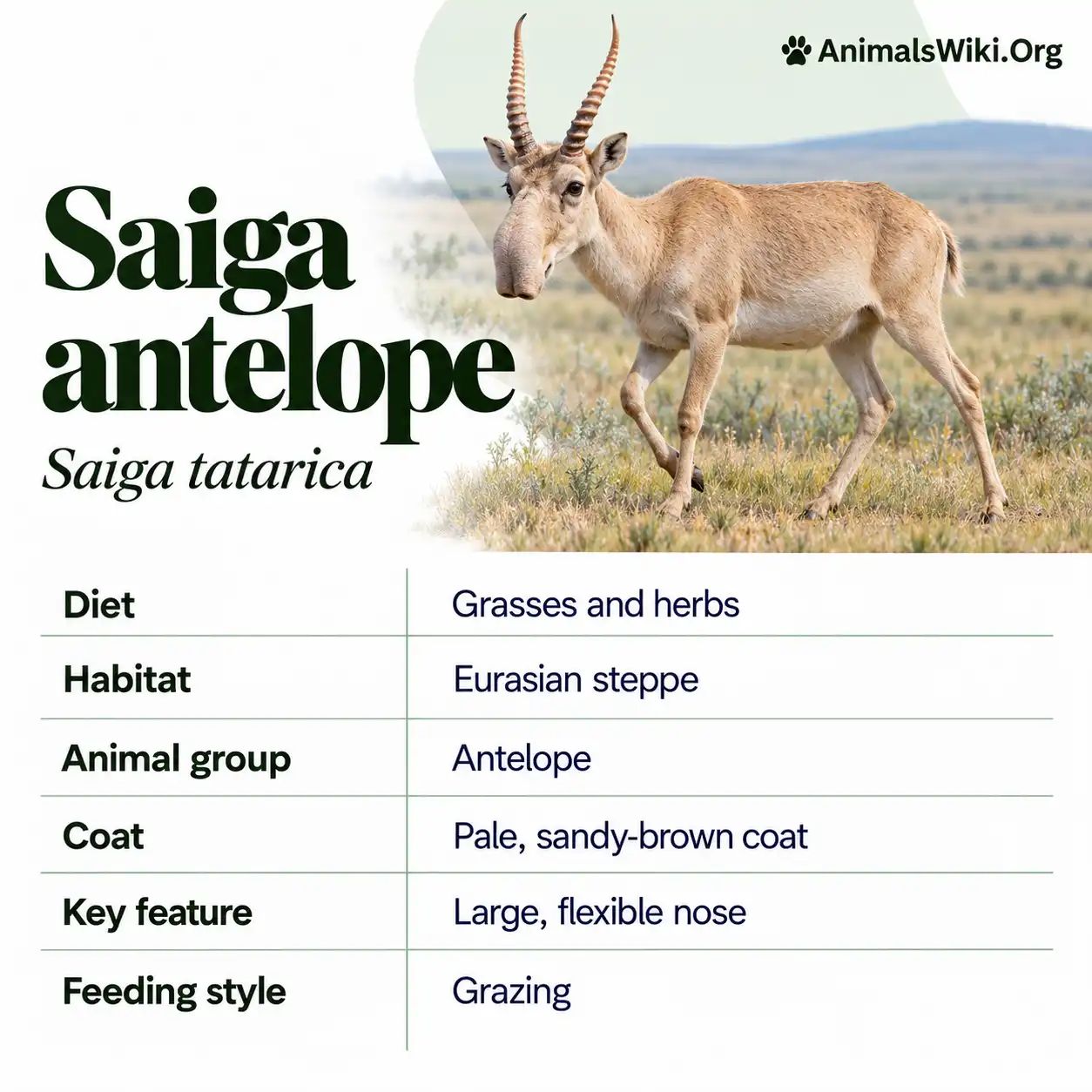
Saiga Antelope, A Complete Guide to the Remarkable Antelope of the Eurasian Steppe
The saiga antelope is one of the most recognizable grazing mammals in the world. Its oversized, downward-facing nose looks almost like a miniature trunk, giving this animal an appearance unlike any other antelope. That unusual face is part of a practical adaptation to life on the open plains of Eurasia, where summer dust, winter cold, and long journeys shape everyday survival.
Saigas live in landscapes that can appear almost empty at first glance. Look more closely, however, and these grasslands and semideserts support a moving network of plants, predators, livestock, and wildlife. Saiga herds follow changing conditions across this landscape, sometimes gathering in extraordinary numbers.
Their conservation story is equally striking. After a severe population collapse, protection and coordinated recovery efforts helped saigas rebound dramatically in parts of their range. In December 2023, their global IUCN classification changed from Critically Endangered to Near Threatened. That improvement represents substantial progress, although disease, illegal hunting, fragmented habitat, and uneven regional recovery remain concerns.
This guide explains what saiga antelopes are, why their noses look so unusual, how they reproduce, and what their recovery means for the future of the Eurasian steppe.
Saiga Antelope Facts
| Feature | Information |
|---|---|
| Common name | Saiga antelope |
| Scientific name | Saiga tatarica |
| Animal group | Mammal |
| Family | Bovidae |
| Diet | Herbivorous |
| Main habitats | Steppe, dry grassland, and semidesert |
| Main range | Kazakhstan, parts of Russia and Uzbekistan, and western Mongolia |
| Shoulder height | Approximately 60–80 centimeters |
| Typical appearance | Slender legs, rounded body, large nasal opening, and short tail |
| Horns | Normally present only in males |
| Gestation | Approximately five months |
| Young | One or two calves; twins are common in mature females |
| Social behavior | Herd living, with seasonal changes in group size |
| Global IUCN status | Near Threatened |
| Most distinctive feature | Enlarged, flexible nose |
What Is a Saiga Antelope?
A saiga antelope is a hoofed, plant-eating mammal adapted to open Eurasian landscapes. It belongs to the same broad animal family as cattle, sheep, goats, and other antelopes.
Although its face can seem unfamiliar, the rest of its body is built around a recognizable grazing-animal design: a compact torso, relatively slender legs, a short tail, and a head positioned for feeding close to the ground. These features support a life spent alternating between feeding, resting, watching for danger, and traveling.
The word “antelope” describes several groups within the bovid family rather than one single, neatly separated branch. Saigas are genuine bovids, with a distinctive evolutionary history of their own.
They are especially associated with large, open spaces. Their survival depends on access to a functioning landscape where feeding grounds, seasonal ranges, and safe breeding areas remain connected.
Saiga Classification and Subspecies
The scientific name most commonly used for the saiga antelope is Saiga tatarica. Its classification places it in the family Bovidae and the order Artiodactyla, the even-toed hoofed mammals.
A widely used arrangement recognizes two living subspecies:
- Mainland saiga — Saiga tatarica tatarica
- Mongolian saiga — Saiga tatarica mongolica
The mainland form occurs across parts of the western and central range. The Mongolian form occupies a much smaller area in western Mongolia.
Taxonomic treatment is not completely uniform. Some publications and conservation agreements use different arrangements or names for the Mongolian population. Readers comparing sources may therefore encounter a name that differs from the one used here.
The important biological point is that regional populations have distinct histories and conservation needs. A strong recovery in Kazakhstan cannot automatically replace the ecological or genetic value of saigas elsewhere.
What Does a Saiga Antelope Look Like?
The saiga’s head immediately draws attention. Its swollen nose hangs over the mouth, and its large nostrils point downward. Small eyes sit above and behind this enlarged nasal region.
Its body has a rounded outline, supported by narrow legs suited to movement across open ground. The ears are relatively short, and the tail is small. Together, these proportions give the animal a compact appearance even when it is standing in an immense grassland.
Adult males are generally larger than females. Males also carry a pair of pale, ridged horns that rise from the top of the head.
Color changes with the seasons. Summer animals usually look sandy, yellowish, or reddish buff. Winter animals become noticeably paler and shaggier. A photograph taken in one season can therefore make a saiga look surprisingly different from an animal photographed several months later.
Saiga Size and Seasonal Coat
Saigas are roughly comparable in overall scale to a medium-sized sheep or goat, although their proportions differ. Adults commonly stand around 60–80 centimeters at the shoulder. Males are often around 40 kilograms, while females may be closer to 25 kilograms, with considerable variation.
These figures are useful guides rather than strict boundaries. A growing juvenile, a breeding male after the rut, and a well-fed adult before winter will not have identical body conditions.
Their coat also changes substantially. A shorter summer coat suits warmer conditions, while a thicker winter coat provides insulation during the cold season.
This seasonal transformation reflects the demands of a continental climate. The same population may experience hot, dusty weather and severe winter cold within a single year. Its appearance follows those changing demands.
Why Does the Saiga Antelope Have Such a Large Nose?
The saiga antelope’s nose is a specialized air-processing structure. Inside the enlarged nasal region are passages and tissues that influence how inhaled air moves before reaching the lungs.
One important function is filtering airborne particles. Moving herds can raise substantial dust, especially when the ground is dry. An animal traveling with many others may repeatedly breathe air disturbed by hooves in front of it.
The saiga’s nasal anatomy helps manage that challenge. Anatomical research has examined the enlarged nasal vestibule and related structures, supporting the importance of particle collection and controlled airflow.
The external shape is therefore only part of the adaptation. Much of the useful work occurs inside the nose.
Calling it a “trunk” can help describe its appearance, but the comparison has limits. Saigas do not use their noses to grasp branches, pick up objects, or perform the manipulative tasks associated with an elephant’s trunk.
How the Saiga’s Nose Helps in Cold Weather
Dust is only one challenge on the steppe. During cold periods, a saiga must breathe air that can be far colder than its body.
Its enlarged nasal region helps warm incoming air. Conditioning inhaled air is particularly useful for an animal that spends winter outdoors and may continue moving through exposed terrain.
This does not make the saiga immune to severe weather. Access to food, snow conditions, body reserves, and the ability to reach suitable seasonal habitat remain important.
The nose should therefore be understood as one part of a larger survival system. Insulating fur, seasonal behavior, feeding choices, and movement all contribute.
This is a useful example of how an unusual feature can serve an ordinary but demanding need. Every breath must pass through the nose, so improvements in air handling matter repeatedly throughout the animal’s day.
The Nose Also Plays a Role in Saiga Calls
The saiga’s nose has another role during breeding behavior. Adult males produce calls during the rut, and changes in the position and extension of the nasal region affect the vocal tract.
Research on rutting males has examined how these anatomical specializations influence sound production. The nose helps shape the resonance of the calls rather than simply acting as an oversized opening for breathing.
For an animal communicating across open ground, vocal signals can carry information without requiring physical contact. Calls may form part of the broader display used during competition and breeding.
Sound also adds an important dimension to understanding saigas. Wildlife photographs emphasize their appearance, but a living herd is a moving, listening, calling collection of animals.
The saiga’s face is consequently involved in several activities at once: breathing dusty air, coping with cold conditions, and participating in seasonal communication.
Do Female Saigas Have Horns?
Female saigas are normally hornless. The characteristic paired horns belong to males.
These horns are relatively slender, lightly colored, and marked with ridges. Their pale appearance can look almost translucent under certain lighting conditions.
Like other bovid horns, they consist of a keratin sheath associated with a bony core. They are different from deer antlers, which are made of bone and are usually shed and regrown each year. Saiga horns are also not ivory.
This difference between males and females has had serious conservation consequences. Hunting directed at horns can remove males disproportionately, changing the structure of a population even before the total number becomes extremely low.
Counting animals alone may therefore miss a developing problem. Knowing how many breeding males and females remain can be just as important when assessing whether a herd can reproduce successfully.
Where Do Saiga Antelopes Live?
Today, saigas occur in separated populations across parts of Eurasia. Kazakhstan supports the largest herds, while other important populations occur in Russia and western Mongolia. Parts of Uzbekistan are connected to the movements and conservation of the Ustyurt population.
Within Kazakhstan, names such as Ural, Betpak-Dala, and Ustyurt refer to major population groupings. These names describe meaningful geographic and management differences rather than interchangeable pieces of one uniform herd.
Distribution also changes through time. A map showing the species’ overall range may include areas used seasonally, areas occupied irregularly, and places where recovery remains limited.
For that reason, “found in a country” does not necessarily mean saigas occur throughout it.
Understanding their range requires attention to movement and connectivity. A wintering area across a border can matter even when animals spend another part of the year elsewhere.
Saiga Habitat: Steppe and Semidesert
Saiga habitat is often described as steppe or semidesert. These terms cover open landscapes with relatively low-growing vegetation, rather than dense forests or tropical savannas.
The habitat may contain grasses, flowering herbs, low shrubs, bare ground, and patches that change noticeably with rainfall. Some areas look greener during a short growing season and much drier later in the year.
Open visibility helps animals detect approaching danger. However, an exposed landscape also offers little shelter from wind, temperature extremes, or disturbance.
The value of habitat cannot be judged only by how lush it appears in a photograph. A dry-looking area may provide essential seasonal forage or connect two more productive regions.
Conservation planning therefore needs to consider a whole annual cycle. A place used briefly during migration can be just as necessary as a place where animals feed for weeks.
Saigas and the Ice Age
Saigas have a much longer geographic history than their modern distribution suggests. During the late Pleistocene, their range extended across a broad northern belt, reaching parts of Europe and northwestern North America.
Ancient remains and genetic research help reconstruct that history. They show that the species once occupied regions far beyond the isolated populations seen today.
This explains why saigas are often called Ice Age survivors. Their ancestors shared northern environments with animals associated with the mammoth steppe.
However, the phrase should not imply that modern saigas have remained evolutionarily unchanged. Living species continue to experience selection, population shifts, and environmental pressures.
Their history also provides perspective on present-day range loss. Today’s distribution represents a remaining portion of a much broader past. Protecting that remainder preserves both a distinctive living animal and part of the ecological history of the Northern Hemisphere.
What Do Saiga Antelopes Eat?
Saiga antelopes are herbivores. Their diet includes grasses, other herbaceous plants, and some low shrubs.
The exact mixture changes with location and season. A plant that is nutritious and accessible during spring may become dry or less useful later. Animals must respond to those changes by choosing different foods or moving to different feeding areas.
This flexibility matters in landscapes where rainfall and plant growth are uneven. Feeding success depends on more than the amount of vegetation visible above the ground.
Research on saiga forage has examined plant composition and nutritional quality, including the balance between grasses and other flowering plants.
For readers, the most useful distinction is that a saiga is not simply a lawn grazer. It selects from a changing range of steppe vegetation, and the quality of those choices affects its ability to maintain body condition and reproduce.
Feeding Quality Matters as Much as Food Quantity
A field covered in plants does not necessarily provide everything a saiga needs. Nutritional value can change as plants mature, dry out, or become less digestible.
For a female preparing to give birth, energy and nutrient demands differ from those of a resting adult outside the breeding season. Growing calves also face different requirements from fully developed animals.
Studies of forage quality and feeding selectivity help explain why saigas may favor particular areas even when vegetation is available elsewhere.
This distinction matters for habitat management. Protecting a large area on a map is useful, but its value also depends on whether it supplies suitable food at the right time.
The same principle applies when comparing wildlife and livestock use. An apparent overlap in grazing space does not, by itself, reveal the nutritional needs or feeding choices of either group.
Herd Life on the Open Plains
Saigas are social animals, but their groups are not fixed in size throughout the year. Herds may gather, separate, and reorganize as feeding conditions and reproductive needs change.
Living with other animals provides opportunities to detect danger. When one individual becomes alert, nearby animals may respond quickly. Group movement can then turn a small reaction into a herd-wide change of direction.
At the same time, large groups bring costs. Animals share feeding space, raise dust, and must move through the same limited passages when obstacles interrupt their routes.
A herd should therefore be understood as a flexible arrangement rather than a permanent family unit.
For observers, this means a single sighting reveals only one moment in a seasonal pattern. A scattered group seen during feeding may later become part of a much larger gathering.
Why Saiga Antelopes Migrate
Saiga movements connect animals with changing supplies of food and suitable seasonal conditions. Green vegetation, snow, water availability, and disturbance can all influence where herds travel.
Some populations make recognizable seasonal journeys. Others also show nomadic movements, adjusting their routes as conditions change.
The Ustyurt population illustrates the importance of cross-border landscapes because seasonal movement links parts of Kazakhstan and Uzbekistan. A national boundary does not remove the animals’ need to reach a wintering or feeding area.
Migration is also about timing. A route that remains physically open may still become difficult if disturbance occurs when animals need to pass.
Conserving saigas consequently requires more than protecting isolated destinations. The ground between those destinations must remain usable.
Movement is one of the central features of the species’ ecology, so barriers can affect animals far beyond the immediate area occupied by a road or fence.
Mongolian Saigas Have Their Own Movement Patterns
It is easy to assume that every saiga population behaves like the immense herds of Kazakhstan. The Mongolian saiga shows why that assumption can be misleading.
Its distribution is more restricted, and the relationship between seasonal movements, local habitat use, and population structure differs from that of the mainland form.
Research on Mongolian saiga genetics and ecology emphasizes the importance of understanding this population on its own terms.
That has practical consequences. A conservation measure designed around a broad migration in one landscape may require adjustment in another. Local roads, grazing patterns, settlements, and environmental conditions can create different pressures.
Regional knowledge is therefore essential even when the animals share the same species name.
The Mongolian saiga’s smaller range also means that events affecting a relatively limited area may influence a substantial portion of its remaining population.
Saiga Breeding and the Winter Rut
Saigas have a seasonal breeding period known as the rut. In mainland populations, this generally occurs during late autumn and early winter.
Adult males compete for access to females through displays, calls, and physical interactions. Breeding activity can be energetically demanding, especially when males devote considerable time to maintaining access to groups of females.
This mating system is often described as polygynous, meaning one male may mate with several females. However, that does not make adult males unlimited or replaceable.
The number, condition, and distribution of males still influence reproductive success.
For wildlife managers, the breeding season provides a reminder that population health involves behavior as well as abundance. A herd needs animals capable of completing the entire reproductive cycle, from mating and pregnancy through birth and calf survival.
How Long Are Saigas Pregnant?
Saiga pregnancy lasts approximately five months. Zoological references commonly give a gestation range of roughly 139–152 days.
This relatively short pregnancy helps explain how mating in late autumn or early winter can lead to births during the following spring.
Females may give birth to one or two calves. Twins are common among mature females, while younger females are more likely to produce a single calf.
Reproductive output varies with age and condition. A species’ ability to produce twins does not mean every female does so every year, or that every newborn survives.
The mainland calving season commonly falls in April and May. Timing differs across the range, and Mongolian saigas may give birth later.
Understanding those differences is important when deciding when particular areas need protection from avoidable disturbance.
Why Do Many Saigas Give Birth at the Same Time?
Saiga calving is highly synchronized. In a breeding population, many females may give birth within a relatively short period.
A concentrated calving season can help align the demands of newborn care with favorable feeding conditions. It can also affect the relationship between calves and predators because many vulnerable young appear at once.
However, synchronized birth is not a guarantee of safety. Weather, food availability, disturbance, and health conditions still influence the outcome.
Calving grounds deserve special attention because they bring together females and newborns during a sensitive stage of the annual cycle.
Managers need to know where animals are gathering in a particular year rather than assuming that one small, permanently marked area will always be sufficient.
Protecting calving therefore combines seasonal timing with current information about animal distribution.
How Saiga Calves Develop
Newborn saigas begin life in a vulnerable state despite being relatively well developed compared with many mammal young. During their first days, they may remain bedded down while their mothers feed nearby and return to nurse them.
Remaining still helps a calf avoid drawing attention. As it develops strength and coordination, keeping up with moving animals becomes increasingly important.
Producing twins places substantial demands on a mother. She must supply milk while also maintaining her own condition in a landscape where feeding quality can change quickly.
Research on maternal investment has examined these differences between single calves and twins.
Calf survival is consequently a useful measure of population health. A high number of births is encouraging, but the longer-term result depends on how many young survive and eventually join the breeding population.
What Eats Saiga Antelopes?
Wolves are important natural predators of saigas. Smaller predators and large birds of prey may threaten young calves, depending on location and circumstances.
Predation is part of the ecosystem in which saigas evolved. It influences alertness, grouping, movement, and the vulnerability of animals in poor condition.
It is useful to distinguish natural predation from human-caused pressures such as illegal hunting or barriers that prevent escape and movement. These pressures can overlap, but they are not interchangeable.
A predator taking a calf does not automatically indicate an ecological imbalance. Understanding the wider pattern requires information about population size, reproduction, habitat, and survival over time.
This is why conservation decisions should rely on evidence from the population as a whole. A dramatic observation can reveal an important event without explaining the full reason that a herd is increasing or declining.
The Saiga’s Role in the Steppe Ecosystem
Saigas help shape the steppe through their feeding and movement. Grazing changes how vegetation is used, while dung and urine return nutrients to the ground.
Their bodies also support other animals. Living saigas provide prey for predators, and animals that die become food for scavengers and decomposers.
These connections make the species part of a wider ecological system rather than an isolated conservation symbol.
The effects of grazing depend on density, season, plant communities, and interactions with livestock. It would be inaccurate to claim that every amount of grazing benefits every habitat equally.
Even so, the disappearance of a large native herbivore can remove important ecological processes from an open landscape.
Restoring saigas therefore has implications beyond increasing one species’ head count. It can help restore movement, feeding relationships, and nutrient transfers across the steppe.
Why Saiga Populations Collapsed
Saiga numbers fell sharply during the late twentieth century, particularly following the breakup of the Soviet Union.
Economic disruption, weakened protection, and increased hunting pressure contributed to the decline. Animals were killed for meat and, in the case of males, for horns.
The speed of the collapse showed how quickly a once-abundant species could become vulnerable when several pressures acted together.
This history is more informative than a simple statement that people hunted too many animals. Changes in livelihoods, institutions, enforcement capacity, and trade created conditions in which exploitation became difficult to control.
Effective recovery therefore required more than telling individuals to stop hunting. It depended on restoring protection, supporting field operations, improving knowledge of populations, and building cooperation.
The saiga’s decline remains an important example of how social and economic instability can rapidly affect wildlife.
How Horn Poaching Can Disrupt Reproduction
Horn-directed hunting creates a particular problem because male saigas normally carry the horns.
If males are removed faster than females, the population’s sex ratio becomes increasingly uneven. A herd may still contain many animals while lacking enough suitable males to maintain normal breeding.
Research on saigas documented reproductive consequences associated with extreme male depletion. The findings challenged the assumption that a polygynous species could lose almost all its males without a serious effect.
This lesson applies directly to monitoring. A total population estimate is valuable, but it should be accompanied by information on sex ratios, age structure, and reproductive success.
Protecting adult males is therefore part of protecting future generations.
It also shows why conservation cannot always be reduced to whether a species appears common during a brief visit. The visible number may conceal a less obvious demographic problem.
The Saiga Antelope’s Remarkable Recovery
Saiga recovery has been especially strong in Kazakhstan, where populations have increased dramatically from their early twenty-first-century lows.
This improvement reflects sustained work by government agencies, rangers, scientists, conservation organizations, and local partners. Protection and monitoring allowed the species’ reproductive capacity to translate into population growth.
The 2023 change to Near Threatened recognized this substantial improvement.
However, a global assessment should not be interpreted as a statement that every herd is equally secure. Smaller populations may face local threats that large herds elsewhere do not share.
Recovery also changes management needs. When animals become abundant again, questions about movement, agriculture, grazing, and public support can become more prominent.
The achievement is real, but maintaining it requires continued attention. Conservation success is strongest when institutions can adapt as populations and surrounding human activities change.
Why Population Figures Need Dates
Saiga numbers can change quickly, making dates essential when reporting population estimates.
A count conducted before calving measures something different from a count after newborns have joined the population. Estimates also depend on survey coverage and the methods used.
For example, Kazakhstan’s zoological authorities reported a 2024 pre-calving estimate of 2,833,600 saigas. That is a useful dated result, but it should not be relabeled as a current worldwide total.
Different population reports may also cover different geographic areas.
When comparing figures, ask three questions: When was the survey conducted? Which population did it cover? How was the estimate produced?
These details prevent outdated numbers from circulating as current facts. They also help readers understand why two apparently conflicting figures may describe different points in the same recovery process.
What Happened During the 2015 Saiga Die-Off?
In 2015, more than 200,000 saigas died in Kazakhstan within a matter of weeks.
Scientific investigation identified hemorrhagic septicemia associated with the bacterium Pasteurella multocida. Researchers also found an association between the event and unusually warm, humid conditions before the deaths.
The outbreak was especially alarming because large numbers of animals died rapidly across affected calving aggregations.
It should not be described as an unexplained virus or a mysterious poisoning event. The research provides a much more specific explanation involving bacterial disease and environmental conditions.
At the same time, the findings do not mean that every warm spell will cause a mass die-off. Disease emergence depends on interacting factors.
The event demonstrated how a population capable of rapid growth can also experience sudden, exceptional losses. Recovery planning must account for both possibilities.
Disease in Mongolian Saigas
Mongolian saigas experienced another major disease emergency during 2016–2017, involving peste des petits ruminants, commonly shortened to PPR.
PPR is a viral disease. It is different from the bacterial condition associated with the 2015 Kazakhstan mortality event.
The Mongolian outbreak affected wildlife in a setting where disease also circulated among domestic small ruminants. It highlighted the importance of connections between livestock health and wildlife conservation.
These events should be discussed separately because combining them into one generic “saiga plague” hides differences in cause and prevention.
For a restricted population, a major outbreak can have particularly severe consequences.
Protecting Mongolian saigas therefore includes attention to surrounding animal-health systems, alongside habitat protection and the prevention of illegal hunting. Healthy wildlife populations are influenced by conditions beyond the boundaries of their immediate habitat.
Why Wildlife and Livestock Health Must Be Studied Together
Saiga conservation benefits from an approach that considers wildlife, domestic animals, and environmental conditions together.
Disease does not always follow the administrative divisions used by conservation and agricultural agencies. Animals may use neighboring grazing grounds, and pathogens can move through networks that require shared investigation.
Research on the Mongolian PPR outbreak has used molecular evidence to examine disease relationships. Such work helps scientists move beyond assumptions about where an infection began or how it spread.
Practical priorities include surveillance, prompt reporting, appropriate livestock health measures, and coordinated investigation of unusual mortality.
These systems are most effective when established before an emergency.
For members of the public, the useful action is to report unusual wildlife deaths through appropriate local channels and avoid disturbing affected animals. Diagnosing and treating wild herds requires trained teams and organized field procedures.
Roads, Railways, and Fences
A saiga’s habitat can remain visually open while becoming difficult to cross.
Railways, roads, fences, and associated structures may interrupt movement between seasonal ranges. Their effects depend on design, location, traffic, and the animals’ behavior.
A barrier does not need to occupy much land to influence a much larger area. If it blocks an important route, animals may lose access to feeding grounds beyond it.
Infrastructure can also create direct risks where animals attempt crossings.
Research in Kazakhstan has examined these problems within the saiga’s range, emphasizing the importance of considering wildlife movement during planning.
The practical lesson is to assess a project’s position within the wider landscape. Protecting habitat on both sides of a barrier may be insufficient if the connection between them no longer works.
What Makes a Useful Saiga Migration Corridor?
A migration corridor is a connection that animals can actually use. Its value depends on more than drawing a narrow line between two protected areas.
For saigas, useful connectivity may require broad passages, suitable approaches, limited disturbance at sensitive times, and access to feeding or resting areas along the way.
Routes can vary with environmental conditions. Planning should therefore allow some flexibility rather than assuming that animals will always follow one exact path.
Projects studying Ustyurt movements are helping identify where barriers and human activities create problems.
That information can guide practical decisions about crossings, fence design, and the placement of new development.
Monitoring remains necessary after a measure is introduced. A crossing structure may look suitable to people yet receive little use if its location or surroundings do not match the animals’ movement behavior.
Saigas and Human–Wildlife Conflict
Successful recovery can create new tensions when large herds overlap with farming and livestock production.
Concerns may include crop damage, competition over grazing, pressure around water, or animals entering areas used for agricultural work. The seriousness of these issues varies by place and season.
Recent research has examined human–saiga conflict in recovering populations. Understanding that conflict requires evidence about both ecological conditions and the experiences of affected people.
Dismissing local concerns can weaken support for conservation. Treating every reported problem as proof that recovery has failed is equally unhelpful.
Useful responses begin with measuring damage, identifying recurring locations, and examining why animals and agricultural activities overlap there.
Management decisions should then be assessed for their actual results. Lasting coexistence depends on solutions that communities consider workable and that maintain viable wildlife populations.
Saiga Horn Trade and Conservation
Saiga horns have been sought for use in traditional medicine markets. That demand has contributed to pressure on male animals.
The existence of traditional use does not, by itself, establish medical effectiveness. Conservation discussions should distinguish cultural demand from evidence about health benefits.
Trade rules also need careful wording because international decisions and national regulations can change. Broad statements that every form of commercial trade is permanently banned everywhere can become inaccurate.
Recent recovery has led to renewed debate about regulated use, monitoring, traceability, and the conservation consequences of trade arrangements.
The central biological concern remains clear: horn demand can create incentives to remove males.
Any management system must therefore be assessed through evidence about sourcing, enforcement, population structure, and outcomes for wild herds. A legal framework on paper is only one part of that assessment.
Why Rangers Remain Essential
Rangers turn conservation commitments into daily field protection.
Their work may include patrols, detecting illegal activity, recording wildlife observations, communicating with communities, and supporting researchers. In remote steppe landscapes, these tasks can involve long distances and difficult conditions.
Training, equipment, reliable support, and coordination affect how effectively teams can operate.
Protection also depends on information. Rangers who understand seasonal movements can direct attention toward places where animals are especially exposed.
Their observations can provide early warning of unusual deaths, disturbance, or changes in herd distribution.
For readers following the saiga’s recovery, it is helpful to recognize this continuing work. A successful population increase does not make field protection unnecessary. It often increases the area, complexity, and public importance of the task that protection teams must manage.
Community Education and Local Participation
Saiga conservation takes place in inhabited and worked landscapes. Local residents, teachers, livestock keepers, and young people can all influence its future.
Education programs such as Saiga Day activities and wildlife clubs help make the species familiar to communities living within its range.
Good outreach connects the animal to local landscapes and everyday experience. It can explain why migration matters, how to report unusual observations, and why particular places receive seasonal protection.
Participation is also a source of knowledge. People who spend time on the land may notice changes that visiting teams miss.
These contributions work best when communication moves in both directions.
Conservation organizations need to listen as well as explain. Programs that acknowledge practical concerns and share findings clearly are better positioned to build durable relationships than occasional publicity alone.
How Scientists Monitor Saigas
Monitoring saigas involves more than counting a visible herd.
Researchers need information about distribution, births, survival, sex ratios, movement, and threats. Different methods answer different questions.
Population surveys estimate abundance, while repeated observations can reveal changes in where animals occur. Studies of survival help identify whether losses are concentrated among calves, juveniles, or adults.
Movement research can show which seasonal areas are connected and where animals encounter barriers.
A dated example comes from Mongolia, where a population estimate reported in January 2025 was based on an October 2024 survey. The published method and survey period make that figure interpretable.
Combining several forms of evidence produces a stronger picture than relying on one headline number. It helps distinguish a short-term increase from a recovery supported by healthy reproduction and survival.
Climate and Extreme Weather
Saigas are adapted to a demanding climate, but adaptation does not remove the effects of environmental extremes.
Drought can influence plant growth and water availability. Snow and ice can affect access to forage. Unusual weather can also interact with disease risk.
The consequences depend partly on whether animals can move. A herd with access to several suitable areas has more options than one confined by barriers or disturbance.
This makes climate resilience closely connected to habitat connectivity.
It is important to avoid attributing every death or decline to climate change without investigation. Disease testing, weather records, food conditions, and field observations are needed to understand particular events.
The practical conservation goal is to retain options: sufficient space, functioning seasonal ranges, diverse feeding areas, and systems capable of detecting emerging problems before they become widespread emergencies.
International Cooperation for Saiga Conservation
Saigas connect countries through their distribution, movements, conservation challenges, and trade pressures.
Cooperation allows governments and conservation partners to share population information, coordinate protection, and discuss problems that cannot be resolved within one jurisdiction.
International work programs also help maintain attention on smaller populations that might otherwise receive less notice than the largest herds.
The 2025–2030 international work programme for saigas reflects this continuing need for coordinated action.
However, agreements are most useful when they lead to practical work on the ground. Monitoring, trained staff, functioning corridors, and communication between neighboring areas give cooperation its real value.
The species’ recovery shows what sustained effort can achieve. Its remaining challenges show why cooperation must continue after the most urgent phase of decline has passed. cms.int
How to Observe Saigas Responsibly
Seeing a wild saiga herd can be an extraordinary experience, particularly when the animals are moving across an open landscape.
Responsible viewing begins with distance. Binoculars and long camera lenses allow detailed observation while reducing the need to approach.
Calving areas require particular care because disturbance can separate animals or interrupt resting and nursing. Vehicles should not be used to chase herds for photographs.
Visitors should follow local access rules and the instructions of experienced guides or reserve staff. Drone use also requires attention to site restrictions and animal responses.
A useful goal is to watch natural behavior without becoming the reason it changes.
Patient observation can reveal feeding choices, social interactions, and the gradual coordination of herd movement. Those details often provide a richer experience than a close encounter created by pressure or pursuit.
Common Saiga Myths and Facts
| Myth | Fact |
|---|---|
| The saiga is an African antelope. | Its native range is in Eurasia. |
| Its nose works like an elephant’s trunk. | The enlarged nose mainly processes air and also contributes to male vocalization. |
| All saigas have horns. | Horns normally occur in males. |
| Saigas eat only grass. | Their diet includes grasses, other herbs, and some shrubs. |
| Saiga horns are shed like deer antlers. | They are bovid horns and are not normally shed annually. |
| All populations migrate in exactly the same way. | Movement patterns vary across the range. |
| The 2015 deaths were caused by PPR. | The Kazakhstan event involved bacterial hemorrhagic septicemia; PPR affected Mongolian saigas in a separate outbreak. |
| Near Threatened means the species no longer needs protection. | Recovery remains uneven, and significant threats continue. |
| A large herd guarantees a healthy population. | Sex ratios, reproduction, survival, and connectivity also matter. |
Frequently Asked Questions About Saiga Antelopes
What is special about the saiga antelope?
The saiga is especially distinctive for its enlarged, flexible nose. Its seasonal coat, herd movements, and rapid reproductive potential also suit life on the Eurasian steppe. Its dramatic decline and subsequent recovery make it an important conservation example.
Why does the saiga have a strange nose?
The enlarged nasal region helps filter dust and condition inhaled air. This is useful in dry, dusty summers and cold winters. In adult males, nasal structures also influence the sounds produced during breeding displays.
Is the saiga antelope endangered?
The saiga’s global IUCN category is Near Threatened, following reassessment in December 2023. It was previously Critically Endangered. This improvement reflects major recovery, but individual populations still face serious risks and require continued conservation.
Where can saiga antelopes be found?
The largest populations occur in Kazakhstan. Other populations occur in Russia and western Mongolia, while parts of Uzbekistan are important to the Ustyurt population and its seasonal movements. Distribution is uneven within these countries.
Are saigas related to elephants?
Saigas are bovids, related to other antelopes, cattle, sheep, and goats. Their nose can resemble a short trunk, but this appearance does not indicate a close relationship with elephants.
How big is a saiga antelope?
Adults commonly stand approximately 60–80 centimeters at the shoulder. Males are generally larger than females. Body mass varies with age, sex, season, and population, so a single weight should be treated as an approximate guide.
What do saiga antelopes eat?
Saigas eat grasses, flowering herbs, and some low shrubs. Their choices change with seasonal availability and plant quality. Access to nutritious forage is especially important during growth, pregnancy, nursing, and preparation for demanding weather.
Do saigas live in deserts?
Saigas use semidesert as well as steppe and dry grassland. Their habitat is not limited to sand dunes. Much of it consists of open plains with grasses, herbs, shrubs, and seasonally changing vegetation.
Do female saigas have horns?
Female saigas are normally hornless. Males carry the distinctive pale, ridged horns. This difference matters because hunting for horns can remove males disproportionately and disrupt the population’s breeding structure.
Are saiga horns made of ivory?
No. Saiga horns have a keratin sheath associated with a bony core, as in other bovids. Ivory comes from specialized teeth or tusks. Saiga horns also differ from the antlers grown by deer.
How long are saigas pregnant?
Pregnancy lasts about five months, commonly reported as roughly 139–152 days. Birth timing varies among populations, with mainland calving generally occurring in spring and Mongolian saigas often giving birth later.
How many babies do saigas have?
A female usually produces one or two calves. Twins are common among mature females, while younger females more often have a single calf. The outcome depends on age, body condition, and environmental circumstances.
Why do saigas give birth in groups?
Many females give birth within a short seasonal window. This can align calf development with favorable feeding conditions and influence predation risk. Concentrated calving also makes protection from disturbance especially important during that period.
Do saigas migrate every year?
Many saigas make seasonal movements, but the routes, distances, and regularity vary. They may also move more flexibly in response to vegetation, snow, water, and disturbance. Mongolian movement patterns differ from those of the largest mainland populations.
What animals prey on saigas?
Wolves are important predators. Young calves can also be vulnerable to smaller carnivores and large birds of prey. Predator effects must be understood alongside habitat conditions, reproduction, disease, and other causes of mortality.
What caused the 2015 mass deaths?
The Kazakhstan die-off involved hemorrhagic septicemia associated with Pasteurella multocida. Research identified unusually warm, humid preceding conditions as an important part of the event. It was separate from the later PPR outbreak in Mongolia.
Why are male saigas targeted by poachers?
Males carry horns that have been sought in traditional medicine markets. Removing too many males can alter sex ratios and reduce reproductive success. Effective monitoring therefore needs to examine population structure as well as total abundance.
Can saigas recover quickly?
Saigas have reproductive traits that can support rapid growth when survival and habitat conditions are favorable. However, recovery depends on protection, sufficient resources, successful breeding, and surviving disease or severe weather. High reproductive potential does not guarantee recovery.
Is the Mongolian saiga the same as other saigas?
It is widely treated as a subspecies, Saiga tatarica mongolica, although taxonomic arrangements vary. Its restricted distribution and ecological differences make it important to manage as a distinct conservation population.
Did saigas live in North America?
Yes. Ancient remains show that saigas formerly occurred in northwestern North America during the late Pleistocene. Their historical northern distribution was much broader than the separated Eurasian populations found today.
Can saigas be kept as pets?
Saigas are wild herd animals with specialized space, social, health, and environmental needs. They are unsuitable household pets. Conservation management or professional zoological care should not be confused with ordinary domestic animal keeping.
Why do roads and fences threaten saigas?
Infrastructure can block or redirect movement between seasonal habitats. It may prevent animals from reaching food, water, or suitable breeding areas. Its ecological effect can extend well beyond the narrow strip of land it occupies.
Why does the saiga still need conservation?
Recovery is uneven, and large populations remain exposed to disease, movement barriers, illegal hunting, and conflict with land users. Smaller populations face additional vulnerability. Continued monitoring helps detect problems before gains are reversed.
How can people support saiga conservation?
People can support credible conservation organizations, learn about the species, avoid products linked to illegal wildlife trade, and share accurate information. Visitors can also reduce disturbance by following local guidance and observing animals from a distance.
What is the difference between a saiga and a pronghorn?
Saigas are Eurasian members of Bovidae. Pronghorns are North American animals belonging to Antilocapridae. Despite some similarities associated with open-country living, they are distinct animals with different evolutionary histories and horn characteristics.
Saiga Antelope (Saiga tatarica)
The saiga antelope combines an extraordinary appearance with a highly practical way of living. Its enlarged nose, seasonal coat, flexible feeding, and herd movements help it survive in a landscape defined by change.
Its conservation history is equally instructive. Severe decline showed how quickly abundance can disappear, while recovery demonstrated the value of sustained protection, research, and cooperation.
The next challenge is to maintain that progress across the species’ full range. Large herds need connected landscapes and workable relationships with surrounding communities. Smaller populations need attention that reflects their particular risks.
Understanding the saiga means looking beyond its unusual face. It means recognizing an animal whose future depends on movement, healthy steppe ecosystems, and continued commitment from the people who share its landscape.



