
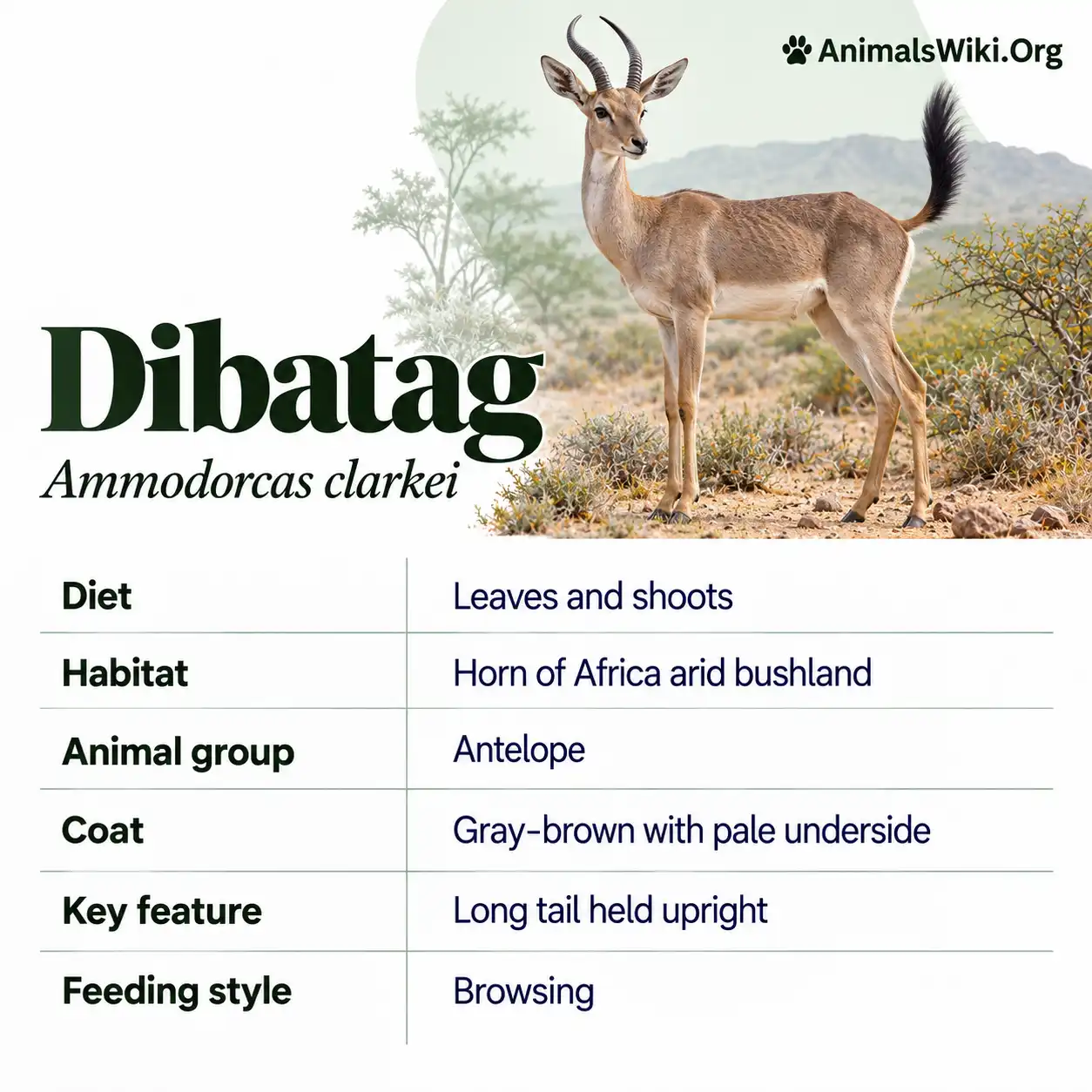
Dibatag Antelope, The Elusive Long-Necked Browser of the Horn of Africa
The dibatag antelope is one of Africa’s most distinctive yet least familiar hoofed mammals. With a narrow body, slender legs, an elongated neck, and a conspicuous dark tail, it looks perfectly suited to slipping between thorny branches. Its appearance invites comparisons with the gerenuk, but the dibatag is a separate species with its own identity and conservation needs.
Known scientifically as Ammodorcas clarkei, this antelope belongs to the wildlife heritage of Ethiopia and Somalia. It inhabits dry country where surviving depends on finding nutritious vegetation, managing limited water, detecting danger, and moving through a landscape that can change sharply with the rains.
The dibatag’s obscurity makes it especially interesting. Familiar African mammals appear in documentaries, tourist photographs, and long-running research projects. The dibatag has received much less attention. Consequently, some widely repeated statements about its life are based on older observations rather than extensive modern field studies.
Understanding this animal therefore requires two approaches at once: appreciating its remarkable biology and recognizing the limits of available evidence. A historical population estimate is not a current census. A commonly quoted lifespan is not necessarily a measured average. An ecological explanation may be reasonable without having been tested specifically in this species.
This guide explores the dibatag’s identification, classification, habitat, feeding adaptations, behavior, reproduction, ecological relationships, and conservation. It also explains why protecting an elusive browser involves more than counting animals: the surrounding vegetation, local knowledge, land use, and continuity of suitable habitat all matter.
Facts About the Dibatag Antelope
| Feature | Details |
|---|---|
| Common name | Dibatag |
| Other common name | Clarke’s gazelle |
| Scientific name | Ammodorcas clarkei |
| Animal group | Mammal; even-toed ungulate |
| Family | Bovidae |
| Native range | Ethiopia and Somalia |
| Typical habitat | Dry thorn scrub, bushland, and sandy scrub-covered plains |
| Main food | Leaves and young shoots of woody plants |
| General build | Slender, with long legs and an elongated neck |
| Horns | Present in males; females are hornless |
| Distinctive feature | Long, dark tail that can be carried upright |
| Social organization | Usually solitary or in small groups |
| Young per birth | Normally one |
| Gestation | Commonly reported as approximately six to seven months |
| Lifespan | Often reported as around 10–12 years; evidence is limited |
| Global Red List category | Vulnerable in the 2016 assessment |
| Population trend | Decreasing in the assessment reviewed |
1. What Is a Dibatag Antelope?
The dibatag is a browsing antelope native to the Horn of Africa. Browsing means feeding mainly on vegetation such as leaves and shoots, particularly from shrubs and trees. This distinguishes its general feeding strategy from that of animals that depend primarily on grass.
Although commonly called Clarke’s gazelle, the dibatag belongs to the genus Ammodorcas. Common names are useful for communication, but they do not always describe precise taxonomic relationships. The scientific name is therefore especially helpful when checking wildlife records or separating this species from similar antelopes.
Its most memorable feature is the combination of a long neck and long dark tail. Either feature alone could be misleading in a brief sighting. Together with body proportions, facial markings, and, in males, horn shape, they provide a stronger basis for identification.
The dibatag also illustrates how much biodiversity can remain outside popular awareness. An animal does not need to be large, abundant, or frequently photographed to have ecological significance. Species restricted to relatively small geographic regions can represent an irreplaceable part of local natural history.
For readers encountering the name for the first time, the essential point is straightforward: this is a distinct African antelope adapted to dry scrubland, rather than a young giraffe, a deer, or a variety of gerenuk.
2. Scientific Classification and Names
The Dibatag’s Place in the Animal Kingdom
Classification places the dibatag within increasingly specific groups.
| Taxonomic rank | Classification |
|---|---|
| Kingdom | Animalia |
| Phylum | Chordata |
| Class | Mammalia |
| Order | Artiodactyla |
| Family | Bovidae |
| Subfamily | Antilopinae |
| Tribe | Antilopini |
| Genus | Ammodorcas |
| Species | Ammodorcas clarkei |
The Integrated Taxonomic Information System recognizes Ammodorcas clarkei as a valid species and records its taxonomic authority as Thomas, 1891. Older names and alternative spellings occur in historical literature, which can complicate searches through museum records or older publications.
As a mammal, the dibatag has hair and nurses its young. As a bovid, it belongs to the same broad family as cattle, sheep, goats, and many other antelopes. These relationships concern ancestry and anatomy; they do not imply that all members share the same diet or social system.
What Does “Dibatag” Mean?
The name dibatag is generally explained through Somali words referring to an erect or raised tail. This matches one of the animal’s characteristic postures when moving away from disturbance.
Such names can preserve practical observations made by people who know an animal in its native landscape. A feature that immediately attracts attention in the field may become the basis of the name itself.
Clarke’s gazelle is another established common name. For an educational article, introducing both names helps readers connect different references. After that introduction, consistently using “dibatag” avoids unnecessary confusion.
3. Identification and Physical Appearance
A Slender Body With Unusual Proportions
The dibatag has a lightly built body, narrow limbs, and an elongated neck. Reference accounts commonly place shoulder height at approximately 80–90 centimeters and body mass around 22–35 kilograms, although published measurements vary.
These figures should be treated as broad guides. Sex, age, individual condition, and differences among reference sources can affect reported ranges. A photograph also creates perspective problems: an animal nearer the camera may look much larger than another standing farther away.
The neck is particularly striking when the animal raises its head above surrounding vegetation. Its proportions give the dibatag an elegant appearance, but describing it as “delicate” should not imply that it is poorly equipped for its environment. Its body supports the everyday demands of feeding, movement, vigilance, and reproduction.
Coat Color and Facial Markings
The upper coat is generally described as grayish fawn or brownish, contrasting with paler underparts. Light facial markings help define the eyes and muzzle.
Color descriptions are approximate because illumination matters. Warm evening light can make a coat appear more reddish, while shade can emphasize gray tones. Dust, camera processing, and seasonal vegetation further affect how an animal looks in photographs.
For identification, observers should therefore use a combination of features rather than a single color label. Body shape, the dark tail, face pattern, and horn characteristics usually provide more reliable clues together than coat shade alone.
The Long Dark Tail
The tail is one of the strongest field marks. It is relatively long and dark, making it conspicuous when lifted.
A raised tail can make a retreating dibatag recognizable even when much of the body is partly obscured. However, a tail seen in isolation is not enough to establish identification. Whenever possible, observers should also record the head, neck, body outline, and surrounding habitat.
Horns in Males
Male dibatags carry horns; females are hornless. The horns curve in a distinctive pattern, with tips directed forward. Published reference ranges differ, but lengths around 15–25 centimeters are often given.
Horn size alone is an unreliable indicator of exact age. Growth, wear, viewing angle, and individual variation all complicate interpretation. The broader identification features—male-only horns, their shape, the slender body, and the dark tail—are more useful than an attempted age estimate from a distant photograph.
4. Dibatag Versus Gerenuk
The gerenuk is the animal most often confused with the dibatag. Both are long-necked browsers associated with dry environments, and their general silhouettes can look similar.
The distinction matters for more than naming photographs. Misidentified records can distort distribution maps, create false impressions of abundance, and undermine conservation assessments.
| Feature | Dibatag | Gerenuk |
|---|---|---|
| Scientific name | Ammodorcas clarkei | Litocranius walleri |
| Genus | Ammodorcas | Litocranius |
| General appearance | Slender, long-necked browser | Slender, long-necked browser |
| Tail | Relatively long and conspicuously dark | Shorter |
| Male horns | Shorter, with a characteristic forward-directed curve at the tips | Longer, prominently curved horns |
| Neck impression | Long and narrow | Often appears longer and more substantial |
| Feeding resemblance | Can reach elevated browse | Also known for elevated browsing |
The comparison should be used as a starting point rather than a complete identification key. An obscured tail, immature male, or poor viewing angle can remove the most helpful differences.
For practical identification, first examine the tail and overall proportions. Then assess the horns if the animal is an adult male. Finally, consider location and habitat. No single feature should override clear contradictory evidence elsewhere in the animal’s appearance.
Their resemblance is also an invitation to ask ecological questions. Similar body forms can help animals use similar resources, but resemblance does not prove identical diets, social relationships, or responses to environmental change.
5. Geographic Distribution
A Species of Ethiopia and Somalia
The dibatag’s native range is restricted to Ethiopia and Somalia. In Ethiopia, the Ogaden region is especially important in published accounts. Historical distribution also extended through parts of northern and central Somalia.
Its range should not be imagined as a continuous area occupied evenly by antelopes. Within any broad distribution map, suitable vegetation, disturbance, hunting pressure, and survey coverage can vary considerably.
A country-level label therefore answers only the first geographic question. It says where the species belongs naturally, but not how many animals remain in each district or whether a historical locality still supports a population.
Historical Range and Present-Day Evidence
Older reports indicate a wider distribution than can be confidently confirmed today. The later Green Status assessment includes records from southeastern Ethiopia in 2021 and reports of presence in part of central Somalia during late 2020 and early 2021.
These records are important evidence of persistence, but they do not establish present abundance across either country. A documented sighting confirms that an animal was present at a place and time; it is not a population census.
Why Blank Areas on Maps Are Difficult to Interpret
An area without recent records may have lost its dibatags. Alternatively, it may not have received adequate surveys.
Distinguishing these possibilities requires information about search effort. How much ground was covered? At what season? By which methods? Were experienced local observers involved?
For an elusive species, “not recorded” and “absent” are different conclusions. Conservation planning needs to preserve that distinction while also avoiding the optimistic assumption that every unsurveyed area contains surviving animals.
6. Habitat and Environmental Conditions
Dry Scrubland Rather Than Bare Desert
Typical dibatag habitat includes thorn scrub, bushland, and low-lying sandy plains with woody vegetation. The important feature is the presence of usable browse and cover.
Calling the dibatag a desert animal can be misleading if readers imagine open dunes with almost no vegetation. Dry landscapes contain many habitat types. A scrub-covered plain can offer a complex arrangement of feeding sites, shaded resting places, and concealment.
The ecological value of such country is easy to underestimate. Sparse-looking vegetation may still support specialized animals. A landscape that appears empty from a vehicle can contain a great deal of biological activity at the scale of individual shrubs and patches.
Food, Shelter, and Visibility
Habitat quality involves more than the total number of bushes. Plants differ in nutritional value, accessibility, leaf production, and persistence through dry periods.
Vegetation structure also affects how an animal experiences danger. Dense cover may help conceal it, while gaps can provide routes between feeding areas. A useful habitat can therefore consist of a mosaic rather than uniformly thick scrub.
These are general ecological considerations, not a measured formula for ideal dibatag habitat. Species-specific field research would be needed to determine which combinations best support survival and reproduction.
Seasonal Change
Rain changes dryland vegetation. New leaves and shoots can appear, temporarily improving food availability. As conditions dry, the distribution and quality of forage may change again.
For a browser, surviving seasonal change means locating appropriate food rather than simply remaining near visibly green ground. The most valuable plants may be scattered, and their importance can shift over time.
This is why habitat conservation must consider a full annual cycle. A patch used during a favorable month may not meet the same animal’s needs during the hardest part of the year.
7. Diet and Feeding
What Does a Dibatag Eat?
The dibatag primarily eats leaves and young shoots from shrubs and trees. Its feeding strategy centers on browse rather than dependence on grass.
This distinction helps explain its body shape. An elongated neck increases access to vegetation above ground level, while selective feeding allows an animal to choose particular plant parts.
However, “browser” is a broad ecological category. It does not mean the animal eats every available leaf, consumes only one plant species, or never uses other foods. Precise seasonal diet composition remains an area where stronger field evidence would be valuable.
Feeding Height and Food Choice
Two animals can share a landscape without eating exactly the same resources. One may feed mainly near the ground, while another reaches higher branches. Even at the same height, they may choose different plants or different stages of leaf growth.
These differences can reduce overlap, but they do not automatically eliminate competition. During poor conditions, the remaining nutritious plants may become important to several herbivores at once.
For the dibatag, the key research questions include which plants dominate the diet, how selection changes through the year, and whether access to preferred browse limits population recovery.
Rumination and Digestion
As a ruminant, the dibatag belongs to a group of mammals that use microbial fermentation to help process plant material. Food can be regurgitated and chewed again, improving its physical breakdown.
This digestive strategy helps herbivores obtain energy from vegetation that humans cannot digest efficiently. It also means that eating and digestion involve more than the time spent visibly plucking leaves.
Feeding success depends on both quantity and quality. A landscape can contain abundant woody growth while offering relatively little accessible, nutritious material. Consequently, plant cover alone is an incomplete measure of food supply.
8. Adaptations to Dry Environments
Obtaining Moisture From Food
Dibatags are described as having low dependence on free-standing drinking water. Moisture in their food contributes to their water balance.
That does not mean they have no water requirements. Every mammal needs water for basic physiological processes. The relevant distinction is between obtaining water directly by drinking and obtaining it through food and metabolism.
Claims that the dibatag “never drinks” go beyond what limited observations can safely demonstrate. An animal rarely seen at water may still drink occasionally under particular conditions.
Reaching Elevated Browse
The long neck and limbs extend feeding reach. Accounts also describe dibatags rising on their hind legs and supporting their forefeet against vegetation to access higher leaves.
This behavior increases the range of food within reach, but it does not make all elevated vegetation equally usable. Branch strength, thorn arrangement, leaf quality, and the animal’s balance still matter.
The feeding posture is best understood as one part of a broader browsing strategy. It works alongside selective feeding and movement between suitable plants, rather than acting as an independent solution to food scarcity.
Concealment and Cautious Movement
A muted coat and narrow silhouette can make the dibatag difficult to detect among branches. Remaining still further reduces the movement cues that help an observer find it.
Avoiding detection can be useful before an encounter becomes a chase. Once a predator or person approaches closely, however, concealment may no longer be sufficient.
Reference accounts describe the raised tail and upright head posture during retreat, alongside the animal’s tendency to use vegetation for cover. These observations explain some aspects of its appearance and behavior without requiring unverified claims about running speed or endurance.
Adaptation Has Limits
Adaptation to aridity does not make an animal immune to drought. If vegetation fails to produce sufficient food, a browser still faces nutritional stress.
Likewise, reaching higher leaves cannot compensate indefinitely for the removal of shrubs or persistent disturbance. An adaptation is useful within a range of conditions; it is not a guarantee of survival under every environmental pressure.
9. Daily Activity and Social Behavior
Solitary Animals and Small Groups
Dibatags are usually described as occurring alone, in pairs, or in small groups. They are not known for the enormous aggregations associated with some plains antelopes.
Small groups can be difficult to locate because there are fewer bodies and movements to catch an observer’s attention. Vegetation can conceal an entire group that would be obvious in open grassland.
A sighting of several animals together does not automatically reveal their relationships. They could represent a female with offspring, a temporary feeding association, or another social arrangement. Establishing relationships requires repeated observation of identifiable individuals.
Activity Through the Day
Species accounts generally describe the dibatag as active during daylight. However, broad activity labels should not be mistaken for a complete schedule.
An animal’s timing can vary with temperature, food availability, disturbance, and reproductive condition. Detailed camera-trap or tracking research would be needed to quantify how activity changes between locations and seasons.
An observer who watches only in the morning may accurately report morning activity while missing everything that happens later. This illustrates a broader principle in wildlife study: the timing of observations influences the picture that emerges.
Movement and Space Use
Movement connects feeding sites, shelter, and opportunities to reproduce. Yet reliable numerical estimates of dibatag home-range size should not be supplied without an appropriate study.
A home range is the area used during ordinary activities. A territory is an area actively defended. The two terms describe different things and should not be used interchangeably.
For conservation, understanding both would help answer practical questions. How much connected habitat supports an individual? Which routes link occupied patches? Do animals shift their use of the landscape during dry periods? These remain important questions rather than established numerical facts.
10. Communication and Territoriality
Scent as a Source of Information
Antelopes can communicate through scent as well as visible behavior. Dibatag accounts discuss marking associated with dung, urine, and glands near the eyes.
Scent communication is useful because a signal can remain after an animal has moved away. Another individual may encounter information about a previous visitor without a direct meeting.
However, identifying the precise meaning of a mark requires more than observing its placement. A scent deposit could relate to reproduction, familiarity, spacing, or several functions together. Assigning a single purpose without behavioral evidence can oversimplify what the animal is doing.
Territorial Behavior in Males
Male territoriality is described in reference accounts, although detailed modern field evidence remains limited. The extent, duration, and seasonal pattern of defended areas should therefore be treated cautiously.
Territorial behavior also does not mean an animal continuously fights. Displays, marking, avoidance, and recognition may influence encounters before physical contact occurs.
From a research perspective, repeated observations are essential. Seeing one male chase another establishes an interaction. Demonstrating a stable territory requires evidence that the same individual repeatedly controls a particular area.
Reading Posture Carefully
A raised head, fixed gaze, or change in body position can indicate attention, but observers should avoid treating every posture as a precisely decoded message.
The same position may occur in more than one context. An animal might lift its head to inspect a sound, watch another dibatag, or assess a person.
Accurate descriptions begin with what was observed. Explanations of purpose should then be separated into what is supported and what remains an interpretation.
11. Reproduction and Calf Development
Gestation and Birth
Dibatags normally produce one calf per birth. Gestation is commonly reported as approximately six to seven months; the AnAge life-history database lists 204 days.
Published accounts also commonly give sexual maturity at around 12–18 months. These values are useful reference points, but they should not be presented as a comprehensive description of every wild population.
Sexual maturity, first successful breeding, and first successful rearing of a calf are separate milestones. Environmental conditions and social circumstances can influence whether a physiologically mature animal actually reproduces.
Is There a Fixed Breeding Season?
Older accounts often mention births in October and November. A narrow date range should be interpreted cautiously because observations are limited and environmental conditions vary.
To demonstrate a consistent breeding season across the species, researchers would need repeated records covering different years and locations. A cluster of recorded births may reflect a real seasonal pattern, but it can also be influenced by when observers were present.
The responsible conclusion is that seasonal birth patterns have been reported, while a rigid range-wide calendar is insufficiently established.
The Hidden Calf
Reference accounts describe a period in which the young calf remains concealed. Concealment can reduce exposure while the mother feeds nearby or returns to nurse.
A hidden calf should not automatically be regarded as abandoned. In many antelopes, mothers do not remain continuously beside their young. Human approach can disturb both calf and mother and may interfere with normal behavior.
For the dibatag specifically, detailed measurements of nursing schedules, weaning, and juvenile growth are not well established in the sources reviewed. These gaps should remain visible rather than being filled with figures borrowed from better-studied species.
Reproduction and Population Recovery
Producing a calf is only the beginning of recruitment. The young animal must survive and eventually join the breeding population.
When evaluating recovery, researchers therefore need more than birth counts. They need information about calf survival, adult survival, sex ratios, and successful reproduction over time.
A population may show calves regularly while still declining if losses elsewhere are greater than recruitment. Conversely, improved survival can aid recovery even without a dramatic change in the number of births.
12. Lifespan and Survival
How Long Does a Dibatag Live?
A lifespan of about 10–12 years is frequently quoted. However, the evidence is limited. AnAge explicitly states that maximum longevity has not been established and notes that the animals appear capable of living up to about 12 years in the wild.
This is different from demonstrating that the average wild dibatag lives 10–12 years. An average would require information about many individuals, including those that die young.
The distinction between potential lifespan and typical survival is important. A species may be capable of reaching a particular age while many individuals never do so.
What Determines Survival?
General influences on herbivore survival include access to food, disease, injury, predation, weather, and human activity. Their relative importance in dibatags has not been measured adequately enough to assign precise percentages.
Age also matters. A young calf faces different challenges from an experienced adult. A reproductive female may experience different nutritional demands from a nonbreeding individual.
Long-term monitoring would help identify which life stages are most vulnerable. That information could make conservation more effective by showing whether the main limitation involves adult losses, poor juvenile recruitment, or both.
13. Predators and Defensive Behavior
Which Animals Prey on Dibatags?
Reference accounts identify large carnivores such as cheetahs, lions, hyenas, and African wild dogs as predators.
Such lists should be read as reported predator relationships, not a verified inventory of predators operating in every remaining dibatag locality. Carnivore distributions and local abundances change, and historical overlap does not guarantee present-day overlap.
The frequency of predation by each species is also uncertain. Naming a predator is different from measuring its contribution to annual dibatag mortality.
Detection Before Escape
For a prey animal, detecting danger early can be as important as responding after an attack begins. Watching, pausing, and using vegetation may reduce the chance of a close encounter.
A motionless dibatag can be surprisingly difficult to distinguish from surrounding branches. Once it moves, the observer may suddenly see an animal that was present all along.
This explains why concealment affects both survival and research. The same behavior that makes an antelope difficult for a predator to notice can make it difficult for a survey team to count.
Natural Predation and Conservation
Predation is a normal ecological process. Its presence alone does not demonstrate a conservation problem.
Human pressures can alter the circumstances in which predation occurs. For example, loss of cover could change exposure, while habitat fragmentation could constrain movement. Whether such effects are important for dibatags requires direct investigation.
Conservation should therefore examine the full system rather than automatically treating native predators as the primary cause of decline.
14. Ecological Importance
Connecting Plants With the Wider Food Web
A browsing herbivore converts plant material into animal tissue and supports other organisms through its life and death.
Its droppings return organic matter and nutrients to the ground. Its body can support predators and scavengers. These are general ecological pathways through which herbivores participate in ecosystems.
The size of the dibatag’s contribution has not been quantified sufficiently to attach a numerical value to these functions. Nevertheless, limited measurement does not mean the pathways are absent.
Potential Effects on Vegetation
Repeated browsing can influence plant growth, but the outcome depends on intensity, plant species, season, and environmental conditions.
Moderate use of some plants may produce different effects from heavy pressure during drought. It would therefore be inappropriate to claim that dibatags always improve vegetation or always damage shrubs.
The useful question is how they interact with the particular plant community around them. Studying that relationship could reveal whether certain plants depend on low browsing pressure, whether others tolerate repeated use, and how livestock alter the balance.
A Distinct Part of Regional Biodiversity
The dibatag represents a particular evolutionary lineage and a distinctive way of living in dry scrubland.
Protecting it also directs attention toward habitats that receive less publicity than forests or famous safari plains. Dry bushland can be biologically important even when it lacks spectacular scenery or large concentrations of visible animals.
Its value therefore extends beyond its appearance. It contributes to the identity, ecological relationships, and natural heritage of its native region.
15. Relationships With People and Livestock
Shared Landscapes
Dibatag habitat overlaps landscapes used by pastoral communities. Conservation must account for the people who live with dryland variability and depend on livestock.
It is inaccurate to assume that all livestock use has the same effect. Impacts depend on animal numbers, the species being herded, seasonal movement, vegetation condition, and the concentration of use.
A landscape may accommodate wildlife and pastoral activity under some conditions while becoming heavily pressured under others. Understanding those conditions is more useful than treating all human presence as equivalent.
Competition and Indirect Effects
Competition can occur when wildlife and domestic animals depend on a resource that becomes limiting. However, similar locations do not necessarily mean identical diets.
Indirect effects also matter. Cutting shrubs, concentrating animals around infrastructure, or changing access routes can influence wildlife without direct competition for the same leaf.
For the dibatag, research should distinguish these mechanisms. A response aimed at grazing pressure may be ineffective if the more important problem is loss of browse or hunting access.
The Importance of Local Knowledge
People who travel through the landscape regularly may recognize wildlife signs, seasonal locations, and changes that occasional visitors miss.
Local knowledge is strongest when combined with documented observations and respectful verification. Researchers should record when and where an animal was seen, how it was identified, and whether the information describes a recent event or a memory from decades earlier.
Collaboration can improve both evidence and conservation design. Measures developed without understanding local livelihoods may be difficult to maintain, while locally informed approaches can identify practical ways to reduce pressure.
16. Population Estimates and Their Limitations
Is There a Reliable Current Global Count?
The sources reviewed do not provide a recent, comprehensive global census that supports a precise 2026 population total.
The 2016 IUCN assessment cites a 2013 estimate of roughly 4,000 animals in the central Ogaden, including about 2,800 mature individuals. It also notes an unknown number in Somalia.
Those figures must retain their date and geographic scope. They are not a verified count of every living dibatag today.
| Figure or statement | Date and scope | Correct interpretation |
|---|---|---|
| Approximately 4,000 animals | Central Ogaden estimate cited from 2013 | A regional historical estimate |
| Approximately 2,800 mature individuals | Associated with that regional estimate | Estimated breeding-age component, rather than a global census |
| Unknown number in Somalia | Discussed in the 2016 assessment | Major gap in total population knowledge |
| Present global abundance | Not established by a recent comprehensive census in the reviewed material | Should not be given as an exact current total |
Why Counting Is Difficult
A count is affected by the probability of detecting animals that are actually present.
Dense vegetation, small groups, observer experience, travel routes, and time of day can all influence sightings. If researchers see ten animals, the landscape may contain more than ten. Estimating how many more requires a suitable method rather than an arbitrary adjustment.
Survey coverage matters equally. A carefully studied locality cannot automatically represent every part of a species’ range.
Why Mature Individuals Are Counted Separately
Conservation assessments often consider mature individuals because they contribute directly to reproduction.
A population with many calves and relatively few breeding adults may have a different outlook from one with the same total number but a different age structure. The distinction helps assess future persistence.
However, maturity is not always easy to determine in the field. Estimates may rely on assumptions about age structure. Those assumptions should be documented and revisited as better information becomes available.
Comparing Estimates Through Time
Two figures from different years do not necessarily measure change accurately.
Researchers must ask whether they refer to the same area, use comparable methods, and include the same age classes. A lower estimate may reflect a real decline, a smaller survey area, or a revised method.
For readers, the safest habit is to preserve the original date and scope. A number becomes misleading when those details disappear.
17. Conservation Status and Threats
The Red List Category
The latest global Red List assessment located for this article was published in 2016 and classifies the dibatag as Vulnerable. The IUCN Antelope Specialist Group’s listing also identifies it as Vulnerable.
“Vulnerable” is a formal threatened category. It should not be replaced casually with the separate category “Endangered,” even though the animal faces serious conservation concerns.
An assessment date is also not the date of every observation used within it. Assessments draw on evidence that may have been collected across several years.
What the Green Status Adds
A separate Green Status assessment, published in 2024 following assessment in December 2023, describes the dibatag as Largely Depleted, with a recovery score of 35%.
The Green Status addresses recovery and ecological functionality; it does not replace the Red List’s extinction-risk category. Marwell’s account emphasizes that the dibatag has received little conservation attention and could benefit from habitat protection and population management.
The recovery score must not be interpreted as proof that precisely 35% of a historical population remains. It is an assessment measure, not a simple head count or a survival probability.
Hunting
Hunting is among the pressures identified in conservation assessments.
For a population that is already limited, additional adult mortality can make recovery harder. The consequences depend on how many animals are removed, which age and sex classes are affected, and whether losses are concentrated in particular areas.
Effective responses require local evidence. Broad statements about hunting cannot substitute for understanding where it occurs, why it occurs, and which interventions are practical.
Habitat Degradation and Drought
Loss or deterioration of browse can reduce the usefulness of an area even before it becomes visibly bare.
Drought can intensify existing pressure by reducing vegetation production. Animals adapted to dry conditions still depend on sufficient food.
The interaction matters: a drought affecting relatively intact habitat may have different consequences from one affecting heavily used or fragmented vegetation. Conservation must therefore consider cumulative pressures rather than assessing each threat in isolation.
Conflict and Limited Institutional Capacity
Insecurity can make surveys, enforcement, and sustained conservation difficult.
It can also interrupt the collection of evidence. When monitoring stops, uncertainty increases, making it harder to identify where animals persist or where urgent intervention is needed.
This does not justify assuming the worst everywhere, but neither does it support assuming stability. Limited information is itself a management challenge.
18. Conservation Priorities
Establish a Credible Baseline
The first priority is to improve knowledge of current distribution and abundance.
A useful baseline would combine systematic surveys, verified photographs, local reports, and clear records of search effort. It should distinguish confirmed occupancy from possible occupancy.
Repeating the work with comparable methods would then make trends easier to interpret. Without consistency, each new estimate risks becoming another isolated number.
Protect Useful Habitat
Protecting habitat means maintaining the resources animals actually need: suitable browse, cover, and access between important areas.
A boundary on a map is insufficient if vegetation continues to deteriorate inside it. Conversely, valuable habitat can exist outside formally designated reserves.
Planning should identify where conservation measures can remain effective over time and how they relate to local land use. The appropriate arrangement may vary between places.
Work With Communities
Community participation should begin with understanding priorities and constraints, rather than presenting a finished plan.
People may be able to identify occupied areas, report unusual mortality, or help distinguish recent sightings from historical distribution. Conservation programs should recognize those contributions.
Long-term cooperation also depends on whether measures are realistic. Expectations that ignore access to grazing, water, or livelihoods are unlikely to produce durable results.
Evaluate Captive Conservation Carefully
An insurance population could be considered within a broader conservation strategy, but establishing one would involve substantial challenges.
Capturing rare animals creates welfare and conservation risks. Suitable husbandry, veterinary knowledge, genetics, financing, and a clear purpose would all be necessary.
Captive breeding should therefore be evaluated as a possible tool, rather than presented as an immediate or sufficient answer. Maintaining viable wild populations and their habitat remains fundamental.
19. Research Gaps and Responsible Observation
Questions That Most Need Answers
Important research priorities include present distribution, abundance, survival, reproductive success, seasonal food use, and movement between habitat patches.
Not every question requires the most expensive technology. Well-designed field observations and repeated surveys can be highly valuable when they address a clear uncertainty.
The central requirement is that methods match the question. Camera traps can document presence and activity, for example, but producing a reliable population estimate requires additional design and assumptions.
Using Photographs Responsibly
A useful wildlife record includes a date, an appropriate location record, and features that support identification.
For public educational use, images should be checked carefully against the gerenuk and other potentially confusing antelopes. An attractive photograph of the wrong species undermines the article even if the accompanying text is accurate.
Captions should distinguish a documented wild photograph from an illustration or generated reconstruction. Visual realism alone does not establish scientific accuracy.
Observation Without Disturbance
Observers should allow the animal to control its distance. Repeatedly approaching until it moves can interrupt feeding or concealment.
Playback, baiting, chasing, and attempts to provoke a dramatic raised-tail photograph are inappropriate ways to document a threatened animal.
Exact locations of vulnerable animals may also require discretion. Sharing records with appropriate researchers can be useful without broadcasting sensitive coordinates publicly.
Responsible observation produces information while minimizing its cost to the animal.
20. Frequently Asked Questions
1. What is a dibatag antelope?
A dibatag is a slender browsing antelope native to Ethiopia and Somalia. Its scientific name is Ammodorcas clarkei, and it is also called Clarke’s gazelle. Its elongated neck, narrow build, and long dark tail give it a distinctive appearance among African antelopes.
2. Where do dibatags live?
Dibatags belong to the Horn of Africa, with their native range in Ethiopia and Somalia. Published accounts particularly emphasize the Ogaden region of Ethiopia. However, a historical range map should not be interpreted as evidence that every part of that area remains occupied today.
3. Is the dibatag the same animal as a gerenuk?
No. They are separate species in different genera. Their long necks and browsing habits create a superficial resemblance. The dibatag’s relatively long dark tail and the shape of the male’s horns are useful distinguishing features, especially when several identification characteristics can be seen together.
4. Why is it called a dibatag?
The name is generally connected with Somali words referring to a raised tail. It reflects the conspicuous tail posture associated with the animal. This is an example of a common name drawing attention to a practical field characteristic rather than a formal taxonomic relationship.
5. What does the dibatag eat?
Its main foods are leaves and young shoots from shrubs and trees. This makes it a browser. Detailed information about seasonal food proportions remains limited, so claims that it depends exclusively on one plant or eats a precisely measured diet should be treated cautiously.
6. Does the dibatag eat grass?
Its established feeding category is browsing, with emphasis on woody vegetation. That description does not require claiming that it can never consume grass or other plant material. Reliable seasonal dietary studies would be needed to quantify occasional foods and their importance in different conditions.
7. Do dibatags need to drink water?
They need water physiologically, like other mammals, but food provides part of that requirement. Reference accounts describe low dependence on drinking water. The stronger claim that they never drink is difficult to establish and should not be repeated as an absolute fact.
8. Can a dibatag stand on its hind legs?
Reference accounts describe elevated browsing in which the dibatag rises on its hind legs and supports its forefeet against vegetation. This can extend its feeding reach. The behavior contributes to its resemblance to the gerenuk, although the two remain distinct species.
9. Do female dibatags have horns?
Female dibatags are hornless, while males carry horns. Sex identification from a distant image can still be difficult, particularly with young animals or an obscured head. Observers should avoid treating a single unclear photograph as sufficient evidence of age or sex.
10. How large is a dibatag?
Reference measurements commonly place adults around 80–90 centimeters at the shoulder and approximately 22–35 kilograms in weight. These are broad values rather than fixed limits. Individual variation and differences between published accounts make an approximate description more appropriate than a single exact figure.
11. How many calves does a dibatag have?
A single calf is normally reported per birth. Birth counts alone do not establish population growth, because calves must survive to enter the breeding population. Adult survival and the frequency of successful reproduction also influence whether a population increases or declines.
12. How long is dibatag gestation?
Gestation is commonly reported as approximately six to seven months. A value of 204 days appears in life-history reference material. This should be understood as a published reference figure, rather than a demonstrated invariant duration for all individuals under all environmental conditions.
13. How long does a dibatag live?
Around 10–12 years is frequently quoted, but longevity evidence is limited. Maximum lifespan has not been firmly established in the reviewed database. It is therefore better to describe this as a commonly reported potential range than a confidently measured average for wild animals.
14. Do dibatags live in large herds?
They are usually described as solitary or living in small groups. A group seen together may not be a permanent unit. Repeated observations are needed to establish relationships and determine whether an association is stable, seasonal, or simply a temporary gathering at a feeding location.
15. What predators eat dibatags?
Reference accounts include cheetahs, lions, hyenas, and African wild dogs. The list does not demonstrate that all these predators remain present in every occupied locality. Their current contributions to dibatag mortality would require local research and should not be assigned invented percentages.
16. Is the dibatag endangered?
Its formal global category in the latest Red List assessment located for this article is Vulnerable, based on the 2016 assessment. Vulnerable is a threatened category, but it is distinct from Endangered. Using the correct category preserves an important conservation distinction.
17. How many dibatags remain?
A precise current global total is not established by the reviewed evidence. The often-repeated figure of approximately 4,000 refers to an estimate for the central Ogaden cited from 2013. It should not be presented as a complete worldwide count for 2026.
18. What are the main threats to the dibatag?
Conservation assessments identify hunting, habitat degradation, and drought among important pressures. Limited monitoring and insecurity can make responses more difficult. The intensity of each threat varies geographically, so effective conservation requires local evidence rather than assuming that every area faces identical conditions.
19. What does “Largely Depleted” mean?
It is the recovery category reported in the dibatag’s 2024 Green Status assessment. It addresses the species’ recovery relative to its ecological and geographic context. It does not replace the Red List category, indicate a precise remaining population percentage, or measure the probability of extinction.
20. Why is the dibatag difficult to study?
Its small groups, concealed behavior, and scrubland habitat reduce detectability. Uneven access and limited survey coverage add further difficulty. Researchers must distinguish low abundance from low visibility, which is why a few sightings cannot be converted directly into a confident population estimate.
21. Can the dibatag recover?
Recovery is possible in principle if populations persist and pressures can be reduced. However, the speed and scale of improvement cannot be guaranteed. Better monitoring, habitat protection, reduced hunting, and sustained cooperation with local communities would provide a stronger basis for recovery planning.
22. Why should people care about this little-known antelope?
The dibatag represents a distinctive part of the Horn of Africa’s wildlife. Its conservation also draws attention to dry scrubland ecosystems that are easily overlooked. Protecting biodiversity includes safeguarding less familiar species, rather than focusing only on animals that attract large audiences or tourism.
Dibatag Antelope (Ammodorcas clarkei)
The dibatag antelope is a remarkable specialist of the Horn of Africa’s dry scrublands. Its elongated neck, selective browsing, long dark tail, and cautious behavior combine to produce an animal unlike the familiar image of a large plains antelope.
Its story also demonstrates the importance of careful wildlife communication. Several aspects of its biology are reasonably established, while others remain poorly documented. Lifespan figures need qualification, seasonal breeding claims need context, and population estimates must retain their original dates and geographic boundaries.
The conservation picture is concerning. The latest Red List assessment located for this article classifies the species as Vulnerable, while the later Green Status assessment describes it as Largely Depleted. These complementary assessments point toward a need for greater attention, better evidence, and practical conservation work.
The most useful next steps involve understanding where dibatags persist, maintaining the vegetation they need, reducing avoidable mortality, and working with people who share their landscape. Research and protection should reinforce each other: knowledge helps direct action, while effective protection creates the conditions in which better knowledge can be gathered.
The dibatag deserves recognition both for its unusual appearance and for its place in a living ecosystem. Giving this elusive antelope informed attention is a meaningful first step toward ensuring that it remains part of the Horn of Africa’s future.



