
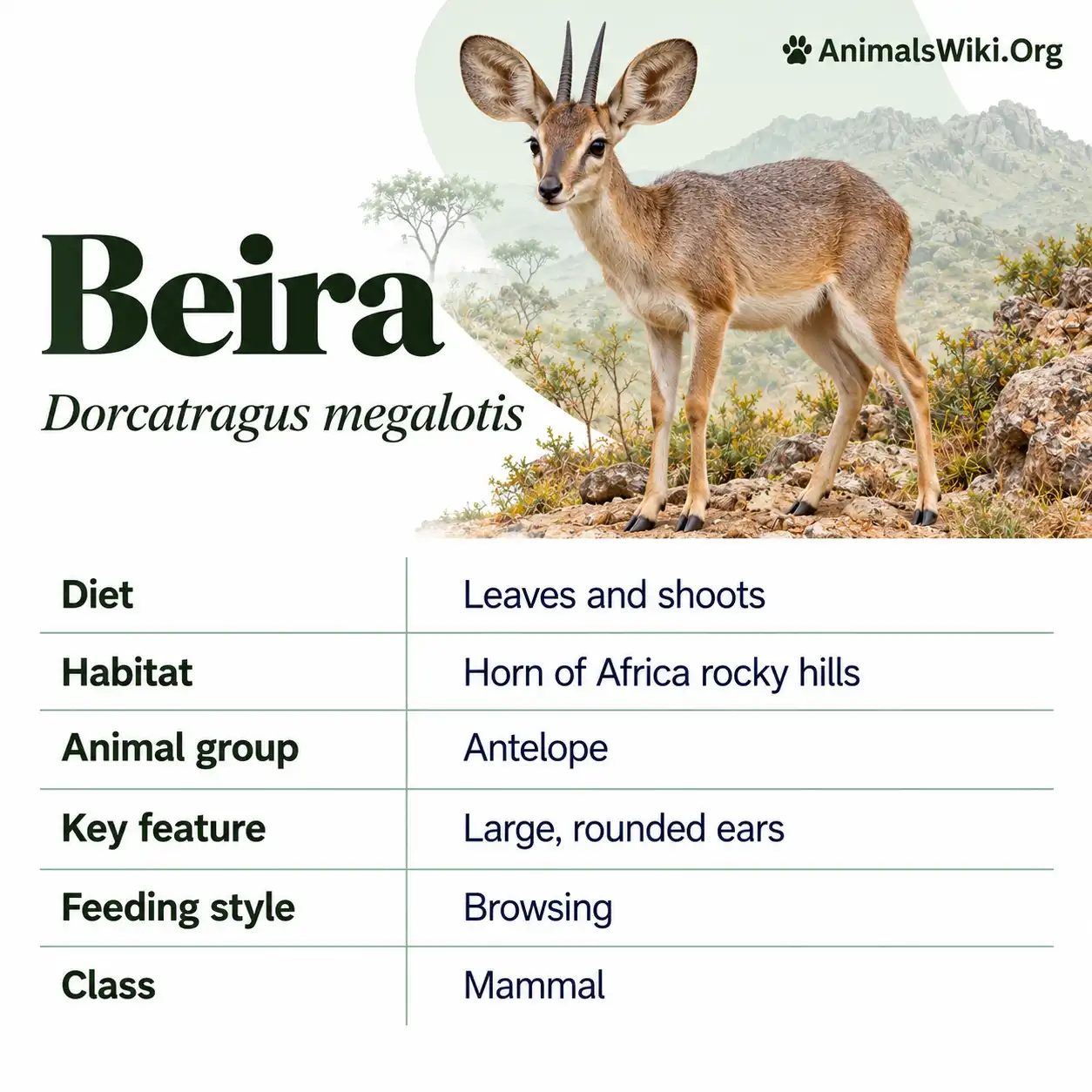
Beira Antelope, The Big-Eared Survivor of Africa’s Rocky Hills
The beira antelope is a small, striking mammal with enormous ears, slender legs, and an extraordinary ability to blend into dry, rocky landscapes. Far from the great migrating herds of Africa’s open plains, it lives among hills where scattered shrubs, shaded slopes, and sheltered resting places help shape everyday survival.
Known scientifically as Dorcatragus megalotis, the beira belongs to the wildlife of the Horn of Africa. Its native distribution includes northern Somalia, including Somaliland, southern Djibouti, and a restricted part of northeastern Ethiopia. Across this region, suitable habitat is patchy, environmental conditions can be demanding, and reliable wildlife monitoring is uneven.
At first glance, the beira’s oversized ears dominate its appearance. Look more closely, however, and a more complex animal emerges: a selective plant eater, a member of small social groups, and a hill-dwelling specialist whose activities change with seasonal heat.
The beira also has an important scientific story. Field studies have examined its behavior, feeding, and use of shade, while captive research has contributed information about reproduction and husbandry. These sources provide valuable insights, but they do not answer every question about wild populations.
Understanding the species therefore means separating direct observations from broader ecological explanations. A historical population estimate does not describe today’s abundance. A result from one Djibouti hillside does not automatically apply across the entire range. These distinctions help reveal what makes the beira remarkable without exaggerating what is known.
Facts About the Beira Antelope
| Feature | Details |
|---|---|
| Common name | Beira |
| Alternative name | Beira antelope |
| Scientific name | Dorcatragus megalotis |
| Animal group | Mammal; even-toed ungulate |
| Family | Bovidae |
| Genus | Dorcatragus |
| Native region | Horn of Africa |
| Range countries | Djibouti, Somalia, and a restricted area of northeastern Ethiopia |
| Typical habitat | Arid rocky hills, stony slopes, and scrub-covered uplands |
| Approximate shoulder height | Commonly reported around 50–60 centimeters |
| Approximate adult weight | Commonly reported around 9–11.5 kilograms |
| Most recognizable feature | Exceptionally large ears relative to its head |
| Horns | Short, upright horns in males; females are hornless |
| Feeding strategy | Selective browser |
| Social organization | Small groups, commonly with one adult male |
| Gestation | Approximately six months in reference accounts |
| Young per birth | Normally one calf |
| Wild lifespan | Insufficiently established for a dependable average |
| Global conservation category | Vulnerable in the 2016 Red List assessment |
| Current global population | No recent comprehensive census verified for this article |
1. What Is a Beira Antelope?
The beira is a small African antelope associated with arid hills and rocky terrain. It is often described as a dwarf antelope, an informal term used for several small antelope species.
“Dwarf” describes size rather than a single uniform way of life. Small antelopes occupy different environments, eat different combinations of plants, and vary in their social relationships. The beira’s association with stony hills is therefore an important part of its identity.
It is the only living species in the genus Dorcatragus. This gives it taxonomic distinctiveness: protecting the species also preserves the only surviving representative of that genus.
Unlike a large plains grazer, the beira does not depend on traveling in conspicuous herds across open grassland. Its world operates at a smaller scale, involving feeding patches, rocky escape routes, resting sites, and the relationships within a small group.
Its limited public profile should not be confused with ecological insignificance. Many animals remain unfamiliar because they live outside major tourist circuits or receive little media attention. The beira offers a clear example of how specialized wildlife can remain overlooked even when its appearance is immediately memorable.
2. Scientific Classification and Name
The Beira’s Scientific Classification
The scientific name Dorcatragus megalotis identifies the beira independently of language or local naming differences.
| Taxonomic rank | Classification |
|---|---|
| Kingdom | Animalia |
| Phylum | Chordata |
| Class | Mammalia |
| Order | Artiodactyla |
| Suborder | Ruminantia |
| Family | Bovidae |
| Subfamily | Antilopinae |
| Tribe | Antilopini |
| Genus | Dorcatragus |
| Species | Dorcatragus megalotis |
The Mammal Diversity Database recognizes the species as Dorcatragus megalotis and gives its authority as Menges, 1894. It also records the original combination, Oreotragus megalotis, which explains why older literature may place the animal under a different genus.
Classification helps organize relationships, but it should not be mistaken for a complete behavioral description. Belonging to the same family as cattle, goats, and other antelopes does not mean the beira can be understood simply by observing domestic livestock.
What Does Its Name Mean?
The species name megalotis refers to large ears. This is particularly appropriate because the ears are among the first features an observer notices.
The common name beira comes from a Somali name for the animal. Local names can preserve longstanding familiarity with a species that became formally described in scientific literature much later.
For clear writing, the common name works well after the scientific name has been introduced. Including both near the beginning helps readers connect field guides, research papers, conservation documents, and educational articles.
3. Identification and Physical Appearance
A Small Body With Long, Slender Legs
The beira has a compact body supported by slim legs. Common reference measurements place its shoulder height around 50–60 centimeters and its weight at approximately 9–11.5 kilograms.
These values convey scale more effectively than describing it simply as “tiny.” It is substantially smaller than familiar medium-sized antelopes, yet large enough to move independently across demanding terrain and sustain the digestive system of a browsing ruminant.
Photographs can distort apparent size. A close portrait may make the beira look comparable to a much larger gazelle, while a distant image against a hillside may make it appear almost rabbit-sized.
Body proportions, rather than apparent size alone, are therefore useful for identification. The ears, short tail, slender limbs, face, and male horns should be considered together.
Coat and Facial Markings
The upper coat is generally reddish gray or grayish brown, with pale underparts and a darker line along the sides. The legs are lighter, and the face has contrasting markings around the eyes.
Such coloration works visually with the mixture of stones, dry soil, and subdued vegetation in its habitat. However, an apparent color match does not prove that every feature evolved specifically for camouflage; evolutionary explanations require evidence.
Lighting also changes appearance. A beira photographed in warm sunlight may look more reddish than one resting in shade.
The Remarkable Ears
The beira’s ears are broad, long, and conspicuous, with pale hair inside. Reference descriptions commonly give lengths of about 15 centimeters.
Their size is a powerful identification clue, particularly when the animal faces the observer. However, claims that the ears function mainly as cooling devices should be qualified unless supported by species-specific measurements. A plausible function is not automatically a demonstrated one.
Male Horns and the Short Tail
Only males carry horns. These are short, relatively straight, and upright, commonly reported around 7.5–10 centimeters long.
The tail is short and bushy. This is a useful contrast with the long dark tail of the dibatag, another unusual antelope of the Horn of Africa.
Historical descriptions document these general external features, although older measurements and distribution statements should not be treated as current survey evidence.
4. Beira Compared With Similar Antelopes
The beira may be confused with other small antelopes, especially in distant photographs. Large ears can suggest a dik-dik, while rocky habitat can encourage an assumption that the animal is a klipspringer.
Neither assumption is sufficient.
| Feature | Beira | Dik-diks | Klipspringer |
|---|---|---|---|
| Scientific group | Dorcatragus megalotis | Several species in Madoqua | Oreotragus oreotragus |
| Strong identification clue | Very large ears and distinctive facial appearance | Elongated, mobile-looking muzzle | Stocky appearance and characteristic stance on rocks |
| General setting | Arid hills with browse and shelter | Commonly bushland and scrub | Rocky outcrops and mountainous terrain |
| Social comparison | Small groups may include multiple adult females | Often associated with pairs | Commonly associated with pairs |
| Main identification caution | Ear size alone is insufficient | Species differ from one another | Rocky habitat alone does not establish identity |
A reliable identification begins with visible anatomy and then uses habitat and location as supporting evidence.
The beira is also completely different from the beisa oryx. Similar names can cause confusion in keyword searches, but the oryx is a much larger antelope with long horns and a different overall appearance.
For image libraries and wildlife articles, scientific names provide an effective safeguard. A correctly labeled photograph is especially important when an unfamiliar species is being introduced to readers.
5. Geographic Distribution
A Restricted Horn of Africa Range
The beira is native to the Horn of Africa. Its range includes northern Somalia, including Somaliland, southern Djibouti, and a restricted part of northeastern Ethiopia.
The Mammal Diversity Database specifically refers to the Marmar Mountains in northeastern Ethiopia, while also signaling uncertainty in its country-level presentation. That uncertainty should be preserved rather than converted into an assumption of widespread Ethiopian occurrence.
The species’ geography is closely tied to suitable hills and uplands. A broad range outline does not mean that every valley, settlement, plain, or mountainside within it contains beiras.
For wildlife planning, the important unit is often an occupied patch or connected set of hills, rather than the total land area of a range country.
Why Djibouti Matters
Djibouti has been particularly important for field research. Studies in the southern Aser-Jog region have contributed information about population distribution, feeding, social relationships, and seasonal behavior.
These findings are valuable precisely because they come from identifiable places and methods. Their usefulness increases when readers retain that context.
A study in one country can generate hypotheses for another, but confirming those hypotheses requires additional observations. Vegetation, terrain, disturbance, and climatic conditions may differ across the range.
Distribution Is More Than a Map
A distribution map summarizes evidence; it does not replace it. Confirmed observations, historical reports, and predicted suitable habitat represent different levels of certainty.
When a species is poorly monitored, mapping should show those differences where possible. Otherwise, a smooth colored shape can conceal substantial gaps in knowledge.
6. Habitat and Landscape Preferences
Rocky Hills With Living Resources
Beiras inhabit arid rocky hills, stony slopes, and uplands containing suitable vegetation. These are not necessarily high mountains in the alpine sense.
An apparently barren hillside can contain a useful combination of shrubs, small trees, herbaceous plants, shaded pockets, and rock shelters. From the animal’s perspective, these details determine whether the landscape provides food and refuge.
Rocks alone are insufficient. A hillside may offer excellent footing and shelter but too little nutritious vegetation. Another may have abundant plants but lack suitable resting sites during intense heat.
Understanding habitat therefore requires looking at several resources together.
Vegetation Structure
A beira’s feeding opportunities depend on which plants are present, how accessible they are, and when they produce edible leaves.
Total greenness can be misleading. Some plants may be poorly selected, while a less abundant shrub can provide an important food resource.
The same principle applies to conservation restoration. Planting any hardy species is not necessarily equivalent to restoring usable beira habitat. Appropriate local vegetation and its arrangement matter.
Connections Between Hills
An isolated occupied hill may support animals for a time, but movement between patches can matter for recolonization and genetic exchange.
Whether a particular valley acts as a barrier depends on its width, disturbance, vegetation, and the animals’ willingness to cross it. Those relationships should be investigated rather than assumed.
Habitat planning works best when it considers both the quality of individual patches and the connections among them.
7. Diet and Feeding
A Selective Browser
The beira primarily consumes leaves and other suitable parts of broad-leaved plants. Both woody plants and forbs can contribute to its food supply.
A growing-season study in Djibouti compared beira and domestic goat diets through microscopic examination of plant remains in droppings. The beira emerged as a selective browser, while goats consumed much more grass during that particular study.
The researchers also identified shared use of some plants, including Acacia etbaica, alongside substantial differences in other foods.
This provides stronger evidence than a generic statement that the beira “eats vegetation.” It shows that plant identity and selection matter.
Why Selectivity Matters
A selective feeder cannot necessarily substitute every available plant for a declining preferred food.
Plants differ in digestibility, nutrient content, physical defenses, and chemical composition. Within one plant, young leaves may differ from old leaves, and shoots may differ from stems.
The practical implication is that food availability should be measured in terms of usable forage. A hillside can remain covered in vegetation while becoming less suitable for an animal with particular dietary preferences.
Seasonal Diet Questions
Results from the growing season do not establish the complete annual diet.
When plants dry or lose leaves, available choices change. Researchers have proposed that dietary overlap with goats could become more important during resource shortages, but that requires direct seasonal testing.
The distinction is useful: a documented wet-season result is established evidence, while a predicted dry-season pattern remains a hypothesis until measured.
8. Digestion and Food Quality
How Rumination Helps
The beira is a ruminant. Its digestive system uses microbial fermentation to help process plant material, and food can be regurgitated and chewed again.
This allows the animal to obtain nutrients from material that humans cannot digest efficiently. Nevertheless, fermentation does not make food quality irrelevant.
An abundance of fibrous stems is different from an abundance of nutritious leaves. Animals must obtain sufficient usable energy and nutrients while managing the time and physical capacity involved in digestion.
Feeding Time Is Only Part of the Story
An observer may see a beira lying quietly and assume that it is inactive in a biological sense. Yet resting can coincide with digestion and rumination.
This is important when interpreting activity budgets. Time spent feeding, resting, watching, moving, and ruminating contributes to the animal’s daily needs in different ways.
A healthy habitat must support the full daily cycle, including opportunities to rest without repeated disturbance.
Why Wild Diets Are Difficult to Reconstruct
Watching every mouthful is rarely practical, especially in rocky terrain. Dropping analysis offers another approach, but it also has methodological limits.
Plant tissues differ in how well they survive digestion and how easily they can be identified. Results need appropriate reference material and careful interpretation.
The strongest dietary picture combines methods where possible: direct observations, plant availability measurements, and analysis of what animals have consumed.
9. Adaptations to Dry, Rocky Environments
Movement Across Uneven Ground
The beira’s association with hills places a premium on controlled movement. Steep slopes and loose stones create different demands from those of running across a flat plain.
Maintaining balance, choosing routes, and responding to danger all occur within this physical setting. A direct sprint is not always the only useful escape strategy when the ground is broken.
However, precise claims about maximum speed, jumping distance, or climbing angle should not be supplied without measurements. Describing the species as an agile hill-dweller communicates the established association without inventing performance records.
Water Balance
Plants contain water, so feeding contributes to hydration. This is relevant to animals living where surface water is scarce or seasonal.
The beira is generally described as having low dependence on drinking water. That should not be expanded into the claim that it has no water requirement.
Water balance includes intake, physiological production, and losses through several pathways. The animal must keep those processes within workable limits.
Behavioral Flexibility
Adaptation includes behavior as well as anatomy.
Choosing shade, changing the timing of activity, or using a sheltered slope can reduce exposure to difficult conditions. Such decisions may have immediate value without requiring a visible structural feature.
This broader view helps explain why conserving habitat involves more than protecting food plants. Access to suitable resting conditions can also matter.
10. Seasonal Activity and Shade Use
A Daily Schedule That Changes With Heat
A field study published in 2013 examined seasonal heat and beira activity in southern Djibouti.
During cooler conditions, animals alternated between activity and rest through the day. In hotter conditions, extended midday rest became more prominent, with activity concentrated toward the beginning and end of daylight.
The animals also used tree shade, rock shelters, and shaded hillsides. Rock shelters measured cooler than tree shade in the study’s comparisons.
These observations make “active at dawn and dusk” an incomplete description. Timing depends partly on season and thermal conditions.
Shade as a Habitat Resource
Shade changes the immediate conditions experienced by an animal. Two points a short distance apart can differ substantially in exposure.
A tree therefore provides more than leaves. Its canopy can create a resting place, although the value of that shade varies with canopy size, sun angle, and weather.
Rock shelters offer another form of thermal refuge. Their availability may influence how animals use a particular hillside.
Consequences for Conservation
Removing trees can alter both feeding opportunities and resting conditions. These effects should be assessed together.
The logical conservation question is not simply how many trees remain. It is whether animals still have access to suitable food and shelter across the conditions they experience.
This also explains why a habitat assessment conducted in mild weather may miss resources that become important during the hottest months.
11. Social Organization
Small Groups With Recognizable Structure
Beiras commonly live in small groups. A field study based on observations during spring 2004 recorded groups of one to five individuals, and many mixed-sex groups contained a single adult male.
The researchers also reported apparently stable associations and shared urination–defecation sites. These findings suggest social organization more structured than animals merely gathering by chance around food.
However, a social group is not necessarily a fixed unit whose membership never changes. Births, dispersal, mortality, and encounters can affect composition.
What Group Living Can Offer
In general, living with other individuals can influence vigilance, access to mates, and movement.
It can also introduce costs, such as competition for food or the need to coordinate activities. The balance depends on environmental and social circumstances.
For beiras, these are useful explanatory possibilities rather than measured benefits that should be assigned numerical values.
Why Long-Term Observation Matters
A single sighting shows which animals were together at that moment. Repeated observation helps reveal whether the association persists.
Recognizing individuals can clarify whether females remain together, whether males are replaced, and how young animals enter or leave groups.
This information also improves population surveys by reducing the chance of counting the same group repeatedly.
12. Communication and Territorial Behavior
Shared Marking Sites
The use of collective urination–defecation sites is an especially interesting aspect of beira behavior.
Such locations can provide opportunities for communication because chemical information remains available after an animal leaves. Repeated use also creates recognizable places within a group’s surroundings.
The precise information communicated should not be assumed. Establishing whether a mark indicates group identity, reproductive condition, ownership, or another function requires targeted research.
Encounters Between Males
Male–male interactions can help researchers investigate territoriality, but a single chase does not establish the full social system.
A territory is an area actively defended. A home range is the area an animal uses during ordinary activities. These concepts are related but distinct.
To demonstrate territorial boundaries, researchers need repeated evidence about where individuals move and how they respond to others.
Hearing, Watching, and Posture
The beira’s large ears naturally draw attention to hearing, while changes in head position and orientation can reveal alertness.
Nevertheless, an observer should begin by describing the behavior rather than confidently assigning an emotion. “The animal turned toward a sound” is more precise than “the animal became frightened” when no further response occurred.
Careful descriptions make behavioral records more useful and reduce the tendency to humanize unfamiliar animals.
13. Reproduction and Breeding Season
Gestation and Number of Young
Beiras normally produce one calf per birth. Reference accounts commonly describe gestation as approximately six months.
A single calf represents a substantial reproductive investment for a small mammal. The female must support pregnancy and milk production while continuing to meet her own nutritional needs.
These demands help explain why suitable food matters beyond simple adult maintenance.
Is Breeding Strictly Seasonal?
Spring observations in Djibouti included both births and mating. However, those observations do not demonstrate that beiras everywhere reproduce only during a particular month.
Captive accounts have reported breeding across the year. Wild and captive conditions differ in food availability, environmental exposure, and management.
The safest interpretation is that seasonal patterns occur in field observations, while a rigid range-wide breeding calendar is not established.
Studying Reproductive Physiology
A scientific study of ovarian activity used noninvasive hormone monitoring in beiras. Such methods can help researchers investigate reproduction without relying solely on observed mating or visible pregnancy.
The value lies in linking behavior with physiological evidence. However, results from a small managed group should retain that context.
For wild populations, important unanswered questions include how food conditions influence conception, successful birth, and the interval between successful reproductive events.
14. Calf Development and Parental Care
The Concealed Young Calf
Young antelopes may spend time hidden while adults feed or remain elsewhere nearby. Historical field material on beiras also documents concealed young.
This behavior can reduce the visibility of a vulnerable calf. It means that a young animal seen alone is not necessarily abandoned.
Approaching or handling a calf can disrupt a normal situation. Observation from a distance is the appropriate response unless qualified wildlife personnel identify a genuine emergency.
Nursing and Dietary Transition
A calf initially depends on milk, then gradually develops the ability to use plant foods and a functioning ruminant digestive system.
That transition involves more than simply copying adult feeding movements. Digestive development, microbial communities, and changes in nutritional requirements all contribute.
Precise beira weaning ages and growth rates should be tied to a particular study or managed population. They should not be invented from a generic antelope schedule.
Births Are Only One Measure of Success
A population can produce calves and still decline.
Recruitment requires young animals to survive and eventually contribute to reproduction. Adult survival also matters because repeated losses can outweigh successful births.
For conservation monitoring, recording calves is useful, but it should be combined with repeated group observations and evidence about longer-term survival.
15. Lifespan and Survival
How Long Does a Beira Live?
A dependable average wild lifespan is not established by the evidence reviewed for this article.
Some online profiles supply a neat lifespan figure, but a number without a documented basis can create false confidence. Captive longevity, maximum recorded age, and average survival in the wild describe different things.
A maximum age shows what at least one animal achieved. An average requires information about many animals, including those that died young.
What Affects Survival?
General influences include nutrition, injury, disease, predation, environmental exposure, and human activity.
Their relative importance in wild beiras has not been measured comprehensively enough to assign percentages. Conditions can also differ between locations and years.
For example, a difficult dry period might affect survival through food shortage, whereas another locality could face more immediate pressure from habitat disturbance.
Why Adult Survival Matters
In a small population, losing breeding adults can affect both present numbers and future reproduction.
Understanding age-specific survival would help identify where intervention could be most useful. Protecting calves may be insufficient if adult mortality remains high, while improving adult survival alone may not resolve persistent recruitment failure.
These are questions for structured monitoring rather than assumptions based only on occasional sightings.
16. Predators and Defensive Behavior
Reported and Suspected Predators
Research in Djibouti recorded carnivores and gathered local information about possible predators.
The distinction between a predator being present and a predator being observed killing a beira is important. In the Aser-Jog study, local reports and field observations informed discussion of caracals, hyenas, baboons, and large eagles.
Those findings should not be converted into a universal ranked list of beira predators. The available evidence differs among species and places.
Avoidance and Escape
For a small antelope, avoiding a close encounter can be as important as escaping after an attack begins.
Vigilance, concealment, and route choice can all influence risk. Rocky terrain may create barriers or refuges, but its usefulness depends on the predator and the circumstances.
The same hillside that provides an escape route can also contain blind spots. Terrain is therefore part of a complex interaction, rather than an automatic guarantee of safety.
Predation in a Conservation Context
Natural predation is part of ecosystem functioning.
The presence of predators does not by itself explain a threatened population’s condition. Human pressures can reduce habitat quality or survival in ways that make normal ecological processes harder to withstand.
Management should investigate the full set of pressures before assigning blame to native carnivores.
17. Ecological Importance
Part of the Food Web
The beira connects vegetation with other organisms by consuming plants and becoming a potential food source itself.
Droppings return organic matter to the ground. Carcasses can support scavengers and decomposers. These are general ecological pathways through which herbivores contribute to their surroundings.
The size of the beira’s contribution has not been quantified sufficiently to justify claims that it controls an entire ecosystem.
Browsing and Plant Communities
Selective feeding can affect individual plants and, over time, potentially influence vegetation patterns.
However, the outcome depends on the plants involved, browsing intensity, rainfall, and interactions with other herbivores. It would be simplistic to claim that beiras always improve or always damage vegetation.
Research into these relationships would help explain whether certain plant resources constrain the species and how land-use changes alter their availability.
Evolutionary and Regional Value
As the only living species of Dorcatragus, the beira represents a distinctive evolutionary lineage.
It is also part of the natural heritage of the Horn of Africa. Its conservation brings attention to dry, rocky habitats that may receive less support than forests or famous wildlife plains.
Protecting biodiversity requires this broader perspective. Familiarity and tourist appeal are poor measures of a species’ biological value.
18. Relationships With People and Livestock
Sharing an Arid Landscape
People and livestock use many of the same landscapes occupied by beiras.
Pastoral livelihoods depend on navigating variable rainfall and forage availability. Conservation therefore needs to understand seasonal movement, access to resources, and the practical choices available to local households.
Treating every livestock presence as equally harmful ignores differences in stocking levels, timing, vegetation condition, and land management.
Competition Can Be Indirect
Animals do not need identical diets to affect one another.
Heavy use can alter plant communities, reduce regeneration, or change the distribution of shade and cover. A plant community that remains usable for goats may become less suitable for a more selective browser.
This is a general ecological interpretation consistent with the need to assess vegetation change, rather than assuming that measured dietary differences eliminate all competition.
Local Knowledge and Cooperation
Herders and residents can contribute observations of animal presence, seasonal use, and changes over time.
Such information becomes more useful when records include dates, locations, and identification details. A remembered sighting from childhood has a different evidential role from a recent photograph.
Cooperation also helps shape feasible conservation. Measures that account for local needs are more likely to receive sustained support than rules imposed without understanding how people use the landscape.
19. Population Estimates and Survey Limitations
Why a Current Global Total Is Uncertain
No recent comprehensive global census was verified for this article.
A figure of about 7,000 animals is widely repeated online, often without enough context. It should not be presented as a confirmed count for 2026.
For readers, a dated regional estimate with a clear method is often more informative than a precise-looking global number whose origin and assumptions have disappeared.
The Djibouti Estimate
Research based on fieldwork from October 2005 to June 2006 estimated approximately 100–150 beiras in Aser-Jog.
The researchers explained potential counting uncertainties, including missed groups and the possibility of confusing repeated sightings. Their estimate referred to the study population at that time.
A 2024 conservation research project highlighted the age of that baseline and the need to reassess distribution and habitat conditions. It also included a beira camera-trap photograph from 2023.
| Evidence | Date | What it supports |
|---|---|---|
| Aser-Jog population estimate of approximately 100–150 | Fieldwork in 2005–2006 | Historical regional abundance |
| Camera-trap image in Aser-Jog | 2023 | Presence at a documented place and time |
| Research project describing updated survey needs | 2024 | Recognition that older information requires reassessment |
| Exact worldwide population in 2026 | Not verified | Should remain unspecified |
Counting a Hill-Dwelling Antelope
Visibility changes with terrain, vegetation, weather, and animal behavior.
Researchers must also avoid counting the same group twice. Repeated observations help, but require knowledge of movements and, ideally, recognizable individuals.
A reliable trend needs comparable surveys through time. Two estimates cannot be interpreted confidently as an increase or decline if their study areas and methods differ substantially.
20. Conservation Status and Main Threats
Formal Conservation Category
The beira is listed as Vulnerable in the 2016 global Red List assessment. The IUCN Antelope Specialist Group’s species listing also identifies it as Vulnerable.
Vulnerable is a formal threatened category. It should not be casually replaced with Endangered, which is a separate category.
The assessment year also matters. A category retained on a current website does not imply that all population evidence was collected recently.
Loss of Suitable Vegetation
Cutting shrubs and trees can reduce food and change habitat structure.
The consequences depend on which plants disappear and how the landscape responds. Removing a mature tree may affect shade immediately, while reduced regeneration can produce a slower decline in future resources.
Monitoring vegetation condition alongside animal occurrence would help identify these changes before population losses become obvious.
Livestock Pressure
High livestock pressure can reduce available forage and alter plant communities.
The beira’s selectivity means that remaining vegetation is not necessarily an adequate substitute for preferred foods. Effective management therefore requires information about both animal use and plant response.
This does not imply that coexistence is impossible. It means the conditions supporting coexistence need to be understood and maintained.
Drought and Environmental Stress
Drought can affect leaf production, food quality, and the distribution of usable habitat.
A dry-adapted species remains vulnerable when conditions exceed its normal coping capacity. Repeated shortages may also interact with other pressures.
The conservation question is how much resilience remains in the system, including alternative feeding areas and access to shelter.
Fragmentation and Limited Capacity
Roads, development, and changing land use can affect habitat continuity. Their actual influence should be assessed locally rather than assumed from their presence alone.
Broader conservation research has identified limited capacity and insecurity as obstacles for threatened Horn of Africa antelopes, including the beira.
These challenges can reduce both protection and knowledge, making sustained partnerships especially important.
21. Captive Breeding and Scientific Research
What Captive Studies Have Contributed
Managed beiras have provided opportunities to study behavior, nutrition, reproduction, and veterinary care.
A 2011 husbandry paper described work at Al Wabra Wildlife Preservation in Qatar. It reported population growth followed by a serious decline associated with a respiratory disease outbreak, probably involving Mycoplasma infection.
That paper describes a historical managed population. Its statements about holdings should not automatically be treated as a current global inventory of captive beiras.
Lessons From Disease
A managed population can face serious risk even when food and shelter are provided.
Disease surveillance, appropriate group composition, veterinary expertise, and careful husbandry all matter. Small populations may be particularly vulnerable if several animals are lost in a short period.
The lesson is that captive conservation requires sustained technical capacity. It is not simply a matter of moving animals into enclosures.
The Role of Captivity in Conservation
Captive breeding can support knowledge and potentially contribute to broader species planning.
However, reintroduction would require suitable habitat, reduced threats, appropriate genetics, health safeguards, and long-term monitoring. Producing animals alone does not resolve the reasons a wild population declined.
A conservation strategy should define the purpose of an ex situ population and how it complements work in the species’ native range.
22. Conservation Priorities and Responsible Observation
Update Distribution and Abundance
A practical priority is to establish which areas remain occupied and how populations change.
Useful work combines field surveys, camera traps, verified local reports, and clear records of search effort. Methods should be repeatable so that later comparisons are meaningful.
Unsurveyed areas should be distinguished from areas searched carefully without success.
Protect Food and Thermal Refuge
Habitat work should consider browse, shade, rock shelters, and connections among patches.
A landscape may fail to meet the animal’s needs if only one component is protected. Mapping resources across seasons can reveal places that become disproportionately important during difficult conditions.
Restoration should use appropriate local ecological knowledge rather than a generic tree-planting approach.
Build Local Partnerships
Residents can help identify priorities and evaluate whether proposed measures are workable.
Conservation programs should provide clear roles, communicate results, and recognize local contributions. Sustained relationships are particularly valuable where outside researchers cannot remain continuously.
Successful protection depends on trust as well as biological information.
Observe Without Disrupting
Wildlife observers should maintain distance and allow animals to continue feeding or resting.
Chasing a beira to obtain a clearer photograph imposes a cost on the animal and can undermine the purpose of documenting it. Hidden calves should be left undisturbed.
For educational images, accurate identification matters equally. Generated illustrations should be labeled appropriately, and photographs should not be substituted with a similar-looking species.
23. Frequently Asked Questions
1. What is a beira antelope?
The beira is a small antelope native to the Horn of Africa. Its scientific name is Dorcatragus megalotis. It is especially recognizable by its very large ears, slender legs, short tail, and association with dry rocky hills containing suitable browsing plants.
2. Where does the beira live?
Its native range includes southern Djibouti, northern Somalia, including Somaliland, and a restricted part of northeastern Ethiopia. This does not mean it is distributed evenly across those areas. Occupancy depends on suitable habitat, and current records remain incomplete in parts of the range.
3. Is the beira a gazelle?
The beira is an antelope in the family Bovidae, but it belongs to its own genus, Dorcatragus. Calling every small, slim antelope a gazelle can obscure useful taxonomic differences. The scientific name is the clearest way to identify the species precisely.
4. Why are its ears so large?
Large ears are a defining anatomical feature and an important identification clue. They are associated with sensory function, but precise claims about their contribution to cooling require species-specific evidence. It is better to distinguish the observed anatomy from an untested explanation of its main function.
5. How big is a beira?
Common reference ranges place shoulder height around 50–60 centimeters and adult weight around 9–11.5 kilograms. These figures are approximate. Individuals differ, and apparent size in photographs depends strongly on distance, camera angle, and the absence or presence of familiar objects for comparison.
6. Do female beiras have horns?
Females are hornless, while males carry short, upright horns. However, age and image quality can complicate sex identification. An immature male or an animal with an obscured head should not be confidently identified from the apparent absence of horns in a single distant photograph.
7. What does the beira eat?
The beira is a selective browser that consumes suitable leaves and other plant material from woody plants and forbs. Field research shows that plant selection matters. The amount of vegetation on a hillside alone does not reveal whether enough of the right foods are available.
8. Does the beira eat grass?
A growing-season study found very little grass in the beira diet compared with domestic goats. This supports its description as a browser in that setting. The result should retain its seasonal and geographic context rather than becoming an absolute statement about every mouthful eaten throughout the range.
9. Does a beira need water?
Yes, its body requires water, as every mammal’s does. Moisture in food contributes to hydration, and the species is described as having low dependence on drinking water. That is different from claiming that water is unnecessary or that no beira ever drinks under any circumstances.
10. When are beiras most active?
Activity changes with environmental conditions. Research in Djibouti found a stronger emphasis on early and late daylight activity during hot conditions, with prolonged midday rest. Cooler conditions allowed a more distributed pattern of activity and rest, making a single year-round schedule misleading.
11. Why do beiras use rock shelters?
Rock shelters can provide shade and cooler resting conditions. Their importance depends on local availability and weather. They are part of the animal’s habitat resources alongside food plants and other shade sources, rather than merely convenient places that have no bearing on conservation planning.
12. Do beiras live alone or in groups?
They commonly occur in small groups, although solitary animals are also observed. Field research has documented mixed-sex groups containing a single adult male and apparently stable associations. Group composition can change, so one sighting does not reveal every relationship among the animals present.
13. How many calves does a beira have?
A single calf is normally reported per birth. Successful population recruitment requires more than producing young: calves must survive and eventually enter the breeding population. Monitoring should therefore follow survival and group composition rather than interpreting any observed birth as proof of population growth.
14. How long is beira pregnancy?
Gestation is commonly described as approximately six months. This is a reference value rather than a reason to assume that every pregnancy has exactly the same duration. Reproductive timing and success also need to be interpreted in relation to whether the evidence comes from wild or managed animals.
15. Do beiras breed only in April?
No reliable range-wide conclusion supports that strict rule. Spring field observations included reproduction, while captive accounts report breeding beyond a single month. Limited observations of births in one season should not be converted into an absolute breeding calendar for all beiras.
16. How long does a beira live?
A dependable average lifespan in the wild was not established in the evidence reviewed. Maximum age, captive longevity, and average wild survival are separate measurements. A responsible species profile should acknowledge this uncertainty rather than insert an unsupported number to complete a facts table.
17. What predators eat beiras?
Field studies and local reports identify possible predators, with evidence varying among carnivores and other animals. Caracals feature in discussions of adult predation in Djibouti. However, predator presence, local testimony, and directly observed predation should be distinguished when describing how certain a relationship is.
18. Is the beira endangered?
Its formal global Red List category is Vulnerable in the 2016 assessment reviewed here. Vulnerable is a threatened category, but it is distinct from Endangered. Using the correct terminology conveys concern while preserving the meaning of the conservation classification.
19. How many beiras remain?
A reliable current worldwide total was not verified. Approximately 100–150 were estimated in the Aser-Jog study area using 2005–2006 fieldwork, but that is a historical regional estimate. It should not be treated as the current population of Djibouti or the entire species.
20. Can beiras coexist with livestock?
Coexistence may be possible under suitable conditions, but outcomes depend on resource availability, livestock pressure, and habitat management. Different diets do not eliminate indirect impacts. Conservation needs to assess vegetation change and seasonal shortages rather than assuming either universal compatibility or inevitable conflict.
21. Can the beira be bred in captivity?
Yes, captive breeding and husbandry have been documented. However, historical success was accompanied by serious veterinary challenges. Captive management requires specialist knowledge and a clear conservation purpose; it cannot substitute for maintaining suitable habitat and viable populations within the species’ native range.
22. Why is the beira important?
The beira is the only living species in its genus and a distinctive part of Horn of Africa biodiversity. Its protection also draws attention to overlooked rocky drylands. Ecological value is not limited to large, famous, or easily photographed animals.
Beira Antelope (Dorcatragus megalotis)
The beira antelope is a memorable specialist of the Horn of Africa’s rocky hills. Its oversized ears and compact body make it visually distinctive, while its selective feeding, small social groups, and seasonal use of shade reveal a life closely connected to the details of its environment.
Its habitat is more complex than a first glance suggests. Food plants, shaded slopes, rock shelters, and connections between hills can each contribute to survival. Protecting only the visible outline of a hillside would miss the resources that make it usable.
Scientific research has provided valuable knowledge, especially from Djibouti and managed populations. At the same time, major gaps remain in current abundance, wild survival, and distribution. Historical estimates should retain their dates, and uncertainty should guide further investigation rather than invite invented precision.
The most useful conservation work combines updated surveys with habitat protection and cooperation with local communities. These efforts can help identify where beiras persist, what pressures matter most, and which actions are practical.
This small antelope deserves attention as both a distinctive species and part of a wider living landscape. Its future depends on maintaining the ecological relationships and resources that have allowed it to survive in a demanding corner of Africa.



