
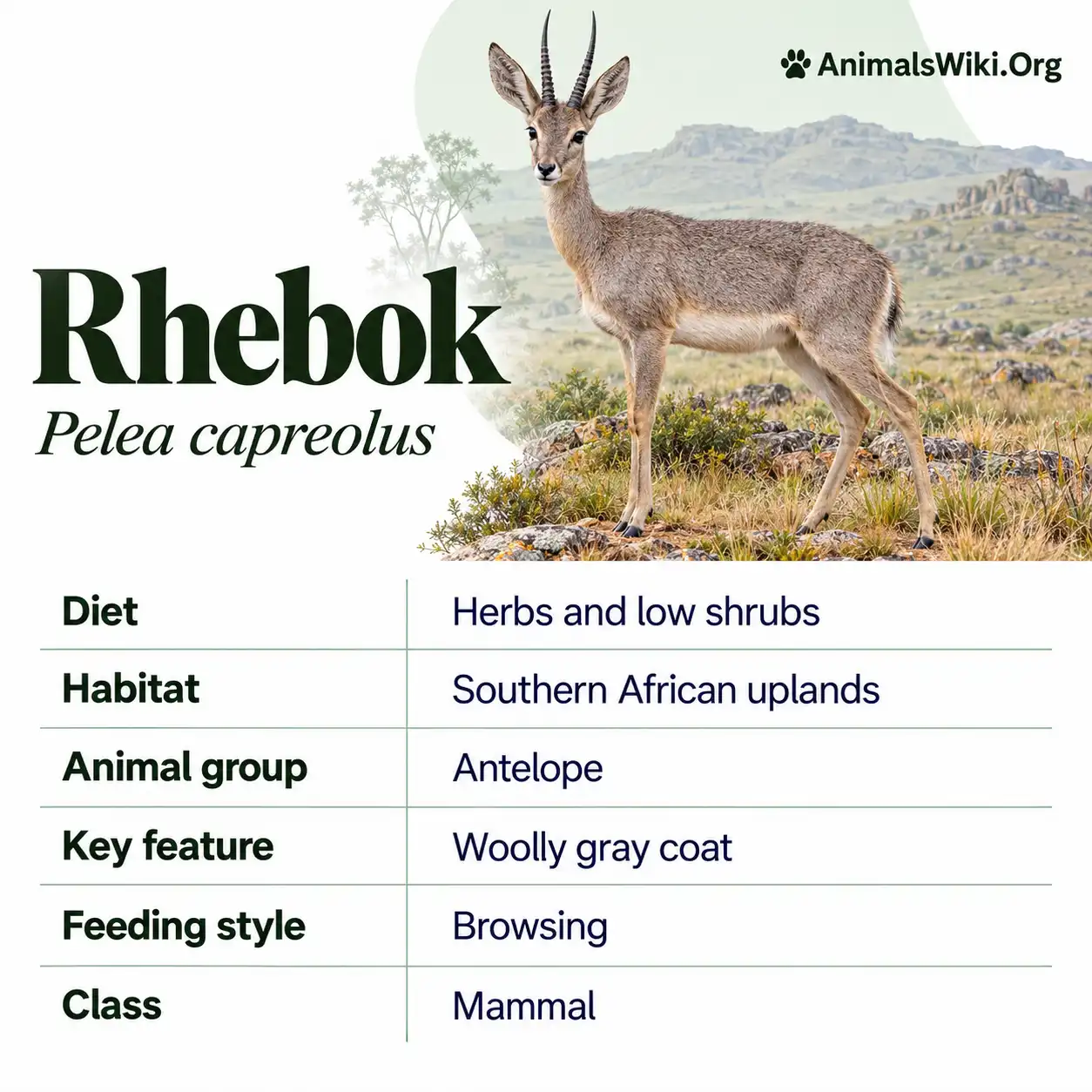
Woolly Gray Rhebok, The Remarkable Antelope of Southern Africa’s Hills
The woolly gray rhebok is an antelope that rewards a closer look. Its long neck, narrow ears, dark nose, and soft gray coat give it an appearance quite different from the familiar impala or springbok. Standing on a grassy slope, it can seem understated until it moves, revealing the alertness and confident footing of an animal at home in uneven country.
Usually called the gray rhebok or grey rhebok, this southern African mammal is known scientifically as Pelea capreolus. “Woolly” describes its distinctive coat; it does not identify a separate species or recognized subspecies.
The rhebok is associated with mountain grasslands, rocky hills, and open uplands, but its ecology contains several surprises. Although often seen feeding close to the ground among grasses, it primarily selects broad-leaved plants. Although its range includes protected areas, conservation assessments have documented concerns about declining populations. And although it resembles some other hill-dwelling antelopes, its social organization is unusually structured.
Its story also illustrates why wildlife information needs context. A population figure published decades ago should not become a present-day total. A result from one reserve should not automatically describe every population. Differences between scientific references should be explained rather than hidden behind an artificially precise answer.
This guide explores the woolly gray rhebok’s identification, classification, distribution, habitat, feeding, adaptations, social behavior, reproduction, ecological importance, and conservation. Along the way, it separates well-supported observations from reasonable interpretations and information that remains uncertain.
Woolly Gray Rhebok Facts
| Feature | Details |
|---|---|
| Main common name | Gray rhebok or grey rhebok |
| Other names | Vaal rhebok, vaal rhebuck, gray ribbok |
| Scientific name | Pelea capreolus |
| Animal group | Mammal; even-toed ungulate |
| Family | Bovidae |
| Genus | Pelea |
| Native countries | South Africa, Lesotho, and Eswatini |
| Typical habitat | Open hills, rocky slopes, mountain grasslands, and some Cape shrubland landscapes |
| Approximate shoulder height | About 70–80 centimeters |
| Approximate adult weight | About 18–30 kilograms |
| Distinctive appearance | Woolly gray coat, narrow ears, long neck, and prominent dark nose |
| Horns | Present in males; females are hornless |
| Main feeding strategy | Selective browsing, especially on low-growing forbs |
| Social organization | Stable female groups associated with a dominant male; other males often solitary |
| Young per birth | Normally one |
| Gestation | References differ; approximately seven to nine months is a cautious summary |
| Commonly reported lifespan | Around eight to ten years, with important limitations |
| Global conservation category | Near Threatened in the 2017 assessment |
| Population trend in that assessment | Decreasing |
| Verified current global population | Not established by a recent comprehensive census reviewed here |
1. What Is a Woolly Gray Rhebok?
The woolly gray rhebok is a distinctive southern African antelope. It belongs to the family Bovidae, which also includes cattle, sheep, goats, and many other antelopes.
Its common name sometimes creates confusion because “rhebok,” “rhebuck,” and “ribbok” appear in different publications. These spellings generally refer to the same animal when used alongside Pelea capreolus.
The addition of “woolly” emphasizes the coat’s texture. It is useful descriptively, but readers should not interpret it as evidence of a separate wool-producing variety or a domestic breed.
The rhebok occupies a different ecological position from a large herd-forming plains grazer. Its feeding depends heavily on selecting particular plants and plant parts, while its social life centers on relatively small groups.
It is also the only living species in the genus Pelea. That makes its conservation significant beyond the survival of a single familiar-looking antelope. Losing the species would mean losing the surviving representative of a distinctive evolutionary branch.
For a first-time observer, the most useful impression is an alert, slim antelope with an elongated neck, narrow upright ears, and a subdued gray coat.
2. Scientific Classification and Names
Classification of Pelea capreolus
Scientific classification helps connect information across older field guides, modern databases, and research papers.
| Taxonomic rank | Classification |
|---|---|
| Kingdom | Animalia |
| Phylum | Chordata |
| Class | Mammalia |
| Order | Artiodactyla |
| Suborder | Ruminantia |
| Family | Bovidae |
| Genus | Pelea |
| Species | Pelea capreolus |
| Species authority | J. R. Forster, 1790 |
The Mammal Diversity Database recognizes Pelea capreolus and records its distribution in South Africa, Lesotho, and Eswatini. Older references use Swaziland for the country now called Eswatini.
Classification below family level has varied among treatments. Readers may encounter the rhebok placed in Reduncinae, associated with Reduncini, or discussed in a separate group emphasizing its distinctiveness.
These differences concern the interpretation and arrangement of evolutionary relationships. They do not mean that every reference is discussing a different animal.
Why Its Evolutionary Position Is Interesting
A genetic and chromosomal study published online in 2013 examined the rhebok’s relationships with other bovids. It supported a close evolutionary association with the broader lineage containing reedbuck, waterbuck, and their allies, while emphasizing the rhebok’s distinctiveness.
This is a useful reminder that external resemblance is only one source of evidence. Similar habitats can produce similar-looking animals, while closely related animals can evolve different feeding strategies.
3. Identification and Physical Appearance
Overall Size and Shape
The gray rhebok has a slender body, an elongated neck, and relatively long legs. Reference measurements commonly place shoulder height around 70–80 centimeters and adult weight around 18–30 kilograms.
Those measurements describe a medium-small antelope rather than a dwarf species. Individual condition, sex, age, and geographic variation can influence size.
Its posture can make it appear taller than expected. When the neck is raised and the ears are upright, the animal presents a noticeably vertical outline.
A photograph taken on a slope may exaggerate or reduce that impression. Identification should therefore rely on proportions and visible features rather than apparent size alone.
The Woolly Gray Coat
Both sexes have a dense, woolly-looking coat. The overall shade is usually gray, with warmer tones possible on the head, neck, and legs.
“Woolly” describes texture rather than a commercial fiber category. The animal should not be imagined as carrying the same fleece as a selectively bred domestic sheep.
Coat appearance also depends on light. Low sunlight can introduce brown or golden tones, while shade may emphasize gray. Dust and camera processing can further change the result.
Ears, Nose, and Tail
The ears are long, narrow, and upright. The nose is dark and prominent, contributing to the species’ distinctive facial profile.
The tail is relatively short and bushy, with contrasting pale areas. A clear view of the head and tail can be more useful than coat color when separating rheboks from similar antelopes.
Horns in Males
Males carry slender, nearly straight horns that rise upright from the head. Females are hornless.
Published horn measurements differ, so a broad description is safer than treating one length as universal. Horn shape, rather than an attempted measurement from a photograph, is especially helpful in identification. A detailed mammal reference describes the coat, narrow ears, dark nasal area, and male-only upright horns together as key features.
4. Gray Rhebok Compared With Similar Antelopes
The mountain reedbuck is one of the most important comparison species. The two can share landscapes, and distant views may conceal their differences.
However, sharing a hillside does not mean they eat the same food or organize themselves socially in the same way.
| Feature | Gray rhebok | Mountain reedbuck |
|---|---|---|
| Scientific name | Pelea capreolus | Redunca fulvorufula |
| General coat impression | Gray and woolly-looking | Typically browner |
| Male horn shape | Nearly straight and upright | More curved |
| Face | Narrow profile with prominent dark nose | Different muzzle and facial proportions |
| Main feeding category | Browser, especially on low-growing broad-leaved plants | Grazer |
| Social emphasis | Stable female groups associated with a dominant male | Different territorial and female association system |
| Main identification caution | Ground-level feeding does not prove grazing | Similar habitat does not establish identity |
A scientific review comparing their ecology emphasized the contrast between browsing in gray rheboks and grazing in mountain reedbuck. It also described different systems of male access to females.
For field identification, start with anatomy. Check horn shape in adult males, ear proportions, facial profile, and coat texture. Then use location and behavior as supporting information.
A name on an image search result is not enough. Wildlife articles and image libraries should verify the animal itself.
5. Geographic Distribution
Native Range in Southern Africa
The gray rhebok is native to South Africa, Lesotho, and Eswatini.
South Africa contains a substantial portion of its range, while the highlands of Lesotho form an important part of its mountain setting. Eswatini also supports the species, though its presence should not be interpreted as uniform across that country.
The distribution is patchy. Suitable habitat, land use, disturbance, and local population history influence where animals occur.
A country-level range statement is therefore a broad introduction. It cannot establish which individual reserves, farms, or hills currently contain breeding groups.
Mountains and Lower-Elevation Populations
The rhebok is strongly associated with elevated country, particularly in eastern parts of its range. However, it is not restricted to a single altitude band.
Cape populations demonstrate why “mountain antelope” should remain a general ecological description rather than a rigid rule. Suitable conditions can occur in lower landscapes as well.
For conservation, this variation matters. A management approach developed in high-elevation grassland may not transfer directly to a Cape shrubland population.
Historical Records Need Context
Older distribution records can reveal former occurrence, but they do not confirm present occupancy.
A population may have disappeared, persisted at low density, or been restored through management. Current records should identify those possibilities where relevant.
The best range summaries distinguish historical distribution, recent verified observations, and uncertain areas rather than blending them into one uninterrupted map.
6. Habitat and Environmental Conditions
Open Hills and Rocky Slopes
Gray rheboks use rocky hills, grassy mountain slopes, and open plateaus. In southern and southwestern areas, their habitats also include landscapes associated with mountain fynbos and the Little Karoo.
The common thread is not simply elevation. Terrain, vegetation structure, and access to suitable food all contribute.
An open slope can provide visibility, while grass and other vegetation can offer concealment or shelter. Different activities may take place in different parts of the same home range.
More Than a Field of Grass
A rhebok habitat may look grassy from a distance, but its food resources include broad-leaved plants growing within that grass matrix.
This makes small-scale plant diversity important. Two slopes with similar grass cover may differ substantially in the abundance of usable forbs.
SANBI’s species account identifies rocky and grassy habitats while emphasizing ground-level browsing and the importance of vegetation cover for shelter.
Weather and Exposure
Hill country can expose animals to wind, cold, strong sunlight, and rapid changes in weather.
The animal must manage those conditions while obtaining enough food. Shelter does not always mean dense woodland; slope aspect, terrain, and low vegetation can affect local exposure.
Understanding habitat quality therefore requires observing the landscape across seasons. A place that appears suitable during mild weather may offer fewer resources during a prolonged dry or cold period.
7. Diet and Food Selection
A Browser Among the Grasses
One of the most important gray rhebok facts is that feeding close to the ground does not automatically mean eating grass.
The species selects low-growing forbs and other broad-leaved plants. Leaves and flowers are important components of its browsing diet.
A forb is a herbaceous broad-leaved flowering plant rather than a grass. Such plants can grow between grass clumps and remain almost invisible to someone watching from a vehicle.
This explains why early or casual descriptions may misclassify the rhebok as a grazer.
Why Plant Parts Matter
An animal can select both among plant species and among parts of the same plant.
A fresh leaf, mature stem, flower, and seed head differ in nutritional properties. The availability of preferred parts changes with growth and season.
For the rhebok, food supply is therefore not equivalent to total plant biomass. A slope containing abundant vegetation may still provide relatively little suitable browse.
Diet Research
Research on gray rhebok feeding has included analysis of digestive contents, providing evidence beyond the visual impression of animals feeding in grassland.
Such methods also have limitations. A sample represents particular animals, places, and times. Building an annual dietary picture requires observations across conditions.
The reliable general conclusion is that the rhebok is a selective browser. Exact dietary percentages should retain the context of the study that produced them.
8. Digestion and Nutritional Needs
The Ruminant Digestive System
The gray rhebok is a ruminant. Microorganisms in its digestive system help ferment plant material, and regurgitating and rechewing food improves physical breakdown.
This digestive strategy allows access to nutrients in plants that humans cannot use efficiently.
However, fermentation does not make all vegetation equally suitable. Digestibility, fiber, nutrient content, and plant chemicals still affect the value of a meal.
Why Selective Feeding Is Necessary
A small mouthful may contain much more useful nutrition than a larger amount of unsuitable material.
Selective feeding can therefore involve careful searching. The animal must balance the quality of individual bites against the effort and time needed to find them.
This creates a practical connection between vegetation structure and daily behavior. If preferred plants become scattered, an animal may need to move farther or search longer to obtain a similar meal.
Resting Is Part of Feeding Ecology
A resting rhebok may still be processing food through rumination.
Consequently, disturbance affects more than the minutes spent visibly feeding. Repeatedly interrupting rest can alter the whole daily sequence of feeding, digestion, movement, and vigilance.
A useful habitat must support that complete sequence. Food abundance alone does not describe whether animals can use the area efficiently and safely.
9. Adaptations to Mountain and Hill Country
A Dense Coat in Exposed Environments
The woolly coat is consistent with the rhebok’s use of cool and exposed habitats. Insulation helps manage heat exchange between the body and its surroundings.
However, coat appearance alone does not provide a complete measurement of thermal performance. Wind, moisture, posture, and physiological responses also influence heat balance.
It is reasonable to connect the dense coat with environmental exposure while avoiding invented temperature limits.
Movement on Uneven Terrain
The rhebok is an accomplished mover on slopes. Its characteristic running action can look different from the smoother movement expected of plains antelopes.
Terrain familiarity may be valuable when selecting routes between feeding areas or responding to danger.
Precise claims about maximum speed, jumping height, or endurance should be based on measurements. The well-supported description is that the species is suited to moving through hilly and rocky surroundings.
Limited Dependence on Drinking Water
Reference accounts describe the species as obtaining much of its required water from food.
This can reduce dependence on permanent surface water, but it does not eliminate physiological water needs.
An animal can be relatively independent of drinking sites while still becoming vulnerable when plants dry and food quality declines. Hydration and nutrition are connected.
Adaptations Have Boundaries
No adaptation guarantees survival under every condition.
A woolly coat cannot replace food, and agility cannot overcome every fence or disturbance. Conservation must maintain the environmental conditions within which those adaptations remain useful.
10. Daily Activity and Seasonal Change
Feeding and Resting Across the Day
Gray rheboks alternate among feeding, moving, resting, and watching their surroundings.
A year-long study at Sterkfontein Dam Nature Reserve examined activity patterns alongside those of mountain reedbuck. This type of research is more informative than assuming a fixed schedule from a few daytime sightings.
Activity can extend beyond daylight, so describing the species as exclusively active during one short period would be misleading.
Seasonal Food Conditions
Seasonal change affects the plants available to the animals.
Where preferred food becomes less accessible or nutritious, feeding effort may change. The outcome depends on local vegetation and climate rather than a single range-wide calendar.
A reserve in a summer-rainfall region may present different seasonal challenges from one in the southwestern Cape.
Why Observers See Different Patterns
The timing of observation influences apparent behavior.
A visitor watching around midday may encounter resting animals, while another arriving earlier may see feeding and movement. Neither observation alone describes the full daily cycle.
Researchers address this by sampling systematically across times and seasons. Visitors can apply the same principle informally by recording when, where, and under what conditions a behavior occurred.
11. Social Organization and Group Life
Stable Groups and Solitary Males
Gray rheboks are known for relatively stable groups containing females, their young, and a dominant adult male. Males outside these groups commonly occur alone.
The arrangement differs from the fluid aggregations of some large herd-forming antelopes.
Stable association means that relationships can persist through time, but it should not be interpreted as an unchanging membership list. Births, deaths, dispersal, and male replacement can alter a group.
Why Group Structure Matters
Social organization influences access to mates and the movement of young animals.
It can also affect conservation responses. Moving several animals into an area does not guarantee that they will immediately form a functional group.
Age, sex, familiarity, and the presence of an established male may influence what happens after introduction.
Group Size Is Not a Fixed Rule
Reference accounts give somewhat different group-size ranges.
These differences can reflect location, season, the inclusion of young, or temporary associations. It is better to describe the typical structure than to insist that every group contains an exact number.
For observers, recording composition is particularly useful: the number of adult males, adult females, and young can reveal more than the total alone.
12. Communication and Territorial Behavior
Scent Marking
Male rheboks use scent-related behavior, including dung and urine marking.
Research at Sterkfontein investigated marking and submission in adult and juvenile males, demonstrating that communication can be studied through repeated behavior rather than guessed from isolated events.
A chemical mark can remain after the animal leaves, allowing communication without a direct meeting.
Territory and Home Range
A home range is the area used in normal life. A territory is an area defended against others.
The distinction matters because mapping movement does not automatically prove defense. Researchers need behavioral evidence as well as location records.
For rheboks, territorial behavior and the protection of access to females are important parts of male social life.
Male Competition
Males can chase and fight. Their pointed horns make physical encounters potentially dangerous.
However, aggression should not be interpreted as continuous fighting. Avoidance, displays, marking, and recognition can influence interactions before contact occurs.
An adult male’s presence near females also does not mean that every movement is a defensive act. Careful description helps separate observed behavior from assumptions about its purpose.
13. Reproduction and Breeding Seasons
A Seasonal Breeder
Gray rheboks show seasonal reproduction, but timing differs geographically.
At Sterkfontein Dam Nature Reserve, a study spanning three breeding seasons found that 91% of recorded young were born between November and February. That is a result for the studied population and period, not a universal rule for every rhebok.
Regional differences are expected where rainfall and plant growth follow different annual patterns.
Gestation: Why References Disagree
Published sources do not give a single consistent pregnancy length.
Some references report approximately seven months, while others give about eight months or 261 days, which is closer to eight and a half months.
A university comparative-reproduction resource specifically records the 261-day figure from earlier literature.
For a general profile, approximately seven to nine months communicates the range of published accounts. A precise day count should be attributed to its source rather than presented as universally settled.
Reproductive Opportunity and Success
Reaching sexual maturity does not guarantee successful reproduction.
An animal must obtain a mate, maintain adequate condition, and survive pregnancy and early parental investment. For males, social position can affect access to females.
Population growth therefore depends on successful breeding and survival together, not merely on the theoretical age at which reproduction becomes possible.
14. Birth, Young, and Development
Usually One Young
Gray rheboks normally produce one young per birth. The young may be called a lamb or calf in different references.
The terminology does not indicate a different animal. It reflects naming conventions used for antelope offspring.
A single young represents a substantial investment of energy and nutrients, particularly during pregnancy and milk production.
The Hiding Phase
Newborn young spend an early period concealed in vegetation. A comparative behavioral review describes hiding for up to approximately four weeks.
A hidden young animal seen alone is not automatically abandoned. The mother may be feeding or remaining away from the immediate site.
Approaching closely can interrupt normal behavior or draw attention to the young. The appropriate response is to leave it undisturbed.
Growing Into the Group
Development involves increasing mobility, consuming plant foods, and gradually becoming less dependent on milk.
The young animal must also negotiate social relationships and learn to move within its environment.
For population monitoring, the important question is not simply whether young appear. Researchers need to know how many survive and eventually enter the reproductive population.
15. Lifespan and Survival
How Long Does a Gray Rhebok Live?
A lifespan of around eight to ten years is commonly reported in species accounts. These values should be treated as broad reference information rather than a precisely measured average across all wild populations.
Maximum age, average lifespan, and expected remaining life at a particular age are different measurements.
An individual reaching ten years demonstrates that such survival is possible. It does not establish that most newborns will reach the same age.
Survival Changes With Age
Young animals face challenges different from those of adults. Nutrition, concealment, weather, and predation may affect early survival, while reproductive competition and human pressures can influence adults.
The relative importance of these factors varies.
Long-term monitoring is valuable because it can distinguish a population losing adults from one failing to recruit enough young.
Parasites and Disease
Scientific work has documented parasites associated with rheboks, but finding parasites does not demonstrate that disease is the main cause of population decline.
The effect depends on parasite burden, host condition, environmental stress, and other circumstances.
A conservation diagnosis should therefore investigate health where appropriate without assuming that every decline has a veterinary explanation.
16. Predators and Defensive Behavior
Natural Predators
Gray rheboks can be taken by carnivores such as leopards and caracals where their ranges overlap. Smaller young may face different risks from adults.
A predator list does not establish how frequently each species kills rheboks. Local diet studies and direct observations provide stronger evidence.
It is also important to distinguish natural predation from attacks by free-ranging domestic or feral dogs.
Watching and Running
The rhebok’s open-habitat behavior allows vigilance to play an important role.
When danger approaches, running can be a prominent response. This differs from species that rely more heavily on remaining motionless in cover.
However, a response depends on distance, terrain, and circumstances. An animal may pause to assess a distant disturbance before deciding whether to flee.
Predation and Population Decline
Natural predation is part of ecosystem functioning.
A decline should not automatically be blamed on predators simply because predators are present. Habitat deterioration, illegal hunting, disturbance, and poor recruitment can interact with normal ecological processes.
Effective management begins by identifying causes with evidence. Removing a suspected cause without investigation may leave the real problem unresolved.
17. Ecological Importance
Turning Plants Into Food-Web Resources
As a browser, the rhebok transfers energy from plants into the wider food web.
Predators, scavengers, insects, and decomposers can benefit at different stages. Droppings also return organic matter to the ground.
These are general herbivore functions. Their magnitude in any particular rhebok population would require measurement.
Selective Browsing
Repeated feeding can influence individual plants and potentially affect vegetation patterns.
The outcome depends on browsing intensity, plant responses, rainfall, and the activities of other herbivores.
It would be inaccurate to describe all rhebok browsing as beneficial or harmful. Ecological effects arise from context and interactions.
Value in Smaller Landscapes
A medium-small browser can contribute to wildlife communities in places unable to support large browsing mammals.
However, stocking an area simply to perform an assumed ecological role requires caution. Suitable habitat, space, social structure, and conservation purpose still matter.
The rhebok’s value is not limited to a service it provides. It is also an independently significant part of southern Africa’s biodiversity and evolutionary history.
18. Fire, Vegetation, and Habitat Management
Fire Does Not Affect Every Herbivore Equally
Fire changes vegetation structure and the availability of different plant parts.
A grass flush after burning may attract some grazers, but a selective browser can respond differently. Research on rheboks and bontebok in coastal renosterveld illustrates why managers should evaluate species-specific responses.
A green appearance after fire is therefore not proof of improved rhebok food supply.
Timing and Frequency Matter
The ecological effects of fire depend on when it occurs, how often it returns, its intensity, and the condition of vegetation before burning.
Repeated fire can influence cover and plant regeneration, while prolonged exclusion can also change some ecosystems.
There is no responsible universal prescription to burn every rhebok habitat at the same interval.
A Practical Monitoring Approach
Managers can compare vegetation condition, group use, reproduction, and survival before and after a planned intervention.
The purpose is to test whether the action produces the intended result.
An adaptive approach treats management as a process of observation and adjustment. It is more informative than repeating a practice because it benefits a different herbivore elsewhere.
19. Relationships With People and Farmland
Life Beyond Reserve Boundaries
Rheboks can use land outside formally protected areas.
The important question is whether that land retains suitable vegetation and allows safe movement. A reserve boundary is an administrative line, while an animal responds to resources and risks.
A population using both a reserve and adjoining farms may depend on management across the whole shared landscape.
Livestock and Wildlife
Livestock presence does not automatically eliminate rheboks. Equally, coexistence should not be assumed under all levels of use.
Stocking pressure, plant community changes, fencing, dogs, and land conversion can affect outcomes.
Understanding these mechanisms is more useful than treating all farming systems as identical.
Cultural Recognition
The rhebok also has a recognizable cultural connection: IUCN identifies it as the animal behind the Reebok sports brand’s name.
That association can introduce the species to people who have never seen it.
However, cultural familiarity should lead back to accurate natural history. The living animal has a specific range, ecology, and conservation situation that cannot be captured by a brand association alone.
20. Population Estimates and Their Limitations
Historical Numbers Are Not Current Counts
The 2017 IUCN assessment cites an estimate of about 18,000 animals from East’s 1999 work, while emphasizing that comprehensive information was insufficient for an accurate contemporary total.
It also discusses a count of 414 animals in Golden Gate Highlands National Park associated with 2016 reporting.
These figures have different dates, scopes, and methods. Neither is a verified worldwide count for 2026.
| Figure or evidence | Date | Geographic scope | Appropriate interpretation |
|---|---|---|---|
| Approximately 18,000 animals | Estimate cited from 1999 | Species-wide historical estimate | Background information, not a current census |
| Count of 414 animals | Reported in material cited in 2016 | Golden Gate Highlands National Park | A local count with its own survey context |
| Current total worldwide | Not verified here | Entire range | Should remain unspecified |
| Publication date of an assessment | For example, 2017 | Assessment document | Does not mean every underlying survey occurred that year |
Why Counts Can Be Difficult
Terrain, vegetation, animal movement, and observer effort affect detection.
Aerial surveys can cover substantial ground but may miss small groups. Ground surveys provide closer views but cannot always cover the same area efficiently.
Changing methods can create apparent trends that reflect observation rather than biology.
Measuring Trends Properly
Comparable methods and study areas are essential.
A larger count after a reserve expands does not necessarily indicate population growth. A smaller count in poor visibility does not necessarily indicate mortality.
The strongest monitoring records document survey conditions and uncertainty alongside the numbers.
21. Conservation Status and Main Threats
Near Threatened
The latest global IUCN assessment located for this article was published in 2017 and classifies the gray rhebok as Near Threatened, with a decreasing trend.
An IUCN announcement from September 2017 explicitly records its move into the Near Threatened category. Older accounts still describing it as Least Concern should therefore be read in their historical context.
Near Threatened is not one of the three formal threatened categories—Vulnerable, Endangered, and Critically Endangered—but it signals conservation concern.
Illegal Hunting and Dogs
Illegal hunting and attacks involving uncontrolled dogs are important concerns identified in regional conservation material.
These pressures can affect small groups directly through mortality and indirectly through disturbance.
They also require different responses from those used for natural predation. Responsible dog management and cooperation with surrounding communities can therefore be relevant parts of wildlife protection.
Habitat Change
Land conversion, altered vegetation, and loss of usable connections can reduce the value of a landscape.
For a selective browser, plant composition matters as well as vegetation cover. A greener or more densely vegetated area is not automatically better habitat.
Multiple Pressures
A population may face several pressures simultaneously.
Poor food conditions can reduce resilience to disturbance, while small group size can make individual losses more consequential. Determining the relative contribution of each factor requires local investigation.
Conservation should avoid reducing a complicated decline to one convenient explanation.
22. Conservation Priorities
Establish Reliable Local Baselines
A useful baseline records where groups occur, their approximate composition, and the methods used to detect them.
Repeated work can then reveal changes in occupancy, abundance, and recruitment.
Monitoring should include land outside reserves where animals use a shared landscape. Otherwise, movement across a boundary may be mistaken for population loss or gain.
Maintain Suitable Vegetation
Habitat management should consider the availability of forbs, cover, and open feeding areas.
The aim is not simply to maximize grass height or tree cover. It is to preserve the combination of resources required by the species in that particular ecosystem.
Vegetation surveys can help identify changes before they become obvious in animal numbers.
Address Avoidable Mortality
Where evidence identifies illegal hunting, snares, or uncontrolled dogs as important pressures, interventions should address those causes directly.
Measures need local cooperation and consistent implementation. A short campaign may produce temporary improvement without changing the underlying situation.
Evaluate Reintroductions Carefully
Reintroduction can be considered where the species formerly occurred and suitable conditions remain.
However, habitat, threats, health, source populations, social composition, and long-term monitoring all require attention.
Moving animals is the beginning of a conservation intervention, not proof that it has succeeded. Success should be measured through survival, reproduction, and persistence.
23. Responsible Observation and Photography
Recognize the Animal Correctly
Use the combined features of the coat, face, ears, and male horns.
Do not label every slim gray antelope on a hillside as a rhebok. Mountain reedbuck are an especially important source of confusion.
A clear photograph can support verification, but an unclear image should remain uncertain rather than receive an overconfident label.
Minimize Disturbance
Remain at a distance that allows the animals to continue their activities.
Repeatedly advancing until they run changes the behavior being observed and consumes time that could be used for feeding or rest.
A hidden young animal should be left undisturbed.
Record Useful Information
A date, general location, group composition, and habitat description can make a sighting more useful.
For conservation records, method and effort matter too. A brief roadside encounter and a systematic survey should not be treated as equivalent evidence.
Educational photography is most valuable when it combines an attractive image with accurate identification and honest context.
24. Frequently Asked Questions
1. What is a woolly gray rhebok?
The term refers to the gray rhebok, Pelea capreolus, a southern African antelope with a dense, woolly-looking coat. “Woolly” is descriptive rather than the name of a separate recognized species. The animal is also called the grey rhebok, vaal rhebok, or vaal rhebuck.
2. Where do gray rheboks live?
They are native to South Africa, Lesotho, and Eswatini. Their distribution is patchy and associated with suitable habitat. A country-level range statement should not be interpreted as evidence that every mountainous or grassy area within those countries currently supports a breeding population.
3. Are gray rheboks found only in mountains?
No. They are strongly associated with hills, slopes, and mountain grassland, but some populations occur in lower Cape landscapes. “Mountain antelope” is a helpful general description rather than a strict altitude rule applying to every part of the species’ range.
4. Is the gray rhebok a deer?
No. It belongs to Bovidae, the family containing antelopes, cattle, goats, and sheep. Deer belong to Cervidae. Common names can reflect superficial resemblance, but the scientific classification establishes that a rhebok is an antelope rather than a member of the deer family.
5. Why is its coat described as woolly?
The coat has a dense, soft-looking texture that differs from the sleek appearance of many familiar antelopes. This does not make it equivalent to domestic sheep fleece. The term helps describe the animal’s appearance and its association with cool or exposed environments.
6. How large is a gray rhebok?
Commonly reported measurements are around 70–80 centimeters at the shoulder and approximately 18–30 kilograms in adult weight. These are broad reference ranges. Sex, age, condition, and individual variation affect size, while photographs can create misleading impressions without a reliable scale.
7. Do female rheboks have horns?
Female gray rheboks are hornless. Males have slender, nearly straight horns that rise upright. However, a young male or an animal with a partly hidden head can be difficult to identify confidently from one image, so apparent horn absence should be interpreted carefully.
8. What does the gray rhebok eat?
It mainly selects broad-leaved plants, especially low-growing forbs and suitable plant parts such as leaves and flowers. This makes it a browser even when it feeds close to the ground. The surrounding grassland can conceal the plants actually being eaten.
9. Why is it sometimes incorrectly called a grazer?
Observers may see its head lowered among grasses and assume that grass is the food. Feeding height does not establish diet. Identifying the plants consumed, or examining dietary samples, provides better evidence than the general appearance of the habitat.
10. Does a gray rhebok need drinking water?
Its body requires water, but food can supply much of that requirement. The species is described as relatively independent of drinking sites. This should not become an absolute claim that no individual ever drinks or that drought has no effect on its survival.
11. Do rheboks live in large herds?
They generally live in relatively small, structured groups rather than enormous aggregations. Groups commonly include females, young, and a dominant adult male. Other males may remain solitary. Exact group size varies, so social composition is more informative than one rigid numerical rule.
12. Are male rheboks territorial?
Yes, territorial and female-defense behavior are important aspects of their social system. Males use marking and can confront rivals. However, a home range and a defended territory are different concepts, and a single encounter does not reveal the complete boundaries of an animal’s defended area.
13. How long is rhebok gestation?
References differ, with values ranging from about seven months to approximately 261 days. For a general account, roughly seven to nine months acknowledges that disagreement. A precise figure should be attributed to the particular reference rather than presented as universally settled.
14. How many young does a rhebok have?
A single young is normally reported per birth. The offspring may be called a lamb or calf. Successful recruitment requires survival beyond birth, so seeing young in a group is encouraging but does not, by itself, prove that the wider population is increasing.
15. When are young rheboks born?
Timing varies geographically. Research at Sterkfontein found most births between November and February during the study period, while reference accounts describe different timing in western populations. A single breeding calendar should therefore not be imposed on every population across southern Africa.
16. Why does a young rhebok hide alone?
Concealment is part of its early anti-predator strategy. The mother does not need to remain continuously beside the young for it to be receiving care. An apparently solitary youngster should be left undisturbed rather than handled on the assumption that it has been abandoned.
17. How long does a gray rhebok live?
Around eight to ten years is commonly reported, but this should remain a broad reference value. Average wild lifespan and maximum recorded age are different measurements. Reliable survival estimates require long-term information that includes animals dying young as well as those reaching older ages.
18. What predators eat rheboks?
Carnivores such as leopards and caracals can prey on them where they overlap. Young and adults may face different risks. Local evidence is needed to identify which predators are important in a particular population, rather than relying on a universal list or invented percentages.
19. Is the gray rhebok endangered?
Its formal category in the 2017 global IUCN assessment is Near Threatened, rather than Endangered. The distinction matters because these categories have different meanings. Near Threatened still indicates conservation concern and should not be interpreted as a reason to ignore documented local declines.
20. How many gray rheboks remain?
A reliable current global total was not verified for this article. An estimate of about 18,000 cited from 1999 is historical information. It should not be copied into a modern facts table as though every surviving animal had recently been counted.
21. How is it different from a mountain reedbuck?
Gray rheboks have a woolly gray appearance and nearly straight male horns. Mountain reedbuck generally look browner and have curved horns. Their feeding differs too: gray rheboks primarily browse, while mountain reedbuck graze. Reliable identification should combine several visible features.
22. Can rheboks coexist with farming?
They can use some land outside reserves, but outcomes depend on habitat, livestock pressure, fencing, dogs, and human activity. Coexistence requires suitable conditions rather than an assumption that all farmland is compatible. Management across neighboring properties can be important where animals move between them.
23. Was Reebok named after the rhebok?
Yes. IUCN identifies the gray rhebok as the origin of the sports brand’s name. This cultural connection offers a memorable introduction to the animal, but its natural history extends far beyond the name: it is a distinctive browser with specific habitat and conservation needs.
24. Why should the gray rhebok be protected?
It is the only living species in its genus and part of southern Africa’s natural heritage. Protecting it also supports attention to open hills, grassland diversity, and connected landscapes. Conservation value does not depend solely on an animal’s size, fame, or appeal to tourists.
Woolly Gray Rhebok (Pelea capreolus)
The woolly gray rhebok is much more than a gray antelope on a hillside. Its distinctive coat, narrow ears, upright male horns, selective feeding, and stable social associations give it a recognizable place in southern Africa’s wildlife.
Its ecology challenges simple assumptions. An animal feeding among grasses can be a browser. A species associated with mountains can also occur at lower elevations. A population inside a protected area can remain vulnerable to pressures beyond its boundary.
Accurate communication is part of understanding those challenges. Historical population estimates need their dates, regional breeding observations need their locations, and conflicting reproductive figures should remain visible rather than be converted into false precision.
The conservation priorities are practical: improve monitoring, maintain suitable vegetation, reduce avoidable mortality, and manage connected landscapes with the people who use them. Where interventions are attempted, their results should be measured through survival and reproduction rather than activity alone.
The rhebok’s quiet appearance can make it easy to overlook. Giving it informed attention reveals a distinctive evolutionary lineage and an important part of southern Africa’s living landscapes.



