
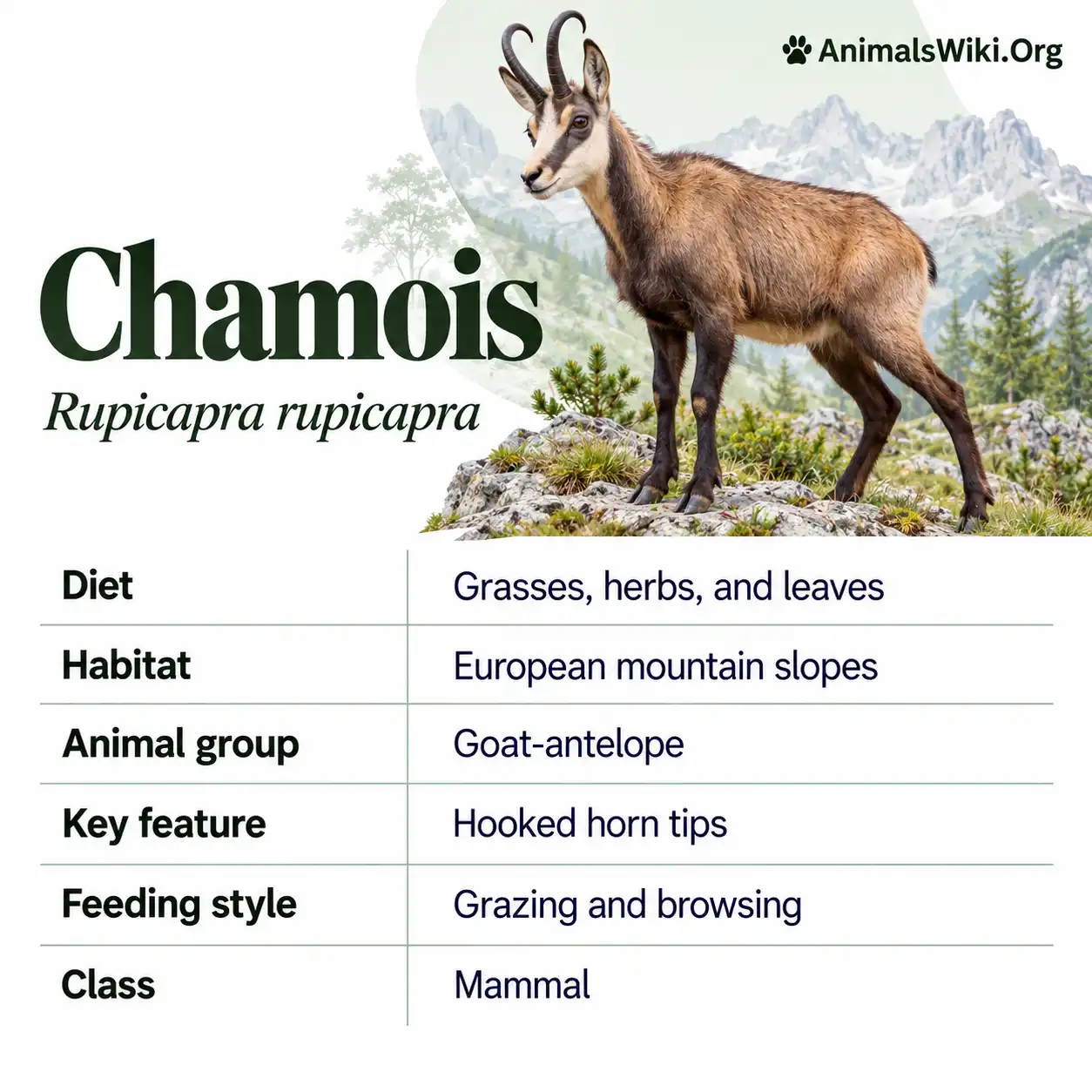
Chamois, The Remarkable Mountain Climber of Europe and Beyond
A movement on a distant mountainside can reveal an animal that seemed invisible moments earlier. A chamois steps from the shadow of a rock, pauses on a narrow ledge and climbs toward a patch of vegetation. Its dark facial stripes, slender hooked horns and compact body distinguish it from the surrounding landscape.
The chamois is one of the most recognizable mammals of European mountains. It occupies environments where steep ground, snow, short growing seasons and changing weather create demanding conditions. Yet it is more versatile than the familiar image of an animal permanently standing above the clouds suggests.
Chamois also use forests, shrublands and lower slopes. Their feeding choices change with local vegetation, while their movements respond to food, temperature, snow and disturbance. A shaded woodland can be as important to their survival as a dramatic rocky ridge.
The name “chamois” also covers more than one species. Two are commonly recognized: the northern chamois, Rupicapra rupicapra, and the southern chamois, Rupicapra pyrenaica. Their populations occupy different mountain systems and do not all share the same conservation circumstances.
This guide covers both species, with particular attention to the well-studied Alpine populations of northern chamois. Where findings apply to a particular species, region or study population, that distinction is made clear.
From specialized hooves to seasonal coats, from rapidly mobile kids to complex male breeding behavior, the chamois offers a detailed example of life in mountainous terrain. Its conservation story also shows why a favorable species-level status can coexist with vulnerable local populations.
Chamois Facts
| Feature | Information |
|---|---|
| Common name | Chamois |
| Genus | Rupicapra |
| Commonly recognized living species | Northern chamois and southern chamois |
| Northern species | Rupicapra rupicapra |
| Southern species | Rupicapra pyrenaica |
| Family | Bovidae |
| Broad relationship | Goat and sheep relatives, commonly called goat-antelopes |
| Native geographical setting | Mountain systems of Europe and parts of western Asia |
| Introduced occurrence | New Zealand’s South Island |
| Typical habitats | Rocky slopes, mountain grasslands, shrubland and forest |
| Main diet | Grasses, herbs and varying amounts of woody vegetation |
| Digestive system | Ruminant |
| Approximate adult shoulder height | Commonly around 70–90 centimeters |
| Approximate adult weight | Often around 25–50 kilograms, with substantial variation |
| Horns | Permanent, present in both sexes and hooked backward near the tips |
| Activity | Often active by day, with flexible daily schedules |
| Usual offspring | One kid |
| Gestation | Approximately 170 days |
| Typical European birth season | Late spring, commonly May–June |
| Conservation overview | Both species are listed as Least Concern; some local forms need greater protection |
1. What Is a Chamois?
A chamois is a relatively small, mountain-associated member of the cattle family, Bovidae. It belongs to the genus Rupicapra and is closely associated with the broader group containing goats and sheep.
The description “goat-antelope” is commonly used for animals in this group. It does not mean that a chamois is a hybrid between a goat and an antelope.
Chamois have their own evolutionary history and distinctive combination of features. Their slender horns, facial markings and relatively compact bodies separate them from the larger-horned ibex often seen in similar settings.
They are herbivores and ruminants. Food collection, digestion, resting and movement occupy much of their daily lives.
Their mountain association is strong, but “mountain animal” should not be interpreted as “animal that lives only on exposed summits.” Depending on the location and season, a chamois may spend considerable time among trees or on lower rocky slopes.
This flexibility matters. The animal’s success depends on using a range of resources, not simply tolerating cold weather or climbing steep ground.
Understanding the chamois therefore requires considering the entire mountain landscape, including the less spectacular places between cliffs and peaks.
2. Scientific Classification and the Two Species
Classification
| Taxonomic level | Classification |
|---|---|
| Kingdom | Animalia |
| Phylum | Chordata |
| Class | Mammalia |
| Order | Artiodactyla |
| Family | Bovidae |
| Genus | Rupicapra |
| Northern chamois | Rupicapra rupicapra |
| Southern chamois | Rupicapra pyrenaica |
Taxonomic references differ in how they arrange some ranks between family and genus. Chamois are commonly placed with goat and sheep relatives in Caprini; traditional treatments often use the subfamily name Caprinae.
Northern and southern chamois
Northern chamois include populations associated with the Alps and several mountain systems farther east.
Southern chamois include the Pyrenean, Cantabrian and Apennine forms. The Mammal Diversity Database recognizes these within Rupicapra pyrenaica, while noting that some authors have proposed additional species divisions.
Why names need care
“Alpine chamois” is sometimes used casually for the northern species, although the Alpine form is only part of its wider diversity.
Likewise, “Pyrenean chamois” can be used either for the southern species broadly or more narrowly for the population of the Pyrenees.
A clear article identifies the geographical setting whenever it discusses population estimates, behavior or conservation. Otherwise, information about one mountain population can easily be mistaken for a rule applying to every chamois.
3. Physical Appearance and Identification
Body shape
Chamois have a compact torso, relatively slender legs, upright ears and a short tail.
Their outline changes with season. A thick winter coat can make an animal look heavier than the same individual in summer.
Males and females are broadly similar. Adult males tend to be more robust, but sex can be difficult to establish from a distant photograph.
Body mass is particularly variable. A measurement recorded before the autumn breeding season may not be directly comparable with one taken after winter.
Facial markings
A pale face crossed by dark stripes is one of the most useful identification features.
The stripes run along the sides of the face around the eye region, contrasting with lighter cheeks and throat.
These markings help distinguish a chamois from other hoofed mammals in the same landscape, especially when the animal is too distant for a detailed view of its horns.
Summer and winter appearance
Northern chamois typically have a lighter brown or reddish-brown summer coat and a darker, thicker winter coat.
National park descriptions emphasize this seasonal transformation and the animal’s movement between woodland and mountain pasture.
Identification should therefore use several features together. An image of a dark winter animal and one of a pale summer animal may show the same species under very different conditions.
4. Horns and Age
Permanent horns
Both sexes carry horns. These grow upward before curving sharply backward near the tips.
The resulting hook is characteristic of chamois.
Unlike deer antlers, the horns are not shed and regrown each year. They consist of a keratin covering associated with an underlying bony core.
The difference matters when interpreting photographs. A hornless-looking young animal may simply have horns too small to see clearly.
Differences between males and females
Male horns are often thicker, with a more pronounced curve. However, these are tendencies rather than an infallible field test.
Age, viewing angle and individual variation complicate comparison.
An experienced observer may combine horn shape with body build and behavior, but uncertainty should remain visible when the view is limited.
Can horn rings reveal age?
Seasonal growth produces features that can help trained observers estimate age.
However, age determination requires more care than counting every visible line in a photograph. Wear and the quality of the view can affect interpretation.
Ötztal Nature Park describes the seasonal growth of chamois horns and their usefulness as an age indicator. It also emphasizes that the horns remain throughout life.
5. Chamois Compared With Ibex and Mountain Goats
Mountain hoofed mammals can look similar at first glance, especially at a distance. Horn shape, coat and geographical context help separate them.
| Feature | Chamois | Alpine ibex | North American mountain goat |
|---|---|---|---|
| Genus | Rupicapra | Capra | Oreamnos |
| Native association | European and western Asian mountain systems | European Alps | Northwestern North America |
| Typical appearance | Brown coat with dark facial stripes | Usually brown or gray-brown | Predominantly white, shaggy coat |
| Horn impression | Slender, upright and hooked near the tips | Especially large, backward-curving horns in adult males | Dark, relatively short and pointed |
| Both sexes horned? | Yes | Yes | Yes |
| Same animal as a domestic goat? | No | No | No |
These comparisons describe typical adult appearance, not every age or seasonal condition.
Why geography helps
A white mountain goat photographed in North America is not a chamois, even if both animals are standing on a cliff.
Similarly, the presence of several mountain ungulates in Europe means that location alone cannot establish identity.
The best approach combines geography with visible anatomy. This is more reliable than assuming every agile, horned animal on steep ground belongs to the same species.
6. Native Distribution
Northern chamois
Northern chamois occupy a discontinuous range across mountain systems in Europe and western Asia.
Their distribution includes the Alps, parts of the Balkans, the Carpathians, the Tatras, the Caucasus and areas of Turkey.
This is a collection of mountain populations rather than one unbroken herd extending across the continent.
The Mammal Diversity Database documents this broad distribution and separately identifies New Zealand as an introduced location.
Southern chamois
Southern chamois occur in the Pyrenees, the Cantabrian Mountains and the central Italian Apennines.
These separated populations have different histories and conservation needs.
The Apennine form is particularly important because protection and reintroduction have helped rebuild a population once restricted to a much smaller refuge.
Mountains do not guarantee connection
Two mountain ranges can appear close on a continental map while being effectively isolated for wildlife.
Valleys, roads, settlements and unsuitable habitat can restrict movement.
For conservation, the practical question is whether animals can exchange between populations safely and successfully. A line connecting mountain regions on a map does not establish that such movement occurs.
7. Habitat and Elevation
More than cliffs
Chamois use rocky terrain, grassland, shrubland and forest.
Steep slopes can provide escape opportunities, while nearby vegetation supplies food. Trees and varied slope exposure offer shelter from weather and heat.
These components work together. A cliff without accessible feeding habitat is not necessarily a complete living space.
Elevation varies
Chamois occur across a broad range of elevations.
Some populations spend summer above the tree line and move lower in winter. Others use lower rocky or wooded habitats more extensively.
A single altitude range should therefore not be presented as an absolute biological boundary.
Forests have several functions
Forest can provide forage, concealment and a different local climate from an exposed slope.
A 2024 tracking study found that Alpine chamois changed their habitat use with weather and time of day. Forest cover provided important refuge during high summer temperatures.
This finding challenges the idea that forests are merely winter shelters.
Habitat is a changing set of opportunities
The same slope can be attractive in one season and difficult in another.
Snow, plant growth, temperature and disturbance alter what the animal can obtain there. Chamois habitat should therefore be understood through time as well as space.
8. Diet and Seasonal Feeding
What do chamois eat?
Chamois eat grasses, herbs and varying amounts of leaves, shoots and other plant material.
They are often described as intermediate or mixed feeders because they can use both grassy vegetation and browse from woody plants.
The proportions differ between regions.
Why seasonal changes matter
During the growing season, fresh vegetation can offer relatively accessible nutrients.
As plants mature or snow covers feeding areas, the available diet changes. Animals may use different plants, different plant parts or different feeding locations.
Research on Pyrenean chamois found a varied diet that followed seasonal changes in plant production. The researchers emphasized the value of mixed vegetation containing herbs and shrubs.
Avoiding the “winter moss diet” simplification
Popular descriptions sometimes reduce the winter diet to mosses and lichens.
Those items can occur in accounts, but they should not replace the broader picture. Grasses and woody vegetation may remain important, depending on the population and local conditions.
A useful way to understand food selection
Imagine a mountainside as a changing menu.
The animal does not simply choose its favorite plant once and eat it throughout the year. It responds to accessibility, growth stage, nutritional quality and the cost of reaching a patch.
That balance helps explain why diet and movement are closely connected.
9. Digestion and Rumination
A ruminant digestive system
Chamois rely on microbial fermentation to process plant material.
Microorganisms help break down compounds that the animal could not use efficiently on its own.
Rumination involves returning previously swallowed material to the mouth for further chewing. An animal resting quietly may therefore still be engaged in an essential part of feeding.
Seasonal feeding has internal consequences
Changes in diet are not only visible as a shift from one plant to another.
Research in the Bavarian Alps has examined seasonal changes in the chamois digestive microbiota alongside forage availability. This shows that adaptation includes processes inside the digestive system as well as movements across the mountain.
Why more vegetation is not always better food
A large quantity of coarse material may provide less usable nutrition than a smaller quantity of suitable leaves.
Digestion takes time and has limits.
Consequently, a chamois cannot always compensate for poor food simply by grazing continuously. Feeding decisions must operate within the constraints of digestion, movement and other daily demands.
This is why habitat quality cannot be judged solely by how green or densely vegetated a slope looks to a visitor.
10. Hooves and Climbing Adaptations
A hard edge and a more yielding sole
The chamois hoof combines firm outer structures with a softer sole.
The edge helps engage small footholds, while the sole contributes contact with uneven surfaces.
Gran Paradiso National Park identifies these features as important to the animal’s ability to move on rock.
Cloven hooves
The main hoof is divided into two principal parts.
Their movement helps the foot accommodate irregular ground.
However, the animal’s agility is not a property of the hoof alone. Limb movement, balance, experience and route selection also contribute.
Skilled movement is not invulnerability
A chamois can travel confidently across terrain that looks alarming to a person, but it remains subject to gravity and unstable footing.
Loose stones, ice, snow and sudden disturbance can create danger.
Descriptions that make the animal sound incapable of falling are misleading.
Why spectacular jumping statistics deserve caution
Popular wildlife summaries often repeat exact maximum speeds or leap distances without explaining how they were measured.
Such figures are less informative than the established observation that chamois are highly agile on steep ground.
Their ordinary ability to choose footholds and move efficiently is more important to daily survival than an exceptional leap reported without context.
11. Seasonal Coats and Temperature Regulation
Winter insulation
The winter coat becomes thicker and darker than the summer coat.
Insulation reduces heat loss, but it also changes the challenges the animal faces as temperatures rise.
A body well equipped for cold cannot treat summer heat as irrelevant.
Seeking a suitable microclimate
Different parts of a mountain can have different temperatures at the same time.
Aspect, shade, wind and vegetation affect conditions near the ground.
An animal may move a relatively short distance and experience a meaningful change in exposure.
Thermal refuge
Research has shown that forested areas can buffer some temperature-related effects in Alpine chamois.
A study using long-term records of yearlings found evidence that forest cover moderated relationships between climate and body mass.
Adaptation includes behavior
Temperature regulation is therefore not only about growing or shedding hair.
It also involves choosing where to rest, when to feed and which routes to use.
Protecting a range of habitat conditions can give animals more options. A landscape containing only exposed feeding areas offers a different set of choices from one containing nearby shaded refuges.
12. Daily Activity and Movement
Flexible daily schedules
Chamois are often active by day, but their schedule is flexible.
Feeding, resting, rumination and movement change with temperature, season and local circumstances.
A group resting at midday may become more active later as conditions improve.
Heat and disturbance
A long-term study of female northern chamois examined how temperature and hikers influenced daily activity.
Its findings underline the need to consider both environmental conditions and human use of the landscape, rather than attributing every change in behavior to one cause.
Seasonal movement
Some chamois shift between summer and winter areas.
That movement can involve changes in elevation, slope aspect or vegetation.
However, not every population follows a simple rule of climbing in summer and descending in winter. Local terrain and feeding opportunities affect the pattern.
Home ranges are not random wandering
Repeated use of particular areas can reflect knowledge of food, shelter and routes.
A chamois may appear to be moving freely across a vast landscape while using a relatively familiar set of locations.
Understanding that pattern usually requires repeated observations or tracking rather than one brief encounter.
13. Herds and Social Organization
Females and young
Females commonly associate with young animals in groups.
The size and composition of those groups vary.
A temporary gathering on favorable grazing should not automatically be treated as a permanent social unit.
Adult males
Adult males often spend substantial periods apart from female groups.
However, the familiar description “all males are solitary” is too rigid. Associations and spacing change with age, season and circumstances.
Why group living matters
Nearby animals provide social information.
One individual may detect a disturbance while another is feeding. Responses can spread through changes in posture or movement.
Group living also creates competition for feeding space and other resources.
Avoiding a fixed herd-size rule
Published accounts frequently provide typical group ranges, but these are not maximum capacities.
A herd observed in one valley or season cannot establish what all chamois groups look like.
The useful questions concern who is present, how individuals interact and whether the grouping persists. Those details reveal more than a simple head count.
14. Communication and Alarm Behavior
The alarm whistle
Chamois are known for a sharp alarm whistle.
It can draw attention to a disturbance and alert nearby animals.
The whistle does not reveal exactly what the animal has detected. A person, dog, unfamiliar movement or predator may all provoke concern under different circumstances.
Posture and movement
Communication also includes orientation, stance and changes in spacing.
An animal that stops feeding and watches a particular direction can affect its companions before any sound is heard.
During social encounters, movements can communicate threat or withdrawal.
Reading behavior carefully
A raised head is not always evidence of panic, and a running animal is not necessarily fleeing a predator.
Behavior needs context.
Observers should consider what happened immediately before the response and what the animal does next.
Why this matters for visitors
Repeated alarm responses indicate that wildlife may be adjusting to a disturbance.
A visitor interested in natural behavior should give animals enough space to resume their activities.
The best sighting is not necessarily the closest one. Watching an undisturbed group often reveals more about feeding and social life.
15. Reproduction and the Rut
European breeding season
In European populations, mating generally occurs in autumn or early winter.
The rut often includes November, although timing varies with population.
Males become more actively involved in seeking or defending access to females.
More than one male strategy
Research in Alpine chamois has identified territorial and nonterritorial reproductive tactics.
Some males defend relatively restricted areas, while others follow females or enter areas occupied by competitors.
These are documented alternatives, not simply a division between successful adults and inexperienced young males.
Environment influences opportunities
Snow can affect where females feed and therefore which males encounter them.
A study of reproductive opportunities found that the benefits associated with territoriality depended partly on snow conditions and terrain.
Breeding effort has costs
Courtship, vigilance and competition require energy.
Time devoted to reproduction may reduce time available for feeding.
The rut therefore connects behavior with the body reserves needed for the approaching winter. Reproductive success cannot be understood independently of the environment in which those interactions occur.
16. Pregnancy, Birth and Maternal Care
Gestation and birth timing
Gestation lasts approximately 170 days.
European births commonly occur in May and June, linking early growth with the period of increasing vegetation.
One kid is usual; twins are uncommon.
Northern chamois accounts consistently describe this seasonal pattern, although exact timing differs between locations and years.
Early mobility
Kids are precocial: they can stand and begin accompanying the mother soon after birth.
This is essential in terrain where maintaining contact can require movement over uneven ground.
Early mobility does not make the newborn independent.
Maternal investment
The mother supplies milk and maintains a close association with the kid.
The young animal gradually increases its use of vegetation while developing strength and coordination.
Groups of young
Observers may see several kids together near females.
Such groupings can create the appearance of a nursery, but they should not be interpreted as proof that every adult provides milk to every youngster.
The social setting supports development while the mother–kid relationship remains important.
17. Growth, Lifespan and Survival
How long do chamois live?
Some chamois survive into their late teens or beyond 20 years.
Published lifespan ranges should not be converted into a universal average.
An individual’s prospects depend on its population, health, environment and exposure to human activities.
Growth is not uniform
Body mass differs with sex, age, season and habitat.
A growing kid and an adult male preparing for the rut allocate energy differently.
Long-term research across Alpine mountain ranges has found that habitat and climate help explain variation in growth patterns.
Survival and population structure
A population’s future depends on more than the number of animals present.
The balance of kids, breeding females and older individuals affects future recruitment.
A large-looking herd may still require attention if few young survive over several years.
Interpreting a thin animal
A single photograph rarely establishes poor health.
Season, age and recent reproductive effort can influence appearance.
Assessing condition requires appropriate context and, where necessary, direct examination. Wildlife articles should avoid diagnosing disease or starvation from an image alone.
18. Predators and Defensive Behavior
Mammalian predators
Wolves and Eurasian lynx can prey on chamois where their ranges overlap.
The importance of each predator varies considerably between regions.
A population living without one of these carnivores cannot be described as facing the same pressures as a population living alongside it.
Golden eagles and kids
Golden eagles can attack young chamois.
Published observations include both successful predation and unsuccessful attacks.
One report documented female Apennine chamois cooperating in a defense that deterred an eagle. This establishes that such behavior occurs, but not that every attack triggers the same response.
Terrain and escape
Steep, broken ground can offer opportunities to escape a pursuer.
However, reaching it may require abandoning a feeding patch.
Predation risk can therefore influence habitat use without a kill occurring.
Avoiding simple predator stories
The return of a predator does not automatically produce a predictable population decline.
A recent study of wolves and chamois examined changes in altitudinal behavior and highlighted the importance of indirect effects. Predator–prey relationships involve movement, alternative prey and local habitat as well as mortality.
19. Winter Challenges
Snow and food access
Snow can cover vegetation and increase the effort required to move.
Its depth, hardness and distribution matter.
A windswept ridge may offer exposed feeding opportunities while a nearby hollow holds deep snow.
Energy balance
Winter survival involves balancing food intake against expenditure.
Long movements, repeated disturbance and difficult footing can increase costs when food is limited.
Body reserves accumulated earlier provide an additional buffer, but they are finite.
Avalanches and accidents
Mountain terrain brings physical hazards.
No climbing adaptation removes the danger of unstable snow, falling rock or ice.
The same steepness that offers escape from some predators can create other risks.
Why winter refuges deserve protection
A winter refuge is valuable because it combines usable resources with tolerable conditions.
Disturbing animals there can force them into less favorable places.
Protecting such areas is therefore a practical conservation measure even where the wider mountain landscape appears extensive and undeveloped.
20. Ecological Importance
Herbivory
Chamois consume vegetation and contribute to the interactions shaping mountain plant communities.
Their effects depend on density, feeding choices and the productivity of the site.
Grazing and browsing are not automatically beneficial or harmful in every setting.
Nutrient movement
Dung and urine return nutrients to the environment.
Because animals move and use some areas more frequently than others, those inputs are unevenly distributed.
This links feeding behavior with soil and decomposer processes.
Food-web relationships
Chamois can support predators and scavengers.
Their ecological role therefore extends beyond the vegetation they consume.
A carcass may provide resources to several species even when only one predator caused the death.
Native context matters
These functions must be interpreted within the ecosystem concerned.
A native chamois population in Europe and an introduced population in New Zealand can perform similar physical activities while having different conservation consequences.
Ecological importance does not mean that increasing the animal everywhere is an appropriate goal.
21. Climate Change and Scientific Evidence
Several pathways of influence
Changing temperatures can affect vegetation, snow, heat exposure and the timing of food availability.
These changes may influence feeding opportunities and growth.
However, there is no single response that applies equally to all chamois populations.
Evidence of declining body mass
A 2024 Swiss study linked warmer spring conditions with an approximately three-kilogram decline in yearling body mass over its 27-year study period.
The result concerns the animals, age class and area examined. It is not evidence that every adult chamois throughout Europe has lost the same amount of weight.
Evidence also varies
Another extensive study of Alpine ungulates found stable body mass and size in its eastern Swiss study populations between 1991 and 2013.
Different results can reflect location, time period, age class and methods rather than a simple contradiction.
Conservation implications
The evidence supports continued monitoring and protection of habitat variety.
Shaded forests, varied slopes and access between seasonal areas can provide options as conditions change.
Precise predictions require local information. Responsible communication separates an observed relationship from a proposed mechanism or future projection.
22. Disease and Competition
Disease outbreaks
Disease can cause major local losses even in a species that is widespread overall.
Pestivirus associated with border disease has produced severe mortality in some Pyrenean chamois populations.
Research comparing threats identified these outbreaks as potentially important population drivers under the conditions modeled.
Other health concerns
Sarcoptic mange and infectious eye disease also feature in chamois health research.
Their occurrence and severity vary.
It would be inaccurate to imply that every mountain population is experiencing the same outbreak.
Livestock and other wild herbivores
Chamois may share vegetation with livestock or other wild ungulates.
Dietary overlap can indicate potential competition, but overlap alone does not prove that one population is harming another.
Resources must be limiting, and the animals must interact in relevant ways.
A study of Alpine ungulates explicitly distinguished food-niche overlap from demonstrated competition.
Management needs diagnosis
A declining population may face several pressures at once.
Identifying the main drivers requires evidence rather than automatically blaming predators, livestock, weather or disease.
The most effective response follows the cause established for that population.
23. Population Estimates and Conservation Status
Species-level status
Both northern and southern chamois are listed as Least Concern in current taxonomic reference summaries.
Northern chamois have a newer IUCN assessment conducted in 2023 and published in 2025. Older assessments remain widely searchable, so dates should be checked before quoting them.
Dated population estimates
A 2022 scientific review compiled approximate numbers from available assessments and regional sources.
| Group | Approximate figure in the 2022 review | Interpretation |
|---|---|---|
| Northern chamois | 550,000 | Broad compiled estimate |
| Southern chamois | 71,500 | Broad compiled estimate |
| Alpine form in the Alps | 500,000 | Included within the northern total |
| Apennine form | 2,500 | Included within the southern total |
These are dated estimates, not a synchronized global census conducted in 2022 or a verified total for 2026.
The component figures should not be added again to the species totals.
Local risk can be much greater
Least Concern at species level does not establish security for every subspecies.
A small, isolated population may face risks that are obscured by a large total elsewhere.
Why counts are uncertain
Mountain terrain makes animals difficult to detect.
Forest cover, weather, observer position and timing influence sightings.
Repeated surveys conducted consistently can reveal trends even when they do not detect every individual. A precise-looking number should not be mistaken for perfect knowledge.
24. Protected Areas and Population Management
Refuges and research
Protected areas can maintain habitat, reduce disturbance and provide opportunities for long-term study.
Gran Paradiso National Park, for example, has supported research on chamois ecology and behavior over many years.
Such work helps replace assumptions with observations of identifiable animals.
The Apennine recovery
The Apennine chamois illustrates the importance of targeted protection.
Abruzzo, Lazio and Molise National Park describes how protection helped save the form and how reintroductions subsequently established populations in additional Apennine protected areas.
Reintroductions require care
Moving animals is not automatically a conservation success.
Suitable habitat, ancestry, health, future monitoring and the causes of the original loss all matter.
A release into an area where the original threat remains may achieve little.
Managing beyond park boundaries
Animals do not necessarily remain inside administrative lines.
Cooperation among neighboring authorities helps address movements, hunting, disturbance and disease.
The aim is a viable population across its usable landscape, rather than a favorable count confined to one management unit.
25. Chamois in New Zealand
An introduced population
Chamois were introduced to New Zealand in the early twentieth century and now occur on the South Island.
Their presence is separate from the native European and western Asian distribution.
Reversed seasons
The Southern Hemisphere changes the calendar.
New Zealand’s Department of Conservation describes a rut beginning around May and peaking toward late May or early June.
European rut dates should therefore not be copied into a New Zealand account.
Different ecological consequences
New Zealand’s native vegetation developed without these introduced hoofed mammals.
The Department of Conservation manages chamois and other introduced browsers because they can damage native plants and habitats.
Diet demonstrates flexibility
Research in Westland forests found substantial use of woody plants by chamois.
That is a useful reminder that they are not restricted to grazing open alpine lawns.
Why conservation goals differ
Protecting a native population and controlling an introduced population can both be legitimate biodiversity objectives.
The difference comes from ecological context.
A species does not have one universal management role in every place where people have established it.
26. Responsible Wildlife Observation
Watch from a distance
Binoculars allow a detailed view without requiring a close approach.
Remain far enough away that animals can continue feeding, resting and interacting.
If they repeatedly stop to monitor you, increase the distance.
Avoid following them toward escape terrain
A chamois moving onto a cliff is not inviting pursuit.
Following can prolong disturbance and create risks for both wildlife and people.
Respect seasonal restrictions
Winter refuges and breeding areas may need additional protection.
Follow local guidance on trails, dogs and access.
The relevant rules differ among parks and countries, so general advice should not replace instructions at the site.
Publish accurate photographs
Use captions that distinguish chamois from ibex and other mountain mammals.
Identify the location when known, since it helps establish which population is shown.
Avoid claiming an exact age, sex or health condition when the photograph does not support it.
27. Frequently Asked Questions About Chamois
What is a chamois?
A chamois is a hoofed, plant-eating mammal in the genus Rupicapra. It belongs to the cattle family and is related to goats and sheep. Its distinctive features include dark facial stripes, slender hooked horns and agility on steep ground.
Is a chamois a goat or an antelope?
It is commonly called a goat-antelope and belongs to the broader group containing goat and sheep relatives. That name does not describe a hybrid. Chamois form their own genus and differ from domestic goats, ibex and the antelopes familiar from African grasslands.
How many chamois species are there?
Two living species are commonly recognized: northern chamois, Rupicapra rupicapra, and southern chamois, Rupicapra pyrenaica. Some authors propose finer divisions. This article follows the two-species treatment and identifies regional forms when their biology or conservation needs differ.
Where do chamois live naturally?
Their native range includes mountain systems in Europe and parts of western Asia. Northern chamois occupy regions including the Alps, Balkans and Caucasus. Southern chamois occur in the Pyrenees, Cantabrian Mountains and Apennines. Their distribution is discontinuous rather than continent-wide.
Are chamois native to New Zealand?
No. They were introduced. Their management there differs from conservation in their native range because browsing can affect indigenous vegetation. Modern presence does not establish native status, and the ecological consequences of an introduction must be evaluated within the receiving landscape.
Do chamois live only above the tree line?
No. They also use forests, shrublands and lower rocky slopes. The balance varies by population and season. Forest can provide food, shelter and refuge from summer heat, making it a meaningful part of chamois habitat rather than merely a place passed through.
What do chamois eat?
They consume grasses, herbs and varying amounts of woody vegetation such as leaves and shoots. Diet changes with location and season. Some populations rely heavily on grasses, while others incorporate substantial browse. No single short food list describes every chamois population.
Are chamois ruminants?
Yes. They use microbial fermentation to help digest plant material and chew cud as part of processing food. A resting animal may therefore still be digesting an earlier meal. Its feeding strategy includes both collecting vegetation and spending time processing it.
How do chamois climb steep rocks?
Their hooves combine firm edges with softer soles, helping them use uneven footholds. Divided hooves, coordinated movement and balance also contribute. Their agility comes from several interacting features, not a single structure that guarantees a grip on every surface.
Can chamois fall?
Yes. They remain vulnerable to unstable ground, ice, avalanches and accidents. Being highly adapted to steep terrain does not remove physical risk. Disturbance can also force animals to move when they would otherwise remain in a safer position.
Do female chamois have horns?
Yes. Both sexes carry permanent horns. Male horns tend to be more robust and strongly hooked, but there is overlap. Sex should not be assigned from horn presence alone, and a distant photograph may not provide enough detail for certainty.
Do chamois shed their horns?
No. Their horns remain throughout life and continue growing. This differs from the annual antler cycle of most male deer. Growth features can help trained observers estimate age, although a clear and appropriate view is needed.
How large is a chamois?
Many northern chamois stand around 70–90 centimeters at the shoulder and weigh roughly 25–50 kilograms. Size varies with population, sex, age and season. Those figures are general guidance and should not be treated as universal limits for every chamois.
Why do chamois become darker in winter?
Their seasonal coat changes include thicker, darker winter fur. The winter coat provides insulation, while behavioral choices help the animal manage temperature. Color alone does not explain winter survival; food access, shelter and energy reserves also matter.
What sound does a chamois make?
Its best-known call is a sharp alarm whistle. The sound indicates that the animal has detected something concerning, but it does not identify the source. Nearby animals may also respond to changes in posture and movement.
Do chamois live in herds?
Females and young commonly form groups, while adult males often spend periods apart. Group size and membership vary. A large temporary gathering on good feeding habitat should not automatically be interpreted as one permanent herd.
When do chamois mate?
European populations usually mate during autumn or early winter, often around November. Introduced New Zealand populations follow a Southern Hemisphere schedule. Breeding dates should always be associated with a location rather than presented as one worldwide calendar.
How long is a chamois pregnant?
Gestation is approximately 170 days. One kid is usual, although twins can occur. In Europe, births commonly take place in late spring. These are general biological patterns, with some variation between populations and years.
Can newborn chamois walk?
Kids can stand and begin following their mothers soon after birth. They are precocial, but not independent. Milk, maternal contact and developing coordination remain important, particularly in terrain where a short movement may involve steep or uneven ground.
How long do chamois live?
Some reach their late teens or survive beyond 20 years. That does not mean an average wild animal necessarily reaches those ages. Potential longevity, maximum recorded age and average survival measure different things and should remain distinct.
What predators eat chamois?
Wolves and Eurasian lynx can prey on chamois where they coexist. Golden eagles can attack kids. The importance of each predator varies by region, so a general list should not imply that every chamois faces the same predators.
Are chamois endangered?
Both species are listed as Least Concern at species level. However, some geographically restricted forms have greater conservation needs. A favorable overall category can coexist with local decline, isolation or disease outbreaks.
How many chamois remain?
A 2022 scientific review compiled approximate totals of 550,000 northern and 71,500 southern chamois. These are dated estimates assembled from different sources, not a synchronized current census. Population figures should retain their dates and scope.
Does climate change affect chamois?
Studies have documented relationships involving temperature, habitat use and growth, but effects vary. Some populations show declining yearling mass, while other studies report stable measurements. The evidence supports local monitoring rather than one universal prediction.
Why are forests important to chamois?
Forests can provide forage, cover and a cooler microclimate. Tracking and long-term studies indicate that forest cover can buffer some heat-related effects. Protecting only exposed alpine habitat may therefore overlook resources used at other times.
Is a chamois the same as an ibex?
No. They belong to different genera and differ in appearance. Adult male Alpine ibex have much larger horns, while chamois have slender, hooked horns and distinctive facial stripes. Location and several anatomical features should be considered together.
What is an Apennine chamois?
It is the distinctive southern chamois form associated with the central Italian Apennines, usually called Rupicapra pyrenaica ornata. Protection and reintroductions have supported its recovery. Its restricted distribution makes population-specific conservation particularly important.
Can tourists disturb chamois?
Yes. Close approaches, pursuit and uncontrolled dogs can interrupt normal activity. Effects depend on circumstances and season. Observers should follow local guidance, remain at a suitable distance and allow animals to choose where they feed or rest.
Chamois (Rupicapra)
The chamois is an accomplished mountain mammal whose abilities extend beyond climbing. Its survival depends on combining specialized feet, seasonal coats, flexible feeding and careful use of a varied landscape.
Rocky slopes provide important opportunities, but forests, shrubs and meadows also contribute. Temperature, snow, food and social relationships influence where animals move and how they spend their time.
The distinction between northern and southern chamois remains important. So does the difference between a widespread species and a small regional population. Dated estimates and local evidence provide a clearer picture than a single undifferentiated global total.
Conservation must respond to that variation. Some populations need protection from disturbance or overharvesting; others require disease monitoring, habitat connections or carefully planned recovery programs. Introduced populations in New Zealand raise different ecological questions.
Understanding the chamois means seeing the whole mountain system around it. The animal on the ledge is connected to seasonal vegetation, shaded forest, neighboring populations and the decisions people make about those places.



