
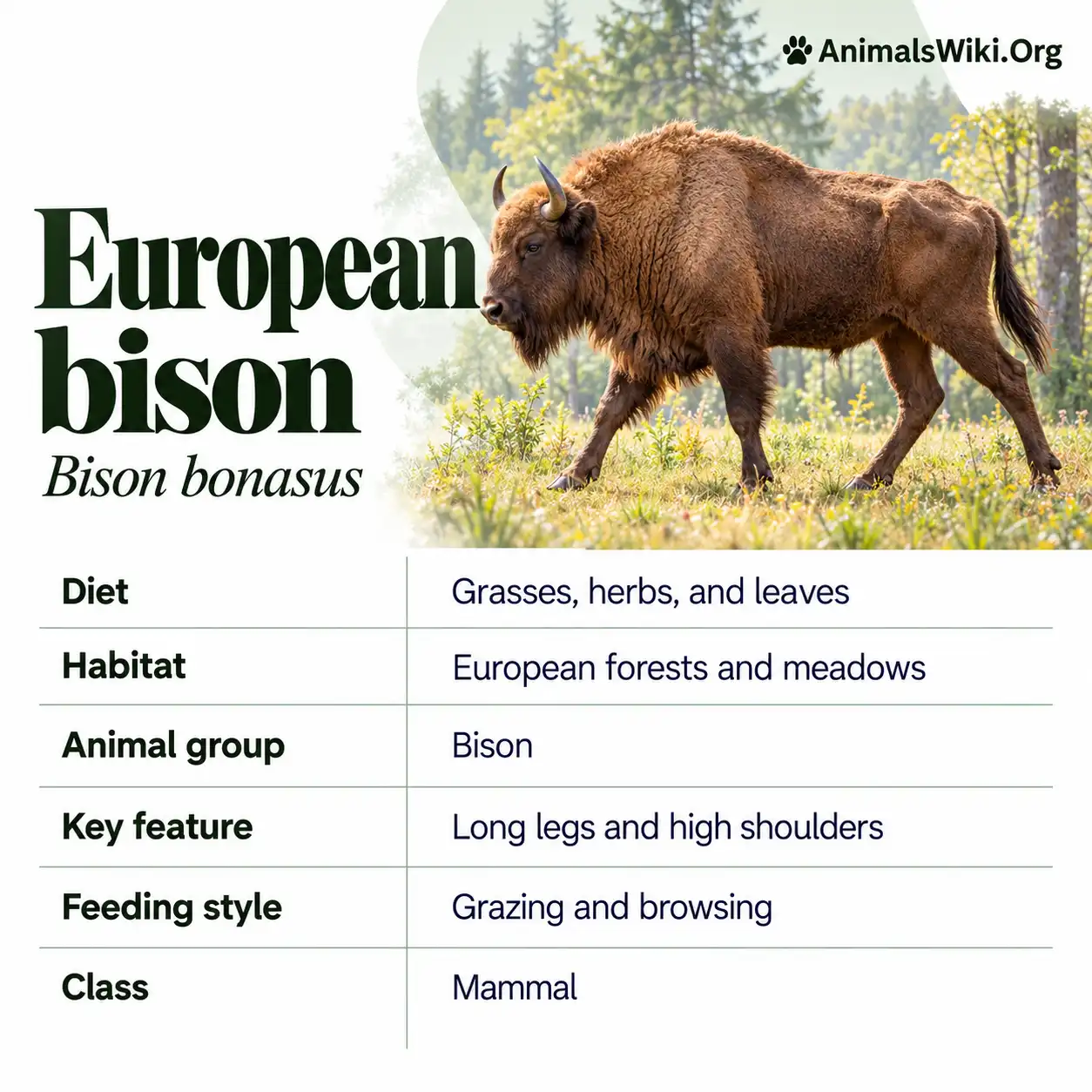
European Bison, The Remarkable Comeback of Europe’s Largest Land Mammal
A European bison emerging from woodland can transform an ordinary forest scene. Its massive shoulders, curved horns and heavy brown coat give it an almost prehistoric appearance. Yet this animal belongs to the present: a living part of Europe’s wildlife and one of its most significant conservation recoveries.
Also called the wisent, the European bison disappeared from the wild during the early twentieth century. The species survived because animals remained in zoos and other managed collections. International cooperation, carefully documented breeding and later reintroductions made its return possible.
That history is extraordinary, but it is only part of the story. The European bison is also a large herbivore whose feeding, movement and physical disturbance can influence vegetation and other organisms. Its return raises questions about how landscapes function and how people can share space with large wildlife.
The animal is often described as a forest specialist. However, its relationship with habitat is more flexible. Woodland offers shelter, while grasslands, clearings and other open areas can provide important feeding opportunities. Understanding that combination is essential when choosing places for conservation.
Population growth has brought new opportunities and responsibilities. More animals do not automatically mean connected populations, sufficient genetic diversity or freedom from conflict. A herd may need assistance even while the worldwide total increases.
This guide explores the European bison’s identification, classification, habitat, diet, behavior, reproduction, predators and ecological importance. It also explains its recovery, presents dated population figures and distinguishes established findings from claims that require further evidence.
European Bison Facts
| Feature | Information |
|---|---|
| Common name | European bison |
| Alternative name | Wisent |
| Scientific name used here | Bison bonasus |
| Family | Bovidae |
| Closest familiar comparison | American bison, Bison bison |
| General distinction | Europe’s largest living wild land mammal |
| Native geographical association | Europe and parts of the Caucasus region |
| Typical modern habitat | Landscapes combining woodland, clearings, grassland and other feeding areas |
| Diet | Grasses, herbs, leaves, shoots, bark and other vegetation |
| Feeding system | Ruminant herbivore |
| Adult male weight | Commonly around 500–900 kilograms; exceptionally larger |
| Adult female weight | Often approximately 320–640 kilograms |
| Male shoulder height | Can approach two meters |
| Horns | Present in both sexes |
| Social organization | Mixed female–young groups, small male groups and solitary individuals |
| Gestation | Approximately nine months |
| Usual offspring | One calf |
| Typical European calving period | Mainly late spring and early summer |
| Conservation status | Near Threatened |
| Verified worldwide register total | 12,209 at December 31, 2024 |
| Free-living category within that total | 9,762 |
1. What Is a European Bison?
The European bison is a large, hoofed mammal belonging to the cattle family, Bovidae. It is related to domestic cattle and other wild bovines, but it is a distinct wildlife species with its own evolutionary and conservation history.
Its alternative name, wisent, is especially useful because it separates the animal clearly from American bison.
European bison are herbivores. Their size allows them to consume substantial amounts of vegetation, while their ruminant digestive system helps process plant material.
They are also social animals, although they do not always move in one permanent herd. Individuals can associate, separate and regroup as conditions change.
Their importance extends beyond their impressive appearance. They consume plants, redistribute nutrients, disturb soil and interact with other wildlife. These activities help explain why conservationists are interested in restoring bison as functioning members of ecosystems.
However, being ecologically influential does not mean they are suitable for every location. A large herbivore needs appropriate food, space and management arrangements.
The European bison therefore represents both an animal conservation achievement and a continuing test of how modern landscapes can accommodate large wild mammals.
2. Scientific Classification and Names
Classification
| Taxonomic level | Classification |
|---|---|
| Kingdom | Animalia |
| Phylum | Chordata |
| Class | Mammalia |
| Order | Artiodactyla |
| Family | Bovidae |
| Genus used here | Bison |
| Species | Bison bonasus |
Some taxonomic treatments place bison within the genus Bos. Readers may therefore encounter Bos bonasus in scientific material.
This article uses Bison bonasus, the name familiar from the European Bison Pedigree Book and major conservation publications.
Wisent, bison and buffalo
“Wisent” refers specifically to the European bison.
“Bison” can refer to either the European or American species, depending on context.
“Buffalo” is commonly used for American bison in everyday speech, but true buffalo belong to different groups. African buffalo and Asian water buffalo are not European bison.
Why names matter
A search for “bison behavior” may return research on American animals. Although the species share many characteristics, their environments and histories differ.
Information about North American population totals, breeding programs or predator relationships should not automatically be transferred to the European species.
Using the full common or scientific name helps keep those distinctions clear.
3. Physical Appearance and Identification
A powerful front end
The European bison has a particularly substantial shoulder region, a large head and a strong neck.
Its shoulder hump is supported by the structure of the spine and associated musculature. The back slopes away from the elevated front of the body.
Adult males are usually heavier and more robust than females. A mature bull can therefore look markedly different from a young animal, even within the same herd.
Coat and seasonal condition
The coat ranges through shades of brown and is especially noticeable around the head, neck and shoulders.
Seasonal shedding can produce a patchy appearance. Loose winter hair does not automatically indicate disease.
Condition, light and age also affect how an animal looks in photographs.
Horns
Both sexes have horns.
They are relatively short compared with the enormous horns of some wild cattle, but they remain effective structures during social encounters and defense.
Horn presence alone does not distinguish males from females.
Identifying the whole animal
A reliable identification considers body shape, coat, horns and context together.
A close-up of the head may conceal useful differences in proportions. Likewise, photographs taken through vegetation can make shoulder shape difficult to judge.
The wisent’s distinctive outline becomes clearer when the whole body is visible.
4. European Bison vs American Bison
The two living bison species are closely related and broadly similar, but they are not interchangeable.
| Feature | European bison | American bison |
|---|---|---|
| Scientific name | Bison bonasus | Bison bison |
| Common alternative name | Wisent | Often called buffalo |
| Native continent | Europe and adjacent parts of western Eurasia | North America |
| General body impression | Often relatively tall and less heavily front-loaded | Often more massive through the head and shoulders |
| Coat impression | Usually less dramatically shaggy around the forequarters | Often more conspicuous shaggy forequarters |
| Feeding ecology | Flexible use of grasses, herbs and browse | Strong grazing association, with variation |
| Modern conservation history | Restored after extinction in the wild | Severe historical decline followed by recovery in managed and conservation populations |
These are broad comparisons, not identification rules without exceptions.
The Royal Zoological Society of Scotland describes European bison as generally taller but lighter than their American relatives, while emphasizing differences in body proportions and habitat use.
Why size alone is unreliable
The weight ranges overlap.
A large European bull may outweigh a smaller American individual. Sex, age and nutritional condition can matter more than a simple species average.
The most useful comparison examines proportions and several visible features rather than asking which animal looks heavier.
5. Historical and Modern Distribution
A formerly broader range
European bison once occupied a much wider area than their remaining natural populations did immediately before extinction in the wild.
Over time, hunting, habitat change and expanding human pressures reduced their distribution.
The final refuges did not necessarily represent every habitat the species could use. Survival in a forest stronghold is not proof that closed forest was always its only suitable environment.
Modern populations
Reintroductions have established populations in several European countries.
Poland, Belarus and Russia hold especially important numbers, while additional populations occur elsewhere through conservation programs.
Exact distribution changes as releases, movements and management decisions occur.
Presence does not establish ecological independence
An animal can appear on a distribution map while living inside an enclosure or depending heavily on intervention.
For that reason, modern maps should ideally distinguish free-living, semi-free and captive populations.
Restoring a range is more than adding dots
A new herd may help distribute risk, but its contribution depends on habitat, ancestry, health and long-term prospects.
A successful restoration establishes conditions in which animals can persist, rather than merely documenting that they were released.
6. Habitat: Forests, Meadows and Landscape Mosaics
The forest association
European bison are strongly associated with forests in public imagination.
Woodland can provide shade, shelter and separation from intensive human activity. It also contains feeding opportunities, particularly where the ground vegetation is productive.
However, not every forest provides enough accessible food throughout the year.
The importance of open areas
Meadows, clearings and other open patches can be valuable feeding habitat.
A combination of shelter and accessible forage can be more useful than a large area of uniformly dense woodland.
The Convention on Migratory Species describes how bison in Białowieża use both forest and surrounding farmland, with winter food availability and management influencing their movements.
The refuge-species interpretation
Research has examined whether human pressure pushed European bison into forests that served as refuges.
Historical and isotopic evidence has contributed to that discussion.
It supports questioning a narrow forest-specialist label, but it does not establish that every open landscape is appropriate for reintroduction.
Habitat quality is multidimensional
Useful habitat includes more than vegetation.
Water, resting sites, connectivity, disturbance and neighboring land uses all matter.
A landscape may contain abundant food yet be difficult to use because reaching it requires crossing roads or entering cultivated fields.
7. Diet and Feeding Choices
What do European bison eat?
Their diet includes grasses, herbs, sedges, leaves, shoots and bark.
The balance changes with location and season.
Gdańsk Zoo’s species account emphasizes both the variety of plants consumed and the importance of open feeding areas such as meadows and pastures.
Grazing and browsing
Grazing involves feeding mainly on grassy vegetation, while browsing involves leaves, twigs and other material from woody plants.
European bison can do both.
This flexibility helps them use different environments, but it should not be interpreted as an ability to thrive on any vegetation.
Food still varies in digestibility, accessibility and nutritional value.
Evidence from dung analysis
DNA-based research has identified a wide variety of plants in European bison diets.
A study of a forest population in Denmark found herbs, trees, grasses and shrubs represented in dung samples. Such findings demonstrate dietary breadth while remaining specific to the animals and season studied.
Why percentages need context
The proportion of plant DNA detected is not automatically the same as the proportion of food mass swallowed.
Different methods measure different aspects of diet.
The safest general conclusion is that European bison have a varied feeding ecology and that local conditions strongly influence what they consume.
8. Digestion and Water Requirements
A ruminant feeding strategy
European bison use microbial fermentation to process plant material.
Their digestive system allows microorganisms to break down structural compounds that mammals cannot use efficiently on their own.
Rumination involves returning swallowed material to the mouth for further chewing.
An animal resting and chewing is therefore still engaged in food processing.
Why food quantity is not enough
A field containing a large amount of vegetation may offer relatively little usable nutrition.
Mature stems, inaccessible growth and low-quality material can limit feeding value.
The animal must obtain enough nutrients within the constraints of movement, chewing and digestion.
Water belongs in habitat planning
Reliable water access is part of the practical requirements for a bison population.
Managers must consider how animals reach it and whether they can do so without encountering barriers or conflict.
Feeding, digestion and movement are connected
A herd’s route through a landscape reflects more than curiosity.
Animals move among resources, pause to process food and adjust to weather or disturbance.
Understanding that cycle helps explain why an apparently quiet herd can still be using its habitat actively and efficiently.
9. Physical and Seasonal Adaptations
Large body size
A large body provides advantages in a cool environment, including a relatively low surface area compared with volume.
However, size also creates substantial food requirements.
An adult bison cannot maintain itself simply because it tolerates cold. It must obtain enough usable energy.
Seasonal coat changes
The winter coat provides insulation, while shedding helps the animal adjust to warmer conditions.
Shade and resting behavior also matter during hot weather.
A dense coat is therefore only one part of temperature management.
Strength and mobility
European bison can move more quickly and turn more effectively than their bulky appearance suggests.
A calm animal should never be assumed incapable of a rapid response.
Exact maximum-speed or jumping claims are less useful for understanding everyday behavior than recognizing that these are powerful, mobile wild mammals.
Adaptation does not remove limitations
Deep snow, restricted feeding areas and prolonged poor conditions can still create difficulties.
The relevant question is not whether bison are “hardy,” but whether the landscape supplies enough resources under the conditions they face.
10. Daily Activity and Movement
Repeated feeding and resting
Daily activity includes feeding, walking, resting and rumination.
The schedule changes with season, temperature and local management.
Korkeasaari Zoo describes stronger morning and evening activity in summer, with resting and chewing in shade during the hottest part of the day.
Movement follows resources
A herd may shift between woodland and open feeding areas.
Some individuals explore beyond familiar areas, while others repeatedly use established routes.
These movements can change when food is concentrated at supplementary feeding sites.
What tracking studies reveal
Research on a semi-free-ranging herd found that environmental conditions and hay provision influenced movement and social organization.
The study also documented small groups and changing associations. Its findings illustrate how management can affect behavior rather than merely supporting animal numbers.
One observation is only a moment
A visitor seeing bison lying down has not established that the species spends most of its life inactive.
Likewise, a photograph of animals in a field does not show whether they spend the rest of the day in woodland.
Repeated observations provide a more useful picture.
11. Herds and Social Relationships
Mixed groups
Female bison, calves and younger animals commonly associate in mixed groups.
Adult males may join them, particularly around the breeding season.
Other males occur alone or in smaller associations.
Groups can split and merge
European bison show what researchers call fission–fusion dynamics.
In plain terms, groups divide and come together again.
This allows the number of animals moving together to change with circumstances.
Social structure is more than group size
Two herds containing the same number of animals may have different relationships among their members.
Age, familiarity and repeated association can influence who remains near whom.
A social-network study examined these relationships in a semi-free herd, while clearly acknowledging that its sample represented one group rather than the entire species.
Why social knowledge matters for conservation
Moving animals between populations changes their social setting as well as their location.
Release planning should therefore consider group composition and behavior alongside genetics and health.
An animal’s ability to feed and breed can depend partly on how it fits into its new group.
12. Communication and Dominance
Several forms of information
Bison communicate through posture, movement, scent and sound.
A change in head position or orientation can matter before any physical contact occurs.
During the rut, males become especially attentive to females and competitors.
Dominance is not constant fighting
Physical conflict can be costly.
Displays and assessment can help animals respond to one another without every interaction escalating into a clash.
That does not make the horns or body mass harmless. Serious injury remains possible.
Leadership and collective movement
A group’s departure from a resting area may involve a sequence of individual decisions rather than one simple command.
Researchers have studied how European bison coordinate movement within changing groups.
Interpreting behavior cautiously
An animal looking toward a person is not necessarily preparing to charge.
However, its behavior should not be treated as permission to approach.
The responsible response is to provide space and allow it to continue its normal activities.
Understanding communication is useful for observation, but it does not replace the guidance of reserve staff.
13. Reproduction and the Rut
Seasonal breeding
In many free-living European populations, the main breeding activity occurs in late summer and early autumn.
Timing varies, and managed populations may show a broader pattern.
The rut includes males seeking access to receptive females and responding to competitors.
A tending relationship
A bull may remain close to a receptive female, following and monitoring her.
This can reduce time spent feeding or resting.
Breeding behavior therefore involves an energetic investment as well as an opportunity to reproduce.
Maturity and breeding success are different
A young male can be physiologically capable of breeding before regularly obtaining mating opportunities.
Social competition affects which males reproduce.
This distinction is important when reading age-at-maturity figures. Such figures do not necessarily identify the age at which every animal first produces offspring.
Food conditions can affect timing
Recent research across European herds has examined links between winter feeding conditions and breeding synchrony.
This connects reproduction with nutrition and management, rather than treating the breeding calendar as entirely fixed.
14. Calves and Maternal Care
Pregnancy and birth
Gestation lasts roughly nine months.
One calf is usual, while twins are rare.
Births commonly occur in late spring and early summer, although timing varies.
Females often separate from the group around birth and later return with the calf.
Early development
Calves can stand relatively soon after birth, but they remain dependent on the mother.
Milk supports early growth, while grazing and other feeding behaviors develop gradually.
The University of Michigan’s species account describes early standing, maternal care and a continuing mother–calf association.
A calf’s needs differ from an adult’s
A newborn has less strength and experience.
Its ability to remain close to the mother matters, especially during disturbance.
The presence of adults can offer protection, but it does not eliminate every risk.
Recruitment is more than birth numbers
A population may produce many calves but still have weak recruitment if too few survive.
Monitoring should therefore follow development and survival, not simply record that births occurred.
The transition from newborn to breeding adult is a major part of population recovery.
15. Growth, Lifespan and Survival
Sexual differences develop with age
Male and female calves do not begin life with the dramatic size difference seen between mature bulls and cows.
That difference develops during growth.
Nutrition, health and age influence the final appearance of an animal.
How long do European bison live?
European bison can survive for around two decades, and some females live longer.
Captive longevity and free-living survival should remain separate.
A maximum recorded age does not establish the average lifespan of a wild population.
General zoo references commonly describe potential longevity around 20 years, while detailed accounts report differences between sexes and conditions.
Population age structure
A healthy-looking group of adults may still face future decline if recruitment is poor.
Conversely, a large number of young animals creates future demands for space and food.
The balance among calves, breeding adults and older individuals helps determine the population’s prospects.
Why marked animals are valuable
Following known individuals allows researchers to connect survival with age, reproduction and movement.
Without such records, an animal disappearing from a count might have died, moved away or simply gone undetected.
16. Predators and Defensive Behavior
Large size reduces vulnerability
Healthy adult European bison are difficult prey.
Their strength, horns and social responses make attacking them risky.
However, the statement that European bison have no natural predators is too absolute.
Evidence involving wolves
A 2026 study documented a wolf attack directed at a newborn calf in Białowieża.
Adults responded, and the report described protective grouping around the calf.
The observation demonstrates that attempts occur. It does not establish how frequently wolves attack bison or what proportion of attempts succeed.
Why age and condition matter
A newborn calf presents different opportunities from a large adult bull.
Predator behavior also depends on the availability of alternative prey and the local environment.
Predation and population regulation
One dramatic encounter cannot establish that predators regulate the whole bison population.
That requires broader information about mortality and reproduction.
The useful conclusion is narrower: European bison are formidable animals, yet their interactions with predators remain biologically meaningful and incompletely understood.
17. Ecological Importance
An ecosystem engineer
European bison can alter their surroundings through feeding, trampling, rubbing and soil disturbance.
The term “ecosystem engineer” describes this capacity to change habitat conditions.
It does not mean every effect is beneficial to every species.
Effects on vegetation
Removing vegetation can change competition among plants.
A 2024 study found increased plant species richness in the forest habitats it examined following bison introduction.
The result supports a role for bison in habitat management while remaining specific to the study’s conditions.
Dung and seeds
Dung returns nutrients and provides resources for decomposers and insects.
Seeds can also move through the digestive system or become attached externally.
Research has examined viable seed dispersal by bison under different management conditions.
Why density matters
A moderate level of disturbance can create opportunities for some plants, while excessive pressure can damage others.
Ecological benefits therefore depend on animal density, vegetation and conservation objectives.
The appropriate goal is a functioning relationship between animals and habitat, not the largest possible number of bison.
18. Winter Feeding and Management
Why supplementary feeding occurs
Managers may provide food to support animals during difficult conditions or reduce movement into agricultural areas.
Feeding has played an important role in some European bison populations.
However, it also changes the way animals use space.
Aggregation and parasites
Fixed feeding sites can concentrate animals repeatedly in the same locations.
Research in northeastern Poland linked intensive aggregation with higher infection intensity of the parasite Ashworthius sidemi.
The study emphasized that management practices can influence transmission.
Effects are not identical for every parasite
Another study found differing patterns among parasite species when comparing fed and nonfed bison.
This cautions against claiming that feeding affects every infection in the same way.
A management trade-off
Reducing feeding abruptly without considering habitat could create new problems.
Maintaining concentrated feeding indefinitely may also have costs.
The practical challenge is to balance welfare, natural foraging, disease risk and coexistence. Decisions should follow local evidence rather than a universal rule that feeding is always necessary or always harmful.
19. Historical Decline and Extinction in the Wild
A long contraction
The European bison’s decline occurred over centuries as hunting and habitat change reduced its range.
Political disruption and war intensified pressures on the remaining populations.
The final losses were not simply the result of one isolated event.
The last wild populations
The last bison in Białowieża Forest died in 1919.
The remaining wild Caucasian population disappeared in 1927.
These dates mark the species’ extinction in the wild, while animals still survived under human care.
Survival in captivity
Zoos and private collections preserved the animals from which recovery became possible.
That survival alone was not enough. Breeding required cooperation, records and decisions about which animals belonged in the conservation population.
A species can survive while losing its ecological role
During extinction in the wild, the species remained alive biologically but no longer functioned as a free-living part of its former ecosystems.
The later return therefore involved restoring more than numbers. It re-established relationships between a large herbivore and landscapes from which it had disappeared.
20. Breeding Programs and Reintroduction
International cooperation
The International Society for the Protection of the European Bison was established in 1923.
Work to identify and document survivors helped create the foundation for coordinated breeding.
Białowieża National Park describes the early census and the role of the pedigree book in the restoration effort.
Return to Białowieża
Bison returned to managed facilities at Białowieża in 1929.
This should not be confused with the later restoration of free-living animals.
The first releases into the Polish part of the forest occurred in 1952.
Why a release is only a beginning
Animals must adapt to local food, weather and social conditions.
The site must also support future generations.
Monitoring after release is therefore as important as preparing the animals beforehand.
Continuing value of managed populations
Zoos and breeding centers can contribute animals, expertise and genetic records.
Their role continues even after wild numbers rise.
A coordinated system allows conservation programs to treat captive and free-living populations as connected responsibilities, while recognizing that they serve different ecological functions.
21. Population Figures and Their Meaning
The verified end-of-2024 total
The official European Bison Pedigree Book 2024, published in 2025, records the following worldwide categories at December 31, 2024:
| Category | Recorded number |
|---|---|
| Free-living | 9,762 |
| Semi-free-living | 722 |
| Captive | 1,725 |
| Total | 12,209 |
The categories sum to the worldwide total. They should not be added to that total again.
What these numbers establish
They provide a dated register-based account of recovery.
They do not establish the population at the end of 2025 or on the day this article is read.
This article uses the verified 2024 figures rather than presenting an unconfirmed newer worldwide number.
Free-living does not mean unmanaged
A population classified as free-living may still receive monitoring, supplementary food or occasional veterinary intervention.
The category describes its management setting, not complete independence from people.
Total animals and mature animals differ
Calves contribute to a head count but are not breeding adults.
Likewise, a worldwide total is not a measure of genetic diversity.
A responsible population summary states the date, category and source rather than relying on one large number to communicate complete security.
22. Conservation Status
Near Threatened
The European bison moved from Vulnerable to Near Threatened on the IUCN Red List in 2020.
IUCN attributed the improvement to sustained conservation efforts and growth in the wild population.
What the category means
Near Threatened indicates that the species is close to qualifying for a threatened category or could do so without continued attention.
It should not be interpreted as “fully recovered.”
Why increasing numbers are not enough
Several small populations can remain vulnerable to local events.
Disease, habitat loss or management failure at one site can have a disproportionate effect.
Isolation also limits natural exchange.
Recovery depends on continuity
A breeding program cannot substitute for habitat indefinitely, while habitat without appropriate population management may not solve genetic problems.
The European bison’s status reflects the interaction of these factors.
Its recovery is real, but it remains dependent on maintaining the conditions that made that recovery possible.
23. Genetics and Breeding Lines
A severe founder bottleneck
The present conservation population descends from a very small founder base, commonly described as 12 animals.
That is a founder count, not a claim that only 12 bison were alive at one particular historical moment.
Some surviving animals contributed descendants while others did not.
The two managed lines
The principal breeding lines are the Lowland line and the Lowland–Caucasian line.
The Lowland line derives from seven founders. The broader founder set for the Lowland–Caucasian line includes Caucasian ancestry.
These distinctions guide conservation breeding rather than describing two ordinary modern geographical populations.
Why more animals do not restore lost variation
Once a genetic variant disappears, producing additional descendants does not automatically recreate it.
A population can therefore grow rapidly while retaining a narrow genetic foundation.
A genealogical study covering pedigree records through 2020 documented that combination of numerical growth and low genetic diversity.
What records contribute
Pedigrees help managers assess relationships and plan breeding.
They are powerful tools, but they are not perfect. Record quality and unequal founder contributions affect interpretation.
Genetic testing and demographic information can complement them.
24. Threats and Human–Bison Coexistence
Fragmentation
Roads, settlements, fences and unsuitable land can divide populations.
A landscape may contain enough habitat in total while lacking safe connections between its parts.
Disease and transfer risks
Moving animals can support genetic management but also requires health assessment.
Research on translocated European bison has examined changes in parasites and diet, showing why release planning needs more than transport logistics.
Agricultural conflict
Bison may feed in crops or use hay intended for livestock.
For local farmers, these effects can create real costs.
A stakeholder study in Poland identified crop damage, road hazards and safety concerns among the issues people raised. Its findings also showed differences between stakeholder groups.
Coexistence requires participation
Conservation is stronger when residents can report problems and see practical responses.
Compensation, prevention and clear communication may all have roles, depending on local arrangements.
Avoiding one-sided accounts
Describing residents as obstacles ignores the costs they may bear.
Describing bison only as a problem ignores their conservation and ecological value.
Useful management addresses both.
25. Rewilding and Future Conservation
Restoring ecological processes
Rewilding projects often aim to restore the effects of large herbivores as well as their presence.
For bison, this can involve feeding, disturbance, seed movement and changing vegetation structure.
Choosing suitable sites
A promising site requires adequate food, water, space and realistic long-term management.
Historical occurrence also deserves careful examination. Fossil evidence for an extinct bison species should not automatically be treated as proof that the modern wisent occupied the same place.
Connections between populations
A metapopulation approach considers separate herds as parts of a larger conservation system.
Movement or planned transfers can support exchange, but each option has practical limitations.
A 2025 modeling study examined how viable European bison metapopulations might be established in Central Europe. Such models inform planning; they do not guarantee a particular outcome.
Measuring success
Births and rising counts are important indicators.
So are survival, genetic representation, habitat condition and local acceptance.
The strongest project can explain what it aims to restore and provide evidence that those goals are being met.
26. Responsible Wildlife Observation
Keep space around the animals
European bison are powerful wild mammals.
A relaxed appearance does not make close contact appropriate.
Follow reserve guidance and use binoculars or a suitable camera lens.
Do not block movement
Avoid positioning yourself between animals or along the route they are using.
Give mothers and calves additional space.
Never feed them
Visitor feeding can change behavior and encourage approaches to people.
It can also interfere with carefully planned management.
Accurate photography matters
Captions should distinguish European from American bison.
Where relevant, identify whether the animals are free-living, semi-free or in a zoo.
A photograph cannot establish complete ecological independence or genetic ancestry.
Observe ordinary behavior
Watching feeding, rumination and group movement often reveals more than seeking a dramatic confrontation.
The animal’s normal activities are central to its biology and ecological role.
27. Frequently Asked Questions About European Bison
What is a European bison?
The European bison is a large wild bovine known scientifically as Bison bonasus. It is also called the wisent. It belongs to Bovidae, the family containing cattle and many antelopes, and is Europe’s largest living wild land mammal.
Is a wisent the same as a European bison?
Yes. Wisent is an alternative name for the European bison. It is particularly useful when distinguishing the species from American bison. Both names refer to the same animal rather than separate regional forms.
Are European bison and American bison different species?
Yes. European bison are Bison bonasus, while American bison are Bison bison. Their appearance overlaps, but their body proportions, ecological settings and conservation histories differ. Information about one should not automatically be applied to the other.
Is a European bison a buffalo?
It is a bison. True buffalo belong to different groups, including African buffalo and Asian water buffalo. Everyday use of “buffalo” for American bison can create confusion, so the full common name is preferable in educational writing.
How large is a European bison?
Adult bulls commonly weigh several hundred kilograms, often around 500–900 kilograms, with exceptionally larger individuals. Females are smaller. Sex, age and condition affect size, so an unusually heavy bull should not be used as the average for every European bison.
Do female European bison have horns?
Yes. Both sexes carry horns. Horn presence alone does not identify a male. Body size, build and other features can help experienced observers, but photographs may not always support a confident determination of sex.
Where do European bison live today?
They occur in managed and free-living populations across several European countries. Poland, Belarus and Russia hold important populations, with additional herds elsewhere. Distribution should be interpreted alongside management category rather than assuming every mapped population is fully free-ranging.
Are European bison forest animals?
They use forests, but they also depend on open feeding opportunities. Meadows, clearings and grasslands can be important. The evidence supports a flexible relationship with habitat rather than the claim that dense forest is their only suitable environment.
What do European bison eat?
They consume grasses, herbs, sedges, leaves, shoots and bark, with proportions varying by location and season. Their dietary flexibility helps them use different habitats. It does not mean all vegetation provides equal nutritional value.
Are European bison ruminants?
Yes. Microbial fermentation helps them digest plant material, and they chew cud. Resting and rumination are therefore essential parts of their feeding strategy. An animal lying quietly may still be processing a previous meal.
Do European bison live in herds?
Females and younger animals commonly form mixed groups. Adult males may associate with these groups, remain alone or form smaller associations. Membership can change, so the herd is not necessarily a permanent unit containing the same individuals.
Who leads a bison herd?
Experienced females can play important roles in group movement, but leadership is more complex than one animal issuing commands. Research examines how individuals initiate and coordinate movements. Group composition and circumstances influence the process.
When do European bison breed?
The main breeding activity in many free-living populations occurs in late summer and early autumn. Timing varies with population and management. A young male may reach physiological maturity before regularly obtaining opportunities to mate.
How long is European bison pregnancy?
Gestation lasts approximately nine months. A female usually produces one calf. Birth timing commonly centers on late spring and early summer, although variation occurs. The period after birth includes substantial maternal investment in milk and protection.
Can newborn European bison walk?
Calves can stand and begin moving relatively soon after birth. They remain dependent on their mothers, however, and do not immediately possess adult strength or endurance. Early mobility and maternal association work together.
How long do European bison live?
They can live around two decades, with some females surviving longer. Captive longevity and free-living survival differ. Maximum ages should not be presented as the average lifespan of every population.
What predators attack European bison?
Adults are formidable prey, but wolves can attempt attacks, particularly on calves. A 2026 study documented such an encounter. The frequency and population-level importance of predation remain less certain than the existence of individual attempts.
Did European bison become extinct?
They became extinct in the wild, rather than completely extinct. Animals survived in managed collections. Those survivors provided the basis for breeding and subsequent reintroduction, allowing the species to return to free-living conditions.
When did the last wild European bison disappear?
The Białowieża population disappeared in 1919, while the final wild Caucasian animals were lost in 1927. These dates refer to different remaining populations. They should not be combined into one undifferentiated event.
When were European bison reintroduced?
Animals returned to managed facilities at Białowieża in 1929. Releases into the Polish forest began in 1952. Distinguishing those stages prevents the return to an enclosure from being mistaken for the restoration of a free-living population.
How many European bison remain?
The official pedigree book records 12,209 worldwide at December 31, 2024. That includes 9,762 free-living, 722 semi-free-living and 1,725 captive animals. These are dated figures, not a verified count for the present day.
Are European bison endangered?
Their IUCN category is Near Threatened, following an improvement from Vulnerable in 2020. They still need conservation attention. Population growth does not remove concerns about isolation, habitat, health and a narrow genetic foundation.
What are the Lowland and Lowland–Caucasian lines?
They are managed breeding lines reflecting founder ancestry. They help guide conservation decisions and are not simply labels for current habitat. Keeping appropriate ancestry records is important when breeding or transferring animals.
Why is genetic diversity still a concern?
The modern population descends from very few founders. Increasing the number of descendants does not automatically restore genetic variants lost during the bottleneck. Managers therefore need to consider relationships and founder representation alongside head counts.
Do European bison improve biodiversity?
They can create conditions that benefit some plants and other organisms, and studies have documented positive effects in particular settings. Results depend on habitat and density. Bison should not be described as improving every ecosystem under every circumstance.
Why do managers feed wild bison?
Supplementary food may support animals or reduce movement into farmland. However, concentrated feeding can change behavior and parasite exposure. Decisions require local evidence, suitable habitat assessment and attention to both benefits and costs.
Are European bison dangerous to people?
They can cause serious injury if approached or disturbed. Their calm appearance should not encourage close contact. Follow local viewing guidance, avoid blocking their route and never approach calves or attempt to feed the animals.
Why do zoos still keep European bison?
Managed populations contribute to breeding, genetic records, expertise and potential future reintroductions. Their role continues alongside free-living populations. Maintaining a zoo herd is not the same ecological activity as restoring a wild herd, but it can support wider conservation.
Is the European bison a conservation success story?
Yes. Its return after extinction in the wild is a major achievement. The success depended on cooperation and sustained work. Continuing threats do not erase that recovery; they explain why the effort must continue.
What is most important for its future?
Suitable habitat, connected or coordinated populations, genetic management, health monitoring and local coexistence all matter. No single action replaces the others. Long-term success requires maintaining animals within landscapes where they can persist without creating unmanageable costs.
European Bison (Bison bonasus)
The European bison’s return is one of Europe’s most important wildlife recoveries. A species lost from the wild survived through managed animals, coordinated breeding and the determination to restore free-living populations.
Its biology is equally compelling. This is a powerful ruminant with flexible feeding habits, changing social relationships and the capacity to influence vegetation, nutrients and other organisms.
The verified end-of-2024 register total of 12,209 animals demonstrates substantial progress. However, the distinction between free-living, semi-free and captive populations remains essential, as does the difference between numerical growth and genetic security.
The wisent’s future depends on suitable habitat, thoughtful population management and practical coexistence with people. Reintroductions succeed when they establish durable ecological relationships, not simply when animals leave a transport vehicle.
Protecting the European bison means preserving both the animal and the conditions that allow it to function as wildlife. Its recovery shows what sustained cooperation can achieve, while its continuing needs give that cooperation a clear purpose.



