
American Bison, The Powerful Prairie Giant and Its Continuing Comeback
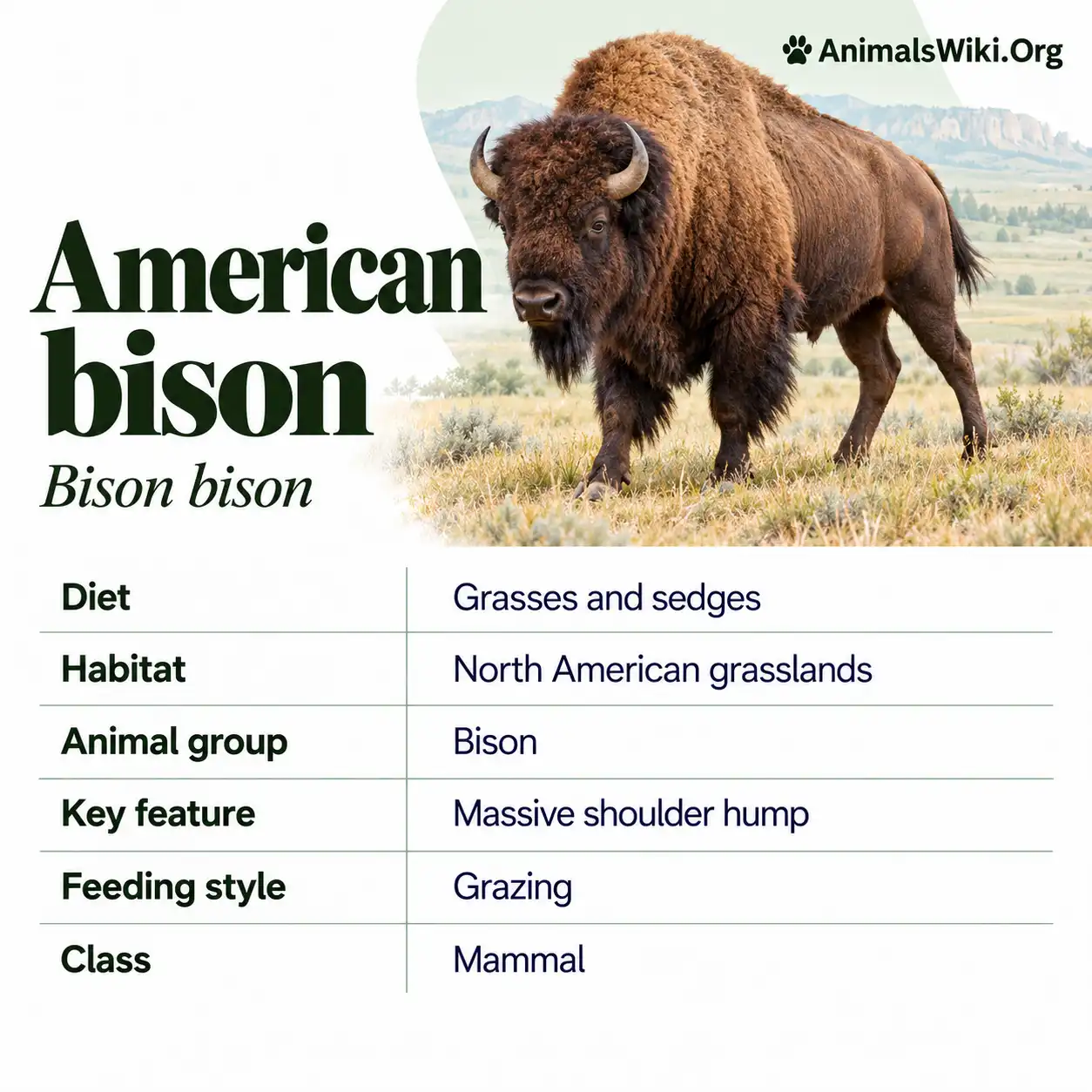
An American bison standing on open grassland is one of North America’s most recognizable wildlife sights. Its massive shoulders rise above a lowered head, a shaggy coat covers its forequarters, and short horns curve outward and upward. Even at rest, the animal has a presence that is difficult to overlook.
Yet the bison is much more than a symbol of the American West. It is a large herbivore whose grazing, movement and wallowing have helped shape ecosystems across a vast part of North America. Its story also remains inseparable from the histories, cultures and contemporary priorities of many Indigenous nations.
Bison once numbered in the tens of millions. During the nineteenth century, commercial slaughter, colonial expansion and other pressures pushed them close to extinction. Their destruction devastated communities that depended on buffalo and transformed grassland ecosystems.
The recovery that followed prevented the species from disappearing. However, the existence of hundreds of thousands of bison today does not mean that wild populations have regained their former range or ecological influence. Most modern animals are managed as livestock, while conservation herds represent a much smaller population.
Understanding that distinction is essential. So is recognizing the differences between plains bison and wood bison, the American species and its European relative, and an animal’s survival in managed herds versus its recovery as functioning wildlife.
This guide explores the American bison’s classification, identification, habitat, diet, adaptations, behavior, reproduction and ecological importance. It also examines dated population estimates, recent genetic research and the continuing work of Indigenous communities, conservation organizations and wildlife agencies.
American Bison Facts
| Feature | Information |
|---|---|
| Common name | American bison |
| Widely used alternative name | Buffalo |
| Scientific name used here | Bison bison |
| Family | Bovidae |
| Recognized subspecies | Plains bison and wood bison |
| Plains bison | Bison bison bison |
| Wood bison | Bison bison athabascae |
| Native continent | North America |
| Typical habitats | Grasslands, meadows, parklands and suitable northern open habitats |
| Main diet | Grasses and sedges, with other vegetation also consumed |
| Digestive system | Ruminant |
| Adult male size | Often approximately 900 kilograms; large individuals can exceed 1,000 kilograms |
| Adult female size | Commonly several hundred kilograms and substantially smaller than mature bulls |
| Horns | Present in both sexes |
| Usual offspring | One calf |
| Gestation | Approximately nine to nine and a half months |
| Typical birth season | Spring, varying with population |
| Newborn appearance | Reddish or cinnamon-colored coat |
| Conservation status | Near Threatened on the IUCN Red List |
| Important distinction | Commercial totals and conservation-herd estimates are different measures |
1. What Is an American Bison?
The American bison is a large, hoofed mammal belonging to the cattle family, Bovidae. It is a wild bovine, related to domestic cattle but representing a distinct species with its own evolutionary history.
Its most obvious characteristics are a substantial shoulder hump, a large head, short curved horns and a heavy coat over the front of the body.
Bison are herbivores. Their lives depend on obtaining enough vegetation, processing it through a ruminant digestive system and moving among feeding, watering and resting areas.
They are also social animals, although not every individual lives in a large herd throughout the year. Group composition changes with age, sex, season and circumstances.
The species is native to North America. Its historical importance extends beyond the modern boundaries of the United States to Canada and Mexico.
Calling the bison a prairie animal is useful, but incomplete. Different populations use environments ranging from open plains to northern meadows and mountain valleys.
The American bison is therefore best understood as a flexible large herbivore whose modern distribution represents only part of its former ecological presence.
2. Scientific Classification and Naming
Classification used in this article
| Taxonomic level | Classification |
|---|---|
| Kingdom | Animalia |
| Phylum | Chordata |
| Class | Mammalia |
| Order | Artiodactyla |
| Family | Bovidae |
| Genus | Bison |
| Species | Bison bison |
Some scientific treatments place bison within the genus Bos. Readers may consequently encounter the name Bos bison.
This article follows the familiar Bison bison treatment used by the National Park Service and many conservation sources.
Bison or buffalo?
“American bison” is the clearest scientific common name.
However, “buffalo” is a longstanding and meaningful name in North America, particularly in many Indigenous cultural contexts. It should not be dismissed as an unacceptable word.
In zoological classification, African buffalo and Asian water buffalo belong to different groups.
The National Park Service explicitly recognizes the cultural preference for “buffalo” among many Indigenous people while distinguishing scientific terminology.
Why context matters
A scientific comparison benefits from precise species names. A discussion of cultural relationships should respect the terms communities use.
Neither purpose is served by correcting every use of “buffalo” without considering its meaning.
3. Plains Bison and Wood Bison
Two recognized subspecies
American bison are commonly divided into plains bison and wood bison.
Their differences involve geographical history, appearance and aspects of habitat use.
| Feature | Plains bison | Wood bison |
|---|---|---|
| Scientific name | B. b. bison | B. b. athabascae |
| Historical association | Central and southern grassland regions | Northern parts of the range |
| General size tendency | Smaller on average | Larger on average |
| Shoulder hump | More rounded | More angular and positioned differently |
| Coat appearance | More conspicuous shaggy forequarters | Different hair distribution and generally darker appearance |
| Typical conservation setting | Prairie and grassland restoration | Northern meadow and boreal-region conservation |
Parks Canada describes these differences while emphasizing that both belong to the same species.
Identification has limits
A single photograph may not reveal every diagnostic feature.
Age, sex, posture and seasonal coat condition can obscure differences. Historical movements between populations have also complicated ancestry.
“Wood bison” does not mean a closed-forest specialist
Northern landscapes contain open meadows, wetlands and other feeding areas within a broader forested region.
The name should not imply that wood bison obtain their food exclusively beneath dense tree cover.
Understanding the vegetation actually used is more informative than relying on the subspecies name alone.
4. Physical Appearance and Identification
The shoulder hump
The hump is one of the most recognizable features of an American bison.
It is associated with long vertebral structures and strong muscles, rather than being a camel-like storage mound of fat.
The muscular shoulder and neck region supports the heavy head and contributes to winter foraging.
Coat and body proportions
The forequarters carry longer, shaggier hair than the hindquarters.
A large head, substantial shoulders and relatively narrower rear create the characteristic outline.
Spring shedding can make the coat look untidy. Hanging clumps of winter hair are not automatically evidence of poor health.
Males and females
Mature bulls are usually substantially larger and heavier than cows.
However, both sexes have horns, so horn presence alone cannot establish sex.
A young male may also lack the massive appearance of an older bull.
Calves look different
Newborns are reddish or cinnamon-colored and lack the fully developed adult outline.
Their color darkens as they grow.
This transformation is important for identification: an unfamiliar observer might not immediately connect a small reddish calf with the dark, heavy animals standing nearby.
5. American Bison vs European Bison
American and European bison are close relatives, but they are separate species in the classification used here.
| Feature | American bison | European bison |
|---|---|---|
| Scientific name | Bison bison | Bison bonasus |
| Alternative common name | Buffalo | Wisent |
| Native geographical setting | North America | Europe and adjacent western Eurasian regions |
| Typical body impression | Massive head and heavily developed forequarters | Often relatively taller and less front-heavy |
| Coat impression | Especially shaggy over the head and shoulders | Generally less dramatically shaggy in front |
| Historical conservation experience | Severe decline, with some wild populations surviving | Became extinct in the wild before reintroduction |
| Modern challenge | Restoring ecological range and function | Expanding and connecting populations after reintroduction |
These are general comparisons, not absolute rules for every individual.
Size overlaps
A large European bull can outweigh a smaller American animal.
Species identification should therefore consider several characteristics rather than asking which animal looks heavier.
Avoid transferring facts indiscriminately
Research on European bison feeding in a particular forest does not automatically describe American bison on prairie.
Likewise, the history of Yellowstone should not be presented as the conservation history of the European species.
The shared name reflects relationship, not identical ecology.
6. Historical Range and Modern Distribution
A much broader historical presence
American bison formerly occupied a vast part of North America.
Their range extended from northern regions toward Mexico and included more than the familiar central plains.
The species used different environments where suitable food and other resources were available.
Modern distribution
Today’s populations occur in separated areas under a range of management systems.
These include public reserves, Tribal lands, private conservation properties and commercial ranches.
A map showing all modern bison locations can therefore conceal major differences in how animals live.
Why occurrence is not recovery
A group behind a small enclosure and a herd moving through a large landscape both establish that bison are present.
They do not provide the same evidence of ecological restoration.
Historical maps require interpretation
Former distribution does not mean that every location supported the same density or was occupied continuously.
Seasonal movement and changing environmental conditions affected use.
The most useful maps distinguish historical occurrence, current conservation populations and commercial distribution rather than presenting all three as one interchangeable range.
7. Habitat Requirements
Food, water and space
Suitable habitat must provide enough accessible vegetation, reliable water and places for resting and movement.
Area alone is not a complete measure.
A large tract divided by roads or unsuitable fencing may provide fewer practical opportunities than its size suggests.
Plains landscapes
Grasslands offer a changing mixture of vegetation height, species and growth stages.
Short, actively growing patches can differ nutritionally from nearby mature vegetation.
Bison respond to that variation rather than treating every part of a prairie equally.
Northern and mountain habitats
Bison can also use mountain valleys and suitable northern open habitats.
Colorado Parks and Wildlife documents their historical and modern association with plains, mountain parks, forests and high-elevation environments.
Seasonal usability
A place that provides good summer grazing may be difficult to use beneath deep or crusted snow.
Habitat assessment should therefore consider the whole year.
Protecting a summer feeding area without accounting for winter access can leave a population dependent on intervention or restricted movement.
8. Diet and Feeding Choices
What do American bison eat?
Grasses and sedges make up much of the diet.
Other vegetation can also be consumed, depending on availability and local conditions.
Bison are primarily grazers, but “grass eater” should not imply a diet that is identical everywhere.
Selecting useful food
Plants change as they grow.
Young leaves, mature stems and dry material differ in their nutritional content and ease of digestion.
A bison must collect enough usable food while balancing the energy spent walking and feeding.
Why grazing patterns are uneven
A recently productive patch may attract repeated use while another area remains taller.
This creates variation across the landscape.
The pattern can change after rain, fire or seasonal growth.
Natural diet and husbandry diets
Foods supplied in a zoo or on a ranch reflect management decisions.
They should not automatically be listed as natural foods of free-ranging animals.
For ecological understanding, the important questions concern what plants are available, which parts are selected and how those choices change through the year.
9. Digestion and Rumination
Fermenting plant material
American bison are ruminants.
Microorganisms in the digestive system help process structural plant compounds that mammals cannot efficiently break down on their own.
This relationship allows bison to use fibrous vegetation, although food quality still matters.
Chewing cud
Previously swallowed material returns to the mouth for further chewing.
An animal lying quietly may therefore be actively processing an earlier meal.
Feeding is a cycle that includes collecting, chewing, digesting and resting.
Why quantity cannot replace quality indefinitely
A large amount of coarse vegetation does not necessarily provide enough nutrients.
Digestion takes time, and the animal cannot compensate for every nutritional shortfall simply by eating continuously.
Implications for management
Stocking decisions should consider seasonal forage quality as well as plant biomass.
A pasture may look full while offering limited useful food.
Likewise, the absence of tall grass does not automatically indicate poor conditions if a productive, grazing-tolerant community remains.
These distinctions require examining plants and animals together.
10. Adaptations to Cold and Snow
A protective coat
Bison grow a dense winter coat that reduces heat loss.
Seasonal shedding helps them adjust when conditions become warmer.
The familiar image of snow resting on a bison’s back illustrates insulation, but it does not mean the animal has unlimited tolerance for cold.
Using the head to clear snow
The powerful shoulder and neck region helps bison sweep snow aside with the head while searching for vegetation.
The National Park Service identifies this as an important function of the animal’s muscular hump.
Cold tolerance still has costs
Deep snow increases the effort required to move and reach food.
Ice layers can create different problems from loose snow.
Severe conditions may force animals to change location or draw on stored reserves.
Large size has trade-offs
A large body can reduce heat loss relative to its volume, but it also requires substantial food.
Survival depends on the balance between insulation, food access, reserves and expenditure.
Calling bison “winter-proof” would obscure that balance.
11. Movement, Swimming and Seasonal Travel
Mobile despite their size
Bison can accelerate and maneuver more effectively than their bulky appearance suggests.
They are also capable swimmers.
These abilities help explain why low fences, water or an apparently calm posture should not be treated as guarantees of containment or safety.
Movement follows changing conditions
Food, water, snow, insects and disturbance can influence travel.
Historical movements were not necessarily a uniform continental circuit followed by every herd.
Different landscapes created different opportunities.
Migration and restricted movement
Some modern populations retain substantial seasonal movement, while others occupy fenced areas.
A herd may attempt to leave a reserve when accessible food becomes scarce, even if a boundary appears clear on a management map.
Why movement matters ecologically
Travel connects feeding areas and redistributes nutrients and seeds.
It also gives animals choices when conditions deteriorate.
Restoring bison movement therefore involves more than providing a corridor on paper. The route must be usable and compatible with surrounding land uses.
12. Daily Activity and Wallowing
A repeating activity cycle
Bison alternate among feeding, moving, resting and rumination.
Activity can occur during daylight and at other times, depending on conditions.
Temperature, insects and season influence when particular behaviors occur.
What is wallowing?
A bison wallow is a disturbed patch created through rolling, rubbing or working the ground.
Wallowing can contribute to coat care and responses to insects, and it can also occur in social or reproductive contexts.
Effects beyond the animal
Repeated use changes vegetation and soil at the site.
The resulting patch can differ from surrounding grassland in structure and moisture behavior.
Avoiding a single explanation
A photograph of a rolling bison does not establish exactly why it is doing so.
The same behavior can have several functions.
The National Park Service describes wallowing and horning as part of bison behavior while linking their activities to variation in vegetation and soils.
Understanding the ecological result does not require assuming that the animal consciously intends to engineer habitat.
13. Herds and Social Organization
Different group types
Cows, calves and younger animals commonly associate in mixed groups.
Adult bulls may remain alone or form smaller groups outside the main breeding period.
During the rut, associations can change substantially.
Herd membership is flexible
Groups can split and merge.
This allows animals to respond to food distribution and social circumstances.
A herd seen today may not contain exactly the same individuals tomorrow.
No universal herd size
A small reserve group and a large seasonal aggregation are both normal possibilities under different conditions.
Published averages describe particular places and times.
They should not be turned into an exact rule for the species.
Social information
Animals can respond to the alertness or movement of companions.
However, association also brings competition for food and space.
The benefit of being in a group therefore depends partly on what the group is doing and the resources it is using.
University wildlife accounts describe this flexible organization alongside differences between male and mixed groups.
14. Communication and Dominance
Sounds and posture
Bison communicate through vocalizations, body position and movement.
Bulls bellow during the rut, while cows and calves use sounds in maintaining contact.
A lowered head, a change in orientation or an approach can convey information before contact occurs.
Assessment before combat
Physical fighting carries risks.
Displays help animals assess one another, although some interactions escalate into pushing or clashes.
Dominance should not be imagined as nonstop fighting.
Reading behavior cautiously
A stationary bison is not necessarily indifferent to nearby people.
Likewise, a raised tail or a head movement should not be treated as the only warning that matters.
Visitors should already be maintaining appropriate distance.
Biology and observation
For someone watching safely, the sequence of an encounter is informative.
Notice when the animals become aware of one another, how they adjust their posture and whether one withdraws.
These transitions often reveal more than the final dramatic moment.
15. Reproduction and the Rut
Breeding season
Many plains populations show their strongest breeding activity in summer, with local timing varying.
Yellowstone commonly describes a late-July and August rut.
That schedule should not be presented as the exact calendar for every American bison population.
The tending bond
A bull may closely accompany a receptive cow.
This temporary association is often called a tending bond.
The male monitors the female and responds to competitors, investing time and energy in the encounter.
Maturity and opportunity differ
Bulls can become physiologically mature before regularly breeding.
Older, heavier males often obtain more mating opportunities.
A single age-at-maturity figure therefore does not describe the age at which every male first produces offspring.
Reproductive effort
Competition and tending can reduce feeding and resting time.
The breeding season has consequences for condition as well as offspring production.
National Park Service life-history material distinguishes early maturity from the later age at which bulls commonly compete successfully.
16. Calves and Maternal Care
Birth and appearance
A cow usually gives birth to one calf after approximately nine to nine and a half months.
Spring births are common, although timing varies.
The reddish newborn coat gives rise to the familiar nickname “red dog.”
Rapid mobility
A healthy calf can stand and begin moving soon after birth.
That early mobility helps maintain contact with its mother, but it does not make the calf independent.
Young animals still have limited strength and experience.
Milk and developing grazing
Milk supports early growth.
Vegetation becomes progressively more important as the calf develops, and weaning occurs over time rather than at one identical moment for every animal.
Maternal protection
A cow can respond strongly to a perceived threat near her calf.
Other adults may also affect how a predator or disturbance develops.
The practical lesson for observers is straightforward: never approach a calf or move between it and an adult.
The National Park Service’s facts summary documents the typical single birth and distinctive newborn coloration.
17. Growth, Lifespan and Survival
Development takes years
A calf’s rapid early mobility should not be confused with full physical maturity.
Body size, horn development and sexual differences become more pronounced with growth.
A young bull lacks the mass and experience of an older breeding male.
How long do bison live?
Many wild bison live into their teens, and some survive beyond 20 years.
Captive animals may live longer under some conditions.
Maximum recorded ages and average survival should remain separate.
Survival pressures
Food shortages, disease, injury, predation, hunting and severe weather can all affect survival.
The importance of each factor differs among populations.
Why age structure matters
A population containing many adults may appear secure while producing too few surviving young.
Conversely, strong calf production can increase demands on limited habitat.
Useful monitoring considers births, deaths, recruitment and condition together.
A single annual head count cannot explain every change or predict the population’s future on its own.
18. Predators and Defensive Behavior
Wolves and bears
Wolves and grizzly bears can prey on bison.
Calves and vulnerable individuals may face greater risk, but large size does not make adults completely immune.
The outcome depends on the condition and behavior of both predator and prey.
A dangerous animal to attack
Horns, strength and a powerful front end make bison difficult prey.
Adults can stand their ground or counterattack.
This helps explain why predators may select other available species even when bison are present.
Group responses
The position of calves and the reactions of adults can influence an encounter.
However, a group does not offer guaranteed protection.
Predation is context-dependent
Findings from one park or northern population should not be generalized to every herd.
Some modern bison live without large predators, while others remain part of functioning predator–prey systems.
Research and management need to recognize that difference.
Colorado Parks and Wildlife identifies wolves and grizzly bears as natural predators while emphasizing the protection associated with bison size and grouping.
19. Ecological Importance
A keystone grazer
Bison can strongly influence the structure and diversity of the ecosystems they occupy.
Their effects arise through several connected activities rather than grazing alone.
Vegetation
Selective feeding changes which plants retain leaves and compete for light.
Repeated grazing can maintain short patches beside taller vegetation.
That variation creates different conditions for other organisms.
Nutrient cycling
Dung and urine return nutrients to the environment.
Dung also supplies resources for insects and decomposers.
Because animals move, these inputs do not occur uniformly.
Seeds and disturbance
Seeds can travel on the coat or through the digestive system.
Hooves and wallows create disturbed patches where some plants may establish.
Benefits depend on conditions
The phrase “ecosystem engineer” does not imply that every effect is positive everywhere.
Animal density, soil, rainfall and vegetation determine the outcome.
A conservation program should measure habitat responses rather than assuming that adding bison automatically improves every ecological indicator.
20. Fire, Grazing and Prairie Diversity
Interacting processes
Fire and grazing both influence grassland structure.
Following a burn, new growth can attract grazers when conditions support regrowth.
Animal use can then alter the vegetation available later.
Evidence from long-term research
A 2022 study at Konza Prairie found that bison reintroduction produced substantial increases in native plant richness over nearly three decades.
Those gains persisted through an extreme drought.
The results provide strong evidence for that tallgrass-prairie system, rather than a promise of identical outcomes in every habitat.
Why variation matters
A landscape containing several vegetation heights and growth stages can offer more kinds of habitat than a uniformly treated area.
However, variation is not achieved simply by burning as often as possible or maximizing animal numbers.
Management needs objectives
Different sites may prioritize native plants, bird habitat, restoration of natural processes or several goals together.
The appropriate combination of fire and grazing depends on those objectives and local ecological conditions.
Evidence-based management tracks what actually changes.
21. Indigenous Relationships With Buffalo
More than a food source
Buffalo have profound cultural, spiritual, ecological and economic significance for many Indigenous nations.
Relationships differ among communities, and no single description represents every nation.
Food, clothing, shelter, tools and ceremonial life all form part of that history.
A continuing relationship
These connections belong to the present as well as the past.
Buffalo restoration can support food sovereignty, cultural renewal, ecological stewardship and community priorities.
The Tribal Buffalo Lifeways Collaboration explicitly brings these dimensions together in its mission.
Indigenous leadership
The InterTribal Buffalo Council supports Tribal buffalo programs through technical assistance and other services.
Its work demonstrates that Indigenous communities are leading restoration rather than merely participating in someone else’s project.
Different goals can coexist
A community herd may provide food, education and cultural connection while also contributing to ecological restoration.
Assessing such a program only by one wildlife-management criterion can overlook its stated purposes.
Respectful conservation begins by understanding whose land, knowledge and priorities are involved.
22. Historical Decline and Recovery
Historical abundance
American bison once numbered in the tens of millions.
Frequently quoted estimates range around 30–60 million, but they are reconstructions rather than complete historical censuses.
The essential fact is their extraordinary former abundance.
The nineteenth-century collapse
Commercial hunting, hide markets, railways and colonial expansion drove rapid losses.
Military actions and policies that undermined Indigenous access to buffalo contributed to the devastation.
Disease, drought and competition also formed part of the broader historical context.
The National Park Service identifies both commercial slaughter and the use of buffalo destruction as a means of controlling Indigenous peoples.
Human consequences
The losses affected food systems, livelihoods, political autonomy and cultural life.
Economic research has documented enduring consequences for bison-dependent Indigenous societies.
Recovery involved many contributors
Indigenous people, private keepers, conservationists and public institutions all contributed to retaining animals and rebuilding populations.
The history should not be reduced to a single individual saving the species.
Preventing extinction was a major achievement, but restoring ecological range became a separate and continuing challenge.
23. Population Estimates and Conservation Status
Why one total is misleading
Population summaries often combine animals managed for different purposes.
Commercial bison, conservation herds and extensively roaming wildlife should not be treated as interchangeable categories.
Ownership alone does not establish ecological value, but management goals matter.
Figures that require context
| Population measure | Approximate figure | Date or limitation |
|---|---|---|
| Bison managed for conservation in North America | Around 30,000 | Broad institutional reference estimate; not a synchronized 2026 census |
| Bison raised as livestock | Several hundred thousand | Sources vary in coverage and reference year |
| Yellowstone population | Nearly 5,300 | National Park Service estimate for 2025 |
Current National Park Service and Smithsonian summaries use different broad livestock totals. Their agreement is clearer on the central point: conservation populations represent a small fraction of all bison.
The Yellowstone figure describes one population and should not be added to a conservation total that already includes it.
Red List status
The American bison is Near Threatened on the IUCN Red List.
The assessment commonly cited was conducted in 2016 and published in 2017.
Green Status
The 2022 Green Status assessment classified the species as Critically Depleted.
That is a recovery category, not a Red List category equivalent to Critically Endangered. It reflects how far the species remains from full ecological recovery.
24. Genetics and Recent Research
The legacy of a bottleneck
The historical collapse left populations separated and founded by relatively few animals.
Genetic management therefore involves relationships within herds and differences among them.
A large total does not guarantee that every herd retains sufficient breeding options.
Historical cattle crossing
People deliberately crossed bison and cattle in some managed populations.
The resulting ancestry has become an important topic in conservation genetics.
Why older blanket claims need updating
Earlier genomic work detected cattle ancestry in all animals it examined.
However, an August 2026 study using ancient and modern genomes reported that many sampled modern bison lacked cattle ancestry.
It also documented plains-bison ancestry in modern wood bison associated with historical translocations.
What the evidence does not establish
One study does not test every living bison.
Nor does visible appearance reveal the presence or absence of small ancestry contributions.
Practical implications
Genomic evidence can guide transfers and breeding while helping managers preserve diversity across populations.
The useful goal is informed conservation, rather than unsupported labels that describe entire herds as genetically identical or conclusively free of ancestry based on outdated tests.
25. Disease, Fragmentation and Other Threats
Fragmented populations
Fences, roads and conflicting land uses restrict movement.
Small herds may depend on planned transfers to maintain genetic exchange.
National Park Service population work identifies isolation and restricted ranges as continuing limitations on ecological recovery.
Brucellosis
Some bison populations carry brucellosis, a bacterial disease that can affect reproduction and create concerns for livestock management.
The situation varies by herd.
Yellowstone reports no documented direct transmission from bison to cattle under existing management, while emphasizing that this does not mean transmission is impossible.
Other health concerns
Bovine tuberculosis is important in some northern populations.
Health status must therefore be assessed locally rather than generalized across the species.
Habitat and environmental pressure
Drought, severe winters and limited seasonal range can affect condition and survival.
Management consequences
A transfer intended to improve genetics must also consider health.
A fence intended to reduce conflict may restrict seasonal access.
These trade-offs explain why conservation requires coordinated decisions rather than one isolated solution.
26. Restoration and Long-Term Conservation
More than increasing numbers
Ecological recovery involves suitable landscapes, movement, reproduction and interaction with other species.
A growing herd behind a small fence may contribute to conservation without recreating the processes of a large roaming population.
Public, Tribal and private contributions
Different landholders can support different parts of recovery.
Effective collaboration recognizes those roles and avoids assuming that one ownership category always provides the best outcome.
Connecting populations
A metapopulation approach treats separate herds as parts of a wider managed system.
Planned exchange can help retain diversity where natural movement is unavailable.
Measuring progress
Useful measures include survival, recruitment, habitat condition, genetic representation and community acceptance.
A program should be able to explain which goals it is pursuing.
A continuing responsibility
Saving bison from extinction did not complete restoration.
The next stage involves expanding their opportunities to function as wildlife while addressing the practical concerns of people sharing those landscapes.
That task requires sustained partnerships and realistic monitoring.
27. Responsible Wildlife Observation
Maintain appropriate distance
Bison can injure people who approach too closely.
At Yellowstone, visitors must remain at least 25 yards, or approximately 23 meters, from bison. Other sites may require a greater distance, so follow local guidance.
Distance is a minimum
A numerical rule does not mean every situation becomes safe immediately beyond that line.
Give additional room when animals are moving, calves are present or conditions limit escape routes.
Do not feed or provoke
Never approach for a close photograph, attempt to touch an animal or encourage a reaction.
Avoid blocking movement
Do not place yourself between individuals or stand along the route they are using.
Observe ordinary behavior
Grazing, rumination and group movement reveal much of the animal’s biology.
A successful sighting allows those activities to continue.
Accurate captions should identify the species and, where relevant, whether the animals are in a conservation reserve, Tribal program, ranch or zoo.
28. Frequently Asked Questions About American Bison
What is an American bison?
The American bison is a large North American bovine known scientifically as Bison bison. Its most recognizable features include a shoulder hump, a shaggy forequarters coat and short curved horns. It is a herbivore and ruminant with a major ecological role in grasslands.
Are bison and buffalo the same animal?
In North American usage, buffalo commonly means American bison. The term has longstanding cultural importance, particularly among many Indigenous communities. In zoological classification, African buffalo and Asian water buffalo are different animals. Context matters when choosing the appropriate name.
How many kinds of American bison are recognized?
Two subspecies are commonly recognized: plains bison, Bison bison bison, and wood bison, Bison bison athabascae. They differ in appearance and geographical history, although historical movements and ancestry make identification more complicated than a simple north–south division.
Are wood bison larger than plains bison?
They tend to be larger on average, but individual sizes overlap. Sex, age and condition also influence measurements. A large plains bull can be heavier than a smaller wood bison, so size alone is not a conclusive identification test.
Where did American bison originally live?
They occupied a broad North American range, including grassland, northern and mountain environments. Their historical presence extended beyond the Great Plains. The exact density and seasonal use varied, so a range map should not imply identical occupation throughout every region.
Where do American bison live today?
Modern populations occur in Canada, the United States and Mexico under different management arrangements. These include conservation herds, Tribal programs and commercial ranches. A location on a map does not reveal whether animals roam extensively or occupy a restricted enclosure.
What do American bison eat?
They feed mainly on grasses and sedges, while also consuming other vegetation. Their choices change with habitat and season. Plant growth stage and accessibility matter, so a patch with abundant vegetation is not automatically a patch containing high-quality food.
Are American bison ruminants?
Yes. Microorganisms help them process fibrous plant material, and they chew cud. This means digestion includes periods when the animal is resting rather than collecting food. Quiet behavior can therefore be an essential part of its feeding cycle.
Is the hump filled with fat?
It is primarily associated with the skeleton and powerful muscles of the shoulder region. It is not a camel-like fat reservoir. The musculature supports the heavy head and helps the animal clear snow while seeking vegetation in winter.
How do bison survive cold weather?
They combine an insulating coat, body reserves, behavior and access to food. Their ability to sweep aside snow helps winter foraging. However, severe weather and restricted resources still create risks. Cold adaptation does not remove the need for suitable habitat.
Can American bison run fast?
Yes. They can move much faster than their heavy build suggests and can respond quickly at close range. Visitors should never rely on outrunning one. Maintaining distance and avoiding disturbance are more useful than memorizing an exceptional maximum speed.
Can bison swim?
Yes. They are capable swimmers, although crossing water can still involve risks. Ice, currents and conditions matter. An ability to swim does not mean every crossing is safe, just as good mobility does not eliminate accidents on land.
Why do bison roll in dirt?
Wallowing can contribute to coat care, responses to insects and social behavior. Repeated rolling also changes the ground and vegetation. A single observation does not establish one exclusive cause, because the behavior can serve several functions.
Do female bison have horns?
Yes. Both sexes have horns. Males are generally more massive, but horn presence alone cannot identify sex. Age and viewing conditions can make identification difficult, particularly when the animal is young or partly concealed.
Do bison live in permanent herds?
Their associations are flexible. Mixed groups commonly contain cows and young, while adult males may spend time alone or in smaller groups. Groups can divide and merge, and composition changes with season and reproductive activity.
When do American bison mate?
Breeding commonly occurs during summer, with timing varying among populations. Yellowstone’s main rut is usually described in late July and August. Those dates should not be treated as a fixed calendar that applies identically across the species.
How long is a bison pregnant?
Gestation lasts approximately nine to nine and a half months. A cow usually produces one calf. Spring births are common, although exact timing depends on the population and individual. Pregnancy is followed by substantial investment in milk and protection.
Why are baby bison called red dogs?
Their reddish or cinnamon-colored coats create the resemblance behind the nickname. Calves darken as they grow and gradually develop the adult appearance. The nickname is informal and does not indicate a separate kind of bison.
Can newborn bison walk?
They can stand and begin following their mothers soon after birth. Early mobility helps maintain contact, but calves remain dependent. Their strength and endurance develop over time, so standing quickly should not be confused with adult-level ability.
How long do American bison live?
Many wild individuals survive into their teens, and some live beyond 20 years. Captive longevity can differ. Maximum recorded ages and average survival are different measurements, so neither should be presented as a guarantee for every animal.
What predators eat American bison?
Wolves and grizzly bears can prey on them. Calves and vulnerable individuals may face greater risk, while healthy adults are difficult and dangerous prey. Predator importance varies among locations, and some managed herds live without large carnivores.
Are American bison endangered?
Their IUCN Red List category is Near Threatened. Separately, their Green Status classification is Critically Depleted, reflecting incomplete recovery across their former ecological range. These categories assess different things and should not be treated as interchangeable labels.
How many American bison remain?
There are several hundred thousand overall, but most are managed as livestock. Institutional references commonly describe around 30,000 managed for conservation. These are broad estimates with varying coverage, not a synchronized census for the present year.
How many bison live in Yellowstone?
The National Park Service reports nearly 5,300 for its 2025 estimate. That is a dated figure for one population. Births, deaths, movement and management can change numbers, so it should not be relabeled as a verified 2026 count.
Did American bison become extinct in the wild?
No. The species came close to extinction, but some wild populations survived. This differs from European bison, which disappeared from the wild before reintroduction. Both histories involve recovery, but the circumstances should remain distinct.
How many bison lived before the historical collapse?
They numbered in the tens of millions. Frequently cited estimates range around 30–60 million, but these are historical reconstructions rather than complete censuses. Their exact precision is less certain than the scale of the subsequent decline.
Why were so many bison killed?
Commercial markets, colonial expansion, railways and policies that undermined Indigenous access to buffalo contributed to the collapse. Other environmental pressures also mattered. Describing the decline simply as accidental overhunting leaves out important historical causes and consequences.
Why are buffalo important to Indigenous communities?
Relationships include food, culture, spirituality, livelihoods and ecological stewardship, with differences among nations. These connections continue today. Indigenous-led restoration can support community priorities as well as wildlife recovery, and should not be described only in the past tense.
Do all American bison contain cattle DNA?
That blanket claim is not supported by the newest research discussed here. An August 2026 study found that many sampled modern bison lacked cattle ancestry. Results depend on sampling and methods; they do not establish the ancestry of every living animal.
Do bison grazing improve plant diversity?
Long-term research has documented substantial gains in native plant richness in a tallgrass-prairie setting. That supports their restoration value there. Outcomes still depend on density, habitat and management, so identical results should not be promised for every site.
Can bison transmit disease to cattle?
Some diseases can be shared between wildlife and livestock. Yellowstone reports no documented direct brucellosis transmission from its bison to cattle under existing management, while recognizing that transmission is possible. The distinction between biological possibility and documented events matters.
Are American bison safe to approach?
No. They are powerful wild animals and can respond rapidly. Follow local distance rules, avoid blocking movement and never approach calves. Their calm appearance is not an invitation to move closer or attempt contact.
American Bison ()
The American bison combines immense physical presence with an ecological and cultural importance that reaches far beyond its appearance. Its grazing, wallowing and movement help shape landscapes, while its relationships with Indigenous nations remain central to understanding both its history and its future.
Preventing extinction was a major achievement. However, the continued existence of large commercial populations does not mean wild bison have regained their former range, connections or ecological role.
The distinctions matter: plains and wood bison, livestock and conservation herds, historical estimates and dated modern counts, Red List risk and Green Status recovery. Recent genetic research also shows why familiar claims must remain open to better evidence.
Long-term restoration depends on habitat, population connections, health, appropriate management and Indigenous leadership. Success means more than adding animals. It means sustaining bison within landscapes and communities where their presence has a durable future.
The American bison’s comeback remains unfinished, but its survival provides a foundation on which that work can continue.



