
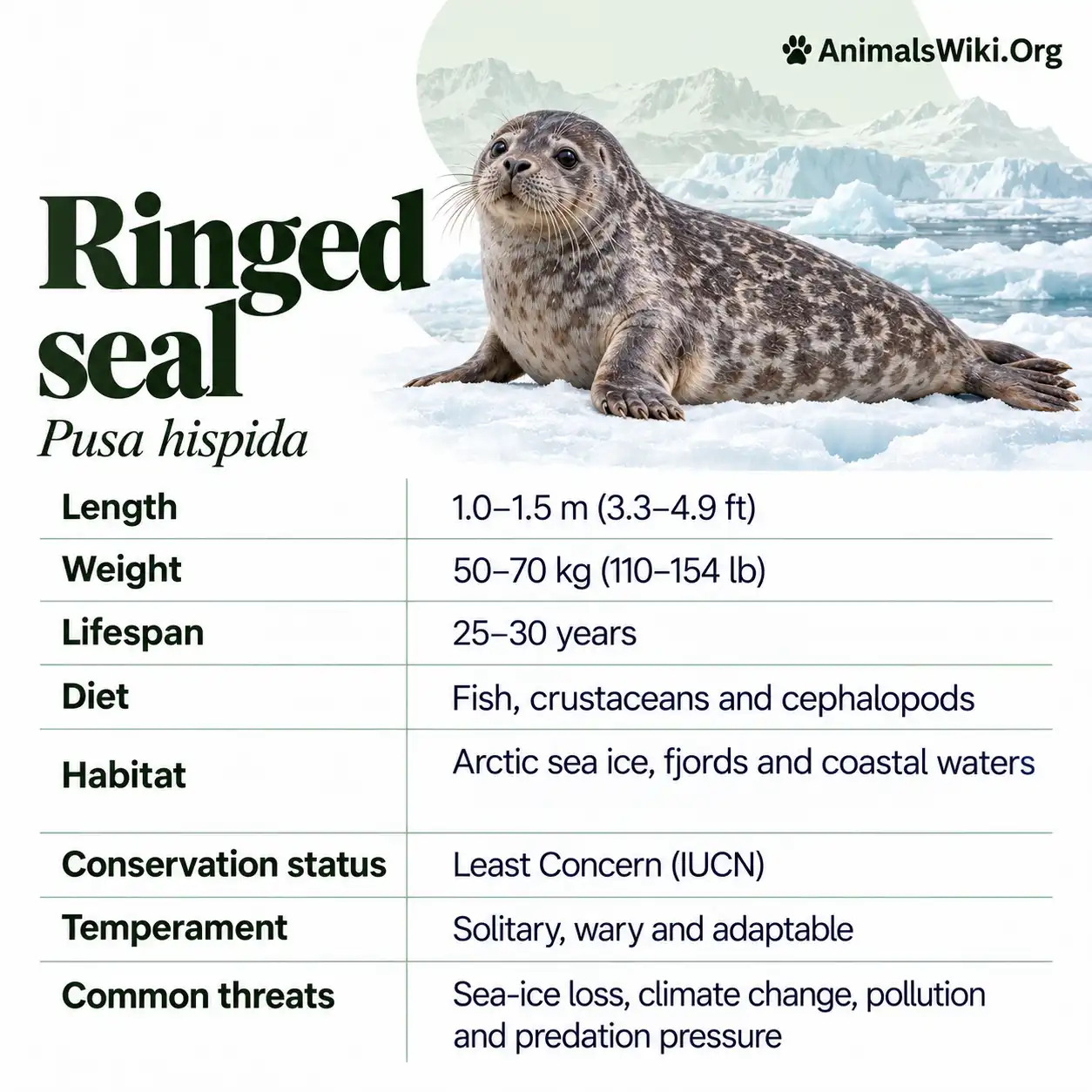
Ringed Seal , The Arctic Survivor That Raises Its Pups Beneath the Snow
The ringed seal is a small marine mammal with an extraordinary ability to live beneath Arctic ice. Recognized by the pale rings scattered across its darker coat, it maintains breathing holes with its claws and shelters inside snow-covered chambers above the water.
These hidden chambers, called lairs, are central to its survival. They provide resting places and protect newborn pups from severe weather and some predators. A seemingly empty stretch of snow-covered ice may therefore contain an active world of seals moving between underwater feeding areas and concealed shelters.
Ringed seals also occupy an important position in northern food webs. They eat small fish and crustaceans and are major prey for polar bears. Their lives connect the productivity beneath the ice with some of the Arctic’s largest predators.
Their conservation story requires careful explanation. The ringed seal, Pusa hispida, is globally classified as Least Concern, but regional populations face different pressures, and several have stronger legal protection. Freshwater forms associated with Lakes Ladoga and Saimaa add further complexity, including a recent change in the scientific classification of the Saimaa seal.
This guide explores ringed seal appearance, habitat, feeding, reproduction, snow dens, predators, and conservation, while explaining how life differs across its northern range.
Ringed Seal Facts
| Feature | Information |
|---|---|
| Common name | Ringed seal |
| Scientific name | Pusa hispida |
| Animal group | Mammal |
| Family | Phocidae |
| Seal type | True seal |
| Typical adult length | Approximately 1.1–1.6 meters |
| Adult weight | Often around 50–100 kilograms, with regional and seasonal variation |
| Main distribution | Arctic and adjoining northern waters |
| Diet | Small fish, shrimp, amphipods, and other marine invertebrates |
| Breeding shelter | Snow lair above a breathing hole |
| Young | Usually one pup |
| Newborn weight | Approximately 4.5 kilograms |
| Nursing period | Commonly several weeks, often around five to eight weeks in stable ice |
| Main Arctic predator | Polar bear |
| Global conservation status | Least Concern |
1. What Is a Ringed Seal?
A ringed seal is an air-breathing marine mammal belonging to the species Pusa hispida. It is a member of the true seal family, Phocidae, which also includes harbor seals, grey seals, harp seals, and elephant seals.
Like other mammals, it maintains its internal temperature, gives birth to live young, and feeds its offspring milk. Its aquatic adaptations allow it to search for food underwater, but it must reach air regularly.
That requirement becomes especially challenging beneath extensive ice cover. Ringed seals meet the challenge by maintaining openings through which they can breathe.
Their lives therefore depend on a connection between the water below and the atmosphere above. Breathing holes and associated snow shelters make otherwise difficult habitat usable.
Older scientific publications often use the name Phoca hispida. This is an earlier scientific combination for the animal now generally called Pusa hispida, rather than evidence that those studies concern a completely different seal.
2. Why Is It Called a Ringed Seal?
The name comes from the light-colored rings visible against the darker fur on the back and sides.
These markings vary between individuals and can appear more or less conspicuous depending on lighting, wetness, and the part of the body visible. The belly is usually paler than the back.
Young seals do not immediately display the fully developed appearance of an adult. Newborns have a pale natal coat, and later coat stages change as the animal grows.
The pattern is therefore useful, but it should be considered together with body shape and location.
Ringed seals generally have compact bodies, relatively small heads, and short muzzles. Their appearance differs from the long head of an adult grey seal or the elongated shape of a large bearded seal.
A clear view of several features provides a better identification than relying on one faint ring or a distant silhouette alone.
3. Ringed Seal Size and Weight
Ringed seals are among the smallest northern seals. Many adults measure approximately 1.1–1.6 meters and weigh around 50–100 kilograms, although larger animals occur.
Size differs geographically, and body weight changes markedly through the annual cycle.
A well-fed seal in autumn can carry substantially more stored energy than it does after breeding and molting. Consequently, a single average weight cannot describe every adult throughout the year.
Males are often slightly larger than females, but the difference is modest compared with the extreme contrast between male and female elephant seals.
Their relatively small size is important to their lifestyle. Ringed seals use breathing holes and sheltered spaces that would not accommodate much larger marine mammals as easily.
However, small size also makes heat conservation important. Insulation, body condition, and access to suitable shelter all contribute to surviving northern conditions.
The animal’s success comes from this combination of traits, rather than size alone.
4. How Long Do Ringed Seals Live?
Ringed seals can live for several decades.
General accounts often describe lifespans around 25–30 years, while some regional descriptions report animals reaching considerably older ages.
These figures should be understood as longevity information, not a guarantee that every newborn will survive that long.
Early life presents substantial challenges. A pup must receive sufficient milk, survive predators and weather, and develop the ability to obtain food independently.
Animals that reach adulthood may then experience very different conditions depending on location, prey availability, and exposure to human activities.
Researchers also distinguish between average survival and maximum recorded age. A particularly old animal demonstrates what is possible, while an average describes a broader group.
For a general wildlife article, the clearest conclusion is that ringed seals are potentially long-lived mammals. Their conservation depends on both successful reproduction and the continued survival of older animals already contributing to the population.
5. Ringed Seal vs. Other Northern Seals
Several seal species share northern waters, but their appearance and ecological habits differ.
Ringed seals are particularly associated with maintaining breathing holes and using snow lairs. Harp seals are more migratory and commonly gather in large breeding concentrations on pack ice.
Harbor seals are strongly associated with coastal resting places, while bearded seals are larger and have conspicuous whiskers.
| Feature | Ringed seal | Harp seal | Harbor seal |
|---|---|---|---|
| Scientific name | Pusa hispida | Pagophilus groenlandicus | Phoca vitulina |
| Typical adult marking | Pale rings | Dark adult harp-shaped pattern | Variable spots or rings |
| Breeding setting | Commonly snow lairs on ice | Pack ice | Coastal haul-outs |
| General social pattern | Often dispersed | Frequently forms large seasonal groups | Often gathers at resting sites |
| Characteristic adaptation | Maintains ice breathing holes | Extensive seasonal migration | Strong coastal association |
These comparisons describe broad tendencies rather than rules applying to every observation. Age, season, and local conditions remain important when identifying a seal.
6. Where Do Ringed Seals Live?
Ringed seals have a circumpolar distribution, meaning they occur around much of the Arctic.
Their range includes northern waters associated with Alaska, Canada, Greenland, Russia, and northern Europe. They also occur in adjoining seas outside the central Arctic.
This is a Northern Hemisphere animal. Ringed seals do not live naturally in Antarctica.
Their broad range contains many different environments, including fjords, coastal ice, offshore pack ice, and regions with pronounced seasonal changes in open water.
A species-wide map can therefore hide considerable ecological variation. A seal living in a Svalbard fjord may encounter different ice, prey, and movement opportunities from one in the Bering Sea.
Their distribution also changes through the year. Breeding habitat, summer feeding areas, and winter conditions do not necessarily overlap completely.
Understanding where a ringed seal lives requires both geographic location and season. Those details help explain its behavior, food, and conservation needs.
7. Regional Forms and a Recent Taxonomy Change
Many established accounts describe five ringed seal forms: Arctic, Okhotsk, Baltic, Ladoga, and Saimaa.
However, classification has recently changed in some scientific references.
Following research published in 2025, the Mammal Diversity Database recognizes the Saimaa seal as a separate species, Pusa saimensis, rather than including it within Pusa hispida.
Older papers, legal documents, and conservation programs may still use Pusa hispida saimensis. Readers can therefore encounter different names for the same freshwater animal.
This does not make earlier conservation research irrelevant. It means the boundaries used to classify these seals have been revised as new evidence became available.
For clarity, this article focuses primarily on Pusa hispida while also explaining the closely related Saimaa seal.
The distinction matters when comparing population estimates and conservation categories. A figure for Arctic ringed seals should not be applied to a small, isolated freshwater population.
8. Why Sea Ice Matters
Sea ice provides more than a surface on which ringed seals rest.
It supports breathing holes, snow accumulation, shelters, breeding habitat, and seasonal molting opportunities. These functions connect different parts of the animal’s annual cycle.
For a breeding female, ice becomes the foundation beneath a snow lair. For a young pup, the shelter above that ice can determine exposure to weather and predators.
The usefulness of ice depends on more than its total area. Timing, stability, snow depth, and the way snow accumulates all influence habitat quality.
A large expanse of smooth ice with little snow may provide fewer suitable lair locations than a smaller area with snow-catching features.
This is why researchers examine ice and snow together.
The ringed seal’s habitat is a layered system: water below, ice at the surface, and protective snow above. Changes in any layer can affect how effectively the entire system functions.
9. How Ringed Seals Maintain Breathing Holes
Ringed seals use the strong claws on their foreflippers to maintain openings in the ice.
These holes allow them to breathe even where the surface becomes extensively frozen. Maintaining access to air is fundamental because the animals cannot extract oxygen from water.
The holes are part of an actively used environment rather than accidental gaps that always remain available.
Some become associated with snow shelters, while others serve primarily as breathing access.
This ability helps ringed seals occupy heavily ice-covered habitat that presents difficulties for marine mammals unable to maintain comparable openings.
It also illustrates how anatomy and behavior work together. Strong claws are useful because the animal repeatedly applies them to a specific problem.
The result is an underwater living space linked to a network of air access points.
For a ringed seal, the surface above is therefore not simply a barrier. It is a structure the animal modifies and maintains.
10. What Is a Ringed Seal Snow Lair?
A snow lair is a concealed chamber excavated within accumulated snow above the ice, usually associated with a breathing hole.
The seal can enter from below, moving from the water into a protected space without emerging onto an exposed surface.
These chambers provide shelter for resting and raising young.
A birth lair is especially important because a newborn has less insulation and fewer reserves than an adult.
The shelter reduces exposure to severe conditions and makes the pup less visible to predators, although it does not make it completely safe.
Lairs depend on suitable snow. The snow must be deep enough and structurally appropriate to support a chamber.
This explains why snowfall alone is not a complete measure of breeding habitat. Wind redistribution, ice features, snow consistency, and melting all influence whether a usable shelter can form and persist.
11. Why Seals Use More Than One Lair
Ringed seals can maintain several shelters and breathing openings within the area they use.
This provides alternatives when a structure becomes unsafe or a predator attacks.
A mother may move her pup between shelters, making the surrounding network important rather than only the chamber in which birth occurred.
The arrangement also helps explain why studying one visible opening cannot describe all nearby seal activity.
Researchers investigating lairs examine different structure types, their spacing, and the snow and ice conditions around them.
A breathing hole, a resting shelter, and a pup lair do not necessarily serve identical purposes.
From above, much of this system remains hidden beneath the snow. The animal’s habitat therefore extends beyond the small features visible to a human observer.
The network is a practical response to risk: access to several options can be valuable in an environment where weather and predators can quickly change conditions.
12. When Are Ringed Seal Pups Born?
Ringed seals generally give birth during late winter or spring, with timing varying across regions.
Canadian accounts commonly describe births from March to May, while peak timing differs elsewhere.
Females usually produce one pup, typically inside a snow-covered birth lair.
The reproductive schedule must fit the seasonal habitat. A pup needs enough time for nursing and development before melting or breakup removes the protection of its shelter.
Earlier birth is not automatically better, because suitable habitat and maternal condition must also align.
Likewise, a warm spring can alter the environment before the pup has completed development.
The timing of reproduction is therefore connected to both the mother’s annual cycle and the availability of snow-covered ice.
Local breeding information is more accurate than assigning one universal birth month to a species spread across such a large northern range.
13. What Does a Newborn Ringed Seal Look Like?
A newborn ringed seal is small, commonly weighing around 4.5 kilograms.
It has a pale, woolly natal coat called lanugo, rather than the darker ring-patterned appearance associated with adults.
The coat is temporary and is replaced during early development. Accounts differ on the exact timing, so it is more accurate to describe shedding as occurring during the pup’s first weeks than to assign one rigid day.
The newborn also needs to build substantial body reserves.
Its sheltered environment is important during this stage because insulation and energy storage are still developing.
A pale pup on exposed ice is therefore in a different situation from one protected inside a functioning lair.
The appearance may seem similar to other whitecoat seals, but the ringed seal’s early life includes a distinctive combination of concealed shelter, maternal care, and increasing activity beneath the ice.
14. Nursing and Maternal Investment
Ringed seal nursing lasts several weeks, often around five to eight weeks in stable landfast ice.
The duration can differ in other ice conditions. Canadian research summaries describe shorter nursing periods in some moving pack-ice settings.
During nursing, the mother supplies the energy needed for growth while also managing her own reserves.
Unlike a simple model in which a mother remains continuously ashore without feeding, ringed seal females can supplement stored energy by feeding beneath the ice.
Lactation is therefore connected to access to water and local prey.
The pup’s development also continues throughout this interval. It gains reserves and becomes increasingly capable of aquatic activity.
This makes the nursing period more than passive growth inside a shelter.
It is a demanding phase in which maternal feeding, milk transfer, pup activity, and habitat stability must work together until the young animal is ready for greater independence.
15. Can Ringed Seal Pups Swim?
Yes. Ringed seal pups become active swimmers and divers while they are still nursing.
Studies summarized by the Norwegian Polar Institute describe substantial time in the water during this period, including early feeding on small invertebrates.
This distinguishes them from the idea of a whitecoat pup remaining entirely inactive until its first coat has disappeared.
However, early swimming does not make the snow lair unnecessary.
The pup still needs a sheltered place to rest and receive maternal care. Its ability to make short dives is not equivalent to the endurance and feeding efficiency of an experienced adult.
The relationship between water and shelter is therefore central.
A developing pup can benefit from aquatic activity while remaining vulnerable if its refuge disappears too early.
Swimming ability and dependence on a lair are complementary parts of ringed seal development, rather than contradictory descriptions.
16. Weaning and the Transition to Independence
Weaning ends the pup’s dependence on maternal milk, but it does not instantly make the young seal as effective as an adult.
Independent survival requires enough successful feeding to support maintenance, activity, and continued growth.
The environment can influence that transition. Ice breakup changes access to shelters and resting surfaces while also altering the surrounding habitat.
A pup that has developed under favorable conditions may have different reserves and experience from one exposed to premature shelter loss.
This is why researchers consider juvenile survival when assessing population change.
A successful birth does not guarantee that the young animal will survive to reproductive age.
The period after maternal care therefore connects breeding success with future population structure.
Understanding it requires looking beyond the birth lair to the food and habitat encountered by young seals as they begin using a wider environment on their own.
17. Reproduction and Delayed Implantation
Ringed seals have a seasonal reproductive cycle that includes delayed implantation.
After fertilization, the early embryo does not immediately proceed through the full period of active development. Implantation and later growth occur after a delay.
This helps coordinate the next birth with the seasonal cycle.
Because of this delay, the interval between mating and birth differs from the period of active fetal development.
That distinction explains why gestation figures can look inconsistent when sources describe different stages.
Mating generally occurs around the later part of the nursing period, although timing varies geographically.
Females take several years to reach reproductive maturity, and not every young animal contributes to births immediately.
The annual cycle therefore links feeding, body condition, mating, delayed development, pregnancy, and nursing.
Conservation assessments must consider that complete sequence rather than treating each year’s pup count as independent of earlier environmental conditions.
18. The Annual Molt
Ringed seals replace their coat during an annual molt.
Hair replacement is an active physiological process requiring tissue growth and suitable skin conditions.
Research on Arctic seals has measured increased metabolic demands associated with molting in ringed seals.
Animals often spend more time hauled out during this period. Resting at the surface helps them maintain the skin conditions associated with coat regeneration.
This creates another seasonal reason for suitable resting habitat to remain available.
A patchy or changing coat can therefore represent a normal stage rather than illness.
However, molting should be considered alongside overall condition and behavior when assessing an animal.
The annual molt also illustrates how habitat supports body maintenance. Ice is important not only for giving birth but also for completing a recurring process that prepares the seal for continued life in cold water.
19. What Do Ringed Seals Eat?
The ringed seal diet includes small fish and marine invertebrates.
Depending on location, prey can include polar cod, Arctic cod, saffron cod, shrimp, amphipods, and other available animals.
The exact mixture changes with region, season, and age.
A young seal may rely more heavily on small invertebrates than an adult feeding in a fish-rich area.
Research in Greenland has documented substantial seasonal and regional differences, demonstrating why a single menu cannot describe the species everywhere.
Food availability also depends on depth and habitat.
A seal feeding near coastal ice may encounter different prey from one using offshore waters.
The broad dietary flexibility is useful, but it does not mean all prey provide equal energy or that every substitute is easy to obtain.
Successful feeding depends on the amount and quality of food available where and when the animal needs it.
20. Why Polar Cod Is Important
Polar cod, Boreogadus saida, is an important prey species for ringed seals in many Arctic regions.
Research around Svalbard has repeatedly identified it as a major component of the diet.
Its importance connects ringed seals to the wider ice-associated food web.
If a key prey species changes in abundance, distribution, or accessibility, seals may need to adjust where they feed or what they consume.
The consequences depend partly on whether alternatives provide comparable energetic returns.
Scientists therefore study prey communities as well as the seals themselves.
A healthy-looking adult at one moment does not reveal whether its feeding environment is becoming more difficult over time.
Understanding the relationship with polar cod helps explain why changes beneath the water can matter as much as visible changes in the ice above.
The seal and its prey are connected parts of the same changing ecosystem.
21. Regional and Age-Related Feeding Differences
Ringed seal feeding varies across the Arctic, and adults and younger animals can use different resources.
A study examining spatial and age-related feeding patterns found greater reliance on Arctic cod among some High Arctic adults than among subadults or seals at lower latitudes.
Such differences matter when describing the species as a generalist predator.
A broad species-level diet does not mean every individual eats the same mixture.
Regional differences can also influence how populations respond to environmental change. Animals with access to several suitable prey types may face different conditions from those strongly dependent on one resource.
Researchers use these comparisons to understand ecological flexibility.
The useful question is not simply whether ringed seals can eat many foods. It is whether animals in a particular place can obtain enough suitable food to support growth, reproduction, and survival.
22. How Deep Can Ringed Seals Dive?
Ringed seals can make dives hundreds of meters deep, despite their relatively small size.
However, maximum diving ability should not be confused with typical feeding behavior.
The depth and duration of a dive depend on available prey, local water depth, season, and the animal’s age and condition.
Tracking research in the Beaufort, Chukchi, and Bering Seas has documented repeated diving patterns consistent with focused feeding activity.
This is more informative than a single maximum record.
Repeated dives reveal how animals allocate time and use particular areas, while isolated extreme dives show only part of their capacity.
The same seal may change its behavior as it moves between shallow coastal habitat and deeper water.
Diving is therefore a flexible response to the environment.
Understanding it requires connecting underwater performance with the location of food and access to breathing opportunities.
23. Seasonal Movements and Home Areas
Ringed seals do not all follow one identical migration.
Some adults return to familiar breeding territories, while younger animals can make more extensive seasonal movements.
Satellite studies reveal considerable variation associated with age, capture location, and year.
During open-water periods, animals may travel substantial distances. In winter, suitable ice and snow influence where breeding adults establish their activities.
This combination allows both local attachment and long-distance movement.
It also complicates population monitoring. A seal absent from one survey area may have moved rather than died.
Repeated observations and tracking help separate redistribution from true changes in abundance.
Seasonal movement is therefore important to both natural history and conservation.
A place that supports breeding in spring may represent only one part of the habitat an animal uses during the rest of the year.
24. Communication Beneath the Ice
Ringed seals produce underwater vocalizations, creating an acoustic presence that is hidden from people observing the ice surface.
Researchers have recorded calls to investigate distribution and seasonal activity.
Sound recording is useful because animals may be underwater or concealed within snow shelters when visual observation is difficult.
The Saimaa seal has also been studied through long-term underwater recordings, including research on knocking calls and their seasonal occurrence.
These studies show how acoustic behavior can contribute to understanding reproduction and habitat use.
However, hearing a call does not automatically reveal the number of animals present. Calling rates and behavior need to be understood before sound can be translated into abundance.
Communication research therefore complements other methods.
It adds evidence about animals using an environment where much of their daily activity remains invisible beneath ice, snow, and water.
25. Social Behavior and Breeding Territories
Ringed seals are often dispersed rather than concentrated in enormous breeding groups.
Breeding adults use areas containing breathing holes and shelters, and males can show territorial behavior during the reproductive period.
This spacing differs from the conspicuous breeding aggregations of harp seals.
It also changes how the species appears to observers. An apparently empty landscape can contain animals distributed beneath the snow.
A seal seen alone is therefore not automatically separated from a necessary social group.
The ecological importance of its location may depend on nearby breathing access, snow quality, and underwater feeding opportunities.
Social behavior also varies seasonally. The needs of breeding adults differ from those of juveniles or animals using open water.
The species is best understood through its changing use of space, rather than by assuming all seals share the same colony-based lifestyle.
26. Polar Bears and Ringed Seals
Ringed seals are major prey for polar bears.
The relationship is especially important on sea ice, where bears hunt at breathing holes, investigate lairs, and approach seals resting at the surface.
Snow shelters reduce some risks but do not make the animals inaccessible.
Bears can locate and break into lairs, while the seal’s access to water provides an escape opportunity.
Research has examined hunting attempts and the ages and sexes of seals taken.
Such work demonstrates that predation is not evenly distributed across every animal. Pup availability, breeding conditions, and seal behavior influence vulnerability.
The relationship also connects two species affected by changing ice conditions.
A change that exposes seal pups may temporarily alter hunting opportunities while also damaging the habitat needed to sustain the prey population.
Predator success during one event therefore does not necessarily indicate a healthy long-term ecosystem.
27. Other Ringed Seal Predators
Polar bears are not the only predators of ringed seals.
Arctic foxes can attack pups, including by entering snow shelters. Birds may also take exposed young under some conditions.
Killer whales and other marine predators can prey on seals in parts of the range.
The importance of each predator depends on location and life stage.
A hidden pup inside a deep snowdrift faces different risks from a young animal exposed after early melt.
This is one reason shelter quality matters.
Predation is a natural ecological process, but habitat deterioration can change the conditions under which it occurs.
When snow cover becomes insufficient, a pup may lose both protection from weather and concealment from predators at the same time.
The resulting risk reflects the interaction between normal predator behavior and a breeding environment that no longer provides the same protection.
28. Ringed Seals and Northern Communities
Ringed seals have long been important to Indigenous northern communities.
They provide food, oil, materials, and cultural connections, and local knowledge contributes substantially to understanding their behavior and changing habitat.
This relationship should not be reduced to a simple count of harvested animals.
Observations accumulated across generations can reveal changes in ice, body condition, seasonal movements, and the timing of animal availability.
Research partnerships combine this knowledge with biological sampling, tracking, and other scientific methods.
NOAA’s Arctic reporting describes collaborative work involving samples from Alaska Native subsistence harvests.
Such cooperation can support monitoring across remote regions where continuous conventional fieldwork is difficult.
The people who depend on northern ecosystems are also among those observing their changes most closely.
Effective conservation benefits from their participation in defining research questions, interpreting evidence, and developing practical management approaches.
29. Pollution and Contaminant Monitoring
Remote Arctic waters are not isolated from environmental contamination.
Researchers have measured substances such as mercury, PCBs, and other persistent contaminants in ringed seal tissues.
A 2025 study examined contaminants in seals from Baffin Island, illustrating the continuing importance of monitoring.
The purpose is to understand exposure patterns and changes over time.
Detecting a chemical does not automatically establish the scale of its biological effect. Interpretation requires information about concentration, tissue type, age, and other factors.
Monitoring is also relevant because seals are an important food resource for northern communities.
That connection makes careful, locally appropriate interpretation especially important.
The broader ecological lesson is that contamination can reach animals far from the original source.
Protecting ringed seals therefore involves both local habitat and wider processes that transport pollutants through water, air, and food webs.
30. How Climate Change Affects Snow Lairs
Climate change threatens ringed seal breeding habitat through changes in ice and snow.
Later freezing can reduce the period during which snow accumulates on ice. Earlier spring melt can remove shelter before nursing is complete.
Rain and warming events can weaken or collapse lair roofs.
Research in Svalbard has modeled how changes in snow and sea ice affect the availability of reproductive shelter.
The concern is not simply that the Arctic becomes less cold.
The animal requires a particular seasonal combination: ice must form, snow must accumulate, and the resulting structure must last long enough.
If one stage fails, the breeding habitat may become unsuitable even while some ice remains visible.
This explains why the timing and quality of habitat change can matter as much as the total area of ice measured on a map.
31. Are Ringed Seals Endangered?
At the global species level, Pusa hispida is currently listed as Least Concern.
However, global Red List status and national legal listings are different systems.
Under the U.S. Endangered Species Act, NOAA lists the Arctic, Baltic, and Okhotsk forms as threatened and the Ladoga form as endangered. Its legal framework also retains the Saimaa form as endangered.
These classifications do not contradict a global assessment. They evaluate particular units and apply different legal criteria.
| Assessment or framework | Classification |
|---|---|
| Global IUCN assessment of Pusa hispida | Least Concern |
| U.S. ESA: Arctic ringed seal | Threatened |
| U.S. ESA: Baltic ringed seal | Threatened |
| U.S. ESA: Okhotsk ringed seal | Threatened |
| U.S. ESA: Ladoga ringed seal | Endangered |
| U.S. ESA: Saimaa listing | Endangered |
For readers, the key is to identify which animal group and assessment system a status refers to.
32. How Many Ringed Seals Are There?
Ringed seals number in the millions across their broad range, but no precise, comprehensive global count is available.
Surveying them is difficult because animals can be underwater, beneath ice, or concealed in snow shelters.
Aerial observers therefore see only a fraction of the animals using an area.
Researchers must estimate how many are unavailable to be counted, and that correction depends on behavior and conditions.
NOAA’s recent Arctic stock assessment emphasizes substantial gaps in abundance information across much of the stock’s range.
This uncertainty is a reason to avoid presenting one rounded estimate as an exact current total.
It also explains why reliable trend detection can be difficult.
A widespread animal can remain poorly counted when its habitat is remote and its behavior makes it hard to observe consistently.
Better monitoring requires both wider coverage and improved understanding of when seals become visible.
33. Baltic Ringed Seals
Baltic ringed seals live in a more enclosed and geographically fragmented setting than the broad Arctic population.
Sea ice remains important for reproduction, but winter conditions vary considerably within the Baltic region.
Research has linked breeding prospects to ice conditions and examined how warmer winters could influence different population areas.
This regional perspective matters because a favorable winter in the north does not necessarily provide suitable habitat farther south.
The Baltic population therefore cannot be treated as one uniform response to temperature.
Scientists and conservation organizations monitor distribution, reproduction, and habitat to understand where problems are most severe.
The situation illustrates a general principle: the global abundance of a species does not describe the security of every regional group.
Animals near the warmer edge of an ice-dependent range can face especially challenging conditions as the duration of suitable winter habitat decreases.
34. Ladoga Ringed Seals
The Ladoga ringed seal inhabits Lake Ladoga in northwestern Russia.
Its freshwater setting separates it ecologically from seals using the open Arctic Ocean.
Isolation creates particular conservation concerns because the population cannot freely draw on animals distributed across the circumpolar range.
Snow and ice remain important to its breeding environment, but researchers have also documented a case of nursing on land.
That observation demonstrates behavioral flexibility without proving that land breeding is an adequate replacement under all conditions.
A successful case and a population-wide solution are different things.
For Ladoga seals, conservation must consider local habitat, fishing interactions, disturbance, and the conditions needed for successful reproduction.
Their story shows how closely related seals can occupy very different environments while retaining important elements of an ice-associated life history.
Protecting them requires attention to the lake itself rather than relying on the status of Arctic seals elsewhere.
35. The Saimaa Seal: A Distinct Freshwater Relative
The Saimaa seal lives in Finland’s Lake Saimaa.
Long treated as a ringed seal subspecies, it is now recognized as Pusa saimensis by the Mammal Diversity Database following recent genetic and anatomical research.
Its conservation remains closely connected to the wider ringed seal story because it shares a dependence on suitable winter breeding shelter.
Metsähallitus estimated 530 animals for 2025, compared with 495 for 2024.
That figure describes the population at the beginning of the assessment year and excludes pups born during the following spring.
The distinction prevents a common mistake: adding a year’s pup count to a population estimate without considering how the estimate was defined.
Despite recovery, the Saimaa seal remains a small, isolated freshwater population requiring active protection.
Its success demonstrates the value of sustained conservation, while its limited range makes continuing losses especially consequential.
36. Artificial Snowdrifts and Nesting Shelters
Saimaa seal conservation includes an unusual practical measure: creating artificial snowdrifts.
These provide material in which seals can excavate shelters when natural snow accumulation is insufficient.
Researchers and conservation teams have also developed artificial nesting structures as an additional response to mild winters.
These efforts address a specific biological problem: breeding animals need protected space, and natural conditions do not always provide it.
Metsähallitus reported that artificial snowdrifts and nests sheltered a large proportion of observed Saimaa pups during the poor conditions of 2025.
Such interventions require planning and specialist knowledge. They are not a reason for visitors to approach breeding areas or construct structures independently.
They also do not remove the need to address broader environmental change.
Their value lies in improving survival while longer-term conservation continues.
The approach shows how understanding an animal’s natural history can lead to concrete actions targeted at a vulnerable stage of life.
37. How Researchers Identify and Monitor These Seals
Researchers use aerial surveys, tracking devices, acoustic recordings, biological samples, and photographic identification.
Each method reveals a different part of the animal’s life.
Tracking shows movements and diving. Surveys describe visible abundance. Biological samples provide information about health, age, and feeding.
For Saimaa seals, distinctive ring patterns allow individuals to be recognized in photographs.
Researchers have developed photo-identification datasets and mark–recapture approaches using repeated sightings.
The challenge is that posture, lighting, wetness, and viewing angle can change how a seal appears.
Reliable identification therefore requires careful matching rather than assuming two similar images show the same animal.
Combining methods produces a more complete picture than any single technique.
It also helps distinguish a missing sighting from a death and a change in visible abundance from a genuine change in population size.
38. What Ringed Seal Conservation Needs
Ringed seal conservation must address both broad environmental pressures and local sources of mortality.
For Arctic populations, protecting the conditions that support sea ice and snow habitat is central.
For isolated freshwater populations, fishing-gear mortality, disturbance, and breeding-site protection can be especially important.
Monitoring must continue even where animals remain numerous because changes in habitat can affect future recruitment before a major decline becomes obvious.
Community participation is also essential.
The Saimaa conservation program combines research, volunteer work, habitat measures, and efforts to reduce bycatch. A project launched in 2026 aims to support recovery toward approximately 700 animals by 2032.
That target is a conservation objective, not the current population size.
Across the wider ringed seal range, effective action depends on understanding which pressures are operating locally while recognizing the global processes changing northern environments.
Frequently Asked Questions About Ringed Seals
1. What is the scientific name of the ringed seal?
The ringed seal is Pusa hispida. Older research may use Phoca hispida. The closely related Saimaa seal is now recognized separately as Pusa saimensis by the Mammal Diversity Database.
2. Why are ringed seals called ringed seals?
Their name comes from the pale rings scattered across darker fur on the back and sides. The markings develop with age and vary in visibility among individuals.
3. Where do ringed seals live?
They occur throughout much of the Arctic and adjoining northern seas. Regional forms also occur in the Baltic Sea and Lake Ladoga, with the related Saimaa seal living in Finland.
4. Do ringed seals live in Antarctica?
No. Ringed seals are Northern Hemisphere animals. Antarctic seals such as Weddell seals, crabeater seals, and leopard seals belong to different species.
5. How big are ringed seals?
Many adults measure approximately 1.1–1.6 meters and weigh around 50–100 kilograms. Size varies geographically, and body weight changes substantially through the annual cycle.
6. What do ringed seals eat?
They eat small fish and invertebrates, including polar cod, saffron cod, shrimp, and amphipods. The mixture depends on region, season, age, and available feeding habitat.
7. How do ringed seals breathe under ice?
They maintain openings through the ice using their strong foreflipper claws. These breathing holes provide essential access to air while the surrounding surface remains frozen.
8. What is a ringed seal lair?
A lair is a chamber excavated in snow above the ice, generally associated with a breathing hole. It provides shelter for resting, giving birth, and nursing.
9. Why do ringed seal pups need snow?
Snow provides material for protective lairs. These shelters reduce exposure to harsh weather and some predators while pups develop insulation, reserves, and aquatic abilities.
10. When are ringed seal pups born?
Births generally occur in late winter or spring. Timing varies geographically, so local information is more accurate than assigning one birth month to the entire species.
11. How many pups does a female have?
A female normally gives birth to one pup. Raising that pup requires several weeks of care and a suitable environment for nursing and development.
12. How much does a newborn weigh?
A newborn commonly weighs approximately 4.5 kilograms. It has a pale natal coat and must grow and accumulate reserves during its early development.
13. Are baby ringed seals white?
Newborns have pale, woolly lanugo. This temporary coat is shed during early life and replaced by a shorter coat, with adult ring patterns developing later.
14. Can ringed seal pups swim?
Yes. Pups become active swimmers and divers during nursing. They still benefit from sheltered resting space and should not be considered independent simply because they can enter the water.
15. How long do ringed seals nurse?
Nursing commonly lasts several weeks, often around five to eight weeks in stable landfast ice. Duration differs among populations and can be shorter in some moving ice conditions.
16. Do ringed seal mothers feed while nursing?
They can feed beneath the ice during lactation. Maternal care therefore combines stored reserves with access to local prey rather than relying on one identical fasting strategy everywhere.
17. What predators eat ringed seals?
Polar bears are major predators. Pups may also be taken by foxes and birds, while killer whales and other marine predators consume seals in parts of the range.
18. Are ringed seals important to polar bears?
Yes. Ringed seals are a major food source for polar bears, linking smaller fish and invertebrates beneath the ice with a large Arctic predator.
19. Do ringed seals migrate?
Some make extensive seasonal movements, while breeding adults may return to familiar areas. Movement patterns differ with age, location, season, and environmental conditions.
20. How long do ringed seals live?
They can live for several decades. Broad accounts often describe approximately 25–30 years, while some regional sources report substantially older animals.
21. Are ringed seals endangered?
The global species assessment is Least Concern, but several regional forms have threatened or endangered legal listings. Always identify the population and assessment system before comparing statuses.
22. Is the Saimaa seal still a ringed seal subspecies?
Older sources and some legal frameworks treat it that way. Recent research and the Mammal Diversity Database recognize it as the separate species Pusa saimensis.
23. How many Saimaa seals are there?
Metsähallitus estimated 530 animals for 2025. That estimate refers to the beginning of the year and excludes pups born in the following spring.
24. Why do people build artificial snowdrifts for seals?
In Lake Saimaa, artificial drifts provide material for breeding lairs when natural snow is insufficient. The work is organized conservation activity designed to improve pup survival.
25. What is the main conservation concern for Arctic ringed seals?
Loss and alteration of sea ice and snow habitat are central concerns. Breeding success depends on suitable ice forming, snow accumulating, and shelters lasting through early pup development.



