
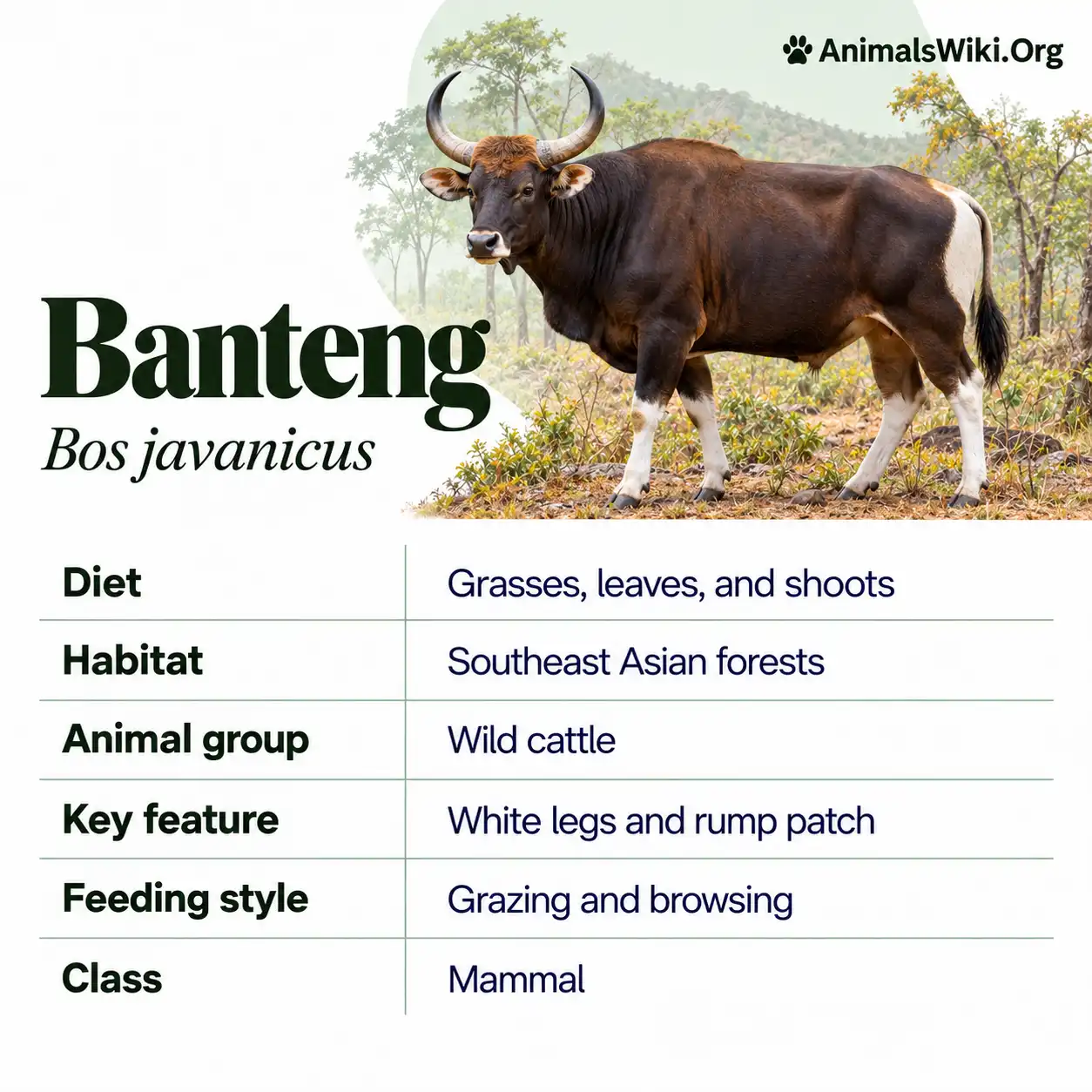
Banteng, A Complete Guide to Southeast Asia’s Endangered Wild Cattle
A reddish-brown cow steps from the forest into a grassy clearing, followed by a calf. A dark bull stands nearby, his curved horns and muscular shoulders contrasting with the bright white markings on his legs and rump. For a moment, the herd resembles domestic cattle. Then the animals become alert and retreat into cover.
These are banteng, some of Southeast Asia’s most distinctive wild mammals.
Their appearance can hide the seriousness of their situation. Although their domestic descendants, Bali cattle, remain important livestock, native wild banteng have suffered severe declines. In October 2024, the species was uplisted from Endangered to Critically Endangered on the IUCN Red List. An amended assessment followed in 2025.
The distinction between wild and domestic animals is essential. A Bali cattle herd, a zoo breeding group and a free-ranging Australian feral population do not represent the same conservation achievement as a secure native population living in Southeast Asian habitat.
Banteng also have a fascinating biological story. They are ruminants that graze and browse, form changing social groups, raise a single calf after a long pregnancy and contribute to ecosystems that support other threatened wildlife.
This guide explains their identification, classification, regional forms, ecology and conservation. It also separates established findings from uncertainty and labels population figures according to their date and scope.
Banteng Facts
| Feature | Key information |
|---|---|
| Common name | Banteng |
| Other name | Tembadau, particularly in Borneo |
| Scientific name | Bos javanicus |
| Family | Bovidae |
| Subfamily | Bovinae |
| Animal group | Wild cattle |
| Native region | Southeast Asia |
| Traditional wild subspecies | Javan, mainland and Bornean banteng |
| Domestic descendant | Bali cattle |
| General shoulder height | Approximately 1.2–1.9 meters across sexes and populations |
| General adult mass | Often summarized as approximately 400–900 kilograms |
| Distinctive markings | White lower legs and a white rump patch |
| Diet | Grasses, sedges, herbs, leaves and other plant material |
| Reproduction | Usually one calf after approximately 9–10 months |
| Exceptional longevity | A captive record of 27.1 years is listed by AnAge |
| Current global category | Critically Endangered |
| Dated native wild estimate | Approximately 3,300 animals, with a reported range of 2,475–4,900, announced in 2024 |
| Main threats | Illegal hunting, snares, habitat loss, fragmentation and livestock-associated risks |
What Is a Banteng?
A banteng is a species of wild cattle native to Southeast Asia. Its scientific name is Bos javanicus.
It belongs to Bovidae, the family containing cattle, buffaloes, antelopes, sheep and goats. Within that family, banteng belong to the cattle-related group Bovinae.
Their closest everyday comparison is a cow, but describing them simply as escaped domestic cattle would be incorrect. Native wild banteng represent populations with their own ecological relationships and evolutionary history.
The connection with livestock runs in the opposite direction: banteng gave rise to domestic Bali cattle.
This relationship creates an unusual conservation situation. The domestic form can be numerous and economically important while the wild form approaches extinction in parts of its natural range.
A species name alone does not capture these differences. Conservation also considers ancestry, management history, location and ecological function.
A native wild herd maintains natural behaviors and relationships within its habitat. A managed herd may preserve valuable genetic material but depends on people. An introduced feral herd may reproduce without daily care while affecting an ecosystem outside the species’ native range.
Understanding banteng therefore requires asking not only “What animal is this?” but also “Which population does it belong to, and under what conditions is it living?”
Identification and Physical Appearance
White stockings and a white rump
The most recognizable banteng markings are the pale lower legs and contrasting white rump patch.
These markings occur in both sexes and help distinguish banteng from several other cattle-like mammals. However, domestic Bali cattle can share them, so markings alone do not prove wild ancestry.
Body proportions, location and population history must also be considered.
A photograph showing a white-rumped bovine in a village is not automatically a record of wild banteng.
Differences between bulls and cows
Banteng show sexual dimorphism: adult males and females differ in appearance.
Mature bulls are generally darker and more heavily built. Many appear dark brown or black, while cows commonly have a reddish-brown or chestnut coat.
Young males may resemble females before developing the darker adult appearance.
These are broad patterns rather than an identification rule without exceptions. Regional variation, age, lighting and individual differences can complicate a photograph.
Whipsnade Zoo describes the contrasting adult colors and the shared white rump and leg markings.
Horns in both sexes
Both bulls and cows have horns.
Male horns are generally larger and more robust, while female horns are usually slimmer. Their shape changes with growth, making horn development useful when interpreting age.
Horns are permanent structures rather than antlers that are normally shed and regrown annually.
A broken horn, unusual curvature or a scar can also help researchers distinguish one individual from another.
How large are banteng?
Banteng are substantial animals, but a single size figure can be misleading.
Males tend to outweigh females, and regional populations differ. Domestic descendants are often smaller than their wild relatives.
Head-and-body length, total length including the tail and shoulder height are separate measurements. They should not be combined as though they describe the same dimension.
For general readers, it is more useful to remember that a mature wild banteng is a large bovine weighing several hundred kilograms than to treat an exceptional maximum as the normal size of every animal.
Scientific Classification
Banteng taxonomy
| Taxonomic rank | Classification |
|---|---|
| Kingdom | Animalia |
| Phylum | Chordata |
| Class | Mammalia |
| Order | Artiodactyla |
| Suborder | Ruminantia |
| Family | Bovidae |
| Subfamily | Bovinae |
| Tribe | Bovini |
| Genus | Bos |
| Species | Bos javanicus |
The Mammal Diversity Database recognizes banteng as Bos javanicus. The species was described under that name by d’Alton in 1823.
Some references use the broader order name Cetartiodactyla, reflecting the evolutionary relationship between even-toed ungulates and whales. This naming difference does not change the banteng’s identity as a ruminant bovid.
Older scientific names
Older publications may use names such as Bos banteng or place the animal in Bibos.
These names are relevant when searching historical literature. A changed scientific combination does not necessarily indicate that the author studied a different animal.
The current database places Bibos at subgenus level within Bos.
Where Bali cattle fit
The domestic form is sometimes labeled Bos javanicus domesticus.
The Mammal Diversity Database includes domestic banteng within B. javanicus rather than recognizing them as a separate species.
That taxonomic inclusion does not mean livestock counts should be substituted for native wild population estimates.
Taxonomy describes biological relationships. Conservation assessment must additionally consider whether a population is wild, domestic, captive or introduced.
Subspecies and Taxonomic Questions
The three traditional wild subspecies
Banteng have traditionally been divided into three geographically separated wild subspecies.
| Traditional subspecies | Scientific name | Main geographical association |
|---|---|---|
| Javan banteng | Bos javanicus javanicus | Java |
| Mainland or Burmese banteng | Bos javanicus birmanicus | Mainland Southeast Asia |
| Bornean banteng | Bos javanicus lowi | Borneo |
These names remain widely used in conservation planning and research.
Geographical separation is important because losing one regional population can remove ancestry and adaptations that are not fully represented elsewhere.
Domestic Bali cattle should not be inserted into this table as though they were a fourth equivalent native wild population.
Is the Bornean banteng a separate species?
Some mitochondrial results suggested that Bornean banteng might represent a distinct species.
However, a 2022 genomic study analyzed nuclear DNA and found that the sampled Bornean banteng grouped strongly with Javan banteng. The authors concluded that their results did not support the separate-species hypothesis.
They also emphasized limitations in the available genomic data.
The appropriate conclusion is therefore measured: the familiar subspecies treatment remains useful, while broader sampling is needed to understand regional diversity fully.
Why different genetic datasets can disagree
Mitochondrial DNA follows a maternal line of inheritance and represents a small portion of an animal’s genetic history.
Nuclear DNA provides information from many more parts of the genome.
Historical interbreeding and the sorting of ancestral genetic variation can produce different evolutionary signals in these datasets.
Consequently, an unusual mitochondrial relationship does not by itself establish that an animal belongs to a different species.
This matters beyond naming. Decisions about conservation breeding, transfers and reintroductions should be based on an adequate understanding of ancestry rather than one dramatic genetic result.
Banteng Compared With Similar Cattle
Banteng can be confused with gaur, domestic cattle and buffaloes, especially in photographs lacking scale.
| Animal | Useful distinguishing context | Relationship to banteng |
|---|---|---|
| Banteng | White rump patch, pale lower legs, characteristic adult color differences | The species discussed here |
| Gaur | Usually a more massive build and pronounced shoulder region; no comparable large white rump patch | Another Asian wild cattle species |
| Bali cattle | Often share banteng-like coloration and markings; maintained as livestock | Domestic descendants of banteng |
| Zebu cattle | Commonly have a conspicuous shoulder hump and domestic breeding history | A different cattle lineage that can contribute to mixed ancestry |
| Asian water buffalo | Different head and horn proportions; belongs to Bubalus | Another member of the cattle tribe |
Appearance is a starting point, not a complete ancestry test.
Genomic research published in 2025 demonstrated complex contributions from banteng-related ancestry to several Indonesian cattle populations. Domestic cattle in the region cannot always be divided into simple categories based on coat color alone.
This is especially relevant when identifying animals near farms or settlements. A bovine may resemble wild banteng while belonging to a domestic or mixed population.
Distribution and Regional Populations
Native range
Banteng are native to Southeast Asia.
Remaining populations occur in parts of Cambodia, Thailand, Myanmar, Indonesia and Malaysia, with the status of some peripheral historical areas uncertain or requiring current confirmation.
The species’ former distribution was much more extensive than its present patchwork of surviving populations.
A historical range map should therefore never be presented as a map of continuous current occupation.
Java
Java supports important native banteng populations, including animals associated with protected landscapes such as Baluran, Alas Purwo, Meru Betiri and Ujung Kulon.
These populations are separated by extensive human-modified areas.
The island’s banteng should not be treated as one freely mixing herd. Isolation affects dispersal, genetic exchange and the ability to recover after a local decline.
Mainland Southeast Asia
Mainland populations persist in increasingly restricted areas.
Cambodia’s dry forests were formerly a major stronghold, while Thailand retains important conservation landscapes.
Country-level presence can hide serious losses within individual protected areas. A species may remain on a national checklist after disappearing from many former sites.
Borneo
Bornean banteng survive in fragmented populations.
Sabah’s wildlife authorities estimated approximately 500 animals in four isolated subpopulations in their October 2024 announcement.
That was a dated estimate for Sabah, not a complete census of all banteng on Borneo.
Why local range matters
A wide geographical label can conceal very little usable habitat.
Two herds may be close on a map but separated by plantations, roads, settlements or other barriers.
Protecting the space between surviving populations can therefore be as important as protecting the places where animals are currently photographed.
Habitat Requirements
A mosaic of feeding areas and cover
Banteng use combinations of forest, grassland, clearings and other vegetation.
Open areas can provide food, while forest cover offers shade and concealment. Water and mineral resources add further components.
This makes habitat quality a landscape question.
A clearing with nutritious grass may be unsuitable if it exposes animals to constant disturbance or lacks safe access to cover.
Regional variation
Javan, mainland and Bornean banteng do not all occupy identical environments.
Deciduous forests and grassy openings are important in some mainland landscapes. Bornean populations also use forest environments, including areas with a history of logging.
“Banteng habitat” should therefore not be reduced to a single photograph of open savanna.
Heat and shade
Large mammals must balance feeding opportunities with temperature.
A camera-trap study in Sabah found that banteng activity and habitat use varied with ambient temperature and forest regeneration history.
The findings show that responses to forest modification involve behavior as well as simple presence or absence.
A camera recording a banteng in an opening does not establish that the animal spends the entire day there.
Logged forest is not equivalent to intact habitat
Banteng can persist in some logged forests, making these areas valuable for conservation.
However, persistence does not demonstrate that logging is harmless.
Research using photographic body-condition scores found relationships with logging method and time since disturbance. The effects were complex rather than uniformly beneficial or negative.
Protecting wildlife in production landscapes requires attention to vegetation, access, hunting and long-term population performance.
Diet and Digestion
What do banteng eat?
Banteng are herbivores.
Their diet includes grasses, sedges, herbs, leaves and other plant material. Depending on habitat and season, they can also consume shoots, flowers and fruits.
They are often described as predominantly grazing animals, but browsing becomes important where grasses are scarce or less nutritious.
This flexibility helps them use different habitats without making every vegetation type equally suitable.
Grazing versus browsing
Grazing generally involves feeding on grasses and similar low-growing plants.
Browsing involves leaves, twigs and other parts of shrubs or trees.
A banteng can do both. The proportion depends on what is available and useful at the time.
The distinction is ecological rather than a strict behavioral boundary. An individual does not cease being a grazer because it eats leaves during part of the year.
Rumination
Like other cattle, banteng are ruminants.
They first swallow plant material, then later regurgitate and rechew it as cud. Microorganisms in the digestive system help break down components that the animal could not efficiently process alone.
This arrangement supports the use of fibrous foods, but it does not eliminate nutritional needs.
Old, coarse vegetation can be abundant while providing less usable nutrition than younger growth.
Water and minerals
Banteng drink when water is available and use mineral resources such as salt licks.
Water access affects movement and habitat use, particularly during dry periods.
Their ability to cope with temporary shortages should not be interpreted as an absence of water requirements.
Marwell’s species account describes both their varied plant diet and the importance of access to water and mixed habitat.
Diet after reintroduction
Released animals must learn or adjust to the foods available in a new setting.
Research in Thailand monitored forage and nutrition before and after banteng reintroduction, demonstrating why food adaptation deserves direct study.
Providing animals for release is only the beginning; managers must establish whether the habitat can support them afterward.
Physical and Behavioral Adaptations
Strength and mobility
A banteng’s muscular body supports movement through varied terrain and provides some protection against smaller predators.
Its size also creates costs. A large animal requires substantial food and cannot hide in the same spaces available to a small forest mammal.
Successful survival therefore depends on both physical ability and access to suitable habitat.
Hooves and horns
Cloven hooves support movement across forest floors, grasslands and other substrates.
Horns contribute to defense and interactions between animals, especially adult males.
They are not proof that an animal is always aggressive. Many confrontations are avoided through alertness, spacing and retreat.
Wariness
Banteng are often shy in places where people pose a threat.
Changes in activity can reduce contact with humans, but avoidance may also restrict access to food or force animals to use less favorable times.
Behavioral flexibility can help an animal survive disturbance without removing the underlying pressure.
Responses to changing landscapes
A useful conservation question is not simply whether banteng “adapt.”
Managers need to know whether animals maintain body condition, reproduce successfully and survive in the altered habitat.
Temporary use of an area and long-term population persistence are different outcomes.
This distinction is particularly important when interpreting camera-trap records from logged forests, edges and plantation landscapes.
Herds, Communication and Activity
Maternal groups
Females and their young form the core of many banteng herds.
Group living can help animals detect danger and maintain social relationships. Calves also remain close to mothers and other herd members during development.
Published group sizes vary, and large temporary gatherings should not be treated as the normal size of every herd.
Bulls and bachelor groups
Adult males may associate with female herds, live alone or form bachelor groups.
Their social position can change with age, condition and breeding opportunities.
The familiar description of one bull with a herd of cows is useful but incomplete. It should not imply that every group maintains an identical membership throughout the year.
Activity patterns
Banteng may be active during daylight, darkness or twilight.
Temperature, food availability and disturbance influence the pattern.
In some places, increased nighttime activity can reduce contact with people. In other situations, animals use cool periods for feeding and shaded areas for resting.
Calling the species strictly nocturnal or strictly diurnal would overlook this flexibility.
Communication
Body posture, movement, sound and chemical information contribute to social interactions.
A bull’s size and horn display may communicate information before physical contact occurs. Mothers and calves must also maintain contact within vegetation.
For observers, context matters. A raised head might indicate attention to an unfamiliar sound rather than a threat display.
Zoo breeding herds provide opportunities to observe these interactions, while field studies reveal how they operate under natural conditions.
Reproduction and Mating
A slow reproductive strategy
Banteng usually produce one calf at a time after a long pregnancy.
This is a relatively slow reproductive strategy compared with that of animals producing multiple offspring several times a year.
The consequence for conservation is straightforward: losses of breeding females can take years to replace.
A population cannot quickly compensate for sustained adult mortality simply because calves continue to appear.
Mating and competition
Males compete for breeding opportunities.
Full reproductive success depends on more than reaching sexual maturity. Size, condition and social circumstances influence a bull’s access to females.
Young males may be physiologically capable of reproduction before they can compete effectively with mature bulls.
Pregnancy
Sources commonly describe gestation as approximately 9–10 months, with figures around 285–295 days.
Variation among records, populations and management systems makes a rounded description more useful than presenting one exact day count as universal.
The AnAge compilation lists 295 days, while other zoological accounts use approximately 285 days.
Breeding season
Seasonality varies.
Some wild populations show breeding or birth peaks associated with local conditions, while managed herds can breed throughout the year.
A calendar reported from Thailand or an introduced Australian herd should not automatically be applied to every native population.
Food availability and rainfall patterns differ across the species’ range.
Calf Development
A single newborn
Banteng generally give birth to one calf.
The young are relatively well developed and can stand and move soon after birth. This is important for an animal that eventually needs to accompany a mobile herd.
Early movement does not make a calf independent. It still depends on milk, maternal protection and the social setting.
Coat changes
Calves commonly have a brown or reddish coat.
Male appearance changes as the animal grows, particularly in populations where mature bulls become very dark.
A brown young male should not be mistaken for an adult female solely because of color.
Horns, body size and other features develop gradually.
Nursing and grazing
Calves begin exploring vegetation while still nursing.
Eating some grass is not the same as obtaining all nutritional needs independently.
Published nursing durations differ, and management records may define weaning differently. It is therefore better to describe dependence as lasting many months than to insist on one universal weaning date.
Growth and maturity
A 2023 study of captive banteng in Thailand examined age structure, body measurements, condition and development in relation to conservation breeding.
It documented substantial changes in male appearance after the first few years, including horn shape, body size and coloration.
These findings are valuable for interpreting photographs, but captive growth should not be assumed to reproduce every condition experienced in the wild.
Lifespan and Mortality
How long can banteng live?
AnAge lists a maximum captive longevity of 27.1 years.
That is a documented managed-animal record, not the average lifespan of a newborn wild banteng.
Wild survival depends on hunting pressure, disease, food, habitat and age.
A heavily hunted population can have short realized lifespans even when the species is biologically capable of living much longer.
Different measures answer different questions
Maximum lifespan asks how long an exceptional individual survived.
Average life expectancy asks how long an individual can be expected to live under specified conditions.
Adult survival measures the probability of surviving from one period to another.
These figures should not be substituted for one another.
Why adult survival matters
For a large mammal producing one calf after a long pregnancy, survival of breeding adults strongly influences recovery.
Protecting calves is important, but repeated loss of mature cows can undermine the population even if births remain visible.
A herd photograph showing several young animals is encouraging evidence of reproduction. It is not sufficient evidence that the population is stable or increasing.
Natural and human-caused mortality
Predation is part of normal ecology.
Illegal hunting and indiscriminate snares add pressures that may operate at levels the population cannot replace.
The conservation challenge is therefore not to eliminate every possible death. It is to reduce preventable mortality enough for births and recruitment to support recovery.
Predators and Competitors
Tigers
Tigers can kill banteng where the two species occur together.
Research in Thailand has examined banteng among the large prey contributing to tiger diets. A 2020 study specifically estimated the weights of banteng and gaur killed by tigers.
Large body size does not make every adult immune to predation.
At the same time, tiger predation should not be presented as a species-wide explanation for banteng decline.
Other predators
Calves and weakened animals can be vulnerable to smaller large carnivores, including leopards and dholes in suitable parts of the range.
Predator communities differ geographically. A list appropriate to mainland Southeast Asia should not be transferred unchanged to Java or Borneo.
Competition
Banteng may share food and water with other wild herbivores and domestic livestock.
Actual competition depends on whether resources become limiting.
Merely photographing two species at the same clearing does not demonstrate that one is harming the other.
Livestock can also affect banteng through disease exposure and interbreeding, which are separate processes from food competition.
Why predator conservation also matters
Recovering large herbivores supports predators that depend on them.
A 2017 tiger study identified banteng alongside sambar and gaur as major prey in its Thai study landscape.
Protecting banteng can therefore contribute to the recovery of a broader ecological community.
Ecological Importance
Grazing and browsing effects
Banteng remove plant tissue and influence how vegetation develops.
Repeated feeding can affect plant height, regeneration and the balance among species.
These effects vary with animal density, plant community and season.
A native grazing role should not be simplified into a claim that every additional banteng always improves vegetation.
Nutrient movement
Dung returns nutrients to the environment and supports organisms involved in decomposition.
Animals also move material between feeding and resting locations.
At a landscape scale, these activities contribute to the circulation of nutrients through ecosystems.
The exact effect requires local study rather than assuming that all large herbivores produce identical outcomes.
Seeds and plant relationships
Banteng can consume fruits and other seed-bearing material, potentially moving seeds through the digestive system.
Whether this benefits a plant depends on seed survival, deposition location and the species involved.
Seed movement is not automatically beneficial to conservation: animals can also interact with invasive plants.
Food-web value
Banteng connect vegetation with predators, scavengers and decomposers.
Losing them removes more than a large animal from a checklist. It changes the availability of prey and the distribution of herbivory.
This is why maintaining native populations matters even if related livestock remain abundant.
A domestic herd cannot automatically perform the same ecological role in the same place.
Population Estimates Explained
The 2024 estimate
The official October 2024 Sabah Wildlife Department announcement reported a global native wild population estimate of approximately 3,300 banteng, with a range of 2,475–4,900.
It also described an estimated decline of 81% over 21 years.
These are assessment-based estimates, not a simultaneous head count of every animal.
The estimate should remain attached to its date. It should not be relabeled a new 2026 census.
Total animals versus mature individuals
A total-individual estimate includes calves, juveniles and adults.
A mature-individual estimate focuses on animals capable of contributing to reproduction under assessment definitions.
The official announcement described the approximately 3,300 figure as a total global population. Some secondary summaries label it differently.
To avoid changing the meaning, this article follows the official announcement’s wording and does not invent a separate mature-individual count.
Wild, captive, domestic and feral
| Population category | What it includes | How it should be reported |
|---|---|---|
| Native wild | Free-ranging banteng in their natural range | Core focus of wild conservation estimates |
| Conservation captive | Managed animals in zoos or breeding centers | Separate inventory with pedigree and management context |
| Domestic | Bali cattle and other managed descendants | Livestock figures, not wild recovery |
| Introduced feral | Free-ranging descendants outside the native range | Separate population with ecological and genetic context |
Adding all four categories together would conceal the condition of native wild populations.
Local counts do not equal global abundance
Camera traps may identify a minimum number of animals without detecting every individual.
A study in southwest Cambodia identified 32 recognizable adults over its survey period, largely through scars and snare wounds. That was not a claim that the entire population consisted of exactly 32 animals.
Population interpretation must account for detection, survey effort and the method used.
Conservation Status
Critically Endangered
Banteng are currently classified as Critically Endangered.
The IUCN specialist-group report confirms that the reassessment was completed in June 2024 and published in October 2024, changing the category from Endangered because of the rate of decline.
An amended version was published in 2025.
Older pages that still say Endangered may contain useful biological information, but their conservation category is outdated.
Why the uplisting matters
The change indicates a higher assessed extinction risk.
It does not mean banteng suddenly declined on the day the category changed. Assessments summarize evidence accumulated over time.
The announcement brought attention to a decline already occurring across fragmented populations.
Local success and global decline can coexist
One protected area may record reproduction or increasing numbers while other populations collapse.
Conservation reporting should therefore distinguish a site-level improvement from recovery of the species as a whole.
Both are meaningful, but they answer different questions.
A successful local project demonstrates what protection can achieve. It does not remove the need for action elsewhere.
Threats to Wild Banteng
Illegal hunting and snares
Illegal hunting is a major threat.
Snares are especially damaging because they can catch animals indiscriminately. Banteng may be deliberately targeted or caught in traps set for other species.
A 2023 study in Cambodia’s Eastern Plains used wildlife surveys and patrol data to examine declines associated with the snaring crisis.
An animal escaping a snare may still suffer injury, infection or impaired movement.
Survivors with scars show only part of the effect; animals that die unseen are missing from that visible record.
Habitat loss and fragmentation
Conversion removes feeding areas, shelter and routes between populations.
Fragmentation can leave herds too isolated for regular genetic exchange.
A protected patch may retain animals while becoming increasingly vulnerable to chance events, disease or the loss of a few breeding adults.
Invasive vegetation
Habitat quality can deteriorate without complete forest clearance.
At Baluran in Java, research documented how invasive Acacia nilotica suppressed native grasses used by wildlife, including banteng.
This illustrates why protected-area management may require active vegetation restoration rather than simply preventing development.
Disease
Contact with domestic livestock can create additional risks.
A published Cambodian case documented lumpy skin disease in a wild banteng and described a vaccination response involving domestic livestock.
The affected animal also had a snare injury, showing how multiple pressures can act together.
A single case does not quantify disease mortality across the species. It does establish that the risk deserves investigation and management.
Interbreeding
Interbreeding with domestic cattle can alter the ancestry of small wild populations.
The scale of this threat varies and should be evaluated genetically rather than assumed from appearance.
Recent cattle-genomics research also shows that gene flow in Bos has a complex history.
The conservation issue is preserving viable wild populations and their evolutionary distinctiveness, not treating all historical gene exchange as the same event.
Bali Cattle and Domestication
Domestic descendants of banteng
Bali cattle are domesticated banteng and remain important livestock, particularly in Indonesia.
They provide a striking example of a domestic lineage surviving successfully while its wild ancestor declines.
Their agricultural value does not reduce the need to protect native wild herds.
A history still being investigated
The timing and process of domestication remain subjects of research.
A study published in Current Biology in 2026 analyzed wild, domestic and historical samples and found a more complex history than a single sharply defined domestication event.
It reported relatively limited differentiation outside populations strongly affected by recent founder events or captive breeding.
Genetic divergence dates should not be read as the exact day people first domesticated the animal.
Can domestic animals help conservation?
Potentially, but not automatically.
The 2026 study found that some domestic populations retained substantial genetic diversity. This may be relevant to future conservation planning.
However, using domestic animals in wild recovery would require careful evaluation of ancestry, health, behavior and management objectives.
A large livestock population is not an uncomplicated substitute for lost wild diversity.
Why wild banteng remain irreplaceable
Wild populations retain relationships with landscapes, predators, foods and seasonal conditions.
They also contain regional histories that may not be represented fully in domestic stock.
Conservation must therefore protect both biological diversity and the settings in which it functions.
Maintaining Bali cattle is valuable agricultural stewardship. Recovering wild banteng is a related but distinct task.
Introduced Banteng in Australia
How the population began
Banteng-derived cattle were introduced to northern Australia in the nineteenth century.
After the settlement at Port Essington was abandoned in 1849, animals remained and established a feral population on the Cobourg Peninsula.
Their ancestry is associated with domestic Bali cattle rather than an untouched sample of all wild banteng diversity.
Why they are counted separately
An introduced population can be large while native populations remain threatened.
Combining the Australian animals with Southeast Asian wild estimates would hide the geographical and ecological loss occurring in the native range.
It would also ignore founder history and genetic change.
Environmental impacts
The Northern Territory Government describes impacts from grazing and trampling, including damage to wetlands and dune ecosystems.
This creates a real management tension.
Animals can have conservation interest because of their ancestry while also affecting ecosystems outside their natural range.
Are they a ready-made rescue population?
Not necessarily.
A founder population may contain only part of the original genetic diversity, and introduced animals have experienced a different environment.
The 2026 genomic study identified substantial founder-related effects in the Australian population.
Any proposed conservation use would need evidence rather than assuming that free-ranging animals are automatically suitable for release into native habitat.
Conservation Breeding and Reintroduction
Protecting wild populations comes first
Effective protection from hunting is fundamental.
Releasing animals into a landscape where the original causes of decline remain active risks repeating the same losses.
Habitat suitability, community relationships and enforcement must be addressed alongside breeding.
Coordinated zoo populations
Zoos and breeding centers can preserve animals and support research.
Pedigree records, carefully planned transfers and coordinated breeding help manage a population beyond the capacity of any single institution.
Programs involving banteng form part of international cooperation through Action Indonesia and global species-management efforts.
These programs support conservation but should not be described as having already restored the species in the wild.
Reintroduction in Thailand
Thailand has established banteng reintroduction projects in areas of former range.
Research at Salakphra Wildlife Sanctuary has followed habitat use, movement and adaptation after release.
A study covering 2019–2021 compared animals using core and edge areas, illustrating the need for continued monitoring.
How success is measured
Release numbers alone are insufficient.
Important outcomes include survival, reproduction, calf recruitment, habitat use and whether the population persists without unacceptable intervention.
A project may successfully release animals but still need years of work before a stable population is established.
Assisted reproduction and genetic resources
Artificial insemination and stored biological material can help manage breeding populations.
The Wilds has reported producing banteng calves through assisted reproduction, while San Diego’s historical records document the use of Frozen Zoo cells in banteng cloning.
These are significant technical achievements, but they do not replace habitat protection or remove hunting pressure.
Research and Responsible Observation
Camera traps and individual recognition
Researchers use horn shape, scars, ear damage and leg-marking patterns to recognize some individuals.
This can support studies of survival, body condition and movement.
Recognition is more difficult in calves whose appearance changes rapidly.
A photograph is therefore data requiring interpretation, not a complete population estimate by itself.
Different methods answer different questions
| Method | Main contribution |
|---|---|
| Camera trapping | Presence, activity, recognizable individuals and condition |
| Line-transect surveys | Density estimates where assumptions are met |
| GPS tracking | Movement and space use |
| Genetic sampling | Ancestry, relatedness and connectivity |
| Veterinary investigation | Disease and causes of mortality |
| Long-term monitoring | Trends in survival, reproduction and abundance |
A broad Thai prey study used thousands of survey transects to examine habitat use, showing how systematic fieldwork can identify priorities for recovery.
Watching banteng responsibly
Maintain distance and avoid blocking movement between feeding areas and cover.
Do not approach calves or assume that a quiet animal is tame.
A large wild bovine can injure a person if cornered or disturbed.
Responsible observation also avoids sharing precise locations of vulnerable herds where that information could increase hunting risk.
The best encounter leaves the animal able to continue its normal behavior.
Frequently Asked Questions About Banteng
1. What is a banteng?
A banteng is a Southeast Asian wild cattle species with the scientific name Bos javanicus. It belongs to Bovidae and is recognizable by pale lower legs and a white rump patch. Domestic Bali cattle descend from banteng.
2. How do you identify a banteng?
Look for the combination of cattle-like proportions, curved horns, white stockings and a white rump. Adult bulls are often dark, while cows are commonly reddish-brown. Domestic descendants can share these features, so location and history also matter.
3. Are banteng cows?
They are wild cattle. “Cow” can describe an adult female banteng, while “bull” describes an adult male. They are not simply feral versions of ordinary domestic cattle, although their own domestic descendants exist.
4. Where do wild banteng live?
Surviving native populations occur in parts of Southeast Asia, including Java, Borneo and mainland landscapes. Their distribution is fragmented, and historical country records should not be interpreted as proof of current widespread occupation.
5. How many subspecies are recognized?
Three wild subspecies are traditionally recognized: Javan, mainland and Bornean banteng. These remain useful regional labels. Genetic research continues to clarify their relationships, so disputed species-level proposals should not be presented as settled facts.
6. Is the Bornean banteng a separate species?
A proposal based on mitochondrial evidence suggested that possibility. A 2022 nuclear-genomic analysis did not support it. Broader sampling remains valuable, but current conservation usage commonly retains Bos javanicus lowi as a subspecies.
7. What do banteng eat?
They eat plant material, particularly grasses, together with sedges, herbs, leaves, shoots and other foods. Their balance of grazing and browsing changes with habitat and season. A single diet list cannot describe every population.
8. Do banteng hunt other animals?
No. Their normal feeding strategy is herbivorous grazing and browsing. References to “banteng hunting” generally concern humans hunting banteng, not banteng pursuing prey.
9. Do both sexes have horns?
Yes. Bulls generally have more substantial horns than cows. Horn growth and shape change with age and can help interpret an animal’s development. Individual horn features can also assist photographic recognition.
10. Why are males darker?
Adult coloration is part of the species’ sexual dimorphism. Young males may remain brown before developing a darker coat. Regional and individual variation means color should be used with other features rather than as an absolute rule.
11. Are banteng active at night?
They can be. Activity varies with temperature, habitat and disturbance. In some places they use daylight or twilight extensively; in others, greater nighttime activity may reduce encounters with people.
12. How long is pregnancy?
Pregnancy lasts approximately 9–10 months. Different references give figures around 285–295 days. A rounded range better represents the available information than claiming every pregnancy lasts exactly the same number of days.
13. How many calves are born?
Usually one calf is born per pregnancy. This slow reproductive pattern means sustained losses of breeding adults can be difficult to replace. Seeing calves is evidence of reproduction, but not by itself proof of population recovery.
14. Can newborn calves walk?
Yes. Calves are relatively well developed and can stand and move soon after birth. They remain dependent on their mothers for milk and protection while developing the ability to feed and travel more independently.
15. How long do banteng live?
AnAge lists a captive longevity record of 27.1 years. This is exceptional managed survival, not an average for wild animals. Wild life expectancy varies with hunting pressure, disease, habitat and other conditions.
16. What eats banteng?
Tigers can prey on banteng where their ranges overlap. Calves and weakened animals may also be vulnerable to other carnivores. Predator relationships differ between mainland and island populations.
17. Are banteng endangered?
Their current category is Critically Endangered. The species was uplisted in October 2024, and an amended assessment followed in 2025. Pages still describing banteng only as Endangered may be using an older assessment.
18. How many wild banteng remain?
The official 2024 announcement estimated approximately 3,300 animals, with a range of 2,475–4,900. This is a dated estimate for native wild populations, not a new 2026 census or a count including domestic cattle.
19. Does 3,300 mean mature individuals?
The official announcement described it as a total population estimate. Mature-individual estimates are a separate category. This article preserves that wording rather than relabeling the number or calculating an unsupported breeding-adult figure.
20. Are Bali cattle the same as wild banteng?
Bali cattle are domestic descendants of banteng and are included within the species in some taxonomic treatments. Their management, ancestry and ecological circumstances differ from native wild populations. Livestock abundance does not demonstrate wild recovery.
21. Are banteng native to Australia?
No. Australian herds descend from introduced animals associated with nineteenth-century settlement. They are counted separately from native wild banteng and can cause environmental impacts in the ecosystems where they became established.
22. Can zoo banteng be released?
Some captive-bred banteng have been reintroduced in carefully managed projects. Release requires suitable habitat, health and ancestry assessment, threat reduction and long-term monitoring. Simply opening an enclosure would not constitute a conservation program.
23. What is the greatest threat?
Illegal hunting and snares are major immediate threats, together with habitat loss and fragmentation. Livestock-associated disease and interbreeding can add risks. Their relative importance varies between populations.
24. Why do banteng matter to tigers?
Banteng are substantial prey in some tiger landscapes. Recovering their populations can help restore food resources for tigers. This connection is region-specific and does not mean every tiger population historically depended on banteng.
25. Can cloning save banteng?
Cloning and stored cells may contribute to genetic management, but they cannot secure habitat or stop hunting. Recovery depends on viable populations that survive and reproduce in suitable landscapes. Technology is one possible tool within that larger effort.
Banteng (Bos javanicus)
Banteng are far more than attractive wild relatives of domestic cattle.
Their lives connect grassy clearings with forest cover, maternal herds with developing calves, and vegetation with large predators. Their domestic descendants also make them part of Southeast Asia’s agricultural history.
Yet that connection creates a misleading impression of security. Numerous Bali cattle and introduced herds cannot replace native wild populations or the ecological relationships they maintain.
The 2024 uplisting to Critically Endangered reflects a severe conservation problem. Reducing hunting and snaring, protecting connected habitat, managing livestock-related risks and monitoring recovery are essential.
Conservation breeding and genomic research can support that work. Their greatest value comes when they contribute to the central goal: banteng populations surviving, reproducing and functioning within their native Southeast Asian landscapes.



