
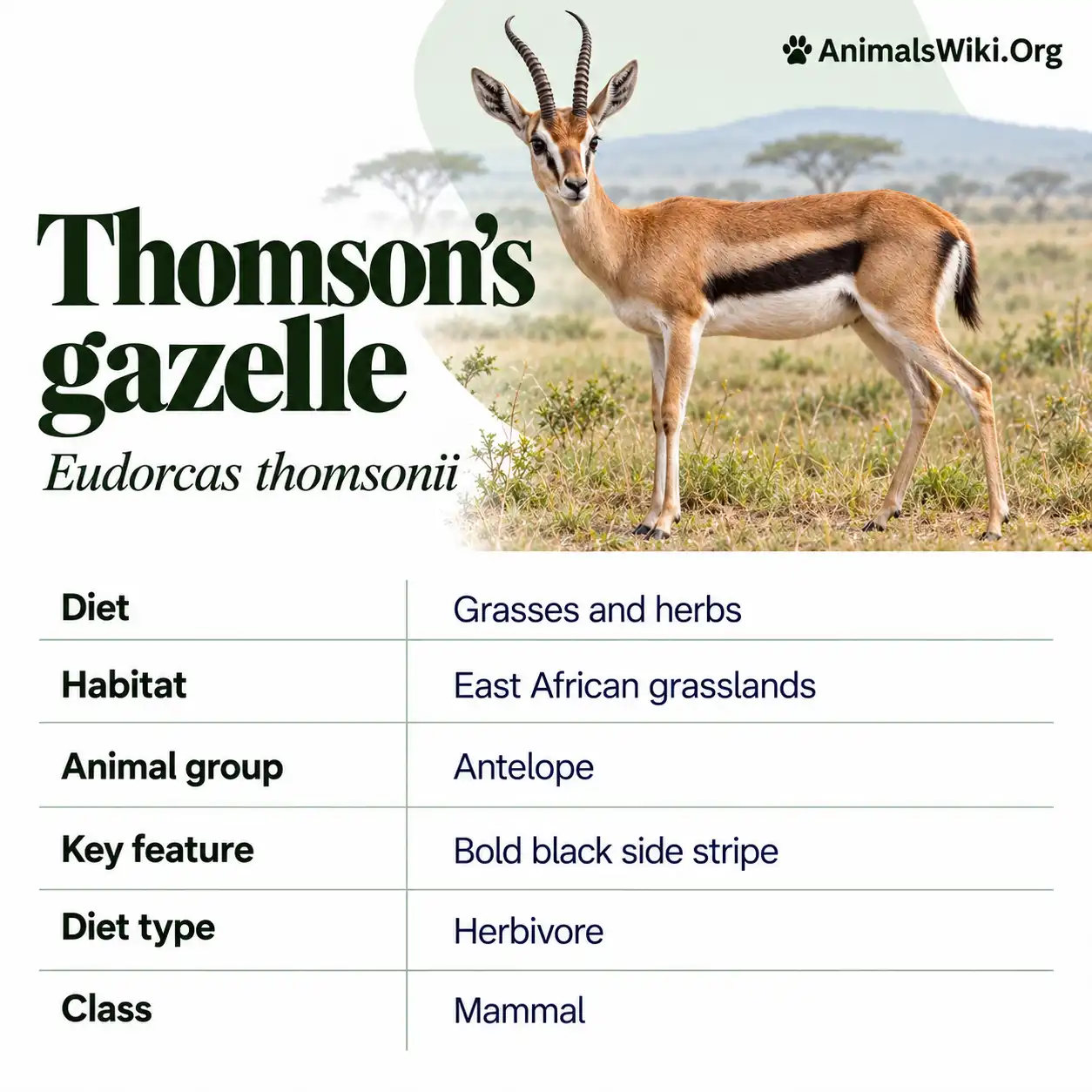
Thomson’s Gazelle, A Complete Guide to East Africa’s Remarkable Antelope
A small antelope lifts its head above the grass. Its ears turn toward a sound, its black tail flicks, and its body becomes still. A moment later, it springs upward with all four feet clear of the ground before racing across the plain.
This is Thomson’s gazelle, one of the most recognizable animals of East Africa’s open landscapes. Its sandy coat, bold black flank stripe, white underside and graceful movements make it a familiar sight in wildlife documentaries. Yet there is much more to this animal than speed and a distinctive appearance.
Thomson’s gazelles make difficult decisions throughout the day. They must find nutritious plants while watching for predators, choose when to join other animals, and balance feeding against vigilance. Females face an additional challenge: protecting young fawns that initially depend on concealment rather than running with the herd.
Their lives also reveal how grassland ecosystems work. Rainfall changes the quality of their food. Larger grazers alter the vegetation they use. Predators influence where they feed, while livestock, fences and cultivation can reshape their movements.
This guide explores the species from identification and classification to reproduction, ecological importance and conservation. Population figures are dated or qualified where necessary, because an older global estimate, a local census and a count of mature animals answer different questions.
Thomson’s Gazelle Facts
| Feature | Details |
|---|---|
| Common name | Thomson’s gazelle |
| Scientific name | Eudorcas thomsonii |
| Older scientific combination | Gazella thomsonii |
| Animal group | Mammal; antelope |
| Family | Bovidae |
| Native distribution | Primarily southern and central Kenya and northern Tanzania |
| Main habitats | Open grasslands, short-grass plains and suitable savanna |
| Typical adult weight | Approximately 15–35 kg, with males generally heavier |
| Shoulder height | Approximately 55–82 cm |
| Diet | Primarily grasses, supplemented by other vegetation |
| Social organization | Flexible herds, bachelor groups and territorial males |
| Pregnancy | Approximately 5½–6 months |
| Usual number of young | One fawn |
| Distinctive behavior | Stotting: stiff-legged leaps with all four feet airborne |
| Conservation category | Least Concern |
| Population caution | Published totals and mature-individual estimates are not interchangeable |
The size ranges reflect variation between sexes and individuals. They should not be interpreted as measurements that every adult reaches. The Mammal Diversity Database recognizes the species as Eudorcas thomsonii, while the African Wildlife Foundation provides the general size ranges above.
What Is Thomson’s Gazelle?
Thomson’s gazelle is a small African antelope adapted to open environments where food can be abundant but safety is never guaranteed. It belongs to the same large mammal family as cattle, buffalo, goats and many other antelopes, although its light build differs greatly from those heavier relatives.
“Antelope” is a convenient common term rather than the name of a single scientific rank. It includes many bovids with different evolutionary histories, body sizes and lifestyles. A gazelle is therefore an antelope, but not every antelope is a gazelle.
Thomson’s gazelle is often called a “tommy” in wildlife tourism and popular writing. That nickname can be useful in conversation, but the full common name is clearer in an educational article, especially when several gazelle species are being discussed.
The species is closely associated with the Serengeti–Mara landscape. However, its biology should not be reduced to a background role in the wildebeest migration. Individual gazelles have their own feeding requirements, reproductive schedules and responses to danger.
Their small size allows them to select individual plant parts that a much larger grazer may pass over. At the same time, that size makes them vulnerable to several predators. Much of their behavior reflects the need to obtain enough food without becoming an easy target.
Identification and Physical Appearance
Coat Color and the Black Flank Stripe
A typical Thomson’s gazelle has a sandy or reddish-brown upper body, a white belly and a conspicuous dark stripe along each side. The contrast between the upper coat, black stripe and pale underside is particularly useful when viewing the animal from the side.
Its face carries contrasting markings, and its rump is pale around a dark tail. Together, these features create a recognizable pattern, but identification is strongest when several characteristics are considered at once.
Distance, shadow, dust and the angle of the animal can hide a stripe or make body proportions difficult to judge. A gazelle facing directly toward an observer may be much harder to identify than one standing broadside.
Size and Differences Between the Sexes
Males are generally heavier and more robust than females. The difference becomes easier to notice when adults stand together, although body condition, age and viewing distance can complicate comparisons.
A healthy adult male may have a thicker neck and a more substantial appearance than a female. A young male, however, can be mistaken for a female if the observer relies only on size.
Body size also affects behavior. Larger males can invest in territorial contests, while females must meet the changing nutritional demands of pregnancy and nursing. These differences influence how animals use the landscape, but they do not mean every male or female behaves identically.
Do Female Thomson’s Gazelles Have Horns?
Male horns are generally longer and more strongly developed, with visible ridges and a curved profile. Female horns can be much smaller and thinner, and some females lack them.
This variation makes the statement “female Thomson’s gazelles are hornless” unreliable. Horn size can help with identification and sexing, but it should be combined with body shape, age and behavior.
Identification Requires More Than One Marking
A practical field approach is to look for the combination of:
- Small, lightly built body.
- Strong contrast between the brown back and white underside.
- Broad dark flank stripe.
- Facial markings.
- Rump pattern and tail position.
- Horn shape, where clearly visible.
Using a combination of features is especially important when Thomson’s gazelles occur alongside Grant’s gazelles. Some Grant’s gazelles can also show flank markings, so the presence of a stripe alone does not settle the identification.
Scientific Classification and Subspecies
Where Thomson’s Gazelle Fits in the Animal Kingdom
| Taxonomic level | Classification |
|---|---|
| Kingdom | Animalia |
| Phylum | Chordata |
| Class | Mammalia |
| Order | Artiodactyla, within the broader cetartiodactyl grouping |
| Family | Bovidae |
| Subfamily | Antilopinae |
| Tribe | Antilopini |
| Genus | Eudorcas |
| Species | Eudorcas thomsonii |
Some classifications use Cetartiodactyla as the order name to emphasize the evolutionary relationship between even-toed hoofed mammals and cetaceans. Differences in the presentation of these higher ranks do not mean that researchers disagree about whether Thomson’s gazelle is a bovid antelope.
The species was scientifically described in 1884. Older books commonly place it in Gazella, which explains why Gazella thomsonii remains widespread in historical literature.
Why Different Scientific Names Appear
Scientific classifications change as researchers compare anatomy, geographic variation and genetic evidence. A change in genus does not necessarily mean an entirely new animal has been discovered. It may reflect a revised understanding of relationships between already known animals.
For readers, the important distinction is between an older combination and a genuinely different species. Searching both Eudorcas thomsonii and Gazella thomsonii can help locate relevant literature, but older sources still need to be checked for outdated range or conservation information.
Are There Different Subspecies?
Traditional treatments have recognized geographic forms commonly called Eudorcas thomsonii thomsonii and Eudorcas thomsonii nasalis. Some taxonomic authors have treated the western form, nasalis, as a separate species.
The Mammal Diversity Database currently includes nasalis within Eudorcas thomsonii. Its treatment illustrates why an article should explain alternative classifications rather than present every proposed split as settled.
Geographic variation is real, but deciding whether that variation deserves species or subspecies rank requires an explicit taxonomic framework. A useful account should identify the framework it follows and avoid mixing population figures from different species definitions.
Distribution and Habitat
Where Does Thomson’s Gazelle Live?
The species’ native distribution is centered on Kenya and Tanzania. It is particularly associated with the open ecosystems of southern Kenya and northern Tanzania, including the wider Serengeti–Mara region.
That distribution is much narrower than the phrase “African gazelle” might suggest. Thomson’s gazelle is not naturally spread across every African grassland, and it should not be assumed to occur wherever another gazelle species is found.
Country boundaries alone also provide an incomplete picture. Within a country, suitable habitat may occur as connected plains, isolated ranches, protected areas or fragments separated by cultivation and infrastructure.
Preferred Habitat
Thomson’s gazelles are strongly associated with open grasslands and short vegetation. These habitats can provide accessible forage and long sightlines for detecting approaching predators.
However, an apparently uniform plain contains many different feeding opportunities. Recent rain, soil fertility, grazing history and the height of the grass all influence which patches are attractive.
A short patch may contain tender new leaves. A taller patch may offer concealment for a fawn. A bare area might improve visibility but provide little food. Habitat quality therefore depends on what the animal needs at that moment.
Why Open Ground Can Be Valuable
Visibility is a major advantage of open habitat. Detecting a predator early gives a gazelle more time to assess the threat and choose an escape direction.
Yet visibility is only one part of the decision. An exposed animal can also be seen by predators, and open ground without adequate forage cannot support it indefinitely.
The best feeding location is consequently a compromise. Gazelles must evaluate food, cover, the presence of other animals and the likelihood of danger. These choices can shift with season, reproductive condition and local predator activity.
Seasonal Movement Is Flexible
Some populations make substantial seasonal movements, while others use more localized ranges. A study of ungulates in Tanzania’s Tarangire ecosystem, for example, examined a resident Thomson’s gazelle population.
It is therefore misleading to describe every individual as participating in one continuous, long-distance migration. Movement patterns depend on the population and landscape being studied.
Population Estimates and Conservation Status
What Is the Current Conservation Category?
Thomson’s gazelle is listed as Least Concern. The IUCN’s 2018 category-change documentation records a change from Near Threatened to Least Concern.
Older pages and books may still display Near Threatened. Those references should be dated rather than silently combined with the current category. The Mammal Diversity Database also displays Least Concern for the species.
Least Concern does not mean that every population is secure or that numbers are increasing. It describes the species’ global extinction-risk category under the assessment framework.
How Many Thomson’s Gazelles Remain?
Published figures differ partly because they describe different things.
The African Wildlife Foundation’s species page gives approximately 207,000 animals, but it does not present that figure as a newly completed 2026 census. A 2025 IFAW overview reports approximately 145,000 mature individuals in the wild, reflecting an IUCN-linked estimate rather than a fresh, simultaneous count across the range.
These figures should not be treated as contradictory measurements of exactly the same population category.
| Published figure | What it describes | How to interpret it |
|---|---|---|
| Approximately 207,000 | Overall population figure on an undated AWF species page | A published estimate, without claiming a new survey year |
| Approximately 145,000 | Mature wild individuals reported in a 2025 IFAW overview | An adult breeding-population estimate, not all ages combined |
| 1,223 in 2021 and 327 in 2024 | Local census figures for Solio Ranch in Kenya | A change at one site, not a national or global population total |
Total Animals Versus Mature Individuals
A total-population estimate may include young animals as well as adults. A mature-individual estimate aims to describe animals capable of reproduction, subject to the assessment’s definitions and assumptions.
The two figures cannot be compared as though one automatically proves a decline from the other. Nor should a fixed percentage be used to convert between them without supporting demographic information.
Seasonal birth pulses, juvenile survival and survey timing can all change the relationship between the number of young and mature animals.
A Dated Example of Local Decline
Kenya’s 2025 national wildlife census report includes a Solio Ranch comparison showing 1,223 Thomson’s gazelles in 2021 and 327 in 2024, a reported decline of approximately 73.3%.
This is a serious local result, but it does not mean that Thomson’s gazelles declined by 73.3% across Kenya. The report discusses possible contributing pressures; identifying their relative effects requires more than the count alone.
Wild, Captive and Managed Populations
An animal in a zoo is part of a captive population. Animals on ranches or conservancies may live under various forms of management, and their treatment in population reporting depends on the survey’s definitions.
A global wild-population estimate should not be increased by adding zoo holdings without explanation. Likewise, a successful local breeding program does not automatically demonstrate recovery throughout the natural range.
Diet and Feeding
What Does Thomson’s Gazelle Eat?
Thomson’s gazelle is a plant eater. Grasses are central to its diet, but it can also consume other vegetation, including leafy non-grass plants and browse.
Calling it a selective feeder is more useful than imagining it simply cutting any grass in front of it. It can choose particular leaves, shoots and patches according to their nutritional value and availability.
The balance between grasses and other plants changes with local conditions. A fixed percentage repeated without a study location or season can conceal that flexibility.
Why Fresh Growth Matters
Young plant tissue is often easier to digest than older, fibrous material. Following rain, fresh growth can create attractive feeding patches even where the vegetation appears sparse.
For a small herbivore, food quality matters alongside quantity. A tall stand of mature grass can contain considerable plant material while offering fewer of the tender parts the animal selects.
This helps explain why gazelles may spend time in closely grazed areas that look unimpressive to a human observer. The relevant question is not simply how much grass is present, but which parts are available and how nutritious they are.
How Digestion Works
As a ruminant, Thomson’s gazelle uses a specialized digestive system in which microorganisms help break down plant material. Food is initially swallowed and later returned to the mouth as cud for further chewing.
This arrangement allows the animal to obtain nutrients from vegetation that humans cannot digest effectively. It also creates a visible rhythm of feeding and resting: an animal lying down may still be processing an earlier meal.
Rumination does not make all plants equally useful. The quality of the selected food remains important, and the gazelle must continue balancing intake with time spent watching for danger.
Feeding Is Also a Safety Decision
A gazelle with its head down has a different view of its surroundings from one standing alert. Looking up can improve awareness, but frequent interruptions reduce feeding time.
The presence of companions can alter that trade-off. Other animals may detect danger, although relying entirely on them would also be risky.
Food choice and predator avoidance therefore operate together. A patch with excellent plants may be avoided if approaching danger is difficult to detect, while a slightly poorer patch can be attractive because it offers a clearer view.
Water Use and Dry-Country Adaptations
Does Thomson’s Gazelle Need to Drink Every Day?
Thomson’s gazelle has relatively low dependence on surface water compared with some other savanna herbivores. Water obtained from food helps it use places where permanent drinking water is limited.
Low dependence does not mean complete independence. The moisture content of plants, temperature, reproductive demands and the availability of forage all affect water balance. Research classifications that describe the species as having low water dependence should not be rewritten as “it never drinks.”
Behavioral Responses to Dry Conditions
An animal can respond to difficult conditions by changing where and when it feeds. Moving toward greener vegetation can improve both nutrient intake and the amount of moisture obtained from food.
Resting, selecting shade where available and adjusting activity are additional ways that savanna mammals manage environmental demands. However, the exact pattern varies with location and season; there is no single schedule that applies to every herd.
Dry conditions can also increase competition. When fresh growth becomes scarce, animals may be concentrated into a smaller area, where both food availability and predator encounters change.
Adaptation Has Limits
An animal suited to a seasonally dry environment can still suffer during severe or prolonged drought. Adaptation allows survival within a range of conditions; it does not remove the need for food and water.
This distinction matters for conservation. Describing an animal as drought adapted should never become a reason to ignore the loss of movement routes or seasonal feeding areas.
Movement, Speed and Stotting
How Fast Can Thomson’s Gazelle Run?
Thomson’s gazelles are fast runners. Popular wildlife references commonly report speeds around 65–70 km/h, although such figures are best treated as approximate rather than precise, standardized records.
A predator encounter depends on much more than maximum speed. Starting distance, acceleration, footing, turning ability, stamina and the predator’s approach all influence the result.
A gazelle that detects danger early may escape without ever reaching its fastest possible speed. Another caught at very close range may have little opportunity to use its full running ability.
What Is Stotting?
Stotting is a distinctive leap in which the animal springs upward with relatively stiff legs and all four feet leave the ground.
The movement is visually dramatic, but a scientific explanation requires more than saying the animal is excited. Researchers have tested several ideas about what stotting communicates and when it is useful.
Possible functions are not necessarily mutually exclusive. A movement can convey information to a predator while also being visible to nearby gazelles.
What Research Suggests About Its Function
A 1986 study by Tim Caro found support for the interpretation that stotting can tell a predator it has been detected. This challenges the idea that every leap should be interpreted simply as an attempt to confuse or frighten the predator.
A separate 1988 study by Clare FitzGibbon and John Fanshawe examined encounters involving wild dogs and cheetahs. Gazelles stotted more toward coursing wild dogs than toward stalking cheetahs. The authors interpreted aspects of the behavior as consistent with an honest signal of condition or escape ability.
| Explanation | What it proposes | Necessary caution |
|---|---|---|
| Predator-detection signal | The gazelle indicates that a hidden approach has failed | Detection does not guarantee escape |
| Condition or escape-ability signal | The display provides information about how difficult capture may be | Evidence depends on predator and context |
| Communication visible to companions | Nearby animals may respond to the display | Visibility alone does not establish its primary function |
| One universal explanation | Every leap serves exactly the same purpose | This is too strong for the available evidence |
Stotting should therefore be described as a behavior with experimentally investigated signaling functions, rather than a trick that always prevents an attack.
Social Behavior and Communication
Flexible Herds
Thomson’s gazelle groups are not always stable family units. Animals may gather, separate and reorganize as feeding conditions and reproductive circumstances change.
Groups can include females and young, bachelor males, or mixed aggregations. Published accounts describe groups ranging from a few individuals to several dozen, with larger gatherings under suitable conditions.
This flexibility allows animals to respond to patchy resources. A large group may provide benefits in detecting danger, but it also brings more mouths to the same feeding area.
Territorial Males
Some males defend territories rather than permanently controlling a fixed group of females. Females move through the landscape according to their own needs, including feeding and caring for young.
A territory’s value can therefore depend on its location and resources. A male occupying a useful patch may encounter females, but defending it requires time and energy.
Territorial behavior can include displays, scent marking and confrontations with rivals. Not every encounter becomes a prolonged fight, because injury can be costly to both participants.
Scent, Posture and Attention
Communication is not limited to sounds. Scent marks, body orientation, horn presentation and changes in movement can provide information to other gazelles.
Accounts of the species describe scent marking associated with territorial behavior, including the use of glandular secretions and dung or urine. The North Carolina Zoo also highlights scent marking and the importance of social communication.
For an observer, a still animal may be communicating or assessing a situation. Wildlife behavior should not be judged only by obvious movement; pauses, spacing and attention are often equally informative.
Reproduction and Breeding
Breeding Opportunities and Female Condition
Reproduction depends on more than the presence of a mature male and female. A female must obtain enough resources to support pregnancy and then produce milk.
Rainfall can influence reproductive success by changing forage quality. However, the relationship is not as simple as every animal giving birth immediately after the first rain.
Different populations experience different seasonal patterns, and individual condition also matters. Broad statements about a single breeding month across the entire range should therefore be treated cautiously.
Pregnancy and Birth
Pregnancy lasts approximately 165–170 days, or around five and a half to six months. A female normally gives birth to one fawn.
Newborns weigh only a few kilograms, creating a marked difference between their vulnerability and an adult’s ability to detect danger and run. The AnAge database lists a typical birth mass of approximately 2.6 kg and a gestation of 170 days.
Birth is the beginning of an extended period of maternal investment. Milk production, vigilance and repeated visits to a concealed fawn all place demands on the mother.
Why One Fawn Can Still Be a Major Investment
Producing a single young animal may appear less demanding than producing a large litter, but a gazelle fawn must grow rapidly enough to become more mobile and less dependent.
The mother also has to maintain her own condition. If she spends too little time feeding, milk production and future survival may suffer. If she feeds without adequate attention to danger, her fawn may be exposed.
Reproduction is consequently a sequence of decisions rather than a single event. Successful birth does not guarantee successful development.
Fawn Development and Maternal Care
The Hiding Phase
Young Thomson’s gazelles initially use a hiding strategy. A fawn spends substantial periods lying quietly in vegetation while its mother feeds elsewhere and returns to nurse it.
This behavior differs from the popular image of every young antelope immediately following a herd throughout the day. A hidden fawn can remain near its birth area even while adults are visible at some distance.
Concealment works by reducing the chance of discovery. Unnecessary movement can reveal a fawn, which is one reason an apparently motionless youngster should not automatically be assumed to be injured or abandoned.
Mothers Use More Than One Protective Strategy
Research on mother–fawn pairs has identified different combinations of social setting and vegetation.
A 2014 study found that mothers could reduce detection risk by isolating themselves in taller grass or by remaining with groups in shorter grass. The important finding was that successful tactics depended on the combination of circumstances.
It would therefore be misleading to claim that every mother must separate from other gazelles or that taller vegetation is always safest. Cover and social surroundings interact.
Why Returning to a Fawn Can Be Dangerous
A concealed fawn may be difficult to find until the mother approaches it. Her return can provide a clue to a watching predator.
Research published in 1993 showed that maternal behavior can limit information about a fawn’s location, including delaying a return when a predator has been detected.
Later work found that mothers adjusted vigilance around visits to their young, with heightened attention before retrieving the fawn and lower vigilance after it had resumed hiding. This provides evidence that maternal care includes carefully timed observation as well as nursing.
From Concealment to Following
As a fawn develops, it becomes more mobile and spends more time moving with its mother. This transition changes how it avoids predators: remaining unnoticed becomes less central, while movement, attention and association with others become more important.
The change is gradual rather than an abrupt switch on an identical day for every animal.
| Developmental phase | Main needs | Common protective approach |
|---|---|---|
| Newborn | Milk, warmth and concealment | Limited movement and maternal visits |
| Early hiding phase | Rapid growth and regular nursing | Remaining quiet in a selected resting place |
| Increasing mobility | Coordination and experience | More movement near the mother |
| Following phase | Learning feeding and social routines | Greater use of movement and group surroundings |
| Growing juvenile | More independent feeding | Continued development of vigilance and escape skills |
Weaning and Independence
Weaning occurs after several months rather than immediately after the fawn begins tasting plants. AnAge lists approximately 102 days as a weaning value, which is useful as a general guide rather than a fixed deadline for every individual.
Eating vegetation, no longer depending on milk and becoming socially independent are related but distinct stages. A young animal can begin feeding on plants while still receiving milk.
Lifespan and Survival
How Long Do Thomson’s Gazelles Live?
Lifespan depends on whether the question concerns wild animals, captive animals, maximum recorded age or average survival from birth.
AnAge records a captive longevity of 20 years, while rating the underlying data as acceptable and of medium quality. That is a maximum record, not the expected lifespan of every gazelle.
In the wild, predation, injury, disease and food shortages affect survival. An adult that has already survived its vulnerable early life faces a different outlook from a newborn.
Why “Average Lifespan” Can Be Misleading
A single number can conceal very different measurements. Average age at death across all newborns may be much lower than the remaining life expectancy of a healthy adult.
Zoo animals also experience conditions that differ from those in open ecosystems. Veterinary treatment and reliable food can reduce some risks, while managed care introduces its own circumstances.
A careful species account should therefore avoid presenting a captive maximum as a normal wild lifespan or treating an approximate adult lifespan as a guarantee.
Predators and Hunting Encounters
Main Predators
Thomson’s gazelles occur in ecosystems containing several large carnivores. Cheetahs are particularly associated with gazelle hunting, but lions, leopards, spotted hyenas and African wild dogs can also take them.
Young fawns face additional danger from smaller predators, including jackals. Which predator is most important varies by place, season and the age of the gazelle.
A predator list describes possible relationships; it does not establish the proportion of deaths caused by each species.
Stalking and Pursuit Create Different Problems
A stalking predator benefits from approaching close before it is detected. A coursing predator can rely more on pursuit after the prey begins moving.
These different hunting styles help explain why a gazelle’s response can vary between predators. Detecting a concealed cheetah early may undermine its approach, while assessing pursuit ability may matter differently during an encounter with wild dogs.
The 1988 stotting study is especially useful because it compared behavior in encounters with different predator types rather than assuming all danger produces the same response.
Escape Is a Sequence of Decisions
An encounter may involve noticing movement, identifying the threat, judging distance, signaling awareness and choosing whether to flee.
Running too late can be fatal. Running at every uncertain sound can waste energy and interrupt feeding. The problem is therefore to respond appropriately under incomplete information.
This is why an animal’s stillness should not be confused with an absence of awareness. A gazelle may be watching closely before deciding whether movement is necessary.
Predation Is Part of the Ecosystem
Predation is a natural relationship, not automatically evidence that the ecosystem is failing.
However, habitat changes can alter that relationship. A fenced population with limited escape routes may experience pressures different from those in a connected landscape.
When numbers fall, managers need to investigate the wider setting rather than assuming that removing predators will solve the problem.
Competitors and Relationships With Other Grazers
Do Wildebeest Help Thomson’s Gazelles Feed?
Larger herbivores can change grass height and plant growth, sometimes creating feeding opportunities for smaller grazers.
A classic 1976 Serengeti study linked gazelle use of areas with earlier wildebeest grazing. Such research supports the possibility of facilitation: one species’ feeding activity can improve conditions for another.
Yet the familiar story of zebras, wildebeest and gazelles always feeding in a neat, beneficial sequence is too simple.
Facilitation and Competition Can Both Occur
Animals can benefit from earlier grazing and still compete when food becomes scarce. The outcome depends on timing, plant growth and how much forage remains.
A 1981 study explicitly tested competition and facilitation as explanations for Serengeti ungulate population regulation, challenging a simple assumption that facilitation alone determines the system.
Later research on mixed-species groups also shows that food availability and predation risk influence whether grazers associate. Benefits from being together can weaken when scarce resources increase competition.
Relationships With Livestock
Cattle and gazelles do not interact in exactly the same way in every season.
Research in the Mara found that gazelle distribution was associated with intermediate cattle densities under some wet-season conditions, while higher livestock density was associated with lower gazelle density in the dry season.
The findings are consistent with context-dependent benefits and costs, rather than a universal claim that cattle always help or always exclude gazelles.
| Situation | Possible outcome |
|---|---|
| Earlier grazing followed by plant regrowth | Improved access to nutritious shoots |
| Moderate grazing that keeps vegetation short | Potential feeding and visibility benefits |
| Heavy use during food scarcity | Increased competition |
| Mixed groups in risky habitat | Potential benefits from additional vigilance |
| Concentration around limited resources | Greater pressure on available forage |
Ecological Importance
A Link Between Plants and Predators
Thomson’s gazelle converts plant material into animal tissue that supports carnivores and scavengers.
Its ecological role is therefore not limited to its own feeding. A gazelle population connects vegetation to several other levels of the food web.
The disappearance of a local population can affect predators, although the outcome depends on what alternative prey are available. Such effects should be investigated rather than assumed to be identical in every ecosystem.
Grazing and Nutrient Cycling
By selecting plants, gazelles influence which tissues are removed and where feeding pressure occurs. Their dung and urine return nutrients to the environment.
These processes happen across many individual movements and feeding decisions. An apparently small animal can contribute substantially when many individuals use a landscape over time.
The ecological effect is also distributed unevenly. Frequently used patches receive different pressure from areas that animals avoid because of poor forage, disturbance or danger.
A Species That Reveals Landscape Conditions
Changes in distribution can provide clues about changes in the landscape. Gazelles may disappear from an area because movement has become difficult, vegetation has changed or disturbance has increased.
However, their presence alone does not prove that every part of an ecosystem is healthy. A population can persist temporarily in a shrinking habitat, and a local concentration may reflect displacement from elsewhere.
Long-term monitoring is needed to distinguish a functioning connected population from a group confined to a diminishing refuge.
Threats to Thomson’s Gazelle
Habitat Loss and Fragmentation
Cultivation, settlement and infrastructure can replace feeding areas or separate them from seasonal resources.
Fragmentation matters even when some grassland remains. A patch may support animals during one season but fail to provide what they need during another.
The conservation question is therefore not only how much habitat exists, but whether animals can reach the right places at the right times.
Fences and Restricted Movement
Fences can prevent access to grazing, redirect movements or create entanglement risks. Their effects depend on design, location and the species attempting to cross.
A boundary that appears small on a map can be important if it cuts across a regularly used route. Conversely, evaluating fence impacts requires local evidence rather than assuming that all barriers have identical consequences.
Hunting and Snares
Illegal hunting can remove animals directly. Snares may kill the intended species or catch other wildlife moving through the same area.
A population that appears numerous can still be affected if removal is concentrated in particular places or continues alongside habitat deterioration.
Species-level abundance should not obscure the risks faced by individual local populations.
Drought and Changing Resource Availability
Extended dry periods can reduce the amount and quality of forage. When movement is constrained, animals have fewer options for finding suitable conditions.
The interaction between drought and land use can be particularly important. A landscape that once allowed animals to track rainfall may become much less resilient when routes are blocked.
Why Declining Numbers Need Investigation
Current summaries describe a decreasing population trend despite the species’ Least Concern category. That combination is possible because a species can remain relatively widespread and numerous while still losing animals or habitat.
A decline can reflect several interacting pressures. Counting animals is the starting point; identifying causes requires information about habitat, survival, reproduction, movement and human activities.
Conservation and Monitoring
Protect Connected Landscapes
Protected areas provide important habitat, but many animals also depend on land beyond formal park boundaries.
Conservation therefore benefits from maintaining links among parks, conservancies, ranches and community landscapes. The objective is to preserve the processes animals need, including seasonal access to food and space for movement.
A map showing isolated protected blocks may look reassuring while concealing a loss of practical connectivity between them.
Work With Local Land Users
People living alongside wildlife make daily decisions that affect grazing, fencing and habitat.
Effective conservation needs to account for livestock management, crop protection and local livelihoods. Measures that ignore those realities may be difficult to maintain even if they appear attractive on paper.
The context-dependent relationship between gazelles and livestock also supports careful management rather than blanket assumptions.
Improve the Quality of Population Reporting
Useful monitoring should identify the area counted, date, method and population category.
Repeated surveys are easiest to interpret when they use comparable methods and seasonal timing. Changes in visibility, observer effort or survey boundaries can affect results.
A good monitoring table should answer four questions:
- Where were the animals counted?
- When was the survey conducted?
- Which animals were included?
- How uncertain is the estimate?
The Solio Ranch comparison illustrates the value of dated local information. It also illustrates why a local result must retain its geographic label when repeated elsewhere.
Measure Conservation Success Broadly
A larger count is encouraging, but it is not the only useful measure.
A population also needs successful reproduction, access to seasonal resources and the ability to persist through difficult years. Habitat condition and connectivity can reveal problems before they become obvious in a single census.
Conservation is strongest when numbers are interpreted alongside the ecological conditions supporting them.
Thomson’s Gazelle Compared With Similar Antelopes
Thomson’s Gazelle Versus Grant’s Gazelle
Grant’s gazelle is generally larger. Its white rump marking typically extends above the tail onto the lower back, whereas the pattern in Thomson’s gazelle differs.
Some Grant’s gazelles show dark flank markings, so “stripe equals Thomson’s” is an unreliable shortcut. The combined use of body size, rump pattern and overall appearance is more dependable.
| Feature | Thomson’s gazelle | Grant’s gazelle |
|---|---|---|
| Scientific genus | Eudorcas | Nanger |
| General size | Smaller and lighter | Larger and more substantial |
| Flank stripe | Usually conspicuous | Variable; may be present |
| Rump identification | Consider alongside tail and body pattern | White commonly extends above the tail |
| Field approach | Use several features together | Avoid relying on size or stripe alone |
Thomson’s Gazelle Versus Springbok
Springbok and Thomson’s gazelles can look similar in photographs because both have contrasting body markings and perform dramatic leaps.
They are nevertheless different animals with different native distributions. Springbok are associated with southern Africa, while Thomson’s gazelles are East African.
Springbok also possess a distinctive dorsal skin fold associated with their display. Thomson’s gazelle stotting should not be described as involving that springbok feature.
A photograph’s location is therefore useful identification evidence. It should support visual analysis rather than replace it, since photographs of captive animals may be taken far outside their native ranges.
Watching Thomson’s Gazelles Responsibly
Observe the Details
Thomson’s gazelles reward patient observation. Watching only for a high-speed chase misses much of their behavior.
Look for changes in spacing, repeated head movements, feeding choices and the attention a female gives to a particular patch of vegetation. A territorial male may repeatedly patrol an area while other animals move through it.
These small actions reveal how the animal uses its surroundings.
Give Hidden Fawns Space
A fawn lying alone is not necessarily abandoned. Its mother may be feeding nearby and waiting for a safe opportunity to return.
Approaching, touching or moving the fawn can interrupt that system. Observers should keep their distance and follow local wildlife guidance.
If an animal appears injured or trapped, the appropriate response is to notify a guide, ranger or relevant wildlife authority rather than attempt an improvised intervention.
Do Not Provoke Displays
Chasing an animal to make it run or stot turns an observation opportunity into a disturbance.
Natural behavior is more informative when the animal is free to choose it. Keeping a respectful distance also helps protect feeding time and allows mothers to return to their young.
Frequently Asked Questions About Thomson’s Gazelle
1. What is the scientific name of Thomson’s gazelle?
The currently accepted name used here is Eudorcas thomsonii. Older references frequently use Gazella thomsonii. These names usually refer to the same familiar East African species under different genus classifications, although older geographic accounts still need careful checking.
2. Is Thomson’s gazelle an antelope?
Yes. It is an antelope in the family Bovidae. “Antelope” is a broad common term covering many different bovids, while “gazelle” refers to a narrower set of animals. Thomson’s gazelle is therefore both a gazelle and an antelope.
3. Where does Thomson’s gazelle live?
Its native distribution is centered on Kenya and Tanzania, especially suitable open landscapes in southern Kenya and northern Tanzania. It is strongly associated with the Serengeti–Mara region, but its distribution should not be described as covering Africa generally.
4. What does Thomson’s gazelle eat?
It eats grasses and other plant material. It selects nutritious leaves and shoots rather than consuming every available plant equally. The balance between grass and other vegetation changes with season, habitat and local food availability.
5. How can you recognize Thomson’s gazelle?
Look for a relatively small antelope with a sandy-brown back, white underside and strong dark flank stripe. Facial markings, horn form and rump pattern provide additional clues. Use several features together, particularly where Grant’s gazelles are present.
6. Do female Thomson’s gazelles have horns?
They can. Female horns are generally smaller and thinner than male horns, and some females lack them. Horn presence alone is therefore insufficient for confidently identifying the sex of every animal, especially at a distance.
7. How fast can Thomson’s gazelle run?
Common wildlife references give approximate sprint speeds around 65–70 km/h. These should be treated as broad figures rather than exact performance limits. Escape also depends on warning distance, acceleration, footing and the predator’s hunting strategy.
8. Can a Thomson’s gazelle outrun a cheetah?
A gazelle can escape a cheetah, but that does not mean it has a greater maximum speed. Early detection, the distance between the animals and the circumstances of the chase all matter. Some encounters end before a prolonged pursuit develops.
9. Why do Thomson’s gazelles jump into the air?
The behavior is called stotting. Research supports signaling interpretations, including communicating that a predator has been detected and, in some encounters, providing information about escape ability. No single explanation should be assumed to account for every leap.
10. Is stotting the same as springbok pronking?
The terms describe related-looking stiff-legged leaps, and popular usage sometimes overlaps. However, the animals and their displays should not be treated as identical. In particular, the springbok’s distinctive dorsal fold is not a feature of Thomson’s gazelle.
11. Do Thomson’s gazelles migrate?
Some populations make seasonal movements, but not every population follows the same pattern. Others are more resident. It is more accurate to describe the movement behavior of a particular population than to assume all animals join a single regional migration.
12. Do they need water every day?
They have relatively low dependence on surface water and can obtain moisture from food. Whether an individual drinks depends on conditions. Low water dependence should not be turned into the absolute claim that the species never needs to drink.
13. How long is a Thomson’s gazelle pregnant?
Pregnancy is approximately 165–170 days, or around five and a half to six months. Published figures vary slightly, so an approximate range is more useful than presenting one exact day count as universal.
14. How many babies does a female have?
A female normally produces one fawn at a time. The newborn depends heavily on maternal milk and protection. Successful reproduction requires more than birth: the mother must support the youngster through its vulnerable early development.
15. What is a baby Thomson’s gazelle called?
“Fawn” is commonly used, although “calf” also appears in descriptions of antelope young. Either can be understood in context. Using “fawn” consistently helps distinguish the young animal from the adults throughout an article.
16. Why does a mother leave her fawn alone?
Young fawns use concealment as an important defense. The mother feeds elsewhere and returns to nurse, reducing continuous activity around the hiding place. A quiet fawn without an adult immediately beside it is therefore not necessarily abandoned.
17. When does the fawn begin following its mother?
Following increases as the youngster becomes more mobile and the hiding phase ends. This is a developmental transition rather than a fixed event occurring at the same age in every animal. Movement and concealment overlap during the change.
18. When are Thomson’s gazelles weaned?
Weaning generally occurs after several months. A database value of approximately 102 days provides a useful reference, but individual timing can vary. A fawn may begin eating plants before it has completely stopped receiving milk.
19. How long do Thomson’s gazelles live?
Longevity depends on the conditions and the measurement used. A captive record reaches 20 years, but that is not a typical wild life expectancy. Survival in nature is influenced by predation, food supply, disease and injury.
20. What eats Thomson’s gazelles?
Predators include cheetahs and other large carnivores in their range. Fawns can also be taken by smaller predators, including jackals. The importance of each predator differs among locations and age groups, so there is no single universal predator ranking.
21. Are Thomson’s gazelles endangered?
They are currently categorized as Least Concern, not Endangered. However, a Least Concern species can still have a decreasing trend and experience serious local losses. Global category and local population condition should always be distinguished.
22. How many Thomson’s gazelles are left?
Published summaries include approximately 207,000 animals overall and approximately 145,000 mature wild individuals. These represent different population categories and should not be presented as equivalent counts. Neither should be described as a new 2026 census without supporting survey evidence.
23. Why do older sources call the species Near Threatened?
The IUCN documented a change from Near Threatened to Least Concern in 2018. Older publications may retain the earlier category. The date of an assessment matters, and an outdated category should not be repeated as the current one.
24. Are Thomson’s gazelles important to the ecosystem?
Yes. They consume vegetation, redistribute nutrients and provide prey for carnivores. Their interactions with other grazers also form part of grassland ecology. These roles connect the species to plants, predators, scavengers and the wider landscape.
25. Can Thomson’s gazelles live alongside cattle?
They can share landscapes, but the outcome depends on grazing intensity, season and resources. Research in the Mara found context-dependent associations rather than one simple relationship. During food scarcity, competition may become more important than potential benefits from earlier grazing.
26. How are they different from Grant’s gazelles?
Thomson’s gazelles are generally smaller and often show a more conspicuous flank stripe. Grant’s gazelles usually have a white rump marking extending above the tail. Because markings vary, identification should combine size, rump pattern and other visible features.
Thomson’s Gazelle ()
Thomson’s gazelle is a small antelope with a complex life. Its survival depends on much more than running fast: it must select suitable food, interpret danger, communicate with other animals and adjust to changing conditions.
Its maternal behavior is especially revealing. Hidden fawns, carefully timed nursing visits and flexible protective tactics show how much of the species’ life happens quietly, beyond the dramatic chase scenes commonly associated with gazelles.
The species remains classified as Least Concern, but that status does not erase local declines or the importance of connected habitat. Reliable conservation depends on dated population information, careful interpretation of surveys and attention to the landscapes that support feeding, movement and reproduction.
Understanding Thomson’s gazelle means seeing both the individual animal and the ecosystem around it. Its distinctive markings may make it easy to recognize, but its behavior and ecological relationships make it worth watching closely.



