
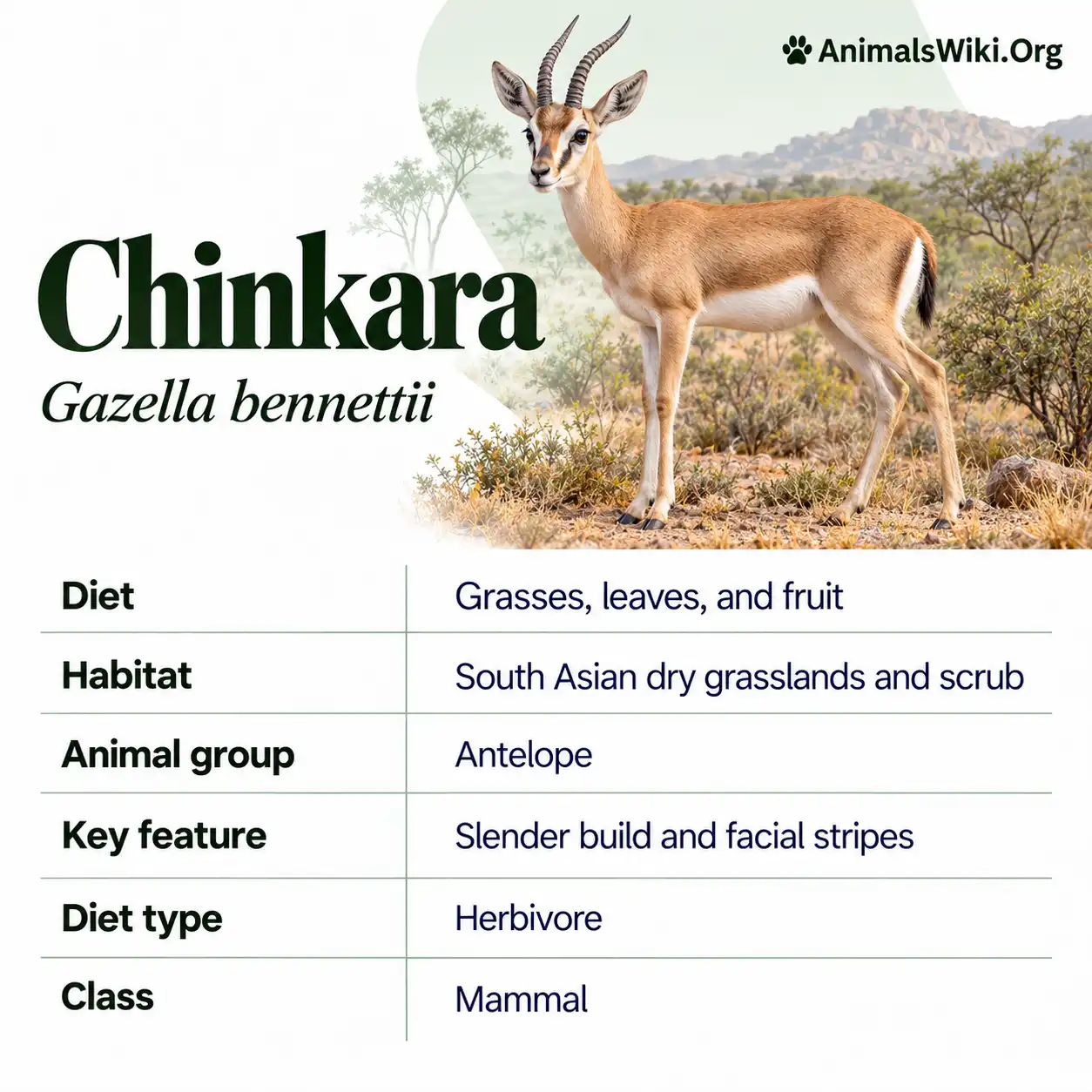
Chinkara, the graceful Indian gazelle adapted to dry plains
The Chinkara is a graceful wild gazelle known for its sandy coat, slender legs, distinctive facial markings and remarkable ability to survive in dry environments. Scientifically known as Gazella bennettii, this small antelope inhabits parts of the Indian subcontinent, including India, Pakistan, Iran and Afghanistan. It is especially associated with arid plains, desert margins, rocky terrain and open scrublands.
Unlike many large mammals that depend on frequent access to drinking water, the Chinkara can tolerate long intervals between visits to water sources under suitable conditions. Its ability to obtain moisture from vegetation and conserve water helps it survive in landscapes where rainfall is unpredictable and surface water can be scarce.
The Chinkara is also an important member of its ecosystem. It feeds on grasses, herbs, leaves and other vegetation, provides prey for carnivores and contributes to the natural functioning of dryland habitats. Its alert behavior, quick movements and cautious nature help it avoid danger in environments where hiding places may be limited.
However, survival in a harsh climate does not make this gazelle immune to human pressures. Illegal hunting, habitat degradation, overgrazing, agricultural expansion, roads and changing climate conditions can threaten local populations. Although the species is classified as Least Concern globally in the IUCN assessment commonly cited in conservation references, its population trend has been described as decreasing, and the condition of individual populations varies considerably.
This complete guide explores Chinkara identification, scientific classification, distribution, habitat, diet, adaptations, behavior, reproduction, lifespan, predators, ecological importance and conservation. It also examines population estimates carefully, distinguishes older figures from current evidence, and explains why the classification of some related gazelle populations deserves further scientific attention.
Chinkara Facts
| Feature | Details |
|---|---|
| Common name | Chinkara |
| Other common name | Indian gazelle |
| Scientific name | Gazella bennettii |
| Animal group | Mammal |
| Class | Mammalia |
| Order | Artiodactyla; sometimes treated within Cetartiodactyla |
| Family | Bovidae |
| Genus | Gazella |
| Species | Gazella bennettii |
| Described by | William Henry Sykes, 1831 |
| Native range | Indian subcontinent and parts of southwestern Asia |
| Countries in its recognized range | India, Pakistan, Iran and Afghanistan |
| Typical habitat | Deserts, semi-arid plains, dry scrublands, rocky terrain and open woodland |
| Diet | Grasses, herbs, leaves, shoots and other plant material |
| Feeding type | Herbivore; flexible grazer and browser |
| Typical shoulder height | Approximately 60–70 cm |
| Approximate body weight | Around 20–25 kg in many descriptions, with individual variation |
| Coat color | Sandy, reddish-buff or fawn |
| Distinctive markings | Dark facial stripes bordered by pale markings; light underparts |
| Horns | Usually present in adult males; females are generally hornless or have much smaller horns, depending on the population and individual |
| Water requirements | Can survive long intervals between drinking when conditions and food moisture permit |
| Social behavior | Often solitary or found in small groups |
| Reproduction | Usually one fawn per birth |
| Gestation | Approximately five to six months in commonly reported accounts |
| Lifespan | Varies with habitat, predation and other conditions; exact typical lifespan estimates are not consistent across references |
| Main threats | Hunting, habitat degradation, overgrazing, land conversion and fragmentation |
| Global conservation status | Least Concern in the IUCN assessment published in 2017 |
| Population trend in that assessment | Decreasing |
| Historical mature-individual estimate | 50,000–70,000 |
| Introduced populations | No major introduced population is needed to explain the species’ conservation status; focus remains on its native range |
Note: Measurements and biological details vary among individuals and geographic populations. The population estimate of 50,000–70,000 mature individuals comes from the IUCN assessment published in 2017, based on an assessment dated June 21, 2016. It is not a verified global count for 2026.
What Is a Chinkara?
The Chinkara is a small, slender gazelle native to dry landscapes across parts of South Asia and neighboring regions of southwestern Asia. It belongs to the family Bovidae, the same broad mammal family that includes cattle, sheep, goats and many other antelopes.
Its scientific name is Gazella bennettii. The animal is also widely known as the Indian gazelle, although its geographic range extends beyond India. It occurs in Pakistan, Iran and Afghanistan as well, with distribution and population conditions differing substantially among these countries.
The Chinkara is particularly well adapted to arid and semi-arid environments. Its sandy coat helps it blend into dry ground and sparse vegetation, while its long, slender legs support fast movement across open terrain. Its cautious behavior and keen awareness of its surroundings help it avoid predators.
One of its most remarkable features is its ability to tolerate water scarcity. Chinkaras can sometimes obtain much of the moisture they need from plants and go for long periods without drinking directly. However, this ability depends on environmental conditions, the moisture content of food and the animal’s physiological needs. It does not mean the species is independent of water under every circumstance.
Why Is the Chinkara Important?
The Chinkara is important for several ecological and conservation reasons.
First, it is a native herbivore in dryland ecosystems. By eating grasses, leaves and other vegetation, it transfers energy from plants into the wider food web. Carnivores can prey on it, while its droppings contribute nutrients to the environment.
Second, the Chinkara is adapted to habitats that are often overlooked in conservation planning. Deserts, scrublands and dry plains may appear barren, but they support specialized plants and animals. Converting these habitats can damage biodiversity even when the landscape does not resemble a lush forest.
Third, the species is an important part of the natural heritage of India and Pakistan. It occurs in landscapes where wildlife must coexist with farming, livestock grazing and expanding human settlements. Its survival therefore depends not only on protected areas but also on how surrounding land is managed.
Finally, the Chinkara illustrates why conservation categories must be interpreted carefully. A species can be globally classified as Least Concern while facing hunting pressure and habitat decline in particular regions. Understanding the local situation is essential for choosing appropriate conservation measures.
Is a Chinkara a Deer or an Antelope?
A Chinkara is an antelope, not a deer. More specifically, it is a gazelle belonging to the genus Gazella.
Antelopes and deer are both hoofed mammals, but they belong to different families. The Chinkara belongs to Bovidae, while deer belong to Cervidae.
A key distinction involves their headgear. Chinkaras typically have permanent horns in males. These horns consist of a bony core covered by a keratin sheath and are not normally shed every year.
Most deer species that possess antlers grow them as bone structures that are periodically shed and regrown. Antlers are often branched, whereas Chinkara horns are generally slender and curved.
What Makes the Chinkara Different From Other Gazelles?
The Chinkara has several recognizable features:
-
A sandy or reddish-buff coat that blends with dry environments.
-
Dark facial stripes bordered by pale markings.
-
A relatively small, slender body.
-
Long legs suited to rapid movement.
-
Curved horns in most adult males.
-
A strong tolerance for arid conditions.
-
A tendency to live alone or in small groups rather than always forming large herds.
These traits help distinguish it from larger antelopes such as the nilgai and from other gazelles with different facial markings, body proportions or geographic distributions.
Why Is It Called the Indian Gazelle?
The common name Indian gazelle reflects the species’ strong association with India, where much of its recognized population occurs.
However, common names are not precise maps of geographic distribution. The Chinkara also occurs in Pakistan, Iran and Afghanistan. In different parts of its range, it may be known by different local names.
For accurate wildlife identification and scientific writing, the scientific name Gazella bennettii is more precise than a regional common name.
Chinkara Identification and Physical Characteristics
The Chinkara is a relatively small gazelle with a delicate build, narrow muzzle, large eyes and long legs. Its coat generally ranges from sandy beige to reddish-buff, helping it blend into the dry landscapes where it lives.
Although it may resemble other gazelles from a distance, the combination of its facial markings, body size, coat color and horn shape provides useful clues for identification.
Body Size and Shape
Chinkaras have a light, streamlined body. Their long legs help them move quickly across dry plains, gravelly ground and open scrub.
Most general wildlife references place their shoulder height at approximately 60–70 centimeters, with body weight often around 20–25 kilograms. Individual measurements vary according to sex, age, health, nutrition and geographic population.
| Physical feature | Typical description |
|---|---|
| Shoulder height | Approximately 60–70 cm |
| Body weight | Often around 20–25 kg |
| Body shape | Slender and lightly built |
| Legs | Long and adapted for fast movement |
| Muzzle | Narrow and tapered |
| Eyes | Prominent and useful for detecting movement |
| Ears | Relatively long and mobile |
| Tail | Relatively short, with darker hairs toward the tip |
| Hooves | Cloven and suited to movement over firm ground |
These figures are approximate identification guides, not strict limits. Published measurements can differ because researchers use different samples and measurement methods.
Coat Color and Camouflage
The Chinkara’s coat is usually sandy, fawn, reddish-buff or pale brown. Its coloration is well suited to dry habitats containing sand, rocks, dusty soil and sparse vegetation.
The coat can vary with season, location, age and individual characteristics. A gazelle photographed in bright sunlight may appear paler than one seen in shade, so color alone should not be used to identify a population or subspecies.
Camouflage is especially valuable in open habitats. Unlike animals that hide beneath dense forest cover, a Chinkara may rely on remaining inconspicuous against the background and detecting danger early enough to escape.
Its coat does not make it invisible. A moving animal can still be noticed by a predator, and the effectiveness of camouflage depends on the color and structure of the surrounding landscape.
Facial Markings
One of the Chinkara’s most useful identification features is the pattern on its face.
Dark chestnut or brownish stripes typically run from near the eyes toward the muzzle, bordered by lighter markings. This creates a contrasting facial pattern that can help distinguish the Chinkara from other gazelles.
The exact intensity of the markings varies. Some individuals show stronger contrasts than others, and photographs taken at different distances or lighting conditions may not reveal the full pattern.
When identifying a gazelle, facial markings are most useful when combined with body size, horn shape, coat color and geographic location.
Chinkara Horns
Adult male Chinkaras generally develop slender, curved horns. The horns often show rings or ridges and may bend backward or outward, depending on the individual’s growth pattern.
Horns are important in interactions between males, particularly during competition over territories or mating opportunities. They can also provide a means of defense at close range, although escaping a predator is usually safer than confronting it.
Females are generally hornless or have much smaller horns, depending on the individual and the population. This means horn presence is useful for identifying males, but horn absence alone should not be treated as an infallible way to determine sex.
Unlike deer antlers, the Chinkara’s horns are permanent structures. They grow over time and are not normally shed each year.
Differences Between Male and Female Chinkaras
Male and female Chinkaras look broadly similar in their sandy coloration, body shape and facial markings. This differs from some antelope species, in which adult males develop dramatically different coat colors.
Adult males typically have more prominent horns, while females generally have smaller or absent horns. Males may also be somewhat larger, although body size overlaps between the sexes.
| Feature | Male Chinkara | Female Chinkara |
|---|---|---|
| Body size | Often somewhat larger | Often somewhat smaller |
| Coat | Sandy, fawn or reddish-buff | Sandy, fawn or reddish-buff |
| Horns | Usually well developed | Usually absent or much smaller |
| Facial markings | Dark and pale facial stripes | Similar general pattern |
| Main reproductive role | Competes for mating opportunities | Carries pregnancy and nurses the young |
| Social behavior | May become territorial during breeding | May remain alone or associate with other females and young |
The differences are general patterns rather than absolute rules for every individual.
How to Identify a Chinkara in the Wild
When observing a possible Chinkara, look for several features together:
-
A relatively small, slender gazelle.
-
A sandy or reddish-buff coat.
-
Dark facial stripes bordered by pale markings.
-
Long, narrow legs and a light body.
-
Curved horns in a typical adult male.
-
An arid or semi-arid habitat with sparse vegetation.
-
Cautious behavior and rapid movement when disturbed.
Location is also important. In the Indian subcontinent, a small sandy gazelle in dry plains or scrubland may be a Chinkara, but other species can occur in parts of the wider region. A reliable identification should consider the complete set of visible features.
Is the Chinkara Built for the Desert?
Yes, the Chinkara has several characteristics suited to arid environments. Its coat blends into sandy landscapes, its body is built for rapid movement and it can tolerate long intervals between drinking when conditions permit.
However, it is not restricted to sand deserts. It can also occupy rocky hills, dry scrub, open woodland and semi-arid plains. The most important factor is the availability of suitable habitat, food and safe movement routes rather than the presence of sand alone.
Scientific Classification and Taxonomy
The Chinkara’s scientific name is Gazella bennettii. The species was described by British naturalist William Henry Sykes in 1831. It belongs to the genus Gazella, a group of gazelles adapted to a variety of open and dry environments.
Scientific classification helps distinguish the Chinkara from other gazelles that may look similar but have different evolutionary histories. However, classification within the wider gazelle group has changed over time as researchers have examined physical characteristics, chromosomes and genetic evidence.
Chinkara Taxonomic Classification
| Classification level | Name |
|---|---|
| Kingdom | Animalia |
| Phylum | Chordata |
| Class | Mammalia |
| Order | Artiodactyla |
| Family | Bovidae |
| Subfamily | Antilopinae |
| Genus | Gazella |
| Species | Gazella bennettii |
| Scientific authority | (Sykes, 1831) |
Some modern classification systems use the order name Cetartiodactyla, which groups even-toed ungulates with cetaceans based on evolutionary relationships. Other references retain Artiodactyla. This difference in higher-level classification does not mean that the Chinkara itself is a different species.
What Does the Scientific Name Mean?
The genus name Gazella identifies the animal as a gazelle. The species name bennettii honors the naturalist associated with its scientific naming history.
Scientific names provide a standardized way to refer to organisms across languages and regions. This is particularly helpful for the Chinkara because its common names differ among countries and communities.
For example, the term Indian gazelle is widely used in English, but it can be misleading if interpreted as meaning the species occurs only in India. The scientific name avoids that geographic ambiguity.
Does the Chinkara Have Subspecies?
The classification of Chinkara populations below the species level has varied across historical references.
Some zoological sources have recognized several named geographic forms, including names associated with regional populations. Older literature and educational references may list subspecies such as Gazella bennettii bennettii and other regional forms. The number and validity of these names are not uniformly accepted across all modern taxonomic treatments.
The Mammal Diversity Database and other contemporary taxonomic resources provide a basis for recognizing Gazella bennettii as a species, but the treatment of historical subspecies names can vary.
For that reason, it is more accurate to describe the Chinkara as one recognized species while acknowledging that the boundaries and status of some regional populations require careful taxonomic evaluation.
A name appearing in an older book does not automatically demonstrate that a subspecies remains accepted under modern classification.
Why Is Chinkara Taxonomy Important?
Taxonomy affects conservation because researchers need to know whether populations represent ordinary geographic variation within one species or distinct evolutionary lineages that deserve separate management.
If two populations differ genetically, their conservation needs may not be identical. A population adapted to a particular environment could contain distinctive genetic diversity that would be lost if it disappeared.
Taxonomic uncertainty is therefore not merely an academic issue. It can influence population assessments, conservation priorities, captive-breeding decisions and the interpretation of historical distribution records.
New Genetic Evidence and the Jebeer Gazelle Question
Research published in 2025 examined the genetic relationships of Chinkara populations and a form known as the Jebeer gazelle in Iran. The study raised concerns that genetically distinct lineages may be grouped under the same broad species-level conservation assessment. Its authors argued that the Jebeer lineage may require separate consideration in future conservation planning.
This is an important finding, but it should not be overstated. A research paper proposing that lineages be managed separately does not automatically establish a universally accepted new species classification or change the IUCN status of the entire Chinkara species.
Further taxonomic evaluation and agreement among relevant scientific authorities may be needed. Until then, the clearest approach is to recognize Gazella bennettii as the accepted species name while noting that genetic research has identified questions about the boundaries and conservation status of some populations.
How Do Scientists Study Chinkara Taxonomy?
Scientists use several types of evidence to study the relationships among gazelles.
Morphology: Researchers compare body proportions, skull features, horn characteristics and other physical traits.
Genetics: DNA analysis can reveal how closely populations are related and whether they have experienced long periods of isolation.
Chromosomes: Differences in chromosome number and structure can provide evidence about evolutionary relationships.
Geography: The distribution of populations helps researchers understand how mountains, deserts, rivers and other barriers may have influenced their development.
Ecology and behavior: Differences in habitat use, reproduction or other characteristics may contribute useful information, although behavioral differences alone do not establish separate species.
The strongest conclusions generally come from multiple lines of evidence rather than one characteristic in isolation.
Chinkara Population and Conservation Status
The Chinkara remains distributed across parts of South Asia and southwestern Asia, but its abundance varies considerably from one region to another. India is regarded as the principal stronghold, while populations in Pakistan, Iran and Afghanistan have experienced different levels of pressure and remain less consistently monitored.
Understanding its status requires separating the global conservation category from local population trends. The species can remain classified as Least Concern globally even while individual populations decline because of hunting, habitat loss or other threats.
What Is the Chinkara’s Global Conservation Status?
The Chinkara is listed as Least Concern on the IUCN Red List assessment published in 2017. That assessment was based on an evaluation dated June 21, 2016, and recorded the overall population trend as decreasing.
Least Concern means that the species did not meet the applicable global criteria for a threatened category at the time of assessment. It does not mean that the population was stable, that all regional populations were healthy or that conservation action was unnecessary.
The distinction is particularly important for a species with a wide but uneven distribution. A large population in one country can influence the global assessment even if smaller populations elsewhere are declining rapidly.
How Many Chinkaras Are Left in the World?
There is no verified, comprehensive global census for October 2026 that provides a reliable current total for all Chinkaras across their native range.
The IUCN assessment published in 2017 reported an estimated 50,000–70,000 mature individuals. It also summarized older estimates suggesting that India’s population had previously exceeded 100,000, with a substantial proportion in the Thar Desert. The assessment noted that the Indian population had declined from those earlier estimates and that current population figures for Pakistan were unavailable.
These figures must be interpreted carefully. The 50,000–70,000 figure refers to mature individuals, not necessarily every animal alive. The older estimate of more than 100,000 in India comes from a different reference period and cannot be treated as a current national census.
A precise global number should not be invented by adding historical estimates from different years or combining surveys that used different methods.
Total Population Versus Mature Individuals
Population estimates can describe different groups of animals.
A total population estimate aims to represent all individuals in a specified area, including adults, younger animals and fawns.
A mature-individual estimate counts animals considered mature under the relevant assessment criteria. It may exclude juveniles and some subadults.
The difference matters because a population containing many young animals can have a different total count from its mature population. Similarly, two estimates can appear inconsistent when one counts all visible gazelles and the other estimates only the reproductive component.
For the Chinkara, the IUCN figure of 50,000–70,000 mature individuals should therefore not be described as a confirmed total population of exactly that size in 2026.
Population Estimates by Region
| Region | Population information | Date or reference period | Important limitation |
|---|---|---|---|
| India | Historical estimates exceeded 100,000 individuals | Older estimates summarized in the 2017 IUCN assessment | Not a current nationwide census |
| Iran | Approximately 1,300 individuals in an older estimate | Estimate cited in the 2017 assessment | Historical estimate, not a confirmed 2026 count |
| Pakistan | Population described as scattered, with no current reliable national estimate in the cited assessment | Information summarized in 2017 | Current abundance remains uncertain |
| Afghanistan | Population described as very rare or poorly known | Information summarized in 2017 | A reliable current national count is unavailable |
| Global | 50,000–70,000 mature individuals | IUCN assessment published in 2017, based on a 2016 assessment | Mature individuals, not a new total-population census |
The table presents dated information rather than implying that each country has been surveyed comprehensively in 2026.
Chinkara Population in India
India is the most important country for the species’ survival because it holds much of the recognized global population.
Chinkaras occur in dry regions of western and northwestern India, including Rajasthan and Gujarat, as well as other suitable parts of the country. The Thar Desert is particularly significant because it provides extensive arid habitat.
However, a broad distribution does not mean that every area contains the same number of animals. Some populations occur in protected areas, while others survive on community-managed land or in landscapes shared with agriculture and livestock.
Population trends may differ even between neighboring districts. A local increase can occur where hunting is controlled and habitat remains suitable, while a nearby population declines because of land conversion or other pressures.
Chinkara Population in Pakistan
Pakistan is part of the Chinkara’s native range, but the species’ distribution has become more fragmented in many areas.
Older conservation records describe Chinkaras in arid and semi-arid landscapes, including the Thar, Cholistan and Thal regions, as well as parts of Balochistan. The species is also recorded in regional wildlife information from Punjab.
Hunting pressure and habitat degradation have been identified as major concerns. However, a reliable, up-to-date national population total is not available in the cited global assessment.
The presence of suitable habitat does not prove that a viable population remains in every part of the historical range. Field surveys are needed to establish current distribution and abundance.
Chinkara Population in Iran and Afghanistan
The Chinkara’s status in Iran and Afghanistan is less well documented than its principal populations in India.
An older estimate cited by the IUCN assessment placed Iran’s population at approximately 1,300 individuals. The same assessment described the Afghan population as very rare or poorly known. These figures should be treated as historical evidence, not as verified current totals.
Genetic research published in 2025 also raised concerns about a distinct Jebeer lineage in Iran. If confirmed through further research and taxonomic evaluation, this could affect how conservationists assess and manage some regional populations.
Why Can a Species Be Least Concern While Declining?
The IUCN Red List evaluates extinction risk using criteria such as population size, rate of decline, geographic range and the degree of fragmentation.
A species may have a decreasing population trend without meeting the thresholds for a threatened category. For example, a species with a large remaining population and broad distribution may still be classified as Least Concern even if its abundance is falling.
This is not a contradiction. It reflects the difference between a trend and a formal risk category.
For the Chinkara, the 2017 assessment identified continued concerns about overhunting and declining populations outside protected areas in India. Its global category should not be interpreted as a reason to ignore those regional problems.
What Information Is Needed for a Better Population Estimate?
A more reliable global estimate would require coordinated surveys across the Chinkara’s range.
Useful information would include:
-
The number of animals observed in each surveyed area.
-
The date and season of each survey.
-
The survey method and the area covered.
-
Whether the estimate includes all age groups or only mature animals.
-
Evidence of repeated counting or animals missed during observations.
-
Population trends from repeated surveys using comparable methods.
-
The status of populations outside protected areas.
-
Genetic information where regional lineages may differ.
These details would help researchers distinguish actual population change from changes in survey coverage or counting methods.
Chinkara Habitat
The Chinkara is adapted to arid and semi-arid landscapes. Its habitat includes sandy deserts, dry plains, rocky hills, thorn scrub, open woodland and areas with sparse vegetation.
Although the species is commonly associated with deserts, it is not restricted to sand dunes. It can live in a range of dry environments as long as suitable food, cover and space for movement remain available.
Its habitat preferences reflect a balance between feeding and avoiding danger. The Chinkara needs enough vegetation to meet its nutritional requirements, but it also benefits from open sightlines that allow it to detect predators and escape quickly.
Deserts and Semi-Deserts
Deserts and semi-deserts are among the habitats most closely associated with the Chinkara.
These environments can experience low or irregular rainfall, large temperature changes and long periods when surface water is unavailable. Plants may grow rapidly after rain and then become dry or scarce as conditions change.
Chinkaras survive by feeding on the vegetation available at different times of the year and by conserving water. They can also move between feeding patches as local conditions change.
However, a desert is not an empty landscape. Desert ecosystems contain grasses, shrubs, insects, reptiles, birds and mammals that depend on the same limited resources. The Chinkara is one component of this broader community.
Dry Grasslands and Open Plains
Dry grasslands provide accessible food and room for movement. Chinkaras can graze on suitable grasses and supplement their diet with other plants.
Open plains also make it easier to detect potential threats at a distance. This is useful for a relatively small herbivore that may be hunted by larger carnivores.
Not all grasslands are equally suitable. The height and composition of vegetation, seasonal rainfall, disturbance and grazing pressure all influence habitat quality.
A landscape with extensive vegetation may still be unsuitable if the plants are too mature, the food supply is poor or movement between feeding areas is obstructed.
Thorn Scrub and Open Woodland
Chinkaras also use dry scrubland and open woodland, including areas with scattered trees and shrubs.
These habitats can provide a mixture of food and limited cover. Shrubs may offer browse during periods when grasses are less available, while nearby open patches provide space for feeding and escape.
The species does not require a completely treeless environment. Instead, it benefits from a suitable combination of vegetation, visibility and movement space.
Rocky Terrain and Hills
Rocky slopes, foothills and broken ground can also provide habitat for Chinkaras.
Such landscapes may contain sparse grasses, herbs and shrubs, with natural features that influence the movement of both predators and prey. Rocky terrain can provide feeding opportunities and allow animals to move away from disturbance.
However, not every rocky landscape is suitable. Food availability, water conditions and human activity remain important.
Agricultural Land and Human-Modified Habitat
Chinkaras sometimes occur near agricultural areas, especially where fields border dry scrub or open natural habitat.
Fields may provide additional food, but they can also attract animals into places where roads, people, dogs and fencing increase the risks of injury or disturbance.
Agricultural expansion may remove natural habitat even when some crops remain available to wildlife. A field is not necessarily an ecological replacement for a diverse natural grassland or scrub ecosystem.
Managing the boundaries between agriculture and wildlife habitat can therefore be important for both conservation and local livelihoods.
Features of Suitable Chinkara Habitat
| Habitat feature | Benefit to the Chinkara |
|---|---|
| Sparse grasses and herbs | Provides accessible food |
| Shrubs and low vegetation | Offers additional browse and some cover |
| Open sightlines | Helps detect approaching threats |
| Firm, open ground | Supports rapid movement |
| Seasonal plant diversity | Provides food under changing conditions |
| Connected habitat patches | Allows movement when food becomes scarce |
| Limited hunting pressure | Reduces direct human-caused mortality |
| Manageable livestock grazing | Helps maintain available forage |
| Natural refuges | Provides areas where disturbance may be lower |
The quality of Chinkara habitat depends on more than the total area of dryland. Vegetation composition, connectivity, human activity and seasonal resource availability all matter.
Where Do Chinkaras Live?
The Chinkara’s recognized native range includes India, Pakistan, Iran and Afghanistan. It occurs mainly in dry regions of these countries, but its distribution is uneven and the current status of some populations remains uncertain.
India contains the principal surviving stronghold. Elsewhere, the species has been affected by hunting, habitat change and limited monitoring.
Chinkaras in India
India supports much of the Chinkara’s global population. The species occurs in dry and semi-arid regions, particularly across parts of western and northwestern India.
Rajasthan is especially important because it contains extensive arid habitat, including parts of the Thar Desert. Chinkaras also occur in Gujarat and other regions with suitable dryland vegetation.
They may inhabit protected areas, wildlife sanctuaries, community-managed land and unprotected landscapes. In some locations, local traditions have helped reduce hunting pressure and encourage coexistence with wildlife.
The species’ distribution should not be interpreted as continuous across every state or district. Suitable habitat may be interrupted by settlements, intensive agriculture, roads and other development.
Chinkaras in Pakistan
Pakistan’s arid and semi-arid regions form part of the species’ native range.
Older records describe Chinkaras in areas such as the Thar Desert, Cholistan, Thal and parts of Balochistan. Regional conservation sources also identify dry areas of Punjab as Chinkara habitat.
However, distribution and abundance have declined in some areas, and a reliable current national census is not available in the cited global assessment.
Conservation in Pakistan requires attention to hunting pressure, habitat degradation, grazing conditions and the connectivity of remaining populations. It also requires current surveys rather than assuming that historical records demonstrate continued occupancy.
Chinkaras in Iran
Chinkaras occur in parts of Iran, where their distribution is scattered.
An older estimate of approximately 1,300 animals was included in the IUCN assessment published in 2017. This figure is useful historical context but should not be presented as the current Iranian population.
Iran is also important to the discussion of genetic diversity because research published in 2025 examined the relationship between Chinkaras and the Jebeer gazelle lineage. That work suggests that regional genetic differences may be significant for conservation planning.
Chinkaras in Afghanistan
The Chinkara is recorded within Afghanistan’s recognized range, particularly in dry landscapes in the southwest.
However, the species’ current status there is poorly documented. The IUCN assessment summarized the Afghan population as very rare or insufficiently known, and reliable contemporary national population figures are unavailable in the cited sources.
A lack of reliable data should not be interpreted as proof that no Chinkaras remain. It means that surveys and monitoring are needed to establish the current distribution and condition of the population.
Native Range Versus Confirmed Occupancy
A species’ mapped range can include areas where it occurred historically or where suitable habitat may exist, even when current occupancy is uncertain.
This distinction is particularly important for the Chinkara because its distribution across parts of Iran, Pakistan and Afghanistan is unevenly documented.
A reliable account should distinguish among:
-
Confirmed current occupancy: Recent evidence shows animals are present.
-
Historical occurrence: Records demonstrate that the species lived in an area in the past.
-
Potential habitat: Conditions may be suitable, but current presence has not been established.
-
Uncertain status: Available evidence is insufficient to determine whether a population remains.
This approach avoids overstating the species’ present distribution and helps identify where additional fieldwork is most needed.
Chinkara Diet and Feeding Habits
Chinkaras are herbivores that feed on a variety of plants. Their diet includes grasses, herbs, leaves, shoots and other vegetation available in dry environments.
They are flexible feeders rather than animals that rely on a single plant species. This flexibility helps them cope with seasonal changes in vegetation, although it does not remove the effects of drought or habitat degradation.
What Do Chinkaras Eat?
The Chinkara’s diet can include:
-
Grasses and young grass shoots.
-
Herbaceous plants and forbs.
-
Leaves from shrubs and low-growing trees.
-
Tender shoots and seasonal vegetation.
-
Other locally available plant material.
The exact composition changes with location and season. After rainfall, fresh plant growth may provide nutritious food. During dry periods, Chinkaras may rely more heavily on the plants that remain available.
It is therefore inaccurate to state that every Chinkara population eats exactly the same plants throughout the year.
Grazing and Browsing
Grazing refers to feeding mainly on grasses and similar low-growing plants. Browsing involves eating leaves, shoots and other vegetation from shrubs and trees.
Chinkaras can use both strategies, depending on local conditions. Their flexible feeding behavior is useful in habitats where vegetation can change substantially between seasons.
The balance between grazing and browsing depends on plant availability, nutritional quality and the animal’s requirements. In an area where grasses dry out, suitable browse may become more important.
How Does Seasonal Rainfall Affect Their Diet?
Rainfall can transform dryland vegetation.
After rain, grasses and herbs may produce new growth that is easier to eat and more nutritious than mature, dried plants. As the dry season continues, these plants may become less available or less nutritious.
Chinkaras may respond by changing feeding locations or selecting different plant species. The availability of food can affect body condition, reproductive success and the survival of young animals.
A drought that lasts longer than usual may create serious difficulties if vegetation fails to recover or animals cannot reach alternative feeding areas.
Do Chinkaras Eat Crops?
Chinkaras may feed on cultivated plants when agricultural fields are accessible and attractive.
Crop feeding can create conflict with farmers, particularly when natural habitat has been reduced or fields lie along regular movement routes.
The extent of damage varies with crop type, herd size, season, habitat availability and local farming practices. It should not be assumed that all Chinkaras cause significant crop losses.
Practical responses may include protecting vulnerable crops, maintaining suitable habitat outside fields and using locally appropriate wildlife-management measures. These approaches should be based on local evidence and designed to reduce unnecessary harm to wildlife.
How Do Chinkaras Digest Plants?
Like other bovids, Chinkaras are ruminants. Their digestive systems contain specialized compartments where microorganisms help break down fibrous plant material.
This process allows them to extract nutrients from vegetation that many other mammals cannot digest efficiently.
Ruminants may regurgitate partially digested food and chew it again as cud. This additional chewing breaks plant material into smaller particles and supports further digestion.
The ability to process fibrous plants is particularly useful in dryland habitats, where the available food may be tough, mature or relatively low in nutritional quality.
When Do Chinkaras Feed?
Chinkaras often feed during cooler parts of the day, such as early morning and late afternoon, although activity patterns vary with local conditions.
During hot weather, reducing activity can help limit heat stress. Feeding schedules may also change in response to disturbance, hunting pressure and the availability of food.
A population living in a remote dryland reserve may have a different daily routine from one living near villages, farms or frequently used roads.
Chinkara Diet Compared With Other Herbivores
| Animal | Main feeding strategy | Typical food |
|---|---|---|
| Chinkara | Flexible grazing and browsing | Grasses, herbs, leaves and shoots |
| Blackbuck | Predominantly grazing | Grasses and other low-growing plants |
| Nilgai | Mixed grazing and browsing | Grasses, leaves, shoots and shrubs |
| Domestic goat | Flexible browser and grazer | Shrubs, leaves, herbs and grasses |
| Camel | Broad browsing and grazing | Leaves, shrubs, grasses and other dryland vegetation |
These descriptions summarize general feeding tendencies. Actual diets vary according to local plant communities, seasons and competition.
Water Conservation and Desert Adaptations
One of the Chinkara’s best-known characteristics is its ability to survive in dry environments where free-standing water may be scarce.
Its survival depends on a combination of physiological processes, food selection and behavior. It may obtain moisture from vegetation, reduce unnecessary water loss and avoid spending too much energy during the hottest periods.
However, water independence should not be exaggerated. Chinkaras still require water physiologically, and their ability to go without drinking depends on environmental conditions.
Can Chinkaras Survive Without Drinking Water?
Chinkaras can sometimes survive for extended periods without drinking directly, particularly when they consume plants containing sufficient moisture.
This adaptation is valuable in deserts and semi-arid environments where rainfall is irregular and water sources may be separated by long distances.
It is not accurate to say that Chinkaras never drink water. Their requirements depend on temperature, humidity, diet, activity and the amount of moisture available from food.
During prolonged droughts, even a species adapted to dry conditions can face dehydration, reduced food availability and other forms of stress.
Getting Moisture From Plants
Plants contain varying amounts of water. Fresh leaves, shoots and other green vegetation can provide moisture in addition to nutrients.
A Chinkara feeding on such vegetation may obtain a meaningful proportion of its water needs without visiting a drinking source.
As vegetation dries, however, its moisture content can decline. The animal may then need to select different foods or adjust its movements.
This is one reason habitat quality is about more than the number of plants present. The species, condition and seasonal availability of vegetation all influence its nutritional and water requirements.
Reducing Water Loss
Desert-adapted mammals use physiological processes that help conserve water. Chinkaras can tolerate conditions that would be difficult for many less-adapted animals, although precise measurements of water balance vary among studies and circumstances.
Water conservation can involve limiting unnecessary water loss and adjusting activity to avoid excessive heat.
The important point is that the Chinkara’s survival depends on multiple adaptations working together. Its ability to tolerate dry conditions is not explained by a single special organ or behavior.
Avoiding the Hottest Periods
Chinkaras may reduce activity during the hottest hours of the day and feed when temperatures are lower.
This behavior helps limit heat gain associated with physical activity. Resting in suitable places can also reduce exposure to intense sunlight.
However, shade is not always plentiful in open deserts. During extreme heat, the availability of suitable resting locations can influence how comfortably an animal manages its daily routine.
Why Water Adaptations Matter for Conservation
The Chinkara’s water-conservation abilities can create the impression that it needs little protection in dry landscapes. This is misleading.
It still requires adequate food, suitable shelter or resting sites, space to move and protection from excessive hunting and disturbance.
A landscape may contain very little surface water but still support Chinkaras if its vegetation and other ecological conditions are suitable. Conversely, an area with artificial water sources may remain poor habitat if its natural vegetation has been destroyed.
Conservation planning should therefore consider the whole ecosystem rather than treating water provision as a complete solution.
Chinkara Speed and Survival Skills
Chinkaras are swift, agile gazelles that depend on alertness and rapid movement to avoid predators. Their slender bodies, long legs and ability to change direction help them escape across open ground.
They do not rely on speed alone. Detecting danger early, selecting suitable resting places and remaining cautious around unfamiliar movement are also important parts of their survival strategy.
How Fast Can a Chinkara Run?
Chinkaras are recognized as fast-running antelopes, but a single exact maximum speed should be treated cautiously because published figures vary and reliable measurements are limited.
Their long legs and light build help them accelerate quickly. When threatened, a Chinkara may run rapidly away from danger, using open ground to create distance from a predator.
The speed an animal reaches depends on its age, physical condition, the terrain, the distance covered and the urgency of the situation. A brief burst of rapid movement should not be confused with the ability to maintain maximum speed over a long distance.
Why Are Chinkaras So Agile?
Several physical and behavioral features contribute to the Chinkara’s agility.
Light body: A relatively small body helps the animal accelerate and change direction.
Long legs: Their limbs support a long stride and efficient movement.
Strong muscles: Leg muscles provide the force required for acceleration and jumping.
Cloven hooves: Their hooves help them move across firm ground and suitable rocky terrain.
Alert senses: Early detection gives them more time to escape before a predator gets close.
These characteristics work together, especially in open habitats where animals can move without encountering many obstacles.
Can Chinkaras Jump?
Chinkaras can make leaps while moving, particularly when startled or moving rapidly across open ground.
Jumping may help them negotiate uneven terrain and form part of an escape response. The meaning of a particular jump depends on the situation, however, and not every leap should be interpreted as a deliberate signal.
A Chinkara’s jumping ability also has limits. Fences, deep channels, steep barriers and other artificial obstacles may interrupt its movement or create dangerous situations.
How Do Chinkaras Detect Danger?
Chinkaras are generally cautious animals. Their eyes and ears help them monitor the environment for movement and sounds that may indicate danger.
They may pause while feeding, look toward a disturbance or move away when they sense a threat. If danger approaches, they can flee rapidly.
Their sandy coat may help them remain less conspicuous when standing still, but early detection and escape are often more important than relying on camouflage alone.
Does the Chinkara Use Camouflage?
Yes, its coat color can help it blend into dry environments.
Sandy, reddish-buff fur resembles the colors of dry soil, rocks and sparse vegetation. This can make a stationary animal more difficult to see, particularly at a distance.
Camouflage works best under suitable lighting and against a compatible background. It does not make the Chinkara invisible, and movement can reveal its position.
What Happens When a Chinkara Is Chased?
When a Chinkara detects a serious threat, it will generally attempt to escape rather than confront a large predator.
It may accelerate, turn sharply or move across open ground. The outcome depends on the predator’s hunting method, the terrain and the animal’s physical condition.
Young, injured or weakened individuals may be more vulnerable than healthy adults. In areas where roads or fences restrict movement, an otherwise effective escape response may also fail.
Chinkara Behavior and Social Life
Chinkaras are often described as solitary or living in small groups. Their social organization is flexible and can change with the breeding season, food availability, population density and local disturbance.
Some individuals may spend much of their time alone, while others associate with a mate, another adult or a small group. Females may also be observed with their young.
Do Chinkaras Live in Herds?
Chinkaras do not always form the large herds associated with some other antelopes. They are often solitary or occur in small groups of approximately two to four individuals, although larger aggregations may occur under certain conditions.
Small groups can provide some of the advantages of social living without requiring many animals to share a limited food supply.
Group composition varies. It may include females, young animals or males, depending on the circumstances.
Why Do Chinkaras Sometimes Live Alone?
Living alone may reduce competition for food and allow an animal to use scattered feeding patches efficiently.
In dry environments, vegetation can be widely dispersed. A solitary animal may be able to feed in a small area without competing directly with a large group.
However, solitary behavior also has disadvantages. An individual has fewer companions available to detect danger, and finding a mate may require moving through the habitat.
The balance between solitary and group living depends on the local environment and the animal’s stage of life.
Territorial Behavior
Male Chinkaras may show territorial behavior, particularly when competing for access to females or suitable areas.
Displays, chasing and other forms of competition can help establish social position. Physical fights may occur, but not every encounter escalates into direct combat.
Territorial behavior can vary with population density and the distribution of resources. Where animals are widely dispersed, encounters between males may be less frequent than in areas with greater concentrations of suitable habitat.
How Do Chinkaras Communicate?
Chinkaras can communicate through body posture, movement, scent and vocal signals.
Visual displays may indicate alertness, agitation or social interest. Scent can provide information about the presence of other animals, while movement can influence how nearby gazelles respond.
A sudden escape by one animal may cause others to become alert or flee as well. This is one way that behavior can transmit information without direct physical contact.
It is important not to assign one exact meaning to every gesture or sound. Animal communication is context-dependent, and the same behavior may serve different functions in different situations.
Are Chinkaras Aggressive?
Chinkaras are generally cautious and tend to avoid people rather than seek confrontation.
Males may compete with one another, especially during breeding periods, and an animal may defend itself if cornered or threatened. Nevertheless, the species is not generally known for the kind of large-scale physical aggression seen in some territorial mammals.
People should not attempt to approach, chase or handle a wild Chinkara. Even a relatively small antelope can injure itself or a person when frightened.
Daily Activity and Resting
Chinkaras may feed during cooler periods and reduce activity during the hottest hours, although daily routines differ among populations.
They need time to feed, rest, digest plant material and remain alert to potential threats. Suitable resting places may include sparse vegetation, natural depressions or other locations that provide some protection from disturbance.
Activity can change with temperature, season, human presence and food availability. Animals living near roads or settlements may alter their behavior to avoid people.
Seasonal Behavior
Seasonal rainfall affects vegetation, and vegetation affects feeding patterns and body condition.
During periods of fresh growth, food may be more abundant and nutritious. During dry periods, Chinkaras may spend more time searching for suitable plants or change the types of vegetation they consume.
Breeding activity also influences behavior. Males may compete more intensely during reproductive periods, while females must balance feeding with the demands of pregnancy and raising young.
Not every population follows an identical seasonal schedule because local rainfall, temperature and habitat conditions vary.
Chinkara Reproduction and Fawn Development
Chinkara reproduction is closely linked to age, body condition, food availability and local environmental conditions. Females invest substantial energy in pregnancy and nursing, while males may compete for mating opportunities.
The species’ reproductive biology helps maintain populations when suitable habitat remains available, but successful reproduction does not guarantee long-term stability if hunting or habitat loss causes high mortality.
When Do Chinkaras Breed?
Breeding can occur during different periods of the year, and the timing of reproductive activity varies across the species’ range.
Seasonal rainfall and food availability may influence breeding patterns. In dry environments, the availability of nutritious vegetation can affect a female’s ability to support pregnancy and lactation.
It is therefore better to describe Chinkara breeding as seasonally variable rather than give one universal mating month that applies to every country and population.
Courtship and Mating
During reproductive periods, males may display toward other males and compete for access to females.
These interactions can involve posture, chasing and other behaviors that establish social position. Physical contests may occur, but displays can sometimes reduce the need for direct fighting.
Females become pregnant after successful mating. Their reproductive success depends on their health, food availability and the environmental conditions they experience.
How Long Are Chinkaras Pregnant?
The Chinkara’s gestation period is commonly described as approximately five to six months, although the precise figure varies among references.
Females generally give birth to a single fawn. Multiple births are not the usual reproductive pattern.
Pregnancy places demands on the female’s body, so nutrition and environmental conditions matter. Severe drought, poor-quality food or disturbance can affect reproductive success and the survival of young animals.
How Many Fawns Does a Chinkara Have?
A single fawn is the usual outcome of a Chinkara pregnancy.
A young gazelle must grow quickly enough to move effectively and respond to danger. Its survival depends on maternal care, suitable feeding conditions and the ability to avoid predators.
The number of fawns born is only one measure of reproductive success. Conservationists must also consider how many young survive long enough to become independent and eventually reproduce.
Fawn Development
Newborn Chinkaras are relatively well developed compared with the young of many mammals that are born helpless.
A fawn can generally stand and begin moving soon after birth. This ability is important in open habitats where predators may approach and the mother cannot always remain beside the young continuously.
Nevertheless, the fawn still depends on its mother for milk and protection. It must gradually develop stronger coordination, feeding skills and the ability to recognize danger.
Why Might a Fawn Remain Hidden?
Many hoofed mammals use quiet resting behavior during early development. A young animal that remains still and inconspicuous may be less likely to attract the attention of a predator.
Chinkara fawns may use similar strategies, although their behavior depends on the circumstances and the mother’s movements.
A person who finds a fawn alone should not automatically assume it has been abandoned. The mother may be nearby or away feeding temporarily. Approaching, touching or moving the fawn can create unnecessary stress and may separate it from its mother.
Nursing and Weaning
Milk supplies the energy and nutrients required for early growth.
As the fawn matures, it begins to consume more vegetation and gradually becomes less dependent on nursing. The timing of this transition varies with individual development and environmental conditions.
After weaning, young Chinkaras continue developing the skills required to feed efficiently, recognize threats and move through their habitat.
What Influences Fawn Survival?
Several factors can affect whether a young Chinkara survives to adulthood:
-
Predation.
-
Drought and extreme heat.
-
Availability of nutritious vegetation.
-
Disease and parasites.
-
Disturbance around birth sites.
-
Hunting and other human-caused mortality.
-
Road accidents and habitat fragmentation.
-
The mother’s body condition and ability to provide milk.
Monitoring fawn survival is essential because a population may contain many adults while failing to replace them successfully through reproduction.
Chinkara Lifespan and Life Cycle
The lifespan of a Chinkara depends on habitat conditions, predation, food availability, disease and human-related threats.
Exact lifespan estimates are not consistent across all reference sources, and the maximum age reached by an individual should not be confused with the average lifespan of the species. Wild Chinkaras face risks that may be reduced under managed care, but captive conditions also vary.
The Main Stages of a Chinkara’s Life
| Life stage | General characteristics |
|---|---|
| Newborn fawn | Stands and begins moving soon after birth; depends on maternal milk and protection |
| Young fawn | Develops coordination, feeding skills and awareness of danger |
| Weaned juvenile | Becomes less dependent on milk and increasingly feeds on vegetation |
| Subadult | Develops adult body proportions and social behavior |
| Mature female | May reproduce when physically mature and in suitable condition |
| Mature male | Develops adult horns and may compete for mating opportunities |
| Older adult | May experience changes in physical condition, mobility and reproductive success |
The transitions between stages are gradual and may vary with nutrition, sex and local conditions.
Factors That Affect Lifespan
Food availability: Adequate nutrition supports growth, health and reproduction.
Predation: Young, injured or weakened animals may be more vulnerable.
Habitat quality: Connected habitat and suitable vegetation help animals meet their needs.
Hunting: Illegal killing can remove animals from a population before they complete their natural lifespan.
Disease and parasites: Illness may affect survival, particularly when animals are stressed or poorly nourished.
Climate and drought: Prolonged food shortages and extreme heat can increase physiological stress.
Human activity: Roads, fences and disturbance may create additional risks.
Wild Versus Captive Lifespan
| Factor | Wild Chinkaras | Captive Chinkaras |
|---|---|---|
| Food supply | Changes with rainfall and habitat | Usually managed by caretakers |
| Predation | Present where predators occur | Often reduced or absent |
| Movement | Depends on natural habitat and barriers | Restricted by enclosure size and design |
| Disease | Exposure varies by environment | Some risks can be monitored and treated |
| Human-related risks | May include hunting, roads and dogs | Depend on facility conditions and management |
| Survival conditions | Highly variable | More controlled, but dependent on welfare and care |
Captive care can reduce some dangers, but it does not automatically guarantee good health or a long life. Suitable space, nutrition, veterinary care and appropriate social conditions remain important.
Why Lifespan Matters in Conservation
Lifespan influences how quickly a population can replace animals lost through mortality.
If adults survive long enough to reproduce repeatedly, a population may be able to recover from some losses. If adult mortality becomes high, however, even a species capable of producing fawns regularly may decline.
The age structure of a population is therefore important. Counting animals without determining their approximate ages can make it difficult to understand whether reproduction is sufficient to maintain the herd.
Chinkara Predators and Natural Enemies
The Chinkara is a herbivore, but it plays an important role as prey for carnivores in the dryland ecosystems where they coexist.
Its relatively small body makes it vulnerable to several predators. The level of risk depends on geography, habitat structure, the availability of cover and the condition of the individual animal.
Leopards
Leopards are capable predators of medium-sized and smaller hoofed mammals. Where Chinkaras and leopards share habitat, a gazelle may become prey.
Leopards often use concealment and surprise when approaching prey. A Chinkara’s alertness and speed can help it escape, but an animal caught at close range may have little opportunity to respond.
The presence of leopards does not mean that they depend exclusively on Chinkaras. Their diets vary according to the prey available in each region.
Wolves and Other Canids
Wolves can prey on gazelles in areas where their ranges overlap. Their hunting strategies differ from those of solitary ambush predators, and the outcome of a pursuit depends on terrain, group behavior and the condition of the prey.
Other wild carnivores may also prey on young or vulnerable gazelles, depending on the local ecosystem.
The exact predator community is not identical across India, Pakistan, Iran and Afghanistan. A list of potential predators should not be interpreted as proof that every species regularly hunts Chinkaras in every part of the range.
Other Predators
Large cats and other carnivores may prey on Chinkaras where suitable ecological conditions exist.
Predation risk can also change with the season. Vegetation may provide cover for predators in one period and leave prey more exposed in another.
Young fawns are particularly vulnerable because they have less experience and are still developing the ability to move quickly and respond to danger.
Free-Ranging Dogs
Dogs are a human-associated threat to wildlife in some landscapes.
Free-ranging dogs may chase, injure or kill wild mammals. Even when an animal escapes, repeated pursuit can interrupt feeding and increase stress.
The importance of dog-related mortality depends on local dog density, wildlife habitat and the frequency of contact. It should be investigated through local evidence rather than assumed to be equally severe everywhere.
Humane dog-management programs, responsible ownership and community cooperation can help reduce this threat.
How Do Chinkaras Avoid Predators?
Chinkaras use several strategies to reduce the risk of being caught.
-
Camouflage: Their sandy coat can blend into dry ground and sparse vegetation.
-
Alertness: They monitor their surroundings for movement and sounds.
-
Rapid escape: Their long legs and light body support fast movement.
-
Agility: They can change direction while fleeing.
-
Cautious behavior: They often avoid unfamiliar people and disturbances.
-
Use of habitat: They may select areas where they can see approaching threats and move away quickly.
These strategies are effective only under suitable conditions. Fences, roads, dense obstructions and close-range ambushes can limit the Chinkara’s ability to escape.
Do Chinkaras Have Competitors?
Yes. Chinkaras may compete with other herbivores for food, especially when vegetation is limited.
Potential competitors include domestic goats, sheep and cattle, as well as wild herbivores such as blackbucks and nilgai in areas where their ranges overlap.
Competition depends on which plants are available and how heavily the habitat is used. Two species that share a landscape may feed on different plants or use different parts of the vegetation, reducing direct competition.
During severe drought, however, the supply of forage may fall enough that even species with somewhat different diets compete more strongly.
Natural Predators Versus Human-Related Threats
| Threat | Effect on Chinkaras | Possible response |
|---|---|---|
| Leopards and other wild predators | Natural predation | Maintain functioning ecosystems and monitor prey populations |
| Wolves and other canids | Predation on accessible animals | Assess local predator-prey relationships where necessary |
| Free-ranging dogs | Chasing, injuries and mortality | Humane dog management and community engagement |
| Illegal hunting | Direct removal of animals | Law enforcement and community reporting |
| Livestock competition | Reduced availability of vegetation | Responsible grazing management |
| Roads | Collisions and habitat fragmentation | Road-safety measures in important wildlife areas |
| Habitat conversion | Loss of feeding and breeding habitat | Protect and reconnect suitable dryland landscapes |
Natural predation is part of a functioning ecosystem. Conservation efforts should focus on maintaining ecological balance while reducing avoidable human-caused mortality.
Chinkara Compared With Other Animals
The Chinkara shares its dryland habitat with other antelopes and herbivores. Some look similar because they have evolved comparable adaptations for moving and feeding in open environments.
However, body size, coat patterns, horn structure, feeding behavior and geographic range help distinguish the Chinkara from other species.
Chinkara vs. Blackbuck
The Chinkara and blackbuck are both native to the Indian subcontinent, but they belong to different genera and have different appearances.
Blackbucks are strongly associated with open grasslands and plains. Chinkaras are particularly well adapted to arid and semi-arid landscapes, including scrub and desert environments.
Adult male blackbucks typically develop a much darker coat and long spiral horns. Chinkaras generally retain a sandy coat in both sexes, and male horns are usually curved rather than strongly spiral.
| Feature | Chinkara | Blackbuck |
|---|---|---|
| Scientific name | Gazella bennettii | Antilope cervicapra |
| General build | Small, slender gazelle | Medium-sized, slender antelope |
| Typical coat | Sandy or reddish-buff | Mature males dark above; females usually tan |
| Male horns | Curved and relatively slender | Long and spirally twisted |
| Habitat | Deserts, semi-arid plains, scrub and rocky terrain | Grasslands, open plains and some agricultural landscapes |
| Feeding | Flexible grazing and browsing | Predominantly grazing |
| Social behavior | Often solitary or in small groups | Often forms herds and territorial groups |
| Water adaptation | Can tolerate long intervals between drinking under suitable conditions | Also adapts to seasonal environments, but has different ecological preferences |
Both species can be threatened by habitat loss and hunting, but the relative importance of individual threats varies by region.
Chinkara vs. Nilgai
The nilgai is much larger and more robust than the Chinkara. Adult male nilgai commonly develop grayish or bluish-gray coats, whereas Chinkaras are generally sandy or reddish-buff.
Nilgai can use a broader range of vegetation, including leaves and shoots from shrubs and trees. Chinkaras are better known for their association with dry, open landscapes.
| Feature | Chinkara | Nilgai |
|---|---|---|
| Scientific name | Gazella bennettii | Boselaphus tragocamelus |
| Body size | Small and slender | Larger and more robust |
| Male coat | Sandy or reddish-buff | Usually grayish or bluish-gray |
| Horns | Curved horns in typical adult males | Shorter horns in males |
| Habitat | Dry plains, scrub, deserts and rocky areas | Scrub, open woodland and agricultural landscapes |
| Feeding | Flexible grazing and browsing | Mixed grazing and browsing |
| Water needs | Can tolerate long intervals between drinking under suitable conditions | Varies with diet and environment |
The two species can share some agricultural and scrub landscapes, but their body sizes and feeding patterns influence how they use those environments.
Chinkara vs. Arabian Gazelle
The Arabian gazelle is associated with parts of the Arabian Peninsula, while the Chinkara’s native range lies farther east across South Asia and neighboring regions.
The two can look similar because both have sandy coats and are adapted to dry environments. However, they are classified as different species, and their precise identification may require attention to facial markings, horn shape and geographic location.
Gazelle taxonomy has changed over time, and different taxonomic authorities have revised the classification of several related forms. A comparison should therefore use the scientific names and current taxonomic references rather than relying only on common names.
Chinkara vs. Deer
The Chinkara is a gazelle in the family Bovidae, whereas deer belong to the family Cervidae.
The distinction is particularly clear in the headgear. Chinkaras typically have permanent horns in males. Many deer grow antlers that are shed and regrown.
The Chinkara’s sandy coat and facial stripes also differ from the markings of many deer species, although coloration varies widely across both groups.
Chinkara vs. Domestic Goat
Domestic goats are flexible feeders that often browse shrubs and trees as well as graze on grasses.
Chinkaras are wild gazelles adapted to dryland ecosystems. Although they can consume some of the same plants as goats, their behavior, body structure and ecological roles differ.
Where large numbers of livestock use the same dryland habitat, competition for forage can become a concern. The impact depends on stocking density, vegetation availability and local grazing management.
Comparison of Common Dryland Herbivores
| Animal | Scientific name | Distinguishing feature | General feeding strategy |
|---|---|---|---|
| Chinkara | Gazella bennettii | Sandy coat and contrasting facial stripes | Grazing and browsing |
| Blackbuck | Antilope cervicapra | Strong coat-color difference between mature males and females | Predominantly grazing |
| Nilgai | Boselaphus tragocamelus | Large body and grayish adult males | Mixed grazing and browsing |
| Arabian gazelle | Gazella arabica | Gazelle adapted to parts of the Arabian Peninsula | Flexible herbivory |
| Domestic goat | Capra hircus | Domesticated bovid with highly flexible feeding behavior | Browsing and grazing |
Common names and taxonomic treatments can differ among references, particularly for related gazelles. Scientific names should be checked against the classification being used.
Ecological Importance of the Chinkara
The Chinkara contributes to the ecological functioning of deserts, scrublands and semi-arid plains. Its importance comes from its relationships with plants, predators, other herbivores and the wider environment.
Protecting the species can help maintain the ecological connections that make dryland ecosystems function.
Its Role in the Food Web
Chinkaras consume vegetation and convert plant material into energy that supports their bodies and reproduction.
Carnivores can then obtain energy by preying on them. When an animal dies, scavengers and decomposers may use its remains, returning nutrients to the ecosystem.
The Chinkara is therefore one link in a larger food web rather than an isolated species.
Effects on Vegetation
By feeding on grasses, herbs and leaves, Chinkaras influence which plants are consumed and how much vegetation remains.
The effect depends on animal density, the plant community and the amount of grazing by livestock and other wild herbivores.
Moderate grazing can be part of a naturally functioning grassland system, but excessive grazing can reduce plant cover and damage the habitat. It would be inaccurate to claim that Chinkaras always improve vegetation or always prevent overgrowth.
Ecological outcomes depend on the balance between plant growth, grazing pressure, rainfall and other environmental processes.
Nutrient Cycling
Chinkaras contribute to nutrient cycling through their droppings and urine.
These materials return nutrients to the soil and influence the activity of soil organisms. The magnitude of this effect depends on how many animals are present, where they feed and how they move through the landscape.
Chinkaras are only one component of the nutrient cycle, which also involves plants, microorganisms, insects, livestock and other wildlife.
Supporting Carnivores
Chinkaras can serve as prey for carnivores where their ranges overlap. Their presence may contribute to the food available to predators, although the diets of carnivores typically include several prey species.
Maintaining healthy prey populations can be part of conserving a wider ecosystem, but predator conservation should not depend on one prey species alone.
Supporting Dryland Biodiversity
The Chinkara is an example of a mammal adapted to environments where water and food may be limited.
Protecting its habitat can also benefit other wildlife that uses the same landscape, including birds, reptiles, small mammals and invertebrates.
The benefits depend on how conservation is carried out. Protecting a dryland ecosystem should account for the needs of multiple species rather than focus exclusively on one gazelle.
Cultural and Educational Importance
Chinkaras are part of the natural heritage of India and Pakistan. They are also useful for teaching people about adaptation, food webs, desert ecology and the conservation of dryland habitats.
In some areas, traditional respect for wildlife has supported local conservation. Community attitudes and practices vary, however, so conservation programs should work with local residents rather than assume that every community has the same relationship with the species.
Why Dryland Conservation Matters
Deserts and semi-arid landscapes are sometimes considered less valuable than forests because they have less dense vegetation. This perception can lead to inappropriate land conversion or development.
Yet drylands contain specialized ecosystems that support plants and animals adapted to difficult conditions. Protecting them helps preserve biological diversity and the natural processes that sustain these environments.
The Chinkara is a useful reminder that open, sparsely vegetated landscapes can be ecologically important even when they appear harsh or unproductive.
Threats to Chinkara Survival
The Chinkara faces a range of pressures across its native range. The importance of each threat differs among regions, but hunting and habitat degradation have been prominent concerns in conservation assessments.
Illegal Hunting and Poaching
Illegal hunting is one of the major threats identified for Chinkaras.
Hunting removes animals directly and can reduce the size of local populations. Its impact depends on how many animals are killed, which age and sex groups are affected and whether the remaining population can reproduce successfully.
Even a population that appears widespread can suffer serious local declines if hunting pressure is persistent.
Effective protection requires enforcement, public awareness and cooperation with communities that live near wildlife habitat.
Habitat Loss
Habitat loss occurs when natural desert, scrub or grassland is converted to agriculture, settlement, industry or other land uses.
The Chinkara depends on suitable vegetation and space for movement. When these features disappear, the animal may be forced into smaller or less suitable patches of habitat.
Drylands can be particularly vulnerable to development because open terrain may appear easy to build on or convert.
Protecting suitable habitat is therefore essential for maintaining viable populations.
Habitat Degradation and Overgrazing
Overgrazing by livestock can reduce the amount of vegetation available to wildlife.
When too many domestic animals feed in a limited area, plants may not have enough time to recover. Heavy grazing can also alter plant composition and affect soil conditions.
Chinkaras may then face greater competition for food, especially during drought.
The relationship between livestock and wildlife is not identical everywhere. Carefully managed grazing may be compatible with some wildlife populations, while excessive grazing can seriously degrade habitat.
Agricultural Expansion
Agriculture can replace natural vegetation with cultivated fields, reduce habitat connectivity and increase contact between wildlife and people.
Fields may sometimes provide food, but they do not necessarily replace the diversity of natural plants or the movement opportunities offered by intact habitat.
Where agricultural expansion fragments the landscape, Chinkaras may become more exposed to roads, dogs and human disturbance.
Roads and Infrastructure
Roads can cause direct mortality through vehicle collisions and fragment habitat by interrupting movement routes.
A Chinkara that moves between feeding areas may need to cross a road, fence or other artificial barrier. If a safe crossing is unavailable, the animal may be injured, killed or separated from suitable habitat.
Infrastructure projects should consider wildlife movement before construction. In some places, speed management, warning signs and appropriately designed crossings may reduce risks.
Climate Change and Drought
Chinkaras are adapted to arid conditions, but they are not immune to prolonged drought or extreme heat.
Changes in rainfall can affect the amount, timing and nutritional quality of vegetation. Longer dry periods may reduce food availability and increase competition with livestock and other herbivores.
Climate change can also interact with land-use change. A habitat that might once have provided enough seasonal forage may become less suitable if vegetation changes and movement routes are blocked.
A 2026 study used species-distribution models to examine the potential effects of climate and land-use change on Chinkara habitat across the Indian subcontinent. Its projections suggested substantial potential losses of suitable habitat under combined future scenarios. These are model-based projections, not observed proof that a specific percentage of the species’ habitat has already disappeared.
Fragmentation and Barriers
Habitat fragmentation can separate populations that once exchanged individuals.
This may reduce genetic exchange and make small populations more vulnerable to local disturbances. Barriers can also prevent animals from moving toward better forage during drought.
The effects depend on the size and location of habitat patches, the permeability of the landscape and the distance between populations.
Maintaining connected habitat is particularly important in dry regions, where food availability may shift over the course of the year.
Disease and Parasites
Chinkaras can be affected by disease and parasites, as can other wild mammals.
Contact with livestock may create opportunities for disease transmission, although the actual risk depends on which pathogens are present and how frequently animals come into contact.
Poor nutrition and environmental stress may make it more difficult for an animal to withstand disease. Monitoring should be based on veterinary and ecological evidence rather than assuming that disease explains a decline without supporting data.
Human-Wildlife Conflict
Conflict can arise when Chinkaras feed on crops or move through areas used by people.
Farmers may experience losses if wildlife repeatedly enters fields, while development and disturbance can reduce the habitat available to the animals.
Long-term solutions may include locally appropriate crop protection, maintaining suitable habitat, community monitoring and cooperation with wildlife authorities.
The most effective response depends on the nature and scale of the conflict. Conservation is more sustainable when local communities have a meaningful role in decisions and are not expected to bear all the costs of protecting wildlife.
Main Threats at a Glance
| Threat | Potential effect | Possible conservation response |
|---|---|---|
| Illegal hunting | Direct population decline | Enforcement and community reporting |
| Habitat loss | Reduced feeding and breeding areas | Protect natural dryland habitat |
| Overgrazing | Reduced forage and altered vegetation | Sustainable livestock management |
| Agricultural expansion | Fragmentation and increased disturbance | Wildlife-sensitive land-use planning |
| Roads | Collisions and blocked movement | Road-safety measures and crossings |
| Climate change | Changes in vegetation and habitat suitability | Protect connected habitat and monitor trends |
| Disease | Illness and mortality | Wildlife and livestock health surveillance |
| Human-wildlife conflict | Reduced tolerance and potential retaliatory harm | Coexistence programs and practical local solutions |
The threats facing a Chinkara population should be assessed locally rather than assumed to be identical throughout its range.
Chinkara Conservation and Protection
Protecting the Chinkara requires more than preventing hunting. The species needs suitable habitat, access to seasonal food, safe movement routes and effective cooperation between wildlife authorities and local communities.
Because Chinkaras live in several countries, conservation measures must also account for differences in national laws, land use, population monitoring and available resources.
Legal Protection in India
The Chinkara receives strong legal protection in India. It is listed under Schedule I of the Wildlife (Protection) Act, 1972, as amended, providing a high level of protection against prohibited hunting and other activities covered by the law. India’s National Tiger Conservation Authority has also included the species in its work on the status of ungulates in tiger habitats.
Legal protection is important, but its effectiveness depends on enforcement and suitable habitat management. A species can be protected by law while still experiencing illegal hunting or habitat degradation.
People should not capture, injure or kill Chinkaras unlawfully. Anyone who finds an injured gazelle should contact the relevant wildlife authority rather than attempt to handle it without appropriate training.
Conservation in Pakistan
Chinkara conservation is also important in Pakistan, where the species is part of the country’s native dryland wildlife.
Regional wildlife departments identify the Chinkara as a species of conservation interest in arid and scrubland habitats. Older conservation records highlight the need for monitoring, habitat protection and effective enforcement against illegal hunting.
Reliable current population estimates remain a priority. Without repeatable surveys, conservationists cannot easily determine which local populations are stable, which are declining and where additional protection is most urgently needed.
Protecting Natural Drylands
The Chinkara’s habitat includes deserts, semi-deserts, dry scrub and open plains. Conservation programs should protect the ecological characteristics of these environments rather than treating all open land as interchangeable.
Important measures include preventing inappropriate conversion of natural habitat, maintaining vegetation diversity, reducing excessive grazing pressure and preserving movement routes between suitable areas.
Restoration may be useful where habitat has been degraded, but it should be based on local ecological evidence. Planting trees indiscriminately in naturally open dryland ecosystems, for example, may not improve habitat for a gazelle adapted to sparse vegetation.
Protected Areas and Community Conservation
Protected areas can provide refuges where hunting and habitat destruction are controlled more effectively.
However, the Chinkara also occurs outside designated reserves. In some locations, community-managed land and traditional wildlife protection have been important to its survival.
Community participation can support monitoring, reporting of illegal hunting and the maintenance of suitable habitat. It can also help address concerns about crop damage or competition with livestock.
Conservation is more likely to succeed when local residents benefit from healthy ecosystems and have a voice in management decisions.
Reducing Hunting Pressure
Reducing illegal hunting requires several complementary approaches.
-
Enforcing wildlife laws.
-
Investigating and responding to reported hunting.
-
Raising awareness about the ecological importance of Chinkaras.
-
Supporting local conservation groups.
-
Monitoring population trends in hunting-prone areas.
-
Working with communities to reduce incentives for illegal killing.
A successful conservation program should measure outcomes rather than rely solely on the number of patrols or awareness campaigns conducted.
Managing Livestock Grazing
Livestock are an important part of many dryland livelihoods, but excessive grazing can reduce the forage available to wildlife.
Better management may involve adjusting stocking levels to local conditions, protecting sensitive vegetation and ensuring that heavily used areas have opportunities to recover.
The goal is not necessarily to remove livestock from every Chinkara habitat. In some landscapes, wildlife and livestock can coexist if grazing pressure remains compatible with vegetation growth and other ecological needs.
Monitoring Climate and Habitat Change
Climate change may affect Chinkara habitat by altering rainfall, vegetation and the availability of seasonal food.
Researchers can use field surveys, satellite observations and species-distribution models to investigate these changes. Models can identify potential future risks, but their results depend on assumptions about climate, land use and the animal’s ecological requirements.
The 2026 habitat-modeling study is a reminder that future habitat suitability deserves attention, especially where climate pressures overlap with development. Its projections should inform further investigation rather than be interpreted as a precise forecast of how many Chinkaras will remain.
Research and Genetic Conservation
Research can help identify whether different Chinkara populations are connected, whether genetic diversity is being lost and whether some regional lineages require special attention.
The 2025 study concerning the Jebeer gazelle lineage in Iran is relevant because it raises questions about whether one global species assessment adequately represents all genetically distinct populations currently grouped under Gazella bennettii.
Further work could clarify the taxonomic relationships and help conservationists identify appropriate management units. Until scientific authorities resolve these questions, the proposed distinction should be described as an active research issue rather than a universally settled classification.
How Individuals Can Help Chinkara Conservation
People can support Chinkara conservation through practical actions:
-
Respect wildlife laws and never buy products obtained through illegal hunting.
-
Support credible dryland habitat conservation initiatives.
-
Drive carefully in areas known to support wildlife.
-
Report suspected illegal hunting to the relevant authorities.
-
Encourage responsible livestock grazing practices.
-
Support humane management of free-ranging dogs where they threaten wildlife.
-
Avoid approaching or disturbing wild gazelles.
-
Share accurate information about the Chinkara and its habitat.
-
Support local wildlife monitoring and education.
-
Encourage land-use planning that recognizes the ecological value of deserts and scrublands.
Conservation Priorities
| Priority | Main objective | How progress can be measured |
|---|---|---|
| Population monitoring | Establish reliable local trends | Repeatable surveys with documented methods |
| Habitat protection | Prevent loss of suitable dryland | Area and quality of habitat retained |
| Hunting prevention | Reduce illegal mortality | Recorded incidents and enforcement outcomes |
| Grazing management | Maintain adequate forage | Vegetation condition and grazing pressure |
| Habitat connectivity | Allow movement between suitable areas | Connected habitat and safe movement routes |
| Community participation | Improve coexistence with residents | Local involvement and conflict outcomes |
| Genetic research | Clarify regional population relationships | Published genetic and taxonomic findings |
| Climate monitoring | Identify emerging habitat risks | Repeated ecological observations and updated models |
Conservation success should be judged by whether the species and its habitat are becoming more secure, not simply by whether individual projects have been completed.
Interesting Chinkara Facts
The Chinkara has several remarkable features that make it one of the most interesting gazelles of South Asia.
-
The Chinkara is also called the Indian gazelle. Its native range extends beyond India into Pakistan, Iran and Afghanistan.
-
Its scientific name is Gazella bennettii. The species was described by William Henry Sykes in 1831.
-
It is a member of the Bovidae family. This family includes cattle, sheep, goats and antelopes.
-
It is adapted to dry environments. It can live in deserts, semi-deserts, scrublands and rocky areas.
-
Its coat is usually sandy or reddish-buff. This coloration can help it blend into dry landscapes.
-
Its facial markings are distinctive. Dark stripes bordered by pale markings run along the sides of the face.
-
It is a relatively small gazelle. Many descriptions place its shoulder height at around 60–70 centimeters.
-
Adult males usually have curved horns. Females generally lack prominent horns.
-
Its horns are permanent. Unlike the antlers of many deer, they are not normally shed annually.
-
It is a fast and agile runner. Its long legs and light body help it escape danger.
-
It can tolerate long intervals without drinking. This ability depends on food moisture and environmental conditions.
-
It is a herbivore. Its diet includes grasses, herbs, leaves and shoots.
-
It can graze and browse. This flexibility helps it use different plant resources.
-
It is a ruminant. Microorganisms in its digestive system help break down fibrous vegetation.
-
It often lives alone or in small groups. It does not always form the large herds seen in some other antelopes.
-
Its breeding season varies geographically. Reproductive activity is influenced by local conditions.
-
A single fawn is the usual birth outcome. The young animal depends on its mother for milk and protection.
-
Its native range includes four countries. These are India, Pakistan, Iran and Afghanistan in the commonly recognized distribution.
-
India is its main population stronghold. The Thar Desert is especially important.
-
Pakistan has important historical Chinkara habitat. However, reliable current national population estimates are lacking in the cited global assessment.
-
Its global status is Least Concern. This classification comes from the IUCN assessment published in 2017.
-
Its historical population trend was decreasing. Least Concern does not mean the population was stable.
-
The IUCN estimate counted mature individuals. The reported 50,000–70,000 figure is not a verified 2026 total-population count.
-
Genetic research has raised taxonomic questions. A 2025 study examined the relationship between Chinkaras and the Jebeer gazelle lineage.
-
Climate change may affect its habitat. Modeling published in 2026 projected potential losses of suitable habitat under future climate and land-use scenarios.
-
Overgrazing can reduce available food. Competition with livestock becomes particularly important when vegetation is scarce.
-
Illegal hunting is a major threat. Its effects can be severe for small or isolated populations.
-
It contributes to nutrient cycling. Its droppings and urine return nutrients to the environment.
-
It provides prey for carnivores. Predation depends on which predators occur in a given region.
-
Protecting drylands benefits other wildlife. Chinkara habitat supports a range of plants and animals beyond the gazelle itself.
Did You Know?
Its face provides an important identification clue
The Chinkara’s dark facial stripes and contrasting pale markings help distinguish it from several other gazelles.
It does not need to visit water sources as frequently as many mammals
Under suitable conditions, it can obtain moisture from vegetation and tolerate long intervals between drinking. It still requires water physiologically.
Its conservation story is more complex than its global status suggests
The species is classified as Least Concern in the 2017 IUCN assessment, but the same assessment reported a decreasing population trend.
Frequently Asked Questions About Chinkaras
1. What Is a Chinkara?
A Chinkara is a small, graceful gazelle native to parts of South Asia and southwestern Asia. Scientifically known as Gazella bennettii, it is recognized by its sandy coat, dark facial stripes, slender legs and curved horns in adult males. It is especially adapted to deserts, dry plains and scrublands.
2. What Is the Scientific Name of the Chinkara?
The scientific name is Gazella bennettii. The species belongs to the genus Gazella and the family Bovidae. It was described by William Henry Sykes in 1831.
3. Where Do Chinkaras Live?
Chinkaras occur in India, Pakistan, Iran and Afghanistan. They inhabit deserts, semi-arid plains, dry scrublands, rocky areas and open woodland. India is considered their principal population stronghold, particularly in the western and northwestern parts of the country.
4. What Is Another Name for a Chinkara?
The Chinkara is also known as the Indian gazelle. This common name reflects its strong association with India, but the species also occurs in other countries. Its scientific name is the most precise way to identify it across different languages and regions.
5. What Does a Chinkara Eat?
Chinkaras eat grasses, herbs, leaves, shoots and other vegetation. They can both graze and browse, allowing them to use different plant resources as conditions change. Their diet depends on local vegetation, seasonal rainfall and food availability.
6. How Fast Can a Chinkara Run?
Chinkaras are fast and agile runners, but reliable maximum-speed measurements are limited and published figures vary. Their long legs, light body and ability to change direction help them escape predators. It is better to describe them as swift gazelles than to treat an unverified speed figure as a precise biological limit.
7. Can Chinkaras Survive Without Water?
Chinkaras can tolerate long intervals without drinking directly when environmental conditions and the moisture in their food permit. They may obtain water from fresh vegetation and conserve water through physiological and behavioral adaptations. However, they still need water, and severe drought can threaten their survival.
8. How Long Does a Chinkara Live?
Chinkara lifespan varies with habitat, food availability, predation, disease and human-related dangers. A single typical lifespan figure is not consistently established across the references used for this article. Wild animals may face greater risks than animals receiving managed care, but captive longevity also depends on welfare and health.
9. Do Male and Female Chinkaras Look Different?
Male and female Chinkaras have broadly similar sandy coats and facial markings. Adult males usually have more prominent horns, while females are generally hornless or have much smaller horns. Males may also be somewhat larger, although body size varies among individuals.
10. Do Chinkaras Have Horns?
Adult male Chinkaras generally have slender, curved horns. Females are usually hornless or have much smaller horns, depending on the individual and population. The horns are permanent structures and are not normally shed annually like the antlers of many deer.
11. How Long Is a Chinkara Pregnant?
The gestation period is commonly described as approximately five to six months. Exact figures vary among references. Pregnancy duration, birth timing and reproductive success can be influenced by the female’s condition and environmental circumstances.
12. How Many Babies Does a Chinkara Have?
A single fawn is the usual outcome of a Chinkara pregnancy. The young animal can stand and begin moving soon after birth, but it remains dependent on its mother for milk and protection. Fawn survival is an important factor in the long-term health of a population.
13. Are Chinkaras Endangered?
The Chinkara is classified as Least Concern in the IUCN Red List assessment published in 2017. However, the assessment reported a decreasing population trend. Some regional populations face substantial pressure from hunting and habitat degradation, so the global category should not be interpreted as meaning the species is secure everywhere.
14. How Many Chinkaras Are Left in the World?
A verified, comprehensive global census for October 2026 is not available in the sources used here. The IUCN assessment published in 2017 estimated 50,000–70,000 mature individuals, based on an assessment dated June 21, 2016. This is a historical mature-individual estimate, not a confirmed total population for 2026.
15. What Is the Difference Between Total Population and Mature Individuals?
A total population estimate includes all counted or estimated age groups, including young animals. A mature-individual estimate counts animals considered mature under the assessment’s criteria. The two figures measure different things and should not be used interchangeably.
16. What Are the Main Predators of Chinkaras?
Potential predators include leopards, wolves and other carnivores where their ranges overlap. Young or vulnerable animals may face greater risks. Free-ranging dogs can also threaten Chinkaras in some areas, although the severity of dog-related mortality varies by location.
17. Do Chinkaras Live in Groups?
Chinkaras are often solitary or found in small groups. Their social organization varies with food availability, population density and breeding activity. Females may be seen with young, while males may compete for access to females or suitable territories.
18. Why Is the Chinkara Called the Indian Gazelle?
The name reflects the species’ strong association with India, where much of its recognized population occurs. However, Chinkaras also inhabit Pakistan, Iran and Afghanistan. The scientific name Gazella bennettii avoids the geographic limitation implied by the common name.
19. What Is the Difference Between a Chinkara and a Blackbuck?
The Chinkara is a small gazelle adapted to arid and semi-arid environments, while the blackbuck is a different antelope species often associated with open grasslands and plains. Chinkaras generally have sandy coats and curved male horns. Mature male blackbucks typically develop much darker upperparts and long spiral horns.
20. What Is the Difference Between a Chinkara and a Nilgai?
The nilgai is considerably larger and more robust than the Chinkara. Adult male nilgai are usually grayish or bluish-gray, while Chinkaras have sandy or reddish-buff coats. Their horn shapes, feeding patterns and habitat use also differ.
21. Why Are Chinkaras Important to the Ecosystem?
Chinkaras transfer energy from plants to the wider food web, influence vegetation through feeding and contribute nutrients through their waste. They also provide prey for carnivores where their ranges overlap. Conserving their habitat can benefit other wildlife that depends on dryland ecosystems.
22. What Are the Biggest Threats to Chinkaras?
Major threats include illegal hunting, habitat loss, overgrazing, agricultural expansion, habitat fragmentation and roads. Drought and climate-related changes can also affect food availability and habitat suitability. The importance of each threat varies across the species’ range.
23. Are Chinkaras Found in Pakistan?
Yes. Pakistan forms part of the Chinkara’s recognized native range. Older records identify populations in dry regions such as Thar, Cholistan, Thal and parts of Balochistan. However, the species has declined in some areas, and the cited global assessment does not provide a reliable current national population estimate.
24. Are Chinkaras Found in Iran?
Yes. Chinkaras occur in parts of Iran, although their distribution is scattered. An older estimate cited in the 2017 IUCN assessment placed the population at approximately 1,300 individuals. This should not be treated as a verified current count. Research published in 2025 also raised questions about the genetic relationship between Chinkaras and the Jebeer gazelle lineage.
25. Are Chinkaras Found in Afghanistan?
Afghanistan is included in the species’ recognized native range. However, the population has been described as very rare or poorly known in the cited global assessment. More recent field surveys are needed to establish the current distribution and abundance reliably.
26. Can Chinkaras Survive in Captivity?
Chinkaras can be kept in managed wildlife facilities, but captive survival depends on suitable space, nutrition, veterinary care and appropriate management. Captive animals should be distinguished from wild populations when discussing conservation status. Their presence in a managed collection does not establish that a viable wild population exists in the surrounding area.
27. How Does Climate Change Affect Chinkaras?
Climate change may alter rainfall, vegetation growth, food availability and habitat suitability. A study published in 2026 modeled potential habitat changes across the Indian subcontinent and projected substantial losses under certain combined climate and land-use scenarios. These are future projections rather than direct measurements of current population decline, and outcomes depend on the assumptions used in the models.
28. What Is the Jebeer Gazelle, and Why Is It Relevant to Chinkara Taxonomy?
The Jebeer gazelle is a regional gazelle form discussed in research on populations in Iran. A 2025 genetic study raised the possibility that it represents a distinct evolutionary lineage currently grouped within the broader Chinkara classification. The finding may be important for conservation, but it should not be described as a universally settled change in species taxonomy.
29. How Can People Help Protect Chinkaras?
People can help by respecting wildlife laws, supporting dryland habitat conservation, reporting illegal hunting, driving carefully in wildlife areas and encouraging responsible livestock grazing. Community programs that reduce conflict between wildlife and people can also help sustain local populations.
30. What Is the Best Way to Identify a Chinkara?
Look for a small, slender gazelle with a sandy or reddish-buff coat, dark facial stripes bordered by pale markings and long legs. Adult males generally have curved horns. The animal’s geographic location and dryland habitat provide additional clues, but several characteristics should be considered together for reliable identification.
Chinkara (Gazella bennettii)
The Chinkara is a remarkable gazelle whose survival depends on its ability to live in some of the Indian subcontinent’s driest environments. Its sandy coat, slender legs, curved horns in males and capacity to tolerate long intervals between drinking make it well suited to deserts, semi-arid plains, scrublands and rocky terrain.
Scientifically known as Gazella bennettii, the Chinkara plays an important ecological role. It feeds on grasses and other vegetation, contributes to nutrient cycling and provides prey for carnivores. Its flexible feeding behavior and cautious nature help it use landscapes where food and water availability can change considerably throughout the year.
Yet these adaptations cannot protect it from every threat. Illegal hunting, habitat loss, overgrazing, roads and changing climate conditions can reduce populations or isolate them from suitable habitat. Although the species is classified as Least Concern in the IUCN assessment published in 2017, that assessment also reported a decreasing population trend.
Its conservation story is further complicated by gaps in population monitoring and questions about the relationships between some regional gazelle lineages. The historical estimate of 50,000–70,000 mature individuals should not be presented as a verified global count for 2026, and proposed taxonomic distinctions should be described with appropriate scientific caution.
Protecting the Chinkara requires maintaining natural drylands, reducing avoidable mortality, supporting local communities and improving long-term monitoring. It also requires recognizing that deserts and scrublands are valuable ecosystems, not empty spaces awaiting development.
The future of this graceful gazelle will depend on whether its habitat remains suitable and connected, whether hunting pressure can be controlled, and whether conservation efforts continue across the different countries within its range. By protecting the Chinkara, people can also help preserve the wider ecological communities that make South Asia’s drylands unique.



