Tapir Facts
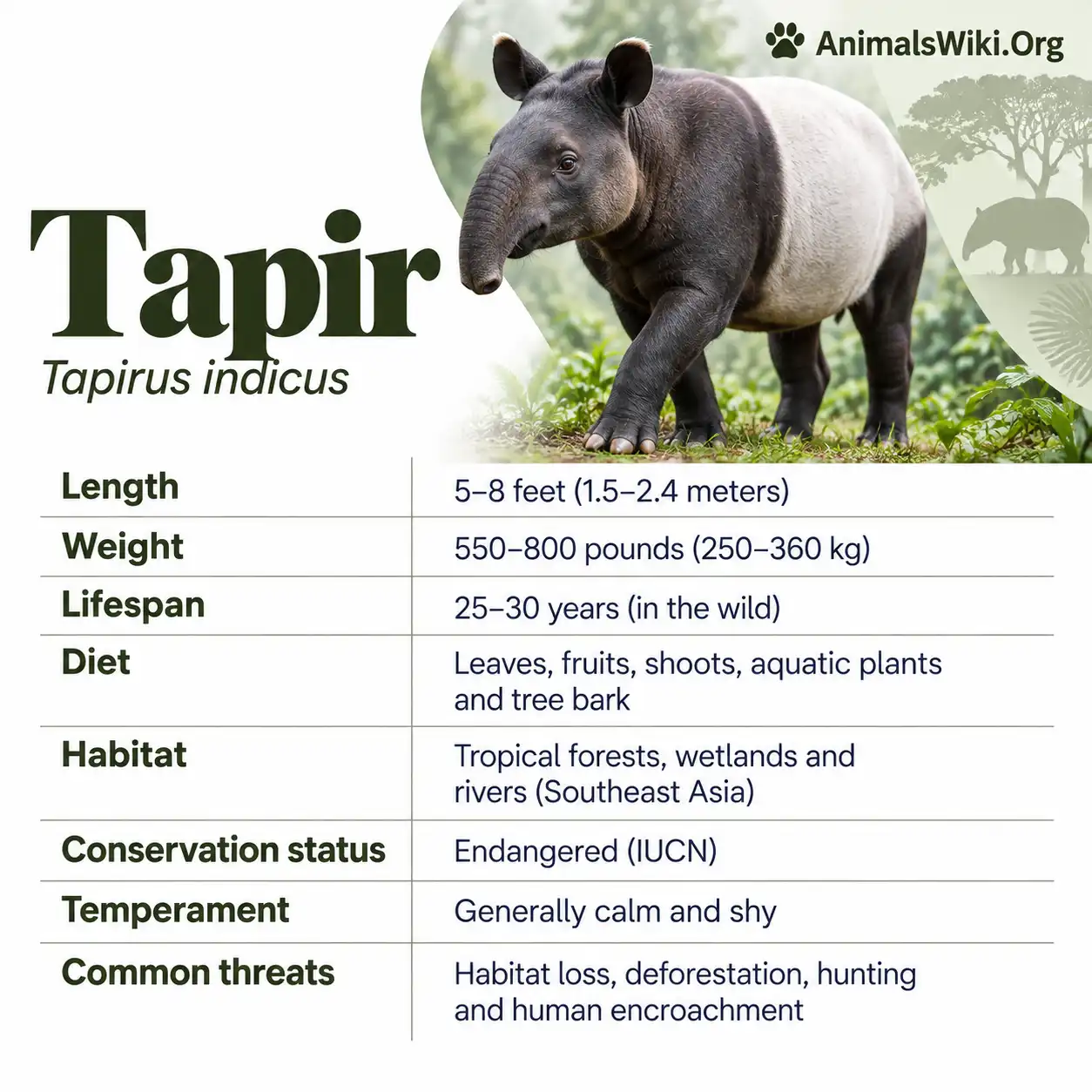
| Feature | Details |
|---|---|
| Common Name | Tapir (South American Tapir — focus species) |
| Scientific Name | Tapirus terrestris (South American / Lowland Tapir) |
| Family | Tapiridae |
| Order | Perissodactyla |
| First Described | 1758 (by Carl Linnaeus) |
| Native Habitat | Tropical and subtropical rainforest; gallery forest; grassland; montane forest |
| Geographic Range | South America (Venezuela to Argentina); other species in C America and SE Asia |
| Average Size | 1.8–2.5 meters body length; 0.9–1.1 meters shoulder height |
| Average Weight | 150–320 kg |
| Lifespan | 25–30 years (wild); up to 36 years (captivity) |
| Diet | Herbivore — leaves, shoots, fruits, aquatic plants, grasses |
| Conservation Status | Vulnerable (IUCN) — South American Tapir; all 4 species threatened |
| Defining Feature | Prehensile proboscis (flexible snout); ancient lineage unchanged for 35+ million years; closest living relatives are horses and rhinoceroses |
| Number of Species | 4 living species (3 Neotropical; 1 Southeast Asian) |
1. Tapir Species Overview & Classification
There is an animal walking through the Amazon rainforest tonight that belongs to the same ancient lineage as the horse and the rhinoceros — yet looks like none of them. It has a pig-like body, a short prehensile trunk, the feet of a rhinoceros, and the browsing habits of a miniature horse. It has been looking essentially like this for 35 million years. It survived the asteroid that killed the dinosaurs’ descendants. It survived the Pleistocene megafaunal extinction that eliminated the mammoths, the giant sloths, and the sabre-toothed cats. It has watched three ice ages come and go from the forests and savannahs of South America, Central America, and Southeast Asia, making the same unhurried rounds of its forest territory, finding the same water holes, eating the same leaves and fruits, and doing what tapirs have done since before the Himalayas finished forming.
The tapir — from the Tupi word tapyra, meaning “thick” — is one of the planet’s most ancient surviving large mammal lineages, classified in the order Perissodactyla alongside horses and rhinoceroses. This relationship is surprising at first glance — what does this pig-sized forest browser have in common with a thoroughbred racehorse or a white rhinoceros? The answer lies in the feet: tapirs, horses, and rhinoceroses all share the defining feature of the Perissodactyla — odd-toed ungulate feet, in which the central axis of the foot passes through the middle toe. In tapirs, this produces a three-toed hind foot and a four-toed front foot — an anatomical arrangement that connects this seemingly unremarkable forest animal to an extraordinarily ancient and successful lineage.
The four living tapir species together represent the surviving remnant of a once far more diverse family — tapirs were widespread across North America, Europe, and Asia until relatively recently in geological terms. Today, they are restricted to tropical forests of Central and South America (three species) and Southeast Asia (one species) — a distribution that reflects millions of years of geographic isolation and recent catastrophic range reduction due to human activities.
The tapir’s conservation story is one of quiet crisis — none of the four species attract the global attention that elephants, tigers, or rhinos command, yet all four are threatened, one is Endangered, and together they represent one of the most evolutionarily irreplaceable groups of large mammals on Earth.
Species Classification Table
| Classification Level | Details |
|---|---|
| Kingdom | Animalia |
| Phylum | Chordata |
| Class | Mammalia |
| Order | Perissodactyla |
| Family | Tapiridae |
| Genus | Tapirus (all living species) |
| Focus Species | Tapirus terrestris — South American / Lowland Tapir |
| Described By | Carl Linnaeus, 1758 |
| Common name origin | From Tupi tapyra — “thick” |
The Four Living Tapir Species
| Species | Scientific Name | Common Name | Range | Weight | IUCN Status |
|---|---|---|---|---|---|
| Tapirus terrestris | South American / Lowland Tapir | South America | 150–320 kg | Vulnerable | |
| Tapirus bairdii | Baird’s Tapir | C America, NW Colombia | 150–300 kg | Endangered | |
| Tapirus pinchaque | Mountain / Woolly Tapir | Andes (Colombia–Peru) | 136–180 kg | Endangered | |
| Tapirus indicus | Malayan / Asian Tapir | SE Asia (Malaysia, Sumatra, Thailand) | 250–400 kg | Endangered |
The Perissodactyla — Unexpected Relatives
The tapir’s position within the order Perissodactyla — the odd-toed ungulates — is one of biology’s most surprising evolutionary stories:
| Family | Common Representatives | Toes | Relationship to Tapir |
|---|---|---|---|
| Tapiridae | Tapirs | 3 hind; 4 front | Focus group |
| Equidae | Horses, zebras, donkeys | 1 (all feet) | Closer than they appear |
| Rhinocerotidae | Rhinoceroses | 3 (all feet) | Closest living relative to tapirs |
Molecular phylogenetic research confirms that rhinoceroses are the tapir’s closest living relatives — a relationship that becomes more understandable when you consider the fossil record, which shows intermediate forms connecting the two families. The tapir and rhinoceros shared a common ancestor more recently than either shares with horses.
Did You Know? The tapir, the horse, and the rhinoceros are all members of the order Perissodactyla — the odd-toed ungulates. Despite their dramatically different appearances (a racehorse, a white rhinoceros, and a pig-sized forest browser seem to have nothing in common), all three groups share a common ancestor and are connected by the anatomical feature of weight-bearing through the central toe of each foot. The tapir is the most ancient-looking survivor of this once much more diverse order, which also included the extinct Indricothere (Paraceratherium) — the largest land mammal that ever lived, a hornless rhinoceros relative as tall as a giraffe.
2. Tapir Physical Description & Unique Features
The tapir’s physical form is one of nature’s most distinctive — an animal that seems assembled from components of several different mammals yet functions with extraordinary effectiveness in its forest environment.
Size and Build
The South American Tapir (Tapirus terrestris) is a substantial animal:
- Body length: 1.8–2.5 meters (5.9–8.2 feet)
- Shoulder height: 0.9–1.1 meters (35–43 inches)
- Weight: 150–320 kg (330–705 lbs)
- Body shape: Massive, barrel-chested, with a characteristic tapering shape — broad and heavy at the hindquarters, narrowing through the shoulders to a relatively small head with the distinctive proboscis
The Malayan Tapir (T. indicus) is the largest species — reaching up to 400 kg in large adults — while the Mountain Tapir (T. pinchaque) is the smallest at 136–180 kg.
The body shape — broad at the back, narrowing toward the front — is specifically adapted for moving through dense forest vegetation; the tapered shape allows the tapir to push through thick undergrowth with less resistance than a more conventionally shaped animal of the same size.
The Prehensile Proboscis — The Tapir’s Defining Feature
The tapir’s most immediately distinctive anatomical feature is its short, muscular, prehensile proboscis — a flexible, elongated snout that extends beyond the upper jaw and can be moved in all directions. This is not merely a large nose — it is a genuine grasping organ:
- Can curl around branches and leaves to draw them toward the mouth
- Can grasp and manipulate food items with surprising precision
- Functions as an olfactory organ of considerable sensitivity — the tapir’s sense of smell is excellent
- Can be extended underwater for aquatic feeding and possibly for snorkeling-like breathing
- Used for scent investigation — the tapir raises its proboscis to sample airborne scents in a behavior reminiscent of the elephant’s trunk use
The tapir’s proboscis is not homologous to an elephant’s trunk — it is a completely independent evolutionary development of the same functional idea (a flexible, elongated snout). This represents another remarkable example of convergent evolution — evolution independently arriving at the prehensile snout solution in multiple unrelated lineages (tapirs, elephants, and saiga antelope all have elongated, flexible snouts of different evolutionary origin).
The Feet — Ancient Anatomical Heritage
The tapir’s feet are one of its most evolutionarily significant features:
Forefeet (front): Four toes — three functional weight-bearing toes plus a smaller inner toe; the four-toed front foot is a very ancient mammalian characteristic preserved in tapirs while being reduced or lost in most other large ungulates
Hind feet: Three toes — all functional weight-bearing; the three-toed hind foot is shared with rhinoceroses and reflects the odd-toed ungulate body plan
Hoof structure: Each toe bears a small hoof; the tapir walks on its toes (digitigrade locomotion in part) with the central toe bearing the most weight
Muddy terrain adaptation: The four-toed front feet spread significantly on soft or muddy substrates — increasing the surface area in contact with the ground and improving stability in the wet, muddy forest floor environments that tapirs frequently occupy
Skin and Coloration
Adult South American Tapir:
- Uniformly dark brown to greyish-brown on the dorsal surface
- Paler on the face and throat
- Ear margins often white or pale — a distinctive feature
- Sparse, bristly hair — not densely furred
- Tough, thick skin providing some protection against biting insects and thorny vegetation
Adult Malayan Tapir — the most dramatically colored tapir:
- Striking black-and-white pattern — the front half of the body (head, neck, forelegs, shoulders) is black; the rear half (back, hindquarters, flanks) is white; the hindlegs are black again
- This bold coloration functions as disruptive camouflage in the dappled light of the forest floor — the white saddle pattern breaks up the animal’s outline, making it more difficult to identify as a large mammal in low light conditions
Adult Mountain Tapir — the most distinctive coat:
- Dense, woolly fur — significantly thicker than other tapir species; an adaptation to the cold temperatures of its high-altitude Andean habitat
- Dark brown to black overall; whitish lip margins
The Calf Pattern — Universal Tapir Baby Camouflage
All four tapir species share a spectacular juvenile coloration — tapir calves are born with:
- Dark brown to black base color
- White and yellow horizontal stripes and spots across the body — creating a pattern remarkably similar to the dappled light-and-shadow pattern of the forest floor
- This pattern, shared across all tapir species despite their dramatically different adult colorations, fades over approximately 6–8 months as the juvenile develops adult coloration
The universality of the tapir calf pattern across all four species suggests it is a very ancient adaptation — present in the common ancestor of all living tapirs and maintained under strong selective pressure because of its effectiveness as camouflage.
Did You Know? The Malayan Tapir’s striking black-and-white body pattern — which looks almost designed to be maximally conspicuous — actually functions as extraordinarily effective disruptive camouflage in the moonlit forest. The white saddle pattern breaks up the animal’s outline against the dappled forest floor illumination, making it very difficult for predators to identify the animal as a single large prey item. This principle — that high-contrast patterns can disrupt shape recognition better than cryptic uniform colors — is the same principle used in dazzle camouflage on World War I naval vessels.
3. Tapir Habitat & Geographic Range
The tapir family’s geographic distribution is one of the most striking examples of relict biogeography in the mammalian world — a family that was once distributed across six continents now survives in two widely separated tropical regions, connected by a common evolutionary heritage but separated by tens of millions of years of independent geographic history.
Habitat Preferences — What All Tapirs Share
Despite their geographic separation, all four tapir species share remarkably consistent habitat preferences:
Primary tropical and subtropical forest — all four species are fundamentally forest animals; they require forest for cover, food diversity, and thermal regulation; deforestation is the primary threat to all four species
Proximity to water — tapirs are strongly associated with rivers, streams, lakes, and wetlands across all species; they are excellent swimmers and frequently enter water for:
- Thermoregulation (cooling in hot conditions)
- Feeding on aquatic vegetation
- Escaping predators
- Wallowing in mud (which reduces parasite loads and provides cooling)
Dense understory vegetation — tapirs browse primarily in the forest understory and along forest margins; they require vegetation at the appropriate height for browsing with their proboscis
Mineral lick access — tapirs regularly visit mineral licks (natural salt licks) to obtain sodium, calcium, and other minerals not adequately available in their vegetation diet; mineral lick locations are focal points of tapir activity and important sites for wildlife monitoring
South American / Lowland Tapir — Broad Habitat Flexibility
Tapirus terrestris shows the greatest habitat flexibility of any tapir species — occupying:
- Amazon rainforest (the largest single habitat block)
- Atlantic Forest (severely fragmented; isolated populations)
- Cerrado (Brazilian tropical savannah)
- Pantanal (world’s largest tropical wetland)
- Gallery forest in grassland landscapes
- Chaco (dry thorny woodland)
This habitat flexibility makes the South American Tapir the most broadly distributed tapir species — found from Venezuela and Colombia south to Paraguay, Bolivia, and northern Argentina, and from the Amazon basin east to the Atlantic coast of Brazil.
Baird’s Tapir — Central America’s Largest Native Land Mammal
Tapirus bairdii is the largest native land mammal in Central America — found from southern Mexico (Oaxaca and Chiapas) through Guatemala, Belize, Honduras, Nicaragua, Costa Rica, Panama, and into northwestern Colombia and Ecuador. It inhabits:
- Lowland tropical forest (primary and secondary)
- Cloud forest up to approximately 3,600 meters elevation
- Riparian forest along watercourses
Baird’s Tapir populations are severely fragmented, with the largest remaining populations in Corcovado National Park (Costa Rica), La Amistad Biosphere Reserve (Costa Rica/Panama), and Maya Biosphere Reserve (Guatemala).
Mountain Tapir — The High Altitude Specialist
Tapirus pinchaque is the most altitude-adapted tapir — and the only large mammal endemic to the Andes:
- Found in the Andean mountain forests of Colombia, Ecuador, Peru, and extreme northern Venezuela
- Elevation range: 1,400–4,700 meters (4,600–15,400 feet) — extending into the high-altitude páramo (high Andean grassland above the treeline)
- The dense woolly coat is an adaptation to the cold, frequently misty conditions of its high-altitude habitat
- Estimated population: fewer than 2,500 mature individuals — the most restricted population of any tapir species
Malayan Tapir — The Asian Outlier
Tapirus indicus is the only tapir species outside the Americas — representing the surviving fragment of a formerly much wider Asian tapir distribution:
- Peninsular Malaysia (most important remaining population)
- Sumatra (Indonesia) (significant but declining population)
- Southern Thailand (small, fragmented populations)
- Myanmar (very small, poorly monitored population)
The Malayan Tapir inhabits primary lowland and hill tropical forest, secondary forest, and forest bordering agricultural land. Its preferred habitat in Peninsular Malaysia is lowland dipterocarp forest — one of the most biodiverse forest types on Earth and one of the most severely threatened by oil palm plantation conversion.
4. Tapir Diet & Feeding Behavior
The tapir is a generalist browser of considerable dietary range — exploiting the extraordinary diversity of the tropical forest plant community to maintain a varied, nutritious diet that changes with season, habitat, and availability.
What Tapirs Eat
Leaves and browse — the primary dietary component in most tapir species and habitats; tapirs browse from a wide diversity of tree and shrub species, selecting specific leaves based on nutritional content, toxin load, and palatability; the prehensile proboscis is the primary food-gathering tool — wrapping around branches and drawing them toward the mouth
Fruits — a critically important dietary supplement providing high energy (sugars) and seeds that contribute to the tapir’s ecological role as a seed disperser; tapirs are among the most effective large-fruit dispersers in tropical forests and can swallow fruits up to several centimeters in diameter whole; fruit consumption is highest when fruit is seasonally abundant
Aquatic vegetation — uniquely among large forest mammals, tapirs regularly enter rivers, lakes, and swamps to feed on aquatic and semi-aquatic plants including water hyacinths, aquatic grasses, and emergent vegetation; aquatic feeding is most common in the South American Tapir and Malayan Tapir
Fallen fruits and seeds — tapirs are ground-level foragers that exploit fallen plant material extensively; they follow fruiting seasons across their home ranges and concentrate in areas of current fruit abundance
Young shoots and buds — the most nutritious parts of plants; preferentially selected when available; young shoots have lower toxin content and higher protein than mature leaves
Grasses and sedges — consumed particularly by the South American Tapir in the Cerrado and Pantanal habitats where grassland vegetation is abundant
Bark — consumed occasionally, particularly in dry seasons when other food is scarce; the tapir’s strong teeth can process bark from various tree species
Fungi — consumed opportunistically; fallen bracket fungi and ground-level fungi are eaten when encountered
The Prehensile Proboscis as Feeding Tool
The tapir’s proboscis is fundamental to its feeding strategy:
- Branch manipulation — the proboscis wraps around branches, pulls them toward the mouth, and holds them steady while the incisor teeth strip leaves
- Fruit picking — individual fruits are grasped and detached from branches or picked from the ground
- Aquatic feeding — the proboscis is extended into water to grasp aquatic vegetation; the tapir can apparently breathe through its proboscis while submerged to the neck — functioning as a natural snorkel
- Scent assessment — before eating, the tapir frequently raises its proboscis to scent-assess potential food items
Diet Breakdown Table
| Food Type | % of Annual Diet | Peak Season | Notes |
|---|---|---|---|
| Leaves and browse | 40–60% | Year-round | Primary food; highly diverse species selection |
| Fruits | 20–35% | Wet season (peak fruiting) | Critical energy supplement; seed dispersal function |
| Aquatic vegetation | 5–15% | Year-round | Higher in flood season; important minerals |
| Young shoots and buds | 5–10% | Wet season | Preferred; high nutrition; lower toxins |
| Grasses and sedges | 5–10% | Dry season | Cerrado/Pantanal populations primarily |
| Bark, fungi, other | 2–5% | Dry season | Fallback foods when primary foods scarce |
The Mineral Lick — An Essential Supplement
All tapir species regularly visit mineral licks — natural exposures of mineral-rich soil, clay, or water where sodium, calcium, magnesium, and other minerals are concentrated. Mineral lick use is one of the most consistently observed behaviors across all tapir species and all population studies:
- Visits typically occur at night — when predation risk is lower
- The same lick sites are used repeatedly over years to decades
- Multiple tapirs may use the same lick, though typically not simultaneously
- Sodium is thought to be the primary mineral sought — plant diets are typically sodium-deficient
- Mineral licks are important concentration points for wildlife monitoring and camera trap surveys
Selective Feeding — Tapirs as Dietary Connoisseurs
Despite their reputation as ecological generalists, tapirs are remarkably selective feeders — choosing specific plant species and plant parts based on assessment criteria that reflect nutritional sophistication:
- Phytochemical assessment — tapirs avoid plants with excessive toxin loads; leaves from species with high alkaloid or tannin concentrations are typically rejected in favor of less-defended alternatives
- Nutritional targeting — research using stable isotope analysis and dietary surveys has demonstrated that tapirs selectively consume plants with higher nitrogen content (an indicator of protein) relative to random availability
- Seasonal dietary shifting — tapirs systematically adjust diet composition with seasonal changes in plant community productivity; the seasonal shift toward fruit during fruiting seasons represents a purposeful exploitation of high-energy food resources
5. Tapir Reproduction & Life Cycle
The tapir’s reproductive biology reflects its life history as a large, long-lived mammal with low reproductive rate — a pattern that makes tapir populations extremely sensitive to adult mortality.
Sexual Maturity
- South American Tapir: Sexual maturity at approximately 2–4 years in females; 3–5 years in males
- Malayan Tapir: Maturity at 3–4 years in females; slightly later in males
- Mountain Tapir: Estimated at 3–4 years in females
The relatively late sexual maturity (compared to smaller mammals) combined with a single-offspring reproductive pattern and long calving interval means that tapir population replacement rates are very low — making them highly sensitive to any increase in adult mortality.
Mating Behavior
Tapir mating behavior is poorly studied in the wild due to the animals’ nocturnal, secretive habits — but observations in captivity and occasional wild encounters have revealed:
Prolonged courtship — mating involves extended chasing and following behavior; both males and females make high-pitched squealing and whistling vocalizations during courtship that are quite unexpected from such a large, typically quiet animal
Mutual spraying — tapirs spray urine on each other during courtship — a behavior that communicates reproductive status and identity; the Flehmen response (curling of the upper lip to expose the Jacobson’s organ) is used to assess urine scent
Male competition — where multiple males are present, competitive interactions occur; these rarely involve overt physical combat but involve chasing and display
Multiple mates — female tapirs appear to mate with multiple males; the mating system is not well characterized but is probably promiscuous in both sexes
Gestation and Birth
- Gestation period: Approximately 13–14 months — one of the longest gestations of any non-ruminant mammal; the long gestation produces a well-developed calf at birth
- Birth season: Variable; in many populations not strongly seasonal, though in areas with marked wet-dry seasonality, births may be timed to coincide with peak vegetation productivity
- Litter size: Invariably 1 calf — twins are extremely rare and appear to result in the death of both calves in most recorded cases
- Birth weight: Approximately 4–7 kg depending on species
- Birth location: Females seek dense vegetation cover for parturition — the calf’s spotted camouflage pattern is critical during the early period when it is most vulnerable to predators
Calf Development
Tapir calves are precocial — standing and walking within hours of birth:
| Stage | Timing | Development |
|---|---|---|
| Birth | Day 0 | 4–7 kg; spotted/striped camouflage; precocial; walking within hours |
| First water entry | Days 1–2 | Calves enter water very early; swimming ability appears almost innate |
| Solid food sampling | Week 2–3 | Begin browsing alongside mother; learning food selection |
| Spot pattern fading | Months 4–6 | Adult coloration replacing juvenile camouflage |
| Weaning | Months 6–8 | Nursing reduces; primarily eating solid food |
| Independence | Months 12–18 | Gradually separating from mother; establishing own range |
| Sexual maturity | Years 2–4 | Species and individual variable |
The Long Calving Interval
Female tapirs produce a calf approximately every 2–3 years — a long calving interval reflecting:
- The 13–14 month gestation (essentially occupying more than a year before a new pregnancy can begin)
- An extended lactation period (6–8 months)
- A recovery period before the next conception
This means a female tapir produces at most 5–8 calves over her entire reproductive lifetime — a very low lifetime reproductive output for a large mammal. A single female killed by a poacher or in a road accident represents a significant loss to the local population’s reproductive capacity.
Lifespan
- Wild: Approximately 25–30 years
- Captivity: Up to 36 years documented
The long lifespan (among the longest for ungulates) combined with the low reproductive rate makes the tapir’s population dynamics particularly vulnerable to any increase in adult mortality above natural levels.
Did You Know? All four tapir species — despite their dramatically different adult colorations (the Malayan Tapir’s black-and-white pattern versus the South American Tapir’s uniform brown) — share an identical juvenile camouflage pattern: dark brown with white and yellow horizontal stripes and spots. This universal calf pattern is thought to be an extremely ancient adaptation, present in the common ancestor of all living tapirs and maintained unchanged through millions of years of evolution because it is so effective at camouflaging young tapirs against the dappled forest floor. The fact that all four species share this pattern despite their geographic separation (three species in the Americas, one in Southeast Asia) is strong evidence of its evolutionary importance.
6. Social Behavior & Communication
Tapirs are fundamentally solitary animals — among the most solitary of all large mammals — spending the vast majority of their lives ranging independently through their home territories with minimal direct social interaction. Yet their social communication system is considerably more sophisticated than their solitary lifestyle might suggest.
Solitary but Overlapping
Adult tapirs occupy individual home ranges that typically overlap extensively with the home ranges of other individuals — they are not territorial in the aggressive, exclusive sense, but neither are they social:
South American Tapir home range sizes:
- Highly variable: 1–14 km² depending on habitat quality, resource density, and individual variation
- Males typically have somewhat larger ranges than females
- Home ranges of multiple individuals in a given area overlap substantially
Malayan Tapir home ranges:
- Typically 2–8 km² in Malaysian lowland forest
- Slightly smaller in areas with higher resource density
The overlap of home ranges without direct social interaction is maintained through scent marking — olfactory signals that communicate individual identity, reproductive status, and passage timing without requiring physical encounter.
Scent Communication — The Primary Social Medium
Tapirs maintain an elaborate olfactory communication network that allows individuals to know who else is using their area, when they passed, and whether they are reproductively available — without direct encounter:
Urine marking — the primary scent-marking behavior; tapirs spray urine on vegetation, rocks, and trail surfaces; the glandular odor of tapir urine is distinctive and detectable by humans at significant distances from marking sites; tapirs revisit and reinvestigate urine marks left by other individuals
Dung marking — tapirs deposit dung at latrine sites — specific locations used repeatedly by multiple individuals; these latrines are significant social information centers where multiple individuals deposit and investigate olfactory information
Facial and body gland secretions — various body secretions contribute to the olfactory information profile of individual tapirs
Vocalizations — Surprisingly Complex for a “Silent” Animal
Tapirs have a vocal repertoire that is considerably more complex than their reputation as quiet animals suggests:
Whistling and squealing — the most dramatic tapir vocalization; high-pitched whistle-squeals that carry over considerable distances in dense forest; used during courtship and mating (both sexes), during mother-calf communication (the calf produces high-pitched squeaks when separated from the mother), and apparently as alarm and contact calls between individuals
Clicking — a rapid clicking sound produced by both sexes in various social contexts; the mechanism is not fully understood but may involve the teeth or the tongue
Low grunts and snuffling — close-range social sounds used during direct interactions and when investigating scent marks
Alarm snort — a sharp exhalation produced when alarmed; alerts other animals in the vicinity
Water as Social Space
One behavioral context in which tapirs do encounter each other directly is at mineral licks and water sources — the concentration points in their landscapes:
- Multiple tapirs may use the same water hole or lick site; they typically avoid direct encounter by using these resources at different times (staggered through the night)
- Camera trap studies at mineral licks have revealed the social structure of local tapir populations more effectively than direct observation — the timing and frequency of individual visits reveals dominance relationships and social hierarchy
7. Predators & Defense Mechanisms
The tapir’s predator community varies by geographic range but includes some of the world’s most formidable large carnivores. The tapir’s response to this predator pressure is characterized by a combination of physical robustness, behavioral avoidance, and water as refuge.
Natural Predators
Jaguar (Panthera onca) — the primary predator of tapirs across the Neotropical range; jaguars are large enough to successfully take adult tapirs, particularly juveniles and smaller adults; research at multiple Neotropical study sites documents tapirs as a significant component of jaguar diet; tapir-jaguar interactions at water holes and mineral licks are high-risk moments
Puma / Mountain Lion (Puma concolor) — important secondary predator of tapirs; pumas are present throughout the tapir’s Neotropical range and take tapirs where jaguars are absent or less common; pumas are particularly important predators of calves and juveniles
Tiger (Panthera tigris) — primary predator of Malayan Tapirs in their Southeast Asian range; tigers are large enough to take adult Malayan Tapirs and do so regularly where populations overlap; the decline of tigers in Southeast Asia has reduced predation pressure on Malayan Tapirs, but the ecological relationship between the two species has existed for millions of years
Spectacled Bear (Tremarctos ornatus) — occasional predator of Mountain Tapirs in the Andes; bears have been documented taking young tapirs
Anaconda (Eunectes murinus) — large anacondas can ambush and constrict tapirs, particularly at water’s edge; calves and small individuals are most vulnerable
Crocodilians — caimans and crocodiles are significant predators of tapirs when they enter water; the tapir’s habit of entering rivers and lakes exposes it to aquatic ambush predation
Defense Mechanisms
Water as primary refuge — the tapir’s most important anti-predator response is fleeing to water; tapirs are strong, fast swimmers and can submerge completely; most terrestrial predators cannot pursue them effectively in deep water; the tapir may remain submerged for extended periods with its proboscis extended above the surface for breathing — essentially hiding underwater from pursuing predators
Speed and bush-crashing flight — despite their bulk, tapirs can move surprisingly fast through dense forest — their compact, tapered body shape allows them to crash through undergrowth at speeds that larger predators (like jaguars) cannot easily match in dense vegetation; 40 km/h has been estimated as a short-burst speed capability
Thick skin — the tapir’s hide is thick enough to resist some predator attacks; large cats must target vulnerable areas (throat, back of neck) to effectively kill a tapir
Defensive biting — when cornered, tapirs can deliver powerful bites with their large teeth; tapirs have attacked and injured humans in captivity and when threatened in the wild; the bite of a large tapir is genuinely formidable
The “hiding in plain sight” strategy — tapirs are crepuscular and nocturnal; by being most active when light levels are low, they reduce their visibility to predators that hunt primarily by sight; the Malayan Tapir’s disruptive coloration specifically exploits low light conditions
Submersion camouflage — tapirs feeding in shallow water or resting in streams are protected by aquatic camouflage — seen from above, a tapir in water among aquatic vegetation is very difficult to identify
8. Relationship with Humans
Indigenous Relationships — Tapirs as Cultural Keystones
Indigenous peoples across the tapir’s range in the Americas have coexisted with tapirs for thousands of years — incorporating them into dietary traditions, spiritual practices, and material culture:
As food — tapir is one of the most important large game animals for many Amazonian and Central American indigenous communities; tapir meat is nutritious, available in large quantities from a single hunt, and highly valued; traditional hunting techniques include stalking at water holes and mineral licks, hunting with dogs, and pursuing to rivers where tapirs are captured in the water; tapir fat is rendered for cooking and medicinal use
Cultural and spiritual significance — tapirs appear in the mythology and cosmology of numerous Amazonian indigenous traditions; among the Desana people of the northwest Amazon, the tapir is associated with the cosmic cycle and with the forest itself; in various Tupian traditions, the tapir is a totemic animal with specific ritual requirements for hunting; the distinctive tapir call — the whistle-squeal — appears in indigenous musical traditions as an imitated sound
The Malayan world — in Malaysia, the tapir (tapir in Malay) has traditionally been associated with the deep forest and is known in some indigenous Orang Asli traditions as an animal of spiritual significance connected to forest spirits; its distinctive black-and-white coloration has given it symbolic associations with duality and balance in some traditions
Colonial and Post-Colonial History
European naturalists first formally described tapirs in the 16th century as “Brazilian asses” or confused animals combining features of multiple familiar species. The tapir’s bizarre combination of features — pig body, elephant-like proboscis, rhinoceros feet — made classification challenging for early naturalists unfamiliar with perissodactyl diversity.
The tapir appears in some of the earliest European accounts of South American wildlife — Amerigo Vespucci and later Gonzalo Fernández de Oviedo y Valdés described encounters with tapirs in the early 1500s. The Malayan Tapir was described to European science by Sir Stamford Raffles (the founder of Singapore) in the early 19th century.
Modern Conservation Challenges
The hunting pressure dilemma — tapirs remain a critical traditional food source for many indigenous and forest-dependent communities across their range; the conservation challenge is not simply “stop hunting” but managing offtake sustainably in a context where indigenous hunting rights are legally protected and culturally non-negotiable; sustainable harvest programs are being developed in some areas
Wildlife trafficking — tapir parts (particularly the distinctive hide) are traded in some markets; the thick, distinctive skin of the Malayan Tapir has been used in traditional medicine in parts of Southeast Asia
The habitat loss crisis — in both the Neotropical and Southeast Asian ranges, agricultural expansion (cattle ranching and soy in South America; oil palm in Southeast Asia) is the dominant driver of tapir habitat loss and is the fundamental conservation challenge that all other efforts must address
Road mortality — as road networks expand through tapir habitat in both regions, vehicle collisions have become an increasing source of mortality; tapirs crossing roads at night are vulnerable and their large size makes collisions potentially lethal for both tapir and vehicle occupant
Research and Conservation
The Tapir Specialist Group of the IUCN Species Survival Commission coordinates international tapir research and conservation; the group produces species assessments, population surveys, and conservation action plans for all four species. Key research centers include:
- Instituto Pró-Tapir (Brazil) — South American Tapir research and conservation
- Tapir Conservation Programme, Malaysia — Malayan Tapir research
- Wildlife Conservation Society — multi-species tapir research across multiple range countries
9. Conservation Status & Threats
All Four Species Are Threatened
| Species | IUCN Status | Estimated Population | Trend |
|---|---|---|---|
| T. terrestris (South American) | Vulnerable | ~3,000–5,000 | Decreasing |
| T. bairdii (Baird’s) | Endangered | ~5,500 | Decreasing |
| T. pinchaque (Mountain) | Endangered | <2,500 | Decreasing |
| T. indicus (Malayan) | Endangered | ~2,500 | Decreasing |
All four species show declining population trends — no tapir species has an increasing or stable population trajectory at the global level.
Key Threats
1. Deforestation and Habitat Conversion — The Primary Driver
The conversion of tropical forest to agriculture is the most significant threat to all tapir species:
- Amazon deforestation — Brazil’s Amazon has lost approximately 20% of its original forest cover, with losses accelerating in some periods; the Brazilian Cerrado (transitional savannah) has lost over 50% of its original vegetation; both biomes are critical South American Tapir habitat
- Palm oil expansion in Southeast Asia — the conversion of lowland forest in Malaysia and Sumatra to oil palm plantation has been catastrophic for Malayan Tapir habitat; Peninsular Malaysia has lost the majority of its lowland forest to plantation agriculture
- Cattle ranching in Central America — the conversion of Central American forest to cattle pasture has severely fragmented Baird’s Tapir habitat
- Andean agricultural expansion — the encroachment of agriculture into Andean montane forest reduces Mountain Tapir habitat from below while climate change alters habitat suitability from above
2. Hunting
Tapirs are hunted for:
- Subsistence food — the most significant hunting pressure; indigenous and rural forest communities hunt tapirs as a major protein source; offtake that was sustainable at traditional hunting levels becomes unsustainable as human populations increase and firearms replace traditional methods
- Commercial bushmeat — in some areas, tapir meat enters commercial bushmeat markets; the large size of tapirs (a single animal provides substantial meat) makes them economically attractive targets
- Traditional medicine — tapir body parts (particularly the fat, bone, and skin of the Malayan Tapir) are used in traditional medicine in parts of Southeast Asia
3. Roadkill and Infrastructure Mortality
Road construction through former wilderness areas creates direct mortality:
- Tapirs crossing roads at night are struck by vehicles; their dark coloration makes them very difficult to see at night
- Brazil’s road expansion program has been documented as a significant tapir mortality source
- Malaysian road networks through former Malayan Tapir habitat create corridors of mortality risk
4. Human-Wildlife Conflict
Tapirs occasionally damage crops — raiding agricultural fields at forest margins for maize, cassava, and other crops; this creates conflict with farming communities that may result in retaliatory killing
5. Climate Change
- Mountain Tapir vulnerability — the high-altitude Andean habitat of the Mountain Tapir is being compressed from below as climate change allows human land use to expand upslope and from above as suitable forest types shift upslope beyond the páramo; the Mountain Tapir has nowhere to go
- Drought and fire — increasing drought frequency in the Amazon and Cerrado reduces food availability and forces tapirs into more exposed situations
6. Disease
Tapirs are susceptible to several diseases including anthrax (documented at Malayan Tapir populations), foot-and-mouth disease (which can be transmitted from livestock), and various parasitic infections; contact with domestic cattle in degraded habitats increases disease exposure
Conservation Success Stories
Pantanal Tapir Project (Brazil) — long-term monitoring and research on South American Tapirs in the Pantanal has produced detailed population data and contributed to land protection decisions; one of the most comprehensive tapir research programs in existence
Malaysian rescue and rehabilitation — the Department of Wildlife and National Parks Malaysia (PERHILITAN) operates a rescue and rehabilitation program for injured and orphaned Malayan Tapirs; several successful rehabilitations and wild releases have been documented
TAPIR-back — community-based conservation programs in several countries are training local hunters and forest communities as tapir monitors, combining conservation employment with wildlife protection
10. Famous Tapirs Around the World
Rinaldo — The Malayan Tapir of Edinburgh Zoo
Edinburgh Zoo has been home to several notable Malayan Tapirs; the current population includes animals that have been bred through the European Endangered Species Programme (EEP) — a coordinated captive breeding program for Malayan Tapirs across European zoos. Edinburgh Zoo’s tapirs have been important for public education about this little-known species.
Tilda — Chester Zoo’s Conservation Ambassador
Chester Zoo in England has one of the most successful Malayan Tapir breeding programs in Europe — having produced multiple calves that have contributed to the captive population. Chester Zoo’s tapir exhibit and associated conservation education programs have raised significant public awareness and funding for wild Malayan Tapir conservation in Malaysia.
The Baird’s Tapir of Corcovado
The Baird’s Tapirs of Corcovado National Park in Costa Rica’s Osa Peninsula represent one of the most important remaining Baird’s Tapir populations and have been extensively studied by researchers from multiple institutions. Individual tapirs in Corcovado have been followed through years of field research using camera traps, GPS collars, and direct observation — contributing fundamental data on Baird’s Tapir home range, reproduction, and habitat use.
The Mountain Tapir of Otún-Quimbaya, Colombia
Research on Mountain Tapirs at the Otún-Quimbaya Flora and Fauna Sanctuary in Colombia has produced some of the most detailed population data available for this Endangered species. Individually identified tapirs at this site — known by names assigned by researchers — have contributed years of longitudinal data on Mountain Tapir ecology and behavior.
“Tapita” — Peru’s Most Famous Orphan
Tapita — an orphaned South American Tapir calf rescued in the Peruvian Amazon — became something of a social media celebrity in Peru following her rescue and rehabilitation at a wildlife center in the 2010s; her story attracted national attention to tapir conservation and contributed to increased Peruvian public awareness of the species’ Vulnerable status.
11. Role in Ecosystem & Food Chain
Tapirs as “Gardeners of the Forest” — Seed Dispersal
The tapir’s most celebrated ecological role is as one of the most important seed dispersers in tropical forest ecosystems — a function so significant that researchers have given tapirs the title “Gardeners of the Forest.”
Mechanism: Tapirs consume large quantities of fruits, swallow the seeds whole, and deposit them in their dung at distances of hundreds of meters to several kilometers from the parent tree. Because tapirs have relatively long gut retention times compared to smaller animals, seeds experience extended gut passage that can:
- Scarify hard seed coats — improving germination rates for some species
- Remove pulp that might otherwise attract competing seedling-eating invertebrates
- Transport seeds to new locations where they germinate and grow without competing with the parent tree for light
Ecological significance:
- Tapirs are among the very few large-bodied frugivores remaining in tropical forests — animals capable of swallowing fruits large enough that smaller animals (monkeys, birds, rodents) cannot handle them; in the absence of tapirs, many large-fruited tree species cannot effectively disperse their seeds
- Research in the Atlantic Forest of Brazil has documented that tapirs are the primary seed dispersers for dozens of plant species — including some of the largest-fruited trees in the ecosystem; forests from which tapirs have been extirpated show measurable changes in tree community composition over decades as large-fruited trees fail to recruit effectively
- The “Defaunation” effect — the loss of large mammals from tropical forests (called “defaunation”) is increasingly recognized as causing subtle but far-reaching changes in forest structure; the tapir’s disappearance is one of the most ecologically significant components of this defaunation
Scale of the service: A single tapir moving through its several km² home range deposits seeds across a large area each day; multiplied across the tapir population of a forest, the total seed dispersal service is ecologically fundamental to the maintenance of tree species diversity.
Tapirs as Habitat Modifiers
Beyond seed dispersal, tapirs physically modify their habitat in ways that benefit other species:
Paths and trails — tapirs create and maintain trail networks through dense forest; these trails are used by many other species including deer, peccaries, and predators; tapir trails often follow the most efficient routes through difficult terrain and represent centuries of accumulated knowledge about the landscape
Wallowing — tapirs create wallow sites — depressions in soft ground filled with mud and water; these wallows are used by multiple species for thermoregulation and parasite control; they also support distinctive communities of aquatic invertebrates and amphibians
Browsing effects on vegetation — selective tapir browsing influences the composition and structure of forest understory vegetation; by preferentially consuming some species and avoiding others, tapirs create vegetation patterns that affect the succession and composition of the forest
Tapirs as Prey — Supporting Apex Predators
The tapir is among the most important large prey species for the two most significant Neotropical apex predators — the jaguar and the puma. Studies at multiple Neotropical sites document tapirs as comprising 15–30% of jaguar diet by biomass — making the tapir one of the jaguar’s most important prey species. Healthy tapir populations are therefore a prerequisite for healthy jaguar populations, linking tapir conservation directly to the conservation of the region’s apex predator.
In Southeast Asia, the equivalent relationship involves the tiger — Malayan Tapirs are documented tiger prey in areas where both species coexist, though the quantitative contribution of tapirs to tiger diet in remaining Southeast Asian tiger habitat is less well studied than the jaguar-tapir relationship.
12. Tapir Discovery & Evolution Timeline
~55 million years ago — The order Perissodactyla (odd-toed ungulates) diverges from other placental mammal orders; early perissodactyls are small, forest-dwelling herbivores.
~50 million years ago — The earliest tapir-like animals (Lophiodon and related species) appear in the Eocene fossil record of North America and Europe; these early forms already show the basic tapir body plan.
~35 million years ago — Animals recognizable as true tapirs — members of the family Tapiridae — appear in the fossil record; by this point, tapirs are essentially modern in their anatomy; the Oligocene tapirs are very similar to living species.
~20 million years ago — Tapirs are widespread across North America, Europe, and Asia; the genus Tapirus is established and diversifying across the northern continents.
~10 million years ago — Tapirs reach South America via a corridor through Central America or island-hopping before the formal closure of the Panama land bridge; the ancestors of modern Neotropical tapir species begin their South American radiation.
~3 million years ago — The closure of the Panama land bridge (Great American Biotic Interchange) reinforces tapir populations in South America and provides a direct land corridor for North American tapir species to enter South America and vice versa.
~12,000–10,000 years ago — The Pleistocene megafaunal extinction eliminates tapirs from North America and Europe; horses and other perissodactyls similarly go extinct in North America; tapirs survive only in their tropical forest refugia in Neotropical South and Central America and Southeast Asia.
~8,000 years ago — The modern distribution of tapirs is essentially established — three species in the Neotropics, one in Southeast Asia.
~1,500 BC–1500 AD — Indigenous peoples across the tapir’s range develop rich cultural traditions incorporating tapirs as food, spiritual symbols, and ecological reference points.
Early 1500s — European explorers encounter tapirs in the Americas; early descriptions reach Europe mixed with confusion about the animal’s nature; Amerigo Vespucci and Gonzalo Fernández de Oviedo y Valdés provide early accounts.
1758 — Carl Linnaeus formally describes Tapirus terrestris (the South American Tapir) in Systema Naturae.
1816 — Sir Stamford Raffles formally describes the Malayan Tapir (Tapirus indicus) to European science from specimens obtained in Sumatra; Raffles notes that the animal was known to local peoples and had a long history of indigenous recognition.
1865 — John Edward Gray formally describes Baird’s Tapir (Tapirus bairdii) — named after naturalist Spencer Fullerton Baird.
1829 — The Mountain Tapir (Tapirus pinchaque) is formally described from specimens collected in the Colombian Andes.
1900s–1960s — Tapirs become subjects of initial scientific study; basic biology and distribution documented; hunting for food and trade continues largely unregulated.
1977 — CITES Appendix I listing provides formal international trade protection for all tapir species.
1980s — The first systematic field studies of tapir ecology begin; radio-tracking studies reveal home range sizes and habitat use patterns for the first time.
2000s — Tapir genetic studies reveal the extent of population fragmentation; molecular tools begin to be applied to tapir conservation; the Tapir Specialist Group of the IUCN becomes formally established.
2008 — World Tapir Day (April 27) established; coordinated international awareness effort begins.
2010s — Camera trap studies revolutionize tapir population monitoring; satellite tracking provides detailed movement data; seed dispersal research establishes the tapir’s critical ecosystem function.
2022–2026 — All four species confirmed as declining; IUCN assessments updated; increased international attention to the tapir’s ecological importance as a “Gardener of the Forest”; expanding conservation programs in Brazil, Malaysia, Colombia, and Costa Rica; continued concern about deforestation rates in all range countries.
13. Tapir Comparison of All Four Species
| Feature | S. American Tapir (T. terrestris) | Baird’s Tapir (T. bairdii) | Mountain Tapir (T. pinchaque) | Malayan Tapir (T. indicus) |
|---|---|---|---|---|
| Range | South America | C America to NW S America | Andes (Colombia–Peru) | SE Asia |
| Max weight | ~320 kg | ~300 kg | ~180 kg | ~400 kg |
| Shoulder height | 0.9–1.1 m | 0.9–1.2 m | 0.75–1.0 m | 0.9–1.1 m |
| Adult coloration | Uniform dark brown | Dark brown; white ear margins | Dark brown/black; woolly | Black front; white saddle; black rear |
| Coat | Short, sparse | Short, sparse | Dense, woolly | Short, sparse |
| Elevation range | Sea level — 1,500 m | Sea level — 3,600 m | 1,400–4,700 m | Sea level — 2,000 m |
| Habitat | Rainforest, Cerrado, Pantanal | Rainforest, cloud forest | Andean forest, páramo | Lowland forest, hill forest |
| IUCN Status | Vulnerable | Endangered | Endangered | Endangered |
| Population trend | Decreasing | Decreasing | Decreasing | Decreasing |
| Primary threat | Deforestation, hunting | Deforestation, hunting | Habitat compression, climate | Palm oil, hunting |
| Notable feature | Most widespread tapir | Largest C American mammal | Only Andean endemic ungulate | Dramatic black-and-white pattern |
14. Best Places to See Tapirs in the Wild
South America — South American Tapir
- 🇧🇷 Pantanal, Brazil/Bolivia — the world’s largest tropical wetland provides exceptional tapir viewing; South American Tapirs are abundant in the Pantanal and are regularly seen at river edges, water holes, and on road margins during day and night wildlife drives; transpantaneira highway night drives regularly encounter multiple tapirs; the combination of outstanding tapir density and the extraordinary general biodiversity of the Pantanal makes this one of the world’s premier wildlife destinations; best time: dry season (May–September) when animals concentrate at water
- 🇧🇷 Amazon lodges (Manaus/Iquitos region) — riverside lodges in both Brazilian and Peruvian Amazon provide tapir spotting opportunities; salt lick platforms allow nocturnal observation of tapirs visiting mineral licks; camera trap footage from Amazon lodges regularly includes tapirs
- 🇧🇷 Emas National Park, Cerrado, Brazil — South American Tapirs in the Brazilian Cerrado; less commonly visited than Pantanal but excellent tapir habitat; open cerrado landscape provides different viewing context than closed forest
- 🇦🇷 Iberá Wetlands, Argentina — rewilding project at Iberá has reintroduced tapirs; one of the southern-most accessible tapir populations
Central America — Baird’s Tapir
- 🇨🇷 Corcovado National Park, Osa Peninsula, Costa Rica — the premier site for Baird’s Tapir observation; dense tapir population; well-maintained trails; professional guides reliably locate tapirs at river crossings and forest clearings; La Leona, San Pedrillo, and Sirena stations are most productive; overnight stays at Sirena station particularly recommended; best time: dry season (December–April) when tapirs are more predictably found at water sources
- 🇧🇿 Cockscomb Basin Wildlife Sanctuary, Belize — the world’s first jaguar reserve; Baird’s Tapirs are present and occasionally observed on trails; the sanctuary’s excellent trails and accommodation make it accessible
- 🇵🇦 Darién National Park, Panama — remote; outstanding biodiversity; one of the largest remaining Baird’s Tapir populations; logistically challenging but exceptionally rewarding
Andes — Mountain Tapir
- 🇨🇴 Los Nevados National Natural Park, Colombia — the most accessible site for Mountain Tapir observation; the park’s trails in the zone between 2,000–3,500 m offer the best chance of encounters; specialist guided tours from Manizales focus on Mountain Tapir observation
- 🇪🇨 Antisana Ecological Reserve, Ecuador — excellent Mountain Tapir habitat in páramo and Andean forest; specialist wildlife tours from Quito include Mountain Tapir as a target species
Southeast Asia — Malayan Tapir
- 🇲🇾 Royal Belum State Park, Perak, Malaysia — one of the oldest remaining tropical forest areas in Southeast Asia; significant Malayan Tapir population; boat-based wildlife watching on the Temenggor Lake system; night safaris by boat at forest edges; the best accessible site for Malayan Tapir in Malaysia; best time: any time but nocturnal boat trips most productive
- 🇲🇾 Taman Negara National Park, Malaysia — Malaysia’s premier national park; Malayan Tapirs present; salt lick hides allow nocturnal observation; the Sungai Relau hide is particularly productive for tapirs
- 🇲🇾 Endau-Rompin State Park, Johor, Malaysia — remote lowland forest with significant Malayan Tapir population; guided expeditions available
Zoos for Guaranteed Viewing
- Chester Zoo, UK — excellent Malayan Tapir breeding program; consistently one of the best captive Malayan Tapir exhibits globally
- Zoo Miami, Florida, USA — Baird’s Tapir breeding program; part of AZA Species Survival Plan
- Smithsonian’s National Zoo, Washington DC — South American Tapir; excellent exhibit and education program
- San Diego Zoo, California — Baird’s Tapir; long-established tapir breeding program
15. Tapir Fun Facts for Kids
- Tapirs are more closely related to horses and rhinoceroses than to any other living animals — all are members of the odd-toed ungulates (Perissodactyla)
- The tapir’s body plan has remained essentially unchanged for 35 million years — making it one of the most ancient-looking large mammals alive today
- All four tapir species share identical baby camouflage — white and yellow spots and stripes on dark fur — despite their dramatically different adult colorations
- The tapir is known as the “Gardener of the Forest” for its role as one of the most important seed dispersers in tropical forests — maintaining tree species diversity through its gut
- Tapirs can use their proboscis as a natural snorkel — extending it above water while completely submerged to breathe while hiding from predators
- The Malayan Tapir’s black-and-white pattern is actually highly effective camouflage in moonlit forest — disrupting the animal’s outline against dappled light
- The Malayan Tapir inspired the Japanese mythological Baku — the dream-eating creature; Pokémon characters Drowzee and Hypno are based on this mythology
- Tapirs gestate for 13–14 months — one of the longest pregnancies of any non-ruminant mammal
- The tapir’s four-toed front feet and three-toed hind feet are shared with no other living mammal — a unique anatomical combination
- World Tapir Day is celebrated annually on April 27 — one of the few species-specific conservation days with genuine international participation
- The Mountain Tapir ranges up to 4,700 meters elevation — higher than any other tapir species and higher than most other large mammals in the Andes
- Tapirs can run at approximately 40 km/h in short bursts — surprising speed for an animal of their bulk in dense forest
16. Frequently Asked Questions About Tapirs
Q1: What exactly is a tapir and what animal is it related to?
The tapir is a large herbivorous mammal belonging to the family Tapiridae within the order Perissodactyla — the odd-toed ungulates. Despite looking superficially like a pig or a small hippopotamus, the tapir’s closest living relatives are rhinoceroses (most closely related) and horses — all members of the Perissodactyla. The connection is in the feet: all perissodactyls bear their weight through the central toe, and tapirs retain the ancient four-toed front foot and three-toed hind foot that reflect this body plan. The tapir lineage has existed for approximately 35 million years essentially unchanged — making tapirs one of the most ancient-looking large mammals alive today.
Q2: Why do all baby tapirs look alike when the adults are so different?
All four tapir species — including the dramatically colored Malayan Tapir — produce calves with the same juvenile pattern of white and yellow spots and stripes on dark brown fur. This pattern functions as camouflage against the dappled light of the forest floor, making the vulnerable young tapir difficult for predators to detect. The universality of this pattern across all four species (including the geographically isolated Malayan Tapir) suggests it was present in the common ancestor of all living tapirs and has been maintained unchanged by strong natural selection because it is so effective. The different adult colorations evolved independently in each lineage after the common ancestor’s lineages diverged — but the baby pattern has remained essentially constant for tens of millions of years.
Q3: What is the tapir’s ecological role in the forest?
The tapir’s most important ecological role is as a seed disperser — sometimes called the “Gardener of the Forest.” Tapirs consume large quantities of fruits and swallow the seeds whole; the seeds pass through the digestive system undamaged and are deposited in the animal’s dung across the tapir’s home range. Because tapirs can swallow very large fruits that smaller animals cannot handle, they are the primary or sole dispersers of many large-fruited tree species in tropical forests. Research in the Atlantic Forest of Brazil has demonstrated that the absence of tapirs leads to measurable changes in tree community composition over decades, as large-fruited trees cannot recruit effectively without their primary disperser. Tapirs also create trails used by other wildlife, maintain wallowing sites that support aquatic invertebrates and amphibians, and serve as important prey for apex predators.
Q4: How many tapir species are there and where do they live?
There are four living tapir species: three in the Americas (the South American / Lowland Tapir across much of South America; Baird’s Tapir in Central America and northwestern South America; and the Mountain Tapir in the Andes of Colombia, Ecuador, and Peru) and one in Asia (the Malayan Tapir in Malaysia, Sumatra, southern Thailand, and Myanmar). All four species are threatened — the South American Tapir is Vulnerable while the other three are Endangered on the IUCN Red List. All four show declining population trends primarily due to deforestation and hunting.
Q5: How does the tapir’s proboscis work?
The tapir’s prehensile proboscis is a muscular, flexible extension of the nose and upper lip — not a separate organ but an elongation of these existing structures. It is controlled by many small muscles that allow it to move in all directions. The tapir uses it to: grasp leaves and branches and draw them toward the mouth; pick and manipulate fruits from branches or the ground; assess scents by raising it to sample airborne odors; breathe while submerged — extending the proboscis above water while the rest of the body is underwater, functioning as a snorkel. The tapir’s proboscis is functionally similar to an elephant’s trunk but evolved completely independently — the two structures are not homologous (they don’t share a common ancestral structure) but represent convergent evolution of the same functional solution.
Q6: Are tapirs dangerous to humans?
Tapirs are generally timid and non-aggressive toward humans — their natural response to encountering people is to flee. However, they can be genuinely dangerous when cornered, surprised at close range, or protecting young. Tapirs have powerful jaws and can deliver serious bites; several attacks on humans — particularly on handlers at wildlife facilities and on hunters who have wounded an animal — have been documented. Female tapirs with calves are particularly defensive. In indigenous hunting traditions, wounding a tapir and pursuing it is considered dangerous precisely because cornered tapirs may turn and attack their pursuer. Visitors to tapir habitats should maintain appropriate distances and follow guide instructions.
Q7: What is the difference between the four tapir species?
The four species differ in size, coloration, coat texture, geographic range, and preferred habitat. The Malayan Tapir is the largest (up to 400 kg) and most dramatically colored (black front, white saddle, black rear); it is the only Asian species. The South American Tapir is the most widespread — uniformly dark brown with white ear margins — found across multiple South American biomes. Baird’s Tapir is the largest animal in Central America — similar to the South American Tapir but slightly larger; it is the only tapir found in Central America. The Mountain Tapir is the smallest, with a dense woolly coat adapted for cold Andean temperatures; it is the only species found above the treeline in páramo habitat and is restricted to the Andes.
Q8: What is the Baku and how is it connected to tapirs?
The Baku (獏) is a Japanese mythological creature that eats bad dreams — summoned by calling its name after waking from a nightmare. The Baku is described as a composite animal with features resembling an elephant’s nose, a tiger’s feet, and a bear’s body — and in Japanese artistic tradition, it is often depicted in ways that remarkably resemble a tapir. The connection is direct: Chinese natural history texts used the character 獏 (tapir) to describe the Malayan Tapir of Southeast Asia; these texts informed Japanese natural history knowledge, and the image of the exotic, strange-looking tapir became conflated with the mythological dream-eater in Japanese popular culture. The character 獏 was adopted for the Baku, and the tapir-inspired dream-eater mythology has survived into modern Japanese pop culture — most notably in the Pokémon characters Drowzee and Hypno, whose dream-eating abilities directly reference the Baku/tapir tradition.