
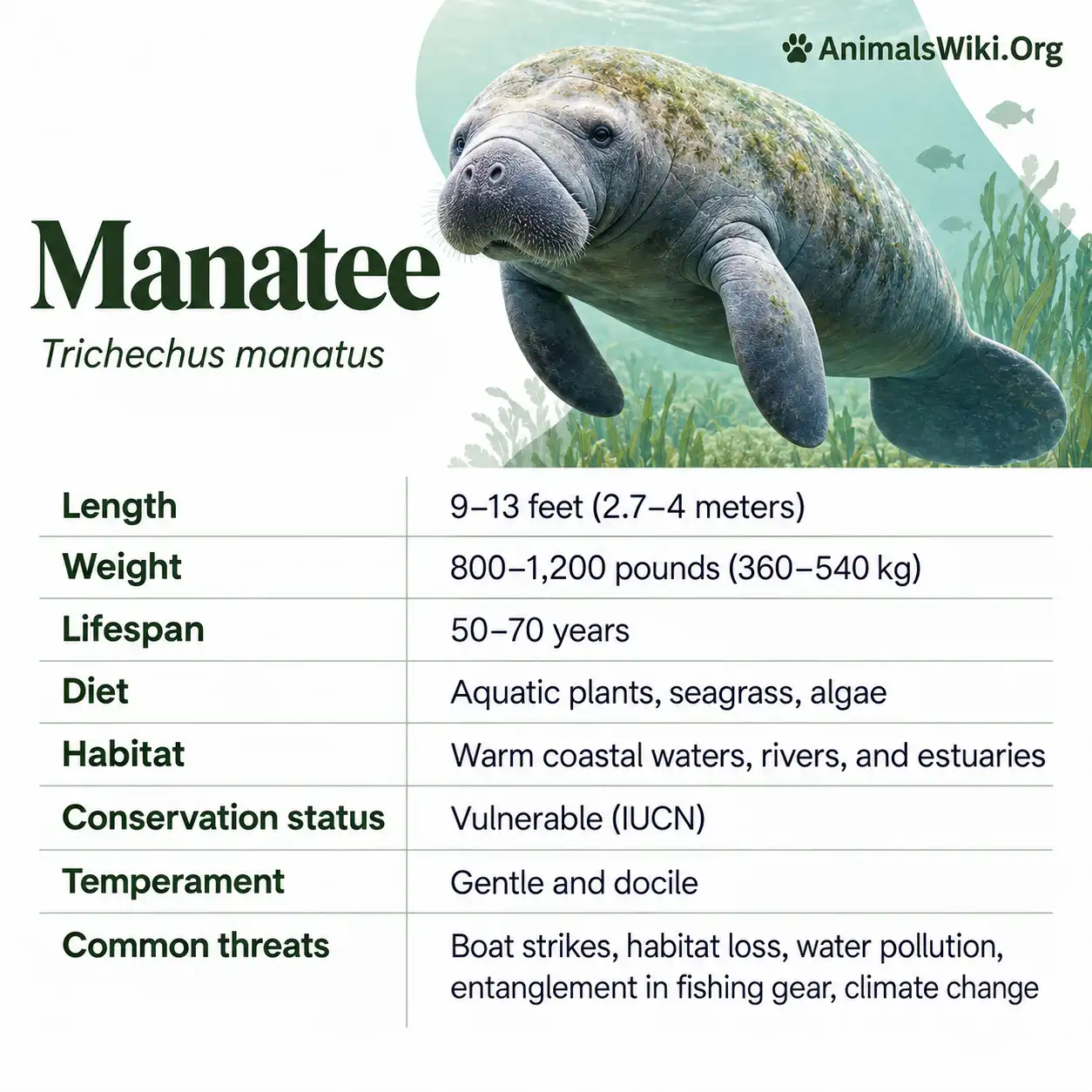
Manatee
| Feature | Details |
|---|---|
| Common Name | Manatee |
| Scientific Name | Genus Trichechus (3 species) |
| Family | Trichechidae |
| Order | Sirenia |
| First Described | 1758 (West Indian Manatee, by Carl Linnaeus) |
| Native Habitat | Warm shallow coastal waters, estuaries, rivers, springs |
| Geographic Range | Southeastern United States, Caribbean, Central/South America, West Africa |
| Average Size | 2.7–3.5 m (9–11.5 feet) |
| Average Weight | 400–590 kg (880–1,300 lbs); large individuals can exceed 1,500 lbs |
| Lifespan | 40–60 years (wild and captivity) |
| Diet | Herbivore — seagrass, freshwater vegetation, algae |
| Conservation Status | Vulnerable (all three species); Amazonian Manatee more severely threatened |
| Defining Feature | Slow-moving, gentle giant; paddle-shaped tail; prehensile, bristled lip pads; extraordinarily low metabolic rate; cold intolerance |
| Number of Species | 3 (West Indian, Amazonian, West African); a related fourth sirenian, the Dugong, is a separate family |
1. Manatee Species Overview & Classification
In the crystal-clear, spring-fed waters of Florida’s Crystal River, where the temperature holds a near-constant 22°C (72°F) year-round even as the outside air turns cold with the first breath of winter, dozens of massive grey shapes drift into the shallows with unhurried, almost dreamlike grace. Up close, the animal’s bulk is undeniable — a body the length of a small car, weighing as much as a compact automobile — yet everything about its movement speaks of profound gentleness: the slow, deliberate paddle of its broad, flattened tail; the careful, almost tender way it uses its flexible, whisker-covered lips to gather vegetation; the calm, unblinking gaze of small eyes set deep in a face that seems to carry a permanent, faintly wistful smile. This is the manatee — often called the “sea cow” — one of the most gentle, most slow-moving, and most genuinely beloved large mammals in the world, and an animal whose entire biology represents a remarkable evolutionary departure from nearly every other marine mammal lineage on Earth.
The manatee is a large, fully aquatic, herbivorous marine mammal belonging to the genus Trichechus — one of only two surviving genera within the mammalian order Sirenia, an ancient lineage of plant-eating marine mammals whose closest living relatives, remarkably, are not whales, seals, or any other marine mammal group, but rather elephants and other members of the superorder Afrotheria, a genuinely surprising evolutionary connection discussed in detail in the Discovery and Evolution section. Three manatee species are recognized today — the West Indian Manatee, the Amazonian Manatee, and the West African Manatee — distributed across warm coastal and riverine waters of the Americas and West Africa, alongside their close sirenian relative, the dugong, which occupies a broadly similar ecological niche across the Indo-Pacific region and is covered separately given its distinct taxonomic family.
Manatees occupy a genuinely unique ecological and evolutionary position: they are the only entirely herbivorous marine mammals in existence, subsisting almost exclusively on aquatic vegetation in a world where nearly every other marine mammal — from dolphins to seals to whales — is at least partly, and usually predominantly, carnivorous. Their extraordinarily slow metabolism, striking cold sensitivity for an aquatic mammal, remarkably placid and unhurried temperament, and near-total lack of natural predators as adults combine to make the manatee one of the most physiologically distinctive and behaviorally gentle large mammals anywhere in the animal kingdom — and also, unfortunately, one of the more acutely vulnerable to modern human-caused threats, particularly boat strikes, habitat loss, and cold-related mortality events, discussed extensively throughout this guide.
Species Classification Table
| Classification Level | Details |
|---|---|
| Kingdom | Animalia |
| Phylum | Chordata |
| Class | Mammalia |
| Superorder | Afrotheria |
| Order | Sirenia |
| Family | Trichechidae |
| Genus | Trichechus |
| Described By | Carl Linnaeus, 1758 (West Indian Manatee) |
| Closest Living Relatives | Elephants, hyraxes, aardvarks (all Afrotheria) |
The Three Manatee Species
| Species | Scientific Name | Range | Population (approx.) | Notes |
|---|---|---|---|---|
| West Indian Manatee | Trichechus manatus | Southeastern US, Caribbean, Gulf of Mexico, northern South America | ~13,000+ | Includes Florida and Antillean subspecies; most studied species |
| Amazonian Manatee | Trichechus inunguis | Amazon River basin (freshwater only) | Uncertain; declining | Smallest species; the only exclusively freshwater sirenian; lacks toenails |
| West African Manatee | Trichechus senegalensis | Coastal and riverine West Africa (Senegal to Angola) | Uncertain; least studied of the three | Faces significant, poorly documented hunting pressure |
Note: The West Indian Manatee is further divided into two recognized subspecies — the Florida Manatee (T. m. latirostris) and the Antillean Manatee (T. m. manatus) — reflecting genetic and geographic distinctions across its considerable range.
The Name “Manatee”
The word “manatee” derives from the Taíno word “manatí”, used by the Indigenous Taíno people of the Caribbean to describe the animal well before European contact — another instance, alongside the iguana covered elsewhere in this guide series, of a common English animal name deriving directly from an Indigenous Caribbean language, reflecting the deep and ancient relationship between Caribbean Indigenous peoples and the manatees that shared their coastal and riverine waters for thousands of years before European arrival.
Did You Know? Manatees belong to the taxonomic order Sirenia, a name derived from the mythical sirens of ancient Greek legend — the alluring, often dangerous creatures said to lure sailors with their song. This naming convention reflects a long-standing historical belief, discussed further in the Myths and Culture section, that manatees and their sirenian relatives may have inspired ancient and medieval mermaid and siren legends among sailors who observed the animals from a distance at sea.
2. Manatee Physical Description & Unique Features
The manatee’s body represents one of the more distinctive evolutionary body plans among marine mammals — a genuinely unique combination of massive bulk, remarkably slow movement, and specialized feeding adaptations that together reflect the species’ entirely herbivorous, low-energy aquatic lifestyle.
Size and Build
West Indian Manatee (the most studied and largest-bodied of the three species):
- Body length: 2.7–3.5 m (9–11.5 feet); exceptionally large individuals have been documented at over 4 m
- Weight: 400–590 kg (880–1,300 lbs) on average; large individuals can exceed 1,500 lbs (680 kg)
Amazonian Manatee (the smallest species):
- Body length: 2.5–3.0 m
- Weight: 350–500 kg
- Distinctive feature: Uniquely among manatee species, lacks toenails on its flippers, and often displays a distinctive white or pink belly patch
West African Manatee:
- Body length and weight: Broadly comparable to the West Indian Manatee, though considerably less thoroughly studied given the species’ remote range and the historically limited scientific research access across much of its West African distribution
Sexual dimorphism: Modest; females are, on average, slightly larger than males in most manatee populations, a pattern less pronounced but broadly consistent with the female-larger tendency noted in several other large aquatic mammal groups
Body Shape and Skin
Overall body shape: A large, rotund, torpedo-like body tapering toward a distinctive paddle-shaped tail — the manatee’s primary means of aquatic propulsion, and a key visual feature distinguishing manatees from the fluked tail of whales and dolphins or the notched tail of the closely related dugong (discussed in the Comparison section)
Skin texture: Manatee skin is notably thick, tough, and wrinkled, typically grey to grey-brown in color, and frequently colonized by algae growth, giving many individuals a distinctly greenish tint, particularly on the back and upper body — a natural, harmless accumulation reflecting the manatee’s slow-moving, low-activity lifestyle in nutrient-rich, algae-supporting warm coastal and riverine waters
Sparse body hair: Despite their smooth outward appearance, manatees are sparsely covered in fine body hairs across their entire skin surface, believed to serve a sensory function, potentially helping the animal detect subtle water current changes and movement in its environment
The Face and Feeding Apparatus
Prehensile, bristled lip pads: Perhaps the single most distinctive anatomical feature of the manatee is its highly specialized upper lip, divided into two independently mobile, muscular pads, each covered in stiff, sensitive bristles (vibrissae); these prehensile lip pads function almost hand-like, allowing the manatee to grasp, manipulate, and draw aquatic vegetation into its mouth with remarkable dexterity — one of the more genuinely unusual and specialized feeding adaptations found in any large mammal
Continuously replacing teeth (marching molars): Manatees possess a highly unusual dental adaptation known as polyphyodonty, or more specifically “marching molars” — rather than having a single, fixed set of teeth that must last a lifetime (as in most mammals, including humans), manatee molars continuously form at the back of the jaw and gradually move forward, eventually falling out at the front as they wear down from the animal’s consistently abrasive, sediment-laden plant diet, and are replaced by newly erupting teeth from behind — an adaptation allowing manatees to maintain functional chewing teeth throughout their unusually long lifespan despite the severe dental wear caused by their diet, discussed further in the Diet section
Small eyes: Manatee eyes are notably small relative to their massive body size, an adaptation broadly consistent with the often murky, low-visibility waters the species frequently inhabits, where vision plays a comparatively secondary role to touch (via the sensitive facial bristles) and hearing in the animal’s overall sensory experience of its environment
No external ears: Manatees lack visible external ear structures, though their hearing is nonetheless well developed and plays a significant role in social communication, discussed in the Social Behavior section
The Flippers and Tail
Paddle-like flippers: Manatee forelimbs have evolved into broad, paddle-shaped flippers used for both steering and, notably, for the fine manipulation involved in feeding, described above; manatee flippers retain internal bone structure closely reflecting the ancestral mammalian limb, including individual “finger” bones, and West Indian and West African Manatees possess distinctive flat, vestigial toenails on their flippers — a notable anatomical trace of their terrestrial evolutionary ancestry, as detailed in the Discovery and Evolution section
The tail: The broad, flat, paddle-shaped (rather than forked or notched) tail serves as the manatee’s primary means of swimming propulsion, moved in an up-and-down undulating motion; this rounded, paddle-shaped tail is one of the clearest and most reliable visual features distinguishing manatees from the closely related dugong, whose tail is instead distinctly fluked and notched, similar in general shape to a whale’s tail
Extraordinary Metabolic Adaptations
Manatees possess several genuinely unusual physiological traits related to their entirely herbivorous, low-energy lifestyle:
- Exceptionally low metabolic rate: Manatees have one of the lowest metabolic rates of any marine mammal, a characteristic directly linked to their low-calorie plant-based diet and one of the key reasons behind the species’ notable vulnerability to cold water, discussed extensively in the Conservation section
- Lack of substantial insulating blubber: Unlike most marine mammals, which rely on thick blubber layers for insulation in cold water, manatees possess comparatively thin fat reserves, making them genuinely poorly equipped to tolerate sustained cold water exposure despite being fully aquatic animals — a striking and somewhat counterintuitive vulnerability for a marine mammal, and a defining factor shaping the species’ geographic range and seasonal movement patterns
- Dense bones (pachyostosis): Manatee bones, particularly the ribs, are notably dense and heavy compared to most mammals, an adaptation believed to function as a form of natural ballast, helping the animal maintain neutral buoyancy and remain comfortably positioned near the bottom of relatively shallow water where much of its feeding activity occurs, without expending excessive energy to counteract natural buoyancy
3. Manatee Habitat & Geographic Range
Manatees are specialists of warm, shallow coastal and riverine waters, with a geographic range and seasonal movement pattern fundamentally shaped by the species’ pronounced cold-water intolerance and its dependence on abundant aquatic vegetation.
Preferred Habitat Features
Warm shallow water — the single most important habitat requirement across all three manatee species; given the species’ limited cold tolerance described in the Physical Description section, manatees require consistent access to water temperatures generally above 20°C (68°F), with sustained exposure to colder temperatures posing genuine, sometimes fatal, physiological stress
Abundant aquatic vegetation — as an obligate herbivore (detailed extensively in the Diet section), manatee habitat selection is closely tied to the availability of sufficient seagrass, freshwater vegetation, or algae to meet the species’ substantial daily food intake requirements
Access to freshwater — despite generally inhabiting coastal and estuarine waters, manatees require periodic access to freshwater for drinking, and are frequently observed seeking out freshwater river mouths, springs, or other freshwater sources within or adjacent to their broader coastal range
Natural and artificial warm-water refuges — particularly significant for the Florida population of the West Indian Manatee, natural warm springs and, increasingly significant in the modern era, the warm water discharge from power plants have become critical seasonal refuges allowing manatees to survive winter periods that would otherwise expose them to dangerously cold coastal water temperatures, a dynamic discussed further in the Conservation section
Habitat Types Occupied
| Habitat | Primary Manatee Use | Species | Key Features |
|---|---|---|---|
| Coastal seagrass beds | Primary feeding habitat | West Indian, West African | Shallow, warm, vegetation-rich water |
| Estuaries and river mouths | Feeding, freshwater access, travel corridor | All three species | Transition zone between salt and freshwater |
| Freshwater rivers and lakes | Exclusive habitat | Amazonian Manatee | Entirely freshwater; never enters saltwater |
| Natural springs | Winter refuge | West Indian (Florida population) | Consistent warm-water temperature year-round |
| Power plant warm-water discharge canals | Winter refuge (modern/artificial) | West Indian (Florida population) | Critical modern substitute/supplement for natural warm refuges |
Geographic Range
Current range by species:
| Region | Key Countries/Areas | Primary Species | Population Status |
|---|---|---|---|
| Southeastern United States | Florida, Georgia, occasionally further north in summer | West Indian (Florida subspecies) | Recovering overall; localized threats persist |
| Caribbean and Gulf of Mexico | Cuba, Puerto Rico, Mexico, Belize, and others | West Indian (Antillean subspecies) | Variable; generally more poorly monitored than Florida population |
| Northern South America (coastal) | Colombia, Venezuela, Guyana, Brazil (coastal) | West Indian (Antillean subspecies) | Variable; significant regional data gaps |
| Amazon River Basin | Brazil, Peru, Colombia, Ecuador | Amazonian Manatee | Declining; significant hunting pressure historically and, in some areas, ongoing |
| West Africa (coast and rivers) | Senegal to Angola, including major river systems | West African Manatee | Uncertain; least studied and monitored of the three species |
Seasonal Movement and the Florida Manatee’s Winter Migration
The Florida Manatee population — a subspecies of the West Indian Manatee and the most extensively studied and monitored manatee population in the world — undertakes a genuinely significant seasonal migration pattern driven directly by the species’ cold-water intolerance:
- Summer dispersal: During Florida’s warm summer months, manatees disperse relatively widely across the state’s coastal and inland waterways, and some individuals have been documented traveling considerable distances north along the U.S. Atlantic and Gulf coasts, occasionally as far as the Carolinas, Virginia, or even further north in exceptionally warm years
- Winter congregation: As water temperatures drop through autumn and into winter, Florida manatees undertake a pronounced return migration toward reliable warm-water refuges — natural springs (such as the famous Crystal River and Blue Spring systems) and power plant thermal discharge sites — where hundreds or even thousands of individuals may congregate in relatively confined areas during the coldest months, creating some of the most reliable and spectacular wild manatee viewing opportunities anywhere in the world, discussed further in the Best Places section
- Vulnerability during migration and cold snaps: Manatees caught in unusually severe or prolonged cold weather events, particularly if unable to reach adequate warm-water refuge in time, face genuine risk of cold stress syndrome, a serious and sometimes fatal physiological condition discussed in detail in the Conservation section.
4. Manatee Diet & Feeding Behavior
The manatee is the only entirely herbivorous marine mammal in the world, sustaining its considerable bulk on a diet composed almost exclusively of aquatic plant material — a genuinely unusual ecological role among marine mammals broadly, the great majority of which are at least partially carnivorous.
What Manatees Eat
Seagrasses — the dietary foundation for coastal-dwelling manatee populations, particularly the West Indian and West African Manatees; various seagrass species form extensive underwater meadows in shallow coastal waters, providing the primary food resource for manatees across much of their marine and estuarine range
Freshwater aquatic vegetation — critically important for the exclusively freshwater Amazonian Manatee, and a significant seasonal food source for West Indian Manatees during freshwater river and spring residence periods; consumed species include various submerged, floating, and emergent freshwater plants
Algae — consumed opportunistically by all three manatee species, particularly in areas of abundant algal growth
Mangrove leaves and shoreline vegetation — occasionally consumed, particularly by coastal populations with access to mangrove habitat, illustrating the species’ broader dietary flexibility beyond purely submerged aquatic vegetation
Water hyacinth and invasive aquatic plants — notably, manatees in some regions, including parts of Florida, have been documented consuming significant quantities of invasive, non-native aquatic plant species such as water hyacinth and hydrilla, an ecological interaction of some interest given the broader ecological management challenges posed by invasive aquatic vegetation in many of the waterways manatees inhabit
The Feeding Process
Manatee feeding is a slow, methodical process reflecting the species’ overall low-energy, unhurried lifestyle:
- Locating vegetation using the sensitive facial bristles and, to a lesser extent, vision, particularly in the often murky, low-visibility water many manatee populations inhabit
- Grasping vegetation using the highly dexterous, independently mobile prehensile lip pads described in the Physical Description section — an almost hand-like manipulation capability unusual among large mammals
- Pulling and tearing vegetation free, often uprooting entire plants including root systems, particularly when feeding on seagrass beds
- Extensive chewing using the continuously replacing “marching molars” described in the Physical Description section, necessary given the coarse, often sediment-covered nature of aquatic vegetation and the significant dental wear this diet causes over time
Daily Food Consumption — A Genuinely Massive Appetite
Despite the manatee’s characteristically slow, low-energy lifestyle, the animal’s substantial body size and the comparatively low caloric density of its plant-based diet combine to require a genuinely enormous daily food intake:
- Adult manatees typically consume between 4% and 9% of their body weight in aquatic vegetation daily — for a large adult, this can translate to 32–68 kg (70–150 lbs) of vegetation consumed per day, a remarkable quantity reflecting both the animal’s substantial size and the relatively low nutritional density of most available aquatic plant food
- Feeding activity typically occupies 6–8 hours per day, spread across multiple feeding bouts, reflecting the substantial time investment required to consume such a large daily volume of comparatively low-calorie vegetation
Ecological Consequence of Manatee Feeding — “Grazing Trails”
Manatee feeding activity, particularly on seagrass beds, can leave visible physical traces in the underwater landscape — distinctive, meandering grazing trails created as manatees systematically work through and uproot sections of seagrass meadow, a visible ecological signature of manatee feeding activity that researchers use, among other methods, to help monitor manatee habitat use and feeding patterns across seagrass ecosystems.
Freshwater Drinking Behavior
Despite their significant time spent in saltwater and brackish coastal environments, manatees require periodic access to freshwater for drinking and maintaining proper physiological hydration and osmotic balance, and are frequently observed actively seeking out freshwater sources — river mouths, springs, or even freshwater runoff from storm drains and hoses in some documented instances near human settlement — within or adjacent to their broader coastal range, a behavioral pattern that has occasionally brought individual manatees into close and sometimes concerning proximity to human infrastructure and activity.
5. Manatee Reproduction & Life Cycle
Manatee reproductive biology is characterized by a notably slow reproductive rate — a genuinely significant factor in the species’ conservation vulnerability, given that population recovery from any significant mortality event or sustained threat pressure occurs correspondingly slowly.
Sexual Maturity
- Females: Typically reach sexual maturity at approximately 3–5 years of age, though some individuals may not successfully breed until somewhat later
- Males: Generally reach sexual maturity slightly later, though actual breeding success for males is often further delayed by competition with more experienced, larger rival males for mating access
Mating Behavior — The “Mating Herd”
Manatee mating does not involve the formation of long-term pair bonds; instead, when a female enters estrus (reproductive receptivity), she is frequently trailed by a temporary aggregation of multiple males, sometimes called a “mating herd,” which can persist for several weeks as the various males compete, sometimes through direct physical jostling and positioning, for mating access to the receptive female — one of the more distinctive and closely studied social behaviors observed in manatee populations, discussed further in the Social Behavior section.
Gestation and Birth
- Gestation period: Approximately 12–14 months, among the longer gestation periods of any mammal covered in this guide series, reflecting the manatee’s overall slow-paced reproductive and life-history strategy
- Litter size: Single calf overwhelmingly typical; twin births occur only rarely
- Birth setting: Manatee calves are born in water, and — as with cetaceans and other fully aquatic mammals — must be capable of reaching the surface to breathe within moments of birth, an immediate and critical survival requirement
- Birth weight: Approximately 27–32 kg (60–70 lbs), and calves are typically around 1.2 m (4 feet) in length at birth
Calf Development and Extended Maternal Bond
| Stage | Timing | Development |
|---|---|---|
| Birth | Day 0 | ~27–32 kg; must reach surface to breathe within moments |
| Early nursing period | Weeks 1–8 | Nursing beneath the mother’s flipper (mammary glands located there, described below) |
| Solid food introduction | ~Month 3–6 | Begins sampling vegetation alongside continued nursing |
| Extended maternal dependency | ~1–2 years | Remains closely associated with and dependent on mother |
| Weaning completed | ~12–24 months | Full transition to independent feeding |
| Independence | ~2 years | Separates from mother; establishes independent range use |
| Sexual maturity | 3–5 years (species/individual variation) | Reproductive capability begins |
Nursing anatomy: Uniquely among marine mammals, manatee mammary glands are located beneath the front flippers, rather than in the more posterior, tail-adjacent position typical of cetaceans — an anatomical detail directly connected to the manatee’s Afrotherian evolutionary ancestry (shared broadly with elephants, whose own nursing structures are positioned in a broadly comparable forward body location), discussed further in the Discovery and Evolution section
Extended maternal bond: The mother-calf bond in manatees is notably prolonged, typically persisting for one to two years — a considerably extended period of maternal dependency and instruction relative to many other mammals of comparable size, during which the calf learns critical survival information, including migratory routes to seasonal warm-water refuges, from its mother, a form of learned behavioral transmission that researchers believe plays a genuinely significant role in individual manatee survival, particularly regarding the Florida population’s critical seasonal warm-water refuge migration described in the Habitat section.
Reproductive Rate and Conservation Implications
Given the combination of late sexual maturity, single-calf births, and a multi-year interval typically observed between successive calving events for individual females (often 2–5 years, influenced by calf survival and maternal body condition), manatees exhibit one of the slowest reproductive rates of any large mammal covered in this guide series — a biological reality carrying direct and significant conservation implications, since manatee populations subjected to substantial additional mortality pressure, whether from boat strikes, cold stress, habitat loss, or other threats detailed in the Conservation section, are inherently slow to recover, often requiring many years or decades of sustained protective management to rebuild population numbers following a significant decline.
Lifespan of Manatee
- Wild and captivity: Manatees are notably long-lived, typically reaching 40–60 years of age, with some well-documented individuals in managed care settings living even longer — a genuinely long lifespan for a mammal of this general body size, and one directly connected, researchers believe, to the species’ characteristically low metabolic rate described in the Physical Description section.
6. Social Behavior & Communication
Manatee social structure is generally described as loose and non-territorial, without the tightly bonded, persistent social groups characteristic of many other large marine mammals such as dolphins or certain whale species, though manatees are nonetheless capable of genuine social interaction, communication, and, in specific contexts such as the “mating herd” described in the Reproduction section, temporary but significant social aggregation.
Loose, Non-Territorial Social Structure
Unlike many of the more overtly social species covered elsewhere in this guide series, manatees do not form stable, long-term social groups or maintain exclusive territories; individuals move relatively independently through their habitat, and social groupings, when they do form, tend to be temporary and context-dependent — driven by factors such as shared access to a particularly rich feeding area, aggregation at warm-water refuges during cold weather (described extensively in the Habitat section), or the temporary “mating herd” aggregation associated with a receptive female.
Warm-Water Refuge Aggregations
As detailed in the Habitat section, one of the most significant and visually striking manatee social aggregations occurs seasonally at natural springs and power plant warm-water discharge sites during colder months, where substantial numbers of otherwise largely independent individuals congregate in relatively close proximity purely as a function of shared thermal refuge needs, rather than reflecting any deeper, persistent social bonding between the specific individuals present — though these seasonal aggregations do provide researchers with valuable, relatively concentrated opportunities to study individual manatee behavior, health, and population demographics.
Mother-Calf Bond — The Primary Persistent Social Relationship
As described extensively in the Reproduction section, the mother-calf bond, typically persisting for one to two years, represents by far the most significant, persistent, and behaviorally rich social relationship in typical manatee social life, involving extended physical proximity, nursing, and — significantly — the transmission of critical learned survival behaviors including migratory route knowledge.
Communication — Vocal and Tactile Signals
Vocalizations: Manatees produce a range of vocalizations, most commonly described as chirps, squeaks, and whistle-like sounds, used across various social contexts:
- Mother-calf contact calls — used to maintain acoustic contact and locate one another, particularly important in the often murky, low-visibility water many manatee populations inhabit, where visual contact alone would be insufficient for reliable maternal-offspring coordination
- General social communication — vocalizations are also produced during other social interactions, including within mating herd aggregations and during general encounters between individuals, though the full range and specific functional meaning of the manatee’s vocal repertoire remains an area of ongoing scientific research and is generally considered less thoroughly understood than the vocal communication systems of cetaceans
Tactile communication: Given the manatee’s close-range social interactions, particularly within the mother-calf bond, direct physical touch — including nuzzling and other close physical contact — plays a meaningful role in social communication and bonding, a pattern broadly consistent with the touch-oriented sensory emphasis reflected in the species’ highly sensitive facial bristles described in the Physical Description section.
Play Behavior
Manatees, despite their generally slow-paced, low-energy reputation, have been documented engaging in genuine play behavior, including body-surfing in the wake or current created by boats (a behavior that, notably, also carries significant collision risk, discussed in the Conservation section), and various other exploratory or apparently recreational interactions with objects and environmental features in their habitat — behavior that researchers and manatee advocates frequently cite as evidence of a level of behavioral complexity and apparent curiosity somewhat at odds with the species’ popular “simple, sleepy sea cow” reputation.
Curiosity Toward Humans
Manatees are frequently described, including by researchers and wildlife management authorities, as displaying notable curiosity and a lack of natural wariness toward humans and human objects, including boats, swimmers, and various underwater equipment — a trait that, while reflecting the species’ generally gentle, non-aggressive temperament, also carries significant practical safety implications discussed in the Human Relationships section, since a curious, unwary manatee approaching a boat is placed at genuinely elevated risk of vessel strike injury, one of the leading documented causes of manatee mortality across much of the species’ modern range.
7. Predators & Defense Mechanisms
Adult manatees, owing to their substantial size, tough skin, and generally predator-scarce aquatic environment across much of their range, face remarkably limited natural predation pressure compared to most of the animals covered elsewhere in this guide series — a genuinely notable ecological position among large mammals, and one that stands in sharp relief against the species’ considerable and ongoing vulnerability to human-caused mortality, discussed extensively in the Conservation section.
Natural Predators
Sharks — occasionally documented preying on manatees, particularly smaller or vulnerable individuals, though direct shark predation on manatees is relatively infrequently documented and is not considered a major population-level mortality factor across most manatee range
Alligators and crocodiles — American alligators and, in some parts of the range, American crocodiles have been documented as occasional predators of young or vulnerable manatee calves, though again this represents a relatively modest overall mortality factor compared to the various human-caused threats detailed in the Conservation section
Jaguars — in the Amazonian Manatee’s exclusively freshwater riverine range, jaguars have occasionally been documented preying on manatees, particularly in shallower water where the typically more secure advantage of full aquatic submersion is reduced
Killer whales (orcas) — while not extensively documented as a significant or frequent manatee predator given limited direct range overlap in most contexts, orcas are theoretically capable predators of manatees in the rare circumstances where the two species’ ranges might overlap
Defense Strategies
Large body size: An adult manatee’s substantial bulk — often exceeding 1,000 lbs — represents a significant deterrent to most potential predators, placing the species largely outside the practical prey-size range for the great majority of aquatic predators across its range
Tough skin: The manatee’s notably thick, tough skin, described in the Physical Description section, provides a meaningful degree of physical protection against predator attack and general injury
Slow but capable swimming: While manatees are generally slow-moving and unhurried under typical conditions, they are capable of surprisingly rapid, powerful swimming bursts — reaching speeds of up to 30 km/h (nearly 19 mph) over short distances — when genuinely motivated to escape a perceived threat, a notable contrast to their usual leisurely pace
Submersion and avoidance: Manatees’ fundamentally aquatic lifestyle, combined with their ability to remain submerged for extended periods (typically several minutes between surface breaths, and considerably longer when resting), provides a general degree of predator avoidance simply through reduced surface exposure and detectability
Minimal need for active defense: Given the genuinely limited natural predation pressure most adult manatees face across the great majority of their range, the species has not evolved the more elaborate, active defensive behavioral or anatomical adaptations seen in many other animals covered throughout this guide series — reflecting an evolutionary history shaped considerably more by the challenges of efficient herbivorous foraging and thermoregulation than by significant, sustained predation pressure.
8. Relationship with Humans
Indigenous Cultural Relationships
Manatees have held significant cultural, spiritual, and practical importance among Indigenous peoples across their range for thousands of years prior to European contact:
As food and material resource: Various Indigenous Caribbean, Central American, South American, and West African peoples historically hunted manatees for meat, hide, and oil, a practice documented across multiple archaeological and historical records spanning thousands of years of Indigenous coexistence with the species
Taíno cultural context: As detailed in the Species Overview section, the very word “manatee” derives from the Taíno language of the pre-Columbian Caribbean, reflecting the animal’s long-established place in Indigenous Caribbean culture and subsistence practice
Amazonian Indigenous relationships: Various Indigenous peoples across the Amazon basin have maintained particularly significant traditional relationships with the Amazonian Manatee specifically, including traditional hunting practices, some of which continue in various forms today, discussed further in the Conservation section given ongoing concerns regarding sustainable harvest levels
The Mermaid and Siren Connection
As referenced in the Species Overview section and discussed further in the Myths and Culture section, manatees and their sirenian relatives (including the dugong) are widely believed by historians and folklorists to have inspired, at least in part, historical mermaid and siren legends among sailors across various maritime cultures — sightings of manatees or dugongs from a distance at sea, particularly when an animal was observed nursing a calf in a semi-upright posture with its head and upper body above the waterline, are believed to have contributed to reports of “mermaid” sightings recorded across numerous historical maritime accounts, including reportedly by Christopher Columbus himself during his voyages to the Americas.
Historical Commercial Hunting
Beyond traditional Indigenous subsistence hunting, manatees across various parts of their range were subjected to more intensive commercial hunting pressure during various historical periods, targeting meat, hide (valued for its notable toughness and durability), and oil — commercial hunting pressure that, particularly in combination with subsequent modern threats detailed in the Conservation section, contributed to significant historical population declines across portions of the species’ range, particularly affecting the more remote and historically less monitored Amazonian and West African Manatee populations.
Modern Legal Protection
Manatees across their range are now subject to varying degrees of formal legal protection:
- In the United States, manatees have been protected under federal law since the early 20th century, with significant additional protection established through the Endangered Species Act and the Marine Mammal Protection Act, and Florida maintains extensive state-level manatee protection regulations including boat speed zones in critical habitat areas
- Various Caribbean, Central American, and South American countries maintain their own manatee protection legislation, though enforcement capacity and effectiveness vary considerably across the species’ extensive and often remote range
- West African Manatee protection, while formally established in various national legal frameworks across the species’ range countries, faces particularly significant enforcement and monitoring challenges given the comparatively limited research infrastructure and conservation funding historically directed toward this specific species relative to the more extensively studied and internationally prioritized West Indian Manatee
Modern Ecotourism and the “Swim-With-Manatees” Industry
Florida’s Crystal River region has developed into one of the world’s most significant and closely regulated manatee ecotourism destinations, where permitted operators offer supervised opportunities for visitors to snorkel and swim in proximity to wintering manatees at designated warm-water refuge sites:
- Economic significance: Manatee ecotourism represents a substantial and growing component of the regional Florida economy, particularly around Crystal River and several other significant winter refuge locations
- Regulatory framework: Given documented concerns regarding the potential for tourist interaction to stress or disturb wintering manatees during a biologically critical period, this activity is subject to specific federal regulatory guidelines, including designated “passive observation” zones, restrictions on chasing or actively pursuing manatees, and prohibitions on touching resting or nursing animals — regulations that continue to be periodically reviewed and, in some cases, tightened in response to ongoing research regarding manatee welfare and disturbance impact
- Educational value: Supervised manatee ecotourism experiences are widely credited by conservation organizations with playing a significant role in building broader public awareness, appreciation, and conservation support for the species among the many thousands of visitors who participate each winter season
Boat Strikes — The Single Most Significant Direct Human-Caused Threat
As introduced in the Social Behavior section and detailed extensively in the Conservation section, vessel/boat strikes represent the single most significant, well-documented, direct human-caused mortality threat facing manatees across much of their modern range, particularly acute in Florida’s heavily boated coastal and inland waterways, where manatee habitat overlaps extensively with substantial recreational and commercial vessel traffic.
9. Manatee Conservation Status & Threats
IUCN Status by Species
| Species | IUCN Status |
|---|---|
| West Indian Manatee | Vulnerable |
| Amazonian Manatee | Vulnerable |
| West African Manatee | Vulnerable |
All three manatee species are currently classified as Vulnerable by the IUCN, though the specific severity, nature, and trajectory of threats vary considerably by species and region, and conservation status assessments for the less-studied Amazonian and West African Manatees carry somewhat greater scientific uncertainty than the comparatively well-monitored West Indian Manatee, particularly its intensively studied Florida subspecies population.
The Florida Manatee — A Genuinely Notable Conservation Story
The Florida Manatee population represents one of the more closely tracked and, in certain respects, genuinely encouraging manatee conservation stories globally, though the picture remains considerably more complex and precarious than a simple recovery narrative would suggest:
- Historical population low: Florida Manatee numbers were estimated at only a few hundred to low thousands of individuals during the mid-to-late 20th century, reflecting the cumulative impact of historical hunting, and increasing 20th-century pressures from boat strikes and habitat loss
- Subsequent recovery and current numbers: Following decades of legal protection, habitat management, and public awareness efforts, the Florida Manatee population grew substantially, with recent aerial survey counts periodically exceeding 7,000–8,000 individuals in favorable survey years, representing a genuinely significant recovery from historical lows
- 2021 “Unusual Mortality Event”: Despite this longer-term recovery trend, Florida manatees experienced a genuinely alarming and closely monitored mass mortality crisis beginning in 2020–2021, formally declared an Unusual Mortality Event by federal wildlife authorities, during which over 1,100 manatee deaths were documented in a single year — an unprecedented modern mortality spike driven primarily by starvation, resulting from a severe, well-documented collapse in seagrass availability in the critical Indian River Lagoon region on Florida’s east coast, itself driven substantially by water pollution-fueled algal blooms that blocked sunlight and killed off the underlying seagrass beds manatees depend on for food
- Emergency supplemental feeding response: In response to the 2021 mortality crisis, Florida wildlife authorities took the genuinely unprecedented step of conducting an emergency supplemental feeding program, providing lettuce and other vegetation directly to starving manatees at a critical winter warm-water refuge site — an extraordinary, closely watched intervention reflecting the severity of the seagrass collapse crisis and representing one of the more significant and unusual wildlife management interventions in recent U.S. conservation history
Current Threats
1. Boat/Vessel Strikes
As detailed in the Human Relationships section, collisions with recreational and commercial watercraft represent one of the most significant, sustained, and well-documented causes of manatee injury and mortality, particularly severe in Florida’s heavily boated coastal and inland waterways; boat strike injuries — visible as characteristic propeller scarring patterns on the backs of many surviving individuals — are so common among the Florida manatee population that individual scar patterns are frequently used by researchers as a practical tool for photographic identification and long-term tracking of specific individual animals.
2. Habitat Loss and Seagrass Decline
As dramatically illustrated by the 2021 Unusual Mortality Event described above, the loss and degradation of seagrass beds and other critical aquatic vegetation — driven substantially by coastal water pollution, nutrient runoff-fueled algal blooms, and broader coastal development pressure — represents a genuinely severe and, in the case of the Indian River Lagoon crisis, acutely dangerous threat to manatee food security across significant portions of the species’ range.
3. Cold Stress Syndrome
Given the manatee’s pronounced cold-water intolerance detailed in the Physical Description and Habitat sections, unusually severe or prolonged cold weather events — particularly when combined with reduced availability or accessibility of adequate warm-water refuge sites — can cause serious, sometimes fatal cold stress syndrome, a condition involving compromised immune function, digestive impairment, and, in severe cases, death; this vulnerability is a significant ongoing management concern, particularly regarding the long-term future availability of artificial power plant warm-water discharge refuges, many of which depend on the continued operation of specific power generation facilities that may eventually be decommissioned or converted to alternative energy sources not producing comparable warm-water discharge.
4. Entanglement and Marine Debris
Manatees are documented becoming entangled in fishing line, crab trap lines, and other marine debris, which can cause serious injury, impaired feeding or swimming ability, and, in severe cases, death — a threat compounded by the species’ documented curiosity toward unfamiliar objects in its environment, described in the Social Behavior section.
5. Red Tide and Harmful Algal Blooms
Periodic red tide events — a form of harmful algal bloom producing toxins that can directly poison manatees, both through direct water exposure and through consumption of algae-contaminated vegetation — represent a recurring, sometimes locally severe mortality threat, particularly along Florida’s Gulf Coast, with certain red tide events in recent decades causing substantial documented manatee mortality within relatively short, acute timeframes.
6. Hunting Pressure (Amazonian and West African Manatees Particularly)
While largely eliminated as a significant threat to the well-protected and closely monitored West Indian Manatee population, ongoing — if generally reduced compared to historical levels — hunting pressure continues to affect the Amazonian and West African Manatee populations in various parts of their range, compounded by the comparatively limited research infrastructure, conservation funding, and enforcement capacity historically available to address this threat for these two less internationally prioritized manatee species.
7. Climate Change
Beyond its role in extreme cold weather event patterns relevant to cold stress syndrome, broader climate change impacts — including sea level rise affecting coastal seagrass habitat, ocean temperature and chemistry changes affecting vegetation availability, and potentially altered storm intensity patterns — represent a longer-term, compounding threat consideration across all three manatee species’ ranges.
10. Famous Manatees Around the World
Snooty — The Beloved Centenarian of South Florida
Snooty, a West Indian Manatee born in captivity at the South Florida Museum’s Parker Manatee Aquarium in Bradenton, Florida, in 1948, became internationally famous as the oldest known manatee in recorded history, living to the remarkable age of 69 years before his death in 2017 — Snooty served for decades as an extraordinarily popular ambassador for manatee conservation education, introducing many hundreds of thousands of visitors to the species over his long life, and his death prompted a substantial and genuinely heartfelt public outpouring of tribute and grief across Florida and beyond.
The Manatees of Crystal River’s Three Sisters Springs
While not individually named celebrities in the manner of Snooty, the substantial wintering manatee population that congregates each year at Three Sisters Springs within the Crystal River National Wildlife Refuge has collectively become one of the most recognized and photographed wild manatee gatherings in the world, featured extensively in wildlife documentaries, tourism media, and conservation awareness campaigns showcasing the species’ remarkable winter aggregation behavior described in the Habitat section.
Chessie — The Long-Distance Wanderer
A West Indian Manatee nicknamed Chessie, first documented in Chesapeake Bay, Maryland, in 1994, became notable within the manatee research and conservation community for demonstrating the species’ occasional capacity for genuinely long-distance seasonal wandering well beyond its typical Florida-centered range, subsequently tracked via satellite tagging on a remarkable journey as far north as Rhode Island before successfully returning south — a documented case frequently cited in scientific literature regarding the outer boundaries of manatee seasonal range and movement capability.
11. Role in Ecosystem & Food Chain
The Manatee as a “Lawnmower of the Sea” — Seagrass Ecosystem Management
Manatees play a genuinely significant ecological role in the seagrass ecosystems they inhabit, sometimes informally described by researchers and conservationists as functioning like a “lawnmower of the sea”:
- Seagrass bed maintenance: Sustained manatee grazing activity, described in detail in the Diet section, helps maintain seagrass bed health and species composition in some contexts, with research suggesting that moderate grazing pressure can, under appropriate conditions, promote continued seagrass growth and nutrient cycling within these critically important coastal ecosystems, broadly analogous in ecological principle (if considerably different in specific mechanism and scale) to the vegetation management roles played by several other large herbivores covered throughout this guide series
- Nutrient cycling: Manatee waste products contribute meaningful nutrient input to the coastal and riverine ecosystems they inhabit, supporting broader aquatic productivity
Indicator Species Status
Because manatee health, distribution, and reproductive success are so closely tied to the underlying health of seagrass and freshwater vegetation ecosystems, described extensively in the Diet and Conservation sections, manatee population trends are widely used by researchers and conservation managers as a meaningful indicator of broader coastal and estuarine ecosystem health — the 2021 Unusual Mortality Event and its direct connection to Indian River Lagoon seagrass collapse, described in detail in the Conservation section, represents a particularly clear and closely documented illustration of this indicator relationship, in which manatee mortality served as a highly visible, publicly resonant signal of underlying, broader water quality and coastal ecosystem degradation.
Manatees as Prey — A Minor but Genuine Ecological Link
As detailed in the Predators section, while adult manatees face comparatively limited natural predation pressure, occasional predation by sharks, alligators, crocodiles, and jaguars represents a modest but genuine ecological link connecting manatees to the broader coastal and riverine predator communities across their range.
Ecotourism-Driven Conservation Funding
As detailed in the Human Relationships section, the substantial economic activity generated by manatee-focused ecotourism, particularly in Florida, provides meaningful indirect ecological benefit by generating public and political support for the broader coastal and freshwater habitat protection measures that benefit not only manatees themselves but numerous other species sharing the same aquatic ecosystems.
12. Manatee Discovery & Evolution Timeline
~50–60 million years ago — The order Sirenia begins diversifying from early terrestrial mammalian ancestors, part of the broader radiation of the superorder Afrotheria — the same deep evolutionary lineage that separately gave rise to elephants, hyraxes, and aardvarks, representing one of the more genuinely surprising deep evolutionary relationships in mammalian taxonomy, given the dramatically different modern appearance and ecology of these various Afrotherian descendant lineages
~40–50 million years ago — Early sirenians, including four-legged, semi-aquatic ancestral forms such as the genus Pezosiren, discovered in the fossil record, demonstrate the gradual, well-documented evolutionary transition from a terrestrial, four-limbed ancestral body plan toward the fully aquatic, flippered, tail-propelled body plan of modern manatees and dugongs — representing one of the more thoroughly documented and scientifically significant examples of a terrestrial-to-fully-aquatic mammalian evolutionary transition in the fossil record, broadly comparable in evolutionary significance to the independently evolved terrestrial-to-aquatic transition documented in the ancestry of modern whales
~20–30 million years ago — The lineage leading to modern Trichechus (manatees) diverges from the lineage leading to the dugong family (Dugongidae), establishing the two distinct modern sirenian family lineages
Pre-Columbian era — Indigenous peoples across the Caribbean, Central America, South America, and West Africa establish long-standing cultural, subsistence, and linguistic relationships with manatees, including the Taíno naming convention that gives the animal its modern common English name, as detailed in the Species Overview section
1493 — Christopher Columbus records his famous “mermaid” sighting during his voyage to the Americas, now widely understood by historians to describe an actual manatee observation
1758 — Carl Linnaeus formally describes the West Indian Manatee (Trichechus manatus) in the 10th edition of Systema Naturae, establishing the modern scientific classification of the genus
18th–19th centuries — Continued documentation and, in various regions, commercial hunting pressure on manatee populations across the Americas and West Africa, described in the Human Relationships section
Early-mid 20th century — Florida Manatee populations decline to historically low levels, reflecting the cumulative impact of historical hunting alongside emerging modern pressures from increasing coastal boat traffic and habitat development
1966–1970s — Formal legal protections for manatees are progressively strengthened in the United States, including designation under early federal endangered species protections predating the modern Endangered Species Act, followed by comprehensive protection under the Endangered Species Act (1973) and the Marine Mammal Protection Act (1972)
1980s–2000s — Sustained conservation, habitat management, and public awareness efforts contribute to significant, well-documented growth in the Florida Manatee population from historical lows, alongside the establishment of key protected warm-water refuge sites and boat speed zone regulations across critical Florida manatee habitat
2017 — Death of Snooty, the internationally famous, oldest known manatee in recorded history, at age 69, marking a significant and widely mourned milestone in the species’ public conservation profile
2017 — The Florida Manatee is officially downlisted from Endangered to Threatened status under the U.S. Endangered Species Act, reflecting the documented population recovery achieved over preceding decades, though this reclassification decision generated some ongoing debate among conservation advocates regarding whether it appropriately reflected the full scope of continuing threats facing the species
2020–2021 — Florida experiences the unprecedented Unusual Mortality Event described in detail in the Conservation section, with over 1,100 documented manatee deaths driven primarily by starvation linked to severe seagrass collapse in the Indian River Lagoon, prompting an emergency supplemental feeding response and renewed, intensified conservation and water-quality policy attention to the species’ ongoing vulnerability
2022–2026 — Continued monitoring of Florida Manatee population recovery following the 2020–2021 mortality crisis, ongoing water quality and seagrass restoration efforts in the Indian River Lagoon and other critical habitat areas, and continued, if comparatively more limited, research and conservation attention to the less-studied Amazonian and West African Manatee populations.
13. Manatee Comparison with Similar Species
| Feature | Manatee (Trichechus spp.) | Dugong (Dugong dugon) | Bottlenose Dolphin (Tursiops truncatus) | African Elephant (Loxodonta africana) |
|---|---|---|---|---|
| Order | Sirenia | Sirenia | Cetacea | Proboscidea |
| Diet | Herbivore (aquatic vegetation) | Herbivore (seagrass specialist) | Carnivore (fish, squid) | Herbivore (terrestrial vegetation) |
| Tail shape | Broad, rounded paddle | Forked, notched (whale-like) | Forked flukes | N/A (no tail equivalent) |
| Range | Americas, West Africa (coastal/river) | Indo-Pacific coastal waters | Worldwide, temperate/tropical seas | Sub-Saharan Africa |
| Habitat | Coastal, estuarine, freshwater | Exclusively marine, coastal | Exclusively marine | Terrestrial |
| Weight | 400–590+ kg | 230–420 kg | 150–650 kg | 2,700–6,000 kg |
| Metabolic rate | Notably low | Low, similar to manatee | Higher, active predator metabolism | Moderate for body size |
| Closest relative in this guide | Dugong | Manatee | Other cetaceans | Manatee (shared Afrotheria ancestry) |
| Conservation | Vulnerable (all 3 species) | Vulnerable | Least Concern | Endangered |
| Notable shared trait | Afrotherian ancestry with elephants | Only exclusively marine sirenian | Complex social/vocal behavior | Deep evolutionary link to manatee |
14. Best Places to See Manatees in the Wild
Florida, United States
- 🇺🇸 Crystal River National Wildlife Refuge (Three Sisters Springs), Florida — widely regarded as the single best and most reliable location in the world for close, legally regulated wild manatee encounters, particularly during peak winter aggregation season (roughly November through March)
- 🇺🇸 Blue Spring State Park, Florida — another major natural warm-water spring refuge supporting substantial winter manatee aggregations, with dedicated viewing infrastructure
- 🇺🇸 Manatee Lagoon, West Palm Beach, Florida — a dedicated visitor education center built adjacent to a power plant warm-water discharge site, offering reliable winter viewing alongside conservation education programming
- 🇺🇸 Homosassa Springs Wildlife State Park, Florida — combines wild and rehabilitative manatee viewing with broader native Florida wildlife exhibits
Caribbean and Central America
- 🇧🇿 Southern Lagoon and coastal waters, Belize — significant Antillean Manatee population with established, regulated ecotourism viewing opportunities
- 🇵🇷 Various coastal areas, Puerto Rico — supports West Indian Manatee populations, with growing ecotourism and conservation awareness programming
South America
- 🇧🇷 Amazon River basin protected areas, Brazil — offers limited but growing opportunities to observe or learn about the more elusive, less commonly viewed Amazonian Manatee, often in conjunction with dedicated conservation and rehabilitation center visits
West Africa
- 🇸🇳/🇬🇲/other West African coastal nations — West African Manatee viewing opportunities remain considerably more limited and less developed for tourism compared to the well-established Florida and Caribbean viewing infrastructure, reflecting the species’ comparatively limited research and conservation development to date, though localized community-based conservation and ecotourism initiatives continue to develop in various parts of the species’ range.
15. Fun Facts About Manatees
- Manatees are the only entirely herbivorous marine mammals in the world — nearly every other marine mammal species is at least partly carnivorous
- A manatee’s closest living relatives are not other marine mammals at all, but rather elephants, sharing a deep evolutionary connection through the superorder Afrotheria
- Manatee molars continuously grow and move forward through the jaw over the animal’s lifetime, eventually falling out at the front and being replaced from behind — an adaptation called “marching molars”
- An adult manatee can eat between 4% and 9% of its body weight in vegetation every single day — up to 150 lbs for a large individual
- Despite living entirely in water, manatees are remarkably cold-intolerant, requiring water temperatures generally above 20°C (68°F) to avoid dangerous cold stress
- Manatee mammary glands are located beneath the front flippers, not near the tail as in whales and dolphins — an anatomical echo of their elephant-related ancestry
- Christopher Columbus reportedly mistook a manatee for a mermaid during his 1493 voyage to the Americas, though he noted the creature was less beautiful than legend suggested
- Snooty, the world’s oldest known manatee, lived to 69 years old at a Florida museum aquarium before his death in 2017
- Manatees can burst-swim at speeds up to 30 km/h (19 mph) when motivated, despite their generally slow, unhurried everyday pace
- In 2021, Florida declared an official “Unusual Mortality Event” after over 1,100 manatees died in a single year, primarily from starvation linked to seagrass collapse — prompting an unprecedented emergency supplemental feeding program
- A manatee’s dense, heavy bones function as natural ballast, helping the animal stay comfortably positioned near the shallow lake or seafloor without expending extra energy
- The taxonomic order name “Sirenia” comes directly from the mythical sirens of Greek legend, reflecting the historical belief that manatees and dugongs helped inspire mermaid mythology
16. Frequently Asked Questions About Manatees
Q1: Are manatees related to elephants?
Yes, genuinely — and this is one of the more surprising facts in mammalian evolutionary biology. Manatees belong to the superorder Afrotheria, alongside elephants, hyraxes, and aardvarks — a deep evolutionary grouping established through modern genetic research rather than obvious physical resemblance. This shared ancestry is reflected in several specific anatomical details, including the position of manatee mammary glands beneath the front flippers (broadly comparable in body position to elephant nursing anatomy) and certain skeletal and dental characteristics. Despite living in dramatically different environments today, manatees and elephants share a more recent common ancestor than manatees share with any other marine mammal, including whales, dolphins, or seals.
Q2: Why are manatees sometimes called “sea cows”?
The popular nickname “sea cow” reflects two main characteristics: the manatee’s substantial bulk and rounded body shape, broadly reminiscent of terrestrial cattle, and — more specifically — its entirely herbivorous, grazing-based diet, consisting almost exclusively of seagrass and other aquatic vegetation. Manatees are, in fact, the only entirely herbivorous marine mammals in the world, making the “grazing” comparison to cattle a genuinely apt, if taxonomically unrelated, description of their basic feeding ecology, even though manatees share no actual evolutionary relationship with cattle or any other bovine species.
Q3: Why are manatees vulnerable to cold water despite being aquatic mammals?
Unlike most marine mammals, which rely on thick insulating blubber layers to survive in cold water, manatees possess comparatively thin fat reserves and an unusually low metabolic rate, both direct consequences of their low-calorie, entirely plant-based diet. This combination leaves manatees genuinely poorly equipped to tolerate sustained cold water exposure, and prolonged exposure to water below roughly 20°C (68°F) can cause serious, sometimes fatal cold stress syndrome. This vulnerability is why Florida manatees undertake a pronounced seasonal migration to warm natural springs and power plant thermal discharge sites each winter, and why the long-term availability of these warm-water refuges remains a significant ongoing conservation management concern.
Q4: What caused the major manatee die-off in Florida in 2021?
Florida experienced a federally declared Unusual Mortality Event beginning in 2020–2021, during which over 1,100 manatee deaths were documented in a single year — an unprecedented modern mortality spike. The primary cause was determined to be starvation, resulting from a severe collapse of seagrass beds in the critical Indian River Lagoon region on Florida’s east coast. This seagrass collapse was itself driven substantially by water pollution and nutrient runoff, which fueled harmful algal blooms that blocked sunlight from reaching and sustaining the underlying seagrass meadows manatees depend on for food. In response, Florida wildlife authorities took the unprecedented step of conducting an emergency supplemental feeding program, providing lettuce and other vegetation directly to starving manatees at a key winter refuge site.
Q5: How did manatees inspire mermaid legends?
Historians and folklorists widely believe that manatees and their close relative the dugong contributed, at least in part, to historical mermaid and siren legends recorded across various maritime cultures. Sightings of a manatee from a distance at sea — particularly when an animal was observed nursing a calf in a semi-upright posture, with its head and upper body briefly above the waterline — may have been misinterpreted or embellished by sailors into reports of “mermaid” encounters. Christopher Columbus himself recorded such a sighting during his 1493 voyage to the Americas, though he noted, in an account widely quoted in modern retellings, that the creatures he observed were considerably less beautiful than the mermaids of popular legend — an observation now generally understood to describe an actual manatee encounter. The formal taxonomic order name for manatees and dugongs, Sirenia, directly reflects this historical mythological association.
Q6: How fast can manatees swim, and are they really that slow?
While manatees are generally slow-moving and unhurried under typical everyday conditions — reflecting their low-energy, herbivorous lifestyle — they are genuinely capable of surprisingly rapid, powerful swimming bursts when sufficiently motivated, reaching speeds of up to 30 km/h (nearly 19 mph) over short distances, considerably faster than their typical leisurely pace might suggest. This burst-speed capability is occasionally relevant to the animal’s limited natural predator-avoidance needs, though it is generally insufficient to reliably avoid the primary modern threat of vessel/boat strikes, given the speed and maneuverability differential typically involved in such encounters.
Q7: What is a “marching molar,” and why do manatees have them?
Manatees possess a highly unusual dental adaptation called polyphyodonty, popularly nicknamed “marching molars.” Rather than having a fixed set of teeth that must last an entire lifetime, as in most mammals including humans, manatee molars continuously form at the back of the jaw and gradually move forward over time, eventually falling out at the front once worn down, and are replaced by newly erupting teeth from behind. This remarkable adaptation allows manatees to maintain functional chewing teeth throughout their unusually long lifespan (typically 40–60 years) despite the severe, ongoing dental wear caused by their consistently abrasive, sediment-laden aquatic plant diet — a genuinely elegant biological solution to a dental wear challenge that would otherwise significantly limit the animal’s feeding capability and lifespan.
Q8: Are all manatee species equally endangered?
All three manatee species — the West Indian, Amazonian, and West African Manatee — are currently classified as Vulnerable by the IUCN, but the specific severity, nature, and level of scientific understanding of the threats facing each species vary considerably. The West Indian Manatee, particularly its well-studied Florida subspecies population, benefits from decades of intensive research, legal protection, and conservation management, and has shown genuine, well-documented population recovery over recent decades, even as it continues to face acute threats such as the 2021 mortality crisis. The Amazonian and West African Manatees, by contrast, are considerably less studied, face ongoing hunting pressure in various parts of their range, and have historically received comparatively limited international research funding and conservation attention — meaning that while all three species share the same formal conservation status designation, the practical conservation picture and level of scientific certainty differ meaningfully between them.



