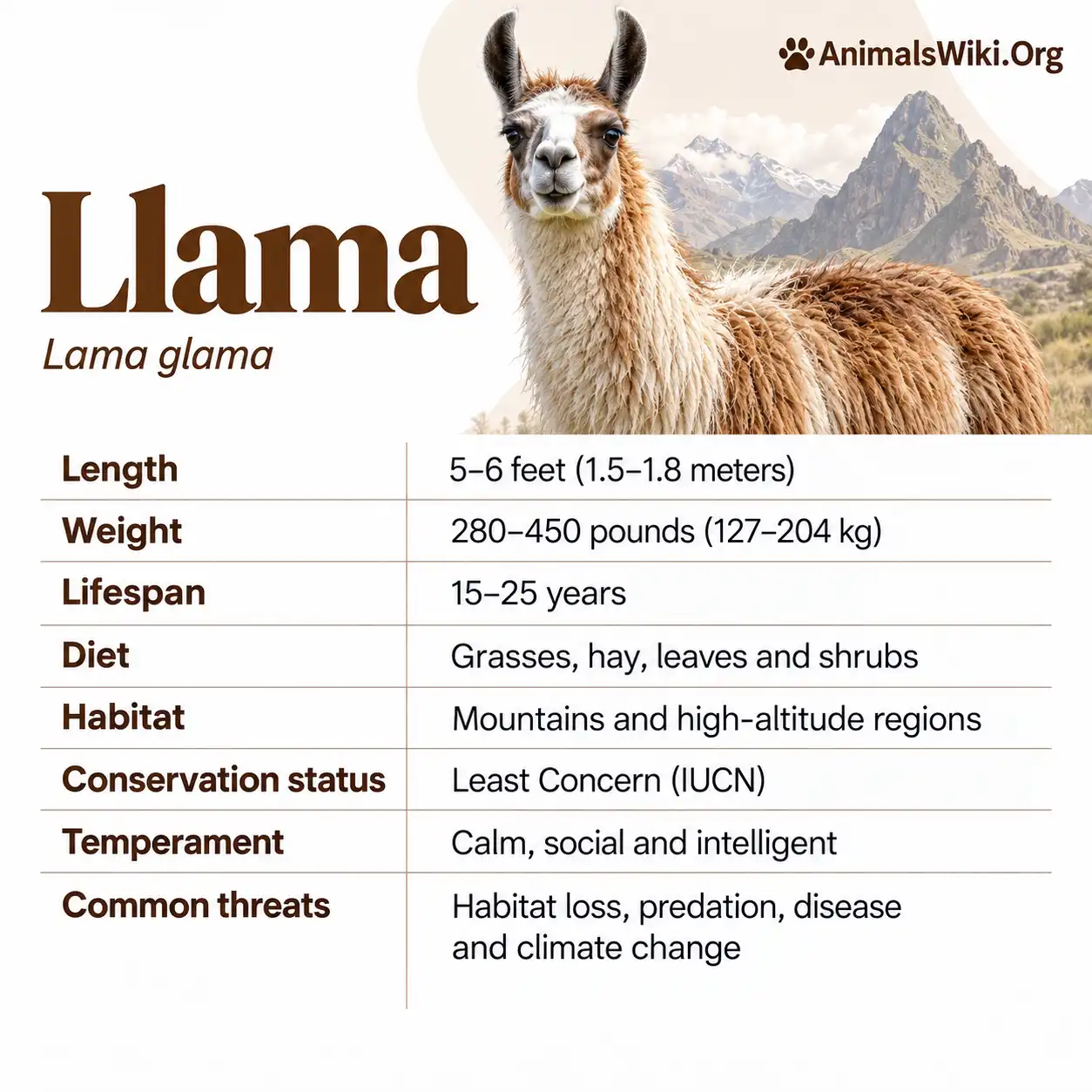
Llama Facts
| Feature | Details |
|---|---|
| Common Name | Llama |
| Scientific Name | Lama glama |
| Family | Camelidae |
| Order | Artiodactyla |
| First Described | 1758 (by Carl Linnaeus) |
| Native Habitat | High-altitude Andean grassland (puna and altiplano), domesticated grazing land |
| Geographic Range | Peru, Bolivia, Chile, Argentina, Ecuador; introduced/farmed worldwide |
| Average Size | 1.7–1.8 m tall at the head; 1.1–1.2 m at the shoulder |
| Average Weight | 130–200 kg |
| Lifespan | 15–25 years (domestic) |
| Diet | Herbivore — grasses, shrubs, lichens |
| Conservation Status | Domesticated (not evaluated in the wild sense); no wild populations exist |
| Defining Feature | Long banana-shaped ears; three-chambered stomach; spitting behavior; exceptional high-altitude adaptation; carried Andean civilizations for millennia as a pack animal |
| Number of Species/Relatives | 1 domesticated species; 3 close wild/domestic relatives (alpaca, guanaco, vicuña) |
1. Llama Species Overview & Classification
At over 4,000 meters above sea level on the windswept altiplano of the Bolivian highlands, where the air is thin enough to leave most lowland visitors gasping within minutes, a line of long-necked, thick-coated animals moves along a centuries-old mountain trail with the calm, unhurried confidence of creatures who have walked this exact route, in some form, for thousands of years. Their large, dark eyes survey the landscape from beneath long lashes; their distinctive banana-shaped ears swivel independently, tracking sounds across the vast open terrain; and on their backs, wooden pack frames carry loads of goods between highland communities separated by some of the most demanding terrain on Earth. These are llamas — the legendary beast of burden of the Andes, an animal whose partnership with human civilization in South America stretches back further than the wheel, the written word, or the horse in the Americas.
The llama (Lama glama) is a large, domesticated South American camelid — a member of the camel family adapted not to hot desert sand, like its more famous Old World relatives, but to the cold, thin, oxygen-poor air of the high Andes Mountains. Unlike the great majority of animals covered elsewhere in this guide series, the llama exists today almost entirely as a domesticated species with no genuinely wild populations remaining; it was bred by Indigenous Andean peoples from its wild ancestor, the guanaco, several thousand years ago, and has since become one of the most economically, culturally, and spiritually significant animals in the history of the Americas — a species whose remarkable physiological adaptations to extreme altitude, distinctive social behaviors, and centuries-long partnership with human civilization make it one of the most genuinely unique domesticated animals on the planet.
The llama belongs to a small, closely related group of South American camelids that includes two wild species — the guanaco and the vicuña — and one other domesticated species, the smaller alpaca, bred primarily for its exceptionally fine wool rather than as a pack animal. Understanding the llama requires understanding this broader camelid family group, since the four species share deep evolutionary history, overlapping range, and, in some cases, the ability to interbreed and produce fertile hybrid offspring — a genetic closeness that continues to shape both scientific classification debates and modern Andean livestock breeding practices.
Species Classification Table
| Classification Level | Details |
|---|---|
| Kingdom | Animalia |
| Phylum | Chordata |
| Class | Mammalia |
| Order | Artiodactyla |
| Family | Camelidae |
| Genus | Lama |
| Species | Lama glama |
| Described By | Carl Linnaeus, 1758 |
| Wild Ancestor | Guanaco (Lama guanicoe) |
The Four South American Camelids
| Species | Scientific Name | Status | Range | Notes |
|---|---|---|---|---|
| Llama | Lama glama | Domesticated | Andes (farmed); worldwide (introduced) | Bred primarily as a pack and meat animal |
| Alpaca | Vicugna pacos | Domesticated | Andes (farmed); worldwide (introduced) | Bred primarily for fine wool |
| Guanaco | Lama guanicoe | Wild | Patagonia, Andes (Peru to Tierra del Fuego) | Wild ancestor of the llama |
| Vicuña | Vicugna vicugna | Wild | High Andes (Peru, Bolivia, Chile, Argentina) | Wild ancestor of the alpaca; produces the world’s finest natural wool |
The Name “Llama”
The word “llama” derives from Quechua, the language family of the Indigenous Andean peoples of the Inca Empire and their descendants, who domesticated the animal and have maintained an unbroken cultural relationship with it for thousands of years. The Quechua term was adopted into Spanish following European colonization of the Andes and subsequently entered English and other European languages largely unchanged.
🦙 Did You Know? Llamas and their camelid relatives — despite being found today only in South America and, historically, in the case of true camels, Africa and Asia — actually originated in North America roughly 40–45 million years ago. The entire camelid family only reached South America relatively recently in evolutionary terms, crossing via the Isthmus of Panama during the Great American Biotic Interchange, while the North American camelid population from which they descended eventually went extinct entirely.
2. Llama Physical Description & Unique Features
The llama’s body reflects millions of years of camelid evolutionary adaptation combined with thousands of years of deliberate human selective breeding for its role as a domesticated highland pack and utility animal.
Size and Build
- Height: Typically 1.7–1.8 m (5.6–5.9 feet) measured to the top of the head; 1.1–1.2 m (3.6–3.9 feet) at the shoulder
- Weight: 130–200 kg (287–441 lbs), making the llama considerably larger than its wool-focused cousin the alpaca, and the largest of the four South American camelid species
- Body proportions: A long neck, long legs, and a relatively slender body, giving the llama a notably tall, elegant silhouette compared to the stockier build of true Old World camels
Sexual dimorphism: Modest; males are generally somewhat larger than females, though the difference is far less pronounced than in many other large mammal species covered in this guide series
The Distinctive Ears and Face
Banana-shaped ears: Among the llama’s most immediately recognizable and frequently commented-upon physical features, the long, curved ears — often likened in shape to bananas — are highly mobile and can rotate independently, providing excellent directional hearing across the open, often windy Andean terrain
Facial structure: A relatively long face with a distinctive split upper lip (shared with other camelids), large, expressive dark eyes with notably long eyelashes, and — as with camels — the ability to close the nostrils, an adaptation useful in the dusty, wind-blown conditions common to high-altitude terrain
Coat and Coloration
Fiber/wool: Llamas possess a double coat, consisting of a coarser outer “guard hair” layer and a softer undercoat; llama fiber, while generally coarser and less prized commercially than that of the alpaca, is nonetheless used in traditional Andean textile production and provides significant insulation against the extreme temperature swings of high-altitude environments
Coloration: Llama coats display enormous color variation — a direct result of thousands of years of selective breeding — ranging from solid white, brown, black, and grey to complex multicolor and spotted patterns, making individual llama coloration one of the most visually variable of any domesticated large mammal
Extraordinary High-Altitude Physiological Adaptations
Perhaps the single most scientifically remarkable aspect of llama biology is its suite of specialized adaptations for surviving and thriving at extreme altitude, where oxygen levels can be roughly 40% lower than at sea level:
- Specialized hemoglobin: Llama red blood cells are notably oval-shaped rather than the round shape typical of most mammals (including humans), an adaptation that allows blood to flow more efficiently through narrow capillaries even under the thickened blood conditions altitude can otherwise cause, while llama hemoglobin itself has an unusually high oxygen affinity, allowing more efficient oxygen uptake from the thin high-altitude air
- Elevated red blood cell count — llamas maintain a higher baseline concentration of oxygen-carrying red blood cells than most lowland mammals, a direct adaptation to chronic low-oxygen conditions
- Large lung capacity relative to body size — supporting more efficient oxygen extraction from each breath in the thin mountain air
The Feet and Legs
Unlike true Old World camels, which possess a single or double fatty hump for energy storage, llamas have no hump at all. Their feet are distinctively adapted for the rocky, uneven Andean terrain:
- Soft, padded, two-toed feet — rather than hooves, llamas have soft foot pads with two toenails, providing excellent traction and grip on steep, rocky mountain trails while minimizing soil erosion and vegetation damage compared to the hard, cutting hooves of many other large hoofed mammals — a genuinely significant ecological advantage that has made llamas particularly valued as low-impact pack animals in fragile high-altitude ecosystems
The Three-Chambered Stomach
Llamas, like other camelids, possess a specialized three-chambered stomach (in contrast to the four-chambered stomach of true ruminants such as cattle and deer), allowing efficient digestion of the tough, fibrous, often nutritionally sparse vegetation available in high-altitude grassland environments, described further in the Diet section.
3. Llama Habitat & Geographic Range
While llamas exist today primarily as a domesticated species raised across a considerable range of environments worldwide, their core traditional range and the environment to which their physiology remains most fundamentally adapted is the high-altitude Andean grassland of South America.
Preferred Habitat Features
High-altitude grassland (puna and altiplano) — the traditional core llama habitat, characterized by cold temperatures, thin oxygen, intense solar radiation during the day contrasted with severe nighttime cold, and sparse, hardy vegetation adapted to these extreme conditions
Rocky, mountainous terrain — llamas’ specialized padded feet, described in the Physical Description section, make them particularly well suited to steep, uneven mountain trails and terrain that would be considerably more difficult or damaging for many other domesticated pack animals to traverse
Cold-tolerant grazing land — llamas show strong physiological tolerance for cold temperatures, an adaptation to their traditional high-Andean range, though modern farmed llama populations worldwide are raised across a considerably broader range of climates given the species’ overall adaptability in domestication
Geographic Range
Traditional and current range:
| Region | Countries | Context | Notes |
|---|---|---|---|
| Central Andes | Peru, Bolivia | Core traditional range | Highest llama population density; deepest cultural integration |
| Southern Andes | Chile, Argentina | Significant traditional range | Extensive high-altitude grazing land |
| Northern Andes | Ecuador, Colombia | Smaller traditional presence | Less extensive than central/southern range |
| North America | United States, Canada | Introduced/farmed | Popular as livestock guardians, pack animals, fiber production, and pets |
| Europe, Australia, elsewhere | Various | Introduced/farmed | Growing popularity in small-scale farming and hobby livestock contexts |
No Wild Llama Population
It is important to note clearly that no genuinely wild llama population exists anywhere in the world today — the llama is, and has been for thousands of years, an entirely domesticated species. Its closest wild counterpart and direct ancestor, the guanaco, continues to exist in genuinely wild populations across Patagonia and other parts of the Andes, described further in the Species Overview section, but the llama itself is only found in domesticated, human-managed contexts, whether traditional Andean pastoral herds or modern farms across the world.
4. Llama Diet & Feeding Behavior
The llama is a highly efficient herbivore, well adapted to extracting adequate nutrition from the sparse, tough vegetation characteristic of its traditional high-altitude Andean range, while showing considerable dietary flexibility in modern farmed contexts worldwide.
What Llamas Eat
Grasses — the dietary foundation for llamas in both traditional Andean grazing contexts and modern farm settings worldwide; llamas are efficient grazers capable of thriving on grass species too sparse or nutritionally poor to adequately support many other livestock species
Shrubs and low woody vegetation — particularly important in the more marginal, sparse vegetation zones of the high Andean puna and altiplano, where pure grassland may be limited
Lichens — consumed opportunistically, particularly in the more extreme, sparsely vegetated high-altitude zones of the traditional Andean range, reflecting the genuinely marginal vegetation conditions llamas are adapted to tolerate
Hay and cultivated forage (modern/farmed contexts) — in most modern farming operations, particularly outside the Andes, llamas are commonly fed hay, pasture grass, and sometimes supplemental grain, reflecting standard livestock feeding practice rather than the more marginal, opportunistic foraging characteristic of traditional high-altitude grazing
Digestive Efficiency
Llamas are noted for their remarkable feed conversion efficiency — the specialized three-chambered stomach described in the Physical Description section allows llamas to extract substantially more nutritional value from a given quantity of low-quality forage than many other comparable livestock species, an adaptation directly tied to the historically sparse vegetation available across much of the traditional high-Andean grazing range, and one of the key practical reasons llamas have remained such a valuable and sustainable livestock choice in marginal high-altitude environments where more nutritionally demanding livestock species would struggle.
Water Requirements
Llamas require comparatively modest water intake relative to body size and can tolerate extended periods with limited water access, an adaptation broadly consistent with the arid-to-semi-arid conditions characteristic of much of the traditional Andean altiplano and puna grazing range.
Feeding Behavior Patterns
Grazing pattern: Llamas typically graze throughout daylight hours, moving in loose groups across available pasture or rangeland, with feeding activity generally more concentrated during the cooler parts of the day in warmer farmed environments
Selective grazing: Like several other camelids, llamas show a degree of dietary selectivity, and their soft, padded feet (rather than hard hooves) mean that llama grazing activity causes comparatively minimal damage to root systems and topsoil compared to hoofed grazing livestock such as cattle or sheep — a genuinely significant ecological and agricultural advantage in fragile high-altitude grassland ecosystems
Daily Food Consumption
- Adult llamas typically consume approximately 1–2% of their body weight in dry matter daily — a relatively modest requirement reflecting the species’ efficient digestive physiology and adaptation to historically sparse forage conditions
5. Llama Reproduction & Life Cycle
Llama reproductive biology reflects both general camelid reproductive patterns and specific traits shaped by thousands of years of selective breeding under human management.
Sexual Maturity
- Females: Typically reach sexual maturity at approximately 12–18 months, though breeding is generally recommended somewhat later, closer to 18–24 months, to ensure adequate physical maturity for a healthy pregnancy
- Males: Generally reach sexual maturity slightly later, around 2–3 years, with full breeding competence and social maturity often not established until closer to this upper end of the range
Induced Ovulation — A Distinctive Camelid Trait
One of the more scientifically notable aspects of llama (and broader camelid) reproductive biology is that females are induced ovulators — unlike many mammals that ovulate on a fixed cyclical schedule regardless of mating activity, female llamas typically only ovulate in response to the physical act of mating itself, a reproductive strategy that offers practical advantages for breeding management under human care, since it removes the need to precisely time breeding around a female’s independent estrus cycle.
Mating Behavior
Llama mating is a distinctive process among domesticated livestock, notable for its unusually long duration — copulation can last anywhere from 20 minutes to over an hour, considerably longer than the mating duration typical of most other domesticated mammals, and is conducted with both animals in a sitting (cushed) position rather than standing, a further distinctive feature of camelid mating behavior.
Gestation and Birth
- Gestation period: Approximately 11.5 months (330–350 days), notably long for an animal of the llama’s size
- Litter size: Single offspring (called a cria) is the overwhelming norm; twins are extremely rare and often associated with significant complications
- Birth timing: Births typically occur during daylight hours, an adaptive behavioral pattern believed to reduce nighttime predation risk on the vulnerable newborn in traditional high-altitude range conditions
- Birth weight: Approximately 9–14 kg (20–31 lbs)
Cria Development
| Stage | Timing | Development |
|---|---|---|
| Birth | Day 0 | ~9–14 kg; standing within 30–90 minutes |
| Early nursing period | Weeks 1–4 | Highly dependent on mother’s milk |
| Solid food introduction | Weeks 2–4 | Begins sampling grass and forage alongside continued nursing |
| Weaning | 4–6 months | Gradual transition to independent grazing |
| Juvenile growth | 6 months–2 years | Continued physical development |
| Sexual maturity | 12–18 months (female); 2–3 years (male) | Reproductive capability begins |
Rapid standing: As with several other large hoofed mammals covered in this guide series, llama crias are notably precocial, typically standing within 30 to 90 minutes of birth and capable of following the mother and the broader herd shortly thereafter — an important survival adaptation for a species whose traditional range includes considerable predation risk and challenging terrain, described further in the Predators section.
Llama Lifespan
- Domestic: Typically 15–25 years, with well-cared-for individuals sometimes exceeding this range; llamas are notably long-lived relative to many other domesticated livestock species of comparable size
6. Social Behavior & Communication
Llamas are genuinely social herd animals, exhibiting a range of communicative and social behaviors shaped both by their evolutionary history as a herding camelid and by thousands of years of selective breeding under close human management.
Herd Structure
Llamas naturally form herds, and show a strong instinctive preference for group living; a solitary llama, whether in traditional Andean herding contexts or modern small-scale farming, is generally considered to experience significant stress, and llama husbandry guidance consistently recommends keeping llamas in groups of at least two or more individuals for basic welfare reasons.
Dominance hierarchy: Within a herd, llamas establish a relatively stable dominance hierarchy, determined through a combination of postural displays, vocalizations, and occasional direct physical confrontation, particularly among males; established hierarchies generally reduce the frequency of ongoing conflict within a stable group over time.
The Famous Spitting Behavior
Perhaps no llama behavior is more widely known — or more frequently, and somewhat inaccurately, associated with the species in general popular perception — than spitting:
- Function: Spitting is primarily a social communication and dominance-assertion behavior used between llamas themselves, most commonly deployed to establish or reinforce dominance hierarchy, express displeasure over resource competition (such as food), or ward off unwanted attention, rather than being a routine or default response toward humans
- Mechanism: A llama spit can involve saliva alone for milder communicative displays, or can escalate to include regurgitated stomach content for more forceful, serious expressions of displeasure or threat — the latter considerably more unpleasant and typically reserved for more significant conflicts
- Human-directed spitting: While llamas are fully capable of spitting at humans, this typically occurs only when the animal feels genuinely threatened, mishandled, or is redirecting spitting behavior intended for another llama toward a human who has inadvertently stepped into the middle of an inter-llama social dispute — well-socialized, properly handled llamas rarely spit at humans under normal circumstances, a nuance frequently lost in the animal’s broader popular cultural reputation, discussed further in the Pop Culture section
Vocalizations
Llamas possess a varied vocal repertoire used across different social contexts:
- Humming — perhaps the most characteristic and frequently observed llama vocalization, a soft, low-pitched sound produced across a range of social contexts including general contentment, mild anxiety, and communication between a mother and her cria
- Alarm calls — a distinctive, sharp, high-pitched call used to alert the herd to a potential threat, discussed further in the Predators section given the llama’s notable and practically valuable role as an effective livestock guardian animal in many modern farming contexts
- Clucking and other close-range vocalizations — used in various social interactions, particularly between mothers and crias
Body Language
Ear position — llama ears, described in the Physical Description section, convey considerable social information through position and movement; ears pinned back typically signal irritation or aggression, while relaxed, forward-oriented ears generally indicate a calm or attentive state
Neck and body posture — used extensively in dominance displays and general social communication, including a distinctive “neck wrestling” behavior sometimes observed between males establishing dominance
Bonding with Other Species
One of the more practically significant aspects of modern llama social behavior is the species’ demonstrated capacity to form protective social bonds not only with other llamas but with other livestock species entirely — a trait that underlies the llama’s widespread and increasingly popular modern use as a livestock guardian animal, discussed further in the Human Relationships section.
7. Predators & Defense Mechanisms
While llamas today exist almost entirely within human-managed farming and pastoral contexts rather than facing natural predation pressure in a genuinely wild setting, the species retains behavioral and physical traits reflecting its evolutionary history as a prey species across the Andean landscape, and these traits have, notably, been actively put to modern practical use.
Historical/Potential Predators
Puma (Puma concolor) — the most significant historical predator of guanacos (the llama’s wild ancestor) across the Andean range, and a predator that domesticated llamas in traditional high-altitude pastoral settings may still occasionally encounter and must be actively guarded against
Andean Condor and large raptors — occasional predation risk to very young or vulnerable crias, though adult llamas face negligible direct predation risk from avian predators given their substantial adult body size
Domestic and feral dogs — in modern farming contexts, dogs represent a more immediately relevant predation and harassment risk to llamas than most genuinely wild predators, particularly in regions outside the traditional Andean range
Defense Strategies
Alarm calling and group vigilance: As described in the Social Behavior section, llamas produce distinctive alarm vocalizations upon detecting a potential threat, alerting the broader herd (or, in modern guardian contexts, the livestock the llama is protecting) to potential danger
Kicking: Llamas are capable of delivering a powerful, well-aimed kick with the hind legs, a genuinely effective physical defense against smaller predators such as coyotes or dogs
Spitting as a defensive/deterrent tool: As described in the Social Behavior section, while spitting is primarily an inter-llama social communication behavior, it can also serve a genuine deterrent function against a perceived threat
Body size and aggressive posturing: An adult llama’s substantial size, combined with confident, aggressive posturing (including neck extension, ear pinning, and direct confrontational approach) toward a perceived threat, can be sufficient to deter many smaller predators without requiring actual physical contact
The Llama as Livestock Guardian — A Modern Application of Ancestral Instincts
One of the more practically significant and widely adopted modern applications of the llama’s natural anti-predator behavioral toolkit is its increasingly popular use as a livestock guardian animal, particularly protecting sheep and goat herds from coyote, dog, and other mid-sized predator attacks across parts of North America, Australia, and elsewhere:
- Natural aggression toward canids: Llamas frequently display an instinctive wariness and active aggression toward dog-like predators (a category that would historically have included some of the llama’s ancestral threats), making a llama guardian genuinely effective at deterring coyote and dog-related livestock predation
- Bonding with the protected flock: As described in the Social Behavior section, a llama’s capacity to form genuine protective social bonds with other livestock species underlies its effectiveness in this guardian role — a single, typically gelded (neutered) male llama is commonly used, both to avoid unwanted breeding behavior toward the protected flock and to focus the animal’s protective instinct rather than reproductive instinct on its guardian role
- Widespread modern adoption: Llama guardian use has grown substantially as a genuinely effective, lower-maintenance alternative or complement to traditional livestock guardian dogs in many parts of the world, representing one of the more practically valuable and widely appreciated modern applications of the species’ ancestral defensive behavioral repertoire.
8. Relationship with Humans
Ancient Andean Domestication
The llama’s relationship with humanity represents one of the oldest, deepest, and most consequential animal domestication stories in the Western Hemisphere:
Domestication timeline: Llamas were domesticated from the wild guanaco by Indigenous Andean peoples approximately 4,000–5,000 years ago, making the llama one of the oldest domesticated large mammal species in the Americas, alongside the alpaca
Foundational role in Andean civilization: Long before European contact, llamas served as an absolutely central pillar of Andean civilization, functioning simultaneously as the primary pack and transport animal across the extraordinarily challenging Andean terrain (where wheeled transport was largely impractical given the mountainous landscape, and where horses did not yet exist in the Americas), a valuable source of meat, wool, hide, and dung (used both as fuel and fertilizer in the notably scarce-timber high-altitude environment), and a species of significant religious and ceremonial importance
The Inca Empire and llama caravans: The Inca Empire, at its height one of the largest and most sophisticated pre-Columbian civilizations in the Americas, relied extensively on organized llama pack caravans — sometimes numbering in the hundreds or even thousands of animals — to transport goods, tribute, and supplies across the empire’s extensive road network, a logistical system fundamental to Inca imperial administration, trade, and military capability across the challenging Andean terrain
Sacrificial and ceremonial significance: Llamas held (and in many communities, continue to hold) genuine religious and ceremonial significance in Andean spiritual tradition, including their historical use in ceremonial sacrifice within Inca religious practice, and their continuing symbolic and practical role in various contemporary Andean cultural and religious ceremonies and observances
Modern Andean Pastoral Life
Llamas remain a genuinely significant component of contemporary Andean rural economic and cultural life across Peru, Bolivia, Chile, and Argentina, continuing to provide meat, wool for traditional textile production, and pack transport capability in many of the more remote, high-altitude communities where modern mechanized transport remains impractical or prohibitively expensive.
Global Spread and Modern Uses
Since the 20th century, llamas have been increasingly exported and farmed well beyond their traditional Andean range:
Livestock guardian use — as detailed extensively in the Predators section, llamas have become an increasingly popular and genuinely effective livestock guardian animal across North America, Australia, and elsewhere
Pack and trekking animals — llamas are increasingly used recreationally as pack animals for hiking and wilderness trekking outside their traditional Andean context, valued for their calm temperament, low ecological impact (owing to their soft, padded feet described in the Physical Description section), and substantial carrying capacity relative to their feed and water requirements
Fiber production — while generally considered coarser and less commercially prized than alpaca wool, llama fiber continues to be used in various textile applications, both within traditional Andean weaving practice and in some modern niche fiber markets
Companion and hobby farming — llamas have become an increasingly popular choice for small-scale hobby farms and as unconventional companion animals in various parts of the world, valued for their generally calm, personable temperament and manageable size relative to other large livestock
Therapy animal programs — some llamas are specifically trained and employed in animal-assisted therapy programs, valued for their calm disposition and notably approachable, engaging presence in settings including hospitals, nursing homes, and educational programs
9. Llama Conservation Status & Threats
Conservation Status Overview
Because the llama exists today entirely as a domesticated species with no wild populations, it is not formally assessed under standard wild-species conservation frameworks such as the IUCN Red List in the manner of the other animals covered throughout this guide series. Global llama numbers are, if anything, considerably more secure than at almost any point in recent history, given the species’ significant and growing popularity in farming, guardian, and companion contexts well beyond its traditional Andean range.
Considerations Relevant to the Llama’s Broader Context
While the llama itself faces no conservation threat in the traditional sense, several related considerations remain relevant to understanding the species’ broader ecological and cultural context:
1. The Wild Guanaco’s More Precarious Status
The llama’s wild ancestor, the guanaco, while classified as Least Concern overall by the IUCN, has experienced significant historical range contraction and population decline across parts of its traditional Patagonian and Andean range, driven by habitat loss, competition with introduced livestock for grazing land, and historical overhunting — a genuinely more precarious conservation situation than the domesticated llama itself faces, and one that receives comparatively less international conservation attention than some of the more high-profile threatened species covered elsewhere in this guide series.
2. Genetic Diversity in Domesticated Populations
As with many long-domesticated livestock species, questions regarding the maintenance of adequate genetic diversity within managed llama breeding populations — both within traditional Andean herds and in the various international farming populations established more recently — represent an ongoing area of interest for livestock geneticists and breed conservation organizations, particularly regarding the preservation of traditional Andean llama breed lines and characteristics.
3. Cultural and Economic Sustainability of Traditional Andean Herding
Beyond the animal’s own biological conservation status, broader socioeconomic pressures on traditional Andean pastoral communities — including rural-to-urban migration, changing land use patterns, and the economic pressures facing traditional subsistence and small-scale commercial herding practices — represent a genuine area of cultural sustainability concern relevant to the continuation of traditional llama husbandry practices and their associated cultural knowledge across Andean communities.
4. Hybridization Management
As referenced in the Species Overview section, llamas can interbreed with alpacas (producing offspring sometimes called “huarizo”) and, less commonly, with other camelid relatives, and modern camelid breeding programs — both traditional and commercial — must actively manage breeding practices to maintain desired breed characteristics and avoid unintended hybridization where distinct breed lines are a priority.
10. Famous Llamas Around the World
Caesar and Lightning — The Cincinnati Zoo Escapees
In 2015, two llamas that escaped from a handler in Sun City, Arizona, and led local police on a widely broadcast, genuinely viral live television chase through suburban streets became an unexpected global internet phenomenon, with footage of the pursuit watched by millions and generating extensive social media commentary and humor — a striking example of how a single unplanned llama-related incident could capture sustained international public attention and amusement.
Machu Picchu’s Resident Llamas
The llamas that roam freely across the terraces of Machu Picchu, the iconic 15th-century Inca citadel in Peru, have become individually and collectively one of the most photographed groups of animals in South American tourism, serving simultaneously as a living connection to the site’s Inca heritage and as one of the most recognizable and beloved elements of the Machu Picchu visitor experience for millions of international tourists each year.
Llamas of Andean Ceremonial Tradition
While not individually named in the manner of a single celebrity animal, llamas used in ongoing traditional Andean religious and ceremonial practices — including various contemporary observances rooted in pre-Columbian Andean spiritual tradition — continue to hold genuine, actively practiced cultural and ceremonial significance across many highland communities in Peru, Bolivia, and neighboring countries, representing a living, unbroken thread of cultural practice extending back thousands of years.
11. Role in Ecosystem & Food Chain
Low-Impact Grazing and Traditional Andean Land Management
As detailed in the Diet and Physical Description sections, the llama’s soft, padded, two-toed feet cause substantially less erosion and vegetation damage than the hard hooves of many other large grazing livestock species, making traditional llama herding a genuinely lower-impact form of land use on the fragile, slow-recovering vegetation of the high Andean grassland ecosystem compared to alternative livestock grazing practices — an ecological consideration increasingly recognized in discussions of sustainable high-altitude land management in the Andes.
Nutrient Cycling in a Traditionally Fuel-Scarce Environment
As referenced in the Human Relationships section, llama dung has historically served a genuinely important dual ecological and practical function across the traditionally timber-scarce high-Andean environment, serving simultaneously as a valuable natural fertilizer supporting continued grassland productivity and, notably, as a critical fuel source for cooking and heating in an environment where wood is often scarce or entirely unavailable at extreme altitude — a practical ecological relationship that has sustained human habitation across some of the most challenging inhabited terrain on Earth for thousands of years.
The Broader Andean Camelid Ecosystem
The llama’s wild relatives — the guanaco and vicuña — continue to play a more directly wild-ecosystem-integrated ecological role across their remaining range, serving as significant native herbivores shaping Andean and Patagonian grassland vegetation dynamics, and as an important prey base for the puma across much of their shared range, illustrating the broader ecological role the domesticated llama’s evolutionary lineage continues to play in its wild form even as the llama itself has moved almost entirely into a domesticated, human-managed ecological niche.
12. Llama Discovery & Evolution Timeline
~40–45 million years ago — The camelid family (Camelidae) first appears in the fossil record in North America — the true evolutionary origin point of all modern camelids, including both Old World camels and the South American llama, alpaca, guanaco, and vicuña.
~3 million years ago — Camelids migrate from North America into South America across the newly formed Isthmus of Panama during the Great American Biotic Interchange, eventually giving rise to the guanaco and vicuña lineages that would later be domesticated; separately, other camelid lineages migrate into Asia and eventually Africa, giving rise to modern true camels, while the original North American camelid population eventually goes fully extinct.
~4,000–5,000 years ago — Indigenous Andean peoples domesticate the llama from the wild guanaco, and separately domesticate the alpaca from the wild vicuña, establishing what would become one of the most consequential and enduring animal domestication relationships in the history of the Americas.
Pre-Columbian era (particularly Inca period, 15th–16th century CE) — The Inca Empire develops sophisticated large-scale llama pack caravan logistics as a central pillar of imperial transport, trade, and administrative infrastructure across the empire’s extensive Andean road network.
1532–1533 — Spanish conquest of the Inca Empire under Francisco Pizarro brings the llama into direct contact with European colonizers, who document and, in various written accounts, describe the animal in detail for the first time from a European scientific perspective.
1758 — Carl Linnaeus formally describes the llama (Lama glama) in the 10th edition of Systema Naturae, establishing its modern scientific classification.
19th–20th century — Continued integration of llama husbandry into evolving Andean rural economies, alongside gradually increasing scientific and international public interest in the species beyond its traditional South American range.
Mid-late 20th century — Llamas begin to be exported and farmed in increasing numbers outside South America, particularly in North America, establishing the foundation for the species’ modern international farming, guardian animal, and companion animal popularity.
1990s–2000s — Llama guardian animal use expands significantly across North American and Australian sheep and goat farming operations, as detailed in the Predators section, alongside a notable rise in the llama’s broader Western popular culture visibility, including major media appearances such as “The Emperor’s New Groove” (2000).
2010s — Viral internet incidents, including the widely covered 2015 Arizona llama chase, alongside the continued popularity of llama-themed children’s media and merchandise, further cement the llama’s distinctive modern comedic pop-culture reputation internationally.
2022–2026 — Continued growth in llama farming, guardian animal use, and companion/hobby farming applications worldwide, alongside ongoing efforts within Andean communities and cultural heritage organizations to document, preserve, and celebrate the llama’s deep traditional cultural and religious significance amid the animal’s simultaneous rise as an internationally popularized, often comedically depicted global icon.
13. Llama Comparison with Similar Species
| Feature | Llama (Lama glama) | Alpaca (Vicugna pacos) | Guanaco (Lama guanicoe) | Bactrian Camel (Camelus bactrianus) |
|---|---|---|---|---|
| Family | Camelidae | Camelidae | Camelidae | Camelidae |
| Domestication status | Fully domesticated | Fully domesticated | Wild | Domesticated (some wild populations remain) |
| Height | 1.7–1.8 m | 0.8–1.0 m (shoulder) | 1.0–1.2 m (shoulder) | 1.8–2.3 m (shoulder, incl. hump) |
| Weight | 130–200 kg | 55–65 kg | 90–140 kg | 300–1,000 kg |
| Primary use/role | Pack animal, meat, coarse wool | Fine wool production | N/A (wild) | Pack/transport, meat, milk |
| Native range | Andes (domesticated) | Andes (domesticated) | Patagonia, Andes | Central Asia |
| Humps | None | None | None | Two |
| Notable trait | Banana ears; livestock guardian use | Finest natural wool of any camelid | Wild ancestor of the llama | Extreme temperature tolerance |
| Conservation | N/A (domesticated) | N/A (domesticated) | Least Concern (wild) | Critically Endangered (wild population); domesticated stock secure |
14. Best Places to See Llamas
Peru
- 🇵🇪 Machu Picchu — as detailed in the Famous Llamas section, home to one of the most photographed and internationally recognized free-roaming llama populations in the world, grazing among the historic Inca terraces
- 🇵🇪 Sacred Valley region, near Cusco — numerous traditional Andean farms and cultural centers offer close encounters with llamas alongside broader Andean cultural and textile heritage experiences
- 🇵🇪 Lake Titicaca region — traditional highland communities around South America’s largest lake maintain significant traditional llama herding practices, often incorporated into community-based tourism experiences
Bolivia
- 🇧🇴 Altiplano region, near La Paz — extensive traditional llama grazing land across Bolivia’s high-altitude plateau, offering genuine insight into traditional Andean pastoral practice
- 🇧🇴 Salar de Uyuni surrounding communities — traditional llama herding continues across the communities bordering the world’s largest salt flat
Chile and Argentina
- 🇨🇱 Northern Chilean Altiplano (near San Pedro de Atacama) — significant traditional and farmed llama populations across this high-altitude desert region
- 🇦🇷 Northwestern Argentina (Salta and Jujuy provinces) — traditional Andean llama herding communities across this culturally significant high-altitude region
Outside South America
- 🇺🇸 Various farm parks, petting zoos, and llama trekking operations across North America — llamas are increasingly accessible to visitors well outside their traditional Andean range through a growing number of dedicated farms, wildlife parks, and recreational trekking operations
15. Fun Facts About Llamas
- 🦙 Llamas and all other camelids originated in North America roughly 40–45 million years ago, before migrating to South America and Asia; the original North American camelid population eventually went extinct entirely
- 🦙 No genuinely wild llama population exists anywhere in the world — the species has been entirely domesticated for approximately 4,000–5,000 years
- 🦙 Llama red blood cells are distinctively oval-shaped, rather than round, an adaptation that helps oxygen flow more efficiently through the body at extreme high altitude
- 🦙 A llama’s gestation period lasts approximately 11.5 months — notably long for an animal of its size
- 🦙 Llama mating is unusually prolonged, sometimes lasting over an hour, and is conducted with both animals in a sitting position
- 🦙 The Inca Empire relied on organized llama pack caravans, sometimes numbering in the hundreds or thousands of animals, as a central pillar of imperial transport and trade
- 🦙 Llamas have soft, padded, two-toed feet rather than hard hooves, causing significantly less erosion and vegetation damage than many other large grazing livestock
- 🦙 Spitting, the llama’s most famous behavior, is primarily used for communication between llamas themselves, not as a routine response toward humans
- 🦙 Gelded male llamas are increasingly and effectively used as livestock guardian animals, protecting sheep and goat herds from coyote and dog predation across North America and elsewhere
- 🦙 Llamas can interbreed with alpacas, producing hybrid offspring sometimes referred to as “huarizo”
- 🦙 A single male llama escaping police custody in Sun City, Arizona in 2015 became a global viral internet sensation after being chased through suburban streets on live television
- 🦙 Llama dung has historically served as a critical fuel source for cooking and heating across the traditionally timber-scarce high-Andean environment, alongside its role as natural fertilizer
18. Frequently Asked Questions About Llamas
Q1: Do llamas actually spit at people?
Llamas are fully capable of spitting at humans, but this is generally not their default or routine behavior toward people. Spitting is primarily a communication and dominance-assertion behavior used between llamas themselves, most often to establish hierarchy, express displeasure over resource competition, or ward off unwanted attention. Well-socialized, properly handled llamas rarely spit at humans under normal circumstances — human-directed spitting typically occurs only when an animal feels genuinely threatened, is mishandled, or when a person inadvertently steps into the middle of an ongoing dispute between two llamas and receives spit intended for the other animal.
Q2: Is a llama the same as an alpaca?
No — while closely related and often confused, llamas and alpacas are two distinct domesticated species. Llamas (Lama glama) are considerably larger, typically bred primarily as pack and meat animals, and descend from the wild guanaco. Alpacas (Vicugna pacos) are notably smaller, bred primarily for their exceptionally fine wool, and descend from the wild vicuña. The two species can interbreed and produce fertile offspring, but they represent genuinely separate domesticated lineages with distinct traditional breeding purposes across Andean history.
Q3: Are there any wild llamas?
No — llamas exist today entirely as a domesticated species, with no genuinely wild populations anywhere in the world. The llama was domesticated from its wild ancestor, the guanaco, by Indigenous Andean peoples approximately 4,000–5,000 years ago. The guanaco itself continues to exist in genuinely wild populations across Patagonia and parts of the Andes today, but the llama, much like the domestic dog or domestic cow, is only found in human-managed contexts.
Q4: How are llamas adapted to high altitude?
Llamas possess several remarkable physiological adaptations for surviving at extreme altitude, where oxygen levels can be roughly 40% lower than at sea level. Their red blood cells are distinctively oval-shaped rather than round, allowing more efficient blood flow through narrow capillaries, and their hemoglobin has an unusually high oxygen affinity, allowing more efficient oxygen extraction from thin mountain air. Llamas also maintain a higher baseline red blood cell concentration than most lowland mammals and possess proportionally large lung capacity — a combined suite of adaptations that allows the species to thrive at elevations that would cause severe altitude sickness in most other large mammals, including humans without acclimatization.
Q5: Why are llamas used to guard sheep and goats?
Llamas, particularly gelded (neutered) males, are increasingly used as effective livestock guardian animals because they display an instinctive wariness and active aggression toward dog-like predators such as coyotes, and because the species has a demonstrated capacity to form genuine protective social bonds with other livestock species entirely. A single guardian llama integrated into a sheep or goat flock will often actively confront and chase away coyotes or dogs approaching the herd, making it a genuinely effective, relatively low-maintenance, non-lethal predator deterrence option increasingly adopted across North American, Australian, and other sheep and goat farming operations.
Q6: What role did llamas play in the Inca Empire?
Llamas were absolutely central to Inca imperial infrastructure and daily life. Because wheeled transport was largely impractical across the extremely mountainous Andean terrain, and horses did not yet exist in the pre-Columbian Americas, the Inca Empire relied on organized llama pack caravans — sometimes numbering in the hundreds or even thousands of animals — to transport goods, tribute, and supplies across the empire’s extensive road network. Beyond transport, llamas also provided meat, wool, hide, and dung (used as both fuel and fertilizer in the timber-scarce high-altitude environment), and held significant religious and ceremonial importance within Inca spiritual tradition, including use in ceremonial sacrifice.
Q7: How long do llamas live, and how do they reproduce?
Llamas typically live 15–25 years in domestic care, making them notably long-lived relative to many other domesticated livestock species of comparable size. Female llamas are induced ovulators, meaning they typically only ovulate in response to the physical act of mating itself, rather than following an independent cyclical schedule. Gestation lasts approximately 11.5 months (330–350 days), and females almost always give birth to a single offspring, called a cria, which typically stands within 30 to 90 minutes of birth and is weaned by approximately 4 to 6 months of age.
Q8: Do llamas cause damage to the land they graze on?
Generally, considerably less than many comparable livestock species. Llamas have soft, padded, two-toed feet rather than hard hooves, an adaptation that causes significantly less erosion and root system damage to grassland vegetation than the hard, cutting hooves of livestock such as cattle, horses, or sheep. This lower-impact grazing characteristic has made llamas particularly valued as a genuinely sustainable livestock choice across the fragile, slow-recovering high-altitude grassland ecosystems of the traditional Andean range, and is one of the reasons llamas are increasingly favored for low-impact pack and trekking use in sensitive wilderness environments outside South America as well.