
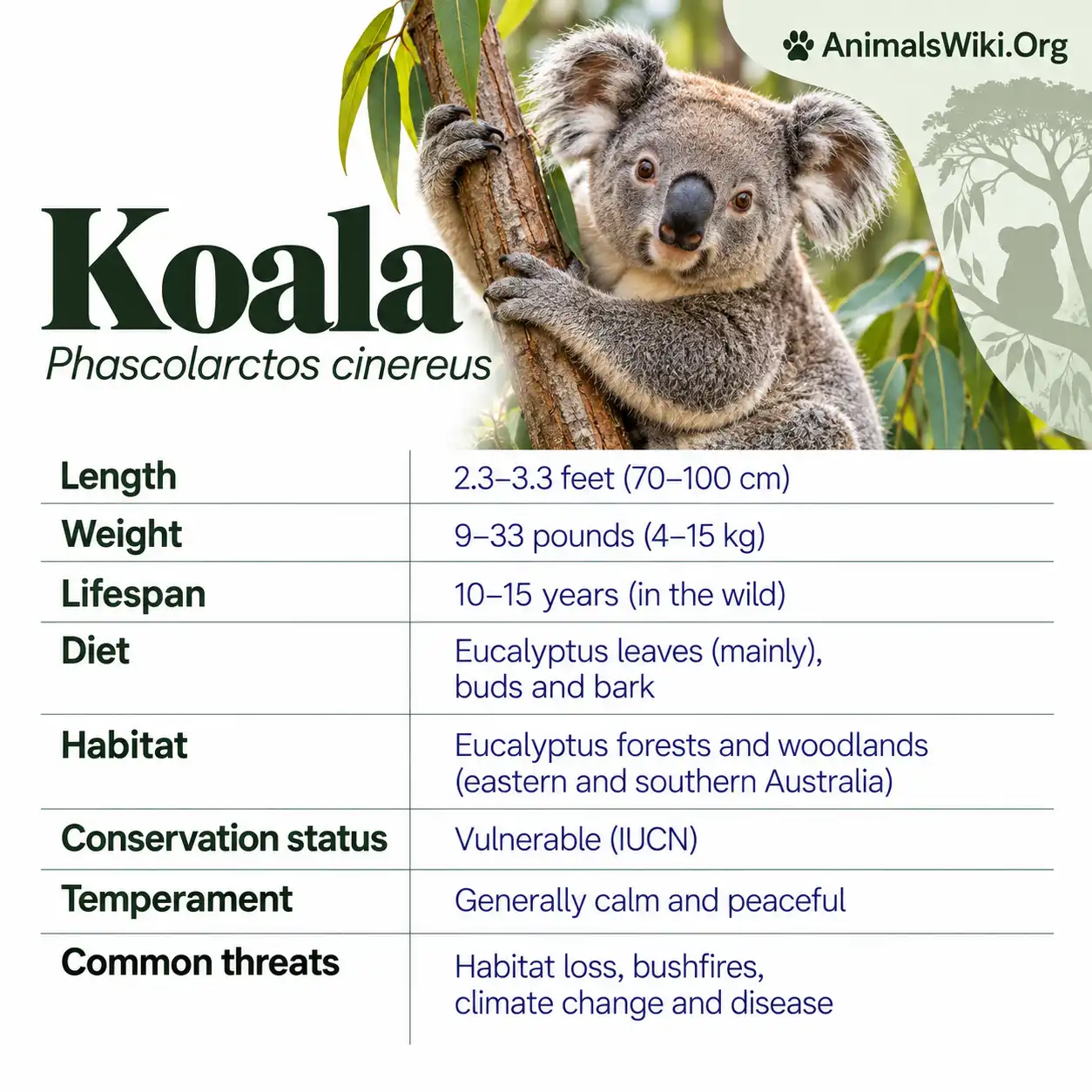
Koala Facts
| Feature | Details |
|---|---|
| Common Name | Koala |
| Scientific Name | Phascolarctos cinereus |
| Family | Phascolarctidae |
| Order | Diprotodontia |
| First Described | 1817 (by Georges Cuvier, formally naming the genus based on earlier descriptions) |
| Native Habitat | Eucalyptus forest and woodland |
| Geographic Range | Eastern and southeastern Australia (Queensland, New South Wales, Victoria, South Australia) |
| Average Size | 60–85 cm body length |
| Average Weight | 4–15 kg (northern populations smaller; southern populations larger) |
| Lifespan | 10–15 years (wild, females often longer); up to 20 years (captivity) |
| Diet | Herbivore — almost exclusively eucalyptus leaves |
| Conservation Status | Vulnerable/Endangered (varies by state; nationally listed as Endangered in Queensland, NSW, and ACT since 2022) |
| Defining Feature | Extreme dietary specialization on toxic eucalyptus leaves; large fluffy ears; forward-facing pouch; distinctive fingerprint patterns nearly identical to human fingerprints |
| Number of Species/Subspecies | 1 species; 3 traditionally recognized regional forms (though modern taxonomy questions their formal validity) |
1. Koala Species Overview & Classification
High in the fork of a tall eucalyptus tree somewhere along Australia’s eastern seaboard, wedged snugly between two branches with its round, fluffy-eared head tucked against its chest, a grey shape sits motionless for hour after hour after hour. To a casual passerby glancing up through the canopy, it might be mistaken for a strange growth on the tree itself, or perhaps a forgotten child’s toy somehow lodged twenty meters above the ground. Then, almost imperceptibly, one paw shifts its grip, a nostril flares to sample the air, and the animal’s true nature becomes clear: this is a koala, Australia’s most beloved and most misunderstood marsupial, deep in one of the twenty-odd hours of sleep and rest it requires each and every day — not from laziness, as popular myth insists, but from one of the most extraordinary and precarious dietary specializations found anywhere in the animal kingdom.
The koala (Phascolarctos cinereus) is a tree-dwelling marsupial native to the eucalyptus forests of eastern and southeastern Australia — an animal so thoroughly, so completely built around a single dietary and ecological niche that its entire biology, from its digestive system to its unusually small brain-to-body ratio to its famously languid pace of life, represents one of the most striking examples of extreme specialization among the world’s mammals. Despite its enduring popular nickname, “koala bear,” the koala is not a bear at all and is not remotely related to bears; it is a marsupial, more closely related to wombats, kangaroos, and the extinct giant Diprotodon than to any placental carnivore, and it carries its young in a distinctive backward-facing — technically forward-opening but anatomically unusual — pouch, nurses them on milk, and reproduces via a biology entirely distinct from any placental mammal covered elsewhere in this guide series.
Koalas occupy a genuinely precarious ecological position: they are among the most extreme dietary specialists of any mammal on Earth, subsisting almost exclusively on the leaves of eucalyptus trees — leaves that are low in nutritional value, high in fiber, and laced with toxic compounds that would sicken or kill most other mammals attempting to consume them in any quantity. This extraordinary specialization has allowed the koala to exploit an ecological niche essentially uncontested by any other mammal, but it has also made the species acutely, almost uniquely vulnerable to habitat loss, since a koala’s survival depends not merely on any forest, but specifically on access to a relatively narrow range of preferred eucalyptus species growing in sufficient density and connectivity to sustain its population. The koala’s modern conservation story — a beloved global icon whose wild populations have nonetheless suffered catastrophic regional declines from habitat clearing, bushfires, disease, and climate change — is one of the most closely watched and emotionally resonant conservation narratives in the world today.
Species Classification Table
| Classification Level | Details |
|---|---|
| Kingdom | Animalia |
| Phylum | Chordata |
| Class | Mammalia |
| Infraclass | Marsupialia |
| Order | Diprotodontia |
| Family | Phascolarctidae |
| Genus | Phascolarctos |
| Species | Phascolarctos cinereus |
| Described By | Georges Cuvier, 1817 (genus); species based on earlier 1816 description by de Blainville |
| Closest Living Relatives | Wombats (family Vombatidae) |
Regional Forms of the Koala
Koalas are not currently divided into scientifically distinct subspecies by most modern taxonomic authorities, though three traditionally recognized regional forms are still commonly referenced in popular and some scientific literature, reflecting genuine, measurable differences in body size, coat characteristics, and genetics across the species’ considerable north-south range:
| Regional Form | Range | Typical Size | Notes |
|---|---|---|---|
| Queensland Koala | Queensland | Smallest; ~4–8 kg | Shorter, greyer, more sparsely furred coat suited to warmer climate |
| New South Wales Koala | New South Wales | Intermediate | Intermediate coat density and coloration |
| Victorian Koala | Victoria, South Australia (mostly introduced) | Largest; up to 15 kg | Thick, dark, dense fur suited to cooler southern climate; notable genetic bottleneck from historical near-extirpation and re-establishment from a very small founder population |
Note: Genetic research increasingly suggests these regional forms represent a north-south cline (gradual variation) rather than genuinely distinct subspecies, and modern taxonomic treatments generally recognize koalas as a single, geographically variable species.
The Name “Koala”
The word “koala” is widely believed to derive from a word in one or more Aboriginal Australian languages of the Sydney and Illawarra regions — variously recorded in early European colonial accounts as “koala,” “koolah,” “colo,” or similar forms — long popularly, though not definitively, translated as meaning something akin to “no water” or “no drink,” a reference to the animal’s famously minimal need to drink standing water, obtaining nearly all its moisture requirements directly from the eucalyptus leaves it consumes. Contemporary linguists note that this popular etymological explanation, while widely repeated, is not conclusively verified, and the precise original meaning of the source Aboriginal word remains a subject of ongoing linguistic discussion.
🐨 Did You Know? Koalas are famously not bears at all, despite the enduring popular nickname “koala bear.” They are marsupials — mammals that give birth to extremely underdeveloped young and complete the great majority of their development inside a pouch — and their closest living relatives are not bears in any sense, but rather wombats, the stocky, burrowing marsupials of the same taxonomic order, Diprotodontia.
2. Koala Physical Description & Unique Features
The koala’s body is a masterclass in specialized adaptation for an arboreal, folivorous (leaf-eating) lifestyle centered almost entirely around the eucalyptus tree — from its powerful climbing limbs to its uniquely modified digestive system to sensory features perfectly tuned to a life spent almost entirely off the ground.
Size and Build
Koala size varies considerably across the species’ north-south range, following a pattern known as Bergmann’s Rule, in which animals in cooler southern climates tend to be measurably larger than their counterparts in warmer northern regions — a pattern well documented in the koala and one of the clearest illustrations of this ecological principle among Australian mammals:
Northern (Queensland) koalas:
- Body length: 60–70 cm (24–28 inches)
- Weight: 4–8 kg (9–18 lbs)
- Coat: Shorter, sparser, greyer
Southern (Victorian) koalas:
- Body length: 70–85 cm (28–33 inches)
- Weight: Males up to 14–15 kg (31–33 lbs); females typically 8–11 kg
- Coat: Thicker, denser, darker brown-grey, providing greater insulation against the cooler southern Australian climate
Sexual dimorphism: Males are noticeably larger and more robustly built than females, sometimes by a substantial margin in southern populations, and possess a distinctive chest gland (described below) largely absent or far less developed in females — one of the more reliable ways to distinguish the sexes at a glance, alongside overall body size and, in mature males, a broader, more square-shaped face
The Face and Sensory Apparatus
Large, rounded ears: Densely furred and set relatively high and wide on the head, koala ears provide excellent directional hearing, an important sensory tool given the animal’s largely nocturnal and crepuscular activity pattern and its need to detect both potential mates (through vocalization, described in the Social Behavior section) and approaching predators or threats while spending extended periods in a single, relatively fixed position within the canopy
Distinctive large nose: The koala’s oversized, leathery, spoon-shaped nose houses an exceptionally acute sense of smell, essential for the animal’s remarkable ability to distinguish between individual eucalyptus trees, and even individual leaves, based on subtle differences in toxin concentration and nutritional quality — a sensory specialization directly tied to the koala’s precarious dietary strategy described in detail in the Diet section
Small eyes: Koala eyes are comparatively small relative to head size, an adaptation broadly consistent with the animal’s low-activity, largely stationary lifestyle and its reliance on smell and hearing over sharp distance vision for most of its ecological needs
Fur and Coloration
Coat color: Generally ranges from grey to grey-brown on the back and sides, with a white or cream-colored underside, chest, and inner limbs — a countershading pattern that, while less directly relevant to predator camouflage given the koala’s largely predator-scarce arboreal existence in much of its range, may still offer some thermoregulatory and visual-blending benefit within the dappled light of the eucalyptus canopy
Rump patch: Many koalas display a distinctive pale, mottled patch on the rump, sometimes described as resembling a “double-scoop” or dappled pattern, believed to assist in camouflage when viewed from below by a ground-based predator looking up into the canopy
Fur density and function: Koala fur is notably dense and woolly, particularly in southern populations, serving essential functions in both insulation (retaining body heat during cooler weather, particularly in the southern part of the range) and, critically, waterproofing — koala fur has been specifically studied for its water-repellent qualities, which help the animal remain relatively dry and better able to thermoregulate even during Australia’s often intense seasonal rainfall
The Hands, Feet, and Climbing Adaptations
The koala’s limbs and extremities represent some of the most specialized climbing adaptations of any mammal:
Opposable “thumbs”: Each front paw has two opposable digits (functioning similarly to thumbs) set apart from the other three fingers, providing an extraordinarily strong, secure grip on tree branches of varying diameter — a configuration distinct from, and in some ways more specialized than, the single-opposable-thumb hand structure of most primates, including humans
Fingerprints: Koalas possess fingerprints that are remarkably, almost indistinguishably similar to human fingerprints under microscopic examination — so similar, in fact, that koala fingerprints have reportedly caused genuine confusion at Australian crime scenes in rare historical cases, a striking example of convergent evolution, in which two entirely unrelated lineages (marsupial and primate) independently evolved a near-identical anatomical solution to the shared functional challenge of secure, precise gripping
Sharp, curved claws: Present on both front and hind paws (with the notable exception of the first digit on the hind foot, which lacks a claw and functions somewhat like an opposable “big toe” for additional grip), koala claws provide exceptional traction on the smooth, often slippery bark of eucalyptus trees
Rough paw pads: The palms and soles of koala paws feature distinctive ridged, roughened pad surfaces that further enhance grip security while climbing — an adaptation working in concert with the claws and opposable digits described above
Powerful forelimbs: Koalas possess notably strong forelimb musculature relative to overall body size, essential for the sustained climbing effort and the ability to grip a branch securely for the extended, largely motionless resting periods that make up the great majority of the koala’s daily activity budget
The Pouch
Female koalas possess a pouch — a distinguishing feature of marsupial reproductive anatomy — located on the lower abdomen. Unlike the forward-opening pouch of many other marsupials, the koala’s pouch opens toward the rear (a configuration shared with wombats, the koala’s closest living relatives), which is understood to be an adaptation allowing the mother to keep dirt and debris from entering the pouch opening during the digging behavior more characteristic of ground-dwelling wombat ancestry, even though the koala itself is now an almost entirely arboreal animal that rarely digs. The pouch contains two teats, though koalas virtually always give birth to and raise a single joey at a time, discussed further in the Reproduction section.
The Brain — A Genuine Evolutionary Curiosity
One of the more scientifically discussed and popularly mythologized aspects of koala anatomy is the species’ comparatively small, smooth brain relative to body size — among the smallest brain-to-body mass ratios of any marsupial. The koala brain fills only a fraction of the cranial cavity, with the remaining space occupied by cerebrospinal fluid, a configuration that has led to considerable popular (and somewhat exaggerated) commentary regarding koala intelligence. The scientifically favored explanation for this unusual brain structure centers on energy conservation: given the koala’s extremely low-calorie, low-nutrient eucalyptus diet (detailed extensively in the Diet section), maintaining a smaller, less metabolically expensive brain may represent a genuine energy-saving evolutionary adaptation, allowing the animal to allocate its severely limited caloric intake toward other essential survival functions rather than sustaining costly neural tissue beyond what is functionally necessary for its relatively simple, low-activity ecological lifestyle.
3. Koala Habitat & Geographic Range
The koala is a habitat specialist in the truest sense — its survival is not simply a matter of forest cover in general, but depends on access to specific eucalyptus species, in sufficient density, connectivity, and quality, to sustain its extraordinarily narrow dietary requirements.
Preferred Habitat Features
Eucalyptus forest and woodland — the singular, non-negotiable habitat requirement for koala survival; unlike many of the more habitat-flexible species covered elsewhere in this guide series, koalas cannot simply adapt to alternative vegetation types when eucalyptus forest is unavailable
Tree species selectivity within eucalyptus forest itself — critically, not all eucalyptus forest is equally suitable koala habitat; of the roughly 700–800 eucalyptus species native to Australia, koalas show strong dietary preference for only a relatively small subset — often cited as around 30–50 species consumed to any significant degree across the species’ full range, with typically only a handful of preferred species dominating the diet in any given local population, discussed further in the Diet section
Forest connectivity — because koalas move between trees both for feeding and for locating mates and dispersing to new territory, well-connected forest with minimal fragmentation is considerably more valuable habitat than the same total area of forest broken into small, isolated patches separated by cleared land, roads, or urban development
Water source proximity (secondary importance) — while koalas obtain the great majority of their water needs directly from eucalyptus leaf moisture, as reflected in the species’ popularly cited name etymology, proximity to supplementary water sources can still provide meaningful benefit, particularly during periods of extreme heat, drought, or when consuming lower-moisture, more mature leaves
Habitat Types Occupied
| Habitat | Primary Koala Use | Region | Key Features |
|---|---|---|---|
| Coastal eucalyptus forest | Primary habitat | Queensland, NSW coastal regions | High tree density; relatively stable moisture |
| Open eucalyptus woodland | Primary habitat | Inland NSW, Victoria | More widely spaced trees; greater ground-level predation exposure during dispersal |
| River red gum forest | Important regional habitat | Along major inland river systems | Dense, tall preferred food trees |
| Fragmented urban-edge woodland | Increasingly significant habitat | Southeast Queensland, coastal NSW | Growing human-koala interface; significant conservation challenges |
| Manna gum/blue gum forest (southern) | Primary habitat | Victoria, South Australia | Preferred food species for southern populations |
Geographic Range
Current range by region:
| Region | Population Estimate (approx.) | Trend | Notes |
|---|---|---|---|
| Queensland | Uncertain; significant decline | Declining, listed Endangered (2022) | Severe habitat clearing pressure; heat stress vulnerability |
| New South Wales | Uncertain; significant regional variation | Declining overall, listed Endangered (2022) | 2019–2020 bushfires caused catastrophic regional losses |
| Victoria | Locally abundant, even overabundant in places | Stable to locally increasing | Genetic bottleneck from historical near-extirpation and reintroduction |
| South Australia | Present, largely from historical translocation | Stable to locally increasing | Not naturally native to much of current SA range; largely introduced populations |
A Species Divided — The North-South Population Paradox
One of the most important and sometimes confusing aspects of koala conservation status is the striking north-south divergence in population trend across the species’ range: in Queensland and New South Wales, koala populations have suffered severe, well-documented, and accelerating declines, driving the 2022 federal Endangered listing for those states plus the Australian Capital Territory. In parts of Victoria and South Australia, by contrast, koala populations are in some areas locally abundant, or even overabundant relative to available food tree capacity, occasionally requiring active management intervention including fertility control and, controversially in some historical instances, translocation — a genuinely striking regional contrast that means blanket statements about “koala population trends” require careful qualification by specific region, discussed further in the Conservation section.
Habitat Loss and Historical Range Contraction
Koala range and population density have contracted significantly from historical levels across large portions of eastern Australia since European colonization, driven initially by extensive historical hunting for the fur trade (discussed in the Human Relationships section) and, in the modern era, overwhelmingly by land clearing for agriculture and urban development, particularly acute in the rapidly growing southeast Queensland and coastal New South Wales corridor, where koala habitat directly overlaps with some of Australia’s fastest-growing human population centers.
4. Koala Diet & Feeding Behavior
The koala’s diet represents one of the most extreme and precarious examples of dietary specialization found in any mammal on Earth — an almost exclusive reliance on eucalyptus leaves that are simultaneously low in caloric and nutritional value and laced with genuinely toxic defensive plant compounds.
What Koalas Eat
Eucalyptus leaves — the overwhelming, near-exclusive foundation of the koala diet, accounting for well over 95% of total food intake under natural conditions; of the hundreds of eucalyptus species native to Australia, individual koala populations typically rely heavily on just a handful of locally preferred species, which can vary considerably by region — populations in different parts of the koala’s range may favor entirely different specific eucalyptus species based on local availability, soil conditions, and even individual tree chemistry
Other Myrtaceae family leaves (minor component) — koalas occasionally consume small quantities of leaves from other closely related tree genera within the broader myrtle family, including some wattle species, though these represent a minor supplementary component compared to overwhelming eucalyptus dependence
Bark and soil (very minor, occasional) — koalas have been observed occasionally consuming small quantities of bark and, less commonly, soil, behaviors hypothesized by some researchers to potentially aid digestion or provide trace minerals, though the precise function and significance of this behavior remains an area of ongoing scientific discussion rather than settled consensus
Why Eucalyptus? An Ecological Niche Almost No Other Mammal Can Fill
Understanding the koala requires understanding just how genuinely difficult and dangerous eucalyptus leaves are as a food source for most mammals:
Toxicity: Eucalyptus leaves contain significant concentrations of terpenes and phenolic compounds, including various toxic essential oils, which serve as the tree’s own natural chemical defense against being eaten; these compounds are genuinely poisonous to most mammals in any significant quantity, effectively excluding the vast majority of potential mammalian competitors from exploiting this abundant food source
Low nutritional and caloric value: Beyond their toxicity, eucalyptus leaves are notably low in protein and overall caloric density, and high in indigestible fiber, meaning that even an animal capable of safely processing the toxins would still face the challenge of extracting adequate nutrition and energy from a food source that offers relatively little of either per unit consumed
The koala’s specialized liver detoxification system: Koalas possess an unusually large and metabolically active liver, containing an expanded and highly active population of specialized detoxifying enzymes (part of what is known as the cytochrome P450 enzyme system) capable of breaking down and neutralizing the toxic compounds in eucalyptus leaves at a rate and efficiency far exceeding that of most other mammals — a genuinely remarkable physiological adaptation that represents the biological foundation making the koala’s extreme dietary specialization possible at all
Specialized gut anatomy — the caecum: Koalas possess an extraordinarily long caecum (a pouch-like structure at the junction of the small and large intestine) — proportionally one of the longest of any mammal relative to body size, reaching lengths of up to 2 meters in an animal barely 70–85 cm long — which houses a population of specialized gut microbes capable of fermenting and breaking down the tough, fibrous plant cellulose in eucalyptus leaves, extracting whatever modest nutritional value is available from this genuinely difficult food source
Individual Leaf Selection — A Sophisticated Sensory Skill
One of the more scientifically fascinating aspects of koala feeding behavior is the animal’s demonstrated ability to make highly discriminating choices at the level of individual leaves and even individual trees:
- Tree-to-tree selectivity: Research has shown that koalas can distinguish between individual eucalyptus trees of the same species based on subtle differences in leaf toxin concentration and nutrient content, consistently favoring trees with a more favorable nutritional-to-toxin ratio, and in some cases returning repeatedly to specific preferred individual trees within their home range while largely avoiding others of the same species nearby
- Scent-based assessment: This discriminating selection ability is believed to be driven primarily by the koala’s keen sense of smell, described in the Physical Description section, allowing the animal to assess leaf chemistry before committing to feeding
- Seasonal and individual variation: Preferred trees and leaf selection patterns can shift seasonally, as eucalyptus leaf chemistry itself varies with growing conditions, tree age, and time of year, requiring koalas to continuously reassess and adjust their feeding choices rather than relying on a fixed, static preference
Feeding Behavior and the Koala’s Famous Sleep Pattern
Extended sleep and rest: Koalas are famous — and frequently, inaccurately, mocked in popular culture — for sleeping or resting for approximately 18–22 hours per day, among the longest daily rest periods of any mammal; contrary to the popular assumption that this reflects simple laziness, the scientifically supported explanation directly ties this extended rest requirement to the koala’s diet: eucalyptus leaves provide so little usable energy, and require such substantial digestive effort (including extended fermentation time in the specialized caecum described above) to extract what nutrition is available, that the koala’s entire activity budget must be structured around minimizing all non-essential energy expenditure
Nocturnal and crepuscular feeding pattern: Active feeding is concentrated primarily during nighttime and around dawn and dusk, when temperatures are cooler and energy conservation is somewhat easier to maintain than during the heat of the Australian day
Daily leaf consumption: An adult koala typically consumes approximately 500 grams to 1 kilogram of eucalyptus leaves daily, a substantial quantity relative to body size given the low caloric density of the food source, requiring the animal to process considerable leaf volume simply to meet basic metabolic energy requirements
Minimal water intake: As reflected in the species’ popularly cited name etymology discussed in the Species Overview section, koalas obtain the great majority of their water requirements directly from the moisture content of eucalyptus leaves and rarely need to drink standing water under normal conditions — though during periods of extreme heat, drought, or bushfire-related stress, koalas have been documented actively seeking out and drinking free water, a behavior increasingly observed and documented by wildlife carers and researchers during Australia’s intensifying heat events in recent years, an important and closely watched indicator of climate-related physiological stress in the species.
5. Koala Reproduction & Life Cycle
Koala reproduction follows the distinctive biological pattern characteristic of marsupials broadly — extremely brief gestation, an underdeveloped newborn completing the great majority of its physical development inside the mother’s pouch, and an extended period of maternal dependency well beyond typical mammalian weaning timelines.
Sexual Maturity
- Females: Typically reach sexual maturity at approximately 2–3 years of age, though first successful breeding may occur somewhat later depending on individual body condition and local population density
- Males: Generally reach sexual maturity slightly later than females, at approximately 3–4 years, and — as with many mammal species featured throughout this guide series — full competitive breeding success, dependent on establishing sufficient size, condition, and social status to compete effectively with rival males, often occurs somewhat later still
The Breeding Season
Koala breeding season in most of the species’ range occurs primarily during the Southern Hemisphere spring and summer months, roughly September through February/March, though some regional and individual variation exists. During this period, the koala’s typically quiet, solitary existence is punctuated by dramatically increased vocal activity and male competitive behavior, described further in the Social Behavior section.
Courtship and Mating
Male bellowing: During the breeding season, male koalas produce a distinctive, surprisingly deep and loud bellowing call — described further in the Social Behavior section — used both to advertise their presence, size, and competitive status to rival males and to attract receptive females across what can be a considerable distance given the relatively low density and dispersed nature of koala populations across their forest habitat
Female receptivity signaling: Female koalas signal reproductive receptivity through a combination of scent marking and specific vocalizations, and will actively select among competing males based on size, vocal quality, and other assessed indicators of fitness and competitive status
Male competition: Where multiple males converge on a single receptive female’s territory, direct competitive interaction — including vocal contests and, when necessary, physical confrontation — determines which male ultimately gains mating access, broadly consistent with the polygynous mating system believed to characterize koala reproductive behavior across most of the species’ range
Gestation and Birth
- Gestation period: Remarkably brief — approximately 33–35 days — among the shortest gestation periods of any mammal, a defining characteristic of marsupial reproductive biology broadly, in which the great majority of offspring development occurs after birth rather than in utero
- Birth condition: The newborn koala, called a joey, is born in an extraordinarily underdeveloped state — blind, hairless, with only partially developed hind limbs, and weighing a mere 0.3–0.5 grams, smaller than a jellybean and among the smallest relative birth sizes of any mammal on Earth
- The journey to the pouch: Immediately after birth, the tiny, entirely undeveloped joey must complete an extraordinary, instinct-driven journey — climbing, unaided by the mother, from the birth canal through the mother’s fur to reach the safety of the pouch, using its comparatively well-developed forelimbs and an innate climbing reflex, before attaching to one of the two teats inside
Pouch Development — The Marsupial Growth Model
| Stage | Timing | Development |
|---|---|---|
| Birth | Day 0 | Blind, hairless, ~0.3–0.5 g; climbs unaided into pouch |
| Pouch attachment | Days 0–~130 | Continuously attached to teat; teat swells to hold joey in place |
| Eyes open | ~Month 3–4 | Vision begins to develop |
| Fur growth begins | ~Month 4–5 | First fur emerges |
| First emergence from pouch | ~Month 6–7 | Brief exploratory excursions; retreats to pouch for safety |
| “Pap” feeding begins | ~Month 6–7 | Transitional feeding on specialized maternal secretion (described below) |
| Permanent pouch exit | ~Month 7–8 | Too large to fully re-enter pouch; rides on mother’s back/belly |
| Weaning completed | ~Month 12 | Fully independent of milk; established on solid eucalyptus diet |
| Independence from mother | 12–18 months | Disperses to establish own home range |
| Sexual maturity | 2–4 years (species-dependent by sex) | Reproductive capability begins |
“Pap” — A Remarkable Transitional Feeding Adaptation
One of the most scientifically fascinating aspects of koala reproductive biology is the production of a specialized maternal substance known as “pap” — a soft, nutrient-rich, partially digested material produced by the mother, distinct from regular fecal matter, which the joey consumes directly from the mother during the critical transitional period (roughly month six to seven) when it begins shifting from an exclusively milk-based diet toward solid eucalyptus leaves. Pap consumption is now understood to serve a genuinely critical biological function beyond simple nutrition: it is believed to be the primary mechanism by which essential gut microbes — specifically, the specialized bacteria required to safely ferment and detoxify eucalyptus leaf material in the extended caecum described in the Diet section — are transferred from mother to offspring, effectively “seeding” the young koala’s digestive system with the specific microbial community it will need for the rest of its life to survive on its extraordinarily specialized and otherwise toxic diet. Without this maternal pap-feeding stage, a young koala would likely be entirely unable to safely process eucalyptus leaves at all.
Single-Joey Reproduction
Female koalas almost invariably give birth to and raise a single joey per breeding attempt, only very rarely producing twins; combined with the extended roughly 12-month period of full pouch and post-pouch maternal dependency described above, and the multi-year interval before females typically breed again in many populations, this results in one of the slowest reproductive rates of any mammal covered in this guide series — a biological reality with significant conservation implications, since koala populations subjected to significant additional mortality pressure (from habitat loss, disease, vehicle strikes, or bushfire, all discussed further in the Conservation section) are inherently slow to recover compared to more fecund species.
Lifespan
- Wild: Typically 10–15 years, with females often living somewhat longer on average than males, who face additional mortality risk from territorial conflict and the physical demands of the breeding season
- Captivity: Up to 20 years documented under optimal care conditions, reflecting reduced exposure to the various mortality pressures — vehicle strikes, dog attacks, disease, and habitat-related stress — that significantly affect wild lifespan expectancy in many parts of the koala’s current range
6. Social Behavior & Communication
Koala social structure is best characterized as solitary but not strictly territorial — individuals maintain overlapping home ranges and interact relatively infrequently outside the breeding season, yet the species possesses one of the more scientifically surprising and extensively studied vocal communication systems of any Australian mammal.
Home Range Structure
Rather than defending an exclusively guarded territory in the manner of some of the more overtly territorial species covered elsewhere in this guide series, koalas maintain individual home ranges that frequently overlap considerably with the home ranges of neighboring koalas, particularly between individuals of opposite sex; a dominant, high-status male’s home range in particular may overlap with the ranges of several females, broadly consistent with the polygynous mating system referenced in the Reproduction section.
Home range size variation: Home range size varies considerably depending on habitat quality and food tree density — koalas in high-quality, dense eucalyptus forest may maintain relatively compact home ranges, while koalas in more marginal, fragmented, or lower-density habitat often require substantially larger ranges to access sufficient food resources, a pattern with direct and significant implications for the amount of connected, high-quality habitat required to sustain a viable koala population in any given landscape.
Solitary Daily Existence
Outside of the breeding season and the extended mother-joey dependency period described in the Reproduction section, adult koalas spend the overwhelming majority of their time — reflecting both their extended rest requirement and their generally solitary disposition — as individual animals, largely uninterested in or actively avoiding close proximity to other adult koalas outside of specific reproductive or, occasionally, competitive contexts.
The Male Bellow — One of the Most Surprising Sounds in the Australian Bush
Perhaps the single most scientifically and popularly remarkable aspect of koala social behavior is the male bellow — a deep, resonant, almost otherworldly vocalization that stands in striking contrast to the koala’s popular image as a quiet, gentle, sleepy animal:
- Acoustic characteristics: The male bellow is produced at surprisingly low frequency for an animal of the koala’s modest body size, a result of a specialized vocal anatomy including an unusually positioned larynx and, more recently discovered, a unique additional vocal organ located outside the larynx itself — a discovery that substantially revised scientific understanding of how the koala is physically capable of producing such a disproportionately deep call relative to its body size
- Function: The bellow serves primarily as a long-distance advertisement of the calling male’s presence, body size, and competitive status to both rival males and potentially receptive females across the koala’s relatively dispersed, low-density forest habitat, functioning analogously to the deep vocalizations used by several other large mammals covered elsewhere in this guide series to communicate size and status without requiring direct visual contact
- Seasonal intensity: Bellowing activity intensifies dramatically during the breeding season described in the Reproduction section, when establishing dominance and attracting mates takes on heightened importance, though bellowing can occur at reduced frequency outside the peak breeding period as well
Other Vocalizations
Beyond the male’s distinctive bellow, koalas produce a range of other vocalizations across different social contexts:
- Female “wails” and “snarls” — used in the context of resisting unwanted male attention or during defensive encounters
- Distress calls — a sharp, cry-like vocalization produced by koalas, including joeys, in situations of acute stress or danger
- Clicking and grunting sounds — used in closer-range social encounters, including between mother and joey
Visual and Chemical Communication
Scent marking: Male koalas possess a distinctive chest gland, visible as a hairless or sparsely-furred patch on the chest, used to deposit scent marks on tree trunks and branches within their home range; this scent marking is believed to communicate territorial presence, individual identity, and reproductive status to other koalas navigating the same forest area
Limited visual signaling: Given the koala’s largely solitary, dispersed, and nocturnally-weighted activity pattern, visual communication plays a comparatively modest role relative to vocal and chemical signaling, though body posture and movement can still convey information during the relatively infrequent direct encounters between individuals.
Encounters Between Individuals
When koalas do encounter one another directly — whether during the breeding season, during dispersal-related movement, or incidentally when home ranges overlap — interactions can range from largely neutral coexistence (particularly in overlapping female home range areas) to genuinely aggressive confrontation, particularly between competing males during the breeding season, when direct physical conflict involving biting and scratching can occasionally result in significant injury, despite the koala’s generally placid popular reputation.
7. Predators & Defense Mechanisms
Adult koalas, owing significantly to their arboreal lifestyle and the relative scarcity of large native mammalian predators across much of modern Australia, face a comparatively modest range of natural predators — though joeys, dispersing juveniles, and koalas forced to the ground remain considerably more vulnerable.
Natural Predators
Dingoes (Canis dingo) — the most significant native mammalian predator capable of taking koalas, particularly when the koala is on the ground during dispersal movement between trees or forest patches, since koalas are considerably safer while established within the tree canopy itself
Powerful Owl (Ninox strenua) — one of Australia’s largest owl species, capable of preying on smaller koalas and joeys, particularly in southeastern Australian forest habitat where the two species’ ranges overlap significantly
Wedge-tailed Eagle (Aquila audax) — Australia’s largest bird of prey, occasionally documented preying on smaller or juvenile koalas, though adult koalas of typical size generally exceed the practical prey-size range for this species except under particular circumstances
Goannas (large monitor lizards, genus Varanus) — several large goanna species prey opportunistically on koala joeys, and have been documented preying on eggs and young of various tree-dwelling species across their shared Australian range
Introduced predators — dogs (domestic and feral): Since European colonization, domestic and feral dogs have become one of the most significant predation and mortality threats facing koalas across much of their modern range, particularly in the increasingly common urban-edge and peri-urban habitat areas where koala range now directly overlaps with suburban development, discussed further in the Conservation section
Defense Strategies
Arboreal lifestyle as primary defense: The single most important koala defense strategy is not active or behavioral but fundamentally ecological — by spending the overwhelming majority of its life high in the tree canopy, described extensively throughout this guide, the koala simply removes itself from the reach of the great majority of potential ground-based predators for nearly its entire daily existence
Camouflage: The koala’s grey-brown coat coloration, described in the Physical Description section, provides reasonably effective camouflage against the bark and foliage of its eucalyptus habitat, helping the largely motionless animal avoid visual detection during its extended daily rest periods
Claws as defensive weapons: While primarily adapted for climbing, as described in the Physical Description section, koala claws are also capable of inflicting significant defensive injury when the animal is directly threatened or handled roughly, including by well-meaning but inexperienced humans attempting to assist an injured or distressed koala
Biting: Koalas possess sharp teeth and a surprisingly strong bite for an animal of their generally placid reputation, and are fully capable of delivering a serious defensive bite when cornered, frightened, or in genuine distress — a fact well known to Australian wildlife rescue and rehabilitation workers who regularly handle injured or displaced koalas
Vulnerability while grounded: The koala’s overwhelming reliance on arboreal safety means that periods spent on the ground — necessary during dispersal between trees, particularly in fragmented habitat where trees may be widely spaced — represent by far the koala’s most vulnerable and predator-exposed moments, a vulnerability increasingly significant given modern habitat fragmentation forcing more frequent and longer ground-level movement between increasingly isolated patches of remaining suitable habitat.
8. Relationship with Humans
Aboriginal Australian Cultural Significance
The koala holds deep and long-standing cultural, spiritual, and practical significance among many Aboriginal Australian peoples across its native range, predating European colonization by tens of thousands of years:
Traditional ecological knowledge: Aboriginal peoples across the koala’s range developed extensive traditional ecological knowledge of koala behavior, habitat, and seasonal patterns over many thousands of years of coexistence, knowledge increasingly recognized and incorporated into modern Australian conservation science and land management practice
Traditional use: In various Aboriginal cultures across the koala’s range, the animal has historically held significance both as an occasional traditional food source in some regions and, more prominently, within various Dreaming stories (traditional creation and moral narrative traditions) specific to different Aboriginal nations, in which the koala frequently features as a significant totemic or narrative figure, with specific stories and cultural meanings varying considerably between different Aboriginal language groups and communities across the koala’s extensive range
Ongoing cultural connection: Many Aboriginal communities across eastern Australia maintain active, ongoing cultural connections to koalas and koala habitat today, and Aboriginal-led conservation and land management initiatives increasingly play a significant and growing role in contemporary koala habitat protection and restoration efforts, particularly following the catastrophic 2019–2020 bushfire season discussed in the Conservation section.
The Historical Fur Trade — A Near-Catastrophic Chapter
Following European colonization, koalas were subjected to intensive commercial hunting for their fur during the late 19th and early 20th centuries, representing one of the most severe historical population pressures the species has ever faced:
- Scale of the fur trade: Millions of koala pelts were harvested and exported, particularly during peak hunting periods in the early 20th century, with some historical estimates suggesting over two million koala skins were exported from Australia in certain individual years during the trade’s peak, a scale of exploitation that drove severe regional population collapses and, in some areas, complete local extirpation
- “Black Friday” and mounting public concern: Public outcry over the scale of koala hunting grew significantly during the early 20th century, with a particularly large and controversial 1927 open hunting season in Queensland (during which an estimated 600,000+ koalas were killed in a single month, sometimes referred to in retrospective accounts as contributing to the broader public reckoning around koala hunting) becoming a significant catalyst for the growing conservation movement that would ultimately lead to formal legal protection
- Legal protection achieved: By the 1930s, formal legal protection for koalas had been established across all Australian states where the species occurs, ending the commercial fur trade and marking one of the earlier successful wildlife protection campaigns in Australian conservation history, though the species’ populations in many regions never fully recovered to pre-hunting baseline levels, and some regional populations — as described in the Habitat section — required subsequent active reintroduction efforts
The Koala as a Modern National and Global Icon
Since gaining legal protection, the koala has risen to become one of the most internationally recognized symbols of Australia and Australian wildlife more broadly:
Tourism significance: Koalas rank among the most sought-after wildlife encounters for international visitors to Australia, and koala sanctuaries, wildlife parks, and zoos featuring koalas represent a genuinely significant component of Australia’s broader wildlife tourism economy
Conservation fundraising and awareness: The koala’s status as a globally beloved animal has made it an unusually effective focal species for Australian wildlife conservation fundraising and public awareness campaigns, particularly evident during and after the catastrophic 2019–2020 Australian bushfire season, when international media coverage and public concern for koalas specifically helped drive substantial global donations toward broader Australian wildlife recovery efforts
“Koala hugging” and physical interaction debate: Direct physical handling of koalas by tourists — a practice historically permitted and actively promoted at some Australian wildlife parks, particularly in Queensland — has become the subject of increasing scientific and animal welfare scrutiny in recent years, with growing evidence and advocacy suggesting that repeated close human handling can represent a genuine, if often well-intentioned, source of stress for the animals, leading some jurisdictions and facilities to progressively restrict or discontinue direct hands-on tourist interaction in favor of observation-based encounters
Vehicle Strikes, Dog Attacks, and the Urban-Edge Koala
As described in the Predators section and further detailed in the Conservation section, the modern expansion of human settlement into and adjacent to koala habitat — particularly acute in rapidly growing southeast Queensland and coastal New South Wales — has generated substantial, ongoing human-koala conflict and incidental harm, primarily in the form of vehicle collisions and domestic/feral dog attacks, both now ranking among the leading documented causes of koala injury and mortality presented to Australian wildlife rescue and rehabilitation organizations, alongside habitat loss and disease.
9. Koala Conservation Status & Threats
Conservation Status Overview
The koala’s conservation status presents one of the more nuanced and regionally variable pictures of any species covered in this guide series, reflecting the significant north-south divergence in population trend described in the Habitat section:
- National listing (Australia): In February 2022, the koala was formally uplisted to Endangered under Australian federal environmental law across Queensland, New South Wales, and the Australian Capital Territory — a significant escalation from the previous Vulnerable listing, reflecting mounting scientific evidence of accelerating regional population decline, particularly following the catastrophic impact of the 2019–2020 bushfire season
- IUCN Red List: The koala is listed globally as Vulnerable by the IUCN, a designation that, like the Australian federal listing, reflects an overall assessment across highly variable regional population trends rather than a single uniform national trajectory
- Regional variation: As detailed in the Habitat section, Victorian and South Australian koala populations remain comparatively robust and in some localized areas even require population management intervention due to local overabundance relative to available habitat — a striking regional contrast that complicates any single, simple conservation status characterization for the species as a whole
The 2019–2020 Black Summer Bushfires — A Watershed Conservation Event
The catastrophic 2019–2020 Australian bushfire season, popularly known as the “Black Summer,” represents one of the most significant single conservation events in the koala’s modern history:
- Scale of impact: Scientific estimates suggest the fires killed, injured, or displaced tens of thousands of koalas across New South Wales and parts of Queensland and Victoria, with some individual regional koala populations suffering catastrophic, potentially unrecoverable losses within a single fire season
- Habitat destruction: Beyond direct animal mortality, the fires destroyed vast areas of prime eucalyptus forest habitat, in some cases eliminating suitable koala habitat across areas that will likely require many years to decades to regenerate to a condition capable of supporting viable koala populations once again
- Global attention and response: International media coverage of the bushfires’ impact on koalas specifically became one of the most widely shared and emotionally resonant elements of global coverage of the broader 2019–2020 Australian bushfire crisis, driving substantial international donations and significantly elevating global public awareness of koala conservation challenges beyond Australia’s own borders
- Accelerant to the Endangered listing: The scale of bushfire-related mortality and habitat loss documented following the 2019–2020 season is widely understood to have been a significant contributing factor to the subsequent 2022 federal Endangered listing decision for koala populations in Queensland, New South Wales, and the ACT
Current Threats
1. Habitat Loss and Fragmentation
Ongoing land clearing for agriculture, urban and suburban development, and infrastructure construction — particularly acute across the rapidly growing southeast Queensland and coastal New South Wales corridor — remains the single most significant, sustained, ongoing threat to koala populations in the northern portion of the species’ range, progressively reducing and fragmenting the connected eucalyptus forest habitat essential to long-term population viability.
2. Bushfire
As detailed above, increasingly frequent and severe bushfire events — themselves linked by climate scientists to broader climate change trends affecting fire weather conditions across Australia — represent both a direct, acute mortality threat and a longer-term habitat degradation threat, with some severely burned areas requiring many years to regenerate sufficient eucalyptus canopy to support koala populations at pre-fire densities.
3. Chlamydia and Disease
Chlamydial infection represents one of the most significant and widespread disease threats facing wild koala populations across much of the species’ range, causing serious reproductive tract disease (often resulting in infertility) and, in advanced cases, blindness (conjunctivitis) and other severe health complications; chlamydia prevalence varies considerably by region but reaches genuinely alarming levels in some populations, with some heavily affected populations showing infection rates estimated at over 50% of individuals — a disease burden that directly compounds the reproductive and survival challenges already posed by the koala’s inherently slow reproductive rate described in the Reproduction section. Research into a koala-specific chlamydia vaccine has been an active and closely watched area of Australian wildlife veterinary science in recent years, offering some genuine cause for cautious optimism regarding future disease management.
4. Vehicle Strikes and Dog Attacks
As detailed in the Human Relationships section, vehicle collisions and domestic/feral dog attacks represent leading, ongoing causes of koala injury and mortality, particularly severe in the growing areas of direct overlap between koala habitat and expanding human settlement and road infrastructure.
5. Climate Change and Heat Stress
Beyond its role in intensifying bushfire risk, climate change poses direct physiological challenges to koalas through increasingly frequent and severe extreme heat events; koalas have limited capacity to cool themselves compared to many mammals, and documented instances of koalas actively seeking out and drinking free water during extreme heat (a departure from typical behavior, as described in the Diet section) reflect genuine, observable physiological stress under increasingly common extreme temperature conditions. Extended drought conditions associated with climate change can also reduce the nutritional and moisture quality of available eucalyptus leaves, compounding stress on already pressured populations.
6. Genetic Diversity Concerns in Some Populations
Certain koala populations, particularly in parts of Victoria and South Australia descended from very small historical founder populations following near-extirpation events described in the Habitat section, show measurably reduced genetic diversity, raising longer-term concerns regarding population resilience and adaptive capacity, an issue increasingly factored into modern translocation and genetic management planning by Australian wildlife authorities.
10. Famous Koalas Around the World
Sam — The Face of the Black Summer Bushfires
A koala named Sam, rescued with severe burns during the devastating 2019–2020 bushfire season, became one of the most widely shared and internationally recognized individual animals of the entire bushfire crisis, after video and images of the koala being given water and comfort by a passing motorist went viral globally, coming to symbolize both the devastating impact of the fires on Australian wildlife and the broader public wave of concern and support that followed.
Blinky Bill — Australia’s Most Beloved Fictional Koala
While not a real individual animal, Blinky Bill — the mischievous koala protagonist of Dorothy Wall’s classic Australian children’s book series, first published in 1933, and subsequently adapted into multiple television series and films — deserves recognition as one of the most enduringly popular and culturally significant fictional koala characters in Australian literary and popular culture history, introducing generations of Australian and international children to the koala as a character long before most would encounter the real animal.
The San Diego Zoo Koala Program
Koalas maintained at institutions such as the San Diego Zoo in the United States — among the first zoos outside Australia to successfully establish a long-term breeding koala population, beginning in the 1920s-30s and expanding significantly from the 1950s onward — have played a genuinely significant role in international public education and awareness regarding the species, introducing millions of visitors outside Australia to koalas over multiple generations, and individual notable koalas from this and similar international breeding programs have periodically achieved considerable local media attention and public affection.
Koalas of the 2000 Sydney Olympics
Koala imagery and, in some ceremonial contexts, live koala appearances featured prominently in the promotion and cultural presentation surrounding the 2000 Sydney Olympic Games, reflecting the species’ role as one of the most immediately recognizable and internationally beloved symbols of Australia presented to a global audience during this major international event.
11. Role in Ecosystem & Food Chain
The Koala as an Ecosystem Indicator Species
Because of its extreme habitat and dietary specialization, described extensively throughout this guide, the koala functions as a genuinely valuable indicator species for the overall health of eastern Australian eucalyptus forest ecosystems: a healthy, stable koala population generally signals a correspondingly healthy, well-connected, and appropriately diverse eucalyptus forest ecosystem, while koala population decline frequently signals broader underlying ecosystem stress — whether from habitat fragmentation, disease, climate stress, or fire — that may also be affecting numerous other, less visible or less charismatic species sharing the same forest habitat.
Vegetation Interaction and Forest Dynamics
While koalas do not represent a dominant, ecosystem-shaping herbivore in the manner of some of the larger grazing and browsing mammals covered elsewhere in this guide series, their sustained, selective feeding on preferred eucalyptus trees over time can have measurable localized effects on individual tree health and canopy structure, particularly in areas of unusually high koala density relative to available food tree resources — a dynamic most notably documented in some of the locally overabundant Victorian populations referenced in the Habitat section, where sustained heavy browsing pressure has in some cases contributed to observable local eucalyptus canopy decline, prompting active population and habitat management responses.
Koalas as Prey — A Modest but Genuine Ecological Link
As detailed in the Predators section, koalas — while facing comparatively limited natural predation pressure relative to many of the ground-dwelling species covered elsewhere in this guide series — nonetheless form a genuine, if modest, prey resource for dingoes, powerful owls, wedge-tailed eagles, and goannas across their range, representing one component of the broader eastern Australian forest food web, and contributing, through natural mortality and predation, to nutrient cycling within their forest ecosystem.
Habitat Value for Other Species
Eucalyptus forest maintained and protected specifically for koala conservation purposes provides substantial incidental habitat benefit for a wide range of other native Australian species sharing the same forest ecosystem, including numerous other arboreal marsupials, native birds, and invertebrates — meaning that koala-focused habitat protection and restoration efforts, driven substantially by the species’ outsized public profile and conservation appeal, frequently deliver meaningful conservation benefit well beyond the koala population itself, a pattern sometimes described in conservation science as the koala’s role as a genuine “umbrella species” for broader eastern Australian forest ecosystem protection.
12. Koala Discovery & Evolution Timeline
~25–30 million years ago — Fossil evidence places early ancestors of the koala/wombat lineage (order Diprotodontia) in the Australian fossil record, as part of the broader diversification of Australia’s uniquely isolated marsupial fauna.
~1.5–2 million years ago — Fossil evidence indicates that considerably more physically diverse koala relatives, including several now-extinct larger-bodied species within the broader family Phascolarctidae, existed across prehistoric Australia, with the modern Phascolarctos cinereus representing the sole surviving lineage of what was once a more diverse family.
Tens of thousands of years ago (pre-European contact) — Aboriginal Australian peoples establish deep, long-standing cultural, spiritual, and practical relationships with koalas across the species’ native range, reflected in extensive traditional ecological knowledge and numerous Dreaming stories specific to different Aboriginal nations, as detailed in the Human Relationships and Pop Culture sections.
1798 — European colonial explorers document early sightings and initial descriptions of koalas in the vicinity of the Blue Mountains region of New South Wales, among the earliest recorded European encounters with the species.
1816 — French naturalist Henri Marie Ducrotay de Blainville provides an early formal scientific description of the koala.
1817 — Georges Cuvier formally establishes the genus Phascolarctos, cementing the koala’s modern scientific classification.
Late 19th–early 20th century — Extensive commercial hunting for the koala fur trade, described in detail in the Human Relationships section, drives severe population declines and localized extirpation across significant portions of the species’ range.
1927 — A large, controversial open hunting season in Queensland results in an estimated 600,000+ koalas killed within a single month, becoming a significant catalyst in the growing Australian public conservation movement calling for formal koala protection.
1930s — Formal legal protection for koalas is progressively established across Australian states, ending the commercial fur trade and marking a significant early success in Australian wildlife conservation policy, though full population recovery in many regions remains incomplete even today.
1920s–1950s — International zoological institutions, including the San Diego Zoo, begin establishing the first successful long-term koala breeding populations outside Australia, expanding global public awareness and scientific study of the species.
1990s–2000s — Growing scientific research documents the severity and spread of chlamydial infection across many wild koala populations, alongside mounting concern regarding accelerating habitat loss in the rapidly developing southeast Queensland and coastal New South Wales corridor.
2012 — Koala populations in Queensland, New South Wales, and the Australian Capital Territory are formally listed as Vulnerable under Australian federal environmental law, reflecting mounting scientific evidence of significant regional population decline.
2019–2020 — The catastrophic “Black Summer” bushfire season causes devastating koala mortality and habitat destruction across New South Wales and parts of Queensland and Victoria, becoming a globally significant conservation event and a major catalyst for renewed international attention to koala conservation, as detailed extensively in the Conservation section.
2022 — Koala populations in Queensland, New South Wales, and the Australian Capital Territory are formally uplisted from Vulnerable to Endangered under Australian federal environmental law, reflecting the accelerating decline documented in the years following the Black Summer bushfires.
2022–2026 — Ongoing development and trial of a koala-specific chlamydia vaccine, continued habitat restoration efforts following the 2019–2020 bushfires, and active, ongoing scientific and public debate regarding the most effective federal, state, and local policy approaches to reversing koala population decline in the species’ most severely affected northern range, alongside continued localized population management efforts addressing overabundance in parts of the species’ more secure southern range.
13. Koala Comparison with Similar Species
| Feature | Koala (Phascolarctos cinereus) | Common Wombat (Vombatus ursinus) | Sloth (Bradypodidae/Megalonychidae) | Giant Panda (Ailuropoda melanoleuca) |
|---|---|---|---|---|
| Family/Order | Phascolarctidae/Diprotodontia | Vombatidae/Diprotodontia | Multiple families/Pilosa | Ursidae/Carnivora |
| Native range | Eastern/southeastern Australia | Australia (incl. Tasmania) | Central/South America | China |
| Weight | 4–15 kg | 20–35 kg | 3.5–7 kg (varies by species) | 70–125 kg |
| Reproductive type | Marsupial (pouch-raised) | Marsupial (pouch-raised) | Placental | Placental |
| Diet | Near-exclusive eucalyptus leaves | Grasses, roots, bark | Leaves (varies by species) | Near-exclusive bamboo |
| Activity level | Extremely low; 18–22 hrs rest/sleep daily | Moderate; largely nocturnal | Extremely low; among slowest-moving mammals | Moderate; extensive feeding time |
| Habitat | Arboreal (tree-dwelling) | Ground-dwelling; extensive burrower | Arboreal (tree-dwelling) | Ground-dwelling, forest |
| Conservation | Vulnerable/Endangered (region-dependent) | Least Concern | Varies by species (LC–Critically Endangered) | Vulnerable (recovering) |
| Closest relative | Wombats | Koala | Anteaters | Other bear species |
| Shared trait emphasis | Extreme single-species dietary specialization, parallel to giant panda’s bamboo dependence | Closest living relative to koala | Similarly extreme low-energy, low-activity lifestyle | Similarly extreme single-food dietary specialization |
14. Best Places to See Koalas in the Wild
Queensland
- 🇦🇺 Magnetic Island, Queensland — home to one of Australia’s most accessible and reliable wild koala populations, with a notably high density of visible, relatively easily spotted individuals along established walking trails
- 🇦🇺 Lone Pine Koala Sanctuary, Brisbane — while a dedicated wildlife sanctuary rather than a purely wild setting, Lone Pine represents one of the world’s largest and oldest koala sanctuaries, offering extensive close-range viewing and significant conservation and rehabilitation programming
- 🇦🇺 Noosa National Park, Queensland — supports a wild koala population viewable along the park’s coastal walking trails, particularly around the Noosa Heads section
New South Wales
- 🇦🇺 Port Stephens region, NSW — one of the more significant remaining wild koala population strongholds in New South Wales, with active local conservation and habitat protection programs
- 🇦🇺 Blue Mountains National Park region, NSW — historically significant koala habitat, with ongoing post-bushfire population recovery monitoring following the severe 2019–2020 impacts described in the Conservation section
Victoria
- 🇦🇺 Kangaroo Island, South Australia (technically South Australia, but closely associated with Victorian-origin translocated populations) — historically one of the most reliable locations for wild koala viewing in Australia, though the island’s koala population was significantly impacted by the 2019–2020 bushfires, which burned a substantial portion of the island’s habitat
- 🇦🇺 Great Ocean Road region, Victoria — including areas around Kennett River and Cape Otway, among the most reliable and popular wild koala viewing locations along Australia’s southeastern coastline, benefiting from the comparatively robust southern population trends described in the Conservation section
- 🇦🇺 Phillip Island, Victoria — supports a locally well-established wild koala population alongside the island’s broader wildlife tourism offerings
South Australia
- 🇦🇺 Cleland Wildlife Park, Adelaide Hills — offers close, guided wild-setting koala encounters as part of a broader native wildlife park experience
15. Fun facts about Koalas
- 🐨 Koalas are not bears at all — despite the enduring “koala bear” nickname, they are marsupials most closely related to wombats
- 🐨 Koala fingerprints are so similar to human fingerprints that they have reportedly caused genuine confusion at real Australian crime scenes
- 🐨 Koalas sleep or rest for approximately 18–22 hours per day — not from laziness, but because their extremely low-calorie eucalyptus diet leaves little energy to spare
- 🐨 A newborn koala joey weighs less than half a gram — smaller than a jellybean — at birth
- 🐨 Koalas possess a specialized digestive pouch called the caecum, which can measure up to 2 meters long in an animal barely 70–85 cm in body length
- 🐨 A joey obtains the specific gut bacteria it needs to safely digest toxic eucalyptus leaves by eating a special maternal substance called “pap”
- 🐨 Male koalas produce a surprisingly deep, resonant bellowing call, made possible by a uniquely specialized vocal organ located outside the standard larynx
- 🐨 An estimated over two million koala pelts were exported from Australia during the peak years of the historical fur trade before legal protection was established in the 1930s
- 🐨 Koalas were formally uplisted to Endangered status in Queensland, New South Wales, and the ACT in 2022, following catastrophic losses in the 2019–2020 “Black Summer” bushfires
- 🐨 Koalas can distinguish between individual eucalyptus trees of the same species, favoring those with a more favorable nutrient-to-toxin balance
- 🐨 The entirely fictional “drop bear” is one of Australia’s most beloved and enduring practical jokes played on unsuspecting international tourists
- 🐨 Despite consuming almost exclusively eucalyptus leaves, koalas obtain the great majority of their water needs directly from leaf moisture, rarely needing to drink standing water under normal conditions
16. Frequently Asked Questions About Koalas
Q1: Is a koala a bear?
No — despite the extremely widespread and persistent popular nickname “koala bear,” the koala is not a bear in any taxonomic sense whatsoever. It is a marsupial, a distinct mammalian group that gives birth to extremely underdeveloped young that complete the great majority of their physical development inside a maternal pouch, entirely unrelated to the reproductive biology of bears or any other placental mammal. The koala’s closest living relatives are, in fact, wombats, and its broader taxonomic order (Diprotodontia) also includes kangaroos and various other Australian marsupials — a lineage that shares no meaningful recent evolutionary connection to bears at all.
Q2: Why do koalas sleep so much?
Koalas rest or sleep for approximately 18–22 hours per day, among the longest daily rest periods of any mammal — but contrary to the popular assumption that this simply reflects laziness, the scientifically supported explanation is directly tied to the koala’s extreme dietary specialization. Eucalyptus leaves, the koala’s almost exclusive food source, are notably low in caloric and nutritional value, high in indigestible fiber, and laced with toxic compounds that require substantial digestive effort and specialized detoxification to safely process. Given this genuinely poor energy return relative to the digestive and metabolic effort required, koalas must minimize essentially all non-essential activity and energy expenditure simply to maintain basic survival on their available caloric budget.
Q3: What makes eucalyptus leaves toxic, and how do koalas survive eating them?
Eucalyptus leaves contain significant concentrations of terpenes and phenolic compounds — genuinely toxic essential oils that serve as the tree’s natural chemical defense against being eaten, effectively excluding the great majority of potential mammalian herbivores from this abundant food source. Koalas survive on this diet thanks to a combination of remarkable physiological adaptations, including an unusually large, metabolically active liver containing highly efficient detoxifying enzymes capable of breaking down these toxic compounds, and an extraordinarily long caecum — reaching up to 2 meters in length — housing specialized gut bacteria that ferment and extract nutrition from the tough, fibrous, low-nutrient leaf material.
Q4: How do baby koalas (joeys) develop?
Koala joeys are born after an extremely short 33–35 day gestation period, in an almost impossibly underdeveloped state — blind, hairless, and weighing less than half a gram, smaller than a jellybean. Immediately after birth, the joey must climb, entirely unaided by the mother, from the birth canal through the mother’s fur into her rear-opening pouch, where it attaches to a teat and remains continuously for roughly the next six to seven months, completing the great majority of its physical development. Around six to seven months, the joey begins consuming a specialized maternal substance called “pap” — a critical transitional food that also transfers the essential gut bacteria the joey will need to safely digest eucalyptus leaves for the rest of its life — before permanently leaving the pouch around seven to eight months of age and becoming fully independent by roughly twelve months.
Q5: Why was the koala listed as Endangered in 2022?
In February 2022, koala populations in Queensland, New South Wales, and the Australian Capital Territory were formally uplisted from Vulnerable to Endangered under Australian federal environmental law. This decision reflected mounting scientific evidence of significant, accelerating population decline across the koala’s northern range, driven by a combination of ongoing habitat loss and fragmentation from land clearing and development, the catastrophic mortality and habitat destruction caused by the 2019–2020 “Black Summer” bushfires, widespread chlamydial disease, and ongoing vehicle strike and dog attack mortality — a combination of sustained, compounding pressures that Australian wildlife authorities determined had pushed these regional populations to genuine Endangered status, distinct from the comparatively more secure population trends observed in parts of Victoria and South Australia.
Q6: How did koala fingerprints become similar to human fingerprints?
Koala fingerprints, remarkably, are nearly indistinguishable from human fingerprints under microscopic examination — a striking example of convergent evolution, in which two entirely unrelated evolutionary lineages (one marsupial, one primate) independently arrived at a very similar anatomical solution to a shared functional challenge. In the koala’s case, this challenge is the need for an extremely secure, precise grip for extended tree-climbing and branch-holding; the loop-and-whorl ridge pattern of fingerprints appears to have evolved independently in koalas for essentially the same underlying friction-and-grip functional reasons it evolved in primates, rather than reflecting any actual shared evolutionary ancestry between the two groups.
Q7: What is chlamydia in koalas, and how serious is it?
Chlamydial infection is one of the most significant and widespread disease threats currently facing wild koala populations across much of the species’ range, distinct from the human sexually transmitted infection of the same bacterial family name, though caused by related bacterial species. In koalas, chlamydia can cause serious reproductive tract disease — frequently resulting in infertility — as well as, in more advanced cases, painful eye infections that can progress to blindness, and other significant health complications. Infection prevalence varies considerably by region, but some heavily affected wild populations show infection rates estimated at over 50% of individuals, representing a substantial ongoing burden that directly compounds the species’ already inherently slow reproductive rate. Australian researchers have made significant progress developing a koala-specific chlamydia vaccine, an active and closely watched area of current wildlife veterinary science.
Q8: Are koala populations increasing or decreasing?
The honest answer depends significantly on which region of Australia is being discussed — the koala’s conservation picture is notably regionally divergent rather than uniform. In Queensland and New South Wales, koala populations have suffered severe, well-documented, and accelerating declines, driving the 2022 federal Endangered listing for those states plus the Australian Capital Territory. In parts of Victoria and South Australia, by contrast, koala populations remain comparatively robust, and in some localized areas are even considered locally overabundant relative to available eucalyptus food tree capacity, occasionally requiring active population management intervention. This striking north-south divergence means that any single, blanket statement about overall koala population trends requires careful regional qualification to be genuinely accurate.



