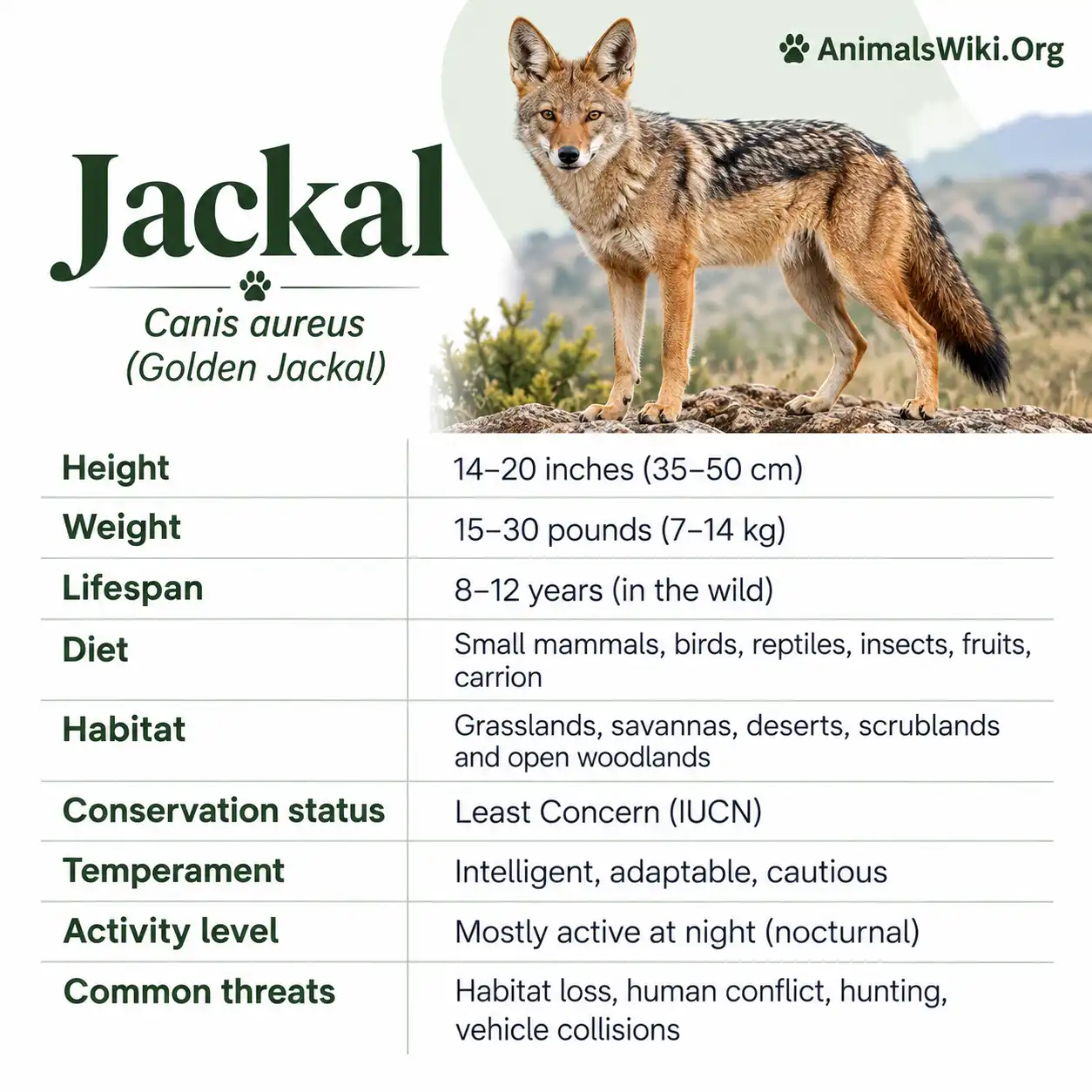
Jackal Facts
| Feature | Details |
|---|---|
| Common Name | Jackal |
| Scientific Name | Canis aureus (Golden Jackal), Lupulella mesomelas (Black-backed), Lupulella adusta (Side-striped) |
| Family | Canidae |
| Order | Carnivora |
| First Described | 1758 (Golden Jackal, by Carl Linnaeus) |
| Native Habitat | Savanna, grassland, semi-desert, scrubland, agricultural edges, urban fringe |
| Geographic Range | Africa, Southeast Europe, the Middle East, South and Central Asia |
| Average Size | 45–90 cm body length; 30–50 cm shoulder height |
| Average Weight | 6–15 kg depending on species |
| Lifespan | 8–9 years (wild); up to 16 years (captivity) |
| Diet | Omnivore — small mammals, carrion, fruit, insects, birds |
| Conservation Status | Least Concern (all three main species) |
| Defining Feature | Highly vocal, eerie chorus howls; monogamous pair bonding; opportunistic, adaptable scavenging and hunting strategy |
| Number of Species | 3 true jackal species (Golden, Black-backed, Side-striped) |
1. Jackal Species Overview & Classification
As dusk settles over the Serengeti plains and the day’s heat finally begins to lift, a sound rises from the tall grass near a termite mound — first a single, rising howl, thin and almost mournful, then a second voice joining in counterpoint, then a third, until the calls tangle together into an eerie, yipping chorus that carries for kilometers across the darkening savanna. It is a pair of black-backed jackals — a mated couple, calling together to reaffirm their bond and announce their territory to any rivals within earshot — and the sound is one of the most evocative and instantly recognizable nighttime calls of the African wilderness, a sonic backdrop to countless nature documentaries and a fixture of the savanna soundscape for as long as humans have listened to it.
The jackal is a group of medium-sized, highly adaptable wild canids found across Africa, Southeast Europe, the Middle East, and South and Central Asia — animals whose reputation, in both popular culture and much of scientific history, has long been unfairly reduced to that of a mere scavenger, a lesser cousin skulking in the shadow of lions and hyenas. In reality, the jackal is one of the most successful and behaviorally sophisticated mid-sized predators in its range: a skilled hunter in its own right, a devoted and unusually monogamous parent, a highly vocal and socially complex communicator, and — perhaps most remarkably — a species so adaptable that it has not only survived alongside some of the world’s most formidable large predators but has, in the case of the Golden Jackal, been quietly and dramatically expanding its range across Europe in recent decades, entirely under its own power.
Modern taxonomy recognizes three true jackal species, which — in one of the more significant recent developments in canid science — are now understood to be considerably less closely related to one another than their shared common name suggests. Genetic research has revealed that the Golden Jackal is, in fact, more closely related to wolves, coyotes, and domestic dogs than it is to the Black-backed and Side-striped Jackals, which instead form their own distinct evolutionary lineage — a genetic surprise that has reshaped how scientists classify and think about the jackal group as a whole.
Species Classification Table
| Classification Level | Details |
|---|---|
| Kingdom | Animalia |
| Phylum | Chordata |
| Class | Mammalia |
| Order | Carnivora |
| Family | Canidae |
| Genera | Canis (Golden Jackal); Lupulella (Black-backed, Side-striped) |
| Described By | Carl Linnaeus, 1758 (Golden Jackal) |
| Common Names | Jackal (English); Sciacallo (Italian); Chakal (Hindi/Urdu-derived root of the English word) |
The Three True Jackal Species
| Species | Scientific Name | Range | Population | Notes |
|---|---|---|---|---|
| Golden Jackal | Canis aureus | North/East Africa, Southeast Europe, Middle East, South/Central Asia | Abundant; expanding | Most widespread; genetically closer to wolves and dogs than to other jackals |
| Black-backed Jackal | Lupulella mesomelas | East and Southern Africa | Abundant | Most vocal and territorial; distinctive silver-black saddle marking |
| Side-striped Jackal | Lupulella adusta | Central, East, and Southern Africa (more forested/wetter habitats) | Stable | Least studied; quietest and most secretive of the three species |
Note: The “Simien Jackal” or “Ethiopian Wolf” (Canis simensis), despite its common historical name, is not a true jackal and is today recognized as a distinct, highly endangered canid species in its own right — one of the rarest canids in the world, confined to Ethiopia’s Afroalpine highlands.
The Name “Jackal” and Its Etymology
The English word “jackal” entered the language via French and Turkish, ultimately tracing back to the Persian word “shaghal” and further back to a Sanskrit root related to the animal — a linguistic journey reflecting the jackal’s long historical presence and cultural recognition across South Asia, the Middle East, and Europe.
Did You Know? Genetic studies published in the 2010s revealed that the Golden Jackal is more closely related to grey wolves, coyotes, and domestic dogs than to the Black-backed and Side-striped Jackals it has long been grouped with under the same common name — meaning “jackal” describes a shared ecological role and general appearance far more than it describes a single unified evolutionary lineage.
2. Jackal Physical Description & Unique Features
Jackals share a broadly similar, compact, fox-like canid body plan across all three species, adapted for a fast, energy-efficient trotting gait and the flexibility to both hunt and scavenge across open, often resource-sparse terrain.
Size and Build
Golden Jackal:
- Body length: 60–106 cm (24–42 inches), plus a tail of 20–30 cm
- Shoulder height: 38–50 cm (15–20 inches)
- Weight: 6–15 kg (13–33 lbs); the largest of the three jackal species on average
Black-backed Jackal:
- Body length: 45–90 cm
- Weight: 6–13 kg (13–29 lbs)
Side-striped Jackal:
- Body length: 55–100 cm
- Weight: 6.5–14 kg (14–31 lbs); broadly similar in size to the Black-backed Jackal but with a slightly more robust build
Sexual dimorphism: Modest across all species; males are typically only slightly larger and heavier than females, without the pronounced size differences seen in many other mammal groups covered in this guide series
Coat and Coloration — Species Identification
Each of the three jackal species has a distinctive coat pattern that serves as the primary field identification feature:
Golden Jackal: Overall tawny-golden to pale yellowish-brown coat, without strong contrasting markings; coloration can vary seasonally and regionally, sometimes appearing more greyish in winter
Black-backed Jackal: The most visually striking of the three species, featuring a distinctive black-and-silver “saddle” of grizzled black and white fur running from the shoulders to the base of the tail, sharply contrasting with the rich reddish-tan coloration of the flanks, legs, and head — a pattern so distinctive it gives the species its common name
Side-striped Jackal: Named for a faint pale stripe running along each flank, bordered by a thin dark line, visible on an otherwise greyish-brown to buff coat; the tail tip is distinctively white in this species (in contrast to the typically dark or black tail tips of the Golden and Black-backed Jackal), a useful field identification feature where ranges overlap
Ears, Legs, and General Build
- Large, erect, pointed ears — proportionally large relative to head size across all three species, providing excellent hearing used both for locating prey and for the extensive vocal communication described in the Social Behavior section
- Long, slender legs — adapted for a highly energy-efficient trotting gait that allows jackals to cover considerable daily distances while foraging or patrolling territory, rather than for explosive sprint speed
- Bushy tail — typically carried low or straight out during movement, with coloration and tip-color varying distinctly by species as described above
Dental and Sensory Adaptations
Jackals possess the generalized dental structure typical of omnivorous canids — combining sharp carnassial teeth suited to processing meat with more general-purpose molars capable of handling plant material and insects, reflecting the broad dietary flexibility described in the Diet section. Their sense of smell and hearing are particularly acute, essential tools for both locating scattered, unpredictable food resources and for detecting the presence of the larger, more dangerous predators jackals must constantly navigate around across their shared range.
3. Jackal Natural Habitat & Geographic Range
Jackals are among the most habitat-flexible mid-sized carnivores in Africa and Asia, occupying an unusually broad range of environments from open savanna to semi-desert to, increasingly, the fringes of human agricultural and urban landscapes.
Preferred Habitat Features
Open savanna and grassland — the classic and most familiar jackal habitat, particularly for the Black-backed and Golden Jackal, offering good visibility for spotting both prey and larger predators, along with abundant small mammal populations
Semi-desert and arid scrubland — Golden and Black-backed Jackals in particular show strong tolerance for hot, dry conditions, exploiting sparse vegetation zones that exclude many other mid-sized carnivores
Woodland and denser vegetation — the Side-striped Jackal shows a distinct habitat preference compared to its two relatives, favoring moister, more wooded habitats, including forest edges and riverine woodland, and generally avoiding the most open, arid savanna favored by Golden and Black-backed Jackals
Agricultural and urban fringe habitat — all three jackal species, but particularly the highly adaptable Golden Jackal, readily exploit human-modified landscapes, including farmland edges, waste sites, and the outskirts of towns and villages, drawn by concentrated and predictable food resources such as agricultural waste, livestock carcasses, and refuse
Habitat Types Occupied
| Habitat | Primary Jackal Use | Species | Key Features |
|---|---|---|---|
| Open savanna/grassland | Primary habitat | Golden, Black-backed | Good visibility; abundant small prey |
| Semi-desert/arid scrub | Primary habitat | Golden, Black-backed | Heat-tolerant; sparse vegetation |
| Woodland/riverine forest | Primary habitat | Side-striped | Denser cover; moister conditions |
| Agricultural edge | Feeding, denning | All three species | Concentrated food from crops/livestock |
| Urban/village fringe | Feeding, increasingly denning | Golden Jackal especially | Refuse and waste as food source |
Geographic Range
Current range by species:
| Region | Key Countries | Primary Species | Population Status |
|---|---|---|---|
| North/East Africa | Egypt, Ethiopia, Kenya, Tanzania | Golden Jackal | Abundant; stable |
| Southern/East Africa | South Africa, Namibia, Botswana, Kenya, Tanzania | Black-backed Jackal | Abundant; stable to increasing |
| Central/East/Southern Africa (wetter zones) | DR Congo, Zambia, Mozambique, parts of East/Southern Africa | Side-striped Jackal | Stable; least studied |
| Southeast Europe | Bulgaria, Serbia, Hungary, Italy, Austria, and expanding further | Golden Jackal | Rapidly expanding since the late 20th century |
| Middle East/South Asia | Turkey, Iran, India, Pakistan | Golden Jackal | Stable; widespread |
The Extraordinary European Expansion of the Golden Jackal
One of the most remarkable wildlife range expansions of any mid-sized carnivore in modern Europe has been the Golden Jackal’s rapid, entirely natural (non-reintroduced) spread across Central and Southeastern Europe since the latter half of the 20th century. Originally confined largely to the Balkans within Europe, Golden Jackals have since established breeding populations as far north and west as Germany, Austria, Switzerland, and even the Netherlands and Denmark — a genuine range expansion driven by a combination of factors including changing land use, reduced persecution in some areas, and the species’ inherent ecological flexibility, and one that continues to be closely monitored by European wildlife researchers as an ongoing, still-unfolding phenomenon.
4. Jackal Diet & Feeding Behavior
The jackal is one of the most dietarily flexible mid-sized carnivores in its range — a genuine omnivore whose diet shifts opportunistically according to season, location, and local resource availability, spanning active predation, scavenging, and plant-based foraging.
What Jackals Eat
Small mammals — rodents, hares, and other small mammals form a substantial part of the diet across all three species, hunted through a combination of stalking and quick pouncing pursuit
Carrion and scavenged kills — jackals are highly effective scavengers, frequently feeding on the remains of kills made by lions, hyenas, and other large predators; this scavenging role has historically dominated the jackal’s popular reputation, somewhat obscuring the species’ equally significant hunting ability
Insects — particularly important seasonally; termites, dung beetles, and other insects can form a substantial dietary component at certain times of year, particularly during termite emergence events
Birds and bird eggs — ground-nesting birds and their eggs are opportunistically taken across all three species
Fruit and vegetation — jackals regularly consume wild fruit, berries, and some plant material, particularly seasonally when available, reflecting the species’ genuinely omnivorous rather than strictly carnivorous nature
Livestock and domestic animals — jackals, particularly Black-backed Jackals in parts of Southern Africa, are documented predators of young or vulnerable livestock, particularly lambs and goat kids, a behavior that has historically driven significant human-jackal conflict discussed further in the Human Relationships section
Larger prey through cooperative hunting — mated jackal pairs and, occasionally, small family groups are capable of cooperatively hunting prey considerably larger than a single jackal could subdue alone, including young or vulnerable individuals of larger antelope species such as gazelles or impalas
Feeding Behavior Patterns
Opportunistic generalism: The single defining feature of jackal feeding ecology is extreme dietary opportunism — jackals rapidly shift their foraging effort toward whatever food source is currently most abundant or accessible, a flexibility that underlies much of the species’ broader ecological success and habitat adaptability
Cooperative pair hunting: Mated jackal pairs frequently hunt together, employing coordinated tactics — one partner may flush prey toward the other, or the pair may take turns pursuing a fleeing animal to prevent it from resting — a level of cooperative hunting sophistication that has only been well documented and appreciated by researchers in more recent decades
Kleptoparasitism and scavenging tactics: Jackals frequently attempt to steal food from other predators’ kills, sometimes working in small groups to distract or harass a larger predator such as a cheetah away from a fresh kill long enough to steal a portion of the carcass — a genuinely risky but often successful foraging tactic
Caching behavior: Jackals, like several other canid species, will cache surplus food for later consumption when resources are temporarily abundant, burying or hiding portions of a kill or scavenged carcass to retrieve at a later time
Daily Food Consumption
- Adult jackals require approximately 0.5–1 kg of food daily, a relatively modest absolute quantity reflecting both the species’ moderate body size and its metabolic efficiency
- Feeding activity is primarily nocturnal and crepuscular, concentrated around dawn, dusk, and nighttime hours, reducing exposure to both the heat of the day and the activity peaks of larger, potentially dangerous predators
5. Jackal Reproduction & Life Cycle
Jackal reproductive biology is distinguished by one of the more notable examples of genuine long-term social and sexual monogamy among wild canids, alongside a distinctive cooperative breeding system involving non-breeding “helper” offspring from previous litters.
Sexual Maturity
- Both sexes typically reach sexual maturity at approximately 11 months to 1 year of age, though actual first breeding may occur somewhat later depending on territory availability and social circumstances
Pair Bonding — A Genuinely Monogamous Canid
Jackals are notable among wild canids for forming long-term, often lifelong monogamous pair bonds:
- Mated pairs establish and defend a shared territory together, cooperating in hunting, territorial defense, and — critically — in the raising of offspring
- Pair bond duration — jackal pairs frequently remain together for multiple breeding seasons, and in many cases for the life of one partner, a pattern of sustained pair fidelity relatively uncommon among mid-sized carnivores more broadly
- Joint territorial defense — mated pairs cooperatively patrol, scent-mark, and vocally defend a shared territory against intruding jackals, reinforcing and maintaining the pair bond through this ongoing cooperative activity
Breeding Season and Denning
- Breeding season varies by region and species but is generally timed so that pups are born during a period of relatively favorable food availability
- Den sites — jackals give birth in dens, which may be dug by the pair themselves or repurposed from abandoned burrows created by other species such as aardvarks or springhares; dens typically include multiple chambers and entrances, and pairs may maintain and periodically relocate between several den sites within their territory
Gestation and Birth
- Gestation period: Approximately 60–65 days, broadly typical for a canid of this size
- Litter size: Typically 3–6 pups, occasionally larger
- Birth condition: Pups are born altricial — blind, largely helpless, and entirely dependent on parental care, consistent with typical canid reproductive biology
Pup Development and the “Helper” System
| Stage | Timing | Development |
|---|---|---|
| Birth | Day 0 | Blind, helpless; confined to the den |
| Eyes open | ~8–11 days | Vision begins to develop |
| Emergence from den | ~3 weeks | Begin exploring den entrance area |
| Weaning | 8–10 weeks | Transition to solid food, initially regurgitated by parents |
| Independent foraging begins | 3–6 months | Increasing participation in family foraging activity |
| Dispersal or “helper” role | 6 months–2 years | Some offspring disperse; others remain as non-breeding helpers |
| Sexual maturity | ~11 months–1 year | Reproductive capability begins |
Cooperative “helper” system: One of the most scientifically notable features of jackal social biology, particularly well documented in the Black-backed Jackal, is the tendency of some offspring from a previous litter to remain with their parents beyond independence, acting as non-breeding “helpers” that assist in guarding, provisioning (including regurgitating food for), and even babysitting the following season’s new litter of pups — a cooperative breeding strategy that measurably improves the survival rate of subsequent litters and represents one of the more sophisticated examples of extended family cooperation among mid-sized wild canids.
Both parents provision pups: Both the male and female of a mated pair actively participate in feeding pups, typically through regurgitation of partially digested food upon returning to the den — a pattern of substantial paternal investment relatively uncommon among carnivores broadly, and directly linked to the species’ strong pair-bonding system.
Lifespan
- Wild: Typically 8–9 years, though mortality — particularly from larger predators, disease, and human-related causes — often shortens actual lifespans in many populations
- Captivity: Up to 16 years documented, reflecting the species’ underlying physiological longevity potential when freed from the wild’s substantial mortality pressures
6. Social Behavior & Communication
Jackal social structure centers on the monogamous mated pair as the fundamental social unit, extended in some cases by the cooperative “helper” system described above, and reinforced by one of the most distinctive and extensively studied vocal communication systems of any African or Asian carnivore.
The Pair as the Core Social Unit
Unlike the large, complex pack structures of wolves or African wild dogs, or the extended clan systems of spotted hyenas, jackal social organization is centered primarily on the mated pair, occasionally extended by helper offspring as described in the Reproduction section, rather than organized into large, persistent multi-generational packs.
Territoriality
Mated jackal pairs maintain and defend a shared territory, the size of which varies considerably depending on habitat quality and local food availability — territories in food-rich areas can be relatively small and stable, while territories in more marginal or resource-sparse habitat may be considerably larger and less rigidly defended.
Territorial marking: Jackals scent-mark territorial boundaries using urine and scat deposits, often concentrated at prominent landmarks or trail junctions, communicating both territorial ownership and reproductive status to neighboring jackals.
The Famous Jackal Chorus — Vocal Communication
Jackal vocalization is among the most distinctive and evocative sounds of the African and Asian nighttime landscape, and has been the subject of considerable scientific study:
The duet howl: Mated pairs frequently engage in coordinated duet howling, in which one partner initiates a call and the other joins in close vocal succession, producing the tangled, overlapping chorus effect described in the Species Overview section; this duetting behavior is believed to reinforce the pair bond while simultaneously communicating joint territorial ownership to surrounding jackals
Contagious chorus calling: A single pair’s howl frequently triggers responsive howling from neighboring jackal pairs across the landscape, producing a chain-reaction “chorus” effect that can be heard across considerable distances on a quiet night — one of the most recognizable auditory signatures of the African savanna after dark
Alarm barks: A sharp, repeated barking call is used to signal alarm, often in response to the detection of a significant predator such as a leopard or lion, alerting both the mate and any nearby pups to potential danger
Close-range vocalizations: A range of yips, whines, and growls are used in close-range social interaction, particularly between mates and between parents and pups, facilitating coordination during cooperative activities such as hunting and pup care
Visual and Olfactory Communication
Body posture and tail position — used in dominance and submission signaling, both between mated pairs and during territorial encounters with intruding jackals
Scent marking — as described above, urine and scat marking serves as a primary long-distance communication method, particularly important given the jackal’s substantial territory size relative to its body size and its largely nocturnal activity pattern, which limits the effectiveness of purely visual communication.
7. Predators & Defense Mechanisms
Jackals occupy a genuinely precarious position in the mid-sized carnivore guild — too small to compete directly with Africa’s largest predators, yet large enough to represent a worthwhile target for several of them, resulting in a defense strategy built primarily around vigilance, speed, and avoidance rather than direct confrontation.
Natural Predators
Lions (Panthera leo) — a significant threat, particularly to jackals that linger too long around lion kills attempting to scavenge; lions will readily kill jackals encountered at close range, though jackals are not typically actively hunted as a primary prey item
Spotted Hyenas (Crocuta crocuta) — both direct competitors for scavenged food and occasional predators of jackals, particularly at contested carcass sites where jackals may be caught by a hyena during a dispute over scavenging rights
Leopards (Panthera pardus) — significant predators of jackals across much of the shared African range, capable of ambushing jackals in denser cover where the jackal’s usual predator-detection advantages in open terrain are reduced
African Wild Dogs (Lycaon pictus) — occasional predators of jackals, particularly where the two species’ ranges and prey resources overlap and direct competition arises
Eagles and large raptors — martial eagles and other large birds of prey are documented predators of jackal pups, particularly those that venture too far from den cover at a young age
Larger jackals and intraspecific conflict — territorial disputes between neighboring jackal pairs, and conflicts with jackals of other species where ranges overlap, occasionally result in serious injury or death, representing a notable source of mortality distinct from interspecific predation
Defense Strategies
Speed and agility: Jackals are fast, agile runners, capable of quickly outdistancing many potential threats over open terrain, and their long, slender legs (described in the Physical Description section) are well adapted for sustained, energy-efficient flight when needed
Vigilance and early detection: Jackals rely heavily on acute hearing and smell, described in the Physical Description section, to detect approaching danger well before a direct encounter becomes necessary, allowing early avoidance of larger predators
Group vigilance (pair and helper system): The mated pair structure, and any accompanying helper offspring, provides a degree of collective vigilance, with one member of the group able to alert others to approaching danger
Careful scavenging behavior: Jackals typically approach large predator kills cautiously, remaining alert to the presence of the kill’s original owner and other competing scavengers, and are prepared to abandon a scavenging attempt immediately if the risk becomes too great — a learned behavioral caution essential to the jackal’s substantial reliance on scavenging as a food source
Den security for pups: As described in the Reproduction section, den sites are selected and, where necessary, modified for defensibility, and parents (along with any helpers) maintain vigilant guarding behavior around the den during the vulnerable early pup-rearing period
8. Relationship with Humans
Ancient Cultural and Mythological Significance
The jackal holds an exceptionally deep and long-documented place in human cultural and religious tradition, particularly in ancient Egyptian civilization:
Ancient Egypt — Anubis: The jackal-headed god Anubis, associated with mummification, the afterlife, and the protection of graves and tombs, is among the most iconic and enduring images from ancient Egyptian religion; Egyptian associations between jackals and death and the afterlife are widely believed to stem directly from the real animal’s habit of scavenging around burial sites and cemeteries in the ancient Egyptian landscape, where jackals would have been a familiar and unavoidable presence
South Asian folklore and literature: The jackal features prominently and recurringly in traditional South Asian storytelling, notably in the ancient Indian Panchatantra fable collection, where the jackal is frequently cast as a cunning, clever trickster figure — a literary characterization echoed in numerous regional folk tales across the Indian subcontinent and one of the primary sources for the jackal’s enduring popular association with cunning and cleverness in human storytelling more broadly
Middle Eastern and biblical references — jackals are referenced numerous times in biblical and other ancient Near Eastern texts, typically in the context of desolate, abandoned places, reflecting the animal’s long-standing association with scavenging around ruins and human settlement edges throughout the region’s history
Historical and Modern Human-Jackal Conflict
Livestock predation: As described in the Diet section, jackals — particularly the Black-backed Jackal in parts of Southern Africa — are documented predators of vulnerable livestock, especially young lambs and goat kids, a pattern that has historically driven extensive lethal control programs, including trapping, poisoning, and hunting, across parts of the species’ range where sheep and goat farming is significant
Rabies vector concerns: Jackals, alongside various other wild canids, can carry and transmit rabies, and historical rabies outbreaks in some regions have prompted public health-driven population control measures targeting jackal populations, alongside broader regional rabies management efforts involving domestic dog vaccination programs
Modern coexistence and non-lethal management: In recent decades, growing recognition of the jackal’s actual ecological role (detailed in the Ecosystem Role section) and the limitations of purely lethal control approaches has driven increased interest in non-lethal livestock protection methods — including improved fencing, livestock guardian animals, and better herding practices — as more effective and sustainable long-term alternatives to widespread jackal culling
Jackals in Tourism and Wildlife Viewing
Jackals, while historically overshadowed in safari tourism by more charismatic “Big Five” species, have increasingly become a genuinely popular subject of dedicated wildlife photography and viewing in their own right, particularly for visitors drawn to the species’ engaging social behavior, distinctive vocalizations, and the opportunity to observe genuine monogamous pair bonding and cooperative pup-rearing behavior in the wild.
9. Jackal Conservation Status & Threats
IUCN Status
| Species | IUCN Status |
|---|---|
| Golden Jackal | Least Concern |
| Black-backed Jackal | Least Concern |
| Side-striped Jackal | Least Concern |
All three true jackal species are currently classified as Least Concern, with generally stable or, in the case of the Golden Jackal’s European range, actively expanding populations — a genuinely more secure conservation picture than several of the other species covered elsewhere in this guide series, though localized threats and conflicts persist across parts of the jackal’s range.
Current Threats
1. Human-Wildlife Conflict and Lethal Control
As detailed in the Human Relationships section, livestock predation — particularly by Black-backed Jackals in Southern African sheep and goat farming regions — continues to drive significant lethal control efforts, including trapping, poisoning, and hunting, in some areas; while these efforts have not threatened overall species survival given the jackal’s broad range and adaptability, they represent an ongoing, locally significant source of mortality and human-wildlife tension
2. Disease
Rabies and canine distemper virus, often transmitted through contact with domestic dogs at the human-wildlife interface, represent significant disease threats to jackal populations in some regions, occasionally causing localized population declines or complicating broader carnivore disease management efforts, particularly in areas where jackals interact closely with unvaccinated domestic dog populations
3. Habitat Fragmentation
Agricultural expansion and human settlement growth across parts of the jackal’s African and Asian range fragment habitat and can increase the frequency of human-jackal contact and associated conflict, even as the species’ overall habitat flexibility has allowed it to persist and even thrive in many human-modified landscapes where less adaptable carnivores have declined
4. Vehicle Collisions
As with many mid-sized carnivores that frequently traverse roads while foraging or dispersing, vehicle collisions represent a locally significant mortality source, particularly in areas where jackal range increasingly overlaps with expanding road infrastructure, including within the species’ newly colonized European range
5. Persecution Due to Mistaken Identity or General Antipathy
In some regions, jackals face indiscriminate persecution stemming from generalized negative cultural attitudes toward “vermin” predators, sometimes compounded by mistaken identification with other, less tolerated predator species, despite the jackal’s generally modest actual impact on livestock and game populations relative to its historical reputation.
10. Famous Jackals Around the World
Anubis — The Eternal Jackal-God of Ancient Egypt
While not an individual animal, the jackal-headed god Anubis deserves recognition as, collectively, one of the most famous and enduring jackal-associated figures in human cultural history — a deity whose imagery, rooted directly in the observed behavior of real wild jackals around ancient Egyptian burial sites, remains globally recognizable in popular culture, museum collections, and religious history study more than four thousand years after the earliest surviving depictions.
The Trickster Jackal of the Panchatantra
As referenced in the Human Relationships section, the cunning trickster jackal of India’s ancient Panchatantra fable collection represents one of the most influential recurring animal characters in world literature, having shaped storytelling traditions across South Asia and, through subsequent translation and adaptation, influencing fable traditions considerably beyond the Indian subcontinent over the many centuries since the collection’s original composition.
The Pioneering Jackals of Germany and the Netherlands
While not individually named, the first documented Golden Jackal individuals to establish breeding territories in newly colonized parts of Central and Western Europe — including landmark first confirmed sightings and breeding records in countries such as Germany, the Netherlands, and Denmark over the past two decades — have collectively achieved a notable degree of attention within European wildlife research and conservation media, each new national “first record” treated as a significant milestone in the species’ ongoing, closely tracked natural range expansion.
11. Role in Ecosystem & Food Chain
The Jackal as Nature’s Cleanup Crew
Jackals play a genuinely significant ecological sanitation role across their range through extensive scavenging behavior:
- Carcass processing — by consuming carrion left by larger predators or from natural mortality, jackals contribute to the rapid breakdown and recycling of dead animal matter across savanna and grassland ecosystems, reducing disease transmission risk associated with decomposing carcasses and returning nutrients to the ecosystem more efficiently
- Competition and coexistence with other scavengers — jackals interact regularly, and sometimes competitively, with vultures, hyenas, and other scavenging species at shared carcass sites, forming part of a broader, interconnected scavenger guild whose collective activity is essential to efficient ecosystem-level carcass processing across the African savanna in particular
Population Control of Small Mammals
Through their significant predation on rodents and other small mammals, described in the Diet section, jackals contribute meaningfully to the regulation of small mammal populations across their range — a top-down ecological control function that, in the jackal’s absence, could allow rodent populations to expand unchecked, with potential downstream effects on vegetation and agricultural systems.
Jackals as Prey — Supporting the Broader Predator Guild
As detailed in the Predators section, jackals themselves form a meaningful, if secondary, prey resource for lions, leopards, and large raptors across their shared range, representing an intermediate trophic link between smaller prey species and Africa’s largest apex predators within the broader savanna food web.
Seed Dispersal
Through their consumption of wild fruit, described in the Diet section, jackals contribute to the dispersal of seeds from various fruiting plant species across their home range, a modest but genuine ecological service paralleling the seed-dispersal roles played by numerous other omnivorous species covered elsewhere in this guide series.
12. Jackal Discovery & Evolution Timeline
~4–6 million years ago — Early canid lineages diversify across Africa and Eurasia, eventually giving rise to the distinct evolutionary lines leading to modern jackals, wolves, and other canid species.
~1.5–2 million years ago — Genetic evidence suggests the divergence of the Lupulella lineage (Black-backed and Side-striped Jackals) from the broader Canis lineage that includes the Golden Jackal, wolves, coyotes, and domestic dogs — establishing the significant evolutionary separation between the two jackal groupings later confirmed through modern genetic study.
Ancient Egypt (c. 4000+ years ago) — The jackal-headed god Anubis becomes firmly established in Egyptian religious tradition, one of the earliest and most enduring documented human cultural relationships with the species.
Ancient India (composition period disputed, broadly ~200 BCE–300 CE) — The Panchatantra fable collection is composed, establishing the jackal’s enduring trickster archetype within South Asian and, eventually, global literary tradition through subsequent translation.
1758 — Carl Linnaeus formally describes the Golden Jackal (Canis aureus) in the 10th edition of Systema Naturae, establishing the species’ modern scientific classification.
19th–early 20th century — European colonial-era naturalists and hunters document jackal distribution and behavior across Africa and Asia in greater zoological detail, alongside widespread persecution efforts linked to perceived livestock predation risk.
Mid-20th century — Jackals across much of Africa and Asia face sustained and, in some regions, aggressive lethal control programs driven by livestock protection concerns, though populations remain broadly stable given the species’ wide range and habitat flexibility.
Late 20th century — The Golden Jackal’s natural range expansion into Central Europe begins in earnest, with the species progressively establishing breeding populations in the Balkans and gradually extending further north and west.
1990s–2000s — Field research increasingly documents and confirms the sophisticated cooperative breeding and monogamous pair-bonding behavior of the Black-backed Jackal, substantially revising earlier, more simplistic scientific characterizations of jackal social structure.
2010s — Landmark genetic research clarifies that the Golden Jackal is more closely related to wolves, coyotes, and domestic dogs than to the Black-backed and Side-striped Jackals, prompting the taxonomic reclassification of the latter two species into the separate genus Lupulella.
2015–2020 — Golden Jackals establish confirmed breeding populations in Germany, the Netherlands, Denmark, and other Central and Western European countries well beyond the species’ historical European range, an ongoing expansion closely tracked by European wildlife monitoring programs.
2022–2026 — Continued monitoring of the Golden Jackal’s European range expansion, alongside ongoing human-wildlife conflict management efforts targeting Black-backed Jackal livestock predation in Southern Africa, and increasing scientific and conservation interest in the previously understudied Side-striped Jackal.
13. Jackal Comparison with Similar Species
| Feature | Jackal (Canis/Lupulella spp.) | Coyote (Canis latrans) | Red Fox (Vulpes vulpes) | African Wild Dog (Lycaon pictus) |
|---|---|---|---|---|
| Family | Canidae | Canidae | Canidae | Canidae |
| Body length | 45–106 cm | 75–100 cm | 45–90 cm | 75–110 cm |
| Weight | 6–15 kg | 7–21 kg | 3.6–6.8 kg | 18–36 kg |
| Range | Africa, SE Europe, Middle East, S/C Asia | North/Central America | Northern Hemisphere (widest range of any wild canid) | Sub-Saharan Africa |
| Social structure | Monogamous pairs + occasional helpers | Variable; pairs to loose packs | Largely solitary/small family groups | Large, highly cooperative packs |
| Diet | Omnivore; hunting + scavenging | Omnivore; hunting + scavenging | Omnivore; opportunistic | Obligate cooperative hunter (carnivore) |
| Vocal signature | Duetting chorus howls | Yipping howls | Sharp barks/screams | Twittering/hooting calls |
| Conservation | Least Concern (all 3 species) | Least Concern | Least Concern | Endangered |
| Closest relative in this guide | Coyote (Golden Jackal specifically) | Golden Jackal | Other fox species | Other pack-hunting canids |
14. Best Places to See Jackals in the Wild
East Africa
- 🇰🇪 Maasai Mara National Reserve, Kenya — reliable Black-backed and Golden Jackal sightings, particularly around dawn and dusk, and frequently observed near larger predator kills during scavenging opportunities
- 🇹🇿 Serengeti National Park, Tanzania — excellent sightings of both Golden and Black-backed Jackals across open plains habitat, including good opportunities to observe cooperative pair hunting behavior
Southern Africa
- 🇿🇦 Kruger National Park, South Africa — strong Black-backed Jackal population, frequently observed at dawn and dusk along road networks and near known predator kill sites
- 🇳🇦 Etosha National Park, Namibia — excellent Black-backed Jackal viewing, particularly around waterholes during the dry season, when jackals congregate alongside other wildlife
- 🇧🇼 Central Kalahari Game Reserve, Botswana — good sightings of Black-backed Jackal in classic semi-arid habitat
Central/Southern Africa (Side-striped Jackal)
- 🇿🇲 South Luangwa National Park, Zambia — one of the more reliable locations for observing the less commonly seen Side-striped Jackal in its preferred woodland habitat
Europe (Golden Jackal Range Expansion)
- 🇧🇬 Eastern Rhodope Mountains, Bulgaria — one of the strongholds of the well-established Balkan Golden Jackal population, with organized wildlife-watching tours available
- 🇭🇺 Various rural regions, Hungary — supports one of the largest and most stable Golden Jackal populations in Central Europe, reflecting the species’ successful northward range expansion
Middle East/South Asia
- 🇮🇳 Various national parks and rural agricultural regions, India — Golden Jackals remain widespread and relatively easily observed across much of rural India, particularly around dawn and dusk near agricultural land
15. Fun Facts About Jackals
- 🐺 The Golden Jackal is genetically more closely related to wolves, coyotes, and domestic dogs than to the Black-backed and Side-striped Jackals it shares its common name with
- 🐺 Jackals form genuinely monogamous, often lifelong pair bonds — a relatively uncommon trait among mid-sized wild carnivores
- 🐺 Some jackal offspring remain with their parents as non-breeding “helpers,” assisting in raising the following season’s pups — a sophisticated cooperative breeding strategy
- 🐺 Mated jackal pairs perform coordinated duet howls, which frequently trigger a spreading “chorus” of howling from neighboring pairs across the landscape
- 🐺 The jackal-headed Egyptian god Anubis, associated with death and mummification, is believed to be directly inspired by real jackals’ historical scavenging behavior around ancient burial grounds
- 🐺 The Golden Jackal has been rapidly and naturally expanding across Europe in recent decades, now breeding as far north and west as Germany, the Netherlands, and Denmark
- 🐺 Jackals are capable of cooperative hunting, with mated pairs sometimes successfully taking prey considerably larger than either individual could subdue alone
- 🐺 The so-called “Ethiopian Wolf,” sometimes historically called the “Simien Jackal,” is not actually a true jackal at all, but a distinct and highly endangered canid species
- 🐺 Jackals feature prominently as cunning trickster characters in ancient Indian fable traditions, including the Panchatantra
- 🐺 A jackal pair will sometimes work together to distract a larger predator, such as a cheetah, away from a fresh kill long enough to steal a portion of the meat
- 🐺 Despite a long-standing popular reputation as “mere scavengers,” jackals are accomplished active hunters in their own right, taking substantial numbers of live rodents, birds, and other small prey
- 🐺 All three true jackal species are currently classified as Least Concern, a notably more secure conservation status than many other carnivores covered in this guide series
16. Frequently Asked Questions About Jackals
Q1: Are jackals and wolves related?
It’s complicated. The Golden Jackal (Canis aureus) is genetically quite closely related to grey wolves, coyotes, and domestic dogs — all members of the genus Canis — closely enough that genetic research has revealed it shares more recent common ancestry with wolves than with the other two “jackal” species. The Black-backed and Side-striped Jackals, however, belong to a separate genus, Lupulella, and represent a considerably older, more distinct evolutionary lineage — meaning “jackal” is really a name describing a shared ecological role and general appearance across two genetically distinct canid lineages, rather than a single, unified family tree.
Q2: Do jackals mate for life?
Yes, generally — jackals are notable among mid-sized wild carnivores for forming genuinely long-term, often lifelong monogamous pair bonds. Mated pairs cooperate closely in hunting, territorial defense, and raising pups, and pairs frequently remain together across multiple breeding seasons, often for the life of one partner. This strong pair-bonding system is reinforced by cooperative behaviors including joint territorial patrol, shared pup provisioning, and the distinctive duet howling described in the Social Behavior section.
Q3: Why do jackals howl together at night?
Mated jackal pairs frequently perform coordinated duet howls, in which one partner begins calling and the other joins in close succession, producing an overlapping, tangled chorus effect. This duetting is believed to serve two main functions: reinforcing the pair bond between mates, and jointly communicating territorial ownership to neighboring jackal pairs. A single pair’s howling frequently triggers a spreading chain-reaction of responsive howls from neighboring pairs across the landscape, producing the extended nighttime “chorus” effect widely recognized as one of the classic sounds of the African savanna after dark.
Q4: Are jackals just scavengers, or do they actually hunt?
Jackals are genuinely skilled active hunters, not merely scavengers, despite a long-standing and somewhat unfair popular reputation centered mainly on their scavenging behavior. Jackals regularly hunt rodents, hares, birds, and insects, and mated pairs are capable of cooperative hunting tactics that allow them to successfully take prey considerably larger than a single jackal could subdue alone, including young or vulnerable individuals of larger antelope species. Scavenging from lion, leopard, and hyena kills is simply one component — an important one, but far from the whole picture — of the jackal’s broader, highly flexible omnivorous foraging strategy.
Q5: Is the Golden Jackal really expanding its range into new parts of Europe?
Yes — this is one of the most well-documented mid-sized carnivore range expansions in modern Europe. Since the latter half of the 20th century, Golden Jackals have progressively expanded their European range far beyond their traditional Balkan stronghold, establishing confirmed breeding populations as far north and west as Germany, Austria, Switzerland, the Netherlands, and Denmark. This expansion has occurred entirely under the species’ own natural dispersal ability, without deliberate reintroduction efforts, and continues to be closely tracked by European wildlife monitoring programs as an ongoing, still-unfolding ecological phenomenon.
Q6: What is the “helper” system in jackal families?
In some jackal populations, particularly well documented in the Black-backed Jackal, offspring from a previous litter sometimes remain with their parents beyond the point of full independence, acting as non-breeding “helpers.” These helpers assist the breeding pair by guarding, provisioning (including regurgitating food for), and even babysitting the following season’s new litter of pups. This cooperative breeding strategy has been shown to measurably improve the survival rate of subsequent litters, representing a genuinely sophisticated example of extended-family cooperation among mid-sized wild canids.
Q7: Are jackals dangerous to livestock and humans?
Jackals, particularly the Black-backed Jackal in parts of Southern Africa, are documented predators of vulnerable livestock, especially young lambs and goat kids, and this predation has historically driven significant lethal control efforts in some sheep and goat farming regions. However, jackals pose essentially no direct predatory threat to adult humans under normal circumstances. The more significant human health consideration is the jackal’s potential role, alongside domestic dogs, as a carrier of rabies in some regions — a disease risk best managed through coordinated wildlife and domestic dog vaccination programs rather than broad, indiscriminate jackal population control.
Q8: What is the difference between the three true jackal species?
The Golden Jackal (Canis aureus) has an overall tawny-golden coat without strong contrasting markings and the widest overall range, spanning Africa, Southeast Europe, the Middle East, and South/Central Asia. The Black-backed Jackal (Lupulella mesomelas) is the most visually distinctive, featuring a sharply contrasting black-and-silver “saddle” pattern across its back, and is largely confined to East and Southern Africa. The Side-striped Jackal (Lupulella adusta) has a faint pale flank stripe and a distinctive white-tipped tail, favors moister, more wooded habitat than its two relatives, and is the least studied and most secretive of the three species, found across parts of Central, East, and Southern Africa.