
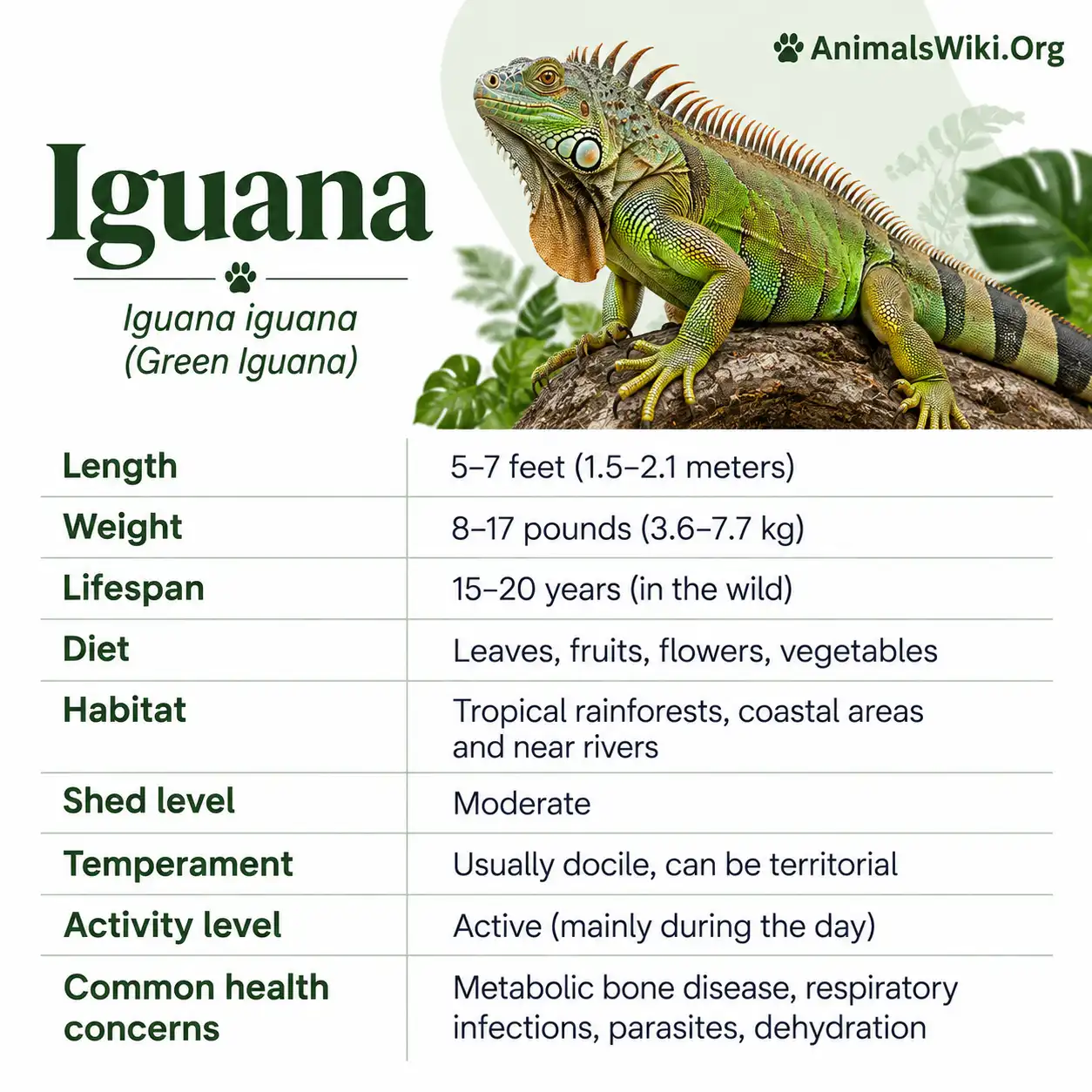
Iguana Facts
| Feature | Details |
|---|---|
| Common Name | Iguana |
| Scientific Name | Genus Iguana (2 species); broader family Iguanidae includes many relatives |
| Family | Iguanidae |
| Order | Squamata |
| First Described | 1758 (Green Iguana, by Carl Linnaeus) |
| Native Habitat | Tropical rainforest canopy, mangroves, coastal scrub, riverbanks, arid scrubland (Lesser Antilles) |
| Geographic Range | Mexico, Central America, South America, Caribbean; introduced populations in Florida and elsewhere |
| Average Size | 1.2–1.8 m total length (up to 2 m in large males); tail comprises over half of total length |
| Average Weight | 4–8 kg (large males can exceed 9 kg) |
| Lifespan | 8–12 years (wild); 15–20 years (captivity, with good care) |
| Diet | Primarily herbivore — leaves, flowers, fruit (occasional opportunistic animal matter in youth) |
| Conservation Status | Least Concern (Green Iguana) to Critically Endangered (several island species) |
| Defining Feature | Dorsal spines running neck-to-tail; large dewlap (throat flap); third “parietal eye” on top of head; whip-like tail used defensively |
| Number of Species | 2 in genus Iguana (Green Iguana, Lesser Antillean Iguana); dozens more in the broader Iguanidae family worldwide |
1. Iguana Species Overview & Classification
High in the emergent canopy of a Costa Rican rainforest, where the midday sun finally breaks through the upper leaves in scattered gold coins of light, a large green shape lies motionless along a horizontal branch — so still, so perfectly the color of the surrounding foliage, that it might be mistaken for a trick of the light rather than a living animal. Then, unhurried, a ridge of soft spines along its back catches the sun, a leathery fold of skin beneath its chin trembles slightly in the breeze, and one ancient, reptilian eye rotates slowly to track a passing bird. It is a Green Iguana — one of the largest and most recognizable lizards in the Western Hemisphere, sunbathing forty meters above the forest floor with the unbothered patience of an animal that has occupied this ecological niche for tens of millions of years.
The iguana is a genus of large, herbivorous, tree-dwelling lizards native to the tropical forests, coastlines, and scrublands of Mexico, Central America, South America, and the Caribbean — animals whose dragon-like silhouette, spiked dorsal crest, and impressive size have made them one of the most instantly recognizable reptiles on Earth. Though the name “iguana” is popularly used to describe an enormous variety of lizards across the broader family Iguanidae — including marine iguanas, desert iguanas, spiny-tailed iguanas, and rock iguanas — the genus Iguana itself contains only two true species: the widespread and highly adaptable Green Iguana (Iguana iguana) and the far rarer, more range-restricted Lesser Antillean Iguana (Iguana delicatissima).
Far more than a reptilian curiosity or a familiar fixture of the exotic pet trade, the iguana is a genuinely important ecosystem engineer of the Neotropics — one of the largest herbivorous animals in many of the forest and coastal ecosystems it inhabits, a critical seed disperser for numerous tropical plant species, and, in several of its island-endemic relatives, among the most acutely endangered vertebrates on the planet. The iguana’s story spans deep evolutionary history, extraordinary anatomical specialization for an arboreal, herbivorous lifestyle, a complicated and sometimes troubling relationship with the international pet trade, and one of the more dramatic modern conservation turnarounds of any reptile group.
Species Classification Table
| Classification Level | Details |
|---|---|
| Kingdom | Animalia |
| Phylum | Chordata |
| Class | Reptilia |
| Order | Squamata |
| Family | Iguanidae |
| Genus | Iguana |
| Described By | Carl Linnaeus, 1758 (Green Iguana) |
| Common Names | Iguana (English/Spanish); Garrobo, Gallina de Palo (“tree chicken,” regional Latin American names) |
The Two True Iguana Species (and Notable Relatives)
| Species | Scientific Name | Range | Population | Notes |
|---|---|---|---|---|
| Green Iguana | Iguana iguana | Mexico to Brazil/Paraguay; Caribbean; introduced Florida, Puerto Rico, others | Abundant; millions | Most widespread and commonly kept iguana species |
| Lesser Antillean Iguana | Iguana delicatissima | Lesser Antilles (Dominica, Martinique, a few smaller islands) | Fewer than 10,000 | Critically Endangered; threatened by hybridization with invasive Green Iguanas |
| Notable Relatives (Broader Iguanidae Family) | Scientific Name | Range | Notes |
|---|---|---|---|
| Marine Iguana | Amblyrhynchus cristatus | Galápagos Islands | Only sea-foraging lizard on Earth |
| Desert Iguana | Dipsosaurus dorsalis | Southwestern US, Mexico | Highly heat-tolerant |
| Rhinoceros Iguana | Cyclura cornuta | Hispaniola | Rock iguana relative; Vulnerable |
| Blue Iguana | Cyclura lewisi | Grand Cayman | Rock iguana; recovered from ~25 individuals |
| Fiji Banded Iguana | Brachylophus fasciatus | Fiji, Tonga | Only iguanas native outside the Americas |
The Name “Iguana”
The word “iguana” derives from the Taíno word “iwana”, the name used by the Indigenous Taíno people of the Caribbean for the animal well before European contact — one of relatively few common English animal names to derive directly from an Indigenous Caribbean language, a linguistic legacy of the Taíno’s long coexistence with, and traditional use of, these large lizards prior to Spanish colonization.
Did You Know? Iguanas possess a genuine “third eye” — a light-sensitive structure called the parietal eye, visible as a small pale scale on top of the head. It cannot form images but can detect changes in light and shadow, helping the iguana sense the approach of aerial predators from directly above, even while its two main eyes are focused elsewhere.
2. Iguana Physical Description & Unique Features
The iguana’s body is built for a highly specific lifestyle — arboreal, herbivorous, heat-dependent, and equipped with a formidable defensive toolkit despite its generally docile, sun-loving temperament.
Size and Build
Green Iguana (the dominant species by far):
- Total length: 1.2–1.8 m (4–6 feet), with exceptional large males reaching 2 m (6.5 feet)
- Tail proportion: The tail makes up over half of total body length — a critical detail when comparing size figures, since body-only length is considerably shorter
- Weight: 4–8 kg (9–18 lbs); large mature males can exceed 9 kg (20 lbs)
Lesser Antillean Iguana:
- Total length: Slightly smaller than the Green Iguana on average, typically 1–1.5 m
- Coloration: Generally more uniformly grey-green with less banding than the Green Iguana, an important field identification feature given ongoing hybridization concerns detailed in the Conservation section
Sexual dimorphism: Males are typically larger and more robustly built than females, with noticeably larger dewlaps (throat flaps) and more prominent dorsal spines, particularly during the breeding season
The Dorsal Crest and Dewlap — Signature Features
Dorsal spines: A row of soft, flexible spines runs along the iguana’s neck, back, and partway down the tail — largest and most prominent near the neck and shoulders, tapering toward the tail; despite their formidable appearance, these spines are composed of soft keratin rather than bone and are more flexible than they appear
The dewlap: A large, flexible flap of skin beneath the chin and throat, which the iguana can extend using a specialized hyoid bone:
- Thermoregulation function — the extended dewlap increases surface area for heat absorption or dissipation
- Communication function — dewlap extension is a key visual signal in territorial displays, courtship, and general social communication, described further in the Social Behavior section
- Size difference by sex — males typically possess a considerably larger, more prominent dewlap than females, making it one of the most reliable field indicators of sex
The Parietal Eye — A Genuine Third Eye
As introduced in the Species Overview section, iguanas possess a parietal eye (also called the “third eye” or “pineal eye”) — a small, light-sensitive organ located on top of the head, visible as a pale, translucent scale:
- Unlike the two main eyes, the parietal eye cannot form images, but it can detect changes in light intensity and shadow
- Its primary function is believed to be predator detection from above — alerting the iguana to the shadow of an approaching aerial predator such as a hawk — as well as playing a role in regulating the animal’s exposure to sunlight and associated hormonal cycles
Coloration and Camouflage
Green Iguana coloration: Predominantly bright to olive green in juveniles and many adults, providing effective camouflage against rainforest foliage; coloration can vary regionally and with age, with some populations and individuals displaying orange, reddish, or even blueish tones, particularly in adult males during breeding season
Color change capability: Iguanas can shift shade somewhat in response to temperature and mood, darkening to absorb more heat when cool, and displaying brighter or more saturated coloration during territorial and courtship displays
Banding pattern: Both true Iguana species display dark banding along the tail, though the pattern and prominence differ somewhat between species and is a key feature used by researchers distinguishing Green Iguanas from the rarer Lesser Antillean Iguana in areas where the two overlap
The Whip-Like Tail
The iguana’s long, muscular tail — making up more than half its total body length — serves multiple important functions:
- Defensive weapon — capable of delivering a powerful, whip-like lash used to fend off predators or threats, discussed further in the Predators section
- Balance — critical for stability while moving through the branches of the forest canopy
- Swimming propulsion — iguanas are strong swimmers, using powerful lateral tail movements to propel themselves through water
- Autotomy (tail loss) — like many lizards, iguanas can voluntarily detach a portion of the tail when seized by a predator, an emergency escape mechanism; the tail can partially regrow, though the regrown section typically differs somewhat in coloration and scale pattern from the original
Claws and Limbs
Iguanas possess long, sharp claws adapted for climbing — an essential feature given their predominantly arboreal lifestyle high in the forest canopy, as well as for digging nest burrows during the breeding season, described in the Reproduction section.
3. Iguana Natural Habitat & Geographic Range
The Green Iguana is one of the most habitat-adaptable large lizards in the Americas, occupying a broad range of tropical and subtropical environments, while its rarer relative the Lesser Antillean Iguana occupies a far narrower and more precarious island range.
Preferred Habitat Features
Tropical and subtropical forest canopy — the core Green Iguana habitat; iguanas spend the great majority of their time in trees, often at considerable height, descending to the ground primarily for nesting, mating displays, and occasional foraging
Proximity to water — iguanas are strongly associated with rivers, streams, mangroves, and coastal areas, both because of their strong swimming ability (used as an escape route from predators, described in the Predators section) and because riparian vegetation offers abundant, high-quality browse
Sunny, thermally favorable microhabitats — as ectothermic (cold-blooded) reptiles, iguanas require regular access to direct sunlight for thermoregulation, and habitat selection is strongly influenced by the availability of sunlit basking sites within or at the edge of forest canopy
Sandy or loose soil for nesting — female iguanas require accessible sandy or loose-soil areas, often along riverbanks, beaches, or open ground, for digging the nest burrows described in the Reproduction section
Habitat Types Occupied
| Habitat | Primary Iguana Use | Species | Key Features |
|---|---|---|---|
| Tropical rainforest canopy | Primary year-round habitat | Green Iguana | High basking sites; abundant leaf browse |
| Mangrove forest | Feeding, shelter | Green Iguana | Coastal; strong swimming advantage |
| Riverine forest | Feeding, nesting | Green Iguana | Sandy nesting banks; water escape route |
| Dry tropical forest/scrubland | Year-round habitat | Lesser Antillean Iguana | Island-specific; more arid conditions |
| Coastal scrub and beach | Nesting | Both species | Loose sandy soil for egg-laying |
| Urban and suburban green space | Feeding, basking (introduced populations) | Green Iguana | Highly adaptable to human-modified landscapes |
Geographic Range
Current range by species:
| Region | Key Countries/Areas | Primary Species | Population Status |
|---|---|---|---|
| Mexico and Central America | Mexico through Panama | Green Iguana | Abundant; native range core |
| South America | Colombia to Brazil, Paraguay, Bolivia | Green Iguana | Abundant; extensive native range |
| Greater Caribbean (native) | Various islands | Green Iguana (native subpopulations) | Variable |
| Lesser Antilles | Dominica, Martinique, a few smaller islands | Lesser Antillean Iguana | Critically Endangered; fewer than 10,000 remaining |
| Introduced/invasive range | Florida (USA), Puerto Rico, Texas, various Pacific and Caribbean islands | Green Iguana | Rapidly expanding; considered invasive in most introduced areas |
The Florida Invasion — A Modern Case Study
The Green Iguana has become one of the most visible and widely discussed invasive reptile species in the southeastern United States, particularly in Florida, where escaped and released pet iguanas have established large, self-sustaining wild populations since the 1960s–1970s. Florida’s mild winters (outside of periodic cold snaps) and abundant ornamental vegetation have allowed iguana numbers to grow substantially, to the point that Florida wildlife authorities now actively encourage humane removal of iguanas from private property, given the species’ documented impacts on native vegetation, seawalls, and infrastructure (burrowing) in the region, discussed further in the Conservation and Human Relationships sections.
4. Iguana Diet & Feeding Behavior
The iguana is overwhelmingly herbivorous as an adult — one of relatively few large lizard species to rely so heavily on plant material — though juveniles show somewhat more dietary flexibility.
What Iguanas Eat
Leaves — the dietary foundation for adult iguanas; a wide range of tropical tree and vine leaves are consumed, selected partly based on availability and partly on specific nutritional and toxin-avoidance considerations
Flowers — consumed both for nutritional content and, incidentally, contributing to the iguana’s role in pollen transport, discussed in the Ecosystem Role section
Fruit — an important dietary component, particularly when seasonally abundant; iguanas play a significant role in seed dispersal for numerous tropical fruiting plant species as a result
Shoots and buds — new plant growth is often preferentially targeted for its higher nutritional density and lower concentration of mature-leaf plant defense compounds
Occasional animal matter in juveniles: Young iguanas, particularly in their first year, have been documented consuming insects and other small invertebrates at a notably higher rate than adults — a pattern believed to reflect the higher protein demands of rapid juvenile growth; as iguanas mature, the diet shifts almost entirely to plant material, and adult iguanas rarely consume animal protein under natural conditions
Digestive Adaptations for Herbivory
Processing a bulky, fiber-rich plant diet as a lizard (rather than as a mammal with more specialized multi-chambered digestive systems) requires significant adaptation:
- Hindgut fermentation — iguanas rely on a large, specialized hindgut chamber containing symbiotic bacteria that ferment and break down plant cellulose, similar in basic principle to the digestive strategy used by many large herbivorous mammals
- Basking-dependent digestion — because digestion (like all metabolic processes in an ectothermic reptile) depends heavily on body temperature, iguanas must bask extensively after feeding to raise body temperature sufficiently for effective digestion of their fibrous plant diet; an iguana that cannot access adequate basking opportunity may struggle to properly digest food regardless of quantity consumed
- Salt gland excretion — iguanas possess a specialized nasal salt gland that allows excretion of excess salt and potassium obtained from their plant diet through sneezing, a distinctive behavior often observed in both wild and captive iguanas
Feeding Behavior Patterns
Diurnal feeding: Iguanas are strictly diurnal (active during daylight hours), feeding primarily during the warmer parts of the day when body temperature is sufficiently elevated for active foraging and digestion
Canopy foraging: Much feeding occurs directly within the tree canopy, with iguanas moving carefully along branches to access leaves, flowers, and fruit, minimizing the need to descend to the more predator-exposed forest floor
Selective feeding: Iguanas show measurable dietary selectivity, favoring certain plant species and plant parts over others based on palatability, nutritional content, and toxin concentration — behavior that has been studied in some detail given the species’ significant impact on ornamental and native vegetation in areas where introduced populations have become established
Daily Food Consumption and Water
- Adult iguanas consume plant material equivalent to a substantial percentage of body weight relative to many reptiles, reflecting the lower caloric density of a leaf-based diet compared to animal protein
- Much of an iguana’s water requirement is obtained directly from the moisture content of its plant diet, supplemented by direct drinking, particularly in captivity or during dry seasons
5. Iguana Reproduction & Life Cycle
Iguana reproduction centers on seasonal breeding, dramatic male territorial and courtship displays, and a nesting strategy built around excavated burrows rather than the mound-nest or crèche systems seen in some other species covered in this guide series.
Sexual Maturity
- Females: Typically reach sexual maturity at 2–4 years of age, depending on growth rate, body condition, and regional population
- Males: Similarly reach maturity around 2–4 years, though larger body size and social dominance — critical for actual breeding success — generally continue developing for several additional years beyond baseline sexual maturity
Courtship and Male Territorial Display
Breeding season in most Green Iguana populations occurs during the dry season, with considerable regional variation depending on latitude and local climate:
Male territorial displays: Dominant males establish and defend breeding territories, using a combination of visual displays to advertise status and deter rival males:
- Head-bobbing — rhythmic up-and-down head movements, one of the most characteristic and frequently observed iguana behaviors, used in both territorial and courtship contexts
- Dewlap extension — the extended throat dewlap, described in the Physical Description section, is prominently displayed during territorial and courtship encounters, its size and coloration signaling the male’s condition and status
- Body coloration changes — many male iguanas develop brighter, more saturated coloration (often orange or reddish tones) during the breeding season, a visible signal of reproductive readiness and status
Male combat: When head-bobbing and dewlap displays fail to establish clear dominance, direct physical confrontation between rival males can occur, including biting and shoving, though serious injury is relatively uncommon compared to some other reptile species’ breeding combat
Nesting
Female iguanas exhibit one of the more labor-intensive nesting strategies among lizards:
- Nest site selection: Females seek out sandy or loose-soil areas, often along riverbanks or in open, sunlit ground, sometimes traveling considerable distances from their usual canopy home range specifically to reach suitable nesting substrate
- Burrow excavation: Using their claws, females dig a nesting burrow that can extend over a meter into the substrate — a significant excavation effort for the animal’s size
- Communal nesting sites: In some populations, multiple females use the same suitable nesting area, sometimes resulting in dense concentrations of nest burrows in a limited area of appropriate sandy soil
- Nest guarding: Some evidence suggests female iguanas may remain near the nest site for a period after egg-laying, offering a degree of nest-guarding behavior unusual among lizards more broadly, though the extent and consistency of this behavior varies by population and is an area of ongoing herpetological study
Eggs and Incubation
- Clutch size: Typically 20–70 eggs per clutch — a remarkably large clutch size, reflecting significant egg and hatchling mortality in the wild
- Incubation period: Approximately 90–120 days (3–4 months), with no parental care during incubation beyond the initial nest site selection and construction
- Temperature-dependent factors: As with many reptiles, incubation temperature can influence hatchling development, though the specific extent of temperature-dependent sex determination in iguanas is less pronounced or well-documented than in some other reptile groups, such as certain turtles and crocodilians
Hatchling Development
| Stage | Timing | Development |
|---|---|---|
| Hatching | Day 0 | Fully independent; ~20–25 cm; no parental care |
| Early juvenile period | Months 1–12 | Higher dietary reliance on insects/invertebrates alongside plant material |
| Juvenile growth | Years 1–2 | Rapid growth; increasingly herbivorous diet |
| Sub-adult | Years 2–4 | Approaching full size; developing sexual characteristics |
| Sexual maturity | 2–4 years | Reproductive capability begins |
| Full adult size/coloration | 4+ years | Continued growth in males particularly |
No parental care after hatching: Unlike many of the mammals and birds covered elsewhere in this guide series, iguana hatchlings receive no parental care or protection whatsoever after emerging from the nest — they are fully independent from the moment of hatching, immediately dispersing to find their own shelter and food, and facing very significant predation pressure during this vulnerable early period.
Lifespan
- Wild: Typically 8–12 years, substantially shortened in many populations by significant predation pressure and, increasingly, human-related mortality
- Captivity: With appropriate care, pet iguanas can live 15–20 years, and well-documented individuals have occasionally exceeded this range
6. Social Behavior & Communication
Iguana social structure centers on territoriality and dominance hierarchies, particularly among males, with a degree of tolerance for aggregation around shared basking or feeding resources outside of active territorial disputes.
Territoriality Among Males
Adult male iguanas establish and defend territories, particularly during the breeding season:
- Territory size and quality — larger, more dominant males typically control the most desirable territories, including prime basking sites and access to receptive females
- Territorial marking — iguanas possess femoral pores (specialized glands located along the inner thigh) that secrete waxy substances used for scent-marking territory and communicating individual identity and status to other iguanas
- Hierarchical tolerance — outside of direct territorial disputes, iguana populations often show a degree of established, relatively stable dominance hierarchy, reducing the frequency of escalated physical conflict among familiar individuals within a shared area
Aggregation and Basking Groups
Despite their generally territorial nature, iguanas frequently tolerate loose aggregation at high-quality shared resources, particularly favored basking sites, where multiple individuals — including individuals that might otherwise maintain territorial distance — can be observed sharing sun-exposed branches or rocks, a pattern of practical resource-based tolerance overriding strict territorial exclusivity.
Communication — A Multi-Modal System
Visual signals:
- Head-bobbing — the most characteristic and frequently observed iguana communication behavior, used in territorial assertion, courtship, and general social signaling; the specific rhythm and intensity of head-bobbing can convey different social messages
- Dewlap extension — a key visual signal of status, sex, and reproductive condition, described in detail in the Physical Description and Reproduction sections
- Body posture — including lateral (side-on) body compression and presentation, a display used to visually maximize apparent body size when confronting a rival or potential threat
- Coloration shifts — seasonal and situational color changes, particularly in males, function as an additional visual communication channel
Chemical signals:
- Femoral gland secretions — the primary chemical communication method, used for territorial marking and individual identification, as described above
Physical/tactile signals:
- Head and body contact during dominance encounters — direct physical interaction, including pushing and shoving, is used to establish and reinforce dominance relationships between males, particularly when visual displays alone fail to resolve a dispute
Limited vocalization: Unlike many of the birds and mammals covered elsewhere in this guide series, iguanas are relatively quiet animals, with a limited vocal repertoire consisting primarily of hisses (typically produced as a defensive or warning signal) rather than the rich vocal communication systems seen in more vocally expressive animal groups.
7. Predators & Defense Mechanisms
Iguanas, particularly as juveniles, face substantial predation pressure across their range, and their defense strategy relies on a combination of camouflage, escape behavior, and, when necessary, active physical defense.
Natural Predators
Birds of prey — hawks and other raptors are significant predators of iguanas, particularly juveniles and smaller individuals, capable of attacking from directly above; the parietal eye’s predator-detection function, described in the Physical Description section, is specifically adapted to counter this threat
Snakes — various snake species prey on iguana eggs, hatchlings, and smaller juveniles, particularly at or near nest sites
Crocodilians — American crocodiles and caimans occasionally prey on iguanas, particularly when the lizard is swimming or resting near the water’s edge
Mammalian predators — including various wild cat species (such as ocelots and margays across the iguana’s range) and, in some regions, opossums, which are known nest predators targeting iguana eggs
Introduced and domestic predators — in areas where Green Iguana populations have become established outside their native range, domestic and feral cats and dogs represent a significant additional predation source, particularly for juveniles
Defense Strategies
Camouflage: The iguana’s green (or regionally variable) coloration provides highly effective camouflage against forest foliage, and the animal’s habit of remaining motionless for extended periods enhances this passive defense considerably
The parietal eye: As described above, this light-sensitive “third eye” provides early warning of aerial predator approach even while the iguana’s attention is directed elsewhere
Flight into water: One of the iguana’s most distinctive and effective escape strategies is dropping directly from a high branch into water below — iguanas are strong swimmers and will readily leap from considerable heights into rivers or other water bodies to escape a threat, then swim to safety using powerful lateral tail movements
The whip-like tail: As described in the Physical Description section, the iguana’s powerful tail can be used as an active defensive weapon, delivered as a forceful lash capable of deterring or injuring a predator or threat
Tail autotomy: If seized by the tail, an iguana can voluntarily detach a portion of it, allowing the animal to escape while the still-moving detached tail segment distracts the predator — a well-known lizard defense mechanism, with partial tail regrowth occurring over subsequent months
Biting: Iguanas possess sharp teeth and a powerful bite, and while generally docile toward humans under normal circumstances, a cornered or threatened iguana is fully capable of delivering a serious defensive bite
Claws: The iguana’s sharp claws, primarily adapted for climbing, can also serve a defensive function when the animal is grasped or cornered
8. Relationship with Humans
Indigenous Cultural Relationships
Long before European contact, iguanas held significant cultural and practical importance across much of their native range:
As food: Iguana meat has been consumed by Indigenous peoples across Mexico, Central America, and the Caribbean for thousands of years, and remains a traditional food source in parts of this range today, sometimes referred to by the regional nickname “gallina de palo” (“chicken of the tree” or “bamboo chicken”) reflecting its traditional culinary role as a lean, poultry-like meat source
Taíno cultural context: As noted in the Species Overview section, the very word “iguana” derives from the Taíno language of the pre-Columbian Caribbean, reflecting the animal’s long-established place in Indigenous Caribbean culture, tradition, and subsistence practices prior to European colonization
Traditional medicine: In various regional folk traditions across Mexico and Central America, iguana fat and other body parts have historically been used in traditional remedies, a practice that continues in some communities today alongside modern medical care
The Modern Pet Trade
The Green Iguana has become one of the most widely kept exotic reptile pets in the world, particularly popular in the United States and Europe from the late 20th century onward:
Rise in popularity: Relatively low cost, striking appearance, and initial impressions of manageable size drove enormous popularity in the pet trade, particularly during the 1980s and 1990s, though the species’ ultimate large adult size, specific husbandry requirements (including substantial UV lighting and temperature needs), and considerable lifespan have historically led to a high rate of abandonment or relinquishment among owners unprepared for the full scope of adult iguana care
Farmed and wild-caught trade: A significant portion of the pet trade has historically relied on wild-caught animals from Central America, alongside captive-breeding operations, raising ongoing conservation and welfare considerations, particularly for the rarer Lesser Antillean Iguana, which faces additional specific trade-related pressures described in the Conservation section
Human-Iguana Conflict in Introduced Range
As described in the Habitat section, established invasive Green Iguana populations, particularly in Florida, have generated substantial human-wildlife conflict:
- Infrastructure damage — iguana burrowing has been documented undermining seawalls, sidewalks, and building foundations in parts of Florida
- Vegetation impact — introduced iguana populations can significantly impact ornamental and native landscaping, given the species’ substantial appetite and locally high population densities in favorable introduced-range conditions
- Management response — Florida wildlife authorities have implemented management guidance encouraging humane removal of iguanas from private property in the state, given the species’ formal classification as invasive and non-native there
9. Iguana Conservation Status & Threats
IUCN Status
| Species | IUCN Status |
|---|---|
| Green Iguana | Least Concern |
| Lesser Antillean Iguana | Critically Endangered |
The striking divergence in conservation status between the iguana genus’s two species is one of the most significant conservation stories within the family — a widespread, thriving, even invasively successful species existing alongside a critically endangered island relative facing severe and specific threats.
The Lesser Antillean Iguana Crisis
The Lesser Antillean Iguana (Iguana delicatissima), native to a small number of islands in the Lesser Antilles, faces one of the more severe and unusual conservation threats of any reptile — genetic swamping through hybridization:
- Hybridization threat: Invasive Green Iguanas, introduced to islands within the Lesser Antillean Iguana’s native range (both through the pet trade and accidental transport), readily hybridize with the native Lesser Antillean Iguana, producing fertile hybrid offspring; over successive generations, this hybridization threatens to genetically overwhelm and effectively eliminate the pure native species’ distinct genetic identity, even without direct predation or habitat competition
- Population decline: The species has disappeared from a number of islands within its historical range entirely, and the total remaining population is now estimated at fewer than 10,000 individuals, concentrated primarily on Dominica and a small number of other islands with limited Green Iguana presence
- Active management response: Conservation programs on several islands actively work to remove invasive Green Iguanas and hybrid individuals in an effort to protect remaining genetically pure Lesser Antillean Iguana populations — a conservation approach that requires careful, ongoing genetic monitoring to distinguish pure native individuals from hybrids
Current Threats
1. Hybridization (Lesser Antillean Iguana specifically)
As detailed above, genetic swamping by invasive Green Iguanas represents the single most severe and distinctive threat facing the Lesser Antillean Iguana.
2. Habitat Loss
Coastal development, tourism infrastructure expansion, and agricultural conversion across the iguana’s Caribbean and Central American range continue to reduce available habitat, particularly affecting island-endemic populations with inherently limited total range.
3. Overharvesting for Food and the Pet Trade
Traditional and commercial harvesting for meat, alongside wild-collection for the international pet trade, continues to pressure some wild Green Iguana populations, particularly in parts of Central America, even as the species overall remains abundant
4. Introduced Predators
On several Caribbean islands, introduced predators including mongooses, feral cats, and rats represent significant threats to iguana eggs and juveniles, compounding the direct hybridization pressure facing the Lesser Antillean Iguana specifically.
5. Climate Change and Extreme Weather
Increasingly severe hurricanes affecting the Caribbean region pose a direct threat to already small, geographically concentrated island iguana populations, capable of causing significant, rapid population-level damage to habitat and individual survival in a single storm event.
6. Invasive Species Management Conflicts
Paradoxically, the Green Iguana’s own conservation security (Least Concern status) coexists with active, ongoing culling and removal programs in regions such as Florida and parts of the Caribbean where the species is classified as invasive — a genuinely unusual conservation situation in which the same species is simultaneously a conservation non-concern in its native range and an actively managed pest requiring population control in introduced range.
10. Famous Iguanas Around the World
The Marine Iguanas of the Galápagos — Darwin’s “Imps of Darkness”
While not a true member of genus Iguana, the Marine Iguana (Amblyrhynchus cristatus) of the Galápagos Islands — the only sea-foraging lizard species on Earth — achieved lasting fame after Charles Darwin’s description of the animal during his 1835 Galápagos visit, memorably (if somewhat unflatteringly) describing them as “imps of darkness.” The Marine Iguana remains one of the most famous and scientifically significant lizards in the world, a cornerstone species of Galápagos wildlife tourism and evolutionary biology education.
“Blue,” the Grand Cayman Blue Iguana Recovery Icon
The Blue Iguana (Cyclura lewisi) of Grand Cayman, though not a true Iguana genus member, represents one of the most celebrated reptile conservation recovery stories in the world: reduced to as few as 25 individuals in the wild by the early 2000s, dedicated captive breeding and release programs have since restored the population to several hundred individuals, making the Blue Iguana Recovery Program a widely cited conservation success story and its individual founder animals — several bred and reintroduced individuals — locally celebrated figures in Cayman Islands conservation history.
Iguanas of Roatán’s Iguana Farm
The Roatán Iguana Farm in Honduras, established originally as a conservation and research facility, has become internationally known for its large resident population of Green Iguanas, offering close public viewing and contributing to public education and awareness regarding the species and its ecological role.
11. Role in Ecosystem & Food Chain
The Iguana as Neotropical Seed Disperser
As one of the largest herbivorous animals in many of the forest ecosystems it inhabits, the Green Iguana plays a genuinely significant ecological role as a seed disperser:
- Frugivory and gut passage — fruit consumed by iguanas passes through the digestive tract and is deposited, along with viable seeds, at locations often considerable distances from the parent plant, supporting forest regeneration and plant community distribution across the iguana’s range
- Scale of dispersal — given the iguana’s relatively large body size, significant home range, and substantial fruit consumption, individual iguanas can contribute meaningfully to the dispersal of numerous tropical plant species over the course of their multi-year lifespan
Iguanas as Prey — Supporting Predator Communities
As detailed in the Predators section, iguanas — particularly eggs, hatchlings, and juveniles — form an important prey resource for a wide range of predators across their range, including raptors, snakes, crocodilians, and various mammalian predators, contributing meaningfully to the broader Neotropical forest and coastal food web given the sheer number of eggs produced per breeding female each season.
Vegetation Management
Sustained iguana browsing, particularly at high population densities such as those seen in some introduced range populations, can have measurable effects on local vegetation structure and composition — an effect studied in some detail in Florida, where dense introduced iguana populations have been documented significantly impacting specific plant species favored as browse, illustrating the same herbivore-vegetation dynamic observed with other large herbivores covered elsewhere in this guide series, albeit at the smaller physical scale appropriate to a lizard rather than a large mammal.
12. Discovery & Evolution Timeline
~150–200 million years ago — The broader lizard order (Squamata) begins diversifying, eventually giving rise to the iguanian lineage among many others.
~35–65 million years ago — Fossil and molecular evidence suggests the iguanid lineage, including the ancestors of the modern Iguana genus, becomes established across the Americas, with a notable evolutionary puzzle: the family’s closest relatives outside the Americas are found in Fiji and Tonga (the Fiji Banded Iguana), suggesting an ancient trans-Pacific dispersal event whose exact mechanism remains a subject of ongoing scientific discussion
Pre-Columbian era — Indigenous peoples across Mexico, Central America, and the Caribbean, including the Taíno of the Caribbean, establish long-standing cultural, culinary, and linguistic relationships with iguanas, including the Taíno naming convention that gives the animal its modern common name
1758 — Carl Linnaeus formally describes the Green Iguana (Iguana iguana) in the 10th edition of Systema Naturae, establishing the modern scientific classification of the genus
1835 — Charles Darwin visits the Galápagos Islands and documents the Marine Iguana in detail, including his famous “imps of darkness” description, contributing significantly to the species’ later scientific and cultural prominence
Late 19th–early 20th century — Continued taxonomic and field research across Central America, South America, and the Caribbean refines understanding of iguana species distribution and the broader Iguanidae family’s diversity
1960s–1970s — Escaped and released pet Green Iguanas begin establishing wild breeding populations in Florida, marking the beginning of the species’ now well-documented invasive presence in the southeastern United States
1980s–1990s — The Green Iguana becomes one of the most popular reptile species in the international exotic pet trade, driving both increased captive breeding operations and, historically, significant wild-collection pressure in parts of Central America
2000s — The Blue Iguana Recovery Program in the Cayman Islands achieves significant success rebuilding the Grand Cayman Blue Iguana population from a low of approximately 25 wild individuals, becoming a widely cited conservation model for other endangered island reptile species
2010s — Growing scientific and conservation attention focuses on the Lesser Antillean Iguana’s hybridization crisis, as invasive Green Iguana populations increasingly threaten the genetic integrity of remaining native populations across the Lesser Antilles
2022–2026 — Ongoing invasive Green Iguana management continues in Florida and across parts of the Caribbean, alongside intensified conservation and genetic monitoring efforts for the Critically Endangered Lesser Antillean Iguana, including active removal programs targeting invasive and hybrid individuals on key remaining stronghold islands.
13. Iguana Comparison with Similar Species
| Feature | Green Iguana (Iguana iguana) | Marine Iguana (Amblyrhynchus cristatus) | Bearded Dragon (Pogona vitticeps) | Monitor Lizard (Varanus spp.) |
|---|---|---|---|---|
| Family | Iguanidae | Iguanidae | Agamidae | Varanidae |
| Native range | Mexico to South America; Caribbean | Galápagos Islands only | Australia | Africa, Asia, Australia |
| Length | 1.2–2.0 m | 0.5–1.7 m (varies by island) | 0.4–0.6 m | 0.2–3.0+ m (species-dependent) |
| Diet | Herbivore (adult) | Herbivore (marine algae) | Omnivore | Carnivore |
| Primary habitat | Tropical forest canopy | Coastal volcanic rock | Arid scrubland | Highly varied by species |
| Distinctive feature | Dorsal spines, dewlap | Only marine-foraging lizard | “Beard” throat display | Forked tongue; high intelligence |
| Feeding strategy | Canopy browsing | Diving for algae | Ground foraging | Active predation |
| Conservation | Least Concern | Vulnerable | Least Concern (wild); popular pet | Varies widely by species |
| Closest relative in this guide | Lesser Antillean Iguana | Land Iguana (Galápagos) | Other agamids | Other varanids |
14. Best Places to See Iguanas in the Wild
Central America
- 🇨🇷 Manuel Antonio and Tortuguero National Parks, Costa Rica — reliable Green Iguana sightings amid classic rainforest and coastal habitat; among the most accessible wild iguana viewing in the region
- 🇭🇳 Roatán Iguana Farm, Honduras — dedicated site offering close, guaranteed viewing of a large resident Green Iguana population in a semi-wild setting
- 🇧🇿 Community Baboon Sanctuary and surrounding riverine areas, Belize — good Green Iguana viewing alongside broader wildlife tourism
South America
- 🇨🇴 Tayrona National Park, Colombia — coastal and forest habitat supporting healthy Green Iguana populations
- 🇧🇷 Pantanal wetlands, Brazil — good iguana sightings alongside the region’s broader exceptional wildlife density
The Caribbean
- 🇩🇲 Dominica — the primary remaining stronghold of the Critically Endangered Lesser Antillean Iguana; responsible, conservation-supporting ecotourism operators can provide sightings of this rare species
- 🇰🇾 Grand Cayman, Cayman Islands — home to the Blue Iguana Recovery Program’s protected reserve populations, offering guided viewing of one of the world’s rarest and most successfully recovered iguana relatives
- 🇩🇴 Various protected areas, Dominican Republic and Haiti (Hispaniola) — habitat for the Rhinoceros Iguana and other rock iguana relatives
Introduced/Invasive Range (Not Recommended for Conservation Tourism, but Highly Visible)
- 🇺🇸 South Florida (Miami-Dade, Broward, and surrounding counties), USA — extremely common invasive Green Iguana sightings in canals, parks, and suburban landscaping; while abundant and easy to observe, this population is actively managed as invasive rather than celebrated as native wildlife
The Galápagos (Marine and Land Iguana Relatives)
- 🇪🇨 Galápagos Islands, Ecuador — while not true genus Iguana members, the Marine Iguana and Galápagos Land Iguana are among the signature wildlife-viewing experiences of the islands, and no guide to iguana-viewing would be complete without noting this globally significant destination
15. Fun Facts About Iguanas
- 🦎 Iguanas possess a genuine “third eye” — a light-sensitive parietal eye on top of the head that helps detect predators approaching from above
- 🦎 An iguana’s tail makes up over half its total body length, and can be voluntarily detached to escape a predator’s grip
- 🦎 Iguanas are strong swimmers and will readily leap from high tree branches directly into water to escape danger
- 🦎 A single female iguana can lay a clutch of 20–70 eggs, one of the largest clutch sizes of any lizard covered in this guide series
- 🦎 Despite popular assumptions, adult iguanas are almost entirely herbivorous — juveniles eat more insects, but adults rarely consume meaningful animal protein
- 🦎 The word “iguana” comes directly from “iwana”, the Taíno word for the animal, used by the Indigenous people of the Caribbean before European contact
- 🦎 The Lesser Antillean Iguana is Critically Endangered largely because of hybridization with invasive Green Iguanas — a genetic, rather than purely predatory or habitat-based, threat
- 🦎 The Blue Iguana of Grand Cayman was reduced to as few as 25 wild individuals before a dedicated recovery program helped restore its population to several hundred
- 🦎 Iguanas excrete excess salt through a specialized nasal gland, often producing a visible sneeze
- 🦎 Charles Darwin famously described the related Marine Iguana as an “imp of darkness” during his 1835 Galápagos expedition
- 🦎 The Green Iguana is now considered an invasive species in Florida, despite thriving as Least Concern in its native Central and South American range
- 🦎 Iguana hatchlings receive no parental care whatsoever after hatching — they are fully independent from the moment they emerge from the nest
16. Frequently Asked Questions About Iguanas
Q1: How big do iguanas get?
The Green Iguana, the most common and widespread species, typically reaches a total length of 1.2–1.8 meters (4–6 feet), with exceptional large males reaching up to 2 meters (6.5 feet). It’s important to note that the tail makes up more than half of this total length, so the body itself is considerably shorter than these figures might suggest. Adult Green Iguanas typically weigh 4–8 kg (9–18 lbs), with large mature males sometimes exceeding 9 kg.
Q2: Are iguanas dangerous to humans?
Generally, no — iguanas are typically docile and non-aggressive toward humans under normal circumstances, and the great majority of human-iguana interactions, including in the extensive pet trade, are without serious incident. However, a cornered, threatened, or improperly handled iguana is fully capable of defending itself with a powerful bite, sharp claws, and a forceful tail lash, and a large adult male iguana in particular can inflict a genuinely serious injury if provoked. As with most wild or semi-wild animals, maintaining respectful distance and avoiding cornering or grabbing an iguana significantly reduces any risk of defensive injury.
Q3: What is the “third eye” on an iguana’s head?
Iguanas possess a genuine light-sensitive organ called the parietal eye (or “third eye”), visible as a small, pale, translucent scale on top of the head. Unlike the two main eyes, it cannot form actual images, but it can detect changes in light intensity and shadow — a specialized adaptation believed to help the iguana detect the approach of aerial predators, such as hawks, attacking from directly overhead, even while the iguana’s attention and main eyesight are directed elsewhere.
Q4: Why is the Green Iguana considered invasive in Florida if it’s not endangered?
The Green Iguana is native to Mexico, Central America, South America, and parts of the Caribbean, where it remains abundant and is classified as Least Concern. However, decades of escaped and intentionally released pet iguanas have established large, self-sustaining wild breeding populations in Florida, well outside the species’ native range. In Florida, these introduced populations have caused documented damage to seawalls, sidewalks, and building foundations (through burrowing) and significant impacts on ornamental and native vegetation, leading Florida wildlife authorities to classify the species as invasive there and encourage humane population control — even as the same species remains a conservation non-concern throughout its actual native range.
Q5: Why is the Lesser Antillean Iguana endangered?
The Lesser Antillean Iguana (Iguana delicatissima), native to a small number of islands in the Lesser Antilles, faces a particularly unusual and severe conservation threat: hybridization with invasive Green Iguanas introduced to its island range through the pet trade and accidental transport. Because the two species readily interbreed and produce fertile offspring, sustained hybridization threatens to genetically overwhelm the pure native population even without direct predation, competition, or habitat loss. Combined with habitat loss, introduced predators, and increasingly severe hurricanes, the species has declined to fewer than 10,000 remaining individuals and is now classified as Critically Endangered.
Q6: What do iguanas eat?
Adult iguanas are overwhelmingly herbivorous, consuming leaves, flowers, fruit, and new plant shoots and buds; the species relies on a specialized fermentation chamber in the hindgut, aided by symbiotic bacteria, to break down fibrous plant cellulose — a digestive strategy broadly similar in principle to that used by many large herbivorous mammals. Interestingly, juvenile iguanas show notably greater dietary flexibility, consuming insects and other small invertebrates at a considerably higher rate than adults, a pattern believed to reflect the higher protein demands of rapid early growth before the animal transitions to an almost entirely plant-based adult diet.
Q7: How do iguanas escape predators?
Iguanas rely on a multi-layered defense strategy. Their green or regionally variable coloration provides effective camouflage against forest foliage, often combined with prolonged stillness. The parietal eye provides early warning of aerial predator approach. When directly threatened, iguanas will readily leap from high tree branches into water below, using their powerful tail to swim rapidly to safety — one of the species’ most distinctive escape behaviors. If actually seized, an iguana can voluntarily detach part of its tail (autotomy) to escape, and as a last resort, iguanas can deliver a forceful tail lash, a serious bite, or use their sharp claws in active self-defense.
Q8: How long do iguanas live, and what is their life cycle like?
Wild iguanas typically live 8–12 years, while well-cared-for pet iguanas can live considerably longer, 15–20 years or more, given consistent access to proper lighting, temperature, and diet unavailable to most wild individuals. Female iguanas lay large clutches of 20–70 eggs, which incubate for 3–4 months with no parental care whatsoever — hatchlings emerge fully independent and receive no protection or provisioning from either parent, a significant contrast to many of the mammals and birds covered elsewhere in this guide series, and a major contributing factor to the species’ correspondingly large clutch sizes as a population-level survival strategy.



