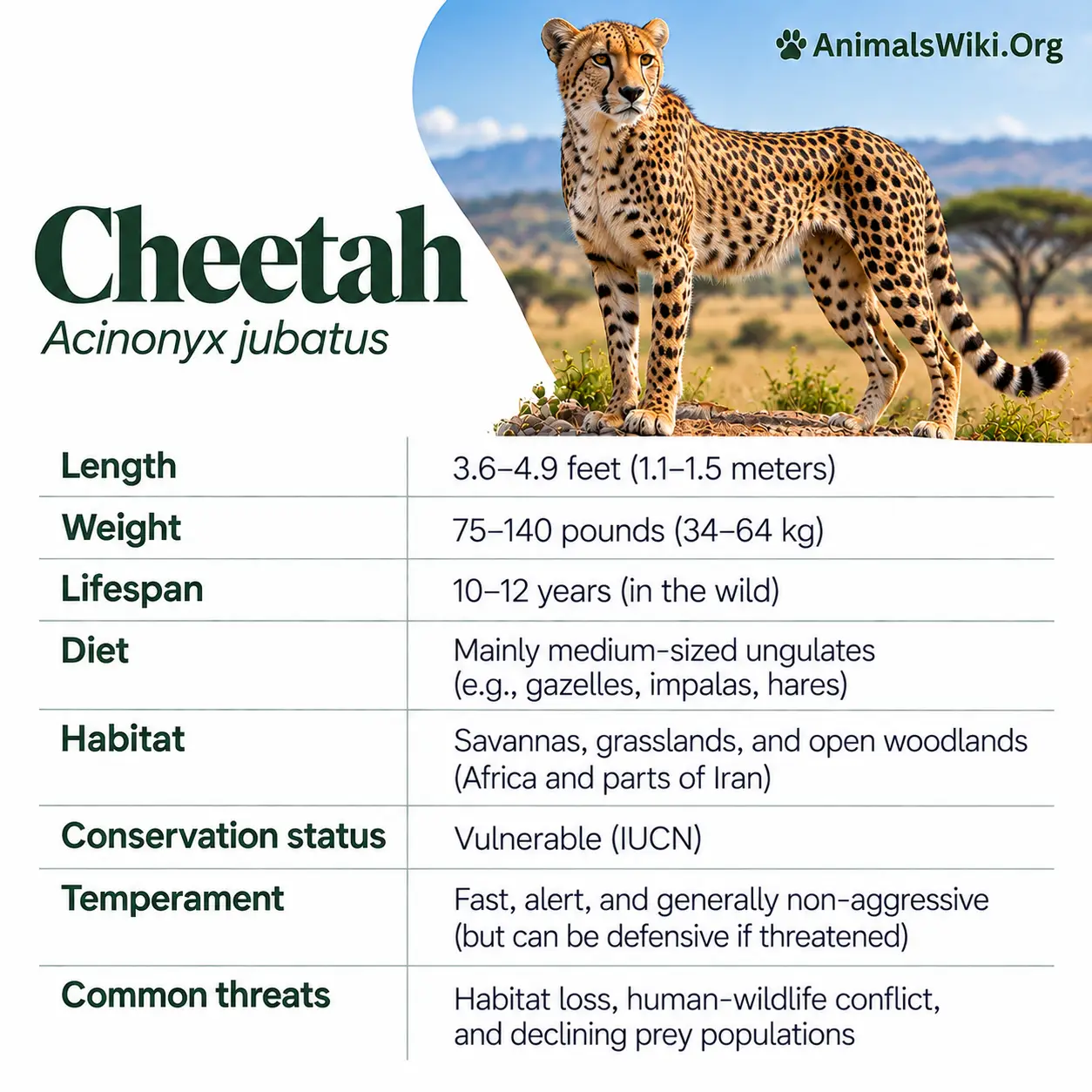
The cheetah is one of the most remarkable predators in the animal kingdom and is famous for being the fastest land animal in the world. Built for explosive acceleration rather than raw strength, the cheetah has a lightweight body, exceptionally long legs, a flexible spine, enlarged nasal passages, a deep chest, and a long tail that helps it maneuver while pursuing fast-moving prey.
Scientifically known as Acinonyx jubatus, the cheetah belongs to the cat family Felidae. Although it shares its family with lions, tigers, leopards, jaguars, and domestic cats, the cheetah has evolved a very different body design. Instead of relying primarily on overwhelming strength or stealth followed by a short powerful attack, it can pursue prey across open ground at extraordinary speeds.
Most wild cheetahs survive in Africa, particularly in eastern and southern regions. A tiny and critically threatened Asiatic population also remains in Iran. Cheetahs favor landscapes where they can locate prey and use their speed effectively, including grasslands, savannas, shrublands, and open woodland.
Their speed does not make cheetahs invincible. They face habitat loss, fragmented populations, declining prey, conflict with livestock owners, competition with larger predators, and illegal wildlife trade.
This guide explores the cheetah’s habitat, diet, speed, size, weight, lifespan, hunting behavior, reproduction, cubs, adaptations, social behavior, predators, conservation, and fascinating facts.
Cheetah Facts
| Feature | Information |
|---|---|
| Common Name | Cheetah |
| Scientific Name | Acinonyx jubatus |
| Kingdom | Animalia |
| Phylum | Chordata |
| Class | Mammalia |
| Order | Carnivora |
| Family | Felidae |
| Genus | Acinonyx |
| Species | Acinonyx jubatus |
| Animal Type | Mammal |
| Diet | Carnivore |
| Main Habitat | Grasslands, savannas, shrublands, and open woodland |
| Main Distribution | Primarily Africa, with a tiny population in Iran |
| Famous Feature | Exceptional running speed |
| Top Speed | Roughly 93–104 km/h (58–65 mph) in measured short sprints |
| Body Length | Approximately 1.1–1.5 m (3.6–4.9 ft), excluding tail |
| Tail Length | Roughly 60–80 cm (24–31 in) |
| Adult Weight | Commonly around 34–64 kg (75–141 lb), varying by sex and population |
| Social Behavior | Variable; females often solitary, males may form coalitions |
| Reproduction | Live birth |
| Young | Cub |
| Lifespan | Often around 10–12 years in the wild, with considerable variation |
| Conservation Status | Vulnerable |
| Main Threats | Habitat loss, fragmentation, conflict, prey decline, and illegal trade |
What Is a Cheetah?
A cheetah is a medium-to-large wild cat specially adapted for high-speed hunting.
Its scientific name, Acinonyx jubatus, distinguishes it from other familiar large cats. The cheetah is the only living species in the genus Acinonyx.
Although cheetahs are sometimes casually grouped with lions, tigers, leopards, and jaguars as “big cats,” their anatomy and behavior differ significantly.
Cheetahs have lightweight bodies, relatively small heads, long legs, deep chests, narrow waists, and long tails.
Almost every major feature of their body contributes in some way to speed, acceleration, balance, or efficient breathing during a chase.
This specialization makes the cheetah an extraordinary example of evolution shaped by the need to catch fast prey.
Scientific Classification of the Cheetah
| Classification | Name |
|---|---|
| Kingdom | Animalia |
| Phylum | Chordata |
| Class | Mammalia |
| Order | Carnivora |
| Family | Felidae |
| Subfamily | Felinae |
| Genus | Acinonyx |
| Species | Acinonyx jubatus |
Unlike lions, tigers, leopards, and jaguars, which belong to the genus Panthera, the cheetah belongs to Acinonyx.
This reflects its distinct evolutionary history and specialized anatomy.
What Does a Cheetah Look Like?
Cheetahs are immediately recognizable by their slender bodies and spotted coats.
Their fur is generally golden-yellow, pale tan, or sandy in color and is covered with numerous solid black spots.
The underside is considerably lighter.
A cheetah typically has:
- Long, slender legs
- A lightweight body
- Small rounded head
- Deep chest
- Narrow waist
- Long tail
- Solid black spots
- Dark facial markings
- Small rounded ears
- Claws that are less fully retractable than those of most cats
Its entire appearance is more similar to that of a specialized runner than a heavily built ambush predator.
What Are a Cheetah’s Tear Marks?
One of the easiest ways to recognize a cheetah is by the pair of dark lines running from the inner corners of the eyes toward the mouth.
These markings are commonly called tear marks or tear stripes.
They may help reduce glare around the eyes and improve visual performance in bright environments, although simplified claims about their exact function should be treated cautiously.
Regardless of their precise evolutionary role, the markings give cheetahs a distinctive facial appearance and help distinguish them from other spotted cats.
Cheetah Spots
The cheetah’s coat is covered in solid dark spots.
These markings provide camouflage by breaking up the animal’s outline against grasses, shadows, bushes, and other vegetation.
The spots differ from the rosettes found on leopards and jaguars.
A typical cheetah has relatively simple, solid spots, whereas a leopard’s coat contains more complex rosette-shaped markings.
This is one of the easiest ways to distinguish the two species.
How Big Is a Cheetah?
Cheetahs are much lighter and more slender than lions and tigers.
An adult commonly has a head-and-body length of approximately 1.1–1.5 meters (3.6–4.9 feet).
The long tail can add roughly another 60–80 centimeters (24–31 inches).
Adults commonly weigh approximately 34–64 kilograms (75–141 pounds), although size varies according to sex, geographic population, age, and physical condition.
Males are generally somewhat larger than females.
The cheetah’s relatively low body weight is advantageous because excessive mass would make extreme acceleration more difficult.
Male Cheetah vs. Female Cheetah
Male and female cheetahs look similar, but their social lives can be quite different.
| Feature | Male Cheetah | Female Cheetah |
|---|---|---|
| Size | Generally slightly larger | Generally smaller |
| Social Behavior | May form coalitions | Usually solitary outside cub-rearing |
| Territory | Some males defend territories | Females often use large home ranges |
| Cub Care | Normally little direct involvement | Raises cubs |
| Hunting | Hunts independently or with coalition | Hunts for herself and cubs |
| Reproduction | May associate with other males | Bears and raises offspring |
Female cheetahs face particularly demanding lives because they must hunt while simultaneously protecting and feeding their cubs.
Where Do Cheetahs Live?
Most wild cheetahs live in Africa.
Important populations occur in parts of southern and eastern Africa, including countries such as Namibia, Botswana, South Africa, Tanzania, and Kenya.
Smaller and more fragmented populations survive elsewhere on the continent.
Historically, cheetahs occupied a much larger geographic range extending across large areas of Africa, the Middle East, and Asia.
Today, the Asian population has been reduced dramatically.
A tiny population of Asiatic cheetahs survives in Iran.
Cheetah Habitat
Cheetahs are often associated with open African grasslands, but they can use several types of habitat.
These include:
- Savannas
- Grasslands
- Dry forests
- Shrublands
- Semi-desert landscapes
- Open woodland
- Mountainous or rocky environments in some regions
Suitable habitat must provide adequate prey, space, and opportunities to hunt.
Open landscapes are particularly useful because cheetahs depend heavily on vision and speed.
However, some vegetation and terrain can also help them approach prey before beginning a chase.
African Cheetah
The overwhelming majority of remaining wild cheetahs occur in Africa.
Different populations experience different ecological conditions.
Some live in famous savanna ecosystems containing lions, spotted hyenas, leopards, African wild dogs, and large numbers of herbivores.
Others occupy dry, sparsely populated landscapes outside traditional protected areas.
This creates an important conservation challenge because many cheetahs spend at least part of their lives in landscapes also used by people and livestock.
Asiatic Cheetah
The Asiatic cheetah is one of the world’s rarest large terrestrial predators.
Historically, cheetahs ranged widely across southwestern and southern Asia.
Today, the surviving natural population is restricted to Iran and is extremely small.
Asiatic cheetahs inhabit arid and semi-arid environments rather than the classic grassy savannas often associated with African cheetahs.
Their survival depends on protecting remaining habitat, prey, movement routes, and individual animals.
What Do Cheetahs Eat?
Cheetahs are carnivores.
They primarily hunt small and medium-sized mammals that can be captured through rapid pursuit.
Common prey can include:
- Gazelles
- Impalas
- Springbok
- Young wildebeest
- Young antelope
- Hares
- Small mammals
- Some ground-dwelling birds
The exact diet depends on location and prey availability.
Cheetahs generally prefer prey that is large enough to provide a useful meal but not so large that attacking it creates an excessive risk of injury.
How Do Cheetahs Hunt?
A cheetah hunt involves far more than simply running as fast as possible.
First, the cheetah identifies suitable prey.
It then attempts to approach without being detected.
The closer the cheetah gets before beginning its sprint, the less distance it must cover at high speed.
Once the chase begins, acceleration is extremely rapid.
The cheetah follows the prey’s sudden turns while using its long tail and flexible body to maintain control.
When sufficiently close, it may use a forepaw to trip or destabilize the fleeing animal.
After bringing the prey down, the cheetah typically uses a throat bite to subdue it.
How Fast Is a Cheetah?
The cheetah is the fastest living land animal.
Measured individuals have reached roughly 93–104 km/h (58–65 mph) during short sprints, although exact maximum-speed claims vary depending on how speed is measured.
What is especially impressive is not simply maximum speed but acceleration and maneuverability.
A hunting cheetah must rapidly accelerate, slow down, and change direction while following unpredictable prey.
It cannot maintain its highest speed for long.
Extreme running places enormous demands on the body, so most high-speed chases are relatively short.
Why Can Cheetahs Run So Fast?
The cheetah’s entire body is specialized for speed.
Several adaptations work together.
Long Legs
Long limbs increase stride length.
Flexible Spine
The spine flexes dramatically while running, helping extend the distance covered during each stride.
Lightweight Body
A slender frame reduces the mass that must be accelerated.
Deep Chest
The chest accommodates a powerful cardiovascular and respiratory system.
Enlarged Nasal Passages
Large nasal passages support rapid airflow during intense exercise.
Long Tail
The tail contributes to balance and control during rapid changes of direction.
Specialized Claws
The claws are less fully retractable than those of most cats and help provide traction.
Tough Foot Pads
The feet help maintain grip while sprinting across the ground.
Together, these characteristics create one of nature’s most specialized running machines.
How Does a Cheetah’s Spine Help It Run?
The cheetah’s flexible spine is essential to its running style.
During a sprint, the spine alternately extends and contracts.
When extended, the front and rear legs can reach far apart.
During the next phase of the stride, the legs gather underneath the body.
This spinal movement dramatically increases stride length and allows the cheetah to cover substantial ground with each running cycle.
At certain points in a full-speed sprint, all four feet can be off the ground simultaneously.
Why Does a Cheetah Have a Long Tail?
A cheetah’s tail can measure more than half a meter long and is extremely important during a chase.
Fast prey animals do not simply run in straight lines.
Gazelles and antelopes can suddenly turn in an attempt to escape.
The cheetah’s long muscular tail helps stabilize the body during these rapid changes of direction.
It effectively contributes to balance and rotational control, allowing the animal to remain agile at high speed.
Cheetah Claws
Most cats can retract their claws extensively.
Cheetah claws are less fully retractable.
This characteristic provides extra grip against the ground, somewhat like the traction provided by spikes on athletic footwear.
Good traction is particularly important during rapid acceleration and turning.
The foot pads are also adapted for gripping the ground during high-speed movement.
How Long Can a Cheetah Run at Full Speed?
A cheetah cannot maintain maximum speed for long.
High-speed pursuits usually last only a short period.
Running at extreme intensity places enormous demands on muscles, breathing, circulation, and energy reserves.
For this reason, cheetahs depend heavily on stalking.
The closer they can get before launching an attack, the better their chances of capturing prey before exhaustion forces them to stop.
What Happens After a Cheetah Catches Its Prey?
After a successful high-speed chase, a cheetah may need time to recover before eating.
Its breathing rate can be extremely high following intense exertion.
This recovery period can create a problem.
Cheetahs share many habitats with stronger predators and scavengers, including lions and spotted hyenas.
If a larger competitor discovers the kill, a cheetah may abandon it rather than risk serious injury.
Speed helps a cheetah capture prey, but it does not necessarily help the animal defend a carcass.
Do Cheetahs Hunt During the Day?
Cheetahs are often more active during daylight than many other large African predators.
They may hunt during the morning and later afternoon, although activity varies according to temperature, prey behavior, competitors, and human disturbance.
Daytime activity can sometimes reduce encounters with more nocturnal predators.
However, cheetahs are flexible and can adjust their activity patterns when circumstances require it.
Are Cheetahs Solitary?
Cheetah social behavior is unusual among cats.
Adult females are generally solitary unless they are raising cubs.
Males, however, can be either solitary or social.
Male siblings frequently remain together after leaving their mother and form groups called coalitions.
Occasionally unrelated males may also associate.
Coalition members can hunt, rest, travel, and defend areas together.
What Is a Cheetah Coalition?
A coalition is a group of male cheetahs that live together.
Coalitions commonly consist of brothers from the same litter, although other arrangements are possible.
Living together can provide several advantages.
Coalition males may be better able to defend territories and compete for access to females.
They may also cooperate while hunting certain prey.
This male social system is one of the most interesting differences between cheetahs and many other primarily solitary cats.
How Do Cheetahs Communicate?
Cheetahs communicate using scent, posture, facial expressions, and a surprising variety of sounds.
They can:
- Chirp
- Purr
- Growl
- Hiss
- Moan
- Yowl
- Produce other contact calls
Unlike lions and tigers, cheetahs cannot produce a true roar in the same way members of the genus Panthera can.
Their vocal communication can nevertheless be complex.
Mothers and cubs, for example, use vocalizations to maintain contact.
Can Cheetahs Roar?
No, cheetahs cannot roar like lions or tigers.
Their throat anatomy differs from that of the roaring cats in the genus Panthera.
Instead, cheetahs produce a wide range of other sounds.
One of the most distinctive is a bird-like chirp, which can be surprisingly high-pitched for an animal of their size.
They can also purr, growl, hiss, and make several other calls.
Can Cheetahs Purr?
Yes.
Cheetahs can produce purring sounds.
Purring can occur during relaxed social interactions, particularly between mothers and cubs or among familiar individuals.
This is another characteristic distinguishing them from the classic roaring members of Panthera.
Cheetah Reproduction
Cheetahs can breed at different times of year when conditions allow.
After mating, the female undergoes a pregnancy lasting approximately three months.
Before giving birth, she finds a relatively concealed location.
Vegetation, rocky cover, or other protected areas can help hide newborn cubs from predators.
The mother raises her offspring without routine assistance from the father.
Cheetah Cubs
Baby cheetahs are called cubs.
A female can give birth to several cubs in one litter, with litter size varying considerably.
Newborn cubs are small, vulnerable, and dependent on their mother.
Young cubs have a distinctive covering of longer grayish hair along the back and neck known as a mantle.
This appearance becomes less prominent as they mature.
The mother regularly moves young cubs between hiding locations, which can help reduce the risk of predators discovering them.
Why Do Cheetah Cubs Have a Mantle?
Young cheetah cubs develop long grayish or silvery hair along their backs.
This is called the mantle.
It may provide camouflage by breaking up the cub’s outline in vegetation.
Another popular hypothesis suggests that the mantle could make cubs resemble honey badgers, potentially discouraging some predators, but this idea remains difficult to demonstrate conclusively.
What is clear is that the mantle is a distinctive feature of young cheetahs and gradually becomes less prominent with age.
How Do Cheetah Cubs Learn to Hunt?
Cubs learn important survival skills from their mother.
Initially, they spend much of their time hiding while she hunts.
As they grow older, they begin accompanying her.
Young cheetahs observe stalking, chasing, and prey handling.
Mothers can provide opportunities for cubs to practice catching prey.
Play between siblings also develops coordination, speed, stalking behavior, balance, and other abilities.
Eventually, young cheetahs must become capable of hunting independently.
How Long Do Cheetah Cubs Stay With Their Mother?
Young cheetahs usually remain with their mother for well over a year.
As they approach independence, siblings may continue traveling together temporarily.
Females generally become increasingly solitary.
Male littermates may remain together much longer and establish a coalition.
This transition from maternal dependence to independent adulthood is one of the most important stages in a cheetah’s life.
Cheetah Lifespan
Wild cheetahs often live approximately 10–12 years, although lifespan varies considerably.
Females may sometimes survive longer than males.
Factors affecting lifespan include:
- Food availability
- Predation
- Injuries
- Disease
- Competition
- Human conflict
- Habitat quality
- Reproductive demands
Under professional managed care, cheetahs can sometimes live longer because they receive reliable food, veterinary treatment, and protection from predators.
Cheetah Predators
Adult cheetahs are predators themselves, but they share their environment with larger and stronger carnivores.
Potential competitors and threats include:
- Lions
- Spotted hyenas
- Leopards
- African wild dogs
Adult cheetahs generally avoid physical fights with larger predators whenever possible.
Cubs are much more vulnerable.
Predation contributes significantly to cub mortality in some ecosystems.
This is why female cheetahs carefully select hiding places and frequently move young cubs.
Cheetahs and Lions
Lions represent an important threat to cheetahs in ecosystems where the two species overlap.
Lions are considerably larger and stronger.
They may steal cheetah kills and can kill cheetahs, particularly cubs.
A cheetah’s best defense is usually avoidance rather than combat.
Excellent eyesight and open habitat can help cheetahs detect danger from a distance.
Their speed also provides an important escape advantage when enough space is available.
Cheetahs and Hyenas
Spotted hyenas and cheetahs can compete over food.
A hyena discovering a cheetah kill may attempt to take it.
Although cheetahs are extremely fast, they are not built for prolonged fights with heavily constructed predators such as spotted hyenas.
The cheetah will often surrender a carcass rather than risk an injury that could prevent it from hunting.
For a wild predator, even a relatively minor injury can have severe consequences.
Cheetah vs. Leopard
Cheetahs and leopards are frequently confused because both have spotted coats.
However, they are quite different.
| Feature | Cheetah | Leopard |
|---|---|---|
| Scientific Name | Acinonyx jubatus | Panthera pardus |
| Body Build | Slender and lightweight | Stocky and muscular |
| Coat Pattern | Solid spots | Rosettes |
| Face | Dark tear marks | No typical cheetah tear marks |
| Running Speed | Extremely fast | Slower |
| Climbing | Can climb but less specialized | Excellent climber |
| Claws | Less fully retractable | Retractable |
| Hunting Style | High-speed pursuit | Ambush |
| Strength | Built for speed | Built for strength and agility |
| Roaring | Cannot truly roar | Can produce roaring-type calls |
A cheetah’s slender body and facial tear marks are often the quickest identification clues.
Cheetah vs. Lion
| Feature | Cheetah | Lion |
|---|---|---|
| Scientific Name | Acinonyx jubatus | Panthera leo |
| Size | Much smaller | Much larger |
| Main Adaptation | Speed | Strength and social cooperation |
| Coat | Spotted | Mostly plain tawny |
| Social Behavior | Females solitary; males may form coalitions | Lives commonly in prides |
| Hunting | Rapid pursuit | Stalking and ambush |
| Roar | No | Yes |
| Claws | Less fully retractable | Fully retractable |
| Build | Lightweight | Heavy and muscular |
Both are successful African predators, but they occupy very different ecological roles.
Cheetah vs. Tiger
The differences between cheetahs and tigers are even more dramatic.
Tigers are much larger and heavier.
A tiger relies on powerful muscles, stealth, and ambush, whereas the cheetah’s body sacrifices some strength in favor of extreme acceleration.
Tigers have striped coats; cheetahs have spotted coats.
Tigers are also excellent swimmers and members of the genus Panthera, while cheetahs belong to Acinonyx.
Both species demonstrate how members of the cat family can evolve very different hunting strategies.
Cheetah vs. Jaguar
Jaguars are much more heavily built than cheetahs.
The jaguar has powerful jaws, muscular limbs, and a coat covered with rosettes, often containing spots inside them.
Cheetahs are taller and slimmer relative to their weight and possess simple solid spots.
The species also live on different continents.
Cheetahs are native primarily to Africa, with a tiny surviving Asian population, while jaguars are native to the Americas.
Cheetah vs. Greyhound
Greyhounds are among the fastest domestic dogs, so they are sometimes compared with cheetahs.
Both animals have slender bodies, long legs, flexible backs, and adaptations for rapid running.
However, the cheetah reaches substantially higher peak speeds and accelerates extremely rapidly.
The comparison is interesting because it shows how unrelated branches of carnivorous mammals can develop somewhat similar body characteristics when adapted for running.
King Cheetah
The king cheetah is not a separate species.
It is a rare coat-pattern variation caused by inherited genetics.
Instead of the usual small solid spots, a king cheetah has larger blotches and broad dark stripes running along the back.
The underlying animal is still a cheetah, Acinonyx jubatus.
This unusual appearance demonstrates how genetic variation can dramatically alter coat patterns without creating a separate species.
Are There Black Cheetahs?
Extremely dark coloration has occasionally been reported in cheetahs, but it is exceptionally unusual.
Claims of fully black cheetahs should be approached carefully because lighting, image manipulation, unusual coat patterns, or mistaken identification can create confusion.
The familiar wild cheetah has a tan-to-golden coat with dark spots.
Are Cheetahs Dangerous to Humans?
Cheetahs are wild carnivores and should always be treated with caution and respect.
They are generally less physically powerful than lions, tigers, or leopards and typically avoid unnecessary confrontation.
Nevertheless, they possess sharp teeth, claws, and strong muscles and are capable of causing serious injury.
A wild cheetah should never be approached, cornered, fed, or treated like a domestic animal.
Are Cheetahs Apex Predators?
Cheetahs are highly effective predators, but whether they are described as apex predators depends on the ecosystem and how the term is being used.
In many African ecosystems, cheetahs coexist with larger carnivores such as lions and spotted hyenas that can dominate them and steal their kills.
For this reason, cheetahs occupy a different competitive position from dominant large predators.
They specialize in speed and the pursuit of relatively fast prey rather than defending kills through physical strength.
Cheetah Conservation Status
The cheetah is classified as Vulnerable on the IUCN Red List.
However, conservation conditions differ dramatically between regions and populations.
The Asiatic cheetah is especially threatened, while some African populations remain larger but increasingly fragmented.
Cheetahs require large areas because individuals can travel substantial distances.
This makes them especially vulnerable when natural landscapes are divided by roads, fences, farms, settlements, and other development.
Why Are Cheetahs Endangered or Threatened?
Cheetahs face several major conservation pressures.
Habitat Loss
Natural habitats are converted to agriculture, settlements, roads, and other uses.
Habitat Fragmentation
Remaining populations can become isolated from one another.
Human-Wildlife Conflict
Cheetahs sometimes prey on livestock, creating conflict with farmers and herders.
Declining Natural Prey
Reduced wild prey can force cheetahs to travel farther or increase the risk of livestock predation.
Illegal Wildlife Trade
Cheetah cubs have been captured and trafficked illegally for the exotic pet trade.
Low Population Density
Cheetahs naturally occur at relatively low densities and require large landscapes, making fragmented populations difficult to conserve.
Competition With Larger Predators
Lions, hyenas, and other predators can steal kills or kill cheetahs and their cubs.
Genetic Diversity in Cheetahs
Cheetahs are famous in genetics research because populations show relatively low genetic diversity compared with many other mammals.
This pattern is believed to reflect severe historical population reductions, or genetic bottlenecks.
Low genetic diversity can create conservation concerns because genetic variation can help populations respond to disease and environmental change.
However, cheetah conservation is not simply a genetics problem.
Habitat protection, connectivity, prey availability, conflict reduction, and preventing illegal killing remain essential for their survival.
Why Are Cheetahs Important to Ecosystems?
Cheetahs contribute to ecosystem function as predators.
By hunting gazelles and other animals, they participate in the complex relationships connecting carnivores and herbivores.
Their kills can also provide food for scavengers when remains are left behind.
Protecting cheetahs often requires preserving large natural landscapes.
Those landscapes support many additional species, meaning cheetah conservation can contribute to broader biodiversity protection.
How Are Cheetahs Different From Other Cats?
Cheetahs have several characteristics that distinguish them from most other cats.
Their bodies are unusually slender.
Their legs are exceptionally long.
Their claws are less fully retractable.
Their spine is highly flexible.
Their tail is specialized for control during high-speed movement.
They cannot roar like lions and tigers.
And rather than relying primarily on raw strength, they are among the most specialized pursuit predators in the cat family.
These differences make the cheetah one of the most distinctive members of Felidae.
40 Interesting Cheetah Facts
- The scientific name of the cheetah is Acinonyx jubatus.
- Cheetahs belong to the cat family Felidae.
- The cheetah is the fastest living land animal.
- Measured cheetahs have reached speeds above 90 km/h during short sprints.
- They cannot maintain maximum speed for long.
- Cheetahs have long, slender legs.
- Their flexible spine increases stride length.
- Their long tail helps with balance and maneuvering.
- Their claws are less fully retractable than those of most cats.
- Specialized foot pads provide traction.
- Cheetahs have solid black spots.
- Leopards generally have rosettes rather than simple spots.
- Cheetahs have distinctive dark tear marks on their faces.
- Most wild cheetahs live in Africa.
- A tiny Asiatic population survives in Iran.
- Cheetahs once occupied a much larger geographic range.
- They are carnivores.
- Gazelles and other antelopes are important prey.
- Cheetahs are primarily pursuit predators.
- They stalk prey before beginning a sprint.
- Their acceleration is one of their most impressive abilities.
- Females are generally solitary outside the period when they raise cubs.
- Male cheetahs may live in coalitions.
- Coalition members are often brothers.
- Baby cheetahs are called cubs.
- Cubs have a distinctive grayish mantle.
- Female cheetahs raise their cubs without regular help from males.
- Cubs learn hunting skills from their mother.
- Cheetahs cannot roar like lions.
- They can produce chirping sounds.
- Cheetahs can purr.
- Lions can kill cheetahs and their cubs.
- Hyenas may steal cheetah kills.
- Cheetahs often avoid fighting larger predators.
- A king cheetah is a rare coat-pattern variation, not a separate species.
- Cheetahs have relatively low genetic diversity.
- They need extensive landscapes to survive.
- Habitat fragmentation is a major conservation concern.
- Illegal wildlife trafficking threatens some populations.
- The cheetah is classified as Vulnerable.
Did You Know?
A cheetah’s greatest advantage is not simply its maximum speed—it is the combination of acceleration, braking, and maneuverability.
During a real hunt, prey animals rarely run in a perfectly straight line.
Gazelles can make sudden turns in an attempt to escape.
A cheetah must continually adjust its speed and direction while maintaining control.
Its flexible spine, long legs, specialized feet, and long tail work together to make these rapid movements possible.
Frequently Asked Questions About Cheetahs
What is a cheetah?
A cheetah is a fast-running carnivorous mammal belonging to the cat family Felidae. Its scientific name is Acinonyx jubatus.
Where do cheetahs live?
Most wild cheetahs live in Africa, especially eastern and southern regions. A tiny Asiatic population survives in Iran.
What do cheetahs eat?
Cheetahs primarily eat small and medium-sized mammals, including gazelles, impalas, springbok, young antelope, and other suitable prey.
How fast can a cheetah run?
Measured cheetahs have reached roughly 93–104 km/h (58–65 mph) during short sprints. Exact maximum speeds vary between individuals and measurement methods.
Is the cheetah the fastest animal in the world?
The cheetah is the fastest land animal, but some flying birds can achieve much higher speeds, particularly during dives.
Why are cheetahs so fast?
Their speed results from a combination of long legs, a lightweight body, flexible spine, deep chest, large respiratory passages, specialized feet, and a long balancing tail.
How long can a cheetah run at full speed?
Only for a relatively short period. Maximum-speed running is extremely demanding, so cheetahs depend on approaching prey before beginning a chase.
How big is a cheetah?
Adults commonly measure about 1.1–1.5 meters in head-and-body length, excluding the tail, and often weigh around 34–64 kilograms.
What is a baby cheetah called?
A baby cheetah is called a cub.
How many cubs does a cheetah have?
Litter size varies, but females can give birth to several cubs at a time.
How long do cheetah cubs stay with their mother?
Young cheetahs commonly remain with their mother for well over a year while learning the skills required for independent survival.
Why do cheetahs have spots?
Their spotted coats help break up the outline of their bodies and provide camouflage in natural vegetation.
What are the black lines on a cheetah’s face?
They are commonly called tear marks. They may have visual benefits, including reducing glare, although their exact evolutionary function is not completely established.
Can cheetahs roar?
No. Cheetahs cannot produce the true roar associated with lions and other Panthera cats.
Can cheetahs purr?
Yes. Cheetahs can produce purring sounds.
What sound does a cheetah make?
Cheetahs can chirp, purr, growl, hiss, yowl, and produce several other vocalizations.
Are cheetahs solitary?
Adult females are usually solitary unless raising cubs. Males may live alone or form coalitions.
What is a cheetah coalition?
A coalition is a group of male cheetahs living together. Members are frequently brothers, although unrelated males can sometimes associate.
Can cheetahs climb trees?
Cheetahs can climb some trees and elevated objects, although they are far less specialized for climbing than leopards.
Can cheetahs swim?
Yes, cheetahs are physically capable of swimming, although they are not as strongly associated with water as tigers.
What animals eat cheetahs?
Healthy adults are not commonly hunted as prey, but lions and other large predators can kill them. Cheetah cubs face much greater predation risk.
Why do hyenas steal food from cheetahs?
Hyenas are powerful competitors and may take advantage of a cheetah’s kill. A cheetah often avoids fighting because an injury could seriously affect its ability to hunt.
What is a king cheetah?
A king cheetah is a cheetah with a rare inherited coat pattern characterized by large blotches and broad dark stripes. It is not a separate species.
Are cheetahs faster than lions?
Yes. Cheetahs can achieve much higher maximum running speeds than lions.
Are cheetahs faster than horses?
Cheetahs can reach higher peak speeds than most horses, although horses have far greater endurance and can maintain substantial speeds for much longer distances.
Are cheetahs stronger than leopards?
Cheetahs are faster, but leopards have more heavily built bodies and are generally stronger relative to their hunting and climbing lifestyle.
Are cheetahs dangerous?
They are wild predators capable of causing serious injury. They should never be approached or treated as tame animals.
How long do cheetahs live?
Wild cheetahs often live around 10–12 years, although lifespan varies. Individuals under professional care may live longer.
Are cheetahs endangered?
The species is currently classified as Vulnerable on the IUCN Red List, while some populations, particularly the Asiatic cheetah, face much more severe risks.
Why are cheetahs threatened?
Major pressures include habitat loss, fragmented populations, human-wildlife conflict, prey decline, illegal wildlife trade, and competition with larger predators.
Why are cheetahs important?
Cheetahs are predators within their ecosystems and contribute to natural predator-prey relationships. Conserving them also requires protecting large habitats that support many other species.
Conclusion
The cheetah (Acinonyx jubatus) is one of evolution’s most extraordinary examples of specialization for speed.
Its slender frame, long legs, flexible spine, specialized claws and foot pads, deep chest, enlarged respiratory system, and long balancing tail work together to create a predator capable of remarkable acceleration and maneuverability.
But speed alone does not define the cheetah.
Its lifestyle requires patience and precision. Before every high-speed chase comes careful observation and stalking. After a successful hunt, the cheetah must recover quickly and remain alert for larger predators that may steal its meal.
Its social behavior is equally interesting. Females usually live independently while raising cubs, whereas males may form long-lasting coalitions. Young cheetahs spend many months learning the complex combination of stalking, timing, acceleration, turning, and prey handling required to survive independently.
Despite being the fastest land animal, the cheetah cannot outrun the environmental challenges created by a rapidly changing world.
Habitat loss and fragmentation restrict movement between populations. Declining natural prey can increase competition and conflict. Illegal wildlife trade threatens individual animals, while interactions with livestock owners create additional challenges outside protected areas.
Protecting cheetahs therefore requires large connected landscapes, healthy prey populations, effective wildlife management, reduced conflict between predators and people, and protection from illegal capture and trade.
The cheetah may be famous for a sprint lasting only seconds, but ensuring the species survives in the wild is a long-term conservation challenge. Protecting this remarkable predator also helps preserve the grasslands, savannas, shrublands, and other ecosystems that countless species depend upon.