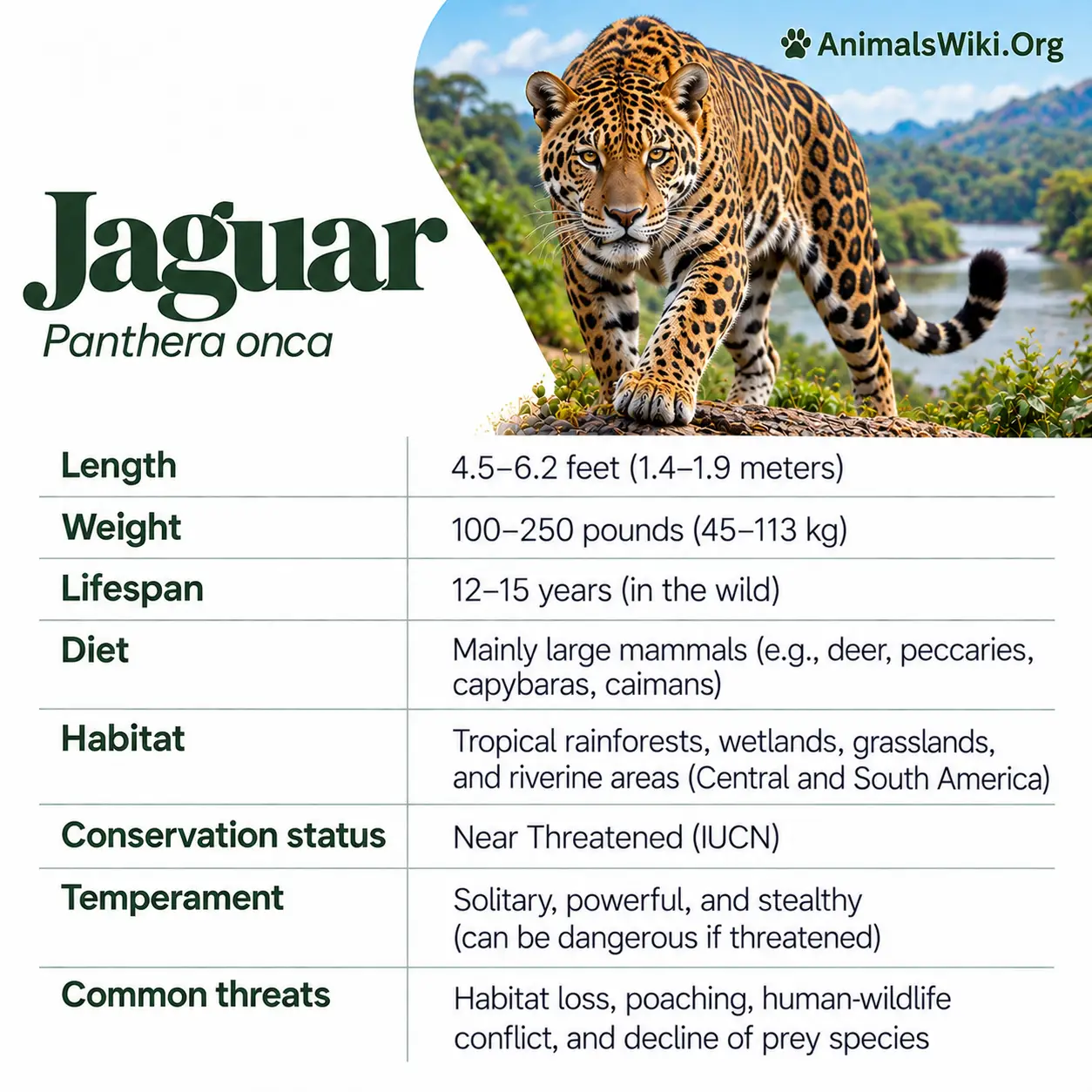
The jaguar is one of the most powerful and fascinating wild cats in the world. Recognized by its muscular body, golden coat, dark rosettes, broad head, and remarkably strong jaws, this elusive predator occupies forests, wetlands, grasslands, and other habitats across parts of the Americas.
Scientifically known as Panthera onca, the jaguar is the largest native cat in the Americas and one of the largest living members of the cat family, Felidae. It belongs to the genus Panthera, alongside lions, tigers, leopards, and snow leopards.
Unlike cheetahs, which depend heavily on speed, jaguars are built around strength, stealth, and explosive power. Their compact muscular bodies allow them to overpower substantial prey, while their exceptional swimming ability enables them to hunt around rivers, wetlands, and flooded forests.
Historically, jaguars occupied a much larger geographic range extending from parts of the southwestern United States through Mexico and Central America into South America. Today, their strongest populations are associated with large tropical landscapes, particularly the Amazon Basin and other relatively intact habitats.
This guide explores the jaguar’s habitat, diet, size, weight, lifespan, hunting behavior, reproduction, adaptations, swimming ability, predators, conservation, and other fascinating facts.
Jaguar Facts
| Feature | Information |
|---|---|
| Common Name | Jaguar |
| Scientific Name | Panthera onca |
| Kingdom | Animalia |
| Phylum | Chordata |
| Class | Mammalia |
| Order | Carnivora |
| Family | Felidae |
| Genus | Panthera |
| Animal Type | Mammal |
| Diet | Carnivore |
| Native Range | The Americas |
| Main Habitat | Tropical forests, wetlands, grasslands, and scrublands |
| Social Behavior | Primarily solitary |
| Body Length | Roughly 1.1–1.85 m (3.6–6.1 ft), excluding tail |
| Weight | Commonly about 45–120 kg (99–265 lb), with substantial regional variation |
| Reproduction | Live birth |
| Young | Cub |
| Lifespan | Often around 12–15 years in the wild |
| Famous Feature | Powerful jaws and rosette-patterned coat |
| Swimming Ability | Excellent |
| Conservation Status | Near Threatened |
| Major Threats | Habitat loss, fragmentation, prey decline, and conflict with humans |
What Is a Jaguar?
The jaguar is a large carnivorous mammal native to the Americas.
Its scientific name is Panthera onca.
Jaguars belong to the same genus as lions, tigers, leopards, and snow leopards. They are especially notable for their combination of muscular strength, stealth, swimming ability, and powerful jaws.
Although jaguars superficially resemble leopards, the two are separate species found naturally on different continents.
Jaguars generally have broader heads, heavier bodies, shorter-looking limbs, and more robust builds than leopards.
Their coat patterns also provide useful identification clues.
Scientific Classification of the Jaguar
| Classification | Name |
|---|---|
| Kingdom | Animalia |
| Phylum | Chordata |
| Class | Mammalia |
| Order | Carnivora |
| Family | Felidae |
| Subfamily | Pantherinae |
| Genus | Panthera |
| Species | Panthera onca |
The jaguar is the only living member of the genus Panthera native to the Americas.
What Does a Jaguar Look Like?
Jaguars have compact, muscular bodies built for strength.
Their coats generally range from pale yellow to golden or orange-brown and are covered with dark markings called rosettes.
The underside of the body is usually lighter.
Typical physical characteristics include:
- Broad head
- Powerful jaws
- Strong neck
- Muscular shoulders
- Thick legs
- Large paws
- Retractable claws
- Relatively short tail
- Golden coat
- Dark rosettes
The jaguar’s robust appearance contrasts sharply with the lightweight, long-legged body of a cheetah.
Jaguar Rosettes
A jaguar’s rosettes are irregular dark markings shaped somewhat like roses.
Many contain one or more small spots inside them.
This feature is particularly useful when distinguishing jaguars from leopards.
Leopard rosettes are usually smaller and often lack the central spots commonly visible in jaguar markings.
The pattern helps camouflage the jaguar in complex environments containing vegetation, shadows, branches, and patches of sunlight.
Does Every Jaguar Have a Unique Pattern?
Individual jaguars have distinctive coat patterns.
Researchers can therefore use photographs to help identify particular animals.
Camera traps placed along forest trails and other frequently used locations photograph passing jaguars without researchers needing to physically capture them.
Scientists can compare their rosettes and other markings to distinguish individuals.
This technique helps researchers estimate population sizes and study movements, territories, reproduction, and habitat use.
How Big Is a Jaguar?
Jaguars are the largest native cats in the Americas.
Adults commonly measure approximately 1.1–1.85 meters (3.6–6.1 feet) in head-and-body length, excluding the tail.
Body weight varies enormously.
Many adults weigh around 45–120 kilograms (99–265 pounds), although particularly large males can exceed this range.
Males are usually substantially larger than females.
Body size also varies geographically.
Jaguars living in landscapes containing abundant large prey can become considerably larger than animals inhabiting some forest environments.
Male Jaguar vs. Female Jaguar
| Feature | Male Jaguar | Female Jaguar |
|---|---|---|
| Size | Larger and heavier | Smaller |
| Social Behavior | Primarily solitary | Primarily solitary |
| Home Range | Usually larger | Usually smaller |
| Cub Care | Little direct involvement | Raises cubs |
| Hunting | Independent | Independent and hunts for cubs |
| Territory | Can overlap several female ranges | Maintains individual home range |
Although males and females differ in average size, both are powerful predators capable of hunting independently.
Where Do Jaguars Live?
Jaguars are native to the Americas.
Their present range extends from Mexico through parts of Central America and into South America.
Important jaguar populations occur in countries including:
- Mexico
- Belize
- Guatemala
- Costa Rica
- Panama
- Colombia
- Venezuela
- Guyana
- Suriname
- Ecuador
- Peru
- Bolivia
- Brazil
- Paraguay
- Argentina
The Amazon Basin contains some of the largest remaining expanses of suitable jaguar habitat.
The Pantanal wetlands of Brazil and neighboring countries are also famous for jaguar populations.
Jaguar Habitat
Jaguars can occupy several habitat types.
These include:
- Tropical rainforests
- Wetlands
- Flooded forests
- Grasslands
- Savannas
- Scrublands
- Dry forests
- River systems
They are strongly associated with landscapes containing water.
Unlike many cats that merely tolerate swimming when necessary, jaguars regularly move around rivers, lakes, wetlands, and flooded habitats.
They can cross waterways and hunt animals associated with aquatic environments.
Jaguars in the Amazon Rainforest
The Amazon rainforest is one of the most important remaining strongholds for jaguars.
Its enormous forest landscapes provide cover, water, and a wide variety of prey.
Dense vegetation allows jaguars to move quietly and remain concealed.
Rivers and wetlands provide additional hunting opportunities.
However, even the Amazon is experiencing habitat loss and fragmentation.
Deforestation can remove hunting habitat, reduce prey populations, and create more opportunities for conflict between jaguars and people.
Jaguars in the Pantanal
The Pantanal is one of the world’s largest tropical wetland systems and one of the most famous places for observing wild jaguars.
Its network of rivers, wetlands, forests, and grasslands supports abundant wildlife.
Jaguars in this region can prey on animals such as capybaras and caimans.
Because jaguars frequently travel along riverbanks, they can sometimes be observed more easily in portions of the Pantanal than in extremely dense rainforest.
What Do Jaguars Eat?
Jaguars are obligate carnivores.
They have an exceptionally diverse diet and can hunt many different kinds of animals.
Potential prey includes:
- Capybaras
- Peccaries
- Deer
- Caimans
- Turtles
- Armadillos
- Pacas
- Monkeys
- Fish
- Birds
- Other mammals and reptiles
Diet varies according to habitat and prey availability.
Their ability to exploit both terrestrial and aquatic prey contributes to their ecological flexibility.
How Do Jaguars Hunt?
Jaguars are primarily ambush predators.
They depend on stealth rather than long-distance pursuit.
A jaguar moves quietly through vegetation while using trees, bushes, tall plants, and shadows for concealment.
Once it gets sufficiently close, it attacks with a short burst of explosive power.
Its muscular forelimbs and claws help control the prey.
The jaguar’s jaws then deliver an exceptionally powerful bite.
This strategy is very different from the high-speed pursuit used by cheetahs.
Jaguar Bite Force
The jaguar is famous for its powerful bite.
Relative to body size, it possesses one of the strongest bites among living cats.
Its broad skull and strong jaw muscles allow it to handle prey that would be challenging for many other predators.
Jaguars are capable of biting through tough structures such as reptile skin and turtle shells.
They may also kill certain prey using powerful bites to the skull or head region rather than relying exclusively on the throat bite commonly associated with many other large cats.
This unusual ability contributes to the jaguar’s reputation as an exceptionally powerful predator.
Can Jaguars Kill Caimans?
Yes.
Jaguars living in wetland environments can prey on caimans.
They may approach from riverbanks or other concealed positions before attacking.
Their powerful jaws and strong forelimbs help them control these reptiles.
Caimans are only one component of a very diverse jaguar diet, but this predator-prey relationship has become one of the most dramatic examples of the jaguar’s strength.
Can Jaguars Swim?
Yes. Jaguars are excellent swimmers.
They readily enter water and can cross rivers and other waterways.
Swimming is especially important for jaguars living in tropical forests and wetlands.
They may use water to:
- Travel
- Cross territories
- Cool themselves
- Reach new hunting areas
- Pursue aquatic or semi-aquatic prey
Their comfort around water distinguishes them from the popular stereotype that cats avoid getting wet.
Can Jaguars Climb Trees?
Yes.
Jaguars are capable climbers.
They may climb trees to rest, explore, escape disturbances, or investigate potential prey.
However, they are generally more heavily built than leopards and are not as strongly associated with an arboreal lifestyle.
Most jaguar hunting and traveling occurs on the ground or around waterways.
Are Jaguars Solitary?
Yes.
Adult jaguars are primarily solitary animals.
They usually hunt, travel, and rest alone.
Each adult occupies a home range, and male ranges are typically larger than those of females.
A male’s range may overlap the ranges of several females.
Jaguars communicate without needing constant direct contact by leaving scent marks, scratches, and other signals throughout their territories.
How Do Jaguars Communicate?
Jaguars communicate through several methods.
Scent Marking
Urine and other scent signals provide information about identity, territory, and reproductive condition.
Scratching
Jaguars can leave claw marks on trees and other surfaces.
Vocalizations
They can roar, growl, grunt, and produce other sounds.
Body Language
Posture, facial expressions, ear position, and tail movements provide information during direct encounters.
These communication methods help solitary animals share landscapes while reducing unnecessary confrontations.
Jaguar Territory
Jaguars require substantial areas containing sufficient prey, water, and cover.
Home-range size varies according to:
- Sex
- Habitat
- Prey density
- Season
- Human disturbance
- Population density
Males generally travel across larger areas than females.
Maintaining connected habitat is particularly important because young jaguars eventually need to disperse and establish territories of their own.
When Are Jaguars Most Active?
Jaguars can be active during both daytime and nighttime.
Their activity patterns depend on habitat, prey behavior, temperature, human activity, and individual circumstances.
Many jaguars show considerable activity around dusk, nighttime, and dawn.
In areas with significant human disturbance, they may become more nocturnal.
This flexibility allows jaguars to adjust their behavior to local environmental conditions.
Jaguar Reproduction
Jaguars can reproduce throughout the year in many parts of their range.
After mating, the female undergoes a pregnancy lasting roughly three to three and a half months.
She finds a protected den before giving birth.
Suitable den sites may include dense vegetation, caves, rocky areas, or other concealed locations.
The male normally does not participate significantly in raising the offspring.
Jaguar Cubs
Baby jaguars are called cubs.
A female commonly gives birth to around one to four cubs, with two being common.
Newborn cubs are small and dependent on their mother.
She provides:
- Milk
- Warmth
- Protection
- Shelter
- Food
- Hunting instruction
The cubs remain hidden during the earliest stages of life and gradually begin exploring their surroundings.
How Do Jaguar Cubs Learn to Hunt?
Jaguar cubs learn essential survival skills from their mother.
As they grow, they begin following her through their habitat.
Play behavior develops strength, coordination, stalking ability, and reactions.
Eventually, the mother introduces them to prey and hunting opportunities.
Young jaguars must learn how to move quietly, select prey, approach without detection, attack effectively, and avoid dangerous situations.
These skills develop gradually rather than appearing fully formed when the cubs are born.
How Long Do Jaguar Cubs Stay With Their Mother?
Young jaguars remain with their mother for an extended period, commonly around one and a half to two years.
During this time they become progressively more independent.
Eventually, they disperse to establish their own home ranges.
Dispersal can be dangerous because young jaguars may encounter established adults, human settlements, roads, livestock areas, and fragmented habitat.
Jaguar Lifespan
Wild jaguars commonly live around 12–15 years, although individual lifespan varies.
Factors affecting longevity include:
- Food availability
- Injuries
- Disease
- Territorial conflicts
- Human activity
- Habitat quality
- Reproductive pressures
Under professional managed care, jaguars can sometimes survive for 20 years or longer.
Jaguar Adaptations
Jaguars possess numerous adaptations that make them highly successful predators.
Powerful Jaws
Their strong jaws allow them to tackle a wide range of prey.
Muscular Body
A compact and robust frame provides enormous strength during an ambush.
Retractable Claws
Sharp claws help grip prey and provide traction.
Camouflaged Coat
Rosettes help break up the jaguar’s outline in forests and vegetation.
Excellent Swimming Ability
Strong swimming skills allow jaguars to exploit rivers and wetland environments.
Strong Night Vision
Good low-light vision supports hunting in darker conditions.
Sensitive Hearing
Jaguars can detect subtle sounds produced by potential prey.
Stealth
Soft footfalls and controlled movement allow them to approach prey quietly.
These characteristics make the jaguar highly adaptable across a variety of habitats.
Black Jaguar
Some jaguars have a genetic condition called melanism, which causes the coat to appear extremely dark or black.
These animals are often called black panthers.
A black jaguar is not a separate species.
Under suitable lighting, the animal’s characteristic rosette pattern can usually still be seen beneath the dark coloration.
Black jaguars occur more frequently in some forest populations than in certain open habitats.
What Is a Black Panther?
The term black panther does not refer to one specific species.
It is commonly used for melanistic individuals of two large cat species:
- Jaguar (Panthera onca) in the Americas
- Leopard (Panthera pardus) in Africa and Asia
Therefore, a black panther seen in South or Central America would generally be a melanistic jaguar, while one in Africa or Asia would generally be a melanistic leopard.
Jaguar vs. Leopard
Jaguars and leopards are frequently confused.
| Feature | Jaguar | Leopard |
|---|---|---|
| Scientific Name | Panthera onca | Panthera pardus |
| Native Range | Americas | Africa and Asia |
| Body | Stocky and muscular | Leaner |
| Head | Broad | Relatively smaller |
| Rosettes | Larger, often with central spots | Smaller, usually without central spots |
| Tail | Relatively shorter | Relatively longer |
| Swimming | Excellent | Capable |
| Climbing | Good | Exceptional |
| Bite | Extremely powerful | Powerful |
The easiest clues are usually body build, geographic location, and rosette pattern.
Jaguar vs. Cheetah
| Feature | Jaguar | Cheetah |
|---|---|---|
| Scientific Name | Panthera onca | Acinonyx jubatus |
| Main Region | Americas | Primarily Africa |
| Body | Heavy and muscular | Slender and lightweight |
| Coat | Rosettes | Solid spots |
| Hunting | Ambush | High-speed pursuit |
| Speed | Moderate | Fastest land animal |
| Bite | Extremely powerful | Less specialized for crushing |
| Swimming | Excellent | Capable |
| Facial Tear Marks | No | Yes |
| Roar | Can roar | Cannot truly roar |
The jaguar represents power and stealth, while the cheetah represents speed and acceleration.
Jaguar vs. Tiger
Jaguars and tigers are both members of the genus Panthera.
Tigers are considerably larger overall and are the world’s largest living cats.
Both species are powerful ambush predators and strong swimmers.
Their coats make identification simple: jaguars have rosettes, while tigers have dark vertical stripes.
Tigers are native to Asia, whereas jaguars are native to the Americas.
Jaguar vs. Lion
Lions are generally larger than jaguars and have a very different social structure.
Lions commonly live in prides.
Jaguars are primarily solitary.
Male lions typically have manes, whereas male and female jaguars share the same basic spotted coat pattern.
Both are powerful predators, but jaguars are particularly adapted to dense forests, wetlands, and river systems.
Jaguar vs. Puma
Jaguars and pumas—also called cougars or mountain lions—can occur in some of the same regions.
However, they are easy to distinguish visually.
Jaguars have heavily spotted coats and robust bodies.
Adult pumas have mostly plain tawny coats and more slender builds.
Jaguars are members of the genus Panthera, whereas pumas belong to the genus Puma.
Their diets and habitat use can overlap, but differences in body size and hunting behavior can reduce direct competition.
Are Jaguars Apex Predators?
Yes.
Jaguars are major apex predators throughout much of their natural range.
Healthy adult jaguars have few natural predators.
Their combination of strength, stealth, powerful jaws, and adaptability allows them to prey on a wide variety of animals.
Other jaguars can represent threats during territorial disputes, particularly between adult males.
Humans, however, are responsible for many of the most significant modern threats facing the species.
Do Jaguars Have Natural Predators?
Healthy adult jaguars generally have no regular natural predators.
Young cubs are more vulnerable.
They can potentially be threatened by other predators and adult jaguars.
The mother’s ability to select secure den sites and defend her offspring is therefore important.
For adults, territorial fights, prey-related injuries, disease, and human activities are generally more significant than predation.
Are Jaguars Dangerous to Humans?
Jaguars are powerful wild predators and should always be treated with respect.
They generally avoid humans when possible, and attacks are relatively uncommon compared with the amount of attention these animals receive.
Nevertheless, a jaguar is physically capable of causing severe or fatal injuries.
Wild jaguars should never be approached, cornered, fed, or treated as tame animals.
Jaguar Conservation Status
The jaguar is classified as Near Threatened on the IUCN Red List.
Although the species still occupies extensive areas, its distribution has contracted considerably compared with its historical range.
Some populations remain relatively strong, while others are small, isolated, or threatened.
Long-term conservation therefore depends heavily on maintaining large connected landscapes.
Why Are Jaguars Threatened?
Several pressures affect jaguar populations.
Habitat Loss
Forests and other habitats are cleared for agriculture, cattle ranching, roads, mining, settlements, and infrastructure.
Habitat Fragmentation
Even when some forest remains, roads and development can divide populations into isolated groups.
Human-Wildlife Conflict
Jaguars occasionally kill cattle and other livestock.
This can lead to retaliatory killing.
Illegal Hunting
Jaguars can be killed illegally for perceived threats, trophies, or wildlife trafficking.
Prey Decline
Hunting and habitat degradation can reduce populations of natural prey.
Road Mortality
Road networks create additional risks when jaguars move between habitat areas.
Jaguars and Cattle Ranching
Conflict between jaguars and livestock producers is an important conservation challenge in parts of Latin America.
When natural prey becomes scarce or cattle are accessible, jaguars may occasionally kill livestock.
The economic losses can lead to retaliatory killing.
Conservation programs therefore increasingly focus on practical measures that protect both jaguars and livestock.
These can include improved animal husbandry, better nighttime protection, strategic fencing, management of vulnerable livestock, and maintaining adequate natural prey.
Reducing conflict can benefit both wildlife and local communities.
Why Are Jaguars Important to Ecosystems?
As major predators, jaguars influence the animals and ecosystems around them.
They consume a wide variety of prey and contribute to predator-prey relationships across tropical forests, wetlands, and other habitats.
Protecting jaguars also requires preserving large areas of natural habitat.
These landscapes contain thousands of additional species.
For this reason, the jaguar can function as an important umbrella species: conserving enough connected habitat for jaguars can simultaneously protect many other plants and animals.
Cultural Importance of Jaguars
Jaguars have influenced human cultures in the Americas for thousands of years.
Ancient civilizations, including the Maya and other Indigenous cultures, associated jaguars with strength, power, the night, leadership, spirituality, and the natural world.
Jaguar imagery appears in:
- Ancient artwork
- Sculptures
- Ceremonial objects
- Traditional stories
- Modern conservation symbols
- Sports identities
- Tourism
- Popular culture
The jaguar remains one of the most culturally significant animals native to the Americas.
35 Interesting Jaguar Facts
- The scientific name of the jaguar is Panthera onca.
- Jaguars belong to the family Felidae.
- They are members of the genus Panthera.
- Jaguars are the largest native cats in the Americas.
- They are among the largest living cats in the world.
- Jaguars are native to the Americas.
- Their strongest remaining populations occur in parts of Central and South America.
- The Amazon Basin is an important jaguar stronghold.
- Jaguars also thrive in wetlands such as the Pantanal.
- Their coats are covered with rosettes.
- Jaguar rosettes often contain small central spots.
- Individual coat patterns can help identify particular jaguars.
- Jaguars have broad heads and muscular bodies.
- They possess exceptionally powerful jaws.
- Jaguars are obligate carnivores.
- They eat a remarkably diverse range of prey.
- Capybaras can form part of their diet.
- Jaguars can prey on caimans.
- They can also attack turtles and other reptiles.
- Jaguars are ambush predators.
- They rely heavily on stealth.
- Jaguars are excellent swimmers.
- They readily cross rivers.
- They are capable tree climbers.
- Adult jaguars are primarily solitary.
- Males generally have larger home ranges than females.
- Baby jaguars are called cubs.
- Females raise cubs without regular help from males.
- Jaguars can roar.
- Melanistic jaguars are commonly called black panthers.
- Black jaguars still have rosettes beneath their dark coloration.
- Jaguars and leopards are different species.
- Jaguars are apex predators.
- Habitat loss and fragmentation threaten many populations.
- The jaguar is classified as Near Threatened.
Did You Know?
A jaguar’s hunting power comes from much more than body size.
Its broad skull, muscular jaws, strong neck, and compact body allow it to tackle an unusually diverse range of prey.
Unlike a cheetah, which is highly specialized for speed, the jaguar is specialized for powerful close-range ambushes.
It can hunt on land, move through dense forests, swim across rivers, and capture animals associated with aquatic habitats.
This combination of strength and ecological flexibility makes the jaguar one of the most versatile large predators in the Americas.
Frequently Asked Questions About Jaguars
What is a jaguar?
A jaguar is a large carnivorous cat native to the Americas. Its scientific name is Panthera onca.
Where do jaguars live?
Jaguars occur from Mexico through Central America and across parts of South America, with major populations in the Amazon Basin and other large natural landscapes.
What do jaguars eat?
Jaguars eat meat and can prey on capybaras, peccaries, deer, caimans, turtles, armadillos, fish, and numerous other animals.
How big is a jaguar?
Adults commonly measure approximately 1.1–1.85 meters in head-and-body length, excluding the tail. Their weight varies greatly according to sex and region.
How much does a jaguar weigh?
Many adults weigh approximately 45–120 kg, although particularly large males can exceed this range.
Are jaguars bigger than leopards?
Jaguars are generally heavier and more robust than leopards.
Are jaguars bigger than lions?
Lions are generally larger overall, particularly adult males.
Are jaguars bigger than tigers?
No. Tigers are considerably larger and are the world’s largest living cats.
Are jaguars stronger than cheetahs?
Jaguars have much heavier and more muscular bodies and are specialized for power. Cheetahs are specialized for extreme speed.
How fast can a jaguar run?
Jaguars can sprint rapidly over short distances, but they are not endurance runners and do not approach cheetah speeds.
Can jaguars swim?
Yes. Jaguars are excellent swimmers and frequently use rivers and wetlands.
Can jaguars climb trees?
Yes. Jaguars can climb trees, although they spend much of their time on the ground.
Do jaguars live in groups?
No. Adult jaguars are primarily solitary except during mating and when females raise cubs.
What is a baby jaguar called?
A baby jaguar is called a cub.
How many cubs do jaguars have?
Females commonly produce around one to four cubs per litter.
How long do jaguar cubs stay with their mother?
Young jaguars can remain with their mother for roughly one and a half to two years before becoming independent.
How long do jaguars live?
Wild jaguars often live around 12–15 years, although lifespan varies.
Do jaguars roar?
Yes. Jaguars belong to the genus Panthera and can produce powerful vocalizations, including roars.
Why do jaguars have spots?
Their rosettes provide camouflage by breaking up their outline in forests, grasslands, and other vegetation.
What is the difference between a jaguar and a leopard?
Jaguars live naturally in the Americas and are generally heavier, with broader heads and larger rosettes that often contain central spots. Leopards are native to Africa and Asia.
What is a black jaguar?
A black jaguar is a melanistic jaguar with unusually high levels of dark pigmentation.
Is a black jaguar a black panther?
Yes. A melanistic jaguar can be called a black panther. The same term is also used for melanistic leopards.
Can jaguars kill crocodiles?
Jaguars are documented predators of caimans, which are crocodilians. Their strong jaws and ambush tactics allow them to tackle these reptiles.
Are jaguars dangerous?
Yes. Jaguars are powerful wild predators capable of causing serious injury, although they generally avoid people.
Are jaguars endangered?
The species is currently classified as Near Threatened, but the condition of individual populations varies significantly.
Why are jaguars threatened?
Habitat loss, fragmentation, illegal killing, declining prey, roads, and conflict with livestock producers are major pressures.
Why are jaguars important?
Jaguars are major predators that influence food webs. Protecting their large habitats can also conserve numerous other species.
Conclusion
The jaguar (Panthera onca) is one of the most impressive predators of the Americas. Its muscular body, powerful jaws, camouflaged coat, excellent swimming ability, and patient ambush strategy allow it to hunt successfully across forests, wetlands, grasslands, and river systems.
Unlike the cheetah, which depends on extraordinary speed, the jaguar relies primarily on stealth and explosive strength. It can overpower substantial prey, hunt around waterways, capture reptiles such as caimans, and move confidently through some of the most complex tropical habitats on Earth.
Its adaptability, however, cannot completely protect it from human-driven environmental change.
Deforestation, habitat fragmentation, road construction, declining prey, illegal killing, and conflict over livestock have reduced jaguar populations and separated some of their remaining habitats.
Protecting the jaguar therefore requires more than protecting individual animals. Large connected ecosystems must remain intact so jaguars can hunt, reproduce, disperse, and maintain genetically connected populations.
Conserving those landscapes benefits far more than the jaguar. Tropical forests and wetlands protected for this powerful predator also provide habitat for countless mammals, birds, reptiles, amphibians, insects, and plants.
With its unmistakable rosettes, extraordinary bite, secretive behavior, and remarkable ability to move between land and water, the jaguar remains a defining predator of the Americas—and an important symbol of the wild landscapes it inhabits.