Hippopotamus Facts, The Powerful River Giants of Sub-Saharan Africa
The hippopotamus, commonly called the hippo, is one of Africa’s largest and most recognizable mammals. Famous for its enormous barrel-shaped body, massive mouth, formidable canine teeth, short legs, and semi-aquatic lifestyle, the hippopotamus spends much of the day resting in rivers, lakes, and wetlands before emerging after sunset to feed primarily on grass.
Its scientific name is Hippopotamus amphibius.
Despite its bulky appearance and association with water, the hippopotamus is not closely related to rhinoceroses, elephants, pigs, or horses. Its closest living relatives are actually cetaceans—the evolutionary group containing whales, dolphins, and porpoises.
This relationship is one of the most surprising facts about hippo evolution.
Modern hippopotamuses belong to the family Hippopotamidae. Only two living species remain:
- Common hippopotamus (Hippopotamus amphibius)
- Pygmy hippopotamus (Choeropsis liberiensis)
The common hippopotamus is the much larger and more familiar species found across parts of sub-Saharan Africa.
Pygmy hippos are smaller, rarer, more solitary, and strongly associated with the forests and wetlands of West Africa.
A large male common hippo can weigh well over 1,500 kg (3,300 lb), while exceptional individuals can become considerably heavier.
Yet body size does not make hippos slow.
On land they can move remarkably quickly over short distances, and in water they are exceptionally well adapted to moving along river and lake bottoms.
Contrary to a common misconception, hippos are not conventional aquatic swimmers in the same way as dolphins, seals, or many other aquatic mammals. They often propel themselves by pushing against the bottom, walking, bounding, or making controlled movements through the water.
Their eyes, ears, and nostrils are positioned high on the skull. This arrangement allows a mostly submerged hippo to see, hear, and breathe while exposing very little of its body.
Hippos can also close their nostrils and ears when submerged.
Their skin possesses another extraordinary adaptation. Specialized glands produce secretions containing pigments that can appear reddish-orange. These secretions help protect the skin and possess antimicrobial properties. They are sometimes misleadingly called “blood sweat,” even though they are neither blood nor ordinary sweat.
Hippos are predominantly herbivorous.
At night, common hippos leave the water and may travel considerable distances across land to graze. A large individual can consume tens of kilograms of vegetation during a night’s feeding.
Despite their plant-based diet, hippos possess enormous canine teeth and powerful jaws.
These structures are primarily weapons rather than feeding tools.
Male hippos use their canines during territorial disputes, and adults can inflict devastating injuries.
This combination of huge size, territorial behavior, powerful jaws, and close proximity to rivers used by people means wild hippos require considerable caution and respect.
This comprehensive guide explores hippopotamus facts, species, habitat, distribution, diet, size, weight, teeth, bite, speed, swimming, underwater adaptations, behavior, reproduction, calves, lifespan, predators, evolution, hippo vs. rhino and crocodile differences, conservation, ecological importance, and much more.
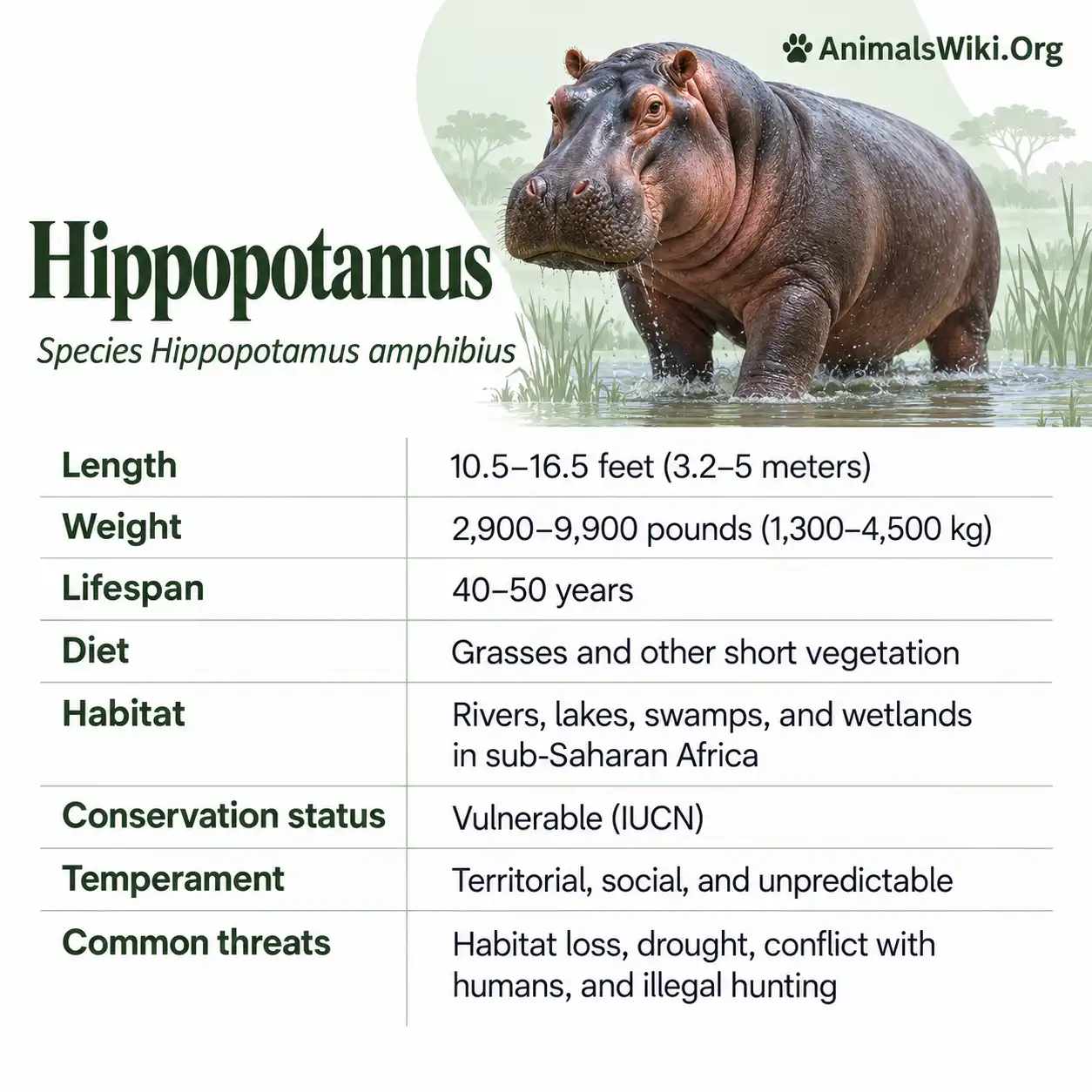
Hippopotamus Quick Facts
| Feature | Information |
|---|---|
| Common Name | Hippopotamus / Hippo |
| Scientific Name | Hippopotamus amphibius |
| Family | Hippopotamidae |
| Order | Artiodactyla |
| Animal Type | Mammal |
| Diet | Primarily herbivorous |
| Native Region | Sub-Saharan Africa |
| Main Habitat | Rivers, lakes, wetlands and nearby grasslands |
| Lifestyle | Semi-aquatic |
| Adult Weight | Commonly around 1,300–3,200+ kg depending on sex and individual |
| Body Length | Roughly 3–5 m in large common hippos |
| Young | Calf |
| Major Weapons | Large canine teeth and jaws |
| Main Food | Grass |
| Activity | Primarily nocturnal feeding |
| Living Hippo Species | 2 |
| Closest Living Relatives | Cetaceans |
| Major Threats | Habitat loss, hunting and human-wildlife conflict |
What Is a Hippopotamus?
A hippopotamus is a large semi-aquatic African mammal belonging to the family Hippopotamidae.
The word hippopotamus comes from Greek roots traditionally translated as:
hippos = horse
potamos = river
The name therefore means approximately “river horse.”
Despite the name, hippos are not closely related to horses.
Horses belong to Perissodactyla, while hippos belong to the even-toed ungulate evolutionary radiation associated with Artiodactyla/Cetartiodactyla.
Modern evolutionary evidence places hippos much closer to whales and dolphins.
Scientific Classification of the Hippopotamus
| Classification | Name |
|---|---|
| Kingdom | Animalia |
| Phylum | Chordata |
| Class | Mammalia |
| Order | Artiodactyla |
| Family | Hippopotamidae |
| Genus | Hippopotamus |
| Species | Hippopotamus amphibius |
The common hippopotamus is the only living member of the genus Hippopotamus.
How Many Hippo Species Are There?
There are two living hippopotamus species.
Common Hippopotamus
Hippopotamus amphibius
This is the familiar giant river-dwelling hippo of sub-Saharan Africa.
Pygmy Hippopotamus
Choeropsis liberiensis
The pygmy hippo is much smaller and lives primarily in forested habitats of West Africa.
Although both belong to Hippopotamidae, their ecology and behavior differ considerably.
Common Hippopotamus
The common hippopotamus is the species most people picture when they hear the word hippo.
It possesses:
- Massive barrel-shaped body
- Enormous head
- Broad muzzle
- Short powerful legs
- Small ears
- High-positioned eyes
- High-positioned nostrils
- Very large canine teeth
- Nearly hairless skin
Common hippos depend heavily on aquatic habitats during the daytime.
At night they leave the water to graze.
Pygmy Hippopotamus
The pygmy hippopotamus is dramatically smaller than its common relative.
It inhabits forest environments in West Africa, particularly areas associated with countries such as Liberia, Côte d’Ivoire, Guinea, and Sierra Leone.
Compared with common hippos, pygmy hippos are generally:
- Smaller
- More solitary
- More forest-adapted
- Less dependent on large open-water systems
They still rely heavily on moist habitats and waterways.
Common Hippo vs. Pygmy Hippo
| Feature | Common Hippo | Pygmy Hippo |
|---|---|---|
| Scientific Name | H. amphibius | C. liberiensis |
| Size | Very large | Much smaller |
| Habitat | Rivers, lakes, wetlands | Forests, streams, swamps |
| Social Behavior | Often congregates | More solitary |
| Aquatic Dependence | Very high | Lower |
| Geographic Range | Much of sub-Saharan Africa | West Africa |
| Adult Weight | Often over 1,000 kg | Usually a few hundred kg |
What Does a Hippopotamus Look Like?
The common hippopotamus has one of the most distinctive body shapes among mammals.
It possesses:
- Barrel-shaped torso
- Enormous head
- Wide mouth
- Small eyes
- Small ears
- Short neck
- Short muscular legs
- Four toes on each foot
- Short tail
- Thick skin
Its body is designed to support tremendous weight while allowing efficient movement both on land and in shallow water.
Hippopotamus Size
The common hippo ranks among the world’s largest living land mammals.
Adults can measure approximately:
3–5 meters (10–16 feet) in body length
Large individuals may stand around:
1.3–1.6 meters (4.3–5.2 feet) at the shoulder
Measurements vary according to sex, age, and individual.
Hippopotamus Weight
Adult males commonly weigh approximately:
1,500–1,800 kg (3,300–4,000 lb)
although very large males can exceed:
3,000 kg (6,600 lb)
Adult females are generally smaller.
Common hippos are therefore among the heaviest terrestrial mammals, surpassed principally by elephants and some rhinoceroses.
What Is the Largest Hippopotamus?
The common hippopotamus is vastly larger than the pygmy hippo.
Exceptionally large males can exceed three metric tons.
However, extremely high historical weight claims should be treated cautiously unless supported by reliable measurements.
Male vs. Female Hippopotamus
Male hippos are called bulls.
Females are called cows.
Young are called calves.
| Feature | Male | Female |
|---|---|---|
| Common Name | Bull | Cow |
| Average Size | Larger | Smaller |
| Territoriality | Strong in dominant males | Generally less territorial |
| Major Weapon | Canines and jaws | Canines and jaws |
| Calf Care | Limited | Extensive |
| Social Role | Territorial defense and mating | Calf protection and social associations |
Males continue growing for much of their lives and can become substantially larger than females.
Hippopotamus Mouth
The hippo’s enormous mouth is one of its most famous features.
A hippo can open its jaws extremely widely.
This dramatic gape serves several purposes.
It can function as:
- Threat display
- Territorial signal
- Fighting posture
- Yawning-like behavior
The wide-open mouth exposes enormous canine teeth.
Hippopotamus Teeth
Adult hippos possess formidable teeth.
Their lower canine teeth can become extremely long.
Unlike the flat grinding teeth used to process grass, the enlarged canines and incisors function largely as weapons.
Male hippos may slash opponents during territorial fights.
Their teeth continue growing and can be sharpened through contact with opposing teeth.
How Big Are Hippo Teeth?
Large lower canines can reach around 50 cm (20 in) or more when measured along their full curvature, although visible length is considerably shorter.
They are among the most formidable canine teeth possessed by any living terrestrial mammal.
Hippopotamus Bite Force
Hippos possess extraordinarily powerful jaws.
Measurements and estimates commonly place their bite force at around 8,000 newtons or more, often popularly converted to roughly 1,800 pounds-force.
Exact numbers vary depending on measurement method and individual.
Rather than focusing on a single number, the important biological point is clear:
A hippo combines enormous jaw muscles with huge canine teeth capable of causing devastating injuries.
Why Do Hippos Have Such Big Teeth if They Eat Grass?
The giant canines are primarily weapons, not feeding adaptations.
Hippos use their broad lips to crop grass.
The enormous teeth are especially useful during:
- Male competition
- Territorial disputes
- Defense
- Threat displays
This illustrates how feeding structures and fighting structures can evolve very different functions within the same mouth.
Hippopotamus Skin
Hippo skin can be several centimeters thick in places.
It provides substantial physical protection.
However, the skin is also vulnerable to drying and prolonged sun exposure.
This is one reason hippos spend so much daytime in water or mud.
Do Hippos Sweat Blood?
No.
The famous phrase “blood sweat” is misleading.
Hippo skin produces oily secretions containing pigments that can appear reddish or orange.
These substances include compounds often called:
- Hipposudoric acid
- Norhipposudoric acid
The secretions can help absorb ultraviolet radiation and possess antimicrobial properties.
They are neither blood nor conventional sweat.
Why Do Hippos Stay in Water?
Water helps hippos:
- Remain cool
- Protect their skin
- Reduce dehydration
- Rest during hot daylight hours
A massive body generates and retains considerable heat.
Spending the day in water provides an efficient cooling strategy.
Where Do Hippos Live?
Wild common hippos occur across parts of sub-Saharan Africa.
Their distribution is associated strongly with permanent or seasonal water.
They occur in countries across:
- East Africa
- Southern Africa
- Central Africa
- Parts of West Africa
Their historic range was considerably larger.
Hippopotamus Habitat
Common hippos inhabit:
- Rivers
- Lakes
- Wetlands
- Floodplains
- Swamps
They require nearby grazing areas because most feeding occurs on land.
An ideal hippo habitat therefore combines:
suitable water + productive grassland
Do Hippos Live in the Jungle?
Common hippos are more strongly associated with rivers, wetlands, lakes, and open grasslands than dense rainforest.
Pygmy hippos, however, are strongly associated with West African forests.
This distinction is important when discussing “hippo habitat.”
Do Hippos Live in Saltwater?
Common hippos are primarily freshwater animals.
They normally inhabit:
- Rivers
- Lakes
- Wetlands
They may occasionally enter brackish or coastal waters, but they are not marine mammals.
What Do Hippos Eat?
Hippos are primarily herbivores.
Grass forms the overwhelming majority of the common hippo’s normal diet.
They may occasionally consume other vegetation.
Their broad muscular lips allow them to crop grass efficiently.
How Much Does a Hippo Eat?
A large hippo can consume roughly 30–40 kg (66–88 lb) of vegetation during a night’s feeding, although intake varies considerably.
Relative to its enormous body size, this is less than some people expect.
Hippos conserve energy by spending much of the day resting.
Do Hippos Eat Meat?
Hippos are primarily herbivorous.
However, rare observations of:
- Scavenging
- Meat consumption
- Cannibalistic behavior
have been documented.
These behaviors are unusual and do not make meat a normal component of the hippo diet.
The digestive system is fundamentally adapted for plant material.
Do Hippos Eat Fish?
Fish are not a normal dietary component.
A hippo sharing water with fish does not mean it is hunting them.
Hippos are fundamentally grazing mammals.
When Do Hippos Eat?
Common hippos are primarily nocturnal feeders.
They typically spend the day resting in water.
Around sunset they emerge and travel onto land.
They may feed for several hours before returning to water around dawn.
How Far Do Hippos Travel for Food?
Hippos may travel several kilometers from water during nighttime feeding.
Individuals often follow established pathways between:
- Water
- Grazing grounds
Repeated movement can create obvious trails through vegetation.
Do Hippos Chew Cud?
No.
Hippos are not true ruminants like cattle, sheep, or antelope.
They possess a complex multi-chambered stomach and use foregut fermentation, but they do not chew cud in the same manner as true ruminants.
Hippopotamus Digestive System
Hippos possess a specialized digestive system capable of processing fibrous vegetation.
Microorganisms ferment plant material before much of it reaches the intestines.
This allows hippos to extract nutrients from grass.
However, their digestive anatomy differs from the four-chambered ruminant system of cattle.
Can Hippos Swim?
The answer requires some nuance.
Hippos move extremely well through water, but they do not normally swim using continuous paddling in the manner of many aquatic mammals.
Instead, they often:
- Walk along the bottom
- Run or bound underwater
- Push themselves from the substrate
- Glide between contacts with the bottom
Their dense bodies make them naturally inclined to remain submerged.
How Do Hippos Move Underwater?
A submerged hippo can push forcefully from the river or lake bottom.
This creates a bounding movement that can look almost like underwater running.
They can also control buoyancy and rise toward the surface for air.
Their aquatic movement is remarkably graceful considering their enormous body mass.
How Long Can Hippos Hold Their Breath?
Common hippos can typically remain underwater for around five minutes, sometimes longer.
They automatically surface to breathe.
They can even perform this behavior while sleeping.
Can Hippos Sleep Underwater?
Yes.
Hippos can sleep while partially or fully submerged.
A reflexive response allows them to rise toward the surface, breathe, and sink again without becoming fully conscious.
This is an extraordinary adaptation to their semi-aquatic lifestyle.
Hippo Eyes, Ears and Nostrils
The eyes, ears, and nostrils are positioned high on the skull.
This allows a hippo to remain almost entirely underwater while keeping these sensory structures above the surface.
When submerged:
- Nostrils close
- Ear openings can close
- Eyes remain protected
This body design is ideal for a semi-aquatic mammal.
Can Hippos See Underwater?
Hippos can function visually underwater, although murky river environments limit visibility.
Their eyes possess protective adaptations associated with aquatic life.
Smell, hearing, and environmental familiarity also contribute to navigation.
Hippopotamus Speed
Despite their enormous bodies and short legs, hippos can move surprisingly quickly on land.
Short-distance estimates commonly reach approximately:
30 km/h (19 mph)
depending on conditions and how speed is measured.
They cannot sustain this pace for long distances.
Can Humans Outrun a Hippo?
Most people should not expect to outrun a charging hippo.
Hippos can accelerate rapidly and are extremely powerful.
The safe strategy is maintaining appropriate distance and avoiding situations where a hippo feels trapped between a person and water.
Do Hippos Gallop?
Hippo locomotion differs from that of horses.
At faster speeds, they can enter an airborne phase in which all four feet temporarily leave the ground.
Their movement is sometimes loosely described as trotting or galloping, although their gait mechanics are distinctive.
Hippopotamus Feet
Hippos possess four toes on each foot.
Their toes spread under load, helping distribute body weight across soft ground.
This is particularly useful around:
- Mud
- Riverbanks
- Wetlands
Their feet are surprisingly well adapted to supporting enormous mass.
Are Hippos Fast in Water?
Hippos can move efficiently underwater by pushing off the bottom.
Exact “swimming speed” claims are difficult because they do not swim conventionally.
Their ability to maneuver underwater is nevertheless impressive.
Hippopotamus Strength
Hippos are enormously powerful animals.
Their physical power comes from:
- Massive body weight
- Muscular neck
- Huge jaws
- Strong legs
- Large canine teeth
There is no scientifically useful single number describing how many times stronger a hippo is than a human.
Their actual advantage is the combination of mass, acceleration, jaws, teeth, and defensive behavior.
Hippopotamus Behavior
Hippo behavior changes dramatically between day and night.
Day
They usually:
- Rest in water
- Socialize
- Defend aquatic territories
- Cool their bodies
Night
They usually:
- Leave the water
- Travel inland
- Graze
- Feed independently
This daily movement connects aquatic and terrestrial ecosystems.
Are Hippos Social?
Yes, particularly in water.
Common hippos can gather in groups containing:
- Females
- Calves
- Subordinate males
- Dominant males
Group size depends on:
- Water availability
- Habitat
- Season
- Population density
However, gathering together does not necessarily mean hippos maintain the same complex cooperative social organization seen in elephants or many primates.
What Is a Group of Hippos Called?
Popular collective nouns include:
- Bloat
- Pod
- Herd
Bloat of hippos is particularly famous.
In biological writing, simply saying group or herd is often clearer.
Hippo Territorial Behavior
Dominant males can defend stretches of water.
A male may tolerate females and subordinate individuals within his territory while aggressively challenging rival males.
Territorial displays include:
- Gaping
- Vocalizations
- Dung spreading
- Chasing
- Fighting
Territoriality is strongest in aquatic habitats.
Hippo Dung Spreading
Hippos possess a particularly unusual scent-marking behavior.
While defecating, a hippo may rapidly rotate its tail.
The tail scatters dung across a wide area.
This behavior can help distribute scent signals and mark territory.
Hippopotamus Communication
Hippos communicate using:
- Grunts
- Bellows
- Honks
- Wheezes
- Roars
- Body posture
- Scent
Some calls can be heard both above and below water.
This allows communication across the boundary between aquatic and terrestrial environments.
Why Do Hippos Open Their Mouths?
A huge open-mouth display is not always a simple yawn.
It can communicate:
- Threat
- Dominance
- Territoriality
- Agitation
The display exposes the animal’s enormous canine teeth and demonstrates fighting capability.
Do Hippos Fight?
Yes.
Adult males can engage in violent territorial battles.
They attack with:
- Canine teeth
- Incisors
- Powerful jaws
- Body weight
Serious fights can result in deep wounds and occasionally death.
Are Hippos Aggressive?
Hippos can be highly defensive and territorial.
Particularly risky situations include:
- Approaching a calf
- Blocking a hippo’s route to water
- Approaching a territorial male
- Surprising an animal at close range
- Traveling between a grazing hippo and its aquatic refuge
They should always be treated as large, potentially dangerous wild animals.
Are Hippos Dangerous to Humans?
Yes.
Human-hippo conflicts occur in parts of Africa where people and hippos use the same:
- Rivers
- Lakes
- Shorelines
- Agricultural areas
Reliable continent-wide annual fatality statistics are difficult to establish, so widely repeated claims assigning an exact number of deaths per year should be treated cautiously.
The biological reality is sufficient: hippos possess the size, speed, teeth, and territorial behavior to be extremely dangerous at close range.
Why Do Hippos Attack Boats?
Hippos may react defensively when boats:
- Approach too closely
- Enter a defended area
- Surprise submerged animals
- Come near calves
- Block movement
Small boats and canoes can be especially vulnerable.
Maintaining distance is essential in hippo habitat.
Hippopotamus Reproduction
Common hippos reproduce sexually and generally give birth to one calf.
Females usually reproduce every few years rather than annually.
Mating often occurs in water.
Hippopotamus Pregnancy
Gestation lasts approximately:
8 months
This is surprisingly short compared with the gestation of similarly massive elephants and rhinoceroses.
Females normally produce one calf.
Twins are rare.
Baby Hippopotamus
A baby hippo is called a calf.
Newborn common hippos may weigh approximately:
25–50 kg (55–110 lb)
although birth weight varies.
A calf is tiny relative to its enormous mother but already heavier than many adult mammals.
Can Hippos Give Birth Underwater?
Yes.
Hippo mothers may give birth in shallow water or on land.
When born in water, the calf must reach the surface to breathe.
Young hippos quickly develop aquatic abilities.
Can Baby Hippos Nurse Underwater?
Yes.
Hippo calves can nurse while submerged.
They can close their nostrils and ears while underwater.
They may also nurse on land.
Hippo Mother and Calf
The relationship between mother and calf is strong.
Mothers provide:
- Milk
- Protection
- Guidance
- Social security
Females can become extremely defensive when calves are threatened.
Young calves remain close to their mothers both in water and on land.
Hippopotamus Lifespan
Common hippos often live approximately:
40–50 years
under favorable conditions.
Some individuals under managed care have lived longer.
Lifespan is affected by:
- Disease
- Injury
- Food availability
- Drought
- Competition
- Human pressures
Hippopotamus Predators
Healthy adult common hippos have few natural predators because of their tremendous size.
Calves are more vulnerable.
Potential predators include:
- Lions
- Nile crocodiles
- Spotted hyenas
Predation on healthy adult hippos is unusual.
Humans are the most significant threat to many populations.
Do Lions Eat Hippos?
Lions may occasionally attack:
- Calves
- Young hippos
- Weakened adults
Groups of lions can sometimes challenge larger individuals, but adult hippos are extremely dangerous prey.
Do Crocodiles Eat Hippos?
Large Nile crocodiles can threaten young hippos.
Adult common hippos are generally too large and dangerous to be normal crocodile prey.
Hippos and crocodiles frequently share waterways.
Their interactions can range from tolerance to aggression.
Do Hippos Eat Crocodiles?
Hippos do not normally hunt crocodiles for food.
They may attack or kill crocodiles during aggressive encounters, particularly when:
- Calves are nearby
- Space is limited
- The hippo feels threatened
Such attacks are defensive or territorial rather than feeding behavior.
Hippopotamus vs. Rhinoceros
| Feature | Hippopotamus | Rhinoceros |
|---|---|---|
| Main Habitat | Semi-aquatic | Primarily terrestrial |
| Main Weapon | Canine teeth and jaws | Horns/body; teeth in some species |
| Feet | 4 toes | 3 toes |
| Horns | None | 1 or 2 |
| Diet | Primarily grass | Herbivorous; grazing or browsing |
| Closest Familiar Relatives | Cetaceans | Horses and tapirs |
| Water Dependence | Very high | Variable |
| Body Shape | Barrel-shaped | Heavy with prominent head/horn |
Despite their similar size, hippos and rhinos belong to very different evolutionary lineages.
Hippopotamus vs. Rhinoceros: Which Is Bigger?
It depends on species and individual.
White rhinos and greater one-horned rhinos can become heavier than many hippos.
Large male common hippos can nevertheless exceed three tonnes.
All three rank among Earth’s largest terrestrial mammals.
Hippopotamus vs. Elephant
Elephants are substantially larger than hippos.
African bush elephants can weigh several tonnes more than a typical adult hippo.
Elephants also possess:
- Trunks
- Tusks
- Large ears
- Highly developed social systems
Hippos are much more specialized for semi-aquatic life.
Hippopotamus vs. Crocodile
| Feature | Hippo | Crocodile |
|---|---|---|
| Animal Group | Mammal | Reptile |
| Body Temperature | Endothermic | Ectothermic |
| Diet | Primarily herbivorous | Carnivorous |
| Young | Live birth | Eggs |
| Main Weapon | Canines/jaws | Teeth/jaws |
| Skin | Mammalian skin | Scales |
| Feeding | Mostly grass | Animal prey |
Both are formidable animals, but their biology is fundamentally different.
Hippopotamus vs. Buffalo
Hippos and African buffalo are both large herbivorous mammals, but buffalo are bovids.
Buffalo:
- Possess horns
- Are ruminants
- Live predominantly on land
- Often form large herds
Hippos:
- Lack horns
- Are semi-aquatic
- Possess huge canine teeth
- Are not true ruminants
Hippopotamus vs. Pig
Hippos were historically associated with pigs in older classifications because both are even-toed ungulates.
Modern evolutionary evidence shows that hippos are more closely related to the lineage containing whales and dolphins.
They are not simply giant aquatic pigs.
Are Hippos Related to Whales?
Yes.
This is one of the most fascinating facts about hippopotamus evolution.
Hippos and cetaceans share a common ancestor within the even-toed ungulate evolutionary radiation.
Genetic and fossil evidence strongly supports this relationship.
Their shared ancestry does not mean modern whales evolved from modern hippos.
Instead, both descended from earlier extinct ancestors.
Did Whales Evolve From Hippos?
No.
Modern whales did not evolve from modern hippos.
Hippos and whales share an ancient common ancestor.
The lineage leading to whales became increasingly aquatic over millions of years, eventually producing fully marine cetaceans.
The lineage leading toward modern hippos followed a different evolutionary path.
Hippopotamus Evolution
The hippo evolutionary story is complex.
Fossil and genetic evidence connects hippopotamids with the broader cetacean lineage.
Ancient relatives differed considerably from modern hippos.
Over millions of years, the lineage evolved adaptations for:
- Large body size
- Herbivory
- Semi-aquatic life
- Powerful jaws
- River and wetland habitats
Several hippo species once existed that are now extinct.
Extinct Hippos
Hippos once had a broader diversity and distribution.
Extinct forms lived in areas including:
- Africa
- Europe
- Mediterranean islands
- Madagascar
Some island hippos evolved dramatically smaller bodies.
Several species of Malagasy hippopotamuses survived until relatively recent geological times before disappearing.
Hippopotamus Adaptations
Hippos possess numerous adaptations for semi-aquatic life.
High-Positioned Eyes
Allow vision while most of the body remains submerged.
High Nostrils
Permit breathing with minimal exposure.
Closable Nostrils
Prevent water entering during submersion.
Closable Ears
Help protect the ear canal underwater.
Dense Body
Allows easy submersion.
Powerful Legs
Enable movement along underwater substrates.
Thick Skin
Provides physical protection.
Protective Skin Secretions
Help reduce UV damage and microbial growth.
Huge Canines
Provide powerful defensive and competitive weapons.
Broad Lips
Efficiently crop grass.
Four-Toed Feet
Distribute body weight on soft substrates.
Hippos and Ecosystems
Hippos connect land and water ecosystems.
At night they feed on terrestrial vegetation.
During the day they return to aquatic environments.
Through:
- Dung
- Urine
- Movement
- Grazing
they transport nutrients between land and water.
This can substantially influence aquatic ecosystems.
Hippo Dung and Rivers
Hippo dung adds:
- Organic matter
- Nitrogen
- Phosphorus
- Other nutrients
to aquatic environments.
At moderate densities this contributes to ecosystem nutrient cycling.
At extremely high densities or during low-water conditions, however, large quantities of organic matter can reduce oxygen levels and alter water chemistry.
Hippos therefore have powerful ecological effects.
Hippo Trails
Repeated nighttime movement between water and grazing areas creates trails.
These pathways can influence:
- Drainage
- Vegetation
- Soil
- Animal movement
Large animals can literally reshape landscapes through repeated movement.
Hippopotamus Conservation
The common hippopotamus is classified as Vulnerable on the IUCN Red List.
Major threats include:
- Habitat loss
- Habitat degradation
- Hunting
- Illegal trade in hippo teeth
- Human-wildlife conflict
- Water extraction
- Agricultural expansion
- Drought and changing water availability
Protection of rivers and surrounding grazing areas is essential.
Why Are Hippos Hunted?
Hippos may be hunted for:
- Meat
- Teeth
- Ivory-like canine material
Hippo teeth have entered wildlife trade partly because they can be carved.
Unregulated or illegal hunting can seriously reduce populations.
Hippo Teeth and Ivory
Hippo canine and incisor teeth contain ivory-like dentine.
Historically, hippo teeth have been used for carving.
Demand can create conservation pressure.
Protecting hippos therefore requires attention not only to habitat but also to wildlife trade.
Human-Hippo Conflict
Conflict occurs where people and hippos depend on the same landscapes.
Problems can involve:
- Crop damage
- Fishing areas
- River crossings
- Boats
- Livestock access
- Human settlements
Reducing conflict can involve:
- Better land-use planning
- Community education
- Safe river access
- Protected corridors
- Effective wildlife management
Long-term hippo conservation depends on making coexistence practical for nearby communities.
Are Hippos Important?
Yes.
Hippos influence ecosystems through:
- Grazing
- Nutrient transport
- Dung deposition
- Trail creation
- Disturbance of aquatic habitats
Their ecological influence means population changes can affect many other organisms.
40 Interesting Hippopotamus Facts
- Hippopotamuses are mammals.
- The common hippo’s scientific name is Hippopotamus amphibius.
- There are two living hippo species.
- The second species is the pygmy hippo.
- Common hippos live in sub-Saharan Africa.
- Pygmy hippos live in West Africa.
- Hippos are semi-aquatic.
- They spend much of the day in water.
- They usually feed at night.
- Grass is their primary food.
- Hippos are mainly herbivores.
- Rare meat consumption has been observed.
- Adult males can weigh well over 1,500 kg.
- Exceptional males can exceed 3,000 kg.
- Hippos have four toes on each foot.
- Their eyes are positioned high on the skull.
- Their ears are also positioned high.
- Their nostrils can close underwater.
- Their ears can close underwater.
- Hippos can remain submerged for several minutes.
- They can surface to breathe while sleeping.
- Hippos do not swim like dolphins.
- They often push from the bottom underwater.
- Hippos can move surprisingly quickly on land.
- Their canine teeth can become enormous.
- Large canines are primarily weapons.
- Hippos possess extremely powerful jaws.
- Their reddish skin secretion is not blood.
- Their skin secretion helps protect against sunlight.
- It also has antimicrobial properties.
- A baby hippo is called a calf.
- Females usually produce one calf.
- Calves can nurse underwater.
- Mothers strongly protect their young.
- Dominant males can defend aquatic territories.
- Hippos communicate using loud vocalizations.
- They spread dung by rapidly moving their tails.
- Hippos are close evolutionary relatives of cetaceans.
- Modern whales did not evolve from modern hippos.
- Hippos help transport nutrients between terrestrial and aquatic ecosystems.
Did You Know?
The hippopotamus is more closely related to whales and dolphins than to rhinoceroses.
At first glance this seems almost impossible.
A hippo is a huge four-legged herbivore that spends every night grazing on land.
A whale possesses flippers, lives entirely in water, and may travel thousands of kilometers through the ocean.
Yet evolutionary relationships are determined by ancestry, not simply appearance.
Genetic and fossil evidence shows that hippos and cetaceans belong to closely related branches of the even-toed ungulate evolutionary tree.
They share an extinct common ancestor.
One lineage eventually produced modern hippopotamuses.
Another produced the extraordinary transition from terrestrial mammals to increasingly aquatic animals and eventually to the fully marine whales, dolphins, and porpoises alive today.
This does not mean that whales evolved from modern hippos.
Instead, hippos and whales can be thought of as distant evolutionary cousins whose ancestors followed dramatically different paths.
Frequently Asked Questions About Hippopotamuses
What is a hippopotamus?
A hippopotamus is a large semi-aquatic African mammal belonging to Hippopotamidae.
What does hippopotamus mean?
The name comes from Greek words commonly translated as “river horse.”
What is the scientific name of a hippo?
The common hippopotamus is Hippopotamus amphibius.
How many hippo species are there?
Two living species: the common hippo and pygmy hippo.
Where do hippos live?
Common hippos live in rivers, lakes, wetlands, and surrounding grasslands across parts of sub-Saharan Africa.
Do hippos live in Africa?
Yes. Both living species are native to Africa.
Do hippos live in the jungle?
Common hippos are primarily associated with open aquatic habitats, while pygmy hippos inhabit West African forests.
Do hippos live in water?
They spend much of their daytime in water but must also use land, particularly for feeding.
Are hippos amphibians?
No. Hippos are mammals.
Are hippos semi-aquatic?
Yes.
Can hippos swim?
They move extremely effectively through water but often do so by walking, running, or bounding along the bottom rather than conventional swimming.
How long can hippos stay underwater?
Usually around five minutes at a time, although duration varies.
Can hippos breathe underwater?
No. They must surface for air.
Can hippos sleep underwater?
Yes. They can reflexively surface to breathe while sleeping.
Do hippos have gills?
No. They possess lungs.
Can hippos close their nostrils?
Yes.
Can hippos close their ears?
Yes.
Why are hippo eyes on top of their heads?
Their position allows a hippo to see while keeping most of its body submerged.
How big is a hippopotamus?
Common hippos can reach approximately 3–5 meters in length.
How much does a hippo weigh?
Adult common hippos often weigh around 1,300–3,200 kg depending on sex and individual.
What is the largest hippo?
The common hippopotamus is the largest living hippo species.
How big is a pygmy hippo?
Pygmy hippos are dramatically smaller, generally weighing only a few hundred kilograms.
What do hippos eat?
Primarily grass.
Are hippos herbivores?
Yes, predominantly.
Do hippos eat meat?
Rare meat consumption and scavenging have been observed, but meat is not a normal part of their diet.
Do hippos eat fish?
Fish are not normal prey.
How much does a hippo eat?
A large common hippo may consume roughly 30–40 kg of vegetation in a night, although intake varies.
When do hippos eat?
Mostly at night.
Why do hippos leave the water at night?
They leave primarily to graze on land.
Do hippos chew cud?
No. They are not true ruminants.
How many teeth does a hippo have?
Adults typically possess around 36 teeth, although numbers can vary.
Why are hippo teeth so big?
The enlarged canine and incisor teeth function primarily as weapons and displays.
How long are hippo teeth?
Large canine teeth can reach around 50 cm or more along their full curvature.
How strong is a hippo bite?
Hippos possess extremely powerful jaws capable of producing forces measured or estimated in the thousands of newtons.
Why do hippos open their mouths so wide?
Wide gaping can function as a territorial or threat display.
Are hippos aggressive?
They can be highly territorial and defensive.
Are hippos dangerous?
Yes. Their size, speed, powerful jaws, and territorial behavior can make close encounters extremely dangerous.
How fast can a hippo run?
Approximately 30 km/h over short distances is commonly cited.
Can a human outrun a hippo?
Most humans should not expect to outrun a charging hippo.
Do hippos sweat blood?
No. Their reddish skin secretion is neither blood nor ordinary sweat.
Why is hippo sweat red?
Special skin pigments give the secretion its reddish-orange appearance.
What does hippo skin secretion do?
It helps protect the skin from ultraviolet radiation and has antimicrobial properties.
What is a baby hippo called?
A calf.
How much does a baby hippo weigh?
Common hippo calves often weigh roughly 25–50 kg at birth.
Can baby hippos swim?
Young hippos quickly become capable of moving through water.
Can baby hippos nurse underwater?
Yes.
How long is a hippo pregnant?
Approximately eight months.
How many babies do hippos have?
Usually one calf.
How long do hippos live?
Common hippos can live approximately 40–50 years, sometimes longer.
What eats hippos?
Calves can be vulnerable to lions, crocodiles, and hyenas. Healthy adults have few natural predators.
Do crocodiles eat hippos?
Large crocodiles may prey on calves, but healthy adult hippos are generally too large and dangerous.
Do hippos eat crocodiles?
No. Hippos do not normally hunt crocodiles for food, although they can attack them.
Do lions eat hippos?
Lions occasionally attack young, weak, or vulnerable hippos.
Are hippos stronger than crocodiles?
A direct strength comparison is not biologically meaningful. Adult hippos possess vastly greater body mass, while crocodiles have their own specialized predatory adaptations.
Are hippos related to pigs?
They share distant ancestry as even-toed ungulates, but hippos are evolutionarily closer to cetaceans.
Are hippos related to whales?
Yes.
Did whales evolve from hippos?
No. Whales and hippos share an extinct common ancestor.
Are hippos related to rhinos?
Not closely.
What is the difference between a hippo and a rhino?
Hippos are semi-aquatic mammals with huge canine teeth and four-toed feet. Rhinos are primarily terrestrial odd-toed ungulates with keratin horns and three-toed feet.
Which is bigger, a hippo or a rhino?
Large white and greater one-horned rhinos can outweigh many hippos, although exceptionally large male hippos can exceed three tonnes.
Are elephants bigger than hippos?
Yes. Large elephants are considerably heavier.
Do hippos have horns?
No.
Do hippos have tusks?
Their enlarged canine and incisor teeth are sometimes informally described as tusks, although they are teeth rather than separate horn structures.
Why do hippos spread their poop?
Rapid tail movement distributes dung and scent, which can contribute to territorial communication.
What is a group of hippos called?
A bloat, herd, or pod.
Are hippos endangered?
The common hippopotamus is classified as Vulnerable, while the pygmy hippo faces an even higher extinction risk.
Why are hippos threatened?
Habitat loss, hunting, wildlife trade, water pressures, and human-wildlife conflict are major threats.
Why are hippos important?
They move nutrients between land and water, influence vegetation, alter waterways, and play significant roles in African ecosystems.
Conclusion
The hippopotamus is far more complex than the familiar image of an enormous animal resting peacefully in an African river.
Its entire body reflects an extraordinary compromise between terrestrial and aquatic life.
A hippo breathes with lungs, feeds mainly on grass, gives birth to live young, and walks on four powerful legs like a terrestrial mammal. Yet its high-positioned eyes, ears, and nostrils, closable nasal openings, dense body, protective skin secretions, and remarkable underwater movement allow it to spend much of its life almost completely submerged.
Its enormous mouth tells another fascinating story.
The broad lips are effective tools for cropping grass, while the gigantic canine teeth behind them serve an entirely different purpose. They are formidable weapons used during defense and competition.
This combination makes the hippo one of the most physically impressive herbivores alive today.
Its evolutionary history is equally surprising.
Despite looking superficially similar to a rhinoceros, the hippo belongs to a completely different mammalian lineage. Its closest living relatives are the cetaceans—whales, dolphins, and porpoises.
The ancestors of modern hippos and whales diverged millions of years ago and followed radically different evolutionary paths, one producing the semi-aquatic river giants of Africa and the other producing mammals that ultimately became completely marine.
Hippos are also important ecosystem engineers.
Every night they leave rivers and lakes to graze on land. Every day they return to water, carrying nutrients with them. Their feeding, trails, dung, movement, and sheer physical presence can alter vegetation, soils, shorelines, and aquatic nutrient cycles.
But sharing landscapes with such large animals creates challenges.
People across Africa depend on many of the same rivers, wetlands, and fertile floodplains used by hippos. Habitat conversion, hunting, wildlife trade, water extraction, agriculture, and direct conflict can place pressure on populations.
The common hippopotamus is consequently classified as Vulnerable.
Conserving hippos requires protecting more than individual animals. It means protecting connected systems of rivers, lakes, wetlands, grazing areas, and movement routes, while finding practical ways for nearby communities to safely share those landscapes.
From a tiny calf nursing underwater beside its mother to a multi-tonne bull defending a river territory with enormous canine teeth, the hippopotamus represents one of the most remarkable combinations of size, strength, aquatic adaptation, evolutionary history, and ecological influence found among living mammals.