Rhinoceros Facts, The Powerful Horned Giants of Africa & Asia
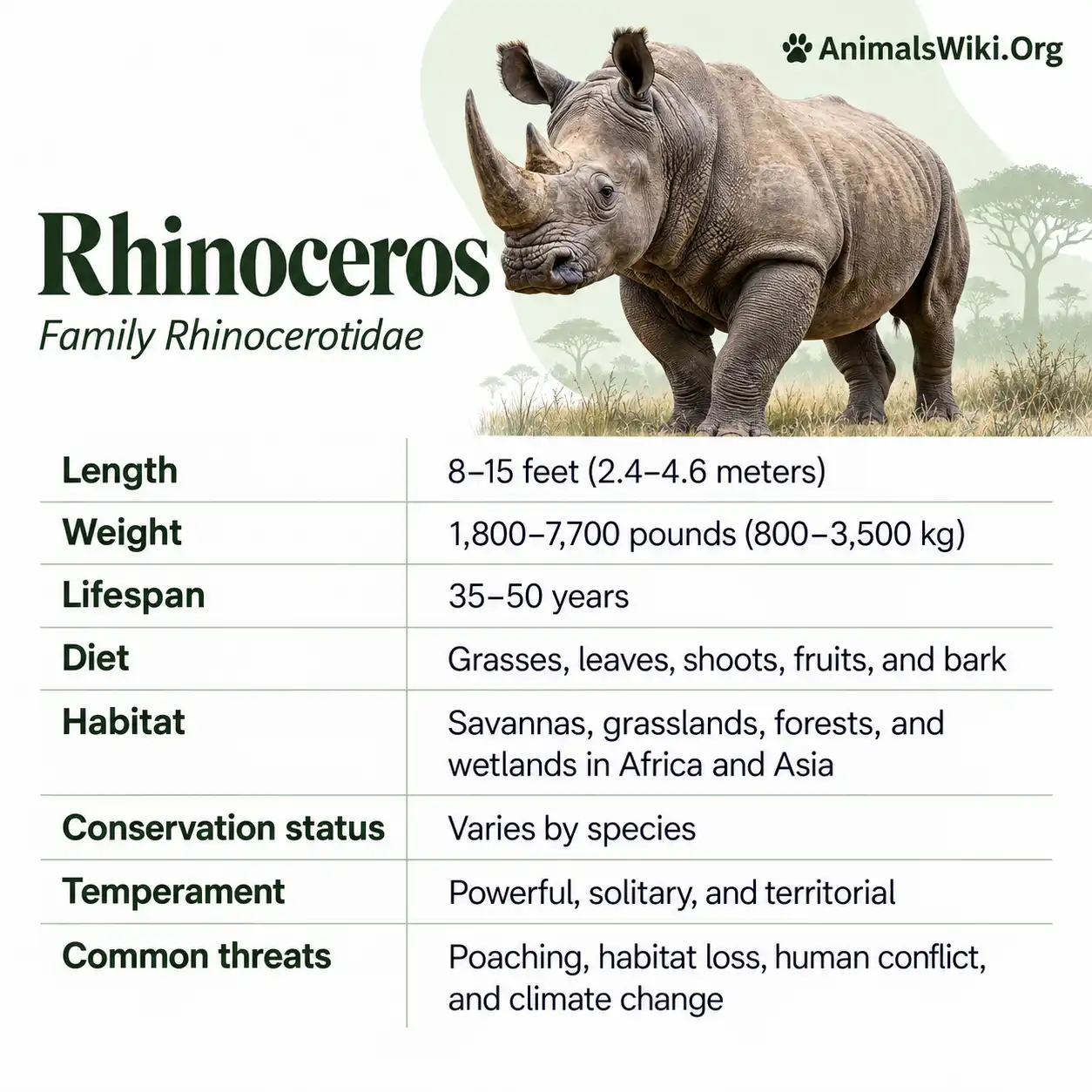
Rhinoceroses, commonly known as rhinos, are enormous herbivorous mammals famous for their massive bodies, thick skin, powerful legs, and distinctive horns. They are among the largest land mammals alive today and belong to an ancient evolutionary lineage that has survived for tens of millions of years.
Once, many different rhinoceros species lived across large parts of Africa, Asia, Europe, and North America. Today, only five living rhinoceros species remain:
- White rhinoceros (Ceratotherium simum)
- Black rhinoceros (Diceros bicornis)
- Greater one-horned rhinoceros (Rhinoceros unicornis)
- Javan rhinoceros (Rhinoceros sondaicus)
- Sumatran rhinoceros (Dicerorhinus sumatrensis)
Two species—the white and black rhinoceros—are native to Africa, while the greater one-horned, Javan, and Sumatran rhinoceroses are native to Asia.
Rhinos are members of the mammalian order Perissodactyla, meaning they are evolutionary relatives of horses, zebras, and tapirs.
Their most famous feature is the horn.
Unlike the horns of cattle, antelope, or goats, a rhinoceros horn does not contain a bony core. It consists mainly of keratin, a structural protein also found in human hair and fingernails.
Different species have either one or two horns.
Although rhinos look heavily armored and intimidating, all living species are herbivores. Depending on the species and habitat, they eat grasses, leaves, shoots, branches, shrubs, fruit, and aquatic vegetation.
Their huge bodies do not make them slow, either. A rhinoceros can accelerate surprisingly quickly and some species can reach roughly 50 km/h (31 mph) or more over short distances.
Rhinos also possess sophisticated senses, social behavior, communication systems, territorial habits, maternal care, and ecological roles that are often overlooked.
Unfortunately, their horns have made them targets of illegal wildlife trafficking.
Poaching, habitat loss, fragmented populations, and slow reproduction continue to threaten rhinos. According to the International Rhino Foundation’s 2026 assessment, only about 26,700 rhinos remain globally across all five species.
This comprehensive guide explores rhinoceros facts, species, habitat, distribution, diet, size, weight, horns, speed, strength, behavior, senses, reproduction, babies, lifespan, adaptations, predators, rhino vs. hippo and elephant differences, conservation, population, poaching, and much more.
Rhinoceros Facts
| Feature | Information |
|---|---|
| Common Name | Rhinoceros / Rhino |
| Family | Rhinocerotidae |
| Class | Mammalia |
| Order | Perissodactyla |
| Diet | Herbivore |
| Living Species | 5 |
| Distribution | Africa and Asia |
| Largest Species | White rhinoceros |
| Smallest Species | Sumatran rhinoceros |
| Horn Material | Primarily keratin |
| Number of Horns | 1 or 2 depending on species |
| Feet | 3 toes on each foot |
| Young | Calf |
| Group Term | Crash |
| Major Senses | Smell and hearing |
| Major Threats | Poaching, habitat loss and fragmentation |
| Global Population | About 26,700 in 2026 |
| Evolutionary Relatives | Horses, zebras and tapirs |
What Is a Rhinoceros?
A rhinoceros is a large, thick-skinned, herbivorous mammal belonging to the family Rhinocerotidae.
The word rhinoceros originates from Greek words referring to the animal’s most obvious characteristic:
rhino = nose
keras = horn
The name therefore essentially means “nose horn.”
Rhinoceroses are odd-toed ungulates, belonging to the order Perissodactyla.
This places them in the same broad evolutionary group as:
- Horses
- Zebras
- Donkeys
- Tapirs
They are not closely related to elephants or hippopotamuses despite similarities in body size.
Scientific Classification of Rhinoceroses
| Classification | Name |
|---|---|
| Kingdom | Animalia |
| Phylum | Chordata |
| Class | Mammalia |
| Order | Perissodactyla |
| Superfamily | Rhinocerotoidea |
| Family | Rhinocerotidae |
The five living species belong to four genera:
Ceratotherium
Diceros
Rhinoceros
Dicerorhinus
How Many Rhino Species Are There?
There are five surviving rhinoceros species.
1. White Rhinoceros
Scientific name: Ceratotherium simum
The white rhino is the largest living rhinoceros.
It occurs primarily in southern Africa, with populations also established or re-established elsewhere.
Its most distinctive feature is its wide, square-shaped mouth, which is highly adapted for grazing grass.
2. Black Rhinoceros
Scientific name: Diceros bicornis
The black rhino is smaller than the white rhino.
It possesses a pointed, flexible upper lip adapted for browsing leaves, branches, and shrubs.
Despite its name, it is not actually black.
3. Greater One-Horned Rhinoceros
Scientific name: Rhinoceros unicornis
Also called the Indian rhinoceros, this enormous Asian species possesses one horn.
Its skin forms deep folds that create an armor-like appearance.
It survives mainly in protected areas of India and Nepal.
4. Javan Rhinoceros
Scientific name: Rhinoceros sondaicus
The Javan rhino is one of the world’s rarest large mammals.
Today, its surviving wild population is restricted to Indonesia.
It possesses a single horn, although females often have only a small horn or knob.
5. Sumatran Rhinoceros
Scientific name: Dicerorhinus sumatrensis
The Sumatran rhino is the smallest living rhinoceros.
It is also the hairiest.
Its reddish-brown body can be covered with noticeable hair, particularly in younger individuals.
The species survives only in Indonesia and is extremely rare.
Rhino Species Comparison
| Species | Scientific Name | Horns | Main Region | Distinctive Feature |
|---|---|---|---|---|
| White Rhino | Ceratotherium simum | 2 | Africa | Wide grazing mouth |
| Black Rhino | Diceros bicornis | 2 | Africa | Pointed browsing lip |
| Greater One-Horned Rhino | Rhinoceros unicornis | 1 | South Asia | Armor-like skin folds |
| Javan Rhino | Rhinoceros sondaicus | 1 | Indonesia | Extremely rare |
| Sumatran Rhino | Dicerorhinus sumatrensis | 2 | Indonesia | Smallest and hairiest |
White Rhinoceros
The white rhinoceros is the largest living rhino species and one of the largest land mammals after elephants.
Large males can weigh well over 2,000 kg (4,400 lb).
Its broad mouth is almost rectangular when viewed from the front.
This shape acts like a natural lawnmower, allowing the rhino to crop large quantities of short grass.
White rhinos are generally more social than black rhinos.
Females and young animals may form small groups.
Why Is the White Rhino Called White?
White rhinos are not actually white.
Their skin is usually gray.
A popular explanation claims that “white” developed from a misunderstanding of an Afrikaans word meaning “wide,” referring to the animal’s mouth.
However, the exact historical origin of the English name remains uncertain.
It is therefore safer not to present the “wide = white” explanation as proven fact.
Black Rhinoceros
Black rhinos are also gray rather than black.
They have a distinctive prehensile upper lip.
The lip can grasp:
- Leaves
- Twigs
- Shoots
- Branches
This makes black rhinos specialized browsers.
They often inhabit:
- Shrubland
- Savanna
- Woodland
- Semi-arid environments
White Rhino vs. Black Rhino
| Feature | White Rhino | Black Rhino |
|---|---|---|
| Size | Larger | Smaller |
| Mouth | Wide and square | Pointed and prehensile |
| Feeding | Primarily grazing | Primarily browsing |
| Head Position | Usually lower | Usually higher |
| Social Behavior | Often more social | Generally more solitary |
| Horns | 2 | 2 |
| Actual Color | Gray | Gray |
The easiest visual distinction is usually the mouth shape, not color.
Greater One-Horned Rhinoceros
The greater one-horned rhino is the largest Asian rhinoceros.
Its deeply folded skin gives it an almost prehistoric, armored appearance.
It inhabits environments including:
- Floodplain grasslands
- Riverine forest
- Wetlands
- Tall grasslands
The species is particularly associated with northern India and Nepal.
Unlike African rhinos, it possesses only one horn.
Javan Rhinoceros
The Javan rhino is among the rarest mammals on Earth.
It once occurred across a much broader area of Southeast Asia.
Today, the surviving population is concentrated in Ujung Kulon National Park in Indonesia.
The International Rhino Foundation’s current estimate is approximately 50 animals, after serious losses linked to poaching.
This extreme concentration creates additional risks because a single catastrophic event could affect much of the species.
Sumatran Rhinoceros
The Sumatran rhino differs dramatically from the other living species.
It is:
- Smaller
- Hairier
- Forest-adapted
- Extremely rare
It is also the living rhino most reminiscent in appearance of some extinct hairy rhinoceros lineages.
Current estimates place the remaining population at only about 34–47 individuals, making it one of the world’s most endangered large mammals.
What Does a Rhinoceros Look Like?
A typical rhinoceros possesses:
- Massive barrel-shaped body
- Large head
- Thick skin
- Short neck
- Powerful legs
- Three-toed feet
- Small eyes
- Mobile ears
- One or two horns
- Short tail
Body shape differs among species according to feeding ecology.
Grazing white rhinos have broad mouths and low head carriage.
Browsing black rhinos have pointed lips and tend to hold their heads higher.
Rhino Skin
Rhino skin looks extremely thick and armor-like.
In some areas, it can measure several centimeters thick.
However, rhino skin is still sensitive.
Rhinos can suffer from:
- Insect bites
- Parasites
- Sun exposure
- Wounds
This helps explain why mud wallowing is so important.
Why Do Rhinos Roll in Mud?
Rhinos frequently wallow in mud.
Mud can:
- Cool the body
- Coat the skin
- Reduce insect irritation
- Provide some protection from sunlight
- Help remove parasites when dried mud rubs away
After wallowing, rhinos may rub against trees or rocks.
Rhinoceros Size
Size differs substantially among species.
White Rhino
Large adults can weigh approximately:
1,800–2,500 kg (4,000–5,500 lb)
with some males exceeding this range.
Black Rhino
Adults commonly weigh approximately:
800–1,400 kg (1,760–3,090 lb)
Greater One-Horned Rhino
Large males may weigh:
1,800–2,700 kg (4,000–6,000 lb)
or more in exceptional cases.
Sumatran Rhino
Generally:
500–800 kg (1,100–1,760 lb)
This makes the Sumatran rhino the smallest living species.
Exact measurements vary considerably among individuals and sources.
What Is the Largest Rhinoceros?
The white rhinoceros is generally considered the largest living rhinoceros species.
Large males can exceed two metric tons.
The greater one-horned rhinoceros can approach similar massive sizes.
Both rank among Earth’s largest terrestrial mammals.
What Is the Smallest Rhinoceros?
The Sumatran rhinoceros is the smallest living rhino.
Yet “small” is relative.
An adult can still weigh several hundred kilograms.
Male vs. Female Rhinoceros
Male rhinos are called bulls.
Females are called cows.
Young rhinos are called calves.
Males are generally larger than females, although the degree of difference varies among species.
| Feature | Male | Female |
|---|---|---|
| Name | Bull | Cow |
| Typical Size | Larger | Smaller |
| Territorial Behavior | Often stronger | Usually less territorial |
| Calf Care | Usually little | Extensive |
| Reproductive Role | Competes for mating access | Raises calf |
Rhino Horn
The rhinoceros horn is one of the most distinctive structures in the animal kingdom.
Unlike cattle horns, it lacks a central bony core.
Instead, rhino horn is composed mainly of densely packed keratin.
Keratin also forms:
- Human hair
- Fingernails
- Animal claws
- Hooves
The horn grows from specialized skin tissue.
How Many Horns Does a Rhino Have?
It depends on species.
Two horns:
- White rhinoceros
- Black rhinoceros
- Sumatran rhinoceros
One horn:
- Greater one-horned rhinoceros
- Javan rhinoceros
The front horn is generally the larger horn in two-horned species.
Does Rhino Horn Grow Back?
Rhino horn can regrow if it is damaged or removed without destroying the growth tissue.
This is one reason conservationists sometimes use carefully managed dehorning as part of anti-poaching programs.
However, dehorning alone cannot protect rhinos.
Security, monitoring, intelligence gathering, and law enforcement remain necessary.
What Is Rhino Horn Used For?
Rhinos naturally use their horns for:
- Defense
- Fighting
- Threat displays
- Protecting calves
- Interacting with vegetation
Unfortunately, illegal demand for horn has driven extensive poaching.
There is no scientific basis for treating rhino horn as a magical substance simply because of its origin.
Rhino Feet
Rhinos have three toes on each foot.
This characteristic reflects their membership in Perissodactyla, the odd-toed ungulates.
Their broad feet distribute enormous body weight across the ground.
Are Rhinos Related to Horses?
Yes.
It may seem surprising, but rhinoceroses are more closely related to horses and tapirs than to elephants.
All belong to Perissodactyla.
Living members include:
- Rhinoceroses
- Horses
- Zebras
- Donkeys
- Tapirs
Where Do Rhinos Live?
Modern wild rhinos survive in parts of Africa and Asia.
African Rhinos
White and black rhinos occur primarily in protected areas of southern and eastern Africa.
Asian Rhinos
Greater one-horned rhinos survive primarily in India and Nepal.
Javan and Sumatran rhinos survive in Indonesia.
Historically, rhinos occupied a dramatically larger geographic range.
Rhinoceros Habitat
Different rhino species occupy different habitats.
These include:
- Savanna
- Grassland
- Shrubland
- Woodland
- Tropical rainforest
- Floodplain
- Wetland
- Swamp forest
This diversity demonstrates that rhinoceroses are not exclusively savanna animals.
African Rhino Habitat
White rhinos favor habitats containing abundant grass.
Black rhinos can occupy:
- Bushland
- Woodland
- Savanna
- Semi-desert shrubland
Availability of:
- Food
- Water
- Shade
- Mud wallows
strongly influences habitat use.
Asian Rhino Habitat
Greater one-horned rhinos are strongly associated with productive floodplain ecosystems.
Javan rhinos inhabit tropical forest environments.
Sumatran rhinos occupy dense tropical forests and mountainous forest landscapes.
What Do Rhinos Eat?
All living rhinos are herbivores.
Depending on species, foods include:
- Grass
- Leaves
- Twigs
- Shoots
- Shrubs
- Branches
- Fruit
- Aquatic plants
Their mouths have evolved according to their feeding strategies.
Grazing vs. Browsing Rhinos
Grazers
White rhinos specialize heavily in grass.
Their broad mouths allow them to crop vegetation efficiently.
Browsers
Black rhinos use their pointed upper lips to grasp leaves and branches.
Sumatran and Javan rhinos also consume diverse forest vegetation.
Greater one-horned rhinos eat grasses as well as other vegetation.
How Much Does a Rhino Eat?
A large rhinoceros must consume substantial quantities of vegetation.
Exact daily intake varies according to:
- Species
- Body size
- Food quality
- Season
- Habitat
Large herbivores spend substantial portions of their active periods feeding.
Do Rhinos Eat Meat?
No.
Rhinos are herbivores.
Their digestive anatomy and teeth are adapted to processing vegetation.
They do not hunt other animals for food.
Rhino Teeth
Rhino dental anatomy varies among species.
Their teeth are adapted for cutting and grinding plant material.
Some Asian rhinos possess large lower incisors that can become important weapons during fights.
African rhinos lack prominent front incisors and rely more heavily on their horns during confrontation.
Do Rhinos Drink Water?
Yes.
Rhinos regularly drink when water is available.
Water sources also provide opportunities for:
- Cooling
- Wallowing
- Social interaction
Some species may travel considerable distances between feeding and drinking areas.
Rhinoceros Speed
A rhinoceros may look slow because of its enormous size.
That impression is misleading.
Some rhinos can reach roughly 50 km/h (31 mph) or more over short distances.
They can accelerate quickly and change direction more effectively than their appearance suggests.
Can a Human Outrun a Rhino?
Generally, no.
A charging rhinoceros can easily outrun most humans.
The appropriate response around wild rhinos is prevention—maintaining safe distance and following trained wildlife-guide instructions—rather than attempting to test their speed.
Rhinoceros Strength
Rhinos are extraordinarily powerful.
Their strength comes from:
- Massive body weight
- Muscular neck
- Powerful shoulders
- Strong legs
- Low center of gravity
A charging adult can generate tremendous force.
Exact claims assigning a numerical “strength multiplier” compared with humans are not scientifically meaningful.
Rhino Senses
Rhinos rely heavily on:
Smell
Their sense of smell is highly developed.
Hearing
Large mobile ears can rotate toward sounds.
Vision
Rhino eyesight is generally considered less acute than their smell and hearing.
This sensory combination can influence their defensive behavior.
Can Rhinos See Well?
Rhinos can see, but their vision is relatively limited compared with their excellent smell and hearing.
They may have difficulty identifying distant stationary objects.
A rhino detecting an unfamiliar smell or sound without clearly identifying its source may become cautious or defensive.
Rhino Ears
Rhino ears are surprisingly expressive.
They can rotate independently toward sounds.
Ear position may also provide clues to the animal’s attention and emotional state.
Rhino Communication
Rhinos communicate through:
- Vocalizations
- Scent
- Dung
- Urine
- Body posture
- Physical contact
Sounds can include:
- Grunts
- Snorts
- Squeals
- Bellows
- Growls
Different species possess different vocal repertoires.
Rhino Dung Middens
Some rhinos repeatedly defecate at communal sites called middens.
These are not merely waste piles.
Dung contains chemical information that may help communicate:
- Identity
- Sex
- Reproductive condition
- Territorial presence
Rhinos can investigate these scent signals using their highly developed sense of smell.
Are Rhinos Solitary?
It depends on the species, sex, age, and circumstances.
Black rhinos are often relatively solitary.
White rhinos can be more social, particularly females and younger animals.
Greater one-horned rhinos may gather around:
- Water
- Feeding areas
- Mud wallows
Even solitary rhinos participate in complex networks of scent communication and overlapping ranges.
What Is a Group of Rhinos Called?
A group of rhinos is commonly called a crash.
However, this is a popular collective noun rather than a description of a permanent social unit.
Many rhinos spend substantial time alone.
Are Rhinos Territorial?
Adult males of several species can establish territories.
They may mark them using:
- Dung
- Urine
- Scent
- Scraping
Territorial boundaries can overlap with the ranges of females.
Male disputes can become aggressive.
Do Rhinos Fight?
Yes.
Rhinos may fight over:
- Territory
- Mates
- Dominance
- Personal space
They can use:
- Horns
- Body weight
- Head movements
- Teeth in some Asian species
Serious fights can cause major injuries.
Are Rhinos Aggressive?
Rhinos should not simply be labeled naturally aggressive.
Behavior depends on:
- Species
- Individual
- Situation
- Presence of calves
- Previous disturbance
- Ability to escape
A frightened or surprised rhino may charge defensively.
Black rhinos are particularly famous for defensive charges.
Rhinoceros Reproduction
Rhinos reproduce slowly.
Females generally give birth to one calf at a time.
Twins are extremely rare.
Gestation lasts approximately 15–18 months, depending on species.
This is among the longest pregnancy periods among terrestrial mammals.
Baby Rhinoceros
A baby rhino is called a calf.
Despite being a “baby,” a newborn can already weigh tens of kilograms.
Calves can stand and begin moving relatively soon after birth.
They remain closely attached to their mothers.
Rhino Mother and Calf
Female rhinos are highly protective mothers.
A calf follows its mother while learning:
- Feeding locations
- Water sources
- Travel routes
- Social behavior
- Environmental dangers
A mother may aggressively defend her calf against perceived threats.
How Long Do Rhino Calves Stay With Their Mothers?
Calves may remain with their mothers for approximately two to four years, depending on species and circumstances.
A mother often becomes less tolerant of an older calf as the next birth approaches.
Rhino Pregnancy
Gestation differs among species but generally lasts around:
15–18 months
This long pregnancy, combined with prolonged maternal care, produces a slow reproductive rate.
That is a major conservation issue.
Populations cannot rapidly replace adults killed by poaching.
Rhinoceros Lifespan
Rhinos can live for several decades.
Depending on species and conditions, lifespans of approximately 35–50 years are possible.
Longevity is influenced by:
- Species
- Habitat quality
- Disease
- Injury
- Food availability
- Human pressure
Rhinoceros Adaptations
Rhinos possess numerous adaptations that allow them to survive as giant herbivores.
Massive Body
Large size discourages many predators.
Thick Skin
Provides physical protection.
Horns
Useful for defense and competition.
Powerful Legs
Support enormous body mass.
Three-Toed Feet
Help distribute weight.
Strong Sense of Smell
Helps detect other rhinos and potential danger.
Mobile Ears
Improve sound detection.
Specialized Lips
Allow efficient feeding.
Mud Wallowing
Helps with cooling and skin protection.
Large Digestive System
Allows processing of fibrous vegetation.
Do Rhinos Sweat?
Rhinos have limited ability to cool themselves through sweating compared with humans.
They rely substantially on behavioral cooling methods such as:
- Seeking shade
- Resting during hot periods
- Drinking
- Wallowing in mud
Do Rhinos Swim?
Yes, although ability and behavior differ by species.
Greater one-horned rhinos are particularly comfortable around water and can swim.
African rhinos also use water and mud, although deep-water behavior varies.
Can Rhinos Jump?
Rhinos are not adapted for jumping like deer or horses.
Their massive body and limb structure favor:
- Walking
- Trotting
- Charging
rather than leaping.
Do Rhinos Have Natural Predators?
Healthy adult rhinos have few natural predators because of their enormous size.
However, calves can potentially be attacked by:
- Lions
- Tigers, where ranges historically or currently overlap
- Crocodiles in some environments
- Hyenas
Mothers provide powerful protection.
Humans represent the greatest threat to modern rhinos.
Lions vs. Rhinos
Lions generally avoid healthy adult rhinos.
However, lions may occasionally attack:
- Calves
- Injured individuals
- Vulnerable rhinos
An adult rhino is an extremely dangerous target.
Tigers vs. Rhinos
In Asian ecosystems, tigers can potentially prey upon young or vulnerable greater one-horned rhinos.
Healthy adults are generally too large and dangerous to be normal prey.
Rhinoceros vs. Hippopotamus
| Feature | Rhinoceros | Hippopotamus |
|---|---|---|
| Order | Perissodactyla | Artiodactyla |
| Diet | Herbivore | Primarily herbivorous |
| Horn | Present | Absent |
| Main Weapon | Horn/body; teeth in some species | Huge canine teeth |
| Lifestyle | Primarily terrestrial | Semi-aquatic |
| Closest Familiar Relatives | Horses and tapirs | Cetaceans are close living relatives within cetartiodactyl evolution |
| Feet | 3 toes | 4 toes |
Despite their superficial resemblance, rhinos and hippos are not particularly close relatives.
Rhinoceros vs. Elephant
| Feature | Rhino | Elephant |
|---|---|---|
| Family | Rhinocerotidae | Elephantidae |
| Horn/Tusk | Keratin horn | Ivory tusks |
| Nose | Normal muzzle | Trunk |
| Toes | 3 main toes | Different foot structure |
| Social Structure | Often solitary or small associations | Highly social in many populations |
| Diet | Herbivore | Herbivore |
| Largest Size | Several tonnes | Larger |
Elephants are generally larger and have more complex matriarchal herd structures.
Rhino vs. Buffalo
Rhinos are not cattle.
Buffalo belong to the family Bovidae and possess true horns with bony cores covered by keratin.
Rhino horns are structurally different.
Buffalo are also ruminants, while rhinos are hindgut fermenters.
Rhino vs. Horse
Rhinos and horses look extremely different but share evolutionary ancestry as odd-toed ungulates.
Both possess digestive systems adapted for hindgut fermentation.
However, rhinos have:
- Three toes
- Massive bodies
- Horns
- Much thicker skin
while modern horses possess a single dominant hoof on each foot.
Woolly Rhinoceros
The woolly rhinoceros (Coelodonta antiquitatis) was an extinct Ice Age rhinoceros.
It inhabited cold environments across Eurasia.
Adaptations included:
- Thick fur
- Massive body
- Large horns
- Cold-resistant anatomy
It lived alongside animals such as:
- Woolly mammoths
- Reindeer
- Steppe bison
- Cave lions
The species disappeared near the end of the Pleistocene.
Were There Giant Prehistoric Rhinos?
Yes.
The rhinoceros evolutionary family tree once contained remarkable forms.
One famous relative, Paraceratherium, was a gigantic hornless rhinoceros relative and among the largest land mammals known.
It lived tens of millions of years ago.
The existence of such animals demonstrates that today’s five rhino species represent only a tiny surviving fraction of a once much more diverse lineage.
How Long Have Rhinos Existed?
Rhinoceros relatives have existed for more than 50 million years.
Over evolutionary history, rhino relatives ranged across:
- Africa
- Asia
- Europe
- North America
Some were small.
Others were enormous.
Some possessed horns.
Others did not.
Rhinoceros Conservation Status
The conservation picture differs dramatically among species.
As of the latest 2026 International Rhino Foundation assessment, approximately 26,700 rhinos survive globally.
Recent estimates include approximately:
| Species | Recent Population Estimate |
|---|---|
| White Rhino | 15,752 |
| Black Rhino | 6,788 |
| Greater One-Horned Rhino | 4,075 |
| Javan Rhino | ~50 |
| Sumatran Rhino | ~34–47 |
These figures illustrate enormous differences between species.
The black rhino population has increased compared with earlier estimates, and greater one-horned rhinos have also increased. White rhinos have recently declined, while Javan and Sumatran rhinos remain in exceptionally precarious situations.
Why Are Rhinos Endangered?
Major threats include:
Poaching
Illegal hunting for rhino horn remains one of the greatest threats.
Habitat Loss
Agriculture, development, infrastructure, and other land-use changes reduce habitat.
Habitat Fragmentation
Separated populations can have difficulty finding mates and maintaining genetic diversity.
Small Population Size
Javan and Sumatran rhinos are particularly vulnerable because so few individuals remain.
Slow Reproduction
Females cannot rapidly replace animals lost from populations.
Human-Wildlife Conflict
Rhinos can encounter people and agriculture where natural habitats overlap with human land use.
Rhino Poaching
Poaching has devastated rhinoceros populations.
Rhinos are illegally killed primarily for their horns.
The consequences extend beyond the individual animal.
If a reproductive female is killed:
- Her calf may die
- Future offspring are lost
- Population recovery slows
- Social and genetic structure can be affected
Modern anti-poaching efforts include:
- Ranger patrols
- Intelligence gathering
- Surveillance
- Forensic science
- Law enforcement
- Community partnerships
- Monitoring
- Strategic dehorning in some populations
Does Dehorning Save Rhinos?
Dehorning can reduce the incentive for poachers in certain situations, but it is not a complete solution.
Horns regrow.
Some poachers may still kill dehorned rhinos.
The International Rhino Foundation emphasizes that dehorning must be combined with effective security and monitoring.
Rhino Conservation Success Stories
The rhinoceros conservation story is not entirely one of decline.
The greater one-horned rhinoceros has increased substantially through protection and habitat management.
Black rhino numbers have also recovered dramatically from their lowest levels.
Current estimates put black rhinos at about 6,788 and greater one-horned rhinos at about 4,075.
These recoveries demonstrate that sustained conservation can work.
Why Are Javan Rhinos So Vulnerable?
The Javan rhino is especially vulnerable because essentially its entire surviving population is concentrated in one area.
A single population can potentially be affected by:
- Disease
- Poaching
- Natural disasters
- Habitat changes
- Reproductive problems
Current estimates suggest only about 50 Javan rhinos remain.
Why Are Sumatran Rhinos So Rare?
Sumatran rhinos face both population decline and extreme fragmentation.
When individuals become isolated, they may struggle to find mates.
Low reproductive rates make recovery especially difficult.
Current estimates suggest only about 34–47 remain.
Conservation breeding is therefore an important part of efforts to prevent extinction.
Why Are Rhinos Important?
Rhinos can influence entire ecosystems.
Large herbivores alter vegetation through feeding and movement.
Grazing rhinos can help shape:
- Grassland structure
- Plant communities
- Paths
- Nutrient distribution
Their dung also provides resources for:
- Dung beetles
- Insects
- Microorganisms
Rhinos as Umbrella Species
Protecting large landscapes for rhinoceroses can simultaneously protect many other species.
This is why rhinos are often considered umbrella species.
Protected rhino landscapes may also conserve:
- Elephants
- Antelopes
- Big cats
- Birds
- Reptiles
- Insects
- Native vegetation
Rhino conservation can therefore produce ecosystem-wide benefits.
Rhinoceros and Oxpecker Relationship
African rhinos are often seen carrying oxpeckers.
These birds feed on:
- Ticks
- Other small organisms
- Material associated with wounds
Oxpeckers may also react loudly to approaching danger, potentially providing additional warning.
The relationship is more complicated than the simplistic idea that the birds only “clean” rhinos, but the association is one of Africa’s most recognizable wildlife interactions.
40 Interesting Rhinoceros Facts
- Rhinoceroses are mammals.
- They belong to Rhinocerotidae.
- Five living species survive.
- Two species are native to Africa.
- Three species are native to Asia.
- White rhinos are the largest living rhinos.
- Sumatran rhinos are the smallest.
- Sumatran rhinos are noticeably hairy.
- White rhinos have broad mouths.
- Black rhinos have pointed prehensile lips.
- Greater one-horned rhinos possess armor-like skin folds.
- Javan rhinos are exceptionally rare.
- Rhino horn is primarily keratin.
- Rhino horn is not bone.
- Some rhinos have one horn.
- Others have two.
- Rhinos are herbivores.
- White rhinos primarily graze.
- Black rhinos primarily browse.
- Rhinos have three toes on each foot.
- They are related to horses.
- They are also related to tapirs.
- Rhinos are not close relatives of elephants.
- They possess excellent smell.
- Their hearing is also highly developed.
- Their eyesight is comparatively limited.
- Rhinos frequently wallow in mud.
- Mud helps cool and protect their skin.
- Rhinos can run surprisingly quickly.
- A baby rhino is called a calf.
- Adult males are called bulls.
- Adult females are called cows.
- A group can be called a crash.
- Rhino pregnancies last well over a year.
- Females usually produce one calf.
- Rhinos can live for several decades.
- Healthy adults have few natural predators.
- Humans are their greatest modern threat.
- Roughly 26,700 rhinos remain globally according to the 2026 assessment.
- Protecting rhino habitat benefits many other animals.
Did You Know?
Rhinos are more closely related to horses than to elephants.
Their enormous bodies, thick skin, and horns make rhinos seem superficially similar to elephants or hippos.
Evolution tells a different story.
Rhinos belong to the mammalian order Perissodactyla, the odd-toed ungulates.
The surviving members of this group include:
Rhinos
Horses
Zebras
Donkeys
Tapirs
One clue is visible directly beneath a rhino.
A rhinoceros has three toes on each foot.
Modern horses took a different evolutionary path, reducing their functional toes until a single central digit became dominant and formed the hoof.
Rhinos therefore represent one surviving branch of an ancient and once remarkably diverse family of odd-toed mammals.
Frequently Asked Questions About Rhinoceroses
What is a rhinoceros?
A rhinoceros is a large herbivorous mammal belonging to the family Rhinocerotidae.
What does rhinoceros mean?
The word comes from Greek roots referring to a “nose horn.”
How many rhinoceros species are there?
Five living species.
What are the five rhino species?
White, black, greater one-horned, Javan, and Sumatran rhinoceroses.
Where do rhinos live?
Wild rhinos survive in parts of Africa and Asia.
Do rhinos live in Africa?
Yes. White and black rhinos are African species.
Do rhinos live in Asia?
Yes. Greater one-horned, Javan, and Sumatran rhinos are Asian species.
What is the largest rhinoceros?
The white rhinoceros.
What is the smallest rhinoceros?
The Sumatran rhinoceros.
How much does a rhino weigh?
Depending on species, adults may range from roughly 500 kg to well above 2,000 kg.
What are rhino horns made of?
Primarily keratin.
Are rhino horns made of bone?
No.
Are rhino horns made from hair?
Not literally bundled hair, although horn and hair both contain keratin.
Does a rhino horn grow back?
It can regrow if the growth tissue remains intact.
How many horns does a rhino have?
Depending on species, one or two.
Which rhino has one horn?
Greater one-horned and Javan rhinos.
Which rhinos have two horns?
White, black, and Sumatran rhinos.
What do rhinos eat?
Grass, leaves, branches, shoots, shrubs, fruit, and other vegetation depending on species.
Do rhinos eat meat?
No. They are herbivores.
What is the difference between a white and black rhino?
White rhinos are larger and have broad grazing mouths, while black rhinos possess pointed browsing lips.
Are white rhinos actually white?
No. They are gray.
Are black rhinos actually black?
No. They are also generally gray.
How fast can a rhino run?
Some can reach around 50 km/h or more over short distances.
Can humans outrun rhinos?
Most people cannot outrun a charging rhinoceros.
Are rhinos strong?
Yes. Their enormous body mass and muscular build make them exceptionally powerful.
Can rhinos swim?
Yes, although aquatic behavior varies among species.
Can rhinos jump?
They are not specialized for jumping.
Do rhinos have good eyesight?
Their eyesight is relatively limited compared with their strong hearing and smell.
Can rhinos hear well?
Yes.
Can rhinos smell well?
Yes. Smell is an extremely important sense.
Why do rhinos roll in mud?
Mud helps cool them and can protect their skin from insects and sunlight.
What is a baby rhino called?
A calf.
What is a male rhino called?
A bull.
What is a female rhino called?
A cow.
What is a group of rhinos called?
A crash is a commonly used collective term.
How long is a rhino pregnant?
Approximately 15–18 months depending on species.
How many babies do rhinos have?
Usually one calf at a time.
How long do rhino calves stay with their mothers?
Often around two to four years.
How long do rhinos live?
Approximately 35–50 years is possible depending on species and conditions.
Do rhinos have predators?
Healthy adults have few natural predators. Calves are more vulnerable.
Do lions eat rhinos?
Lions occasionally attack calves or vulnerable individuals but healthy adults are extremely dangerous prey.
Do tigers eat rhinos?
Tigers may occasionally prey on young or vulnerable Asian rhinos, but adult rhinos are not normal prey.
Are rhinos related to elephants?
Not closely.
Are rhinos related to horses?
Yes. Both belong to Perissodactyla.
Are rhinos related to hippos?
They are not close relatives.
What is the difference between a rhino and a hippo?
Rhinos are odd-toed ungulates with horns and primarily terrestrial lifestyles; hippos are semi-aquatic even-toed ungulates with enormous canine teeth.
Are rhinos dinosaurs?
No.
Rhinos are mammals whose evolutionary history began long after non-avian dinosaurs appeared.
Did woolly rhinos exist?
Yes. Woolly rhinoceroses lived across Eurasia during the Ice Age.
Are woolly rhinos still alive?
No. They are extinct.
How many rhinos are left in the world?
The latest 2026 International Rhino Foundation assessment estimates approximately 26,700 rhinos globally across all five species.
How many Javan rhinos are left?
Recent estimates are around 50.
How many Sumatran rhinos are left?
Recent estimates are approximately 34–47.
Are rhinos endangered?
Conservation status varies by species, but four of the five surviving species are threatened with extinction, and three are Critically Endangered.
Why are rhinos endangered?
Poaching, habitat loss, fragmented populations, slow reproduction, and human pressures are major causes.
Why are rhinos poached?
They are primarily targeted for illegal trade in their horns.
Does cutting off a rhino’s horn save it?
Dehorning can sometimes reduce poaching risk but must be combined with security, monitoring, and other conservation measures.
Why are rhinos important?
They influence vegetation, nutrient cycling, and habitat structure, while protecting rhino landscapes benefits many other species.
Conclusion
Rhinoceroses are among the most powerful and extraordinary mammals remaining on Earth.
Their enormous bodies, thick skin, distinctive horns, three-toed feet, highly developed sense of smell, surprising running speed, and specialized feeding adaptations represent millions of years of evolution.
Yet there is no single “typical” rhinoceros.
The grass-eating white rhinoceros of Africa differs dramatically from the browsing black rhinoceros.
The massive greater one-horned rhinoceros moves through South Asian grasslands and wetlands wearing deeply folded skin that resembles natural armor.
The secretive Javan rhinoceros survives in a tiny Indonesian population.
And the small, hairy Sumatran rhinoceros represents one of the most distinctive and endangered branches of the entire rhino family.
Their evolutionary history is even larger than today’s animals suggest.
For more than 50 million years, rhinoceros relatives have occupied Earth. They once ranged through Africa, Asia, Europe, and North America and evolved into forms ranging from relatively small animals to enormous hornless giants.
Only five species remain.
Their survival now depends heavily on human decisions.
The latest 2026 assessment estimates that roughly 26,700 rhinos remain worldwide. White rhinos account for the majority, while the Javan and Sumatran species survive in populations numbering only in the dozens.
There are reasons for hope.
Black rhino numbers have recovered significantly from historic lows, and greater one-horned rhinos have also increased through sustained conservation. These successes demonstrate that habitat protection, anti-poaching enforcement, population management, reintroduction, scientific monitoring, and community involvement can make a measurable difference.
But recovery is slow.
A female rhinoceros invests well over a year in pregnancy and then spends years caring for a calf. Every breeding adult lost to poaching can therefore represent years of lost population growth.
Protecting rhinos also means protecting much more than rhinos.
These enormous herbivores help shape vegetation and redistribute nutrients, while the landscapes necessary to support viable rhino populations provide habitat for thousands of other organisms.
From the enormous white rhinoceros grazing African grasslands to one of the world’s last Javan rhinos moving silently through Indonesian forest, each surviving species represents an irreplaceable branch of mammalian evolution.
Keeping all five alive would preserve not merely some of Earth’s largest animals, but a biological lineage that has survived for tens of millions of years.