
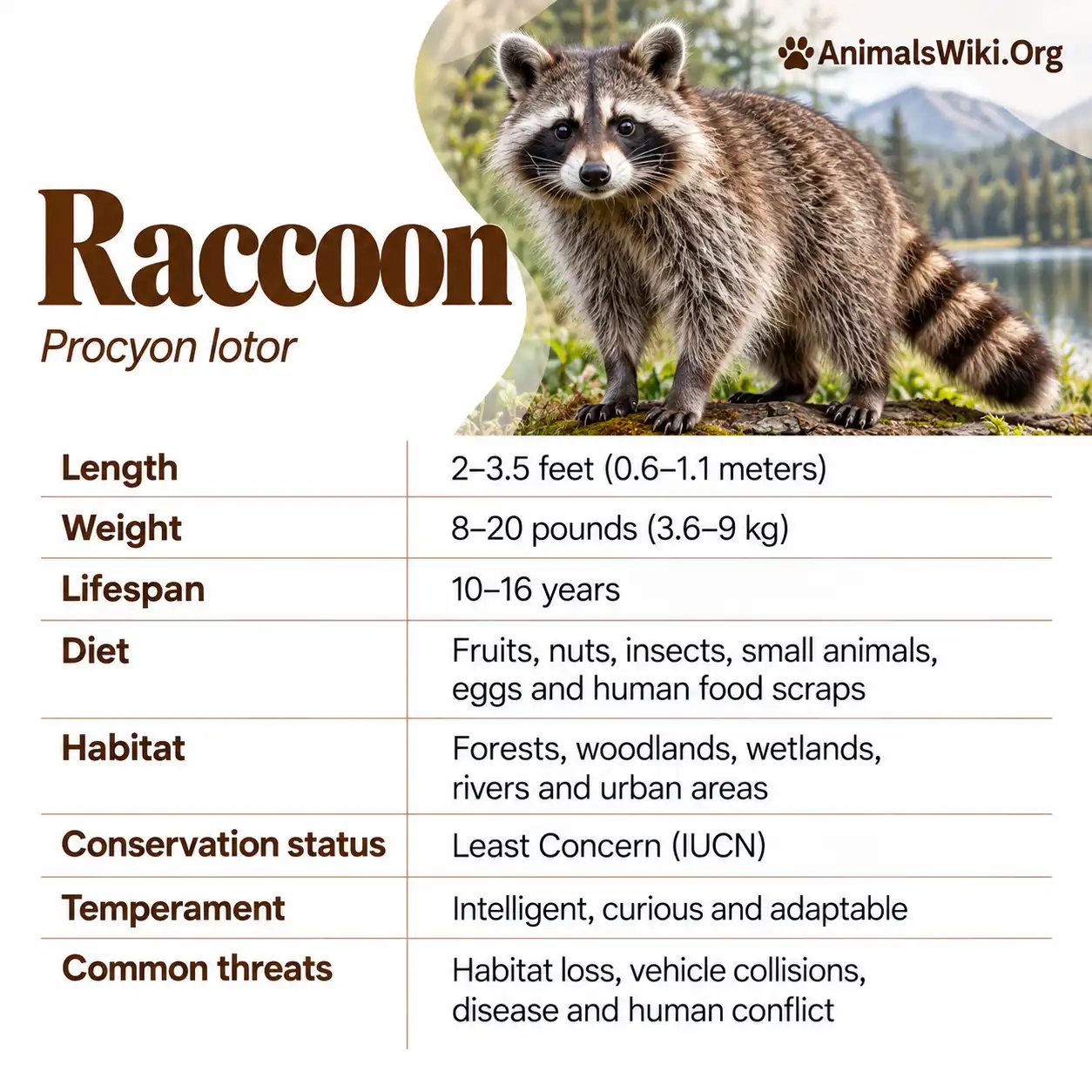
Raccoon Facts
| Feature | Details |
|---|---|
| Common Name | Raccoon |
| Scientific Name | Procyon lotor |
| Family | Procyonidae |
| Order | Carnivora |
| First Described | 1758 (by Carl Linnaeus) |
| Native Habitat | Deciduous and mixed forest, wetlands, riverbanks, increasingly urban and suburban environments |
| Geographic Range | North America (native); introduced to Europe, Japan, and the Caucasus |
| Average Size | 60–95 cm (including tail) |
| Average Weight | 4–9 kg (larger in northern populations; up to 20+ kg documented) |
| Lifespan | 2–3 years (wild average); up to 20+ years (captivity) |
| Diet | Omnivore — fruit, nuts, insects, crayfish, small vertebrates, human food waste |
| Conservation Status | Least Concern (expanding range and population) |
| Defining Feature | Black facial “mask”; ringed tail; extraordinarily dexterous, sensitive front paws; exceptional problem-solving intelligence; highly successful urban adaptation |
| Number of Species/Subspecies | 1 species; up to 22 recognized subspecies across North America |
1. Raccoon Species Overview & Classification
Just after midnight in a quiet suburban neighborhood somewhere in the eastern United States, a small, dark shape drops silently from a backyard fence onto a patio, pauses to survey its surroundings with an unmistakable black-masked face, and then approaches a securely latched trash can with the calm, methodical confidence of an animal that has solved this particular puzzle many times before. Two remarkably dexterous front paws — paws that will, within moments, demonstrate a level of fine manual control rivaling that of many primates — work at the latch mechanism with deliberate, exploratory precision, feeling, testing, adjusting, until the lid finally gives way. It is a scene that plays out in cities and suburbs across North America on any given night, a small, quiet testament to one of the most genuinely intelligent, most behaviorally flexible, and most successfully adaptable wild mammals to be found anywhere on the continent — and increasingly, in select introduced populations, well beyond it.
The raccoon (Procyon lotor) is a medium-sized, highly adaptable omnivorous mammal native to North America — instantly recognizable by its distinctive black facial “mask,” ringed bushy tail, and, above all, its remarkable, almost hand-like front paws, whose extraordinary sensitivity and manual dexterity underlie much of the species’ genuinely impressive cognitive and behavioral reputation. Belonging to the family Procyonidae (which also includes coatis, kinkajous, and ringtails), the raccoon has, over the course of the past century in particular, achieved one of the most successful and dramatic range expansions and habitat adaptations of any North American mammal — moving from its traditional forest, wetland, and riparian habitat base into an extraordinary range of human-modified environments, including some of the largest and most densely populated cities on the continent, with individual urban raccoon populations in several major metropolitan areas now reaching densities considerably higher than anything typically observed in comparable natural forest habitat.
Raccoons occupy a genuinely distinctive position among North American wildlife: they are simultaneously one of the continent’s most scientifically interesting animals from a cognitive and sensory biology standpoint — subjects of significant ongoing research into problem-solving intelligence, tactile sensory processing, and behavioral flexibility — and one of the more commonly encountered sources of everyday human-wildlife conflict, given the species’ well-earned reputation for opportunistically exploiting garbage, gardens, pet food, and structural access points across the human-dominated landscapes it has so successfully colonized. This combination of genuine biological sophistication and everyday, often exasperating familiarity makes the raccoon one of the more paradoxical entries in any broader survey of North American wildlife — simultaneously among the best-studied and most casually, even dismissively, regarded mammals on the continent.
Species Classification Table
| Classification Level | Details |
|---|---|
| Kingdom | Animalia |
| Phylum | Chordata |
| Class | Mammalia |
| Order | Carnivora |
| Family | Procyonidae |
| Genus | Procyon |
| Species | Procyon lotor |
| Described By | Carl Linnaeus, 1758 |
| Closest Relatives | Coatis, kinkajous, ringtails (family Procyonidae) |
Notable Raccoon Subspecies
| Subspecies (Examples) | Range | Notes |
|---|---|---|
| Eastern Raccoon (P. l. lotor) | Eastern United States | The nominate, most widely referenced subspecies |
| Upper Mississippi Valley Raccoon (P. l. hirtus) | North-central US | Notably large body size; dense winter coat |
| Florida Raccoon (P. l. elucus) | Florida | Smaller body size; adapted to warm, humid climate |
| Tres Marias Raccoon (P. l. insularis) | Islas Marías, Mexico | Island population; historically sometimes treated as distinct species |
Note: Several island and coastal raccoon populations historically classified as entirely separate species — including the now-extinct or reclassified Bahamian, Guadeloupe, and Cozumel raccoons — have, following modern genetic research, generally been reclassified as subspecies or populations of the widespread P. lotor, though some taxonomic debate on specific island populations continues.
The Name “Raccoon”
The English word “raccoon” derives from the Powhatan (an Algonquian language spoken by Indigenous peoples of the Virginia region at the time of early English colonization) word “aroughcun,” generally translated as referring to an animal that “scratches with its hands” — a remarkably apt and enduring linguistic reference to the species’ famously dexterous forepaw use, discussed extensively in the Physical Description section, and one of numerous North American animal names, alongside several others covered throughout this broader guide series, that entered English directly from Indigenous language sources during the early colonial period.
🦝 Did You Know? A raccoon’s front paws contain far more concentrated sensory nerve endings than almost any other mammal’s forepaws relative to size — some research suggests the raccoon’s sense of touch through its paws may be so refined that nearly two-thirds of the sensory area of the brain dedicated to processing physical sensation is devoted specifically to interpreting information from the front paws, a genuinely remarkable neurological allocation that helps explain the species’ famous manual dexterity and its well-documented tendency to “feel” and manipulate objects, including food, with almost investigative thoroughness.
2. Raccoon Physical Description & Unique Features
The raccoon’s body reflects a genuinely successful generalist mammalian body plan, built around remarkable manual dexterity, keen sensory capability, and considerable overall physical adaptability — the combined foundation of the species’ extraordinary ecological and behavioral flexibility.
Size and Build
- Body length: 40–70 cm (16–28 inches) excluding tail; total length including tail typically 60–95 cm (24–37 inches)
- Weight: Typically 4–9 kg (9–20 lbs), though considerable variation exists by region, season, and individual condition; northern populations, particularly reflecting Bergmann’s Rule (the same general size-latitude pattern discussed in the Koala guide within this series), tend to run notably larger than southern populations, and exceptionally large individuals — particularly well-fed urban or suburban raccoons with reliable access to human food waste — have been documented at 20 kg (44 lbs) or more, considerably exceeding typical wild body weight
- Seasonal weight fluctuation: Raccoons show pronounced seasonal weight variation, building substantial fat reserves in autumn ahead of winter (discussed further in the Habitat section) and losing considerable body weight over the course of the winter dormancy period
Sexual dimorphism: Modest; males (boars) are generally somewhat larger than females (sows), though the difference is not especially pronounced compared to many other mammals covered throughout this guide series.
The Iconic Facial Mask
Perhaps the single most immediately recognizable feature of raccoon appearance is the distinctive black facial “mask” — a band of dark fur surrounding the eyes, contrasting sharply against the lighter fur of the surrounding face:
- Proposed function: While the precise adaptive function of the facial mask remains a subject of some ongoing scientific discussion, researchers have proposed several plausible explanations, including glare reduction (a function broadly analogous to the eye-black markings used by some human athletes, potentially reducing sunlight or moonlight reflection interference with the raccoon’s notably important nocturnal vision), enhanced individual or species recognition among raccoons themselves, and general camouflage-related visual disruption
- Individual variation: While broadly consistent in overall pattern across the species, the precise shape, size, and intensity of the facial mask shows some individual variation, occasionally used by researchers conducting individual-recognition field studies as a supplementary identification aid alongside other individual markings
The Ringed Tail
The raccoon’s other most visually distinctive feature is its notably bushy tail, marked with alternating dark and light rings, typically 4–7 rings total depending on individual and regional variation:
- Function: The tail serves practical functions including balance assistance during climbing (discussed further below) and, some researchers suggest, a degree of insulation benefit, with the tail sometimes wrapped around the body for added warmth during cold-weather rest
- Length: Typically 20–40 cm (8–16 inches), representing a substantial proportion of the animal’s overall total body length
The Extraordinary Front Paws
As introduced in the Species Overview section, the raccoon’s front paws represent the single most scientifically remarkable and functionally central feature of the species’ overall physical and behavioral toolkit:
- Five long, dexterous digits: Each front paw possesses five long, highly mobile digits, lacking the opposable thumb structure of primates but nonetheless capable of remarkably fine, precise manipulation through a combination of digit length, mobility, and the exceptional sensory feedback described below
- Extraordinary tactile sensitivity: As introduced in the Species Overview section, raccoon front paws are exceptionally richly innervated, providing a level of tactile sensory feedback that allows raccoons to identify, examine, and manipulate objects — including food items — with remarkable precision, frequently without direct visual reference, relying substantially on touch alone even in good lighting conditions
- The “washing” behavior misconception: Raccoons are frequently observed dousing or rubbing food items in water, a behavior that gave rise to the species’ scientific name lotor (Latin for “washer” or “one who washes”) and contributed to a long-standing popular belief that raccoons are meticulously washing their food before eating; however, current scientific understanding suggests this behavior more likely reflects the enhanced tactile sensory processing that occurs when the sensitive paw nerve endings are wetted (a phenomenon documented across various tactile-sensitive animals more broadly), effectively allowing the raccoon to gather additional sensory information about the object through wet-paw manipulation, rather than reflecting genuine hygiene-focused food washing behavior — a genuinely interesting example of a long-standing popular animal behavior explanation being substantially revised by more careful modern scientific understanding
Fur and Coloration
Raccoon body fur is typically grizzled grey-brown, providing effective camouflage against typical forest, wetland, and urban structural backgrounds, with a notably dense underfur providing significant insulation, particularly important given the species’ considerable range extending into regions with genuinely cold winter conditions, discussed further in the Habitat section.
Sensory Adaptations
Excellent night vision: Raccoons possess well-developed nocturnal vision, consistent with the species’ predominantly nighttime activity pattern, discussed extensively in the Diet and Social Behavior sections
Keen sense of smell: A well-developed olfactory sense supports foraging activity and social/territorial communication, discussed further in the Social Behavior section
Vibrissae (whiskers): Facial whiskers provide additional tactile sensory input, complementing the paw-based tactile sensitivity described above.
Physical Agility and Climbing Ability
Raccoons are notably capable climbers, possessing sharp, semi-retractable claws and a genuinely unusual anatomical flexibility feature: raccoons can rotate their hind feet nearly 180 degrees, allowing them to descend trees headfirst — a genuinely distinctive climbing adaptation shared by relatively few other mammals and directly supporting the species’ considerable arboreal foraging and denning capability, discussed further in the Habitat section.
3. Raccoons Habitat & Geographic Range
The raccoon is among the most habitat-flexible mammals native to North America, occupying an extraordinarily broad range of environments from traditional forest and wetland habitat to, increasingly and successfully, some of the continent’s largest and most densely developed urban centers.
Preferred Habitat Features
Water proximity — raccoons show a strong general habitat preference for areas near water — rivers, streams, marshes, ponds, and lakes — reflecting both the species’ significant use of aquatic and semi-aquatic prey resources, described extensively in the Diet section, and the practical value of water access for various other ecological needs
Mature trees with cavities — traditional raccoon denning habitat centers significantly on hollow trees, particularly large, mature deciduous trees offering suitable cavity structure for shelter and, critically, for the vulnerable early denning period following birth, described in the Reproduction section
Mixed forest and forest edge — a broad preference for forested and semi-forested habitat, particularly the edge zones between forest and more open terrain, offering the combined resource diversity of both habitat types
Structural shelter availability (urban/suburban context) — in the species’ now extensive and increasingly significant urban and suburban range, described below, raccoons have shown genuinely remarkable adaptability in substituting a wide range of human-built structures — attics, chimneys, sheds, storm drains, and similar sheltered spaces — for the tree cavities and natural shelter features that formed the species’ traditional denning habitat base
Habitat Types Occupied
| Habitat | Primary Raccoon Use | Notes |
|---|---|---|
| Deciduous/mixed forest | Traditional primary habitat | Tree cavity denning; diverse natural food resources |
| Wetlands, marshes, riverbanks | Primary feeding habitat | Rich aquatic and semi-aquatic prey resources |
| Agricultural land edges | Feeding habitat | Crop and waste grain foraging opportunity |
| Suburban residential neighborhoods | Increasingly primary habitat | Structural denning; abundant human food waste access |
| Urban city centers | Adapted, increasingly significant habitat | Storm drains, buildings; remarkably high documented population densities |
Geographic Range
Native range:
Raccoons are native across the great majority of the contiguous United States, extending into southern Canada and south through Mexico and Central America, representing one of the broadest native geographic ranges of any medium-sized North American mammal covered throughout this guide series.
Introduced range:
| Region | Countries | Context | Notes |
|---|---|---|---|
| Europe | Germany, France, and numerous other European countries | Introduced (fur farming escapes/releases, mid-20th century onward) | Now well-established, expanding invasive population, particularly centered in Germany |
| Japan | Japan | Introduced (pet trade releases/escapes, particularly following popular 1970s animated media, discussed in the Human Relationships section) | Established, expanding invasive population |
| Caucasus region | Azerbaijan and neighboring areas | Introduced (deliberate historical Soviet-era fur trade releases) | Established regional population |
Urban Raccoon Density — A Genuinely Remarkable Modern Phenomenon
One of the most scientifically notable aspects of modern raccoon range and habitat use is the species’ documented capacity to achieve population densities in urban environments considerably exceeding those typically observed in comparable natural forest habitat — a pattern that has been specifically documented and studied in several major North American cities, including notably Toronto, which has developed something of an international reputation, discussed further in the Human Relationships section, for its particularly dense, behaviorally sophisticated urban raccoon population; this urban density phenomenon reflects the combined benefit of abundant, reliable human-derived food resources (described extensively in the Diet section), reduced natural predation pressure within urban environments, and the species’ genuinely impressive capacity to exploit human structures as substitute denning habitat.
4. Raccoon Diet & Feeding Behavior
The raccoon is a genuinely opportunistic omnivore, with a diet showing remarkable breadth and flexibility across seasons, habitats, and — increasingly significantly — the specific human-derived food resources available within its substantial and growing urban and suburban range.
What Raccoons Eat
Fruits, nuts, and berries — a significant dietary component across most seasons, particularly important during late summer and autumn, when raccoons build the substantial fat reserves needed to sustain them through the winter dormancy period described in the Habitat section
Insects and invertebrates — a substantial year-round dietary component, including beetles, grubs, and other insects located through active ground and leaf-litter foraging
Crayfish and aquatic invertebrates — a particularly significant dietary component for raccoons inhabiting wetland, riverine, and other water-adjacent habitat, reflecting the species’ strong general habitat association with water described in the Habitat section, and directly connected to the enhanced tactile foraging technique described in the Physical Description section, since much crayfish and aquatic invertebrate foraging occurs substantially by feel in murky or turbid water
Small vertebrates — including frogs, fish, small rodents, bird eggs, and nestlings, consumed opportunistically when encountered
Agricultural crops — corn and various other agricultural crops represent a significant seasonal food source for raccoons in agricultural landscape contexts, historically contributing to the species’ longstanding reputation as a notable agricultural nuisance in various farming regions
Human food waste and pet food — an increasingly significant dietary component across the species’ substantial and growing urban and suburban range, discussed extensively in the Human Relationships section, reflecting the raccoon’s genuinely remarkable behavioral flexibility in exploiting garbage, unsecured pet food, compost, and similar human-derived food resources
The Tactile Foraging Advantage
As introduced extensively in the Physical Description section, the raccoon’s exceptional forepaw sensory sensitivity provides a genuinely significant foraging advantage, particularly relevant to aquatic and semi-aquatic prey capture: raccoons can effectively locate and capture crayfish, aquatic insects, and other submerged prey substantially by feel alone, reaching into murky water, beneath rocks, or into submerged crevices where visual prey detection would be limited or impossible — a foraging technique that represents one of the more genuinely important practical applications of the species’ remarkable tactile sensory specialization.
Problem-Solving and Food Access — Genuine Cognitive Sophistication
Raccoons have become subjects of significant scientific research interest specifically regarding their problem-solving intelligence in the context of food access challenges:
- Documented cognitive research: Various controlled research studies have documented raccoons’ capacity to solve genuinely complex mechanical puzzles to access food rewards, including multi-step latch and lock mechanisms, with some research suggesting raccoons can retain learned solutions to specific mechanical puzzles for extended periods — evidence of genuine memory retention alongside the immediate problem-solving capability itself
- Real-world manifestation: This documented cognitive sophistication manifests very directly and visibly in the species’ well-known, often exasperating real-world capacity to defeat a wide range of supposedly “raccoon-proof” garbage containers, latches, and other food-security measures across its substantial urban and suburban range — to the point that ongoing “raccoon-proof” product design represents a genuine, actively evolving commercial industry in several regions with particularly dense urban raccoon populations, most notably Toronto, discussed further in the Human Relationships section
Feeding Behavior Patterns
Nocturnal foraging: Raccoons are predominantly nocturnal, with peak foraging activity typically occurring during nighttime hours — a pattern that both reduces exposure to certain daytime threats and aligns with the species’ well-developed night vision described in the Physical Description section
Opportunistic, generalist foraging strategy: The single defining characteristic of raccoon feeding ecology, consistent with the species’ overall reputation for behavioral flexibility, is genuine dietary opportunism — raccoons readily shift foraging effort toward whatever food resource is currently most abundant, accessible, or reliable within their local environment, a flexibility that underlies much of the species’ broader ecological and geographic success
Seasonal fat accumulation and winter dormancy: As referenced above, raccoons in regions experiencing genuinely cold winters undergo significant seasonal behavioral and physiological adjustment, building substantial autumn fat reserves and subsequently entering an extended period of reduced activity and metabolic rate during the coldest winter months — a state of torpor rather than true hibernation, discussed further in the Reproduction and Social Behavior sections, during which raccoons remain denned for extended periods but do not experience the dramatic, sustained metabolic suppression characteristic of genuine hibernating mammals, periodically emerging during milder winter weather intervals.
5. Raccoon Reproduction & Life Cycle
Raccoon reproductive biology follows a broadly seasonal pattern typical of many temperate-zone mammals, with breeding timed to ensure that offspring are born during the period of year offering the most favorable conditions for successful early development.
Sexual Maturity
- Females: Typically reach sexual maturity at approximately 1 year of age, with some individuals capable of breeding even somewhat earlier under favorable conditions
- Males: Generally reach sexual maturity at a broadly similar age, though, as with many mammal species covered throughout this guide series, actual competitive breeding success is often further delayed by the need to establish sufficient size and social standing to successfully compete with more experienced rival males
Breeding Season
Raccoon breeding season timing varies somewhat by latitude and regional climate, but is generally concentrated in late winter to early spring, typically January through March across much of the species’ range, timed to result in births occurring during the more resource-favorable late spring period described below.
Mating Behavior
Raccoons do not form long-term pair bonds; the mating system is generally best characterized as promiscuous, with males typically mating with multiple receptive females across their home range during the breeding season, and no ongoing pair association maintained beyond the mating period itself; males play no role in subsequent parental care, with the entire responsibility for raising offspring falling to the female, discussed further below.
Gestation and Birth
- Gestation period: Approximately 63–65 days
- Litter size: Typically 2–5 kits, occasionally larger
- Birth setting: Kits are born in a den — traditionally a hollow tree cavity, though, reflecting the species’ substantial habitat adaptability described extensively in the Habitat section, urban and suburban raccoon mothers frequently give birth within human structures including attics, chimneys, and similar sheltered spaces
- Birth condition: Kits are born in an altricial state — blind, with minimal fur, and entirely dependent on maternal care, in contrast to the precocial newborn condition characteristic of several other species covered throughout this broader guide series
Kit Development
| Stage | Timing | Development |
|---|---|---|
| Birth | Day 0 | Blind, minimal fur; entirely dependent |
| Eyes open | ~3 weeks | Vision begins to develop |
| Fur/mask development | ~3–4 weeks | Characteristic facial mask and tail rings become visible |
| First den emergence | ~7–9 weeks | Begin brief exploratory excursions from the den |
| Weaning | ~10–12 weeks | Gradual transition to solid food alongside continued nursing |
| Foraging accompaniment | Summer/autumn (first year) | Travel and forage with mother; learning critical survival skills |
| Independence/dispersal | ~8–12 months | Juveniles disperse, though some — particularly females — may remain in overlapping range near their natal area |
| Sexual maturity | ~1 year | Reproductive capability begins |
Extended maternal instruction period: Following initial den emergence, raccoon kits typically remain closely associated with and dependent on their mother through their first summer and into autumn, during which the mother actively teaches critical survival skills, including foraging technique, den site selection, and predator avoidance — an extended period of maternal instruction that, while shorter than the multi-year maternal dependency periods documented in some other mammal species covered throughout this guide series, nonetheless represents a genuinely significant investment period directly connected to the considerable behavioral sophistication and learned problem-solving capability the species displays as adults.
Denning and Winter Behavior
As referenced in the Diet section, raccoons in regions with genuinely cold winters enter a period of reduced activity (torpor) during the coldest months, typically denning individually or, notably, in communal winter denning groups — multiple raccoons, often including related females and their offspring, sharing a single den site during the coldest winter period, a behavior believed to provide meaningful shared thermoregulatory benefit during this energetically demanding season, discussed further in the Social Behavior section.
Raccoon Lifespan
- Wild: Genuinely quite short on average — most wild raccoon populations experience substantial annual mortality from a combination of predation, vehicle strikes, disease, and hunting/trapping pressure where applicable, with average wild lifespan often estimated at only 2–3 years, though individuals that survive the particularly vulnerable early life period can live considerably longer, with well-documented wild individuals occasionally reaching 10 years or more
- Captivity: Considerably longer under protected conditions, with captive raccoons documented living 20 years or more, illustrating a substantial gap between typical wild mortality pressure and the species’ underlying physiological longevity potential, broadly consistent with patterns observed across numerous other species covered throughout this guide series.
6. Social Behavior & Communication
Raccoon social structure has historically been characterized, somewhat inaccurately, as simply and uniformly solitary; more recent, sustained field research has revealed a genuinely more nuanced picture, involving meaningful social structure, particularly among related females, alongside more genuinely independent, solitary adult male behavior.
Sex-Differentiated Social Patterns
Female social structure: Female raccoons, particularly related individuals (mothers, daughters, and sisters), frequently show meaningful social tolerance and even active cooperative association, including overlapping home ranges, shared foraging areas, and, as referenced in the Reproduction section, communal winter denning arrangements — a pattern of female-centered social structure that has been increasingly documented and appreciated by researchers in recent decades, somewhat paralleling similar revisions to earlier, overly simplistic “purely solitary” characterizations documented for several other mammal species covered throughout this broader guide series
Male social patterns: Adult male raccoons generally show a more genuinely solitary pattern outside the breeding season, though some research has documented a degree of loose social tolerance and even limited cooperative association among certain adult males, particularly in the context of joint territorial defense against intruding males from outside the local area — a pattern of qualified male sociality that, while less extensively documented than the female-centered social patterns described above, nonetheless represents a further meaningful revision to the traditional, oversimplified “purely solitary” raccoon social characterization
Home Range and Territoriality
Raccoon home range size varies considerably depending on habitat quality and food resource density — raccoons in resource-rich urban and suburban environments, described extensively in the Diet and Habitat sections, frequently maintain considerably smaller home ranges than raccoons in more resource-limited natural forest habitat, directly reflecting the reduced foraging effort and travel distance required to meet daily food needs when abundant, reliable, concentrated food sources (including garbage and pet food) are consistently available within a compact area.
Territorial marking: Raccoons use scent marking, including urine and feces deposited at specific, sometimes repeatedly used latrine sites, to communicate territorial presence, individual identity, and reproductive status to other raccoons within the local area.
Communication — A Genuinely Varied Multi-Modal System
Vocalizations: Raccoons possess a notably varied vocal repertoire, including:
- Purring and chittering sounds — used in various social and contentment contexts, particularly between mothers and kits
- Growls and snarls — used in aggressive or defensive contexts, including territorial disputes
- Screams and screeches — produced during particularly intense aggressive encounters or, notably, during mating interactions
- Whimpering and crying calls — particularly characteristic of young kits, used to signal distress or maintain contact with the mother
Body language and postural signals: Including piloerection (raised fur, making the animal appear larger, used in threat displays), and various other postural signals used in both intraspecific social communication and in defensive/threat contexts toward potential predators or threats, described further in the Predators section
Scent communication: As described above, scent marking via urine, feces, and various glandular secretions represents a significant, and in several respects primary, long-distance communication channel among raccoons, particularly relevant given the species’ predominantly nocturnal activity pattern, which limits the practical effectiveness of purely visual communication.
Documented Cognitive and Behavioral Sophistication
Beyond the specific problem-solving research described extensively in the Diet section, raccoons have become subjects of broader ongoing scientific interest regarding general cognitive capability, including research into memory retention, individual recognition, and behavioral flexibility — research that has, over recent decades, substantially contributed to a more scientifically informed and genuinely more respectful appreciation of the raccoon’s cognitive sophistication, somewhat in tension with, but increasingly influencing, the species’ more casually dismissive everyday popular cultural reputation as a mere nuisance “trash panda,” discussed further in the Pop Culture section.
7. Predators & Defense Mechanisms
Adult raccoons, owing to their moderate size, genuine defensive capability, and considerable behavioral adaptability, face relatively modest direct predation pressure across much of their range compared to many smaller mammals, though kits and, in certain regional contexts, adults remain vulnerable to a meaningful range of predators.
Natural Predators
Coyotes — a significant and, in several regions, increasingly documented predator of raccoons, particularly relevant given the broader, well-documented expansion of coyote range and population across much of North America in recent decades, including into many of the same suburban and urban environments raccoons have themselves successfully colonized
Bobcats — significant predators of raccoons across much of the species’ shared North American range, particularly in more rural and semi-rural habitat contexts
Great horned owls — a significant predator of raccoon kits, and occasionally smaller adult raccoons, particularly relevant given the shared nocturnal activity pattern of both species
Alligators — significant predators of raccoons across the southeastern United States portion of the raccoon’s range, particularly relevant to raccoons foraging in or near water, consistent with the species’ strong general habitat association with wetland and riparian environments described in the Habitat section
Foxes — documented predators of raccoon kits, particularly in areas of shared range and habitat overlap
Domestic dogs — a significant and increasingly relevant predation and injury source across the species’ substantial urban and suburban range, particularly for raccoons encountered at ground level during nighttime foraging activity
Defense Strategies
Genuine physical fighting capability: Adult raccoons are, despite their generally modest overall body size, capable of surprisingly effective physical defense when cornered or directly threatened, possessing sharp teeth and claws and a documented willingness to engage in genuinely vigorous defensive combat — a raccoon cornered by a domestic dog, for instance, is capable of inflicting significant injury and, in various documented cases, successfully repelling or even seriously injuring an attacking dog considerably larger than itself
Climbing as primary escape strategy: Given the raccoon’s considerable climbing ability, described extensively in the Physical Description section, retreating up a tree represents one of the species’ most significant and frequently employed defensive strategies against ground-based predators, providing access to relative safety well beyond the reach of most terrestrial threats
Nocturnal activity as partial predator avoidance: While not eliminating predation risk entirely, the raccoon’s predominantly nocturnal activity pattern, described in the Diet section, provides some degree of reduced exposure to certain daytime predator activity periods
Piloerection and threat display: As described in the Social Behavior section, raccoons employ visual threat displays, including raised fur and aggressive vocalization, as an initial deterrent response before escalating to direct physical confrontation
Playing dead (limited/situational): While not as pronounced or reliable a defense strategy as documented in some other mammal species, raccoons have occasionally been documented displaying a degree of feigned-death or extreme stillness response under certain acute stress circumstances, though this is considerably less central to the species’ overall defensive repertoire compared to its more active climbing, fighting, and avoidance strategies.
Rabies and Disease as an Indirect Mortality Factor
Beyond direct predation, rabies and canine distemper virus represent significant disease-related mortality factors for wild raccoon populations across much of the species’ range, discussed further in the Conservation and Human Relationships sections, given both the direct population impact of these diseases and their broader public health significance given the raccoon’s substantial and growing proximity to human and domestic animal populations.
8. Relationship with Humans
Indigenous Cultural Relationships
Raccoons have held meaningful cultural, practical, and, in various traditions, spiritual significance among Indigenous peoples across their considerable North American native range for thousands of years prior to European colonization:
Traditional use: Various Indigenous nations across the raccoon’s range historically hunted the species for meat and fur, with raccoon fur, in particular, holding significant traditional and, later, commercial value across a considerable span of North American history
Linguistic legacy: As detailed extensively in the Species Overview section, the very word “raccoon” derives directly from the Powhatan language, reflecting the species’ deep, long-established presence within Indigenous linguistic and cultural tradition well predating European scientific classification
Cultural and symbolic significance: Various Indigenous cultural and storytelling traditions across the raccoon’s range incorporate the animal in various symbolic and narrative contexts, often reflecting genuine, culturally embedded recognition of the species’ cleverness and adaptability — characterizations that, notably, align closely with the modern scientific understanding of raccoon cognitive sophistication described extensively in the Social Behavior section
The Historical Fur Trade
Raccoon fur held genuinely significant commercial value across a considerable span of American history, particularly prominent during specific historical periods:
- The “coonskin cap” era: Raccoon pelt hats, popularly known as “coonskin caps,” became genuinely significant items of frontier and, later, broader American popular fashion and cultural symbolism, particularly associated with early American frontier figures and subsequently experiencing a notable mid-20th-century popular revival (discussed further in the Pop Culture section) following popular television and film depictions of frontier historical figures
- Sustained commercial fur trapping: Raccoon trapping for the commercial fur trade has represented a genuine, sustained economic activity across considerable portions of the species’ range for centuries, and remains a legal, regulated activity in numerous U.S. states and Canadian provinces today, though considerably reduced in overall commercial scale and economic significance compared to certain historical peak periods.
Modern Urban Human-Raccoon Conflict
As detailed extensively throughout this guide, the raccoon’s remarkable and ongoing urban adaptation, described in the Habitat and Diet sections, has generated substantial, genuinely common everyday human-wildlife interaction and, frequently, low-level conflict across much of the species’ urban and suburban range:
Structural damage: Raccoons denning within attics, chimneys, and similar structures can cause meaningful property damage, and their removal from occupied structures represents a genuinely common wildlife-control service request across much of the species’ urban and suburban range
Garbage and property disturbance: As detailed extensively in the Diet section, raccoons’ well-documented capacity to access supposedly secured garbage containers, gardens, and similar food resources represents one of the most common and, for affected homeowners, genuinely persistent sources of everyday human-raccoon friction across the species’ considerable urban range
Toronto’s particular reputation: The Canadian city of Toronto has developed a genuinely notable, internationally recognized reputation — reflected in extensive local and international media coverage — for its particularly dense, behaviorally sophisticated urban raccoon population, and the city’s 2015–2016 introduction of specifically redesigned “raccoon-resistant” municipal green bins, subsequently and repeatedly outmaneuvered by local raccoons in various documented instances, became a genuinely significant, internationally covered example of the species’ remarkable urban problem-solving capability described extensively in the Diet section
Public Health Considerations
Rabies vector significance: Raccoons represent one of the primary wildlife rabies vector species across substantial portions of the eastern United States specifically, a significant and well-documented public health consideration given the species’ close proximity to human and domestic animal populations across its extensive urban and suburban range; various regional oral rabies vaccination bait distribution programs have been implemented across affected areas specifically targeting wild raccoon populations as part of broader regional rabies management strategy
Raccoon roundworm: Baylisascaris procyonis, a parasitic roundworm commonly carried by raccoons, represents a further, less commonly discussed but genuinely significant public health consideration, given the parasite’s potential, though rare, capacity to cause serious illness in humans exposed to contaminated raccoon feces, informing standard public health guidance regarding appropriate caution when encountering or cleaning up raccoon latrine sites.
The Exotic Pet Trade and Its Consequences
Raccoons have, at various points, been kept as exotic pets, a practice that — beyond significant animal welfare and legal concerns given the species’ genuinely challenging captive care requirements and generally unsuitable temperament for typical companion animal life — is widely credited, particularly in the specific context of Japan’s introduced raccoon population described in the Habitat section, with contributing directly to the establishment of significant invasive populations following pet abandonment or escape, a pattern discussed further in the Discovery and Evolution Timeline section regarding the specific cultural and media context driving this historical pet-trade demand.
9. Raccoon Conservation Status & Threats
IUCN Status
The raccoon is currently classified as Least Concern by the IUCN, reflecting the species’ overall abundant population, extensive and, in several respects, actively expanding geographic range, and considerable demonstrated ecological and behavioral adaptability — representing one of the more secure and, in a genuine sense, thriving conservation profiles among the various species covered throughout this broader guide series.
A Genuinely Expanding, Rather Than Declining, Range
Unlike the great majority of species covered elsewhere throughout this guide series, the raccoon represents a genuinely notable exception to the broader pattern of wildlife population and range contraction associated with human land-use change — the species’ population and, in several significant respects, its overall geographic range have measurably expanded over the course of the past century, driven substantially by the species’ successful colonization of urban and suburban environments described extensively throughout this guide, alongside broader landscape-level changes, including reduced large-predator pressure across much of the species’ range and increased forest-edge habitat associated with certain patterns of suburban and agricultural land-use change.
Considerations Relevant to the Species’ Broader Context
While the raccoon itself faces no meaningful conservation threat in the traditional sense, several related considerations remain relevant to understanding the species’ broader modern ecological and public policy context:
1. Disease Management Considerations
As detailed extensively in the Predators and Human Relationships sections, rabies and canine distemper virus represent significant, ongoing wildlife disease management considerations directly relevant to raccoon population health and broader regional public health policy, with substantial, ongoing oral rabies vaccination bait distribution programs representing a significant, sustained wildlife management investment across affected portions of the species’ range.
2. Invasive Population Management (Introduced Range)
As detailed extensively in the Habitat section, raccoons’ introduced European, Japanese, and Caucasus region populations represent a genuine and, in several cases, actively worsening invasive species management concern, given documented negative ecological impacts on native wildlife (including predation on native bird and amphibian species lacking evolutionary experience with raccoon predation pressure) and, in several European countries, active government-sponsored population control and management programs specifically targeting the expanding introduced raccoon population.
3. Urban Wildlife Management Policy Considerations
The raccoon’s substantial and ongoing urban population growth has generated genuine, active policy discussion across numerous North American municipalities regarding appropriate urban wildlife management approaches, balancing legitimate public health, property damage, and general nuisance concerns against genuine animal welfare considerations and the broader recognition of raccoons as a legitimate, ecologically established component of urban wildlife biodiversity.
4. Vehicle Strike Mortality
Vehicle collisions represent a significant, well-documented mortality source for raccoons across much of their range, particularly relevant given the species’ considerable movement across roadways during nighttime foraging activity, though this mortality pressure has not been shown to represent a meaningful population-level conservation concern given the species’ overall population robustness and reproductive capacity.
A Notably Different Conservation Narrative
It is worth explicitly noting, in the context of the many more acutely threatened species covered elsewhere throughout this broader guide series, that the raccoon represents a genuinely distinctive conservation narrative — a species whose modern story is characterized considerably more by successful, even remarkable, ecological and behavioral adaptation to human-dominated landscapes than by the habitat loss, population decline, and conservation urgency that characterizes the great majority of species profiled throughout this guide.
10. Famous Raccoons Around the World
Rocket Raccoon — The Genre-Defining Fictional Icon
While not a real individual animal, Rocket Raccoon, the wisecracking, weapons-obsessed genetically engineered raccoon character from Marvel’s “Guardians of the Galaxy” comic book and, subsequently, blockbuster film franchise, deserves recognition as, by a considerable margin, the single most globally recognized individual raccoon-based character in contemporary popular culture, discussed further in the Pop Culture section, introducing hundreds of millions of moviegoers worldwide to a raccoon-inspired character whose personality traits — cleverness, resourcefulness, and a certain irreverent scrappiness — draw at least loosely on genuine, if considerably exaggerated, real-world raccoon behavioral characteristics.
Toronto’s “Trash Panda” Population
While not individually named celebrity animals in the conventional sense, Toronto’s collectively famous, internationally covered urban raccoon population — discussed extensively in the Human Relationships section — deserves recognition as one of the most widely referenced examples of urban wildlife adaptation in contemporary North American popular media and casual internet discourse, with the specific 2015–2016 “raccoon-resistant green bin” saga achieving genuine international news coverage and establishing Toronto’s raccoons as something approaching a recognized civic mascot, if an unofficial and somewhat exasperating one.
Rascal — A Beloved Literary and Media Companion
The raccoon Rascal, from Sterling North’s beloved 1963 autobiographical memoir Rascal: A Memoir of a Better Era, chronicling the author’s real childhood friendship with a pet raccoon in early 20th-century rural Wisconsin, became a significant and enduringly popular work of American nature writing and children’s literature, subsequently adapted into a well-received 1969 Walt Disney feature film, and remains a formative, fondly remembered introduction to raccoon natural history for generations of American readers.
11. Role in Ecosystem & Food Chain
Raccoons as Seed Dispersers
Given the significant fruit and berry component of raccoon diet described extensively in the Diet section, raccoons contribute meaningfully to seed dispersal across the forest and edge habitat they occupy, consuming fruit and subsequently depositing viable seeds at new locations through their droppings — a genuine, if modest, ecological contribution paralleling the seed-dispersal function documented across numerous other omnivorous species covered throughout this broader guide series.
Population Control of Insects and Small Vertebrates
Through their significant consumption of insects, crayfish, and various small vertebrates described extensively in the Diet section, raccoons contribute to a meaningful degree of natural population regulation across the invertebrate and small vertebrate communities they interact with, particularly within the wetland and riparian habitat contexts the species shows strong general association with.
Raccoons as Prey — Supporting the Broader Predator Community
As detailed extensively in the Predators section, raccoons — particularly kits and, in certain regional contexts, adults — form a meaningful prey resource for coyotes, bobcats, great horned owls, alligators, and various other predators across their considerable range, representing an important intermediate trophic link within the broader North American forest, wetland, and, increasingly, urban-edge food webs.
Nest Predation Impact — A More Complex Ecological Consideration
It is worth noting, in a broader and more nuanced ecological assessment, that raccoons — as documented significant predators of bird eggs and nestlings, described in the Diet section — can represent a genuinely significant, locally impactful nest-predation pressure on various ground-nesting and cavity-nesting bird species, particularly in areas of elevated raccoon population density such as urban and suburban environments where raccoon numbers, as detailed extensively throughout this guide, frequently exceed natural forest-habitat baseline densities; this dynamic represents a genuine, actively studied consideration within broader urban wildlife ecology and conservation research regarding the cascading ecological effects of elevated mesopredator (mid-sized predator) density in human-modified landscapes.
Invasive Range Ecological Impact
As referenced in the Conservation section, raccoons within their introduced European, Japanese, and Caucasus region populations represent a documented, genuine ecological concern given predation pressure on native wildlife species that, unlike raccoons’ native North American ecological associates, have not evolved alongside raccoon predation pressure and may consequently show reduced natural defensive adaptation against this introduced predator.
12. Raccoon Discovery & Evolution Timeline
~25 million years ago — The family Procyonidae, encompassing raccoons, coatis, kinkajous, and ringtails, begins diversifying in the fossil record, part of the broader carnivoran evolutionary radiation across North and South America.
~5–10 million years ago — The specific lineage leading to the modern genus Procyon becomes established as a distinct evolutionary branch within the broader Procyonidae family tree.
Pre-Columbian era — Indigenous peoples across the raccoon’s extensive North American native range establish long-standing practical, cultural, and linguistic relationships with the species, including the Powhatan naming convention that gives the animal its modern common English name, as detailed in the Species Overview section.
1758 — Carl Linnaeus formally describes the raccoon (Procyon lotor) in the 10th edition of Systema Naturae, establishing the species’ modern scientific classification, with the species epithet “lotor” (meaning “washer”) directly reflecting the paw-manipulation behavior described extensively in the Physical Description section.
17th–19th centuries — Raccoon fur becomes a genuinely significant commodity within the broader North American fur trade, alongside other historically significant fur-bearing species, contributing to sustained commercial trapping pressure across considerable portions of the species’ range throughout this extended historical period.
Early-mid 20th century — Raccoon fur “coonskin caps” achieve genuine, sustained cultural prominence as a symbol of American frontier identity, historical figures, and popular fashion.
Mid-20th century — Deliberate raccoon introductions occur in various European countries, most significantly Germany (associated with both fur-farming operations and specific, documented deliberate historical release events) and the Soviet-era Caucasus region (associated with deliberate historical fur-trade establishment efforts), establishing the foundational populations for the species’ subsequent, substantial European invasive range expansion.
1955 — Disney’s “Davy Crockett” television and film franchise achieves major popular success, driving a significant mid-20th-century American popular culture revival of coonskin cap fashion and frontier-associated raccoon fur symbolism.
1963 — Sterling North’s memoir Rascal is published, becoming a significant and enduringly influential work of American nature writing centered on genuine raccoon natural history and behavior.
1970s — A popular Japanese animated television series centered on a pet raccoon character drives substantial raccoon importation into the Japanese exotic pet trade, subsequently contributing directly to the establishment of Japan’s significant ongoing invasive raccoon population following widespread pet abandonment and escape, as detailed extensively in the Pop Culture and Habitat sections.
1990s–2000s — Growing scientific research documentation of raccoon problem-solving cognitive capability and genuine social behavioral complexity, substantially revising earlier, more simplistic characterizations of the species as a purely instinct-driven, simple-minded nuisance animal.
2000s–2010s — Substantial, well-documented growth and increasing scientific research attention to raccoon urban population density and behavioral adaptation across numerous major North American cities, with Toronto specifically emerging as a particularly internationally recognized case study.
2014 — Marvel’s “Guardians of the Galaxy” film, featuring the character Rocket Raccoon, achieves major global box office and cultural success, substantially elevating the raccoon’s broader international pop-culture visibility and recognition.
2015–2016 — Toronto’s introduction of specifically redesigned “raccoon-resistant” municipal green waste bins, and their subsequent, well-documented defeat by local raccoons, becomes a significant, internationally covered news and internet culture phenomenon, further cementing the city’s particular association with urban raccoon adaptation.
2022–2026 — Continued scientific research into raccoon cognitive capability, tactile sensory processing, and urban ecological impact, alongside ongoing regional rabies management and vaccination bait distribution programs across affected portions of the species’ range, and continued, active invasive population management policy discussion across several European countries and Japan.
13. Raccoon Comparison with Similar Species
| Feature | Raccoon (Procyon lotor) | Red Panda (Ailurus fulgens) | Coati (Nasua spp.) | North American Badger (Taxidea taxus) |
|---|---|---|---|---|
| Family | Procyonidae | Ailuridae | Procyonidae | Mustelidae |
| Native range | North/Central America | Himalayas, southern China | Central/South America, southwestern US | North America |
| Weight | 4–9 kg (up to 20+ kg documented) | 3.2–6.2 kg | 3–6 kg | 6–14 kg |
| Diet | Omnivore (highly generalist) | Primarily herbivore (bamboo) | Omnivore | Carnivore (burrowing prey specialist) |
| Activity pattern | Nocturnal | Crepuscular/nocturnal | Diurnal | Nocturnal/crepuscular |
| Social structure | Female-associated; solitary males | Largely solitary | Highly social (females); solitary males | Largely solitary |
| Distinctive feature | Facial mask; dexterous paws | Reddish coat; retractable claws | Long, flexible snout | Powerful digging claws |
| Urban adaptation | Extremely high | Minimal | Moderate (some regions) | Low |
| Conservation | Least Concern | Endangered | Least Concern (most species) | Least Concern |
| Closest relative in this guide | Coati (shared Procyonidae family) | N/A | Raccoon | N/A |
14. Best Places to See Raccoons in the Wild
United States
- 🇺🇸 Everglades National Park, Florida — significant raccoon populations amid classic wetland habitat, offering good opportunities to observe the species’ strong general association with water and aquatic foraging behavior
- 🇺🇸 Great Smoky Mountains National Park, Tennessee/North Carolina — reliable raccoon sightings amid diverse Appalachian forest habitat
- 🇺🇸 Urban parks and green spaces in most major U.S. cities — given the species’ remarkable urban adaptation described extensively throughout this guide, raccoons are genuinely and reliably observable in appropriate evening hours across the great majority of North American urban and suburban green space, without requiring specialized wilderness travel
Canada
- 🇨🇦 Toronto’s urban parks and residential neighborhoods — as detailed extensively throughout this guide, offers genuinely reliable and internationally noted urban raccoon viewing opportunities, reflecting the city’s particularly dense, well-documented local population
- 🇨🇦 Point Pelee National Park, Ontario — significant wild raccoon populations amid diverse wetland and forest habitat
Introduced Range
- 🇩🇪 Kassel region and various forested areas, Germany — one of the most significant and well-established European invasive raccoon population centers, offering somewhat unusual “wild” raccoon viewing opportunities well outside the species’ native North American range
Practical Note for Raccoon Observation
Given the species’ predominantly nocturnal activity pattern, described extensively in the Diet and Social Behavior sections, the most reliable raccoon viewing opportunities typically occur during evening and nighttime hours, particularly around dusk when the animals first become active, with many urban and suburban populations readily observable even without dedicated wilderness travel, reflecting the species’ remarkable and ongoing successful adaptation to human-modified landscapes documented throughout this guide.
15. Fun Facts About Raccoons
- 🦝 A raccoon’s front paws are so richly innervated with sensory nerve endings that a substantial proportion of the brain area dedicated to physical sensation is devoted specifically to interpreting paw touch information
- 🦝 The raccoon’s scientific species name, lotor, means “washer” in Latin — but scientists now believe the “washing” behavior actually enhances tactile sensory feedback rather than reflecting genuine food hygiene
- 🦝 The word “raccoon” comes from the Powhatan word “aroughcun,” meaning roughly “one that scratches with its hands”
- 🦝 Raccoons can rotate their hind feet nearly 180 degrees, allowing them to climb down trees headfirst
- 🦝 Research suggests raccoons can solve genuinely complex multi-step mechanical puzzles to access food — and can remember the solution for extended periods afterward
- 🦝 Urban raccoon populations in cities like Toronto frequently reach population densities considerably higher than raccoons typically achieve in comparable natural forest habitat
- 🦝 A popular 1970s Japanese cartoon about a pet raccoon is widely credited with triggering a pet-trade boom that eventually established Japan’s significant invasive raccoon population
- 🦝 Female raccoons, especially related mothers, daughters, and sisters, often show genuine social cooperation and even shared winter denning — challenging the raccoon’s old reputation as a purely solitary animal
- 🦝 Raccoons are one of the primary wildlife carriers of rabies in parts of the eastern United States, prompting large-scale oral vaccine bait distribution programs
- 🦝 Marvel’s wildly popular Rocket Raccoon character has introduced hundreds of millions of moviegoers worldwide to a (considerably exaggerated) raccoon-inspired personality
- 🦝 Wild raccoons typically only live 2–3 years on average, but well-cared-for captive individuals have lived 20 years or more
- 🦝 The affectionate modern internet nickname “trash panda” reflects both the raccoon’s general resemblance to the more universally beloved giant panda and its famously close relationship with garbage
18. Frequently Asked Questions About Raccoons
Q1: Why do raccoons appear to “wash” their food?
Raccoons frequently douse or rub food items in water, a behavior that gave rise to the species’ scientific name lotor (“washer”) and a long-standing popular belief that raccoons are meticulously cleaning their food before eating. However, current scientific understanding suggests this behavior more likely reflects the raccoon’s exceptionally sensitive front-paw nerve endings — wetting the paws appears to enhance the tactile sensory information the raccoon gathers while examining and manipulating an object, effectively helping the animal “feel” the food more thoroughly, rather than reflecting genuine hygiene-focused washing behavior.
Q2: Are raccoons really as intelligent as their reputation suggests?
Genuinely, yes, in a well-documented, scientifically substantiated way. Controlled research studies have repeatedly demonstrated raccoons’ capacity to solve complex, multi-step mechanical puzzles to access food rewards, and some research suggests raccoons can retain memory of learned puzzle solutions for extended periods afterward — genuine evidence of both sophisticated problem-solving capability and meaningful memory retention. This documented cognitive sophistication is directly reflected in the species’ well-known, often exasperating real-world ability to defeat supposedly “raccoon-proof” garbage containers and latches across its extensive urban range, most famously and extensively documented in Toronto, Canada.
Q3: Why are raccoons so successful in cities?
Raccoons’ remarkable urban success reflects a combination of factors: genuine dietary flexibility allowing them to exploit garbage, pet food, and other human food waste (described extensively in the Diet section); considerable behavioral and cognitive flexibility, including genuine problem-solving capability for accessing secured food sources; substantial adaptability in substituting human structures — attics, chimneys, sheds, storm drains — for the natural tree-cavity denning habitat they traditionally rely on; and generally reduced natural predation pressure within urban environments compared to more rural or wilderness habitat. This combination has allowed urban raccoon populations in several major North American cities to reach densities considerably exceeding those typically found in comparable natural forest habitat.
Q4: Are raccoons dangerous to humans?
Direct raccoon aggression toward humans is uncommon under normal circumstances, and healthy wild raccoons generally avoid close human contact. However, raccoons are capable of delivering serious injury if cornered, handled, or otherwise directly threatened, and represent one of the primary wildlife carriers of rabies across substantial portions of the eastern United States specifically — meaning that a raccoon displaying unusual daytime activity, disorientation, or aggression should be treated with significant caution and reported to local animal control rather than approached. Raccoons also carry a parasitic roundworm (Baylisascaris procyonis) that can, in rare cases, cause serious illness in humans exposed to contaminated feces, informing standard public health guidance regarding raccoon latrine site cleanup.
Q5: Do raccoons really hibernate in winter?
Not in the strict biological sense. Raccoons in regions with genuinely cold winters enter an extended period of significantly reduced activity, called torpor, denning for extended stretches during the coldest months while relying on autumn-accumulated fat reserves. However, unlike true hibernating mammals, raccoons do not experience the dramatic, sustained metabolic rate suppression characteristic of genuine hibernation, and they periodically emerge from the den during milder winter weather intervals — meaning raccoon winter dormancy is more accurately described as a period of substantially reduced activity rather than true, continuous hibernation.
Q6: How did raccoons end up living wild in Europe and Japan?
Raccoons are not native to Europe or Japan, but established invasive populations now exist in both regions. In Germany and other parts of Europe, introductions trace substantially to mid-20th-century fur-farming operations and specific documented historical release events. In Japan, the invasive population is widely credited to a significant surge in raccoon importation for the exotic pet trade during the 1970s, driven substantially by the popularity of a Japanese animated television series featuring a pet raccoon character — many owners subsequently discovered raccoons make genuinely challenging, unsuitable pets, leading to widespread abandonment and escape that ultimately established the country’s ongoing wild invasive population.
Q7: What do raccoons eat, and how do they find food in the dark?
Raccoons are genuine dietary generalists, consuming fruit, nuts, insects, crayfish and other aquatic invertebrates, small vertebrates, agricultural crops, and, across their substantial urban range, human food waste and pet food. Their predominantly nocturnal foraging is supported both by well-developed night vision and, critically, by their exceptionally sensitive front paws, which allow them to locate and capture prey substantially by touch alone — particularly valuable for foraging in murky water or beneath rocks and leaf litter where visual prey detection would be limited, a genuinely important practical application of the species’ remarkable tactile sensory specialization.
Q8: Is the raccoon population declining like so many other wild animals?
No — the raccoon represents a genuinely notable exception to the broader pattern of wildlife decline covered throughout much of this guide series. Raccoon populations and, in several meaningful respects, overall geographic range have actually expanded over the past century, driven substantially by the species’ remarkably successful adaptation to urban and suburban environments, reduced large-predator pressure across much of its range, and considerable increases in forest-edge habitat associated with certain suburban and agricultural land-use patterns. The raccoon is currently classified as Least Concern by the IUCN, and in several introduced regions outside its native North American range, the species’ population growth is actually considered a genuine invasive species management concern rather than a conservation priority.



